Ciência Téc. Vitiv. 35(1) 49-62. 2020
49
This is an Open Access article distributed under the terms of the Creative Commons Attribution License
(http://creativecommons.org/licenses/by/4.0), which permits unrestricted use, distribution, and reproduction in any medium, provided the original work is properly cited.
VOLATILE AND SENSORY CHARACTERIZATION OF WHITE WINES FROM
THREE MINORITY PORTUGUESE GRAPEVINE VARIETIES
CARACTERIZAÇÃO VOLÁTIL E SENSORIAL DE VINHOS BRANCOS DE TRÊS CASTAS PORTUGUESAS MINORITÁRIAS
Simone Piras1,2, João Brazão1, Jorge M. Ricardo-da-Silva2, Ofélia Anjos3,4, Ilda Caldeira1,5*
1Instituto Nacional de Investigação Agrária e Veterinária, INIAV-Dois Portos, Quinta da Almoinha, 2565-191 Dois Portos, Portugal.
2LEAF – Linking Landscape, Environment, Agriculture and Food, Instituto Superior de Agronomia, Universidade de Lisboa, 1349-017 Lisboa,
Portugal.
3CEF, Centro de Estudos Florestais, Instituto Superior de Agronomia, Universidade de Lisboa, 1349-017 Lisboa, Portugal. 4
Instituto Politécnico de Castelo Branco, 6001-909 Castelo Branco, Portugal.
5MED - Mediterranean Institute of Agriculture, Environment and Development, Universidade de Évora, Pólo da Mitra, Ap. 94, 7006-554, Évora,
Portugal.
* Corresponding author: Tel.: +351 261712106, email: [email protected]
(Received 20.04.2020. Accepted 03.07.2020)
SUMMARY
This work focused on the characterization of the volatile compounds and sensory profile of white wines produced from three minority grapevine varieties of Portugal namely ‘Malvasia’ (Colares), ‘Verdelho’ and ‘Galego Dourado’. The characterization took place using sensory and gas chromatography analysis. Furthermore, the data obtained were analysed through the use of multivariate analysis, which made it possible to evaluate the similarities and dissimilarities between the varieties. The results obtained show a differentiation of the wines produced from each grapevine variety but above all a differentiation of the two vintages was verified. The results obtained, both from a sensory and a chemical point of view, show an interesting oenological potential of these varieties, but still require further studies, in order to evaluate the influence of climatic effects on the profile of volatile compounds and also on the sensory profile.
RESUMO
Este trabalho centrou-se na caracterização sensorial e da composição volátil de vinhos brancos produzidos a partir de três castas minoritárias, designadamente ‘Malvasia’ (Colares), ‘Verdelho’ e ‘Galego Dourado’. A caracterização ocorreu por meio de análise sensorial e por cromatografia gás líquido de alta resolução, e os resultados obtidos foram analisados através de análise multivariada, que permitiu avaliar as semelhanças e as diferenças entre as castas. Os resultados obtidos mostram uma diferenciação dos vinhos produzidos a partir de cada casta, mas acima de tudo uma diferenciação das duas colheitas. Os resultados obtidos, tanto do ponto de vista sensorial como na composição química, mostram um potencial enológico interessante destas castas, embora sejam necessários mais estudos para avaliar a influência dos efeitos climáticos no perfil de compostos voláteis e também no perfil sensorial.
Key words: Malvasia, Verdelho, Galego Dourado, white wine, sensory profile, volatile compounds. Palavras-chave: Malvasia, Verdelho, Galego Dourado, vinho branco, perfil sensorial, compostos voláteis.
INTRODUCTION
Wine aromas were common drivers of consumer preferences and they are mainly determined by volatile compounds. The aroma compounds (volatile compounds) contribute to all those sensations
perceived at the olfactory-gustative level during the tasting of the wines, together with the other chemical compounds present in the wine such as acids, sugars, polyphenols, mineral substances and therefore play a role on the quality and degree of appreciation of a wine. The volatile compounds are small hydrophobic
molecules with a molecular weight ranging from 30 g/mol to 300 g/mol (Morrot and Brochet, 2000) and with a concentration varying in wine from several mg/L to a few ng/L, or even less (Vilanova and Oliveira, 2012).
The wine aroma can be classified in different ways according to origin and biotechnological conditions (Bayonove et al., 1998): varietal, pre-fermentative, fermentative aroma and post-fermentative aroma. The varietal aroma, which originates during the development process of the berry, is closely linked to the climatic conditions, the soil, the phytosanitary conditions and the degree of ripeness of the grapes (Cordonnier and Bayonove, 1979). The compounds that contribute to the formation of the varietal aroma are synthesized and then stored in the exocarp, vacuoles and the smallest part are stored in the pulp (Lichtenthaler et al., 1997). The compounds that contribute to the formation of the varietal aroma are part of large chemical families such as terpenes, norisoprenoids and benzenoid compounds like aromatic alcohols, volatile phenols and phenolic aldehydes. In addition, it can be found as varietal aroma compounds, some linear alcohols, fatty acids, methoxypyrazines and sulfur compounds (Oliveira et al., 2000; Ribéreau-Gayon et al., 2006).
The pre-fermentative aroma is developed during the phases prior to fermentation, from the harvest, transport, storage, destemming, crushing, sorting, pressing and maceration as the result of several enzymatic activities where distinct compounds may be produced and released into the must (Cordonnier and Bayonove, 1981). The fermentative aroma, composed of several compounds from different families, such as esters, aldehydes, cetones, alcohols, volatile acids and volatile phenols, originate through microorganisms present in the medium during alcoholic and malolactic fermentation (Rapp and Mandery, 1986; Riberéau- Gayon et al., 2006). Currently, there are many strains of yeast in commerce, with various metabolic capacities more or less accentuated, thanks to the precursors present in the grapes, which are able to develop new compounds and through the selection of different strains, the winemaker is able to differentiate the final product and to develop a wine that complies with the needs of the market (Molina et al., 2009; Vilanova et al., 2012). Finally, the post-fermentative aroma originates after fermentation due to several chemical reactions, which may occur during the wine conservation and ageing (Marais and Pool, 1980; Usseglio-Tomasset, 1983; Vilanova and Oliveira, 2012).
Despite great knowledge about the volatile composition of wines of the most cultivated white
grape varieties in the world, such as ‘Sauvignon Blanc’, ‘Semillon’, ‘Riesling’, ‘Gewurztraminer’ and ‘Muscat’ (Styger et al., 2011), there is little information on the volatile composition of wines produced from other grape varieties, namely minority grapevine varieties.
The wine world is constantly evolving, which forces many historical countries such as Italy, France, Spain and Portugal to face new market needs, while maintaining its historical identity. Europe, and particularly Portugal, presents a unique and enormous genetic patrimony, with around 230 varieties considered autochthonous to Portugal or the Iberian Peninsula listed in Portaria nº 380/2012 of 22 November, which establishes the 343 grapevine varieties suitable to wine production in Portugal (Eiras-Dias et al., 2016). Thus, the conservation and enhancement of minor varieties should be the goal of the historic winegrowing countries, to diversify and implement production and meet new market needs (Alifragkis et al., 2015).
In this work, three grapevine minor varieties (‘Malvasia’, ‘Galego Dourado’ and ‘Verdelho’) were studied, that despite the possibility of having propagating material over the entire surface area of Portugal, they are under the threshold of 1 % of the total vineyard area (IVV, 2017).
‘Verdelho’ is one of the main white grapevine varieties used to produce fortified wines in the Madeira wine region (Portugal). This variety is also used to produce table wines in Madeira and in other winegrowing regions such as continental Portugal, Açores (Portugal), the Canary Islands (Spain), Australia and South Africa. Some information on the aromatic characteristics of this variety can be obtained owing to the studies of Câmara et al. (2004) and Gaspar et al. (2016), which show a high concentration of terpenoids in free form, and the wines presented sweet fruity and floral notes. Also, in the study conducted by Ferreira (2011), thiol characters have been found. ‘Malvasia’, commonly known as ‘Malvasia de Colares’, is a grapevine variety cultivated in the region of Colares (Portugal), located on the south-western coast of the Atlantic Ocean. Finally, ‘Galego Dourado’ is a white grapevine variety widely used to produce fortified wines (McCallum et al., 2019) from the Carcavelos wine region (Portugal).
According to our knowledge there is no published data about the volatile composition of wines produced from ‘Malvasia’ or ‘Galego Dourado’. Thus, this work aimed to characterize the volatile and sensory profile of white wines produced from these three
grapevine varieties: ‘Malvasia’, ‘Galego Dourado’ and ‘Verdelho’, during two vintages.
MATERIAL AND METHODS Vineyard and wine experiment
The grapes were harvested on the Portuguese National Ampelographic Collection located at Dois Portos, Portugal. The vineyard was grafted on SO4, located on the plain, with a 2.3 m x 1 m training system in the counter and with a spurred cordon system (Eiras-Dias, 2003). There are seven grapevines for each variety in this collection and the grapes from all these plants were harvested and used in the wine experiment.
During two vintages (2017 and 2018), wines were produced from the three varieties – ‘Malvasia’, ‘Galego Dourado’ and ‘Verdelho’. Grapes from each variety were harvested by hand and processed in the experimental winery of INIAV, at Dois Portos. In 2017, it was harvested 22 Kg, 21 Kg and 53 Kg of grapes respectively of ‘Galego Dourado’, ‘Malvasia’ and ‘Verdelho’, while in 2018 it was harvested 46 Kg, 27 Kg and 74 Kg of the grapes of the same varieties. The microvinifications were performed using the usual procedures for white wine vinifications. The grapes were crushed and pressed and the grape juice was added with 15 g/hL of a 70% solution of potassium metabisulfite and 30% of ascorbic acid (Oxyless, Proenol, Portugal). The musts were clarified at 4 °C during 48 hours, inside a small stainless-steel tank (50 L). Then they were transferred to another similar tank and inoculated with selected yeasts from the Lalvin company (QA23, 25 g/hL). The fermentation was carried out at a controlled temperature (16 °C), and the temperature and density were checked daily. At the end of the fermentation, the wines were transferred into glass containers (20 L), and 15 g/hL of a solution of metabisulfite and ascorbic acid (Oxyless-Proenol) was added.
In December, the wines were racked and 9 g/hL of Oxyless was added. After three months in the winery at a temperature of 14 ºC, the wines were cold stabilized, with a temperature of about 4 °C for about two weeks. Subsequently, the wines were bottled (bottles of 750 mL with cork stoppers) without any promoted clarification, and three bottles of each wine variety were taken for chemical and sensory analysis. Given the low quantity of some grape varieties, it was chosen to perform only one vinification of each one (trying to be more representative of the industrial process). Consequently, the results of the
experimental design were only evaluated by multivariate analysis.
Climatic conditions on 2017 and 2018
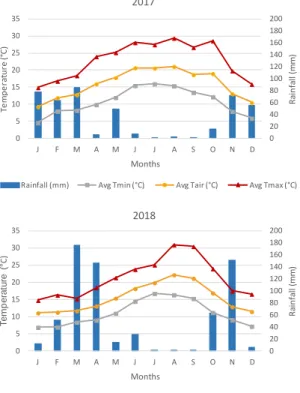
Given the influence of climatic conditions on grapevine growing, some climate data collected by the INIAV, at Dois Portos, was also presented (Figure 1). The 2017 vintage was characterized by a dry year with a total rainfall of around 435 mm, but with a more homogeneous trend compared to the year 2018, in which heavy rainfall events were concentrated in the period between February and April and then occuring between October and November with a total rainfall of about 650 mm. 0 20 40 60 80 100 120 140 160 180 200 0 5 10 15 20 25 30 35 J F M A M J J A S O N D R ain fa ll (m m ) Te m p e ra tu re (° C) Months 2017
Rainfall (mm) Avg Tmin (°C) Avg Tair (°C) Avg Tmax (°C)
0 20 40 60 80 100 120 140 160 180 200 0 5 10 15 20 25 30 35 J F M A M J J A S O N D R ain fa ll (m m ) T e m p e ra tu re ( °C) Months 2018
Rainfall (mm) Avg Tmin (°C) Avg Tair (°C) Avg Tmax (°C)
Figure 1. Temperature and rainfall 2017-2018 at Dois Portos.
Rainfall: rainfall; Avg Tmin: average minimum temperature; Avg Tair: average air temperature; Avg Tmax: average maximum
temperature.
Temperatura e precipitação em 2017 e 2018 em Dois Portos. Rainfall: precipitação; Avg Tmin: média da temperatura mínima;
Avg Tair: temperatura média do ar; Avg Tmax: média da temperatura máxima.
It is interesting, as can be seen in Figure 1, that the period of maturation of the grapes between July and September in the year 2017 was cooler and rainier than the year 2018.
Reagents
Dichloromethane and anhydrous sodium sulphate, both of analytical grade, were purchased from Merck (Darmstadt, Germany). Dichloromethane was bidistilled before use.
Musts and wine analyses
The pH, total acidity, soluble solids and potential alcoholic strength were determined in the musts according to the official methods (OIV, 2014). In the wines, the following chemical analyses were performed: pH, total acidity, volatile acidity, density, free sulphur dioxide, total sulphur dioxide and reducing substances (OIV, 2014). All the analyses were performed in duplicate.
Wine volatile compounds analysis
The extraction of volatiles followed the method proposed by Cocito et al. (1995) using the conditions described by Botelho (2008). A volume of 50 mL of each wine was added of 400 L of 2-octanol (internal standard, 81.9 mg/L in 50 % ethanol solution). After, the extraction was done by the liquid-liquid ultrasonic technique in discontinuous mode with redistilled dichloromethane, dried on anhydrous sodium sulphate. Then, the sample was concentrated and a volume of about 0.30 mL is recovered with a glass graduated pipette.
The extraction of the compounds was carried out in duplicate and each extract was then stored at -20 °C until the analysis by high-resolution gas-liquid chromatography coupled with a flame ionization detector (GC-FID) and up to high-resolution
gas-liquid chromatography coupled with mass
spectrometer (GC-MS).
Quantification and analysis of volatile compounds by GC-FID
The obtained extracts were analyzed by high-resolution gas-liquid chromatography coupled with a flame ionization detector (GC-FID) and each extract was injected (~0.6 L) in triplicate.
An Agilent Technologies 6890N chromatograph equipped with a flame ionization detector (FID) (260 °C), injector (260 ºC) was used in split mode and with a 30 m x 0.32 mm x 0.25 mm capillary column of polyethylene glycol silica (INNOWax, J&W Scientific Technologies, Agilent, USA). The carrier gas was hydrogen (2.4 mL/min) and the split ratio will be 1:3. The samples were injected (~0.8 L) manually. The thermal gradient program in the chromatograph was: 35 °C (6 min), 3.5 °C /min at 55 °C, 7.5 °C/min at 130 °C, 5 °C/min at 210 °C (30 min).
The quantification was performed with the internal standard method and the results have been expressed as 2-octanol (internal standard).
Identification of compounds by GC-MS
The identification of the compounds was performed on a GC-MS (Finnigan Mat Magnum) equipment. The GC-MS system was equipped with a 30 m x 0.25 mm x 0.25 μm polyethylene glycol silica capillary column (INNOWax from J&W). Conditions of analysis: injector and transfer line at 250 °C; helium gas (12 psi of internal pressure and division ratio of 1:60), 0.2-0.4 L of injection volume. The mass spectrometer worked in electron impact mode at 70 eV, evaluating an m/z range of 40-340 amu. The identification was performed by comparing the mass spectrum with those of the spectra libraries (NIST and WILEY) and when possible, confirmed with the analysis of the standard substances. The temperature program used is similar to that for GC-FID.
The compounds were uniquely identified, by calculating the retention index of Kovats (KI) and the MS fragmentation pattern with those of reference compounds or with mass spectra in the NIST and Wiley libraries. The Kovats retention indices (RI) of compounds were calculated by linear interpolation (Philips, 1989) after injecting a sample with a homologous series of alkanes (C9-C30).
Sensory analysis
The wine tests were carried out in the INIAV tasting room, in Dois Portos, with individual workstations, equipped with lights, sinks, with white surfaces as required by the ISO 8589 standard. The test tulip glasses were used as required by the ISO 3591 standard, with a volume of wine per sample of approximately 50 mL.
In the sensory sessions, which were made in the morning (11 a.m.), the samples were provided at temperature of 14 ºC ± 1 ºC. It was supplied water to the tasters for rinsing their mouth between samples. The descriptive sensory analysis of wines was carried out by a trained jury composed eight of judges. All the judges were trained in accordance to the international standards (ISO 8586) including the detection and identification of odor and tastes, and also the use of scales. The training sessions comprised of the assessment of several flavour standards (apple extract, banana extract, strawberry extract, lemon extract, rock-rose extract, straw extract, nuts extract, raisin extract, 1-hexanol, cis-3-hexenol, ethanol, ethyl acetate, ethyl butyrate, 2-phenylethanol, acetaldehyde, geraniol, isoamyl acetate, linalool, vanillin, glucose, fructose, tartaric
acid, quinine sulphate, acetic acid, lactic acid, citric acid, malic acid, and glycerol), the finding of odor defects in spiked wines, as well as the evaluation of several samples of commercial white wines.
The evaluation of the wines was focused on the colour, aroma and taste and the tasters were asked to evaluate the intensity of several attributes, with a structured scale from 0 to 10.
The evaluation form was made starting from the work of Odello et al. (2007) and the descriptors used were chosen starting from the works of Vilanova et al. (2008, 2013). The score sheet is composed of attributes on colour, aroma and flavour. Intensity, yellow, green and limpidity were evaluated for the visual attributes. The aroma attributes contained aroma intensity, floral, white fruit, nuts, tropical fruits, citric, herbaceous, terpenic-muscat and persistence. The gustatory attributes included sweet, sour, bitter, softness, balance, alcohol and body.
The wine samples were presented anonymously to the tasters with a 3-digit identification code for each sample following a balanced order with the purpose of eliminate first-order carryover effects (MacFie et al., 1989).
Statistical analysis
Multivariate analysis of data (Abdi and Williams, 2010) was applied to the sensory and volatile results in order to extract information from the data matrix. Principal component analysis (PCA) and hierarchal clustering analysis (HCA) were performed by using Statistica software (Version7).
RESULTS AND DISCUSSION Chemical analysis of musts and wines
The chemical composition of the musts and corresponding wines from different varieties of the two vintages are presented in Tables I and II.
Table I
Chemical composition (average values and standard deviation) of musts from the two vintages (2017 and 2018) Composição química (valores médios e desvios padrão) dos mostos das duas vindimas (2017 e 2018)
Variety Vintage Soluble solids (%m/m) Potential alcohol strength (% v/v)* pH Total acidity (g tartaric acid/L) ‘Galego Dourado’ 2017 21.6 ± 0.2 12.4 ± 0.1 3.30 ± 0.02 6.4 ± 0.1 2018 21.8 ± 0.1 12.6 ± 0.2 3.13 ± 0.01 6.8 ± 0.2 ‘Malvasia’ 2017 20.6 ± 0.2 11.7 ± 0.1 3.01 ± 0.01 7.4 ± 0.2 2018 20.5 ± 0.2 11.7 ± 0.1 3.21 ± 0.01 7.5 ± 0.1 ‘Verdelho’ 2017 24.0 ± 0.1 14.0 ± 0.2 3.21 ± 0.02 6.7 ± 0.1 2018 21.6 ± 0.1 12.4 ± 0.1 3.06 ± 0.01 6.4 ± 0.1 * Potential alcoholic strength was calculated from the soluble solids results.
Table II
Chemical composition of wines (average values and standard deviation) of different grapevine varieties from the two vintages (2017 and 2018)
Composição química dos vinhos (valores médios e desvios-padrão) de diferentes castas nas duas vindimas (2017 e 2018)
Wine samples Vintage TAV
(% v/v) Total acidity (g tartaric acid/L) Volatile acidity (g acetic acid/L) pH Free sulfur dioxide (mg/L) Reducing substances (g/L) ‘Galego Dourado’ 2017 13.7 ± 0.1 4.2 ± 0.1 0.66 ± 0.02 3.49 ± 0.1 13 ± 0.1 1.8 ± 0.1 2018 13.3 ± 0.2 6.0 ± 0.1 0.28 ± 0.01 3.37 ± 0.1 38 ± 0.5 1.5 ± 0.2 ‘Malvasia’ 2017 12.9 ± 0.2 5.7 ± 0.2 0.48 ± 0.02 3.13 ± 0.1 13 ± 0.1 2.8 ± 0.1 2018 12.7 ± 0.1 7.9 ± 0.1 0.23 ± 0.02 3.03 ± 0.1 41 ± 0.2 1.4 ± 0.1 Verdelho 2017 15.1 ± 0.1 6.1 ± 0.2 0.29 ± 0.01 3.20 ± 0.2 22 ± 0.1 6.9 ± 0.2 2018 13.3 ± 0.1 7.8 ± 0.1 0.40 ± 0.01 3.09 ± 0.2 34 ± 0.5 1.0 ± 0.1
Analyzing the results of the musts (Table I), all the samples showed potential alcoholic strength ranging between 11.7% v/v and 14% v/v. The total acidity in these varieties was very high, showing values between 6.5 and 7.5, as well as the pH ranging from 3.01 until 3.30.
The results of the chemical analysis of wines, obtained before the sensory analysis session (Table II), showed the wines from the 2017 vintage had a tendency to present a higher residual sugar content, estimated by the reducing substances, than those from the 2018 vintage. Also, the wines from the 2017 vintage tended to present higher alcohol content than the corresponding wines produced in 2018, but all presented optimal acidity values in spite of low values in the vintage of 2017.
Sensory profile
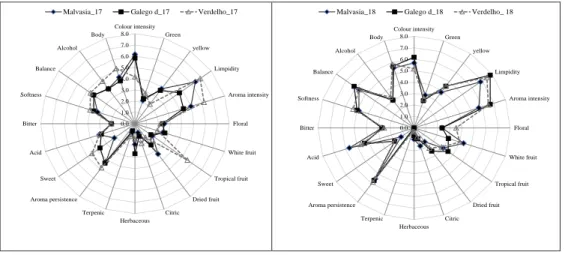
The wine tasting was done with a panel of expert tasters as described previously. The average results from two vintages are shown in Figure 2, and the wines had a tendency to present different characteristics at each vintage. ‘Malvasia’ wine, from the 2017 vintage, was characterized by the intensity of colour, with light floral and white fruit notes; notes of dried fruit prevailed with aromatic persistence and harmony. In the 2018 vintage, ‘Malvasia’ wine had a sensory profile with a prevalence of white fruit notes, light notes of dried fruit and citric aromas, and also with high aroma persistence, body and acidity of the wine.
Figure 2. Averaged sensory analysis results of descriptive evaluation of wines in the two vintages.
Média dos resultados sensoriais da análise descritiva realizada aos vinhos nas duas vindimas.
The ‘Galego Dourado’ wine from 2017 was characterized by a high intensity of colour and aroma, with low floral notes, white fruit, dried fruit and citric aromas with a presence of an herbaceous note. Moreover, the wine has a medium balance and persistence. The ‘Galego Dourado’ wine produced in the 2018 vintage was characterized by high intensity and persistence of aroma, with notes of white fruit, dried fruit and tropical fruit notes. The wine also presented high acidity and balance.
‘Verdelho’ wine from 2017 showed a high aroma intensity and persistence with light floral notes and high intensity of tropical fruit attribute, and medium values for body and balance attributes. In 2018, the ‘Verdelho’ wine also showed high aroma intensity, with light floral notes, dried fruit and predominantly
white fruit notes. Moreover, it showed a trend for a greater acidity and balance than the previous year. The data of the sensory results were submitted to the hierarchical cluster analysis (HCA) and to the principal components analysis (PCA) using the results for the 20 descriptors of each wine. The matrix for the analysis was composed of the average intensity of the judges, for each descriptor and for each wine.
The PCA analysis shows a cumulative variance of 81.8% for the first two components with 54.2 % to component 1 and 27.6 % to component 2 as showed in Figure 3. The variables that showed the greatest relevance in component 1 were bitter, persistence, balance, softness, body, acid, white fruit, herbaceous, terpenic, alcohol and sweet. For component 2 the variables with more importance were tropical fruit, citric aroma, dried fruit and colour intensity.
0.0 1.0 2.0 3.0 4.0 5.0 6.0 7.0 8.0 Colour intensity Green yellow Limpidity Aroma intensity Floral White fruit Tropical fruit Dried fruit Citric Herbaceous Terpenic Aroma persistence Sweet Acid Bitter Softness Balance Alcohol Body
Malvasia_17 Galego d_17 Verdelho_17
0.0 1.0 2.0 3.0 4.0 5.0 6.0 7.0 8.0 Colour intensity Green yellow Limpidity Aroma intensity Floral White fruit Tropical fruit Dried fruit Citric Herbaceous Terpenic Aroma persistence Sweet Acid Bitter Softness Balance Alcohol Body
From Figure 3, it is clear that there was a separation of the wines from the two years. Actually, all the wines from 2018 were positioned on the positive side of the component 1, well related with attributes such as bitter, persistence, balance, softness, body, acid and white fruit. The wines produced in 2017 were located on the negative side of component 1, showing
a separation of the ‘Verdelho’ wine from the other two wine varieties, across component 2, closer to the sensory attributes of tropical and citric aromas. On the contrary, ‘Galego Dourado’ and ‘Malvasia’ wines were more related to herbaceous and dried fruit attributes.
Figure 3. Projection of wine samples of three grapevine varieties (vintage 2017 and vintage 2018) and sensorial descriptors in the plane
defined by the two components of the standardized PCA.
Projeção das amostras de vinho das três castas (vindima 2017 e 2018) e dos atributos da análise sensorial no plano definido pelos dois componentes da PCA padronizada.
This differentiation was also highlighted by the HCA analysis. The dendrogram of wines (Figure 4) exhibits the wine clustering based on the vintages but in case of 2017 vintage it was verified the separation of ‘Verdelho’ wine.
Figure 4. Dendrogram obtained using sensory data results of
wines.
Dendrograma obtido com os resultados da análise sensorial dos vinhos.
A second PCA (data not shown) was done only with aroma attributes, showing a similar distribution of the samples across the two components, which explained 75% of variation.
Volatile compounds in wines
The chromatographic analysis (GC-FID and GC-MS) allowed to detect several compounds, and thirty nine compounds were identified (Figure 5) and quantified (Table III). Figure 5 shows a chromatogram of the ‘Malvasia’ 2017 wine sample, which is representative for all the varieties, since in general all the varieties presented a similar chromatographic profile. The concentrations of the various compounds had tendency to present differences in the studied wines. The quantitative data of volatile compounds found in these mono-varietal wines are shown in the Table III. In addition, the code assigned to each identified compound, the Kovats index and the sensory attribute and detection sensory threshold from the literature were also shown.
Intensity of colour Green . Yellow. Limpidity Intensity aroma Floral White Fruit Tropical Fruit Dried Fruit Citric Aroma Herbaceous Terpenic/Muscat Persistence Sweet Acid Bitter Softness Balance Alcohol Body Malvasia_17 Galego d_17 Verdelho_17 Verdelho18 Malvasia_18 Galego d_18 -1.2 -1.0 -0.8 -0.6 -0.4 -0.2 0.0 0.2 0.4 0.6 0.8 1.0 1.2 Comp. 1 (54.2%) -1.2 -1.0 -0.8 -0.6 -0.4 -0.2 0.0 0.2 0.4 0.6 0.8 1.0 1.2 C o m p . 2 ( 2 7 .6 % ) 1.5 2.0 2.5 3.0 3.5 4.0 4.5 5.0 5.5 6.0 Euclidean distance Verdelho_17 Verdelho_18 Galego d_18 Malvasia_18 Galego d_17 Malvasia_17
56
Figure 5. Chromatogram of dichloromethane extract from wine ‘Malvasia’. Peak identification in Table III.
Cromatograma de um extrato de diclorometano, obtido a partir de um vinho Malvasia. Identificação dos picos na Tabela III.
Table III
Volatile compounds concentrations (average values and standard deviation) in the wines from the three grapevine varieties (mg of 2-octanol/L) Teores de compostos voláteis (valores médios e desvios-padrão) nos vinhos das três castas (mg de 2-octanol/L)
Peak
code Compounds
Odour descriptor
(threshold; mg/L) KI
2017 vintage 2018 vintage
‘Malvasia’ ‘Verdelho’ ‘Galego dourado’ ‘Malvasia’ ‘Verdelho’ ‘Galego Doiurado’ Alcohols
B 1-Propanol ripe fruit, alcohol (830)a 1034 1.413 ± 1.046 2.924 ± 0.838 1.239 ± 0.752 2.606 ± 0.333 2.272 ± 1.380 3.821 ± 0.392 C Isobutyl alcohol oily, bitter, green (40)a
1094 5.538 ± 3.634 6.467 ± 1.119 2.668 ± 1.377 7.780 ± 0.972 7.589 ± 2.136 9.449 ± 0.700 E 1-Butanol medicine, fruitc
1146 0.093 ± 0.052 0.342 ± 0.038 0.091 ± 0.013 0.207 ± 0.017 0.202 ± 0.034 0.294 ± 0.006 F Isoamyl alcohols burnt, alcohol, fusel
a,d
(30)a 1215 96.430 ± 39.019 107.910 ± 8.563 46.035 ± 6.510 167.628 ± 3.123 151.004 ± 17.082 168.256 ± 0.706 K 1-Hexanol flower, green, cut grass
(8)f 1358 1.451 ± 0.202 0.876 ± 0.033 0.779 ± 0.110 1.614 ± 0.033 1.519 ± 0.030 1.583 ± 0.015 M 3-Ethoxy-1-propanol ripe pear (0.1)g
1376 0.582 ± 0.019 1.525 ± 0.048 0.528 ± 0.074 0.525 ± 0.055 0.392 ± 0.087 0.659 ± 0.080
N cis-3-Hexenol cutted grass (0.4)f 1386 nd nd 0.194 ± 0.027 0.013 ± 0.002 0.073 ± 0.018 0.687 ± 0.010
S 2,3-Butanediol caramel, sweetc (0.035)k 1540 7.212 ± 0.528 21.630 ± 1.203 7.872 ± 1.113 4.779 ± 1.256 6.385 ± 0.622 6.606 ± 0.746 AJ 3-Methylthiopropanol cooked vegetable (1)f 1715 0.519 ± 0.067 0.162 ± 0.001 0.259 ± 0.036 0.606 ± 0.028 0.503 ± 0.078 0.640 ± 0.080 AQ Benzyl alcohol fruity blackberry (0.9)o 1876 0.391 ± 0.051 0.277 ± 0.012 0.191 ± 0.027 0.143 ± 0.010 0.122 ± 0.028 0.200 ± 0.014 AR Phenylethyl alcohol floral, roses (10) f
1909 42.772 ± 6.410 16.634 ± 0.10 16.683 ± 2.359 47.700 ± 2.229 41.252 ± 4.644 29.163 ± 5.065 min 5 10 15 20 25 30 35 40 45 pA 20 40 60 80 100 120 140 FID1 A, (CASTAS18\SIMONE18\MALVA-A2.D) B C D E F G H L K M PI N O P R S T V Y Z AA ABAE AF AH AJ AN AO AQ AR AS AW AX BB BD BH BM BQ BS CD
57 Table III (continued) Peak code Compounds Odour descriptor (threshold; mg/L) KI 2017 vintage 2018 vintage
‘Malvasia’ ‘Verdelho’ ‘Galego dourado’ ‘Malvasia’ ‘Verdelho’ ‘Galego Doiurado’ Esters
D Isoamyl acetate banana (0.03)b 1117 0.185 ± 0.097 4.862 ± 0.234 0.345 ± 0.487 1.795 ± 0.066 1.498 ± 0.153 2.520 ± 0.030 G Ethyl hexanoate green apple (0.014)a 1240 0.502 ± 0.128 1.428 ± 0.037 0.293 ± 0.041 1.075 ± 0.078 0.817 ± 0.126 0.998 ± 0.022 L Ethyl lactate strawberry, acid, medicine
(150)d,e 1350 32.908 ± 6.573 2.453 ± 0.005 9.810 ± 1.387 4.141 ± 0.025 3.456 ± 0.032 2.330 ± 0.040 O Ethyl octanoate fruity, sweet (0.005)a 1437 0.969 ± 0.056 1.814 ± 0.069 0.566 ± 0.079 1.472 ± 0.080 1.243 ± 0.123 1.618 ± 0.024 R 3-Hydroxy ethyl butanoate frutado (1.2)i 1518 0.081 ± 0.009 0.159 ± 0.003 0.070 ± 0.010 0.112 ± 0.009 0.088 ± 0.011 0.138 ± 0.002
AB Ethyl decanoate sweet/fruity (0.2)b 1638 0.502 ± 0.054 0.052 ± 0.007 0.105 ± 0.014 nd nd nd
AF Ethyl succinate ripe melon (1000)g 1680 0.693 ± 0.075 0.634 ± 0.010 0.242 ± 0.034 0.427 ± 0.045 0.544 ± 0.060 0.297 ± 0.007 AN 2-Phenylethyl acetate floral (0.25)f 1815 0.129 ± 0.020 0.448 ± 0.009 0.104 ± 0.015 0.288 ± 0.038 0.234 ± 0.057 0.250 ± 0.004 AW Diethyl malate over-ripe, peach, prune
(760)p 2042 0.222 ± 0.081 1.121 ± 0.015 0.097 ± 0.014 0.760 ± 0.044 0.854 ± 0.022 0.381 ± 0.023 BM Monomethyl succinate caramel, coffee (1000)s
2383 19.743 ± 6.290 12.887 ± 0.322 7.379 ± 1.043 9.884 ± 1.711 12.819 ± 0.277 6.375 ± 0.419 Terpenes
T Linalool floral (0.01)f 1551 0.057 ± 0.004 nd nd 0.013 ± 0.002 nd nd
Y Hotrienol floral, citrus (0.015)m
1613 nd nd nd 0.005 ± 0.007 0.064 ± 0.001 nd AH α-Terpineol lilac (0.25)m 1695 0.055 ± 0.009 nd nd 0.000 ± 0.000 nd nd AS 2,6-Dimethyl-3,7-octadiene-2,6-diol - 1948 0.033 ± 0.003 nd nd 0.025 ± 0.004 nd nd Cetones H Acetoin butter/cream (150)e 1283 0.841 ± 0.316 1.349 ± 0.070 0.654 ± 0.093 nd nd nd Lactones
Z Butyrolactone caramel, sweetc,k (0.035)k 1625 4.668 ± 0.179 4.637 ± 0.132 1.535 ± 0.217 3.907 ± 0.553 4.766 ± 0.504 3.049 ± 0.190 BD γ-Undecalactone spice, lactone-liker 2225 0.408 ± 0.103 0.380 ± 0.014 0.165 ± 0.023 0.439 ± 0.072 0.382 ± 0.081 0.284 ± 0.015
Acids
P Acetic acid vinegar (26)h 1465 6.573 ± 2.250 6.107 ± 0.451 5.125 ± 0.725 3.910 ± 1.383 5.909 ± 0.866 4.818 ± 0.335 V Isobutanoic acid rancid, butter, cheese
(2.3)a 1572 0.644 ± 0.019 0.273 ± 0.011 0.204 ± 0.021 0.307 ± 0.049 0.386 ± 0.041 0.297 ± 0.010 AA Butanoic acid rancid, cheese, sweat
(0.173) a 1631 0.615 ± 0.191 0.984 ± 0.048 0.267 ± 0.038 0.479 ± 0.037 0.393 ± 0.044 0.462 ± 0.030 AE Isovaleric acid sweet, acid, rancid
(0.033)b 1672 0.592 ± 0.017 0.309 ± 0.005 0.273 ± 0.038 0.626 ± 0.020 0.487 ± 0.236 0.641 ± 0.030 AO Hexanoic acid sweat (0.42)a
1846 2.934 ± 0.347 5.589 ± 0.181 1.745 ± 0.246 4.331 ± 0.405 3.357 ± 0.547 3.942 ± 0.119 AX Octanoic acid sweat, cheese a,k (10)a 2060 5.972 ± 1.083 8.266 ± 0.108 3.795 ± 0.537 8.602 ± 0.872 6.490 ± 1.380 8.554 ± 0.271 BH Decanoic acid fat, rancid a,k (6)a 2273 2.679 ± 0.675 2.477 ± 0.086 1.575 ± 0.222 2.537 ± 0.235 2.051 ± 0.458 2.896 ± 0.071
BQ Benzoic acid chemical (1)a 2431 0.072 ± 0.017 0.061 ± 0.002 0.031 ± 0.004 0.010 ± 0.001 0.021 ± 0.004 nd
BS Dodecanoic acid dry, metallic, laurel oil
(1)t 2485 0.174 ± 0.058 0.119 ± 0.011 0.104 ± 0.015 0.132 ± 0.033 0.069 ± 0.035 0.148 ± 0.010
Phenols
BB Eugenol clove, cinnamon(0.005) 2161 0.140 ± 0.033 0.168 ± 0.021 0.061 ± 0.009 0.145 ± 0.005 0.131 ± 0.022 0.050 ± 0.021
CD Tyrosol - 2995 2.691 ± 1.190 1.335 ± 0.133 1.774 ± 0.251 1.790 ± 0.010 1.836 ± 0.321 1.530 ± 0.015
nd – not detected. a) Etiévant (1991); b) Ferreira et al. (2000); c) Acree and Heinric (2004); d) López et al. (2003); e) Bartowsky and Pretorius (2009); f) Guth (1997); g) Mestre et al. (2019); h) Salo et al. (1972); i) Pineau et al. (2009); j) Hongku et al. (2011); k) Sánchez-Palomo et al. (2010); m) Waterhouse et al. (2016); n) Marcon et al.(2019); o) Amores-Arrocha et al. (2018); p) García-Carpintero et al. (2012); q) Moyano et al. (2002); r) López et
The compounds identified were from different chemical families, including 11 alcohols, 10 esters, 9 acids, 4 terpenes, 2 lactones, 2 phenolic compounds and 1 cetone. Most of the volatile compounds identified result from yeast metabolism (Styger et al., 2011) namely the alcohols, esters, acids and acetoin. It was also identified the 1-hexanol and cis-3-hexenol usually formed during the pre-fermentative steps due to enzymatic activities (Cordonnier and Bayonove, 1981). The eugenol, usually related with ageing or fermentation in wood (Herrero et al., 2016), has also been identified by other researchers in the unaged white wines (González-Álvarez et al., 2011). Regarding the lactones, the butyrolactone seems to be formed during the fermentation (Clarke and Bakker, 2004), and the -undecalactone has been reported in aged champagne (Escudero et al., 2000) and in different wines (Ferreira et al., 2004). The tyrosol, also identified by other authors in red wine and white wines (Selli et al., 2004, 2006), is a phenolic compound formed from tyrosine by yeast during fermentation, which seems to play an important role on the white wine mouthfeel (Gawel et al., 2018). Four terpenic alcohols were also identified namely in ‘Malvasia’ wines and in ‘Verdelho’ wine from 2018 vintage. These compounds are normally considered as varietal compounds since they are present in the grapes, and they were used to classify the grape varieties in Muscat varieties in which the concentration of free terpenes is higher than 6 mg/L, non-Muscat, but aromatic varieties, with a concentration around 1-4 mg/L, and neutral varieties, such as ‘Chardonnay’ (Cañas et al., 2018), in which the aromatic profile does not depend on the concentration of free terpenes present (Mateo and Jimenez, 2000). Concerning the low level of free terpenes in all the wines (Table III), it appeared that ‘Malvasia’, ‘Verdelho’ and ‘Galego Dourado’ could be considered as neutral varieties. Given that these compounds are normally associated with floral notes; these results could explain that floral attribute is a variable with a low contribution for variability explanation in the PCA of the sensory results (Figure 3) as well as the low intensity of terpenic attribute of all the wines at Figure 2. Taking into account the volatile amounts in the wines (Table III) and the corresponding sensory thresholds found in the scientific literature, it was expected that the compounds with higher impact in the aroma of these wines would be three esters (isoamyl acetate, ethyl hexanoate and ethyl octanoate), some alcohols (isoamyl alcohols, 3-ethoxy-1-propanol, 2-phenylethyl alcohol and 2,3-butanediol), two acids (isovaleric and hexanoic acid), butyrolactone and eugenol. Additionally, the linalool could have importance in ‘Malvasia’ wine of 2017 and the
hotrienol could impact the aroma of ‘Verdelho’ from 2018 vintage. However, as sensory thresholds are influenced by additive, synergic and antagonistic effects in the wine matrix, further research is needed about the odorant compounds of these wines.
The results in Table III show different contents of various compounds in different wines. For example, ‘Malvasia’ wine from 2017 compared to the sample of wine ‘Malvasia’ from 2018 seems to presented higher concentration of terpene compounds but in both years a terpene alcohol (3,7-dimethyl-1,5-octadien-3,7-diol) was found, which was also identified by Di Stefano (1982) and Liberatore et al. (2010) in white wines. However, it is not possible to assess the significance of these differences taking into account the type of experimental design used in this work.
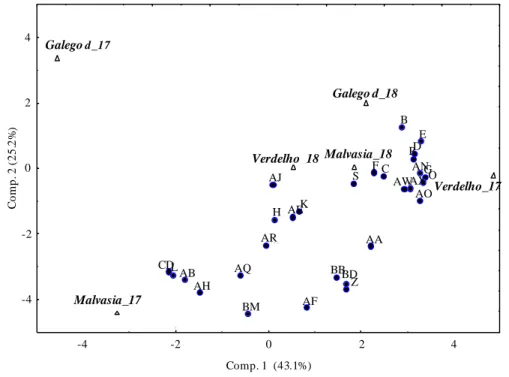
A PCA analysis was performed based on the volatile compounds quantified in the all wine from the three grapevine varieties at the two vintages (Table III) to verify the relevant compounds for both years (Figure 6). A first PCA (data not shown) analysis was performed starting with all compounds of Table III. The analysis indicated that the first two principal components explained only 60.7 % of the total variance among the samples studied. A comparison of scores and loadings for the components allowed to identify the compounds having lower influence for the ranking of different wines. Thus, a second PCA was done after excluding the compounds with a lower contribution for the explained variability, namely AS, BH, BQ, BS, M, N, P, T, V and Y. The analysis of the main components showed 68.6 % of cumulative variance for the two first components: 43.1 % in component 1 (PC1) and 25.2 % in component 2 (PC2). The plot of the wine samples and the volatile compounds, in the planed defined by the components in the PCA (Figure 6), exhibits results in accordance with PCA of sensory results. Indeed, the wines produced in 2018 were much closer, while the wines of the same varieties produced in 2017 were well separated. As noted for the sensory results, it seems that the vintage imparted more dissimilarity than the grape variety, probably due to the strong differences in the climatic conditions verified in the two vintages. The variables with high loadings for the positive side of component 1 were mainly esters: 3-hydrox ethyl
butanoate (R), isoamyl acetate (D),
2-phenylethylacetate (AN), ethyl octanoate (O), ethyl hexanoate (G) diethylmalate (AW) and also alcohols (isobutanol-C, 1-propanol-B, 1-butanol-E) and acids (octanoic acid-AX, hexanoic acid-AO), which seemed well related with wine of ‘Verdelho’ from 2017 vintage. The ‘Malvasia’ wine from 2017 was
located in the opposite side of the component, closer to the tyrosol (CD) and the ethyl lactate (L) compounds. Taking into account the fruity notes of
the majority of the esters (Table III), this may explain the sensory results where the ‘Verdelho’ wine of 2017 were related to citric and tropical fruits.
Figure 6. Projection of wine samples of the three grapevine varieties (vintage 2017 and vintage 2018) and volatile compounds quantified
in the plane defined by the two components of PCA. Compounds identification in the Table III.
Projeção das amostras de vinho das três castas (vindima 2017 e 2018) e dos compostos voláteis quantificados no plano definido pelas duas componentes da PCA. Identificação dos compostos na Tabela III.
Legend - B: 1-Propanol; C: Isobutyl alcohol; D: Isoamyl acetate; E: 1-Butanol; F: Isoamyl alcohols; G: Ethyl hexanoate; H: Acetoin; L: Ethyl lactate; K: 1-Hexanol; O: Ethyl octanoate; P: Acetic acid; R: 3-Hydroxy ethyl butanoate; S: 2,3-Butanediol; Z: Butyrolactone; AA:
Butanoic acid; AB: Ethyl decanoate; AE: Isovaleric acid; AF: Ethyl succinate; AH: α-Terpineol; AJ: 3-Methylthiopropanol; AN: 2-Phenylethyl acetate; AO: Hexanoic acid; AQ: Benzyl alcohol; AR: 2-Phenylethyl Alcohol; AW: Diethyl malate; AX: Octanoic acid; BB:
Eugenol; BD: γ-Undecalactone; BM: Monomethyl succinate; CD: Tyrosol.
In the component 2, there are several compounds with high loadings in the negative side, namely -terpineol (AH), lactones (butyrolactone-Z, -undecalactone-BD), esters (monoBM, ethylsuccinate-AF, ethyl decanoate-AB, ethyl lactate-L) and phenolic compounds (benzyl alcohol-AQ, tyrosol-CD, eugenol-BB). Only the ‘Malvasia’ wine from the 2017 vintage seemed to be related to high amounts of these compounds. Taking into account the sweet notes of several of those compounds, this may explain the relation of this wine with dried fruit attribute in the sensory results. The ‘Galego Dourado’ wine produced in 2017 is located in the opposite side of the component 2. All the wine samples of vintage 2018 presented an intermediate location, but in the positive side of PC1 and PC2, indicating intermediate amounts of compounds with positive loadings in the
component 1 and low amounts in the compounds with high loading in the negative side of component 2. The multidimensional analysis of sensory and volatile results suggested a similar discrimination of the white wines samples of the three grapevines varieties ‘Malvasia’, ‘Galego Dourado’ and ‘Verdelho’. The samples separation in the PCA plots appeared more related to the vintage year than to the grapevine variety. Therefore, further research is needed to re-evaluate these varietal wines and to study the variety and the year as factors that may impart significant differences on their volatile compounds and sensory profile. Indeed, other researchers also found a significant effect of the vintage in several volatile compounds in white and red wines (Selli et al., 2004; Vilanova et al., 2013, Sánchez-Palomo et al., 2019) and also in white must (Rocha et al., 2010).
Malvasia_17 Verdelho_17 Galegod_17 Malvasia_18 Verdelho_18 Galego d_18 -4 -2 0 2 4 Comp. 1 (43.1%) -4 -2 0 2 4 C o m p . 2 ( 2 5 .2 %) O B C D E F G H L K R S Z AA AB AE AF AH AJ AN AO AQ AR AWAX BBBD BM CD
CONCLUSIONS
All the wines produced with the different grapevines – ‘Malvasia’, ‘Verdelho’ and ‘Galego Dourado’ - showed a balanced sensory profile with medium white fruity, tropical fruit and dried fruit notes. The wines also presented high aroma intensity and persistence and medium intensity in the body and balance attributes. The sensory attributes that presented high contribution to the explained variability of the wine samples were bitter, persistence, balance, softness, body, acid, white fruit, herbaceous, terpenic, alcohol, sweet, tropical fruit, citric aroma, dried fruit and colour intensity.
The multidimensional analysis of the sensory properties and volatile compounds results showed a similar discrimination of the wine samples. In both analyses, the separation of the wines samples in the PCA plots seemed more related to the vintage than to the grapevine variety.
Regarding the volatile composition, the volatile compounds with higher contribution to the samples variability were esters (3-hydroxiethyl butanoate, isoamyl acetate, 2-phenylethylacetate, ethyl octanoate, ethyl hexanoate, diethylmalate, monoethylsuccinate, ethylsuccinate, ethyl decanoate, ethyl lactate), alcohols (isobutanol, propanol, 1-butanol), acids (octanoic acid, hexanoic acid), lactones (butyrolactone, -undecalactone), phenolic compounds (benzyl alcohol, tyrosol, eugenol) and a terpenic compound, the -terpineol.
ACKNOWLEDGMENTS
The authors would like to thank the technical support of Otília Cerveira in the volatilecompounds’analysis, of Amélia Soares and Deolinda Mota in general analysis of musts and wines. The authors also thank the wine tasters of INIAV for their persistence and commitment and to Ricardo Egipto for it’s the help and availability in the collecting of climatic data. The authors would like to express their gratitude to Isabele Lavado for the English revision.
The research units were funded by National Funds through FCT - Foundation for Science and Technology: Centro de Estudos Florestais (UIDB/00239/2020); MED - Foundation for Science and Technology (UIDB/05183/2020).
REFERENCES
Abdi H., Williams L.J., 2010. Principal component analysis. Wiley Interdisciplinary Reviews: Computational Statistics, 2, 433-459.
Acree T., Heinrich A., 2004. Flavornet and human odor space, Gas chromatography - olfactometry (GCO) of natural products. Sponsored by DATU Inc. http://www.flavornet.org (accessed on 11.03.2020)
Amores-Arrocha A., Roldán A., Jiménez-Cantizano A., Caro I., Palacios V., 2018. Evaluation of the use of multiflora bee pollen on the volatile compounds and sensorial profile of Palomino fino and Riesling white young wines. Food Res. Int., 105, 197-209. Alifragkis A., Cunha J., Pereira J., Fevereiro P., Eiras Dias J.E.J. 2015. Identity, synonymies and homonynies of minor grapevine cultivars maintained in the portuguese ampelographic collection. Ciência Téc. Vitiv., 30, 43-52.
Bartowsky E.J., Pretorius I.S., 2009. Microbial formation and modification of flavor and off-flavor compounds in wine. In: Biology of microorganisms on grapes, in must and in wine. 209-231. König H., Unden G., Fröhlich J. (Eds), Springer-Verlag, Berlin Heidelberg.
Bayonove C.L., Baumes R.L., Crouzet J., Günata Y.Z., 1998. Arômes. In: Oenologie - Fondements Scientifiques et Technologiques. 163–235, Flanzy C. (Ed.), Lavoisier Tec & Doc, Paris.
Botelho G. 2008. Characterisation of the aroma components of clonal grapes and wines from Aragonez and Trincadeira Vitis vinifera L. cultivars. 169 p. PhD Thesis, Universidade de Trás-os-Montes e Alto Douro.
Câmara J.S., Herbert P., Marques J.C., Alves M.A., 2004. Varietal flavour compounds of four grape varieties producing Madeira wines. Anal. Chim. Acta, 513, 203–207.
Cañas P.M.I., Morales A.M., Manso J.M.H., Romero E.G., Viñas M.A.G., Palomo E.S., 2018. Chemical and sensory characterization of the aroma of ‘Chardonnay’ musts fermented with different nitrogen sources. Ciência Téc. Vitiv., 33, 116-124.
Clarke R., J. Bakker J., 2004. Volatile components. In: Wine Flavour Chemistry. 120-188. Clarke R., J. Bakker (eds), J. Blackwell Publishing Ltd, England.
Cocito C., Gaetano G., Delfini C., 1995. Rapid extraction of aroma compounds in must and wine by means of ultrasound. Food Chem.,
52, 311-320.
Cordonnier R., Bayonove C., 1979. Les composantes variétales et préfermentaires de l’arôme des vins. R. F. Oenol., 16, 79–90. Cordonnier R., Bayonove C., 1981. Etude de la phase préfermentaire de la vinification: extraction et formation de certains composés de l'arôme; cas des terpenols, des aldehydes et des alcools en C6. J. Intern. Sci. Vigne Vin, 15, 269-286.
Di Stefano R., 1982. L'accoppiamento gás cromatografia-spettrometria di massa nello studio dei composti volatili delle uve e dei vini. Vini d'Italia, 24, 3-14.
Eiras-Dias J.E., Cunha J., Brazão J., Clímaco P., 2016. Promover e valorizar as castas minoritárias: O exemplo da casta Malvasia de Colares. Vida Rural, 1818, 36-38.
Eiras-Dias J.E.,2003. Status of the Vitis national collection in Portugal. In: Report of a Working Group on Vitis. 93-94. First Meeting, 12-14 June 2003, Palić, Serbia and Montenegro
Escudero A., Charpentier M., Etievant P., 2000. Characterization of aged champagne wine aroma by GC-O and descriptive profile analyses. Sci. Aliments, 20, 331-346.
Etiévant P., 1991. Wine. In: Volatile compounds in food and beverages. 483-545. Maarse H. (ed.), Marcell Dekker Inc., New York.
Ferreira D.M.L., 2011. Pesquisa de compostos voláteis de enxofre varietais em vinhos brancos elementares de castas Portuguesas. Master Thesis. 74 p. Instituto Superior de Agronomia/Universidade Técnica de Lisboa e Faculdade de Ciências/Universidade do Porto. Ferreira V., Jarauta I., Ortega L., Cacho J., 2004. Simple strategy for the optimization of solid-phase extraction procedures through the use of solid–liquid distribution coefficients: Application to the determination of aliphatic lactones in wine. J. Chrom. A, 1025, 147-156.
Ferreira V., Lopez R., Cacho J.F., 2000. Quantitative determination of the odorants of young red wines from different grape varieties. J. Sci. Food Agric., 80, 1659–1667.
García-Carpintero E.G., Gómez Gallego M.A., Sánchez-Palomo E., González Viñas M.A., 2012. Impact of alternative technique to ageing using oak chips in alcoholic or in malolactic fermentation on volatile and sensory composition of red wines. Food Chem.,
134, 851-863.
Gaspar A., Caldeira I., Silvestre J., Flores R., Alves S., 2016. Avaliação comparativa de vinhos produzidos a partir das castas brancas Gouveio e Verdelho. In: Livro de actas do 10º Simpósio de Vitivinicultura do Alentejo vol I, 127-135. Évora,
Gawel R., Smith P.A., Cicerale S., Keast R., 2018. The Mouthfeel of White Wine. Crit. Rev. Food Sci. Nutr., 58, 2939-2956 González Álvarez M., González-Barreiro C., Cancho-Grande B., Simal-Gándara J., 2011, Relationships between Godello white wine sensory properties and its aromatic fingerprinting obtained by GC– MS. Food Chem., 129, 890-898.
Guth H., 1997. Identification of character impact odorants of different white wine varieties. J. Agric. Food Chem., 45, 3022-3026.
Herrero P., Sáenz-Navajas M.P., Miguel Avizcuri J., Culleré L., Balda P., Antón E. C., Ferreira V., Escudero A., 2016. Study of Chardonnay and Sauvignon blanc wines from D.O.Ca Rioja (Spain) aged in different French oak wood barrels: Chemical and aroma quality aspects. Food Res. Int., 89, 227-236.
Hongku K., Laohakunjit N., Kerdchoechuen O., 2011. Durian Flavor Extracts and its Volatile Characteristics. Agricultural Sci. J.,
42, 241-244.
ISO 3591, 1977. Sensory analysis - Apparatus -Wine-tasting glass. This standard was last reviewed in 2010.
ISO 8586, 2012 Sensory analysis – General guidelines for the selection, training and monitoring of selected assessors and expert sensory assessors.
ISO 8589,2007. Sensory analysis - General guidance for the design of test rooms This standard has been reviewed and then confirmed in 2017.
IVV- Instituto da Vinha e do Vinho, 2017. Yearbook- Anuário 2017, Ficha Técnica.
Li H., Tao Y.-S., Wang H., Zhang L., 2008. Impact odorants of Chardonnay dry white wine from Changli Counti (China), Eur. Food. Res. Technol., 227, 287-292.
Liberatore M. T., Pati S., Nobile M. A. D., Notte, E., 2010. Aroma quality improvement of Chardonnay white wine by fermentation and ageing in barrique on lees. Food Res. Int., 43, 996–1002. Lichtenthaler H.K., Rohmer M., Schwender J., 1997. Two independent biochemical pathways for isopentenyl diphosphate and isoprenoid biosynthesis in higher plants. Physiol Plant., 101, 643-652.
López R., Ezpeleta E., Sánchez I., Cacho J., Ferreira V., 2004, Analysis of the aroma intensities of volatile compounds released from mild acid hydrolysates of odourless precursors extracted from Tempranillo and Grenache grapes using gas chromatography-olfactometry. Food Chem., 88, 95-103..
López R., Ortín N., Pérez-Trujillo J.P., Cacho J., Ferreira V., 2003. Impact odorants of different young white wines from the Canary Islands, J. Agric. Food Chem., 51, 3419-3425.
Macfie H.J.M., Bratchell N., Greenhoff H., Vallis L.V., 1989. Designs to balance the effects of order of presentation and first order carryover effects in hall tests. J. Sens. Stud., 4, 129–148. McCallum M. J., Lopes-Correia T., Ricardo-da-Silva J., 2019. Chemical evaluation of Carcavelos fortified wine aged in Portuguese (Quercus pyrenaica) and French (Quercus robur) oak barrels at medium and high toast. OENO One, 53, 561-572. Marais J., Pool H.J., 1980. Effect of storage time and temperature on the volatile composition and quality of dry white table wines. Vitis, 19, 151-164.
Marcon Â.R., Schwarz L.V., Dutra S.V., Delamare A.P.L., Gottardi F., Parpinello G.P.; Echeverrigaray S., 2019. Chemical composition and sensory evaluation of wines produced with different Moscato varieties. BIO Web Conf., 12, 02033.
Mateo J.J., Jimenez M., 2000. Monoterpenes in grape juice and wines. J Chrom. A., 881, 557 –567.
Mestre M.V., Maturano Y.P., Gallardo C., Combina M., Mercado L., Toro M.E., Carrau F., Vazquez F., Dellacassa E., 2019. Impact on sensory and aromatic profile of low ethanol Malbec wines fermented by sequential culture of Hanseniaspora uvarum and Saccharomyces cerevisiae native yeasts. Fermentation, 5, 65. Molina A.M., Guadalupe V., Varela C., Swiegers J.H., Pretorius I.S., Agosin E., 2009. Differential synthesis of fermentative aroma compounds of two related commercial wine yeast strains. Food Chem., 117, 189-195.
Morrot G., Brochet, F., 2000. Ce que le nez peut dire. In: La Dégustation. J. Intern. Sci. Vigne Vin, nº Hors Série, 15–18. Moyano L., Zea L., Moreno J., Medina M., 2002. Analytical study of aromatic series in sherry wines subjected to biological aging. J. Agric. Food Chem, 50, 7356–7361.
Odello L., Ugolini A., Violoni M., 2007. Analisi Sensoriale: I test descrittivi. L’Assaggio, 14 Brescia.
OIV, 2014. Compendium of International Methods of Analysis of Wines and Musts (2 vol.). Organisation Internationale de la Vigne et du Vin, Paris.
Oliveira J.M., Maia M.O., Baumes R.L., Bayonove C.L., 2000. Free and bound aromatic components of Loureiro and Alvarinho grape varieties from the Vinhos Verdes region. Viticultural and Enological Sciences, 55, 13–20.
Philips R.J., 1989. Qualitative and quantitative analysis. In: High resolution gas chromatography (3rd edition). 1-11. Hyver K.J., Sandra P. (eds), Hewlett-Packard, Palo Alto.
Pineau B., Barbe J.C., Van Leeuwen C., Dubourdieu D., 2009. Examples of perceptive interactions involved in sSpecific “red-” and “black-berry” aromas in red Wines J. Agric. Food Chem., 57, 3702-3708.
Rapp A., Hastrich H., Engel L., 1976. Gaschromatogaphiche untersuchungen über die aromastoffe von weinbeeren. I. Anreicherung und kapillarchromatographische auftrennung. Vitis,
Rapp A., Mandery H., 1986. Wine aroma. Experientia. 42, 873-874.
Ribéreau-Gayon P., Glories Y., Maujean A., 2006. Handbook of Enology. Volume 2. The Chemistry of wine, stabilization and treatment. II edition. 441 p. John Wiley & Sons, Ltd (Eds), England.
Rocha S.M., Coutinho P., Coelho E., Barros A.S., Delgadillo I., Coimbra M., 2010. Relationships between the varietal volatile composition of the musts and white wine aroma quality. A four year feasibility study. LWT-Food Sci Technol, 43, 10, 1508-1516. Salo P., Nykänen L., Soumalainen H., 1972. Odor thresholds and relative intensities of volatile aroma components in an artificial beverage imitating whisky. J. Food Sci., 37, 394-398.
Sánchez-Palomo E., Delgado J.A., Ferrer M.A., González Viñas M.A., 2019. The aroma of La Mancha Chelva wines: Chemical and sensory characterization. Food Res. Int., 119, 135-142.
Sánchez-Palomo E., García-Carpintero E.G., Gómez Gallego M.A., González Viñas M.A., 2012. The aroma of Rojal red wines from La Mancha Region – Determination of key odorants. In: Gas Chromatography in Plant Science, Wine Technology, Toxicology and Some Specific Applications. 147- 170. Salih B., Çelikbıçak Ö. (Eds). InTechOpen, Rijeka.
SánchezPalomo E., García Carpintero E. G., Alonso-Villegas R., Viñas M.A.G., 2010. Characterization of aroma compounds of Verdejo white wines from the La Mancha region by odour activity values. Flavour Fragr. J., 25, 456-462.
Selli S., Cabaroglu T., Canbas A., Erten H., Nurgel C., Lepoutre J.P., Gunata Z., 2004. Volatile composition of red wine from cv. Kalecik Karasι grown in central Anatolia. Food Chem., 85, 207-213.
Selli S., Canbas A., Cabaroglu T., Erten H., Lepoutre J.-P., Gunata Z., 2006, Effect of skin contact on the free and bound aroma compounds of the white wine of Vitis vinifera L. cv Narince. Food Control, 17, 75-82,
Styger G., Prior B., Bauer F.F., 2011. Wine flavor and aroma. J. Ind. Microbiol. Biotechnol., 38,1145.
Usseglio-Tomasset L., 1983. Influence de la température de conservation sur les caractéristiques physico-chimiques et organoleptiques des vins (vins aromatiques). Bulletin de l'OIV, 623, 19–34.
Vilanova M., Escudero A., Graña M., Cacho J., 2013. Volatile composition and sensory properties of North West Spain white wines. Food Res. Int., 54, 562-568.
Vilanova M., Oliveira J.M., 2012. Application of gas chromatography on the evaluation of grape and wine aroma in Atlantic viticulture (NW Iberian Peninsula). In: Chromatography in Plant Science, Wine Technology, Toxicology and some Specific Applications. 109-146. Salih B. (Ed.), IntechOpen, DOI: 10.5772/31854.
Vilanova M., Siebert T.E., Varela C., Pretorius I.S., Henschke P.A. 2012. Effect of ammonium nitrogen supplementation of grape juice on wine volatiles and non-volatiles composition of the aromatic grape variety Albarino. Food Chem., 133, 124-131.
Vilanova M., Zamuz S., Tardáguila J., Masa A., 2008. Descriptive analysis of wines from Vitis vinifera cv. Albariño. J. Agric. Food Chem., 88, 819-823.
Waterhouse A.L., Sacks G.L., Jeffery D.W., 2016. Understanding Wine Chemistry. 472 p. John Wiley & Sons.