Evidence-based practice in radiology: the radiographer
perspective
Poster No.: B-0823
Congress: ECR 2017
Type: Scientific Paper Authors: C. Costa1
, A. F. Abrantes1, L. P. Ribeiro1, K. B. Azevedo1, R. P. P. Almeida1, O. Lesyuk1, C. A. Silva2; 1Faro/PT, 2Évora/PT
Keywords: Professional issues, Management, Radiographers, CT, Health policy and practice, Audit and standards, Diagnostic procedure, Quality assurance, Education and training, Outcomes
DOI: 10.1594/ecr2017/B-0823
Any information contained in this pdf file is automatically generated from digital material submitted to EPOS by third parties in the form of scientific presentations. References to any names, marks, products, or services of third parties or hypertext links to third-party sites or information are provided solely as a convenience to you and do not in any way constitute or imply ECR's endorsement, sponsorship or recommendation of the third party, information, product or service. ECR is not responsible for the content of these pages and does not make any representations regarding the content or accuracy of material in this file.
As per copyright regulations, any unauthorised use of the material or parts thereof as well as commercial reproduction or multiple distribution by any traditional or electronically based reproduction/publication method ist strictly prohibited.
You agree to defend, indemnify, and hold ECR harmless from and against any and all claims, damages, costs, and expenses, including attorneys' fees, arising from or related to your use of these pages.
Please note: Links to movies, ppt slideshows and any other multimedia files are not available in the pdf version of presentations.
Purpose
Main Goal:
• Analyse the application of the Evidence-Based Practice (EBP) in Radiology by the radiographers' in their daily practice in CT departments.
Specific Objectives:
• Evaluate if the concepts of EBP are applied during the radiographers academic training;
• To measure the degree of comprehension of the EBP concepts in Radiology by the radiographers;
• To determine the means or methods used for the training and updating of the EPB in by the radiographers;
• To identify the conditioning factors for the application of EBP in Radiology; • To verify the correlation between the years of experience of radiographers
and the use of EBP in Computed Tomography.
Methods and materials
This study is included in the exploratory-descriptive type, since it aims to analyze the applicability of knowledge and evidence based radiology by radiographers during their daily work and their academic education.
A self-applied questionnaire made by Abrantes, Silva & Fernandes to assess EBP was addressed to 97 radiographers working in 5 public hospitals. A total of 65 valid questionnaires (including 3 main sections (Section A, Section B and Section C)) with a total of 103 items and a 7 point Likert scale format, ranging from "totally disagree" to "strongly agree" for the content dimension, and from "not important" to "extremely important" for the context dimension.
The collected sample is non-probabilistic and it was divided as follows: Hospital A - 14 questionnaires for a population of 15.
Hospital B - 11 questionnaires in a population of 12. Hospital C- 4 questionnaires in a population of 21. Hospital D - 19 questionnaires in a population of 25. Hospital E- 17 questionnaires in a population of 24.
Data were interpreted and statistically analyzed through descriptive statistics. T-student and ANOVA tests were used for groups' comparison.
Results
Regarding the academic qualifications of the respondents, it was observed that 48 radiographers had a Bachelor degree, corresponding to a percentage of 73.8%. Only 10 radiographers have post-graduate studies (Master's, PhD) corresponding to a percentage of (15.4%).
In terms of professional experience, the average is approximately 10 years, ranging from 1 year to 38 years of experience. Regarding the professional experience in Computed Tomography, the average was approximately 7 years, ranging from 1 year to 22 years of experience.
Internal Instrument Reliability:
Factor 1 (Understanding of the EBP concepts) = Cronbach Alpha of 0.910
Factor 2 (General aspects of EBP development in the radiology department) = Cronbach Alpha of 0.910
Factor 3 (EBP in the Work Context) = Cronbach Alpha of 0.920
Factor 4 (EBP: Training and Updating of Knowledge) = Cronbach Alpha of 0.884 Factor 5 (EBP and Clinical Governance in CT) = Cronbach Alpha of 0.794
Factor 6 (Conditioning Factors for the Application of EBP) = Cronbach Alpha of 0.937 Factor 7 (Direct and/or indirect Eeffects of EBP) = Cronbach Alpha of 0.927
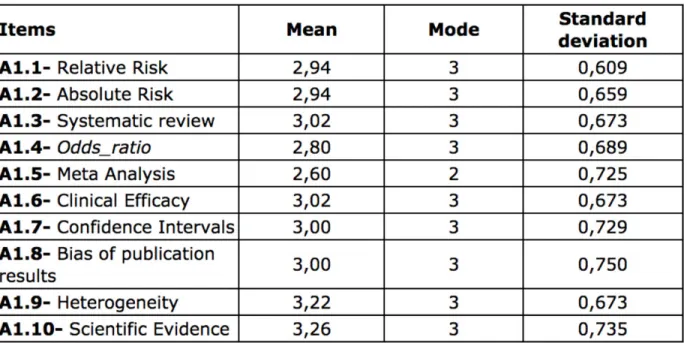
Analysis of the weight and importance of the items of Factor 1 - Understanding of the EBP concepts are available in Fig. 1 on page 4.
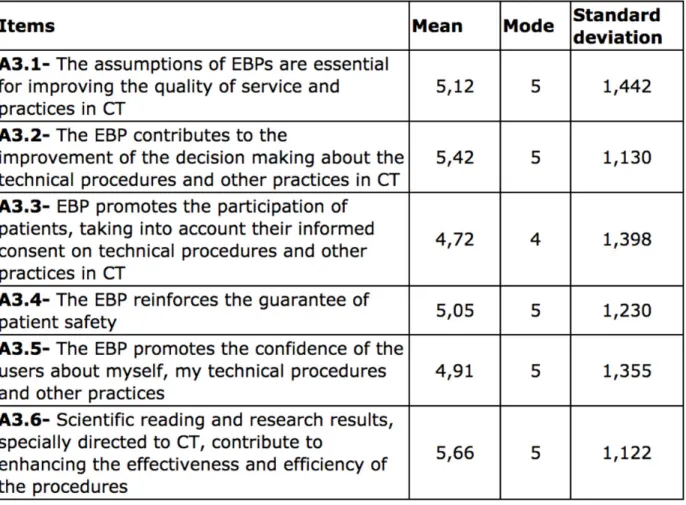
Analysis of the weight and importance of the items of Factor 2 - General aspects of EBP development in the radiology department
are available in Fig. 2 on page 4 .
Othe Main Results:
80% of radiographers applied the principles of EBP in their daily practice. However, the major limiting factors highlighted by the radiographers for the application of EBP were: "Knowledge to transfer the results of literature/scientific articles in their daily practice" (18,5%), "Existence of legislation and regulation about practices" (18,5%), "Knowledge of EBP concepts" (15,4%) and "Professional motivation" (15,4%). Regarding the training and updating of knowledge, the item "Specific training to be able to apply an EBP model in professional activity" had the highest mean score (5,25) and the item "Regular attendance in courses about EBP and research topics" had the lowest (3,49).
Images for this section:
Fig. 1: Results for Factor 1 - Understanding of the EBP concepts
Fig. 2: Results for Factor 2 - General aspects of EBP development in the radiology department
Conclusion
Despite the general application of EBP by radiographers, thanks to regular consultation of CT guidelines and decision-making processes based on literature review and scientific articles, this group of professionals would benefit from further training. Such approach would be well received and help the radiographers to enhance their knowledge and technical skills, which would ultimatly result in an increase of the deparment's quality.
The main conditioning factors for the application of the Evidence Based Practice in Radiology, standing out in descending order were:
1. The knowledge to transfer the results of the literature/scientific articles in daily practice of radiographers;
2. Existence of legislation and regulations on practices; 3. Knowledge about the concepts of EBP;
4. Professional motivation;
5. Knowledge of to analysis of data;
6. Knowledge to elaborate a critical analysis of the literature/scientific articles and the capacity to apply the EBP in examiations for patients with specific clinical cases.
Personal information
Catarina Costa (BSc), Collaborator in the Medical Imaging and Radiotherapy Department, Health School - University of Algarve, Portugal.
António Abrantes (PhD), Professor in the Medical Imaging and Radiotherapy Department, Health School - University of Algarve, Portugal. Researcher in CICS.NOVA (Interdisciplinary Centre of Social Sciences, Faculty of Social Sciences and Humanities) and Member of Studies Center in Healthcare (CES-ESSUALG). E-mail:
Luís Ribeiro (PhD), Professor in the Medical Imaging and Radiotherapy Department, Health School - University of Algarve, Portugal. Researcher in CIDAF - University of Coimbra (Centro de Investigação do Desporto e da Atividade Física) and Member of Studies Center in Healthcare (CES-ESSUALG). Email: [email protected]
Kevin Azevedo (PhD). Professor in the Medical Imaging and Radiotherapy Department, Health School - University of Algarve, Portugal. Radiographer in Centro Hospitalar do Algarve - Faro, Portugal. E-mail: [email protected]
Rui Almeida (MSc), Professor in the Medical Imaging and Radiotherapy Department, Health School - University of Algarve, Portugal. Radiographer in Centro Hospitalar do Algarve - Faro, Portugal. Researcher in CICS.NOVA (Interdisciplinary Centre of Social Sciences, Faculty of Social Sciences and Humanities) and Member of the Studies Center in Healthcare (CES-ESSUALG). Secretary-General of Portuguese Association of Medical Imaging and Radiotherapy (APIMR). E-mail: [email protected]
Rui Almeida (BSc), Professor in the Medical Imaging and Radiotherapy Department, Health School - University of Algarve, Portugal. Radiographer in Centro Hospitalar do Algarve - Portimão, Portugal. E-mail: [email protected]
Carlos da Silva (PhD), Professor in the Sociology Department - University of Évora, Portugal. Researcher in CICS.NOVA (Interdisciplinary Centre of Social Sciences, Faculty of Social Sciences and Humanities). E-mail: [email protected]
Images for this section:
Fig. 3
References
A, Chalazonitis. G, Tsimitselis. J, Tzovara., A, Mariolis. A, Alevizos. E, Pavi. (2007).
Evidence-Based Medicine and Radiology. JBR. Epub 2007.
Agwu, K. Ogbu, S. Okpara, E. (2007). Evaluation of critical thinking application in
medical ultrasound practice among sonographers in south-eastern Nigeria. Radiography:
p.13276-282. Epub 2007 Mar 1.
Ahonen, S. Liikanen, E. (2010). Radiographers' Preconditions for Evidence-Based
Radiography. Radiography. Epub, 2010 Jan.
Akobeng A. (2005). Principles of evidence based medicine. Arch Dis Child. Epub 2005.
ATARP (2004). A Formação em Radiologia, Radioterapia e Medicina Nuclear face à
Implementação do Processo de Bolonha em Portugal. Relatório Final. Recuperado em
Novembro, 2009 em http://www.atarp.pt/pdf/radiologia-relfinal.pdf
Beek, E. Van, Malone. (2007). Evidence-based practice in radiology education: why and
how should we teach it? Radiology. Epub 2007.
Bjorg, Hafslund. Judith, Clare. Birgitte, Graverholt. Monica, Nortvedt. (2008).
Evidence-based radiography. Radiography. Epub 2008.
Blackmore, C. (2004). Critically Assessing the Radiology Literature. AUR: p.11:134-140. Epub 2004.
Brealey, S. Guest, Editorial. (2001). What is evidence based medicine? An emerging
science not fashionable rhetoric. Radiography: 7:7-10. Epub 2001.
Bui, A. Taira, R. Dionisio, J. Aberle, D. El-Saden, S. Kangarloo, H. (2002).
Evidence-based radiology: requirements for electronic access. Acad Radiology. Epub 2002.
Dermot, E. Malone, M. (2006). Evidence-based Practice in Radiology: An Introduction to
Domenico, E. Ide, C. (2003). Enfermagem baseada em evidências: princípios e
aplicabilidades. Rev Latino-am Enfermagem: p. 11(1):115-8. Pub Janeiro, 2003.
Erturk, Sukru. Parra, Silvia. Otero, Hansel. Ros, Pablo. (2006). Evidence-Based
Radiology. Journal of the American College of Radiology/ Vol. 3 No. 7. Epub 2006 July.
Evidence-Based Medicine Working Group. (1992). Evidence-based medicine: a new
approach to teaching the practice of medicine. JAMA 1992.
Evidence-Based Radiology Working Group. (2001). Evidence-based radiology: a new
approach to the practice of radiology. Radiology. Epub 2001.
Hollingworth, W. Jarvik, G. (2007). Technology Assessment in Radiology: Putting the
Evidence in Evidence-based Radiology1. RSNA. Epub 2007.
Sackett, D. Rosenberg, W. Gray, J. Haynes, R. Richardson, W. (1996). Evidence based
medicine: what i tis and what it isn't. BMJ: p..312:71-72. Epub Jan 13, 1996.
Zou K, Fielding J, Ondategui-Parra S. (2004). What is evidence-based medicine? Acad Radiol 2004.