Geography of pledging and application of funds of
crowdfunding platforms and the impact on their online
notoriety
Candidate:
Diogo Onofre Fonseca de Jesus
Advisor:
Professor Juan Andrei Villarroel Fernández
[email protected]
Dissertation submitted in partial fulfillment of requirements for the degree of MSc in Business Administration, at the Universidade Católica Portuguesa, January 2013.
ii
Abstract
Geography of pledging and application of funds of crowdfunding platforms and the impact on their online notoriety
Online crowdfunding is a relatively new way of financing projects and ventures through the internet. This study gives an industry view focusing on the geographic perspective of pledging and application of funds through a model explicating the local and global dimensions. Four possible combinations are then possible: LPLA (Local Pledging/Local Application of funds), LPGA (Local Pledging/Global Application of funds), GPLA (Global Pledging/Local Application of funds) and GPGA (Global Pledging/Global Application of funds). A sample of crowdfunding platforms were analyzed to understand how these characteristics relate with the online notoriety of the platform. The analysis indicates that platforms are experimenting different approaches to the locus of pledging and application of funds and statistical results show that platforms with local characteristics in both pledging and application of funds (LPLA) are outperformed in terms of notoriety by all the remaining combinations.
iii
Preface
Being a student of the major in Innovation and Technology with an interest for entrepreneurship it was my goal to find a subject that could fit in these categories. After studying Innovation Management with Professor Andrei Villarroel whose main research topic is crowdsourcing, I felt that my dissertation should be in a related subject.
After analyzing and discussing some possibilities in the Online Distributed Organization seminar led by Professor Villarroel, crowdfunding was the choice my colleagues and I made. The main reason has to do with my belief that this alternative form of financing is not only changing the logic of launching projects or enterprises but also how society is organized.
Acknowledgements
I am extremely thankful to my supervisor, Professor Andrei Villarroel for his time, valuable insights, mentorship and support through this research. I have learned a lot in the process of working with him and my colleagues in our seminar.
I would also like to thank my dear parents, sister, girlfriend Rita and friend Nuno Bolas for all their support during this time.
Last but not least, a big thank you to Henrique Matos and Sofia Santos, who worked with me in the data collection part and were very important to the definition and characterization of the database. The interactions we all had in the seminar sessions helped develop my ideas further. I thank for this Rui Martins and Maria Joao O’Neil.
4
Table of contents
Abstract ... ii
Preface ...iii
I. Introduction ... 5
II. Literature review ... 7
2.1) Crowdsourcing ... 7
2.2) Crowdfunding ... 7
2.3) Crowdfunding models ... 8
2.4) Geography of financing ... 10
2.5) Geographical distance between entrepreneur and investor ... 12
2.6) Research Hypothesis ... 13
III. Methodology ... 16
3.1) Variables ... 17
3.1.1) Dependent Variable – Notoriety Index (Websites linking in) ... 17
3.1.2) Independent Variables ... 18 3.1.3) Control Variables ... 20 3.2) Method ... 21 3.2.1) Analyzed Dataset ... 21 3.2.2) Statistical analysis ... 22 IV. Results ... 23
4.1) Geographic Pledging / Application of funds and Notoriety ... 28
V. Discussion and conclusions ... 30
5.1) Practical Implications ... 32
5.2) Limitations ... 33
5.3) Future Research ... 34
VI. References ... 36
5
I. Introduction
This dissertation addresses crowdfunding, a form of raising funds, by tapping the general public (or crowd), essentially thought the internet, to fund projects or ventures. The funding is made either in the form of donations or in ex-change for some form of reward. (Lambert & Schwienbacher, 2010)
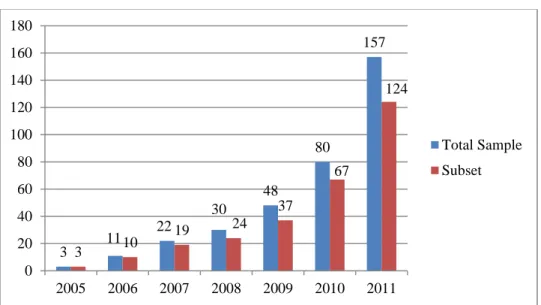
Being a very recent phenomenon, crowdfunding is experiencing a growing interest surrounding it1. Also, the number of platforms created per year keeps increasing year after year. As figure 1 shows, in 2010 and 2011 only, the number of platforms created more than doubled the ones formed in the previous five years.
Figure 1: Number of platforms created by year (2005-2011)
Source: data collected in this study
Contributing to this momentum are, surely, the well-known cases of the 2008 Obama’s campaign election which was able to raise a breaking-record $750 million from 4 million donors2 and more recently Pebble3, an e-paper watch for iPhone and Android that was
1 Appendix 1: Web search interest in the word “crowdfunding” 2
See Final Fundraising Figure: Obama's $750M, ABC NEWS, Dec. 5, 2008, Available at: http://abcnews.go.com/Politics/Vote2008/Story?id=6397572&page=l#.UDUTnaDfKSo 3 11 22 30 48 80 157 3 10 19 24 37 67 124 0 20 40 60 80 100 120 140 160 180 2005 2006 2007 2008 2009 2010 2011 Total Sample Subset
6
funded in more than $10 million from nearly 69.000 people through a platform called Kickstarter.
Contrasting with existent literature (Gaston 1989, Florida & Kenney 1988, Florida & Smith 1993, Lerner 1995, Sorenson & Stuart 2001, Zook, 2002) which predicts that early-stage investors tend invest in companies located near them, Agrawal et al. (2011) showed that crowdfunding seems to eliminate most distance-related economic frictions in early stage financing by studying the platform Sellaband. Nevertheless, different platforms present several characteristics that have impact on the geographic reach of both the pledging and application of funds and no industry study as yet focused on that.
With hundreds of players already operating and many more expected to come4, the online notoriety of a platform seem to be increasingly important to its success.
We proposed a 2 by 2 framework for locus of project and funding to be used on the platform level. This framework is used to answer the following research question:
How does the geography of pledging and application of funds of a crowdfunding platform relate with its online notoriety?
We start by reviewing the available literature under the subjects of distributed knowledge, crowdsourcing, crowdfunding and geography of financing. It is then followed by the Methodology, where the research methods, variables, tools used and datasets are explained. A third section is reserved for the results. Finally, the last chapter presents the conclusions and implications. Limitations and future research opportunities are also explored.
3 See http://www.kickstarter.com/projects/597507018/pebble-e-paper-watch-for-iphone-and-android 4 Massolution’s crowdfunding report expects the number of platform to increase 60% in 2012. A preview of the report is available at http://www.crowdsourcing.org/document/crowdfunding-industry-report-abridged-version-market-trends-composition-and-crowdfunding-platforms/14277
7
II. Literature review
2.1) Crowdsourcing
The word ‘crowdsourcing’ was used for the first time in June 2006 in an article of the Wired Magazine by Jeff Howe who defines it as an ‘act of a company or institution taking
a function once performed by employees and outsourcing it to an undefined (and generally large) network of people in the form of an open call. This can take the form of peer-production (when the job is performed collaboratively), but is also often undertaken by sole individuals” (Howe, 2006)
As Howe (2008) argues, the trend is appearing now not because the Internet made crowdsourcing possible, but because it made it more effective. Particularly thanks to the possibilities of Web 2.0, organizations can interact with other parties more effectively facilitating online collaboration and sharing among users (Albors et al., 2008). Kleemann et al. (2008) consider Web 2.0 as a prerequisite to the development of crowdsourcing arguing that its structure is essential for companies to be able to reach networks of consumers easily.
This concept, and its close cousin crowdfunding discussed next, is drawing increasing attention from management theorists (e.g. Villarroel, 2008; Brabham, 2008; Van den Ende, Villarroel and Tucci, 2009; Malone, Laubacher and Dellarocas, 2010), adding to the debate regarding the impact of the crowdsourcing on the organization of work and innovation (Villarroel and Gorbatai, 2011a,b).
2.2) Crowdfunding
One of the first definitions was provided by Andrea Ordanini considering crowdfunding as an initiative with the objective of raising money for a new project, by collecting small to medium-size investments from several other people (i.e. a crowd) (Ordanini, 2009)
Lambert and Schwienbacher built on the characterization of Crowdsourcing (Kleemann et al., 2008) to create their definition: "Crowdfunding involves an open call, essentially
8
through the Internet, for the provision of financial resources either in form of donations (without rewards) or in ex-change for some form of reward and/or voting rights in order to support initiatives for specific purposes" (Lambert & Schwienbacher, 2010:6).
Despite the term crowdfunding being very recent and associated to Web 2.0, the phenomena of “collecting small amounts of money from many people has a history in the
sphere of charity and social cooperation” (Ordanini et al., 2011:445). As an example, back
in 1885, the newspaper The World raised $100,000 to pay the pedestal of the Statue of Liberty thanks to the donations of roughly 125,000 people5.
What is new in crowdfunding is that “it exploits the capabilities of social networks and
other new features of Web 2.0, especially the function of ‘viral networking and marketing’, which enables the mobilization of a large number of users in specific Web communities within a relatively short period of time.” (Hemer, 2011:8)
Many of the available scientific articles focus on specific sectors like social projects, NGO projects and the music industry. Kappel (2009) made the distinction between ex ante crowdfunding of music projects and ex post crowdfunding for political lobbying and projects. Finally, Agrawal et al. (2011) focused on the geographic dispersion of financiers of small, early-stage projects by studying the platform Sellaband.com and the results were very insightful.
2.3) Crowdfunding models
Hemer (2011) states that as the industry is still on its early phase and regulation is still low in most countries, experimentation is taking place. In his research he identified the following business models: “Threshold pledge model”, Micro-lending models, Investment models, Holding model and Club model. Castrataro (2012) identified the Reward-based crowdfunding, Investment and Microfinance. Finally, Milliken (2012) divided the models as: Microfinance, P2P loans, Donation-Based and Investment.
9
Table 1: Organizational models
Investment Lending
Contribution (or donation) Small description Users invest their funds
expecting future financial returns
Users lend funds expecting the repayment installments in the future
Users donate their money with no expectation of any financial return
Rewards Equity or future revenue share
Interest Experience or object
related with the project, product pre-order, intangible
Main beneficiaries Start-ups, businesses Individuals, small businesses
Project owners, artists and NGOs
E.g. of platforms Growvc.com and Sellaband.com
Prosper.com and Kiva.org Donorschoose.org and Indiegogo.com
Hemer (2011) Investment models, Holding model and Club model
Micro-lending models “Threshold pledge model”
Castrataro (2012) Investment Microfinance Reward-based
Milliken (2012) Investment Microfinance, P2P loans Donation-Based
Table 1 groups the descriptions and suggests the division in three major business models, based on the types of transactions generated: Investment, Lending and Contribution-based models.
The investment model offers the crowd the possibility to get equity or a future revenue share in exchange for their investments (Milliken, 2012). Hemer (2011) and Castrataro (2012) mention that some platforms recruit potential funders as member of a closed “investment club” while others create a “cooperative vehicle as the collecting mechanism
for the investment” (Castrataro, 2012). This model of crowdfunding gained a lot of
momentum when Obama signed a law called the Jumpstart Our Business Startups Act (JOBS) in April, 2012. This act allows small companies to raise up to $1 million in equity per year through crowdfunding, without having to go through the rigorous process of the Securities and Exchange Commission (SEC).
The Lending model is characterized by the lending of funds by the crowd to individuals. Hemer (2011) called it “micro-lending models” and Castrataro (2012) “microfinance”. This model presents two sub-models. One often called P2P lending which occurs “directly
10
between individuals without the intermediation of a traditional financial institution”6 and the other micro lending, which consists in loans to “low-income clients who traditionally
lack access to banking and related services” (Milliken, 2012).
The contribution-based model (or donation-based model) is characterized by not granting any financial return. (Milliken, 2012) Instead, users contribute with the expectation of getting a reward related with the project, may it be more material (e.g.t-shirt or even a product pre-order) or more intangible (e.g. credits or thank you message on website) (Castrataro, 2012). This model is most commonly used by platforms focused on creative (e.g. music, movies, games and art) or philanthropic projects but it is also being used for some business oriented projects like the Pebble watch7.
2.4) Geography of financing
Substantial research has covered the effect of geography in different types of financing. Petersen and Rajan (2002) and Berger et al. (2005) study the impact of geographical distance between borrowers and lenders in the banks’ business.
Berger et al. (2005) state that large banks lend at a greater distance than small banks but are not as effective at alleviating credit constraints, adding that being close to the client makes small banks have an advantage in lending thanks to the easiness of collecting soft information.
According to Petersen and Rajan (2002) the distance between small firms and lenders has been increasing over time and they are communicating in more impersonal ways. This however has not made lenders having poorer decisions. According to the same authors what appears to be explaining these phenomena is the improvement in lender’s productivity which is a result of advances in computing and communications.
6 See http://www.investopedia.com/terms/p/peer-to-peer-lending.asp#axzz25mjxUsY6
7
Peble is an e-paper watch for iPhone and Android, was able to raise more than $10 million from nearly 69.000 people through Kickstarter. The amount was a record for a contribution-based platform. See http://www.kickstarter.com/projects/597507018/pebble-e-paper-watch-for-iphone-and-android
11
French and Poterba (1991) study investors preferences and behavior to show that, despite the recognized advantages in risk reduction through portfolio international diversification (Solnik, 1974), investors in each nation expect returns in their domestic equity market to be higher than other markets and so invest almost exclusively in domestic assets. They explain the lack of diversification to be the result of investor choices, rather than institutional constraints.
Malloy (2005) investigates the effect of geographic distance on the accuracy of equity analysts’ forecasts and provides evidence that geographically proximate analysts are more accurate than other analysts.
Coval and Moskowitz (2001) document that geographical proximity is inversely related to the cost of information acquisition and so mutual fund managers perform better when investing in the stocks of nearby companies.
Ivković and Weisbenner (2005) confirm this strong local bias in individual investors adding that by exploiting local data the average household generates an additional annualized return of 3.2% from its local holdings relative to its nonlocal holdings.
Seasholes and Zhu (2010) also focus on individual investors and document that purchases of local stocks significantly underperform sales of local stocks. This underperformance remained even when focusing solely in stocks that are local and so, more likely to have higher levels of information asymmetry. They then conclude that individuals do not help incorporate information into stock prices, directly contradicting Ivković and Weisbenner (2005).
Some authors focused specifically in Venture Capital.
Venture capitalists differ from traditional investors by not being passive. They add value beyond the money supplied by offering advice and being involved in critical corporate decisions (Sapienza, 1992).
Zook (2002) finds that the location of VCs were key in the concentration of the Internet industry in a few regions in the USA due to the perceived need that entrepreneurs placed on speed and reliance of VCs local network and knowledge. He concludes that the ability to provide these non-monetary inputs is assisted by geographic proximity.
12
Tian (2008) argues that proximity allows VCs to monitor their investments more effectively and consequently improve firm performance.
Cumming and Dai (2010) document that VCs exhibit strong local bias specially when investing alone.
2.5) Geographical distance between entrepreneur and investor
New projects and ventures face difficulties in getting financed at their very initial stage, regardless of whether they resort to bank loans or equity capital (Cosh et al., 2005). While Venture Capital and Business Angels fill gaps for large amounts, small initial investments are usually done by the entrepreneur himself or its family and friends (Lambert & Schwienbacher, 2010). According to Parker (2009) family and friends are the source of 31% of the start-ups’ funds.
What these traditional early stage investment methods have in common is that they tend to be local. Not only due to the local nature of social networks (Hampton and Wellman, 2002), but also due to “face-to-face interactions for conducting due diligence, monitoring
progress, and providing input are relatively important for investors in early-stage ventures and the costs of these activities are sensitive to distance”. (Agrawal et al., 2011:1)
In what regards to Venture Capitals, Lerner (1995) showed that distance to the firm is an important determinant of the board membership of venture capitalists because of the highest costs of over sighting distant firms.
Florida & Kenney (1988) and Florida & Smith (1993) say that many prefer to invest locally or with another venture capitalist that is located near the firm. Zook (2002) adds that they do it in order to monitor and assist the companies they invest in.
Sorenson & Stuart (2001) report that “venture capitalists invest in companies 10 miles from
their offices at twice the rate of ones situated 100 miles away” (Sorenson & Stuart,
2001:1581).
In what regards to Business Angels, Gaston (1989) conducted a study in the USA and reported that only 7% had no geographic preferences for their investments while 72% had intentions of investing in companies within 50 miles of their location.
13
Furthermore, this is not only true for start-ups and small businesses, but also for non-profit early stage projects seeking for funding (Katz, 2006).
Contrary to traditional methods of financing early stage projects, Agrawal et al. (2011) note that crowdfunding platforms are designed to overcome distance-related frictions by allowing virtually anyone with internet access to post a project and to invest a small amount ($1 in some cases). It is also common to provide the amount of money raised by each project to date and the existence of tools that allow the communication between investors and the project owner.
Agrawal et al. (2011) examined the locations of the artists and investors on Sellaband, a crowdfunding platform that allows musicians with no label to raise funds to produce an album, and found out that the mean distance between investors and their investments was approximately 5,000 km. These results contrast with the previous literature that showed the importance of spatial proximity in early stage financing. To our knowledge Agrawal et al. (2011) is the only study that introduces a geographical analysis in the field of crowdfunding.
2.6) Research Hypothesis
The existent literature (Florida & Kenney 1988, Gaston 1989, Florida & Smith 1993, Lerner 1995, Sorenson & Stuart 2001, Zook 2002) says that distance in what concerns to the funding of projects matters. Several authors (e.g. Gaston 1989, Sorenson & Stuart 2001, Zook 2002) studied it by measuring the distance between the investor and the location of the companies in which they invest. Agrawal et al. (2011) are, to date, the only authors who have conducted a geographic study in a crowdfunding platform and did it by measuring the distance in miles between the investors and the bands. Although results are very insightful by only taking into consideration the miles distance one can only conclude if those investments are being made from close or far away, meaning that it does not take into consideration boarders and different cultures or languages. Also, from how many miles can someone consider that a distance is far?
In this study, we propose a model with four quadrants combining the local and global for pledging and application of the funds that we believe is appropriate to evaluate
14
crowdfunding platforms. The reason is related with the characteristics of the platforms, which can leverage or restrict not only the location from where investors are contributing with funds but also the locus where the funds are being applied.
Platforms were classified according to their geographic characteristics in terms of pledging and application of funds8, as follows:
LPLA (Local Pledging/Local Application of funds) LPGA (Local Pledging/Global Application of funds) GPLA (Global Pledging/Local Application of funds) GPGA (Global Pledging/Global Application of funds)
Authors that research on geography of financing such as Gaston (1989), Lerner (1995), Sorenson & Stuart (2001), Zook (2002) and Cumming and Dai (2010) suggests that investors prefer to invest in early stage enterprises that are geographically close to them. Others such as Tian (2008) add that those local investments improve firms’ performance. As crowdfunding platforms are used mainly to fund early stage projects, one should expect that platforms with a more local focus to have higher performance indicators such as online notoriety. Using the proposed model, the first hypothesis is:
H1: LPLA (Local Pledging / Local Application of funds) platforms have higher online notoriety than the remaining platforms.
Nevertheless, advances in computing and communication increased the availability and timeliness of hard information, which is allowing more impersonal and distant lending without compromising performance (Petersen and Rajan, 2002). Transposing this to the CF phenomenon it suggests that platforms that allow for global application of funds should have better performance than those only focusing locally.
Also, Agrawal et al. (2011) argue that local and distant investors clearly display distinct
patterns but are both positive for the success of a pledge. They conclude that crowdfunding
seems to eliminate most distance-related economic frictions in early stage financing, arguing that projects and funding are global in crowdfunding platforms. This suggests that
15
platforms that pledge globally are more likely to be attractive for more people than platforms who only pledge locally and therefore cannot capture distant investors.
Given this, the second hypothesis is:
H2: GPGA (Global Pledging/Global Application of funds) platforms have higher online notoriety than LPLA platforms.
Sapienza (1992) shows that the value of venture capitalists' involvement is strongly positively correlated with venture performance as they can add value besides the money supplied and so choosing the right VC is a very important decision. Contrary to VC in CF typically there are many supporters who make small to medium investments (Ordanini, 2009) so the focus of a project owner should be in gathering the maximum number of investors. I therefore hypothesize that in CF tapping a wider crowd is more important to improve the performance of a CF platform than focusing solely on local investors even if the platform only allows local projects.
Applying this in the proposed model led to the third hypothesis:
H3: GPLA (Global Pledging/Local Application of funds) have higher online notoriety than LPLA platforms.
Finally and in line with the two last hypotheses, the fact that a platform presents a global characteristic related with the application of the funds, even if only accepting local investment, suggests that they should get higher notoriety than the strictly local platforms, and so the fourth and last hypothesis is:
H4: LPGA (Local Pledging/Global Application of funds) have higher online notoriety than LPLA platforms.
To our knowledge no other study looked at the phenomenon of crowdfunding from this perspective, and so we believe it will give new insights.
16
III. Methodology
After searching the literature available under the subject of crowdfunding we found out that very little had been done at the industry level. Prof. Villarroel prompted us to create a database of the characteristics of the crowdfunding platforms that we were able to identify. To this end, we received a template derived from a previous characterization of crowdsourcing platforms developed by Prof. Villarroel, and a set of crowdfunding characteristics identified in the Crowdfunding Survey performed by crowdsourcing.org (2012). We used these to build a classification of a list of crowdfunding platforms. Our main inspiration for this work was Malone et al’s Collective Intelligence Genome (2010). To identify the crowdfunding platforms we started by using crowdsourcing.org9 list, wich presented 450 websites. Besides these we identified 5 more crowdfunding platforms (eg. Movimento 1 Euro). We analyzed them all and deleted from the database all the websites that were inaccurately considered crowdfunding platforms (e.g. Quirky) or that we were unable to surf in the website to get sufficient information (e.g. Wazooke).
We finished this process with 390 crowdfunding platforms10 that were then systematically coded11.
9
A list of 450 crowdfunding initiatives can be found at: www.crowdsourcing.org/directory. Accessed on April 15, 2012)
10
See Appendix 2: List of the 390 analyzed platforms 11 See Appendix 3: Systematically coding platforms
17 3.1) Variables
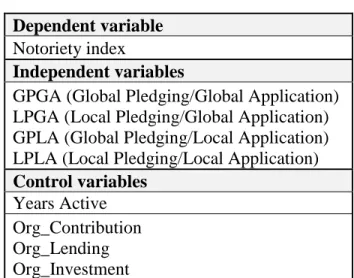
A list of variables used in the analysis is shown in table 2. Table 2: Variables
Dependent variable
Notoriety index
Independent variables
GPGA (Global Pledging/Global Application) LPGA (Local Pledging/Global Application) GPLA (Global Pledging/Local Application) LPLA (Local Pledging/Local Application)
Control variables
Years Active Org_Contribution Org_Lending Org_Investment
3.1.1) Dependent Variable – Notoriety Index (Websites linking in)
Links coming into a website are an important figure when comparing websites because they indicate a measure of popularity of the website content and are one of the main factors to determine the position inside the search engines results page.
To deal with the issue of a website getting a big number of links from a singular source, the dependent variable used (notoriety index) was the number of links of a website from websites visited by users in the Alexa12 traffic panel because multiple links from the same website are only counted once.
To gather this information each website URL was typed in alexa.com search bar and the number of “Sites Linking In” was stored in our database. This task was performed between the 24th and 26th of April 2012 and as Alexa only updates it monthly, all the numbers report to the same period.
12
18 3.1.2) Independent Variables
Pledging13
Pledging stands for where the transactions are coming from. The variable was coded in either Global or Local. The criterion to perform it was the following:
13 For further detail on how the coding was done please see appendix 6:Coding the independent variables Try to register in website as an investor. Does the
platform in the registration form only accept investors from up to two countries?
LOCAL
(e.g. Prosper only accepts registrations from the USA)
Read FAQ and terms & conditions. Is there any explicit country restrictions
concerning investors?
LOCAL
(e.g. To register in WeSayWePay.com the user must be UK resident)
Browse platform projects to check the language. Is the website available in one language that is official in more than 5 countries and at least 2 continents?
Note: Using the Member States of the United Nations list, the languages that meet this criterion are: English, French, Arabic, Spanish, Portuguese and Russian. From this point onwards this list will be mentioned as widely spoken languages.
LOCAL
Even if the application may be global. (e.g. 4just1.com is a Dutch platform that has its
projects description only in Dutch, therefore only people who can read the language can
easily understand and pledge.)
Is the Payment method used widely available?
LOCAL
(e.g. Movere.me is a Brazilian website available in a widely spoken language (Portuguese) but uses as the only payment method “moip”,which
requires the Brazilian identification number in order to accept a donation.)
YES NO YES NO NO YES YES GLOBAL NO
19 Application of funds14
In order to understand where the money raised in the platforms is being applied the variable “Application of funds” was also coded in either Global or Local. The above criteria were followed:
14
For further detail on how the coding was done please see appendix 6:Coding the independent variables Visit “Homepage” and, when available, “About us” and
“Statistics” pages.
Does the website clearly state that it has no restrictions where the money is being applied?
GLOBAL
(e.g. 1%CLUB states on their homepage that they had projects in 67 countries)
Visit FAQ and terms & conditions. Are there explicit countries restrictions, namely that money can only be applied in
up to two countries?
LOCAL
(e.g. DonorsChoose.orgonly accepts projects in the USA)
Look at projects posted to find in which countries the money is being applied. Are the projects from countries located in
different continents?
NO YES
YES NO
YES NO
Are they physically neighboring countries?
Do these countries combined have at least three different
official languages? YES NO NO LOCAL YES
Are projects from at least 4 different countries?
LOCAL GLOBAL
NO YES
20
After coding according to these criteria, there was enough information about 361 platforms.
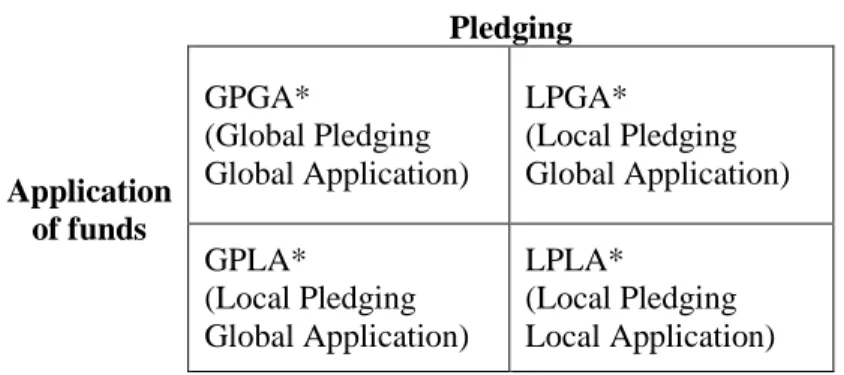
Table 3: Independent variables
Pledging Application of funds GPGA* (Global Pledging Global Application) LPGA* (Local Pledging Global Application) GPLA* (Local Pledging Global Application) LPLA* (Local Pledging Local Application) *Mutually exclusive
There are four combinations of the locus of pledging and application of funds (see Table 3). These are: GPGA (Global Pledging/Global Application), LPGA (Local Pledging/Global Application), GPLA (Global Pledging/Local Application) and LPLA (Local Pledging/Local Application).
3.1.3) Control Variables
Table 4: Control variables Years Active Org_Contribution* Org_Lending* Org_Investment* *Mutually exclusive Years Active
Older platforms are expected to have higher notoriety, so Years active was used as a control variable.
Organizational Models
As the type of crowdfunding used might have a significant impact on notoriety of the platform it was used as a second control variable.
21
All platforms were classified using dummy variables according to the three major types of crowdfunding organizational models: Contribution-based, Investment and Lending.
For the purpose of the analysis only the platforms with just one organizational model were considered in order to have a mutually exclusive variable. A total of 9 platforms were ignored for presenting more than one organizational model.
3.2) Method
To get insights about the data gathered, two statistical programs were used: JMP10 and STATA 12. First, JMP10 was used to create a number of reports and graphics in order to study the distribution of the dataset. Also, platforms were grouped by their characteristics, namely locus of projects and application of funds and subsets were created to know in depth the characteristics of each one.
3.2.1) Analyzed Dataset
In order to increase the trustworthiness of the analysis the following restrictions were imposed in the total sample:
1) All the platforms that were offline at the moment when the data was gathered and the ones with messages on their website saying that they had ceased permanently or temporarily their operations were excluded from the analyzed sample. Platforms with clear signs of being abandoned for a long time, that is, with no website and Facebook activity for more than 3 months, were also coded as “dead” and excluded.(N=54)
2) All the platforms without notoriety index were also excluded. (N=2)
3) All the platforms created in 2012 were excluded because many of them had only a couple of months or even weeks of existence when the data was gathered. Also, we are confident to have covered the majority of the crowdfunding platforms created until 2011 and if we would include the ones created in 2012 there was the risk of missing many of them. Also, most of the platforms created in 2012 would have a
22
low notoriety index not due to their combination of pledging and application of funds but because they were very recent. (N=20)
4) All the platforms created before 2005 were also excluded because some claim to be created many years ago (e.g. ACCION was created in 1961) and so, it very likely that they only become crowdfunding platforms more recently. As this could bias the results and they only represent around 3% of the total sample they were excluded. (N=13)
5) Only platforms with one organizational model were included. The reason was to create a mutually exclusive variable. Therefore, all the platforms with more than an organizational model or that we were unable to identify the organizational model were excluded. (N=14)
6) All the platforms that we were unable to code for both the pledging and application of funds were excluded. (N=2)
Therefore, the analyzed subset consists in the “alive” platforms, with a Notoriety Index higher than zero, created between 2005 and 2011, with exclusively one Organizational Model, and with the Pledging/Application of funds information available. (N=284)
3.2.2) Statistical analysis
In a second step, STATA 12 was used to test the hypotheses. The four possible combinations of Pledging and Application of funds were used in the analysis as independent variable and the variable LPLA was picked as the baseline in the regressions because as literature predicts, traditional way of financing early stage projects tend to be done locally. A negative binomial regression of the logarithm of the notoriety index (dependent variable) was used for the analysis.
23
IV. Results
The 390 crowdfunding platforms are from 40 different countries15.The country with the highest number of platforms is the USA with 151 platforms (38.9% of the total) followed by the United Kingdom and France with 37 and 27 respectively. Although there are platforms in all continents16, around 85% are based in Europe or North America. Europe is the continent with the highest number of platforms with 167 (43% of the total), just followed by North America with 164 platforms (42% of the total).
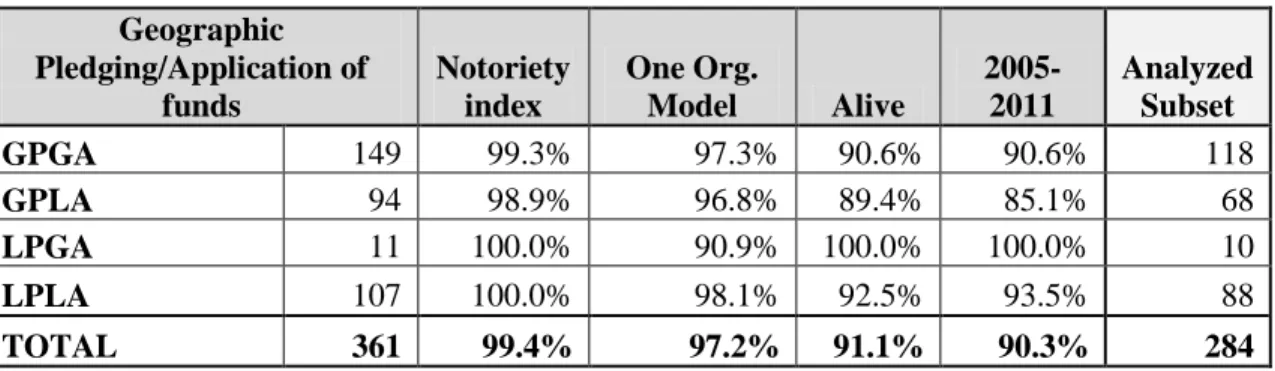
Table 4 presents a summary of the 361 platforms for which we were able to code for Geographic Pledging/Application of funds and the imposed restrictions.
Table 5: Total sample with geographic Pledging/Application of funds (N=361)
Geographic Pledging/Application of funds Notoriety index One Org. Model Alive 2005-2011 Analyzed Subset GPGA 149 99.3% 97.3% 90.6% 90.6% 118 GPLA 94 98.9% 96.8% 89.4% 85.1% 68 LPGA 11 100.0% 90.9% 100.0% 100.0% 10 LPLA 107 100.0% 98.1% 92.5% 93.5% 88 TOTAL 361 99.4% 97.2% 91.1% 90.3% 284
From the table is possible to see that none of the restrictions were particularly severe. Even though, the highest was the years restriction which was the reason to drop 9.7% of the platforms, followed closely by the “dead” platforms which represented 8.9%.
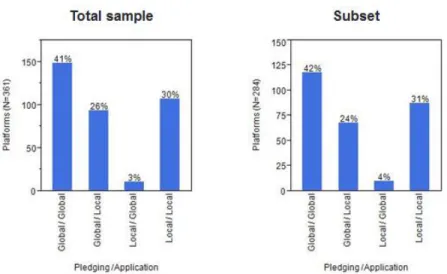
GPGA platforms are the most common type with 149 platforms, followed by LPLA and GPLA with 107 and 94 platforms, respectively. An interesting insight is that LPGA are the rarest type of platforms with only 11 identified, representing 3% of the total sample.
By type, GPLA platforms suffered slightly more than the other types, but differences in the distribution between the total sample and the analyzed subset are not relevant. This last claim becomes even more evident by looking to figure 2.
15
Appendix 12: Total sample vs analyzed subset - Countries distribution 16 Appendix 13: Total sample vs analyzed subset - Continents distribution
24
Figure 2: Number of platforms by Locus of Pledging/Application of funds
In what Organizational models are concerned, the Contribution-based model is the most common, being used by 72% of all platforms. Lending and Equity only represent 15% and 12% of all platforms, respectively.
Figure 3 shows that the distribution of the variable Organizational Models is also very similar in the total sample and the analyzed subset.
Figure 3: Number of platforms by Organizational model (mutually exclusive)
Focusing at the analyzed subset (N=284), figure 4 shows the distribution of the organizational models by Geographic Pledging/Application of funds.
25
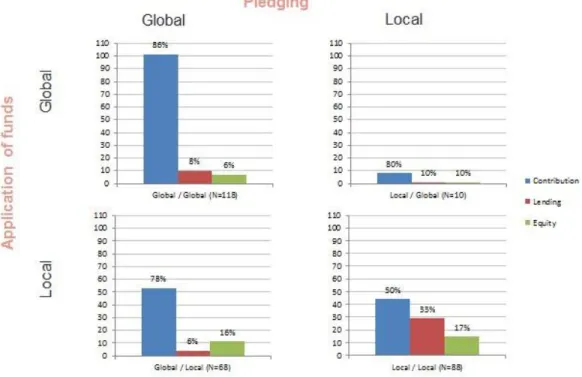
Figure 4: Distribution of platforms by Organizational model by Locus of Pledging/Application of funds (N=284)
This framework exposes the differences in the organizational models adapted by the platforms. As the scale presented is the same in all quadrants, the size of the bars represents the number of platforms. Additionally, the weight of each organizational model is presented in each quadrant.
From figure 4 it is possible to see that Contribution based platforms are the majority in all quadrants. Despite this, they only represent 50% of the LPLA platforms, which is much lower than the remaining combinations, where they vary between 78% and 86%. Lending platforms have a particularly high weight in this quadrant representing 33% of the LPLA platforms.
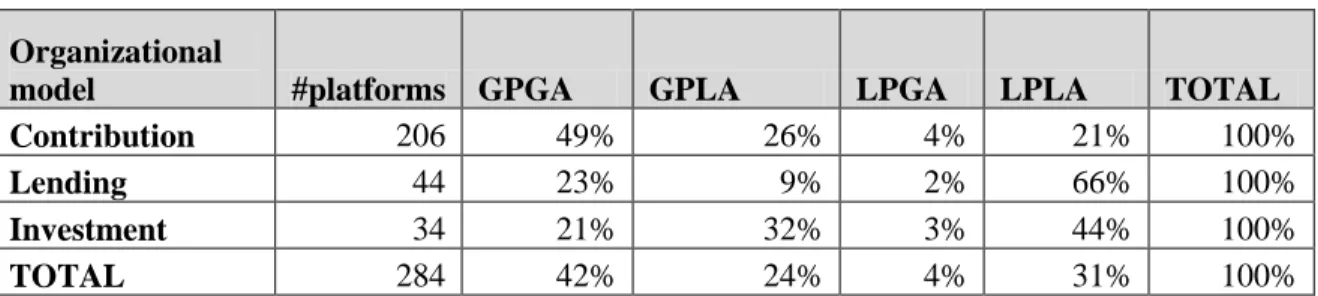
Table 5 adds more information to figure 4 by showing the distribution of each type of platform by geographic pledging/application of funds.
26
Table 6: Total sample with geographic Pledging/Application of funds (N=284)
Organizational
model #platforms GPGA GPLA LPGA LPLA TOTAL
Contribution 206 49% 26% 4% 21% 100%
Lending 44 23% 9% 2% 66% 100%
Investment 34 21% 32% 3% 44% 100%
TOTAL 284 42% 24% 4% 31% 100%
Two thirds of the Lending platforms are LPLA and the main reason is related with the legislation of each country. For instance, Prosper.com only operates in the USA (and even there only in some states) not because they chose to do it, but due to the legislation in the USA. Not only some USA states have been rejecting licenses for lending platforms but also back in 2008, Prosper was shut down for 8 months by the Securities and Exchange Commission (Manjoo, 2011).
Concerning the Investment platforms, 76% have local application (44% LPLA plus 32% GPLA) showing that projects in Investment platforms tend to be from just one or few countries (please see section 3.2.2 for further clarification on criteria). Curiously the majority of the platforms are pledging globally (21% GPGA plus 32% GPLA), meaning that these platforms are not offering barriers for investors from around the world.
The next analysis provided by table 6, explores the indicator of performance used in the analysis (Notoriety index) aggregated by Geographic Pledging/Application of funds.
Table 7:Notoriety index by Geographic Pledging/Application of funds
Geographic
Pledging/Application of funds #platforms
Sum of Notoriety index Average of Notoriety index GPGA 118 129692 1099 GPLA 68 25596 376 LPGA 10 2333 233 LPLA 88 16449 187 TOTAL 284 157621 555
27
The table shows that GPGA platforms have the highest average notoriety index, with 1099 websites linking to them on average. The second highest average notoriety index belongs to GPLA platforms indicating that platforms with Global Pledging tend to have higher notoriety index. Although LPLA platforms are the second most common, they show the lowest average notoriety index (187).
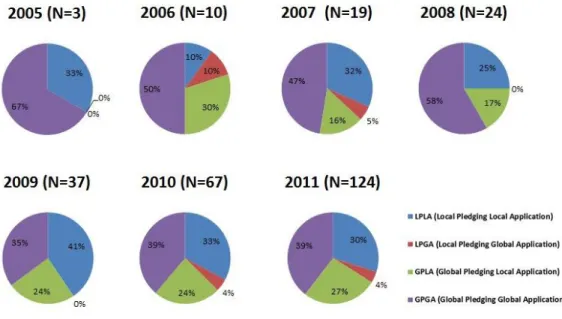
By analyzing the yearly distribution of new platforms by Geographic Pledging/Application (figure 5) it is possible to note that from 2005 until 2008 the majority of the platforms being created were GPGA, varying from 47% in 2007 and 67% in 2005. From 2009 onwards the dominance of GPGA platforms decreased representing 35% of the platforms created in 2009 and 39% created in 2010 and 2011. It is also interesting to note that in 2009 the majority (41%) of the platforms created were LPLA, but that percentage decreased in the last two years to 33% and 30% respectively. GPLA platforms have been constantly increasing since 2007, when they represented 16% of the platforms, until 2011, representing 27% of the platforms created that year.
28
4.1) Geographic Pledging / Application of funds and Notoriety
This section presents a statistical analysis conducted in the subset (N=284) which, as illustrated previously, is representative of the total database.
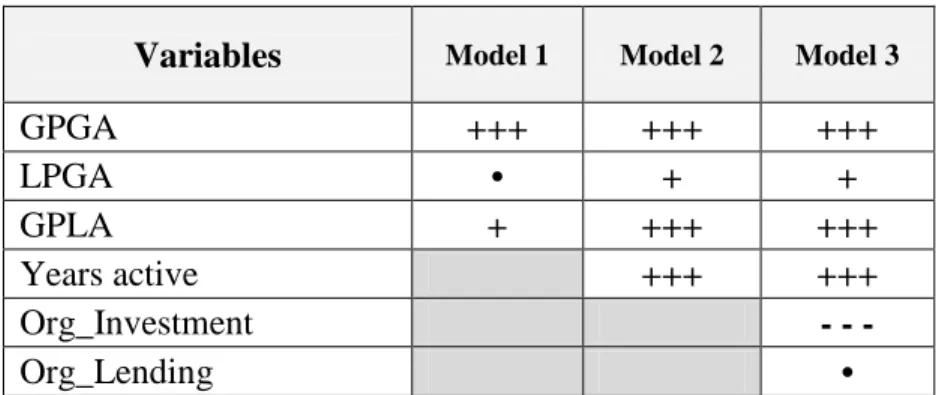
Table 8 presents a set of three regression models17 created to evaluate the impact of the locus of pledging and application of funds in the online notoriety of the crowdfunding platforms
Table 8: Impact of Locus of Pledging/Application of funds in Notoriety index
Variables Model 1 Model 2 Model 3
GPGA +++ +++ +++ LPGA • + + GPLA + +++ +++ Years active +++ +++ Org_Investment - - - Org_Lending •
+++ (positive impact p<0.01), ++ (positive impact p<0.05), + (positive impact p<0.1) - - - (negative impact p<0.01), -- (negative impact p<0.05), - (positive impact p<0.1) • (not statistically significant)
baseline: LPLA
The base model (model 1) includes only the independent variables – GPGA, LPGA, GPLA and LPLA (as baseline).
Model 2 introduces the control variable years active.
Finally, model 3 includes as control variables years active and the three Organizational models. Please note that Organizational models used are mutually exclusive. Representing around 73% of the analyzed platforms, Contribution-based model was chosen as the source of comparison and for that reason it is not shown. The fact that platforms with different organizational models are unevenly distributed by each quadrant reinforces the need to use Organizational models as a control variable.
29
Results show that the control variable years active has a highly significant positive impact in the Notoriety index of 0.522(p<0.01) in model 2 and 0.538(p<0.01) in model 3. This means that older platforms tend to have more websites linking to them, as expected.
In terms Organizational models, model 3 shows that Investment platforms have a highly significant negative impact in the Notoriety index of -1.042(p<0.01) when comparing with Contribution based platforms. We think this results are logical because equity or future revenue are incentives which are relevant to a more sophisticated investor than an object or an experience related with the project which are typical in contribution based model. Lending platforms do not present significant results.
All the models present highly significant positive results for GPGA and GPLA, meaning that always outperform LPLA platforms even with the different Organizational Models as control variables. These results disprove H1: “LPLA (Local Pledging and Local Application of funds) platforms have higher notoriety than the remaining platforms.”
Results indicate that GPGA platforms are always the one who present the strongest and statistically significant positive impact in the notoriety index throughout models. Presenting values of 1.772(p<0.01), 1.547(p<0.01) and 1.284(p<0.01) in models 1, 2 and 3, respectively. This result confirms H2: “GPGA (Global Pledging/Global Application of funds) have higher notoriety than LPLA platforms”.
GPLA platforms also present statistically significant positive impact in the notoriety index throughout models. The main difference is that they increase their significance from 0.700(p<0.1) in model 1 to 0.851(p<0.01) and 0.650(p<0.01) in models 2 and 3, respectively. These figures confirm H3: “GPLA (Global Pledging/Global Application of funds) have higher notoriety than LPLA platforms”.
Finally, LPGA platforms do not present any significant results in the base model but when added the control variables, they present a statistically significant positive impact in notoriety index of 0.802(p<0.1) and 0.825(p<0.1) in models 2 and 3, respectively. This particular result has its limitations because of the reduced size of the LPGA platforms, although confirms H4: “LPGA (Local Pledging/Global Application of funds) have higher notoriety than LPLA platforms”
30
V. Discussion and conclusions
This study tries to give the reader an industry view on the crowdfunding industry by analyzing it with a geographic perspective. To do it we propose a 2 by 2 framework that segments crowdfunding platforms according to their characteristics by the locus of pledging and application of funds. Four combinations were possible: GPGA (Global Pledging/Global Application), LPGA (Local Pledging/Global Application), GPLA (Global Pledging/Local Application) and LPLA (Local Pledging/Local Application).
We believe this model is appropriate to segment the crowdfunding industry due to the characteristics of the platforms, which can leverage or restrict not only the location from where investors are contributing with funds but also the locus where the funds are being applied.
The analysis shows that platforms are experimenting different approaches to the locus of pledging and application of funds. Some are focusing more locally by choice or strategy (e.g. only accepting local payment methods or not having the website in a widely spoken language) while others are restricted by their countries legislation.
By using the framework to analyze platforms by organizational model we get the sense many platforms are trying to mimic geographically what is the common practice in their most similar traditional financing model. For instance, in the case of Lending platforms we can see that 66% are LPLA, meaning that the vast majority is focusing only in investors and projects location to be local similarly to lending banking (Degryse and Ongena, 2005; Petersen and Rajan, 2002).
Also, in the case of the Investment platforms we observe that 76% of them offer Local Application of funds (GPLA + LPLA), meaning that the majority of platforms are restricting the locus of application of funds to a local range. This organizational model which is characterized by offering the crowd the possibility to get equity or a future revenue share is the closest to VC and this approach by the majority of the platforms is consistent with the VC theory (Sapienza, 1992; Florida & Kenney, 1988; Zook, 2002) which says that geographic proximity plays is important to supervise investments.
31
Looking at the statistical results, they clearly indicate that the geographic locus of the pledging and application of funds of a crowdfunding platform have a significant impact on its online notoriety.
Results show that LPLA platforms are outperformed by all the remaining Pledging/Application of funds combinations in terms of the notoriety even after controlling for the organizational models. Taking in consideration that crowdfunding platforms are mainly used to finance early-stage projects, results suggest that proximity between investor and project owner is not relevant in what concerns to the notoriety of the platform.
This contrast with existing literature (Sapienza, 1992; Lerner, 1995; Zook, 2002) which considers spatial proximity and localized networks as a key point in funding early stage projects and therefore contradicts H1: “LPLA (Local Pledging / Local Application of funds) platforms tend to have higher notoriety than the remaining platforms”
It is also demonstrated that GPGA platforms show the strongest and more significant results for all the models. Meaning that crowdfunding platforms that pledge and allow the application of money to be done globally tend to have higher online notoriety than the LPLA confirming H2: “GPGA (Global Pledging/Global Application of funds) platforms have higher online notoriety than LPLA platforms”. This is consistent with prior research on geography of crowdfunding conducted by Agrawal et al. (2011) which states that crowdfunding seems to eliminate most distance-related economic frictions.
A possible explanation is related with advances in computing and communication which increase the availability and timeliness of hard information that Petersen and Rajan (2002) find as the main reason for the increase in distant bank lending, concluding that this is not compromising performance. In fact our figures show that platforms that are tapping a wider crowd by pledging globally are performing better than platforms which are only pledging locally and thus not capturing distant investors. It then comes with no surprise that also GPLA perform better on average than LPLA, confirming H3: “GPLA (Global Pledging/Local Application of funds) have higher online notoriety than LPLA platforms.” Contrary to VC where finding the right VC is considered to be a critically important task, in the case of CF typically there are many investors that contribute with small values. For that reason project owners of crowdfunding projects are more focused in getting the maximum
32
number of investors than finding the right one. To achieve so, CF platforms must have the characteristics to allow it. We then conclude that in CF tapping a wider crowd is more important to improve performance than focusing on local investors.
Although we only identified 10 LPGA platforms statistical results are statistically significant confirming H4: “LPGA (Local Pledging/Global Application of funds) have higher notoriety than LPLA platforms”
This result is in line with H2 and H3 and it suggests that by impacting more people, CF platforms increase the chances of also getting more projects and investors. It makes sense that platforms that allow for at least projects to be realized globally and therefore having a higher exposure to perform better on average than strictly local platforms.
From this study results we note that picking the right platform can be an important decision to the project owner as the characteristics of the platform itself influence the reach of a project in terms of the size of the potential crowd.
5.1) Practical Implications
In this study we analyzed how the locus of pledging and application of funds of a platform relates with its online notoriety.
We believe that the results are particularly useful for platform owners to deepen their knowledge about the industry and understand how their decisions in terms of platform characteristics are affecting its online notoriety.
As shown by this study, local characteristics for pledging and application of funds are an at odds with of online notoriety and very likely of other performance indicators. For this reason platform owners should understand that their platform characteristics have a direct impact in their online notoriety. Some of those characteristics are imposed by local legislations and so there are not in control of the platform (e.g. Prosper can only operate in some USA states because of the USA law for 2p2 lending platforms), but most of the remaining characteristics identified as a source of restricting a platform to be local, can be overcome. Having the website available in a widely spoken language and not restricting the
33
payment methods to local ones are some easy features to implement, that will be key to attract investors from abroad and turn a local pledging platform into a global pledger.
Results also indicate that platforms that are only applying funds locally are getting less notoriety. This suggests that a way to increase the notoriety of a platform might be create some kind of incentive for their users to create projects in different countries.
Also, crowdfunding is getting a lot of momentum and it is expected that not only the number of platforms being created but also the value of the industry keeps increasing. A crowdfunding industry report18 from Massolution estimates that in 2012 the industry will provide funding of around $2.8 billion versus the $1.5 billion from 2011. We then speculate that countries that are too restrictive regarding the laws applicable to crowdfunding platforms will most likely refrain platforms based in their countries from thriving in this industry. A regulatory regime that is clear both for platform owners and users, might become a key success factor for some countries platforms outperform others.
5.2) Limitations
The first and most important limitation is related with the classification of Local and Global. Particularly, in the third step of the of the Pledging of funds, it is considered that to be candidate of being Global a platform has to be available in a widely-spoken language. The classification used is that language has to be official in more than 5 countries and at least 2 continents. While the definition tries to only include languages that are used in different regions in the Globe, it excludes some of the most spoken languages in the world (e.g. Chinese19). An alternative would be using Ethnologue20 list of the most spoken
languages. The ideal solution would be to know exactly who is behind each transaction on each platform.
18
A preview of the report is available at http://www.crowdsourcing.org/document/crowdfunding-industry-report-abridged-version-market-trends-composition-and-crowdfunding-platforms/14277
19
Despite Chinese being a language that is mostly spoken in China, there are around 50 million overseas Chinese. See http://www.china.org.cn/china/NPC_CPPCC_2012/2012-03/11/content_24865428.htm 20
See Lewis, M. Paul (ed.), 2009. Ethnologue: Languages of the World, Sixteenth edition. Dallas, Tex.: SIL International. Online version: http://www.ethnologue.com/
34
Also, as most of the data was collected directly in the platforms websites and coded by hand, despite all our efforts to re-check the data it is possible to have some errors, especially subjective perceptual ones. Nevertheless as the data analyzed includes a large number of platforms (N=284) those possible errors should not have a big influence in the results.
Finally, another limitation of the study is related with the notoriety index.
This variable relies on the number of links of a website from sites visited by users who have Alexa Toolbar installed. The company analyses the online activity from the toolbar users and then extrapolates it to the population as a whole. This approach has however a limitation that is the selection bias: “self-selection of individuals to participate in an
activity”21
, and so it does not represent a random sample of internet users, but only those who have installed the toolbar, which according to the company are millions worldwide”22. The toolbar allows who installs it to know more data about websites, so it is useful to people who are familiar with SEO (Search Engine Optimization) meaning that they might be over represented. As other web metrics companies also suffer from sampling, a way to deal with the problem would be use several sources (e.g. ComScore, SEOmoz) and create an weighted average metric.
5.3) Future Research
As future research it would be very interesting to apply the locus of pledging/application of funds framework using other performance indicators, such as the percentage of successful projects or funds raised by the platforms. This would indicate which type of platform is being effectively used to fund new projects.
From our analysis we note that some countries seem to be outperforming others (e.g. 39% of the platforms are from the USA and Netherlands has more platforms than Germany). Do some cultural features, e.g. Hofstede (1980) dimensions of the platform’s home country, have an impact on its performance?
21
See http://www.skepdic.com/selectionbias.html 22 See Appendix 5: About Alexa Internet
35
Other research topics that can be developed are related with the funders. Are they aware of their risks? Do they know the legislation of the country they are investing in? These issues are specially related with platforms that offer financial return.
36
VI. References
Agrawal, A., Catalini, C. and Goldfarb, A. (2011), The Geography of Crowdfunding.
National Bureau of Economic Research Working Paper No. 16820
Albors, J., Ramos J.C. & Hervas J.L. (2008), New Learning Network Paradigms:
Communities of Objectives, Crowdsourcing, Wikis and Open Source. International
Journal of Information Management 28, pp. 194-202.
Berger, A., N. Miller., M, Petersen, R. Rajan., and J. Stein. (2005), “Does Function Follow Or- ganizational Form? Evidence from the Lending Practices of Large and Small Banks,” Journal of Financial Economics, Vol. 76, 237—269.
Castrataro D. (2012), Crowdfunding platforms to each their own. Social Media Week. Available at: http://socialmediaweek.org/blog/2012/01/crowdfunding-platforms-to-each-their-own/ (Accessed July 2, 2012)
Chaffee, E. C. & Rapp, G. C. (2012), Regulating On-Line Peer-to-Peer Lending in the Aftermath of Dodd-Frank: In Search of an Evolving Regulatory Regime for an Evolving Industry, 69 Washington and Lee Law Review pp485-533
Cosh, A., D. Cumming and A. Hughes (2009), Outside Entrepreneurial Capital. Economic
Journal 119, pp. 1494-1533.
Coval, J., and T. Moskowitz (2001), “The Geography of Investment: Informed Trading and Asset Prices,” Journal of Political Economy, Vol. 109, 811—841.
Croll, A., Power, S. (2009), Complete Web Monitoring: Watching Your Visitors, Performance, Communities, and Competitors. O'Reilly Media. p. 38.
Cumming, D. and Dai, N. (2010), Local bias in venture capital investments, Journal of
Empirical Finance, v.17, Pages 362–380
Degryse, H., and S. Ongena (2005), “Distance, Lending Relationships, and Competition,”
37
Fincher, S. (2011), Jumpstart Our Business Startups (H.R. 3606). govtrack.us. Available at: http://www.govtrack.us/congress/bills/112/hr3606 (Accessed July 8, 2012).
Florida, R. & Kenney, M. (1988), Venture Capital, High Technology and Regional Development, Regional Studies, 22, 33–48.
Florida, R., & Smith, D. (1993), Venture capital formation, investment and regional
Industrialization, Annals of the Association of American Geographers, 83(3), 434–5.
French, K., and J. Poterba (1991), Investor Diversification and International Equity Markets, American Economic Review, Vol. 81, 222—226.
Gaston R.J. (1989), Finding venture capital for your firm: a complete guide, New York:
John Wiley.
Hampton, K., & B. Wellman (2002), Neighboring in Netville: How the Internet supports community and social capital in a wired suburb, City and Community, 2(3), 277–311.
Hemer, J. (2011), A snapshot on crowdfunding (No. R2/2011). Working papers firms and
region.
Howe, J. (2006), The Rise of Crowdsourcing. Wired 14 (6), Available at:
http://www.wired.com/wired/archive/14.06/crowds.html (Accessed May 20, 2012)
Hofstede, G. (1980), Culture’s consequences: International differences in work-related values. Beverly Hills, CA: Sage.
Howe, J. (2008), Crowdsourcing. Why the Power of the Crowd is Driving Future of Business. New York: Three Rivers Press.
Ivković, Z., & Weisbenner, S. (2005), Local does as local is: Information content of the geography of individual investors' common stock investments. The Journal of
Finance, 60(1), 267-306.
Kappel,T. (2009), Ex Ante Crowdfunding and the Recording Industry: A Model for the U.S., 29 Loy. L.A. Ent. L. Rev. 375
38
Katz, S. N. (2006), Philanthropy. Handbook on the Economics of Art and Culture, 1, 1299-1321
Kleemann, F., Voss, G. G. & Rieder K. (2008), Un(der)paid Innovators: The Commercial Utilization of Consumer Work through Crowdsourcing. Science, Technology &
Innovation Studies 4, 5-26.
Lambert, T., & Schwienbacher, A. (2010), An empirical analysis of
crowdfunding. Louvain–la–Neuve: Louvain School of Management, Catholic
University of Louvain.
Lerner, J. (1995), Venture Capitalists and the Oversight of Private Firms, Journal of
Finance, 50, 310–318.
Malone, T., Laubacher, R. & Dellarocas, C. (2010), The Collective Intelligence Genome.
MIT Sloan Management Review, 51(3), pp.21–31.
Malloy, C. J. (2005), The geography of equity analysis. The Journal of Finance,60(2), 719-755.
Manjoo F. (2011), On this site, a stranger will spot you some cash, THE WASHINGTON
POST, April 24, 2011. Available at:
http://www.garp.org/news-and-publications/overview/story.aspx?altTemplate=PrintYellowBrixStory&newsId=2759 6 (Accessed August 21, 2012)
Milliken, D. (2012), Four forms of crowdfunding explained. Crowdsourcing.org, Available at:
http://www.crowdsourcing.org/editorial/four-forms-of-crowdfunding-explained/14249 (Accessed August 21, 2012)
Ordanini, A. (2009), Crowd funding: customers as investors, The Wall Street Journal, 23 March, p. r3.
Ordanini, A., Miceli, L., Pizzetti, M., & Parasuraman, A. (2011), Crowd-funding:
transforming customers into investors through innovative service platforms. Journal
39
Parker, S. C. (2009), The Economics of Entrepreneurship. Cambridge University Press.
Petersen, M., and R. Rajan (2002), Does Distance Still Matter? The Information Revolution in Small Business Lending, Journal of Finance, Vol. 57, 2533—2570.
Sapienza, H.J. (1992), When do venture capitalists add value? Journal of Business Venturing. Vol. 7. 9-27.
Seasholes, M. S., & Zhu, N. (2010), Individual investors and local bias. The Journal of
Finance, 65(5), 1987-2010.
Solnik, B. H. (1974), Why not diversify internationally rather than domestically?.Financial
analysts journal, 48-54.
Sorenson, O. &. Stuart, T. E. (2001), Syndication Networks and the Spatial Distribution of Venture Capital Investments, American Journal of Sociology, 106(6), 1546–1588.
Sorenson, O., & Stuart, T. E. (2005), The evolution of venture capital investment networks. Federal Reserve Bank of Atlanta, 1936
Tian, X. (2008), Geography, staging, and venture capital financing. Boston College.
Van den Ende, J., Villarroel, J. A., & Tucci, C.L. (Eds.) (2009), Strategic crowdsourcing: Orchestrating innovation through the cream of the crowd. Symposium. Proceedings of Academy of Management Annual Meeting, Chicago, USA. August 11, 2009. http://program.aomonline.org/2009/submission.asp?mode=ShowSession&SessionID =821
Villarroel, J. A. (2008), Open Source Corporate Strategy (OSCS, aka crowdsourcing) : Unveiling the firm’s open sources of competitive advantage. Doctoral Dissertation No. 4173, EPFL, Switzerland, August 28, 2008. Available at:
http://library.epfl.ch/theses/?nr=4173.
Villarroel J.A. (2011), Strategic Crowdsourcing: The emergence of online distributed innovation. In Huff A., Reichwald R., Moeslein K. 2012. Leading Open Innovation. Forthcoming with MIT Press.
Villarroel, J.A., & Gorbatai, A. (Eds.) (2011a), The Global Ecology of Crowdsourcing. Symposium. In Proceedings of the Academy of Management Annual Meeting, San Antonio, USA, August 15, 2011.
40
http://program.aomonline.org/2011/submission.asp?mode=ShowSession&SessionID =692
Villarroel, J.A., & Gorbatai, A. (Eds.) (2011b), Online Distributed Organization.
Symposium. In Proceedings of the Academy of Management Annual Meeting, San Antonio, USA, August 16, 2011.
http://program.aomonline.org/2011/submission.asp?mode=ShowSession&SessionID =694
Villarroel, J. A., & Tucci, C.L. (Eds.) (2007), Open Source Corporate Strategy (OSCS, aka crowdsourcing): Reaching outside the firm’s boundaries to tap upon global talent. Symposium. Proceedings of Academy of Management Annual Meeting, Philadelphia, USA. August 6, 2007.
http://program.aomonline.org/2007/submission.asp?mode=ShowSession&SessionID =740
Zook, M. A. (2002), Grounded capital: venture financing and the geography of the Internet industry, 1994–2000, Journal of Economic Geography, 2(2), 151–177.