Co-branding strategies?
Assessing the influence of gender
on consumer evaluations of new
co-branded products
Final Dissertation presented to Universidade Católica Portuguesa to the obtainment of Marketing master’s degree
by
Sara Catarina Pacheco Rodrigues de Sousa
under orientation of PhD Joana César Machado
Católica Porto Business School March 2017
Acknowledgments
To my parents, for always being there to support me along this journey.
To Professor Joana César Machado, whose availability, insight, and effort put into this research made it all possible.
To Ricardo, my amazing life partner, for being my rock and giving me the strength to work towards my goals.
To all my friends and family, for all the support I was given during this process.
To my co-workers, for their patience and assistance, each one helping in their own special way.
Lastly, to all the people who gave me a helping hand and were a part of this study, making it come true.
Abstract
Co-branding strategies arise from the brands’ need to reinvent themselves and are commonly defined as an alliance between two brands in order to create a new product that will carry both brands’ names.
The goal of our research is to assess the influence of brand gender on consumers’ evaluation of a new co-branded product.
Previous studies have shown that consumers tend to choose brands that enhance their gender identity. Moreover, consumers associate human personality traits with brands, since they tend to see brands as if they were their family or friends.
With the aim of studying this influence, we started by doing a pre-test in order to find out the brands that are more strongly associated to each gender, and more familiar among a list of brands belonging to two product categories – personal care and fashion. The results of the pre-test showed that the brands that have a more favorable relation between gender and familiarity are Axe, Dove, Levis, and Mango.
Following we created two co-branding scenarios: Axe by Mango – targeting females – and Dove by Levis – targeting males. We collected data using and online survey. Our sample was composed mainly by students from different University classes in Porto and Faro.
We started our analyses by doing a sociodemographic characterization of our sample and a brief descriptive statistical analysis. This was followed by reliability tests to measure the internal consistency of our variables. Finally, we used Linear Regressions to test our hypotheses.
Our results show that brand gender has a significant and favorable influence on consumers’ attitude towards the new co-branded product, in the case of a masculine co-branding scenario.
Index
Acknowledgments ... iii Abstract ... v Index ... vii Figures Index ... ix Tables Index ... xi Chapter I ... 15 Introduction ... 151.1 – Theme and research questions ... 15
1.2 – Structure of the Dissertation ... 16
Chapter II ... 19
Theoretical Background ... 19
2.1 – Brand Alliances ... 19
2.2 – Co-branding Strategies ... 20
2.3 – Brand Extensions and Co-Branding ... 24
2.4 – Brand Gender ... 26 2.5 – Familiarity ... 30 2.6 – Attitude ... 31 Chapter III ... 33 Method ... 33 3.1 – Research Paradigm ... 33 3.2 – Research Design ... 33 3.3 – Study Variables ... 35 3.3.1 – Independent Variables ... 35 3.3.2 – Dependent Variable ... 39 3.4 – Hypotheses ... 39 Chapter IV ... 43 Study Results ... 43
4.1 – Structure of the questionnaire ... 44
4.2 – Sociodemographic characterization of the sample ... 45
4.3 – Descriptive Analysis ... 47
4.3.1 – Masculine co-branding scenario ... 48
4.3.2 – Feminine co-branding scenario ... 51
4.4 – Statistical Analysis ... 54 4.4.1 – Reliability ... 55 4.4.1.1 – Reliability (Masculine) ... 55 4.4.1.2 – Reliability (Feminine) ... 56 4.4.2 – Hypotheses testing... 56 Chapter V ... 65
Discussion ... 65
Chapter VI ... 71
Conclusion ... 71
6.1 – Summary and Implications ... 71
6.2 – Managerial Implications ... 73
6.3 – Limitations and Further Research ... 74
References ... 77
Appendix ... 81
Appendix 1 – Masculine Co-branding Questionnaire ... 81
Figures Index
Figure 1 - An Extended Model of Fit Measures that Influence the Evaluation of a
Co-branded Product ... 23
Figure 2 - Five Dimensions of Brand Personality ... 27
Figure 3 - Research Model ... 34
Figure 4 - Respondents by gender ... 45
Figure 5 - Respondents by age ... 46
Figure 6 - Respondents by education ... 46
Figure 7 - Respondents by occupation ... 47
Tables Index
Table 1 – Brand-brand fit ... 36
Table 2 – New product-brand fit ... 37
Table 3 – New product-product fit ... 37
Table 4 – Familiarity ... 38
Table 5 – Brand Personality Traits ... 38
Table 6 – Attitude towards the new co-branded product ... 39
Table 7 – Definition of the variables in the study... 43
Table 8– Levels of masculinity and femininity of the product categories ... 48
Table 9– Dove MBP and FBP Traits ... 49
Table 10 – Levis MBP and FBP Traits ... 50
Table 11 – Familiarity of Dove ... 51
Table 12 – Familiarity of Levis ... 51
Table 13 – Levels of masculinity and femininity of the product categories ... 52
Table 14 – Axe MBP and FBP Traits ... 52
Table 15 – Mango MBP and FBP Traits ... 53
Table 16 – Familiarity of Axe ... 54
Table 17 – Familiarity of Mango ... 54
Table 18 – Masculine Reliability Test ... 55
Table 19 – Feminine Reliability Test ... 56
Table 20 – Simple Linear Regression between Brand-Brand Fit (Masculine) and Attitude towards the new co-branded product (Masculine) ... 57
Table 21 – Simple Linear Regression between Brand-Brand Fit (Feminine) and Attitude towards the new co-branded product (Feminine) ... 58
Table 22 – Simple Linear Regression between New Product-Brand Fit (Masculine) and Attitude towards the new co-branded product (Masculine) ... 59
Table 23 – Simple Linear Regression between New Product-Brand Fit (Feminine) and Attitude towards the new co-branded product (Feminine) ... 59
Table 24 – Simple Linear Regression between New Product-Brand Fit (Masculine) and Attitude towards the new co-branded product (Masculine) ... 60
Table 25 – Simple Linear Regression between New Product-Product Fit (Feminine) and Attitude towards the new co-branded product (Feminine) ... 61
Table 26 – Multiple Linear Regression between Familiarity (Masculine) and Attitude towards the new co-branded product (Masculine) ... 61
Table 27 – Multiple Linear Regression between Familiarity (Feminine) and Attitude towards the new co-branded product (Feminine) ... 62
Table 28 – Multiple Linear Regression between Brand Gender of the invited brand (Masculine) and Attitude towards the new co-branded product (Masculine) ... 63
Table 29 – Multiple Linear Regression between Brand Gender of the invited
brand (Feminine) and Attitude towards the new co-branded product
Chapter I
Introduction
1.1 – Theme and research questions
Nowadays, competition among companies has increased in a way that they have to find solutions to stand out in the markets. The need to explore their strengths and opportunities is higher than before, so that they can prove they are better companies than the competitors serving the same markets. Frequently companies try to leverage strengths through the development of brand alliances, which are characterized by an alliance between two independent brands. In this research we will focus in a particular case of a brand alliance – co-branding.
As we will see in Chapter II, co-branding is commonly defined as an alliance between two different brands, which form a new product (Washburn et al., 2000). This new product is represented by the two brands at the same time (Helmig et al., 2008) with both brands’ names, and this strategy is often used to introduce new products in the markets.
A co-branding strategy has innumerous advantages, such as more favorable quality perceptions and, consequently, better product evaluations, as well as the availability to pay higher prices (Helmig et al., 2008). Consumer perceptions, or evaluations of the co-branded product, tend to be influenced by product fit (Simonin and Ruth, 1998, Bouten et al., 2011), brand fit (Simonin and
Ruth, 1998, Bouten et al., 2011) and familiarity (Simonin and Ruth, 1998, Lafferty, 2009).
Besides that, brand gender may also be an important variable in the evaluation of the new co-branded product, since consumers tend to express their masculinity or femininity through the brands or products they choose to buy (Grohmann, 2009). Despite the relevance of brand gender, there is a lack of studies assessing the influence of brand gender on consumer evaluations of brand alliances, and in particular of co-branding strategies.
In this study we intend to contribute to the fulfillment of this research gap, based, besides other studies, on Cardoso (2015), and to complement previous research, by studying how brand gender influences consumers’ attitude towards a new branded product. In order to do that, we will create two co-branding scenarios, one targeting males and the other targeting females. In this quantitative research we chose Dove (“host” brand) and Levis (“invited” brand) for the male target, and Axe (“host” brand) and Mango (“invited” brand) for the female target.
1.2 – Structure of the Dissertation
This research will be divided in six chapters.
The first one is the Introduction, followed by the second one, which contains the theoretical background related to the different themes that make up this research.
The third chapter contains the research model, as well as the hypothesis. In the fourth chapter we analyze the study results and characterize the sample, while in the fifth chapter we present the results and discuss them taking into account the theoretical background presented in Chapter II.
Lastly, in the sixth chapter we present the main conclusions, limitations of this research, as well as managerial implications and suggestions for further studies.
Chapter II
Theoretical Background
2.1 – Brand Alliances
Nowadays, companies have much more competition than before. There are many companies making and selling very similar products in the same way, therefore companies have to innovate the way they do business. In order to do that, companies adopt several different strategies, including brand alliances. Brand alliances are a strategy that is often used by companies to improve their brand image and brand sales (Lafferty, 2009).
According to Tilburg et al. (2015, p.1) “a brand alliance, particularly by co-branding, is a strategic alternative to a brand extension” and it can be defined as “the short or long-term association or combination of two or more individual brands, products, and/or other distinctive proprietary assets” (Rao and Ruekert, 1994, cited by Simonin and Ruth, 1998, p. 30).
This alliance between brands can take different forms (Helmig et al., 2007, p. 286):
- Joint sales promotion, characterized by “the participation and/or pooling of promotional resources by two or more distinct entities with the goal of capitalizing on joint opportunities for sales growth, profits, or other objectives to the mutual benefit of the participants in the cooperative sales promotion program” (Varadarajan, 1986, cited by Helmig et al., 2007, p. 287);
- Advertising alliances, that is, “two brands from different product categories featured together in an advertisement” (Samu et al., 1999, cited by Helmig et al., 2007, p. 287);
- Bundling, which is described as “selling two or more separate products in one package, with separate products defined as products for which separate markets exist” (Stremersch and Tellis, 2002, cited by Helmig et al., 2007, p. 287);
- Co-branding, “combining two existing brand names to create a composite brand name for a new product” (Park et al., 1996, cited by Helmig et al., 2007, p. 287);
- Ingredient branding, defined as the “key attributes of one brand are incorporated into another brand as ingredients” (Norris, 1992, cited by Helmig et al., 2007, p. 287);
- Dual branding, which occurs when “two brands share the same facilities to provide consumers the opportunity to use either or both brands” (Levin and Levin, 2000, cited by Helmig et al., 2007, p. 287).
2.2 – Co-branding Strategies
Throughout the years, because of the increase in competition amongst manufactures, especially in some markets like fast-moving consumer goods, co-branding strategies are becoming more famous (Vaidyanathan and Aggarwal, 2000; Desai and Keller, 2002; Washburn et al. 2004; cited by Helmig et al., 2008).
Co-branding is commonly defined as a way of combining two different products of different brands to form a whole new product (Park et al, 1996, cited by Washburn et al., 2000, p. 591), or as a long-term alliance in which a product is represented by two brands at the same time (Helmig et al., 2008). According to Washburn (2000), many companies use this strategy to introduce new products in the market.
There are four main features that characterize a co-branded product (Helmig et al., 2008). The first one is that the two brands, or companies, offering the co-branded product must be independent before, during and after they launch the co-branding product (Ohlwein and Schiele, 1994). Additionally, the brands that intend to implement a co-branding strategy should do it consciously (Blackett and Russell, 1999). Moreover, there must be an evident cooperation between the two brands, and this cooperation should be clearly visible to potential buyers (Rao, 1997). Finally, the co-branded product must be offered by the two brands at the same time (Helmig et al., 2008).
According to Helmig et al (2008), there are different types of co-branding: vertical co-branding, or ingredient branding, and horizontal co-branding, which refers to the production and distribution of products by companies at the same level of the value chain. According to the same authors, co-branded products can emerge from a product category in which the two producers are already established, from a product category in which only one of the producers is established (“e.g., hypothetical chocolate bar co-branded by Hershey’s and Coca-Cola”) (Helmig et al., 2008, p. 361) or from a category where none of the producers is established (“e.g., a hypothetical yoghurt drink by Coca-Cola and Evian”) (Helmig et al., 2008, p. 361). However, in these two last scenarios, Helmig et al (2008) defend that the co-branding strategy becomes a brand extension strategy.
A co-branding strategy is a good way for companies to gain marketplace exposure, and it also allows them to reduce the threat of private labels and “share expensive promotional costs with a partner” (Washburn et al., 2000, p. 592). The combination of two brands provides as well a higher product quality than a single brand would, and leads to premium prices in part because of the higher product evaluation by consumers (Rao et al., 1999).
Co-branding has three key characteristics: integration, exclusivity and duration (Newmeyer et al., 2014). Integration “refers to the extent to which the
partnering brands are intertwined in form and function” (Newmeyer et al., 2014, p. 105); so, this degree of integration can vary from very low to very high. Exclusivity is related to “the number of partners with whom the focal brand pursues a co-branding arrangement” (Newmeyer et al., 2014, p. 105). The third fundamental dimension of a co-branding strategy is duration, defined as the extent of time during which the co-branding agreement persists (Newmeyer et al., 2014, p. 105).
One of the main factors for a co-branding strategy to succeed is the choice of the partner. In order for a co-branding strategy to prosper, the partner needs to have three characteristics that are indispensable:
- Functional complementarity: “the extent to which a brand’s weakness on a functional attribute is offset by the partner brand’s strength on that attribute” (Newmeyer et al., 2014, p. 109);
- Hedonic consistency: “partnering brands are hedonically more consistent when they convey similar sensory feelings” (Newmeyer et al., 2014, p. 109);
- Brand breadth: “refers to the diversity of product categories with which a brand is associated” (Newmeyer et al., 2014, p. 109).
When a company is looking for a partner to implement a co-branding strategy with, fit between partners is crucial, as it will influence consumers' evaluation of the new co-branded product. Thus, there are some fit measures which are important to mention in this theoretical background.
Fit can be defined as “subjective judgment concerning the match between two constituent brands” (Tilburg et al., 2015, p. 2) and “brand fit is established if the consumer perceives a comprehensive connection between the brands and can integrate the concepts related to them” (Tilburg, 2015, p. 2).
Fit can be divided into product fit and brand fit. Product fit refers to consumers’ perceptions of the compatibility between the two product categories, and brand fit refers to consumers’ perceptions regarding the images and associations between the two different brands (Helmig et al., 2007).
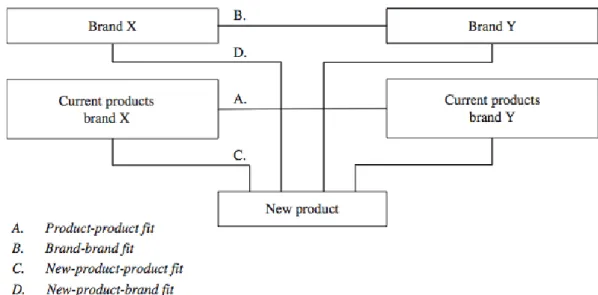
According to previous research, there are four fit measures that allow us to understand the compatibility between the product categories involved in the co-branding strategy and also between the images of the two brands (Bouten et al, 2011). The first two fit measures – product-product fit and brand-brand fit were previously studied by authors such as Park, Youl Jun and Shocker (1996) and Simonin and Ruth (1998). The other two – new-product-product fit and new-product-brand fit were introduced more recently in the research by Bouten et al (2011).
Figure 1 - An Extended Model of Fit Measures that Influence the Evaluation of a Co-branded
Product
Source: Bouten et al., 2011
The first type of fit, known as “product-product fit”, can be defined as “the extent to which consumers perceive the products categories of both brands to be compatible at the functional product level” (Bouten et al., 2011, p. 457). The higher the product-product fit, the more easily consumers will combine their favorable attitudes towards the current products, and the more easily they will transport these positive attitudes to new co-branded products (Bouten et al., 2011).
According to Simonin and Ruth (1998) consumers evaluate co-branded products in the context of brand meanings, so “brand-brand fit” can be defined
as “complementarities between the brand-unique associations that consumers have with both brands” (Bouten et al., 2011, p. 457). Brand-unique associations can be defined as the associations that allow consumers to differentiate a brand from another brand in the same category (Broniarczyk and Alba, 1994). If these associations complement each other, consumers will see a connection between the brands’ images, which leads to a higher brand-brand fit (Bouten et al., 2011). According to Keller, 1993, consumers usually recover certain associations related to brands that are saved in their memory, and which form the brand image. Thus, “if the associations of both brands complement to some extent, consumers see a connection between the brands at the image level, leading to a higher “brand-brand fit”” (Bouten et al., 2011, p. 458).
The third type of fit is “new product-product fit”, and it is determined via a “categorization process in which the consumer assesses the extent to which the new products exemplify a general concept by comparing features of existing products with those of the new products” (Bouten et al., 2011, p. 458). If consumers do not find a fit between the existing products and the new product, this will lead them to think that the extension is worthless (Bouten et al., 2011).
Lastly, “new product-brand fit” is related to the fact that consumers may “categorize a new product based on a shared concept formed by brand-unique associations. These associations may be supported by a certain style of communications or by a product design that carries brand relevant meaning” (Bouten et al., 2011, p. 458-459).
2.3 – Brand Extensions and Co-Branding
After doing research on the definition of co-branding, its advantages, the characteristics that partner brands should have, and also on the different fit measures, we are now going to focus on brand extensions and how they are connected with co-branding strategies.
Since the main goal of co-branding is “to launch a new product, it sometimes is referred to as a special case of brand extension” (Park, Jun and Shocker, 1996, cited by Besharat, 2010, p. 1240), which occurs when “companies use an established brand to launch new products” (Besharat, 2010, p. 1241).
As we have seen in the co-branding chapter, according to Helmig et al. (2008), two scenarios for co-branding are possible: vertical co-branding and horizontal co-branding. Regarding horizontal co-branding, it may involve the launch of a new product belonging to a category where only one producer is established or where none of the producers are established. In the last case, the co-branding strategy is equivalent to a brand extension, differing only in the fact that brand extensions involve just one brand and co-branding includes two or more brands (Helmig et al., 2008).
It is important to notice that both a brand extension and a co-branding strategy have as their main goal to improve consumers’ response toward the brand, and also to improve customers’ value perceptions about the new product (Helmig et al., 2007). Beyond that, the lower cost of advertising and promotions is another strong motive for a brand extension (Besharat, 2010).
Furthermore, co-branding and brand extension have other relevant benefits and also a few disadvantages. A co-branding strategy can be considered more advantageous for a brand than a brand extension since the “invited” brand can increase consumers’ value perceptions towards the “host” brand. Without the new partner, the “host” brand would not be able to achieve this result (Helmig et al., 2008). On the other hand, it can be prejudicial for brands if the two brands do not fit or if consumers create negative value perceptions about the “host” brand and spread it to the other brand.
2.4 – Brand Gender
One of the main goals of this research is to assess the importance of brand gender on the evaluation of new co-branded products.
“To build a strong gender association, brands use symbols, signs and codes referring to these feminine and masculine values in their narratives, advertising, products and retailing” (Nyeck, 2007, p.4).
It then becomes important to clarify this concept, and attempt to understand the reason why it is so difficult for brands that are clearly feminine to attract more masculine targets and vice-versa.
Gender difference always played an important role in the way consumers perceive and relate to brands, and consumption behavior normally follows one gender identity (Friedman, 2013) – masculine or feminine. Therefore, we can apply the same rules to brands, since usually consumers choose the brands that enhance their gender identity.
Brand gender is one important dimension of brand personality. Brand personality can be defined as “the set of human characteristics associated with a brand” (Aaker, 1997, p. 347) and usually consumers express their personalities through the brands they choose to buy (Grohmann, 2009).
It is important to notice that brand personality is a key concept, since consumers tend to associate human personality traits with brands because they relate to brands as they would to partners or friends (Fournier, 1998), and they tend to perceive brands as extensions of themselves (Belk, 1988), but also because marketers suggest that brands have certain personality traits (Grohmann, 2009).
Congruity between these characteristics or human personality traits who describe both the human and the brand are important because “the greater the congruity between the human characteristics that consistently and distinctively describe an individual’s actual or ideal self and those that describe a brand, the
greater the preference for the brand” (Aaker, 1997, p. 348). As so, Aaker identified on this same research five dimensions of brand personality: sincerity, excitement, competence, sophistication and ruggedness, as we can see in the table below.
Figure 2 - Five Dimensions of Brand Personality
Source: Aaker, 1997
Consumers tend to see brands as they see the people who are familiar to them, thus the perception they form about a brand is normally based on these five dimensions, as if they were five personality attributes.
Levy (1959) also suggests that brand personality includes personality attributes and demographic characteristics, like age, gender, and class. It is then possible to acknowledge that a brand can have human traits of personality, and have their own gender as being male or female. This is another relevant concept to this study, and it is classified as the gender dimensions of brand personality. These gender dimensions can be defined as “the set of human personality traits associated with masculinity and femininity applicable and relevant to brands” (Grohmann, 2009, p. 106).
According to Burr (1988, cited by Ulrich, 2013, p. 795), “biological sex defines men and women by their physical characteristics, genital organs and chromosomes. By contrast, gender is a sociocultural concept, representing the set of characteristics and behaviors that a given society associates and ascribes differently to women and men”.
Men are “guided by self goals, while women pursue other communal concerns” (Feiereisen et al., 2009, p. 815). Also, the more strongly men (women)
hold to traditional gender attitudes, the more they prefer the brand presented as masculine (feminine) in advertising” (Ulrich, 2013, p. 796).
Brand gender is a key brand personality trait, since gender is “a sociocultural concept, representing the set of characteristics and behaviors that a given society associates and ascribes differently to women and men” (Ulrich, 2013, p. 795); gender is also a combination of many connected factors which are intertwined in a way that they can influence human behavior in certain contexts, while other factors may not be so important (Ulrich, 2013).
Although brand gender is a critical brand personality trait, there is a lack of studies in this field. However, Grohmann (2009) has had an important contribute on this field. According to this author, brands can also have a gender, and they can have masculinity brand personality traits (MBP) and femininity brand personality traits (FBP), which are considered the two gender dimensions of brand personality and are applicable and relevant for brands (Grohmann, 2009).
One of the main goals of the present study is to complement previous research on brand gender and to understand the influence of brand gender on the evaluation of new co-branded products.
According to Grohmann (2009), MBP and FBT traits are important because masculinity and femininity are two critical dimensions of personality, as previously explained, but they are also important because consumers need to express themselves and their masculinity or femininity through their brand choices and purchases.
According to the same author, gender dimensions of brand personality influence “affective, attitudinal and behavioral consumer responses positively when they are congruent with consumers’ sex role identity and thus enable consumers to express an important dimension of their self-concept” (Grohmann, 2009, p. 116). The influence of brand gender on consumers’ attitude is precisely what we are testing on this study.
Grohmann (2009) also pointed out that “gender dimensions of brand personality affect brand-related consumer responses, including brand extension evaluations when the extension category is associated with specific gender dimensions” (Grohmann, 2009, p.116), especially when it is related to personal care brands and clothing, which are the product categories we have chosen for this study. These conclusions can guide us throughout our study. Since a brand extension is a particular type of a brand alliance, probably the findings will also apply to cases of co-branding strategies.
Grohmann (2009) also shows that the congruency between consumer gender identity and masculinity/femininity personality traits of the brand leads to a more favorable evaluation of the brand.
Grohmann (2009) is not alone in defending the influence of brand gender on the evaluation of the new product. Jung and Lee (2006, cited by Ulrich, 2013, p. 796) “the gender of the parent brand influences the evaluation of cross-gender brand extensions". They also point out that the extension is better accepted when made from a masculine brand targeting females (Jung and Lee, 2006). Jung and Lee (2006) also defend that brand gender has influence over the evaluation of a cross-gender extension and, at the same time, it influences the acceptance of a cross-gender extension.
MBP and FBP traits will be important in this study in order to identify which brands are seen as masculine or feminine by respondents, and to study how brand gender perceptions impact on the evaluation of a new co-branded product.
A brand extension can be made from a masculine brand into a feminine product category or vice-versa, although some brands that had success with their initial targets have come to find some difficulties with their extensions into the opposite target (Ulrich, 2013). However, not only biological sex, or if we want physical traits, influence the acceptance of an extension by a consumer (Ulrich, 2013). Ulrich (2013) also concludes that men are as receptive as women
to a brand extension, with no differences in terms of attitude, purchase intent and fit. Ulrich (2013) also states that it is possible for companies to do a brand extension into the opposite gender in countries with high femininity or in western countries with similar levels of masculinity/femininity.
According to several authors, the multifactorial gender theory (Ashmore, 1990; Athenstaedt, 2003, Aube, Norcliffe and Koestner, 1995; Liben and Bigler, 2002; Signorella and Frieze, 2008; Tobin et al., 2010 and Twenge, 1999) plays an important role in the acceptance of a brand extension from a male to a female product category, or the contrary, because there should be a relation between dimensions such as gender identity, gender role, attitudes, and behaviors (Aube and Koestner, 1995; Spence and Buckner, 2000; Twenge, 1999).
2.5 – Familiarity
There are some studies that show how important brand familiarity can be in a brand alliance. One of the most relevant studies was done by Simonin and Ruth (1998).
According to Simonin and Ruth (1998), two brands with different levels of familiarity will not contribute the same way to the brand alliance, being the most familiar brand the one that will contribute the most. Although, Simonin and Ruth (1998) also point out that, despite one of the brands being unable to contribute as much as the other, the one that provides a smaller contribution will benefit the most from the brand alliance.
These authors also defend that the more familiar the brands involved in the brand alliance are, the more positive consumers’ attitude will be, and vice-versa.
2.6 – Attitude
According to Simonin and Ruth (1998), “attitudes or beliefs are formed and modified as people receive, interpret, evaluate and then integrate stimulus information with existing beliefs or attitudes” (Simonin and Ruth, 1998, p. 32).
Simonin and Ruth (1998) also defend that consumers’ attitudes towards a brand alliance are influenced by different factors, such as the existing attitudes towards each brand involved in the alliance, as well as the fit between the products and also between the brands.
Czellar (2003) also argues that consumers evaluate a brand extension based on their attitude towards the parent brand and the extension category. If consumers have not heard about neither the parent brand nor its products, they will evaluate the extension based only on their experience with the product category in which the extension is included. On the other hand, if consumers are not familiar with the brand extension product category, their evaluation will be done based on their attitudes towards the parent brand (Czellar, 2003). However, if consumers are familiar with both the parent brand of a brand extension, and the brand extension product category, they will evaluate the extension based on their “perception of fit between the parent brand and the extension category” (Czellar, 2003, p. 99).
Chapter III
Method
3.1 – Research Paradigm
There are two types of research methods: the qualitative and the quantitative (Latorre et al, 1996), and in this research we will use the latter.
The theoretical background previously presented allowed us to comprehend the most relevant concepts for the development of this research, namely the variables that influence consumer's evaluation of the new co-branded product, such as the different types of fit, familiarity and brand gender.
As we referred at the beginning of this chapter, a quantitative research will be conducted. This type of research is commonly preferred, since collecting data from a sample of individuals makes it is possible to understand the behavior of an entire population (Raupp and Beuren, 2003).
In this research, the data collection technique used was a questionnaire and the data was collected via online survey between May and June of 2016 and at two University classes – Faculty of Pharmacy of the University of Porto and School of Management, Hospitality and Tourism of the University of Algarve.
3.2 – Research Design
Previous studies have underlined the advantages of co-branding. However, there is a lack of research on the influence of brand personality and, particularly, brand gender on the evaluation of a new co-branded product.
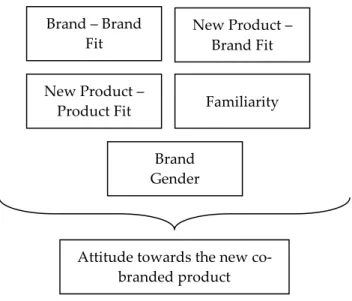
In order to fill this gap, this research intends to assess the influence of brand gender on consumer’s evaluation of a new co-branded product, through the analysis of consumer’s attitude towards the new co-branded product. Following, we present the research model.
In order to give response to our research model, we chose two product categories: personal care and fashion. The choice of these two product categories has to do with the fact that they are affordable for young adults, who usually buy their own clothes and personal care products, since as they are closely linked to their personal taste.
We needed to do a pre-test in order to identify appropriate brands to include in this study. Therefore, we presented a sample of 65 respondents, most of them from Porto, including students and workers, with a list of well-known fashion and personal care brands. The pre-test allowed us to identify which brands are more familiar to our target, and also to evaluate if the chosen brands were perceived as masculine or as feminine brands (see table 5).
According to our results, the personal care brands considered by respondents as the most masculine and familiar are Axe and Gillette, while Dove and Maybelline are the most familiar and feminine brands in this
Figure 3 - Research Model
Source: Own construction
Attitude towards the new co-branded product Familiarity New Product – Brand Fit Brand – Brand Fit New Product – Product Fit Brand Gender
category. In regard to fashion brands, Levis and Carhartt were considered the most masculine, but Levis was the most familiar brand (we think the familiarity levels of Carhartt were lower due to the high average age of our respondents – 35 years old). Regarding most feminine fashion brands, Mango and Bimba y Lola achieved the best results in terms of familiarity, Mango being the most recognized of the two.
Taking into account the balance between the masculinity/femininity and familiarity of the brands, we chose Axe and Dove (personal care brands), and Mango and Levis (fashion brands) in order to create two co-branding scenarios. The first one targets males and includes Dove (“host” brand) and Levis (“invited” brand), while the other scenario includes Axe (“host” brand) and Mango (“invited” brand), and aims to target females. With the creation of these two co-branding scenarios, we aim to understand in which way a brand that is well established within a target with a specific gender, can take advantage of a co-branding strategy with a brand that targets the opposite gender.
3.3 – Study Variables
3.3.1 – Independent Variables
Although we have not considered product category gender as an independent variable in our study, it seemed important to assess how much respondents perceived the fashion and personal care product categories as being masculine or feminine. In order to evaluate this perception, we asked our respondents to express, using a Likert scale from 1 to 7, if the product category is regarded as “not masculine at all” or “extremely masculine”, as well as if it is perceived as “not feminine at all” or “extremely feminine”.
According to some authors, as Simonin and Ruth (1998), Helmig et al. (2007), Lafferty (2009) and Bouten et al. (2011), measures of fit are important since
brand-brand fit, new product-brand fit and new product-product fit are key measures to the success of a co-branding strategy.
The first independent variable considered in our study is brand-brand fit. According to Simonin and Ruth (1998), the brand-unique associations that consumers have with both brands involved in a co-branding strategy should be complementary. In order to measure this variable, we will use a 7 point Likert scale, (1 – completely disagree; 7 – completely agree) adapted from previous studies (Simonin and Ruth, 1998, Park et al., 1996 and Bouten et al., 2011), (see table 1).
Brand-brand fit
I consider that brand A and brand B are consistent (Simonin and Ruth, 1998; Park et al., 1996; Bouten et al., 2011);
I consider that brand A and brand B are complementary (Simonin and Ruth, 1998; Park et al., 1996; Bouten et al., 2011);
I consider that brand A fits brand B (Bouten et al., 2011);
Table 1 – Brand-brand fit
Source: Adapted from Bouten et al., 2011
Another independent variable of this study is new product-brand fit, which has to do with the fit between each brand and the new co-branded product, as we could see in the theoretical background. To evaluate this variable, we will use a 7 point Likert scale (1 – completely disagree; 7 – completely agree) with the items used by Bouten et al. (2011) (see Table 2).
New product-brand fit
I consider that brand X and the new product complement each other (Bouten et al., 2011) I consider that brand X fits the new product (Bouten et al., 2011)
I consider the new product adds something to brand X (Bouten et al., 2011) I consider this a very appropriate product for brand X (Bouten et al., 2011)
Table 2 – New product-brand fit
Source: Adapted from Bouten et al., 2011
Other than that, we also included new product-product fit in our model, which is related to the link between the new product and the actual products the company has, and in which consumers compare the features of the new product with the features of the existing products. To evaluate this variable, we shall use a 7 point Likert Scale (1 – completely disagree; 7 – completely agree), adapted from Bouten et al. (2011) study (see Table 3).
New product-product fit
I consider that the new product complements the current products of brand X (Aker and Keller, 1990; Bouten et al., 2011)
I consider that the new product fits the current products of brand X (Bouten et al., 2011)
Table 3 – New product-product fit
Source: Adapted from Bouten et al., 2011
According to Simonin and Ruth (1998) and Bouten et al. (2011), familiarity can influence the evaluation of a co-branding strategy, hence with decided to include familiarity in our research model. This variable will be measured through a 7 point Likert scale (1 – completely disagree; 7 – completely agree) previously used by Simonin and Ruth (1998) and Bouten et al. (2011) (see Table 4).
Familiarity
I am familiar with brand X (Simonin and Ruth, 1998; Bouten et al., 2011); I recognize brand X (Simonin and Ruth, 1998; Bouten et al., 2011); I have heard of brand X before (Simonin and Ruth, 1998; Bouten et al., 2011);
Table 4 – Familiarity
Source: Adapted from Bouten et al., 2011
As previously explained, the main goal of this research is to understand how brand gender influences the evaluation of a co-branding strategy and, in particular, how the brand gender of the invited brand influences consumers’ attitude towards the new co-branded product.
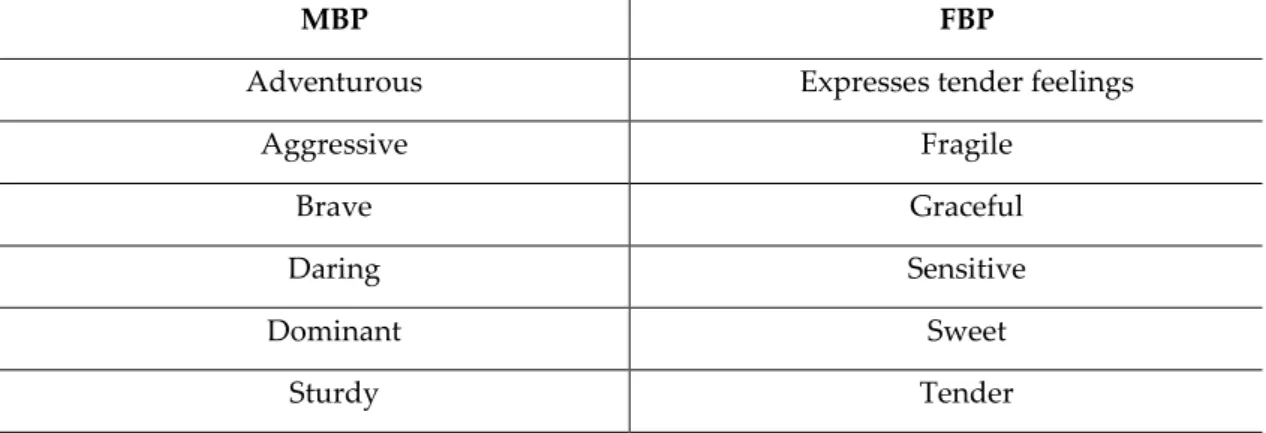
In order to measure the brand gender of the brands involved in our co-branding scenarios, we will use the brand personality traits defined by Grohmann (2009) to access MBP (Masculinity Brand Personality) and FBP (Feminine Brand Personality). These brand personality traits are measured using a 7 point Likert scale (1 – completely disagree; 7 – completely agree) (see Table 5).
MBP FBP
Adventurous Expresses tender feelings Aggressive Fragile
Brave Graceful Daring Sensitive Dominant Sweet
Sturdy Tender
Table 5 – Brand Personality Traits
3.3.2 – Dependent Variable
In order to measure consumer’s evaluation of the new co-branded product, we will use the attitude towards the new co-branded product as our dependent variable.
To measure this variable, we will use a 7 points Likert Scale (1 – completely disagree; 7 – completely agree), including the items used by Bouten et al. (2011) (see Table 6).
Attitude towards the new co-branded product
I consider that the new co-branded product is pleasant (Samu et al., 1999; Bouten et al., 2011)
I consider that the new co-branded product is favorable (Simonin and Ruth, 1998; Samu et al., 1999; Bouten et al., 2011)
I consider that the new co-branded product is interesting (Grossman and Till,1998; Bouten et al., 2011)
I consider that the new co-branded product is good (Simonin and Ruth, 1998; Samu et al., 1999; Bouten et al., 2011)
I consider that the new co-branded product is positive (Simonin and Ruth, 1998; Grossman and Till, 1998; Bouten et al., 2011)
Table 6 – Attitude towards the new co-branded product
Source: Adapted from Bouten et al., 2011
3.4 – Hypotheses
As already mentioned in the theoretical background, brand fit can be defined as the consumers’ perceptions regarding the images and associations between the two brands involved in a co-branding strategy (Helmig et al., 2007). According to Bouten et al. (2011), if the associations that consumers’ have about the two brands complement each other, this will lead to a high brand-brand fit and to a better evaluation of the co-branding strategy. Thus, we recognize that:
H1: Brand-brand fit positively influences attitude towards the new co-branded
product.
Besides, according to Bouten et al. (2011), consumers tend to categorize the new product based on a concept formed by a certain style of communications or by a product design. A so, the consistency between the image of the brands involved in the co-branding and the new co-branded product is important and may influence the evaluation of the new co-branded product. Thus, we hypothesize that:
H2: New product-brand fitpositively influences attitude towards the new co-branded
product.
According to Bouten et al. (2011), consumers determine new product-product fit by comparing the features of the existing product-products with the features of the new product. The consistency between the original product categories of each brand involved in the co-branding strategy and the new co-branded product also influences consumer's evaluation of the co-branding strategy. Therefore, we acknowledge that:
H3: New product-product fit positively influences attitude towards the new
co-branded product.
Regarding familiarity, Simonin and Ruth (1998) suggest that the more familiar the brands are, the more positive consumers’ attitude towards the new co-branded product will be. Therefore, we assume the following hypothesis:
H4: Familiarity positively influences attitude towards the new co-branded product.
To our knowledge there are a few studies showing the influence of brand gender on the attitude towards a new product launched by the brand. Although, these studies analyze the influence of brand gender in the case of a brand extension, more specifically cross gender extensions (Jung and Lee, 2006; Grohmann, 2009; Ulrich, 2013). With this research, we aim to understand if we can apply the findings of these studies to another type of brand strategy, namely a co-branding strategy.
Brand gender can significantly influence consumers’ attitudes towards the brand since consumers tend to associate human personality traits, such as gender, to brands. This happens because consumers tend to see brands as an extension of themselves and relate to them as if they were their family or friends (Grohmann, 2009). Moreover, consumers feel the need to express their gender identity, as being male or female, through the brands they choose to buy (Grohmann, 2009). Thus, brand gender is a key concept that can affect consumer's response towards the brand strategy and significantly influence consumers’ evaluation of a new co-branded product. Considering the results of previous studies, we intend to show that a brand which is clearly perceived as masculine (feminine) and wants to target the opposite gender, i.e., females (males), can take advantage of a co-branding strategy with an “invited” brand that is already well-established within this gender.
Grohmann (2009) suggests that, in the context of a brand extension, the fit between the gender dimensions of brand personality and the gender perceptions associated with the extension category, favorably influence consumers’ evaluations of the new product and their purchase intentions. Furthermore, Grohmann (2009) also highlights the importance of the gender dimensions of brand personality in the particular case of brand extensions of personal care and clothing brands, which are the two product categories considered in this study. Besides that, the author refers that “gender dimensions of brand personality affect brand-related consumer responses, including brand extension evaluations” (Grohmann, 2009, p. 116).
Jung and Lee (2006) also argue that the gender of the brand influences the evaluation of a cross-extension. The authors find that consumers’ attitudes are more favorable when the brand extension is made by a masculine brand which wants to enter in the female market.
Taking into account the findings of previous research, we assume the following hypothesis:
H5: The greater the extent to which consumers perceive the invited brand as strongly
feminine (masculine) in the case of a co-branding strategy targeting women (men), the more favorable their attitude towards the new co-branded product will be.
Chapter IV
Study Results
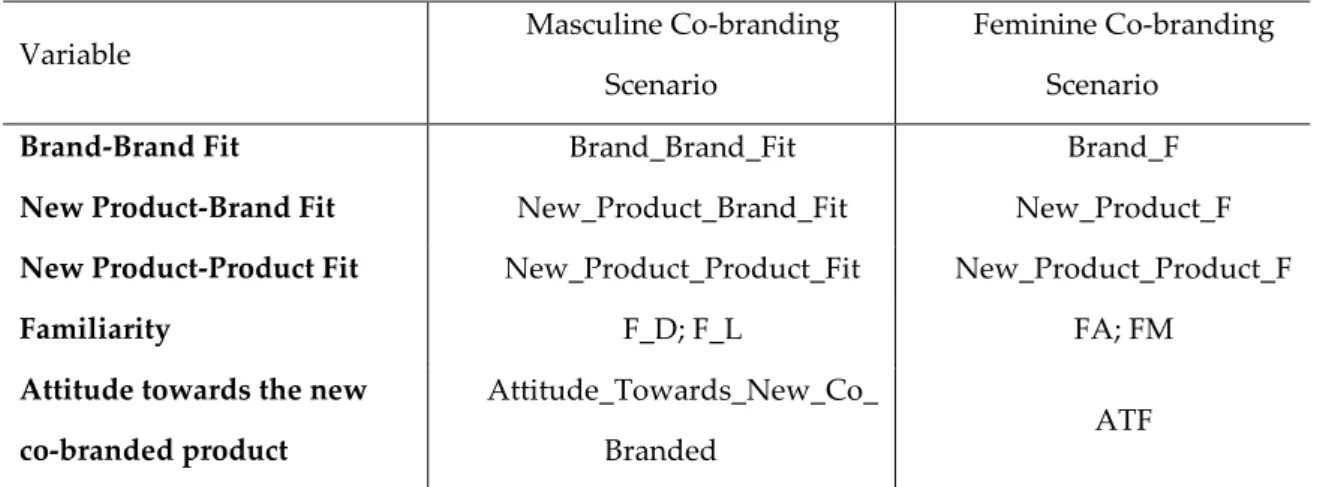
The main goal of this chapter is to analyze the results of our questionnaire. We shall start by doing a brief description of the structure of the questionnaire, followed by a sociodemographic characterization of the sample. Next, we will do the descriptive analysis of the gender of each product category in study, as well as the brand gender of the brands involved in the co-branding scenarios and their familiarity. Finally, we will present the statistical analysis, which includes a reliability test and hypotheses testing. It is important to notice that in this chapter we will present different names for the variables used at SPSS – see Table 7.
Variable Masculine Co-branding Scenario
Feminine Co-branding Scenario
Brand-Brand Fit Brand_Brand_Fit Brand_F
New Product-Brand Fit New_Product_Brand_Fit New_Product_F
New Product-Product Fit New_Product_Product_Fit New_Product_Product_F
Familiarity F_D; F_L FA; FM
Attitude towards the new co-branded product
Attitude_Towards_New_Co_
Branded ATF
Table 7 – Definition of the variables in the study
4.1 – Structure of the questionnaire
The questionnaire presented to the respondents has two versions – one presented to males and another presented to females, since the co-branding scenarios are different, depending on whether the respondent is a man or a woman. As previously explained, all scales were adapted from previous studies.
The first question is related to the gender identity of the respondents. After this, we asked respondents to classify the masculinity/femininity of the first product category in study – personal care – according to a 9 point Likert scale.
The following questions aim to measure the brand gender and familiarity of the first brand studied (the host brand). We asked respondents to classify the brand as “a man”, “a woman”, “both a man and a woman” or “neither a man or a woman”. After these two questions, we asked respondents to describe the brand according to the masculinity and femininity personality traits, using a 7 point Liker scale, from 1 -“completely disagree” to 7- “completely agree”.
The same questions were presented for the other product category studied – fashion – and for the second brand involved in the co-branding scenario (the invited brand).
The next three questions are related to the co-branding scenario. First of all, we presented the co-branding scenario, describing the brands involved in the co-branding strategy and the characteristics of the new product. After this, using a 7 point Likert scale, we asked respondents to answer the questions related to brand-brand fit, new product-brand fit and new product-product fit. Next, we measured the attitude towards the new co-branded product.
Ultimately, respondents answered questions related to their age, level of education, occupation and district of residence.
Respondents by gender
Masculine Feminine
4.2 – Sociodemographic characterization of the sample
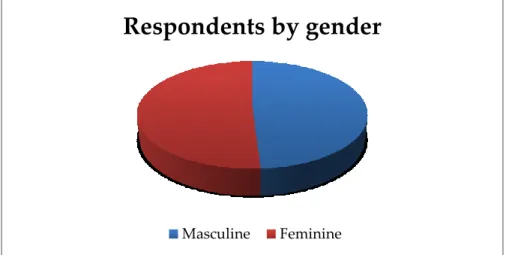
The sample of our investigation was constituted by a total of 155 respondents. 79 were female and 76 were male, making up 51% and 49% of our sample, respectively – see Figure 4.
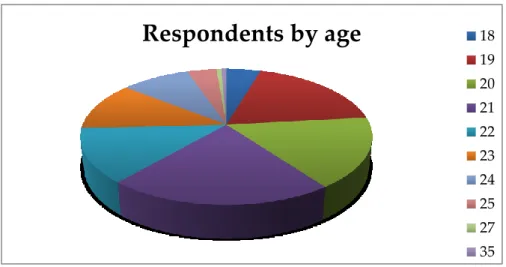
In terms of age, our respondents belong in the age range of 18-35 years old. Even though this is quite wide, those aged 19-21 years old constituted 56,8% of the whole sample – representing 18,7%, 16,8% and 21,3 % of its total, respectively.
Respondents aged 18 years old represent 4,5% of the sample, 22 years old constitute 12,9 %, 23 years old 11,6%, and those aged 24, 25, 27 and 35 years old make up only 9,0%, 3,9%, 0,6%, 0,6% of the sample, respectively – see Figure 5.
Figure 4 - Respondents by gender
Respondents by education
Secondary education BsC MsC/Post Graduation Other Middle schoolRespondents by age
18 19 20 21 22 23 24 25 27 35Regarding education, most respondents either have a secondary education (54,2%) or a higher education (40%). The ones that have a Master’s Degree/Post Graduation constitute only 3,9% of our sample, the ones that only finished middle school 1,3 % and others 0,6% – see Figure 6.
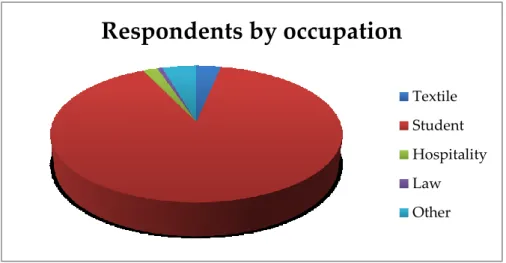
In terms of occupation, 89,7% of the respondents were students, while other reported jobs in various industries, such as textile (3,2%), hospitality (1,9%), law (0,6%) and others (4,5%) – see figure 7.
Figure 6 - Respondents by education
Source: SPSS Output
Figure 5 - Respondents by age
Regarding the distribution of residents by district, the majority are from Porto (49,0%), Faro (23,2%), Braga (10,3%) and Aveiro (11,0%). There are also respondents from Viana do Castelo (1,9%), Viseu (1,9%), Lisbon (1,9%), and Bragança (0,6%) – see Figure 8.
4.3 – Descriptive Analysis
In order to understand how respondents perceived the gender of the product categories in this study, the gender of the chosen brands and their familiarity
Respondents by occupation
Textile Student Hospitality Law OtherRespondents by district of
residence
Braga Porto Lisboa Aveiro Viana do Castelo Viseu Faro BragançaFigure 7 - Respondents by occupation
Source: SPSS Output
Figure 8 - Respondents by district of residence
with the brands, we will present in this sub-chapter a brief descriptive analysis of their answers. We will divide the descriptive analysis in two sub-chapters, one representing the masculine co-branding scenario, and the other the feminine co-branding scenario.
4.3.1 – Masculine co-branding scenario
With the aim to understand if our male respondents perceived the product categories under analysis – personal care and fashion – as masculine or feminine, we asked them to classify the masculinity and femininity of these product categories using a Likert Scale ranging from 1 – “not masculine at all” to 9 – “extremely masculine”, and from 1 – “not feminine at all” to 9 – “extremely feminine”.
It is important to keep in mind that the two brands involved in the masculine co-branding scenario are Dove and Levis.
As we can see in Table 8, male respondents have regarded both personal care and fashion as feminine product categories (μ=6.22 and μ=6.74, respectively). However, they also considered that both product categories have moderate levels of masculinity (μ=5.01 and μ=5.13, respectively), since these values are only slightly over the mid-level of our scale (μ=5).
N Min Max Mean Std. Deviation Masculinity of personal care 76 1 9 5.01 1.58 Femininity of personal care 76 1 9 6.22 1.72 Masculinity of fashion 76 1 9 5.13 1.71 Femininity of fashion 76 1 9 6.74 1.66 Valid N (listwise) 76
Table 8– Levels of masculinity and femininity of the product categories
In terms of the brand gender of the brands involved in this co-branding scenario, after careful examination of the results presented in Table 9, we conclude that male respondents consider Dove as a feminine brand (FBP
μAggregate=4.78), as Dove's FBP μAggregate is above the mid-level of our scale (μ=4).
They also think that Dove has low levels of masculinity (MBP μAggregate=2.86) –
see Table 9.
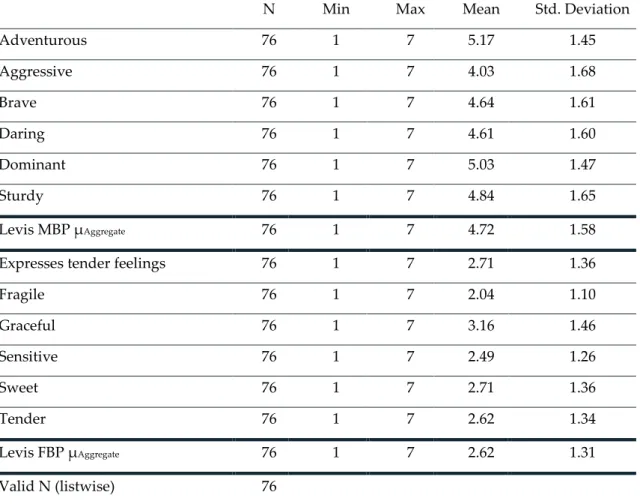
Regarding Levis, respondents consider that this brand has more masculine personality traits than feminine personality traits (MBP μAggregate=4.72>FBP
μAggregate=2.62) – see Table 10. Based on these results, we conclude that male
respondents consider Levis to be a masculine brand (MBP μAggregate=4.72>μ=4). Table 9– Dove MBP and FBP Traits
Source: Adapted from SPSS Output
N Min Max Mean Std. Deviation Adventurous 76 1 7 2.92 1.52 Aggressive 76 1 7 1.91 1.26 Brave 76 1 7 3.03 1.43 Daring 76 1 7 3.22 1.61 Dominant 76 1 7 3.28 1.73 Sturdy 76 1 7 2.80 1.57 Dove MBP μAggregate 76 1 7 2.86 1.52
Expresses tender feelings 76 1 7 5.00 1.66 Fragile 76 1 7 3.99 1.67 Graceful 76 1 7 4.64 1.67 Sensitive 76 1 7 4.95 1.58 Sweet 76 1 7 4.97 1.62 Tender 76 1 7 5.13 1.62 Dove FBP μAggregate 76 1 7 4.78 1.64 Valid N (listwise) 76
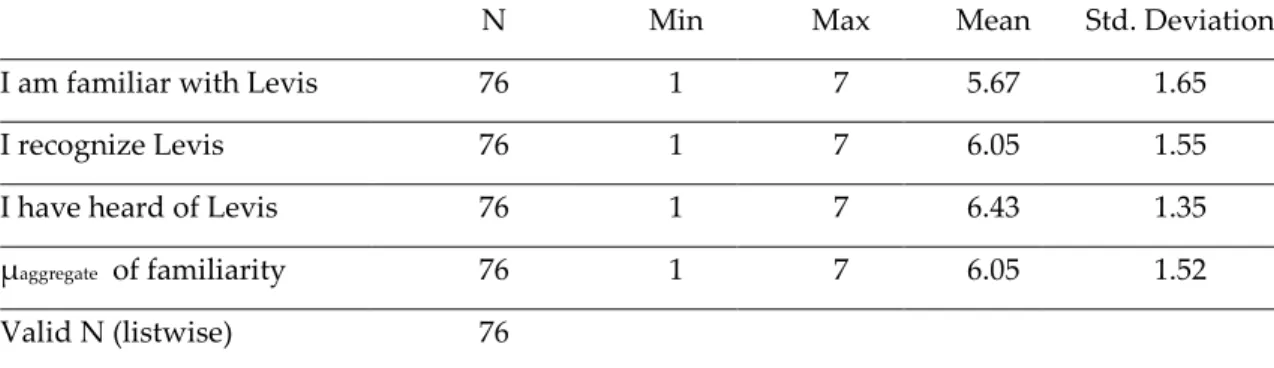
Finally, after analyzing the familiarity of the brands involved in this co-branding strategy, we conclude that respondents are familiarized with both Dove and Levis – see Table 11 and 12. However, as we can see in the tables below, they are slightly more familiarized with Levis than they are with Dove (Dove μaggregate=5.89<Levis μaggregate=6.05).
N Min Max Mean Std. Deviation Adventurous 76 1 7 5.17 1.45 Aggressive 76 1 7 4.03 1.68 Brave 76 1 7 4.64 1.61 Daring 76 1 7 4.61 1.60 Dominant 76 1 7 5.03 1.47 Sturdy 76 1 7 4.84 1.65 Levis MBP μAggregate 76 1 7 4.72 1.58
Expresses tender feelings 76 1 7 2.71 1.36 Fragile 76 1 7 2.04 1.10 Graceful 76 1 7 3.16 1.46 Sensitive 76 1 7 2.49 1.26 Sweet 76 1 7 2.71 1.36 Tender 76 1 7 2.62 1.34 Levis FBP μAggregate 76 1 7 2.62 1.31 Valid N (listwise) 76
Table 10 – Levis MBP and FBP Traits
4.3.2 – Feminine co-branding scenario
The brands involved in the feminine co-branding scenario are Axe and Mango.
First of all, we should highlight that the results related to the masculinity and femininity of the product categories personal care and fashion, are similar to the ones obtained for the masculine co-branding scenario. Female respondents also consider personal care and fashion as feminine product categories (μ=6.47 and μ=6.75, respectively) – see Table 13.
N Min Max Mean Std. Deviation I am familiar with Dove 76 1 7 5.21 1.64 I recognize Dove 76 1 7 6.07 1.37 I have heard of Dove 76 1 7 6.38 1.22
μaggregate of familiarity 76 1 7 5.89 1.41
Valid N (listwise) 76
Table 11 – Familiarity of Dove
Source: SPSS Output
Table 12 – Familiarity of Levis
Source: SPSS Output
N Min Max Mean Std. Deviation I am familiar with Levis 76 1 7 5.67 1.65 I recognize Levis 76 1 7 6.05 1.55 I have heard of Levis 76 1 7 6.43 1.35
μaggregate of familiarity 76 1 7 6.05 1.52
Regarding the brand gender of Axe, as we can see in Table 14, female respondents consider Axe to be a masculine brand (MBP μAggregate=4.52>μ=4),
since the mean value is above the mid-level of our scale (μ=4).
Table 13 – Levels of masculinity and femininity of the product categories
Source: Adapted from SPSS Output
N Min Max Mean Std. Deviation Masculinity of personal care 79 1 9 4.67 1.65 Femininity of personal care 79 1 9 6.47 1.62 Masculinity of fashion 79 1 9 4.76 1.63 Femininity of fashion 79 1 9 6.75 1.54 Valid N (listwise) 79
N Min Max Mean Std. Deviation Adventurous 79 1 7 4.80 1.50 Aggressive 79 1 7 3.51 1.92 Brave 79 1 7 4.38 1.51 Daring 79 1 7 4.97 1.71 Dominant 79 1 7 5.16 1.49 Sturdy 79 1 7 4.29 1.65 Axe MBP μAggregate 79 1 7 4.52 1.63
Expresses tender feelings 79 1 7 2.62 1.46 Fragile 79 1 7 1.85 0.99 Graceful 79 1 7 2.68 1.48 Sensitive 79 1 7 2.47 1.43 Sweet 79 1 7 2.86 1.60 Tender 79 1 7 2.49 1.37 Axe FBP μAggregate 79 1 7 2.50 1.39 Valid N (listwise) 79
Table 14 – Axe MBP and FBP Traits
On the other hand, female respondents think of Mango as an undifferentiated brand, as they consider that Mango has almost the same levels of masculinity and femininity (Mango MBP μAggregate=3.98 and Mango FBP
μAggregate=3.97) – see Table 15.
Concerning the familiarity of the brands involved in the feminine co-branding scenario, respondents are familiar with both brands. Even if the levels of familiarity are high for both brands, it is evident that respondents are more familiar with the invited brand – Mango – (Mango μaggregate=6.35) than they are
with the host brand – Axe – (Axe μaggregate=5.91) – see Table 16 and Table 17.
N Min Max Mean Std. Deviation Adventurous 79 1 7 4.28 1.27 Aggressive 79 1 7 2.66 1.39 Brave 79 1 7 4.10 1.42 Daring 79 1 7 4.72 1.48 Dominant 79 1 7 4.62 1.60 Sturdy 79 1 7 3.49 1.63 Mango MBP μAggregate 79 1 7 3.98 1.46
Expresses tender feelings 79 1 7 3.89 1.55 Fragile 79 1 7 2.91 1.47 Graceful 79 1 7 4.47 1.46 Sensitive 79 1 7 4.04 1.56 Sweet 79 1 7 4.33 1.39 Tender 79 1 7 4.20 1.52 Mango FBP μAggregate 79 1 7 3.97 1.49 Valid N (listwise) 79
Table 15 – Mango MBP and FBP Traits
4.4 – Statistical Analysis
We will start this analysis by doing a reliability test to all the variables included in our study, in order to measure the internal consistency of our variables. Afterwards, we will move on to the hypotheses testing. These tests will allow us to verify if the hypotheses presented in the previous chapter can be confirmed.
N Min Max Mean Std. Deviation I am familiar with Axe 79 1 7 5.13 1.78 I recognize Axe 79 1 7 6.15 1.30 I have heard of Axe 79 1 7 6.46 1.03
μaggregate of familiarity 79 1 7 5.91 1.37
Valid N (listwise) 79
Table 16 – Familiarity of Axe
Source: SPSS Output
N Min Max Mean Std. Deviation I am familiar with Mango 79 1 7 6.10 1.37 I recognize Mango 79 1 7 6.44 1.09 I have heard of Mango 79 1 7 6.52 1.26
μaggregate of familiarity 79 1 7 6.35 1.24
Valid N (listwise) 79
Table 17 – Familiarity of Mango
4.4.1 – Reliability
4.4.1.1 – Reliability (Masculine)
According to an N=76, we calculated the Cronbach’s Alphas for the variables referring to the masculine co-branding scenario – see Table 18 below.
Items N of items Cronbach’s Alpha
Brand-Brand Fit 3 .786 New Product-Brand Fit 4 .884 New Product-Product Fit 2 .767 Dove MBP Traits 6 .965 Dove FBP Traits 6 .989 Levis MBP Traits 6 .987 Levis FBP Traits 6 .973 Familiarity of Dove (FD) 3 .882 Familiarity of Levis (FL) 3 .917 Attitude Towards the New Co-Branded Product 5 .989
Table 18 – Masculine Reliability Test
Source: Adapted from SPSS Outputs
In terms of internal consistency, the table above shows that the variables Dove MBP Traits (α=.965), Dove FBP Traits (α=.989), Levis MBP Traits (α=.987), Levis FBP Traits (α=.973), Familiarity of Levis (α=.917) and Attitude Towards the New Co-Branded Product (α=.989) have an excellent level of internal consistency. Regarding the variables New Product-Brand Fit (α=.884) and Familiarity of Dove (α=.882), these have a good level of internal consistency. Lastly, the variables Brand-Brand Fit (α=.786) and New Product-Product Fit (α=.767) have an acceptable level of internal consistency.
4.4.1.2 – Reliability (Feminine)
Concerning the variables referring to the feminine co-branding scenario and according to an N=79, we also calculated the Cronbach alphas – see Table 19.
Items N of items Cronbach’s Alpha
Brand-Brand Fit 3 .823 New Product-Brand Fit 4 .993 New Product-Product Fit 2 .883 Axe MBP Traits 6 .972 Axe FBP Traits 6 .964 Mango MBP Traits 6 .971 Mango FBP Traits 6 .978 Familiarity of Axe (FA) 3 .772 Familiarity of Mango (FM) 3 .866 Attitude Towards the New Co-Branded Product 5 .954
Table 19 – Feminine Reliability Test
Source: Adapted from SPSS Outputs
The analysis of the table above shows that the variables New Product-Brand Fit (α=.993), Axe MBP Traits (α=.972), Axe FBP Traits (α=.964), Mango MBP Traits (α=.971), Mango FBP Traits (α=.978) and Attitude Towards the New Co-Branded Product (α=.954) have an excellent level of internal consistency. Along with these results, three variables have a good level of internal consistency – Brand-Brand Fit (α.823), New Product-Product Fit (α=.883) and Familiarity of Mango (α=.866), and only one variable, Familiarity of Axe (α =. 772), has a moderate level of internal consistency.
4.4.2 – Hypotheses testing
So that we can evaluate the strength of the correlation between the variables, we calculated this value, keeping in mind that a correlation of 0.9 – 1 is very
high, one of 0.7 – 0.89 is high, one of 0.4 – 0.69 is moderate, one of 0.2 – 0.3 is low, and that a correlation < 0.19 is very low.
H1a: Brand-brand fit positively influences attitude towards the new co-branded product (Masculine).
According to the results obtained for the Simple Linear Regression, the model is statistically significant (F (1;74) = 41.87; p <.001), and explains 35.3% of the variance in the dependent variable.
The analysis of the regression coefficients shows that Brand-Brand Fit has a significant effect (t =6.47; p <.001) on the Attitude towards the New Co-Branded Product for masculine respondents. Through the analysis of the standardized regression coefficients, we find that Brand-Brand Fit (Masculine) (β = .60) has a moderate and positive impact on the Attitude towards the New Co-Branded Product (Masculine) – see Table 20. This suggests a confirmation of H1a.
Model R2 Β t Sig
Brand-Brand Fit (Masculine) .35 .60 6.47 .000
Table 20 – Simple Linear Regression between Brand-Brand Fit (Masculine) and Attitude
towards the new co-branded product (Masculine) Source: Adapted from SPSS Outputs
H1b: Brand-brand fit positively influences attitude towards the new co-branded product (Feminine).
After testing H1b and using the same type of regression, we realize the model is statistically significant (F (1;77) = 30.62; p <.001) and explains 27.5% of the variance in the dependent variable.