RS
EV
BenavrouRAL RespousEs
oF
leenten Mtowtre
Toeo
Tnppoles (Arvzes
crsreR
vAstf
ro
eu
lrurnoDucED
Exonc
Pneoaron,
PRo
oAMBARUS aLARKII
Rrsposras GorupontamENTAtg oos Gmuos DE SApo Panreno laÉntco (Arrres osrenruavf a
uu PReoaoon Exónco, Paocameruts ct.l,nl«t
Vene
Lúcn
Ranaos
Goruçel-ves
Dissertaçâo para obtenção do Grau de Mestre em
BrotocrE
oE
CousenveçÃo
Orientador:
Doutor
RuiMiguel Borges Sampaio
Rebelo(DBÀ
FCUL)Co-Orientador Doutor
PauloAlexandre
Cunhae
Sá de Sousa(DBio,
UE)2006
Évone
IIE
168 673
RS
À'vo
BenevpuRAL
Respot*tsEs
or
leennu
Mtowtrr Tono
Tnopot-es
(Árrzes
crsrER
vasr)
ro
eru
lurnoDucED
Exonc
Pneoeron,
PRo
oAMBARUS
aLARKII
Resposras CoruponrmaENTAts Dos GtRtNos oe Sapo PaRreno leÉruco
(ArrrrsosrERít
Aso) Aum Pneoeoon Exônco, PRooAMBARUS ct.l,RKlt
Venn
Lúcn
Remos
Goruçnlves
ü
Dissertaçáo para obtenção do Grau de Mestre em
Bploen
oe CorusenvaçÃo
Orientador
Doutor Rui Miguel Borges Sampaio
Rebelo(DBA,
FCUL) Co-OrientadonDoutor
PauloAlexandre
Cunha e Sá de Sousa(DBio,
UE)2006
-3
)us
673
Évona
PnerÁcro
A
seguinte dissertação de Meshado foi redigida sob a forma de dois artigos científicos,que formam um conjunto coerente em termos de objecfivos e de linha de investigaçáo: Gonçalves, V., Amaral, S., Rebelo, R. (Submitted). lberic mi&vife toad (Alytes cisÍemasir)
tadpoles show behavioural modifications when faced with a recently introduced predator,
Procambarus clarkii.
Gonçalves,
V.
&
Rebelo,R.
(Submitted). Behavioural responsesof
lberic
midrryife toad tadpoles (Alytes cistemasill to chemical cues of a natural predator (Natrix maura) and anRESPOSIfAS COMFORTAIIITETITTAIS DOS GIRINOS DE SAPO PARTEIRO IBÉruCO (AIYTɧ C'S,iERa,A§T) A UNN PREDADOR
Exón@, PRocAÃtB ARus ctÂ,R,<tl
Resunao
O
principalalvo das
invesügações realizadasem
conservaçãotem
sidoa
perda debiodiversidade, tendo sido idenüficada
a
introdução de espécies exóücas como uma dasprincipais causas do declínio e extinção de espécies a nível global.
Nas últimas décadas, foi relatado o desaparecimento repentino ê a regrêssâo na área de
distribuiçâo
de
numerosas espéciesde
anfíbios,a
nível mundial. Entneos
faclores deameaçâ mais apontados para este declínio também se encontra a introdução de espécies
exóticas predadoras e competidoms. Na Península lbérica, a inhodução de Procambarus
clarkii, que consütui um predador de ovos e larvas de anÍibios (especificamente de todas
as
espéciesdo
sudoeste peninsular) poderáestar
relacionadacom
a
rarefacçâo e desaparecimento de algumas popula@es.Contudo,
a
predação, por predadores nativosou
intnoduzidos, pode tambémser
umaimportante
força
de
selecção,
resultando frequentementena
evolução
de
defesas antipredatórias.Encontram-se descritos alguns comportamentos antipredatórios apresentados por larvas
de anfíbios, que podem ser adoptados na presença de pistas químicas de predadorês, ê
que parêcêm ser importantes para a coexistência dos anÍíbios com os mesmos.
O
objectivodesta
dissertaçãofoi:
(1)
avaliarquais
as
alterações comportamentaisadoptadas pelos girinos de ÂIyÍes cistemasiiperante um predador exóüco recentemente
introduzido, Procambarus clarkii,
e
avaliarse
as diferenças na actividade sazonalde
P.clarkii
estarão
relacionadas
com
alterações
nos
comportamentos antipredatóriosadoptados pelos girinos; (2) verificar a existência de comportamentos antipredatórios nos
FIESUTüO
comparando-as
çpm as
respostasa
um
dos principais predadores nativos,a
cobra-d+água-viperi na, Natrix maura.
Os
resultados obtidos nestefabalho
demonstram queos
girinosde
Nytes
cislemasíireagiram intensamente
ao
predador natural(Natríx
maura). Contudo,já
apresentaramtambém alteraçôes comportamentais
em
respostaao
predador exóüco,uma
vez
quesubmetidos
ao
estímulo químicode
Proambarus
clarkii,os
girinos apresentaram umadiminuição de actividade
e
um aumento da utilização das zonas marginais, em condiç6esnoctumas.
De
acordo
com
a
estratégia
de
predação
do
lagostim,
a§
respostas antipredatórias apresentadas pelos girinos poderão apresentar um carácter adaptaüvo.Foi ainda possível verificar diferenças nas respostas comportamentiais dos girinos, entre
o
lnvemoe a
Primavera. Contudo nãofoi
encontrada evidência de que essas diferençasse encontrem relacionadas com as diferenças sazonais na actividade de P. clarkií.
Estes
resultados dão-nosalgumas pistas aoerca
da
evoluçâode
comportamentosanüpredatórios em girinos de A. osfemasíi face
a
um predador introduzido, Procambarusclarkii, o que pode ser importante para compreender o impacto que este predador tem nas
suas populações e avaliar mais conectamente o grau de ameaça causado pela introdução desta espécie exóüca.
BEHAVIoURAL REspoNsEs oF IBER|ÂN MTDW|FE ToADs TADFoLES (ALYTB crsrEH/lslr) To AN hrRooucD
Exoflc PRBAToR, PRoc/líltBÁRUs c,-ÂRllll
AesrRAcr
The principal aim of the investigations canied out in conservation biology has been the
loss of biodiversi§; today, the introduction of exotic species has been clearly identified as
one of the causes of the decline and extinc{ion of species.
ln
the last decades, there were records ofa
rapid disappearance and regression in lhedistribution
of
numerousspecies
of
amphibiansat
a
worldside
level.
Similarly, theintroduction
of
exotic
predatorsand
competitorsis
amongthe
factors more frequentlypointed
for
this
decline.ln the
Southwestof the
lberian Peninsula,the
introduction ofProcambarus clarkii, which acüvely predates amphibian egg masses and larvae of all the
Southwest lberian amphibians may be related with the rarefaction and local extinction of
some populaüons.
However, predaüon, by native or introduced predators, can also be an important force of
selection, resulüng in the evoluüon of anüpredator defences.
There are seveml anüpredator behaviours that can be adopted by larval of amphibians in
the presence of predator chemical cues, and that seem to be important for the coexistence
of amphibians with those predators.
The aims of this thesis were: (1)
to
assess the behavioural responses ofA.
cistemasii tadpoles when faced with a recenüy inhoduced exotic predator, Procambarus clarkíi, and to evaluate if the seasonal differences in P. clarkii's activity are related with alteraüons in the antipredator behaviours adopted byA,
cislemasii tadpoles; (2)to veriff, the
existence ofantipredator behaviours in tadpoles
of
AMes cisÍemasii as a response to the chemicalcuesof the exoüc predator, Procambarus clarkií, comparing them with the responses to one of
ABSTRACT
The
results obtainedin
this work shorvthat the
tadpolesoi
Nytes
cislemasii reacted strongly to their native predator, Natríx mauta, but also altered their behaviour in re§ponse to the exotic predator, as the tadpoles presenteda
reduction of activity and an increase ofthe
useof
marginal zones duringthe
night, when submittedto the
chemical cuesof P
ctarkii. The antipredator responses of the tadpoles apparently have an adaptive value, as
they may protec{ the tadPoles from the predation strategy of this crayfish.
It was süll possible to verifu differences in the antipredator behaviours
of
the tadpoles,between winter and spring. However these differen@s were not related with the seasonal
differences in the activity of P.
claNi.
These results
may
providesome cues
on the
evolutionof
anüpredator behaviours intadpoles
oi
A.
cistemasrT when facedwith
an
introduced predator, Procambarus darkii,which
is
importantto
understandthe future
impactsthat this
predatorwill
havein
thepopulations of this species and evaluate more conectly the degree of threat caused by the
introduction of this exotic species.
AcRaoectMENTos
Ao
DoutorRui
Rebelo pela excelente orientação, enorme disponibilidadee
incansávelapoio científico prestado durante
todo
o
tempode
execuçãoda
tese, sem esquecsr aênormê simpatia que sempre demonsúou e o apoio logísüco.
Ao Doutor Paulo Sá Sousa pela co-orientaçâo desta dissertação.
À
Ana
Luísa
pela
incansávelajuda
na
procurae
capturade
girinose
lagostins, nalavagem de aquários, e por todos os momentos que partilhámos no campo
e
na Herdadeda Ribeira Abaixo.
À
Sandra Amarat por ter facultadoos
resultados do seutrabalho,
o
que veio permitir arealização do artigo l.
A todas as pessoas que conheci na Herdade da Ribeira Abaixo, durante os meses que por
lá passei, pela forma tão simpática com que §empre me receberam.
A
todosos
Colegasde
Mestrado pelos momentostão
agradáveis que passamos, pelo companheirismo e amizade.À
Utaria Calado,um
obrigado especial, nãosó
por teres sido uma excelente colega nareatização de todos os habalhos
do
Mesfado, mas principalmente por seres uma amigaadmirável e portudo o que fizeste por mim no úlümo ano.
À
D.
gelmira Cardina, nem tenho palavras para agradecer tudoo
quefez
pormim
noúltimo ano.
íruorce
Gennl
Rrsunao... ABSTRACT... AoReoectrueNTos . ÍuorcE Gener..., Íruorce oe FreuREs. Íruorce oe TeeELAs... TeeLe or CoHreurs. Lrsr or Frcunes ... Ltst or TagLES... lrurnoouçÂo GeRRl.. RerenÊrucns... . 1.2. lntrodução... ...1.2.1. Espécie de girino estudada...
I.3. Métodos.
1.3.1. Captura e manutenção das espécies em estudo
1.3.2. Unidade experimental...
I.3.3. Análise estatís{ica.
1.4. Resultados. 1.4.1. Período diumo... 1.4.2. Período noc[umo..
...t
...lll
V VI...vlll
.... tx.,...x
,...xI1 ..xilt 1 4Anuco
! -
Os
emroos
DE sApo'-pÂRteRo{BÉruco(Árrrrs
ssrenarasr4 APRESENTAM naoorceçÕes coMpoRTAMENTA§ EM REsposTÀ Â UM PREDAITOR RECENTEMENTE INTRODUZIDO, PRooÀMBARUSG,ARKT, 1.1. ResumoI
....11I
12í3
...13
...15...16
...17.19
..23 1.5. Discussão.... VI1.6. Referências.. 26
Anrrco ll
-
Resposras CompoRranaEuTArsor
Gmuos oeArvrrs
crsrEnilÂsil,a
EsrlmulosQulwrrcos DE
uM Pneoamn
Nmrnal
(flamrx
MAURÀ|E
DEuM
PREDADoR ExÔncolPaocanaaruscí-,.Fd,
11.2.1 . Espécies estudadas.
I.3. Métodos
11.3.1. CaÉura e manutenção dos indivíduos usados...
11.3.2. Unidade experimental... I 1.3.3. Análises estatísticas... ... ... 11.4. Resultados... ConsroeRaçôes Ftuets...-. RerenÊrucns... ANExo 1... Ar{Exo 11... 41
...32
...35
38...
40 59 61 63 64I 1.4. 1 . Aherações comportamentais circadianas.
..,,..,.41
11.5. Discussão.
...
47lruolcE
oe Frcunas
Figura
l.í.
Relaçâo entre êstaçõese
tratamêntos,Fra
o
usodo
microhabitat 'supêrfície',durante o dia... 17
Figura 1.2. Relação entre estaçÕes e tratamentos, para o comportamento 'uso de refúgios',
durante o dia (A) e a noite (B)...
.í9
Figura 1.3. Variação entre estações e tratamentos, para o comportamento "actiüdade", durante
a noite... ..24
Figura
1.4. Relação entre estaçôese
tratamentos, parao
comportamento 'utilização dasmargens', durante o dia (A) e a noite @). ...21
Figura
ll.l.
Gráficos da comparaçâo do número de girinos de A. ci§emasii registados de dia e de noite na superfície (A), nas margens (B) e no subs{rato (C), no tratamento controlo... ...42Figura 11.2. GráÍicos da comparação do número de girinos
de
A. aisfemasií registados de dia e de noite em actividade, no tratamento com o estímulo quÍmico de P.clarkii
...43Figura 11.3. Comparação do número de girinos de
A.
cistemasii registados de dia e de noite nacoluna de água, no úatamento oom o eslÍmulo químico de N.
maura
...49Figura 11.4. Comparação dos três tratamentos, de dia, para
o
comportamento "utilizaçâo dasmargens"... .45
Figura l!.5. Comparaçâo dos três tmtamentos, série diuma, paÍa o comportamento utilização
do microhabltat'coluna de água". ...45
Figura 11.6. Comparação dos três tratamentos, série noc-tuma, para o comportamento utilizaçâo
do
microhabitat'superfície'...
...47íruorce
oe
TEeerás
Tabela
l.í.
Comparação dos parâmetros dos dois esludos. ...15Tabela 1.2. Resultados do tesie-t e do teste de Vl/ilcoxon que comparam entre as amostras rie
Verão
e
lnvemo
o
comprimentoda
cabeça
e o
estádio
de
desenvolvimento dosgirinos...
Tabela
1.3.
Reuttadosde
ANOVAs Two-way,que
testam
os
efeitos
das
estaçôeS(lnvemoA/erão), tratamentos (controlo/P clartiD
e as
interacções em todosos
parâmetroscomportamentais, durante o dia... ...18
Tabela
1.4. Resuttados de ANOVAs Two-way,para
eíações
(lnvemoÂ/erão), tratamentos(contrololP. clafuiD
e
as
interacções em todosos
parâmetros comportamentais, durante anoite... ..22
Tabela
lt.í.
Comprimentoda
cabeçae
estádiode
desenvolvimento dos girinosem
cadatratamento....
Tabela 11.2. Resultados do tesie-t
e
do teste delllilmxon,
que testam as diferenças diumasentre dia e noite, paÍa os parâmetros registados nos três
tratamentos
...-.4
Tabela
l!.3.
Resultadosdo
teste Kruskal-Wallise
ANOVA univariadada
comparação dostratamentos controlo, estÍmulo químico de P. darkii e estÍmulo químico de N. maura, para os
parâmetros rqislados de dia e de noite.- ..46
Tabela
lÁí.
Resultadosdo
teste
Levene utilizado
para testar
o
pressuposto dahomogeneidade de variâncias entre os resultados de Verão e lnvemo, para o comprimento da
cabeça e estado de desenvolvimento dos girinos. ...63
Tabela
ll.Aí.
Resultadosdo
tes{e
Levene utilizado
para
teíar
o
pressuposto dahomogeneidade de variâncias entre os resultados das observações noctumas e diumas, para
os três tratamentos... ...64
Tabela
ll*42.
Resultadosdo
teste
Levene utilizado
para testar
o
pressuposto dahomogeneidade de variâncias para a ANOVA univariada, que compara os resultados obtidos
Resuuo AssrRAcr... AcReoggueNTos ... [xorceGenru... Íruotce oe FrcuRes... Íuorce oe TEseues... TaeLe or Corurgruts... Ltsr or Frounes ... Lrsr or TneLEs....-....
TnaLe
oF CoNTENTS .... 1il ...v
..vl
.vill
..lx
...x
..xil
.XIII GeNenel Inrnooucttott RErenErucesPepeR
I -
lmruc
MlIrvlflFE ToAD(ÁrrrEs
crsrenruaso TADFoLESsHow
BEHAV|oURALMoDtFrcATtoNs wHEN FAcED urrH A REcENTLv TNTRoDI cED pREDATo& PaoaanaARt s Ctaarut
1.1. Abstract... ..
...8
1.2. lntroduction....
I
1.2.1 . Tadpole species studied...
...
111.3. Methods 12
1.3.1. Capture and maintenance of the studied species...
...13
1.3.2. Experimental unit...
....13
1.3.3. Statis{ical analyses....í5
1.4. Results. 16 1.4.1. Diumal period... 17 1.4.2. Noctumal period......19
1.5. Discussion......,23
1 4 I.6. Referenoês... ..x
..._..26Pepen ll
-
BenauouRal REspoNsesor
lseruc MloWFE ToAD TADPous(Árwrs
d57sn/ul§Írfro
cHEMtcAL
cuEs
oF
A
NATURÂL nREDAToR(IUnrnx
pç,At/,r?Â) ÂNDAN Exorlc
PREDATOR(F»aocaneerusdÁRI<q 11.1. Abstract... .
11.2. lntroduction...
11.2.1. Studied Species
1.3. Methods
11.3.1. Capture and maintenance of the indMduals used
11.3.2. Experimental unit...
11.3.3. §atistical analyses...
11.4. Resuhs
I 1.4. 1 . Circadian behaüoural alterations... ...
11.5. Discussion... ...
11.6. References....
CorucLuslot'Is ÂND FUTURE PERSPECTIVE§... ...
Rereneruces Aruruex I Attruex ll ...41 ..,..,41
...47
... 51 31 32 35 38 38 39 40 59 6í 63 64Ltsr
or
Frcunes
Figure
l.í.
Relation betrrueen seasons and treatments, forthe
useof
microhabitat Surfa@',during the day... ...17
Figure 1.2. Relation between seasons and treatments, forthe behaüour "refuge use', during the
day (A) and the night @)... ...19
Figurc 1.3. Variation between seas{rns and treatments, for the behaüour'acÍivi§f, during the
20
Figure 1.4. Relation between seasons and treatments, for the behaviour "margins use", during
the day (A) and the night (B)... .21
Figurc
ll.í.
Graphics comparing thenumhr
ofA.
ci§emasii tadpoles registered by day and atnight
at
the
surface
maqins
(B)
and
substratum
(C),
in
the
controltreatment... ...,.,....42
Figure 11.2. Graphics comparing the number oÍ A. cl$emasli tadpoles
regislerd
by day and atnight in adivity, in the treatment with chemical cue of P.
clarkii...
...43Figurc 1t.3. Comparison of the number A. ci§emasii tadpoles registered by day and at night in the water column, in the treatmentwith chemical cue of N. maura
Figure
t1.4. ComparisonoÍ
the
three treatmeÍrts, diumal series,for
the behaviour "margins...45
Figurc 11.5. Comparison of the three treatments, diumal series, Íor the behaviour 'use of the
microhabitat water column"... ... . . . ... .. .45
Figurc 11.6. Comparison of the three treatmerÍs, noctumal series, for the behaviour'use of the
microhabitat surfa@'.
xlt
Ltsr
or
TeeLes
Table
l.í.
Comparison of the parameterc of thetwo s{udies.í5
Table 1.2. Results of the t-test and Wlcoxon tests that compare between spring and winter
samplesforheadlengthanddevelopmentalstageoftadpoles..-
...16Table 1.3. Results of Tuío-way ANOVAs, testing
Íor
the
effec[sof
seasons (winter/spring),treatments (controUP. darkif) and their interactions on
all
behavioural parameters measuredduringtheday...
....,,...18Table 1.4. Results
of
Two-way ANOVAs,for
seasons (winter/spring), treatments (control/P.clarkiÍ) and their interadions on all behavioural parameters measured during the night. . . . .. . . . ..22
Table ll.í.
treatment...
Head
length
and
developmentalstages
of
the
tadpoles
used
in each...41
Table l!.2. Results of the t-test and Wilcoxon test, that compare circadian differences between day and night, forthe parameters registered in the three
treatments..
...44Table
11.3. Resultsof the
Kruskal-Walliste§
andthe
univariate ANOVA comparing the treatments control, chemical cue of P. clarkii and chemical cue of N. maura, for the parameters registered by day and at night... ...4ôTable
lÁ{.
Results of the Levene tesi used to test the assumption of homogeneity of variances of the spring and winter data, for the head length and developmental stage of the tadpoles .oóTable
llÁí.
Results of the Levene test used to tes{ the assumption of homogeneity of variancesof the
noctumal
and
diumal
oberuations,
for the
three
treatments .64Table
llá2.
Results of Levene testutilizd
toteí
the assumption of homogeneity of variancesfor the
univariate ANOVAthat
comparesthe
results obtained duringthe
day/nightÍor
thetreatments
control,
chemical
cue
of P.
clarkii
and
chemical
cue
of
N.
mauraGeuenal- lrurRooucnonr
A major goal of conservaüon biology is to understand the organizaüon of the species and
communities that compose the planefs ecosystems so that the biological diversity can be
preserved (Pough et a1.,2O04).
Amphibians
warant
substantial conservation attention. Theyare
considered valuableindicators of environmental quality, and they have mulüple functional roles in aquatic and
tenesúial
ecosystems (Blaustein
and
Wake,
igg0;
Stebbins
and
Cohen, lggs)
Furthennore, amphibians provide qr!fural and economic value to human society (Stebbins
and Cohen, 1995; Reaser,2000).
During
the
past decade,the
amphibian decline issue has cometo
be regardedas
anecological emergency in progress (Stebbins and Cohen, 1995). The causes of amphibian
populaüon
declines
may
include
ulfaviolet
radiation, predation,habitat
modificaüon,environmental acidÍty
and
chemical pollution, diseases, changesin
climateor
weatherpattems, and inter:actions among these factors (Alford and Richards, 1999; Blaustein
et
al.,2003; Collins and Storfer, 2003).
The introduction of exoüc species is a phenomenon rcsponsible forworlóuide biodiversi§
Ioss
(Sakaiet
al.,
2001:,Byers,
2002)and
may have
conúibutedto
some cases of
amphibian
declines (Hecnar
and
M'closkey, 1997; Lawler
et
al.,
lggg;
Knapp
and Mathews, 2000; Hamer et al.,2OO2; tGts and Ferer, 2003). ln particular, the introductionof
predators in amphibian breeding habitats can have severe impacts, because predation is
one of the main factors modulaüng amphibian larval communiües (Azevedo-Ramos eÍ a/.,
1gse).
Crayfish species have been introduced worlôside (Hobbs et al., 1g8g), and there are few
studies on their possible impacis on amphibians (Gamradt and Kats, 1996; Axelsson
et
al.,1997; Nystrôm and Abjômsson, 2000; Nystrôm et a1.,2001).
GBiIERAL INTRoDUcflON
ln
Portugal, despitethe
absenceof
long-tern
monitorization data that would allow theevaluation of amphibian populaüon tendencies, therê are few evidences to suggest a large
scale decline. However, some local extinctions
are
already documented, leadingto
anincreasing fragmentaüon
of
populations (Almeidaet
a1.,2001), namely,as a
result of the introduction of the red cmyfish,Prcambarus
clarkii (Cruz et al.,2OO3).Procambarus clarkiiwas introduced in Portugalin the late 1970s and it expanded quickly
by the center and south of the country, where there were no native crayfish, reaching high
densities in some areas (Coneia, 1995).
!n
conservation biology, thereis
a
specia! concem regarding deúimental effects thatintroduced exotic predators can have on native communities (Primack, 1993 rn Hecnar and
M'Closkey, 1997). ln order to evaluate the impact of this exotic and invading species in the
communiües
of
amphibiansin
Portugal, it was shown that this crayfish actively predatesegg masses and larvae
of all
the Southwest lberian amphibians (experiences canied inbiotherium)
(Cruz
and
Rebelo,
2005).
Moreoverthis
exoüc species
was
probablyresponsible for a reduction in the abundance and local extinction of some species (namely
Pleurodeles
waltl
and
Hy[a
arborea)in
Paul
do
BoquiloboNature
ReseÍve, Central Portugal, between the years of 1993 and 2001 (Cruz et a1.,2003).Larval amphibians
are
extremely vulnerableto
vertebrateand
invertebrate predators (Alford, 1999 in Alford and Richards, 1999) and those that coedstwith
aquaüc predatorshave evolved
a
rangeof
antipredator mechanisms they may alter their life history (Skellyand
Wemer,
1990), behaviour(Pefanka
et
a1.,1987;lGts
et
al., 1988; Wemer, 1991;Chovanec,
í992;
Skelly, 1992; Relyea and Wemer, 1999), or morphology (McCollum andVan Buskirk, 1996; Van Buskirk et al., 1997; Van Buskirk and Relyea, 1998; Relyea, 2000,
200í).
However, widespread introduc{ions
of
predatorshave
increasinglyexposed
nativeGEI|IERAL IT{ÍR@UGÍION
responses to novel predators increase mortality
of
native amphibians (Gamradt and Kats,1996; Kiesecker and Blaustein, í997), leading to significant depression of their populations,
!f we
understandthe
evoluüonof
behaviour:al responsesof
amphibian larvaeto
anintroduced species, we will be able to more correctly evaluate the degree of threat caused by the introduction of this exotic species on amphibian populaüons.
Thus,
the
objectivesof
this wod«are:
(í)
to
assessthe
behavioura! responsesof
Á.cisÍemasii tadpoles when faced
with
a
recenüy introduced exotic predator, Procambarusclarkii, and
to
evaluate if the differencesin
seasonalactivi§
of P. clarkiiare
related withalterations in the anüpredator behaviouÍs adopted by
A.
cisÍemasiÍ tadpoles (Paper l); (2)to
verifu,the
existenceof
antipredator behaviourcin
tadpolesof
Alytes
cistemasíi inresponse to the chemical cues of the exoüc predator Prccambarus clarkii, comparing them
with the responses
to
oneof
its
main naüve predators,the
viperinewater
snake, Natrix maura (Paper lt).lf
Nytes
cistemasiitadpoles are already able to recognize P. clarkii andto
show specificanüpredator behaviour towards the crayfish, this amphibian will probably be less vulnerable
to
the
impactsof this
predator, either direct (survivalof
individuals)or
indirect (reducedfitness of the newly+netamorphosed toadlets and therefore of the adults).
So, this can
be
a
good exampleto
studythe
evoluüonof
behavioural responses of amphibianlarvae
to
an
introducedspecies.
By
knowing
and
understanding thesebehaviouml defences
we will be
ableto
more
conec{ly evaluatethe
degree
of
threatcaused by the intnoduction of this exoüc species on the populations
of
Nytes cistemasii.GE}.|ERAL l!.fÍRoDucmoN
RereReruces
Alford, R.A. and Richards,
S.J.
(1999). Global amphibian declines:a
problemin
applied ecology. Annu. Rev. EcoL Sysú.30:133-í65.Almeida, N. F., Almeida, P. F., Gonçalves, H., Sequeim, F., Teixeira, J., Almeida, F. F. (2001). Guia FAPAS dos Anflbios
e
Répteis de Poftugal. FAPAS e Câmara Municipaldo
Porto,Porto.249 pp.
Axelsson,
E.,
Nystrôm,P-,
SidênmarlqJ.,
BrÕnmark,C.
(1994.
Crayfish predation onamphibian eggs and larvae. tunphibia- Refiília 18:.217-228.
Azevedo-Ramos,
C.,
Magnusson,W.E.,
Bayliss,P.
(1999). Predationas the
key
factorstructuring tadpole assemblages in a savanna area in central Amazonia. Copeia 1999
(í):
22-33.Blaustein,
A.R. and Wake, D.B.
(1990).
Declining amphibian populations:a
globalphenomenon?
Treús
in Ecology and Evohttion 5(/):
203-204.Blaustein,4.R., Romansic, J.M., Kiesecker, J.M., Hatclt, A.C. (2003). Ultraviolet radiation, toxlc
chemicals and amphibian population dedines. DÍversity and
Di*ibutions9:12t144.
Byers, J.E. (2002). lmpac.t of non-indigenous species on natives enhanced by anthropogenic
alteration of seledion regimes. Oikos 97 (3): ,t49-458.
Chovanec,
A
(1992). The influence of tadpolewimming
behaúour on predation by dragonflynymphs. Amphibia-Refiiltia 13: §1
-*9.
Collins, J.P. and Storfer, A. (2003). Global amphibian declines: sorting the hypotheses. Drversffy and Disüibutions 9: 89-98.
Coneia, A.M. (1995). Population dynamics
oÍ
Procambarus clarl<ii (Crustacea: Decapoda) in Portugal. Freslnanter Crayfi§r 8: 276290.
Cruz, M. J., Segurado, P., Sousa, M., Rebelo, R. (2003). Collapse of the amphibian community of the Paul do Boquilobo Natural Reserve, after the introduc.tion of the American Crayfish,
Procambarus clarl<Íi- Actas
do
29 Congresso Nacionalde
Conservaçãoda
Natureza.GB{RAL I§TR@uCfloN
Cru4
M.J. and
Rebelo,R.
(2005). Vulnerabilityof
Southwest lberian amphibiansto
an introduced crayfish, fuoambaruscla*ií
Amphibia-Reptilia 26: 29&303.Gamradt, S.C.
and
Kats,L.B. (í996).
Effec{sof
introduced crayfishand
mosquÍtofish onCalifomia newts. Conseruation Biolory 10: 1 1
5*1
162-Hamer, 4.J., Lane, S.J., Mahony, M.J. e0A?,. The role of introduced mosquitoÍish (Gambusia
holbrookt) in excluding the native green and golden bêil
fog
(Lilorta aurea) from original habitats in south-easlem Australia. OeologÍa 132:445.4.52-Hecnar,
S.
and M'Closkey,R.
(1994.
The effeclsof
predatory fishon
amphibian species richness and distribution. üological Conseruatian 79: 12+^131 .Hobbs
ttl,
H.H., Jass, J.P., Huner, J.V. (1939).A
review of global crayfish irúroductions wlth particular emphasis on two north amedcan species. Crustaceana 56: 29$316.Kats,
L.8.,
Petranka, J.W.,Sih,
A.
(1988). Antipredator defences andthe
prsistence
ofamphibian larvae wilh fishes. Ecology 69 (6): 18ô5-1870.
Kats, L.B. and Fener, R.P. (2003)- Alien predatos and amphibian declines: review
of
twodecades oÍ science and the transition to conseruation. DÍversity and DistributÍons 9: 9$1 10.
Kiesecker, J.M. and Blausiein, A.R. (1994. Populaüon differences in responses of red-legged
Írogs (Rana aurora) to introduced bullfrogs. EcologyTS (6): 1752-1760.
Knapp,
Râ.
and Mattheus, K.R. (2000). Non-native fish introduc{ions and the decline of themountain
yellowlqged
frog from wtthin protec{ed arcas- Conseruatlonüology
14: 42Ü438.
Lawler, S. P., DriE" D., §rangê, T., Holyoak, M. (1999). Effects of introduced mosquitofish and
bullffogs on the threatened Califomia red-legged
frq.
Conseruation Biologyí3
(3): 613-6?2.McCollum,
S.A
and
Van
BuskirlçJ.
(1996). Costsand
benefitsof
a
predator-inducedpolyphenism in the graytreefrog Hyla cfirysocelb. Evolution 50 (2): 58&593.
GBTmAL hÍrR@ucÍoN
Nystrõm,
P-
and Abjômsson,K
(2000). Effec-tsof
fsh
chemiml cueson
the
interactlonsbetween tadpoles and crayfish. Oikos 88: í81-190.
NystrÕm, P., Svenssofl, O., Lardner,
8.,
Briinmarh C., Granéli, W. (2001). The influence ofmultiple introduced predators on a littoral pond communsty. Ecology 82 (4): 1023-1039.
Petranka, J.W., Kats, L.8., Sih,
A. (1984.
Predator-prey intemctions among fish and larvalamphibians: use of chemical cues to detec{ predatory fish. Animal Behavtour
§:
420-425.Pough, F. H., Andrews, R. M., Cadle, J.E., Crump, M.L., Savttz§, A. H., Wells, K. D. (2004).
Herptology. Prentice-Hall, New Jersey. 725 pp.
Reaser, J.K. (2000). Amphibian declines: an issue overview. Federal TasKorce on Amphibian Declines and Deformities, Washington, DC. 31pp.
Relyea, R.A. and Wemer, E.E. (1999). Quantifying
the
relation bettÍúeen predator-inducedbehaviorand growth perÍormance in larualanuÍans.
EalWy
80 (6): 2117-2124.Relyea, R.A. (2000). Trait-mediated indirect effeds in larval anurans: revercing competition with the threat of predaüon. Ecology
81:227&289.
Relyea,
RÁ.
(2001). Morphological and behaüoral plastici§ of larval anuransin
response to different predatorc.Ealogy
82 (2): 52&.340.Sakai, 4.K., Allendorf, F.W., Holt, J.S., Lodge, D.M., Molofsky, J., WÍth, K.4., Baughman, S.,
Cabin, R.J.,
Cohen,J.E.,
Ellstrand,N.C.,
Mccauley,D.E., O'nêil,
P.,
Parker, 1.E.,Thompson, J.N., Weller, S.G. (2001). The population biology of invasive species. Annu.
Rev. Ecol. Syrú. 32:305-332.
Skelly,
D. K.
and Wemer,E.
E.
(1990). Behavioral and life-hislorical responsesof
larvalAmerican toads to an odonate predator.
EcolryTl
(6):2313232..Skelly, D.K. (1992). Fietd eúdence for
a
cost of behaüoral antiprdator response ina
larvalamphibian. Ecology 7 3 (2): 7 A-7 08.
Stebbins, R.C. and Cohen, N.W. (í995).
A
Natural HisÍory of Amphíbians. Princeton Univerci§GENERAL IiITRODUSNON
Van Buskirk,
J.,
Me§ollum, S.4., Wemer, E.E.(1994.
Natural selec{ionfor
environmentally induced phênotypes in tadpoles. Evolution5í
(6):í98$1992.Van Buskirk, J. and Relyea,
RA.
(1998). Selection for pheno§pic plaslicityln
Rana syívaticatadpoles. Bialogúcal Joumal of ünnean Society 65: 30í-328.
Wemer, E.E. (1991). Nonlethal effeds of
a
predator on compe{itive interactions between twoanuran laruae. Ecology 71 (5): 17 A*172O.
Pnprn
IlAenrc
MlclUflFE ToAD(AtWeS
asrenrasr)
TÂDPoLESsHow
BEHAVIOURALMODIFICATIONS WHEN FACED UíTTH A RECENTLY INTRODUCED PREDATOR,
Pnocamaanus Ctanrut
Vena Goruçruves*, SANDRA AunRet- aruo Rut ReseLo
',unidade de Biologia da Conxrvação, Depaúamento de Biologia, tlniveddade de Évora
l.í.
Aasrnacr
Some
studies have shownthat
exoüc predators conúibutedto
amphibian population declines. On the other hand, amphibian larvae that coexist with predators exhibit a varie§ of anüpredator behaviours.ln this work we confirmed the existence of behavioural modificaüons in tadpoles oÍ Alytes
cistemasii
in
dÍfferent developmental stagesin
responseto the
chemicalcues
of
anintroduced predator, Procambarus clafuii, by comparing the responsês in two consecutive
years
andin
different sêasons.We
also verifiedif
the
differencesin
seasonal foragingactivity
of
this crayfish may change the typeor
intensi§of
behavioural alterationsof
the tadpoles.According
to the
resultsobtained,
Alytes cistemasíí tadpoles present seasonal andcircadian differences in their behaviour. These behavioural alterations can be the result of
the chemieal stimulus of the exoüc predator, Procambarus clarkii, and in this case may be
considered anüpredator behaviours,
or
can result from others exogenousor
endogenousIBEnE Uú{TFE TOÂD (ÁârrEs cstER ,ÂS4 TADFOLET §ffi BE}IIYEUnAL mOrFlCAÍElrS WIE| FÂCED Wm{ À REECIfiLY IWnOUEEO PREDATOR, ProúasaÁnus q.Aim
1.2"
lrurnoDucnoN
Predaüon
is
one ofthe
strongest selective forcesin
natural ecosystems. Experimentalmanipulations of predators have shovun that they have important effects on prêy individuals,
populations
and
communiües (Limaand
Dill,
í990;
Lima,
í998 a),
and
predation hasresulted in the evoluüon of complex moryhologiel, ecological and behavioural traits in prey
in orderto reduce vulnerability (Lima and Dill, 1990; Lima, 1998 a, b).
Because predators have both direct predatory effects as well as indirect consequences
on
prey behaviour, anüpredator adaptaüonsare
under strong selec{ion pressures (Sih,1987 in Gamr:adt and Kats, 1996). Amphibian larvae that
coeÍst
with predators (e.9. fish,snakes,
or
insects) exhibita
varietyof
antipredator behaviours.The
plastic behaviouralresponses include reduced
activi§
(Anholt and Wemer, 1995;Skelly,
1994), increasedactivity (Herres,
1988),spatial
avoidanceof
predators,and refuge use
(Horat
and Semlitsch, 1994; Katset al.,
1988; Kiesecker eÍ aÍ., 1996; Petrankaet
al-,1987).
Thesebehaviours reduce vulnerabili§ to predation (Lawler, 1989; Skelly 1992, 1994) and may be
influenced by condiüoning,
the
age of test animals, and genotype (Semlitsch and Reyer,1992; Kats et a1.,1994; Bridges and Gutzke, 1994.
For
larval amphibians, chemical stimuli releasedby
their
predatorsare
usually more important in the elicitaüon of behavioural defences than visual or tactile sümuli (Petranka eÍ a1.,1987; Stauffer and Semlitsch, 1993).Kiesecker eÍ aí. (í996) verified that tadpoles of
&rô
boreas recognized a predator on lhEbasis of chemical stimuli and not on the basis of visual sümuli. Experimental works canied
outwith
Ranatemprara
showed that tadpoles increased the refuge use in the presence ofchemical cues of the
fish
Onarhynchus myl<iss (Nysútim and Abjômsson, 2000), havingthe
same
pattem
been found
in
amphibians
of
the
family
Ranidae,
Hylidae,Ambystomatidae e Plethodonüdae (Kats eÍ a/., 1988).
lBEilCffiEÍOAD(ât TEcrsrE.IÂs|iÁDFOLESSTEI9TEEHAUbUI|Â|-mDIFEÂrB{s§ÍHENFACÊDWIIHARECENTLYIIIIÍRODIJCED PREDAÍOn'
PPocÂ,rilnr§ c,.qir,,
According to Ban and Babbitt (zü02), in the presence of the fish Safueírhus fontinalis
lhe
larvae
of
the
salamanderEuryea
bislíneata increasedthe
use
of
substratum, which presents intersütial spacesthat may
be
usedas
a
refuge in orderto
avoid predation, suggesting that the availability of refuges can be a important factor to alloltr the coexistenceof these larvae with the predator fish.
lntroduced predators are being increasingly implicated in amphibian declines (Fisher and
Shaffer, 1996; Gamradt and lGts, 1996; Lawler eÍ aí., 1999; Kats and Fener, 2003; Cruz
eÍ
a!.,2006:
Cnnet
al., in pÍes§). Native anurans that are able to reduceris§
behaviours in responseto
cues
from
novel
predators
may
be
better able
to
persist
after
theirestablishment. Nonetheless, their
abilis
to modifuris§
behavioursis
likelya
reflection of their behavioural plasücis and predator exposurê over recent evolutionary time (Kats êÍ al.,1988; Kiesecker and Blaustein, 199O.
The
time it
takesfor
prey animalsto
acquire antipredator behaviours in responseto
anew predator can indicate
the
impact that the new predator can have on populations ofthese
prey
(Maloneyand
McLean, 1995). Oncethe
behaviourhas
been acquired, thespeed
with which
it
dispersedin the
populaüonmay be
indicativeof the
intensity of predaüon pressure by Üre new predator (Kiesecker and Blaustein, 1997).The
Americanred
crayfish, Procambarus ctarkii (Girard, 1852),is an
autochlhonousspecies from the Northeast
of
Mexico and South Central US (Hobbs eÍat,
1989), and thefirst occunence of this species in Portugal dates from í979 (Ramos and Pereira, 1981).
This species
is
a tac{ile noctumal predator that actively searches the substratum of thewater bodies (Harper
et
al.,2OO2)-lt
is able to colonize most types of freshwater habitatsand may reach high densiües, especiatly in temporary ponds (Cruzet
al.,20Aq.
Recenly, Cruz and Rebelo (2005) pointed out this exoüc species as
a
predatorof
eggmasses and larvae
of
all the
amphibian speciesof
soutfwest lberian Peninsula- FurtherIBEnE ffiE ToaD (árrzs c.smxnsr) TÂDFoLgs slE§, ElrÃvEr.RÀr Eotm,ÀrEt[r If,HElr FrcED wtrH a REBET{IIY titrRcDlJcED PREDATo&
PRocÂlràÂnl§cLAR o
endemism, altered their behaúour as e rêsponse to the chemical stimulus of Procambarus
ctaffii(Amaral, z$O{).The antipredator behaviours presented by Nytes cís'temasiitadpoles
seemed
to
be in
accordancewith the
circadian foragingac{ivi§
of
this
crayfish,as
thebehavioural alterations were observed to be more intense during the night (Amaral, 2004),
and it is in this period that P. clarkii presents greater predatory activi§ (Correia, 1998).
However, behavioural antipredator defences
may
changewith
tadpole developmentalstage (Bridges and GuEke,
1994
as the vulnerability to predators may not be the same inall life
stages(Iejedo,
1993; Mathiset
al.,
2003).On the
other hand,in
most
naturalsystems predation risk varies temporally: predator aciliúty pattems and densities vary both
circadianly
and
seasonally,and such
variationmay
havea
profound impacton
preybehaviour (Houston
et
al., 1993;Clark,
1994; Limaand
Bednekoff, 1999; Mirzaet
al., 2006).Procambarus clarkii
also
presents seasonal differences in foraging pattems. Feedingintensi§
increases overthe
spring and summer and declines during autumn and winter(Coneia, 1998).
The
objectivesof
thiswork
areto veriff,
in
experimental condiüons,the
existence ofantipredator defences in tadpoles
of
Nytes cistemasiiin different developmental stages inresponse to the chemical cues of Procambarus clarkii, by comparing tadpole responses in
two different seasons, and
to
veriff if
the differences in seasonal foraging activity of this predator may change the§pe
or intensi§ of behavioural alteraüons of the tadpoles.l.2.1.Tad pole
specles
studtedThe lberic midwife toad, Alytes cr.súemasií (Boscá, 1879), is an endemic species of the southwest of the lberian Peninsula, being the major part of its disúibution area situated in
the
Portuguesetenitory
(Parganaet
al-, 1998).ln
Portugalit
has
a
status
of
'NearlBmEffiEÍoaD(/ler=sasraug)TÂEFor.EssõnrBEmyEUnÀLuoatFIcaTElEw{EHFÂcgEwm{AnEcElTLYnrRoDtcED PREuaTo& PnoEar,r',awCuaÍJlt
Threatened
Nn
"
and
is
protectedby the
Gonventionof
Beme (annexll)
and by
theHabitats Direc{ive (92f43CEE) (annex ll,lV) (Almeida ef at.,2001). Although this species is
not threatened
in
Portugal, the expansion of exoüc predators may affect its distribution inthe near future.
This species
is
adaptedto
hot and dry environments, especiallyin
areasof
sandy or coarsê soils, nonnally in opên, plane zones (Almeida et a1.,2001).The larval life takes 1í0-140 days (Salvador and Garcia-País, 2001
in
Marquéz,2004)and the metamorphosis
is
in the spring, with few tadpoles occuning in the water bodiesafter May (Pargana et a1.,1998).
According
to
a
study canied
out at
GÉndola
(SW
Portugal),A.
cistemasíihas
tworeproduction peaks per year, one
in
the autumn and anotherin the
spring (Rebelo andCrespo, 1999), and it reproduces preferenüally in lotic habitats, where it coexists with some
predators, as
the
recently introduced red swamp crayfish,Proambarus
clafuii (Caneira,2003).
1.3.
Mermoos
To compare the behaviounal responses
of
Nytes císÍemasii tadpoles to chemical cues ofProcambarus ctarkii in
two
different seasons (winter and spring),we
usedthe
results ofAmaral (2004), obtained in the winter
of
20CÉ., and performeda
similar experience in thespring
of
2005 (table
1.1). Boththe
experimentswere
performedwith
tadpolesfrom
a populaüon that is in contiact wtth the exoüc predator since the middle of the decade of 1990and were canied
out
inthe
biotherium of the Centreof
Environmental Biology (CBA) inIBEnE ffiE ToÂD(ÂerzE§ asrzntltsd ÍÂDpoLEtsto§, BEtallouBAf,EDrFEAIDII§vrI{EN FÂGEDllIfHA RECEI{ÍLYtllÍRoDucED PnEDAÍo&
PP@ÀúilRtÊe.,.Ro,
1.3.1. Capfure and mairúenance
of
frre*tdted
speciêsThe
tadpoles
of
Alytes cisfemasii
were
captured
in
the
Ribeira
de
Castelhanos (38o06'28.57"N; 8o34'14.56"W and the tempomrywater lines that drain into this stream, inthe
Herdadeda
Ribeira Abaixo,with dipnets
(30an
diameteç2
mm green mesh). Thetadpoles were kept in PVC aquariums (19
qn
x 34 cmx
19 cm) filled with spring water andfed with cerealflakes.
Procambarus
clarkii were
captured
in
the
Rlbeira
de
Castelhanos, maintained inindividual plastic containerc filled with spring water and fed with commercial fish food. The crayfish were captured with funnel
faps,
baited with commercial cat food.All the animals were maintained during the experiments in
a
12:12light-dark photoperiod.t.3.2.
&artmentul
unft
The experimental unit consisted
of
opaque aquariumsof
PVC (40 crnx
60 cmx
37, 5cm), with the base covered with flat rocks. The rocks were placed in order to mimic the river bottom, with creüces that could func{ion as shelter. Each aquarium was filled with 35 litres of spring water.
ln the centre of each aquarium
we
placed a cage! suspended and slightly sunk near thesurface. The cage was constructed with
a
1, 5 litres plastic bottle, open at both sides, in theextremities of wtrich
was
placed grêên netof
fine mesh (2mm) and whose lateral wallswere
pierced,in
orderto
allow
for the
circulaüonof
water and
the
dispersionof
the chemical stimulus.On each experiment there were
2
treatments (the number of replicates was the same inboth years):
(1)
Emp§ cage (confol) (9 replicas);(2)
Cage with an individual of Procambarus clarkii(10 replicas).lEre mmtroÂD (áeyzsscganas4 TADFoLEssmrEEtÀvlouEAL@DtFrEÃÍu{tBtEil FÂcEDrlIÍlraREcEI{rLY ÍNTRoDIJCED PREoâÍoR, Pnoc ,,EÚ.RJ§C,,./|RKI
The
experiment nanin
firvo series:one diumal one
noctumal. Duringthe
night, the tadpoles were observed witha
tor
intensi§ light, having been verified in preliminary tests that this light intensi§ did not affect the behaviour of the tadpoles (Amaral, 2OO4).Each
tadpoleand
crayÍishwas
used
only one
üme
in
each replica;
however the individuals of the diumal series were used in the corresponding nocúumal series.We used 5 tadpotes in each replica, to which we meesurêd the head length (HL, mm) and
idenüfied
the
developmentalstage
(Gosner, 1960) (tablel.í).
Crayfishwere
measuredalong theircephalothorax length (mm) (table 1.1) and sexed.
The
choice
of
the
parametersto
record
was
decidedbased
on the
antipredator behaviours described in other species (Kats ef a/.,í988;
Kiesecker et al., 1996; Keiseckerand
Blaustein, 1997; Nystrôm and Abjômsson, 2000; Altwegg, 2OO2;Ban
and
Babbitt,2002).
For the tuvo treatnents, afrer a 30
minúe
period of acclimatization of the tadpoles, thefollowing parameters were registered every
15
minutes,for 3
times: refugeuse
(totallyvisible ys. not visible or partially visible), activity (active vs. inactive), vertica! microhabitat
use (substratum, water column or surface) and border use (wall of the aquarium or wall of
lBaG ffiE ToaD (Árrzescszeruso TÂapolEast6vBEllAyDr.rEÀLEDTFEAÍE!ts sfiEt{FÁc@wÍHÀnEBEil?LyNrRoDücED pREoaro&
PaeailrÉFí§C[.,'RK,
Table
l.í.
Comparison of the pammeters of thetwo studies.Amaral (m04,
(Wnter)
Preseil study
(Spins)
Months February(ãXl4) Apnl-May(20S)
Watertemperature 10-14oC ÍêíPC Tadpoles (HL,mm) (meantsD; N=45) (control) 17,71+1 ,81 10,36rí,67 Tadpolc (HL,mm) (meanlSD; N=S1 <P.clarkn 17,%t1,78 16,41+1,19 Tadpoles developmenta! stage' (N=45) (control) Tadpoles developnrental s(age" (N=50) ( P. clarkií) P. clüldl (,k) (meanlsD; N=í0) g),3ôr4,í8
'The developmenhl stage of the tadpoles (Gener, íSi0) coneponds to the modal clase,
(*) Thê meaaure oÍ P. clarkii wrrespond to the cephalothorax length.
L3.3. Sfaúisffc aI analysês
The results refening
to
the three records (at 30,45
and 60minúes)
ofthe
number oftadpoles observed
for
each
parameter (refugeuse,
activity,vêrti@l
microhabitat use,margins use), were added and uülized in the comparisons. To compare winter and spring
experiments for both treatments we canied Two-way ANOVA's, onê for the diumal period
and another for the noc{umal period.
To compare the head length (HL) and the developmental stage of the tadpoles, between
cotrêsponding treatnents of both experiments we used t-tests for independent samples.
41 41 % % 9,9513,1í 15
IBEmC mlffiErOAO (/ltrtÍÉc§7Etü§0TÀDpOr..ESSflffiEE|ÂYIOUnALmDl,E,ÂÍDr§wlEll FÂ3ED§lIlllÀnEcEl{lLY lNÍRoDlrcED PREOAÍOR,
PRoEarrilRBCr4efit
The homogeneity of variances was tested and, when not
met
the \Mlcoxon nonparametrictestwas applied.
ln all statisücal analyses
we
considereda
level of significanceof
q=0.05; the analyseswere performed with the program
SfAfrSfrCA
(ve'elion 5.5).1.4.
Resulrs
ln the comparison of tadpole head length and developmental stage between winter and
spring experiments, significant differences were verified
for
bothúeahents,
contro! and chemicalcue of P. clarkii (table 1.2).Table 1.2. Results of the t-test and \Mlcoxon tesfts that compare between spring and winter samples for head length and developmental slage of tadpoles.
Control T&êYwt@xon
z
TÉte-t
t P
Tadpoles head length (mm)
Devdopmeúal stage 8.869
€.68858 0.000390
0.0000
Chemical cue ol P.
clulfl
T&ellUllcoxon2
7de-Í
to P
Tadpoles head length (mm)
Dêvêlopmental slage
27.088
6.t63
0.0088
IBEnE mffiFEÍoaD (áerzacsrrnflÁs4TAt poLEs§,EwBElravDrrEAt EDtncatEts$,HENFEEDffinlAREcElarLY INTtroDIJcED PREDAToR, PRocatr4Frt§Cr.IRto,
1.4.1.
Dtumal
perlodDuring
the
diumal period, therewere
signiftcant differences betweenthe winter
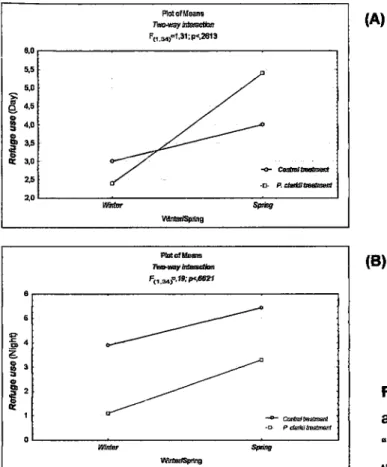
and spring results, regarding the behaviour "refuge use" (F6,34=5,?2;p=0,O257) (table 1.3. 1,). lnthe
spring,
by
day,
the
tadpoles
increased
the usê of
refuge (mean/spring=4,70;mean/rpinter2,70) in both 'control" and "P. clarkii" treatments,with
nointeraction between the categorical variables (Fo,aor= í,31;p= 0,2613) (table !.3
r")
(Íig. 1.2o).
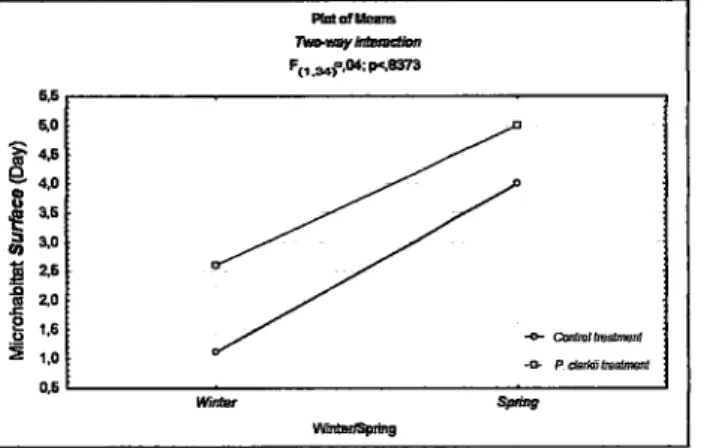
There were also significant differences between seasons for the use of the microhabitat
"surface" in the diumal period (F1r.aa1=5,01;p=0,0318) (table 1.3 <"1). During
the
spring thetadpoles of
A.
cistemasíi were on average more observed at the surface than during thewinter
(mean/spring=4,50;mean/wintee1,86).Once more, there
was
no
interaction betweenthe
fac{ors (table 1.3ol). ln
the
diumal period andin the
spring,the
tadpolesincreased
the
use
of
the
vertical
microhabitatosurface'
in
the
control
treatment(mean/spring=4,00; meanÁ,yinter=í,í1) and in the treatment with chemical cue of P. clarkii
(mean/spring=5,00;
meanfuinter2,60)
(fi g. l. I ).Figure
l.í.
Relaüon between seasonsand
treatments,
for the
use
ofmicrohabitat "surface", during the day.
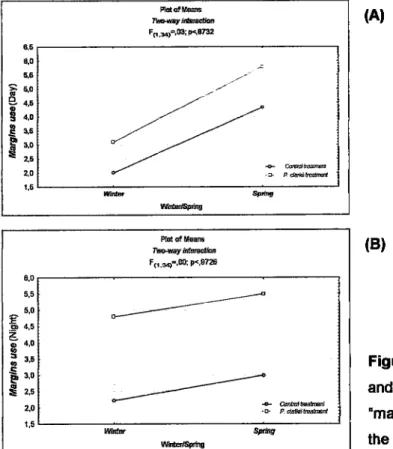
Finally, there
were
significant differences betweenthe
resultsof
winter
and
spring, regardingthe behaviour'margins
use" (F1r,aa;=4,87;P=0,034í) (table 1.3 ar). Once again, there was no interaction between the categorical variables (F11,3ay=0,03;p=0,8732) (table 1.3PíddUe lWh@, F(i.&).,1r,í: P4Er3 Vurüíqúhg 6É 6,0
Fo,
9 a-o oÊ*'
Bco Eau ao zo t .8 ,,u E r,o 0É Wirtu §Etu 17IBERE ffiFE ToaD (âeyres eraxns4 rÀopolEs §ilffi BEltÂyEUraL mDtnc,arDts s,HEr FÀGED wril a REcEilÍLy NrmDucED PREDAToR, PÀocar'EAir,s CLAne,
6).
The
tadpoles increasedthe
utilizaüonof
marginsin
lhe
spring
in
both treatments,control
(mean/spring=4,33;mean/winter2,00)
and
chemical
cuê
of
P.
clarkii (mean/spring=5,80; meanÂadnter3, I 0) (fi g. 1.4 G».Table
I.3.
Reutts of Two-way ANOVAS, tes{ingfor
the
effectsof
seasons (winter/spring),treatments (controUP. clarkill and their interadions
on
all
behaúoural parameteÍs measured during the day (signifcant Pvalues at alpha < 0.05 are indicated by J.DAY Source oÍvariation ss dÍ MS F P Reítrge ase (a) \Mtttcr/Spring(A) ControUP.cúarlrf (B) A'B Enor 37,&É.74 r,5í579 9,473684 246.,8 37,@474 1,5r579 9,473684 7,25&'z.3 5,220507 0,208s2 1,§127 0,028684' 0,6506 o,264t% 1 1 1
u
Acttufty Source of varidion ss
df
M§ F P1 1 1
u
(b) \Ê4lnter/Spring (A) ControUPdarlrf (B) A'B Enoro29U
0,0421(E 0,0í87í3 38,04445 o,ru24 0,042Í05 0,0í87í3 í,odrí3í o,216z.37 0,0397í7 0,017652 0,64É867 o,84322 o,895087 Source oÍmridion ssdf
Ms F P Watercdumn (c) \Múe/Spring(A) ControUP.darÍçD (B) A'B Enor 1,6888@ 0,0í052ô o,ü)4678 u,51111 1,688889 o,01056 o,(x)4678 2,4Étr}21 0,6794t,4 0,@4235 o,(x)1882 0,4í55í7 0,948495 0,966ô49 1 1 1u
Su}a;ffitm
§ource oÍmriation ssdt
Ms F P1 I 1
u
(d) \Mnter/SpÍing (A) ConúoUP.cúerlrf (B) A'B Enor 3,4't0526 2,5&t646 1§í579 4@,1í1í 3,41056 2,5eiô26 1,5í579 13,7€197 0,247714 0,í87655 0,íí0G5 0,621@3 0,667612 o,742§72§rrlbce Source oÍvariaüon §s
df
Ms F P1 1 I
v
(e) Wnter/Sping(A) ControUP.daÍríf (B) A'B Enor 6ô,ãI29 M,6713á 0,sffits2 449,2€69 6ô,ã0@ 14,6*.tl34 o§6082 13,214§ 5,0135 1,1 Í0256 0,042808 0,03í80r 0,2s457 0,837265 Source oÍvariaüon s§df
Ms F P illargfirau* (f) \Mrúe/Sfing (A) ControUPcúerld (B) A'B Enor 4,874766 1,26i1597 o,025869 0,034099' 0,268í03 o,673172@,@8
í5,d)8
o,318É.21 4í8,5 d),@28 t5,dr26[t o,318É,211ZW2
1 1 1g
lEEüc mB{tr'EToÂD (Áry'7Es cIsrERfiÊsO TÂDpoLE)§owBEtavDunal. rcDrFlc,ÀrEtEl nÍHH FÂGEDwrHÂRECE!{ILY E{ÍRoDUGEo PREDAÍoR,
PBacasrÁfrJ6AÂil[
1.4.2.
Noctumal
perlodDuring
the
noctumal period,there
were
significant differences betweenthe
results obtained for winter and spring in the comparisons for the behavioural parameter "refuge use"(F1r,a+1=6,60;p0,0148) (table
1.4 «"»and
betweenthe
featnent
control
and the treatment with the chemical stimulus of crayÍish (F«,anl= 1 1,39;p=Q,9019) (table 1.4 «o).ln
springthe
tadpolesof
A.
cidemasííwere on
average more observedto
use therefuges,
than
during
the
winter
in both
treatments;
control(mearúspring=5,44;meanfuinter3,89)
an in
the featment
wÍththe
chemical cueof
P.clarkii(mean/spring=3,30;meanfuinterí,10).
Horever,
in the presenceof the
chemicalcue
of P.
clarkii,
A.
cistemasii tadpoles decreasedtheir
permanencein the
refuges(mean/P.
clarkii= 2,20;
mean/contro!=4,67). There
was no
interaction between the categorical variables (F«,sal= 0,19;p=0,662í) (table 1.4 1.1)-
the uülizationof
refuges was consistently lower in the chemical cue featment than in the control (Íig. I.2 G).PldofM8@ lbüsftffi, Fo.s).1,31; p<,2ôtg 0,0 E5 §,0
én.
o 3 1,0 o §x5 o tq0 2â 40 + cod&É -L P-ffitu ttuw
\íffilrhg FhdirsG l}oe,h,ôE'íôr1 Fr.sf,l,: e<,@21 0 0 .9 z o o I o § êo E 3 2 I +MM -e PMffi 0 lvíitu §r,ú? U{Le/SffisFigure 1.2. Relation between seasons
and
treatments,for the
behaviour"refuge use", during the day (A) and the night (B).
(A)
(B)
lBEüc ffi[IE ÍoÀD (Áer7es csrm§, TÂopoLEs sÍttr EEltarErrRÂL eDlFE,ÀtDNs mta FÂGED wmi a RECE{ILY E{rRoDucED PREoaÍoR,
PRoEam/,Rl,sOÂRK,
As to
tadpole actiüty, the resultsof
the comparison beüryeen spring and winter were"nearly
signifienf
duringthe
night (F«,aal= 3,49;p=9,9702) (tablel.a
o)
-
the tadpoleswere less active in the spring than in the winter (mean/spring=0,43;meanlwinter=1,08).
ln the control treatment, on averagê the number of
Á.
cistemasiitadpoles observed inactivity,
during
the night was
similar
for both
seasons(mean/winter0,56;mean/spring=9,56). ln the treatmentwith chemical cue of P.
clarkii,lhe
tadpoles
were less
observed
in
activi§
in
the
spring
than
in
the
winter(mean/spring=0,30;meanfuintee1,60) (fi9.!.3).
The
resultswere not
similar
for
bothtreatments, with a nearly signifcant interaction (Fo,sa)= 3,49;p=0,0702) (table 1.4 16y), thus,
the reduc,tion in ac{ivity that was verÍfied in the spring could be related wilh the chemical cue of Procambarus clarkii.
P|lídUe@ l.W&yhtutcttu1 Fo.e)4.,10; P<,lrZU ô § z à à a 1,0 1,8 1A 1,2 1,0 0,9 o,o 0,4 o2 o,0 lMrM Sràrg tlírúBrrydtg
Figurc
!.3. Variation between seasonsand
treatments,
for the
behaviour 'activi§r", during the night.There
were
significantdifferences
betweenfeatment
confuoland
treatment
withchemical stimulus
of
crayfish (F«.eo= 5,09;p=0,0306)(table
1.4o)
for the
use
of
the microhabitat "margins'.During the night the tadpoles were on average morc observed using the margins when
submitted
to
the
teatment
of the
chemical
sümulus
of P.
clarkii (meanl P. cl a rki i= 5,1 5;mean/co nhol =2,61) .lBEnm mErE ToÂD (ârrres cs gso) raDpoLEs s[üy BEmvDURAL @DtFE.ÀtDNs mEt FrcED wIlH a nEcElalLY ll{ÍRoDlJcED PnEDAÍoR, Pnor,AffiAnloAÂRK,
The tadpoles
of
A.
cistemasii usedthe
margins moÍe frequenüyin
the
springin
thecontroltreatment (mean/spring=3,00;meanlwintee2,22) and in the
featmentwith
crayfish(mean/spring=S,50;meanfuinter4,80)
(fig.!.a
(B)),without interaction between
thecategorical variables (Fo,eal= 0,00;p=0,9726) (table 1.4 «o)
-
the use
of
margins was consistently higher in the featment with P. clarkii.(A)
(B)
Figure
1.4. Relation between seasonsand
treatments,for
the
behaüour'malgins usê", during the day (A) and the night (B). Pktotid@B ,bel,lr&,atu Fo,s).,(E; F18nI2 weíEElSFrüxú 8,6 8,0 q5 âeo I ô l-o 3+o P s.s B,,oEa. zo t,6 IM $d,a Plol ol Mr@ lhq€f iffi F(í.o.,(n,; po,g720 lâlh6&ítrg 8,0 5,5 o u'o É a,s z ; 4,0 q à .., Ê Eco
§rs
z0 t,5 MM .E §rÍtE lltutu 21IBEnE mm'E ÍoÂD (AtrEs csrEltasd rÂDFoLEs sm BElravDLRAL EoDtFE.ÀrN trHa FÂCED lrfiÍH a mcEurLY lllÍRoDlrcED PnEDAro&
PFoc,,,Bâft§ A.ARM
Table 1.4. Results
of
Two-way ANOVAs, for seasons (winter/spring), treatments (controUP,clarkiD and their interadions on all behavioural parameters measured during the night
('significant Pvalues at alpha < 0.05:
'
nearly significant/.N'GHT
Source of varidion ss dÍ MS F p
Rúrgorse
(a) Wrter/Sping (A)
CoffroUP.cúarlrf (B) A'B Enor 8,40468 57,6/,211 o,9&m26 172,1111 30,404ô8 57,úZt1 o,9&m26 5,«iãI9í 6,598988 11,38701 o,lgtÍ)i2 0,014765r 0,00í861' o,at2142 1 1 1
u
AútW
§ource of varidion ss df MS F D(b) Wnter/Spring (A) ControUP.darÍd (B) A'B Enor 4,0ü262
1,&§n
4,Wffi2 §.94444 40ü262 1,47§n 4off2fi,,z 1,1M% 1 1 1 3,49,44§,2 o,07oz)8 r 1,28ô838 0,2&1566 3,4s44§,2 0,070208'
u
Watercolumn (c) Source oÍvaridion ss dÍ MS F D \Mnter/Spring (A) ControUP.cíerki'(B) A"B Enor 7,864927 3,16257344sqE
s,ã889 7,W!27 3,16257344$ffi
28o2s14 2,806068 1,1n437 í,604í83 0,103083 0,295596 0,21392v
Su,s,ffium
Sourceofvariation ssdf
Ms F (d) Winter/Sprtng (A) ControUP.dartrf (B) A'B Enor 12,4o[Jl9 í6,0í(EÍ' 0,6í8713n8,8#
12,408í9 1ô,01(EÍi 0,6í8713 8,201§7 1,512§2 1,9f52192 o,o7w1 o,»7132 0,í71403 0,785236 34§zrbce Source ofvariaüon §s dÍ MS F D
(e) Uffier/Sping(A) ControUP.cÍadri (B) A'B Enor 1,774%7 %,27§8 0,5í5789 396