
CERN-EP-2017-262 2018/02/21
CMS-TOP-17-009
Search for standard model production of four top quarks
with same-sign and multilepton final states in
proton-proton collisions at
√
s
=
13 TeV
The CMS Collaboration
∗Abstract
A search for standard model production of four top quarks (tttt) is reported using events containing at least three leptons (e, µ) or a same-sign lepton pair. The events are produced in proton-proton collisions at a center-of-mass energy of 13 TeV at the LHC, and the data sample, recorded in 2016, corresponds to an integrated luminosity of 35.9 fb−1. Jet multiplicity and flavor are used to enhance signal sensitivity, and ded-icated control regions are used to constrain the dominant backgrounds. The observed and expected signal significances are, respectively, 1.6 and 1.0 standard deviations, and the tttt cross section is measured to be 16.9+−13.811.4fb, in agreement with next-to-leading-order standard model predictions. These results are also used to constrain the Yukawa coupling between the top quark and the Higgs boson to be less than 2.1 times its expected standard model value at 95% confidence level.
Published in the European Physical Journal C as doi:10.1140/epjc/s10052-018-5607-5.
c
2018 CERN for the benefit of the CMS Collaboration. CC-BY-4.0 license ∗See Appendix A for the list of collaboration members
1
Introduction
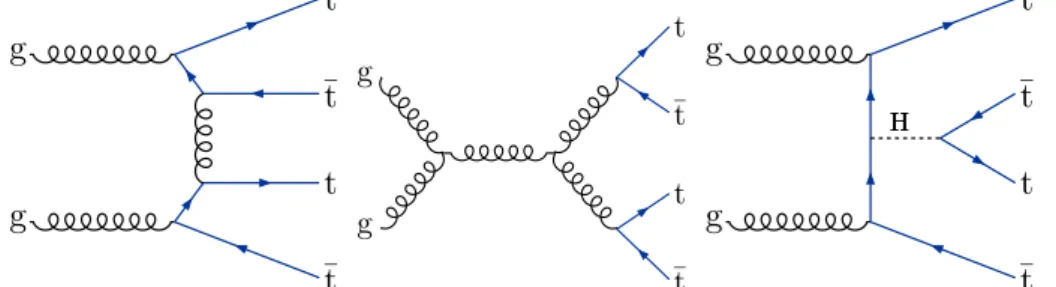
In the standard model (SM) the production of four top quarks (tttt) is a rare process, with repre-sentative leading-order (LO) Feynman diagrams shown in Fig. 1. Many beyond-the-SM (BSM) theories predict an enhancement of the tttt cross section, σ(pp→tttt), such as gluino pair pro-duction in the supersymmetry framework [1–10], the pair propro-duction of scalar gluons [11, 12], and the production of a heavy pseudoscalar or scalar boson in association with a tt pair in Type II two-Higgs-doublet models (2HDM) [13–15]. In addition, a top quark Yukawa coupling larger than expected in the SM can lead to a significant increase in tttt production via an off-shell SM Higgs boson [16]. The SM prediction for σ(pp → tttt) at√s = 13 TeV is 9.2+−2.92.4fb at next-to-leading order (NLO) [17]. An alternative prediction of 12.2+−5.04.4fb is reported in Ref. [16], obtained from a LO calculation of 9.6+−3.93.5fb and an NLO/LO K-factor of 1.27 based on the 14 TeV calculation of Ref. [18].
g g t ¯t ¯t t g g t ¯t t ¯t g g H H H t ¯t ¯t t
Figure 1: Representative Feynman diagrams for tttt production at LO in the SM.
After the decays of the top quarks, the final state contains several jets resulting from the had-ronization of light quarks and b quarks (b jets), and may contain isolated leptons and missing transverse momentum depending on the decays of the W bosons [19]. Among these final states, the same-sign dilepton and the three- (or more) lepton final states, considering` =e, µ, corre-spond to branching fractions in tttt events of 8 and 1%, respectively, excluding the small con-tribution from W→τν, which is included in selected events. However, due to the low level of
backgrounds, these channels are the most sensitive to tttt production in the regime with SM-like kinematic properties. The ATLAS and CMS Collaborations at the CERN LHC have previously searched for SM tttt production in√s=8 and 13 TeV pp collisions [20–24]. The most sensitive of these results is a re-interpretation of the CMS same-sign dilepton search for BSM physics at 13 TeV [23], with an observed (expected) tttt cross section upper limit (assuming no SM tttt signal) of 42 (27+−138 ) fb at the 95% confidence level (CL).
The previous search is inclusive, exploring the final state with two same-sign leptons and at least two jets, using an integrated luminosity of 35.9 fb−1 [23]. The analysis described in this paper is based on the same data set and improves on the previous search by optimizing the signal selection for sensitivity to SM tttt production, by using an improved b jet identification algorithm, and by employing background estimation techniques that are adapted to take into account the higher jet and b jet multiplicity requirements in the signal regions.
2
Background and signal simulation
Monte Carlo (MC) simulations at NLO are used to evaluate the tttt signal acceptance and to estimate the background from diboson (WZ, ZZ, Zγ, W±W±) and triboson (WWW, WWZ, WZZ, ZZZ, WWγ, WZγ) processes, as well as from production of single top quarks (tZq, tγ), or tt produced in association with a boson (ttW, ttZ/γ∗, ttH). These samples are generated us-ing the NLO MADGRAPH5 [email protected] [17] program with up to one additional parton in
2 3 The CMS detector and event reconstruction
the matrix-element calculation, except for W±W±which is generated with up to two additional partons, and the WZ, ZZ and ttH samples, which are generated with no additional partons with thePOWHEG BOXv2 [25, 26] program. The ttZ/γ∗ sample with Z/γ∗ → ``is generated with a dilepton invariant mass greater than 1 GeV. The LO MADGRAPH5 aMC@NLOgenerator, scaled to NLO cross sections, is used to estimate the Wγ and ttγ processes with up to three additional partons. Other rare backgrounds, such as tt production in association with dibosons (ttWW, ttWZ, ttZZ, ttWH, ttZW, ttHH), triple top quark production (ttt, tttW), and tWZ are gener-ated using LO MADGRAPH5 aMC@NLOwithout additional partons, and scaled to NLO cross sections [27]. The NNPDF3.0LO (NNPDF3.0NLO) [28] parton distribution functions (PDFs) are used to generate all LO (NLO) samples. Parton showering and hadronization, as well as W±W±from double-parton-scattering, are modeled by the PYTHIA8.205 [29] program, while the MLM [30] and FxFx [31] prescriptions are employed in matching additional partons in the matrix-element calculations to parton showers in the LO and NLO samples, respectively. The top quark mass in the generators is set to 172.5 GeV. The GEANT4 package [32] is used to model the response of the CMS detector. Additional proton-proton interactions (pileup) within the same or nearby bunch crossings are also included in the simulated events.
To improve the MC modeling of the multiplicity of additional jets from initial-state radiation (ISR), simulated ttW and ttZ/γ∗events are reweighted based on the number of ISR jets (NjetsISR). The reweighting is based on a comparison of the light-flavor jet multiplicity in dilepton tt events in data and simulation. The method requires exactly two jets identified as originat-ing from b quarks in dilepton tt events, and assumes that all other jets are from ISR. Weightoriginat-ing factors are obtained as a function of NjetsISRto bring data and MC into agreement. These weights are then applied, keeping the total cross section constant, to ttW and ttZ/γ∗ MC as a function of the number of jets not originating from top quark, W, or Z decays. To improve the model-ing of the flavor of additional jets, the simulation is also corrected to account for the measured ratio of ttbb/ttjj cross sections reported in Ref. [33]. More details on these corrections and their uncertainties are provided in Section 6.
3
The CMS detector and event reconstruction
The central feature of the CMS detector is a superconducting solenoid of 6 m internal diameter, providing a magnetic field of 3.8 T. Within the solenoid volume are a silicon pixel and strip tracker, a lead tungstate crystal electromagnetic calorimeter (ECAL), and a brass and scintilla-tor hadron calorimeter (HCAL), each composed of a barrel and two endcap sections. Forward calorimeters extend the pseudorapidity (η) coverage provided by the barrel and endcap detec-tors. Muons are measured in gas-ionization detectors embedded in the steel flux-return yoke outside the solenoid. A more detailed description of the CMS detector, together with a def-inition of the coordinate system used and the relevant kinematic variables, can be found in Ref. [34].
Events of interest are selected using a two-tiered trigger system [35]. The first level (L1), com-posed of custom hardware processors, uses information from the calorimeters and muon de-tectors to select events at a rate of around 100 kHz within a time interval of less than 4 µs. The second level, known as the high-level trigger (HLT), consists of a farm of processors running a version of the full event reconstruction software optimized for fast processing, and reduces the event rate to less than 1 kHz before data storage.
Events are processed using the particle-flow (PF) algorithm [36], which reconstructs and iden-tifies each individual particle with an optimized combination of information from the various
elements of the CMS detector. The energy of photons is directly obtained from the ECAL mea-surement. The energy of electrons is determined from a combination of the electron momentum at the primary interaction vertex as determined by the tracker, the energy of the correspond-ing ECAL cluster, and the energy sum of all bremsstrahlung photons spatially compatible with the electron track [37]. The momentum of muons is obtained from the curvature of the corre-sponding track, combining information from the silicon tracker and the muon system [38]. The energy of charged hadrons is determined from a combination of their momentum measured in the tracker and the matching ECAL and HCAL energy deposits, corrected for the response function of the calorimeters to hadronic showers. The energy of neutral hadrons is obtained from the corresponding corrected ECAL and HCAL energies.
Hadronic jets are clustered from neutral PF candidates and charged PF candidates associated with the primary vertex, using the anti-kT algorithm [39, 40] with a distance parameter of 0.4.
The jet momentum is determined as the vectorial sum of all PF candidate momenta in the jet. An offset correction is applied to jet energies to take into account the contribution from pileup. Jet energy corrections are derived from simulation, and are improved with in situ measurements of the energy balance in dijet, multijet, γ+jet and leptonically decaying Z+jet events [41, 42]. Additional selection criteria are applied to each event to remove spurious jet-like features originating from isolated noise patterns in certain HCAL regions. Jets originating from b quarks are identified as b-tagged jets using a deep neural network algorithm [43], with a working point chosen such that the efficiency to identify a b jet is 55–70% for a jet transverse momentum (pT) between 20 and 400 GeV. The misidentification rate for a light-flavor jet is
1–2% in the same jet pT range. The vector~pTmiss is defined as the projection on the plane
per-pendicular to the beams of the negative vector sum of the momenta of all reconstructed PF candidates in an event [44]. Its magnitude, called missing transverse momentum, is referred to as pmissT . The scalar pTsum of all jets in an event is referred to as HT.
4
Event selection and search strategy
The definitions of objects and the baseline event selection follow closely those of Refs. [23, 45]. Electron identification is based on a multivariate discriminant using shower shape and track quality variables, while for muons it is based on the quality of the geometrical matching be-tween the tracker and muon system measurements. Isolation and impact parameter require-ments are applied to both lepton flavors, as well as specific selections designed to improve the accuracy of the charge reconstruction. The combined reconstruction and identification ef-ficiency is in the range of 45–70% (70–90%) for electrons (muons), increasing as a function of pT and converging to the maximum value for pT >60 GeV. The number of leptons (N`), the
number of jets (Njets), and the number of b-tagged jets (Nb) are counted after the application of
the basic kinematic requirements summarized in Table 1.
Table 1: Kinematic requirements for leptons and jets. Object pT (GeV) |η|
Electrons >20 <2.5 Muons >20 <2.4 Jets >40 <2.4 b-tagged jets >25 <2.4
Signal events are selected using triggers that require two leptons with pT > 8 GeV and HT >
300 GeV. The trigger efficiency is greater than 95% for di-electron (ee) and electron-muon (eµ) events and about 92% for di-muon (µµ) events. The baseline selections require HT > 300 GeV
4 5 Backgrounds
and pmissT > 50 GeV, at least two jets (Njets ≥ 2), at least two b-tagged jets (Nb ≥ 2), a leading
lepton with pT > 25 GeV, and a second lepton of the same charge with pT > 20 GeV. To
reduce the background from Drell–Yan with a charge-misidentified electron, events with same-sign electron pairs with mass below 12 GeV are rejected. Events where a third lepton with pT
larger than 5 (7) GeV for muons (electrons) forms an opposite-sign (OS) same-flavor pair with mass below 12 GeV or between 76 and 106 GeV are also rejected. If the third lepton has pT >
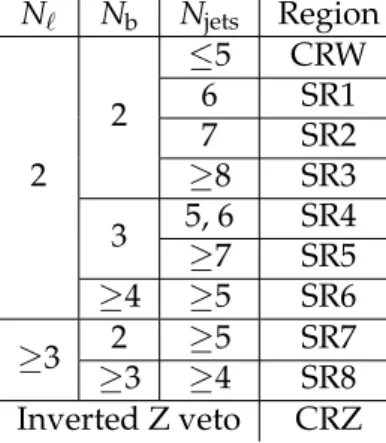
20 GeV and the invariant mass of the pair is between 76 and 106 GeV, these rejected events are used to populate a ttZ background control region (CRZ). The signal acceptance in the baseline region, including the leptonic W boson branching fraction, is approximately 1.5%. After these requirements, we define eight mutually exclusive signal regions (SRs) and a control region for the ttW background (CRW), based on Njets, Nb, and N`, as detailed in Table 2. The observed and
predicted yields in the control and signal regions are used to measure σ(pp→ tttt), following the procedure described in Sec. 7.
Table 2: Definitions of the eight SRs and the two control regions for ttW (CRW) and ttZ (CRZ). N` Nb Njets Region 2 2 ≤5 CRW 6 SR1 7 SR2 ≥8 SR3 3 5, 6 SR4 ≥7 SR5 ≥4 ≥5 SR6 ≥3 2 ≥5 SR7 ≥3 ≥4 SR8 Inverted Z veto CRZ
5
Backgrounds
The main backgrounds to the tttt process in the same-sign dilepton and three- (or more) lepton final states arise from rare multilepton processes, such as ttW, ttZ/γ∗, and ttH (H→WW), and single-lepton or OS dilepton processes with an additional “nonprompt lepton”. Nonprompt leptons consist of electrons from conversions of photons in jets and leptons from the decays of heavy- or light-flavor hadrons. In this category we include also hadrons misidentified as leptons. The minor background from OS dilepton events with a charge-misidentified lepton is also taken into account.
Rare multilepton processes are estimated using simulated events. Control regions are used to constrain the normalization of the ttW and ttZ backgrounds, as described in Section 7, while for other processes the normalization is based on the NLO cross sections referenced in Section 2. Processes such as the associated production of a tt pair with a pair of bosons (W, Z, H) are grouped into a “ttVV” category. Associated photon production processes such as Wγ, Zγ, ttγ, and tγ, where an electron is produced in an unidentified photon conversion, are grouped into a “Xγ” category. All residual processes with very small contributions, including diboson (WZ, ZZ, W±W± from single- and double-parton scattering), triboson (WWW, WWZ, WZZ, ZZZ, WWγ, WZγ), and rare single top quark (tZq, tWZ) and triple top quark processes (ttt and tttW), are grouped into a “Rare” category.
The nonprompt lepton and charge-misidentified lepton backgrounds are estimated following the methods described in Ref. [23]. For nonprompt leptons, an estimate referred to as the
“tight-to-loose” method defines two control regions by modifying the lepton identification (including isolation) and event kinematic requirements, respectively. An “application region” is defined for every SR by requiring at least one lepton to fail the standard identification (“tight”) while satisfying a more relaxed one (“loose”). To obtain the nonprompt lepton background estimate in the corresponding SR, the event yield in each application region is weighted by a factor of
eTL/(1−eTL)for each lepton failing the tight requirement. The eTLparameter is the probability
that a nonprompt lepton that satisfies a loose lepton selection also satisfies the tight selection. It is extracted as a function of lepton flavor and kinematic properties from a “measurement region” that consists of a single-lepton events with event kinematic properties designed to suppress the W→ `νcontribution.
For charge-misidentified leptons, an OS dilepton control region is defined for each same-sign dilepton signal region. Its yield is then weighted by the charge misidentification probability estimated in simulation, which ranges between 10−5 and 10−3 for electrons and is negligible for muons.
6
Systematic uncertainties
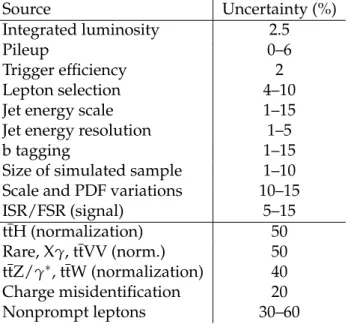
The sources of experimental and theoretical uncertainty for the data and simulations are sum-marized in Table 3. The uncertainty in the integrated luminosity is 2.5% [46]. The simulation is reweighted to match the distribution in the number of pileup collisions per event in data. The uncertainty in the inelastic cross section propagated to the final yields provides an uncertainty of at most 6%.
Trigger efficiencies are measured with an uncertainty of 2% in an independent data sample selected using single-lepton triggers. Lepton-efficiency scale factors, used to account for dif-ferences in the reconstruction and identification efficiencies between data and simulation, are measured using a “tag-and-probe” method in data enriched in Z→ ``events [37, 38]. The scale factors are applied to all simulated processes with an uncertainty per lepton of approximately 3% for muons and 4% for electrons.
The uncertainty in the calibration of the jet energy scale depends on the pTand η of the jet and
results in a 1–15% variation in the event yield in a given SR. The uncertainty due to the jet en-ergy resolution is estimated by broadening the resolution in simulation [42], and the resulting effect is a change of 1–5% in the SR yields. The b tagging efficiency in simulation is corrected using scale factors determined from efficiencies measured in data and simulation [47]. The uncertainty in the measured scale factors results in an overall effect between 1 and 15%, again depending on the SR.
As mentioned in Section 2, ttW and ttZ/γ∗simulated events are reweighted to match the num-ber of additional jets observed in data. The reweighting factors vary between 0.92 for NjetsISR =1 and 0.77 for NISR
jets ≥4. Half of the difference from unity is taken as a systematic uncertainty in
these reweighting factors to cover differences observed between data and simulation when the factors are used to reweight simulation in a control sample enriched in single-lepton tt events. Uncertainties in the reweighting factors are treated as correlated among regions. Simulated ttW and ttZ/γ∗events with two b quarks not originating from top quark decay are also weighted to account for the CMS measurement of the ratio of cross sections σ(ttbb)/σ(ttjj), which was found to be a factor of 1.7±0.6 larger than the MC prediction [33]. In signal regions requiring four b-tagged jets, where the effect is dominant, this results in a systematic uncertainty of up to 15% on the total background prediction. In signal regions requiring three b-tagged jets, the dominant origin of the additional b-tagged jet is a charm quark from a W decay, so the effect is
6 7 Results and interpretation
negligible.
Uncertainties in the renormalization and factorization scales (varied by a factor of two) and from the choice of PDF [48, 49] affect the number of events expected (normalization) in the simulated background processes, as well as the acceptance for the tttt signal. The effects of these uncertainties on the relative distribution of events in the signal regions (shape) are also considered. For the ttW and ttZ/γ∗backgrounds, the normalization uncertainty is 40%, while for ttH a 50% normalization uncertainty reflects the signal strength of 1.5±0.5 measured by CMS [50]. The processes in the Rare category along with Xγ and ttVV, many of which have never been observed, are expected to give small contributions to the event yields in the signal regions. We assign separate 50% normalization uncertainties to each of these three categories. The shape uncertainty resulting from variations of the renormalization and factorization scales is as large as 15% for the ttW, ttZ/γ∗, and ttH backgrounds, and 10% for the tttt signal, while the effect from the PDF is only 1%. For the signal, the uncertainty in the acceptance from variations of the scales (PDFs) is 2% (1%). In addition, for the tttt signal, the scales that determine ISR and final-state radiation (FSR) in the parton shower are also varied, resulting in a 6% change in the acceptance and shape variations as large as 15%.
For nonprompt and charge-misidentified lepton backgrounds, the statistical uncertainty from the application region depends on the SR considered. The background from misidentified charge is assigned a systematic uncertainty of 20%, based on comparisons of the expected number of same-sign events estimated from an OS control sample and the observed same-sign yield in a control sample enriched in Z →e+e−events with one electron or positron having a misidentified charge.
In addition to the statistical uncertainty, the nonprompt lepton background is assigned an over-all normalization uncertainty of 30% to cover variations observed in closure tests performed with simulated multijet and tt events. This uncertainty is increased to 60% for electrons with pT > 50 GeV, to account for trends observed at high pT in the closure tests. We also include
an uncertainty related to the subtraction of events with prompt leptons (from electroweak pro-cesses with a W or Z boson) in the measurement region, which has an effect between 1% and 50%, depending on the SR. The prompt lepton contamination was also checked in the applica-tion region, where it was found to be below 1%.
Experimental uncertainties are treated as correlated among signal regions for all signal and background processes. Systematic uncertainties in data-driven estimates and theoretical un-certainties are treated as uncorrelated between processes, but correlated among signal regions. Statistical uncertainties from the limited number of simulated events or in the number of events in data control regions are considered uncorrelated.
7
Results and interpretation
The properties of events in the signal regions (SR 1–8 as defined in Table 2) are shown in Fig. 2, where distributions of the main kinematic variables in the data (Njets, Nb, HT, and pmissT ) are
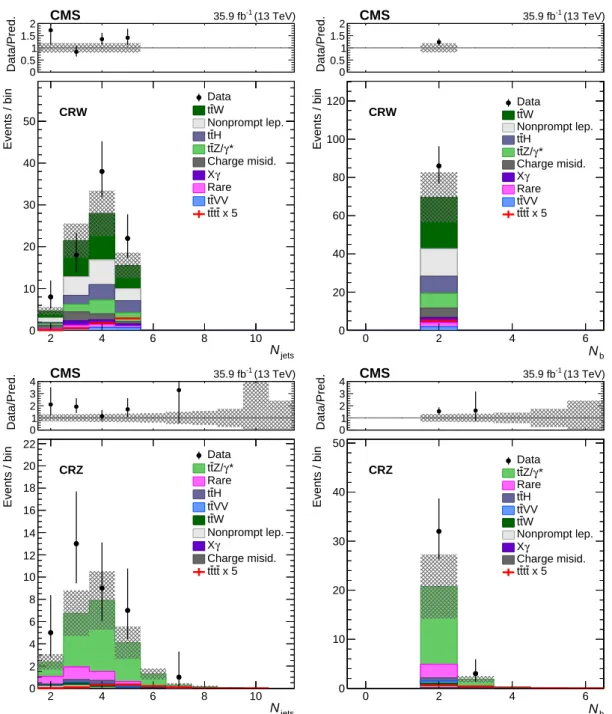
compared to SM background predictions. The Njets and Nb distributions for CRW and CRZ
are shown in Fig. 3. In both figures we overlay the expected SM tttt signal, scaled by a factor of 5. The SM predictions are generally consistent with the observations, with some possible underestimation in CRW and CRZ.
The yields from SR 1–8, CRW, and CRZ are combined in a maximum-likelihood fit, following the procedures described in Ref. [51], to estimate a best-fit cross section for tttt, the
signifi-Table 3: Summary of the sources of uncertainty and their effect on signal and background yields. The first group lists experimental and theoretical uncertainties in simulated signal and background processes. The second group lists normalization uncertainties in the estimated backgrounds. Source Uncertainty (%) Integrated luminosity 2.5 Pileup 0–6 Trigger efficiency 2 Lepton selection 4–10
Jet energy scale 1–15
Jet energy resolution 1–5
b tagging 1–15
Size of simulated sample 1–10 Scale and PDF variations 10–15
ISR/FSR (signal) 5–15 ttH (normalization) 50 Rare, Xγ, ttVV (norm.) 50 ttZ/γ∗, ttW (normalization) 40 Charge misidentification 20 Nonprompt leptons 30–60
cance of the observation relative to the background-only hypothesis, and the upper limit on
σ(pp → tttt). The experimental and theoretical uncertainties described in Section 6 are
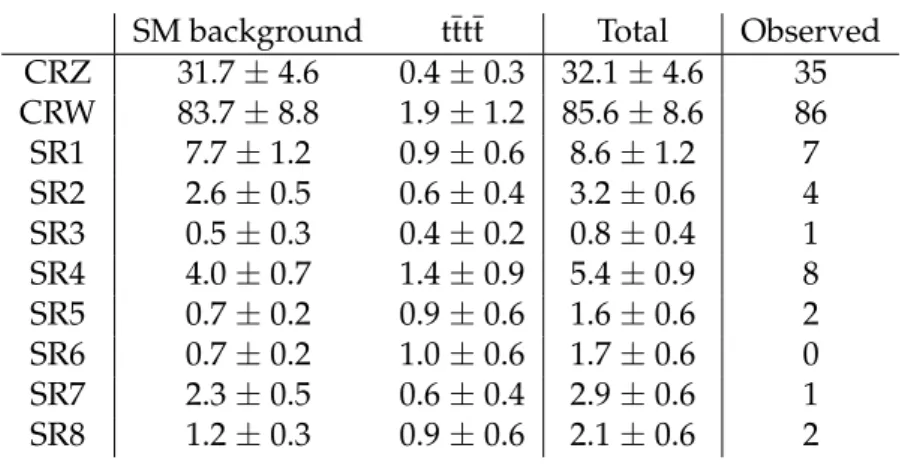
in-corporated in the likelihood as “nuisance” parameters and are profiled in the fit. Nuisance parameters corresponding to systematic uncertainties are parameterized as log-normal distri-butions. The fitted values of the nuisance parameters are found to be consistent with their ini-tial values within uncertainties. The nuisance parameters corresponding to the ttW and ttZ/γ∗ normalizations are scaled by 1.2±0.3 and 1.3±0.3, respectively, while other background con-tributions including ttH are scaled up by 1.1 or less. The signal and control region results after the maximum-likelihood fit (post-fit) are shown in Fig. 4, with the fitted tttt signal contribution added to the background predictions, which are given in Table 4. The tttt cross section is mea-sured to be 16.9+−13.811.4fb, where the best-fit value of the parameter and an approximate 68% CL confidence interval are extracted following the procedure described in Sec. 3.2 of Ref. [52]. The observed and expected significances relative to the background-only hypothesis are found to be 1.6 and 1.0 standard deviations, respectively, where the expectation is based on the central value of the NLO SM cross section of 9.2+−2.92.4fb [17]. The observed 95% CL upper limit on the cross section, based on an asymptotic formulation [53] of the modified frequentist CLs
crite-rion [54, 55], is found to be 41.7 fb. The corresponding expected upper limit, assuming no SM tttt contribution to the data, is 20.8+−11.26.9 fb, showing a significant improvement relative to the value of 27 fb of Ref. [23].
The pp → tttt process has contributions from diagrams with virtual Higgs bosons, as shown in Fig. 1. Experimental information on σ(pp → tttt) can therefore be used to constrain the Yukawa coupling, yt, between the top quark and the Higgs boson. We constrain yt assuming
that the signal acceptance is not affected by the relative contribution of the virtual Higgs boson diagrams. As the cross section for the ttH background also depends on the top quark Yukawa coupling, for the purpose of constraining yt the fit described above is repeated with the ttH
contribution scaled by the square of the absolute value of the ratio of the top quark Yukawa coupling to its SM value (|yt/ySMt |2), where ySMt = mt(
√
2GF)1/2 ≈ 1. This results in a
8 8 Summary
theoretical prediction. The prediction is obtained from the LO calculation of Ref. [16], with an NLO/LO K-factor of 1.27 [18]. The LO calculation is used instead of the NLO one, as Ref. [16] provides a breakdown of the contributions to the cross section according to powers of yt. The
prediction also includes the uncertainty associated with varying the renormalization and fac-torization scales in the LO calculation by a factor of 2. The central, upper and lower values of the theoretical cross section provide respective 95% CL limits for |yt/ySMt | < 2.1,<1.9 and <2.4.
Table 4: The post-fit background, signal, and total yields with their total uncertainties and the observed number of events in the control and signal regions in data.
SM background tttt Total Observed CRZ 31.7±4.6 0.4±0.3 32.1±4.6 35 CRW 83.7±8.8 1.9±1.2 85.6±8.6 86 SR1 7.7±1.2 0.9±0.6 8.6±1.2 7 SR2 2.6±0.5 0.6±0.4 3.2±0.6 4 SR3 0.5±0.3 0.4±0.2 0.8±0.4 1 SR4 4.0±0.7 1.4±0.9 5.4±0.9 8 SR5 0.7±0.2 0.9±0.6 1.6±0.6 2 SR6 0.7±0.2 1.0±0.6 1.7±0.6 0 SR7 2.3±0.5 0.6±0.4 2.9±0.6 1 SR8 1.2±0.3 0.9±0.6 2.1±0.6 2
8
Summary
The results of a search for standard model (SM) production of tttt at the LHC have been pre-sented, using data from√s = 13 TeV proton-proton collisions corresponding to an integrated luminosity of 35.9 fb−1, collected with the CMS detector in 2016. The analysis strategy uses same-sign dilepton as well as three- (or more) lepton events, relying on jet multiplicity and jet flavor to define search regions that are used to probe the tttt process. Combining these regions yields a significance of 1.6 standard deviations relative to the background-only hypothesis, and a measured value for the tttt cross section of 16.9+−13.811.4fb, in agreement with the standard model predictions. The results are also re-interpreted to constrain the ratio of the top quark Yukawa coupling to its SM value, yielding|yt/ySMt | <2.1 at 95% confidence level.
Acknowledgments
We thank Qing-Hong Cao, Shao-Long Chen, and Yandong Liu for providing calculations used in determining a constraint on the top quark Yukawa coupling.
We congratulate our colleagues in the CERN accelerator departments for the excellent perfor-mance of the LHC and thank the technical and administrative staffs at CERN and at other CMS institutes for their contributions to the success of the CMS effort. In addition, we grate-fully acknowledge the computing centers and personnel of the Worldwide LHC Computing Grid for delivering so effectively the computing infrastructure essential to our analyses. Fi-nally, we acknowledge the enduring support for the construction and operation of the LHC and the CMS detector provided by the following funding agencies: BMWFW and FWF (Aus-tria); FNRS and FWO (Belgium); CNPq, CAPES, FAPERJ, and FAPESP (Brazil); MES (Bulgaria); CERN; CAS, MoST, and NSFC (China); COLCIENCIAS (Colombia); MSES and CSF (Croatia);
Data/MC 01 2 3 4 5 Data/Pred. (13 TeV) -1 35.9 fb CMS jets N 2 4 6 8 10 Events / bin 0 2 4 6 8 10 12 14 16 18 Data W t t H t t Nonprompt lep. * γ Z/ t t VV t t γ X Rare Charge misid. x 5 t t t t Data/MC 01 2 3 4 5 Data/Pred. (13 TeV) -1 35.9 fb CMS b N 0 2 4 6 Events / bin 0 5 10 15 20 25 Data W t t H t t Nonprompt lep. * γ Z/ t t VV t t γ X Rare Charge misid. x 5 t t t t Data/MC 01 2 3 4 5 Data/Pred. (13 TeV) -1 35.9 fb CMS (GeV) T H 200 400 600 800 1000 1200 1400 1600 Events / 100 GeV 0 2 4 6 8 10 12 Data W t t H t t Nonprompt lep. * γ Z/ t t VV t t γ X Rare Charge misid. x 5 t t t t Data/MC 01 2 3 4 5 Data/Pred. (13 TeV) -1 35.9 fb CMS (GeV) miss T p 0 100 200 300 400 500 600 Events / 40 GeV 0 2 4 6 8 10 Data W t t H t t Nonprompt lep. * γ Z/ t t VV t t γ X Rare Charge misid. x 5 t t t t
Figure 2: Distributions in Njets (upper left), Nb(upper right), HT (lower left), and pmissT (lower
right) in the signal regions (SR 1–8), before fitting to data, where the last bins include the over-flows. The hatched areas represent the total uncertainties in the SM background predictions, while the solid lines represent the tttt signal, scaled up by a factor of 5, assuming the SM cross section from Ref. [17]. The upper panels show the ratios of the observed event yield to the total background prediction. Bins without a data point have no observed events.
10 8 Summary Data/MC 0 0.5 1 1.5 2 Data/Pred. (13 TeV) -1 35.9 fb CMS jets N 2 4 6 8 10 Events / bin 0 10 20 30 40 50 Data W t t Nonprompt lep. H t t * γ Z/ t t Charge misid. γ X Rare VV t t x 5 t t t t CRW Data/MC 0 0.5 1 1.5 2 Data/Pred. (13 TeV) -1 35.9 fb CMS b N 0 2 4 6 Events / bin 0 20 40 60 80 100 120 Data W t t Nonprompt lep. H t t * γ Z/ t t Charge misid. γ X Rare VV t t x 5 t t t t CRW Data/MC 0 1 2 3 4 Data/Pred. (13 TeV) -1 35.9 fb CMS jets N 2 4 6 8 10 Events / bin 0 2 4 6 8 10 12 14 16 18 20 22 Data * γ Z/ t t Rare H t t VV t t W t t Nonprompt lep. γ X Charge misid. x 5 t t t t CRZ Data/MC 0 1 2 3 4 Data/Pred. (13 TeV) -1 35.9 fb CMS b N 0 2 4 6 Events / bin 0 10 20 30 40 50 Data * γ Z/ t t Rare H t t VV t t W t t Nonprompt lep. γ X Charge misid. x 5 t t t t CRZ
Figure 3: Distributions in Njets and Nb in ttW (upper) and ttZ (lower) control regions, before
fitting to data. The hatched area represents the uncertainty in the SM background prediction, while the solid line represents the tttt signal, scaled up by a factor of 5, assuming the SM cross section from Ref. [17]. The upper panels show the ratios of the observed event yield to the total background prediction. Bins without a data point have no observed events.
Data/MC 0 0.5 1 1.5 2 Data/Pred. (13 TeV) -1 35.9 fb CMS Region CRZ CRW SR1 SR2 SR3 SR4 SR5 SR6 SR7 SR8 Events 1 − 10 1 10 2 10 3 10 4 10 Data t t t t W t t H t t Nonprompt lep. * γ Z/ t t VV t t γ X Rare Charge misid. Data/MC 0 0.5 1 1.5 2 Data/Pred. (13 TeV) -1 35.9 fb CMS Region SR1 SR2 SR3 SR4 SR5 SR6 SR7 SR8 Events 0 2 4 6 8 10 12 Data t t t t W t t H t t Nonprompt lep. * γ Z/ t t VV t t γ X Rare Charge misid.
Figure 4: Observed yields in the control and signal regions (left, in log scale), and signal regions only (right, in linear scale), compared to the post-fit predictions for signal and background pro-cesses. The hatched areas represent the total uncertainties in the signal and background pre-dictions. The upper panels show the ratios of the observed event yield and the total prediction of signal and background. Bins without a data point have no observed events.
RPF (Cyprus); SENESCYT (Ecuador); MoER, ERC IUT, and ERDF (Estonia); Academy of Fin-land, MEC, and HIP (Finland); CEA and CNRS/IN2P3 (France); BMBF, DFG, and HGF (Ger-many); GSRT (Greece); OTKA and NIH (Hungary); DAE and DST (India); IPM (Iran); SFI (Ireland); INFN (Italy); MSIP and NRF (Republic of Korea); LAS (Lithuania); MOE and UM (Malaysia); BUAP, CINVESTAV, CONACYT, LNS, SEP, and UASLP-FAI (Mexico); MBIE (New Zealand); PAEC (Pakistan); MSHE and NSC (Poland); FCT (Portugal); JINR (Dubna); MON, RosAtom, RAS, RFBR and RAEP (Russia); MESTD (Serbia); SEIDI, CPAN, PCTI and FEDER (Spain); Swiss Funding Agencies (Switzerland); MST (Taipei); ThEPCenter, IPST, STAR, and NSTDA (Thailand); TUBITAK and TAEK (Turkey); NASU and SFFR (Ukraine); STFC (United Kingdom); DOE and NSF (USA).
Individuals have received support from the Marie-Curie program and the European Research Council and Horizon 2020 Grant, contract No. 675440 (European Union); the Leventis Foun-dation; the A. P. Sloan FounFoun-dation; the Alexander von Humboldt FounFoun-dation; the Belgian Fed-eral Science Policy Office; the Fonds pour la Formation `a la Recherche dans l’Industrie et dans l’Agriculture (FRIA-Belgium); the Agentschap voor Innovatie door Wetenschap en Technologie (IWT-Belgium); the Ministry of Education, Youth and Sports (MEYS) of the Czech Republic; the Council of Science and Industrial Research, India; the HOMING PLUS program of the Foun-dation for Polish Science, cofinanced from European Union, Regional Development Fund, the Mobility Plus program of the Ministry of Science and Higher Education, the National Science Center (Poland), contracts Harmonia 2014/14/M/ST2/00428, Opus 2014/13/B/ST2/02543, 2014/15/B/ST2/03998, and 2015/19/B/ST2/02861, Sonata-bis 2012/07/E/ST2/01406; the National Priorities Research Program by Qatar National Research Fund; the Programa Severo Ochoa del Principado de Asturias; the Thalis and Aristeia programs cofinanced by EU-ESF and the Greek NSRF; the Rachadapisek Sompot Fund for Postdoctoral Fellowship, Chulalongkorn University and the Chulalongkorn Academic into Its 2nd Century Project Advancement Project
12 8 Summary
|
SM ty
/
ty
|
0.5
1
1.5
2
2.5
) (fb)tt
t
(t
σ
0
10
20
30
40
50
60
Obs. upper limitObs. cross section
Phys. Rev. D 95 (2017) 053004 Predicted cross section,
(13 TeV)
-1
35.9 fb
CMS
Figure 5: The predicted SM value of σ(pp → tttt) [16], calculated at LO with an NLO/LO K-factor of 1.27, as a function of|yt/ySMt |(dashed line), compared with the observed value of
(Thailand); the Welch Foundation, contract C-1845; and the Weston Havens Foundation (USA).
References
[1] P. Ramond, “Dual theory for free fermions”, Phys. Rev. D 3 (1971) 2415, doi:10.1103/PhysRevD.3.2415.
[2] Y. A. Gol’fand and E. P. Likhtman, “Extension of the algebra of Poincar´e group generators and violation of P invariance”, JETP Lett. 13 (1971) 323.
[3] A. Neveu and J. H. Schwarz, “Factorizable dual model of pions”, Nucl. Phys. B 31 (1971) 86, doi:10.1016/0550-3213(71)90448-2.
[4] D. V. Volkov and V. P. Akulov, “Possible universal neutrino interaction”, JETP Lett. 16 (1972) 438.
[5] J. Wess and B. Zumino, “A lagrangian model invariant under supergauge
transformations”, Phys. Lett. B 49 (1974) 52, doi:10.1016/0370-2693(74)90578-4. [6] J. Wess and B. Zumino, “Supergauge transformations in four-dimensions”, Nucl. Phys. B
70(1974) 39, doi:10.1016/0550-3213(74)90355-1.
[7] P. Fayet, “Supergauge invariant extension of the Higgs mechanism and a model for the electron and its neutrino”, Nucl. Phys. B 90 (1975) 104,
doi:10.1016/0550-3213(75)90636-7.
[8] H. P. Nilles, “Supersymmetry, supergravity and particle physics”, Phys. Rept. 110 (1984) 1, doi:10.1016/0370-1573(84)90008-5.
[9] S. P. Martin, “A supersymmetry primer”, in Perspectives on Supersymmetry II, G. L. Kane, ed., p. 1. World Scientific, 2010. Adv. Ser. Direct. High Energy Phys., vol. 21.
doi:10.1142/9789814307505_0001.
[10] G. R. Farrar and P. Fayet, “Phenomenology of the production, decay, and detection of new hadronic states associated with supersymmetry”, Phys. Lett. B 76 (1978) 575, doi:10.1016/0370-2693(78)90858-4.
[11] T. Plehn and T. M. P. Tait, “Seeking sgluons”, J. Phys. G 36 (2009) 075001, doi:10.1088/0954-3899/36/7/075001, arXiv:0810.3919.
[12] S. Calvet, B. Fuks, P. Gris, and L. Valery, “Searching for sgluons in multitop events at a center-of-mass energy of 8 TeV”, JHEP 04 (2013) 043,
doi:10.1007/JHEP04(2013)043, arXiv:1212.3360.
[13] D. Dicus, A. Stange, and S. Willenbrock, “Higgs decay to top quarks at hadron colliders”, Phys. Lett. B 333 (1994) 126, doi:10.1016/0370-2693(94)91017-0,
arXiv:hep-ph/9404359.
[14] N. Craig et al., “The hunt for the rest of the Higgs bosons”, JHEP 06 (2015) 137, doi:10.1007/JHEP06(2015)137, arXiv:1504.04630.
[15] N. Craig et al., “Heavy Higgs bosons at low tan β: from the LHC to 100 TeV”, JHEP 01 (2017) 018, doi:10.1007/JHEP01(2017)018, arXiv:1605.08744.
14 References
[16] Q.-H. Cao, S.-L. Chen, and Y. Liu, “Probing Higgs width and top quark Yukawa coupling from t¯tH and t¯tt¯t productions”, Phys. Rev. D 95 (2017) 053004,
doi:10.1103/PhysRevD.95.053004, arXiv:1602.01934.
[17] J. Alwall et al., “The automated computation of tree-level and next-to-leading order differential cross sections, and their matching to parton shower simulations”, JHEP 07 (2014) 079, doi:10.1007/JHEP07(2014)079, arXiv:1405.0301.
[18] G. Bevilacqua and M. Worek, “Constraining BSM physics at the LHC: Four top final states with NLO accuracy in perturbative QCD”, JHEP 07 (2012) 111,
doi:10.1007/JHEP07(2012)111, arXiv:1206.3064.
[19] Particle Data Group, C. Patrignani et al., “Review of Particle Physics”, Chin. Phys. C 40 (2016) 100001, doi:10.1088/1674-1137/40/10/100001.
[20] CMS Collaboration, “Search for standard model production of four top quarks in the lepton+jets channel in pp collisions at√s = 8 TeV”, JHEP 11 (2014) 154,
doi:10.1007/JHEP11(2014)154, arXiv:1409.7339.
[21] ATLAS Collaboration, “Search for production of vector-like quark pairs and of four top quarks in the lepton-plus-jets final state in pp collisions at√s =8 TeV with the ATLAS detector”, JHEP 08 (2015) 105, doi:10.1007/JHEP08(2015)105,
arXiv:1505.04306.
[22] CMS Collaboration, “Search for standard model production of four top quarks in proton-proton collisions at√s = 13 TeV”, Phys. Lett. B 772 (2017) 336,
doi:10.1016/j.physletb.2017.06.064, arXiv:1702.06164.
[23] CMS Collaboration, “Search for physics beyond the standard model in events with two leptons of same sign, missing transverse momentum, and jets in proton-proton collisions at√s=13 TeV”, Eur. Phys. J. C 77 (2017) 578,
doi:10.1140/epjc/s10052-017-5079-z, arXiv:1704.07323.
[24] ATLAS Collaboration, “Analysis of events with b-jets and a pair of leptons of the same charge in pp collisions at√s=8 TeV with the ATLAS detector”, JHEP 10 (2015) 150, doi:10.1007/JHEP10(2015)150, arXiv:1504.04605.
[25] T. Melia, P. Nason, R. R ¨ontsch, and G. Zanderighi, “W+W−, WZ and ZZ production in the POWHEG BOX”, JHEP 11 (2011) 078, doi:10.1007/JHEP11(2011)078, arXiv:1107.5051.
[26] P. Nason and G. Zanderighi, “W+W−, WZ and ZZ production in the POWHEG BOX V2”, Eur. Phys. J. C 74 (2014) 2702, doi:10.1140/epjc/s10052-013-2702-5, arXiv:1311.1365.
[27] D. de Florian et al., “Handbook of LHC Higgs cross sections: 4. deciphering the nature of the Higgs sector”, CERN Report CERN-2017-002-M, 2016.
doi:10.23731/CYRM-2017-002, arXiv:1610.07922.
[28] NNPDF Collaboration, “Parton distributions for the LHC Run II”, JHEP 04 (2015) 040, doi:10.1007/JHEP04(2015)040, arXiv:1410.8849.
[29] T. Sj ¨ostrand, S. Mrenna, and P. Z. Skands, “A brief introduction to PYTHIA 8.1”, Comput. Phys. Commun. 178 (2008) 852, doi:10.1016/j.cpc.2008.01.036,
[30] J. Alwall et al., “Comparative study of various algorithms for the merging of parton showers and matrix elements in hadronic collisions”, Eur. Phys. J. C 53 (2008) 473, doi:10.1140/epjc/s10052-007-0490-5, arXiv:0706.2569.
[31] R. Frederix and S. Frixione, “Merging meets matching in MC@NLO”, JHEP 12 (2012) 061, doi:10.1007/JHEP12(2012)061, arXiv:1209.6215.
[32] GEANT4 Collaboration, “GEANT4 — a simulation toolkit”, Nucl. Instrum. Meth. A 506 (2003) 250, doi:10.1016/S0168-9002(03)01368-8.
[33] CMS Collaboration, “Measurements of t¯t cross sections in association with b jets and inclusive jets and their ratio using dilepton final states in pp collisions at√s = 13 TeV”, Phys. Lett. B 776 (2018) 355–378, doi:10.1016/j.physletb.2017.11.043,
arXiv:1705.10141.
[34] CMS Collaboration, “The CMS experiment at the CERN LHC”, JINST 3 (2008) S08004, doi:10.1088/1748-0221/3/08/S08004.
[35] CMS Collaboration, “The CMS trigger system”, JINST 12 (2017) P01020, doi:10.1088/1748-0221/12/01/P01020, arXiv:1609.02366.
[36] CMS Collaboration, “Particle-flow reconstruction and global event description with the cms detector”, JINST 12 (2017) P10003, doi:10.1088/1748-0221/12/10/P10003, arXiv:1706.04965.
[37] CMS Collaboration, “Performance of electron reconstruction and selection with the CMS detector in proton-proton collisions at√s = 8 TeV”, JINST 10 (2015) P06005,
doi:10.1088/1748-0221/10/06/P06005, arXiv:1502.02701.
[38] CMS Collaboration, “Performance of CMS muon reconstruction in pp collision events at√ s =7 TeV”, JINST 7 (2012) P10002, doi:10.1088/1748-0221/7/10/P10002, arXiv:1206.4071.
[39] M. Cacciari, G. P. Salam, and G. Soyez, “The anti-ktjet clustering algorithm”, JHEP 04
(2008) 063, doi:10.1088/1126-6708/2008/04/063, arXiv:0802.1189.
[40] M. Cacciari, G. P. Salam, and G. Soyez, “FastJet user manual”, Eur. Phys. J. C 72 (2012) 1896, doi:10.1140/epjc/s10052-012-1896-2, arXiv:1111.6097.
[41] CMS Collaboration, “Determination of jet energy calibration and transverse momentum resolution in CMS”, JINST 6 (2011) P11002,
doi:10.1088/1748-0221/6/11/P11002, arXiv:1107.4277.
[42] CMS Collaboration, “Jet energy scale and resolution in the CMS experiment in pp collisions at 8 TeV”, JINST 12 (2016) P02014,
doi:10.1088/1748-0221/12/02/P02014, arXiv:1607.03663.
[43] CMS Collaboration, “Heavy flavor identification at CMS with deep neural networks”, CMS Detector Performance Summary CMS-DP-2017-005, 2017.
[44] CMS Collaboration, “Performance of missing energy reconstruction in 13 TeV pp collision data using the CMS detector”, CMS Physics Analysis Summary
16 References
[45] CMS Collaboration, “Search for new physics in same-sign dilepton events in proton-proton collisions at√s=13 TeV”, Eur. Phys. J. C 76 (2016) 439, doi:10.1140/epjc/s10052-016-4261-z, arXiv:1605.03171.
[46] CMS Collaboration, “CMS luminosity measurements for the 2016 data taking period”, CMS Physics Analysis Summary CMS-PAS-LUM-17-001, 2017.
[47] CMS Collaboration, “Identification of b quark jets at the CMS experiment in the LHC Run2”, CMS Physics Analysis Summary CMS-PAS-BTV-15-001, 2016.
[48] M. Botje et al., “The PDF4LHC Working Group Interim Recommendations”, (2011). arXiv:1101.0538.
[49] S. Alekhin et al., “The PDF4LHC Working Group Interim Report”, (2011). arXiv:1101.0536.
[50] CMS Collaboration, “Search for Higgs boson production in association with top quarks in multilepton final states at√s = 13 TeV”, CMS Physics Analysis Summary
CMS-PAS-HIG-17-004, 2017.
[51] ATLAS and CMS Collaborations, “Procedure for the LHC Higgs boson search
combination in summer 2011”, ATL-PHYS-PUB-2011-011, CMS NOTE-2011/005, 2011. [52] CMS Collaboration, “Precise determination of the mass of the Higgs boson and tests of
compatibility of its couplings with the standard model predictions using proton collisions at 7 and 8 TeV”, Eur. Phys. J. C 75 (2015) 212,
doi:10.1140/epjc/s10052-015-3351-7, arXiv:1412.8662. [53] G. Cowan, K. Cranmer, E. Gross, and O. Vitells, “Asymptotic formulae for
likelihood-based tests of new physics”, Eur. Phys. J. C 71 (2011) 1554,
doi:10.1140/epjc/s10052-011-1554-0, arXiv:1007.1727. [Erratum: Eur. Phys. J. C 73 (2013) 2501].
[54] T. Junk, “Confidence level computation for combining searches with small statistics”, Nucl. Instrum. Meth. A 434 (1999) 435, doi:10.1016/S0168-9002(99)00498-2, arXiv:hep-ex/9902006.
[55] A. L. Read, “Presentation of search results: the CLstechnique”, in Durham IPPP
Workshop: Advanced Statistical Techniques in Particle Physics, p. 2693. Durham, UK, March, 2002. [J. Phys. G 28 (2002) 2693]. doi:10.1088/0954-3899/28/10/313.
A
The CMS Collaboration
Yerevan Physics Institute, Yerevan, Armenia
A.M. Sirunyan, A. Tumasyan
Institut f ¨ur Hochenergiephysik, Wien, Austria
W. Adam, F. Ambrogi, E. Asilar, T. Bergauer, J. Brandstetter, E. Brondolin, M. Dragicevic, J. Er ¨o, A. Escalante Del Valle, M. Flechl, M. Friedl, R. Fr ¨uhwirth1, V.M. Ghete, J. Grossmann, J. Hrubec, M. Jeitler1, A. K ¨onig, N. Krammer, I. Kr¨atschmer, D. Liko, T. Madlener, I. Mikulec,
E. Pree, N. Rad, H. Rohringer, J. Schieck1, R. Sch ¨ofbeck, M. Spanring, D. Spitzbart, A. Taurok, W. Waltenberger, J. Wittmann, C.-E. Wulz1, M. Zarucki
Institute for Nuclear Problems, Minsk, Belarus
V. Chekhovsky, V. Mossolov, J. Suarez Gonzalez
Universiteit Antwerpen, Antwerpen, Belgium
E.A. De Wolf, D. Di Croce, X. Janssen, J. Lauwers, M. Van De Klundert, H. Van Haevermaet, P. Van Mechelen, N. Van Remortel
Vrije Universiteit Brussel, Brussel, Belgium
S. Abu Zeid, F. Blekman, J. D’Hondt, I. De Bruyn, J. De Clercq, K. Deroover, G. Flouris, D. Lontkovskyi, S. Lowette, I. Marchesini, S. Moortgat, L. Moreels, Q. Python, K. Skovpen, S. Tavernier, W. Van Doninck, P. Van Mulders, I. Van Parijs
Universit´e Libre de Bruxelles, Bruxelles, Belgium
D. Beghin, B. Bilin, H. Brun, B. Clerbaux, G. De Lentdecker, H. Delannoy, B. Dorney, G. Fasanella, L. Favart, R. Goldouzian, A. Grebenyuk, A.K. Kalsi, T. Lenzi, J. Luetic, T. Maerschalk, A. Marinov, T. Seva, E. Starling, C. Vander Velde, P. Vanlaer, D. Vannerom, R. Yonamine, F. Zenoni
Ghent University, Ghent, Belgium
T. Cornelis, D. Dobur, A. Fagot, M. Gul, I. Khvastunov2, D. Poyraz, C. Roskas, S. Salva,
D. Trocino, M. Tytgat, W. Verbeke, N. Zaganidis
Universit´e Catholique de Louvain, Louvain-la-Neuve, Belgium
H. Bakhshiansohi, O. Bondu, S. Brochet, G. Bruno, C. Caputo, A. Caudron, P. David, S. De Visscher, C. Delaere, M. Delcourt, B. Francois, A. Giammanco, M. Komm, G. Krintiras, V. Lemaitre, A. Magitteri, A. Mertens, M. Musich, K. Piotrzkowski, L. Quertenmont, A. Saggio, M. Vidal Marono, S. Wertz, J. Zobec
Centro Brasileiro de Pesquisas Fisicas, Rio de Janeiro, Brazil
W.L. Ald´a J ´unior, F.L. Alves, G.A. Alves, L. Brito, G. Correia Silva, C. Hensel, A. Moraes, M.E. Pol, P. Rebello Teles
Universidade do Estado do Rio de Janeiro, Rio de Janeiro, Brazil
E. Belchior Batista Das Chagas, W. Carvalho, J. Chinellato3, E. Coelho, E.M. Da Costa, G.G. Da Silveira4, D. De Jesus Damiao, S. Fonseca De Souza, L.M. Huertas Guativa, H. Malbouisson,
M. Melo De Almeida, C. Mora Herrera, L. Mundim, H. Nogima, L.J. Sanchez Rosas, A. Santoro, A. Sznajder, M. Thiel, E.J. Tonelli Manganote3, F. Torres Da Silva De Araujo, A. Vilela Pereira
Universidade Estadual Paulistaa, Universidade Federal do ABCb, S˜ao Paulo, Brazil
S. Ahujaa, C.A. Bernardesa, T.R. Fernandez Perez Tomeia, E.M. Gregoresb, P.G. Mercadanteb, S.F. Novaesa, Sandra S. Padulaa, D. Romero Abadb, J.C. Ruiz Vargasa
18 A The CMS Collaboration
Institute for Nuclear Research and Nuclear Energy, Bulgarian Academy of Sciences, Sofia, Bulgaria
A. Aleksandrov, R. Hadjiiska, P. Iaydjiev, M. Misheva, M. Rodozov, M. Shopova, G. Sultanov
University of Sofia, Sofia, Bulgaria
A. Dimitrov, L. Litov, B. Pavlov, P. Petkov
Beihang University, Beijing, China
W. Fang5, X. Gao5, L. Yuan
Institute of High Energy Physics, Beijing, China
M. Ahmad, J.G. Bian, G.M. Chen, H.S. Chen, M. Chen, Y. Chen, C.H. Jiang, D. Leggat, H. Liao, Z. Liu, F. Romeo, S.M. Shaheen, A. Spiezia, J. Tao, C. Wang, Z. Wang, E. Yazgan, T. Yu, H. Zhang, J. Zhao
State Key Laboratory of Nuclear Physics and Technology, Peking University, Beijing, China
Y. Ban, G. Chen, J. Li, Q. Li, S. Liu, Y. Mao, S.J. Qian, D. Wang, Z. Xu, F. Zhang5
Tsinghua University, Beijing, China
Y. Wang
Universidad de Los Andes, Bogota, Colombia
C. Avila, A. Cabrera, L.F. Chaparro Sierra, C. Florez, C.F. Gonz´alez Hern´andez, J.D. Ruiz Alvarez, M.A. Segura Delgado
University of Split, Faculty of Electrical Engineering, Mechanical Engineering and Naval Architecture, Split, Croatia
B. Courbon, N. Godinovic, D. Lelas, I. Puljak, P.M. Ribeiro Cipriano, T. Sculac
University of Split, Faculty of Science, Split, Croatia
Z. Antunovic, M. Kovac
Institute Rudjer Boskovic, Zagreb, Croatia
V. Brigljevic, D. Ferencek, K. Kadija, B. Mesic, A. Starodumov6, T. Susa
University of Cyprus, Nicosia, Cyprus
M.W. Ather, A. Attikis, G. Mavromanolakis, J. Mousa, C. Nicolaou, F. Ptochos, P.A. Razis, H. Rykaczewski
Charles University, Prague, Czech Republic
M. Finger7, M. Finger Jr.7
Universidad San Francisco de Quito, Quito, Ecuador
E. Carrera Jarrin
Academy of Scientific Research and Technology of the Arab Republic of Egypt, Egyptian Network of High Energy Physics, Cairo, Egypt
Y. Assran8,9, S. Elgammal9, A. Mahrous10
National Institute of Chemical Physics and Biophysics, Tallinn, Estonia
S. Bhowmik, R.K. Dewanjee, M. Kadastik, L. Perrini, M. Raidal, A. Tiko, C. Veelken
Department of Physics, University of Helsinki, Helsinki, Finland
Helsinki Institute of Physics, Helsinki, Finland
J. Havukainen, J.K. Heikkil¨a, T. J¨arvinen, V. Karim¨aki, R. Kinnunen, T. Lamp´en, K. Lassila-Perini, S. Laurila, S. Lehti, T. Lind´en, P. Luukka, T. M¨aenp¨a¨a, H. Siikonen, E. Tuominen, J. Tuominiemi
Lappeenranta University of Technology, Lappeenranta, Finland
T. Tuuva
IRFU, CEA, Universit´e Paris-Saclay, Gif-sur-Yvette, France
M. Besancon, F. Couderc, M. Dejardin, D. Denegri, J.L. Faure, F. Ferri, S. Ganjour, S. Ghosh, A. Givernaud, P. Gras, G. Hamel de Monchenault, P. Jarry, I. Kucher, C. Leloup, E. Locci, M. Machet, J. Malcles, G. Negro, J. Rander, A. Rosowsky, M. ¨O. Sahin, M. Titov
Laboratoire Leprince-Ringuet, Ecole polytechnique, CNRS/IN2P3, Universit´e Paris-Saclay, Palaiseau, France
A. Abdulsalam11, C. Amendola, I. Antropov, S. Baffioni, F. Beaudette, P. Busson, L. Cadamuro, C. Charlot, R. Granier de Cassagnac, M. Jo, S. Lisniak, A. Lobanov, J. Martin Blanco, M. Nguyen, C. Ochando, G. Ortona, P. Paganini, P. Pigard, R. Salerno, J.B. Sauvan, Y. Sirois, A.G. Stahl Leiton, T. Strebler, Y. Yilmaz, A. Zabi, A. Zghiche
Universit´e de Strasbourg, CNRS, IPHC UMR 7178, F-67000 Strasbourg, France
J.-L. Agram12, J. Andrea, D. Bloch, J.-M. Brom, M. Buttignol, E.C. Chabert, N. Chanon, C. Collard, E. Conte12, X. Coubez, F. Drouhin12, J.-C. Fontaine12, D. Gel´e, U. Goerlach, M. Jansov´a, P. Juillot, A.-C. Le Bihan, N. Tonon, P. Van Hove
Centre de Calcul de l’Institut National de Physique Nucleaire et de Physique des Particules, CNRS/IN2P3, Villeurbanne, France
S. Gadrat
Universit´e de Lyon, Universit´e Claude Bernard Lyon 1, CNRS-IN2P3, Institut de Physique Nucl´eaire de Lyon, Villeurbanne, France
S. Beauceron, C. Bernet, G. Boudoul, R. Chierici, D. Contardo, P. Depasse, H. El Mamouni, J. Fay, L. Finco, S. Gascon, M. Gouzevitch, G. Grenier, B. Ille, F. Lagarde, I.B. Laktineh, M. Lethuillier, L. Mirabito, A.L. Pequegnot, S. Perries, A. Popov13, V. Sordini, M. Vander Donckt, S. Viret, S. Zhang
Georgian Technical University, Tbilisi, Georgia
A. Khvedelidze7
Tbilisi State University, Tbilisi, Georgia
I. Bagaturia14
RWTH Aachen University, I. Physikalisches Institut, Aachen, Germany
C. Autermann, L. Feld, M.K. Kiesel, K. Klein, M. Lipinski, M. Preuten, C. Schomakers, J. Schulz, M. Teroerde, B. Wittmer, V. Zhukov13
RWTH Aachen University, III. Physikalisches Institut A, Aachen, Germany
A. Albert, D. Duchardt, M. Endres, M. Erdmann, S. Erdweg, T. Esch, R. Fischer, A. G ¨uth, T. Hebbeker, C. Heidemann, K. Hoepfner, S. Knutzen, M. Merschmeyer, A. Meyer, P. Millet, S. Mukherjee, T. Pook, M. Radziej, H. Reithler, M. Rieger, F. Scheuch, D. Teyssier, S. Th ¨uer
RWTH Aachen University, III. Physikalisches Institut B, Aachen, Germany
G. Fl ¨ugge, B. Kargoll, T. Kress, A. K ¨unsken, T. M ¨uller, A. Nehrkorn, A. Nowack, C. Pistone, O. Pooth, A. Stahl15
20 A The CMS Collaboration
Deutsches Elektronen-Synchrotron, Hamburg, Germany
M. Aldaya Martin, T. Arndt, C. Asawatangtrakuldee, K. Beernaert, O. Behnke, U. Behrens, A. Berm ´udez Mart´ınez, A.A. Bin Anuar, K. Borras16, V. Botta, A. Campbell, P. Connor, C. Contreras-Campana, F. Costanza, C. Diez Pardos, G. Eckerlin, D. Eckstein, T. Eichhorn, E. Eren, E. Gallo17, J. Garay Garcia, A. Geiser, J.M. Grados Luyando, A. Grohsjean, P. Gunnellini, M. Guthoff, A. Harb, J. Hauk, M. Hempel18, H. Jung, M. Kasemann, J. Keaveney, C. Kleinwort, I. Korol, D. Kr ¨ucker, W. Lange, A. Lelek, T. Lenz, J. Leonard, K. Lipka, W. Lohmann18, R. Mankel, I.-A. Melzer-Pellmann, A.B. Meyer, M. Missiroli, G. Mittag, J. Mnich, A. Mussgiller, E. Ntomari, D. Pitzl, A. Raspereza, M. Savitskyi, P. Saxena, R. Shevchenko, N. Stefaniuk, G.P. Van Onsem, R. Walsh, Y. Wen, K. Wichmann, C. Wissing, O. Zenaiev
University of Hamburg, Hamburg, Germany
R. Aggleton, S. Bein, V. Blobel, M. Centis Vignali, T. Dreyer, E. Garutti, D. Gonzalez, J. Haller, A. Hinzmann, M. Hoffmann, A. Karavdina, R. Klanner, R. Kogler, N. Kovalchuk, S. Kurz, T. Lapsien, D. Marconi, M. Meyer, M. Niedziela, D. Nowatschin, F. Pantaleo15, T. Peiffer, A. Perieanu, C. Scharf, P. Schleper, A. Schmidt, S. Schumann, J. Schwandt, J. Sonneveld, H. Stadie, G. Steinbr ¨uck, F.M. Stober, M. St ¨over, H. Tholen, D. Troendle, E. Usai, A. Vanhoefer, B. Vormwald
Institut f ¨ur Experimentelle Kernphysik, Karlsruhe, Germany
M. Akbiyik, C. Barth, M. Baselga, S. Baur, E. Butz, R. Caspart, T. Chwalek, F. Colombo, W. De Boer, A. Dierlamm, N. Faltermann, B. Freund, R. Friese, M. Giffels, M.A. Harrendorf, F. Hartmann15, S.M. Heindl, U. Husemann, F. Kassel15, S. Kudella, H. Mildner, M.U. Mozer, Th. M ¨uller, M. Plagge, G. Quast, K. Rabbertz, M. Schr ¨oder, I. Shvetsov, G. Sieber, H.J. Simonis, R. Ulrich, S. Wayand, M. Weber, T. Weiler, S. Williamson, C. W ¨ohrmann, R. Wolf
Institute of Nuclear and Particle Physics (INPP), NCSR Demokritos, Aghia Paraskevi, Greece
G. Anagnostou, G. Daskalakis, T. Geralis, A. Kyriakis, D. Loukas, I. Topsis-Giotis
National and Kapodistrian University of Athens, Athens, Greece
G. Karathanasis, S. Kesisoglou, A. Panagiotou, N. Saoulidou, E. Tziaferi
National Technical University of Athens, Athens, Greece
K. Kousouris
University of Io´annina, Io´annina, Greece
I. Evangelou, C. Foudas, P. Gianneios, P. Katsoulis, P. Kokkas, S. Mallios, N. Manthos, I. Papadopoulos, E. Paradas, J. Strologas, F.A. Triantis, D. Tsitsonis
MTA-ELTE Lend ¨ulet CMS Particle and Nuclear Physics Group, E ¨otv ¨os Lor´and University, Budapest, Hungary
M. Csanad, N. Filipovic, G. Pasztor, O. Sur´anyi, G.I. Veres19
Wigner Research Centre for Physics, Budapest, Hungary
G. Bencze, C. Hajdu, D. Horvath20, ´A. Hunyadi, F. Sikler, V. Veszpremi, G. Vesztergombi19
Institute of Nuclear Research ATOMKI, Debrecen, Hungary
N. Beni, S. Czellar, J. Karancsi21, A. Makovec, J. Molnar, Z. Szillasi
Institute of Physics, University of Debrecen, Debrecen, Hungary
M. Bart ´ok19, P. Raics, Z.L. Trocsanyi, B. Ujvari
Indian Institute of Science (IISc), Bangalore, India
National Institute of Science Education and Research, Bhubaneswar, India
S. Bahinipati22, P. Mal, K. Mandal, A. Nayak23, D.K. Sahoo22, N. Sahoo, S.K. Swain
Panjab University, Chandigarh, India
S. Bansal, S.B. Beri, V. Bhatnagar, R. Chawla, N. Dhingra, A. Kaur, M. Kaur, S. Kaur, R. Kumar, P. Kumari, A. Mehta, J.B. Singh, G. Walia
University of Delhi, Delhi, India
Ashok Kumar, Aashaq Shah, A. Bhardwaj, S. Chauhan, B.C. Choudhary, R.B. Garg, S. Keshri, A. Kumar, S. Malhotra, M. Naimuddin, K. Ranjan, R. Sharma
Saha Institute of Nuclear Physics, HBNI, Kolkata, India
R. Bhardwaj, R. Bhattacharya, S. Bhattacharya, U. Bhawandeep, S. Dey, S. Dutt, S. Dutta, S. Ghosh, N. Majumdar, A. Modak, K. Mondal, S. Mukhopadhyay, S. Nandan, A. Purohit, A. Roy, S. Roy Chowdhury, S. Sarkar, M. Sharan, S. Thakur
Indian Institute of Technology Madras, Madras, India
P.K. Behera
Bhabha Atomic Research Centre, Mumbai, India
R. Chudasama, D. Dutta, V. Jha, V. Kumar, A.K. Mohanty15, P.K. Netrakanti, L.M. Pant, P. Shukla, A. Topkar
Tata Institute of Fundamental Research-A, Mumbai, India
T. Aziz, S. Dugad, B. Mahakud, S. Mitra, G.B. Mohanty, N. Sur, B. Sutar
Tata Institute of Fundamental Research-B, Mumbai, India
S. Banerjee, S. Bhattacharya, S. Chatterjee, P. Das, M. Guchait, Sa. Jain, S. Kumar, M. Maity24, G. Majumder, K. Mazumdar, T. Sarkar24, N. Wickramage25
Indian Institute of Science Education and Research (IISER), Pune, India
S. Chauhan, S. Dube, V. Hegde, A. Kapoor, K. Kothekar, S. Pandey, A. Rane, S. Sharma
Institute for Research in Fundamental Sciences (IPM), Tehran, Iran
S. Chenarani26, E. Eskandari Tadavani, S.M. Etesami26, M. Khakzad, M. Mohammadi Najafabadi, M. Naseri, S. Paktinat Mehdiabadi27, F. Rezaei Hosseinabadi, B. Safarzadeh28, M. Zeinali
University College Dublin, Dublin, Ireland
M. Felcini, M. Grunewald
INFN Sezione di Baria, Universit`a di Barib, Politecnico di Baric, Bari, Italy
M. Abbresciaa,b, C. Calabriaa,b, A. Colaleoa, D. Creanzaa,c, L. Cristellaa,b, N. De Filippisa,c, M. De Palmaa,b, F. Erricoa,b, L. Fiorea, G. Iasellia,c, S. Lezkia,b, G. Maggia,c, M. Maggia, G. Minielloa,b, S. Mya,b, S. Nuzzoa,b, A. Pompilia,b, G. Pugliesea,c, R. Radognaa, A. Ranieria, G. Selvaggia,b, A. Sharmaa, L. Silvestrisa,15, R. Vendittia, P. Verwilligena
INFN Sezione di Bolognaa, Universit`a di Bolognab, Bologna, Italy
G. Abbiendia, C. Battilanaa,b, D. Bonacorsia,b, L. Borgonovia,b, S. Braibant-Giacomellia,b, R. Campaninia,b, P. Capiluppia,b, A. Castroa,b, F.R. Cavalloa, S.S. Chhibraa,b, G. Codispotia,b,
M. Cuffiania,b, G.M. Dallavallea, F. Fabbria, A. Fanfania,b, D. Fasanellaa,b, P. Giacomellia, C. Grandia, L. Guiduccia,b, S. Marcellinia, G. Masettia, A. Montanaria, F.L. Navarriaa,b, A. Perrottaa, A.M. Rossia,b, T. Rovellia,b, G.P. Sirolia,b, N. Tosia
INFN Sezione di Cataniaa, Universit`a di Cataniab, Catania, Italy
22 A The CMS Collaboration
INFN Sezione di Firenzea, Universit`a di Firenzeb, Firenze, Italy
G. Barbaglia, K. Chatterjeea,b, V. Ciullia,b, C. Civininia, R. D’Alessandroa,b, E. Focardia,b, P. Lenzia,b, M. Meschinia, S. Paolettia, L. Russoa,29, G. Sguazzonia, D. Stroma, L. Viliania
INFN Laboratori Nazionali di Frascati, Frascati, Italy
L. Benussi, S. Bianco, F. Fabbri, D. Piccolo, F. Primavera15
INFN Sezione di Genovaa, Universit`a di Genovab, Genova, Italy
V. Calvellia,b, F. Ferroa, F. Raveraa,b, E. Robuttia, S. Tosia,b
INFN Sezione di Milano-Bicoccaa, Universit`a di Milano-Bicoccab, Milano, Italy
A. Benagliaa, A. Beschib, L. Brianzaa,b, F. Brivioa,b, V. Cirioloa,b,15, M.E. Dinardoa,b,
S. Fiorendia,b, S. Gennaia, A. Ghezzia,b, P. Govonia,b, M. Malbertia,b, S. Malvezzia, R.A. Manzonia,b, D. Menascea, L. Moronia, M. Paganonia,b, K. Pauwelsa,b, D. Pedrinia, S. Pigazzinia,b,30, S. Ragazzia,b, T. Tabarelli de Fatisa,b
INFN Sezione di Napolia, Universit`a di Napoli ’Federico II’b, Napoli, Italy, Universit`a della Basilicatac, Potenza, Italy, Universit`a G. Marconid, Roma, Italy
S. Buontempoa, N. Cavalloa,c, S. Di Guidaa,d,15, F. Fabozzia,c, F. Fiengaa,b, A.O.M. Iorioa,b, W.A. Khana, L. Listaa, S. Meolaa,d,15, P. Paoluccia,15, C. Sciaccaa,b, F. Thyssena
INFN Sezione di Padova a, Universit`a di Padova b, Padova, Italy, Universit`a di Trento c, Trento, Italy
P. Azzia, N. Bacchettaa, L. Benatoa,b, A. Bolettia,b, R. Carlina,b, A. Carvalho Antunes De Oliveiraa,b, P. Checchiaa, M. Dall’Ossoa,b, P. De Castro Manzanoa, T. Dorigoa, U. Dossellia, F. Gasparinia,b, U. Gasparinia,b, A. Gozzelinoa, S. Lacapraraa, P. Lujan, M. Margonia,b, A.T. Meneguzzoa,b, N. Pozzobona,b, P. Ronchesea,b, R. Rossina,b, F. Simonettoa,b, E. Torassaa,
M. Zanettia,b, P. Zottoa,b, G. Zumerlea,b
INFN Sezione di Paviaa, Universit`a di Paviab, Pavia, Italy
A. Braghieria, A. Magnania, P. Montagnaa,b, S.P. Rattia,b, V. Rea, M. Ressegottia,b, C. Riccardia,b, P. Salvinia, I. Vaia,b, P. Vituloa,b
INFN Sezione di Perugiaa, Universit`a di Perugiab, Perugia, Italy
L. Alunni Solestizia,b, M. Biasinia,b, G.M. Bileia, C. Cecchia,b, D. Ciangottinia,b, L. Fan `oa,b,
P. Laricciaa,b, R. Leonardia,b, E. Manonia, G. Mantovania,b, V. Mariania,b, M. Menichellia, A. Rossia,b, A. Santocchiaa,b, D. Spigaa
INFN Sezione di Pisaa, Universit`a di Pisab, Scuola Normale Superiore di Pisac, Pisa, Italy
K. Androsova, P. Azzurria,15, G. Bagliesia, T. Boccalia, L. Borrello, R. Castaldia, M.A. Cioccia,b, R. Dell’Orsoa, G. Fedia, L. Gianninia,c, A. Giassia, M.T. Grippoa,29, F. Ligabuea,c, T. Lomtadzea, E. Mancaa,c, G. Mandorlia,c, A. Messineoa,b, F. Pallaa, A. Rizzia,b, A. Savoy-Navarroa,31, P. Spagnoloa, R. Tenchinia, G. Tonellia,b, A. Venturia, P.G. Verdinia
INFN Sezione di Romaa, Sapienza Universit`a di Romab, Rome, Italy
L. Baronea,b, F. Cavallaria, M. Cipriania,b, N. Dacia, D. Del Rea,b, E. Di Marcoa,b, M. Diemoza, S. Gellia,b, E. Longoa,b, F. Margarolia,b, B. Marzocchia,b, P. Meridiania, G. Organtinia,b, R. Paramattia,b, F. Preiatoa,b, S. Rahatloua,b, C. Rovellia, F. Santanastasioa,b
INFN Sezione di Torino a, Universit`a di Torino b, Torino, Italy, Universit`a del Piemonte Orientalec, Novara, Italy
N. Amapanea,b, R. Arcidiaconoa,c, S. Argiroa,b, M. Arneodoa,c, N. Bartosika, R. Bellana,b, C. Biinoa, N. Cartigliaa, F. Cennaa,b, M. Costaa,b, R. Covarellia,b, A. Deganoa,b, N. Demariaa, B. Kiania,b, C. Mariottia, S. Masellia, E. Migliorea,b, V. Monacoa,b, E. Monteila,b, M. Montenoa,
M.M. Obertinoa,b, L. Pachera,b, N. Pastronea, M. Pelliccionia, G.L. Pinna Angionia,b, A. Romeroa,b, M. Ruspaa,c, R. Sacchia,b, K. Shchelinaa,b, V. Solaa, A. Solanoa,b, A. Staianoa, P. Traczyka,b
INFN Sezione di Triestea, Universit`a di Triesteb, Trieste, Italy
S. Belfortea, M. Casarsaa, F. Cossuttia, G. Della Riccaa,b, A. Zanettia
Kyungpook National University, Daegu, Korea
D.H. Kim, G.N. Kim, M.S. Kim, J. Lee, S. Lee, S.W. Lee, C.S. Moon, Y.D. Oh, S. Sekmen, D.C. Son, Y.C. Yang
Chonnam National University, Institute for Universe and Elementary Particles, Kwangju, Korea
H. Kim, D.H. Moon, G. Oh
Hanyang University, Seoul, Korea
J.A. Brochero Cifuentes, J. Goh, T.J. Kim
Korea University, Seoul, Korea
S. Cho, S. Choi, Y. Go, D. Gyun, S. Ha, B. Hong, Y. Jo, Y. Kim, K. Lee, K.S. Lee, S. Lee, J. Lim, S.K. Park, Y. Roh
Seoul National University, Seoul, Korea
J. Almond, J. Kim, J.S. Kim, H. Lee, K. Lee, K. Nam, S.B. Oh, B.C. Radburn-Smith, S.h. Seo, U.K. Yang, H.D. Yoo, G.B. Yu
University of Seoul, Seoul, Korea
H. Kim, J.H. Kim, J.S.H. Lee, I.C. Park
Sungkyunkwan University, Suwon, Korea
Y. Choi, C. Hwang, J. Lee, I. Yu
Vilnius University, Vilnius, Lithuania
V. Dudenas, A. Juodagalvis, J. Vaitkus
National Centre for Particle Physics, Universiti Malaya, Kuala Lumpur, Malaysia
I. Ahmed, Z.A. Ibrahim, M.A.B. Md Ali32, F. Mohamad Idris33, W.A.T. Wan Abdullah, M.N. Yusli, Z. Zolkapli
Centro de Investigacion y de Estudios Avanzados del IPN, Mexico City, Mexico
Reyes-Almanza, R, Ramirez-Sanchez, G., Duran-Osuna, M. C., H. Castilla-Valdez, E. De La Cruz-Burelo, I. Heredia-De La Cruz34, Rabadan-Trejo, R. I., R. Lopez-Fernandez, J. Mejia
Guisao, A. Sanchez-Hernandez
Universidad Iberoamericana, Mexico City, Mexico
S. Carrillo Moreno, C. Oropeza Barrera, F. Vazquez Valencia
Benemerita Universidad Autonoma de Puebla, Puebla, Mexico
J. Eysermans, I. Pedraza, H.A. Salazar Ibarguen, C. Uribe Estrada
Universidad Aut ´onoma de San Luis Potos´ı, San Luis Potos´ı, Mexico
A. Morelos Pineda
University of Auckland, Auckland, New Zealand
24 A The CMS Collaboration
University of Canterbury, Christchurch, New Zealand
P.H. Butler
National Centre for Physics, Quaid-I-Azam University, Islamabad, Pakistan
A. Ahmad, M. Ahmad, Q. Hassan, H.R. Hoorani, A. Saddique, M.A. Shah, M. Shoaib, M. Waqas
National Centre for Nuclear Research, Swierk, Poland
H. Bialkowska, M. Bluj, B. Boimska, T. Frueboes, M. G ´orski, M. Kazana, K. Nawrocki, M. Szleper, P. Zalewski
Institute of Experimental Physics, Faculty of Physics, University of Warsaw, Warsaw, Poland
K. Bunkowski, A. Byszuk35, K. Doroba, A. Kalinowski, M. Konecki, J. Krolikowski, M. Misiura,
M. Olszewski, A. Pyskir, M. Walczak
Laborat ´orio de Instrumenta¸c˜ao e F´ısica Experimental de Part´ıculas, Lisboa, Portugal
P. Bargassa, C. Beir˜ao Da Cruz E Silva, A. Di Francesco, P. Faccioli, B. Galinhas, M. Gallinaro, J. Hollar, N. Leonardo, L. Lloret Iglesias, M.V. Nemallapudi, J. Seixas, G. Strong, O. Toldaiev, D. Vadruccio, J. Varela
Joint Institute for Nuclear Research, Dubna, Russia
A. Baginyan, A. Golunov, I. Golutvin, V. Karjavin, V. Korenkov, G. Kozlov, A. Lanev, A. Malakhov, V. Matveev36,37, V.V. Mitsyn, P. Moisenz, V. Palichik, V. Perelygin, S. Shmatov, V. Smirnov, N. Voytishin, B.S. Yuldashev38, A. Zarubin, V. Zhiltsov
Petersburg Nuclear Physics Institute, Gatchina (St. Petersburg), Russia
Y. Ivanov, V. Kim39, E. Kuznetsova40, P. Levchenko, V. Murzin, V. Oreshkin, I. Smirnov,
D. Sosnov, V. Sulimov, L. Uvarov, S. Vavilov, A. Vorobyev
Institute for Nuclear Research, Moscow, Russia
Yu. Andreev, A. Dermenev, S. Gninenko, N. Golubev, A. Karneyeu, M. Kirsanov, N. Krasnikov, A. Pashenkov, D. Tlisov, A. Toropin
Institute for Theoretical and Experimental Physics, Moscow, Russia
V. Epshteyn, V. Gavrilov, N. Lychkovskaya, V. Popov, I. Pozdnyakov, G. Safronov, A. Spiridonov, A. Stepennov, V. Stolin, M. Toms, E. Vlasov, A. Zhokin
Moscow Institute of Physics and Technology, Moscow, Russia
T. Aushev, A. Bylinkin37
National Research Nuclear University ’Moscow Engineering Physics Institute’ (MEPhI), Moscow, Russia
R. Chistov41, M. Danilov41, P. Parygin, D. Philippov, S. Polikarpov, E. Tarkovskii
P.N. Lebedev Physical Institute, Moscow, Russia
V. Andreev, M. Azarkin37, I. Dremin37, M. Kirakosyan37, S.V. Rusakov, A. Terkulov
Skobeltsyn Institute of Nuclear Physics, Lomonosov Moscow State University, Moscow, Russia
A. Baskakov, A. Belyaev, E. Boos, V. Bunichev, M. Dubinin42, L. Dudko, A. Gribushin,
V. Klyukhin, N. Korneeva, I. Lokhtin, I. Miagkov, S. Obraztsov, M. Perfilov, V. Savrin, P. Volkov
Novosibirsk State University (NSU), Novosibirsk, Russia


![Figure 5: The predicted SM value of σ ( pp → tttt) [16], calculated at LO with an NLO/LO K-factor of 1.27, as a function of | y t /y SM t | (dashed line), compared with the observed value of σ ( pp → tttt) (solid line), and with the observed 95% CL upper l](https://thumb-eu.123doks.com/thumbv2/123dok_br/16087512.1107171/14.892.164.729.359.903/figure-predicted-calculated-factor-function-compared-observed-observed.webp)