arXiv:1111.4116v2 [hep-ex] 8 Apr 2012
Search for Diphoton Events with Large Missing Transverse Momentum in 1 fb
−1of
7 TeV Proton-Proton Collision Data with the ATLAS Detector
The ATLAS CollaborationCERN, 1211 Geneva 23, Switzerland
Abstract
CERN-PH-EP-2011-160
A search for diphoton events with large missing transverse momentum has been performed using 1.07 fb−1of proton-proton collision data at √s = 7 TeV recorded with the ATLAS detector. No excess of events was observed above the Standard Model prediction and 95 % Confidence Level (CL) upper limits are set on the production cross section for new physics. The limits depend on each model parameter space and vary as follows: σ < (22 − 129) fb in the context of a generalised model of gauge-mediated supersymmetry breaking (GGM) with a bino-like lightest neutralino, σ < (27−91) fb in the context of a minimal model of gauge-mediated supersymmetry breaking (SPS8), and σ < (15−27) fb in the context of a specific model with one universal extra dimension (UED). A 95 % CL lower limit of 805 GeV, for bino masses above 50 GeV, is set on the GGM gluino mass. Lower limits of 145 TeV and 1.23 TeV are set on the SPS8 breaking scale Λ and on the UED compactification scale 1/R, respectively. These limits provide the most stringent tests of these models to date.
1. Introduction
This Letter reports on the search for diphoton (γγ) events with large missing transverse momentum (Emiss
T ) in 1.07 fb−1 of proton-proton (pp) collision data at √s = 7 TeV recorded with the ATLAS detector in the first half of 2011, extending a prior study performed with 36 pb−1[1]. The results are interpreted in the context of three models of new physics: a general model of gauge-mediated su-persymmetry breaking (GGM) [2–4], a minimal model of gauge-mediated supersymmetry breaking (SPS8) [5], and a model positing one universal extra dimension (UED) [6– 8].
2. Supersymmetry
Supersymmetry (SUSY) [9–13] introduces a symmetry between fermions and bosons, resulting in a SUSY partner (sparticle) with identical quantum numbers except a differ-ence by half a unit of spin for each Standard Model (SM) particle. As none of these sparticles have been observed, SUSY must be a broken symmetry if realised in nature. Assuming R-parity conservation [14, 15], sparticles have to be produced in pairs. These would then decay through cascades involving other sparticles until the lightest SUSY particle (LSP) is produced, which is stable.
In gauge-mediated SUSY breaking (GMSB) models [16– 20] the LSP is the gravitino ˜G. GMSB experimental sig-natures are largely determined by the nature of the next-to-lightest SUSY particle (NLSP), which for a large part
Email address: [email protected] (The ATLAS Collaboration)
of the GMSB parameter space is the lightest neutralino ˜
χ0
1. Should the lightest neutralino have similar couplings as the SM U(1) gauge boson, also referred to as “bino” in this case, the final decay in the cascade would predomi-nantly be ˜χ0
1→ γ ˜G, with two cascades per event, leading to final states with γγ + Emiss
T , where ETmiss results from the undetected gravitinos.
Searches for GMSB performed at the Tevatron [21, 22] were optimized to be sensitive to a minimal GMSB model (SPS8) [5]. To reduce the number of free parameters in this model, several assumptions are made. These assump-tions lead to a mass hierarchy in which squarks and gluinos are much heavier than the lightest neutralino and chargino
˜ χ±
1. The SUSY breaking mass scale felt by the low-energy sector, Λ, is the only free parameter of the SPS8 model. The other model parameters are fixed to the following val-ues: the messenger mass Mmess= 2Λ, the number of copies of 5 + ¯5 SU(5) messengers N5= 1, the ratio of the vacuum expectation values of the two Higgs doublets tan β = 15, and the Higgs sector mixing parameter µ > 0. The NLSP is assumed to decay promptly (cτNLSP< 0.1 mm). At the present LHC energy the main contribution to the produc-tion cross secproduc-tion in the SPS8 model is via gaugino pair production, i.e. production of ˜χ02 χ˜
±
1 or ˜χ02 χ˜02 pairs. The contribution from gluino and/or squark pairs is below 10 % of the production cross section due to their high masses. Besides the two photons and the two gravitinos, jets, lep-tons, and gauge bosons may be produced in the cascades. This Letter presents the first limits on the SPS8 model at the LHC. Furthermore, a GGM SUSY model is consid-ered in which the gluino and neutralino masses are treated
as free parameters. The other sparticle masses are fixed at ∼ 1.5 TeV, leading to a dominant production mode at √
s = 7 TeV of a pair of gluinos via the strong interac-tion that would decay via cascades into the bino-like neu-tralino NLSP. Jets may be produced in the cascades from the gluino decays if kinematically allowed. Further model parameters are fixed to tan β = 2 and cτNLSP < 0.1 mm. The decay into the wino-like neutralino NLSP is possible and was studied by the CMS Collaboration [23].
3. Extra dimensions
UED models postulate the existence of additional spa-tial dimensions in which all SM particles can propagate, leading to the existence of a series of excitations for each SM particle, known as a Kaluza-Klein (KK) tower. This analysis considers the case of a single UED, with compact-ification radius (size of the extra dimension) R ≈ 1 TeV−1. At the LHC, the main UED process would be the produc-tion via the strong interacproduc-tion of a pair of first-level KK quarks and/or gluons [24]. These would decay via cascades involving other KK particles until reaching the lightest KK particle (LKP), i.e. the first level KK photon γ∗
. SM par-ticles as quarks, gluons, leptons, and gauge bosons may be produced in the cascades. If the UED model is embedded in a larger space with N additional eV−1-sized dimensions accessible only to gravity [25], with a (4 + N )-dimensional Planck scale (MD) of a few TeV, the LKP would decay gravitationally via γ∗
→ γ + G. G represents a tower of eV-spaced graviton states, leading to a graviton mass be-tween 0 and 1/R. With two decay chains per event, the final state would contain γγ + Emiss
T , where EmissT results from the escaping gravitons. Up to 1/R ∼ 1 TeV, the branching ratio to the diphoton and Emiss
T final state is close to 100 %. As 1/R increases, the gravitational decay widths become more important for all KK particles and the branching ratio into photons decreases, e.g. to 50 % for 1/R = 1.5 TeV [7].
The UED model considered here is defined by specifying R and Λ, the ultraviolet cut-off used in the calculation of radiative corrections to the KK masses. This analysis sets Λ such that ΛR = 20. The γ∗
mass is insensitive to Λ, while other KK masses typically change by a few per cent when varying ΛR in the range 10 − 30. For 1/R = 1200 GeV, the masses of the first-level KK photon, quark, and gluon are 1200, 1387 and 1468 GeV, respectively [26]. Further details of the model are given in Ref. [1].
4. Simulated samples
For the GGM model, the SUSY mass spectra were cal-culated using SUSPECT 2.41 [27] and SDECAY 1.3 [28]. The Monte Carlo (MC) signal samples were produced using PYTHIA 6.423 [29] with MRST2007 LO∗ [30] parton distri-bution functions (PDF). Cross sections were calculated at next-to-leading order (NLO) using PROSPINO 2.1 [31, 32].
For the SPS8 model, the SUSY mass spectra were calcu-lated using ISAJET 7.80 [33]. The MC signal samples were produced using HERWIG++ 2.4.2 [34] with MRST2007 LO∗ PDF. NLO cross sections were calculated using PROSPINO. In the case of the UED model, MC signal samples were generated using the UED model as implemented at lead-ing order (LO) in PYTHIA [26].
The “irreducible” background from (W → ℓν)γγ and (Z → νν)γγ production was simulated at LO using MadGraph4 [35] with CTEQ6L1 [36] PDF. Parton shower-ing and fragmentation were simulated with PYTHIA. NLO cross sections and scale uncertainties from Ref. [37, 38] were used. In all cases the underlying event was simulated within the respective generator.
All samples were processed through the GEANT4-based simulation [39] of the ATLAS detector [40]. In addition, the signal samples were overlaid with simulated minimum bias events to model the average number of six pp interac-tions per bunch crossing (pile-up) experienced during the considered data-taking period. More details may be found in Ref. [1].
5. ATLAS detector
The ATLAS detector [41] is a multi-purpose apparatus with a forward-backward symmetric cylindrical geometry and nearly 4π solid angle coverage. Closest to the beam-line are tracking devices comprised of layers of silicon-based pixel and strip detectors covering |η| < 2.51 and straw-tube detectors covering |η| < 2.0, located inside a thin superconducting solenoid that provides a 2 T mag-netic field. The straw-tube detectors also provide discrim-ination between electrons and charged hadrons based on transition radiation. Outside the solenoid, fine-granularity lead/liquid-argon (LAr) electromagnetic (EM) calorime-ters provide coverage for |η| < 3.2 to measure the en-ergy and position of electrons and photons. In the region |η| < 2.5, the EM calorimeters are segmented into three layers in depth. The second layer, in which most of the EM shower energy is deposited, is divided into cells of granularity of ∆η × ∆φ = 0.025 × 0.025. The first layer is segmented with finer granularity to provide discrimination between single photons and overlapping photons coming from the decays of neutral mesons. A presampler, cover-ing |η| < 1.8, is used to correct for energy lost upstream of the EM calorimeter. An iron/scintillating-tile hadronic calorimeter covers the region |η| < 1.7, while copper and liquid-argon technology is used for hadronic calorimeters in the end-cap region 1.5 < |η| < 3.2. In the forward re-gion 3.2 < |η| < 4.5 liquid-argon calorimeters with copper 1ATLAS uses a right-handed coordinate system with its origin
at the nominal interaction point (IP) in the centre of the detector and the z-axis along the beam pipe. The x-axis points from the IP to the centre of the LHC ring, and the y-axis points upward. Cylindrical coordinates (R, φ) are used in the transverse plane, φ being the azimuthal angle around the beam pipe. The pseudorapidity is defined in terms of the polar angle θ as η = − ln tan(θ/2).
and tungsten absorbers measure the electromagnetic and hadronic energy. A muon spectrometer consisting of three superconducting toroidal magnet systems, tracking cham-bers, and detectors for triggering surrounds the calorime-ter system.
6. Object reconstruction
The reconstruction of converted and unconverted pho-tons and of electrons is described in Refs. [42] and [43], respectively.
Converted photons have EM calorimeter clusters matched to tracks coming from a conversion vertex. A con-version vertex is either a vertex that has two tracks with large transition radiation in the straw-tube detector and an invariant mass of the two tracks consistent with a massless particle, i.e. a photon, or one track with large transition radiation that has no associated hits in the pixel layer clos-est to the beam line. Electrons have a track matched to the EM calorimeter cluster, and the track must have hits in the silicon detectors, momentum not smaller than one tenth the cluster energy, and transverse momentum of at least 2 GeV. Clusters matched to neither a track or tracks coming from a conversion vertex nor an electron track as described above are classified as unconverted photons. A heuristic using the pixel hits closest to the beam line and the track momenta is applied to choose between the pho-ton and electron interpretation in cases where the object can be both.
Photon candidates were required to be within |η| < 1.81, the value being chosen by an optimisation of the signal ac-ceptance versus background rejection, and to be outside the transition region 1.37 < |η| < 1.52 between the barrel and the end-cap calorimeters. The analysis used “loose” and “tight” photon selections [42]. The loose photon selec-tion includes a limit on the fracselec-tion of the energy deposit in the hadronic calorimeter as well as a requirement that the transverse width of the shower, measured in the middle layer of the EM calorimeter, be consistent with the narrow shape expected for an EM shower. The tight photon se-lection additionally uses shape information from the first layer to distinguish between isolated photons and photons from the decay of neutral mesons.
The reconstruction of Emiss
T is based on energy deposits in calorimeter cells inside three-dimensional clusters with |η| < 4.5 and is corrected for contributions from muons, if any [44]. The cluster energy is calibrated to correct for the non-compensating calorimeter response, energy loss in dead material, and out-of-cluster energy.
Jets were reconstructed using the anti-kt jet algo-rithm [45] with four-momentum recombination and radius parameter R = 0.4 in η-φ space. They were required to have pT> 25 GeV and |η| < 2.8.
[GeV] T E 50 100 150 200 250 300 350 400 450 500 Events / 10 GeV -1 10 1 10 2 10 3 10 4 10 5 10 6 10 Data 2011 (s = 7 TeV) GGM = 140 TeV Λ SPS8 UED 1/R = 1200 GeV = 400 GeV χ∼ m = 800 GeV, g ~ m 100 ) × ( 100 ) × ( 100 ) × ( -1 Ldt = 1.07 fb
∫
ATLASFigure 1: The ETspectrum of the leading photon in the γγ candidate
events in the data (points, statistical uncertainty only) together with the spectra from simulated GGM (mg˜, mχ˜0
1= (800, 400) GeV), SPS8
(Λ = 140 TeV), and UED (1/R = 1200 GeV) samples, prior to the application of the Emiss
T > 125 GeV cut. The signal samples are
scaled by a factor of 100 for clarity.
7. Data analysis
The data sample, corresponding to an integrated lu-minosity of (1.07 ± 0.04) fb−1, was selected by a trigger requiring two loose photon candidates with a transverse energy (ET) above 20 GeV. In the offline analysis events were retained if they contained at least two tight photon candidates with ET> 25 GeV. In addition, a photon iso-lation cut was applied, whereby the ET deposit in a cone of radius 0.2 in the η-φ space around the centre of the cluster, excluding the cells belonging to the cluster, had to be less than 5 GeV. The ET was corrected for leak-age from the photon energy outside the cluster and for soft energy deposits from pile-up interactions. A cut of Emiss
T > 125 GeV [1] defined the signal region. Preference was given to a common signal region for the three models considered.
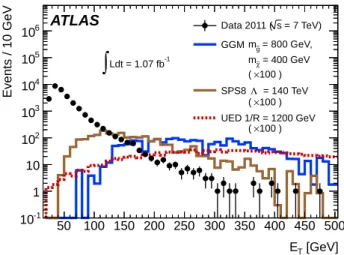
A total of 27293 γγ candidate events were observed pass-ing all selections except the Emiss
T cut. The ETdistribution of the leading photon for events in this sample is shown in Fig. 1. Also shown are the ET spectra obtained from GGM MC samples for m˜g= 800 GeV and m˜χ0
1 = 400 GeV,
from SPS8 MC samples with Λ = 140 TeV, and from UED MC samples for 1/R = 1200 GeV, representing model parameters near the expected exclusion limit. After the ETmiss> 125 GeV cut, 5 candidate events survived. 8. Background estimation
Following the procedure described in Ref. [1], the contri-bution to large Emiss
T diphoton events from SM sources can be grouped into two primary components and estimated with dedicated control samples using data. The first of
[GeV] miss T E 0 50 100 150 200 250 300 350 400 450 500 Events / 5 GeV -2 10 -1 10 1 10 2 10 3 10 4 10 -1 Ldt = 1.07 fb
∫
ATLAS = 7 TeV) s Data 2011 ( QCD +X ν e → t , t γ + ν e → +jets, W ν e → W γ γ + ν l → , W γ γ + ν ν → Z ) = (800, 400) GeV χ∼ , m g ~ GGM (m = 140 TeV Λ SPS8 UED 1/R = 1200 GeV = 7 TeV) s Data 2011 ( QCD +X ν e → t , t γ + ν e → +jets, W ν e → W γ γ + ν l → , W γ γ + ν ν → Z ) = (800, 400) GeV χ∼ , m g ~ GGM (m = 140 TeV Λ SPS8 UED 1/R = 1200 GeV Figure 2: EmissT spectra for the γγ candidate events in data (points,
statistical uncertainty only) and the estimated QCD background (normalised to the number of γγ candidates with Emiss
T < 20 GeV),
the W (→ eν) + jets/γ and t¯t(→ eν) + jets backgrounds as esti-mated from the electron-photon control sample, and the irreducible background of Z(→ ν ¯ν) + γγ and W (→ ℓν) + γγ. Also shown are the expected signals from GGM (mg˜, mχ˜0
1 = (800, 400) GeV), SPS8
(Λ = 140 TeV), and UED (1/R = 1200 GeV) samples.
these components, referred to as “QCD background” for brevity, arises from a mixture of processes that include γγ production as well as γ + jet and multijet events with at least one jet mis-reconstructed as a photon. The second background component is due to W + X and t¯t events, where mis-reconstructed photons can arise from electrons and jets, for which final-state neutrinos produce significant Emiss
T .
In order to estimate the QCD background from γγ, γ + jet, and multijet events, a “QCD control sample” was extracted from the diphoton trigger sample by selecting events for which at least one of the photon candidates does not pass the tight photon identification. Electrons were vetoed to remove contamination from W → eν decays. The QCD background contamination in the signal region Emiss
T > 125 GeV was obtained from this QCD template after normalising it to data in the region Emiss
T < 20 GeV. This gives a QCD background expectation in the signal region of 0.8 ± 0.3(stat) events. An alternate model for the QCD background was obtained using a sample of di-electron events, with no jets, selected by requiring two electrons with ET> 25 GeV and |η| < 1.81 and an invari-ant mass consistent with the Z boson mass. As confirmed by MC simulation, the ETmiss spectrum of this Z → ee sample with no additional jets, which is dominated by the calorimeter response to two genuine EM objects, ac-curately represents the Emiss
T spectrum of SM γγ events. This spectrum was normalised in the same way as the QCD control sample. A systematic uncertainty of 0.6 events was assigned as the systematic uncertainty on the back-ground prediction from the relative fractions of γγ, γ + jet,
[GeV] miss T E 0 50 100 150 200 250 300 350 400 450 500 Events / 5 GeV -2 10 -1 10 1 10 2 10 3 10 4 10 = 7 TeV) s Scaled Data 2011 ( ee → QCD, Z +jets ν e → W γ + ν e → W +X ν e → t t -1 Ldt = 1.07 fb
∫
[GeV] miss T E 0 50 100 150 200 250 300 350 400 450 500 Events / 5 GeV -2 10 -1 10 1 10 2 10 3 10 4 10 ATLAS Figure 3: EmissT spectrum for the electron-photon control sample in
data (points, statistical uncertainty only), normalised according to the probability for an electron to be mis-reconstructed as a tight photon, compared to the expected backgrounds displayed by compo-nents (stacked histograms). For the purpose of this comparison, the expected contributions from W (→ eν) + jets/γ and t¯t(→ eν) + jets events are taken from MC simulation.
and multijet events using the difference between the back-ground estimates obtained using the QCD and the Z → ee templates, yielding the result of 0.8 ± 0.3(stat) ± 0.6(syst) events. The Emiss
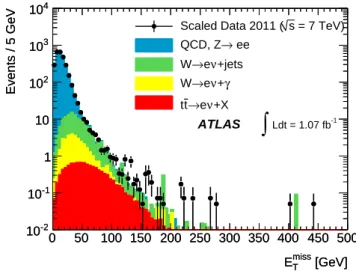
T spectra of the QCD background and the γγ sample are shown in Fig. 2.
The second significant background contribution, from W + X and t¯t events, was estimated via an “electron-photon” control sample composed of events with at least one photon and one electron, each with ET > 25 GeV, and scaled by the probability for an electron to be mis-reconstructed as a tight photon, as estimated from a study of the Z boson in the ee and eγ sample. The scaling factor varies between 5 % and 17 % as a function of η, since it depends on the amount of material in front of the calorimeter. Events with two or more photons were vetoed from the control sample to keep it orthogonal to the signal sample. In case of more than one electron, the one with the highest pT was used. The Emiss
T spectrum for the scaled electron-photon control sample is shown in Fig. 3, where it is compared to the expected contributions from various background sources as computed from MC simulation. The electron-photon control sample has a sig-nificant contamination from Z → ee events, in which one electron is mis-reconstructed as a photon, and from QCD processes mentioned above. Both of these contaminations must be subtracted in order to extract the contribution to the Emiss
T distribution from events with genuine ETmiss, such as W + X and t¯t. The contribution from QCD and Z → ee events was estimated by normalising the QCD control sample to the scaled electron-photon Emiss
T distri-bution in the region Emiss
T < 20 GeV where they dominate, as shown in Fig. 3. This distribution was then subtracted
Table 1: Number of observed γγ candidates in various Emiss
T ranges in the data, as well as the expected numbers of SM background events
estimated from the QCD and electron-photon control samples and, for the irreducible Z(→ ν ¯ν) + γγ and W (→ ℓν) + γγ processes, from MC simulation. Also shown are the expected numbers of signal events from GGM with (mg˜, mχ˜0
1) = (800, 400) GeV, SPS8 with Λ = 140 TeV,
and UED with 1/R = 1200 GeV. The uncertainties are statistical only. The Emiss
T < 20 GeV region (first row) is used to normalise the QCD
background to the number of observed γγ candidates.
Emiss
T range Data Predicted background events Expected signal events
[GeV] events Total QCD W/t¯t(→ eν) + X Irreducible GGM SPS8 UED
0 - 20 20881 - - - - 0.20 ± 0.05 0.22 ± 0.04 0.02 ± 0.01 20 - 50 6304 5968 ± 29 5951 ± 28 13.3 ± 8.1 3.55 ± 0.35 0.45 ± 0.08 1.53 ± 0.10 0.11 ± 0.01 50 - 75 86 87.1 ± 3.3 60.9 ± 2.8 25.2 ± 1.7 1.01 ± 0.16 0.48 ± 0.08 2.19 ± 0.12 0.14 ± 0.01 75 - 100 11 14.7 ± 1.2 6.7 ± 0.9 7.4 ± 0.8 0.52 ± 0.10 0.75 ± 0.10 2.09 ± 0.11 0.15 ± 0.01 100 - 125 6 4.9 ± 0.7 1.6 ± 0.4 3.0 ± 0.5 0.32 ± 0.08 1.20 ± 0.12 2.53 ± 0.13 0.29 ± 0.02 > 125 5 4.1 ± 0.6 0.8 ± 0.3 3.1 ± 0.5 0.23 ± 0.05 17.2 ± 0.5 12.98 ± 0.28 9.67 ± 0.11
from the scaled electron-photon control sample, yielding a prediction for the contribution to the high-Emiss
T dipho-ton sample from W + X and t¯t events. This procedure led to an estimate of the background from W + X and t¯t production of 3.1 ± 0.5(stat) events in the signal region. A systematic uncertainty of 0.06 events was assigned by using the Z → ee template in place of the QCD template when subtracting the contamination due to Z → ee and QCD processes. The contribution from W W events to the electron-photon control sample was estimated using MC simulation and found to be negligible.
A parallel study using MC samples of W (→ eν)+jets/γ and t¯t(→ eν) + jets, rather than the electron-photon con-trol sample, gave an estimate of 1.8 ± 1.2(stat) back-ground events. The difference was taken as an esti-mate of the systematic uncertainty, yielding the result of 3.1 ± 0.5(stat) ± 1.4(syst) events. Also included in the quoted systematic uncertainty is the relative uncer-tainty (±10 %) on the probability for an electron to be mis-reconstructed as a photon.
A small irreducible background of 0.23 ± 0.05(stat) ± 0.04(syst) events from Z(→ ν ¯ν) + γγ and W (→ ℓν) + γγ events was estimated from MC simulation. The system-atic uncertainty accounts for variations in the factorisa-tion and renormalisafactorisa-tion scales in the NLO calculafactorisa-tions. The contamination from cosmic-ray muons was found to be negligible.
Figure 2 shows the Emiss
T spectrum of the selected γγ candidates, superimposed on the estimated backgrounds. Table 1 summarises the number of observed γγ candi-dates, the expected backgrounds, and three representa-tive GGM, SPS8, and UED signal expectations, in several Emiss
T ranges. No indication of an excess at high ETmiss val-ues, where the signal is expected to dominate, is observed. 9. Signal efficiencies and systematic uncertainties
The GGM signal efficiency was determined using MC simulation over an area of the GGM parameter space that ranges from 400 GeV to 1200 GeV for the gluino mass,
and from 50 GeV to within 20 GeV of the gluino mass for the neutralino mass. The efficiency increases smoothly from 5.5 % to 31 % for (m˜g, m˜χ0
1) = (400, 50) GeV to
(1200, 1100) GeV. The SPS8 signal efficiency increases smoothly from 9.2 % (Λ = 80 TeV) to 29.4 % (Λ = 220 TeV). The UED signal efficiency, also determined using MC simulation, increases smoothly from 48.9 % (1/R = 1000 GeV) to 52.6 % (1/R = 1500 GeV).
The various relative systematic uncertainties on the GGM, SPS8, and UED signal cross sections are sum-marised in Table 2 for the chosen GGM, SPS8, and UED reference points. The uncertainty on the luminosity is 3.7 % [46, 47]. The trigger efficiency of the required dipho-ton trigger was estimated from the efficiency of the corre-sponding single photon trigger, which was estimated using a bootstrap method [48]. The result is 99.92+0.04−0.18% for events passing all selections except the final ETmisscut. To estimate the systematic uncertainty due to the unknown
Table 2: Relative systematic uncertainties on the expected sig-nal yield for GGM with (m˜g, mχ˜0
1) = (800, 400) GeV, SPS8 with
Λ = 140 TeV, and UED with 1/R = 1200 GeV. No PDF and scale uncertainties are given for the UED case as the cross section is eval-uated to LO.
Source of uncertainty Uncertainty
GGM SPS8 UED Integrated luminosity 3.7% 3.7% 3.7% Trigger 0.6% 0.6% 0.6% Photon identification 3.9% 3.9% 3.7% Photon isolation 0.6% 0.6% 0.5% Pile-up 1.3% 1.3% 1.6%
ETmissreconstruction and scale 1.7% 5.6% 0.7%
LAr readout 1.0% 0.7% 0.4%
Signal MC statistics 2.9% 2.3% 1.8%
Total signal uncertainty 6.6% 8.3% 6.0%
PDF and scale 31% 5.5% −
composition of the data sample, the trigger efficiency was also evaluated on MC events using mis-reconstructed pho-tons from filtered multijet samples and phopho-tons from signal (SUSY and UED) samples. A conservative systematic un-certainty of 0.6 % was derived from the difference between the obtained efficiencies. Uncertainties on the photon se-lection, the photon energy scale, and the detailed material composition of the detector, as described in Ref. [1], result in an uncertainty of 3.9 % for the GGM and SPS8 signals and 3.7 % for the UED signal. The uncertainty from the photon isolation was estimated by varying the energy leak-age and the pile-up corrections independently, resulting in an uncertainty of 0.6 % for GGM and SPS8 and 0.5 % for UED. The influence of pile-up on the signal efficiency, eval-uated by comparing GGM/SPS8 (UED) MC samples with different pile-up configurations, leads to a systematic un-certainty of 1.3 %(1.6 %). Systematic uncertainties due to the Emiss
T reconstruction, estimated by varying the cluster energies within established ranges and the Emiss
T resolution between the measured performance and MC expectations, contribute an uncertainty of 0.1 % to 12.4 % (GGM), 1.7 % to 13.8 % (SPS8), and 0.5 % to 1.5 % (UED). A systematic uncertainty was also assigned to account for temporary failures of the LAr calorimeter readout during part of the data-taking period, which was not modelled in the MC samples. Electrons and photons were removed from the afflicted area, but jets, being larger objects, were not. Jet energy corrections were therefore applied. Varying these corrections over their range of uncertainty results in sys-tematic uncertainties of 1.0 %, 0.7 %, and 0.4 % for GGM, SPS8, and UED, respectively. Added in quadrature, the total systematic uncertainty on the signal yield varies be-tween 6.3 % and 15 % (GGM), 6.2 % and 15 % (SPS8), and 5.8 % and 6.0 % (UED).
The PDF uncertainties on the GGM (SPS8) cross sec-tions were evaluated by using the CTEQ6.6M PDF error sets [49] in the PROSPINO cross section calculation and range from 12 % to 44 % (4.7 % to 6.6 %). The factori-sation and renormalifactori-sation scales in the NLO PROSPINO calculation were increased and decreased by a factor of two, leading to a systematic uncertainty between 16 % and 23 % (1.7 % and 6.7 %) on the expected cross sections. The different impact of the PDF and scale uncertainties of the GGM and SPS8 yields is related to the different produc-tion mechanisms in the two models (see Secproduc-tion 2). In the case of UED, the PDF uncertainties were evaluated by using the MSTW2008 LO [50] PDF error sets in the LO cross section calculation and are about 4 %. The scale of αs in the LO cross section calculation was increased and decreased by a factor of two, leading to a systematic un-certainty of 4.5 % and 9 %, respectively. NLO calculations are not yet available, but are expected to be much larger than the PDF and scale uncertainties. Thus, the LO cross sections were used for the limit calculation without any theoretical uncertainty, and the effect of PDF and scale uncertainties on the final limit is given separately.
[GeV] χ∼ m 200 400 600 800 1000 1200 [GeV]g ~ m 400 500 600 700 800 900 1000 1100 1200 = 7 TeV s -1 Ldt = 1.07 fb
∫
< 0.1 mm NLSP τ = 2, c βGGM: bino-like neutralino, tan
NLSP g ~ expected 95% CL limit s ATLAS CL observed 95% CL limit s ATLAS CL σ 1 ± ) -1 observed 95% CL limit (36 pb s ATLAS CL ) -1 CMS observed 95% CL limit (35 pb ATLAS
Figure 4: Expected and observed 95 % CL lower limits on the gluino mass as a function of the neutralino mass in the GGM model with a bino-like lightest neutralino NLSP (the grey area indicates the region where the NLSP is the gluino, which is not considered here). The other sparticle masses are fixed to ∼ 1.5 TeV. Further model parameters are tan β = 2 and cτNLSP < 0.1 mm. The previous
ATLAS [1] and CMS [51] limits are also shown.
10. Results
Based on the observation of 5 events with Emiss T > 125 GeV and a background expectation of 4.1 ±0.6(stat)± 1.6(syst) events, a 95 % CL upper limit is set on the num-ber of events in the signal region from any scenario of physics beyond the SM using the profile likelihood and CLsmethod [52]. The result is 7.1 events at 95 % CL.
Further, 95 % CL upper limits on the cross sections of the considered models are calculated, including all sys-tematic uncertainties except for theory uncertainties, i.e. PDF and scale. In the GGM model the upper limit on the cross section is (22 − 129) fb, where the larger value corre-sponds to m˜g, mχ˜0
1 = (400, 50) GeV. For mχ˜ 0
1 ≥ 150 GeV,
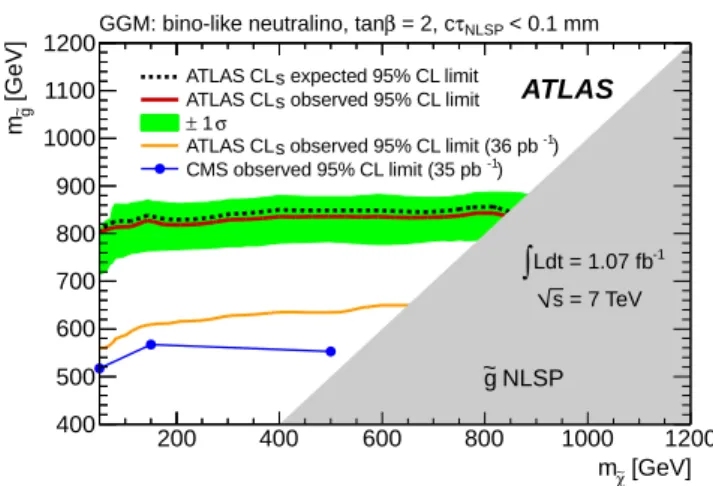
the limit is below 30 fb, reaching 22 fb for heavy neutralino masses. Figure 4 shows the expected and observed lower limits on the GGM gluino mass as a function of the neu-tralino mass. For comparison the lower limits from AT-LAS [1] and CMS [51] based on the 2010 data are also shown. The total systematic uncertainty includes the the-ory uncertainties, which are dominant. Excluding the PDF and scale uncertainty in the limit calculation would im-prove the observed limit on the gluino mass by ∼10 GeV. In the SPS8 model the cross section limit is σ < (27 − 91) fb as shown in Fig. 5, corresponding to Λ = 220 − 80 TeV. For illustration the cross section depen-dence as a function of the lightest neutralino and chargino masses is also shown. A lower limit on the SPS8 breaking scale Λ > 145 TeV at 95 % CL is set including the the-ory uncertainties, i.e. PDF and scale uncertainties, in the total systematic uncertainty.
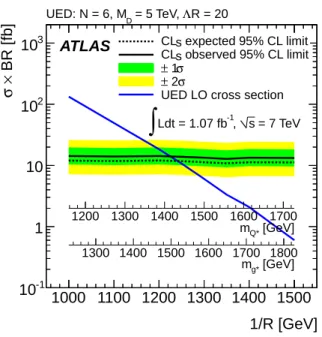
For the UED model the cross section limit is σ < (15 − 27) fb for 1/R = 1000 − 1500 GeV. Figure 6 shows the limit on the cross section times branching ratio for the
[TeV] Λ 80 100 120 140 160 180 200 220 [fb] σ -1 10 1 10 2 10 3 10 4 10 [GeV] 1 0 χ m 150 200 250 [GeV] 1 ± χ m 250 300 350 400 450 500 550 expected 95% CL limit s CL observed 95% CL limit s CL σ 1 ± σ 2 ±
SPS8 NLO cross section = 7 TeV s , -1 Ldt = 1.07 fb
∫
<0.1mm NLSP τ =15, c β =1, tan 5 , N Λ =2 mess SPS8: M ATLASFigure 5: Expected and observed 95 % CL upper limits on the spar-ticle production cross section in the SPS8 model, and the NLO cross section prediction, as a function of Λ and the lightest neutralino and chargino masses. Further SPS8 model parameters are Mmess= 2Λ,
N5= 1, tan β = 15, and cτNLSP< 0.1 mm.
UED model, which is σ < (13 − 15) fb. For illustration the cross section dependence as a function of the KK quark and KK gluon masses is also shown. A lower limit on the UED compactification scale 1/R > 1.23 TeV at 95 % CL is set. In this case PDF and scale uncertainties are not included when calculating the limits. Including PDF and scale uncertainties computed at LO degrade the limit on 1/R by a few GeV.
11. Conclusions
A search for events with two photons and Emiss T > 125 GeV, performed using 1.07 fb−1 of 7 TeV pp collision data recorded with the ATLAS detector at the LHC, found 5 events with an expected background of 4.1 ± 0.6(stat) ± 1.6(syst). The results are used to set a model-independent 95 % CL upper limit of 7.1 events from new physics. Up-per limits at 95 % CL are also set on the production cross section for three particular models of new physics: σ < (22 − 129) fb for the GGM model, σ < (27 − 91) fb for the SPS8 model, and σ < (15 − 27) fb for the UED model. Under the GGM hypothesis, a lower limit on the gluino mass of 805 GeV is determined for bino masses above 50 GeV. A lower limit of 145 TeV is set on the SPS8 breaking scale Λ, which is the first limit on the SPS8 model at the LHC. A lower limit of 1.23 TeV is set on the UED compactification scale 1/R. These results provide the most stringent tests of these models to date, signifi-cantly improving upon previous best limits of 560 GeV [1] for the GGM gluino mass, 124 TeV [22] for Λ in SPS8, and 961 GeV [1] for 1/R in UED, respectively.
1/R [GeV] 1000 1100 1200 1300 1400 1500 BR [fb] × σ -1 10 1 10 2 10 3 10 = 7 TeV s , -1 Ldt = 1.07 fb
∫
R = 20 Λ = 5 TeV, D UED: N = 6, M ATLAS [GeV] Q* m 1200 1300 1400 1500 1600 1700 [GeV] g* m 1300 1400 1500 1600 1700 1800 expected 95% CL limit s CL observed 95% CL limit s CL σ 1 ± σ 2 ±UED LO cross section
Figure 6: Expected and observed 95 % CL upper limits on the KK particle production cross section times branching fraction to two pho-tons in the UED model, and the LO cross section prediction times branching fraction, as a function of 1/R and the KK quark (Q∗)
and KK gluon (g∗) masses. The UED model parameters are N = 6,
MD= 5 TeV, and ΛR = 20.
Acknowledgements
We thank CERN for the very successful operation of the LHC, as well as the support staff from our institutions without whom ATLAS could not be operated efficiently.
We acknowledge the support of ANPCyT, Argentina; YerPhI, Armenia; ARC, Australia; BMWF, Austria; ANAS, Azerbaijan; SSTC, Belarus; CNPq and FAPESP, Brazil; NSERC, NRC and CFI, Canada; CERN; CON-ICYT, Chile; CAS, MOST and NSFC, China; COL-CIENCIAS, Colombia; MSMT CR, MPO CR and VSC CR, Czech Republic; DNRF, DNSRC and Lundbeck Foundation, Denmark; ARTEMIS, European Union; IN2P3-CNRS, CEA-DSM/IRFU, France; GNAS, Georgia; BMBF, DFG, HGF, MPG and AvH Foundation, Ger-many; GSRT, Greece; ISF, MINERVA, GIF, DIP and Benoziyo Center, Israel; INFN, Italy; MEXT and JSPS, Japan; CNRST, Morocco; FOM and NWO, Netherlands; RCN, Norway; MNiSW, Poland; GRICES and FCT, Por-tugal; MERYS (MECTS), Romania; MES of Russia and ROSATOM, Russian Federation; JINR; MSTD, Serbia; MSSR, Slovakia; ARRS and MVZT, Slovenia; DST/NRF, South Africa; MICINN, Spain; SRC and Wallenberg Foundation, Sweden; SER, SNSF and Cantons of Bern and Geneva, Switzerland; NSC, Taiwan; TAEK, Turkey; STFC, the Royal Society and Leverhulme Trust, United Kingdom; DOE and NSF, United States of America.
The crucial computing support from all WLCG part-ners is acknowledged gratefully, in particular from CERN and the ATLAS Tier-1 facilities at TRIUMF (Canada),
NDGF (Denmark, Norway, Sweden), CC-IN2P3 (France), KIT/GridKA (Germany), INFN-CNAF (Italy), NL-T1 (Netherlands), PIC (Spain), ASGC (Taiwan), RAL (UK) and BNL (USA) and in the Tier-2 facilities worldwide.
References
[1] ATLAS Collaboration, Eur. Phys. J. C71 (2011) 1744, arXiv:1107.0561 [hep-ex].
[2] P. Meade, N. Seiberg, and D. Shih, Prog. Theor. Phys. Suppl. 177 (2009) 143, arXiv:0801.3278 [hep-ph].
[3] M. Buican, P. Meade, N. Seiberg, and D. Shih, JHEP 03 (2009) 016, arXiv:0812.3668 [hep-ph].
[4] J. T. Ruderman and D. Shih, General Neutralino NLSPs at
the Early LHC, arXiv:1103.6083 [hep-ph]. [5] B. C. Allanach et al., Eur. Phys. J. C25 (2002) 113,
arXiv:hep-ph/0202233.
[6] T. Appelquist, H.-C. Cheng, and B. A. Dobrescu, Phys. Rev. D64 (2001) 035002, arXiv:hep-ph/0012100. [7] C. Macesanu, C. McMullen, and S. Nandi,
Phys. Lett. B546 (2002) 253, arXiv:hep-ph/0207269. [8] C. Macesanu, Int. J. Mod. Phys. A21 (2006) 2259,
arXiv:hep-ph/0510418.
[9] Y. A. Golfand and E. P. Likhtman, JETP Lett. 13 (1971) 323. [10] A. Neveu and J. H. Schwarz, Nucl. Phys. B31 (1971) 86. [11] P. Ramond, Phys. Rev. D3 (1971) 2415.
[12] D. V. Volkov and V. P. Akulov, Phys. Lett. B46 (1973) 109. [13] J. Wess and B. Zumino, Nucl. Phys. B70 (1974) 39. [14] P. Fayet, Phys. Lett. B69 (1977) 489.
[15] G. R. Farrar and P. Fayet, Phys. Lett. B76 (1978) 575. [16] M. Dine, W. Fischler, and M. Srednicki,
Nucl. Phys. B189 (1981) 575.
[17] S. Dimopoulos and S. Raby, Nucl. Phys. B192 (1981) 353. [18] L. Alvarez-Gaume, M. Claudson, and M. Wise, Nucl. Phys.
B207(1982) 96.
[19] C. R. Nappi and B. A. Ovrut, Phys. Lett. B113 (1982) 175. [20] M. Dine, A. Nelson, Y.Nir, and Y. Shirman, Phys. Rev. D53
(1996) 2658, hep-ph/9507378.
[21] CDF Collaboration, Phys. Rev. Lett. 104 (2010) 011801, arXiv:0910.3606 [hep-ex].
[22] DØ Collaboration, Phys. Rev. Lett. 105 (2010) 221802, arXiv:1008.2133 [hep-ex].
[23] CMS Collaboration, JHEP 1106 (2011) 093, arXiv:1105.3152 [hep-ex].
[24] C. Macesanu, C. McMullen, and S. Nandi,
Phys. Rev. D66 (2002) 015009, arXiv:hep-ph/0201300. [25] A. De Rujula, A. Donini, M. Gavela, and S. Rigolin,
Phys. Lett. B482 (2000) 195, arXiv:hep-ph/0001335. [26] M. ElKacimi, D. Goujdami, H. Przysiezniak, and P. Z. Skands,
Comput. Phys. Commun. 181 (2010) 122, arXiv:0901.4087 [hep-ph].
[27] A. Djouadi, J.-L. Kneur, and G. Moultaka, Comput. Phys. Commun. 176 (2007) 426, arXiv:hep-ph/0211331.
[28] M. Muhlleitner, A. Djouadi, and Y. Mambrini, Comput. Phys. Commun. 168 (2005) 46, arXiv:hep-ph/0311167.
[29] T. Sjostrand, S. Mrenna, and P. Skands, JHEP 05 (2006) 026, arXiv:hep-ph/0603175.
[30] A. Sherstnev and R. S. Thorne, Eur. Phys. J. C55 (2008) 553, arXiv:0711.2473 [hep-ph].
[31] PROSPINO2 .
http://www.thphys.uni-heidelberg.de/~plehn/prospino/. [32] W. Beenakker, R. Hopker, M. Spira, and P. Zerwas,
Nucl. Phys. B492 (1997) 51, arXiv:hep-ph/9610490. [33] F. E. Paige, S. D. Protopopescu, H. Baer, and X. Tata,
ISAJET 7.69: A Monte Carlo Event Generator forpp, ¯pp,
ande+e−Reactions, arXiv:hep-ph/0312045.
[34] M. Bahr et al., Eur. Phys. J. C58 (2008) 639, arXiv:0803.0883 [hep-ph].
[35] J. Alwall et al., JHEP 09 (2007) 028, arXiv:0706.2334 [hep-ph].
[36] D. Stump et al., JHEP 10 (2003) 046, arXiv:hep-ph/0303013. [37] G. Bozzi, F. Campanario, M. Rauch, and D. Zeppenfeld,
Phys.Rev. D84 (2011) 074028, arXiv:1107.3149 [hep-ph]. [38] G. Bozzi, F. Campanario, M. Rauch, and D. Zeppenfeld,
Phys. Rev. D83 (2011) 114035, arXiv:1103.4613 [hep-ph]. [39] GEANT4 Collaboration, S. Agostinelli et al.,
Nucl. Instrum. Meth. A506 (2003) 250.
[40] ATLAS Collaboration, Eur. Phys. J. C70 (2010) 823, arXiv:1005.4568 [physics.ins-det].
[41] ATLAS Collaboration, JINST 3 (2008) S08003. [42] ATLAS Collaboration, Phys. Rev. D83 (2011) 052005,
arXiv:1012.4389 [hep-ex].
[43] ATLAS Collaboration, Electron Performance Measurements
with the ATLAS Detector Using the 2010 LHC Proton-Proton Collision Data, arXiv:1110.3174 [hep-ex]. Submitted to Eur. Phys. J. C.
[44] ATLAS Collaboration, Eur. Phys. J. C 72 (2012) 1844, arXiv:1108.5602 [hep-ex].
[45] M. Cacciari, G. Salam, and G. Soyez, JHEP 04 (2008) 063, arXiv:0802.1189 [hep-ph].
[46] ATLAS Collaboration, Luminosity Determination in pp
Collisions at√s = 7 TeV using the ATLAS Detector in 2011 , ATLAS-CONF-2011-116.
http://cdsweb.cern.ch/record/1376384.
[47] ATLAS Collaboration, Eur. Phys. J. C71 (2011) 1630, arXiv:1101.2185 [hep-ex].
[48] ATLAS Collaboration, Eur. Phys. J. C 72 (2012) 1849, arXiv:1110.1530 [hep-ex].
[49] D. Stump, J. Huston, J. Pumplin, W.-K. Tung, H. Lai, et al., JHEP 0310 (2003) 046, arXiv:hep-ph/0303013.
[50] A. Martin, W. Stirling, R. Thorne, and G. Watt,
Eur. Phys. J. C63 (2008) 189, arXiv:0901.0002 [hep-ph]. [51] CMS Collaboration, Phys. Rev. Lett. 106 (2011) 211802,
arXiv:1103.0953 [hep-ex].
The ATLAS Collaboration
G. Aad48, B. Abbott111, J. Abdallah11, A.A. Abdelalim49, A. Abdesselam118, O. Abdinov10, B. Abi112, M. Abolins88, H. Abramowicz153, H. Abreu115, E. Acerbi89a,89b, B.S. Acharya164a,164b, D.L. Adams24, T.N. Addy56, J. Adelman175, M. Aderholz99, S. Adomeit98, P. Adragna75, T. Adye129, S. Aefsky22, J.A. Aguilar-Saavedra124b,a, M. Aharrouche81, S.P. Ahlen21, F. Ahles48, A. Ahmad148, M. Ahsan40, G. Aielli133a,133b, T. Akdogan18a, T.P.A. ˚Akesson79,
G. Akimoto155, A.V. Akimov94, A. Akiyama67, M.S. Alam1, M.A. Alam76, J. Albert169, S. Albrand55, M. Aleksa29, I.N. Aleksandrov65, F. Alessandria89a, C. Alexa25a, G. Alexander153, G. Alexandre49, T. Alexopoulos9, M. Alhroob20, M. Aliev15, G. Alimonti89a, J. Alison120, M. Aliyev10, P.P. Allport73, S.E. Allwood-Spiers53, J. Almond82,
A. Aloisio102a,102b, R. Alon171, A. Alonso79, M.G. Alviggi102a,102b, K. Amako66, P. Amaral29, C. Amelung22, V.V. Ammosov128, A. Amorim124a,b, G. Amor´os167, N. Amram153, C. Anastopoulos29, L.S. Ancu16, N. Andari115, T. Andeen34, C.F. Anders20, G. Anders58a, K.J. Anderson30, A. Andreazza89a,89b, V. Andrei58a, M-L. Andrieux55, X.S. Anduaga70, A. Angerami34, F. Anghinolfi29, N. Anjos124a, A. Annovi47, A. Antonaki8, M. Antonelli47,
A. Antonov96, J. Antos144b, F. Anulli132a, S. Aoun83, L. Aperio Bella4, R. Apolle118,c, G. Arabidze88, I. Aracena143, Y. Arai66, A.T.H. Arce44, J.P. Archambault28, S. Arfaoui29,d, J-F. Arguin14, E. Arik18a,∗, M. Arik18a,
A.J. Armbruster87, O. Arnaez81, C. Arnault115, A. Artamonov95, G. Artoni132a,132b, D. Arutinov20, S. Asai155, R. Asfandiyarov172, S. Ask27, B. ˚Asman146a,146b, L. Asquith5, K. Assamagan24, A. Astbury169, A. Astvatsatourov52, G. Atoian175, B. Aubert4, E. Auge115, K. Augsten127, M. Aurousseau145a, N. Austin73, G. Avolio163, R. Avramidou9, D. Axen168, C. Ay54, G. Azuelos93,e, Y. Azuma155, M.A. Baak29, G. Baccaglioni89a, C. Bacci134a,134b, A.M. Bach14, H. Bachacou136, K. Bachas29, G. Bachy29, M. Backes49, M. Backhaus20, E. Badescu25a, P. Bagnaia132a,132b,
S. Bahinipati2, Y. Bai32a, D.C. Bailey158, T. Bain158, J.T. Baines129, O.K. Baker175, M.D. Baker24, S. Baker77, E. Banas38, P. Banerjee93, Sw. Banerjee172, D. Banfi29, A. Bangert137, V. Bansal169, H.S. Bansil17, L. Barak171, S.P. Baranov94, A. Barashkou65, A. Barbaro Galtieri14, T. Barber27, E.L. Barberio86, D. Barberis50a,50b, M. Barbero20, D.Y. Bardin65, T. Barillari99, M. Barisonzi174, T. Barklow143, N. Barlow27, B.M. Barnett129, R.M. Barnett14, A. Baroncelli134a, G. Barone49, A.J. Barr118, F. Barreiro80, J. Barreiro Guimar˜aes da Costa57, P. Barrillon115, R. Bartoldus143, A.E. Barton71, D. Bartsch20, V. Bartsch149, R.L. Bates53, L. Batkova144a,
J.R. Batley27, A. Battaglia16, M. Battistin29, G. Battistoni89a, F. Bauer136, H.S. Bawa143,f, B. Beare158, T. Beau78, P.H. Beauchemin118, R. Beccherle50a, P. Bechtle41, H.P. Beck16, S. Becker98, M. Beckingham138, K.H. Becks174, A.J. Beddall18c, A. Beddall18c, S. Bedikian175, V.A. Bednyakov65, C.P. Bee83, M. Begel24, S. Behar Harpaz152, P.K. Behera63, M. Beimforde99, C. Belanger-Champagne85, P.J. Bell49, W.H. Bell49, G. Bella153, L. Bellagamba19a, F. Bellina29, M. Bellomo29, A. Belloni57, O. Beloborodova107, K. Belotskiy96, O. Beltramello29, S. Ben Ami152, O. Benary153, D. Benchekroun135a, C. Benchouk83, M. Bendel81, N. Benekos165, Y. Benhammou153, D.P. Benjamin44, M. Benoit115, J.R. Bensinger22, K. Benslama130, S. Bentvelsen105, D. Berge29, E. Bergeaas Kuutmann41, N. Berger4, F. Berghaus169, E. Berglund49, J. Beringer14, K. Bernardet83, P. Bernat77, R. Bernhard48, C. Bernius24, T. Berry76, A. Bertin19a,19b, F. Bertinelli29, F. Bertolucci122a,122b, M.I. Besana89a,89b, N. Besson136, S. Bethke99, W. Bhimji45, R.M. Bianchi29, M. Bianco72a,72b, O. Biebel98, S.P. Bieniek77, K. Bierwagen54, J. Biesiada14, M. Biglietti134a,134b, H. Bilokon47, M. Bindi19a,19b, S. Binet115, A. Bingul18c, C. Bini132a,132b, C. Biscarat177, U. Bitenc48, K.M. Black21, R.E. Blair5, J.-B. Blanchard115, G. Blanchot29, T. Blazek144a, C. Blocker22, J. Blocki38, A. Blondel49, W. Blum81, U. Blumenschein54, G.J. Bobbink105, V.B. Bobrovnikov107, S.S. Bocchetta79, A. Bocci44, C.R. Boddy118, M. Boehler41, J. Boek174, N. Boelaert35, S. B¨oser77, J.A. Bogaerts29, A. Bogdanchikov107, A. Bogouch90,∗, C. Bohm146a,
V. Boisvert76, T. Bold37, V. Boldea25a, N.M. Bolnet136, M. Bona75, V.G. Bondarenko96, M. Bondioli163, M. Boonekamp136, G. Boorman76, C.N. Booth139, S. Bordoni78, C. Borer16, A. Borisov128, G. Borissov71, I. Borjanovic12a, S. Borroni87, K. Bos105, D. Boscherini19a, M. Bosman11, H. Boterenbrood105, D. Botterill129, J. Bouchami93, J. Boudreau123, E.V. Bouhova-Thacker71, C. Bourdarios115, N. Bousson83, A. Boveia30, J. Boyd29, I.R. Boyko65, N.I. Bozhko128, I. Bozovic-Jelisavcic12b, J. Bracinik17, A. Braem29, P. Branchini134a,
G.W. Brandenburg57, A. Brandt7, G. Brandt15, O. Brandt54, U. Bratzler156, B. Brau84, J.E. Brau114, H.M. Braun174, B. Brelier158, J. Bremer29, R. Brenner166, S. Bressler152, D. Breton115, D. Britton53, F.M. Brochu27, I. Brock20, R. Brock88, T.J. Brodbeck71, E. Brodet153, F. Broggi89a, C. Bromberg88, G. Brooijmans34, W.K. Brooks31b, G. Brown82, H. Brown7, P.A. Bruckman de Renstrom38, D. Bruncko144b, R. Bruneliere48, S. Brunet61, A. Bruni19a, G. Bruni19a, M. Bruschi19a, T. Buanes13, F. Bucci49, J. Buchanan118, N.J. Buchanan2, P. Buchholz141,
R.M. Buckingham118, A.G. Buckley45, S.I. Buda25a, I.A. Budagov65, B. Budick108, V. B¨uscher81, L. Bugge117, D. Buira-Clark118, O. Bulekov96, M. Bunse42, T. Buran117, H. Burckhart29, S. Burdin73, T. Burgess13, S. Burke129, E. Busato33, P. Bussey53, C.P. Buszello166, F. Butin29, B. Butler143, J.M. Butler21, C.M. Buttar53,
J.M. Butterworth77, W. Buttinger27, S. Cabrera Urb´an167, D. Caforio19a,19b, O. Cakir3a, P. Calafiura14, G. Calderini78, P. Calfayan98, R. Calkins106, L.P. Caloba23a, R. Caloi132a,132b, D. Calvet33, S. Calvet33,
R. Camacho Toro33, P. Camarri133a,133b, M. Cambiaghi119a,119b, D. Cameron117, S. Campana29, M. Campanelli77, V. Canale102a,102b, F. Canelli30,g, A. Canepa159a, J. Cantero80, L. Capasso102a,102b, M.D.M. Capeans Garrido29,
I. Caprini25a, M. Caprini25a, D. Capriotti99, M. Capua36a,36b, R. Caputo148, R. Cardarelli133a, T. Carli29,
G. Carlino102a, L. Carminati89a,89b, B. Caron159a, S. Caron48, G.D. Carrillo Montoya172, A.A. Carter75, J.R. Carter27, J. Carvalho124a,h, D. Casadei108, M.P. Casado11, M. Cascella122a,122b, C. Caso50a,50b,∗, A.M. Castaneda Hernandez172, E. Castaneda-Miranda172, V. Castillo Gimenez167, N.F. Castro124a, G. Cataldi72a, F. Cataneo29, A. Catinaccio29, J.R. Catmore71, A. Cattai29, G. Cattani133a,133b, S. Caughron88, D. Cauz164a,164c, P. Cavalleri78, D. Cavalli89a, M. Cavalli-Sforza11, V. Cavasinni122a,122b, F. Ceradini134a,134b, A.S. Cerqueira23a, A. Cerri29, L. Cerrito75, F. Cerutti47, S.A. Cetin18b, F. Cevenini102a,102b, A. Chafaq135a, D. Chakraborty106, K. Chan2, B. Chapleau85, J.D. Chapman27, J.W. Chapman87, E. Chareyre78, D.G. Charlton17, V. Chavda82, C.A. Chavez Barajas29, S. Cheatham85, S. Chekanov5, S.V. Chekulaev159a, G.A. Chelkov65, M.A. Chelstowska104, C. Chen64, H. Chen24, S. Chen32c, T. Chen32c, X. Chen172, S. Cheng32a, A. Cheplakov65, V.F. Chepurnov65, R. Cherkaoui El Moursli135e, V. Chernyatin24, E. Cheu6, S.L. Cheung158, L. Chevalier136, G. Chiefari102a,102b, L. Chikovani51a, J.T. Childers58a, A. Chilingarov71, G. Chiodini72a, M.V. Chizhov65, G. Choudalakis30, S. Chouridou137, I.A. Christidi77, A. Christov48, D. Chromek-Burckhart29, M.L. Chu151, J. Chudoba125, G. Ciapetti132a,132b, K. Ciba37, A.K. Ciftci3a, R. Ciftci3a, D. Cinca33, V. Cindro74, M.D. Ciobotaru163, C. Ciocca19a,19b, A. Ciocio14, M. Cirilli87, M. Ciubancan25a, A. Clark49, P.J. Clark45, W. Cleland123, J.C. Clemens83, B. Clement55, C. Clement146a,146b, R.W. Clifft129, Y. Coadou83,
M. Cobal164a,164c, A. Coccaro50a,50b, J. Cochran64, P. Coe118, J.G. Cogan143, J. Coggeshall165, E. Cogneras177, C.D. Cojocaru28, J. Colas4, A.P. Colijn105, C. Collard115, N.J. Collins17, C. Collins-Tooth53, J. Collot55, G. Colon84, P. Conde Mui˜no124a, E. Coniavitis118, M.C. Conidi11, M. Consonni104, V. Consorti48, S. Constantinescu25a,
C. Conta119a,119b, F. Conventi102a,i, J. Cook29, M. Cooke14, B.D. Cooper77, A.M. Cooper-Sarkar118,
N.J. Cooper-Smith76, K. Copic34, T. Cornelissen174, M. Corradi19a, F. Corriveau85,j, A. Cortes-Gonzalez165, G. Cortiana99, G. Costa89a, M.J. Costa167, D. Costanzo139, T. Costin30, D. Cˆot´e29, L. Courneyea169, G. Cowan76, C. Cowden27, B.E. Cox82, K. Cranmer108, F. Crescioli122a,122b, M. Cristinziani20, G. Crosetti36a,36b, R. Crupi72a,72b, S. Cr´ep´e-Renaudin55, C.-M. Cuciuc25a, C. Cuenca Almenar175, T. Cuhadar Donszelmann139, M. Curatolo47,
C.J. Curtis17, P. Cwetanski61, H. Czirr141, Z. Czyczula175, S. D’Auria53, M. D’Onofrio73, A. D’Orazio132a,132b, P.V.M. Da Silva23a, C. Da Via82, W. Dabrowski37, T. Dai87, C. Dallapiccola84, M. Dam35, M. Dameri50a,50b, D.S. Damiani137, H.O. Danielsson29, D. Dannheim99, V. Dao49, G. Darbo50a, G.L. Darlea25b, C. Daum105, W. Davey86, T. Davidek126, N. Davidson86, R. Davidson71, E. Davies118,c, M. Davies93, A.R. Davison77, Y. Davygora58a, E. Dawe142, I. Dawson139, J.W. Dawson5,∗, R.K. Daya39, K. De7, R. de Asmundis102a,
S. De Castro19a,19b, P.E. De Castro Faria Salgado24, S. De Cecco78, J. de Graat98, N. De Groot104, P. de Jong105, C. De La Taille115, H. De la Torre80, B. De Lotto164a,164c, L. De Mora71, L. De Nooij105, D. De Pedis132a,
A. De Salvo132a, U. De Sanctis164a,164c, A. De Santo149, J.B. De Vivie De Regie115, S. Dean77, R. Debbe24, D.V. Dedovich65, J. Degenhardt120, M. Dehchar118, C. Del Papa164a,164c, J. Del Peso80, T. Del Prete122a,122b,
M. Deliyergiyev74, A. Dell’Acqua29, L. Dell’Asta89a,89b, M. Della Pietra102a,i, D. della Volpe102a,102b, M. Delmastro29, N. Delruelle29, P.A. Delsart55, C. Deluca148, S. Demers175, M. Demichev65, B. Demirkoz11,k, J. Deng163,
S.P. Denisov128, D. Derendarz38, J.E. Derkaoui135d, F. Derue78, P. Dervan73, K. Desch20, E. Devetak148, P.O. Deviveiros158, A. Dewhurst129, B. DeWilde148, S. Dhaliwal158, R. Dhullipudi24,l, A. Di Ciaccio133a,133b, L. Di Ciaccio4, A. Di Girolamo29, B. Di Girolamo29, S. Di Luise134a,134b, A. Di Mattia172, B. Di Micco29,
R. Di Nardo133a,133b, A. Di Simone133a,133b, R. Di Sipio19a,19b, M.A. Diaz31a, F. Diblen18c, E.B. Diehl87, J. Dietrich41, T.A. Dietzsch58a, S. Diglio115, K. Dindar Yagci39, J. Dingfelder20, C. Dionisi132a,132b, P. Dita25a, S. Dita25a,
F. Dittus29, F. Djama83, T. Djobava51b, M.A.B. do Vale23a, A. Do Valle Wemans124a, T.K.O. Doan4, M. Dobbs85, R. Dobinson29,∗, D. Dobos29, E. Dobson29, M. Dobson163, J. Dodd34, C. Doglioni118, T. Doherty53, Y. Doi66,∗, J. Dolejsi126, I. Dolenc74, Z. Dolezal126, B.A. Dolgoshein96,∗, T. Dohmae155, M. Donadelli23d, M. Donega120, J. Donini55, J. Dopke29, A. Doria102a, A. Dos Anjos172, M. Dosil11, A. Dotti122a,122b, M.T. Dova70, J.D. Dowell17, A.D. Doxiadis105, A.T. Doyle53, Z. Drasal126, J. Drees174, N. Dressnandt120, H. Drevermann29, C. Driouichi35, M. Dris9, J. Dubbert99, S. Dube14, E. Duchovni171, G. Duckeck98, A. Dudarev29, F. Dudziak64, M. D¨uhrssen29, I.P. Duerdoth82, L. Duflot115, M-A. Dufour85, M. Dunford29, H. Duran Yildiz3b, R. Duxfield139, M. Dwuznik37, F. Dydak29, M. D¨uren52, W.L. Ebenstein44, J. Ebke98, S. Eckert48, S. Eckweiler81, K. Edmonds81, C.A. Edwards76, N.C. Edwards53, W. Ehrenfeld41, T. Ehrich99, T. Eifert29, G. Eigen13, K. Einsweiler14, E. Eisenhandler75, T. Ekelof166, M. El Kacimi135c, M. Ellert166, S. Elles4, F. Ellinghaus81, K. Ellis75, N. Ellis29, J. Elmsheuser98, M. Elsing29,
D. Emeliyanov129, R. Engelmann148, A. Engl98, B. Epp62, A. Eppig87, J. Erdmann54, A. Ereditato16, D. Eriksson146a, J. Ernst1, M. Ernst24, J. Ernwein136, D. Errede165, S. Errede165, E. Ertel81, M. Escalier115, C. Escobar123,
X. Espinal Curull11, B. Esposito47, F. Etienne83, A.I. Etienvre136, E. Etzion153, D. Evangelakou54, H. Evans61, L. Fabbri19a,19b, C. Fabre29, R.M. Fakhrutdinov128, S. Falciano132a, Y. Fang172, M. Fanti89a,89b, A. Farbin7, A. Farilla134a, J. Farley148, T. Farooque158, S.M. Farrington118, P. Farthouat29, P. Fassnacht29, D. Fassouliotis8, B. Fatholahzadeh158, A. Favareto89a,89b, L. Fayard115, S. Fazio36a,36b, R. Febbraro33, P. Federic144a, O.L. Fedin121, W. Fedorko88, M. Fehling-Kaschek48, L. Feligioni83, C. Feng32d, E.J. Feng30, A.B. Fenyuk128, J. Ferencei144b, J. Ferland93, W. Fernando109, S. Ferrag53, J. Ferrando53, V. Ferrara41, A. Ferrari166, P. Ferrari105, R. Ferrari119a,
A. Ferrer167, M.L. Ferrer47, D. Ferrere49, C. Ferretti87, A. Ferretto Parodi50a,50b, M. Fiascaris30, F. Fiedler81, A. Filipˇciˇc74, A. Filippas9, F. Filthaut104, M. Fincke-Keeler169, M.C.N. Fiolhais124a,h, L. Fiorini167, A. Firan39, G. Fischer41, P. Fischer20, M.J. Fisher109, M. Flechl48, I. Fleck141, J. Fleckner81, P. Fleischmann173,
S. Fleischmann174, T. Flick174, L.R. Flores Castillo172, M.J. Flowerdew99, M. Fokitis9, T. Fonseca Martin16,
D.A. Forbush138, A. Formica136, A. Forti82, D. Fortin159a, J.M. Foster82, D. Fournier115, A. Foussat29, A.J. Fowler44, K. Fowler137, H. Fox71, P. Francavilla122a,122b, S. Franchino119a,119b, D. Francis29, T. Frank171, M. Franklin57, S. Franz29, M. Fraternali119a,119b, S. Fratina120, S.T. French27, F. Friedrich43, R. Froeschl29, D. Froidevaux29, J.A. Frost27, C. Fukunaga156, E. Fullana Torregrosa29, J. Fuster167, C. Gabaldon29, O. Gabizon171, T. Gadfort24, S. Gadomski49, G. Gagliardi50a,50b, P. Gagnon61, C. Galea98, E.J. Gallas118, V. Gallo16, B.J. Gallop129, P. Gallus125, E. Galyaev40, K.K. Gan109, Y.S. Gao143,f, V.A. Gapienko128, A. Gaponenko14, F. Garberson175, M. Garcia-Sciveres14, C. Garc´ıa167, J.E. Garc´ıa Navarro49, R.W. Gardner30, N. Garelli29, H. Garitaonandia105, V. Garonne29, J. Garvey17, C. Gatti47, G. Gaudio119a, O. Gaumer49, B. Gaur141, L. Gauthier136, I.L. Gavrilenko94, C. Gay168, G. Gaycken20, J-C. Gayde29, E.N. Gazis9, P. Ge32d, C.N.P. Gee129, D.A.A. Geerts105, Ch. Geich-Gimbel20, K. Gellerstedt146a,146b, C. Gemme50a, A. Gemmell53, M.H. Genest98, S. Gentile132a,132b, M. George54, S. George76, P. Gerlach174,
A. Gershon153, C. Geweniger58a, H. Ghazlane135b, P. Ghez4, N. Ghodbane33, B. Giacobbe19a, S. Giagu132a,132b, V. Giakoumopoulou8, V. Giangiobbe122a,122b, F. Gianotti29, B. Gibbard24, A. Gibson158, S.M. Gibson29, L.M. Gilbert118, V. Gilewsky91, D. Gillberg28, A.R. Gillman129, D.M. Gingrich2,e, J. Ginzburg153, N. Giokaris8, M.P. Giordani164c, R. Giordano102a,102b, F.M. Giorgi15, P. Giovannini99, P.F. Giraud136, D. Giugni89a, M. Giunta93, P. Giusti19a, B.K. Gjelsten117, L.K. Gladilin97, C. Glasman80, J. Glatzer48, A. Glazov41, K.W. Glitza174,
G.L. Glonti65, J. Godfrey142, J. Godlewski29, M. Goebel41, T. G¨opfert43, C. Goeringer81, C. G¨ossling42, T. G¨ottfert99, S. Goldfarb87, T. Golling175, S.N. Golovnia128, A. Gomes124a,b, L.S. Gomez Fajardo41, R. Gon¸calo76,
J. Goncalves Pinto Firmino Da Costa41, L. Gonella20, A. Gonidec29, S. Gonzalez172, S. Gonz´alez de la Hoz167, M.L. Gonzalez Silva26, S. Gonzalez-Sevilla49, J.J. Goodson148, L. Goossens29, P.A. Gorbounov95, H.A. Gordon24, I. Gorelov103, G. Gorfine174, B. Gorini29, E. Gorini72a,72b, A. Goriˇsek74, E. Gornicki38, S.A. Gorokhov128,
V.N. Goryachev128, B. Gosdzik41, M. Gosselink105, M.I. Gostkin65, I. Gough Eschrich163, M. Gouighri135a,
D. Goujdami135c, M.P. Goulette49, A.G. Goussiou138, C. Goy4, I. Grabowska-Bold163,m, P. Grafstr¨om29, K-J. Grahn41, F. Grancagnolo72a, S. Grancagnolo15, V. Grassi148, V. Gratchev121, N. Grau34, H.M. Gray29, J.A. Gray148,
E. Graziani134a, O.G. Grebenyuk121, D. Greenfield129, T. Greenshaw73, Z.D. Greenwood24,l, K. Gregersen35, I.M. Gregor41, P. Grenier143, J. Griffiths138, N. Grigalashvili65, A.A. Grillo137, S. Grinstein11, Y.V. Grishkevich97, J.-F. Grivaz115, M. Groh99, E. Gross171, J. Grosse-Knetter54, J. Groth-Jensen171, K. Grybel141, V.J. Guarino5, D. Guest175, C. Guicheney33, A. Guida72a,72b, T. Guillemin4, S. Guindon54, H. Guler85,n, J. Gunther125, B. Guo158, J. Guo34, A. Gupta30, Y. Gusakov65, V.N. Gushchin128, A. Gutierrez93, P. Gutierrez111, N. Guttman153,
O. Gutzwiller172, C. Guyot136, C. Gwenlan118, C.B. Gwilliam73, A. Haas143, S. Haas29, C. Haber14, R. Hackenburg24, H.K. Hadavand39, D.R. Hadley17, P. Haefner99, F. Hahn29, S. Haider29, Z. Hajduk38, H. Hakobyan176, J. Haller54, K. Hamacher174, P. Hamal113, M. Hamer54, A. Hamilton49, S. Hamilton161, H. Han32a, L. Han32b, K. Hanagaki116, M. Hance14, C. Handel81, P. Hanke58a, J.R. Hansen35, J.B. Hansen35, J.D. Hansen35, P.H. Hansen35, P. Hansson143, K. Hara160, G.A. Hare137, T. Harenberg174, S. Harkusha90, D. Harper87, R.D. Harrington45, O.M. Harris138,
K. Harrison17, J. Hartert48, F. Hartjes105, T. Haruyama66, A. Harvey56, S. Hasegawa101, Y. Hasegawa140, S. Hassani136, M. Hatch29, D. Hauff99, S. Haug16, M. Hauschild29, R. Hauser88, M. Havranek20, B.M. Hawes118, C.M. Hawkes17, R.J. Hawkings29, D. Hawkins163, T. Hayakawa67, T. Hayashi160, D Hayden76, H.S. Hayward73, S.J. Haywood129, E. Hazen21, M. He32d, S.J. Head17, V. Hedberg79, L. Heelan7, S. Heim88, B. Heinemann14, S. Heisterkamp35, L. Helary4, S. Hellman146a,146b, D. Hellmich20, C. Helsens11, R.C.W. Henderson71, M. Henke58a, A. Henrichs54, A.M. Henriques Correia29, S. Henrot-Versille115, F. Henry-Couannier83, C. Hensel54, T. Henß174, C.M. Hernandez7, Y. Hern´andez Jim´enez167, R. Herrberg15, A.D. Hershenhorn152, G. Herten48, R. Hertenberger98, L. Hervas29, N.P. Hessey105, A. Hidvegi146a, E. Hig´on-Rodriguez167, D. Hill5,∗, J.C. Hill27, N. Hill5, K.H. Hiller41, S. Hillert20, S.J. Hillier17, I. Hinchliffe14, E. Hines120, M. Hirose116, F. Hirsch42, D. Hirschbuehl174, J. Hobbs148, N. Hod153, M.C. Hodgkinson139, P. Hodgson139, A. Hoecker29, M.R. Hoeferkamp103, J. Hoffman39, D. Hoffmann83, M. Hohlfeld81, M. Holder141, S.O. Holmgren146a, T. Holy127, J.L. Holzbauer88, Y. Homma67, T.M. Hong120,
L. Hooft van Huysduynen108, T. Horazdovsky127, C. Horn143, S. Horner48, K. Horton118, J-Y. Hostachy55, S. Hou151, M.A. Houlden73, A. Hoummada135a, J. Howarth82, D.F. Howell118, I. Hristova15, J. Hrivnac115, I. Hruska125,
T. Hryn’ova4, P.J. Hsu81, S.-C. Hsu14, G.S. Huang111, Z. Hubacek127, F. Hubaut83, F. Huegging20, T.B. Huffman118, E.W. Hughes34, G. Hughes71, R.E. Hughes-Jones82, M. Huhtinen29, P. Hurst57, M. Hurwitz14, U. Husemann41, N. Huseynov65,o, J. Huston88, J. Huth57, G. Iacobucci49, G. Iakovidis9, M. Ibbotson82, I. Ibragimov141, R. Ichimiya67, L. Iconomidou-Fayard115, J. Idarraga115, P. Iengo102a,102b, O. Igonkina105, Y. Ikegami66, M. Ikeno66, Y. Ilchenko39, D. Iliadis154, D. Imbault78, M. Imori155, T. Ince20, J. Inigo-Golfin29, P. Ioannou8, M. Iodice134a, A. Irles Quiles167, A. Ishikawa67, M. Ishino68, R. Ishmukhametov39, C. Issever118, S. Istin18a, A.V. Ivashin128, W. Iwanski38,