Abstract
This paper aims to present an emerging phenomenon based on social innovations, which is striving to associate sustainable social, economic and cultural behaviours to the prevailing unsustainable socio-economic model. This emerging phenomenon has been designated as Creative Places, i.e., urban spaces where people collaboratively promote and manage a mix of creative initiatives that foster social innovations and the emergence of a more sustainable development model.
To address the research question “How to facilitate the implementation of Creative Places in the urban territory by means of design?”, it was important to articulate an in-depth understanding of these places, how they work, the motivations and drivers behind their implementation, how they are organized, which kind of activities they develop and their impact in their surroundings, and crucially, how they can be replicated and diffused across the city.
Based in a case study methodology, the research has analysed cases in European cities, taking into consideration the interactions between three main areas of activity (Culture, Knowledge-based enterprises and Social initiatives).
It will be described their features as small and local entities, open and connected in their organizational systems.
It will also be presented a set of strategic design guidelines to bridge local top-down initiatives with bottom-up ones, and a set of tools for citizens to collaborate, create, and contribute in the process.
1. Introduction
There are a growing number of people, organizations and institutions behaving in a creative way in the contemporary knowledge society (Giddens, 2001; Ray and Anderson, 2000) and according to the Young Foundation Report (Mulgan, 2007) social innovations have been moving from the margins to the mainstream. From the EMUDE research (EMUDE, 2006), conducted at the Politecnico di Milano with the European Commission’s support, emerged that all across Europe ordinary people are making the extra-ordinary happen, expressing a diffused creativity put co- operatively into action by “non-specialised” people, embodying a significant expression of contemporary society (Manzini, 2006).
From observation and desk research, it became apparent that those clusters of creativity, or Creative Places, are mostly found in cities, as the result of a special urban creativity deriving from the problems and potential of cities and the special response they require. Characterized by specialisms and niches as well as an innovative mix of ideas, these places are the result of urban life itself in the sense that they result from a set of conditions only found in cities - optimal dimension or critical mass, cultural and ethnic diversity, universalism and large fluxes of exchange and interaction (Landry, 2000). Also worth considering was that the shift from a period of industrial prosperity to a post-industrial one left behind abandoned industrial sites and unemployment, transforming booming neighbourhoods into rundown ones. This reality opened unforeseen perspectives, as some of those abandoned places were re-occupied and converted to new uses. The “available” architectures of those buildings, open-ended in their essence and with no predetermined role, welcomed new experiences and were open to various re-interpretations.
Those renewed and converted places upgraded the urban environment of entire neighbourhoods - they became spaces where groups of people could put in practice urban regeneration through, namely, a focus on culture and creativity as means of generating wealth, jobs, identity and active citizenship. They encourage people to get involved in civic initiatives and to get together to back common causes; they provide emotional and intellectual outlets in creation and in doing so they help people to form a better relationship with their environment and their lives; they promote social
form the backbone of what we consider, for the purposes of the research conducted, Creative Places.
2. Creative Places. An emerging phenomenon
Creative Places are a new type of urban spaces where groups of people
collaboratively promote and manage a mix of creative initiatives in the fields
of art and culture, economy and production, social services and urban regeneration.
They are very diverse but, at the same time, they have some strong common
denominators, the most evident of which are that they are deeply rooted in their own city, but also open and cosmopolitan; and even though they are self-standing
initiatives, the are also highly connected and depending on a complex interplay of top-down, bottom up and peer-to-peer interactions.
Creative Places gather 3 phenomena that are steadily gaining momentum: artistic and cultural production; knowledge-based enterprises; and social initiatives. But the existence of those 3 phenomena, does not, by itself, define a Creative Place. It is their simultaneous mix and confluence that is its defining characteristic. By amassing those 3 areas, Creative Places work as incubators of novel developments, as well as launchpads for what may be a more socially sustainable future.
Figure 1. Sectors of Activity within Creative Places
In order to understand this phenomenon it was important to articulate an in-depth understanding of these places, how they work, the motivations and drivers behind their implementation, how they are organized, which kind of activities they develop and their impact in their surroundings, and crucially, how they can be replicated and diffused across the city. That was done through a Case studies methodology, carried out mainly through desk research. 13 cases were identified and between those, 4 were singled out to be analysed in-depth: UfaFabrik in Berlin (Germany) ; Grote Pyr in The Hague (The Netherlands); Republikken in Copenhagen (Denmark) and Fabbrica del Vapore in Milan (Italy). For this in-depth analysis, field research (through ethnographic methods) was applied.
Landry (2000) refers that cities need “platforms for delivery”, as creative people and projects need to be based somewhere to develop entrepreneurial activity, to test ideas, pilot products and services. But they need them at an affordable price, reducing financial risk and therefore encouraging experiment and innovation. At the same time, the evolution of new governance dynamics, new planning and
policy development paradigms and new organizational structures are also needed. Greater collaboration, cooperation and communication across and between
governments, and public/private and non-profit jurisdictions are urgently required. In order to do this, it is necessary to develop innovative governance tools targeted at facilitating the very existence of innovative communities, a cultural and legal framework capable of dealing with the demands arising from new ventures (Jégou and Manzini, 2008), and a culture of collaboration.
Collaboration (or collaborative work) implies having a shared purpose, high-level of commitment, trust, flexibility, adaptation to change and clarity of objectives (Parker, 2007). It is the capacity to solve problems or open new possibilities collaboratively among different actors.
Those are the characteristics of the individuals or groups of individuals who are behind Creative Places. If governments cannot manage more innovative and collaborative approaches to social problems, their citizens can. This perception is to become central in shifting governance paradigms in order to include those most affected by problems in their solution, since they are best positioned to understand the context within which their communities exist and the problems they face. As Landry (2000) puts is, some of the most forward-looking creative work occurs at the grassroots level, where ideas can flourish, experiments can take place, and creative activity is less constrained by institutional bureaucracy and market
imperatives. And local organizations not only respond more effectively to local needs than larger, top-down structures, but can also better focus and connect community resources to enable latent collaborative talent.
3. Creative Places’ Features
The essential theoretical findings extracted from the research conducted and from the in-depth analysis of case studies characterise Creative Places as incubators of knowledge based initiatives; new organisational models; sustainable lifestyles and a new civil society, all of which are necessary elements towards sustainable growth.
3.1. Incubators of sustainable lifestyles
One of Creative Places’ features is that they challenge traditional ways of thinking and doing and introduce more sustainable ones, proposing themselves as free spaces, where socio-technical experimentation is possible (Warnke and Luiten, 2008 in Jégou and Manzini, 2008).
They generate and put into practice ideas of wellbeing that are based on a set of “sustainable values” (related to the ideas of community, locality, common goods, care, slowness, etc.), where not only new artistic expression becomes possible, but where also more everyday life ways experiences can be tested and more
sustainable ways of living can be experimentally invented and explored.
3.2. Incubators of knowledge-based initiatives
A crucial precondition for the successful transition towards a knowledge intensive economy is the ability of all actors of the innovation system to learn and react to change. As innovation studies have long been pointing out, it is the quality of the whole system of innovation, and no longer the excellence of single elements, that determines success within a knowledge-based economy (Warnke and Luiten, 2008 in Jégou and Manzini, 2008). And for a knowledge economy to flourish it needs a wider knowledge society - knowledge-oriented companies need well-trained knowledge workers and dynamic, stimulating social contexts (Manzini, 2008). The emergence of Creative Places is offering a potential to exploit this pathway towards sustainable knowledge-based competitiveness. They offer a favourable background for creative innovation and can become both the fertile ground for new knowledge-based enterprises to germinate and breeders of well-trained knowledge workers. In their almost “laboratorial”-like settings, Creative Places could become
facilitatorsof thattransition by acting as interfaces between innovators and users and enabling joint learning and customising of innovation; and at the same time they could help companies to orient their innovation activities towards future demands.
3.3. Incubators of a new civil society
The transition from the industrial age to the age of knowledge brought about diverse changes in the way we live, and the progressivemeltdown of the welfare state and globalisation have created new problems and, thus, new needs (McLaughlin and Davidson, 1985; Beck, 1999; Giddens, 2001).
The initiatives promoted by these groups of citizens, congregated in specific places, are a response to everyday problems and to the needs arisen by this new reality, working in a radically different system to the traditional one. These citizens do things themselves, to help themselves. Unlike the mainstream vision of social services where the predominant figure is someone who provides things for others, the characterising aspect here is that everyone concerned is directly and actively involved in achieving the result that the enterprise itself sets out to reach (Manzini, 2008).
Creative Places seem to have a great aptitude to reconcile distinct but complementary objectives, like economic development, social inclusion and sustainability. Because they appear as communities capable “of producing information, knowledge, and culture through social, rather than market and proprietary relations—through cooperative peer production and coordinated individual action—that creates the opportunities for greater autonomous action, a more critical culture, a more discursively engaged and better informed republic, and perhaps a more equitable global community” (Benkler:2006:92).
3.3.1. Active citizenship. Creative Places can be regarded as social laboratories
where a new more integrated citizenship can be forged, with the risk of
fragmentation and pulverisation being reduced. These are places where diverse local communities contribute actively to the formation of a new and shared sense of citizenship, increasing participation to social life through everyday activities, while promoting local economic development and cultural production and consumption. Because collaboration is also about empowering people to shape their own lives and participate in the construction of the res publica.
3.3.2. Social cohesion and active welfare society. Creative Places can be seen as
the seed of a new active welfare society. That is, an intelligent active state where public authority continues to play a key role but where citizens also participate in an active way, exercising their citizenship. In fact, in this perspective, Creative Places may offer an entry point into such a society as they signal a new kind of active and collaborative engagement of people. To counteract social exclusion means working to ensure that everybody is ‘included’ in the benefits of living in a well-organised society. It also means creating strong and cohesive communities which support people, and people contribute to. In this setting Creative Places may offer an alternative pathway for social inclusion beyond classical employment schemes and become core elements of an “active welfare society”, i.e., a society better suited to address the enormous challenges to our welfare state system, that we know is ill-equipped to deal with many of the modern social problems it has to confront (Leadbeater, 1997).
3.4. Incubators of innovative organisational models
These places may be seen as new, open and flexible institutions operating in a world of fast paced change, partially assuming many of the functions traditionally assigned to the old, closed and rigid institutions of the industrial society (Toefler, 1984;
3.4.1. Nonhierarchical organizations. Collaborative work implies an approach
different to the one seen in the traditional hierarchical pyramid-based system, since all actors are involved in the co-design and co-management of the organization, sharing more or less the same degree of responsibility.
Simultaneously, they are the producers and the users of their services, creating also a different economic model based on a combination of self and mutual-help, of barter and gift, market and non-market economies (Manzini, 2008).
These different patterns of organisation, and management, flourish where there are diffused skills and distributed competencies able to put forward such organizational and management models, that is, different and new ways of doing things.
3.4.2. Culture of Trust. These organisations acknowledge that their distributed and collective know-how, creativity and ideas, collaborators and users are their most important resources and to rely on them and to work based on peer-to-peer collaboration calls for trust, without which there is no room for collaboration, nor creativity or innovation (Leadbeater, 1997). What we have seen is that Creative Places generate large reservoirs of trust, without which the collaborative services produced would not take shape.
3.4.3. Size matters. The Web 2.0 phenomenon makes it possible for millions of
people to belong to a community, collaborate and share the contents produced in its midst. In virtual communities size is not a problem, in turn it’s an opportunity for ever increasing the wealth of contents and broaden its scope of influence and reach. In fact, one of the decisive factors for P2P networks to work is its size: the bigger they are, the bigger the contents produced and shared, and the bigger their attractiveness to a wider audience. This “mass-innovation”, as Leadbeater (2008) puts it, is the characteristic of the XXI Century: more ideas being shared by more people than ever before, with the help of technology.
Regarding Creative Places, this relationship is not the same. In fact, most cases are small entities, with small-enterprises and small groups of people, even if they are connected with several similar places, thus creating a diffused knowledge. As they work based in physical peer-to-peer interaction and local collaborative relationships, the bigger they are, the more unmanageable they become as the number of links between people rises much faster than the number of people themselves.
Through the Birthday Paradox (Shirky, 2008) engine, it is easy to see that the complexity of a group grows faster than its size:
A B C
Figure 2. Three clusters A, B and C, with all connections drawn. The cluster A has 5 members and 10 connections; the cluster B has 10 members and 45 connections; and the C has 15 and 105 connections
So, as groups grow it becomes impossible for everyone to interact directly with everyone else. This problem can never be solved, only managed and in modern life the solution has been gathering people together into organizations (Shirky, 2008). But the typical organization is hierarchical with members answering to a manager that, in turn must answer to a higher manager and so on. This simplifies
communication, by avoiding each member having to communicate with everyone else. And to do this, traditional management needs coordination and needs to simplify it; otherwise the costs of directing the members can be higher than the potential gain from directing them. This is why Shirky (2008) refers that certain activities may have some value but not enough to make them worth pursuing in any organized way.
However, the emergence of new social tools is lowering the costs of coordinating group action (Shirky, 2008). These tools are widespread in the Internet, and are mainly used there, but the concept of sharing, working together, collaborating and participating are happening in Creative Places as well, where they are reinvented and complemented by physical peer-to-peer interaction and local collaborative relationships, as mentioned above.
Working together takes time, effort and know-how, and balancing all these is the cornerstone of Creative places, as its effectiveness is largely conditioned by the relational qualities of each concrete initiative, which cannot be dissociated from their size.
3.4.4. Flexibility. Managing such type of organization requires flexibility. And being flexible means being open and adaptative. This implies a system with an openness quality, the capacity to welcome change and diversity, and implies an adaptative quality (or resilience), the capacity to absorb change, the ability to change and adjust to changes in the environment where they evolve.
Adapting to change, building creative capacity and establishing positive new directions requires a culture where people are encouraged to revolutionize approaches, reform processes and policies, rethink measures and outcomes. Creative Places are incubators of these new types of organisation – open, flexible and adaptative - where new patterns of management that can be implemented at both corporate and government levels are trialled in order to respond to future (and present) demands.
4. Strategic design guidelines for Creative Places
If the contexts where innovative communities exist cannot be designed, some of their characterising elements can be conceived and implemented. It is possible to identify and develop material and immaterial elements that work together in a given context to enhance its chances of becoming a fertile ground for creative, bottom-up
initiatives. That is to say, it is possible to improve a context’s capacity to support innovative communities, and to enable a large number of potentially innovative citizens to move in the same direction (Landry, 2000 and 2006; Leadbeater, 2006; Manzini, 2008).
In order to do so it is necessary to actively promote a dialogue that will enable the convergence of groups of people and organizations, optimising and potentiating their resources, skills and ideas. Namely by suggesting the tools that will facilitate/support stakeholders in the process of promoting radical innovation and providing a platform for collaboration, co-creation, and participation.
Figure 4. Visual representation of systemic collaboration
Given the possibilities for collaboration between multiple actors, as presented in figure 4, and assuming the premise that the optimal conditions to work are in place, design may have a role to play in the enhancement of the efficacy and efficiency of the system.
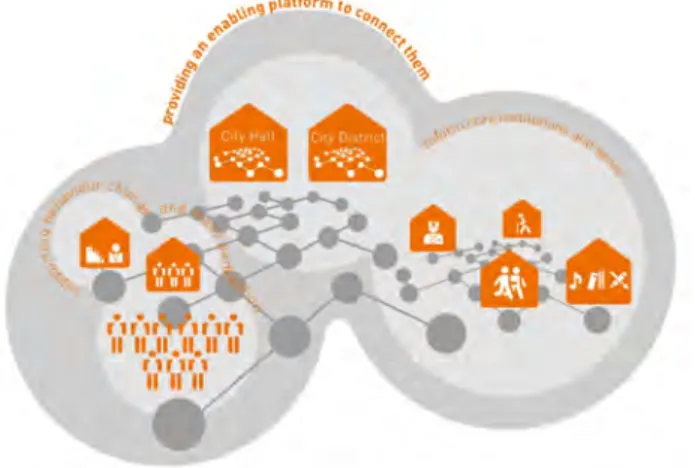
A draft of a possible system to assist in the convergence and sharing of ideas between citizens and urban authorities was designed (figure 5), followed by a possible set of strategic design guidelines with practical examples of the tools and skills needed to orchestrate the challenge of creating an enabling system that stimulates the appearance, preserves and replicates Creative Places. If the pre-required conditions for the system to work are available, then it becomes possible to promote a fruitful dialogue between different actors and deliver the outcomes
envisaged by them.
The system map presented above shows a possible configuration for a platform that enables communication between diverse actors interested in finding/reusing
abandoned spaces.
Employing a design approach brings multiple benefits, such as mechanisms for placing the user at the heart of a solution and for experts to collaborate equally on complex issues; a rapid, iterative process that can adapt to changing circumstances; and a highly creative approach to problem-solving that leads to practical, everyday solutions.
Phase 1.
Considering that a multidisciplinary group of experts, in which the designer is
integrated: observed the urban territory and the emergence of social innovations and creativity in diffuse and unconnected pockets; acknowledged its potential for
strengthening the socio-cultural and economic fabric of the city; identified as essential the existence of places where spontaneous and “de-localised” creative initiatives (existing and future) can find space to develop innovative socio-technical experimentations; recognised that the benefits of social innovations, which can be cascaded to the wider community given the right amount of support, can be potentiated if the Creative Places where they are developed and the social
entrepreneurs behind them are backed by the right enabling system. Then proposes to the relevant local authorities: the survey of all abandoned / available spaces which can be reused by groups of citizens to develop creative activities; to develop an effective communications channel to disseminate that information between the citizens and that welcomes and fosters their contributions and participation, i.e., to create opportunities for mass participation; to engage in discussions with groups of citizens interested in promoting creative activities and regenerating specific spaces, neighbourhoods or areas, i.e., to foster bottom-up creativity and collaborative
services; the study (for future adoption) of policy measures to enable the appearance and diffusion of Creative Places and for their connection into a citywide connected network, i.e., to promote the emergence of connected kernels of creativity and collaboration constituted by a mix of social services, cultural and economic activities. Here the designer should help to design the interface of and for the interactions to take place and to propose policy-orienting scenarios targeted at facilitating political decisions. Besides endowing it with a holistic strategic vision, he could also design tools such as: concept sketches, representational diagrams, scenarios, storyboards, plans, visual frameworks and models, in order to promote meaningful dialogue between all stakeholders.
Phase 2.
In a second moment, through the use of communication skills that are in the field of his expertise, the designer should help to communicate the project to citizens, as well as to the administrative structure that will support its success. The key aim is to mobilise citizens and raise their awareness to the active role they can play in the construction of a more liveable, sustainable city, and at the same time foster the emergence of a socio-cultural, political-administrative ground favourable to creative initiatives. In this phase it is important that information is widely accessible, and this should be made possible through the active involvement of local institutions/places citizens have more direct contact with (schools, healthcare centres, public libraries, local theatres, local businesses, etc). It is also important that the designer can highlight and communicate best practices and successful cases and their positive outcomes, so that they can act as attractors and thus stimulate interest in their reproduction and adaptation, always focusing on the importance of place and local
impact.
Furthermore, and as in these cases creativity and technology play a crucial role and Web 2.0 technologies have made possible the convergence of communication, grassroots creativity and active citizenship, the designer should help with specific advice when new procedures and/or new technologies have to be integrated, involving the relevant experts whenever required.
New media can foster the ‘ephemeral’ practices of cultural citizenship to enhance social networking, community building and emplaced definitions of new sustainable solutions for everyday urban living.
Designers’ inputs at this stage can be made tangible through the creation of various instruments (like the ones presented in the figures) such as: a Web platform;
telecommunications; communication elements as flyers, posters, outdoors, advertisements; a citizen’s scorecard, etc.
Figure 6. Actors and Interfaces’ System Map for decision-making
Phase 3.
In this phase, the convergence between citizens with related interests has been achieved and the space in which they have shown interest in regenerating and dynamising identified. To foster participation and collaboration and to discuss the ideas uploaded onto the ideas pool database (that functions much like a
crowdsourcing process) so as to reach a common ground, an open debate should be organised between all stakeholders: citizens involved in the starting-up of the
Creative Place, representatives of local authorities and organisations (such as
schools, libraries, health centres, local businesses, relevant public offices, etc.) and a multidisciplinary team of experts to help them in the strategic design of the process (designers, urban planners, architects, sociologists, economists, etc). Here, designer should act as an interface between these different actors, acting as a facilitator of others’ ideas and of interrelations, capable to bridge diverse points of view and
facilitate collaboration through his specific set of design skills and instruments - to help clarify and visualise different and comparable visions, propose possible alternatives or scenarios and illustrate potential results arising from best known practices.
Figure 7. Scenario Building for strategic discussion
Figure 8. Storyboard. (Source: www.sustainable-everyday.net)
His role is not to act as a conflicts mediator or negotiator (these roles should be played by experts in those fields), but to deliver tactical outcomes – communications, tools, products, environments - through design orienting scenarios, conceived as tools to be used in the process of designing the creative place. This scenario building has to convey visions based on considerations that the scenario builder (designer) may share with, and ideally build with, the potential scenario users, proposing them as an integral part of the scenario itself (a collectively imagined scenario).
Phase 4.
Once citizens with similar goals have been matched, the space has been allocated, and a strategy for the setting-up of the creative place has been agreed upon with the stakeholders involved, the designer will have to collaborate with a variety of interlocutors, stepping forward as expert, i.e. as design specialists interacting with diverse actors who design without being designers, i.e. design amateurs,
participating in the construction of shared visions and scenarios and combining existing products and services to support the creative community they are collaborating with (Manzini, 2008).
This phase is the unfolding of the preceding one, with the designer introducing enabling solutions, that is, activities and artefacts that support the service, both at its start up and in its day to day management, while raising the level of socialisation among participants making them produsers of the value generated by the service. These enabling solutions consist of: communication tools to publicise the service; organisation and management tools; tools to foster a sense of identity and belonging; items that foster cost reduction and fidelity ; the outline of catalysing events.
Figure 10. Examples of enabling solutions
They can be developed through the usage of plans, visual frameworks and models or physical mock-ups, and storyboards that show the interaction between the members and the system, introducing a timeline that will account for the unexpected evolutions in the service and in the system itself.
Figure 11. Example of scenario building/storyboard (Source: Sustainable Everyday, 2003)
Figures 5 and 6 illustrate the emergence of a platform for interaction, in which there is a transition in the relationship behaviours amongst the parties. In this framework, design should act as an interface between two levels (top-down and bottom-up initiatives), for top-down initiatives are strategic whilst bottom-up ones are more tactical or operative. Having the ability to dematerialize, simplify and make sense out of very complex systems, designers plays a key role in the system’s structuring, by identifying different actors, their possible interactions and the necessary interfaces for the whole process to work smoothly.
5. Conclusions
It is important to underline that the contexts where innovative communities exist cannot be “designed”, and that that is not the aim behind this research. The purpose of this research was to observe and understand its dynamics and to extrapolate ways of further enhancing them and allow for their replicability within different contexts, not to undertake (or promote) what could be regarded as “social engineering”.
From the case studies we have concluded that collaboration changes the way people and enterprises organize themselves. The services they provide are based on the efforts of a local network of creative user-producers. These “produsers” of services within creative networks are the real promoters and managers of Creative Places initiatives. If these places are to work, collaboration always has to be at their core; it
is a necessary element, almost a prerequisite, for their creation and without which they could not exist or function. And even if they are very diverse regarding their business and organisational models, they have a common denominator to develop collaborative services based on the efforts of a local network of creative users-producers.
Creative Places are rooted in their own neighbourhood or city but at the same time they are linked with a wider global network of similar places around the world. They are expressions of an emerging urban culture, identity and citizenship and, at the same time, they are social laboratories where these urban culture, identity and citizenship are actively and continuously produced and reproduced. By enriching city life, promoting an active citizenship, improving cultural diversity, and generating a system of relationships with the neighbourhood and the city, the places studied have enriched the area where they are situated, renewing it and revitalising its community, social and cultural life, widening local boundaries and connecting them to the rest of the city and the world. To intervene in this complex fluidity demands a holistic approach, a level of systems thinking and the orchestration of a wide range of different design inputs. And the designer, operating in very complex systems
involving multiple networks of actors and in a setting where there is no-obvious client, has to make use of the strategic design instruments available to him in order to facilitate and support the ongoing diffuse design activity that characterises such systems so as to give them perspective and endow those singular, individual design flashes with an organic unicity oriented towards ensuring long term positive results and sustainability. Employing a design approach brings multiple benefits, such as mechanisms for placing the user at the heart of a solution and for experts to collaborate equally on complex issues; a rapid, iterative process that can adapt to changing circumstances; and a highly creative approach to problem-solving that leads to practical, everyday solutions. As such, this is a highly transferable process.
6. References
Beck, U. (2004). La società del rischio, Urbino: Carocci Editore.
Benkler, Y. (2006). The Wealth of Networks - How Social Production Transforms
Markets and Freedom. London: Yale University Press.
EMUDE (2006). Emerging User Demands for Sustainable Solutions, 6th Framework Programme (priority 3-NMP), European Community, internal document.
Giddens, A. (2001). O Mundo na Era da Globalização, 3ª Edição, Lisboa, Editorial Presença.
Jégou, F., Manzini, E. (2008). Collaborative services. Social innovation and design
for sustainability. Milan: POLI.Design.
Landry, C. (2000). The Creative City: A toolkit for urban innovators. London: Earthscan Publications Ltd.
Landry, C. (2006). The art of city making. London: Earthscan. Leadbeater, C. (2008). We-Think. London: Profile Books.
Leadbeater, C. (1997). The Rise of the Social Entrepreneur. London: Demos.
Leadbeater , C. (2006). The User Innovation Revolution - How Business Can Unlock
the Value of Customers' Ideas, National Consumer Council, London.
in a Changing World, Book Publishing Company.
Manzini, E. (2008). Collaborative organisations and enabling solutions - Social
innovation and design for sustainability. In Collaborative Services - Social innovation
and design for sustainability, by François Jégou and Ezio Manzini, 29-41. Milan: POLI.Design.
Manzini, E. (2006). Creative communities, collaborative networks and distributed
economies - Promising signals for a sustainable development in
http://sustainable-everyday.net/manzini/.
Mulgan, G. (2007). Social Innovation: what is it, why it matters, how it can be
accelerated. The Young Foundation Report, The Young Foundation, London:
Basingstoke Press.
Parker, S. and Gallagher N. (2007). The Collaborative State. Report, 2007: Demos. Ray, P., and Anderson S. R. (2000). The Cultural Creatives - How 50 million people
are changing the world. New York: Three River Press.
Shirky, C. (2008). Here comes everybody. London: Penguin Books. Toffler, A. (1984). A Terceira Vaga, Lisboa, Edição “Livros do Brasil”