Socionet; CEEOL; Ulrich ProQuest; Cabell, Journalseek; Scipio; Philpapers; SHERPA/RoMEO repositories; KVK; WorldCat; CrossRef; CrossCheck
2019, Volume 10, Issue 2, pages: 84-113 | doi:10.18662/po/73
(Un)professionalisation
or
(Re)professionalisation
of the Academic in the
Brave New World?
Maria JOSÉ SÁ1, Carlos Miguel
FERREIRA2, Sandro SERPA3
1CIPES-Centre for Research in Higher
Education Policies, 4450-227 Matosinhos, Portugal, [email protected]
2Estoril Higher Institute for Tourism and
Hotel Studies; Polytechnic Institute of Castelo Branco; Interdisciplinary Centre of Social Sciences – CICS.NOVA, Portugal, [email protected]
3University of the Azores, Faculty of Social
and Human Sciences, Department of Sociology; Interdisciplinary Centre of Social Sciences – CICS.UAc/CICS.NOVA.UAc; and Interdisciplinary Centre for Childhood and Adolescence – NICA – UAc,
Abstract: Currently, the digital dimension permeates the daily activity of many professions, with all that this entails, in terms of advantages, disadvantages and challenges. The academic world is not immune to these new technological, political and social conditions and new instigations and situations emerge, which need to be studied. This article seeks to answer the following research question: Is the academic profession undergoing a process of increasing proletarianisation, which is influenced by the new universities‘ mission (in a broad way), in the sense of un-professionalisation, or are there new conditions for academics‘ re-professionalisation experienced as a challenge? A meta-analysis of publications that focus directly on this topic was conducted through a conceptual analysis of the most recent literature addressing this topic. It is concluded that, in general, and notwithstanding institutional, local, regional, national and international specificities, there is some degree of academic‘s un-professionalisation resulting from an increase in the functions ascribed to him/her by the political dimension that, in a context of increasing instability and control of his/her activity through the quantity and intensity of the functions to be conducted, may call into question academic autonomy, a basic foundation of the University. However, and concurrently, there is a new context which could, under certain conditions, foster the enormous challenge of re-professionalisation. As an implication of this work, there is a need to rethink this situation, which, if continued and deepened, will threaten the academic profession in some of its central dimensions, which may jeopardise the future sustainable development of our societies.
Keywords: Academic profession; academic; de-professionalisation; (re)professionalisation of the academic profession; digital scholarship; academic autonomy.
How to cite: José Sá, M., Ferreira, C. M., & Serpa, S.
(2019). (Un)professionalisation or
(Re)professionalisation of the Academic in the Brave New World?. Postmodern Openings, 10(2), 84-113. doi:10.18662/po/73
1. Introduction and justification of the study
The academic profession (herein referred to any professional who is a faculty member) and its working environment – universities or other higher education institutions (HEIs) – have always had high status, given the academics‘ functions and the knowledge and expertise necessary to carry out their profession.
The social acknowledgement and autonomy ascribed to these professionals were such that academics and their institutions have sometimes been considered an ivory tower (Etzkowitz, Webster, Gebhardt, Regina, & Terraad, 2000; Watson & Watson, 2013) as if they were isolated from the everyday reality of the surrounding environment (Becker & Eube, 2018; Oliveira, 2000).
According to this perspective, the University would be, in its essence, ―an educational institution whose purpose is the permanent exercise of criticism, and which is based on research, teaching and service to society‖ (Almeida & Pimenta, 2014, p. 8). The author adds that, thus, the key purposes of the University would be ―the production of knowledge on the basis of the problematization of historically produced knowledge and of its results in the construction of human society and of the new challenges and demands that it poses‖ (Almeida & Pimenta, 2014, p. 8).
However, higher education in Portugal – and in a large part of Europe – has undergone and is undergoing a number of profound transformations in the management and self-regulation of academic activity, with the Bologna process and the resulting convergence in a European Higher Education Area (EHEA) (Santos, Pereira, & Lopes, 2016; Galego, 2016; Sá, Machado-Taylor, & Carvalho, 2018). These shifts are also happening all over the world and translates into the need for internationalisation, harmonisation between countries, regions and even at the global level (Shaker, 2016). Specifically in the EHEA context, this reconfiguration of higher education has the central purpose of enabling the possibility of creditation in different HEIs and countries (through ECTS – European Credit Transfer System), the assessment of HEIs and their faculty members, a greater efficiency in their management and the focus on innovation and entrepreneurship, in a closer relationship with the social and economic community (Carlotto & Garcia, 2018; Véliz-Calderon, Theurillat, Paredes, & Pickenpack, 2018) of science as a directly productive factor (Oliveira, 2000), with local, regional, national and international specificities and variations (Dan & Fengqiao, 2015; Isabel, Luis, & Gomez-Gajardo,
2015; Lamarra & Marquina, 2013; Research Institute for Higher Education Hiroshima University, 2015; Sethy, 2018; Trif, 2014; Véliz-Calderon, et. al., 2018). Dan and Fengqiao (2015) offer the example in China, where they identify dimensions of change in higher education, such as massification of teaching frequency, controlled decentralisation of teaching management, revenue marketization, differentiation of institutions into a pyramid structure, and internationalisation process of HEIs. All these dimensions are deeply influenced by the higher education model of the United States (Dan & Fengqiao, 2015; Oliveira, 2000). It is, therefore, a real revolution, with the institutionalisation of the contribution to economic development as another mission of the University, with its profound implications.
In a summary of Moisés de Lemos Martins (2015, p. 406), it can be asserted that ―the numbers of the promise succeed the words of the promise, which are always the indicators of economic growth, of the Gross Domestic Product (GDP) and export figures, i.e., the Trade Balance surplus numbers‖.
These transformations and reconfigurations that have been taking place in the higher education arena have motivated and continue to motivate the need for higher education academics and institutions to adapt to new internal and external demands which may lead to opportunities and challenges for the academic profession (Dan & Fengqiao, 2015; Santos, et al, 2016). The assessment of the academic becomes critical in the main dimensions of his/her work – teaching, research, academic management and service to the community/knowledge transfer (Santos, et al, 2016; Véliz-Calderon, et al, 2018). According to Scanlon (2018),
The priorities of scholars whether conventional or digital are still similar. They research, debate and communicate. However, with the new affordances of digital technologies, the way scholars negotiate and navigate information and communicate is changing, and that is mediated by technology (Scanlon, 2018, p. 2).
Everything that previously mentioned in terms of internationalisation, competitiveness and definition and control by public policies of the intended University model (Carlotto & Garcia, 2018) causes ―the erosion of the prestige of the university‖ and the academic profession (Santos, Pereira, & Lopes, 2016), or at least affects its identity as a profession (Seixas, 2013) in dimensions such as self-management of work and professional self-assessment, as maintained by Carlotto and Garcia (2018).
How and to what extent do these challenges of increasing scientific productivity and, if possible, fostering economic development affect the
academic profession? Has academic ever been a profession? This article seeks to answer these questions.
This paper is organised as follows. Next, we will present the research methods, the results and discuss them in several dimensions. Finally, the paper will offer some conclusions and put forward the implications and limitations of this work.
2. Methods
This paper seeks to answer the following research question: does the academic, as a profession, is shifting towards a growing proletarianisation, to which the new mission that is being implemented in Universities (in the broad sense) as de-professionalisation, or are there new conditions for a re-professionalisation of the academic, experienced as a challenge?
In order to seek to answer this research question, a meta-analysis of publications that directly focus on this topic was carried out. The collection was based in the consultation of the b-on database of the Foundation for Science and Technology (FCT) in Portugal, an electronic library that includes databases such as Web of Knowledge, DOAJ (Directory of Open Access Journals) and SCIELO (Scientific Electronic Library Online), among others, as well as institutional repositories (―What is b-on?‖, n.d.). A survey was carried out between March 1 and 15, 2019, by searching for the following expressions/keywords, both in the Abstract and in the Title: ―academic profession‖ and ―scholar profession‖; and by title, abstract and terms of the topic. This online bibliographic search was supplemented with the collection of complementary bibliographic material directly related to the academic profession.
3. Context of the academic profession
As the main mission of the University, ascribed both by itself and by third parties, it has traditionally always been the articulation of teaching with research (Carlotto & Garcia, 2018; Costa, 2018; Turk & Ledic, 2016), despite variations in its implementation.
However, more recently, alongside these two functions, voices have emerged that propose the need to integrate more functions, such as
[…] a stronger integration of community engagement in academic activities, in order for them to have a recognisable character of synergy with the community and society, as well as with perceived needs and problems. […] Apart from these roles, there are various other additional (new) roles required of academics, which are expected to become an
integral part of their everyday duties: project preparation and management, collecting research funds, application of new teaching methods, etc. (Turk & Ledic, 2016, p. 100).
This university-society relationship seeks to foster a social use of scientific knowledge, in a close relationship with productivity and the market (Carlotto & Garcia, 2018; Santos, et al, 2016; Veliz-Calderon, et al, 2018), translated in its direct contribution to economic and social development as another direct mission of the University in fostering innovation and entrepreneurship, setting the third legitimating mission of the University (Costa, 2018; Sá, Dias, & Sá, 2018). This entails a close relationship between three stakeholders (university-industry and economic actors-government) (Cf. Triple-Helix research), which tends to generate a ―clash of different cultures‖ (Becker & Eube, 2018) with the traditional culture of the academic profession.
4. The academic profession
Acknowledging the difficulty and multiplicity of definitions of the academic profession, in any case, the control of work, the specialised knowledge and the autonomy in this activity are critical for the definition of profession and it is possible that they are decreasing in the academic (Carlotto & Garcia, 2018). According to Sethy (2018), being an academic as a profession involves a set of features and specificities that differentiate it from all others. As the main features, the author highlights:
i. Higher education teachers need to earn the certificate for ‗teaching‘ to enter into HE teaching profession‖, ―ii. Teachers‘ associations and HE governing bodies must come together to formulate teacher‘s code of ethics, which would guide teachers to render their services to students, colleagues, institution authorities, research works, and the society at large professionally‖, ―iii. Teachers in HE settings need to register in the teacher‘s associations, and by implication, they agree to abide the teacher‘s code of ethics while performing their tasks‖, ―iv. The teacher‘s code of ethics must grant ‗autonomy‘ to the HE teachers along with certain responsibilities. By exercising their autonomy, HE teachers can develop course curriculum, design the instruction and pedagogical delivery of a course. Further, they can evaluate students‘ performances and generate final grade sheets. v. The teachers‘ code of ethics shall be revisited and modified if required once in three years (Sethy, 2018, pp. 296-297).
For a long time, the vocation of the academic profession usually involved research and teaching (Arimoto, 2015; Galego, 2016; Santos,
Pereira, & Lopes, 2016; Sethy, 2018). Santos et al. (2016), in their study, stress the intensification of the academic work, concomitant with the fragmentation of the profession, in a context in which
What makes the nature of the university today is the commercial ideology: universities are companies; education is services; teaching and research are business opportunities; teachers are service professionals or consultants; students are clients. And with the financial market and the labour market booming fantastically over its head, the university makes headlines of the ‗excellence‘ of its programmes and academic staff, that is, it makes headlines of its ‗quality‘ (Martins, 2015, p. 409).
As Hada (2015) points out, Universities live (together) in a world in which globalisation, marketisation, market mechanisms and competition are crucial, with national variations and repeating specific strategies. According to Véliz-Calderón et al. (2018), this can materialise as follows:
Normally it is pointed out that academics must: (1) gain national or international reputation (with no clear specification of a criterion for this) in the fields of teaching, research, and/or service, while also being excellent at those activities (as determined by internal committees only); (2) be awarded with external grants and projects (governmental or industrial, usually with no indication of how many or of which nature); (3) maintain a steady publication rate (without specifying time frames or indexing quality); and, (4) stay a minimum of years in each rank, among other requirements (Véliz-Calderón et al., 2018, p. 14).
Currently, in Portugal, the academic profession is enacted and works in the Performance Appraisal Regulations presenting the following dimensions: teaching, research, academic management and knowledge transfer (Martins, 2015; Santos, et al., 2016). In the next section, we will analyse, in some detail, each of these dimensions.
4.1. Teaching
The teaching dimension has always been considered a key dimension in the self and hetero-ascribed academic profession. According to Turk and Ledić (2016, p. 95), in a survey conducted in Croatia with 60 academics interviewed, the researchers who participated in the study ―see themselves most frequently as teachers, then as teachers and researchers, and least frequently as predominantly researchers. Their identification is mainly determined by external factors, most frequently negatively connoted, which presents a challenge within the context of job satisfaction‖. The authors
conclude that the academic self-perception academics have of their profession is, above all, ―the legal acts that regulate the higher education system stipulate dedicating an equal number of working hours to both, while academic promotion requirements give priority to research over (the quality of) teaching‖ (Turk & Ledic, 2016, p. 107).
However, the conditions for efficient teaching are often not created, which can lead to specific training for teaching. This position is presented by Almeida and Pimenta (2014), who mobilise what is reported in a specific training Program:
[...] to know the historical constitution of the university with the purpose of understanding its determinants in the forms of curricular organisation and of teaching performance; the legal foundations of education in the country; the theoretical foundations of the Political-Pedagogical Project and the analysis of the projects underway in the university; conceptions of teaching and learning and analysis of those practiced in the institution; collective work and construction of new models of curricular organization with interdisciplinary perspectives, surpassing the fragmentary conception of disciplines grid; identity and university pedagogy teacher professionalisation; conceptions of science, of knowledge, of didactics and of scholastic knowledge; content-form (method) in teaching processes; teaching with research and research in teaching; criteria for the selection and organisation of the knowledge to be developed; management of knowledge and information in the theory-practice relationship; programme and teaching purposes; evaluation; building learning environments in the programmes; effectiveness of the didactic contract between academics and students; teaching and student autonomy; professional performance; profile of current students; among others (Almeida & Pimenta, 2014, pp. 21-22).
The changes that the teaching profession has been subject to have motivated expected changes in the teaching process (Arimoto, 2015; Scanlon, 2018). As an example, the contribution Nugent et al. (Nugent, Lodge, Carroll, Bagraith, MacMahon, Matthews, & Sah, 2019) and Carroll et al. (Carroll, Lodge, Bagraith, Nugent, Matthews, & Sah, 2018) is offered. The authors maintain that:
[1.] A university education provides a learning experience that broadens students knowing and being for life beyond the classroom […]. [2.] Learning occurs in context, and context can be used to enhance the learning experience […]. [3.] Emotions play a role in how and why students learn […]. [4.] Leverage the social dynamics of learning to enhance the learning experience […]. [5.] Challenge and difficulty can be beneficial for
students‘learning process […]. [6.] When students employ effective methods of thinking, and understand how they learn, they can improve the way they learn […]. [7.] Learning is built on prior knowledge and engages students in deep and meaningful thinking and feeling (Nugent, et al., 2019, p. 1).
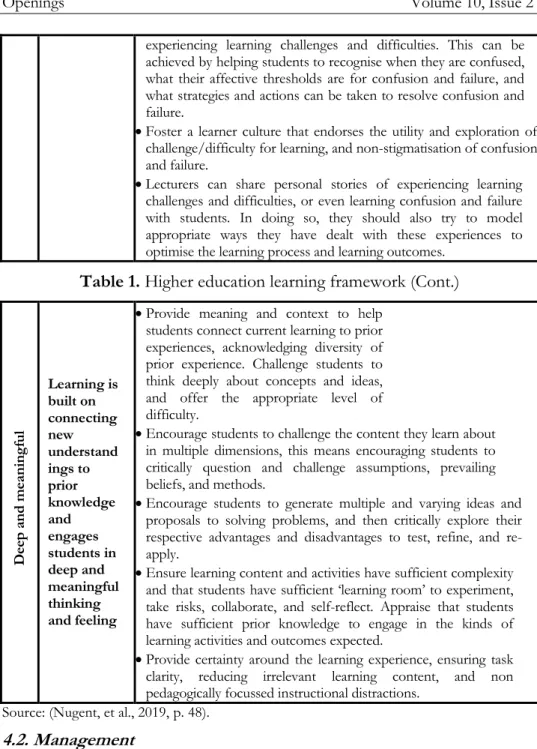
On the basis of these principles, the authors developed the Higher Education Learning Framework. Table 1 results from this framework, but only presents the component directly related to the implications for the teacher, which is the focus of this article (for further development, which covers the implications for students and assessment, see Carroll et al., 2018).
Table 1. Higher education learning framework
IMPLICATIONS FOR TEACHERS
L ea rn ing a s be co mi ng A university education provides a learning experience that broadens students’ knowing and being for life beyond the classroom
Consider students‘ future career paths and their time at university as an integrated experience; predicating your teaching towards them and their learning experiences not as finite ‗students‘ but as ‗evolving professionals‘.
Explore with students how undertaking a course or degree program can influence their self-identity, and encourage students to be open to exploring how it impacts upon their perceptions, beliefs, social interactions, and behaviours, inside and outside of the classroom.
Discuss with students how the broader contexts of community and society influence a student, and how they in turn can influence community and society. Explore with students both the epistemology of knowledge, and how it is students‘ responsibility to examine and question that knowledge.
Encourage students to adopt a mindset of education as a lifelong pursuit. C ont ex tu al le ar ni ng Learning occurs in context, and context can be leveraged to enhance the learning experience
Utilise contextualised teaching approaches and techniques (e.g., case-based learning, project based learning, simulated learning, professional guest speakers, etc.), or work? integrated learning experiences (e.g., practicums and internships) to provide opportunities for students to contextualise their learning to reflect disciplinary or professional practice.
Integrate real-word problems as a vehicle to teach students about learning content as it is situated in the discipline, and concurrently examine with students the analytical methods and techniques that occur in disciplinary/professional practice.
Facilitate student thinking about course content across multiple contexts, including those in a student‘s real life (e.g., casual job, local community, weekly sporting team, or home life). Noting that good quality learning can take place inside and outside of the
Table 1. Higher education learning framework (Cont.)
classroom, even when transferred to unrelated or novel contexts.
Recognise a student‘s own ability in self-directing their learning towards a contexualised learning experience, and work together to cocreate that learning experience.
Regularly consult and engage with relevant stakeholders across industry (e.g., government and representative professionals), community (e.g., NGOs) and alumni (e.g., graduates working in discipline) to examine how courses can remain ‗current‘ in how they contextually reflect practice. Also, utilise these relationships to draw upon opportunities for industry to engage with courses and students.
E m oti on s an d le ar ni ng Emotions play a role in how and why students learn
Promote a learning environment that engenders a sense of belonging and relatedness, and foster a positive and enjoyable learning culture.
Build quality relationships with students focusing on the meaning derived from students‘ engagement with a lecturer, not just upon the quantity of time spent with a lecturer.
Help to assure students‘ perceived ‗effort to reward‘ relationships by making transparent the course design, and addressing arbitrary or bureaucratic elements that can undermine the fidelity of these relationships.
Encourage students to develop their self-efficacy by having them set and explore mastery related goals. Also engage in dialogues with them that reflect the malleable nature of their abilities and their capacity to improve.
Foster students‘ perceptions of their autonomy and agency by providing them with flexibility and choice.
Explore with students how they can regulate their emotions when learning. In te ra cti ve lea rn ing Leverage the social dynamics of learning to enhance the learning experience
Promote social interactivity with diverse peers as part of the learning experience. At a simple level, this can mean incorporating peer-assisted learning activities into lectures and/or tutorials. At a more extensive level, this can mean having students engage in interdisciplinary courses, or projects, that involve a variety of students from different degrees learning together.
Facilitate a culture among students that fosters shared values and beliefs, and is perceived as a safe and inclusive environment for students to exchange a diversity of perspectives.
Appreciate that effective collaboration on learning tasks can take time, with successful collaboration requiring students to develop a level of social synchrony with each other.
Promote students‘ capabilities to socially interact in an effective manner by exploring ways to develop their written and verbal
communication skills.
It is important that any strategies to promote the social dynamics of learning should avoid the arbitrary addition of social elements (e.g., group tasks) unless it clearly aligns with the learning content and objectives. L ea rn ing to le ar n an d hi gh er o rd er thi nki ng When students employ effective methods of thinking, and understand how they learn, they can improve the way they learn
Assist students in their methods of thinking with respect to the analysis and synthesis of learning content and problems, as well as providing guidance to reach answers. This can relate to how students deconstruct, explore, appraise, and reconstruct problems in both accurate/expected and inaccurate/non-expected ways.
Support students to gain greater metacognitive awareness about their learning, and relatedly, to exercise greater metacognitive regulatory actions. This in turn will promote students‘ ability to self-regulate their learning.
Strategically use the repertoire of labels related to higher order thinking skills when teaching and assessing students, and moreover, explicitly teach students what they mean (e.g., explaining, justifying, analysing, synthesising, applying, and/or evaluating; what are their respective methods and how do they converge and diverge).
Aid students to be able to make evaluative judgments about their own capabilities or performance at any stage of learning (pre/post formal assessment).
Explore how student opportunities for self directed learning can be integrated with socially interactive learning or practice, and when and how they best complement each other, giving students the opportunity to make visible their learning.
L ea rn ing c ha lle nge a nd di ff icu lty Challenge and difficulty can be beneficial for students’ learning process
Ensure learning content and activities have sufficient complexity to allow the learning mechanisms of challenge/difficulty to adequately operate, and that students have sufficient ‗learning room‘ to experiment and take risks/fail (e.g., time allocation).
Experiment with, and provide support for, illstructured learning problems, unpredictability in learning content, and problem based learning scenarios to facilitate the exploration of challenge and difficulty in student learning.
Consider the use of interleaved practice for enhancing the learning potential of challenge and difficulty (e.g., conceptual contradictions and dynamic conceptual assumptions) as they explore different concepts and topics.
Facilitate students to become more adept at dealing with, or self-regulating, the confusion and failure that can occur when
Table 1. Higher education learning framework (Cont.)
Source: (Nugent, et al., 2019, p. 48). 4.2. Management
The academic‘s vocation is undergoing enormous changes in the sense of New Public Management (Arvaja, 2018; Stoleroff & Vicente, 2018). In the specific context of the Portuguese higher education system, Stoleroff and Vicente (2018) state in their study that, despite the different regimes
experiencing learning challenges and difficulties. This can be achieved by helping students to recognise when they are confused, what their affective thresholds are for confusion and failure, and what strategies and actions can be taken to resolve confusion and failure.
Foster a learner culture that endorses the utility and exploration of challenge/difficulty for learning, and non-stigmatisation of confusion and failure.
Lecturers can share personal stories of experiencing learning challenges and difficulties, or even learning confusion and failure with students. In doing so, they should also try to model appropriate ways they have dealt with these experiences to optimise the learning process and learning outcomes.
D ee p an d m ea ni ngf ul Learning is built on connecting new understand ings to prior knowledge and engages students in deep and meaningful thinking and feeling
Provide meaning and context to help students connect current learning to prior experiences, acknowledging diversity of prior experience. Challenge students to think deeply about concepts and ideas, and offer the appropriate level of difficulty.
Encourage students to challenge the content they learn about in multiple dimensions, this means encouraging students to critically question and challenge assumptions, prevailing beliefs, and methods.
Encourage students to generate multiple and varying ideas and proposals to solving problems, and then critically explore their respective advantages and disadvantages to test, refine, and re-apply.
Ensure learning content and activities have sufficient complexity and that students have sufficient ‗learning room‘ to experiment, take risks, collaborate, and self-reflect. Appraise that students have sufficient prior knowledge to engage in the kinds of learning activities and outcomes expected.
Provide certainty around the learning experience, ensuring task clarity, reducing irrelevant learning content, and non pedagogically focussed instructional distractions.
adopted by HEIs as a consequence of the decentralisation and autonomy granted to them by changes in recent years, there are features which are common to all of them and that are maintained. The authors point out, as main commonalities,
- a certain uniformity in the weighting of scores amongst the four areas of teaching activity, with a tendency to value teaching and research activities; - similarities in the items of assessment that had been operationalized for each of the areas of activity;
- a certain standardization of the criteria for evaluating teachers irrespec-tive of their professional category, scientific area, degrees or seniority; - standardization of the scales for assessment results such as three or four levels for positive assessment and only one negative level; a prevalence for assessment over three-year periods;
- some sort of inclusion of students‘ evaluation of teachers, usually based on annual or bi-annual questionnaires;
- the presence of some form of self-assessment by teachers through reporting of activities or registering of results and its delivery to an organ (such as a department chair) with responsibility for its validation (Stoleroff & Vicente, 2018, p. 8).
Still on the Portuguese case, Stoleroff and Vicente (2018) put forward the main changes brought about by the new RJIES (Judicial Regime for HEIs), which came into force in 2007. These changes are depicted in Table 2.
Table 2. Main changes introduced by RJIES (Judicial Regime for HEIs)
Governance
The concentration of decision-making power within a reduced number of organs and, especially, the strengthening of the powers of the university rectors and presidents of the polytechnical institutes;
A significant decrease in the number of members constituting the government structures of the institutions, namely in the General Councils and the Management Councils;
The introduction of external stakeholders into the management organs; The introduction of the modes of a selection of members of governing bodies, making it possible for some to be designated or co-opted from above;
Professionalization of certain managerial functions and administrative leadership (supervisors, directors and the like).
Management
Creation of an option between two institutional models: the public institute regulated by public law and the foundation regulated by private law;
Introduction and regularization of reporting and other instruments for accountability;
Viabilization of formalized cooperation and consortia between institutions.
Funding
Linking institutional budgets to productivity through financing contracts with the state;
Possibility of autonomous fixing of tuition, including the possibilityof tuition increases.
Human Resources
Transformation of the civil service status of teachers and administrative staff to public employees;
Introduction of Performance Assessment of academic personnel. Source: [29] (p. 7).
The idea of a new type of ―academic management‖ according to the market and the students‘ future employability, in which bureaucratic administration is one of its main lines (Galego, 2016; Santos, Pereira, & Lopes, 2016) is considered by Nóvoa (2018) as a ―modernisation‖ defined by Employability, Excellence, Corporisation and Entrepreneurship.
In this regard, Martins (2015, p. 405) argues that, ―In the name of the certification of ‗quality‘ and ‗excellence‘, the University seems to be condemned, today, only to procedures that, in teaching and research, certify routines and conformities, efficiencies and utilities, confirming the hegemony of instrumental reason‖ in the control of the academic profession. Nóvoa (2018, p. 19) adds, to Martins‘s (2015) critique of the current functioning of HEIs, that ―Administrative, cold, ‗objective‘ censorship, now through digital hyper-bureaucracy, is the worst form of censorship‖. Martins (2015) offers several illustrative examples of this hyper-bureaucracy: the creation of several Vice-Chancellors for Quality and Excellence or Communication and Image in Portuguese universities, or the Communication and Image Offices that sometimes function as regulatory instruments of this technical-instrumental normalisation of control of academic work advocated in some sense.
This new context reshapes the management context (Santos, Pereira, & Lopes, 2016) and the permanent need to update the technological bureaucracy:
We name intensification of everyday life one of the most significant consequences of the changes in teachers‘ work: huge workload, countless activities and tasks to develop and accumulation of responsibilities. Teachers are faced with a greater number of teaching hours, added to the obligation of internationalisation and publication of works, a high number of students to monitor and supervise, and a recurrence of bureaucratic tasks to solve (Santos, Pereira, & Lopes, 2016).
We are, thus, in the face of a ―bureaucratisation of the teaching career‖ (Santos, Pereira, & Lopes, 2016, p. 309). In this case, what is at stake is
[...] the principle of autonomy that sustains professional cultures consolidated in modernity. In the case of academic work, the recent attempt to redefine patterns of organisation and control of work from objectives and evaluation criteria that are exogenous to professional practice is a trend that has been described and studied in different contexts (Carlotto & Garcia, 2018, p. 4).
Carlotto and Garcia (2018) also assert that these reformulations generate tensions that are being created in the academic profession, and potentially can – besides ―restricting the traditional autonomy of the profession‖ – open ―new spaces of action and professional identity within the university, precisely in the areas of institutional management and coordination‖ (p. 4). According to the authors‘ interpretation, ―This is one of the ways in which the ‗managerial wave‘ is strengthened, gaining new adepts as it opens new repositioning horizons within the academic hierarchies, thus stimulating re-professionalisation‖ (Carlotto & Garcia, 2018, p. 4).
4.3. Research
Scientific articles are very often considered as one or even the main indicator of productivity (Daizen, 2015; Haro, 2017). Bibliometric indicators, with all their limitations, widely focused in the literature (Ferreira & Serpa, 2018; Haro, 2017; Xu, 2018), assimilated and collected through the Internet on their publications and citations, as well as also their social dissemination, have an increasingly crucial influence at the national but, mainly, at the international level. This influence is especially visible both in the assessment of the academic performance in terms of research, with implications in the academics‘ own professional assessment and consequent promotion, and in the application for research funds, and also as one of the elements considered to define the position of the academics‘ institution and of themselves in the more global ranking of higher education (Aksnes, Langfeldt, & Wouters, 2019; Costa, 2018; Haro, 2017; Novoa, 2018; Trif, 2014; Vanz, Dominique, Sánchez, & Casado, 2018; Veliz-Calderon, et al., 2018; Xu, 2018), as proof of academic excellence (Martin, 2015).
In this process, the academic need for digital literacy is critical in this ability to publish and where to publish (Buffardi, 2018; Carrozza, 2018; Haro, 2017; Kasperiuniene, & Zydziunaite, 2019; Santos & Serpa, 2017).
Zachos, Paraskevopoulou-Kollia and Anagnostopoulos (2018), in the literature review carried out on the Social Media Use in Higher Education, sought to provide
[...] insights into social network influences with regard to (a) the learning processes (support, educational processes, communication and collaboration enhancement, academic performance) from the side of students and educators; (b) the users‘ personality profile and learning style; (c) the social networks as online learning platforms (LMS—learning management system); and (d) their use in higher education (Zachos, et al., 2018, p. 1).
The conclusions of their review of the literature point towards the existence of positive impacts in all dimensions of the defined network influences, which, from the authors‘ point of view, is an indicator that ―the wider future use of online social networks (OSNs) in higher education is quite promising. However, teachers and higher education institutions have not yet been highly activated towards faster online social networks‘ (OSN) exploitation in their activities.‖ (Zachos, et al., 2018, p. 1).
Novenkova, Abilov, Vershinina and Medvedeva (2018) presented in 2018 a study whose objective was to evaluate the promotion of universities in their ratings and development. The authors concluded that there are positive effects of promoting university rankings in their development and progress. Novenkova et al. (2018) point out, as the most relevant effects,
[…] the formation of a competitive environment within the university, the definition of a specific strategic goal, the attraction of more qualified personnel to the university, including from the international academic market, etc. Negative consequences were revealed too, such as: increase in the workload on teachers, and as a result, reduced attention to the organization of the educational process, higher risk of losing the quality of scientific research, as a result of increasing the number of publications, ineffective spending of the university funds (Novenkova, 2018, p. 527). However, there are serious limitations in this predominance of international research, as we shall see ahead. Among these various limitations, Haro (2017) highlights that scientific publication
[...] besides being an occupation, is also, as the famous saying Publish or Perish, a source of pressure on individuals. But its meanings are not exhausted here: it is still an essential component of the global market for scientific journals, an exchange currency that allows to attain reputation
and scientific capital and a hierarchy factor among professionals, institutions and countries. […] The United Kingdom, the Netherlands and Germany integrate this centre (Haro, 2017, p. 98).
The semiperiphery and the periphery are always disadvantaged in their attempt to integrate into the centre, as a standard model to be followed, also by linguistic issues related to the English language (Haro, 2017), as the lingua franca for publishing in the international arena.
Chou and Chan (2017, p. 65) argue that these impacts are felt with much greater intensity in the field of social sciences and humanities, inasmuch as researchers in these scientific areas have been able to focus their research ―on social and cultural phenomena that are local in scope and significance. Research in the humanities and social sciences can generate awareness and knowledge of local issues and has the potential to bring about solutions to local challenges‖. Haro (2017, p. 98) complements this stance by adding that ―social sciences are not viable when disconnected from their environment‖.
On the other hand, Arimoto (2015) emphasises that academic productivity translated in the publication of articles is not necessarily synonymous with the improvement of education quality in higher education, by advocating that
The research orientation is not necessarily welcomed by students who are the main actors in the universal stage of higher education, even though it is welcomed by countries, universities, and academics. In the universal stage of higher education, transformation from a decrease of the teaching orientation to an increase in the research orientation inevitably brings about a cause of teaching‘s decline because of a shortage of academics‘ commitment to the teaching and learning (study) process (Arimoto, 2015, p. 10).
The quality of teaching at this educational level implies, therefore, the existence of institutional conditions to develop the research-teaching relationship (Almeida & Pimenta, 2014) as can be seen in Table 1.
4.4. Knowledge transfer
According to Santos et al. (2016) and Novotny (2017), ―the commercialization of research […] under the ethos of ‗academic capitalism‘‖ (Novotny, 2017, p. 2), in a ―‗marketization‘ of university research‖ (Novotny, 2017, p. 2), is considered a new mission of the University and, consequently, of the academic, which is a new expectation in general, considering the traditional academics (Santos, et al., 2016).
Martins (2015) substantiates this need to reconfigure the academic profession that has emerged in recent years, by stating that
Being ours a time of technological mobilisation, a new type of teacher and student is required today, as well as a new type of researcher. Increasingly with less social rights, teachers, researchers and students have, from now on, permanent mobility, by crossing the market needs. And there they are, the new researchers, in mobility programs, from country to country and from university to university. They are required to be competitive and entrepreneurs, to promote self-employment, or employment in general, to create spin-offs, for example. And they are required to be productive, successful achievers (Martins, 2015, pp. 8-9).
Oliver and Sapir (2017) make an interesting comparative analysis between the Logic of academic science and the Logic of market/scientific entrepreneurship based on a set of variables depicted in Table 3.
Table 3. Factors associated with the logics of open academic science and
market/scientific entrepreneurship
Logic of academic science Logic of market/scientific entrepreneurship
Necessary conditions
- Academic excellence in research expertise and training
- Publication in top scientific journals
- Scientific advancement - Innovative research
Innovative scientific breakthrough with applied/commercial potential
Facilitating conditions
- State funding - University funding
- Promotion based on scientific excellence
- Disciplinary and interdisciplinary
collaborations
- State and university funding for basic as well as applied research
- Industry direct funding for research or for various forms of university-industry collaborations
The role of
the TT
office
Small –available for a few cases where patents seem most valuable or for writing contracts for collaborative university-industry research
- Central – writing patents and applying for them, licensing patents, writing and monitoring contracts for collaborative university-industry research
- Scientific Entrepreneurial education - Follow-up of research progress of
scientists and research students
Patenting - Minimal - Large scale patenting of inventions with commercial potential
Scientist/ student’s IPR issues
- Minimal
- Mostly open science research based on open sharing of ideas and findings
- Significant
- Patenting before presentation of research or publication
- Secret proprietary research of scientists hidden from research student
- Research students working on contracted research with industry
Scientific outputs
- Teaching
- Academic presentations of research at conferences -Mainly basic research papers
in top journals
- Patents
- Contracts with the industry
- Commercially oriented basic and applied research
- Market products such as drugs, diagnostics, veterinary, agriculture and technology software and hardware.
Source: (Oliver & Sapir, 2017, p. 41).
These two logics – the ‗academic science‘ logic and the ‗market/scientific entrepreneurship‘ logic –, which sometimes coexist, vary in their relative weight also according to the scientific area and directly affect the academic profession. When there is a move from the institutional level analysis to the individual level analysis, i.e., the effects of these changes on academics and on the performance of their profession, Oliver and Sapir (2017) identify five major shifts which the academic profession has undergone in the recent past:
1. Scientists started conducting more applied science (especially in life sciences, chemistry and engineering), and universities started recruiting more scientists whose research has commercialization potential or scientists who have patenting experience – this means that in many departments there are shifts in the composition of basic versus applied scientists. 2. The enlarged scope of applied science and the heightened legitimacy for such research have influenced scientists who conduct basic research. […] 3. […] universities have developed new policies with regard to IP, added TT goals to their core activities, and formed TT offices on campus to handle commercialization through patenting, licensing and contractual collaborations with the industry. […] 4. Now that university-industry collaborations have become conditioned on detailed contractual arrangements drafted by TT offices, academic exchanges in general have changed as well. […] 5. Changes in professional identity [46] (Oliver & Sapir, 2017, pp. 48-49).
Oliveira (2000, p. 96) states that there is a fundamental difference between ―science as the search for the truth‖ and ―science as the search for
answers to economic and political interests‖. According to Martins (2015), the university‘s primary purpose was to serve the truth, which resulted in its main objective, research, insofar as this is the only way to get to the truth. From this search for the truth emerged another central objective of the university: to serve culture, materialised in the education and training of the person as a whole. On the other hand, to convey the truth, the university had to devote itself to teaching. Even the teaching of professions was guided by the principle of integral education. However, these guiding principles are shifting in contemporary society. According to the author (Martins, 2015),
[...] what we see now is the idea of marketing being applied to the educational system. It is about the university putting on the market products with a strong probability of being bought. And that is why teaching is converted into commerce, teachers become service professionals and consultants, with the commercial directors, that is, the directors of the Schools and Faculties, to centralise the direction of this commerce. The evaluation of the product, its ‗profile‘, is determined from above, according to bureaucratic criteria which depend on the laws of the market, commerce and marketing, and also on its media visibility [18] (Martins, 2015, p. 407).
The university must, according to Nóvoa (2018), reclaim to itself what is peculiar to it and that distinguishes it from all other institutions. The author argues, therefore, that ―The university has to be the place to think what it is not possible to think elsewhere. This is the mark of its distinction‖ (2018, p. 23).
5. Challenges and opportunities
The academic profession is, as aforementioned mentioned, shifting (Arimoto, 2015). Faced with these reconfigurations, Chou and Chan (2017) argue that the appraisal of teacher performance should, in this context, take into account three dimensions, which mirror the university‘s new mission: research, teaching, and service, taking necessarily into account that the importance ascribed to each of them may vary according to the scientific field. The authors add the need that ―any evaluation system must take the local context into account, and there is no one-size-fits-all system that would be universally applicable and fair for all countries or institutions‖ (Chou & Chan, 2017, p. 71). Martins (2015, p. 14) adds, rather critically, that the current model of teacher appraisal ―is a bureaucratic model that serves administrative purposes, and is, therefore, a model without significant academic criteria‖.
Galego (2016, p. 10), in her analysis of educational policies in Portugal and their growing Europeanisation in the framework of the Bologna Process, states that the results of her study allow concluding ―that the academic profession is international in nature. However, this nature has become more complex and diversified by re-dimensioning internationalisation, and it went from an ‗optionality logic‘ to a ‗compulsory logic‘‖. The author argues that the goal of many researchers
[...] is not to deepen the knowledge in itself, but to create strategic networks for raising funds to keep the university structures which are increasingly underfunded. That is, in some cases, research networks composed of different national teams come together, not because they have the same research interests in common, but because of the possibilities of attracting funding for their projects and universities. Raising funding has become an end in itself, perverting all logic of cooperative international research (Galego, 2016, p. 27).
Galego (2016) even argues that this profession, which, not so long ago, had an elitist status, is currently suffering from ills such as precariousness and marginality, and adds that the profession, which was before widely sought and desired, now causes some disenchantment with those who exercise it, and is no longer at the top of the preferences of many graduates when they enter the labour market. At the basis of this disenchantment is, according to Galego (2016, p. 27), ―The expansion of the functions of the academic profession, [which] inevitably contributes to the reconfiguration of the academic profession by promoting new (um)balances between its main functions – teaching and research – with an overvaluation of research over teaching‖. The author reinforces her stance with the observation that, more than, Santiago and Carvalho sustained in 2008 (as cited in Galego, 2016, p. 25) when they referred to the emergence of a ―new non-professional subclass‖, we now witness the emergence of ―a subclass de facto, assumed and lived by academics themselves and by institutions‖ (Galego, 2016, p. 25).
However, when the analysis is made at the micro level, it cannot always be considered a single type of teaching profession with the same features given the new configurations (Galego, 2016). This is the case of the study by Winkel, van der Rijst, Poell and van Driel (2018), who, in the analysis of 18 academics at a Dutch new university, found six comprehensive academic identities that reflect participants‘ personal academic objectives: (1) the ‗continuous learner‘; (2) the ‗disciplinary expert‘; (3) the ‗skilled researcher‘; (4) the ‗evidence-based teacher‘; (5) the ‗guardian
of the research work process‘; and (6) the ‗liaison officer‘. Each of these professional identities has its own specificities, which Winkel et al. (2018) identify and categorise as follows:
(1) ‗continuous learner‘, translating ‗career‘ dispositions into a role portfolio extension; (2) ‗disciplinary expert‘, valuing the nurturing of the ‗academic world‘ and ‗disciplines‘; (3) ‗skilled researcher‘, pioneering in university‘s new ‗research practices‘; 4) ‗evidence-based teacher‘, incorporating research-based learning into ‗teaching practices‘; (5) ‗guardian of the research work process‘, protecting the ‗boundaries of the research work process‘; and (6) ‗liaison officer‘, moving ‗beyond the boundaries‘ to achieve synergy ‗between domains of practice‘. All participants showed in their accounts the core elements of all six identities (Winkel, et al., 2018, p. 544).
However, these transformations in the context of the teaching activity are also sources of challenges and opportunities for different academic profiles (Arvaja, 2018). For example, Winkel et al. (2018, p. 540) name the academics who develop their teaching on the basis of research and who, simultaneously, take on the role of researcher ―later-career academics‖. The authors argue that academics can develop ―hybrid identities as a result of meaningful, alternative involvement in academe, navigating the competitive atmosphere in research practice and the pressure to be an outstanding disciplinary expert‖ (2018, p. 541). Ultimately, as Winkel et al. (p. 541) sustain, ―Despite institutional ambiguities, participants created space for the exercise of personal autonomy‖.
It is important to always keep in mind that academics are not all the same, do not have the same expectations and do not pursue the same goals. Novotny (2017, p. 1) divides these professionals into three distinct groups: ―‗traditional faculty‘ (56%) (do not participate in RC [research commercialization]), ‗market-oriented faculty‘ (22%) (engaged in RC), and ‗academic entrepreneurs‘ (22%) (work for spin-off firms that commercialize research findings)‖. On the other hand, Sá et al. (2018), in a study carried out on Portuguese academics‘ self-perspective of their role in knowledge transfer, concluded that Portuguese academics do not engage substantially in entrepreneurial activities, although a generally positive attitude towards application has been identified in terms of applying research to real problems. The conclusions of this study also revealed that academics involved in technology transfer processes are engaged not only in research activities but also in extension activities, commonly referred to as the university‘s third mission. However, when comparing the academics
involved and not involved in entrepreneurial activities, Sá et al. (2018, p. 789) identified several significant differences in their attitudes, perceptions and behaviours. A closer analysis of the results of the study shows that the great majority of Portuguese academics participating in this study (82.7%) were not involved in the technology transfer process, that is, ―although 54.9% of Portuguese academics considered that their primary research was, to a greater or lesser degree, oriented towards technology transfer, only 17.3% of academics had actually been engaged in this kind of research over the previous year‖. In view of the results obtained, the authors conclude that Portuguese academics are not very involved in entrepreneurial tasks, namely the process of technology transfer, compared to other academic activities and outputs, such as publications and participation at conferences. The same is true of other activities that promote academic entrepreneurship, such as patenting. Moreover, the results for Portugal regarding such involvement are in line with those of the other countries participating in the international CAP [Changing Academic Profession] study (Sa, et al., 2018, p. 794).
In terms of gender differences in the academy, female academics continue to face barriers that their male counterparts do not have to deal with. In this regard, Ekine (2018) states that women also have very limited access to top management positions, especially in countries and regions with a patriarchal leadership culture and system, such as some African Asian countries, such as India, for example (Bakthavatchaalam, 2018). Indeed, especially in these societies, although women increasingly have access to tertiary education, they continue to be significantly underrepresented in leadership positions in academia (Kataeva & DeYoung. 2017).
In terms of academic freedom, Martins (2015, p. 411) argues that the university should be thought of and structured as ―a place of unrestricted freedom. The university‘s mission is to safeguard the possibilities of the (ad)venture of thought‖. In this regard, Sá et al. (2018, p. 787) sustain that the involvement of academics in entrepreneurial activities and knowledge transfer is a way for them to ―earn economic returns in order to protect their academic freedom to engage in further research‖. However, according to Oliveira (2000, p. 103), ―what changes are the nature of research and the famous principle of ‗academic freedom‘‖. The author also draws attention to the fact that ―If the survival of science depends more and more on clients, whether they are public institutions or private companies, it runs the serious risk of also becoming a politically correct science‖ (Oliveira, 2000, p. 111).
According to Faria (2018), one of the challenges that science faces today is a strengthening of the relationships with economic and political stakeholders. However, the author alerts that ―this closeness may lead to non-publicised forms of conflicts of interest or to the interference of the funding entity in the research process‖ (2018, p. 17), namely between the scientific research that is developed by the academics and the entities directly interested in obtaining concrete scientific results. Given the current shortage of resources in HEIs, this situation may imply the risk that the funding granted by these entities will lead to ―a permeability of researchers and consequent submission of their practices to the logic of response to the market and the pressures of the funding entities‖ (2018, p. 144). This can take two forms: ambivalence, when the functional role of the researcher is not clear; and interference, when the funding entity interferes with the research it sponsors, namely in terms of the scientific procedures and scientific methodologies used in the study (Faria, 2018). These pressures on the part of the financiers cause constraints in the academics‘ research work, which can lead, ultimately, to the instrumentalisation of the scientific research, which will depend, to some extent, on the interests of the economic actors, in a business logic of the university also in its own management. According to Costa (2018, p. 55), this situation could ―jeopardize both the autonomy of the University, particularly in the face of political and economic powers, and the comprehensiveness of the vision that makes it an institution balanced between various missions and between various domains of knowledge‖.
Santos et al. (2016) emphasise that the intensification of work in the academic profession is not an exclusive problem of Portugal. Depending on the context where it takes place, academic productivity very often follows the logic of the market and exerts a high pressure, for example, on the publication by the academics. Under these circumstances, the authors state that
Freedom and autonomy, which characterised the academic profession at the university, were constrained by the need to respond to the pressure of the academic world, where there is a charge of publications in a culture of the immediate and the urgency. Science is becoming a fast science (Santos, et al., 2016, p. 298).
6. Conclusions
This article seeks to contribute to the discussion on an issue that is very present in the current academic profession. The academy is not
immune to the new technological, political and social conditions provided by a constantly changing context, and there is the emergence of new instigations and situations that need to be studied. Therefore, the study was geared by the following research question: Is the academic profession, as a profession, going through a process of increasing proletarianisation, to which the new mission that is being implemented in universities (in a broad sense), in the sense of un-professionalisation, or are there new conditions for academic‘s re-professionalisation, experienced as a challenge?
Santos et al. (2016, p. 313) identify that, in the current context of high complexity in which the academic develops his/her profession, he/she is ascribed ―numerous tasks and multiple identities, in an instant world of fast interactions and market control, [and there is] also the continuity of the commitment to students and to society‖. The authors argue that the academic‘s work
[...] is strongly characterised by the intensification of work and, consequently, by the fragmentation of his/her activities. The distance between the expectations academics have about the profession and what they can actually do in everyday life may be responsible for a sense of derealisation and devaluation. The work seems to be constantly behind schedule and unsatisfactory (Santos, et al., 2016, p. 314).
On the institutional side, that is, on the HEIs‘ side, Martins [18] states that universities have an increasingly lower capacity to respond to the growing pressure of social demands, which are countless. Indeed, universities have increasing demands in several areas, including the need for economic development, job creation and conditions for employability, modernisation of the country, technological innovation, international competitiveness, fight against ethnic and gender asymmetries and the need to fight media and digital illiteracy. As a counterpoint, Martins (2015) critically criticises the fact that the academic community gives in ―to the fact that academic policies are currently confined to management strategies and that growth needs accommodate to responses of a merely technical-instrumental nature‖ (p. 411).
In this changing context, where there is a need for the re-professionalisation of academics in interdisciplinarity (Scanlon, 2018), Torgny Roxåa and Katarina Mårtensson (2017) argue that academics should share their experiences, both as teachers and about their daily life within higher education institutions. For this, as the authors argue, there is an urgent need for a counter-speech on the part of the academics. In fact,
[…] academic teachers, anchored in their everyday experiences and in the values guiding their disciplinary training, fuel an alternative discourse about academic teaching and student learning. Our job as academic developers is to scaffold these conversations to become informed and critical and ultimately transformative. Over time, conversations will grow in frequency and in quality. The result is a trace of learning and knowledge-production linked to genuine experiences made by academic teachers. This is a strategy inspired by the scholarship of teaching and learning (Roxå & Mårtensson, 2017, p. 103).
In the current professional context in which academics move, high importance is ascribed to rankings as one of the main indicators of the quality of an HEI. In this regard, Nóvoa (2018) states emphatically that the success of this indicator is intrinsically linked to the culture of Publish or Perish, which, in turn, is nourished by a very strong publishing universe that dominates university and scientific careers. However,
The number of articles, weighted by citation indexes and impact factors, is the easiest to measure in a university yielded to quantification. Everything else – the teaching, the university work, the relationship with society – requires a qualitative judgment, which is necessarily subjective, that no one seems willing to do or accept. What defines university research is the proximity of teaching. What defines university education is the proximity of research. When we cut this connection, we lost the university. The accelerated university is travelling at a great speed, but it does not know where it is going (Novoa, 2018, p. 14).
Given this state of affairs in the academic profession, it is, therefore, urgent to rethink the role of the academic as a key actor in the teaching-learning process and to consider the extent to which the reconfigurations of this profession endanger the academics‘ professional identity at the expense of an eminently corporate logic, which can jeopardise the true mission of HEIs and their academics. However, this instability can also be seen as an opportunity for change, towards the advancement of the profession in the search for new spaces where it can be reconfigured and reinvented.
Acknowledgements: The authors would like to thank the Reviewers for
their comments and suggestions.
Funding: University of Azores, Interdisciplinary Centre of Social
Sciences—CICS.UAc/CICS.NOVA.UAc, UID/SOC/04647/2013, with the financial support of the FCT/MEC through national funds and when
applicable co-financing from the FEDER under the PT2020 Partnership Agreement.
Conflict of interests: The authors declare no conflict of interests. References
Aksnes, D. W., Langfeldt, L., & Wouters, P. (2019). Citations, citation indicators, and research quality: An overview of basic concepts and theories. SAGE Open, 9. doi:10.1177/2158244019829575.
Almeida, M. I., & Pimenta, S. G. (2014). Pedagogia universitária – Valorizando o ensino e a docência na universidade. [University pedagogy – Valuing education and teaching at university]. Revista Portuguesa de Educação, 27, 7-31. doi:10.21814/rpe.6243.
Arimoto, A. (2015). Institutionalization of the R-T-S Nexus in the academic profession from an international, comparative perspective. In Research Institute for Higher Education, (Ed.), The Changing Academic Profession in Asia: The Formation, Work, Academic Productivity, and Internationalization of the Academy Edited and Published. RIHE International Seminar Reports No.22 (pp. 1-25). Hiroshima University: Hiroshima, Japan.
Arvaja, M. (2018). Tensions and striving for coherence in an academic‘s professional identity work. Teaching in Higher Education, 23, 291-306. doi:10.1080/13562517.2017.1379483.
Bakthavatchaalam, V. (2018). Motivation to Conduct Research in a Rapidly Evolving Academic Environment: Study of Coimbatore’s Engineering Institutions, PhD Thesis. Plymouth: University of Plymouth.
Becker, B. A., & Eube, C. (2018). Open innovation concept: Integrating universities and business in digital age. Journal of Open Innovation: Technology, Market, and Complexity, 4. doi:10.1186/s40852-018-0091-6.
Biblioteca do Conhecimento Online (n.d.). What is b-on? Retrieved from
https://www.b-on.pt/en/what-is-b-on/ (accessed on 17 January 2019). Buffardi, A. (2018). Digital knowing and digital making in network and fab labs an
intersection between culture and education. Sociology International Journal, 2. doi:10.15406/sij.2018.02.00125.
Carlotto, M., & Garcia, S. (2018). Novos saberes, novas hierarquias: Disputas contemporâneas em torno da profissão académica [New knowledge, new hierarchies: Contemporary struggles regarding the academic profession]. Revista Brasileira de Ciências Sociais, 33(96). doi:10.17666/339604/2018. Carroll, A., Lodge, J., Bagraith, R., Nugent, A., Matthews, K., & Sah, P. (2018).
Higher Education Learning Framework Matrix – An Evidence-Informed Model for University Learning. Brisbane, Australia: University of Queensland.