Research Article
The Portuguese Severe Asthma Registry: Development,
Features, and Data Sharing Policies
Ana Sá-Sousa
,
1João Almeida Fonseca
,
1,2,3Ana Margarida Pereira,
1,2,3Ana Ferreira,
1Ana Arrobas
,
4Ana Mendes,
5Marta Drummond,
6,7,8Wanda Videira,
9Tiago Costa,
10Pedro Farinha,
10José Soares,
10Pedro Rocha,
10Ana Todo-Bom,
11,12Anna Sokolova,
13António Costa,
14Beatriz Fernandes,
15Carla Chaves Loureiro,
16Cec-lia Longo,
17Cec-lia Pardal,
17Célia Costa,
5C-ntia Cruz,
18Cláudia Chaves Loureiro,
19,20Cristina Lopes,
21,22Duarte Mesquita,
23Em-lia Faria,
24Eunice Magalhães,
25Fernando Menezes,
26Filipa Todo-Bom,
27Francisca Carvalho,
5Frederico S. Regateiro,
24Helena Falcão,
28Ivone Fernandes,
29João Gaspar-Marques,
30,31Jorge Viana,
24José Ferreira,
32José Manuel Silva,
33Laura Simão,
34Leonor Almeida,
6L
-gia Fernandes,
35Lurdes Ferreira,
15Mafalda van Zeller,
6,8,36Márcia Quaresma,
37Margarida Castanho,
26Natália André,
38Nuno Cortesão,
39Paula Leiria-Pinto,
30,31Paula Pinto,
9,40Paula Rosa,
41Pedro Carreiro-Martins,
30,31Rita Gerardo,
42Rui Silva,
43Susana Lucas,
44Teresa Almeida,
4and Teresa Calvo
451 Center for Health Technology and Services Research (CINTESIS), Faculdade de Medicina, Universidade do Porto, Porto, Portugal
2Department of Community Medicine, Information, and Health Sciences (MEDCIDS), Faculdade de Medicina Universidade do Porto,
Porto, Portugal
3Allergy Unit, Instituto & Hospital CUF Porto, Porto, Portugal
4Pulmonology Department, Centro Hospitalar e Universit´ario de Coimbra, Coimbra, Portugal
5Immunology and Allergy Department, Centro Hospitalar Lisboa Norte, EPE, Lisboa, Portugal
6Pulmonology Department, Centro Hospitalar de S. Jo˜ao, EPE, Porto, Portugal
7Pulmonology Department, Faculty of Medicine University of Porto, Porto, Portugal
8I3S Instituto de Investigac¸˜ao e Inovac¸˜ao em Sa´ude, Universidade do Porto, Porto, Portugal
9Pulmonology Department, Centro Hospitalar Lisboa Norte, EPE, Lisboa, Portugal
10VirtualCare, Porto, Portugal
11Immunoallergology Department, Centro Hospitalar e Universit´ario de Coimbra, Coimbra, Portugal
12Immunoallergology Department, Faculdade de Medicina, Universidade do Coimbra, Coimbra, Portugal
13Immunology and Allergy Department, Hospital Prof. Doutor Fernando Fonseca, EPE, Amadora, Portugal
14Pulmonology Department, Hospital da Senhora da Oliveira, Guimar˜aes EPE, Guimar˜aes, Portugal
15Pulmonology Department, Hospital de Braga, Braga, Portugal
16Department of Pediatrics, Centro Hospitalar e Universit´ario de Coimbra, Coimbra, Portugal
17Pulmonology Department, Hospital Prof. Doutor Fernando Fonseca, EPE, Amadora, Portugal
18Immunology and Allergy Department, Centro Hospital de Set´ubal, EPE, Set´ubal, Portugal
19Pulmonology Unit, Hospitais da Universidade de Coimbra, Centro Hospitalar e Universit´ario de Coimbra, Portugal
20Centre of Pulmonology, Faculty of Medicine, University of Coimbra, Coimbra, Portugal
21Immunology and Allergy Department, Hospital Pedro Hispano Unidade Local de Sa´ude Matosinhos, EPE, Matosinhos, Portugal
22Immunology Dpeartment, Faculdade de Medicina da Universidade do Porto, Porto, Portugal
23Novartis Farma-Produtos Farmacˆeuticos, S.A., Porto Salvo, Portugal
24Immunology and Allergy Department, Centro Hospitalar e Universit´ario de Coimbra, Coimbra, Portugal
25Pulmonology Department, Centro Hospitalar Cova da Beira, EPE, Covilh˜a, Portugal
26Pulmonology Department, Hospital Garcia de Orta, EPE, Almada, Portugal
27Pulmonology Department, Hospital Beatriz ˆAngelo, Loures, Portugal
28Immunology and Allergy Department, Centro Hospitalar do Porto, EPE, Porto, Portugal
29Pulmonology Department, Centro Hospital de Set´ubal, EPE, Set´ubal, Portugal
30Immunology and Allergy Department, Centro Hospitalar de Lisboa Central, EPE, Lisboa, Portugal
31CEDOC, Integrated Pathophysiological Mechanisms Research Group, Lisboa, Portugal
32Immunology and Allergy Department, Centro Hospitalar de Vila Nova de Gaia/Espinho, EPE, Vila Nova de Gaia, Portugal
33Pulmonology Department, Unidade Local de Sa´ude da Guarda, EPE, Guarda, Portugal
34Pulmonology Department, Centro Hospitalar Tˆamega e Sousa, EPE, Penafiel, Portugal
35Pulmonology Department, Hospital Distrital Figueira da Foz, EPE, Figueira da Foz, Portugal
36Pulmonology Department, Faculdade de Medicina, Universidade do Porto, Porto, Portugal
37Department of Pediatrics, Centro Hospitalar de Tr´as-os-Montes e Alto Douro, EPE, Vila Real, Portugal
38Pulmonology Department, Centro Hospitalar do Oeste, Torres Vedras, Portugal
39Pulmonology Department, Hospital da Luz Arr´abida, Vila Nova de Gaia, Portugal
40ISAMB, Instituto de Sa´ude Ambiental Faculdade de Medicina de Lisboa. Lisboa, Portugal
41Pulmonology Department, Hospital de Vila Franca de Xira, Vila Franca de Xira, Portugal
42Pulmonology Department, Centro Hospitalar de Lisboa Central, EPE, Lisboa, Portugal
43Immunology and Allergy Department, Centro Hospitalar de Tr´as-os-Montes e Alto Douro, EPE, Vila Real, Portugal
44Pulmonology Department, Centro Hospitalar Universit´ario do Algarve, Faro, Portugal
45Pulmonology Department, Centro Hospitalar de Tr´as-os-Montes e Alto Douro, EPE, Vila Real, Portugal
Correspondence should be addressed to Jo˜ao Almeida Fonseca; [email protected] Received 23 April 2018; Accepted 8 August 2018; Published 21 November 2018 Academic Editor: Pankaj K. Bhavsar
Copyright © 2018 Ana S´a-Sousa et al. This is an open access article distributed under the Creative Commons Attribution License, which permits unrestricted use, distribution, and reproduction in any medium, provided the original work is properly cited. The Portuguese Severe Asthma Registry (Registo de Asma Grave Portugal, RAG) was developed by an open collaborative network of asthma specialists. RAG collects data from adults and pediatric severe asthma patients that despite treatment optimization and adequate management of comorbidities require step 4/5 treatment according to GINA recommendations. In this paper, we describe the development and implementation of RAG, its features, and data sharing policies. The contents and structure of RAG were defined in a multistep consensus process. A pilot version was pretested and iteratively improved. The selection of data elements for RAG considered other severe asthma registries, aiming at characterizing the patient’s clinical status whilst avoiding overloading the standard workflow of the clinical appointment. Features of RAG include automatic assessment of eligibility, easy data input, and exportable data in natural language that can be pasted directly in patients’ electronic health record and security features to enable data sharing (among researchers and with other international databases) without compromising patients’ confidentiality. RAG is a national web-based disease registry of severe asthma patients, available at asmagrave.pt. It allows prospective clinical data collection, promotes standardized care and collaborative clinical research, and may contribute to inform evidence-based healthcare policies for severe asthma.
1. Introduction
Severe asthma has been defined as asthma which requires treatment with high dose inhaled corticosteroids plus a sec-ond controller (and/or systemic corticosteroids), to prevent it from becoming “uncontrolled” or asthma which remains “uncontrolled” despite this therapy [1].
To improve care, a better understanding of the etiol-ogy, burden and management patterns of severe asthma is needed. The management of severe asthma is challenging and involves treatment of comorbidities, medication adherence, allergens exposure avoidance, among others. One of the greatest difficulties is the choice of the optimal treatment for each given patient, although algorithms for treatment decisions have been suggested [2, 3]. Monoclonal antibodies targeting immunoglobulin-E (IgE) and interleukin-5 are currently available and new biologics are under development. However, it is not easy to choose between the biologics to be the first-choice treatment, and head-to-head comparison
studies between them do not exist [4]. A trial involving the direct comparison of two or more treatments is a pressing needed, but it may never be carried out [4]. Hence, clinical observational studies of real-world large patient populations should contribute to the knowledge on how to select the best biologic treatment for an individual patient.
Disease registries are recognized as powerful tools to improve disease-related knowledge. They consist of orga-nized systems that use observational study methods to collect uniform data aiming at evaluating specific outcomes for a heterogeneous population defined by a particular disease [5]. This type of study design enables the assessment of the effect of different therapies in the context of a single dis-ease. Severe asthma registries are being created throughout Europe including in the United Kingdom (UK), Belgium, Germany, Austria, Netherlands, Italy, and Spain (Table 1). However, research aiming at reducing the disease-related burden requires prospective long-lasting studies and the coordination of a wide range of expertise, often only available
T a b le 1: E ur o p ea n R egis tries o f Se ver e A sthm a, a n o n co m p re hen si ve re vie w . Re gi st ry n ame C o u n tr y Ye ar o f re le as e Pr om ot in g So ci et y W eb sit e P atien ts inc lud ed No .o f ce n te rs So ur ces / pu bl is h ed stu d ie s Un it ed K in gd o m Se ve re A sth m a Re gi st ry Un it ed Ki n gd o m 2006 B ri tis h Th o rac ic Soci ety h tt p s: //w w w .b ri t-tho rac ic .o rg .uk/s ta nd ar d s-o f-ca re / lu n g-d is eas e-regis tries / > 50 0 8 [1 3– 22] Be lg ia n Sev er e Ast h m a Re gi st ry Be lg iu m 20 08 Be lg is ch e Ve re n ig in g vo o r Pn eu m o lo gi e / Soci ´et ´eB el ge d e Pn eu m o lo gi e http :/ /w w w 1. ci to bi .b e/ SA R /W el com e en.ac t > 35 0 9 [2 3, 24 ] R egis ter Sch w er es Ast h m a Germ an y 201 1 Germ an A sth m a Ne t e. V . h tt p ://w w w .g erma n-as thma-net.d e > 10 0 17 [2 5, 26] Ba n co d e D at o s d e Asm a Sp ai n < 201 2 Soci ed ad E sp a ˜no la de N eu m o log ia y Ci rur gi aT o raci ca h tt p s: //w w w .s epa r.es /?q=no d e/7 1 > 290 30 [27, 28 ] Au st ri an Se ve re Ast h m a N et Au st ri a 201 2 Au st ri an Se ve re Ast h m a N et (AS A -N et) h tt p ://w w w .as a-net.a t/r egis ter/ > 80 16 [2 9] Se ve re /U n cont rol le d Ast h m a Re gi st ry It al y 201 4 It al ia n Se ve re A sthm a N etw o rk (S ANI ). h tt p ://w w w .s an i-as ma.o rg > 400 63 [30 ,3 1] Re gi st ry o f A d u lt P atien ts w ith Se ver e as thm a fo r O p tim al Dis eas e m an ag em en t Ne th er la n d s 201 6 Ac ad em is ch Me d is ch C en tr u m (P ro f. d r. E .H.D . Be l) h tt p s: //w w w .zo n m w .nl/nl/ o ver -z o n m w /inno va tie-in-d e-z o rg /p ro gra m m as / p ro je ct -de ta il /g o ed-ge b ru ik -g en ee smi dde le n /re gi st ry -o f-ad ul t-pa tien ts -w ith-se ver e-as thm a-f o r-o p tim al-dis ea se -ma na ge me n tr aps o d i/ ve rs la ge n/ > 20 3 [3 2] Re gi st o d e A sma Gr av e P or tu ga l Po rt u ga l 201 8 Re de de Esp ec ia li st as em Asm a G rave h ttps: // w w w .a sma gr ave .p t/ Re le as e p la nned fo r 2nd trim es ter of 20 18 31
-at an intern-ational or even global level [6]. With the goal of establishing a global collaborative initiative, the International Severe Asthma Registry was created and the enrollment of 10 national registries is expected by December 2018[7]. The European Respiratory Society (ERS) Research Agency promotes collaborative Europe-wide research based on data collected from disease registries [8]. Its actions include the development of Standard Operational Procedures and guidelines, consent forms to collect and handle data in compliance with the EU legal and regulatory framework, and establishing a central point to access datasets from multiple projects. In 2016 the collaboration Severe Heterogeneous Asthma Research collaboration, Patient-centered (SHARP) was accepted as an ERS Clinical Research Collaborations [9]. Taking this into consideration, new registries should be designed to enable sharing information and coordination among databases (e.g., federated databases).
Asthma affects 6.8% of the Portuguese population [10]. Using the data from the Portuguese National Asthma Survey we estimate 7.4% of patients were on step 4 or 5 treatment as defined by Global Initiative for Asthma (unpublished data). Even though severe asthma patients represent only a small proportion of those with asthma, they account for a large proportion of asthma-related morbidity and health care expenditures [11].
REAG, Rede de Especialistas em Asma Grave, is an open collaborative network of asthma specialists (allergists, pedi-atricians, and pulmonologists) who manage severe asthma patients in Portuguese hospitals. The foundational principle of REAG is the informal peer collaboration among col-leagues with different medical specialties and backgrounds, maintaining an unhierarchical organization and consensual decision processes to improve sharing of medical experience, data, and knowledge. Since 2011, this network of experts has been working towards a better care of severe asthma patients by (1) promoting a better coordination between medical specialties for early diagnosis and referral of severe asthma patients; (2) describing and implementing harmo-nized procedures to adopt in severe asthma healthcare; and (3) improving scientific knowledge on severe asthma in Portugal. In 2015, REAG published a real-life prospective study on Portuguese patients with severe persistent allergic asthma, treated with omalizumab [12]. This was the first-time specialists from different Portuguese centers who made an effort to harmonize the registration procedures for severe asthma. From this initial study, the necessity for a computer-ized disease registry became even more evident.
The purpose of the Portuguese Severe Asthma Registry (Registo de Asma Grave Portugal (RAG)) is to gather evidence on severe asthma in Portugal contributing to eliminate the information gaps and support the adoption of evidence-based health care policies. Specifically, the registry aims at
(1) improving the healthcare delivery of severe asthma by identifying the best diagnosis and treatment practices and by standardizing disease management processes and clinical records;
(2) supporting collaborative research projects by promot-ing the cooperation between centers and assist with the implementation of research projects.
In this paper, we describe the development and implementa-tion of RAG, its features, and data sharing policies.
2. Material and Methods
RAG results from the collaboration between different stake-holders: the medical experts from REAG, the investigators from CINTESIS (Center for Health Technology and Services Research), and the software development company Virtual-Care.
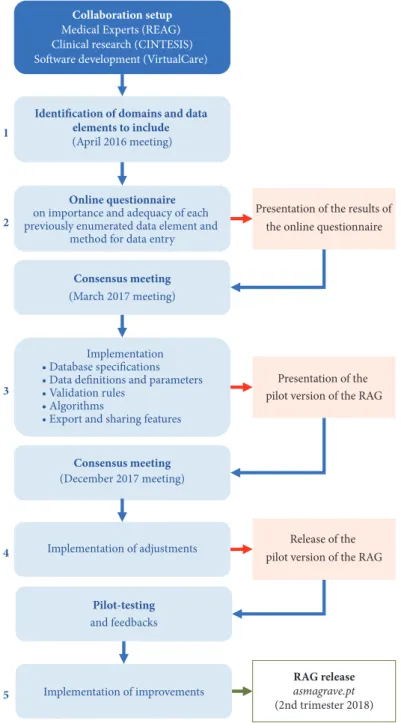
The development and implementation processes of RAG are summarized in Figure 1.
2.1. Definition of Contents. The criteria for patient inclusion
in RAG, the domains, and data elements to be registered were defined by a multistep consensus method.
The patients’ inclusion criteria were based on the defini-tion of Severe Asthma by GINA [1]: (1) patient with treatment on step 4 or 5 according to GINA recommendations; and (2) verified optimization of treatment adherence and comorbidi-ties management. An additional inclusion criterion was (3) the patient’s signed consent to have his/her data included in the registry.
During a meeting (April 2016), the domains and data elements were enumerated, based on the medical expertise of the network and taking into consideration the variables existing in three existing European Registries: the Belgian, the German, and the UK Severe Asthma Registries. Both data elements to be included in the initial patient registry and relevant follow-up information were identified. Different data entry methods were considered to reduce the burden of response.
An online questionnaire sent to 79 medical specialists from REAG was used to explore the importance of each data element and adequacy of data entry method. A total of 34 participants (43%) completed the questionnaire. For each domain, data elements and methods for data entry were chosen when gathering at least 80% of the votes. Comments and suggestions regarding additional variables or different data entry methods were also considered. The results of the questionnaire were presented in a meeting (March 2017) and disagreements were solved by consensus.
2.2. Features. Database specifications concerning data
def-initions and parameters and data validation rules were determined. To assist confirmation of the first criterion and support decision-making, an algorithm to automatically determine the step of treatment based on currently used asthma medication was created.
The following additional features were implemented: (i) Support on data entry by automatic validation of the
inserted data and error messages
(ii) Creation of automatic reports, based on the informa-tion stored, to be integrated into the instituinforma-tional elec-tronic health record (the data recorded are exportable in natural language by generating a text that mimics clinical notes)
(iii) Graphic display of aggregated data on patients’ inclu-sion by healthcare center
Collaboration setup Medical Experts (REAG) Clinical research (CINTESIS) Software development (VirtualCare)
Identification of domains and data elements to include
(April 2016 meeting)
1
Online questionnaire
on importance and adequacy of each previously enumerated data element and
method for data entry
Presentation of the results of the online questionnaire
Consensus meeting
(March 2017 meeting)
2
Implementation
• Database specifications
• Data definitions and parameters
• Validation rules
• Algorithms
• Export and sharing features
3
Presentation of the pilot version of the RAG
Consensus meeting (December 2017 meeting) Implementation of adjustments Pilot-testing and feedbacks Release of the pilot version of the RAG
Implementation of improvements RAG release asmagrave.pt (2nd trimester 2018) 4 5
Figure 1: Development and implementation process of RAG.
(iv) Display for each physician a list of their patients and date of the last medical appointment
(v) At follow-up visit, automatic display of the informa-tion inserted in the last appointment for specified measurements
(vi) Export features for potential data exchange with international severe asthma databases and the phar-macovigilance authorities
(vii) Automatic emails with status report of each registra-tion
2.3. Security and Data Sharing Policies. Security features
compliant with the new European General Data Protection Regulation (GDPR) [37] and required procedures according to this legislation are being incorporated into the platform.
The registry was built on a framework residing in a server hosted by VirtualCare. This server was configured with a Secure Sockets Layer (SSL) certificate from Comodo Security Solutions, Inc., ensuring that all data transferred between the web server and browsers remain private and integral. The access to the database is restricted, requiring authentication (using health professional number and password) and all
accesses to the database are stored and traceable. All changes to the database are also stored; each change generates a new document; the old document becomes out of date allowing the tracking of changes (when, where, and by whom changes were made to the documents).
RAG does not record any identifiable personal data from patients (e.g., date of birth is replaced by the year of birth, no ID numbers are registered, and patients’ names are pseudoanonymized so replaced with a code number) [38]. The patients’ participation on RAG is free and voluntary, and patients may, in any moment and without penalty, withdraw the registry or verify and/or delete their data, by contacting the technical support. Patients are informed on the purposes of RAG, the data collected, and the implications of participating in this registry. The informed consent form is automatically generated at the time of inclusion. Only patients that agree, by a clear affirmative consent given by a written statement, to the storage, processing, and sharing of data belonging to him/her are included in RAG. The signed consent forms are upload into the application server file system, encrypted using phpseclib’s library of PHP, which allows the usage of one of its encryption algorithms combined with a private key. When encrypted, the consent file cannot be read unless the file decryption is activated with the correct combination of algorithm and private key. The algorithm and private key are known only to VirtualCare.
An informed consent is also required by physicians who are registered in RAG since they provide identifiable personal data for that registration, namely, name, health professional number, and email address. At the time of registration, physicians must indicate their acceptance by ticking a box with a clear statement on the storage and processing of their personal data. The registration of each physician in RAG must be validated by at least one of five members of REAG, designated coordinators of RAG.
Data within RAG belongs primarily to each patient and then to the physician that inserted patients’ data into the registry. Each physician is responsible for the management of the data that he/she inputted, belonging to his/her patients. Access to patients’ data by their physicians is based on the Role Based Access Control (RBAC) model that associates privileges and permissions to the roles (e.g., professional categories). This model allows easier administration and independence in relation to the system users and permissions associated with its resources.
After authentication, each physician can access all the registrations inserted by himself/herself, both for clinical and research purposes. One local coordinator will be designated in each center. Each center coordinator has access, for pressing clinical purposes only, to all data inserted by the physicians in that center. If a patient changes the attending physician, the new physician, if interested in having access to the previously inserted data, must request authorization to the former physician, with patient’s consent. Local and national coordinators and RAG technical support may assist this contact.
Data inserted by other physicians may be shared within REAG for research purposes, after authorization. For this, the physician proposing the data analysis must fill-in a form
containing the aim and a brief description of the research project and the principal investigator or research group. When a request for abstracting data is filled, each physician with data matching the request is notified by email and has a period of 5 days to refuse the sharing of the data. In the case of shared information, the privacy of the individual is assured, as registry data cannot be individually identifiable.
2.4. Pilot-Test. After the implementation of the selected data
elements, the supporting features, and validation rules, a beta version of RAG was presented during a REAG meeting (December 2017) and, after adjustments, it was pilot-tested for a month. The pilot version was tested by 22 REAG members and 85 specific feedback comments were provided by 8 testers. The first version of RAG became ready after improvements being made based on the pilot-test feedback.
3. Results
The Portuguese Severe Asthma Registry is a national web-based disease registry. The access is made from the website of REAG, asmagrave.pt, after authentication.
RAG gathers data of adults and children with severe asthma followed at specialized care centers which, after treatment optimization and adequate management of comor-bidities, require step 4 or 5 of treatment according to GINA recommendations[1]. The implemented automatic algorithm determines the step of treatment for patients aged under 6, between 6 and 12 and over 12 years, based on asthma medication prescribed to the patient according to GINA rec-ommendations (Figure 2.A). In any case, the physician makes the decision about the inclusion in the registry indicating the reason for inclusion (Figure 2.B). In fact, even if rarely used, some therapeutic combinations are not explicitly considered in any of the GINA 2018 treatment steps and in these cases, the algorithm cannot present a result. The algorithm will be updated in the future when these recommendations change.
The final data items of RAG are summarized in Table 2. RAG allows collecting data on different asthma medication, including Oral Corticosteroids (OCs), monoclonal antibod-ies, and even new therapies that may become available (Figure 3). Data considered as essential are compulsory, whereas desirable but not essential data may be skipped. The elements to be collected in the follow-up appointments were also defined as RAG was designed to collect data prospectively.
4. Discussion
The Portuguese Severe Asthma Registry is a national web-based disease registry of adult and pediatric severe asthma patients. It includes a comprehensive list of data elements defined by a multistep consensus process, supported by international definitions of severe asthma. The registry offers features to facilitate data entry and to support decision-making. The collected data belongs primarily to each patient and then to the physician who inserted patients’ data into the registry and can be shared for research purposes after authorization. A thorough characterization of severe asthma
A
B
Figure 2: Screenshot of the implemented automatic algorithm to determine the step of treatment, based on asthma medication according to GINA recommendations. A: treatment step calculated by the algorithm; B: the 3 criteria for patients’ inclusion.
T a b le 2: D om ai ns an d d at a el em ent s re corde d in th e P o rt u gu es e Se ve re Ast h m a R eg ist ry . Pa ti en t d at a D em o gr aph ic d at a (gen der ∗ ,b ir th of m on th ∗ and ye ar ∗ ,b ir thpl ac e, pl ac e of re si d en ce ∗ ,b od y m a ss in d ex ca lc u la ti on ∗ ,e d u ca ti on ye ar s∗ ,s moking ha bit s∗ ,o cc u pa ti on ∗ ,f am ily h is to ry of a st h m a∗ and of as th m a -r el at ed dea th ∗ ,p er so na l h is tor y of respira tor y infe cti on s d ur ing ea rl y ch il d h oo d∗ ,e nv ir on m ent al ex po su re s) A sthma ca re inf o rma tio n (age at a st h m a d iagn os is ∗ ,a ge at se ve re a st h m a cl a ss ifi cat io n∗ ,fi rs t yea r of sp eci al iz ed as th m a fo llo w-u p, m ed ic al sp eci al ty of th e at te n d in g ph ys ici an ∗ ) C o mo rb iditie s∗ § At o p y an d In fl am m at ion bi om ar k er s At o p y (t ot al ser u m IgE ∗ ,a ll er gic se n si tiza tio n∗ , ty pe (s) of d iagnos tic te st u se d to co nfir m al le rgic se n si tiza tio n∗ ) In fl am m at ion bi om ar ke rs (F eN O ,b lo od eo si nop h il s, sp utum eo si nop h il s, sp utum ne utr op h il s) D ia g n os tic te sts L u n g func tio n tes ts (FE V 1∗ ,F V C ∗ ,M EF ,r es id ua lv ol u m e, sp eci fi c ai rwa y re si st an ce, ca rb on monox id e di ff u si on cap ac it y, br onch ial ch al le nge tes t) Im ag in g (t h or a x X -r ay ∗ ,t h or a xC T sc an ∗ ,s in u s C T sc an ,b ro n ch ia l en d os co py ,b on e d en si to m et ry ) A rt er ia lb lood ga se s Co n tr o l an d Q ua li ty of L if e A sthma-rela ted heal thc ar e u tiliza tio n d ue to as thma in p re vio us 12 mo n th s (o r sinc e the las t ap p o in tmen t, w hen at fo llo w-u p vi si t) (numbe r of ro u ti ne pr im ar y car e m ed ical ap po in tme n ts , ro u ti ne h os pi tal car e me dical ap po in tme n ts ,no n -s ch edu le d m ed ical ap po in tme n ts ∗ § ,e m er ge n cy se rv ice ad m is si on s∗ § , ho spita li za ti on s∗ § ,i n tens iv e ca re u n it ad m is si on s, n eed fo r m ec h an ic al ven ti la ti on ,s ch oo lo r la bo r ab sen teei sm ) Ast h ma co n tro la ss essme n t ac co rdi n g to GIN A re co mme n dat io n s[ 1] (f re qu en cy of d ayt im e sym pt om s∗ §, ac tiv it y lim it at io n s d u e to a st hm a∗ §, an y ni gh t aw ake ni ng du e to a st h ma ∗ §, fr eq u en cy of u se of re lie ve r m ed ica tio n s fo r a st h m a∗ §, respi ra tor y fu nc ti on , n u m ber of ex ac er ba ti on s in las t yea r/wee k∗ §) A sthm a co n tr o ls elf-q u es tio nna ir es (CA R A T ∗ § and exte rnal li n k to A CT ) Quali ty o f lif e self-as se ss m en t q ues tio nna ir es (e xt er n al lin k to qu al it y of li fe se lf -a ss essme n t qu esti on n aires ) Th er ap y A st h ma me dic at io n∗ § (O Cs ,I Cs ,L T R As ,L A B As ,S A B As ,L A M As ,S A M As ,x an th in es ,i mmuno su pp res so rs , immuno th er ap y, mo no cl on al an ti bo dies ,a n ti bio tic s, th er ap y ad h er enc e, in hal ati on te ch ni qu e) Other m ed ic at io n (p ro ton pump inhi bi tor , an ti -d epr essi ve /a n xi oly ti cs ,i n tr ana sa ls te ro id s, an ti hi stami n es ,l ong -te rm ox yg en the rapy ,non -i n va si ve ve n ti la ti on ) ∗ C o m p ul so ry da ta el emen ts at in iti al vi si t; § co m p ul so ry da ta el emen ts at fo ll o w-u p . Ig E :i m m u no gl o b ul in -E ;F eNO :F racti o n al exhal ed N itr ic O xi de; F E V 1: fo rc ed exp ir ato ry vo lu me in the fi rs t seco n d; FV C: fo rc ed vi tal ca p aci ty ;ME F: m id ex pi ra to ry fl o w ;C T :c om pu te d tom o gr ap h y sc an ;C A R A T : C o n tr ol o f Alle rg ic R h in it is an d A st h m a T es t [3 3, 34] an d A C T :A st h m a C o n tr ol T es t [35 ]; O C s: O ra l C o rt icos te ro ids ;I C s: in h al ed co rt icos te ro ids ,L T RA s: L euk o tr iene Recep to r A n tag o n is t; L A B A :L o n g-A cti n g B eta 2 A go ni st; SA B A :Sho rt-A cti n g B eta A go n is t; L A MA :L o n g-A cti n g M us ca ri n ic A n tag o ni st; SA M A :Sho rt-A cti n g M us ca ri n ic A n tag o ni st.
Table 3: RAG features useful to support severe asthma management.
Elements of chronic care management [36] RAG features
Current Future
Ensure regular follow-up
Displays for each physician a list of their patients and
date of the last medical appointment
Display a simple message with the counting the months since the last appointment and flag patients without medical review
in more than 6 months
Facilitate individual patient care planning
For specified measurements, displays the information inserted in the last appointment and its
progress over time
At the beginning of each follow-up appointments, a brief
report of the previous appointment will be displayed
Embed evidence-based guidelines into clinical practice
has a decision support tool to identify patients treated in step 4 or 5 according to GINA recommendations
Monitor the performance of practice team
Displays aggregated data on the number of patients included by each center
Aggregated real-time data with different graphic displays of trends on specified management
and clinical outcomes will be produced, to give a feedback to physicians about the status of the
care of their patients and/or healthcare center, towards delivering the recommended
care for severe asthma.
patients, using a tool consensually defined to be applied prospectively by specialists from Portuguese hospitals, is ambitious but can improve the information on the disease and contribute to the adoption of evidence-based policies for severe asthma care. This harmonized approach is essential to improve the management of the different phenotypes this pathology. The Portuguese registry was designed to enable future linkage with other databases, as registries from other countries, as well as the Portuguese Pharmacovigilance Authority.
The data elements included in RAG were selected to reflect the current clinical status of the patient avoiding unnecessary burden within the clinical workflow. Through a multistep consensus method, a balance was achieved between the data commonly used by clinicians, the data included in other severe asthma registries, the data needed for the RAG’s reliability, and the expected overall burden for respondents. Therefore, there was an effort to data collected by RAG which can be compared to data collected by other registries enabling comparisons across populations and settings. A consensus method was used to summarize information from different sources, to gather insights from experts and to enable decision-making [39]. After the selection and imple-mentation of the data elements and validation rules, RAG was pilot-tested and iteratively improved before release.
The patients’ inclusion criteria were also defined by consensus and an automatic algorithm was implemented to assist patients’ eligibility assessment, based on GINA recommendations. Clinical guidelines provide a link between the best available evidence and the clinical practice, having
the potential to improve enormously patient care [40]. How-ever, these may have limitations especially for a particular disease where evidence is still insufficient as in severe asthma and cannot be used as a strict formula. During algorithm development became clear that GINA 2018 treatment steps do not account for all possible therapeutic combinations. In the future, it would be important to assess if clinically relevant combinations are not included in the GINA rec-ommendations, to contribute to the improvement of the recommendations concerning severe asthma.
Disease registries are used to support healthcare providers on disease care and to gather evidence for scientific and policy purposes. Therefore, a disease registry should (1) facilitate the access to patient-specific information at the point of care for healthcare delivery and provide status reports of aggregated information to give feedback to physicians or to medical groups about the patient population [36] and (2) provide real-world data on clinical practice, patient outcomes, safety, and/or comparative effectiveness for research purposes[5]. RAG has several features to support healthcare providers on severe asthma care (Table 3). Additionally, as suggested by the members of REAG, RAG includes the automatic generation of clinical notes based on the inputted data that can be pasted into the institutional electronic clinical record of the patient, avoiding duplication of effort.
Real-world prospective observational research, including long-term follow-up data provided by registries, is increas-ingly considered important to generate evidence regarding effectiveness, safety, and quality of care [41]. The utility of a
registry relies on the quality of data collection and storage [5]. RAG’s data are collected at the time of routine medical appointments, in the same manner for every patient, with specific and consistent data definitions. To minimize errors related to data completeness and consistency, several logical and validation rules have been implemented and periodic data audits are being planned. An additional challenge is the recruitment and retention of participants that is critical to the generalizability of a registry [5]. Potential RAG users were involved from the beginning in the development and imple-mentation process and stated their motivation to include patients. Nevertheless, to retain users’ interest, the burden of participation was kept as low as possible and features wanted by the physicians were implemented.
RAG was designed to comply with security and data protection standards, including key challenges of the new European GDPR. No individually identifiable information of the patient is recorded in the database. Only the his/her physician can link the recorded data to the patient that remains the owner of the data. RAG’s data sharing policies allow the use of data for research, requiring the consent of the physician that recorded the data and a simple process to gather this consent was implemented.
5. Conclusions
The Portuguese Severe Asthma Registry is a national web-based disease registry of adult and pediatric severe asthma patients. The development and implementation of the RAG was a multistep consensus process. RAG includes automatic assessment of eligibility, easy data input, and features for exporting and sharing data. It allows prospective clinical data collection, promotes standardized clinical records, and cre-ates a secure virtual setting for collaborative clinical research. RAG database is prepared for future data exchange with international databases. In the future, the analysis of RAG data may contribute to inform evidence-based healthcare policies for severe asthma.
Data Availability
Data sharing is not applicable to this article.
Conflicts of Interest
The authors declare that there are no conflicts of interest regarding the publication of this article.
Acknowledgments
The authors thank all members of the REAG (Rede de
Especialistas em Asma Grave), namely, Ana Morete, Ana Sofia
Barroso, Ant´onio Reis, Aurora Carvalho, Carmen Botelho, Catarina Ferreira, Cl´audia Pinto, Dolores Moniz, Elza Tom´as, Em´ılia Alvares, Eug´enia Almeida, Filipe In´acio, Isabel Car-rapatoso, Isabel Pereira, Jorge Romariz, Jos´e Pedro Moreira da Silva, Leonor Cunha, Lu´ısa Barata, Lu´ısa Geraldes, Lu´ısa Semedo, Madalena Emiliano, Manuel Barbosa, Margarida
Raposo, Maria Jos´e Silvestre, Mariana Mendes, Marta Dias Sousa, Nuno Sousa, Orlando Santos, Paula Duarte, Ros´ario Ferreira, Sofia Furtado, and V´ıtor Teixeira. RAG was financed by an unrestricted grant from Novartis Farma-Produtos Farmacˆeuticos, S.A., which had no participation in any part of the development and implementation of the registry and has no access to the stored data for any purpose. The first author is financed by a PhD Grant (PD/BD/113665/2015) and financed by the European Social Fund and national funds of MCTES (Minist´erio da Ciˆencia, Tecnologia e Ensino Superior) through FCT (Fundac¸˜ao para a Ciˆencia e Tecnologia, I.P) PhD Pro-gramme Ref. PD/0003/2013-Doctoral ProPro-gramme in Clinical and Health Services Research (PDICSS). The publication of this article was supported by ERDF (European Regional Development Fund) through the operation POCI-01-0145-FEDER-007746 funded by the Programa Operacional Com-petitividade e Internacionalizac¸˜ao – COMPETE2020 and by National Funds through FCT - Fundac¸˜ao para a Ciˆencia e a Tecnologia within CINTESIS, R&D Unit (reference UID/IC/4255/2013).
References
[1] GINA, “Global Strategy for Asthma Management and Preven-tion (updated 2018). Global Initiative for Asthma,” 2018. [2] J. Bousquet, G. Brusselle, R. Buhl et al., “Care pathways for the
selection of a biologic in severe asthma,” European Respiratory Journal, vol. 50, no. 6, Article ID 1701782, 2017.
[3] E. Zervas, K. Samitas, A. I. Papaioannou, P. Bakakos, S. Loukides, and M. Gaga, “An algorithmic approach for the treatment of severe uncontrolled asthma,” ERS Monograph, vol. 4, no. 1, Article ID 00125, 2018.
[4] J. M. Drazen and D. Harrington, “New Biologics for Asthma,” The New England Journal of Medicine, vol. 378, no. 26, pp. 2533-2534, 2018.
[5] R. Gliklich, Registries for Evaluating Patient Outcomes: A User’s Guide, N. Dreyer and M. Leavy, Eds., Agency for Healthcare Research and Quality, Rockville, Md, USA, 2014, https://www .ncbi.nlm.nih.gov/books/NBK208616/.
[6] J. B. Soriano, J. Paton, F. Martin Burrieza et al., “The ERS Research Agency: the beginning,” European Respiratory Journal, vol. 47, no. 4, pp. 1017–1023, 2016.
[7] ISAR, “International Severe Asthma Registry,” http://isareg-istries.org.
[8] M. Belvisi, W. Bill, F. Martin, O. Menegale, GB. Migliori, C. Pannetier et al., “ERS Research Agency White Paper,” 2015. [9] European Respiratory Society, “Clinical Research
Collabora-tions,” https://www.ersnet.org/research/clinical-research-col-laborations.
[10] A. Sa-Sousa, M. Morais-Almeida, L. Azevedo et al., “Prevalence of asthma in Portugal - The Portuguese National Asthma Survey,” Clinical and Translational Allergy, vol. 2, no. 1, article 15, 2012.
[11] S. Accordini, A. Corsico, I. Cerveri et al., “The socio-economic burden of asthma is substantial in Europe,” Allergy: European Journal of Allergy and Clinical Immunology, vol. 63, no. 1, pp. 116–124, 2008.
[12] A. Sousa, A. Pereira, J. Fonseca et al., “Asthma control and exacerbations in patients with severe asthma treated with
omalizumab in Portugal,” Revista Portuguesa de Pneumologia (English Edition), vol. 21, no. 6, pp. 327–333, 2015.
[13] G. F. Sferrazza Papa, M. Milanese, F. M. Facchini, and I. Baiardini, “Role and challenges of severe asthma services: insights from the UK registry,” Minerva Medica, vol. 108, no. 3, pp. 13–17, 2017.
[14] J. Burn, A. J. Sims, K. Keltie et al., “Procedural and short-term safety of bronchial thermoplasty in clinical practice: evidence from a national registry and Hospital Episode Statistics,” Journal of Asthma & Allergy Educators, vol. 54, no. 8, pp. 872–879, 2017. [15] J. Sweeney, C. C. Patterson, A. Menzies-Gow et al., “Comorbid-ity in severe asthma requiring systemic corticosteroid therapy: Cross-sectional data from the optimum patient care research database and the british thoracic difficult asthma registry,” Thorax, vol. 71, no. 4, pp. 339–346, 2016.
[16] R. Chaudhuri, C. McSharry, L. G. Heaney et al., “Effects of older age and age of asthma onset on clinical and inflammatory variables in severe refractory asthma,” Respiratory Medicine, vol. 118, pp. 46–52, 2016.
[17] S. O’Neill, J. Sweeney, C. C. Patterson et al., “The cost of treating severe refractory asthma in the UK: An economic analysis from the British Thoracic Society Difficult Asthma Registry,” Thorax, vol. 70, no. 4, pp. 376–378, 2015.
[18] C. Newby, L. G. Heaney, A. Menzies-Gow et al., “Statistical cluster analysis of the british thoracic society severe refractory asthma registry: clinical outcomes and phenotype stability,” PLoS ONE, vol. 9, no. 7, Article ID e102987, 2014.
[19] D. Gibeon, K. Batuwita, M. Osmond et al., “Obesity-associated severe asthma represents a distinct clinical phenotype analysis of the british thoracic society diffi cult asthma registry patient cohort according to BMI,” CHEST, vol. 143, no. 2, pp. 406–414, 2013.
[20] N. C. Thomson, R. Chaudhuri, L. G. Heaney et al., “Clinical outcomes and inflammatory biomarkers in current smokers and exsmokers with severe asthma,” The Journal of Allergy and Clinical Immunology, vol. 131, no. 4, pp. 1008–1016, 2013. [21] J. Sweeney, C. E. Brightling, A. Menzies-Gow, R. Niven, C.
C. Patterson, and L. G. Heaney, “Clinical management and outcome of refractory asthma in the UK from the British Thoracic Society Difficult Asthma Registry,” Thorax, vol. 67, no. 8, pp. 754–756, 2012.
[22] L. G. Heaney, C. E. Brightling, A. Menzies-Gow, M. Stevenson, and R. M. Niven, “Refractory asthma in the UK: Cross-sectional findings from a UK multicentre registry,” Thorax, vol. 65, no. 9, pp. 787–794, 2010.
[23] F. N. Schleich, G. Brusselle, R. Louis et al., “Belgian severe asthma registry. which biotherapy to choose according to inflammatory characteristics?” The Journal of Allergy and Clin-ical Immunology, vol. 139, no. 2, p. AB11, 2017.
[24] F. Schleich, G. Brusselle, R. Louis et al., “Heterogeneity of phenotypes in severe asthmatics. The Belgian Severe Asthma Registry (BSAR),” Respiratory Medicine, vol. 108, no. 12, pp. 1723–1732, 2014.
[25] S. Korn, M. H¨ubner, E. Hamelmann, and R. Buhl, “The German severe asthma registry,” Pneumologie, vol. 66, no. 6, pp. 341–344, 2012.
[26] S. Korn, M. H¨ubner, K.-C. Bergmann, A. Jahn, P. Kardos, A. Koch et al., “The German severe asthma register,” European Respiratory Journal, vol. 40, supplement 56, Article ID P2294, 2012.
[27] L. P. de Llano, M. D. C. Vennera, F. J. ´Alvarez et al., “Effects of omalizumab in non-atopic asthma: results from a Spanish
multicenter registry,” The Journal of Asthma, vol. 50, no. 3, pp. 296–301, 2013.
[28] M. D. C. Vennera, L. P. de Llano, and S. Bardag´ı, “Omal-izumab therapy in severe asthma: experience from the Spanish registry—some new approaches,” Journal of Asthma & Allergy Educators, vol. 49, no. 4, pp. 416–422, 2012.
[29] D. Doberer, W. Auer, J. Loeffler-Ragg, C. Kahler, K. Moritz, M. Kneussl et al., “The Austrian Severe Asthma Registry,” Wiener klinische Wochenschrift, vol. 127, pp. 821-822, 2015.
[30] N. Casella, “The SANI project: verso una gestione personal-izzata e di precisione del paziente con asma severo,” https:// www.pharmastar.it/news/pneumo/the-sani-project-verso-una- gestione-personalizzatae-%0Ddi-precisione-del-paziente-con-asma-severo–25116.
[31] G. Senna, M. Guerriero, P. L. Paggiaro et al., “SANI-Severe Asthma Network in Italy: a way forward to monitor severe asthma,” Clinical and Molecular Allergy, vol. 15, no. 1, article 9, 2017.
[32] D. Schippers, P. Hekking, J. Sont, and E. Bel, “Are asthma patients willing to participate in an interactive web-based disease registry?” European Respiratory Journal, vol. 48, Article ID PA1025, 2016.
[33] J. A. Fonseca, L. Nogueira-Silva, M. Morais-Almeida et al., “Control of Allergic Rhinitis and Asthma Test (CARAT) can be used to assess individual patients over time,” Clinical and Translational Allergy, vol. 2, no. 1, article 16, 2012.
[34] D. V. B. R. Linhares, J. A. L. Da Fonseca, L. M. Borrego et al., “Validation of Control of Allergic Rhinitis and Asthma Test for Children (CARATKids) - a prospective multicenter study,” Pediatric Allergy and Immunology, vol. 25, no. 2, pp. 173–179, 2014.
[35] “Asthma Control Test,” http://www.asthmacontroltest.com/ Portugal/pt.
[36] California Healthcare Foundation, Using Computerized Reg-istries in Chronic Disease Care, California Healthcare Founda-tion, 2004.
[37] Council of the European Union and European Parliament, “Regulation (EU) 2016/679 of the European Parliament and of the Council of 27 April 2016 on the protection of natural persons with regard to the processing of personal data and on the free movement of such data, and repealing Directive 95/46/EC,” Official Journal of the European Union, vol. L119, pp. 1–88, 2016. [38] Article 29 data protection working party. Opinion 05 / 2014 on Anonymisation Techniques Adopted on 10 April 2014. Eur Comm Justice Data Prot. 2014;0829/14/EN.
[39] J. Jones and D. Hunter, “Consensus methods for medical and health services research,” British Medical Journal, vol. 311, no. 7001, pp. 376–380, 1995.
[40] S. Green and J. Piehl, “Clinical practice guidelines: A guide to better practice, not a recipe for uniformity,” Australian Journal of Physiotherapy, vol. 49, no. 1, pp. 3-4, 2003.
[41] N. A. Dreyer and S. Garner, “Registries for robust evidence,” The Journal of the American Medical Association, vol. 302, no. 7, pp. 790-791, 2009.