A Work Project, presented as part of the requirements for the Award of a Master Degree in Management from the NOVA - School of Business and Economics
VALIDATING PÓS-PARTO NOS MUSEUS’ MAIN ASSUMPTIONS: A RESEARCH APPROACH FOR UNDERSTANDING ITS CUSTOMER SEGMENT AND PRACTICAL
RECOMMENDATIONS FOR ITS IMPROVEMENT
Maria Gabriela Peña Silva - 29716 Mariana Gomes Martins Venâncio - 30410
A Project carried out on the Master in Management Program, under the supervision of: Professor Aníbal Lopez
1
Acknowledgements
Firstly, we would like to express our sincere gratitude to our advisor Professor Aníbal Lopez of the NOVA - School of Business and Economics for his constant support and patience. Undoubtedly, his guidance, knowledge and feedback were crucial to develop this project and overcome the obstacles we encountered along the way.
Additionally, we would like to thank Graça Lucena, founder of Graça Lucena Physiotherapy and Pós-parto nos Museus, for her permanent commitment, involvement and trust throughout the project, as well as Fundação Luso-Americana para o Desenvolvimento (FLAD), for giving us the opportunity to participate in the program Connect to Success.
Moreover, we deeply thank the parents who accepted to participate in our interviews and surveys. Without their valuable insights and recommendations, it would not have been possible to meet this project’s goals.
Last but not least, we would like to thank our families and friends for supporting us in every stage of this academic experience, and especially, throughout writing this thesis.
2
Abstract
Pós-parto nos Museus is a potential postpartum physiotherapy service created by Graça Lucena to support recent mothers during their recovery period and prevent postpartum depression. This work project intends to validate the entrepreneur’s main assumptions of Pós-parto nos Museus’ customer segment and main attributes through a mixed methods approach: a qualitative research to build customer profiles and a quantitative research to identify the potential target’s preferences regarding the service. The obtained results were used to suggest recommendations meant to improve Pós-parto nos Museus, including a communication strategy to support Graça Lucena when launching the service in the Portuguese market.
Keywords: Postpartum physiotherapy; Value Proposition Canvas; Customer Relationship
3
Table of Contents
1. Introduction 5
1.1. Addressing New Parents’ Challenges 5
1.2. Main Work Project Challenge and Objectives 6
2. Company’s Internal and External Analysis 7
2.1. Internal Analysis: Current Business Model and Team 7
2.2. External Analysis: SWOT 9
2.3. External Analysis: PESTLE 11
2.4. External Analysis: Porter’s Five Forces 12
2.5. Competitors’ Analysis 14
3. Contextual Background 15
3.1 Value Proposition 15
3.2 Customer Relationship Management (CRM) 19
4. Research Methodology 23
4.1 Study 1: Immersing in the world of new parents 24
4.1.1 Methodology 24
4.1.2 Sampling and Research Tools 24
4.1.3 Results 25
4.1.4 Customer Profiles 29
4.1.5 Conclusions of Study 1 31
4.2 Study 2: Evaluating Pós-parto nos Museus among the potential target 32
4
4.2.2 Sampling and Research Tools 33
4.2.3 Results 33
5. Addressing the Ideal Service for Customers 37
6. Communication Strategy 41
6.1 Competitors’ Analysis: Online Communication 41
6.2. Recommended Communication Strategy - Online 43
6.2.1. Facebook 43
6.2.2. LinkedIn 46
6.3. Recommended Communication Strategy - Offline 46
7. General Recommendations for Pós-parto nos Museus 47
8. Conclusions 50
9. References 51
List of Figures
Figure 1 - SWOT Analysis 10
Figure 2 - Reasons for Not Participating in Pós-parto nos Museus 35 Figure 3 - Perceived Benefits by Mothers Interested in Pós-parto nos Museus 36 Figure 4 - Perceived Benefits by Fathers Interested in Pós-parto nos Museus 36
Figure 5 - Value Proposition Canvas for New Parents 38
5
1. Introduction
1.1. Addressing New Parents’ Challenges
New parents face multiple challenges during the first months after their babies’ birth, from adapting to a new routine to dealing with the tiredness due to lack of sleep. On the one hand, women have to deal with the changes pregnancy had in their bodies. Some mothers may struggle trying to recover their previous figure, whereas others may have to treat physical postpartum injuries through physiotherapy. On the other hand, new mothers are prone to feel socially isolated (Paris, Gemborys, Kaufman, & Whitehill, 2007) and worry about their children’s life and growth, as well as their ability to bond with their babies. These concerns are often translated into feelings of fear, worry, sadness and loneliness (Stern, 1995). Although having these feelings can be normal from time to time, their persistence can lead to Postpartum Depression (PPD). According to the National Institute of Mental Health (2018), PPD describes a range of mood disorders that can appear either during pregnancy or up to a year after a child’s birth, including feelings of extreme sadness, anxiety and exhaustion that can interfere with mothers’ ability to take care of themselves and their families.
Approximately, one in seven women and an estimated 4% of new fathers suffer from PPD worldwide. Furthermore, PPD is present from 6 to 38% in developed countries (Lara et al., 2015; Norhayati, Hazlina, Asrenee, & Wan Emilin, 2015) and predominates in low and middle-income ones (Lara et al., 2015; Place et al., 2016; Shrestha, Pradhan, Tran, Gualano, & Fisher, 2016).
In Portugal, there are centers offering different postpartum treatments to support new parents in their transition to parenthood, such as physiotherapy to treat injuries from the partum, exercises to recover the previous body shape, or meditation classes to relax. Moreover, some health centers offer pre and postpartum courses for free, where classes are held by a nurse and a physiotherapist.
6 In an attempt to present a different service, Graça Lucena Physiotherapy, a WOB (Woman-Owned Business) operating in the Portuguese health industry, aims to launch a service called Pós-parto nos Museus, which would combine culture and health by offering postpartum physiotherapy services to new mothers and their babies in museums, as a way to prevent the appearance of PPD. Moreover, it would allow fathers to participate in some activities. Although this business idea is innovative, it has not been implemented yet and faces some challenges such as: (1) having difficulties attracting partners (museums) and negotiating with them, as well as setting a price for the offering, (2) having difficulties communicating the service and reaching potential customers, (3) having low brand awareness and (4) not knowing if the service will be aligned to potential customers’ preferences and expectations, since Graça Lucena has been building it based on personal assumptions about the customer segment. Some of her hypothesis are the following: (1) Pós-parto nos Museus will attract both new mothers and fathers, (2) new mothers want to take their babies with them to all activities, (3) new mothers search for posture and relaxation exercises to recover faster from the partum, (4) new fathers are interested in relaxation and meditation activities, (5) new parents want to learn exercises for the baby, to bond and further improve the baby’s health, (6) because new parents are in parental leave, they have availability to attend the full-morning activities, (7) a space for socializing and sharing experiences is important for new parents, (8) participants will perceive the added value of attending the sessions in museums and (9) museums’ websites and Facebook are efficient communication channels to promote Pos-parto nos Museus.
1.2. Main Work Project Challenge and Objectives
This work project aims to address the last previously mentioned challenge: validating Graça Lucena’s assumptions about Pós-parto nos Museus’ potential customer segment and service attributes. We chose to focus on this challenge because for the idea to succeed in the market, it is crucial to evaluate its fit with customers first. In fact, this would offer a starting
7 point to tackle other business challenges. As such, the objectives of this work project are: (1) identify new parents’ needs and wants, (2) evaluate Pós-parto nos Museus’ fit with its potential target’s expectations and preferences, (3) suggest practical recommendations for the potential service’s improvement and (4) propose a brief communication strategy designed to create brand awareness, attract and engage potential customers.
2. Company’s Internal and External Analysis
2.1. Internal Analysis: Current Business Model and Team1
Problem: After giving birth, women experience a series of challenges. Moreover, the postpartum period can be a difficult time in which recent mothers feel lonely and isolated. This comes with a problem because postpartum depression can appear, bringing negative consequences, not only for mothers, but also for their families.
Customer Segment: Pós-parto nos Museus aims to target Portuguese parents on their parental leave and their babies. In the future, Graça Lucena wishes to target new mothers in vulnerable conditions, such as single, teenagers and/or unemployed recent moms.
Value proposition: Provide postpartum services in partnership with museums to offer recent mothers support during their recovery period, while promoting socialization and empowerment, in order to prevent postpartum depression.
Key Partners: Museums located in Lisbon. Although the negotiation is still ongoing, a partnership with Museu de Lisboa has already been established.
Key Resources: Graça Lucena’s know-how on physiotherapy, museums’ physical and human resources, and communication channels belonging to Graça Lucena Physiotherapy.
1 Pós-parto nos Museus has not been officially launched. However, current communication channels belonging to Graça Lucena Physiotherapy were used to promote a pilot test in 2015. These channels contain outdated information about the service.
8 Key Activities: Provide physiotherapy services through three different programs, each with an average duration of one hour: (1) Posture and Physical Shape: stretching and strengthening exercises adjusted to the postpartum period, (2) Baby Massage: enhances neurological development and stimulates brain activity and (3) Relaxation and Meditation: exercises to relax and practice mindfulness. Participants can decide to buy only one program or the “Trilogy Pack” to try all of them. Finally, guided visits to museums lasting around 60 minutes, as well as communication and marketing efforts are also important activities.
Customer Relationships: Since the project has not being launched, customer relationships have not been forged yet.
Channels: If using the current channels, Pós-parto nos Museus would reach customers online, through Graça Lucena Physiotherapy’s Facebook Page and website, and offline, through business cards and Word of Mouth (WOM).
Cost Structure: Pós-parto nos Museus costs would consist of insurance, transportation and Graça Lucena’s wage. Moreover, services such as photography, design and accounting would be outsourced and represent variable costs.
Revenue Streams: There are no revenue streams yet. However, Graça Lucena is negotiating with museums for Pós-parto nos Museus to be included as a new program offered by them. In that case, museums would provide the needed material and space for the classes and pay Graça Lucena Physiotherapy to provide the service. Hence, both the risks and costs associated to the service would be reduced.
9
2.2. External Analysis: SWOT
Strengths:
-It is the only business in Lisbon offering new mothers and their babies postpartum physiotherapy treatments in museums. -Graça Lucena’s professional experience in the industry, as well as her academic background, are key elements to inspire confidence among a skeptical target. -Inclusive program designed for all recent mothers, even those in vulnerable conditions who could not be able to afford a similar experience otherwise.
-Offers programs that cover different areas. -Mothers have the possibility to decide
which program best suits their needs, without any kind of customer loyalty. -Each program includes a guided visit to the museum, which is an opportunity to
socialize with other participants.
-Teaching of exercises that new moms can put in practice on a daily basis, reducing the likelihood of PPD and/or contributing for a stress reduction.
Weaknesses:
-Current negotiation channels to reach potential partners are not being effective. -Due to the service’s specificities, it is difficult to set a final price.
-Since the business is composed only by Graça Lucena, who lacks knowledge in marketing and finance, the strategies supporting these areas are non-existent or very weak.
-There is no detailed analysis of the target nor clarity on how to reach it, which is the first step of creating a customer base. -The brand awareness and reputation are low in the postpartum physiotherapy field. -Because there is a lack of owned space (installations), there is a high dependency on partners’ availability to provide the service.
10
Opportunities:
-If the project succeeds, there is a great possibility of expansion to other museums. -Museums are currently providing
educational services only for children. Thus, Pós-parto nos Museus could allow them to complement their current agenda with differentiated and unique offerings. -The nature of “Baby Massage and Development” is an opportunity to get fathers and other family members involved. -Museums can use their communication channels to promote Pós-parto nos Museus which might increase awareness and target audience reach.
-The Lisbon City Council has funds dedicated to social projects. Pós-parto nos Museus could apply to these funds which could help on its further development. -In Portugal, the maternity leave lasts at least 120 days, which gives mothers both availability and flexibility on weekdays to enroll in such activities.
Threats:
-There are companies offering similar services in Lisbon. Moreover, the National Health System offers mothers the chance to benefit from similar postpartum services for free.
-New mothers are resistant to leave their comfort zone and they find it difficult to trust others, especially when their babies’ health is involved.
-Partnerships with museums are difficult to establish: it is a bureaucratic process that involves different intermediaries.
Furthermore, decision-makers are not often present or frequently change, resulting in a delay and/or interruption of the negotiation process.
-Although Graça Lucena is committed to ensure the program success and quality, she is not in control of the overall experience. -Some mothers may find it difficult to go to a museum. In that case, they could be more interested in receiving treatments at home.
11
2.3. External Analysis: PESTLE
Political Forces: (1) In Portugal, bureaucracy still represents a problem to business development. Moreover, the lack of autonomy of governmental institutions leads to an inefficient decision-making process and further implementation. (2) Portugal benefits from political stability and there is low likelihood that the government will be destabilized or overthrown by unconstitutional or violent means. (3) The National Health System offers support to women during pregnancy and after giving birth. It includes group classes with a nurse and, in some cases, a physiotherapist. However, it is not available at every health center which means not all recent moms have access to it.
Economic Forces: (1) An unstable economy and a low average income among the middle class could create distrust and could make people think twice before spending their money on non-basic needs, limiting their willingness to spend on physiotherapy services and/or cultural activities.
Sociocultural Forces:(1) There is a growing trend for preferring natural treatments over traditional medication and women are aware of the importance of looking after their mental and physical health. (2) Women are more likely to suffer from depression primarily during their reproductive life and in periods of hormonal oscillations such as premenstrual, postpartum and perimenopause. Poor social, economic and labor conditions increase the likelihood of
suffering from depression. (3) Portugal has a growing aged population with one of the lowest
birth rates in Europe. Consequently, the age of first-time mothers is also increasing. (4) Motherhood, especially during the postpartum period, can be a time in which mothers experience feelings of loneliness and isolation. Being in contact with people, especially with other mothers going through similar situations, can be crucial to battle postpartum depression. (5) Portugal is one of the European countries with a lower cultural consumption rate. Portuguese rarely visit museums and are not very involved in cultural activities in general.
12 Technological Forces: (1) Growth of online commerce offers businesses the opportunity to reach customers in easier and more direct ways. This is especially relevant for marketing and communication purposes.
Environmental Forces: (1) Extreme weather conditions can motivate participants to look for more comfortable alternatives, such as physiotherapy services at home. (2) Atmospheric pollution can have a direct impact in babies’ health.
Legal and Regulatory Forces: (1) Partnerships with museums are difficult to establish since they involve a bureaucratic process, which can represent an obstacle for developing the project. (2) Privacy issues must be contemplated, especially since the program involves offering service to babies and aims to use photographs for marketing purposes. (3) Both physical spaces and activities must guarantee participants’ safety. In case some damage is caused, a Civil Liability Insurance is needed so the business can receive help on covering the costs of defending itself against a claim made by a client. Moreover, a Personal Accident Insurance must be contemplated to protect the business owner.
2.4. External Analysis: Porter’s Five Forces
This business analysis model was implemented to identify the forces shaping the competitiveness of the physiotherapy industry in Lisbon, as well as the industry’s attractiveness and profitability.
Industry Rivalry: High. The physiotherapy industry focusing on postpartum services is a competitive one, since there are numerous players. One might consider two main types of service modalities in this industry: treatments provided in traditional physiotherapy clinics (or other health establishments) or what is seen as a growing trend, physiotherapy treatments provided at home (individually -for the mother herself- or for a group of friends). Given that the industry rivalry is high, players compete against each other based on service quality and
13 pricing. Additionally, having distinguished offerings is key for them to improve their market position.
Supplier Power: Low. In this case, suppliers are the physiotherapy equipment suppliers plus physiotherapists themselves since they are the ones who have the know-how. Taking into consideration that there are numerous suppliers to choose from and the switching costs are low, suppliers’ bargaining power is also low.
Buyer Power: High. There are several physiotherapy centers available in Lisbon covering the postpartum area and offering similar services. Hence, buyers have a broad range of offer to choose from, where switching costs are rather low, being easy to change to another program. Moreover, buyers are very price sensitive and hold the power to bargain on the service and treatments quality.
Threat of New Entry: Low. Other than specific skills and training, entering this market takes time, effort and can be costly too. Moreover, this sector is quite regulated, especially in case one wants to set up his own business, which constitutes an entry barrier. Since physiotherapy services involve health and well-being, people tend to trust experienced professionals, which can be an obstacle to new players entering the market.
Threat of Substitution: High. Besides the variety of programs within the physiotherapy industry, mothers also have other sports that might bring similar benefits in regaining the previous physical shape such as yoga and pilates. Moreover, with the growth of online platforms, mothers can have access to appropriate exercises to practice during the postpartum period and repeat them at home, guided by tutorial videos from experts. And if available at their nearest health center, mothers can also receive postpartum treatments and guidance concerning maternity issues for free.
14
2.5. Competitors’ Analysis
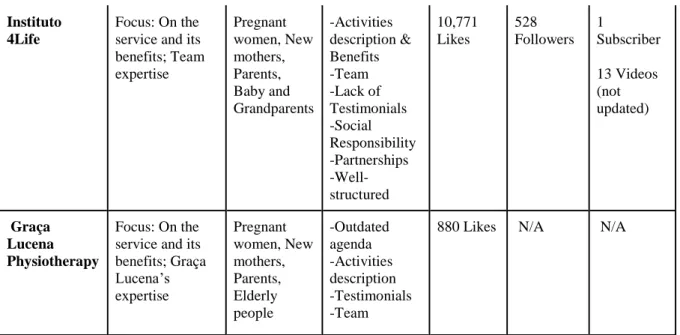
In order to understand what competitors are currently offering in Lisbon, four of them were analyzed: Centros de Saúde (health centers), Fisioterapia Mães e Filhos, Centro Pré & Pós Parto and Instituto4Life (Appendix 1). This analysis showed that all competitors target similar segments (recent parents and babies) and offer similar services in terms of the physiotherapy treatments they provide to their customers. Thus, they strive to differentiate their value propositions by implementing various strategies. For instance, health centers use a pricing strategy by positioning themselves as the most affordable option in the market, whereas the rest of competitors rely on a service differentiation technique. Fisioterapia Mães e Filhos, for example, provides assistance at home and on a seven day a week basis. Conversely, Centro Pré & Pós Parto offers a variety of workshops, psychological support and babysitting/nursing services directed to the whole family. Lastly, Instituto4Life brings an innovative offering to the market, by targeting grandparents with workshops in which they can share experiences and learn about baby care, in order to strengthen their bond with their grandchildren.
Regarding postpartum physiotherapy services for recent mothers, all competitors have similar portfolios, including practical postpartum recovery exercises, treatment of postpartum-related injuries, massages, urinary incontinence assessment and lymphatic drainage. Plus, most of the companies offer additional services, such as pilates/gymnastics, group workshops, support groups, childcare (in charge of a babysitter or a nurse), breastfeeding support, osteopathy, among others. All in all, companies do their best to meet all the needs of recent mothers, be they physical, psychological and/or even aesthetic. Moreover, because they understand that they customers want to connect to their babies, but also need to relax from time to time, they offer activities in which mothers can participate with their children, but also others in which they can relax and share with other mothers, or even receive the service alone.
15 With respect to physiotherapy services for babies, all companies offer similar services as well, including respiratory therapy and baby massage. Furthermore, they also provide complementary services to this target, such as osteopathy and pediatrics.
As for the space, all four competitors offer their services in well-equipped rooms located either within a medical institution (health centers, clinics or hospitals) or close to one, which makes them accessible to their target.
In relation to the price companies charge, it depends on the service and its duration, as well as on the sessions’ duration. Excluding health centers, activities’ prices range from 15€ to more than 100€. Moreover, sessions last on average one hour.
Finally, most competitors’ partners are companies, brands or institutions related to education, childcare, baby/kids’ products, healthy food and gyms.
3. Contextual Background
3.1 Value Proposition
The value proposition is grounded on different specific definitions and has become one of the most widely used terms in business markets in recent years (Carter & Ejara, 2008; p.69). The term “value proposition” was first used in 1988 by Michael Lanning and Edward Michaels who define it as a clear, simple statement of the benefits, both tangible and intangible, that the company will provide, along with the approximate price it will charge each customer segment for those benefits. Hence, this concept describes the bundle of products and services that creates value for a specific customer segment (Osterwalder & Pigneur, 2010). A value proposition may include characteristics such as newness, performance, customization, “getting the job done”, design, brand/status, price, cost reduction, risk reduction, accessibility and convenience/usability (Osterwalder & Pigneur, 2010). In fact, the value proposition offers a description of a customer’s problem, the solution to it and the value on the customer’s perspective (Chesbrough & Rosenbloom, 2002). Anderson, Narus, & Rossum (2006), suggest
16 that most managers use value propositions to get customers’ attention through the product’s or service’s benefits. Following this perspective, (1) a value proposition can state all benefits believed to be delivered to target customers; (2) it can point out those that are favorable points of difference and valuable for the customer, or (3) mention only the one or two points of difference that demonstrate the offering’s superior value (Patala et al. 2016). Essentially, according to the aforementioned authors the value proposition is fundamental to define how a particular product or service will best serve its target consumers.
Furthermore, literature suggests the importance of economic benefits as a value generator. In fact, the common definition of value relies on the price/quality ratio of a product (Kambil, Ginsberg, & Bloch, 1996) or the difference between perceived benefits -the extent to which a product or service fulfils or exceeds customers’ needs- and perceived costs -the full costs associated with the product or service (Garda & Marn, 1993). The definition of value perceived by customers can also be translated into the following formula: Value = Benefits – Costs, where the higher the perceived benefits and lower the perceived costs, the higher perceived value by customers (Lindič & Marques da Silva, 2011). As a result, most companies elaborate their value propositions without taking into account customers or competitors (Anderson et al., 2006) which face the risk of not offering neither a real benefit or a differentiation factor (that ultimately creates superior value vis-à-vis competitors).
Accessing the customer’s experience in terms of their needs and wants is key to deliver a great value proposition (Barnes, Bake, & Pinder, 2009). Following this perspective, value is generated once a product or service attributes (e.g. features, design, support) match specific customer needs (Kambil et al., 1996). Nevertheless, a company cannot expect to meet all the needs of a certain customer segment, also because needs are not all at the same level. Thus, Albrecht (1993) classifies customer needs in four different categories, matched to product attributes: (1) Basic: mandatory attributes that fulfil the core functions of a product; (2)
17 Expected: those that competitors deliver and are perceived as needed to compete within a specific industry; (3) Desired: those the costumer would like to have, but that are not available for the price the customer is willing to pay and (4) Unanticipated: those the costumer would value but didn’t think about asking (Kambil et al., 1996; Albrecht, 1993). Consequently, by selecting the right attributes within these four categories it is likely that a company will create superior value and deliver a good value proposition since fit between product attributes and customer needs is achieved.
“Customers are more than consumers at moments of purchase or moments of truth. What they consume and why is increasingly embedded in the context of their lives. Companies will succeed by understanding and delivering against needs that reflect their customers' whole lives, as citizens and as consumers, rather than simply creating market demand” (Curry & Peck, 2014; p.13). Taking this into consideration, the Value Proposition Canvas helps identifying if certain product or service matches customers’ expectations. Created by Alexander Osterwalder, the Value Proposition Canvas is a tool to visualize, design and test how to create value for customers (Appendix 2). It is composed of two parts: the value map and the customer profile. On the one hand, the customer profile allows to visualize the jobs, pains and gains of the customer segment one aims to create value for. On the other hand, the value (proposition) map describes how a certain product or service creates value to customers by alleviating pains and creating gains (Osterwalder & Pigneur, 2014).
a) Customer Profile
As previously mentioned, the customer profile is divided in three blocks: customer jobs, customer pains and customer gains. Regarding the first, jobs can be defined as tasks customers, within a specific segment, are trying to perform and complete, the problem they are trying to solve, or the needs they are trying to satisfy (Osterwalder & Pigneur, 2014; p.12). These can
18 be functional (e.g. do the laundry), social (e.g. look trendy to be perceived as a stylish person) or personal/emotional jobs (to achieve the feeling of job security at work).
Customer pains are anything that annoy customers before, during and after trying to get a job done or that even prevents them from doing so (Osterwalder & Pigneur, 2014; p.14). According to Osterwalder, there are three types of customer pains: undesired outcomes, problems and characteristics; obstacles and risks. Likewise, a pain can be extreme or moderate, depending on the job’s importance to the customer.
Lastly, customer gains are the positive outcomes and benefits customers want. Similar to how Karl Albrecht matches customer needs to product attributes, Osterwalder defined that some gains are required, expected, desired and unexpected by customers which can include functional utility, social gains, positive emotions and cost savings (Osterwalder & Pigneur, 2014; p.16). By determining a customer profile based on these blocks (jobs, pains and gains) it is possible to get an understanding of customer priorities and, therefore, to design a value proposition that concretely addresses them.
b) Value Map
The value (proposition) map is also composed by three parts: products and services, pain relievers and gain creators. In fact, products and services are a list of what a company is offering to its customers. It helps them complete either functional, social or emotional jobs or helps them satisfy their needs (Osterwalder & Pigneur, 2014; p.29).
Pain relievers define how a product or service alleviates particular customer pains. Moreover, great value propositions focus on pains that matter to customers and try to ease, not all of them, but a few pains by doing so extremely well (Osterwalder & Pigneur, 2014; p.31). The same happens with gain creators, there is no need address every gain but only those that are most relevant for target customers. Thus, gain creators are how a certain product or services
19 creates customer gains by outlining a company intends to produce outcomes and benefits that customers want (Osterwalder & Pigneur, 2014; p.33).
Consequently, the fit between the customer profile and the value map is achieved when a company addresses important jobs, alleviates relevant pains and creates essential gains that customers care about (Osterwalder & Pigneur, 2014; p.42), meaning that a great value proposition was built because it connects a product/service and customers jobs, pains and gains.
3.2 Customer Relationship Management (CRM)
Understanding customers’ needs and creating products and services capable of satisfying those needs are key factors for addressing the right customers with the right offerings. Nevertheless, to ensure long-term and positive relationships with both potential and existing customers, companies must go further and learn how to relate to them. In other words, they need to build relationships, not only transactions. This is the reason why companies have been increasingly shifting from selling goods to strengthening value-creating processes with their customers, which is directly associated to the current marketing thinking focusing on intangibility, exchange processes and relationships (Vargo & Lusch, 2004, 2008). In order to create and nurture these relationships, firms must bring CRM practices into action.
Customer Relationship Management (CRM) does not have a specific definition since various authors have explored it from different perspectives. Winer (2001) arguments that CRM helps companies understand consumer behavior and obstacles related to acquiring and retaining long term customer value as crucial factors for achieving a sustainable competitive advantage. Berkowitz (2006) defines it as the “organization’s attempt to develop a long-term, cost-effective link with the customer for the benefit of both the customer and the organization”. Following this line of thought, there are also those who argue that CRM aims to achieve a “dual creation of value”, where CRM activities create value for both the marketer and the customer (Boulding, Staelin, Ehret, & Johnston, 2005). In this way, value creation relies on the value
20 that the firm can offer customers and the one that customers can offer the firm, with the ultimate aim of maximizing the lifetime value of customers (Payne & Frow, 2005). Lastly, CRM can also be considered as a practice that highlights the importance of the relationships developed between companies and their customers and encompasses both the strategic and tactical actions to achieve positive communication and long-term relationships (Pickton & Broderick, 2005).
Taking into consideration the definitions given above, CRM relies on various actions in order to achieve distinct objectives. For the purpose of this project, this literature review focuses on communication as a key element of CRM efforts to build meaningful relationships with customers and create value.
First of all, it is necessary to understand that CRM practices differ from company to company and, especially, from large to small firms. In relation to SMEs, defined as the category of micro, small and medium-sized enterprises which employ fewer than 250 people (Official Journal of the European Union, 2003) being small is better, given that it is SMEs’ closeness to customers what offers them a unique competitive advantage (Zontanos & Anderson, 2004). SMEs tend to form closer relationships with customers than larger companies, which enables personalized exchange relationships through personal knowledge (Carson, Cromie, McGowan, & Hill, 1995). By having communication channels with customers, SMEs can meet their needs in a more efficient and effective way (Chen & Ching, 2007).
When planning a communication strategy, firms need to remember “that the C in CRM stands for customer” (Kale, 2004, p.44), which is why they need to adopt a customer orientation when developing CRM practices (Teo, Devadoss, & Pan, 2006). Such customer centric approach aims to gather relevant information about customers in order to understand them in a better way, hoping to improve customer management and increase profitability (Kincaid, 2003). Customer-centric firms can focus on customer experience and put it at the heart of the business to make sure they understand their motivations and offer solutions capable of meeting
21 their needs (Warc, 2018). By understanding customers, organizations can also find the best way to retain them, which is one of CRM’s main objectives. Retained customers translates into cumulative revenue for the duration of the relationship, but more importantly, into the value of the ideas they share, their activity on social media, referrals, data sharing and feedback (Hunsaker, 2018).
Technology cannot be ignored when talking about communication as a key factor of CRM, especially since it offers SMEs the opportunity to innovate their marketing activities and create relationships with their customers without the need of large investments. From a technological perspective, and taking into consideration the emergent social media applications, social CRM capability can be understood as “the integration of traditional customer-facing activities, including processes, systems, and technologies with emergent social media applications to engage customers in collaborative conversations and enhance customer relationships” (Trainor, 2012; p. 321).
IT influences the re-design of business processes by creating innovative ways to link a company with customers (Hammer & Champy, 1993). Moreover, online communication media offers faster and more responsive communications with customers (Verhoef, Reinartz, & Krafft, 2010). Specifically, social media applications nowadays offer customer-centric tools that allow customers to interact with others in their social networks as well as with businesses (Kietzmann, Hermkens, McCarthy, & Silvestre, 2011). Moreover, these applications also enable a deeper access to customer information either through company-customer interactions or through customer-customer interactions (Agnihotri, Kothandaraman, Kashyap, & Singh, 2012). By understanding these interactions and identifying relevant insights from them, firms can actively engage customers in collaborative conversations and strengthen customer relationships.
22 Based on what was previously mentioned, it is clear how technology has not only created new channels to approach to customers, but also new ways in which customers interact with each other. In the specific context of motherhood and transition to parenthood, interesting research can be found on how mothers rely on technology to feel supported and/or clarify doubts. For instance, the use of new Information and Communication Technologies (ICT) for health-related issues has been growing over the last few years (Fox, 2011). In Portugal, about 63,6% of women of reproductive age uses the internet as a source of information for health-related issues (Santana, 2009) and many new mothers participate in postpartum online discussion groups in order to obtain information related to the transition to motherhood, share experiences and receive emotional support (Evans, Donelle, & Hume-Loveland, 2012).
Maria T. Bailey, author of Mom 3.0: Marketing with Today’s Mothers by Leveraging New Media & Technology, also highlights the importance of technology and social media to communicate with customers and, specifically, to mothers, in order to build closer relationships with this target. According to the author, moms use and combine various high-tech devices to simplify their daily activities and feel connected. “Moms are driven by certain emotional motivators”, explains Bailey, “They want to feel connected to family, feel validated, and have a sense of accomplishment. Moms have discovered technology can help satisfy these emotional triggers.” From a survey made to 3,000 mothers, it was concluded that these women use their cell phones and social network sites, such as Facebook, to stay connected with their families and friends. The research also showed that in-home moms were more likely to use blogs and social network sites than working moms. Finally, around 80%-90% of moms watched videos online and were looking to vlogging (video blogging) for fast answers that could help them accomplish daily activities. As a conclusion, and quoting Bailey, when using communication channels to create meaningful relationships with mothers, “companies need to realize that they
23 are no longer pushing their message on moms. They are not marketing to them, they are marketing with them” (Mullan, 2009).
Although technology -and specifically social media- has acquired an important role in creating and building relationships with customers, it is important to achieve a balance between traditional channels of communication, such as face-to-face, and virtual ones, given that sometimes the impersonal context of the internet can be an obstacle to developing trust (Durkan, Durkin, & Guillen, 2003).
As the 2016 CMO Council study, The CMO Shift to Gaining Business Lift, reports, only 6% of firms have managed to align digital and physical touchpoints, thereby missing the chance to maximize customers engagement to influence the next experience (Hunsaker, 2018).
To summarize, in order to build strong and meaningful relationships with their customers, firms first need to understand them. To do so, they must rely on customer-centric CRM practices that allow them to approach and address their customers in the right way, through the right channels and with the right offerings, with the aim of creating mutual value.
4. Research Methodology
For the purpose of this study, we used a mixed methods approach: qualitative and quantitative research. According to Tashakkori and Teddlie (2003), this research technique can be useful to better assess the degree to which research findings can be trusted, as well as the extent to which conclusions can be made based on them. Moreover, it allows to use different methods for different purposes in the same study. For instance, interviews can be employed for collecting exploratory data to understand a specific topic, whereas a questionnaire can help to collect descriptive or explanatory data (Saunders, 2009).
In order to implement the previously mentioned approach, we conducted two studies. On the one hand, study 1 main goals were to: (1) understand new parents’ problems and needs arising during the months following the partum, (2) identify their ideal postpartum
24 physiotherapy service and (3) create customer profiles that could help us understanding Pós-parto nos Museus’ potential customer segment. For this purpose, we implemented in-depth semi structured interviews to collect data from both mothers (primary sample) and fathers (secondary sample). On the other hand, study 2 main objective was to identify Pós-parto nos Museus’ potential target’s preferences and expectations in relation to the service’s features. Therefore, we collected data via questionnaires addressed to new parents in their paternal leave.
4.1 Study 1: Immersing in the world of new parents
4.1.1 Methodology
As stated by Walle (2015), in-depth semi structured interviews are a useful method when particular information is sought. For the purpose of this project, we implemented this research technique aiming to obtain information about new parents’ problems and needs during the postpartum period, as well as their preferences and expectations regarding an ideal postpartum physiotherapy service. Thus, we developed a pre-recruiting questionnaire to identify the right interviewees and an interview script with five questions to obtain information about (1) new parents’ problems encountered after the partum, (2) how new parents overcome these problems, (3) their opinion about postpartum physiotherapy, (4) their routine during the paternal leave and (5) a description of their ideal postpartum physiotherapy service.
Furthermore, by relying on this method, we expected to identify similar behavior patterns that would allow us to build customer profiles for understanding Pós-parto nos Museus’ potential customer segment. To do so, we used the Value Proposition Canvas model, namely the first part -Customer Profile-, which allowed us to visualize the profiles based on a set of attributes: customer jobs, pains and gains.
4.1.2 Sampling and Research Tools
Participants were chosen based on a pre-recruiting questionnaire (Appendix 3) where several criteria needed to be met, such as: being a mother or a father of a baby less than two
25 years old, living in Portugal for at least 5 years and being available for interviews. This sample was considered suitable for the study because to these participants the postpartum period is still a recent past, thus, they could look back to it with enough distance to answer our questions. Moreover, the interviews were conducted following an interview guide (Appendix 4) which allowed for flexibility whenever a clarification and/or more information regarding a certain topic was needed.
We conducted 30 in-depth semi structured interviews, each with an approximate duration of 40 minutes, with mothers (primary target) and fathers (secondary target). The interviewees were aged between 25 and 42 years old. Out of the 30 interviewees, 20 were mothers and 10 were fathers. On average, mothers and fathers were 34 years old and had one child. From the primary sample -mothers- 10 percent had completed only High School, 55 percent had a Bachelor’s degree and 35 percent had a Master’s degree. Similarly, 70 percent of the fathers had a Bachelor’s degree while 30 percent had a Master’s degree.
4.1.3 Results
The results of study 1 demonstrated that there are three major problems faced by most new mothers during the postpartum period: tiredness, emotional instability and physical injuries (breasts, arms, back and abdomen). As stated by one of the participants (Andreia) “I felt a lot of pain the days after the partum. I could not sit because the back pain was so strong”. Likewise, 45 percent of mothers mentioned that they stayed isolated at home for too long. “I felt isolated because I live in a 4th floor flat without elevator, so it was very hard to go out, which I could only do with my husband's help. On the first 2/3 months I only left home to go to the doctor” (Vera). Doubts and insecurity regarding maternity, lack of sleep, body changes and adaptation to a new routine were also mentioned by mothers as their core problem throughout the first months.
26 In order to overcome these problems, 65 percent of mothers asked advice to health professionals they trusted (e.g. pediatrician/nurse) and 50 percent relied on their partner’s support and looked for information online (on Facebook groups mostly). “I created a group on Facebook for mothers to support each other and share their maternity experience” (Marta). Nevertheless, some mothers tried to go out often (35 percent), either for a walk or a coffee with friends, and 25 percent took postpartum courses at a clinic or health center. “I enrolled in the postpartum course provided by the health center (…) I became friends with other new moms from the course and we were hanging out together once a week” (Andreia).
Regarding postpartum physiotherapy perceptions, results revealed that most mothers (45 percent) have never tried this kind of service, although they heard about it or know someone who tried it. Due to lack of time, a smooth partum recovery or because the service is believed to be expensive, mothers do not tend to look for postpartum physiotherapy. The ones that tried it (25 percent) appointed the following reasons: the partum was difficult, needed to relieve physical pain, wanted to recover the body shape or the baby needed it. Hence, it is by necessity that mothers consider physiotherapy, however, they affirmed to have liked the class as it was (1) an excuse to go out and get distracted, (2) an opportunity to share with other moms and clarify doubts with professionals, (3) a chance to learn exercises that could be repeated at home, (4) a space to bond with the baby, (5) an opportunity to recover the body’s initial shape, (6) motivating and emotionally beneficial.
During the maternity leave, every mother stated to stay at home taking care of the baby as the key activity. “My 1st month was spent at home taking care of the baby, organizing everything and trying to rest when possible. On the 2nd month I started leaving home with the baby (when he was calm, usually late afternoons) to walk around and get distracted” (Maria). In fact, 75 percent of mothers used their spare time to do housework while 50 percent preferred to go out for a walk with the baby or for a coffee (mostly after the second month). “I felt the
27 freedom to do different things with the baby and I did not feel constrained to stay at home” (Fabricia). Another important insight is that when staying at home, mothers take time to check their social networks and watch TV.
Based on customer expectations, results unveil that the ideal postpartum physiotherapy service in terms of place, company and type of exercises would be (1) in a park, when the weather allows, or in a quiet room with natural light/windows to stimulate the contact with the outside/nature (mentioned by 40 percent of mothers). Moreover, (2) it would combine exercises to help the organs fall back into the right place and improve physical appearance (indicated 65 percent of mothers) with “questions and answers” (Q&A) time. There would be sessions only for mothers to help them relax without the babies (stated by 25 percent of mothers), but also for mothers and their babies, in order to strengthen the mother-baby bond (mentioned by 35 percent of mothers). “For me, the ideal physiotherapy sessions would be in a garden next to my place, where I could bring the baby sometimes and go alone others” (Vera).
When analyzing the secondary sample, results demonstrated key differences from the primary sample. In fact, 80 percent of fathers indicated stress as the biggest problem they face during the first months of paternity. Hereby, stress is related to the baby’s well-being: if the baby is okay, breathing or asleep. Moreover, 70 percent stated that the adaptation to a new routine also constitutes a major problem due to the newness of what being a father represents: “We are never ready. It is a big change that we need to get used to and that also generates new barriers” (Salvador). Likewise, 70 percent of fathers also consider lack of time, translated into the difficulty of managing time properly with all the new habits they have to get familiar with, as a main challenge.
In order to overcome these problems, fathers mentioned to often ask family and friends that are also parents for advice, to give great importance to the dialogue with their partner and to make an effort to better organize their routine, so they could be as supportive and helpful as
28 possible. 40 percent of fathers claimed to “do nothing because it is a natural process” where the body and mind eventually get used to it and the baby also starts to have fixed schedules, meaning that it is a matter of time until things get better.
According to our findings, fathers perceive postpartum physiotherapy differently, with two main distinct attitudes. On the one hand, 80 percent have heard about it or know someone who did it, but they never tried it because they did not need it as a couple, neither the baby. Since the partum was not difficult, the recovery was fast and smooth. Although these participants did not try it, they perceived it important to help mainly the mother and the baby. On the other hand, 20 percent have tried this kind of service either because the doctor recommended physiotherapy for the baby to correct a problem he was facing at the time, or because their partner took some postpartum physiotherapy classes in order to recover faster from the partum where they also had a chance to participate and learn exercises for the baby. Results also demonstrated that 80 percent of fathers took 30 days of paternity leave, during which they stayed at home taking care of the baby and helping with housework as their main task. Additionally, 30 percent were going out often to run some errands, going to the supermarket or taking a walk with the family.
According to fathers’ statements, their ideal service would be in a health clinic which they consider to the most comfortable and adequate space for these activities (50 percent). 30 percent mentioned that ideally, they would like to receive this service at home so as not to expose the baby neither the mother to uncomfortable environments. Contrary to our findings on the primary sample, only 20 percent of fathers said they would prefer to receive this service at an outside space, maybe a park or a garden, so they could be in contact with nature. Considering the type of exercises, all the interviewees believe the most appropriate exercises would be the ones designed for the baby, such as massages for the baby’s development, relaxation exercises, breathing exercises, among others. While 50 percent of fathers would
29 prefer to have postpartum physiotherapy classes in group, 40 percent would rather try it alone with their partner and baby.
4.1.4 Customer Profiles
Based on our findings, we created customer profiles to have a better understanding of Pós-parto nos Museus’ potential customers, knowing that providing a detailed description of these individuals would be key for identifying important insights related to their lifestyles, needs and wants. Moreover, by creating these profiles, we would be better prepared for giving business-related recommendations in the future, ensuring that these would be aligned to customers’ profiles.
For this purpose, we considered the Value Proposition Canvas to be the best framework for creating profiles, given that it would allow us to: (1) uncover not only functional jobs-to-be-done by customers, but also social and emotional ones, (2) understand customers’ problems (pains) when wanting to get a job done, which would give us ideas about possible solutions, and (3) identify customers’ hidden ambitions and goals (gains), which would allow us to design an Ideal Service capable of not only solving problems, but more importantly, creating additional value for its customers.
Thus, regarding the primary target, we found three different customer segments: the Stay at Home Mom, the Active Mom and the Busy Mom. As for the secondary target, a pattern on fathers was recognized, leading to one customer profile: the Multitasking Dad.
In relation to new mothers, it was clear that the three profiles previously mentioned shared similar characteristics. For instance, all of them mentioned “taking care of the baby”, “doing housework” and “trying to relax and/or practice self-care activities” as important jobs. Moreover, mothers belonging to these profiles suggested seeking similar gains: feeling like good mothers and housewives, spending quality time with their babies, strengthening the mother-baby bond, feeling confident (as mothers and women), maintaining a normal routine,
30 feeling physically and emotionally healthy, having time to relax and having support from friends/family. Finally, common pains were also identified, such as: struggling to accept body changes, not having time for self-care, feeling tired due to lack of sleep, feeling stressed and emotionally unstable, feeling insecure and having doubts regarding baby care and motherhood, having postpartum-related physical injuries, having difficulty to adapt to the new routine and not having someone to take care of their babies or not feeling confident when someone does it.
On the other hand, there were notable differences among the three profiles. Such differentiating features will be described below:
Stay at Home Moms (9 out of 20) perform merely the three jobs described above and seek the same gains previously mentioned. However, in addition to the common pains already stated, they often have low self-esteem, due to the fact that they do not have time for self-care. Additionally, they feel socially isolated, “locked at home” (because they stay at home most of the time), dependent on others (e.g. their husbands) to go out, and extremely insecure (they often wonder if they are being good mothers). Furthermore, some live far away from the city and/or in a flat without elevator, which makes it difficult for them to go out in terms of logistics.
Active Moms (8 out of 20) try hard to practice self-care and dynamic activities, such as
going to the gym, taking postpartum physiotherapy classes, going for a walk with the baby and/or with friends, among others. The specific gains Active Moms attempt to achieve are: feeling free (not “locked at home”), feeling socially connected to others and maintaining an active lifestyle. Finally, this segment’s pains are: losing contact with friends, having a passive routine and staying at home (because this type of mother is used to an active lifestyle).
Busy Moms (3 out of 20) represent the segment of mothers that do not complete their maternity leave period since they need to return to work shortly after giving birth. Thus, besides taking care of the baby, doing housework, and trying to relax, Busy Moms also work. The particular gains these mothers seek are basically spending more quality time with their babies
31 and fulfilling their duties as professionals. Conversely, the pains they face are: being apart from their babies once they go back to work, having a tight schedule/limited time to spend with their babies, feeling stressed when bringing their babies to their office and not having enough time to treat postpartum issues correctly.
Multitasking Dads’ (10 out of 10) jobs involve taking care of the baby, supporting their partners at home as much as they can, doing housework, running errands (e.g. going to the pharmacy, to the supermarket, among others) and trying to practice hobbies or relax. Usually after one month, Multitasking Dads go back to work and, therefore, they need to manage work and family in a different way they did before. As for customer gains, these fathers would like to feel like they are being good dads and supportive partners, spend quality time with their babies and partners, strengthen the father-baby bond, maintain a normal routine, have time to rest and relax and feel “useful”. Lastly, this customer segment pains are: not having enough time to relax or practice hobbies, feeling tired due to the lack of sleep, feeling insecure (having doubts regarding baby care and parenthood), feeling stressed, having difficulty to adapt to the new routine, having a tight schedule/limited time to spend with their families and the weakening of the father-baby bond due to the fact that Multitasking Dads go back to work shortly after their babies are born.
4.1.5 Conclusions of Study 1
Based on our findings, we can conclude that since mothers spend too much time at home during the maternity leave, they would prefer to avoid a closed space but, at the same time, they want these sessions to be calm and relaxing. Also, mothers definitely value the contact with an experienced physiotherapist and the sharing of doubts and experiences with other mothers. Thus, more than the physical component, the social benefits of having other participants’ company is very important to motivate them and fight the feeling of being alone. Whereas, the ideal service for fathers would be in a health clinic -a closed space- since these
32 privilege comfort above contact with nature, or at home having individual sessions. Also, the exercises would not be focused on the mother but only on the baby. Moreover, mothers are the ones that engage on social media in order to share experiences and learn from other mothers. When having doubts, they also search for information in maternity blogs/forums or they ask to health professionals for advice. On the contrary, fathers prefer to ask questions/doubts to their friends and family rather than doctors. Finally, fathers rarely search for information online, and unlike mothers, they do not engage on social media (e.g. on Facebook groups) the way mothers do about their maternity experience.
4.2 Study 2: Evaluating Pós-parto nos Museus among the potential target
4.2.1 Methodology
To meet the goals of study 2, we relied on a quantitative approach. We used questionnaires to conduct this type of research, since they allow respondents to answer the same set of questions, which translates into an efficient way of collecting responses from a large sample in an economical way. Moreover, the data obtained by using a questionnaire can be standardized, allowing easy comparison and the opportunity to detect possible relationships between variables (Saunders, 2009). Specifically, we used self-administered/Internet-mediated questionnairesto conduct the quantitative research, due to two main reasons. On the one hand, respondents to self-administered questionnaires are relatively unlikely to answer to please the interviewer or because they believe certain responses are more desirable. On the other hand, Internet-mediated questionnaires enable to contact difficult-to-access groups (Saunders, 2009). With that said, we designed a self-administered/Internet-mediated questionnaire, consisting of fifteen questions, of which eleven were closed-ended and four were open-ended. Before presenting these questions, we included one that worked as a filter to identify parents on their parental leave and provided a brief description of Pós-parto nos Museus, so that respondents could answer based on information previously presented to them. In general,
33 participants took approximately 4 minutes to answer this questionnaire that covered the following topics: (1) respondents’ interest in the service, (2) their willingness to pay, (3) their preferences regarding sessions’ company and format, (4) the benefits they could perceive in the service, (5) the reasons why they would not choose the service, (6) their behaviors regarding postpartum activities and, specifically, postpartum physiotherapy (e.g. which postpartum activities they practiced and where), (7) their preferences in relation to information channels (e.g. where they looked for information about postpartum activities), (8) their behaviors respecting visiting museums, (9) their personal recommendations to improve the service and (10) their demographic attributes.
4.2.2 Sampling and Research Tools
To conduct this study, we implemented the purposive sampling technique, which enables researchers to select cases that will best help them to answer their research question(s) and to meet their objectives (Saunders, 2009).For the purpose of this research, only parents in their parental leave located in Portugal were chosen to answer the questionnaire (Appendix 5). To meet this criterion, we included a question in the survey to identify parents in their parental leave. Moreover, we relied on location data to guarantee that respondents were located in Portugal. In addition to a purposive sampling technique, we also used a convenience one, given that we recruited potential participants through various Facebook parenthood pages, where members were invited to answer an online survey by clicking on a link. A total of 140 parents between 20 and 45 years old participated in this study. Out of these respondents, 100 are mothers and 40 are fathers.
4.2.3 Results
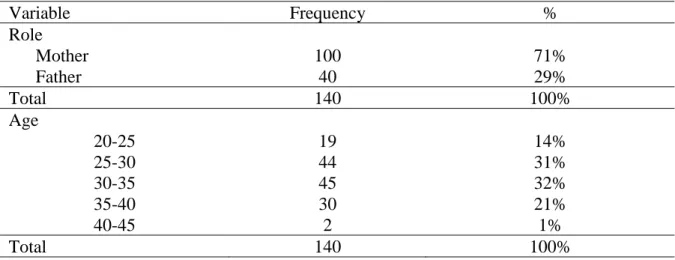
Out of the 140 responses collected, 71 percent were from mothers (n=100) and 29 percent from fathers (n=40), which indicates a higher female participation in Facebook Groups related to parenthood. As for the age, 85 percent of the total respondents was represented by
34 three age ranges: (1) 25-30, (2) 30-35 and (3) 35-40, which indicates that most of the new parents who participated in this study were between 25 to 40 years old (Table 1). Although, 82 percent of mothers and 93 percent of fathers were represented by the same three age ranges previously mentioned, the most representative group of mothers included individuals between 25-30 years old (n=32), whereas the most numerous one of fathers comprised respondents between 30-35 years old (n=16) (Table 2).
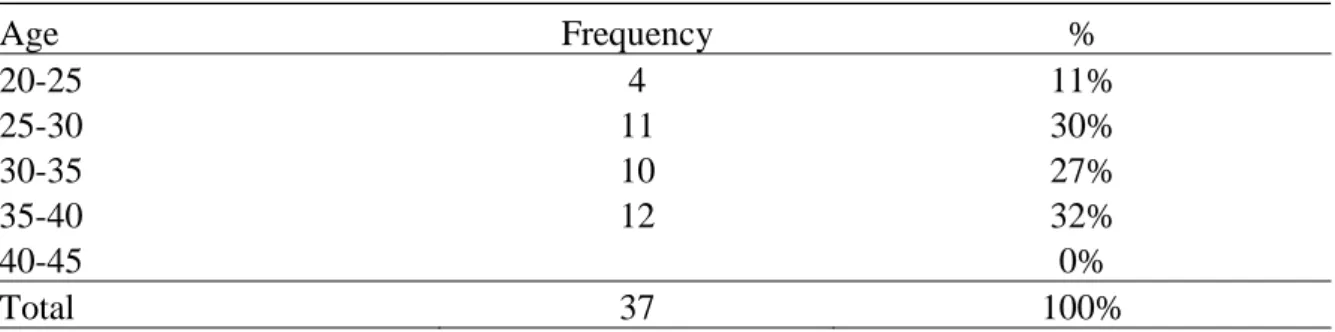
In relation to Pós-parto nos Museus, 86 percent of the total of interviewed mothers and 70 percent of the total of interviewed fathers claimed that they would like to participate in the program. In both groups, more than 80 percent of interested participants (81 percent for mothers and 93 percent for fathers) belonged to three age ranges: (1) 25-30, (2) 30-35 and (3) 35-40 (Table 3).
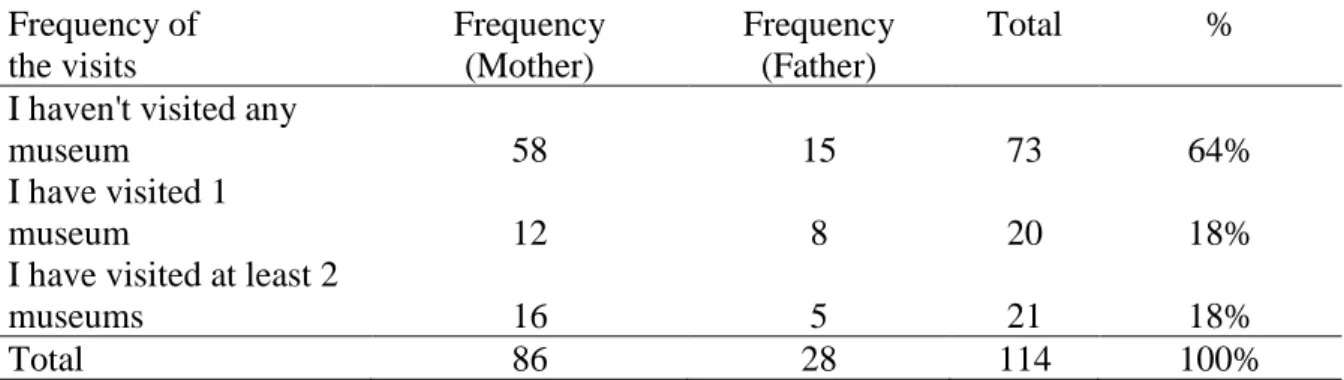
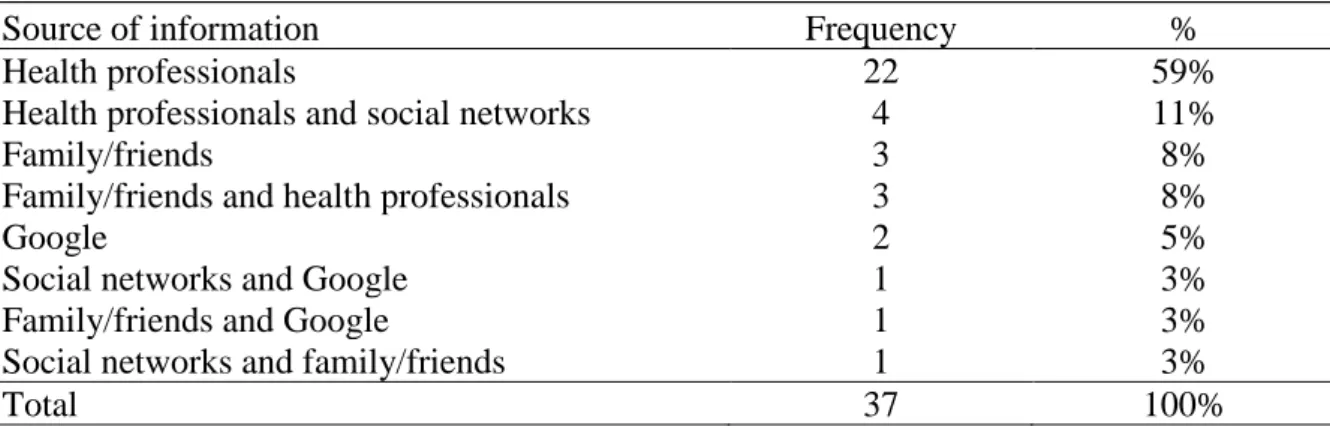
Even though these parents showed interest in Pós-parto nos Museus, 17 percent of them indicated that museums were not the most appropriate spaces for receiving postpartum physiotherapy treatments (Table 4), which was the main reason why parents (mostly fathers) who did not show initial interest in the program, would not participate in it (Table 5). 50 percent of this last group indicated that museums were not adequate (Table 5), mainly because they tend to be open and public spaces where lack of privacy, protective measures for babies and/or accessibility issues can be a concern. Moreover, 64 percent of the parents interested in participating in the program had not visited any museum during the last year (Table 6), which shows that more than half of the group of potential customers may not be interested in visiting museums.
Regarding the willingness to pay, 58 percent of the parents interested in Pós-parto nos Museus would be willing to pay between 10€ and 15€ for participating in the activity (Table 7). As for the company, 66 percent respondents interested in the program stated that they would like to attend the sessions with their partners and their babies (Table 8), which indicates that
35 these participants value activities that help them create/strengthen bonds with their families and/or spend time with them. Lastly, 56 percent of the respondents who would participate in Pós-parto nos Museus showed preference for group sessions of less than 10 participants (Table 9). Nevertheless, it is important to mention that a large number of fathers were also inclined for individualized sessions, rather than group ones.
As to the motives why parents would not be willing to participate in Pós-parto nos Museus, the two main reasons stated by the total of participants (n=140) were the following: moving from one place to another with the baby can be difficult in terms of logistics and accessibility and not having where to leave the baby during the sessions. While 28 percent of the total of interested parents in Pós-parto nos Museus opted for the first option, 27 percent mentioned the second one (Figure 2). In order to attract future customers and offer them a service capable of meeting their needs, these issues must be taken into consideration.
Reasons for Not Participating in Pós-parto nos Museus
Frequency (Mother)
Frequency (Father)
Total %
Mobility is difficult in terms of
logistics and accessibility 24 15 39 28%
Not having where to leave the baby
during the session 32 6 38 27%
Museums are not the best space for this
activity 15 17 32 23%
Not having availability in terms of time 16 13 29 21%
Not being willing to spend money on
postpartum physiotherapy 20 7 27 19%
Figure 2 - Reasons for Not Participating in Pós-parto nos Museus
With respect to the benefits that parents interested in Pós-parto nos Museus perceived in the service, results varied according to participants’ roles, as shown in Figures 3 and 4: