Comparative study of physical and chemical parameters and antioxidant activity of sweet
and sour cherries of Hungarian origin
Diana Raquel de Carvalho Bernardo Barreira
2º Ciclo em Biotecnologia e Qualidade Alimentar
Orientador : Professor Doutora Ana Barros Co-orientador : Professor Doutor Alberto Santos
Foram algumas as pessoas que tornaram possível a concretização desta dissertação de Mestrado, todas elas contribuindo de uma maneira diferente. A parte mais difícil é escrever para essas pessoas quando não se encontram as palavras, é escrever quando as palavras são poucas para transmitir um enorme obrigado a todas. Quero agradecer:
À professora Ana Barros por estar sempre ao meu lado, por confiar em mim, por ser o meu refúgio, a minha protetora, por me ajudar a crescer, por me tornar mais forte, por me ensinar todos os dias algo, por ser o ser humano único que é! Por todos os momentos que passamos juntas, semana após semana, do início ao fim! Será para sempre a professora mais querida, mais bonita, mais otimista, mais profissional e principalmente uma amiga do coração, que conheci. Será inesquecível para mim. Obrigada por tudo.
Ao professor Alberto Santos, por ceder as variedades cerejas e ginjas, e estar sempre disponível para qualquer dúvida.
À professora Paula Lopes pela ajuda no tratamento estatístico e por todos os conselhos que meu deu.
Ao professor Fernando Nunes pela injeção das amostras no HPLC e por estar sempre disponível para qualquer dúvida.
Ao professor João Carrola pela disponibilidade e ajuda na elaboração das fotografias para o trabalho.
Ao Departamento de Química, à Ana Abraão, ao André Lemos, ao Senhor Carlos e à Dona Paula por me ajudarem ao longo do trabalho prático sempre que
darem força todos os dias e me motivarem a ser cada vez melhor em tudo o que faço e nunca desistir daquilo que mais quero.
Ao meu irmão, que todos os dias me faz rir e ver o lado bom da vida.
Aos meus avós, por serem as pessoas mais queridas do mundo e acreditarem sempre em mim.
E finalmente aos meus amigos, à família que eu escolhi, à Cláudia Sousa, à Eunice Moreira, à Tânia Lopes, à Irene Gouvinhas, à Ana Gouveia, Cláudia Costa, à Brigitte Denis, ao Pedro Silva, ao Pedro Machado e ao Rui Costa pela ajuda, companhia, palhaçadas e miminhos que me deram, tanto nos dias partilhados no laboratório, como nas noites divertidas que passamos todos juntos até nos esquecermos das horas! Sem vocês a minha vida não teria tantas histórias para contar!
Um especial obrigada de coração à Cláudia Sousa, por todos os momentos que passamos juntas, pela cumplicidade, por ser a minha sombra todos os dias e por me ter aturado! Serás sempre a minha Propi!
Capitulo I. Enquadramento Temático 1.1.A cereja...2 1.2. Produção de cereja... 3 1.3. Programa de melhoramento………... 4 1.4. Objetivos……… ... 5 1.5. Resultados……… ... 6 1.6. Referências Bibliográficas………... 11
Capítulo II. “Comparative Study of physical and chemical parameters and antioxidant activity of sweet and sour cherries of Hungarian origin” Submitted to Journal of Food Composition and Analysis ... 15
Capítulo III. Conclusões e perspetivas futuras 3.1. Conclusões ...46
1.1. A cereja
As cerejas são o primeiro fruto da época para consumo fresco e são o fruto mais popular da Primavera-Verão em todas as regiões temperadas da Europa (Usenik, Fabčič, Štampar, 2008).
Consoante os diferentes consumidores o conceito de qualidade adquire diferentes definições. Os fatores característicos do fruto como aparência, textura, odor, sabor e valor nutricional, são importantes na aceitação do produto para o consumidor, visto que é um fruto que é consumido sem sofrer nenhum tipo de processamento (Bernalte, Sabio, Hernández , Gervasini, 2003; Gonçalves, Silva, Moutinho-Pereira, Bacelar, Rosa, Meyer, 2007;Usenik et al., 2008).
A qualidade da cereja está dependente de vários fatores, sendo os mais importantes o calibre, a firmeza, a cor, o brilho da epiderme e uma boa relação na concentração de açúcares/ácidos orgânicos, mas também a ausência de fissuras, picadas de aves, podridão e formas estranhas (Gonçalves et al., 2007)
A cor das cerejas é o principal atributo para a grande aceitação do consumidor, tal como o seu peso e total de açúcares (Usenik et al, 2008); o desenvolvimento de cor nas cerejas é usado como indicador do seu estado de maturação (Mazza and Miniati, 1993).
A cereja é um fruto com um elevado valor nutricional, é rica em açúcares (Usenik et al, 2008) e contém na sua constituição compostos fenólicos, principalmente ácidos fenólicos e antocianinas, que contribuem para a sua elevada atividade antioxidante (Kim, Heo, Kim,Yang, Lee, 2005; Gao and Mazza, 1995, Mozetiĉ ,Simĉić,Trebše, 2006;Usenik et al., 2008).
climáticas e porta-enxertos (Gonçalves, Landblo, Knudsen, Silva, Moutinho-Pereira, Rosa, 2004; Kim, Kim, Heo,Freer, Padilla-Zakour, Lee, 2004). De entre os compostos fenólicos presentes em maiores concentrações destacam-se os ácidos fenólicos, ácidos hidroxicinâmicos como o ácido neoclorogênico, ácido clorogênico e o ácido p-cumarilquinico, e os flavonóides, epicatequina e rutina (Robards, Prenzler, Tucker, Swatsitang, Glover, 1999; Kim et al., 2005; Usenik et al, 2008).
Além destes, também pode ser encontrado ácido ferúlico, mas em concentrações mais baixas (Matilla ,Hellström, Törrönen, 2006).
É descrito na literatura que as antocianinas presentes em maior quantidade nas cerejas, contribuindo para a sua cor e para a sua atividade antioxidante, são: cianidina-3-glucósido, seguida da cianidina-3-rutinósido, pelargonidina-3-rutinósido e peonidina-3-rutinósido (Gao and Mazza, 1995; Mozetič et al., 2006; Gonçalves et al., 2004, Usenik et al., 2008).
1.2. A produção de cereja
Como referem Webster e Looney (1996), o reconhecimento da importância da cereja na dieta humana é anterior à civilização Helénica, e na Idade Média foi frequentemente considerada um fruto de luxo. No entanto, só a partir do último quarto do séc. XX é que a espécie conheceu avanços significativos de expressão no sector primário, com a obtenção de novas variedades e porta-enxertos ananicantes adequados à intensificação dos pomares.
Atualmente, a produção mundial de cerejas ronda os 2,1 milhões de toneladas, e os maiores produtores são a Turquia, EUA, Irão, Itália e Ucrânia, com 20, 14, 12, 5 e 3% respetivamente (FAOSTAT, 2010). A UE concentra cerca de 26% da produção, reunindo na Itália, Espanha, Roménia, França e Polónia a sua maior expressão,
respetivamente com 115, 80, 70, 46 e 36 mil toneladas. A produção também tem crescido em Portugal nos últimos vinte anos, tendo atingido 15 227 t em 2010 (INE, 2010), provenientes fundamentalmente da Cova da Beira e Trás-os-Montes.
Em Portugal, as regiões de maior produção de cerejas são Beira Interior, Trás-os-Montes e Minho, destacando-se a Beira Interior com mais de 50% de produção de cereja a nível nacional (GPP, 2007).
Em 1979 existiam apenas 2903 hectares com a cultura de cerejas, e nos dez anos seguintes ocorreu apenas um aumento de 3% da área, atingindo em 1989 os 3000 hectares (GPP, 2007).
No entanto, foi entre 1989 e 1999 que se verificou a maior expansão da cultura de cerejas em Portugal (GPP, 2007). Verificou-se um aumento da área de cultivo para 5635 hectares, ocorrendo um acréscimo no volume de produção devido a diversas razões, entre as quais se destacam a modernização da tecnologia e a introdução de novas variedades (GPP, 2007).
Em relação a outros países da Europa, a produção nacional de cereja (2,6 t/ha) apresenta valores inferiores quando comparada com produtores europeus, entre eles, Espanha (2,7 t/ha), Itália (3,4 t/ha), Alemanha (4,1 t/ha) e França (4,2 t/ha) (GPP, 2007). Para aumentar a confiança do consumidor, relativamente à qualidade e à segurança do produto, foram criados produtos certificados, DOP e IGP, na região da Beira Interior (GPP, 2007).
1.3. Programa de melhoramento
Apesar do acentuado aumento da produção de cereja verificado nas últimas décadas, a sua balança comercial é ainda muito deficitária, face ao acréscimo de procura
destes frutos, em boa parte resultante dos atributos que a investigação lhes tem identificado no passado recente (Webster e Looney,1996).
Devido aos programas de melhoramento deste fruto, um largo número de variedades de cereja tem sido desenvolvido (Kole, 2007).
De acordo com Apostol (2011), a obtenção de cereja doce e ácida tem vindo a acontecer desde há 60 anos e foi iniciada por Sándor Brozik. Os principais objetivos do programa de melhoramento são: aumentar o tempo de maturação, encontrar variedades mais precoces e mais tardias na maturação para que haja um alargamento do seu período de colheita, aumentar a qualidade tanto para o mercado fresco como para a indústria de conservas, aumentar o tamanho dos frutos, melhorar a firmeza, aumentar o teor de açúcar e equilíbrio açúcar / ácido, baixar sensibilidade a rachaduras induzidas pela chuva, aumentar o tempo de vida de prateleira, auto-fertilidade alta, aumentar a tolerância ou resistência a agentes causadores de doença (mancha, podridão parda, Cytospora spp), aumentar a qualidade da cereja, reduzindo os custos para os produtores (Kappel, 2009).
1.4. Objetivos
A cereja e a ginja são frutos vermelhos muito procurados pelo consumidor devido aos seus benefícios para a saúde humana, mas com algumas características diferentes. Estes frutos são de elevado valor nutricional, contendo compostos fenólicos, com uma ação antioxidante, que combatem os radicais livres no organismo, protegendo-o de doenças cardiovasculares e cancerígenas. São uma fonte de vitaminas A e C, fibras solúveis que facilitam o bom funcionamento do intestino, ajudando a reduzir os níveis de colesterol.
Atendendo a que o estudo de cerejas e ginjas resultantes de programas de melhoramento é ainda um tópico pouco estudado, e que podem estas apresentar características relativas a parâmetros físicos e químicos distintas, o objetivo central do presente trabalho foi estabelecer uma comparação relativamente aos parâmetros físicos e às propriedades funcionais entre variedades de cerejeira e variedades de ginjeira resultantes de programas de seleção de melhoramento e resultantes de landraces locais mais ou menos remotos. Assim, serão apresentados resultados relativos a: estudo de parâmetros físicos (cor, calibre e peso); caracterização química (quantificação do teor em fenóis totais, quantificação do teor em antocianinas, quantificação do teor de flavonóides, caracterização do perfil fenólico por HPLC, correlação entre a atividade antioxidante e o teor em fenóis totais, correlação entre a atividade antioxidante e teor em flavonóides). Será ainda apresentada uma comparação entre as cerejas e as ginjas, bem como uma comparação entre as duas origens das cerejas e ginjas, as obtidas através de um programa de melhoramento e as resultantes de variedades locais.
1.5. Resultados
Das 18 variedades de origem húngara analisadas neste estudo, 11 são variedades de cerejeira (Anita, Carmen, Linda, Petrus, Katalin, Paulus, Axel, Vera, Karvics, Valerij Cscalov, Krupnopladja) e 7 são variedades de ginjeira (Piramis, Korai Pipacs, Meteor Korai, Maliga Émleke, Érdi Botermö, Favorit, Érdi Jubileum), sendo que as variedades Érdi Jubileum, Piramis, Korai Pipcas, Meteor Korai, Maliga Émléke, Érdi Botermö, Valerij Cscalov e Krupnopladja tem origem em variedades locais, enquanto que as variedades Anita, Carmen, Petrus Katalin, Paulus, Axel, Vera, Favorit, Linda e
Foram caracterizadas as diferentes cultivares quanto aos parâmetros físicos, peso, calibre e cor das variedades e caracterizadas quimicamente, determinando-se a sua atividade antioxidante, o teor de fenóis totais, flavonóides e antocianinas. Efetuou-se também a caracterização por HPLC-DAD das antocianinas presentes em maior quantidade nas variedades de cerejeira e ginjeira.
O peso das cerejas doces variou de 6,61 ± 1,37 até 13,27 ± 1,66 g para as variedades Axel e Carmen, respetivamente e de 4,49 ± 0,85 até 6,89 ± 0,54 g para as variedades de ginjas, Meteor Korai e Piramis, respetivamente.
Quanto ao diâmetro, as cerejas doces, nomeadamente a variedade Carmen apresenta o maior calibre (31,30 ±1,75 mm) e a variedade ginja Meteor Korai, apresenta o menor valor de calibre (20,75 ± 1,46mm).
As cerejas doces obtidas por variedades locais apresentam o maior valor de peso (9,94 g) e de calibre (28,05 mm), quando comparadas com as cerejas doces obtidas pelo programa de seleção e melhoramento. Fazendo a mesma comparação entre as variedades de ginja, as ginjas obtidas pelas variedades locais apresentam o maior peso ( 5,49g) e calibre (22,39 mm) comparativamente às ginjas obtidas pelo programa de seleção e melhoramento (5,09g e 21,77 mm).
Relativamente à cor, verifica-se que a variedade Valerij Cscalov, cereja doce, apresenta a cor mais escura de entre todas as variedades estudadas, com baixo valor de L* (26,73 ± 0,77), de a* (3,06 ±1,37) e de b* (0,96 ± 0,17).
Entre as cerejas doces e ginjas obtidas por landraces locais de origem mais ou menos remota e as obtidas pelo programa de seleção e melhoramento não se verificam diferenças, visto que os valores dos parâmetros cromáticos são semelhantes.
Relativamente aos parâmetros químicos analisados, verificou-se que os valores de atividade antioxidante variaram de 22,00 ± 2,14 a 97,42 ±4,45 µmoles de Trolox g -1
para as variedades de cerejas doce Anita e Paulus, respetivamente, e de 10,45 ± 2,14 a 141, 83 ± 10,78 µmoles de Trolox g -1para as variedades de ginjeira, Favorit e Meteor Korai, respetivamente.
A literatura é escassa na apresentação de resultados nas mesmas unidades de atividade antioxidante usadas neste estudo, uma vez que a maior parte dos trabalhos usa o método do DPPH (Serrano, Guillén, Martínez-Romero, Castillo, Valero, 2005; Usenik et al., 2008; Prvulović, Malenčić, Popović, Ljubojević, Ognjanov, 2011) que não é comparável com o método ABTS usado neste trabalho.
No entanto, Khoo, Clausen, Pedersen, Larsen (2011) efetuou um estudo em 34 ginjas, em que duas variedades coincidem com o nosso estudo, e expressou os resultados em equivalentes de Trolox. Comparando os resultados obtidos por Khoo et al. (2011) verifica-se que os valores obtidos para atividade antioxidante (12 ± 2,3 µmoles de Trolox g -1) para a variedade Favorit são semelhantes aos obtidos no presente trabalho (10,45 ± 2,14 µmoles de Trolox g -1). Relativamente à variedade Érdi Bótermö, os valores obtidos para a atividade antioxidante por Khoo (2011), são muito inferiores (18 ± 3,4 µmoles de Trolox g-1) aos obtidos neste estudo (131, 42 ± 5,62 µmoles de Trolox g-1).
Os compostos fenólicos estão correlacionados com os valores de atividades antioxidante, uma vez que as variedades em estudo que apresentam maior valor de atividade antioxidante também apresentam maiores valores de compostos fenólicos. As variedades Meteor Korai e Érdi Jubileum apresentam os valores mais altos de compostos fenólicos, 16,28± 0,01 a 19,88 ± 0,19 mg GAE g -1, respetivamente e a variedade Favorit apresenta o valor mais baixo 1,06 ± 0,06 mg GAE g -1. Comparando os valores médios de compostos fenólicos, as variedades de ginjeira apresentam valores
mais altos (11,62 mg GAE g ) quando comparadas com as variedades de cerejeira (6,41 mg GAE g-1), o que está de acordo com a literatura (Kim et al, 2005).
De entre as variedades de ginjeira analisadas, podemos referir que a variedade Favorit, obtida pelo programa de seleção e melhoramento apresenta valores de atividade antioxidante e fenóis totais mais baixos do que a variedade Érdi Jubileum, obtida por landraces locais de origem mais ou menos remota. Nas variedades de cereja doce verifica-se o contrário, uma vez que a variedade Paulus obtida pelo programa de seleção e melhoramento é a que apresenta valores mais altos para os parâmetros referidos anteriormente.
A quantidade de flavonóides varia de 2,41 a 10,33 mg g-1de catequina para as ginjas e de 1,33 a 8,93 mg g-1de catequina para as cerejas doces, estando em maior quantidade nas ginjas.
Considerando todas as variedades em estudo, os fenóis totais e flavonóides variam, cada um, paralelamente com os valores de atividade antioxidante.
As correlações encontradas para estes parâmetros são estatisticamente significantes (r=0,78; P<0,0001; r=0,86 P <0,0001) para os fenóis totais e flavonóides, respetivamente.
Os resultados obtidos são consistentes com os obtidos pela literatura (Khoo et al., 2011).
A quantificação do total de antocianinas pelo método colorimétrico demonstrou que os valores se encontram entre 60,47 ± 1,02 mg 100 g-1 e 1362,48 ± 18,22 mg 100-1por peso fresco em ginjas, nas variedades Favorit e Meteor Korai, respetivamente. Nas cerejas doces os valores variam entre 45,44 ± 0,33 mg 100 g-1 e 1208,63 ± 73,58 mg 100 g-1por peso fresco para as variedades Carmen e Valerij Cscalov, respetivamente. A média do total de antocianinas das variedades de ginjeira (582,98 mg 100 -1por peso
fresco) é 1,5 vezes maior do que a obtida para as variedades de cerejeira (383,24 mg 100 g-1 por peso fresco). Os resultados obtidos neste estudo são superiores aos encontrados na literatura por Khoo (2011), em que os seus valores variam de 9 ±3,1 mg 100 g-1a 63 ± 7,5 mg 100 g-1por peso fresco.
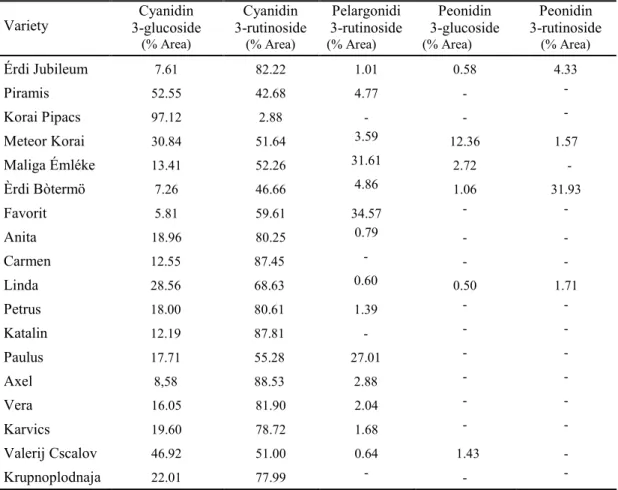
A análise por HPLC-DAD dos cromatogramas das 11 variedades de cereja doce e das 7 variedades de ginjas revelou a presença de 5 antocianinas maioritárias, estando de acordo com Gao e Mazza (1995), Gonçalves et al. (2004) e Usenik et al. (2008). A antocianina identificada com uma maior percentagem de área é a cianidina- 3-rutinósido (42,7 – 88,5 %), estando de acordo com Gao e Mazza (1995) e Gonçalves et al. (2004), existindo apenas uma exceção na variedade Korai Pipacs que apresenta o valor mais alto para a antocianina cinidina-3-glucósido (97,1%) e apenas 2,9% para a cianidina-3-rutinósido.
Os resultados descritos na literatura (Gao e Mazza, 1995) para a percentagem de área das antocianinas são mais baixos do que os obtidos no nosso estudo.
A segunda antocianina identificada nas variedades em estudo é a cianidina-3-glucósido, mas existe uma exceção em 3 casos para a antocianina pelargonidina-3-rutinósido, onde a percentagem de área é superior, particularmente na variedade Máliga Émleke (31,6%), Favorit (34,6%) e Paulus (27,0%).
1.6. Referências Bibliográficas
Apostol, J. (2011).Breeding of sweet and sour cherry in Hungary In: Proceedings of the 3rd Conference Innovations in Fruit Growing. Belgrade, 49-50.
Bernalte, M.J., Sabio, E., Hernández , M.T., Gervasini, C.(2003).Influence of storage delay on quality of „Van‟ sweet cherry. Postharvest Biology and Technology, vol.28, pp.303-312.
FAOSTAT 2010, http://faostat.fao.org 15 Outubro, 2012
Gao, L., Mazza, G. (1995). Characterization, quantitation, and distribution of anthocyanins and colorless phenolics in sweet cherries. Journal of Agricultural and Food Chemistry, 43, 343–346.
Gonçalves, B., Landblo, A., Knudsen, D., Silva, A. P., Moutinho-Pereira, J., Rosa, E. (2004). Effect of ripeness and portharvest storage on the phenolic profiles of cherries (Prunnus avium L.). Journal of Agricultural and Food Chemistry, 52, 523-530.
Gonçalves, B., Silva, A.P., Moutinho-Pereira, J., Bacelar, E., Rosa, E., Meyer, A.S. (2007).Effect of ripeness and postharvest storage on the evolution of color and anthocyanins in cherries (Prunus avium L.). Food Chemistry, 103, 976-984.
GPP (2007). A Cereja. Ministério da Agricultura Desenvolvimento Rural e Pescas. 25 de Setembro, 2012
INE 2010, http://www.ine.pt 12 Outubro, 2012
Kappel, F. (2009). Sweet Cherry Breeding Program. Agriculture and Agri-Food Canada. ISBN 978-1-100-10954-1.
Khoo, G. M., Clausen, M.R., Pedersen, B. H., Larsen, E. (2011). Bioactivity and total phenolic content in 34 sour cherry cultivars. Journal of Food Composition and Analysis, 24, 772-776.
Kim, D.O., Heo,H.J., Kim, Y.J., Yang, H.S., Lee, C.Y. (2005) .Sweet and sour cherry phenolics and their protective effects on neuronal cells. Journal of Agricultural and Food Chemistry,53, 9921-9927.
Kim,D.O.,Kim, Y.J., Heo,H.J., Freer, J.,Padilla-Zakour, O.I.;Lee, C.Y. (2004). Phenolics and antioxidant capacity in selected New York State plums. New York Fruit Quartely, 12, 9-12.
Kole, C. (2007). Genome Mapping and Molecular Breeding in Plants , Fruits and Nuts, 105-106.
Matilla , P.Hellström, J., Törrönen , R. (2006). Phenolic acids in berries, fruits and beverages. Journal of Agricultural and Food Chemistry. 54, 7193- 7199.
Mazza, G., Miniati, E.(1993) Anthocyanins in fruits, vegetables, and grains, Boca Raton: CRC Press.
Mozetiĉ, B.,Simĉić, M.,Trebše, P. (2006). Anthocyanins and hydroxycinnamic acids in Lambert compact cherries (Prunus avium L.) after cold storage and 1-methylcyclopropene treatment. Food Chemistry. 97, 302-309.
Prvulović, D., Malenčić D., Popović, B., Ljubojević, M., Ognjanov, V. (2011).Antioxidant properties of sweet cherries (Prunus avium L.) – Role of phenolic compounds. World Academy of science, Engineering and Techonology, 59.
Robards, K.; Prenzler, P.D.; Tucker, G.; Swatsitang, P.; Glover, W. (1999). Phenolic compounds and their role in oxidative processes in fruits. Food Chemistry, 66, 401-436.
Serrano,M., Guillén, F., Martínez-Romero, D., Castillo, S., Valero, D. (2005).Chemical constituents and antioxidant of sweet cherry at different ripening stages. Journal Agricultural and Food Chemistry, 53, 2741-2745.
Usenik, V., Fabčič, J., Štampar, F. (2008). Sugars, organic acids, phenolic composition and antioxidant activity of sweet cherry (Prunus avium L.). Food Chemistry, 107, 185– 192.
Webster A.D. and Looney, N.E. (1996). Cherries. Crop Physiology, Production and Uses. Cab Int. Oxon OX10 8 DE, UK, 513 .
“Comparative Study of physical and chemical
parameters and antioxidant activity of sweet and sour
cherries of Hungarian origin.”
3
Diana Barreira(a); Cláudia Sousa(a); János Apostol(b); Alberto Santos(c); Ana Barros(a*) 4
aCQ – Chemistry Research Centre, Chemistry Department, University of Trás-os-5
Montes e Alto Douro,5000–801Vila Real, Portugal 6
bResearch Institute for Fruit growing and Ornamentals, Budapest, Hungary 7
cCITAB –Centre for the Research and Technology of Agro-Environment and Biological 8
Sciences. Department of Agronomy, University of Trás-os-Montes e Alto Douro, 5001–
9
801Vila Real, Portugal 10 11 * Corresponding author 12 Tel:+351259350283 13 Fax: +351259350480 14 e-mail:[email protected] 15 16 17 18 19 20 21 22 23 24 25
constitution, mainly phenolic acids and anthocyanins, and a great antioxidant activity. 28
The aim of the present work is a comparative study of physical and chemical parameters 29
between sweet and sour cherries, namely in: size and weight, color, total content in 30
phenolics and flavonoids, anthocyanins, and antioxidant activity. 31
Overall results showed differences in physical and chemical parameters analyzed 32
between the sweet and sour cherries obtained by breeding program or obtained by local 33
landraces from more or less remote source. The results of antioxidant activity, total 34
phenolics and anthocyanins were higher when compared to the literature. Sour cherries 35
reveled to be smaller, with less weight, higher antioxidant activity and higher content of 36
phenolic compounds. 37
The anthocyanin levels on the varieties studied differed between sweet and sour 38
cherries, as well as among the cultivars within each group. 39
40 41
Keywords: Sweet cherries; Sour Cherries; breeding program; phenolics; anthocyanin; 42 antioxidant activity 43 44 45 46 47 48 49
health, essentially due to phenolic compounds, which are described in the literature to 53
reduce the risk of degenerative diseases caused by oxidative stress, namely cancer and 54
cardiovascular diseases (Yoo, Al-Farsi, Lee, Yoon, Lee, 2010; Serra, Duarte, Bronze, 55
Duarte,2011). 56
Sweet cherry (Prunnus avium L.), and sour cherry (Prunnus cerasus L.) are part of the 57
family of Rosaceae, subfamily Prunoideae, genus Prunus and subgenus Cerasus (Sitte, 58
Ziegler, Ehrendorfer, Bresinsky, 1991). 59
Sweet cherries are the first fresh fruit of the season for fresh consumption and are the 60
most popular spring-summer fruits across the temperate regions of Europe; they are 61
consumed mainly non-processed which is the reason why their appearance is so 62
important for consumers (Bernalte, Sabio, Hernández, Gervasini, 2003; Gonçalves, 63
Silva, Moutinho-Pereira, Bacelar, Rosa, Meyer, 2007; Usenik, Fabčič, Štampar,2007). 64
Sour cherries (Prunnus cerasus L.) probablily result by natural crossed between ground 65
cherry (Prunnus fruticosa Pall.) and sweet cherry (Prunnus avium L.) and are 66
allotetraploid specie (Miloševic and Miloševic, 2012) Sour cherries have different 67
characteristics when compared to sweet cherries, and are most commonly used for 68
juices, jams or fillings (Mulabagal Lang , DeWitt , Dalavoy , Nair, 2009). 69
Human consumption of this fruit has several benefits, such as to alleviate the pain 70
associated with arthrits and gout (Mulabagal et al., 2009).The sweet and sour cherries 71
are fruits with high nutritional value mainly due to be rich in sugars (Usenik et al., 72
2007) and high content of phenolic compounds in their constitution, mainly phenolic 73
acids and anthocyanins, which contributes to a great antioxidant activity (Gao and 74
The composition and concentration of phenolics are significantly influenced by the 77
cultivar and its geographic origin, ripening stage at harvest, cultural practices, climatic 78
conditions and postharvest storage (Gonçalves, Landblo, Knudsen, Silva, Moutinho-79
Pereira, Rosa, 2004; Kim, Kim, Heo, Freer, Padilla-Zakour, Lee, 2004). The main 80
phenolic compounds in the cherries are phenolic acids, hydroxycinnamic acids such as 81
the neochlorogenic, chlorogenic and p-coumaroylquinic acids, and flavonoids 82
(epicatechin and rutin) (Robards, Prenzler, Tucker, Swatsitang, Glover, 1999; Kim et 83
al., 2005; Usenik et al., 2007). However, in small amounts is also found ferulic acid 84
(Matilla, Hellström, Törrönen, 2006). 85
The color of the cherries is one of the most important attributes for a greater consumer 86
acceptance, as the weight and the amount sugars content (Usenik et al., 2007), and 87
development of red color in cherries is used as indicator of ripeness (Mazza and Miniati, 88
1993). It is described in literature that the anthocyanin present in larger amounts in 89
cherries is the cyanidin-3-glucoside followed by cyanidin-3-rutinoside, pelargonidine-3-90
rutinoside and peonidine-3-rutinoside (Gao and Mazza, 1995; Mozetič et al., 2006; 91
Gonçalves et al., 2004; Usenik et al., 2007). 92
The importance of the presence of cherries in the human diet has been recognized since 93
the Hellenic civilization, and in middle age cherries were often considered luxury fruits. 94
Important advances in the primary sector for cherries occurred only from the third 95
quarter of the XXth century on, with the acquisition of new suitable varieties and 96
dwarfing rootstocks for orchard intensification (WebsterandLooney,1996). 97
Currently, world production of cherries is around 2.1 million tons, and the major 98
with 115, 80, 70, 46and36thousand tons. The production has also grown in Portugal in 102
the last twenty years, reaching 15 200 t in 2010 (INE, 2010), mainly from the Cova da 103
Beira and Trás-os-Montes regions. 104
According to Apostol (2011), both the Hungarian sweet and sour cherry breeding has 105
been going on for 62years, and was initiated by Sándor Brozik. The main objectives of 106
breeding program are: extend the ripening time, finding more precocious and later 107
ripening varieties to widen the harvesting window period, breeding for excellent quality, 108
both for the fresh market and canning industry, increase the fruit size, good firmness, 109
with high sugar content and good sugar/acid balance, low sensitivity to rain induced 110
fruit cracking, good shelf life, self-fertility, high winter hardiness, tolerance or 111
resistance to diseases (leaf spot, brown rot, Cytospora spp.). The present work reports 112
the fruit physical parameters, phenolic composition and antioxidant activity of some 113
Hungarian cherries obtained from local landtaces from more or less remote source and 114
new ones obtained by the Hungarian breeding program; the fruits were collected on 115
trees at the 3rd leaf in a small varietal collection located at Carrazedo de Montenegro, 116
Portugal. 117
Carrazedo de Montenegro (Chaves), Portugal, with the aim of studying the behaviour 121
and characteristics of the trees and fruits under local conditions. For that purpose, an 122
appropriate nursery was prepared locally in 2007–2008 to raise the plants on Gisela 6
123
rootstock, and five trees per variety were installed in March2009. Some varieties in the 124
collection (Érdi Bòtermö, Érdi Jubileum, Korai Pipacs, Krupnoplodnaja, Maliga 125
Émléke, Meteor Korai and Piramis) are Hungarian landraces from more or less remote 126
source and others result from Hungarian breeding program (Anita, Axel, Carmen, 127
Katalin, Kavics, Linda, Paulus, Petrus, Vera, Favorit and Valerij Cscalov). 128
129
2.1. Sampling
130
When considered in appropriate ripening moment for immediate consumption, samples 131
of 1 kg of cherries were harvested from each variety, by selecting representative fruits 132
of each tree, and then performed analyses. Fruits were air-dried at -45˚C in an oven, 133
until reaching the constant weight then the edible parts were lyophilized. 134
135
2.2.Determination of physical parameters
136
2.2.1. Color
137
Ground color was measured using a tristimulus colorimeter (Minolta CR-200BChroma 138
Meter, Minolta, Japan) with an 8 mm diameter viewing area. Chromatic analyses were 139
carried out following theCIE(Commission International de l'Eclairage) system of 1976. 140
Values of L*, a* and b* were measured to describe a three-dimensional color space. 141
The vertical axis L* is a measure of lightness, where values range from completely 142
(Voss, 1992; Gonçalves et al., 2007). The chroma, a measure of chromaticity (C*), 147
indicating the purity or saturation of the color can be obtained as C* = (a*2 + b*2)1/2 148
(Voss, 1992; Gonçalves et al., 2007). The data of each measurement are the average of 149
triplicate measures on equidistant points of each fruit. 150
2.2.2. Weight and size
151
10 cherries were selected randomly from each variety. Their weights were determinate 152
using an analytical balance, and their calibres using a digital micrometer. 153
2.3. Extraction of polyphenolic compounds from the cherries
154
Freeze-dried cherry samples(1g)were mixed in5ml of1% HCl, in three test tubes. The 155
tubes were placed inclined in a shaker 20minutes and then placed in a centrifuge for 5
156
minutes at 50 rpm. The supernatant was removed with a Pasteur pipette for a 25 ml 157
volumetric flask. Additional 5 ml of MeOH / 1% HClto the test tubes and the procedure 158
was repeated three more times. After four extractions, the volume of the flask was 159
added toMeOH / 1% HCland transferred to the sample holder. The samples were diluted 160
10times for the colorimetric methods determination. 161
162
2.4. Quantification of the antioxidant activity
163
The radical-scavenging activity was determined soon after extraction by the 2,2 -azino-164
bis(3-ethylbenzothiazoline)-6 sulphonic acid (ABTS) radical cation decolorization assay 165
(Ozgen, Reese, Tulio, Scheerens, Raymond Miller, 2006; Barros, Nunes, Gonçalves, 166
Bennett, Silva, 2011). For the assay, ABTS+ radical was prepared by mixing an ABTS
167
stock solution (7 mM in water) with 2.45 mM potassium persulfate. This mixture was 168
allowed to stand for 12–16 h at room temperature in the dark until reaching a stable 169
25, 50, 100, 150 and 200 L of the extract of the cherries previously reported, diluted 172
conveniently to 2 mLof the diluted ABTS+ solution. ABTS+bleaching was monitored 173
at 734 nm at 25ºC for at least 30min and the percentage of discoloration after 15 min 174
was used as the measure of antioxidant activity. The ABTS+bleaching was proportional 175
to the concentration of the sample added to the medium. The antioxidant activity of the 176
extract was calculated as Trolox Equivalent Antioxidant Capacity (TEAC) and was 177
expressed as mmoles of Trolox equivalents per g of cherry flesh (fresh weight). All 178
measurements were performed in triplicate. A standard curve of the percentage of 179
ABTS+inhibition in function of Trolox concentration (0.11 to 0.014 mM) was used for 180
the calculations. 181
182
2.5. Quantification of the total phenolic contents
183
The content of total phenolic compounds in the cherries samples was determined using 184
Folin-Ciocalteu reagent, with gallic acid as standard. This method is based on the 185
reduction of a phosphowolframate-phosphomolybdate complex by phenolics to blue 186
reaction products. 1 mL of diluted samples was mixed with 500mL of Folin-Ciocalteu 187
reagent,2mLof7.5 %sodium carbonate solution and6.5mLof water. The mixture was 188
shaken and the absorbance of the standards and samples was measured at =750 nm 189
after 30 min reaction at 70ºC in relation to a gallic acid standard curve. All 190
measurements were performed in triplicate. The results were expressed as milligrams of 191
gallic acid equivalents g (mgGAEg-1). 192
of distilled water. In a test tube0.5mLof sample-working solution and150μLofNaNO2
197
5 %were introduced. After5min150μLofAlCl310%were added and 6min after1 mL
198
of 1M NaOH was added. The mixture was shaken and the absorbance of the standards 199
and samples was measured at =510 nm in relation to a catechin standard curve. All 200
measurements were performed in triplicate. The results were expressed as milligrams of 201
catechin per g of fresh cherry (mg Catechin g-1). 202
203
2.7. Quantification of anthocyanins
204
The total of anthocyanins was determined colorimetrically by the method originally 205
described by Ribérau-Gayon and Stonestreet(1965).
206
To1mLof concentrated sample, it was added 1 mLof ethanolic solution ofHCl 1%and 207
10mLof buffer solutionpH 3.5. The same procedure was repeated in another tube, but 208
using a buffer solutionpH 0.6. All measurements were performed in triplicate. The 209
mixture was shaken and the absorbance of the samples was measured at =520nm. For 210
the determination of the amount of anthocyanins present in the samples it was used the 211
the following formula:A = 400(AbspH 0.6– AbspH 3.5). The results were expressed as 212
milligrams per100g fresh weight of cherries. 213
214
2.8. Determination of the polyphenolic profile of the fruits by high performance
215
liquid chromatography
216
For the analysis of the methanolic extracts of cherries, 5 mL of the fruit methanolic 217
extracts were concentrated under vacuum by rotary evaporation at 40ºC. After 218
evaporation of3mL, the content was transferred to a5mLvolumetric flask and the total 219
volume completed with sodium formate, to increase the pH. 220
chromatography using a Ultimate 300 solvent delivery system equipped with a PD-100
223
UV-Vis diode array detector. Separation was performed by gradient elution on anACE 5
224
C18 column, 5 m particle size; (250 × 4.6 mm) (Advanced Chromatography 225
Technologies, Scotland). Analysis conditions were as follows: solvent Awas a mixture 226
of95: 5water/formic acid(v/v), and solvent Bmethanol. A linear gradient analysis for a 227
total run time of 80min was used as follows: starting from 5%solvent Bduring2 min, 228
increase to 80% solvent B over 68 min and then isocratic for 8 min, decreasing to 5%
229
solventBover2min, and finally isocratic for 5min. The sample volume injected was50
230
µL, the flow rate was 1.0mL/min, and the column temperature was maintained at 30ºC
231
during the run. The eluent was continuosly monitored from 240 to 600 nm with a 232
photodiode array detector (PDA-100, Dionex). The identification strategies used for 233
characterization of the polyphenolic profile where: the comparison of the retention time 234
andUV-vis spectra with reference compounds and the comparison of the retention time 235
andUV-vis spectra with available in the literature (Gao and Mazza, 1995; Gonçalves et 236
al., 2004; Kim et al., 2005). Data are expressed as mean ± standard deviation of 237
chromatographic peak areas not corrected for the water content. 238
The weight and calibers of eleven sweet and seven sour cherries are given in Table 2. 242
Under our experimental conditions, sweet cherries weight ranged from 6.61 ± 1.37g to 243
13.27 ± 1.66g for the varieties Axel and Carmen, respectively, and from 4.49 ± 0.85g to 244
6.89 ± 0.54 g for the sour cherries Meteor Korai and Piramis, respectively. As can be 245
observed, generally sour cherries presented globally lower weight than the sweet ones, 246
and the differences are statistically significant, except for the Piramis and Érdi Bòtermö 247
varieties. 248
Comparing all the sweet and sour varieties studied, one can observe that the highest 249
average fruit weights were measured in Carmen (13.27 ± 1.66g), sweet cherry, and the 250
lowest in Meteor Korai (4.49 ± 0.85g) and Érdi Jubileum (4.96 ± 0.76), both sour 251
cherries, matching with the observed in other regions (Apostol, 2011; Hunyadi Garden , 252
2008) . 253
Relatively to longitudinal diameter, also the sweet cherry Carmen presented the highest 254
value, 31.30 ± 1.75 mm, and the sour cherry Meteor Korai the lowest one, 20.75± 1.46
255
mm. The sweet varieties obtained from local landraces from more or less remote source 256
present globally highest values from weight (9.94 g) and longitudinal diameter (28.05 257
mm) when compared with the varieties obtained by breeding program(8.89 g and 26.98 258
mm), being Carmen the only exception. Making the same comparative study for the 259
sour cherries, the results obtained are the opposite once the cherries obtained from 260
breeding program present highest values (5.09 g and 21.77 mm) comparatively to the 261
sour cherries obtained from local landraces from more or less remote (5.49 g and 22.39 262
mm). 263
values between 27 and 30 mm and between 21 and 22 mm, respectively, for the same 266
varieties. Also the results for Maliga Émléke and Carmen relatively to weight parameter 267
are and referred in Hunyadi Garden (2008) and supported by Apostol (2011) that 268
obtained values between 6-7 g and between 10-12 g, respectively. 269
3.2. Color
270
One of the objectives of the breeding program is the production of cherries more 271
attractive to the consumer. In the sweet and sour cherries, the antocyanins accumulation 272
is responsible for the development of red color (Mazza and Miniati, 1993). In Table 3, 273
Table4 and Table 5are presented the mean values for parameters L*, a*, b*, C* and H* 274
obtained for sweet and sour cherries obtained from local landraces from more or less 275
remote source and cherries obtained by breeding program. 276
According to Girard and Koop(1998), darker cherries show lower L* values, and tend to 277
be less red, with lower a* values and less yellow, showing also lower b* values. The 278
reddest fruits observed in the present work were sweet cherries from the cultivar Valerij 279
Cscalov, with lowest L* value (26.72 ± 0.77), the lowest a* value (3.06 ± 1.37) and also 280
the lowest b* value(0.96 ± 0.17). 281
The sweet and sour cherries obtained from local landraces from more or less remote 282
source and from breeding program didn´t present differences in chromatic parameters 283
(L *, a *, b *). The L* values of the sweet and sour cherries were similar(L*=30.01and 284
L*=31.26respectively). 285
The sweet cherries obtained by local landraces from more or less remote source and 286
obtained by breeding program showed differences in the chromatic parameters analyzed 287
landraces from more or less remote source and cherries obtained by breeding program 291
are similar, L*=30.91 and L*= 31.37, respectively. However in a* and b* parameters 292
the differences were more marked (a*=15.93and b*=6.68), for the sweet cherries 293
obtained by local landraces from more and less remote source and a*=25.72and b*=9.80
294
for the cherries obtained from breeding program. 295
Analyzing the C* parameter, the sweet and sour cherries obtained by local landraces 296
from more or less remote source presented a more attractive color ( C* =7.83 and 297
C*=15.56) than the sweet and sour cherries obtained by breeding program (C*=21.18 298
and 27.54). 299
3.3. Total phenolic content, flavonoids, antioxidant activity and total anthocyanin
300
content
301
The main objective of this study is the chemical characterization of sweet and sour 302
cherries obtained from local landraces from more or less remote source and obtained by 303
breeding program and the comparative study between these two groups. Table 7
304
presents the values of antioxidant activity, total phenolics, flavonoids and anthocyanins 305
from all the studied varieties. 306
The values for antioxidant activity ranged from 22.00 ± 2.14 to 97.42 ± 4.45 µmoles 307
Trolox g-1 for the sweet varieties Anita and Paulus, respectively, and from10.45 ± 2.14 308
to 141.83 ± 10.78 µmoles Trolox g-1 for sour cherries, Favorit and Meteor Korai, 309
respectively. 310
The literature is scarce in terms of antioxidant activity of cherries expressed in the same 311
units that we have used, once the major articles from this area, used the DPPH method 312
(Serrano, Guillén, Martínez-Romero, Castillo, Valero, 2005; Usenik et al., 2007; 313
Prvulović, Malenčić, Popović, Ljubojević, Ognjanov ,2011) that is not comparable with 314
observe that from the 34cherry varieties studied only two (Érdi Bòttermö and Favorit) 317
coincide with our study. Comparing the results obtained by Khoo et al., (2011), we can 318
find that Favorit values for antioxidant activity were similar to ours (12 ± 2.3 µmoles 319
Trolox g-1) and 10.45 ± 2.14 µmoles Trolox g-1 in the present work; on the contrary, 320
concerning the variety Érdi Bòttermö, values were significantly different. Khloo et al., 321
(2011)refer antioxidant activity values of 18 ± 3.4µmoles Trolox g-1and our work led us 322
to 131.42 ± 5.62 µmoles Trolox g-1for the same variety. As a possible explanation, we 323
think that our plants have a much more open crown architecture, as they were just on 324
their 3rdleaf, while Khloo et al.(2011)worked with older trees. Also, this might point to 325
a dramatic importance of keeping open canopies in the pruning operations to improve 326
the antioxidant content of the fruits. 327
Concerning the phenolic compounds, the results were strictly correlated with the 328
antioxidant activity, once the varieties Meteor Korai and Érdi Jubileum that presented 329
higher values from antioxidant activity from all the studied varieties, also present higher 330
values from phenolic compounds, 16.28 ± 0.01 and 19.88 ± 0.19 mg GAE g-1, 331
respectively. Also Favorit variety that presented lower values from antioxidant activity 332
is also the cultivar that presents the lower phenolic compounds content, 1.06 ± 0.06
333
mg GAE g-1. The total phenolics of sweet varieties were in a range from 5.64 to 14.89 334
mg GAEg-1 with an average of 6.41 mg GAE g-1 and sour varieties from 1.06 to 19.88 335
mg GAE g-1 with an average of 11.62 mg GAE g-1. Although the average from the 336
phenolic compounds of the sour cherries is higher than the average from the sweet ones, 337
the lowest content of phenolic compounds was found in the Favorit cultivar, a sour 338
González Gómez, 2011;Khoo et al., 2011;) the values for total phenolic content is 342
lower than in the present work, for the cherries from Hungarian origin. Concerning the 343
sour cherries, we can refer that the Favorit variety is obtained by breeding program and 344
presents an antioxidant activity and phenolic compounds content significantly lower 345
than the Meteor Korai obtained from local landraces from more or less remote source. 346
The opposite happens with the sweet cherries, once the highest values from these 347
parameters are related to Paulus cultivar, obtained by breeding program (97.42 ± 4.45
348
µmoles Trolox g-1 for antioxidant activity and 14.89 ± 0.09 mg GAE g-1 for phenolic 349
compounds). 350
The content of flavonoids range between 2.41 to 10.33 mg g-1 of catechin for the sour 351
cherries and presents an average of 6.33 mg g-1of catechin and between 1.33 to 8.93 mg 352
g-1of catechin for sweet cherries and an average of 4.2 mg g-1of catechin. This result is 353
in accordance with the phenolic content from sweet and sour cherries. 354
The highest value was obtained for the sour cultivar Érdi Jubileum 10.33 ± 0.19 mg 355
catechin g-1 obtained from local landraces from more or less remote source and the 356
lowest for the sweet cultivar Carmen 1.33 ± 0.06mg catechin g-1, obtained by breeding 357
program. 358
In general, and considering all the varieties, the content of phenolic compounds and 359
flavonoids varies in parallel with the antioxidant activity levels. The correlations found 360
among these parameters were statically significant (r=0.78; P<0.0001; r=0.86 P <0.0001):
361
Figures1and2, for phenolic compounds and flavonoids, respectively. These results are 362
consistent with previous reports of similar nature (Khoo et al.,2011). 363
Favorit and Meteor Korai, respectively. For the sweet cherries, the values ranged 366
between45.44 ± 0.33and1208.63 ± 73.58mg100g-1fresh weight for Carmen and Valerij 367
Cscalov, respectively. The average content of anthocyanins of sour cherries (582.98 mg 368
100 g-1) was about 1.5 times higher than that the obtained for the sweet cherries (383.24 369
mg 100 g-1) wich is in accordance with Kim et al., (2005). 370
The results of this study for the amount to anthocyanins of Hungarian cherries are 371
superior to those obtained in literature by Khoo et al., (2011) in which the content of 372
anthocyanins in the cherries varies between 9 ± 3.1 mg /100g fresh weight to 63 ± 7.5 373
mg /100g fresh weight (Surefire and Brigitte x Böttermö). 374
Khloo et al. (2011) also evaluated the anthocyanin content in the varieties Érdi Bòtermö 375
and Favorit, and found lower values (12 ± 2.4 and 18 ± 3.4 mg.100 g-1 fresh weigh, 376
respectively) than in the present work (60.47 ± 1.02 and 347.87 ± 24.29 mg.100 g-1 377
fresh weight for Favorit and Érdi Bòtermö, respectively. 378
3.5. HPLC – DADanalysis of phenolics on the cherry
379
The chromatogram analysis of the eleven sweet and the seven sour cherry cultivars of 380
this study revealed three major anthocyanins (Table 8) but in some of them five 381
anthocyanins could be identified, either in sweet or sour cherries, which is in 382
accordance with Gao and Mazza(1995),Gonçalves et al.(2004) and Usenik et al. (2007).
383
The order of elution and the retention time for the anthocyanins identified in this study 384
are expressed in Table 9. The anthocyanin levels on the varieties studied differed 385
between the two groups (sweet or sour cherries), as well as among the cultivars within 386
each group. Neverthless, and independently of these factors, the identified anthocyanin 387
glucoside(97.1%)and only2.9%for cyanidin-3-rutinoside (Figure 3). 391
Gao and Mazza (1995) studied11cultivars of cherries, and described the percentage of 392
area of anthocyanins in lower amounts than the obtained in this study. However, in the 393
same study those authors identified 14.0% of cyanidin-3-glucoside, 79.7% cyanidin-3 -394
rutinoside, 0.3% peonidin-3-glucoside, 1.2% pelargonidin-3-rutinoside and 4.2%
395
peonidin-3-rutnoside, while in our study the percentage of area were greater, and ranged 396
from 5.8to 97.0%for cyanidin-3-glucoside, 42.7 to 88.5%for cyanidin-3-rutinoside, 0.6
397
to 34.6% for pelargonidin-3-rutinoside, and from 0.5 to 12.4% for the 3 -peonidin-398
glucoside. 399
The second anthocyanin on the ranking of this study was cyanidin-3-glucoside, but there 400
was an exception to pelargonidin-3-rutinoside in three cases, where the percentage of 401
area was higher, particularly in Maliga Émléke (31.6%), (Figure 4), Favorit (34.6%), 402
(Figure5) and Paulus(27.0%)(Figure6). 403
3.6. Statistics. The six variables mean antioxidant activity, phenolic compounds,
404
flavonoids, weight, longitudinal diameter and color were statistically analysed by 405
ANOVA, and Scheffe’s probability test was performed using the software program 406
“StatView Version 4.5”. Differences were considered significant at the 5% level when 407
Scheffe’s probability test was applied. 408
409
4. CONCLUSIONS
410
From the results obtained in this study we can conclude that the physical and the 411
chemical characteristics of the sweet and sour cherries obtained by local landraces from 412
more or less remote source or obtained by breeding program are different. 413
flavonoids than the sweet cherries. 416
Also these results support the breeding program objectives, once generically the cherries
417
quality characteristics are improved.
422 423 424 425 426 427 428 429 430 431 432 433 434 435 436 437 438 439 440
Érdi Jubileum Sour Hungary Pandy x Eugenia
Piramis Sour Hungary M221 (Pándy x Olivet) x Meteor Korai Korai Pipacs Sour Hungary Pándy x Császár meggy
Meteor Korai Sour Hungary Pándy x Nagy angol Maliga Émléke Sour Hungary Pándy x Eugenia Érdi Bötermö Sour Hungary Pándy x Nagy angol Favorit Sour Hungary Pándy x Montreuilli
Anita Sweet Hungary Trusenszkaja 2 x H3 (Gemersdofer o.p.) Carmen Sweet Hungary Jelow Dragan x H23 (Gemersdofer o.p.) Linda Sweet Hungary Hedelfinger x Gemersdorfer
Petrus Sweet Hungary Burlat x Stella
Katalin Sweet Hungary Gemersdofer x Podjebrad Paulus Sweet Hungary Burlat x Stella
Axel Sweet Hungary Van x John Innes 2420
Vera Sweet Hungary Ljana x Van
Karvics Sweet Hungary Germersdorfer x Budakalasz Valerij Cscalov Sweet Ukraine Rozovaja OP
444 445 446 447 448 449 450 451 452 453 454 455 456 457
MeansSD of each variety followed by the same letter do not differ significantly by P = 0.05
458 459 460 461
Érdi Jubileum 4.96 ± 0.76ab 22.26 ± 1.27bcd Piramis 6.89 ± 0.54ef 24.12 ± 0.81ef Korai Pipacs 5.02 ± 0.36abc 21.35 ± 0.44ab Meteor Korai 4.49 ± 0.85a 20.75 ± 1.46a Maliga Émléke 5.62 ± 1.42bcd 22.59 ± 2.26cd Érdi Bòtermö 6.01 ± 0,43cde 23.29 ± 0.63de Favorit 5.09 ± 0.54abc 21.77 ± 1.41abc Anita 7.79 ± 0.63fg 24.87 ± 1.20f Carmen 13.27 ± 1.66k 31.30 ± 1.75i Linda 7.79 ± 0.6hi 27.82 ± 1.49gh Petrus 8.81 ± 1.02gh 26.96 ± 1.17g Katalin 9.12 ± 1.46hi 27.76 ± 1.22gh Paulus 10.05 ± 0.96ij 28.16 ± 1.44h
Axel 6.61 ± 1.37de 24.29 ± 1.18ef
Vera 9.60 ± 0.73hij 27.49 ± 1.12gh
Karvics 6.95 ± 0.86ef 24.19 ± 1.13ef Valerij Cscalov 9.72 ± 1.40hij 27.79 ± 1.28gh Krupnoplodnaja 10.16 ± 2.33j 28.30 ± 1.20h
Érdi Jubileum 27.62 ± 0.52ab 7.98 ± 1.54b 1.91 ± 0.42ab 8.21 ± 1.57ab 0.23 ± 0.03 Piramis 33.44 ± 3.02f 26.74 ± 4.90j 11.11 ± 4.76h 29.11 ± 6.04ij 0.38 ± 0.11 Korai Pipacs 29.35 ± 1.25abcd 15.05 ± 2.31cde 5.09 ± 1.34cde 15.89 ± 1.34cde 0.32 ± 0.04 Meteor Korai 26.89 ± 0.68a 7.74 ± 2.16b 1.94 ± 0.51ab 7.98 ± 2.22ab 0.25 ± 0.02 Maliga Émléke 40.41 ± 11.34h 26.09 ± 9.46ij 16.74 ± 8.61i 31.73 ± 10.49j 0.55 ± 0.24 Érdi Bòtermö 27.77 ± 0.79ab 11.99 ± 1.23bc 3.27 ± 0.46abcd 12.43 ± 11.19bc 0.27 ± 0.02 Favorit 31.37 ± 1.82def 25.72 ± 4.38hij 9.80 ± 2.72gh 27.54 ± 5.05hij 0.36 ± 0.03 Anita 29.17 ± 1.32abcd 15.81 ± 3.45cde 3.86 ± 1.01bcde 16.28 ± 3.59cde 0.23 ± 0.01 Carmen 30.16 ± 2.39bcd 21.78 ± 6.08fgh 6.37 ± 2.80ef 22.19 ± 6.61fg 0.27 ± 0.05 Linda 28.41 ± 1.38abc 13.84 ± 5.02cd 3.23 ± 1.86abcd 14.23 ± 1.86cd 0.22 ± 0.44 Petrus 30.09 ± 2.60bcd 21.86 ± 6.24fghi 5.89 ± 3.35def 22.68±6.93fgh 0.25 ± 0.06 Katalin 28.62 ± 1.83abc 17.29 ± 4.69def 4.09 ± 1.95bcde 17.79 ± 5.02def 0.22 ± 0.04 Paulus 32.95 ± 9.29ef 22.76 ± 9.29ghij 8.22 ± 4.99fg 24.40 ± 10.03ghi 0.34 ± 0.15
Axel 36.94 ± 3.39g 36.13 ± 4.74k 15.70 ± 4.38i 39.45 ± 6.07k 0.42 ± 0.05
Vera 28.49 ± 1.26abc 13.61 ± 4.50cd 2.88 ± 1.59abc 13.92 ± 4.73cd 0.19 ± 0.05
Karvics 30.66 ± 3.26cde 18.89 ± 8.26efg 5.31 ± 4.31cde 19.68 ± 9.16efg 0.24 ± 0.07 Valerij Cscalov 26.72 ± 0.77a 3.06 ± 1.37a 0.96 ± 0.17a 3.22 ± 1.33a 0.34 ± 0.11 Krupnoplodnaja 28.00 ± 0.97abc 12.15 ± 4.72bc 2.66 ± 1.26abc 12.43 ± 4.86bc 0.21 ± 0.33
MeansSD of each variety followed by the same letter do not differ significantly by P = 0.05
463 464 465 466 467 468 469 470 471 472 473 474 475 476
Variety Chromatic coordinates Chroma Hue angle
L* a* b* C* H*
Sweet 30.01 17.93 5,37 18.75 0.27
Sour 31.26 17.33 7,12 18.98 0.34
479
Table5.Chromatic coordinates L*, a*, b*, chroma (C*) and hue angle (H*) of 480
thesweet cherries (A-Varieties in the collection results Hungarian 481
landraces from more or less remote source; B- Varieties in the collection 482
obtained by Hungarian breeding programs). 483
Variety Chromatic coordinates Chroma Hue angle
Sweet L* a* b* C* H*
A 27.36 7.61 1.81 7.83 0.28
B 30.61 20.22 6.17 21.18 0.26
484
Table6.Chromatic coordinates L*, a*, b*, chroma(C*)and hue angle(H*)of the 485
sour cherries (A-Varieties in the collection results Hungarian landraces 486
from more or less remote source; B- Varieties in the collection obtained 487
by Hungarian breeding programs). 488
Variety Chromatic coordinates Chroma Hue angle
Sour L* a* b* C* H* A 30.91 15.93 6.68 15.56 0.33 B 31.37 25.72 9.80 27.54 0.36 489 490 491 492 493
MeansSD of each variety followed by the same letter do not differ significantly by P = 0.05
497 498 499
Variety Phenolic compounds(mg GAE g-1) (mg catechin gFlavonoids-1) Antioxidant activity(moles Trolox g-1) (mg 100 gAnthocyanins-1fresh weight)
Érdi Jubileum 19.88 ± 0.19j 10.33 ± 0.19i 141.47 ± 10.24j 759.96 ± 24.09 Piramis 13.84 ± 0.19h 6.45 ± 0.19fg 121.91 ± 3.34i 149.69 ± 23.61 Korai Pipacs 4.97 ± 0.63ª 2.44 ± 0.11b 39.37 ± 2.29c 82.30 ± 11.30 Meteor Korai 16.28 ± 0.01i 8.35 ± 0.18h 141.83 ± 10.78j 1362.48 ± 18.22 Maliga Émléke 10.97 ± 0.233fg 6.39 ± 0.15f 71.95 ± 6.23fg 1318.09 ± 59.47 Érdi Bòtermö 14.35 ± 0.16h 7.93 ± 0.32gh 131.42 ± 5.62k 347.87 ± 24.29 Favorit 1.06 ± 0.06efg 1.23 ± 0.86h 10.45 ± 2.14k 109.04 ± 8.07 Anita 7.08 ± 0.71bc 2.67 ± 0.06b 22.00 ± 2.14a 371.03 ± 55.53 Carmen 5.64 ± 0.06ab 1.33 ± 0.06ª 36.29 ± 2.77bc 45.44 ± 0.33 Linda 8.32 ± 0.23cd 8.93 ± 0.18bc 69.75 ± 3.66ef 524.12 ± 18.02 Petrus 9.21 ± 0.59de 3.89 ± 0.37bcd 65.73 ± 3.73ef 146.23 ± 8.03 Katalin 6.82 ± 0.32bc 2.88 ± 0.26bc 65.44 ± 2.05ef 447.43 ± 17.87 Paulus 14.89 ± 0.09hi 5.98 ± 0.29f 97.42 ± 4.45h 507.72 ± 36.40
Axel 5.78 ± 0.004ab 3.71 ± 0.36bcd 48.02 ± 1.45d 176.70 ± 3.29
Vera 6.45 ± 0.76ab 4.19 ± 0.35cde 62.23 ± 5.62e 345.06 ± 36.29
Karvics 9.76 ± 0.70def 5.62 ± 0.17ef 93.87 ± 3.17h 289.88 ± 26.58 Valerij Cscalov 11.49 ± 1.56g 4.59 ± 0.31de 78.22 ± 4.22g 1208.63 ± 73.58 Krupnoplodnaja 8.96 ± 1.12d 2.41 ± 0.22b 28.65 ± 5.38ab 443.29 ± 78.45
501 502
Table9. Retention time(min)of the anthocyanins.
503 504 505 506 507 508 509 510 511 Érdi Jubileum 7.61 82.22 1.01 0.58 4.33 Piramis 52.55 42.68 4.77 - -Korai Pipacs 97.12 2.88 - - -Meteor Korai 30.84 51.64 3.59 12.36 1.57 Maliga Émléke 13.41 52.26 31.61 2.72 -Èrdi Bòtermö 7.26 46.66 4.86 1.06 31.93 Favorit 5.81 59.61 34.57 - -Anita 18.96 80.25 0.79 - -Carmen 12.55 87.45 - - -Linda 28.56 68.63 0.60 0.50 1.71 Petrus 18.00 80.61 1.39 - -Katalin 12.19 87.81 - - -Paulus 17.71 55.28 27.01 - -Axel 8,58 88.53 2.88 - -Vera 16.05 81.90 2.04 - -Karvics 19.60 78.72 1.68 - -Valerij Cscalov 46.92 51.00 0.64 1.43 -Krupnoplodnaja 22.01 77.99 - -
-Anthocyanin Retention time (min) Cyanidin 3-glucoside 23.49 ± 1.25 Cyanidin 3-rutinoside 25.65 ± 1.72 Pelargonidin 3-rutinoside 27.89 ± 2.63 Peonidin 3-glucoside 28.45 ± 2.23 Peonidin 3-rutinoside 29.67 ± 1.93
0,0 5,0 10,0 15,0
0 50 100 150 200
TEAC (µ moles Trolox g-1)
m g G A E g -1 512
Figure1.Relationship between antioxidant activity and phenolic compounds content.
513 514 515 y = 0,0585x + 0,2984 R² = 0,8692 0 2 4 6 8 10 12 0 50 100 150
TEAC (µ moles Trolox g-1)
m g C at eq ui na g -1 516
Figure2.Relationship between antioxidant activity and flavonoids.
517 518
522
523
Figure4. HPLC choramatogram of the variety Maliga Émléke recorded at 525 nm. 524
Peaks of anthocyanins: (1) Cyanidin-3-glucoside, (2) Cyanidin-3-rutinoside, 525
(3)Pelargonidin-3-rutinoside,(4)Peonidin-3-glucoside. 526
527 528
3-rutinoside. 533
534 535
536
Figure 6. HPLC choramatogram of variety Paulus recorded at 525 nm. Anthocyanin 537
peaks: (1) Cyanidin-3-glucoside; (2) Cyanidin-3-rutinoside; (3) Pelargonidin-538
3-rutinoside. 539
540 541
3rd Conference Innovations in Fruit Growing. Belgrade. 49-50. 544
Barros, A.I.R.N.A., Nunes, F.M., Gonçalves, B., Bennett, R.N., Silva, A.P. (2011). 545
Effect of cooking on total vitamin C contents and antioxidant activity of sweet 546
chestnuts (Castanea sativa Mill.). Food Chemistry, 128, 165-172. 547
Bernalte, M.J., Sabio, E., Hernández , M.T., Gervasini, C.( 2003). Influence of storage 548
delay on quality of ‘Van’ sweet cherry. Postharvest Biology and Technology, vol. 549
28, pp. 303-312. 550
FAOSTAT 2010, http://faostat.fao.org 551
Gao, L., Mazza, G. (1995). Characterization, quantitation, and distribution of 552
anthocyanins and colorless phenolics in sweet cherries. Journal of Agricultural and 553
Food Chemistry, 43, 343–346. 554
Girard, B., Kopp, T. G. (1998). Physicochemical characteristics of selected sweet 555
cherry cultivars. Journal of Agricultural and Food Chemistry, 46,471-476 556
Gonçalves, B., Landblo, A., Knudsen, D., Silva, A. P., Moutinho-Pereira, J., Rosa, E. 557
(2004). Effect of ripeness and portharvest storage on the phenolic profiles of 558
cherries (Prunnus avium L.). Journal of Agricultural and Food Chemistry, 52, 523-559
530. 560
Gonçalves, B., Silva, A.P., Moutinho-Pereira, J., Bacelar, E., Rosa, E., Meyer, A.S. 561
(2007). Effect of ripeness and postharvest storage on the evolution of color and 562
anthocyanins in cherries (Prunus avium L.). Food Chemistry, 103, pp. 976-984. 563
Hunyadi Garden 2008, http://www.gyumolcsfa-faiskola.hu 564
INE 2010, http://www.ine.pt 565
Khoo, G. M., Clausen, M.R., Pedersen, B. H., Larsen, E. (2011). Bioactivity and total 566
phenolic content in 34 sour cherry cultivars. Journal of Food Composition and 567
Analysis, 24, p.772-776. 568
Kim, D.O., Heo,H.J., Kim, Y.J., Yang, H.S., Lee, C.Y. (2005) .Sweet and sour cherry 569
phenolics and their protective effects on neuronal cells. Journal of Agricultural and 570
Matilla , P.Hellström, J., Törrönen , R. (2006). Phenolic acids in berries, fruits and 575
beverages. Journal of Agricultural and Food Chemistry. 54, 7193- 7199. 576
Mazza, G., Miniati, E.(1993) Anthocyanins in fruits, vegetables, and grains, Boca 577
Raton: CRC Press. 578
Milošević T., Milošević N. (2012), Fruit Quality Attributes of Sour Cherry Cultivars 579
ISRN Agronomy, Article ID 593981 580
Mozetiĉ, B.,Simĉić, M.,Trebše, P. (2006). Anthocyanins and hydroxycinnamic acids in 581
Lambert compact cherries (Prunus avium L.) after cold storage and 1-582
methylcyclopropene treatment. Food Chemistry. 97, 302-309. 583
Mulabagal V, Lang GA, DeWitt DL, Dalavoy SS, Nair MG. (2009) Anthocyanin 584
content, lipid peroxidation and cyclooxygenase enzyme inhibitory activities of 585
sweet and sour cherries. Journal of Agricultural and Food Chemistry . 57(4) 1239-586
46. 587
Ozgen, M., Reese, N, R., Tulio Jr, A. Z., Scheerens, J. C., Raymond Miller, A. (2006). 588
Modified 2,2-Azino-bis-3-ethylbenzothiazoline-6-sulfonic Acid (ABTS) Method to 589
Measure Antioxidant Capacity of Selected Small Fruits and Comparison to 590
FerricReducing Antioxidant Power (FRAP) and 2,2-Diphenyl-1-picrylhydrazyl 591
(DPPH) Methods. Journal of Agricultural and Food Chemistry, 54, 1151-1157. 592
Prvulović, D., Malenčić D., Popović, B., Ljubojević, M., Ognjanov, V. 593
(2011).Antioxidant properties of sweet cherries (Prunus avium L.) – Role of 594
phenolic compounds. World Academy of science, Engineering and Techonology 595
59. 596
Ribéreau-Gayon, P. and Stonestreet, E. (1965). Le dosage des anthocyanes dans le vin 597
rouge. Bulletin de la Societé Chimique, 9, 2649-2652. 598
Robards, K.; Prenzler, P.D.; Tucker, G.; Swatsitang, P.; Glover, W. (1999). Phenolic 599
compounds and their role in oxidative processes in fruits. Food Chemistry, 66, 401-600
436. 601
Serradilla, M. J., Bernalte M. J, Ayuso, M. C., López Corrales, M., Lozano, M., 605
González Gómez, D. (2011). Physicochemical and bioactive properties evolution 606
during ripening of 'Ambrunés' sweet cherry cultivar. LWT - Food Science and 607
Technology. 44, 199-205. 608
Serrano,M., Guillén, F., Martínez-Romero, D., Castillo, S., Valero, D. (2005).Chemical 609
constituents and antioxidant of sweet cherry at different ripening stages. Journal 610
Agricultural and Food Chemistry, 53, 2741-2745. 611
Sitte, P., Ziegler, H., Ehrendorfer, F., Bresinsky, A. (1991). Strasburger. Tratado de 612
Botánica. 8ª. Edición Castellana. Ediciones Omega, Barcelona, 1068 pp. 613
Usenik, V., Fabčič, J., Štampar, F. (2007). Sugars, organic acids, phenolic composition 614
and antioxidant activity of sweet cherry (Prunus avium L.). Food Chemistry, 107, 615
185–192. 616
Voss, D. H. (1992). Relating colorimeter measurement of plant color to the Royal 617
Horticultural Society color chart. Hort Science, 27(12), 1256-1260. 618
Webster A.D. and Looney, N.E. (1996). Cherries. Crop Physiology, Production and 619
Uses. Cab Int. Oxon OX10 8 DE, UK. 513 p. 620
Yoo, K.M., Al-Farsi, M., Lee, H., Yoon, H., Lee, C.Y. (2010).Antiproliferative effects 621
of cherry juice and wine in Chinese hamster lung fibroblast cells and their phenolic 622
constituents and antioxidant activities, Food Chemistry, 123, pp. 734-740. 623
3.1. Conclusões
Com a elaboração deste trabalho pode-se concluir que os programas de melhoramento alteram positivamente as características das cerejas e ginjas.
Os parâmetros físicos e químicos das cerejas e ginjas, quer obtidas por landraces locais mais ou menos remotos ou obtidas por programas de seleção de melhoramento, são diferentes.
Relativamente à análise dos parâmetros físicos as variedades de cerejas têm valores mais altos para o peso e calibre quando comparadas com os valores obtidos para as variedades de ginjas.
Quanto aos parâmetros químicos, os valores de atividade antioxidante, flavonóides, fenóis totais e antocianinas são muito elevados nas variedades cereja e ginja analisadas, no entanto são as variedades de ginja que apresentam valores superiores quando comparadas com as variedades de cerejas.
3.2. Perspetivas futuras
Frutos vermelhos como a cereja e a ginja são cada vez mais procurados pelo consumidor, devido às suas características físicas e químicas. Será para isso importante continuar com programas de melhoramento, beneficiando o produtor e consumidor, a fim de obter novas variedades de ginjeira e cerejeira, bem como garantir a produção das novas variedades já obtidas. Visto que as árvores plantadas são recentes, seria interessante comparar os parâmetros físicos e químicos dos frutos já obtidos com os obtidos nos próximos anos.