ICT challenges to elderly support – profile and needs diagnosis of
non-institutionalized elderly, in Lamego municipality
Paula Marques dos Santos Sandra Maria Gouveia Antunes Anabela Fernandes Guedes José Paulo Lousado Escola Superior de Tecnologia e Gestão de Lamego, Instituto Politécnico de Viseu Resumo
O presente artigo pretende apresentar um estudo acerca da importância da adaptação dos serviços sociais atuais ao perfil, preferências e necessidades efetivas do indivíduo idoso, desenvolvendo soluções adaptadas, com o apoio das TIC. Como objetivos, foram definidos os seguintes: Identificar os desafios do idadismo; Perceber a importância da adaptação dos serviços disponibilizados pelas organizações sociais aos indivíduos idosos; Apresentar o perfil do idoso não institucionalizado, no concelho de Lamego; Apresentar proposta de intervenção, de acordo com o perfil definido.
Em termos metodológicos, na dimensão empírica da investigação, de natureza essencialmente descritiva, construiu-se um formulário, submetido a pré-teste, que veio a servir de base a uma entrevista estruturada, administrada presencialmente a 33 idosos do concelho de Lamego, selecionados segundo os princípios de uma amostra por conveniência. Os dados colhidos foram submetidos a tratamento no software SPSS, versão 25.0, fazendo uso de medidas da estatística descritiva, selecionadas para responder aos objetivos propostos.
O presente estudo apresenta o perfil do idoso não institucionalizado, do concelho de Lamego, bem como a proposta de serviços sociais adaptados às necessidades e aos gostos identificados, com o desenho de sistemas tecnológicos de monitorização e de apoio às atividades quotidianas desses indivíduos.
Palavras-chave: Perfil do idoso; diagnóstico; necessidades; inovação nos serviços sociais.
Abstract
This paper intends to present a study about the importance of adapting the current social services to the profile, preferences and effective needs of the elderly individual, developing adapted solutions, with the support of ICT. As main goals we identify the following: To identify the challenges of ageism; To realize the importance of adapting the services provided by social organizations to the elderly population; To present the profile of the
non-institutionalized elderly in the municipality of Lamego; To present a proposal of intervention, according to the defined profile.
Methodologically, in the empirical dimension of research, essentially descriptive in nature, a pre-test form was used, which served as the basis for a structured interview, administered personally to 33 elderly people from the county of Lamego, selected according to the principles sample for convenience. Data was submitted to SPSS software, version 25.0, using descriptive statistics measures selected to answer to the proposed objectives. The present study presents the profile of the non-institutionalized elderly in the municipality of Lamego, as well as the proposal of social services adapted to the needs and tastes identified, with the design of technological systems for monitoring and supporting the daily activities of these individuals.
Keywords: Profile of the elderly; diagnosis; needs; innovation in social services.
INTRODUCTION
This research intends to develop a study regarding the importance to adapt contemporary social support services to the real needs and preferences of elderly individuals, by developing new and adapted solutions, with ICT support.
THEORETICAL FRAMEWORK
There is no question that, nowadays, any society in the world is permeated by the so called society of knowledge, which brings implications to the organizations and to the people that are a part of them, making them (people and organizations) to be “alive” and in constant learning (Lousado, Rodrigues, Carvalho, & Albuquerque, 2013).
The information society poses new challenges to school, organizations (profit or non-profit) and individuals today. The digital revolution has changed quite considerably our way of being in the world. In this society, highly marked by the presence of technologies that enable new approaches, technological advances clearly influence our lives every day, and schools also need to advance in this transformation (Guedes, Santos, & Silva, 2011), putting them to community service. The Green Book of the Information Society in Portugal says that Information Society
Refers to a mode of social and economic development in which the acquisition, storage, processing, enhancement, transmission, distribution and dissemination of information leading to the creation of knowledge and satisfaction of companies and citizens’ needs play a central role in economic activity, in wealth creation and in defining the quality of life and their citizens and cultural practices. The information society represents, therefore, a society whose functioning resorts increasingly to digital networks. This change in the field of economic activity and the determinants of social welfare is due to the development of information technology, audiovisual and communications, with important ramifications and impact on work, education, science, health, leisure, transport and environment, among others (Missão para a Sociedade da Informação, s.d., p. 9)
Thanks to the technological paradigm organized around ICT, there appeared a new development model establishing a form of social organization in which the fundamental sources of productivity and power are the generation, processing and transmission of information (Castells, 2007). The construction of the Information and Knowledge Society is a pillar for a more cohesive and participative society while it contributes to the harmonious development of the citizens' competences and opens up opportunities to bet on the innovation and dissemination of valuable practices as the driving productivity and quality, which provide greater competitiveness for people and organizations (Guedes, 2014). Every organization needs, therefore, a strategy, no matter if we are referring to an established business, an emerging business enterprise, an educational organization or a non-profit organization (NPOs). A strategy sets the direction of the organization. It informs not only the priorities, but also the allocation of scarce resources, as well as it establishes orientations to the countless decisions that an organization makes every day (Santos, 2013). According to the concept of strategic management of the new millennium, the strategies should be global, should address objectively the social and ethical responsibility of the organization, define corporate values and should be inclusive, i.e. to reach all markets (Teixeira, 2015). Social Organizations (NPOs) also need to clearly define strategic actions and goals (Fonseca & Baptista, 2013a; Fonseca & Baptista, 2013b; Alves & Oliveira, 2015). Therefore, profit and non-profit organizations must implement effective analysis, explore the competitive situation, define key issues, acknowledge the critical assumptions and compensation, and suggest recommendations strategically.
Attending the 2020 Strategy and its current funding framework for recovery of a growth and employment path in the EU, there is a need for convergence of synergies at local and regional level to create projects that focus on Research and Technological Development and on knowledge of higher education institutions for the labour market, capable not only of enhancing applied research and higher education institutions as competence centres at the disposal of the regions, but also of empowering the tools that promote quality of the services they provide and the well-being of the populations. (Portaria nº 57-A/2015, 2015). One of the possible paths to achieve that will be to "innovate products and/or services by introducing a new or significantly improved product or service, including significant changes in its technical specifications, components and materials, embedded software, ease of use or other functional characteristics (Oliveira, Costa, & Roberto, 2014).
To ally higher education to the world of work and social needs is definitely crucial to bet on increasing competitiveness, sustainable development and wealth creation of the regions. If higher education institutions could promote professionals better prepared for business competition, in the future they will bet on their responsibility in society development and try
to be proactive citizens for an effective inclusive society (Santos, Guedes, & Silva, 2011). Based on this, our school is developing a research project to improve elderly quality of life (QoL) with ICT support.
If today the human being lives longer and society does not know what to do with this part of the population, then it is a good time to offer new ways for healthy aging. Before this reality, there are urgent changes in the way of knowing and/or learning "the new" in order to contribute to the global and harmonious development of those who grow old (Alves & Oliveira, 2015, p. 236). In fact,
Social relationships with family and friends are vital for both quality of life (QoL) and health of elderly people. A recent investigation developed in Italy not only confirmed this view but also illustrated how one crucial issue in the elderly everyday life is the possibility to socialize and handle contacts with the world to overcome their sense of isolation, even though not always real, especially when they are out of the productive cycle (Papa, Cornacchia, Sapio, & Nicolò, 2017, p. 43).
When we relate this to aging, we are reinforcing that it is necessary for the elderly to be part of all that society does and enjoys, such as the use of ICTs, using them for isolation, loneliness and social exclusion prevention. Many real benefits could be made available through digital socialization and ICT support, although elderly often present psychological barriers and rejection attitudes toward ICT, besides sociodemographic indicators like economic wealth or education level, among others.
People are living longer, and the world is benefitting in numerous ways from being populated by a greater number of older adults who are outstanding leaders and resources of knowledge and expertise and who help raise, mentor, and support younger individuals (Levy & Macdonald, 2016, p. 22). Nevertheless, social isolation is a risk factor affecting the health and quality of life of elderly individuals because of depression, loneliness and loss of social network. “The gift of extra years should afford time and opportunities to grow, to cherish bonds, to review life’s meaning. Instead, older people often find themselves marginalized, which diminishes their capacities to contribute—and to matter” (Achenbaum, 2015, p. 15)
In fact, society in Portugal, like in most of developed countries, is affected by ageism. “Although ageism means discrimination on the basis of any age (including young age), most studies in this area focus on the dimension of discrimination against seniors” (Trusinová, 2014, p. 660), that can be assessed on physical, psychological and social dimensions.
Physiological elderliness indicates changes observed with age: an individual’s adaptation capacity in terms of psychological ageing, perception, problem solving and personality traits. From the sociological perspective, elderliness is related to behaviours that are expected from a certain age group in a society and values that are attributed to this group by the society. (Polat, Baysal, & Aktas, 2017, p. 281)
These three dimensions assessment demands that society develops new ways to reduce the negative elderliness effects, becoming more inclusive and socially responsible. ICT are
a very important tool to use on innovative social services, capable to answer to elderly needs, to improve their QoL and to fit into more independent lifestyle.
However, in order for these elderly individuals to take advantage pf ICTs, training is needed, since there is clearly a digital divide existing in this generation . . . The digital divide depends on the access available to telecommunications, economic wealth and social development, and it exists not only in developing countries, but also in those places where a division exists between the urban and the rural, rich and poor, the more and less educated . . . believe that recent technological development has ignored the growing elderly population by failing to adapt its materials and resources to suit their needs. (Padilla-Góngora, et al., 2017, p. 1413) The process of ICT inclusion in social policies and services is, therefore, crucial for elderly life quality increase, if we can develop solving-problem devices and tools to ageing society and reduce the gap between those two social realities. At this moment, “both of the information society and the super ageing society are not fused. The elderly people cannot use ICT in a daily life, have become to feel the inconvenience. In the future of the information society and the ageing society, the ‘digital divide on ICT’ will cause the negative aspect of the elderly's life” (Iwasaki, 2013, p. 73).
Regarding QoL and loneliness, one common theme to emerge is the link existing between QoL and perceived loneliness envisioned as a dimension of social isolation. Both QoL and loneliness are two wide themes applicable to a variety of human beings (not necessarily using ICTs) and indeed to all elderly people (Papa, Cornacchia, Sapio, & Nicolò, 2017). Numerous ICT-based solutions and services have been developed, in last years, to counter ageing-related challenges but mainly for the physiological and nursing aspects in the services for the elderly. Many people experience loneliness and depression in their old age, either as a result of living alone or due to a lack of family and social ties or even a lack of active community participation. Considering the physical and psychological limitations of elderly, it’s therefore important to bet in more ICT tools, helping social organizations to become innovative and closer to their customers.
Stemming from the rapid increase of ICT innovation, more social services have been expanding the digital services which can be accessed by internet . . . Cognition and learning theories have been the basic knowledge of innovation of ICT for older adults, and social services have aimed to advise older adults to use ICT. (Qingyun, 2016, p. 195)
The use of ICTs in health and social care services could allow elderly and generally those who are suffering from various physical and cognitive disabilities, to maintain vital and rich connections with society. “ICTs may also enhance communication between users, playing a significantly positive role in the social and mental health well-being of elderly people: they can keep in touch and socialize through social network applications” (Papa, Cornacchia, Sapio, & Nicolò, 2017, p. 47).
Finally, we would like to emphasize that ICT are already being applied in many projects like ours, around EU.
Recently, information and communication technologies (ICT) have been increasingly applied in the attempt to improve the level of autonomy and quality of life of elderly people at risk of
falling, and a plethora of services were considered for fall prevention and detection, in the latter case, with the possibility to send alarms and call for rescue once falls have been detected. Technology-based interventions have been deployed in a wide range of contexts and include: (i) diagnosing and treating fall risks; (ii) increasing adherence to interventions; (iii) detecting falls and alerting caregivers or next of kin. ICTs could also play a key role in enabling older adults to self-assess their fall risk, reducing costs and lessening the burden on the healthcare system, whilst also improving the quality and effectiveness of care provided. Despite the abundance of ICT systems, and the availability of several interesting implementations, e.g., there are still several challenges that may potentially impact their use in practice. (Genovese, Mannini, Guaitolini, & Sabatini, 2018, p. 75)
However, it is important to know local elderly profile and practical needs so we can increase individual’s adhesion to the use of ICT in daily activities and to improve positive results on social inclusion and quality of life improvement.
METHOD
Our study was aimed to diagnose or characterize sociodemographically the elderly population of the municipality of Lamego, as well as to prospect their needs and perspectives, regarding the ICT and the relevance resulting from its use for daily life, being therefore a study of exploratory-descriptive contours, predominantly oriented by a quantitative methodological perspective, that articulated two domains of research: i) a bibliographic research based on the collection and documental analysis of official sources and statistics (secondary data); (ii) a field survey aiming at collecting unavailable or primary data from a structured interview administered to a sample of elderly persons, subsequently subjected to statistical analysis at the descriptive or deductive level, essentially of a central tendency and of correlational type.
In addition, the pursuit of the research must be considered as applied, insofar as it is governed by assumptions about the applicability of the knowledge to be reached, with a view to solving problems with which the elderly are confronted in their daily life, potentially exceedable by the use of the numerous ICT capabilities and applications.
The sample of elderly people used in the present exploratory-descriptive study is, for its type, a sample for convenience, which is not representative of the elderly population of Lamego, since it is not probabilistic and does not have the randomization of the subjects involved in the research. It is a representation of a theoretical type because the respondents present in themselves the diversity of characteristics useful to the study we undertake and to its guiding objectives, fundamentally exploratory or diagnostic.
The thirty-three subjects who chose to participate in our study were selected according to the following criteria: location and residence; representativeness in relation to the other elderly not considered; relevance, given their personal characteristics, for the study outlined; willingness to participate.
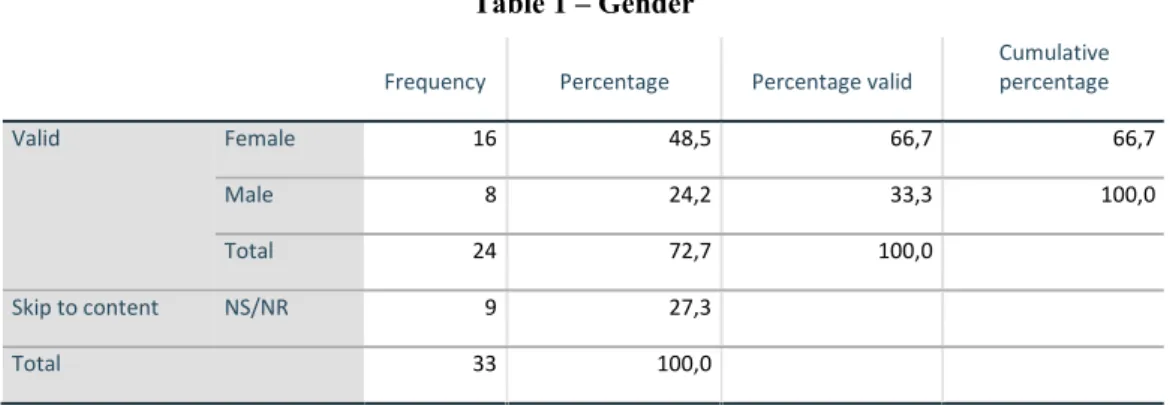
The majority of participants were women (48,5% and 24,2% were male), although some of the inquiries wanted not to identify their gender (27,3%).
Table 1 – Gender
Frequency Percentage Percentage valid Cumulative percentage
Valid Female 16 48,5 66,7 66,7
Male 8 24,2 33,3 100,0
Total 24 72,7 100,0
Skip to content NS/NR 9 27,3
Total 33 100,0
Women presented an average of 84 years old and men presented an average of 79 years old.
Graphic 1 – Age groups
Most of answers show that they live in their own house (66,7%), with basic commodities (only 2 inquiries show that they don’t have sanitation, water or electricity services) and most of those houses don’t need any repair work (84,8%), according to them.
Regarding their civil status, only 22 answer, of which 30,3% are married, 24,2% widower, and single and divorced have the same number (6,1%).
Table 2 – Marital status
Frequency Percentage Percentage valid Cumulative percentage
Valid Single 2 6,1 9,1 9,1 Married 10 30,3 45,5 54,5 Divorced 2 6,1 9,1 63,6 Widower 8 24,2 36,4 100,0 Total 22 66,7 100,0 Skip to content NS/NR 11 33,3 Total 33 100,0
The instruments we used in the present study were, as mentioned, of two types: i) secondary data from scientific articles from public libraries and from the internet, and statistics obtained from governmental sources and internet sites; ii) primary data obtained with the administration of a structured interview.
The structured interview contained, in its final version, twenty-four questions, most of which came from the forms used in the 2011 Censuses, listed over three sections, and was subjected to a pre-test, carried out with a sample of 10 older people, which resulted in the deletion of 8 issues from those originally envisaged in the pilot survey, reducing its complexity and extent.
The first section, entitled "Housing-Water-Energy", was composed of 6 closed questions aimed at ascertaining the habitability conditions of elderly people's homes (water, electricity, energy source, housing status, housing situation). The second section of the survey, entitled "Individual and Family", brought together 6 closed questions designed to characterize the household and the social support network available to the elderly (number of elements and ties of kinship, sex, age, marital status, educational level, place of work and main means of transport of the elements that integrate the household of the elderly, and their social network of alternative support). Finally, in the third section of the survey ("Individual"), there were 12 questions oriented to know the particular situation of the interviewed subjects regarding the economic sector of professional activity, the profession held, their situation before the profession, the origin of the his/her income, the activities he/she carries out in his/her free time, the difficulties/incapacities with which he/she is debating, the health services that he/she uses, the means of transportation he/she makes use of, the time spent with it, technology and its degree of interest in relation to the potential use/acquisition of a technological support device.
The scales used in the questions listed in the survey took into account the nature of the variables, being predominantly nominal scales, and ordinal scales were used in only three of the questions. The issues and their respective scales were built in compliance with the methodology used in the national Censuses of 2011, for which they were previously benchmarked for the Portuguese population.
DATA ANALYSIS
Subjects who participated in this study were indicated by a local social organization, as clients of their external services, and we asked to contact and interview them.
When the interview was administered, after the initial contact and the appointment, a letter of presentation was read to participants, identifying the subject under study, the author's
responsibility, the intended use of the data to be collected, and a reference to the anonymity of the respondents as well as the confidentiality of the information collected.
The data obtained with the interview were collected in a database for later analysis, making use of the program IBM SPSS Statistics v25.0. For the analysis of the data were used measures and forms of representation of the statistical level of descriptive measure, such as tables, graphs, calculation of percentages, fashion, median, as well as some coefficients of correlation, given the non-metric nature of data.
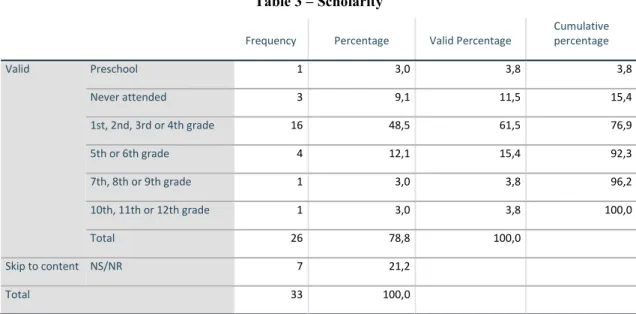
Most of our universe answers show that they have low literary qualifications: only 3% have high school level and most of them have only primary school completed (48,5%). These results are similar to national data, that show that regions of the interior of our country present a low scholarity to older age groups.
Table 3 – Scholarity
Frequency Percentage Valid Percentage Cumulative percentage
Valid Preschool 1 3,0 3,8 3,8 Never attended 3 9,1 11,5 15,4 1st, 2nd, 3rd or 4th grade 16 48,5 61,5 76,9 5th or 6th grade 4 12,1 15,4 92,3 7th, 8th or 9th grade 1 3,0 3,8 96,2 10th, 11th or 12th grade 1 3,0 3,8 100,0 Total 26 78,8 100,0 Skip to content NS/NR 7 21,2 Total 33 100,0
Almost every elderly person answer that they depend of their pension, showing their financial problems to face all their present needs (health, eating and wellbeing social services). Most of them were employed in agriculture, commerce and services economic areas.
Because of their reduced economic conditions, they go most of times they need only to local hospital or local health centre. For this service most of them use family car, emergence ambulance or taxi, which shows the local difficulties regarding public transports.
Most of the individuals present multiple disabilities that interfere with their daily quality of life: 25% have eyesight disability and 22,3% also have earing problems, besides cognitive/understanding disabilities.
Table 4 – Daily problems/disabilities
Cases Percentage N Percentage
Daily problems Vision 28 25,0% 96,6%
Earing 25 22,3% 86,2% Mobility 10 8,9% 34,5% Cognitive issues 18 16,1% 62,1% Personal hygiene 9 8,0% 31,0% Understanding 22 19,6% 75,9% Total 112 100,0% 386,2%
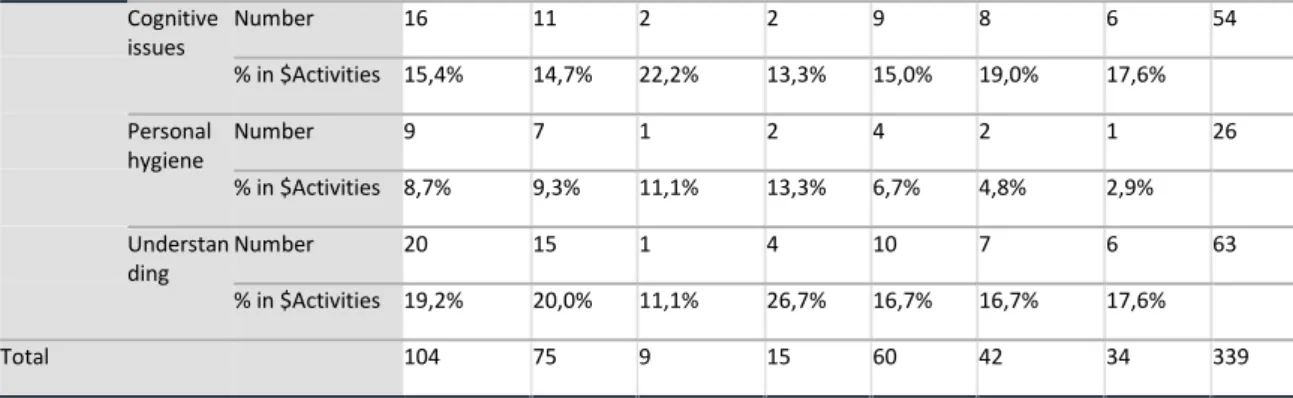
Despite their disabilities, they refer they have leisure activities, mainly of recreational, social and cultural nature. Very few have digital skills or interest to use ICT equipment and/or Internet.
Table 5 – Leisure activities
Total Recreational
activities Social activities Occupational activities Craft activities Cultural activities Physical activities Internet / ICT Daily
problems Vision Number 26 19 2 3 16 11 9 86
% in $Activities 25,0% 25,3% 22,2% 20,0% 26,7% 26,2% 26,5%
Earing Number 23 16 2 3 16 9 9 78
% in $Activities 22,1% 21,3% 22,2% 20,0% 26,7% 21,4% 26,5%
Mobility Number 10 7 1 1 5 5 3 32
Cognitive issues Number 16 11 2 2 9 8 6 54 % in $Activities 15,4% 14,7% 22,2% 13,3% 15,0% 19,0% 17,6% Personal hygiene Number 9 7 1 2 4 2 1 26 % in $Activities 8,7% 9,3% 11,1% 13,3% 6,7% 4,8% 2,9% Understan ding Number 20 15 1 4 10 7 6 63 % in $Activities 19,2% 20,0% 11,1% 26,7% 16,7% 16,7% 17,6% Total 104 75 9 15 60 42 34 339
Regarding the possibility of innovative social services technologically mediated, elderly give more importance to the following: a) emergency alert system; b) teleassistance; c) vital signs monitoring; and one of them also refer d) tracked track service.
Table 6 – ICT support preferences
Cases Percentage N Percentage
ICT support Tracked track service 1 1,4% 3,0% Vital signs monitoring 11 15,1% 33,3% Emergency alert system 33 45,2% 100,0%
Teleassistance 28 38,4% 84,8%
Total 73 100,0% 221,2%
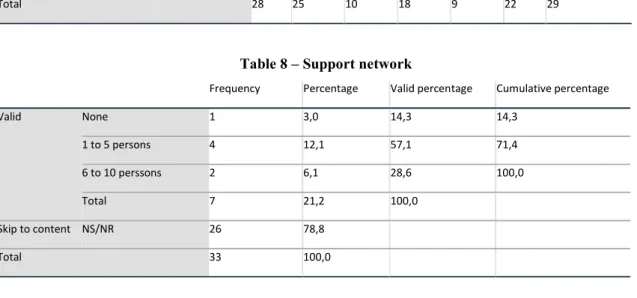
When we compare their ICT support preferences with their daily disabilities, we understand why they prefer emergency alert and teleassistance ICT support. These choices would also answer to their weak social support networks. In fact, most of them are steel living with family members, but they are alone most of time. Regarding this last issue, most of the elderly didn’t want to answer or couldn’t identify who could help them on a daily basis, whenever they need.
Table 7 – ICT preferences versus daily problems/disabilities
Daily problems Total
Vision Earing Mobility Cognitive issues Personal hygiene Understanding ICT support Tracked track service 1 1 1 1 0 1 1
Vital signs monitoring 8 8 3 4 2 4 8
Emergency alert system 28 25 10 18 9 22 29
Total 28 25 10 18 9 22 29
Table 8 – Support network
Frequency Percentage Valid percentage Cumulative percentage
Valid None 1 3,0 14,3 14,3 1 to 5 persons 4 12,1 57,1 71,4 6 to 10 perssons 2 6,1 28,6 100,0 Total 7 21,2 100,0 Skip to content NS/NR 26 78,8 Total 33 100,0
Finally, we would like to refer that all answers show that they are interested in having ICT support, but only if it is free of charge. This can be an interesting issue to be used by social organizations, to find funding to improve their services technologically supported to elderly.
Table 9 – Interest in ICT support, according to age
50-64 65-74 75-84 85 or more I'm not interested in calling into
question my privacy. 0 0 0 0
I see no use in this type of equipment 0 0 0 0 I would like to have access to this
equipment for free 0 1 9 11
I would like to have access to this
equipment even though it is not free 0 0 0 0
DISCUSSION
Our study allowed us to understand how the elderly of this municipality perceive ICT and its potential to become tools of daily support that promote their quality of life and wellbeing. In fact, this territory continues to be characterized by elderly people with low educational qualifications, low pensions and poor access to innovative social services. Their weak perception of the potential of ICTs and of new technologically mediated services results from these sociodemographic characteristics, as well as from the inexistence of a commitment of social organizations and local public organizations to make this kind of support tools available, which in many situations would allow cost reduction and more effective monitoring of the entire population.
This finding also results from the knowledge that the authors have already achieved, through the accompaniment and development of numerous academic and scientific studies about social organizations in the same region. We believe that discrimination of the elderly
can be reduced through technologically-mediated services, as well as contributing to the very sustainability of non-profit organizations in the digital era.
Regardless of the current profile of the elderly, it will change as the generations grow older, where we can observe a higher level of literacy and digital skills. In this regard, the role of higher education institutions also requires the development of applied research projects capable of transferring knowledge to the community, helping to solve real and concrete problems and responding to social needs.
CONCLUSIONS
The present study was part of the development of a social diagnosis that allowed the systematization of the needs of the elderly, in a municipality in the north of Portugal, in order to support the development of technological proposals to support the daily life of these individuals, taking into account the problems associated with ageism. Even in the case studied, where most of the analyzed universe does not have digital and technological skills, we have been able to validate our main purpose, given the unanimous interest of the elderly in the use of technologically-mediated support, which is seen as an efficient tool to combat loneliness, the isolation and replace the reduction of social network of each elderly.
Thus, the development of the permanent monitoring system for the elderly, under development in this project, will allow the presentation of a tool adapted to the reality of the region, since it will allow the monitoring of walking paths, monitoring of vital signs of each individual, the signaling and issuance of alerts, according to the customized parameters for each client. In other words, our proposal will allow: a) to move within internal and external spaces, with analysis of vital signs; b) analysis of routes, with alerts of any deviations; c) integration with information systems via web services, for recording and real-time analysis of movement of individuals monitored; d) integrated services of networks and of telecommunications in particular GPS, GPRS, wireless networks with decision support systems and of recommendation and artificial intelligence systems. This system can be used by individuals or by social organizations to innovate in their services e become more efficient.
Acknowledgements
This article is a result of the project INFO PATHS, Reference code: NORTE-01-0145-FEDER-023623, supported by Norte’s Operational Programme (NORTE 2020), under the PORTUGAL 2020 Partnership Agreement, through the European Regional Development Fund (ERDF) and FCT.
Achenbaum, W. A. (fall de 2015). A history of ageism since 1969. Generations - Journal of the american society on aging, 39(2), pp. 10-16. Obtido em dezember de 2018
Alves, V., & Oliveira, R. (set./dez. de 2015). Tecnologias de comunicação e interação e envelhecimento humano: a busca da inclusão social pela inclusão digital. Revista brasileira de ciências do envelheccimento humano, 12(3), pp. 234-244. doi:10.5335/rbceh.v12i3.6003
Castells, M. (2007). A Era da Informação: economia, sociedade e cultura. A Sociedade em Rede (3ª ed., Vol. 1). Lisboa: Fundação Calouste Gulbenkia.
Fortin, M.-F. (2000). O Processo de Investigação (2ª ed.). Loures: Lusociência - Edições Técnicas e Cientificas, Lda.
Genovese, V., Mannini, A., Guaitolini, M., & Sabatini, A. M. (2018). Wearable inertial sensing for ICT management of fall detection; fall prevention and assessment in eldderly. Em N. Carbonaro, & A. (. Togneti, Wearable Technologies (pp. 73-86). Pisa: MDPI.
Guedes, A. (2014). Os desafios do conhecimento na era tecnológica. Em R. N. V. Oliveira, Conhecimento, Sociabilidade E Humanidade: Prenúncios De Um Novo Tempo.
Guedes, A., Santos, P. M., & Silva, M. (2011). Teaching in the Information Society: teaching and learning practices with the use of technological innovations. EDULEARN11 - International Conference on Education and New Learning Technologies. Obtido em deaembro de 2018
Haro, F. A., Serafim, J., Cobra, J., Faria, L., Roque, M. I., Ramos, M., . . . Costa, R. (2016). Investigação em Ciência Sociais. Lisboa: PACTOR - Edições de Ciênciais Sociais, Forenses e da Educação.
Iwasaki, N. (2013). Usability of ICT applications for elderly people in disaster reduction. Journal of E-Governanc, 36, pp. 73-78. doi:10.3233/GOV-130338
Levy, S., & Macdonald, J. (2016). Progress on understanding ageism. Journal of social issues, 72(1), pp. 5-25. doi:10.1111/josi.12153
Lousado, J. P., Rodrigues, V., Carvalho, R., & Albuquerque, C. (maio de 2013). Medical oncology for treatment of clinical data from children and youth. Atención Primária, 45. Obtido em novembro de 2018
Missão para a Sociedade da Informação. (s.d.). Livro Verde para a Sociedade da Informação em Portugal. Lisboa. Obtido em setembro de 2016, de http://www2.ufp.pt/~lmbg/formacao/lvfinal.pdf
Oliveira, I., Costa, C., & Roberto, M. (2014). Dispositivos móveis e redes sociais: novos rumos para a sedução no ensino e aprendizagem do Turismo na região do Douro. . 2º Encontro sobre Jogos e Mobile Learning. Coimbra, Universidade de Coimbra.
Padilla-Góngora, D., López-Liria, R., Diaz-López, M., Aguilar-Parra, J., Vargas-Munoz, M., & Rpcamora.Pérez, P. (2017). Habits of elderly regarding access to the new ICT. Procedia - Social and Behavioral Sciences, pp. 1412-1417. doi:10.1016/j.sbspro.2016.02.206
Papa, P., Cornacchia, M., Sapio, B., & Nicolò, E. (2017). Engaging technology-resistant elderly people: Empirical evidence from an ICT-enabled social environment. Informatics for health & social care, 42(1), pp. 43-60. doi:10.3109/17538157.2016.1153477
Polat, H., Baysal, H., & Aktas, B. (2017). Determination of ageism attitudes of adults in two different provinces. Turkish journal of geriatrics, 20(4), pp. 280-288.
Portugal. (26 de fevereiro de 2015). Portaria nº 57-A/2015. Regulamento Específico do Domínio da Competitividade e Internacionalização(41), 1ª série. Diário da República.
Qingyun, F. (2016). Utilizing ICT to prevent loneliness and social isolation of the elderly. A literature review. Cuadernos de Trabajo Social, 29(2), pp. 185-200. doi:10.5209/CUTS.251771
Santos, P. M. (maio de 2013). The Need of a New Organizational Vision. Atención Primaria, 45.
Santos, P., Guedes, A., & Silva, M. (november de 2011). The role of teaching institutions to prepare and promote social entrepreneurs. In eJournal of Social Entrepreneurship.
Teixeira, S. (2015). Gestão das Organizações. Amadora: McGraw-Hil.
Trusinová, R. (2014). No two ageisms are the same: testing measurement invariance in ageism experience across Europe. International Journal of Social Research Methodology, 17(6), pp. 659-675. doi:10.1080/13645579.2013.823003