Study of chemical and physical properties of apples dried in a
convective drier
Ana C. Cruz1, Raquel P. F. Guiné1,2*, João C. Gonçalves1,2, Ana C. Correia1
1
Dep. Indústrias Alimentares, Escola Superior Agrária de Viseu, Quinta da Alagoa, Ranhados,
3500-606 Viseu, Portugal
2
CI&DETS, Polytechnic Institute of Viseu, Av. Cor. José Maria Vale de Andrade, Campus Politécnico,
3504 - 510 Viseu, Portugal
*Corresponding author. E-mail: [email protected]
Abstract
The present study evaluates the effects of drying on apple slices from two varieties, Golden Delicious and Granny Smith, which were analyzed in terms of physical and chemical properties. The tests involved the determination of moisture, acidity, soluble solids, colour and texture. Trials were performed in a convective hot air dryer for different temperatures of 30, 40, 50 and 60 ° C.
The results showed that the final moisture of the two varieties of apples was around 3 % (wet basis). With regards to acidity, the variety Granny Smith was found to be more acid than the Golden Delicious. The soluble solids are present, in general, in greater amounts in the variety Granny Smith. As to the colour, this varied very considerably from the fresh apples to the dried ones. Apples of the variety Golden Delicious presented a higher intensity of yellow (b* > 0) and red (a* > 0). However, in comparison to the variety Granny Smith the Golden Delicious presents, in general, smaller total colour differences. The textural attributes evaluated were hardness, adhesiveness, elasticity, cohesiveness and chewiness. However, the results for adhesiveness were very close to zero showing that these products do not have adhesiveness, as it happens with other fruits. It was also found that the fresh apples have a much higher hardness, when compared to the dried samples. Elasticity, on the other hand, was kept approximately constant regardless of the variety or state. Cohesiveness was higher in the fresh apples, and for the dried ones was higher for variety Golden. Finally, chewiness was higher for the fresh apples in comparison to the dried ones, and was higher for Golden Delicious when compared with Granny Smith.
Keywords: apples; drying; acidity; colour; texture.
1. Introduction
Processing may affect the quality of a product, although in different intensities according to the treatment. Indeed, various types of changes in the physical, chemical and/or biological characteristics of foods may occur during processing, as well as storage and/or distribution (Karel et al., 1993). These changes alter the physical properties such as colour and texture, and can also develop undesirable biochemical reactions with deterioration of aroma compounds or degradation of nutritional substances (Achanta & Okos, 1995; Stapelfeldt et al., 1997). All these physical and biochemical changes undoubtedly cause a reduction in product quality besides compromising process efficiency (Chuy & Labuza, 1994). Therefore, the choice of the right method of preservation can be the key for a successful operation, particularly when dealing with valuable products.
Drying, which is the most common but also the most energy-consuming food preservation process, implies the removal of moisture from the product. It is defined as the evaporation of the majority of the water present inside the food into a vapor phase by means of application heat, under controlled conditions (Mujumdar & Devahastin, 2000). At present, drying provides the greatest diversity among food engineering units operations (Ratti & Mujumdar, 1995). Air-drying, in particular, is an ancient process used to preserve foods, in which the solid is exposed to a continuously flowing hot stream of air which remo0ves from the surface the evaporated water. The phenomena underlying this process are complex and involve simultaneous mass and energy transfer from and to a shrinking system. Air-drying offers dehydrated products that can have an extended life of over a year but, unfortunately, the quality of the dried product is usually drastically reduced when compared to that of the original food.
In recent years, microstructure of foods has been extensively studied, considering that many key phenomena that control the properties of foods occur below the scale of 100 µm. Therefore, food structure at the micro, meso or macro scales plays an important role in mass transfer processes such as drying (Aguilera, 2005).
The drying process is affected by the external drying conditions, the physical structure of the product and the spatial distribution of water inside the food, as well as its variation over time, according to the main mechanism of moisture transfer, which can be molecular diffusion, capillary flow or hydrodynamic flow. In general, drying is divided into an initial period in which the main mass transfer mechanism is the capillary flow of liquid water, and therefore the drying rate is constant because the rate of water evaporation from the surface equals the rate of moisture migration from the inside to the surface of the food. In the following periods, diffusion is the main mass transfer mechanism, and the drying rate decreases thus giving place to a continuously drier surface. The quality of dehydrated foods is influenced both by the drying conditions used as well as the physicochemical changes that occur inside the products (Aguilera, 2003).
Dried fruits are widely used as components in many food formulations such as pastry, confectionery products, ice cream, frozen desserts and yogurt. Among them, dried apples are a significant raw material for many food products.
This work aims at comparing two varieties of apples, Golden Delicious and Granny Smith, analyzing the influence of drying and different drying conditions, particularly temperature, on their physical and chemical characteristics.
2. Materials and methods
The apples were purchased at a local market, washed and peeled, and finally cut into semi-circles of approximately 0.5 cm thickness before drying. A convective hot air drying was carried out at 30 °C, 40 °C, 50 °C and 60 °C, for e ach variety of apple tested, namely Granny Smith and Golden Delicious. While for the drying of the Golden Delicious apples the drying times were 10, 10, 16 and 37 hours, respectively for the temperatures of 30, 40 50 and 60 ºC, for the other apples, Granny Smith, the drying times were 10, 14, 19 and 38 hours, respectively for the same temperatures.
Moisture content was determined with a Halogen Moisture Analyzer (Mettler Toledo HG 53), while the quantification of acidity was by titration following the Portuguese Standard NP-1421, and the quantification of Total Soluble Solids (TSS) was done in ºBrix by refractometry (Refractometer ATAGO - 3T). Sample preparation followed the Portuguese Standard NP-783. The colour was evaluated with a colorimeter (Minolta CR-400), in CIELab coordinates, and the parameters that were measured were luminosity, L*, which varies between 0 and 100 (from black to white, respectively), together with the coordinates of colour contrast: a* and b*. The coordinate a* assumes negative values for green and positive for red, while b* assumes negative values for blue and positive for yellow.
From the coordinates L*a*b* the total colour difference was calculated (∆E), which allows an overall assessment of the change in colour suffered when a sample is subject to processing, drying in this case. The total colour difference was calculated by the following equation:
(1)
where L0*, a0* and b0* are the reference values , which in this case were those for the sample in the fresh state.
The textural properties were determined by Texture Profile Analysis, after the TPAs obtained with a texturometer (TA XT Plus Stable Micro Systems). The profiles were obtained by compression of the sample in two consecutive cycles between parallel plates using a probe of 75 mm diameter with a 5 second interval between cycles. The load cell was 5 kg and the test speed was 0.5 mm/s. The texture properties were then calculated according to Caine (2003).
3. Results and discussion
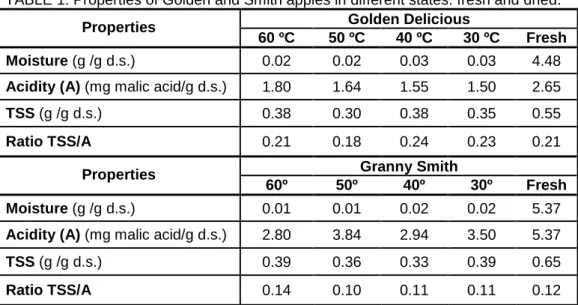
Table 1 shows the results of the chemical analysis made to the apples in the fresh state as well as the different dried samples. It appears that drying slightly affected acidity and sugar contents in both types of apples tested. The Granny Smith apples have a much higher acidity, almost double, when compared to the golden delicious, while the soluble solids content is only slightly higher. Therefore, the ratio of soluble solids over acidity is much higher for the Granny Smith apples. As to the moisture contents, it was possible to achieve a value very close to zero, thus indicating the obtaining of a crispy snack as intended at first.
TABLE 1: Properties of Golden and Smith apples in different states: fresh and dried. Golden Delicious
Properties
60 ºC 50 ºC 40 ºC 30 ºC Fresh
Moisture (g /g d.s.) 0.02 0.02 0.03 0.03 4.48
Acidity (A) (mg malic acid/g d.s.) 1.80 1.64 1.55 1.50 2.65
TSS (g /g d.s.) 0.38 0.30 0.38 0.35 0.55 Ratio TSS/A 0.21 0.18 0.24 0.23 0.21 Granny Smith Properties 60º 50º 40º 30º Fresh Moisture (g /g d.s.) 0.01 0.01 0.02 0.02 5.37
Acidity (A) (mg malic acid/g d.s.) 2.80 3.84 2.94 3.50 5.37
TSS (g /g d.s.) 0.39 0.36 0.33 0.39 0.65
Ratio TSS/A 0.14 0.10 0.11 0.11 0.12
Table 2 shows the average values obtained for the colour coordinates, together with the corresponding standard deviation. As previously mentioned, the determination of colour was made through the system CIELab (L*a*b*), where L* represents the brightness (0: black, 100: white), a* represents the balance between green and red (negative: green, positive: red) and b* represents the balance between the blue and yellow (negative: blue, positive: yellow). Through the analysis of Table 2, it can be seen that apples from Granny Smith variety in the fresh state have a higher value of brightness (are clearer) than the Golden Delicious variety. In terms of the opposing colour coordinates, both varieties have approximately the same intensity of green (negative values of a*), but they differ slightly in terms of intensity of yellow, being the Golden variety the one that has the higher value of b*.With drying, both varieties of pears became darker, regardless of the temperature used. L* decreased from 78.2 in fresh to 68.5 dried at the highest temperature (60 ºC) for variety Golden Delicious, and for variety Granny Smith the decrease was from 79.1 to 69.8, for the same states. As it can be seen, the decrease was similar in both cases. In terms of the coordinate a*, in the two varieties it
b*)
-*
(b
a*)
-*
(a
L*)
-*
(L
E
=
0 2+
0 2+
0 2∆
changes from negative to positive, thus indicating the disappearance of green and appearance of red. The Smith variety presents the redness tone more uniform for all drying temperatures, while the Golden variety dried at 60 ºC shows a greater intensity of red colour. With respect to the parameter b*, both varieties increased their yellow colour in relation to the fresh state. Comparing the two varieties, the Golden apples present a more intense yellow than the Smith apples.
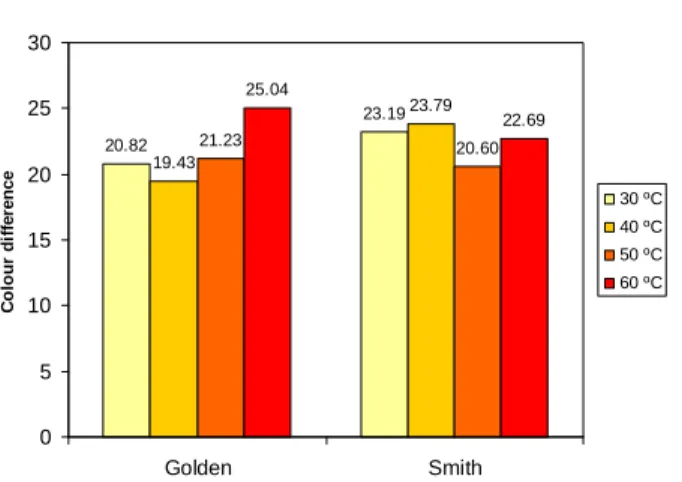
Fig. 1 shows the total colour differences obtained for all died apples, having as reference the corresponding colour coordinates for the fresh state. By observing the graph in the Figure, it becomes evident that the final colour difference is high in all cases, resulting from the darkening and intensification of redness and yellowness, as a consequence of the browning that occur in the apples as a result of drying.
TABLE 2: CIELab colour coordinates (L*a*b*) for fresh and dried apples.
Golden Delicious Granny Smith
L* a* b* L* a* b* Fresh product 78.2(±3.4) -4.5(±0.6) 23.0(±3.2) 79.1(±2.1) -4.4(±1.1) 18.0(±1.2) 30 ºC 73.8(±4.2) 5.8(±2.7) 40.5(±2.8) 71.1(±3.9) 5.3(±2.8) 37.5(±2.9) 40 ºC 74.0(±5.3) 3.5(±1.7) 40.1(±4.4) 68.7(±3.6) 4.5(±2.0) 37.4(±2.1) 50 ºC 71.6(±6.5) 4.8(±3.6) 40.9(±4.2) 71.2(±2.7) 4.8(±1.2) 34.6(±2.2) Dried apples 60 ºC 68.5(±3.9) 8.3(±2.0) 42.1(±2.9) 69.8(±4.0) 4.6(±1.7) 36.6(±2.8) 20.82 23.19 19.43 23.79 21.23 20.60 25.04 22.69 0 5 10 15 20 25 30 Golden Smith C o lo u r d if fe re n c e 30 ºC 40 ºC 50 ºC 60 ºC
FIGURE 1: Colour differences after drying for the two varieties of apples.
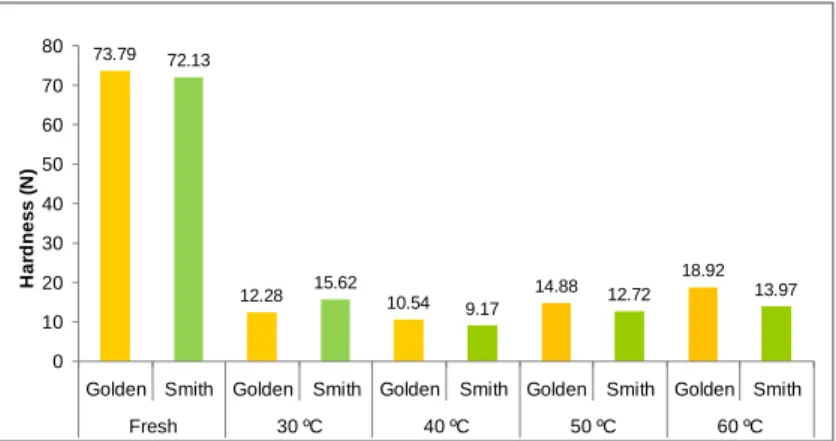
Figs. 2 to 5 show the textural properties for both types of apples in the different states evaluated from the TPAs performed. The graph in Fig. 2 shows the medium values found for hardness, which is the force required to compress a food between the teeth or between the tongue and the mouth, this is, the force required to cause a deformation. The fresh apples have a much higher hardness than all dried apples. Concerning drying temperature, no definite trend was observed as drying temperature increased. In fact, while hardness oscillated for variety Smith, it seems to have increased for variety Golden.
Fig. 3 evaluates the elasticity of all apple samples, fresh and dried, being this textural attribute related to the ability of regaining shape after compression. This parameter measures the speed of return to its initial state after removing the force that caused the deformation. From the results obtained, it is possible to conclude that elasticity is similar for the two varieties of apples analyzed and in the different conditions, fresh and dried at different temperatures.
With regards to cohesiveness, Fig. 4, which represents the internal forces in the food, thus keeping the sample cohesive, it appears that the results are similar for all drying temperatures. Therefore, drying temperature dos not seem to have influenced cohesiveness.
However, when the fresh apples are compared with the dried ones, it is visible that cohesiveness diminished with drying since the fresh apples are those with greater values. This decrease with drying is connected with loss of integrity originated by the intense degree of water loss and changes at the structural level in the fruits, also as a result of shrinking. Comparing the two varieties, the Golden Delicious apple tissues present themselves more cohesive, revealing a greater inner strength.
73.79 72.13 12.28 15.62 10.54 9.17 14.88 12.72 18.92 13.97 0 10 20 30 40 50 60 70 80
Golden Smith Golden Smith Golden Smith Golden Smith Golden Smith Fresh 30 ºC 40 ºC 50 ºC 60 ºC H a rd n e s s ( N )
FIGURE 2: Hardness of Golden and Smith apples in different states: fresh and dried.
76.99 78.24 83.71 76.37 77.70 77.66 82.78 81.30 82.08 77.20 55 60 65 70 75 80 85 90 95 100
Golden Smith Golden Smith Golden Smith Golden Smith Golden Smith Fresh 30 ºC 40 ºC 50 ºC 60 ºC E la s ti c it y ( % )
FIGURE 3: Elasticity of Golden and Smith apples in different states: fresh and dried.
0.81 0.88 0.72 0.68 0.69 0.67 0.73 0.69 0.73 0.63 0.0 0.1 0.2 0.3 0.4 0.5 0.6 0.7 0.8 0.9 1.0
Golden Smith Golden Smith Golden Smith Golden Smith Golden Smith Fresh 30 ºC 40 ºC 50 ºC 60 ºC C o h e s iv e n e s s
FIGURE 4: Cohesiveness of Golden and Smith apples in different states: fresh and dried. Chewiness, shown in Fig. 5, measures the energy required to disintegrate a sample to the point of being proper for swallowing. He graph shows that the fresh apples have a much higher chewiness when compared to the dried ones, this is, one must provide more energy to disintegrate them. This property is a combination of other textural attributes, and therefore it would be expected that it would show a quite similar trend to hardness, given the particular
influence of this last property on chewiness. With respect to the effect of drying temperature, once again no visible trends were observed, in special for variety Smith, since for variety Golden a slight increase could be pointed out with increasing temperature.
46.26 49.90 7.30 8.03 5.66 4.83 8.94 7.06 10.93 6.75 0 10 20 30 40 50 60
Golden Smith Golden Smith Golden Smith Golden Smith Golden Smith Fresh 30 ºC 40 ºC 50 ºC 60 ºC C h e w in e s s ( N )
FIGURE 5: Chewiness of Golden and Smith apples in different states: fresh and dried.
The results that were obtained for adhesiveness were not presented here, because they revealed themselves to be negligible, with all data were very close to zero, thus allowing to conclude that these apples do not possess measurable adhesiveness, like it happens for some other foods.
4. Conclusions
The results showed that acidity is influenced by drying conditions, particularly temperature, with a decrease in acidity as the drying temperature increases. This behavior is expected, as a part of the acidity of the apples is volatile acidity. Regarding soluble solids, they decrease also as temperature increases, due to degradation reactions.
The color gets darker with dying, resulting in a decrease of L* and intensification of red and yellow colorations, respectively a* and b*, as a result of browning, when compared with the fresh apples.
From the results obtained from the TPAs, it was possible to observe that both drying processes affected texture, especially regarding hardness, cohesiveness and chewiness, which decreased.
5. References
Achanta, S., & Okos, M. R. (1995). Impact of drying on biological product quality. In G. V. Barbosa-Canovas, & Welti-Chanes (Eds.) Food preservation by moisture control: fundamentals and applications. Switzerland: Technomic Publishing.
Aguilera, J. M. (2003). Drying and dried products under the microscope. Food Science and Technology International, 9, 137-143.
Aguilera, J. M. (2005). Why food microstructure? Journal of Food Engineering, 67, 3-11.
Caine, W.R., Aalhus, J.L., Best, D.R., Dugan, M.E.R., & Jeremiah, L.E. (2003). Relationship of texture profile analysis and Warner-Bratzler shear force with sensory characteristics of beef rib steaks. Meat Science, 64, 333-339.
Chuy, L.E., & Labuza, T.P. (1994). Caking and stickiness of dairy-based food powders as related to glass transition. Journal of Food Science, 59, 43-46.
Karel, M. (1991). Physical structure and quality of dehydrated foods. In A. S. Mujumdar & I. Filkova (Eds.), Drying '91. Amsterdam: Elsevier.
Mujumdar, A.S. & Devahastin, S. (2000). Fundamental principles of drying, S. Devahastin (Ed.), Mujumdar’s Practical Guide to Industrial Drying. Montreal: Exergex.
Stapelfeldt, H., Nielsen, B. R., & Skibsted, L. H. (1997). Effect of heat treatment, water activity and storage temperature on the oxidative stability of whole milk powder. International Dairy Journal, 7, 331-339.