Masters of Science in Business Administration
The Role of Social
Networks on Financial
Products Subscription
The case of Millennium bcp
Mariana Tavares
Student Number: 152110305
Advisor: Professor Pedro Celeste
Dissertation submitted in partial fulfillment of requirements for the degree of MSc in Business Administration, at Universidade Católica Portuguesa in January 2013
i
Acknowledgements
I would like to thank everyone who helped me writing my dissertation.
First of all, I want to thank Adelaide Jerónimo and Henrique Silva from Millennium bcp for their willingness, kindness and help during these three months. I would also like to thank Marlene Gonçalves, Andreia Esteves, Ricardo Santos for their time during the interviews.
Secondly, I want to thank to Professor Pedro Celeste for his patience, help and guidance during the dissertation period.
ii
List of abbreviations
IBS – Internet Banking Service MGo – Millennium Go
MGo Top – Millennium Go Top WOM – Word of mouth
iii
List of tables
Table 5.1 - Paired Sample T-test for attitudes towards Financial Institutions Facebook Pages …... 28
Table 5.2 - Paired Sample T-test for perceptions towards Financial Institutions Facebook Pages... 29
Table 6.1 – Evaluation of Millennium Facebook Page Performance ………...… 36
iv
Abstract
Dissertation Title: The Role of Social Networks on Financial Products Subscription: The case
of Millennium bcp
Author: Mariana Tavares
During a financial crisis, like the one we are facing today, financial institutions more than ever need to guarantee that they are able to keep their customer base, namely the most profitable customers, and acquire new customers, especially younger people with high potential like undergraduate and master’s students. Customer satisfaction and loyalty play an important role in this matter and that is one of the main concerns of banks in tough times.
To acquire and retain new costumers among the youngsters, Millennium bcp created and launched a bundle of products specially designed for this segment. To reach and engage with this target, Millennium bcp invested in a Facebook page specially designed to communicate the new offer.
The aim of this dissertation is to study the effect of social networks in the subscription of financial products. This paper studies the example of Millennium Go Facebook page, from the Bank Millennium bcp, which is a financial product page where informative and entertainment contents are inserted on a regular basis in order to keep its attractiveness and the relationship with the target public. Despite being quite hard to measure the impact of engagement with this channel, it was possible to reach some conclusions through market research.
This example will help students and their instructor understand all the process of creating the Millennium Go bundle: from the first concept design to its development and marketing communication campaigns.
Market research was done with a main objective: to perceive who has pressed “like” on the Facebook page; when they have decided to do that, if before or after a purchase; and the reason why they have become fans of a financial institution Facebook page. The different perceptions of this channel between people who have and have not a “like” on the Facebook page were also studied.
At the end of the study, it was possible to perceive that this new channel is usually used to seek information about a product or to have access to special content about the brand. It was also possible to conclude that there is a significant difference in terms of attitudes and perceptions among users and non-users of Facebook.
v
Resumo
Título da Tese: O papel das redes sociais na subscrição de produtos financeiros: O caso do
Millennium bcp
Autora: Mariana Tavares
Durante uma crise financeira, como a que vivemos atualmente, as instituições financeiras têm uma necessidade, ainda maior, de defender a sua base de clientes, em especial os clientes mais rentáveis, e de captar novos clientes com particular enfoque nos jovens de elevado potencial como é o caso dos estudantes finalistas do secundário ou universitários. A satisfação e a fidelização dos clientes assumem um papel relevante neste contexto e essa é pois uma das principais preocupações dos bancos em tempos adversos.
Para captar e reter novos clientes entre os jovens, o Millennium bcp criou e lançou um pacote de produtos desenhado especificamente para o segmento. Com o intuito de gerar uma ligação mais envolvente com os jovens o Millennium bcp investiu numa página no Facebook concebida especialmente para comunicar a nova oferta.
Esta dissertação tem por objetivo estudar a influência das redes sociais na subscrição de produtos financeiros. O estudo incide sobre a página do Facebook do Millennium Go, do Banco Millennium bcp, uma página de um produto financeiro alimentada regularmente com conteúdos lúdicos e informativos com o intuito de manter a atratividade e a relação. Apesar de ser extremamente difícil medir o impacto do envolvimento do canal na relação do cliente com o produto e a marca foi possível retirar algumas conclusões com base no estudo de mercado efetuado.
Tendo por base o exemplo utilizado, estudante e orientador poderão conhecer o processo de criação do pacote Millennium Go desde a fase de desenho do conceito, passando pela fase de desenvolvimento e acabando nas campanhas de comunicação.
No âmbito do trabalho foi desenvolvido um estudo de mercado com um objetivo claro: perceber quem fez um “like” na página do Facebook, quando decidiram fazê-lo, antes ou depois da compra, e a razão porque se tornaram fãs de uma página no Facebook de uma Instituição Financeira.
No final do estudo foi possível concluir que este novo canal é fundamentalmente utilizado para recolha de informação sobre um produto ou para ter acesso a conteúdos específicos da marca. Foi ainda possível concluir que existe uma diferença significativa em termos de atitudes e perceções entre utilizadores e não utilizadores do Facebook.
vi
Table of Contents
Acknowledgements ... i
List of abbreviations ... ii
List of tables ... iii
Abstract ... iv
Resumo ...v
1. Introduction ...1
2. Methodology ...3
3. Literature Review ...4
3.1. Banking Industry Characterization ...4
Young Segments: Benefits for Financial Institutions ...4
Internet Banking Service acceptance ...5
3.2. Financial Products Bundling ...6
Definition ...6
Benefits ...7
How to create a successful bundle ...7
How to choose the strategy ...8
3.3. Decision Making Process ...8
Pre-Information seeking ...8
Information Search on Social Networks ...9
Financial Products ... 10
4. Case Study ... 12
Millennium bcp ... 12
Financial Packages evolution in Portugal ... 13
Millennium Go Package (MGo) – The reason why ... 14
vii
Millennium Go - The product... 16
Main differences from competitors’ offer... 16
Millennium Go Top (MGo Top) ... 17
First Marketing Campaign... 18
Facebook Strategy ... 18 Results ... 19 The challenge ... 20 5. Market Research ... 21 5.1 . Methodology ... 21 5.2. Sample analysis ... 23 5.3. Results’ analysis ... 24
RQ (1): Is there opportunity for Millennium Go in Facebook? Why are Financial Institutions investing more and more in this channel?... 24
RQ (2): What is the role of social networks on banking choice and on the financial products purchasing process? ... 25
RQ (3): What are the consumer’s attitudes and perceptions towards Facebook pages of Financial Institutions? ... 26
6. Conclusions ... 29
7. Limitations and Future Research ... 31
8. Teaching Notes ... 32
8.1. Synopsis ... 32
8.2. Use of the case ... 32
8.3. Teaching plan ... 33
8.3.1. Assignment questions ... 33
8.3.2. Group task ... 37
9. References ... 39
9.1. Journal Articles and other publications ... 39
viii
9.3. Other sources ... 42
10. Exhibits ... 43
Exhibit 1 – Interview to Millennium bcp Manager – Henrique Silva ... 43
Exhibit 2 – Interview to Millennium bcp Marketing Managers - Adelaide Jerónimo and Henrique Silva ... 43
Exhibit 3 - Millennium bcp evolution ... 44
Exhibit 4 – Millennium bcp internationalization 2012 ... 44
Exhibit 5 – Millennium Go Package ... 45
Exhibit 6 – Bes up brochure ... 45
Exhibit 7 – Bes 18-31 brochure ... 46
Exhibit 8 – Santander Universitários brochure ... 46
Exhibit 9 – Montepio Jovem brochure ... 46
Exhibit 10 - Activobank ... 47
Exhibit 11 - Banners ... 48
Exhibit 12 – Millennium Go song lyrics ... 49
Exhibit 13 – Offline Campaign ... 50
Exhibit 14 – Radio spot ... 50
Exhibit 15 - Facebook ... 51
Exhibit 16 – My first wage contest ... 51
Exhibit 17 - Go! Gives you music contest ... 52
Exhibit 18 – Casting MGo contest ... 53
Exhibit 19 – Member get Member ... 53
Exhibit 20 - GO! Movies ... 54
Exhibit 21 - GO! Festivals... 54
Exhibit 22 - GO! OUT ... 55
Exhibit 23 – Table of Comparison ... 56
ix
Exhibit 25 – Interview with Branch Employees ... 61
Exhibit 26 – Sample Analysis: Gender (Q5) ... 62
Exhibit 27 – Sample Analysis: Age (Q4) ... 62
Exhibit 28 – Sample Analysis: Marital Status (Q6) ... 62
Exhibit 29 – Sample Analysis: Education (Q7) ... 62
Exhibit 30 – Sample Analysis: Bank where the respondent has account (Q1)... 63
Exhibit 31 – Sample Analysis: Do you have a “like” on a Facebook Page? (Q2) ... 63
Exhibit 32– Sample Analysis: In which Banks do you have a “like”? (Q2.1) ... 63
Exhibit 33 – Sample Analysis: Which bank do you visit with more frequency? (Q2.2) ... 63
Exhibit 34 – Sample Analysis: What do people mean by frequency? (Q2.3) ... 64
Exhibit 35 – Sample Analysis: When did the respondent press “like”? (Q2.4) ... 64
Exhibit 36– Sample Analysis: Reasons for pressing “like” (Q2.5) ... 64
Exhibit 37 – Sample Analysis: Channel through which consumers heard about the products (Q2.6) ... 64
Exhibit 38 – Sample Analysis: Decisive channel (Q2.7) ... 65
1
1. Introduction
In a period of financial crisis, like the one we are facing nowadays, banks need to retain their key costumers and acquire new ones in order to overcome these hard times. They need to innovate by creating new products and using new channels to enhance their relationship with their customers.
The idea is to reach younger costumers, especially students, and use new channels to better engage with them. The usage of Facebook may be a way for banks to increase their visibility and brand awareness. Such is possible because Facebook is a more informal channel where banks can post entertainment content and where they have the opportunity to create or reinforce relationships.
The author, through this dissertation, wants to understand the relevance and the effects of Facebook in the interaction between banks and costumers; namely, the opening of new bank accounts and product subscriptions. This will provide ground for future studies since there are few articles about the relationship between social networks and the financial sector. This paper will explore the topic based on the example of a bundle: Millennium Go, a product developed by Millennium bcp, a Portuguese bank.
Both students and instructor will experience all the stages of Millennium Go, from the product development until the marketing communication campaign. With this, they will be able to understand how Facebook can be used in a communication plan.
In order to test these topics several research questions where tested:
RQ (1): Is there an opportunity for Millennium Go on Facebook? Why are Financial Institutions investing more and more on this channel?
RQ (2): What is the role of social networks in banking choice and in the purchasing process of a financial product?
RQ (3): What are the consumers’ attitudes and perceptions towards Facebook pages of Financial Institutions?
This paper explains the methodology used, revises the literature about market characterization, bundles and the decision making process, especially in the financial sector, and examines the market research conducted. The paper also includes a analyses the results of the
2 study and gives guidelines to the instructor. At the end, conclusions are made, and the study’s limitations and future research are set forward.
3
2. Methodology
Several methodologies were used throughout the study, namely, primary and secondary data. The literature review was based on secondary data. The information was selected based on key words, which will be mentioned in the respective chapter. In order to choose from all the available sources and information specific criteria were taken into account. Academic articles published in recent prestigious journals were the main source of information, as these add value to the topic in study. When needed, older articles were consulted in order to support some key points and definitions that are discussed in the case study. When the information was not found in top journals, other journals were used. The fact that the topics of online communities, social networks and their role in the financial sector are quite recent means that there are few articles to support this part.
Several in-depth interviews were conducted with Millennium bcp’s managers in order to gather enough information to write the case study. Namely, Henrique Silva, Team Manager, Marketing department (Exhibit 1); and Adelaide Jerónimo, Senior Tecnician, Marketing department (Exhibit 2). When needed, Júlio Garcia, Unit Manager, and Pedro Rebelo, Technician, from the Communication department were consulted. The reason behind the author’s choice to conduct these interviews is the fact that this is the best way to capture the essence of the story and the course of the events, something that would be quite hard to capture through quantitative methods or impersonal interviews.
The author also used other secondary sources. Namely, several Millennium bcp’s internal documents and studies, Facebook pages, the Millennium bcp webpage and competitors’ webpages, which were used to collect the information needed to complete the case study.
Finally, in order to respond to the key research question, the author conducted an online survey and some in-depth interviews with Millennium bcp branch employees that will be mentioned in the respective chapter.
4
3. Literature Review
The revision of literature includes three main topics. In a first stage, a market characterization is done with a special focus on young segments and their online characterization; in a second stage, bundle strategies are discussed; and in a third stage, the decision making process is characterized with special focus on information acquisition through social networks.
Key words: Financial institutions, Bundle, Online Communities, Social Networks, Decision Making Process, Information seeking, Online Purchases, Online and Mobile Banking and Youth.
3.1. Banking Industry Characterization
Young Segments: Benefits for Financial Institutions
Financial institutions have developed along the years several products and services for different segments, especially based on age group differences (Lewis and Bingham, 1991, cited in Chau and Ngai, 2010). For characterization purposes the age segmentation used by Chau and Ngai (2010) will be considered in the literature review development.
Lewis and Bingham (1991), as cited in Chau and Ngai (2010), suggest that financial institutions should invest in the young customer segment (16 to 29 years old), not because they will bring benefits in a short term period since they have low income, but because in some years their disposable income is expected to increase, so their purchasing power will be higher. The idea is to acquire them at an early stage and create the mechanisms of marketing strategies based on service quality and satisfaction. Beyond all of that, the young segment is expected to subscribe a variety of financial services, such as loans and mortgages that will be beneficial to the bank in a near future.
Note that the age range used by the author includes different periods of the life of young adults. It is important to refer that students are more profitable than people who did not pursue studies since they are expected to purchase more financial products (Tank and Tyler, 2005). This means that banks should invest in students, just before they finalize their studies in order to retain them when they start working. From that moment on they are expected to subscribe several profitable banking products.
5
Internet Banking Service acceptance
Mols (1999) suggests another way of segmenting financial institutions’ customers. This segmentation is based on which channels customers use to interact with the bank: the branch segment, the telephone segment, the PC segment, the ATM segment and the Internet segment.
More recently, with globalization and service innovation, banks were enforced to offer another choice to consumers. This new channel, the mobile banking, offers customers more flexibility. Mobile banking is considered as a channel where a consumer interacts with the bank through a mobile phone or PDA. (Laukkanen, Pasanen, 2007)
The authors, Laukkanen and Pasanen (2007), define electronic users as having a young age, a high level of education, an occupation and high earnings. They also suggest that online and mobile banking users are quite similar, the main difference noticed is centered on age and gender differences.
Based on Chau and Ngai (2010), the online banking industry is expected to attract the young customers segment since they are the ones that have a higher positive attitude towards the Internet Banking Service (IBS). Thus, this segment is expected to adopt this service and remain on using it in the future. The 30-39 segment has a less positive attitude and intention of using IBS, but this is higher when compared to the 40-49 and over 50 segments’ intention. This happens mainly because older people need a higher investment on cognitive and emotional aspects in order to learn new behaviors and distance themselves from their daily routines. Note that there is a difference when analyzing mobile banking users. Laukkanen and Pasanen (2007) argue that the most typical users are men aged between 30-39 years old. The authors explain this fact by saying that this segment usually has more bills to pay, stocks to exchange and mortgages that lead them to control their account on a regular basis.
Chau and Ngai (2010) study suggests that marketers should focus on several aspects in order to increase IBS acceptance. It is essential for financial institutions to create a strategy that enhances self-efficacy. This means that they should increase customers’ confidence in the ability to use IBS. Companies should also decrease the perception of perceived risk and increase perceived usefulness by creating, for example, online demonstrations explaining how some options work. With this they are also increasing the perception of ease of use.
By investing resources to increase IBS acceptance, financial institutions increase young customers’ perception of IBS as convenient, accessible and time saving (Waite and Harrison,
6 2004), as with this service they are able to handle banking needs from home rather than visiting a branch, less physical and mental effort. Tank and Tyler (2005), argue that besides this information young adults also value free banking (Lewis and Bingham, 1991, cited in Tank and Tyler, 2005), reputation and bank image.
3.2. Financial Products Bundling
Definition
Nowadays, having an innovative solution is crucial to overcome the pressure companies are facing to maintain or grow margins and market share. In the baking industry price bundling is becoming, more and more, an important piece to achieve those goals. (Koderisch, et al., 2006).
The first price bundling strategies appeared in the market several decades ago, but only in 1987 the first article about optimality of bundling was written by Guiltinan. The author defined bundling as "the practice of marketing two or more products and/or services in a single 'package' for a special price". Stremersch and Tellis (2002) argue that to this definition it should be added the word “separate”: “Bundling is the sale of two or more separate products in one package”. They claim that by using that word it becomes clearer that at least some buyers may want to buy each product separately. They even give the example of the banking sector by saying that there are people that buy banking and insurance products bundles, or just banking or just insurance services.
Since the financial sector is quite homogenous, banks need to create products to differentiate themselves from the main competitors. The solution for that is to bundle core banking products, such as accounts with additional products like credit cards, and additional services, namely insurance, travel and leisure offers (Koderisch, et al., 2006). Such offer to a homogeneous sector allows companies to differentiate themselves from competitors by giving supplementary services (Koderisch, et al., 2006).
There are three main bundling price strategies: i) Single price strategy, where products are sold separately, and there is no bundle option available (Stremersch and Tellis, 2002); ii) Pure price bundling strategy, where the opportunity to buy products in separate is not available, only a bundle of items is offered to the market for sale (Adams and Yellen, 1976), iii) Mixed price bundling strategy, where buyers can purchase a bundle of products, or the individual items, as they prefer (Adams and Yellen, 1976).
7
Benefits
Accordingly to Koderisch and Wuebker (2006), bundling strategies bring to companies several benefits. By having a bundling strategy companies are able to increase their profits in a business sector where price pressure has increased considerably, especially due to an increase on online baking competition. This new type of banking offers customers key products such as current and saving accounts, products where banks get high margins. By bundling these products, financial institutions are able to improve their economic situation.
These types of strategies enable companies to reduce their production and complexity costs, as well as enhance their distribution and communication tools, especially in the administrative sector. This happens mainly because they can achieve synergies through these ‘packages’.
This kind of products also help banks in their relationship with their customers: their likelihood of switching banks decreases as the number of products bought from the bank increases, and this leads to economic and emotional ties. With this, banks are also avoiding price comparison by becoming a problem solver and a system provider.
How to create a successful bundle
Accordingly to Koderish and Wuebker (2006), there are four main steps to create a successful bundle:
i) Combination of products and services: this passes through defining the target segment in a clear way, combining attractive products with less attractive elements in order to create a unique package that gives high profits, and correct package design. This will lead to increase customer loyalty and decrease exchangeability of services;
ii) Multi-stage evaluation process of suitable products and services by means of customer research: In order to create a good combination of products and services, companies must do some brainstorming, followed by a market research study, usually a focus group, as they must try to capture the product reactions and extract the willingness to pay from the results through direct questioning, conjoint analysis or expert judgment;
iii) Pricing of the packages – structure and level: having an optimal price is essential to have success. To sell, companies must create incentives: they should establish a price lower than the sum of the prices for the individual products, usually a reduction between 5 and 20%. As an alternative to that, they could offer more additional services in the package;
8 iv) Create the internal preconditions: bundles are a combination of products from different profit centers or divisions in a company. Because of that, there may be some conflicts concerning revenue share. It is also crucial to create an incentive system for sales employees and give them training, since these kinds of packages are not only focused on one kind of company product.
To conclude, it is possible to perceive that bundling, from the financial sector perspective, brings higher profit and customer loyalty; while from the customer perspective, it passes the idea of simplicity, since they only have one provider, and it reduces the final price paid for all the products, giving to consumer a higher perceived value than it actually has. So “bundling offers the opportunity to transform superior know-how into higher profits” (Koderish and Wuebker, 2006).
How to choose the strategy
In order to decide which the best strategy to follow, banks is should support their strategy decision “on the distribution of the willingness-to-pay (WTP), the cost and complexity associated by offering bundles and/or individual products at the same time”. If the buyer WTP diverges between two products, this means that they have high WTP for one and low for the other, and therefore companies should separate prices. If the WTP is relatively high for both products, companies should create pure price strategy. While if the company has this combination of buyers it should have a mixed bundle in order to capture both (Koderisch , et al., 2006).
It is also important to refer that a pure price bundling strategy is less complex to manage, since the number of segments is lower (Koderisch and Wuebker, 2006), while mixed price bundling strategy “is more profitable than other selling alternatives”, since it captures both buyers and the individuals (Adams and Yellen, 1976).
3.3. Decision Making Process
Pre-Information seeking
Engel et al. (1995), as cited in Berge and Messerschmidt (2009), differentiate the decision making process into five different stages: need recognition, search for information and information processing, pre-purchase alternative evaluation, purchase decision and post-purchase evaluation.
9 Accordingly to Kim, Albuquerque and Bronnenberg (2011) it is crucial for companies to understand how consumers’ information search is done. Firstly, it is essential to know that consumers’ consideration sets are limited (Urban, Hulland, and Weinberg 1993). Secondly, companies must know how costumers’ information search is organized. Thirdly, in order to plan a marketing communication strategy and retail distributions, companies need to have knowledge about how consumers’ information acquisition is done (Newman and Staelin 1972).
Dellaert and Haubl (2012), point out an important fact about consumers’ information acquisition: consumers search while the “the cost of search is lower than the expected utility gain from inspecting the next alternative”. When the search is completed they take the product with the highest utility among the alternatives.
The information search process is highly affected by recommendations. Benedict, et al. (2012) argue that when a consumer does not have prior information about different alternatives, this means the search is not based on recommendation, all the alternatives available have different attractiveness. When consumer search information is based on recommendations, the alternatives presented have more attractiveness than others.
Note that, nowadays, the Internet plays an important role in the information acquisition process. Another relevant fact is that people also research on social sites before finalizing the purchasing decision (Periasamy, 2011). This means that this channel is more and more decisive on the purchase decision.
Information Search on Social Networks
Preece (2006) defines online communities as a mean of interaction between people based on joint interests or backgrounds and this interaction is not dependent on physical interaction (Barnatt, 1998). Regarding social networks, Trusov, Bucklin, Pauwels (2009) argue that these sites are initiated by a group of people who send out invitations to join the site and those new members invite new people. This interaction is based on people’s profiles, which usually contain information about interests, pictures and links to friends. Another important fact to refer is that different sites allow different privacy terms.
According to Hagel and Armstrong (1997), online communities are able to satisfy four different consumer needs: (1) interests; (2) relationship building; (3) transactions; and (4) fantasies. As a consequence, online community importance has increased along the years and it has become a helpful tool in terms of the purchasing process. These communities enable people
10 to communicate between them by sharing information in order to find products that meet their requirements. This is crucial when it comes to information seeking about a specific product (Brown et al., 2007). It is proved that most people rely more on reviews of someone who has already bought or experienced a specific product (Peterson and Merino, 2003), than on information from commercial sources (Li and Hitt, 2008).
Knowing that, it is crucial for companies to establish a presence on social networks. The most common strategy to build a social media strategy is the 4C approach. This method is based on content creation by using a mix of user generated content and content published by the enterprise, an articulation of communication of what the enterprise wants to communicate to employees, partners and consumers. It is also important to create a sense of community to stimulate the feeling of “belonging” which will enable knowledge sharing and co-creation content, leading to collaboration between members which enhances the output quality (Periasamy, 2011).
Therefore, it is possible to observe that companies have shifted from customer service to customer engagement and social networks are a new way of doing that. Thus, communities will help banks to retain customers, maintain relationships with existing and prospective customers (Kalmadi, Gurnani, Dan, 2011).
Financial Products
Tank and Tyller (2005), claim that when someone is deciding in which bank they should open an account, the most important aspects influencing the person’s decisions are the non-commercial sources of information: family, friends and word of mouth (WOM). Another important thing to refer about banking search is that in-bank branch leaflets and bank’s websites are the factors that influence the most students’ decision making. An additional important fact to consider is that students are not willing to do an extensive search about which bank to choose since they do not have much money to invest.
Financial products, as intangible goods, are more affected by recommendations than tangible goods, since they have a higher degree of uncertainty, risk associated and complexity (Godes et al., 2005). Because of that, financial products require a major information search. (Lee and Cho, 2005, citied in Berger and Masserschmidt, 2009) Thus, when costumers are not satisfied with sales’ information assistance they tend to go to online communities where they are able to communicate with people that have detailed knowledge about specific financial product areas.
11 Berger and Masserschmidt (2009) provide some suggestions about retail banking, financial services and online communities. The authors argue that financial companies should include social networks on their web strategy. They should also bear in mind that a considerable proportion of consumers rely on online information as information source within their purchasing process, but they prefer to seek provider-independent communities, especially to interact with other bank consumers in order to compare experiences.
So it is possible to conclude that social networks are able to increase the awareness and knowledge of people about a specific product or service and that they have high value in the overall purchasing process (Berger and Masserschmidt, 2009). Because of that, companies should invest in relationship building and try to create positive WOM.
An important thing to refer is the fact that when people decide to buy a more complex financial product, consumers prefer to use offline channels (Frambach et al., 2007, cited in Berger and Messerschmidt, 2009).
12
4. Case Study
In the beginning of 2011 Millennium bcp and the Portuguese banking industry were facing several difficulties: the Portuguese socio-economic context was not in good shape, there was strong competition in terms of communication efforts among the players and people were tired of the traditional banking industry communication strategies.
As a consequence, there was the need to stand out from the competition, to be different and innovate in terms of communication strategy and message contents.
Millennium bcp
In June 19851, after the Portuguese banking industry liberalization, BCP - Portuguese Commercial Bank - arose in the market with a different concept from the existing banks. BCP wanted to be disruptive, to innovate and reinvent the way of doing business in Portugal.
In the eighties, the Portuguese banking industry was underdeveloped, obsolete, without technology or costumer orientation. BCP wanted to make the difference by using in their operations cutting edge technology. Along with that, BCP decided at a first stage to serve premium costumers and be different by having a strong customer focus, a service level of excellence, a unique value proposal and a very strong marketing communication strategy. Even in terms of image at the branches BCP was different: premium branches, top locations and employees on their suites as a signal of respect towards their customers, which was not usual in those days.
Some years later BCP created the brand “Novarede” for the mass market segment. The brand’s mission was translated into the claim: “innovation and promptness”, along with other BCP attributes that were also present. By launching a new network, BCP wanted to also offer to the mass market segment a unique value proposal focused on the costumer and absolutely different from competitors. It was a huge success and Novarede became one of the most important pillars of BCP growth.
1
13 In March 1995, BCP started its expansion with mergers and acquisitions of several Portuguese banks: Atlântico (1995), Mello (2000), SottoMayor (2000). This strategy main goal was to gain market share in Portugal. (Exhibit 3).
More or less at the same time, BCP decided to internationalize its brand to countries with a historical connection with Portugal: Mozambique, Macau, Luxemburg, France, USA and Canada. They also decided to invest in Greece and Poland, as they were using a similar business model to BCP and were seen, at the time, as financial markets with high growth potential.
In 2003, BCP decided to do a rebranding. This was the right thing to do after all the mergers and acquisitions as this meant the implementation of a whole new and standard business model common to all BCP’s brands. The main objective was to put those identities together and create a unique brand whose main focus was market recognition. The name chosen to this brand was: Millennium.
Nowadays Millennium bcp is present in Angola, Mozambique, Poland, Greece, Romania, and Switzerland (Exhibit 4). It is one of the largest Portuguese banks. With 1,700 branches and 21,000 employees around the globe, BCP serves 5.4 million customers worldwide. Millennium bcp is on the PSI20 and is a member of the Euronext 100 stock index. It has more than 2.52 million customers in Portugal, resulting in a market share of 20%. As a result of the international financial crisis and Portugal’s breakdown, Millennium had a net income of 59.4M euros in the first nine months of 2011, while in the first nine months of 2010, it had a net income of 217.4M euros, a decrease of 72.7%.
Currently Millennium bcp largest shareholders are: Sonangol, Teixeira Duarte, Sabadell, Berardo Group, Caixa Geral de Depósitos (Portuguese national bank) and EDP.
Financial Packages evolution in Portugal
As Henrique Silva, Team Manager from the Marketing department of Millennium bcp explained, in 2004 the Portuguese banking industry had become very similar between all the players in the market. The competition had adjusted their strategy and Millennium bcp offer was no longer a synonym of differentiation in the market. All other banks had cutting edge
2
14 technology, well dressed employees and were customer focused. It was time for Millennium bcp to take again one step ahead of its competitors.
In order to find answers for the mass market segment Millennium bcp conducted international benchmark studies, several market research studies and came to the conclusion that there was an opportunity to introduce a new concept in the Portuguese market – the financial packages – which were common and very successful in some European markets like France, England and Italy. It was a kind of offer that was not available in Portugal, neither in Spain, and Millennium bcp took the first step to launch an innovative offer and gain competitive advantage.
The first financial package was then launched in Portugal by Millennium bcp. It was a bundle of products, with a fixed monthly fee, composed by products adjusted to serve basic financial needs; namely, debit and credit cards, transfers, checks, some basic insurance and some other advantages. It was a good deal for customers of Millennium bcp: i) customers got a discount as the monthly fee was much less expensive than the commissions they would have to pay if the products would have been bought separately. As a result client loyalty and satisfaction would become higher; ii) the bank had the advantage of receiving a regular monthly fee and create a stronger long-term relationship with customers.
The financial package was named “Frequent Client” and it was a tremendous disruption within the traditional mass market offer at that time.
The success of the first package inspired Millennium bcp to conceive some other packages specifically designed to serve different segments and needs.
Millennium Go Package (MGo) – The reason why
As Henrique Silva and Adelaide Jerónimo explained during the interview, between 2010 and 2011 Millennium bcp noticed that they did not have enough profitability among the young adults target (18 to 25 years old). Those low results were a consequence of many factors: they were losing people in this segment; young adults had a low involvement with the brand and the competition was investing a lot in this segment.
Usually parents open a bank account for their children in order to put together some savings for them when they become adults. Millennium bcp customers did so but the problem was that teenagers and young adults did not feel connected to Millennium bcp, they were customers just
15 because their parents had opened an account for them. It had not been their own decision and they were willing to change to other bank after finishing their studies, the moment they started to become profitable to banks.
The major competition usually comes to stage in this critical phase. In Portugal, main competitors invest a lot in university students and the colleges’ ID card is usually associated with a specific bank. It is a new customer acquisition strategy with a high level of success in the short term but not strong enough to guarantee the loyalty of the student after graduation.
Millennium bcp wanted to dispute this segment with competitors, reduce abandon rate among the young segment and capture new customers with a new commercial dynamic. To do so there was a need to break with the usual offer and the traditional way of communicating with the young segment. There was a need to be more creative and “younger”. That was the reason why Millennium bcp decided to develop MGo. The product concept was “get your independence” meaning that by subscribing the MGo young people get everything they need to take care of their financial decisions.
Millennium Go development
In order to design the new bundle to target specific needs the Millennium bcp Managers decided to undertake an internal data base analysis and a qualitative marketing research.
The main objective of using an internal data base analysis was to perceive which financial services and products this segment used on a regular basis: debit card, credit card or money transfers. It was fundamental to identify a pattern of financial products consumption and give the right answer to the segment expectations in terms of needs.
After designing the first draft of the product, Millennium bcp decided to conduct a qualitative marketing research analysis in order to test different concepts associated with the product and the communication campaign strategy.
16
Millennium Go - The product
After six months of study and discussion between specialized bank departments – Marketing, Communication, IT and so forth - along with the agency, Millennium bcp came up with the new Millennium bcp package: the Millennium Go.
One of the first decisions was to turn the financial product, in theory an intangible product, into a tangible one in order to capture people’s attention and curiosity. The tangible offer is delivered when someone subscribes the product and is composed by a package with Millennium Go design that includes a pen, a notebook, earphones, a brochure with all the advantages and a “moche” telecom card with 2.5 euros in it (Exhibit 5).
The product3 itself consists of: a debit card, a credit card, free normal transfers for SEPA countries, checks, lower leasing commissions, insurance against civil family liability and personal robbery. On the top of that it also includes a digital and mobile application and interesting discounts in the stores of several partners.
The price of MGo is a monthly fee of 3.5 euros, plus taxes. This amount can be reduced to 1 euro per month, when the client receives their salary through their Millennium bcp account.
Knowing that it is not correct to assume that one costumer uses only one channel to interact with the bank, Millennium bcp offers the majority of the banks’ services through several platforms: branches, phone, IBS. Thus, making the best use of the several channels.
But, it must be noticed that the only way to subscribe MGo is if the customer takes the initiative to go to the branch, receives a call from the branch where they have an account or receives a call from the direct bank department in order to make a sell through the phone.
Main differences from competitors’ offer
Looking at Millennium bcp’s main competitors - Activobank, BES, BPI, Santander, CGD and Montepio - it is possible to conclude that all of them also offer specific products or packages developed for this specific young target (18 to 32 years old).
The most frequent offers for the 18 to 25 target are usually: debit and credit cards, special savings, study loans and car leasing. For the next target, 26 to 32 years old, the banks complement their offer with special conditions for house loans, health insurance, retirement savings and family benefits.
3 Source:http://ind.millenniumbcp.pt/pt/Particulares/suamedida/jovens/Pages/Jovens_18_25.aspx (Consulted Nov.
17 Among competitors only three banks have packages similar to MGo: i) Bes, with “Bes up ” (Exhibit 6) and “Bes 18-31” (Exhibit 7); ii) Santander with “Santander Universitários” (Exhibit 8); and iii) Montepio with “Montepio Especial Jovem” (Exhibit 9). MGo is nowadays considered the main competitor of BES, Santander and Montepio packages.
Besides external competitors, Activo bank, a member of the BCP Group, must be also considered a competitor, as its offer is quite similar to MGo. While this is not presented as a bundle of products, it is supported on a “ no fee” service (Exhibit 10).
Millennium Go Top (MGo Top)
After analyzing the competition’s offer, Adelaide Jerónimo explained that Millennium bcp identified a gap in its offer for the young segment. In fact, most banks had an offer designed to an age range from 18 to 32 years old and Millennium bcp offer did not cover the range from 26 to 32 years old. They had also some feedback from customers older than 25 that would like to access to MGo but could not because they were out of the age range. For that reason BCP decided to develop a new bundle, named Millennium Go Top, in order to fill the gap in the offer. MGo Top was launched in April 2012 associated with a special Rock & Rio campaign.
The reason for not extending the Millennium Go range to this new segment was the awareness of the different needs among people under and over 25 years old, which recommended different offers. People over 25 years old already have their independence, are in the beginning of their professional and family life, and have the ability to take decisions on their own.
Therefore, Millennium Go Top 4appears in the market offering two debit cards, two credit cards, checks and free normal transferences for the SEPA countries, insurance against civil liability, home medical assistance and insurance for IT assistance. Like MGo, MGo Top gives access to the bank’s digital and mobile application and it includes interesting discounts in the stores of several partners, which are different from MGo and were selected to meet the needs of people over 25 years old. In order to have this product, Millennium bcp customers have to pay a monthly fee of 8 euros plus taxes, or 4 euros per month plus taxes if they receive their salary through a Millennium bcp account.
4 Source:http://ind.millenniumbcp.pt/pt/Particulares/suamedida/jovens/Pages/Jovem_26_32.aspx (Consulted Nov.
18
First Marketing Campaign
Millennium Go was announced internally on 6th June 2011. This first step lasted until September 2011 and the main idea was to promote this new product internally in order to let branch employees know the product well and create a well-structured sales argument. During the same time, the product was already available on the branches with some leaflets about its characteristics.
Only between August and September 2011 Millennium bcp launched an aggressive communication campaign with a strong online and offline presence.
In terms of its online campaign, Millennium bcp decided to place banners (Exhibit 11) with a promotional Go song (Exhibit 12) on some search engines, like google and youtube. They also used the same song on several radio webpages. But the most important and innovative way of promoting the product was the creation of a Facebook page named Millennium GO, where the bank interacted with the target audience.
In terms of its offline campaign (Exhibit 13), BCP decided to put 650 outdoors near several universities and their surroundings and also near places where people from the target segment usually go out at night, like discos and bars. They also placed some advertising panels in subway stations that are usually used by the target segment, both in Lisbon and Porto, run spots on the radio (Exhibit 14) and had a small participation on the “5 to midnight“ Portuguese TV show by doing an association with Nilton, a Portuguese comedian.
Facebook Strategy
Millennium has decided to give more emphasis to its Millennium’s Go Facebook page (Exhibit 15), since it believes this is a good vehicle to reach its target: it is very important to be always online with the segment that is always “on”.
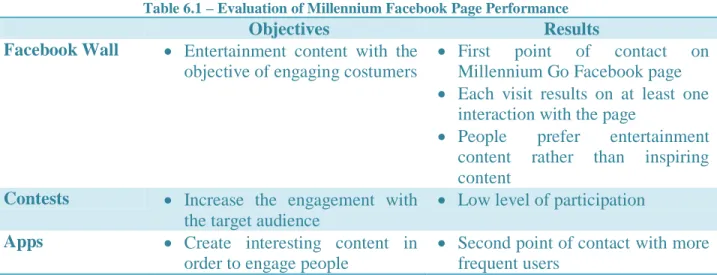
The strategy’s first step was that of not talking a lot about the product. Millennium wanted to create a “fun” page. The main objective was to promote the brand among the target and reach some opinion leaders, people who talk about its visibility on Facebook.
During the launching year of this Facebook page, Millennium ran several contests:
“My first wage” – Campaign launched in August 2011. The contest reward was a night in a youth hostel in Portugal. The participant needed to say what they would do with their first pay check and share it with their friends - 42 participations (Exhibit 16);
19
“Go! Gives you music” – Campaign launched at Christmas 2011. The contest reward was two tickets to Rock in Rio 2012 and to participate people had to make a video clip with Millennium Go song of the Maria Amélia group – 6 participations (Exhibit 17);
Casting Millennium (to Rock in Rio) – Campaign launched in March 2012. The contest reward was some tickets to Rock in Rio 2012 (R&R) and the possibility of singinging on the R&R stage. To participate people needed to sing one of five different songs and post it on youtube or soundcloud. People most voted won – 62 participations (Exhibit 18);
Member get member – Campaign launched in June 2012. The campaign consisted in bringing one friend to MGo or MGo Top and both would be free of MGo’s charges until the end of the year 2012 – 78 participations (Exhibit 19).
Millennium has also developed three different Facebook apps:
GO! Movies, partnership with Lusomundo for the promotion of movies being shown at the theatres, information about the same, and movie premieres (Exhibit 20);
GO! Festivals, information about the different summer music festivals Exhibit 21);
GO! OUT , information about bars, discos and restaurants in Portugal (Exhibit 22).
The main objective of these apps is to be closer to the main target segment by giving them information about things they are interested in. The aim of these Apps is to create a bond with the target, to be closer to them.
However, there is a one single problem with this Facebook page: the fact that the only way customers can interact with the bank is by commenting its posts; this means that if a customer wants to post something on MGo Facebook, they cannot. The only way they can interact is through private messages.
Results
The bank is quite happy with the results and strategy of the campaign. Since the launch of the MGo Facebook page until the date this dissertation was written, Millennium Go had almost
20 43,000 likes. For the company, such numbers are not translated into sales but into brand awareness. The goal is to have as much likes as possible in order to have people talking about it.
The Millennium Go Facebook area with more visits is the Wall, followed by the Apps and each visit generates at least one interaction with the page. The bank is not so happy with the number of people acceding to the contents of the page, as they were expecting a higher adhesion than what actually happens.
Regarding the sales evolution of the MGo package, the results are also quite good. In the beginning they were having 60 new memberships per day, and during the R&R contest they were able to increase that number to 100.
As for MGo Top, the bundle targeted at the 25 and 32 years old segment, sales are not as good as expected, and are not as good as those of MGo; the bank is trying to develop a new strategy in order to turn this result around. During the interviews conducted with Millennium bcp branch employees, it was possible to understand that one plausible explanation for this fact is the existence of another available package: Frequent Client. This might mean that Millennium bcp has an overlapping offer (Exhibit 23).
In terms of profits, these packages are quite cost effective since customers never use all the products available in the package - for example, only a small percentage of subscribers would have to pay a maintenance fee, and not all of them use the debit or the credit card. Millennium bcp expects to continue to use this format to sell products and services, as the package database confirms that customers with bundles are more profitable, more satisfied and more loyal than other customers with similar profile.
The challenge
It is a well-known fact that Portugal is going through a deep crisis that should remain all troughout 2013. As such, Millennium bcp must keep endeavoring to stand out from the competition and gain market share in all segments, especially among the young segment as they represent the future.
The challenge is to reinforce Millennium bcp’s positioning among the young target, which can be achieved through the development of innovative products and the use of new communication channels that will allow the bank to reach the younger target, or develop new ways of business.
21
5. Market Research
An online survey and three interviews with Millennium bcp branch employees were conducted in order to understand what leads people to interact, or not, with a Financial Institution Facebook page.
5.1 . Methodology
Firstly, an online survey was conducted with the main objective of collecting consumer data. The aim was to collect a large sample in order to be able to analyze and reach relevant statistical conclusions. The survey was spread through the electronic channel, as this was the most suitable for the topic in study and also the most efficient way of collecting data. The survey was sent to the author’s Facebook contacts and posted on several financial institutions Facebook pages in order to gather information from people with different profiles.
The only condition imposed was to have only Portuguese Facebook users answering the survey. The main objective of this survey was to understand if the general public had clicked “like” on a Facebook page and what were their feelings about financial institutions or products being present on this social network.
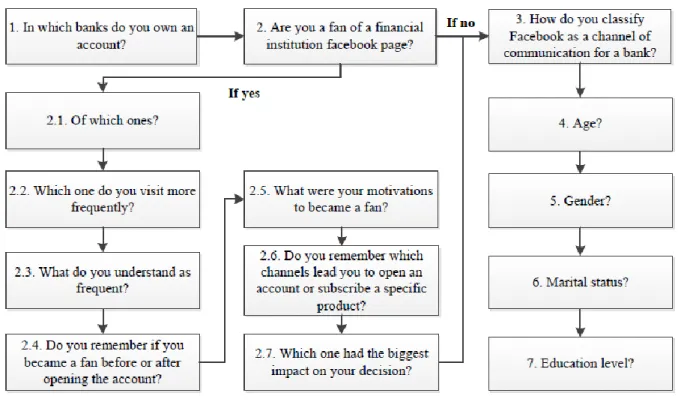
The questionnaire had between 6 and 14 questions (Exhibit 24), depending on the answers chosen by the respondent. Q1 objective was to perceive in which banks the respondents have their account(s). With Q2 the author wanted to observe how many respondents had clicked “like” on a financial institution Facebook page. If the respondents answered positively they were sent to Q 2.1. and were asked to refer which Facebook pages they had clicked “like”. Q 2.2. was meant to observe which page was visited more frequently and Q 2.3. intended to identify the frequency of visits of each respondent. With Q 2.4. the author wanted to test if the respondent opted to press “like” on the bank’s Facebook page before or after opening a bank account, in order to observe if the interaction through Facebook influences the respondent decision process. Q 2.5. tried to capture the respondent’s motivations and reasons of becoming a fan of a financial institution Facebook page. If the answer on Q 2.5. was that the respondent wanted to open and account or subscribe a product, they were conducted to Q 2.6 and Q 2.7. where the author tried to gather what was the marketing channel most important for the decision of opening a bank account or subscribing a financial product. From Q3 on all the respondents were asked to answer, independently of ever having pressed like or not on a financial institution Facebook page. The
22 main objective of this question was to compare the two groups’ feelings towards a Bank Facebook Page. A scale with four different values was used, where the feelings were valued from totally disagree to completely agree. Q4 to Q7 were demographic questions: gender, age, marital status and education in order to be able to define the respondents’ profiles. In order to better understand the sequence of the questions a flowchart is presented in Figure 5.1.
After collecting the data there was the need to prepare it for analyses. In the beginning there were 299 questionnaires of which 59 were deleted, as they had missing data. Thus, a total of 240 questionnaires were considered valid to proceed with the study. The study itself was conducted on SPSS and frequency, cross tabulations and paired sample T-test were performed. The main objective of this last test was to test the mean differences between the evaluation of Banks’ Facebook pages among people who have or have not pressed “like” on those kind of social network pages.
In order to understand how costumers subscribe the product and to have some employee and customer feedback three interviews were conducted with three different branch employees, Andreia Esteves, Ricardo Santos and Marlene Gonçalves. These interviews were conducted
23 individually, face-to-face and with a script (Exhibit 25) as a way of guaranteeing the possibility of comparing answers among the different respondents.
5.2. Sample analysis
The questionnaire analysis shows that the sample is composed by more females (58.3%) than males (41.7%) (Exhibit 26). In terms of age, 74.6% of people are in the 18 to 25 range, and 17.1% in the 26 to 32 years old range (Exhibit 27). The reason behind the creation of these two ranges is due to the fact that the first range is the age interval of Millennium Go and the second one is the interval of Millennium Go Top. An exam of the marital status shows that the majority is single, 87.9% against 10.8% married or living with a partner (Exhibit 28). When analyzing the education question, the sample is mainly composed by people with a bachelor (53,3%) or with a master degree (27,9%) (Exhibit 29). An analysis of the bank account profile shows that there are seven top banks among the sample. The bank with more customers is Caixa Geral de Depósitos, followed by BES, Millennium bcp, Santander Totta, BPI, Montepio Geral and Activo Bank (Exhibit 30).
By examining Q.2. it is possible to observe that only 16.7% of the respondents are fans of at least one Facebook Page from a bank (Exhibit 31), and these are called users. This means that the remaining 83.3% of the respondents have never had contact with this type of pages, and these are called non-users. On average, users have 1.25 likes on Financial Institutions Facebook pages. In terms of popularity, the rank of Facebook pages is: Activobank (57.5), Millennium Go (32.5%), Banif (5%), Banco Best (5%), Others (25%) (the pages referred more often were Bes up, Santander Universitários) (Exhibit 32). From all these pages, Activobank’s page is the one visited more frequently (Exhibit 33).
A closer analysis of the regularity of visits to a page shows that there are two extremes: 62.5% of the sample visits a page on a regular basis (daily 22.5%, 2 to 3 times a week 15%, or monthly 25%), versus 30% that never visit those pages (Exhibit 34). The majority of the respondents have become a fan after opening an account in the bank. However, 22.5% of the respondents do not have an account with the bank whose Facebook page(s) they pressed “like” (Exhibit 35),.
24
5.3. Results’ analysis
RQ (1): Is there opportunity for Millennium Go in Facebook? Why are Financial Institutions investing more and more in this channel?
The number of Portuguese Facebook members already represents 43.57% 5 of the country’s population. The Portuguese spend on average one hour and a half 6 per day on social Networks (Facebook, Twitter and Windows Live), which is translated into one or more than one visit per day (46.2%). This data allows us to conclude that the Portuguese population is quite active on this channel and this can be an advantage for Millennium Go expansion in the future.
When visiting Facebook Pages from several Portuguese banks it is possible to observe that, for example, Bes Up has about 48,600 likes, Banif 44,000, Millennium Go 43,000 and Santander Universidades 22,0007. This actually reinforces the idea that this channel is beginning to have acceptance for banking purposes from the general public. This data also shows that Millennium Go Facebook page is ranked third among banks’ Facebook pages and second among Banks’ Facebook pages for younger targets. This shows that MGo has room to increase its position between its competitors and it has space to grow.
Through a focus group conducted while Millennium Go was being developed, Millennium bcp reached the conclusion that the younger target uses the Internet as their primary way of communication. This means that they have access to information, services and entertainment through online sources, including Facebook. This may be an advantage to Millennium bcp.
An analysis of the questionnaire conducted by the author shows that 16.7% of the respondents have already clicked “like” on a Financial Institution Facebook page. As a matter of fact, when analyzing the mean of “like” per person, it is possible to observe that respondents have 1.25 likes.
During the interviews, Millennium bcp managers explained that what drives them to make larger daily investments in this channel is not sales. This means that they are aware that a page on a social network will not directly increase Millennium Go or Millennium Go Top sales. The real purpose is to be closer to the public, especially to the younger segment. Millennium wants to build a relationship with the youngest target, increase the level of involvement with this public, by having a channel that enables them to interact with the bank and have access to exclusive
5
Socialbakers consulted on December 2012
6
Marktest consulted on December 2012
25 content, which is not financial content but rather content of entertainment. Along with that, they want to increase brand awareness and change their image, as they are considered an “old” bank, a bank for “parents”. Managers believe that the Bank’s involvement with social networks will help the Bank to gain a younger image.
These statements are supported by the literature review, where it is possible to read that companies have shifted from customer service to customer engagement and social networks. This shift is helping companies to retain customers, and maintain a relationship with existing and prospective customers.
Another interesting thing to refer is a curiosity from New Zealand8. ASB bank has developed a whole virtual branch on Facebook that enables people to communicate with employees every day of the week within normal working hours; customers can make instant payments to their Facebook friends independently of the fact that they have or do not have an account with that bank (available only in New Zealand). There are other banks, namely in India and South Africa, that already enable people to check their balance and request several bank services and products through Facebook.
It is, therefore, possible to conclude that social networks, namely Facebook, represent an opportunity for Millennium bcp. Millennium Go can be the right path to increase the Bank’s presence on these new communication channels reinforce its relationship with consumers and reinforce brand awareness, especially among young targets.
RQ (2): What is the role of social networks on banking choice and on the financial products purchasing process?
The literature review demonstrates that the majority of the authors agree that social networks are a major source of information, especially for non-tangible products as it is the case of financial products. One of the articles goes even further by stating that people research social networks before finalizing the purchase decision.
Some authors claim that in order to choose a bank, young adults, especially students, rely more on non-commercial sources of information, such as family and friends’ advice and WOM.
8
26 Only then, they search information on the financial institution webpage with the objective of gathering more information.
Virtual communities have an important role on the purchasing or subscription process, as they enable people to communicate and share information that will help them find products that meet their requirements. In general, people have more trust in someone who has already bought or experienced the product.
This information is confirmed by the questionnaire results. Question 2.4. main objective was to perceive what were the main reasons that led respondents to became a fan of a Financial Institution Facebook Page (Exhibit 35). 40% of the respondents answered that the main reason was to gather more information, 40% answered that what drove them was the fact that they are customers of that bank, and 22.5% simply wanted to have access to exclusive content. These figures show that respondents consider social networks as a reliable source of information.
Question 2.5. (Exhibit 36) and 2.6. (Exhibit 37) asked which channels had an important role on the decision of opening a bank account or subscribing a product. The respondents choices were: Website, Facebook and TV commercials. However, the channel with greater importance is the webpage, as it is the place with more information available.
This information is confirmed by the interviews conducted with branch employees. All the interviewees mentioned that when young people take the initiative to visit a branch, they have usually gathered prior information from Millennium bcp’s webpage or Facebook page (Exhibit 38).
Thus, social networks, as a source of information, have an important role in the decision making process. Before purchase, consumers collect information about product characteristics and most times check the level of satisfaction of previous users.
RQ (3): What are the consumer’s attitudes and perceptions towards Facebook pages of Financial Institutions?
When the survey was conducted, a specific question was asked in order to understand attitudes and perceptions about financial institutions on Facebook among the sample.
When analyzing the paired sample T-test about respondents’ attitudes and perceptions towards Financial Institutions (Exhibit 39) it was possible to perceive that users generally give higher valuations than those who are not users.