Designing Product-Service System solutions for
value co-creation: Integrating Product-Service
Systems and Service Design approaches
Dissertation submitted to Faculdade de Engenharia da Universidade do Porto to obtain the doctoral Degree in leaders for Technical Industries
Supervisor: Professor Lia Martins de Lima Patrício Co-supervisor: Professor Nicola Morelli
Faculdade de Engenharia da Universidade do Porto December 2017
The rapid advance of technology is changing society at a very fast pace, bringing change to the nature of product and service (e.g. smart-products). Customers are more informed and have access to more resources to fulfil their needs. In this context, product and service providers alike, look for new approaches to create more complete solutions for their customers. Acknowledging the limitations of physical products to stay relevant in current markets, manufacturing companies are infusing service in their offerings. Likewise, service providers need more support to combine multiple touchpoints with their customers in a cohesive way to enable positive customer experiences.
Different ways to conceptualize service and create new solutions exist. On the one hand, Product-Service System approach integrates product and service components as well as organizational network components, to create integrated offerings. On the other hand, Service Design looks at customer experiences from a holistic perspective and envision innovative ways to support value co-creation processes with customers and other stakeholders. Although complementary, these approaches have yet to be integrated. Bringing together PSS and Service Design complementarities can support companies to co-create new product-service system solutions, to evolve their design processes, and to improve their business positioning.
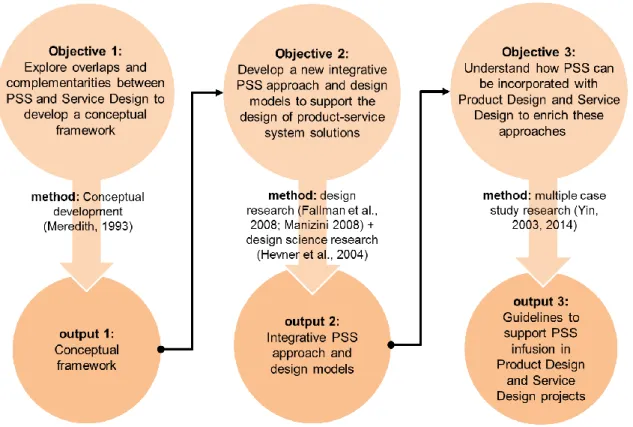
This thesis investigates how PSS and Service Design can be combined to better support the design of integrated product-service system solutions that enhance value co-creation processes, within multiple design contexts. To address these challenges, the research objectives are three folded: (1) Explore overlaps and complementarities between PSS and Service Design to create a conceptual framework; (2) Develop an integrative PSS approach, which combines PSS and service design, and the respective design models to design product-service system solutions from an integrated perspective, since the exploration stage to the development of mock-ups and prototypes; (3) Understand how PSS can be incorporated with Product Design and Service Design to enrich these approaches.
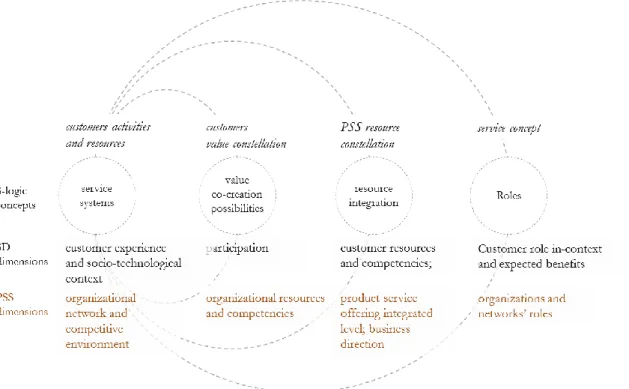
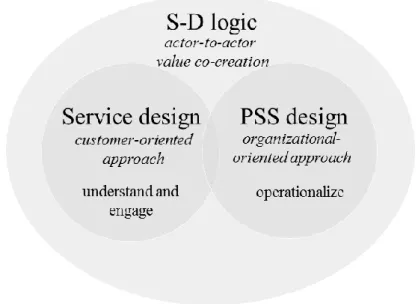
Following a Design Research approach, the objectives led to three contributions. Study (1) analyzes overlaps and complementarities of PSS and Service Design approaches through the lenses of S-D Logic, based on literature review, and develops a conceptual framework. The framework creates a unifying language, outlining potential synergies between PSS design and service design by exploring the concept of value co-creation; and supports the development of future research that lays at the intersection these areas. Study (2) presents the development of a new integrative PSS approach and models. It integrates the co-creative and human-centered approach of Service Design with the organizational-oriented perspective of PSS, throughout the different stages of the design process through a design research approach. It validates this approach through a case study in a laboratory equipment company to design new integrated solutions, which have resulted in prototypes that were partially implemented. Study (3) advances the previous contributions by exploring complementarities and gaps of product design and service design, which remain important backbones of current manufacturing and service companies. The study also explores how PSS approach can enrich these design approaches. A multiple case study with projects using a product design approach and service design approach, in collaboration with companies was undertaken to support the research.
The thesis contributes to advance PSS design research incorporating the complementary perspectives of PSS and service design which were not previously integrated. Moreover, it contributes with a new method to support the design of integrated good-service solutions for value co-creation, and contributes to understand how PSS can be beneficial for current product and service design, thus enabling PSS infusion in multiple types of companies.
RESUMO
O avanço tecnológico está a mudar a sociedade de forma rápida. Neste context, a natureza dos produto e serviços também se está a transformar (e.g. produtos inteligentes, a internet das coisas). Os clientes estão mais informados e têm acesso a mais recursos para responder às suas necessidades. Neste contexto, empresas de produtos e serviços, procuram novas abordagens para criar soluções mais completas para seus clientes. Reconhecendo as limitações das ofertas baseadas em produtos físicos, as empresas de manufatura tentam integrar serviços nas suas ofertas e processos de desenho. Do mesmo modo, as empresas de serviços também precisam de mais apoio para melhorar as experiências dos seus clientes enquanto combinam múltiplas evidências físicas de forma coesa. Isto é fundamental para possibilitar experiências positivas.
Existem formas diferentes para conceptualizar serviço e criar novas soluções. Por um lado, a abordagem de sistemas de produtos e serviços (PSS) integra componentes de produto e serviço, bem como as componentes de redes organizacionais para criar ofertas integradas. Por outro lado, a abordagem de Design de Serviço examina e integra a perspetiva holistica da experiência do cliente e cria formas inovadoras para apoiar os processos de co-criação de valor entre stakeholders. Embora complementares, as abordagens de PSS e Design de Serviço ainda não foram integradas. As complementaridades destas abordagens pode melhor apoiar as empresas a criar novas soluções de sistemas de produtos e serviços, desenvolver seus processos de design, e melhorar o posicionamento comercial e de negócio das empresas.
Esta tese investiga como é que abordagens de PSS e o Design de Serviço podem ser combinados para melhor apoiar o design de soluções integradas de sistemas de produtos-serviços que melhorem os processos de co-criação de valor, em vários contextos de design. Para responder a estes desafios, os objetivos da tese são: (1) Explorar lacunas e complementaridades das abordagens de PSS e Design de Serviço para criar uma framework conceptual; (2) Desenvolver uma nova abordagem PSS e respectivos modelos de design para designar soluções integradas de sistemas de produto e serviço, a partir de uma perspectiva integrada, desde as atividades de exploração até o
desenvolvimento de maquetes e protótipos; (3) Compreender como é que a abordagem PSS pode ser integrada com as abordagens de Design de Produto e com Design de Serviço para as enriquecer.
Seguindo uma abordagem de Design Research, os objetivos da tese resultaram em três trabalhos de pesquisa e três contribuições. O estudo (1) analisa lacunas e complementaridades das abordagens de PSS e Design de Serviço através da S-D Logic, com base na revisão da literatura. O desenvolvimento conceptual levou à criação de uma linguagem mais unificadora, e uma framework que descreve potenciais sinergias entre as disciplinas de PSS, Design de Serviço e S-D Logic, que não estavam previamente integradas. O estudo (2) introduz uma nova abordagem integrada de PSS e modelos. A abordagem integra a perspectiva co-criativa e human-centered do Design de Serviço com a perspectiva organizacional do PSS, ao longo das diferentes etapas do processo de design. A abordagem é validada através de um estudo de caso numa empresa que desenha equipamentos de laboratório. A aplicação permitiu desenvolver um conjunto de novas soluções integradas que resultaram em protótipos parcialmente implementados. O estudo (3) avança as contribuições anteriores e explora como é que a abordagem PSS pode enriquecer as abordagens de Design de Produto e Design de Serviço, que são importantes nas empresas de manufactura e de serviço. Um estudo de caso múltiplo com 10 projetos que adotam Design de Produto e Design de Serviço respectivamente, foi efetuado para explorar as questões.
A tese contribui para evoluir a área de pesquisa de design de PSS, integrando as perspectiva de PSS com design de serviço, que ainda não estavam integradas. Assim, contribui também com um novo método que melhor apoia o desenho de novas soluções integradas de sistemas de produtos e serviços; e permite compreender como é que PSS pode ser benéfico para enriquecer abordagens de design de produto e design de serviço, contribuindo para uma maior infusão de PSS em diversas empresas.
These last five years have been long and rough but were an amazing learning experience. I have many people to thank for, as they have contributed directly or indirectly to the creation of this thesis. First, I am ever grateful to one of the most determined person I know, my supervisor, Professor Lia Patrício. Your persistence and rigour about my writing were paramount to transform my chaotic thoughts into a logical and comprehensive thesis. The long meetings and discussions have greatly contributed for my personal development, as well as my growth as a designer. Thank you for all the support, precious feedback and ideas which were paramount to conclude this thesis. Thank you for your understanding, kindness, and guidance when life's paths became more difficult. To my co-supervisor, Professor Nicola Morelli: thank you for your availability, inspiration and sympathy. Thank you for your advices and feedback which have greatly contributed for the richness of the present document. I am grateful to my co-authors, Professor Christopher Magee and Professor Matthew Cressy for your support, keen interest, insights and feedback, and for providing the conditions I needed to carry out my research at MIT. Special thanks to my engaging and supportive fellow FEUP colleagues and friends: Damian Perez, Cecília Carvalho, Teresa Alaniz, Mohamed Lotfi, Seif Sadek, Ana Kustrak, João Figueiredo, Luís Carvalho, Rita Rodrigues, Liliana Figueiredo and Pouya Samani. Thank you for checking on me, for the daily sunbaths and unconditional support. Jorge Teixeira: thank you for the support throughout the entire PhD; and to Carla Monteiro for your serenity in solving complex administrative issues. To my coaches Carlos Caldas e Ricardo Rocha, as well as my fellow fighting partners Rita Salgado, Jorge Pinto, Joana Pereira and Ana Magalhães, thank you for demanding nothing less than everything. To petit Konstantinos I couldn’t be more grateful. Thank you for your patience, for lending me your strength when I most need it. To my parents, Carlos and Emilia Costa, thank you for giving me all the things that I have ever needed. I hope being able to repay you all this love ten times fold. To my siblings Liliana and Daniel, which I do admire and respect, thank you. You are part vital of this success. And finally, to my grandmother Maria: thank you for showing me what a fighter looks like. I love you.
AGRADECIMENTOS
Estes últimos cinco anos foram longos e difíceis, mas constituem uma experiência de aprendizagem inesquecível. Tenho muitas pessoas a quem agradecer pois contribuíram direta ou indiretamente para a conclusão desta tese. Primeiro, sou infinitamente grata a uma das pessoas mais determinadas que conheço, a minha orientadora, Professora Lia Patrício. A sua persistência no rigor, na correção e reflexão sobre a minha escrita foram essenciais para tornar a pensamentos caóticos numa tese lógica e compreensível. As longas reuniões e discussões contribuíram para o meu desenvolvimento pessoal, bem como meu crescimento enquanto designer. Obrigado por o apoio, comentários e ideais que foram essenciais para levar este trabalho a bom porto. Obrigado pela sua compreensão, gentileza e orientação quando os caminhos da vida se mostraram mais difíceis. Para o meu co-orientador, Professor Nicola Morelli: obrigado pela sua disponibilidade, inspiração e simpatia. Obrigado pelos seus conselhos e comentários que contribuíram muito para a riqueza do deste documento. Agradeço os meus co-autores, Professor Christopher Magee e Professor Matthew Cressy pelo apoio, interesse, ideias e feedback, e por fornecer as condições que eu precisava para realizar minha pesquisa no MIT. Aos meus colegas feupianos e amigos, Damian Perez, Cecília Carvalho, Teresa Alaniz, Mohamed Lotfi, Seif Sadek, Ana Kustrak, João Figueiredo, Luís Carvalho, Rita Rodrigues, Liliana Figueiredo e Pouya Samani, obrigado pelos passeios ao sol e apoio incondicional. Um agradecimento especial ao Jorge Teixeira que me acompanhou e apoiou durante todo o doutoramento; à Carla Monteiro pela calma na resolução de problemas administrativos que, para mim, sempre me parecem infinitamente complicados. Para os treinadores Carlos Caldas e Ricardo Rocha, bem como meus companheiros de luta, Rita Salgado, Jorge Pinto, Joana Pereira e Ana Magalhães, obrigado por exigir de mim nada menos que tudo. Para o petit Konstantinos, que me conheceu numa altura estranha da minha vida: não poderia estar mais agradecida. Obrigado pela paciência, por me emprestar a tua força quando preciso. Para meus pais, Carlos e Emilia Costa, obrigado por me dar todas as coisas que eu alguma vez precisei. Espero conseguir dar de volta desta e de outras formas, no futuro. Para meus irmãos Liliana e Daniel, que eu admiro e respeito, obrigado. Também são parte integrantes desse sucesso. E finalmente para avó Maria: obrigada por me mostrar como é lutadora. Amo-vos.
1. INTRODUCTION ... 15
2. CONCEPTUAL BACKGROUND ... 19
2.1. Product-Service System (PSS) ... 19
2.2. PSS design ... 20
2.3. Service and Service-Dominant logic (S-D Logic) ... 22
2.4. Service Design ... 23
2.5. Research Gaps ... 24
2.6. Research questions and objectives ... 26
Objective 1: Explore overlaps and complementarities between PSS and Service Design to develop a conceptual framework ... 26
Objective 2: Develop a new integrative PSS approach and design models to support the design of product-service system solutions ... 27
Objective 3: Understand how PSS can be incorporated with Product Design and Service Design to enrich these approaches ... 28
3. METHODOLOGY ... 31
3.1. Design and Design Research ... 33
3.2. Research design ... 34
Study 1: literature review to develop an conceptual framework for integrating PSS and service design ... 34
Study 2: design research to develop a new integrative PSS design approach, combining PSS and service design, with an application to a smart-lab project ... 35
Study 3: multiple case study to examine and compare Product and Service Design approaches, and understand how PSS can enrich these approaches ... 38
3.3. Thesis outline ... 40
4. RESEARCH PAPERS ... 41
Paper 1: Revisiting PSS and Service Design in the light of the S-D logic ... 43
Paper 2: Bringing service design to manufacturing companies: integrating service design and PSS design approaches ... 63
Paper 3: Expanding the boundaries of Product Design and Service Design through PSS 105
5. CONTRIBUTIONS ... 157
5.1. Contribution to integrate PSS and Service Design perspectives and create a conceptual framework ... 158
5.2. Contribution to develop a new integrated PSS approach and enhance design models 159 5.3. Contribution understand the potential of PSS to enrich Product Design and Service Design practices and processes ... 160
5.4. Managerial implications ... 162
6. CONCLUSIONS ... 165
1. INTRODUCTION
Globalization and technology evolution have led to rapid socio-technical changes in economies (Ostrom, Parasuraman, Bowen, Patrício, & Voss, 2015). Moreover, the dynamics and saturation of modern markets (Normann, 2001), as well as the rapid mutation of customer needs and behaviors call for new strategies and approaches to co-create value in innovative ways (Lush & Vargo, 2014; Michel, Brown, & Gallan, 2008). In this competitive and evolving landscape, service can sometimes represent the most added value (Ostrom et al., 2015; Teixeira, 2015). Service is significantly reshaping the way companies innovate their offerings and businesses, with a focus on how they can co-create value with their customers. From a Service-Dominant logic, value cannot be pre-produced or embedded in products (Vargo & Lusch, 2008, 2016). Value is rather co-created by customers and product/service providers that are connected through different value propositions, i.e. their offerings (Chandler & Lusch, 2015). This can open new opportunities for product/service innovation.
Today, manufacturing companies increasingly infuse service in their product offerings to improve their value propositions, in a servitization process (Oliva & Kallenberg, 2003). Servitization can be characterized as a transformational journey, where manufacturers seek to develop innovative capabilities (Raddats, Baines, Burton, Story, & Zolkiewski, 2016) and organizational processes to create revenue from service (Baines, Bigdeli, & Bustinza, 2017). The application of such process usually results in product-service system solutions (Baines, Lightfoot, Benedettini, & Kay, 2009; Kowalkowski, Gebauer, Kamp, & Parry, 2017; Oliva & Kallenberg, 2003; Tan, Matzen, McAloone, & Evans, 2010). At the same time, service companies also pay additional attention to physical evidences. Physical evidences are the tangible attributes of a service, or design objects in the service environment, and are key to enable smooth customer experience (Berry L., Wall, & Carbone, 2006; Lo, 2011; Yoon, Pohlmeyer, & Desmet, 2016). In this context, companies increasingly attempt to enhance customer experiences by differentiate their offerings (Zomerdijk & Voss, 2010). However, this requires holistic and integrated perspectives of the multiple levels of problems.
The integration of both physical product and service components into more integrated value propositions is an important concern that is considerably evolving in multiple contexts, for both manufacturing and service companies (Baines et al., 2017; Morelli & Tollestrup, 2009; Raddats et al., 2016). To address this issue, new approaches were developed in the last decade, in particular Product-Service Systems (PSS) and Service Design.
Product-Service Systems (PSS) have gained increased attention in both academia and industry, in particular for researchers engaged with sustainability, business and design-related areas (Tukker, 2015). Product-service systems solutions can be defined as a mix of product and service components, designed and combined so that they are jointly capable of fulfilling customer needs and deliver value-in-use (T. S. Baines et al., 2007; O. Mont & Tukker, 2006; Tukker, 2015). Traditional views of PSS usually focused on performance, and emphasized ownerless solutions. In this perspective, manufacturers remain in ownership of the product component of the overall solution, providing access to specific products and customized services to customers (Tukker, 2004). This represents a shift to a more functional economy, focused on resource efficiency as opposed to consumption (Raddats et al., 2016). However, given the increasing competitive and socio-economical pressure, product-service systems are increasingly becoming the offering with which companies distinguish themselves from competitors (Rymaszewska, Helo, & Gunasekaran, 2017), but the questions of where, how and what directions to take need further research.
Designing product-service system solutions requires integrating product and service and create additional value (Vasantha, Roy, & Corney, 2015). The first PSS design approaches developed methods focused on improving the use stage of the product, enhancing technical efficiency and performance while reducing the amount of waste produced in production and consumption processes (Aurich, Fuchs, & Wagenknecht, 2006; Aurich, Mannweiler, & Schweitzer, 2010; Cavalieri, Pezzotta, & Shimomura, 2012). Although these approaches are important to improve technical systems, they tend to interpret products and services as separate objects of design. Additionally, the social components of PSS tend to be overlooked (Morelli, 2002b; Rexfelt & af Ornäs, 2009), focusing on the economical or environmental gains of these solutions.
More recent PSS approaches developed new methods that emphasize the emotion and customer experiences to improve acceptance and diffusion (Ceschin, Vezzoli, & Zingale, 2010; Stacey & Tether, 2014), which have been identified as important PSS research challenges (Baines et al., 2017; Tukker, 2015). The design perspective of PSS focuses on the social component of integrated solutions, investigating customer behavior regarding new products, services and technology (Morelli, 2002a; Morelli & Tollestrup, 2009). However, more recent perspectives of value co-creation and service still remain weakly integrated in the PSS design process. This thesis addresses this challenge, by complementing PSS organizational view with a Service Design approach, which has gained attention in Service Research.
In parallel to PSS, the design discipline is also transforming and progressively moving from designing objects (i.e. industrial design), to service, experiences and change (Norman, 2010; Yee, Jefferies, & Tan, 2014). Service Design is seen as both a new field of design (Kimbell, 2011) and a discipline that emerged at the intersection of multidisciplinary service fields (Patrício & Fisk, 2013).
Service design is a holistic, human-centered and co-creative approach to envision and create new service (Mager, 2009; Meroni & Sangiorgi, 2011; Wetter-Edman, Sangiorgi, Holmlid, Grönroos, & Mattelmäki, 2014). It has evolved from being considered as a specific stage of the new service development process (Yu & Sangiorgi, 2014) to a broader approach that includes the understanding of customer experience (Teixeira et al., 2012) and the design of service at multiple levels (Patrício, Fisk, e Cunha, & Constantine, 2011; Teixeira et al., 2017). However the expansion of Service Design to later stages of the development process still needs improvement, to facilitate implementation of service solutions (Lin, Hughes, & Katica, 2011; Yu & Sangiorgi, 2014, 2017). This thesis addresses this call by bridging Service Design human-centered and co-creative perspective with the organizational- and network-oriented view of PSS to create a new integrated PSS approach and support the design of more integrated solutions for value co-creation.
Designing more integrated good-service solutions is identified as a priority in both Service research and PSS research (Baines et al., 2017; Ostrom et al., 2015). This topic is also relevant for industries as they need more support to co-create integrated solutions
(Baines et al., 2017; Baines, Lightfoot, Benedettini, et al., 2009). On the one hand, manufacturers infuse service in their offerings but acknowledge the need to better understand customer experience (Baines, Lightfoot, Benedettini, et al., 2009; Rexfelt & af Ornäs, 2009). On the other hand service companies increasingly deal with multiple service evidences that need to be integrated in service solutions. The physical evidence in service is paramount to deliver smooth customer experiences (Berry L. et al., 2006; Lo, 2011; Zomerdijk & Voss, 2010).
In this context, PSS and Service Design have complementary perspectives that can support the design of more integrated good-service solutions for value co-creation, but these approaches have not yet been integrated. It is the aim of this thesis to bridge them by (1) analyzing their overlaps and complementarities and create a more unified PSS design framework (2) develop a new integrative PSS approach and respective design models to support the co-creation of integrated product-service system solutions and (3) to understand how PSS can be integrated and enrich Product Design and Service Design approaches, which remain important backbones of current manufacturing and service companies.
2. CONCEPTUAL BACKGROUND
The previous section highlighted the challenges faced by organizations in designing integrated product-service system solutions. It also introduced the key concepts, such PSS design, Service Design and service. PSS and Service Design are two important and expanding research fields that support the design of more integrated product-service system solutions. The following section presents a brief review of the literature, as well as the challenges, the main research gaps and research questions addressed in this thesis. 2.1. Product-Service System (PSS)
Product-Service System (PSS) can be defined as an approach that combines product and service components that together provide value-in-use for customers (Baines et al., 2007). Evolving to PSS requires innovative strategies (Ceschin & Gaziulusoy, 2016), which include collaborative organizational-networks of stakeholders that co-create value with customers for a determined period of time (Tukker, 2015).
Within PSS research, product-service system solutions may fall within three categories: product-, use- and result-oriented (Tukker, 2004). Product-oriented solutions are product-based solutions with a traditional view of services. Services in this perspective are complementary to physical products e.g. maintenance and repair. The two latter categories of solutions (use-and result oriented solutions) increase the opportunities to innovate value propositions through service. Use-oriented PSS solutions usually make the physical products available for use to customers leading to more optimized consumption patterns (i.e. leasing or sharing services). This type of PSS also brings economic incentives for the manufacturer to expand the life-span of physical products as the use of additional resources (e.g. new materials) can lead to higher operations costs. The result-oriented PSS solutions, on the other hand, do not focus on specific products or services, but rather on performance (e.g. selling washed clothes as opposed to selling washing machines). Result-oriented solutions can have an important impact on co-creation processes among customer and product/service providers (Baines et al., 2017; Baines, Lightfoot, Benedettini, et al., 2009; Tukker, 2015). Examples of companies delivering these solutions are Xerox and Rolls-Royce (Kowalkowski et al., 2017). Xerox shifted its business from selling printers to selling copier management
service systems, whereas Rolls-Royce changed from selling engines, to selling power-by the hour long-term contracts (Davies, Brady, & Hobday, 2006). In both cases, the manufacturers remain in ownership of the product component, and profit from the service delivered. The manufacturer thus can create additional revenue and profit from service, improve its response to customer needs, and set higher barriers to competition (Baines et al., 2017; Oliva & Kallenberg, 2003).
In traditional application of PSS approaches, customers are relieved from certain tasks and/or activities as providers retain most of the activities related with maintenance and repair of product components of the solution. This perspective of PSS emphasizes organizational-oriented networks as the key co-creators of value. The customer is part of the network, but has a minor role. This perspective of PSS has been fairly developed in PSS literature and traditional PSS design approaches, focusing on improving the efficiency and performance of technical systems (Cavalieri & Pezzotta, 2012; Vasantha, Roy, Lelah, & Brissaud, 2012).
However, the implementation and diffusion rate of these solutions still remains rather slow (Baines et al., 2017; Tukker, 2015). Studies identify internal and external barriers as potential causes (Tukker, 2015; Vezzoli, Ceschin, Diehl, & Kohtala, 2015). Internal barriers refer to the need to embed PSS culture in organizations, emphasizing the issue on enabling change in organizational processes. External barriers are related with the cultural shift in customer practices and behaviors, and acceptance of ownerless solutions (Rexfelt & af Ornäs, 2009; Vezzoli, Kohtala, Srinivasan, Xin, & Fusakul, 2014; Vezzoli et al., 2015). Manufacturers acknowledge that it is increasingly important to understand value-in-use from the customer perspective and not only focus on the offering per se (Baines, Lightfoot, Benedettini, et al., 2009).
2.2. PSS design
Designing integrated good-service solutions, combined with a broader understanding of social aspects of PSS (i.e. customer acceptance, understanding of customer behaviors), have been identified as PSS research priorities (Baines et al., 2017; Roy, Shehab, & Tiwari, 2009). The growing importance of PSS is reflected in the volume of contributions in different research domains (Beuren, Gomes Ferreira, & Cauchick Miguel, 2013).
The evolutionary path for PSS design started from a sequential stage-gate based engineering to concurrent engineering such as systems process modeling techniques, CAD supporting tools and frameworks for knowledge reuse, and representation techniques for functions, activities and product behaviors (Cavalieri & Pezzotta, 2012). These approaches, which represent a more traditional perspective of PSS design, emphasize the effective use of resources within organizational-based networks (Aurich et al., 2006; Hara, Arai, Shimomura, & Sakao, 2009; Maxwell, Sheate, & van der Vorst, 2006; Vasantha et al., 2015, 2012). These methods and techniques are useful to understand functions and supporting processes, as well as to improve the efficiency and performance of technical systems. However, they have little capacity to understand and incorporate social components within PSS (Morelli, 2002a).
Additionally, the service components are generally under-defined when compared to traditional product engineering within PSS (Cavalieri & Pezzotta, 2012). This can originate incongruence of product-service system solutions through the customer’s eyes (Valencia Cardona, Mugge, Schoormans, & Schifferstein, 2014), leading to risks of creating negative customer experiences (Carreira, Patrício, Jorge, & Magee, 2013).
To address this issue, a Design perspective of PSS has been developed to expand its scope from technical-based to socio-technical systems (Morelli, 2002a, 2006b; Morelli & Tollestrup, 2009). Design is a user-centered discipline that has been evolving in the last decades, from the design of objects to the design of experiences (Yee et al., 2014). Within PSS research, Morelli et al. have adopted a design perspective to investigate customer behaviors with respect to new products, technologies and services, and includes the analysis of service network components (Morelli, 2006a; Morelli & Tollestrup, 2009). The techniques developed emphasize the motivation of stakeholders within collaborative networks, and support resource coordination and combination. Additionally, Carreira et al. (2013) have developed a new method to incorporate customer experience requirements into the design of PSS (Carreira et al., 2013). This design perspective thus bridges the traditional engineering perspective of PSS, based on efficiency, to the social and experience components of design. However, more recent perspectives of value co-creation and service still remain weakly integrated in the PSS design process. Further incorporation of a service perspective is needed. The next
chapter explains how service has evolved within Service Research, and outlined the main research challenges in service design.
2.3. Service and Service-Dominant logic (S-D Logic)
The earliest perspective interpreted services through the same blueprint of product marketing (Shostack, 1977). In this context, they were defined “as different from products” (Edvardsson, Gustafsson, & Roos, 2005; Lovelock & Gummesson, 2004) or characterized as add-on to products to facilitate product sales. The IHIP model materializes this perspective to some extent. IHIP stands for intangibility (services are not tangible) heterogeneity (it is not possible to reproduce a service as the people involved are unique), inseparability (services are consumed and produced at the same time) and perishability (services cannot be stored or saved) (Zeihaml, Parasuraman, & Berry, 1985). This model characterizes some factors when dealing with the design of service (e.g. time, interactions, and ownership) and is still useful today. However the rapid development of information and communication technology led to some revision of this IHIP framework (Edvardsson et al., 2005; Shostack, 1977). For example, the inseparability of production and consumption or perishability can be overcome by technology through web-based distance learning, or long-distance surgery performance (Moeller, 2010). As Edvardsson et al. (2005) mention, “we should not generalize the characteristics of services but (…) understand the conditions under which they apply” (Edvardsson et al., 2005).
As a consequence, service was expanded into a new and broader perspective – Service-Dominant Logic (S-D Logic) (Vargo & Lusch, 2008, 2016) - that can be applied to all value co-creating processes, whether they involve products, services (in the traditional sense), or a combination of both (Ostrom et al., 2015). Within S-D Logic, service can be defined as the application of competences for the benefit of another entity (Lush & Vargo, 2014). Value is co-created between product/service providers and customers, and is determined by the beneficiary of the solution (Vargo & Lusch, 2008, 2016). This implies that value cannot be pre-produced nor be embedded in products (producer sphere), but rather emerges in-context and while-in-use (Edvardsson, Tronvoll, & Gruber, 2011), within the customer sphere (Grönroos, 2008, 2011).
S-D Logic changes the way organizations create and manage their offerings, as they need to become more focused on supporting the value co-creation processes with their customers and customer networks (Morelli & Götzen, 2017). From the companies’ point-of-view this implies that product and service interfaces and process can still be designed by the product/service provider. However the exact outcome of the interaction cannot be fully controlled (Meroni & Sangiorgi, 2011; Morelli & Götzen, 2016) because the arena where value co-creation processes occur changed from producer value chain, to constellations of actors including customers. As such service should be designed for value co-creation.
S-D Logic also opens up new opportunities for innovation by enabling new forms of value co-creation with customers. S-D Logic and PSS share similar perspectives on value-in-use and solutions co-creation. This alignment between S-D Logic and PSS is important to support service and PSS infusion in organizations.
2.4. Service Design
Service design has gained increase attention in service research (Ostrom et al., 2015), as it brings new ideas to life and can support manufacturing and service companies to create new value propositions. Service Design is characterized as an holistic, human-centered and co-creative approach to envision new service (Mager, 2009; Meroni & Sangiorgi, 2011; Wetter-Edman et al., 2014). S-D Logic is a key pillar of Service Design as it provides a framework to understand service systems in action (Wetter-Edman et al., 2014) and brings forwards a modern view of value co-creation. Customers co-create value when they use and integrate these product/service providers’ solutions with their own constellation of resources (van Riel et al., 2013). The fast pace of technological development is considerably changing how customers and product/service providers interact and co-create value (Ostrom et al., 2015). Within this context, it is important to consider the multiple ways through which customers and product/service providers may interact, and analyze the overall system of resources available to the customer.
To address this challenge, Service Design has evolved from a restrict stage in the new service development process, which defines prerequisites for service concept, service system and service process (Yu & Sangiorgi, 2014), to a broader and more holistic
approach which includes understanding customer experiences and creating new service concepts, systems and encounters (Patrício et al., 2011). More recent work integrated contributions from management and interaction design to support the creation of technology-enabled services and enhanced current Service Design models (Teixeira et al., 2017). Although the models address back-stage processes, their emphasis remain on front-stage activities and provide little insights on the physical evidence and product components required to support the service experience.
Another challenge also outlined as a research priority concerns the need to support service infusion in companies (Ostrom et al., 2015). With the exception of some studies in public (Lin et al., 2011) and private organizations (Zomerdijk & Voss, 2010), few empirical studies exist on how Service Design can support companies in their path towards service infusion. Moreover, these studies mainly focus on the role Service Design in the early stages of the design process, while later stages remain unaddressed (Yu & Sangiorgi, 2017).
Service Design needs to be better incorporated in later stages of the development process, so design contributions can be more effectively incorporated in the implementation process. Moreover, service design also needs to be better infused into current companies’ design practices, to better support their transition towards service (Bailey, 2012; Sabine Junginger, 2014; S Junginger & Sangiorgi, 2009).
2.5. Research Gaps
The analysis of previous literature on the design of PSS solutions shows there are important research gaps PSS and Service Design. Literature outlines two main issues in PSS research, namely customer acceptance of integrated product-service system solutions and the infusion of PSS design in organizations. On the other hand, Service Design needs to be better intertwined with organizational processes to improve the implementation and impact of service in companies. These research gaps are further elaborated below.
Within PSS, value needs to be better understood from the customer perspective (Baines, Lightfoot, Benedettini, et al., 2009). Previous research from Carreira et al., (2013); Morelli, (2006a); Morelli & Tollestrup, (2009) constitute important advances in PSS
design, but customer experience and more recent S-D Logic perspective of value co-creation should be further integrated into the PSS design to foster customer acceptance (Valencia, Mugge, Schoorman, & Schifferstein, 2015; Valencia Cardona et al., 2014). Design methods and tools should be developed taking into account the collaborative effort required to design an integrated solution, which has implications for all parties involved: from the determination of the experience (Rexfelt & af Ornäs, 2009) and benefits co-created, to the definition of the supporting backstage product-service system and organizational networks (Morelli & Tollestrup, 2009).
Second, there is still a high perceived risk for companies that want to make the transition towards PSS as it can require important organizational changes (Rymaszewska et al., 2017). More than a full-transition, some authors argue that partial PSS infusion, instead of making a full transition towards PSS can be more beneficial for some companies (Kowalkowski et al., 2017). However, there are still few design insights into how to support the partial expansion towards PSS. Designing integrated solutions with both product and service components still needs further research (Valencia et al., 2015).
Additionally, designing from an integrated perspective is also important for service organizations. Service companies increasingly understand the importance of physical evidence and product components of their service offering (Lo, 2011). However, research on the impact of PSS approaches in these contexts is still widely under-explored (Baines et al., 2017).
Service Design has been evolving towards more holistic perspectives to co-create new service solutions, incorporating the customer experience in the design of multi-channel touchpoints across the service journey (Bitner, Ostrom, & Morgan, 2008; Patrício et al., 2011). However, current Service Design methods and tools still focus on the earlier stages of the design process, especially concept generation and prototyping. As such, they need to be further integrated with organizational processes, so they can be better incorporated in later implementation stages (Junginger & Sangiorgi, 2009; Lin et al., 2011; Sangiorgi & Prendiville, 2014). Analyzing and co-creating new customer experiences is important, but overlooking the organizational processes and networks
required to make those experiences come true can jeopardize the implementation and impact of service (Sangiorgi & Prendiville, 2014).
Second, Service Design methods and tools have evolved towards more holistic approaches, encompassing experiences, physical evidences, actors and processes (Bitner et al., 2008; Patrício et al., 2011; Teixeira et al., 2012; Teixeira et al., 2017; Wetter-Edman et al., 2014). However, greater emphasis is needed when it comes to understand the specific characteristics of physical products, which are often overlooked within service solutions (Berry L. et al., 2006; Lo, 2011). Physical evidences are important and their nature is changing because of the technology (Rymaszewska et al., 2017). As such additional research is needed to address this issue.
2.6. Research questions and objectives
The overall aim of this thesis is to support the design of integrated product-service system solutions for value co-creation. PSS and Service Design have important differences, but are also highly complementary. PSS has evolved from an organizational-network perspective to develop new product-service system solutions. On the other hand, Service Design is more human-centered and co-creative approach to create new service. Literature indicates a movement in PSS research, evolving towards the S-D logic paradigm, but this trend is still at its infancy (Baines et al., 2017). Given the design challenges and research gaps presented above, we outline three main research objectives: (1) Explore overlaps and complementarities between PSS and Service Design to develop an integrated PSS conceptual framework and build a research ground at the intersection of these two areas; (2) Bring together PSS design and Service Design to develop an integrative PSS design approach that can support manufacturing industries to design integrated value propositions; and (3) Understand how can PSS design be partially incorporated to enrich Product Design and Service Design approaches for a smooth transition towards PSS solutions.
Objective 1: Explore overlaps and complementarities between PSS and Service Design to develop a conceptual framework
PSS and Service Design have complementary perspectives to design new solutions, but these approaches are not very well integrated. The thesis explores the overlaps and
complementarities between PSS and Service Design, based on literature review, and create a unifying conceptual framework through the lens of S-D logic. S-D logic has emerged as a new perspective on value co-creation (Vargo & Lusch, 2008, 2016). This logic advocates that value cannot be pre-produced, but is rather co-created when customers interact with product/service providers. This has important implications for companies. The notion of value co-creation, resource integration and service systems that are part of the S-D logic (Vargo & Lusch, 2008, 2016) have inspired similarities with Service Design (Wetter-Edman et al., 2014), but these have not yet been incorporated in PSS.
The conceptual framework was built to create the foundation and support future research at the intersection of PSS and Service Design, outlining their complementary views on value co-creation, as well as to bridging the systemic and organizational-network oriented view of PSS with the human-centered and holistic approach of Service Design.
Objective 2: Develop a new integrative PSS approach and design models to support the design of product-service system solutions
Second, this thesis aims to develop an end-to-end integrative PSS design approach and a set of models, to support the understanding of customer experience within PSS context, and design integrated product-service system solutions for value co-creation.
Many PSS methods lack a systematic and coherent design process (Vasantha et al., 2012), and often do not consider customer experience (Stacey & Tether, 2014). The new integrative PSS approach and design models were developed to address this issue and support manufacturing industries to design new product-service system solutions from a more integrated perspective: looking both at the organizational-networks components from PSS, as well as the human-centered and co-creative perspective of Service Design, throughout the different stages of the design thinking process.
The integrative PSS design approach aimed also to support companies to shift to a PSS-oriented mind-set, which as be pointed out as a very significant PSS research direction (T Baines et al., 2017; Raddats et al., 2016).
Objective 3: Understand how PSS can be incorporated with Product Design and Service Design to enrich these approaches
Third, the present thesis aims to understand how a PSS approach can enrich the design process and design outcomes of Product Design and Service Design. Product Design and Service Design are important design approaches to create new solutions. Product Design has an extensive background to support the development of new material artifacts (Kim & Lee, 2016; Ulrich, Eppinger, & Goyal, 2011).Also, Service Design approach has emphasized the value co-creative processes among stakeholders and created new methods and tools to envision service solutions (Patrício et al., 2011; J. Teixeira et al., 2012; Yu & Sangiorgi, 2017).
Manufacturing and service companies adopt different design practices when it comes to designing new solutions. Product Design in particular has been a substantial backbone of manufacturing industries. Although the PSS transition is advised (Rymaszewska et al., 2017; Valencia et al., 2015), recent studies indicate that a partial expansion towards PSS can be preferred rather than full-transition (Baines et al., 2017; Kowalkowski et al., 2017). As such, it is important to understand how some components of PSS can be incorporated in product design and service design to support this partial transition.
Current design approaches and practices need to be better understood (Junginger, 2014). A vast majority of PSS contributions focuses on supporting the transformation from goods to service-oriented businesses and limited research explore strategies for service companies to expand towards PSS (T Baines et al., 2017; Kowalkowski et al., 2017; Raddats et al., 2016), without losing the product design focus.
Rather than a full transition, certain cases and companies can benefit from partial PSS infusion in their design process. To explore this issue and answer to Baines et al.’s call of exploring alternative strategies to enrich PSS research (Baines et al., 2017), the third objective is to understand how Product Design and Service Design teams can infuse PSS components in the design process, to improve their process and solutions, without making a full transition to PSS, therefore maintaining the focus of product design and service design. This knowledge can better guides companies using Product Design or
Service Design approach and practices, to co-create more integrated solutions through either full or partial use of PSS approach.
3. METHODOLOGY
To address the three objectives previously presented, the thesis uses Design Research as an overall research approach. Design Research is concerned with studying the artificial phenomena of design (Buchanan, 2001) and aims to advance the understanding of design and designing (Blessing & Chakrabarti, 2009; Fallman, 2008; Ken Friedman, 2008). Design Research also encompasses the development of new artifacts to support designing activities (Fallman, 2008). Given that the present thesis focuses on creating new design artifacts as well as improving design activities concerning the co-creation of integrated solutions, Design Research was adequate.
To create new artifacts (objective 1 and objective 2), design research comprises two main activities: (1) building and reflecting upon new artifacts to address a relevant class of problems and (2) evaluating the artifacts in use in terms of efficiency and effectiveness to the problems identified (Forlizzi, Zimmerman, & Evenson, 2008; Manzini, 2008; Zimmerman & Forlizzi, 2008). The current thesis aims to better support the design of new integrated product-service system solutions (problem), through the development of a framework and approach that bridge PSS and Service Design, which has been identified as a research priority in PSS research.
To study designerly ways-of-knowing when it comes to co-creating new integrated solutions (objective 3), design research can use social science methods. These encompass more traditional academic procedure of qualitative research - sample design, data collection and analysis – and develop more analytical work, adopting a more distant role regarding the object of study (Fallman, 2008).Following Design Research guidelines, the research followed three main following stages:
Study 1: To develop an integrated PSS conceptual framework, building upon the overlaps and complementarities between PSS, Service Design and S-D Logic, an analytical conceptual research was used (Meredith, 1993). Literature review on PSS, Service Design and S-D logic were analyzed and synthesized into a conceptual framework that provides a theoretical foundation for the development of a new integrative PSS approach (study 2).
Study 2: To develop an end-to-end approach combining PSS and Service Design approaches to support the design of integrated product-service system solutions, we followed a Design Research approach (Fallman, 2008; Forlizzi et al., 2008) and complement it with Design Science Research (Hevner, March, Park, & Ram, 2004). Following this methodological approach, the research process followed three stages: (stage 1) Conceptual development of the integrative PSS approach, (stage 2) Application of the integrative PSS approach, following the design thinking stages (Johansson‐Sköldberg, Woodilla, & Çetinkaya, 2013) and (stage 3) Evaluation stage, encompassing Design Science Research guidelines. The application stage was undertaken in a manufacturing industry to design new smart-lab solutions. Multiple research activities were undertaken during the period of six months with participants including design team (6 participants), stakeholders of the project (10 participants), and customers (over 23 participants in co-creative sessions and laboratory visits).
Study 3: To understand how PSS approach can enrich Product Design and Service Design, a multiple case study approach was followed (Yin, 2003; Zomerdijk & Voss, 2010). The study was undertaken with 5 projects using a Product Design approach, and 5 design projects using a Service Design approach. The study used a qualitative research approach (Charmaz, 2014; Neuman, 2014; Strauss & Corbin, 2015) and followed ethnographic guidelines during the period of 8 months to develop an in-depth understanding of the multiple design activities developed by each team. Moreover, the PSS approach was infused in each design environment to understand the changes occurring throughout the design process. The study starts by explaining case selection, data collection and data analysis procedures following the guidelines of (Voss, Tsikriktsis, & Frohlich, 2002; Yin, 2003, 2014). Data analysis included triangulation of the multiple evidences gathered during the field study (Yin, 2003), and progressive data codification, uncovering the most important categories inductively (Charmaz, 2014; Strauss & Corbin, 2015). Additionally the multiple evidences collected were triangulated to increase the validation of the findings (Yin, 2003). The study first compares product design and service design approaches, theoretically and empirically, and proceeds by explaining how PSS enriched these approaches throughout the design process.
The following section explains Design Research approach used throughout the study. It also explains the research process and multiple methods used to address the objectives mentioned in the introduction.
3.1. Design and Design Research
Design is a discipline concerned with solving ill-defined, real-world problems (Buchanan, 1992; Rittel & Webber, 1973). The areas where Design takes place can be categorized from symbolic and visual communication, to design of material objects, design of activities and service, as well as design of complex systems or environments for living, working playing and learning (Buchanan, 1992). The transition of Design as a practice-based discipline to research highlighted the issues concerning the creation of design knowledge, and the difference between scholarly research and creative practice (Melles & Feast, 2010).
Three fundamental epistemological positions are debated within Design Research, namely direct making (related to subjectivism), reflective practice (related to constructivism) and rational problem-solving (related to objectivism) (Melles & Feast, 2010). Direct making, that is, research where the end product is a solution, has been criticized since the connection between data collection, analysis and results are often not always clear, creating knowledge that is difficult to verify (Collins, Joseph, & Bielaczyc, 2004; Friedman, 2003). Within the positivist stance, Design as the science of the artificial considers design research as a systematic inquiry into the nature of design activity (Simon, 1969). Later, design research was aligned with constructivism which argues that designing needs to be complemented with reflecting upon the process of making (Cross, 2001; Dorst, 2008; Schön, 1983).
The debate about the importance of rigor in design research has become a major topic that is still relevant (Davis, 2008). The concerns of Collins et al. (2004) and Friedman (2003) are addressed by incorporating additional research perspectives such as the Design Science Research to improve the research rigor within the constructivist view of design research, especially in later stages to validate the research findings. The activities of making and reflective practice are embedded throughout the research process to support the development of new insights that contribute to design research and practice.
The research is also supported by following qualitative research guidelines in specific stages of the research.
3.2. Research design
This thesis deals with the challenge of supporting the design of more integrated product-service system solutions for value co-creation. As such, it follows an overall Design research approach which focuses on studying the artificial phenomena of design (Buchanan, 2001) and aims to advance the understanding of design and designing (Blessing & Chakrabarti, 2009; Fallman, 2008; Ken Friedman, 2008). Design research has evolved considerably over the years, and was adapted according to the context. Given the objectives outlined, the thesis follows multiple research activities, and combines different perspectives within design research namely, design research to build and reflecting upon new artifacts (Fallman, 2008; Forlizzi et al., 2008; Forlizzi, Zimmerman, Forlizzi, Stolterman, & Zimmerman, 2009), and design research as an approach to understand and study design i.e. design studies (Fallman, 2008). Study 1 is conducted through a literature review and conceptual development of a framework focused on the theory of design and value co-creation. Study 2 is aligned with the design research outlined by Fallman (2008) as it focuses on the development of new artefact (integrative PSS method, and models) to support the development of new product-service system solutions. Finally, study 3 is more aligned with design studies as it uses more scientific-based methods (e.g. observations) to study activities related with design and designing.
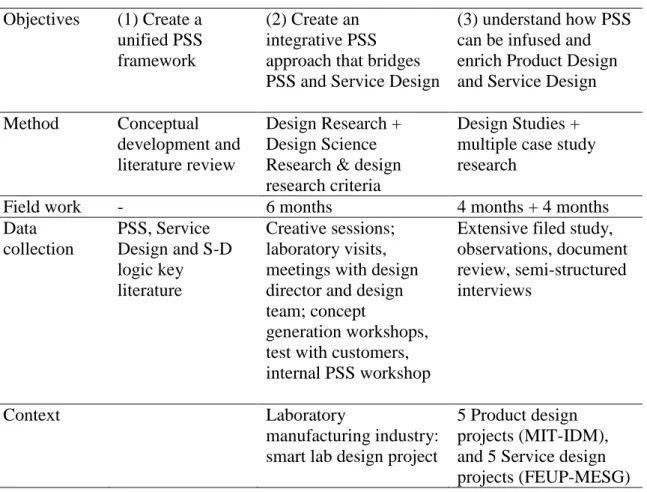
The research process included multiple stages that are outlined in the Table 1 and Figure 1. Topics, methods, data collected and the context of each study are outlined. The next section explains the research process and methods used for each stage.
Study 1: literature review to develop an conceptual framework for integrating PSS and service design
To address the first research question of the thesis, conceptual development (Meredith, 1993) and literature review was undertaken to understand the relevant problems and gaps at the intersection of PSS and Service Design. The thesis explores PSS, Service Design and S-D Logic (Costa, Patrício, & Morelli, 2015b, 2016), outlining key
contributions, gaps and complementarities. The synthesis of the literature results in a conceptual framework. The framework outlines the PSS focus on organizational networks, and Service Design focus on human-centered and co-creative processes. The service perspective on value co-creation (S-D Logic) is used explore and bridge the complementarities of these design approaches and create a conceptual framework.
Figure 1. Research design: objectives, research methods and results
Study 2: design research to develop a new integrative PSS design approach, combining PSS and service design, with an application to a smart-lab project
In the area of PSS, design research seeks to develop new design knowledge that can be embedded within configurations of artifacts (Cross, 1999), which are build and reflected upon, in a construction-oriented view (Forlizzi et al., 2008; Zimmerman & Forlizzi, 2008). As such, to address the second objective of the thesis - create a new integrative PSS approach and design models - the study followed a design research approach. According to Manzini (2008), design research comprises two main activities: (1) building new artifacts and (2) evaluating the artifacts while in use (Manzini, 2008). The first activity consists in identifying a class of problem that is relevant and building artifacts that may solve the problems. The second activity consists in reflecting upon the
Table 1. Objective, research methods, data collected and research context Objectives (1) Create a unified PSS framework (2) Create an integrative PSS approach that bridges PSS and Service Design
(3) understand how PSS can be infused and enrich Product Design and Service Design Method Conceptual
development and literature review
Design Research + Design Science Research & design research criteria
Design Studies + multiple case study research
Field work - 6 months 4 months + 4 months
Data collection PSS, Service Design and S-D logic key literature Creative sessions; laboratory visits, meetings with design director and design team; concept
generation workshops, test with customers, internal PSS workshop
Extensive filed study, observations, document review, semi-structured interviews
Context Laboratory
manufacturing industry: smart lab design project
5 Product design projects (MIT-IDM), and 5 Service design projects (FEUP-MESG) use of these artifacts in context, in terms of efficiency and effectiveness to solve the class of problems previously identified.
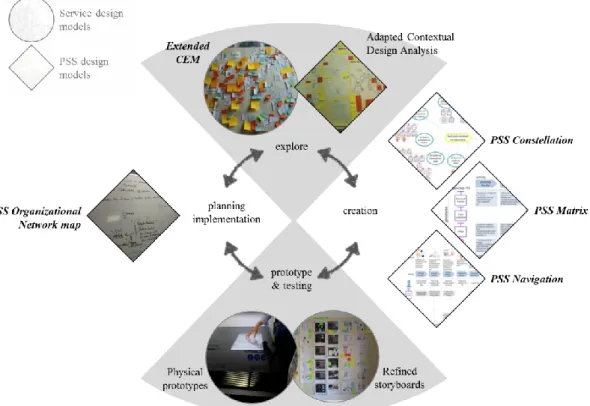
The research process follows three stages. Stage (1) involved the conceptual framework of the integrative PSS approach. Stage (2) comprised the application of the integrative PSS approach in a smart-lab project, following the design thinking stages i.e. exploration, creation, prototype and test and implementation (Johansson‐Sköldberg et al., 2013). Finally, stage (3) involved the evaluation stage, encompassing Design Science Research guidelines (Hevner et al., 2004) and Design Research criteria (Forlizzi et al., 2008).
Stage 1 starts with the literature review on service design, PSS design and S-D Logic, following guidelines of design research (Manzini, 2008). Literature review supports the development of new artifacts (i.e. integrative PSS method and respective models) in accordance to the analytical conceptual research (Meredith, 1993) and aim to better support the design of integrated solutions in manufacturing companies.
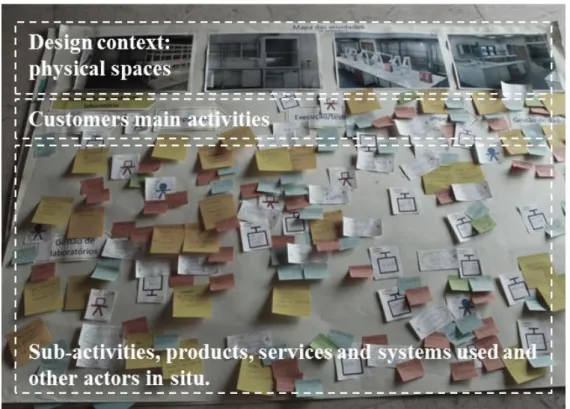
Stage 2 involved the application case follows a design thinking stages of exploration, creation, prototype and test and implementation (Brown, 2008; Johansson‐Sköldberg et al., 2013). The application stage follows the conceptual development stage in design research (Manzini, 2008). The exploration stage of the application uses qualitative research in sample design, data collection and data analysis, to develop an in-depth understanding of the customer experience (Charmaz, 2014; Strauss & Corbin, 2015). Following guidelines of qualitative research, the sample was selected according to the relevance of participants to gain in-depth understanding of the different stakeholders’ experience. Lab visits, group interviews, observations with field notes and exploratory sessions combined, provided information to develop categories of problems in context. The data analysis was supported through design models, which were evolved iteratively, with the participants of the study. The creation stage used new design models to support the creation of new product-service system solutions and new forms of value co-creation between customers and product/service providers. These models were evolved iteratively with the company design team. The prototyping and testing stages were also iterative, going from the construction of new physical products to the storyboards. Finally, the new product-service system solutions co-created were evaluated by the customers of the product-service system solutions.
Stage 3 involved the evaluation stage of the design artifacts developed following guidelines of Design Science Research (Hevner et al., 2004). The present thesis recognizes that reflective practice per se can lack on rigor and robustness (Collins et al., 2004; K Friedman, 2003; Jonas, 2007). As such, the evaluation stage was complemented with design research criteria (Forlizzi et al., 2008) and Design Science Research evaluation stage (Hevner et al., 2004), to evaluate the usefulness and effectiveness of the design artefact developed. The application of the integrative PSS approach and models developed showed that it can support the design of new integrated solutions. Also, following qualitative research guidelines (Charmaz, 2014), the integrative PSS approach was refined and evaluated in an iterative way, through multiple meetings with the design team along the design process and with a final internal workshop.
Design Science Research has been evolving consistently and is spreading across service research (Ostrom et al., 2015; J. Teixeira, 2015). Hevner et al. (2004) claim that built artifacts should be evaluated with respect to the utility provided in solving problems. As such, intervention in the real world is important. The design artifacts were developed together with a manufacturing industry, supporting the development of 5 product-service system solutions, which attests for Design Science Research evaluation criteria. Moreover, data about the effectiveness and utility of the integrative PSS approach was collected through regular meetings with the design team, after data collection and analysis, after the internal the co-creative workshops, as well as in a final internal workshop with the design and development team and CEO of the company. Data collection regarding the integrative PSS approach also followed qualitative research guidelines covering the tenets of sample design, data collection and analysis (Charmaz, 2014; Strauss & Corbin, 2015). The main contributions and limitations of the artifacts were analyzed, and incorporated in the models to refine the approach. Following the same reasoning, the evaluation stage also incorporates Forlizzi et al. (2008) criteria of process, invention, relevance and extensibility (Forlizzi et al., 2008). First (process) the design used was detailed to enable replication and improvement. Second (invention), the integrative PSS approach evolves previous methods of PSS and Service Design by combining their perspectives on customer experience and organizational networks, which were not integrated before. Third (relevance) the application in real-context showed how the method can support the co-creation of integrated solution and support the servitization process. Finally (extensibility), the success of the application indicates that the integrative PSS approach can be applied in other manufacturing settings.
Study 3: multiple case study to examine and compare Product and Service Design approaches, and understand how PSS can enrich these approaches
The third objective of the thesis was undertaken with multiple case study research (Yin, 2003, 2014) to study design practice, with product design and service design projects. Design research goes beyond building new design artifacts, and is concerned with understanding the nature of design itself (Dorst, 2008; Fallman, 2008), designerly ways of knowing (Cross, 2001; Johansson‐Sköldberg et al., 2013). This refers to the human-centered, creative and exploratory approach to understand problems, studying how
designers work, think and carry out their activities, use their methods and tools, how the designed artifacts are produced and how well they perform their jobs (Fallman, 2008).
Multiple case study was considered adequate to explore complementarities and gaps of Product Design and Service Design approaches, and to understand how partial PSS infusion can enrich these approaches. Studying multiple cases enhances the robustness of the findings, covers different theoretical and augments external validity (Voss, Tsikriktsis, & Frohlich, 2002; Yin, 2014). Multiple case study is aligned with design studies from Fallman (2008) as both research approaches are concerned with studying a certain phenomenon in context (Fallman, 2008).
Case study research allows the questions what, why and how to be answered when the boundary between context and phenomena is not clear (Yin, 2003, 2014). Within case study research, qualitative research methods were used to select the cases, collect and analyze data from multiple sources following qualitative research guidelines from Charmaz (2014) to enhance research rigor.
First, (case selection) the empirical ground of the research involved 10 design projects. Projects were purposefully selected within two distinct design contexts and according to their relevance to allow heterogeneity and richer qualitative inquiry (Voss et al., 2002): one context included 5 design teams adopting a Product Design approach, whereas the other context included 5 design teams adopting Service Design approach. The introduction of the PSS approach in the two contexts occurred at the initial stages of the design process, more precisely at the end of the exploration stage.
Second, data collection followed the guidelines of qualitative research (Charmaz, 2014; Strauss & Corbin, 2015) and ethnographic research (Murchison, 2010). Qualitative data collection methods included a total of 8 months extensive field study (4 month in each design context), in-situ observations with field notes, document review, collection of artifacts, and semi-structured interviews with the design teams.
The interviews were analyzed, and coded according to the guideline provided by (Charmaz, 2014; Strauss & Corbin, 2015). Data triangulation combined multiple sources of data. This improved the robustness of the results and increased the validity of