The Type of Advertising Appeals on
Consumer Responses
A Study on Green Advertising
Marta Ramos Lopes de Andrade
Dissertation written under the supervision of
Professor Vera Herédia Colaço
Dissertation submitted in partial fulfillment of requirements for the MSc in Management with Specialization in Strategic Marketing, at Católica Lisbon School of Business and
Title: The Type of Advertising Appeals on Consumer Responses. A Study on Green Advertising.
Author: Marta Ramos Lopes de Andrade
Abstract
The present dissertation aims to understand the impact of the type of advertising appeals (high vs low visually emotional) on consumer responses (Attention to the advertisement, Likelihood of Purchase and Willingness to Pay) to green advertising. Additionally, the mediating role of type of emotions was tested in the relationship between the type of advertising appeals and consumers’ responses. Based on a review of the academic literature, an experimental study was conducted, and results show that consumer responses, especially attention to the advertisement, are more impacted when a high visually emotional advertisement is presented. Additionally, negative rather than positive emotions show to mediate the relationship between visually emotional advertising appeals and consumers’ attention to the advertisement, as well as, the likelihood of purchase a sustainable product, such as bamboo toothbrush.
Resumo
A presente dissertação tem como objetivo compreender o impacto dos diferentes tipos de publicidade (alto versus baixo visualmente emocional) nas respostas dos consumidores (Atenção ao Anúncio, Intenção de Compra e Disposição para Gastar) a publicidade sustentável. Adicionalmente, o papel mediador do tipo de emoções foi testado na relação entre o tipo de apelo publicitário e a resposta dos consumidores. Baseado na revisão de literatura, foi desenvolvido um estudo experimental, e os resultados demonstram que as respostas dos consumidores, especialmente no que diz respeito à atenção ao anúncio, são fortemente condicionadas e mais favoráveis quando um anúncio tem um maior impacto emocional. Além disso, as emoções negativas demonstram mediar a relação entre o tipo de publicidade visualmente emocional e a atenção dos consumidores ao anúncio aquando comparadas com as emoções positivas. Estas têm também um impacto na probabilidade de compra de um produto sustentável, nomeadamente escova de dentes de bambu.
Table of Contents
Abstract ... 2
Resumo ... 2
1. Introduction ... 5
2. Literature Review ... 7
2.1. Sustainability as a growing trend ... 7
2.2. The Role of Advertising Appeals ... 8
2.2.1. Emotional Communication Appeals ... 10
2.3. Visually Emotional Advertising Appeals ... 10
2.4. Green Advertising ... 11
3. Research Question and Hypotheses ... 12
4. Methodology ... 14 4.1. Research Method ... 14 4.2. Research Design ... 14 4.2.1. Pre-Test ... 14 4.2.2. Main Study ... 15 4.3. Variables Description ... 16
5. Results and Analysis ... 17
5.1. Sample Description ... 17 5.2. Reliability Analysis ... 17 5.3. Correlation Analysis ... 18 5.4. Outliers Analysis ... 18 5.5. Manipulation Check ... 18 5.6. Main Results ... 19
5.6.1. The effect of the type of advertisement appeal on consumers’ responses ... 19
5.6.2. The mediating role of the type of emotions ... 20
6. Discussion and Implications ... 25
6.1. Theoretical Implications ... 26
6.2. Practical Implications ... 27
7. Limitations and Future Research ... 28
References ... 30
Appendices ... 34
Table of Tables
Table 1: Manipulation Check for the pre-test ... 14 Table 2: Manipulations ... 16 Table 3: Manipulation Check for the main study ... 19 Table 4: Results of the one-way interaction of the type of ad appeal on the dependent
variables ... 20 Table 5: Results independent samples t-test of the type of ad appeal on the dependent
variables ... 20 Table 6: Positive Emotions as a mediator on the effect of the type of ad appeal on attention to the advertisement ... 21 Table 7: Positive Emotions as a mediator on the effect of the type of ad appeal on likelihood of purchase ... 22 Table 8: Positive Emotions as a mediator on the effect of the type of ad appeal on willingness to pay ... 22 Table 9: Negative Emotions as a mediator on the effect of the type of ad appeal on attention to the advertisement ... 23 Table 10: Negative Emotions as a mediator on the effect of the type of ad appeal on
likelihood of purchase ... 24 Table 11: Negative Emotions as a mediator on the effect of the type of ad appeal on
1. Introduction
“We are now experiencing what can only be called a planetary crisis — a convergence of
accelerating climate change, unprecedented loss of biodiversity, and increasing human health issues caused by a toxic environment.” (Leonardo DiCaprio Foundation, 1998)
During the last decade, the Planet Earth has been experiencing an increase in global warming as a consequence of the climate change (Leonardo DiCaprio Foundation, 1998). Deforestation, urbanization, carbon emissions, and burning of fossil fuels have a major impact on the environment that can lead to massive devasted events in the near future (as cited in Trudel, 2019). While world leaders and big corporations have started to make a change, environmental activists, including Leonardo DiCaprio and Greta Thunberg are being heard and making a difference by educating humans on this relevant and of extreme importance topic that is climate change (Global Climate Strike, 2019).
Environmental concern has been evolving among the population and causing an impact on our daily activities. Using reusable water bottles, public transportation instead of car or even buying in secondhand stores are just some of the small changes that each individual can embrace in order to make a difference on this global crisis. Additionally, with the increase of eco-friendly brands focusing on a more conscious and sustainability-driven business model (e.g. Patagonia, Outerknown and The Bam&Boo Toothbrush) it has been expected that society starts behaving in a more sustainable consumption manner. However, being motivated to become more sustainable doesn’t necessarily mean having a positive relationship with actual buying behavior of eco-friendly products. According to previous research, while 40% of consumers keep in mind the idea of buying sustainable products, only 4% actually act to this and convert it into a behavior (as cited in Kong, Ko, Chae & Mattila, 2016). Consequently, adapting a proper communication model aiming to promote newly developed sustainable products is essential and will enable brands to differentiate themselves from competition and convey the right message so that, the consumer is aware and engages in more sustainable consumption choices.
The complexity and number of stimuli present during purchase decisions can have a huge impact on the final decision of the consumer (Guerreiro, Rita & Trigueiros, 2015), especially when it comes to low-involvement products which are usually recognized as impulsive purchases without much thought. Among the different marketing mix elements, advertising has
been a powerful and dominant tool for stimulating consumer buying behavior, which often has the ability to generate needs (Akbari, 2015). The type of advertising appeal has been shown by marketers to have the capability of influencing attitudes towards advertisements which is an important and well-established antecedent of brand attitudes (Mackenzie & Lutz, 1989). Similarly, during the last decade, firms have started to understand the power of emotions when well applied on advertising. Compared with a rational focus marketing strategies, advertising that is able to generate emotions on the consumer is more likely to motivate and drive constructive actions (Passyn & Sujan, 2006). As a consequence, emotional mechanisms and attentional processing of information become key elements in judging a product/brand (Guerreiro et al., 2015). Understanding how and when consumers devote attention to certain communication is key to determine the strategy to follow (Rosbergen, Pieters, Wedel, 1997). The purpose of this study is then, to evaluate to what extent consumers’ responses such as attention to the advertisement, likelihood of purchase and Willingness to Pay – WTP, are affected by the type of advertising appeals especially when taking into consideration the type of emotions generated by these appeals on consumer responses.
The remaining part of this dissertation starts with a literature review about the most relevant and appropriate concepts and theories about the type of communication messages that may be more versus less effective in promoting sustainability-related issues. Next, the research framework and conceptual model are presented along with the hypotheses. The subsequent section describes the research design and the correspondent methodology. Finally, the final results are presented, and the paper concludes with a general discussion of the findings along with some limitations and outlook for future research.
2. Literature Review
2.1.Sustainability as a growing trend
The increasing interest and availability of sustainable or eco-friendly products is revolutionizing the market as we know it today (Carrigan & Attalla, 2001; Carrington, Neville, & Whitwell, 2010). Introducing new products and practices that focus on quality, performance, pricing and convenience while reducing companies’ footprint has never been more important in order to maximize efficiency and explore new market opportunities (Cronin, Smith, Gleim, & Martinez, 2011; Constantine, Constantinos, & Athina, 2016).
The constant increase of sustainable brands, changes in consumption and ecological challenges have, put further pressure over companies to behave more sustainably (Constantine et al., 2016). With 90% of CEOs’ agreeing that sustainability is fundamental for the success of a brand (Lein, 2018), it is almost impossible to survive in this competitive market without adopting a sustainable business focus and green marketing practices (Kotler, 2011; Constantine et al., 2016).
Firms have come to realize that sustainability is a vitally important business goal that enables them to build competitive advantage, to engage in corporate social responsibilities (CSR), and to sustain the future growth of the business (Constantine et al., 2016). Not only but especially well-known, trend setter, familiar brands have started to realize this phenomenon and are adapting their business model towards a more sustainable driven one by modifying or introducing new products or production practices in order to reduce the ecological impact (Cronin et al., 2011). In the toiletry and personal care industry, there’s now a different variety of products with a more sustainable and eco-friendly focus. For instance, Portuguese laundry detergent brand - Skip has now an Eco Detergent without chemicals and a packaging made out of plastic from the oceans.
Most companies keep up with the changing business environment by aligning themselves with the interests of stakeholders including the market-oriented needs and wants of consumers who have a greater focus on sustainability, the so-called - Green Consumers (Constantine et al., 2016). This new type of ethical minded consumer feels a responsibility for the environment, adopting ethical, sustainable and eco-friendly behaviors or even further, by purchasing green products over the standard alternatives offered in the market (Cronin et al., 2011; Onditi, 2016).
Despite companies’ efforts in developing more sustainable and ethical products, the segment size of green consumers is still difficult to access (Osterhus, ,1997). The growing segment of consumers that are motivated to engage in a more sustainable consumption, doesn’t actually convert into more sustainable behaviors leading to the so-called attitude-behavior gap manifestation (as cited in Perera & Hewege, 2018). According to previous search, while 40% of consumers keep in mind the idea of buying sustainable and eco-friendly products, only 4% actually act accordingly and convert to sustainable behavior (as cited in Kong et al., 2016). This is most evident in in-store situations where brands try to make their products more visible. The high variety of products available, the heavy discounts or even the fact that the desired sustainable product might not be available at the time of purchase are just some of the factors that can lead consumers to refrain from executing more environmentally-friendly behaviors when faced with overcrowded shelves full of competing products (Carrington et al., 2010). More recently an upsurge of Fast-Moving Consumer Goods' brands have started to offer a wider range of low-involvement, eco-friendly products such as toothbrushes made of bamboo in order to motivate consumers to consume more responsibly. Although, low involvement products are often less valued than high-involvement ones, the former indeed represent a significant market share of the fast-moving consumer goods segment (FMCG) (Sable, 2019). In spite of these innovative market launches aiming to promote easier and more sustainable consumption decisions, little is known how consumers react and behave towards product advertising appeals trying to convince them to engage on more sustainable behaviors, and thus, supporting the previously mentioned attitude-behavior gap between good intentions and actual sustainable behaviors (Carrington et al., 2010).
Recognizing this gap is then crucial for any firm to understand what the factors are underlying sustainable consumption intentions and attitudes toward low-involvement sustainable products.
2.2. The Role of Advertising Appeals
The complexity of purchasing decisions has been suggested by prior advertising literature to influence consumers’ genitive and emotional state (Edell & Burke, 1987). The number of visual stimuli that calls for consumer attention surpasses the limited processing capacities and resources of the brain of any consumer (Guerreiro et al., 2015), consequently negatively influencing the attention engagement towards a product or even a brand. Therefore, understanding how and when consumers dedicate attention to commercial stimuli is of even
greater concern in today’s competitive market in order to develop the best marketing strategies (as cited in Rosbergen, Pieters & Wedel, 1997).
This is especially relevant in the case of low-involvement products such as toothbrushes which are typically led by well-established brands in highly competitive and matured markets (e.g. Colgate). For new entry brands, launching a product that is innovative but has no market penetration the challenge becomes even harder in persuading the consumer to the product, especially when it comes to sustainable or eco-friendly products.
Among the different marketing mix elements, advertising is one of the most visible marketing activities (Buil, Chernatony, & Martínez, 2011) among national and international brands promotion since it is a powerful and dominant tool for stimulation consumer buying behavior, which has often the ability of generating a need (Akbari, 2015). For instance, many researchers have suggested the impact that a single picture can have on the processing of the information presented in advertisements (as cited in Edell & Staelin, 1983; Petrova P. K., Cialdini, R. B., 2005, Scott, L. M., Vargas, P. 2007). Pictures are in general more attention gathers, easier to process. According to Starch (1966), a picture is more likely to make people remember an ad than a verbal text therefore influencing a variety of advertising outcomes (as cited in Edell et al., 1983).
Research suggests that the type of advertising appeal has usually a determinant impact on consumer behavior since it influences attitudes-towards-the-ad which is an important and well-established antecedent of brand attitudes (Mackenzie et al., 1989). Selecting the proper type of advertisement stimuli that is likely to elicit appropriate emotions in the target audience (Rossiter & Percy, 1991) plays then a critical role in communication. It enables a firm to stand out from the cluttered environment and have a higher probability of being part of the consideration set of the consumer. This aforementioned aspect is of even greater concern on utilitarian products due to the fact that consumers have already a pre-established learning task aiming to fulfill a functional need (Guerreiro et al., 2015). Furthermore, research also suggests that brand equity perceptions can be highly influenced by consumers’ attitudes towards an advertisement (Gorn, 1982; D'Souza & Taghian, 2005), therefore the message being conveyed will influence its effectiveness (Greyser, 1972; Mehta, 2000) and potentially consumers’ responses to the product (Mehta et al. 2000).
2.2.1. Emotional Communication Appeals
Advertising usually relies within two categories, rational versus emotional. While rational appeals have a major focus on the product benefits and features such as product quality, value or performance (Albers-Miller & Stafford, 1999), emotional appeals have the ability of generating positive or negative feelings. These in turn, have been suggested to affect consumers’ attention/ reaction toward an ad, and furthermore impact brand attitudes (Edell et al., 1987). According to the advertising literature, emotional appeals are usually highly effective on low involvement products whereas rational appeals are more effective on products with which consumers are highly involved (Baker & Lutz, 2000; Akbari et al., 2015).
Additionally, prior research suggests that feelings play an important role in the formation of attitudes and judgements about advertisements and consequently, on generating beliefs about a brand (Edell et al., 1987; Kemp, Bui & Chapa, 2012). This is especially relevant when compared with more rational appeals that have been shown to be less effective (Panda & Mishra, 2013). Thus, a key distinction between rational and emotional appeals, is the emotional ability to motivate and drive consumers’ responses (Passyn et al., 2006).
2.3.Visually Emotional Advertising Appeals
Over the last few decades, marketers have been combining visual attention and emotion arousal appeals in advertising as a marketing and communication technique to persuade consumers into a product/brand (Garg, Wansink & Inman, 2007). Making use of graphic, sensational and shock negative emotional appeals copies, marketers aim to make the brain itch and generate an action on behalf of the consumer (Panda et al., 2013). Overall, what differentiates the effectiveness of an advertising is not the beneficial attributes of a product but rather the marketer’s capability of transmitting those same attributes in an emotional way (Rossiter et al., 1991).
Previous search suggests that negative emotions (especially fear, regret and guilt) when compared to positive emotions act as motivators of altruistic behavior and drive constructive actions (Allen, Machleit & Kleine, 1992; Kim & Johnson, 2013). The stronger the fear aroused through the communication appeal, the more sensitized the consumer is to take action and focus the attention on the critical content of the advertising message (Janis, 1967). Consequently, this may lead the consumer to redirect his/her consumption behavior to conform to or decrease the potential negative affective states that may arise from exposure to the stimuli (Garg et al., 2007).
As a consequence, emotional mechanisms and attentional processing of information become key elements in judging a product/brand (Guerreiro et al., 2015). Understanding how and when consumers devote attention to certain communication is key to determine the strategy to follow (Rosbergen et al.,1997).
2.4.Green Advertising
During the last decade, an increase in global warming as a consequence of the climate change has generated a green challenge emergence bringing many changes in consumers’ buying behavior. Therefore, it has become crucial for any firm to understand which factors among advertisement are underlying the green consumer intentions and attitudes toward (new) sustainable products (Carrington et al., 2010).
Green advertising refers to “the promotional messages that may appeal to the needs and desires of environmentally- concerned consumers” (Zinkhan & Carlson, 1995, p.1 ). It has been growing constantly due to the increase in consumer demand relatively to this new green trend (D'Souza et al., 2005). The credibility of green advertising was still very low in the early days (Kilbourne, 1995) therefore, during the last decades, it has been a crucial and extensively studied topic so that firms can develop highly effective eco communication and marketing strategies targeting the right segment – Green Consumers (Stafford & Chowdhury, 1996; Perera et al., 2018; Trudel, 2019).
Advertisers and marketers have been adopting various types of advertising appeals that help change consumers’ attitudes and behaviors (Edell et al., 1987). Green Advertising is no different. When exposed to an ad, consumers form feelings and judgements that have an impact on the attitude towards the advertisement and on brand perceptions (Batra and Ray, 1986). Therefore, companies have started to understand the high potential of emotions when well applied on green advertisement, especially when it comes to guilt appeals (D'Souza et al., 2005). Among all the studies on emotions, guilt appeals have been found to be a successful persuasive technique among these eco-friendly products (Burnett & Lunsford 1994). Guilt has been defined has an internal emotional response involving self-blame, self-punishment (Lascu, 1991) and according to Bozinoff and Ghingold (1983), guilt can arouse independently of any other emotions in order to change consumers’ attitudes (as cited in Jiménez & Yang, 2008). However, when inadequately applied might be perceived as an attack to one’s self and generate negative behaviors towards a product or even a brand (Coulter & Pinto, 1995). Hence, the relationship
between the level of guilt on message-specific attitudes is very significant (Pinto and Priest, 1991) and should be taken into consideration when developing a new campaign or launching a new product.
Despite the deep and vast research on guilt appeals, there is still very few literature examining the impact of other type emotions (positive versus negative, for instance) on green advertising. Since emotions have an impact on consumers’ reaction to an advertisement, they will affect consumers’ responses and furthermore an attitude towards a brand. Therefore, emotions should be taken into consideration while analyzing green marketing and its effectiveness on consumer buying behavior.
With new marketing strategies being implemented, the aim of this paper, is then to understand the role of emotions on the relationship between the type of green advertising appeal on consumer responses (attention to the advertisement, likelihood of purchase, willingness to pay), to messages that are high versus low visually emotional. Not only it will contribute to examine the previously mentioned attitude-behavior gap of the literature on sustainable consumption in a more detail way, but also it aims at providing insights on the impact of positive versus negative emotions on consumer responses towards the aforementioned types of advertisements.
3. Research Question and Hypotheses
In accordance with the academic literature provided, this chapter presents the conceptual model and hypothesis of this empirical study. Specifically, it attempts to provide answers to the following questions:
RQ 1: Do visually emotional appeal advertisements have an impact on consumers’ emotions and consumer responses, including the attention to the advertisement, likelihood of purchase and Willingness to Pay – WTP?
RQ 2: Does the advertisement message evoke consumers’ emotions and consequently, will help explain the relationship between the type of advertisement appeals and consumer responses?
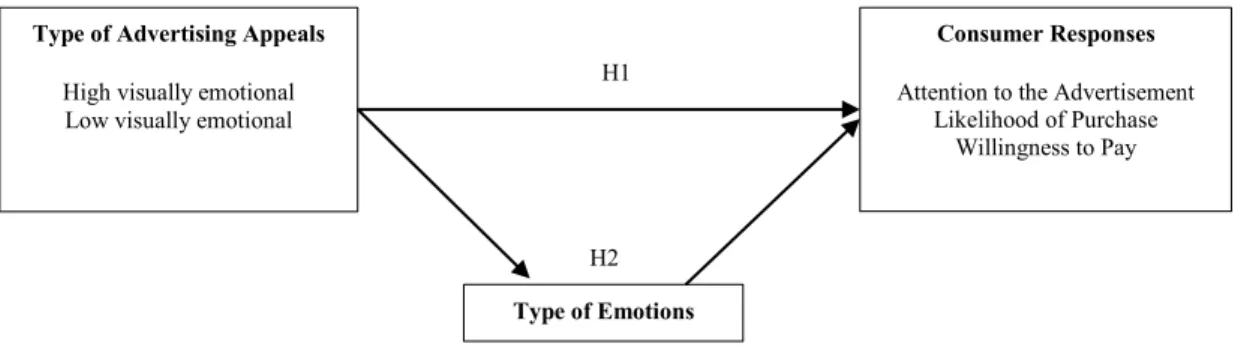
Figure 1: Conceptual Framework
As suggested by prior research the more visually impactful the communication appeal, the higher are consumers’ responses and attention to the critical content of the advertising message (Janis, 1967). Therefore, the first hypothesis is suggested as follows:
H1: The higher (vs. the lower) the level of visually emotional appeal, the higher (vs. the lower)
consumers’ attention to the advertisement, likelihood of purchase and willingness to pay for the advertised products.
Recent literature evaluating the impact of emotions on consumer responses to advertisement appeals, suggests that an ad has the ability to generate emotional reactions on consumers, which can highly affect their attention to an advertisement and on brand perceptions (Edell et al., 1987). Additionally, consumers are usually more susceptible to negatively than positively framed advertising messages (Allen et al., 1992; Kim et al., 2013). Following this reasoning, we predict that the type of emotions generated from an ad will mediate the effect of the type of advertising appeals on consumers’ attention to an advertisement, likelihood of purchase and willingness to pay. Thus, our second hypothesis is as follows:
H2: The type of emotions generated will mediate the relationship between the type of visually
emotional advertising appeals and consumers’ responses (attention to the advertisement, likelihood of purchase and willingness to pay).
Type of Advertising Appeals
High visually emotional Low visually emotional
Consumer Responses
Attention to the Advertisement Likelihood of Purchase
Willingness to Pay
Type of Emotions
H1
4. Methodology
4.1. Research Method
In order to properly address the research questions and proceed to the analysis of the hypothesis presented above, primary data was gathered through two experimental design studies: a pre-test and a main study. Both studies were conducted through an online platform (Qualtrics) that enabled fast and high diversity answers. Despite the importance of qualitative research, an Online Survey was created with the intent of collecting data that would be a more accurate representation of the population.
For this type of research, a non-probability sampling technique was used meaning the odds of any member being selected can’t be calculated. Despite being one of the easiest ways of collecting data, results can contain hidden biases and uncertainties.
4.2. Research Design
4.2.1. Pre-Test
A Pre-Test was conducted through 22 different respondents. The purpose of this study was to understand if the questions were comprehensible and understandable by all the respondents. Additionally, it was helpful to understand whether the manipulations performed as expected. First of all, an independent samples’ t-test at 95% confidence interval level was used to measure the manipulation check. The results show statistical significance. Respondents considered the high emotional ad (Mhigh_emotional_ad = 4.55, SD = .52) more alarming than the low emotional ad
(Mlow_emotional_ad = 3.64, SD = .92); t (20) = -2.84; p < .05 (see Table 1).
Table 1: Manipulation Check for the pre-test
Mean SD Mean SD t-test Alarming Manipulation
Check 3.64 .92 4.55 .52 -2.84*
*p < .05; **p < .01;***p < .001; +p ≤ .1; standard deviations are presented between parentheses.
4.2.2. Main Study
The main study was conducted using the same manipulations and tested across different social media platforms that enabled fast and very diverse results. The manipulations were randomized among 235 respondents who successfully completed the survey with all questions answered. Design and Procedure
The main objective of this study was to understand how visually emotional advertising appeals impact consumers’ attention to the advertisement, likelihood of purchase, and Willingness to Pay, the dependent variables. The study followed a two-group (type of advertising appeal: low visually emotional, high visually emotional) between-within subjects design.
The study was composed by three parts. In the first part, respondents were asked a set of different questions, inspired on the Green Scale (Haws, Winterich & Naylor, 2014), concerning environment and its implications on consumer behavior.
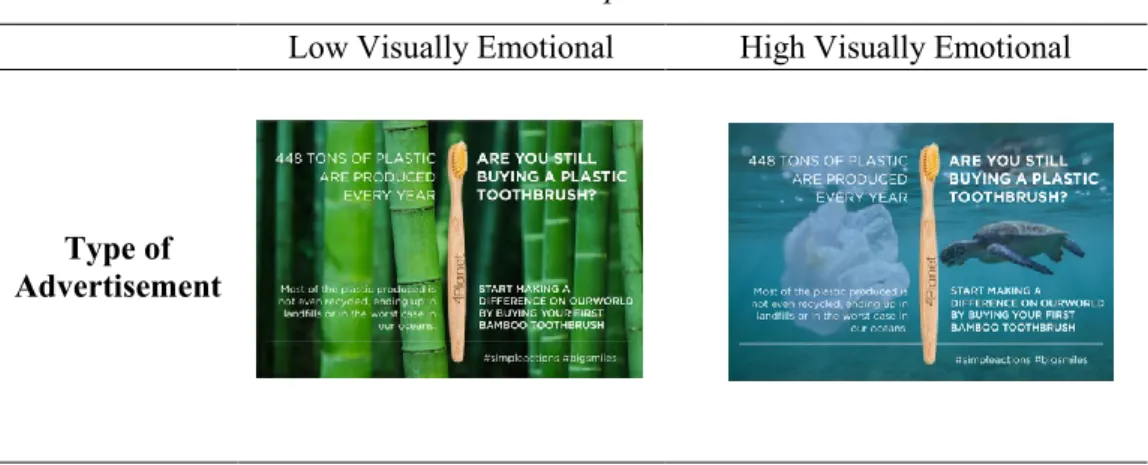
Next, the manipulations were presented. Using the randomizer flow option form Qualtrics, a very powerful tool to test different type of manipulations, respondents were randomly assigned to a condition that showed one of two different visually emotional advertising appeals promoting a fictitious toothbrush brand made of bamboo – the 4Planet. The main objective was to state a problem (plastic pollution) by presenting factual information about the harmful consequences of single-use plastic, followed by offering a recommended action/solution that might avoid those negative consumption consequences.
Therefore, both advertisement appeals showed the exact same verbal information, but what differentiated them was the background image (see Table 2). The low visually emotional advertising appeal showed a bamboo image in the background, in line with the material of the toothbrush promoted. The high visually emotional advertising appeal showed a turtle in the background surrounded by plastic, intended to be more dramatic and alarming.
Table 2: Manipulations
Low Visually Emotional High Visually Emotional
Type of Advertisement
The third part assessed participants’ perceptions and emotional responses toward the advertisement, followed by their consumption habits concerning toothbrush usage. By asking a set of different questions, this section of the survey was crucial to understand, not only the knowledge but also the experience respondents have within the topic of toothbrushes, especially bamboo toothbrushes.
In the end of the survey, a set of demographic questions were asked to better understand the diversity of the sample, and furthermore the different segments concerning age, gender, income, nationality and occupation.
4.3.Variables Description
Independent Variables
Type of advertising appeal - was operationalized as high visually emotional versus low
visually emotional appeal conditions (through the previously mentioned manipulations). Mediator
Type of Emotions was used as a mediator and measured by asking respondents their level of
agreement with four different emotions they experienced after seeing the advertising appeals, on a 5-point Likert scale (1 = strongly disagree; 5 = strongly agree):
(1) “(4Planet advertisement made me feel) Sad” (2) “(…) Shocked”
(3) “(…) Encouraged” (4) “(…) Proud”
Dependent Variables
Attention to the advertisement was measured by asking respondents how likely would the
4Planet ad call their attention if they were in the supermarket, on a 7-point Likert bipolar scale (1 = Unlikely; 7 = Likely).
Likelihood of Purchase was assessed if the respondents would be willing to trade the 4Planet
Bamboo Toothbrush for their usual purchase, on a 7-point Likert bipolar scale (1 = Unlikely; 7 = Likely).
Lastly, Willingness to Pay was measured by asking respondents how much they would be willing to pay for a 4Planet Toothbrush in Euros (from 0 to 10€– since the objective was the make it as realistic as possible).
5. Results and Analysis
5.1. Sample Description
The main objective was to have a sample as diverse as possible so that the results would be a more accurate representation of the population and therefore more reliable. The total sample collected was of two hundred and thirty-five (235) responses composed by both female (50.9%) and male (49.1%). Concerning the age interval of the respondents, most of them were between 18-34 years old (55.1%), followed by the age interval of 35-74 (32.4%). Both of these age segments accounted for 90.2% of the total sample.
Most of the respondents were either students (34.6%) or employed full time (57.3%) living in Portugal (76.5%). Despite the majority of the respondents living in Portugal in the last 5 years, the sample was extremely differentiated with the remaining participants coming from Brazil, France, Germany, Netherlands, Spain, United Kingdom and many others.
The annual income varied across the different levels displayed with the majority of the participants laying on less than €10,000 (17.1%) and between €10,000-€19,999 (19.0%).
5.2.Reliability Analysis
In order to understand whether the set of questions used to measure the type of emotions generated on the respondents are a reliable measure, a factor analysis was performed.
Factor analysis is a technique that serves to combine questions or variables to create factors. Through the factor analysis, we can observe that the Kaiser-Meyer-Olkin Measure of Sampling Adequacy was .74 above the commonly recommended value of .60, and Bartlett’s test of sphericity was significant (χ2(10) = 253.45, p < .001). Additionally, the communalities which are the proportion of variance for each variable that can be explained by the factors were all over .6, an acceptable value. Finally, the negative emotions sadness, shock and guilt emerged as being all part of Component 1 with high factor loadings while pride, encouragement and
guilt emerged as part of component 2. The decision resulting from the factor analysis was to
proceed the analysis with two sets of emotions: positive (encouragement and pride) and negative (sadness, shock and guilt), which were then aggregated to two independent indexes: positive emotion index and negative emotion index.
5.3.Correlation Analysis
In order to analyze the relationship between a set of items on any given variable, a Pearson Correlation Coefficient was also run to assess the correlation within positive emotions. Overall, results show there was a medium correlation between encouragement and pride (r = .31, n = 235, p < 0.001).
Concerning the negative emotions, a linear regression was performed and results show there was a high correlation between the three variables, sadness, shock and guilt (r = .41, F(1,235) < 0.001).
5.4.Outliers Analysis
Outlier Analysis helps understanding whether there is any observation that is distant from the remaining ones, detecting unusual answers and biased results. By using a multivariate outlier analysis, a Mahalanobis was calculated for each participant. As a result, six multivariate outliers were removed from the analysis since the responses had p-values lower that .05.
Therefore, the rest of the study was conducted with two thousand and twenty-nine (229) participants instead of the initial value of two thousand and thirty-five (235).
5.5.Manipulation Check
expected, respondents considered the high visually emotional advertisement (Mhigh emotional_ad =
3.93, SD = .88) more alarming than the low visually emotional advertisement (Mlow_emotional_ad
= 3.67, SD = .94); t (228) = -2.12; p < .05 (see Table 3).
Table 3: Manipulation Check for the main study
Low Visually Emotional High Visually Emotional
Mean SD Mean SD t-test Alarming Manipulation
Check 3.67 .94 3.93 .88 -2.12*
*p < .05; **p < .01;***p < .001; +p ≤ .1; standard deviations are presented between parentheses.
5.6.Main Results
In order to properly address the main results of this study, a multivariate analysis of variance (MANOVA) was performed. A MANOVA is an extension of ANOVA with two or more continuous responses variables. This analysis was conducted to understand the impact of the type of advertisement appeal on consumers’ responses. ANOVA studies the effect of “c” treatments on one response variable and is used to determine whether there are any statistically significant differences between the means of two or more independent groups. For further in-depth analysis, Independent Samples t-tests were performed to measure the difference within the previously mentioned means. Concerning the mediator, regression models were estimated using Hayes’ Process (Hayes, 2013, 2015).
5.6.1. The effect of the type of advertisement appeal on consumers’ responses
H1: The higher (vs. the lower) the level of visually emotional appeal, the higher (vs. the lower)
consumers’ attention to the advertisement, likelihood of purchase and willingness to pay for the advertised products
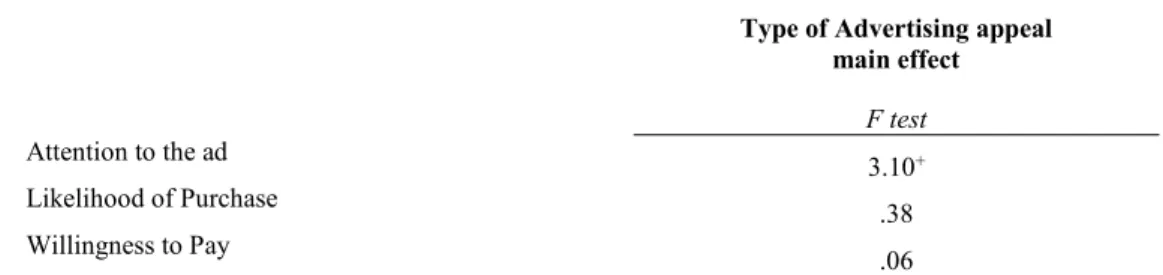
MANOVA results showed a marginally significant effect on the attention to the advertisement dependent variable (F(1, 228) = 3.10, p = .08)). However, no significant main effects were obtained for the remainder dependent variables, Likelihood of Purchase (F(1,227) = .38, p = n.s.) and Willingness to Pay (F(1,227) = .06, p = n.s.), partially validating H1(see Table 4).
Table 4: Results of the one-way interaction of the type of ad appeal on the dependent variables
Type of Advertising appeal main effect
F test
Attention to the ad 3.10+
Likelihood of Purchase .38
Willingness to Pay .06
*p < .05; **p < .01;***p < .001; +p ≤ .1: standard deviations are presented between parentheses.
An independent samples’ t-test was then performed to test mean differences on the attention to the advertisement dependent variable, when consumers were exposed to the high versus low visually emotional advertising appeals. Results show a higher but marginal impact of the high visually emotional advertising appeal (Mhigh_emotional_ad = 5.73, SD = 1.29) than the low visually
emotional advertising appeal (Mlow_emotional_ad = 5.43, SD = 1.30); t(227) = -1.76; p = .08) on the
attention to the advertisement (see Table 5).
This result shows that, overall, the high visually emotional advertisement has a marginally higher impact on participants’ attention toward this type of advertising appeal.
Table 5: Results independent samples t-test of the type of ad appeal on the dependent variables
Low Visually Emotional High Visually Emotional
Mean SD Mean SD t-test Attention to the ad 5.43 1.30 5.73 1.29 -1.76+
*p < .05; **p < .01;***p < .001; +p ≤ .1; standard deviations are presented between parentheses.
5.6.2. The mediating role of the type of emotions
H2: The type of emotions generated will mediate the relationship between the type of visually
emotional advertising appeals and consumers’ responses (Attention to the Advertisement, Likelihood of Purchase and Willingness to Pay).
In order to address hypothesis 2, Hayes’ Process, model 4 (Hayes, 2013, 2015) was used to perform a mediation analysis. A bootstrap analysis was performed in order to understand if the type of emotions were indeed a mediator in the conceptual model. According to the mediation
literature (Hayes, 2013, 2015), only confidence intervals that do not include zero can be considered significant and therefore a mediator.
The type of advertising appeal was included as predictor, the Type of Emotions (positive emotion index, negative emotion index) were included, one at a time, as mediators and Consumer Responses (Attention to the Advertisement, Likelihood of Purchase and Willingness to Pay) as the final outcome. Specifically, the mediation analysis was carried out starting with positive emotions’ index (Pride, Encouragement) as a mediator, first.
The results show that no mediating effects are observed for the attention to the advertisement dependent variable. In spite that there is a main effect of the positive emotion index on attention to the advertisement (b = .64, SE = .11, p < .001, 95% CI = [0.43, 0.85]), the impact of the type of advertising appeal on the positive emotion index is not significant (b = -.08, SE = .10, p = n.s., 95% CI = [-0.28, 0.11]). Subsequent testing of the conditional indirect effects indicate also that the positive emotions do not mediate the effect of type of advertising appeal on attention to the toothbrush advertisement (indirect effect = -0.05, SE = .06, p = n.s., 95% CI = [-0.18, 0.08]). This is supported by a significant test of the conditional direct effect of the type of advertisement appeal on the attention to the advertisement (direct effect = .35, SE = .16, p < .05, 95% CI = [0.04, 0.67]) (see Table 8).
Table 6: Positive Emotions as a mediator on the effect of the type of ad appeal on attention to the
advertisement
As for the variable Likelihood of Purchasing, the same pattern of results was obtained. That is, a main effect of positive emotions was observed on the likelihood of purchase dependent variable (b = .86, SE = .14, p < .001, 95% CI = [0.58, 1.13]). However, no main effect (b = -.08, SE = .10, p = n.s., 95% CI = [-0.28, 0.11]) nor mediation effect of positive emotions on likelihood of purchasing the 4 Planet Toothbrush were observed (indirect effect = -.07, SE = .09, p = n.s., 95% CI = [-0.24, 0.10]). The conditional direct effect of type of advertising appeal Outcome Indirect Effect Paths Indirect Effect Lower CI Upper CI
1 Type of Advertising appeal → Positive Emotions -.08 -0.28 0.11 2 Positive Emotions → Attention to the Advertisement .64*** 0.43 0.85 3 Type of Advertising appeal → Positive Emotions → Attention to the
Advertisement -.05 -0.18 0.08
Direct Effect Paths Direct Effect
4 Type of Advertising appeal → Attention to the Advertisement .35* 0.04 0.67
on likelihood of purchase was also non-significant (direct effect = -.07, SE = .21, p = n.s., 95%
CI = [-0.47, 0.35]) (see Table 9).
Table 7: Positive Emotions as a mediator on the effect of the type of ad appeal on likelihood of
purchase
For the last variable (Willingness to Pay), the same test was performed. Similar to the effect on the previous variable, a main effect of positive emotions was observed on willingness to pay (b = .43, SE = .18, p < .05, 95% CI = [0.07, 0.78]). Nevertheless, no other main effect (b = -.08,
SE = .10, p = n.s., 95% CI = [-0.28, 0.11]) nor mediation effect of positive emotions on
willingness to pay were observed (indirect effect = -.04, SE = .05, p = n.s., 95% CI = [-0.14, 0.05]). This is supported by a non-significant test of the conditional direct effect of the type of advertisement appeal on the 4Planet Toothbrush willingness to pay (direct effect = .10, SE = .27, p = n.s., 95% CI = [-0.43, 0.63]) (see Table 10).
Table 8: Positive Emotions as a mediator on the effect of the type of ad appeal on willingness to pay
Next, the analysis was carried out testing the mediating role of the type of negative emotions (Sadness, Shock, Guilt) between the type of advertising appeal and consumers’ responses – attention to the advertisement, likelihood of purchase and WTP.
A bootstrap analysis model 4 (Hayes, 2013, 2015) was again performed using the negative Outcome Indirect Effect Paths Indirect Effect Lower CI Upper CI
1 Type of Advertising appeal → Positive Emotions -.08 -0.28 0.11 2 Positive Emotions → Likelihood of Purchase .86*** 0.58 1.13 3 Type of Advertising appeal → Positive Emotions → Likelihood of
Purchase -.07 -0.24 0.10
Direct Effect Paths Direct Effect
4 Type of Advertising appeal → Likelihood of Purchase -.07 -0.47 0.35
*p < .05; **p < .01;***p < .001; +p ≤ .1; standard deviations are presented between parentheses.
Outcome Indirect Effect Paths Indirect Effect Lower CI Upper CI
1 Type of Advertising appeal → Positive Emotions -.08 -0.28 0.11
2 Positive Emotions → Willingness to Pay .43* 0.08 0.78
3 Type of Advertising appeal → Positive Emotions → Willingness to Pay -.04 -0.14 0.05
Direct Effect Paths Direct Effect
4 Type of Advertising appeal → Willingness to Pay .10 -0.43 0.63
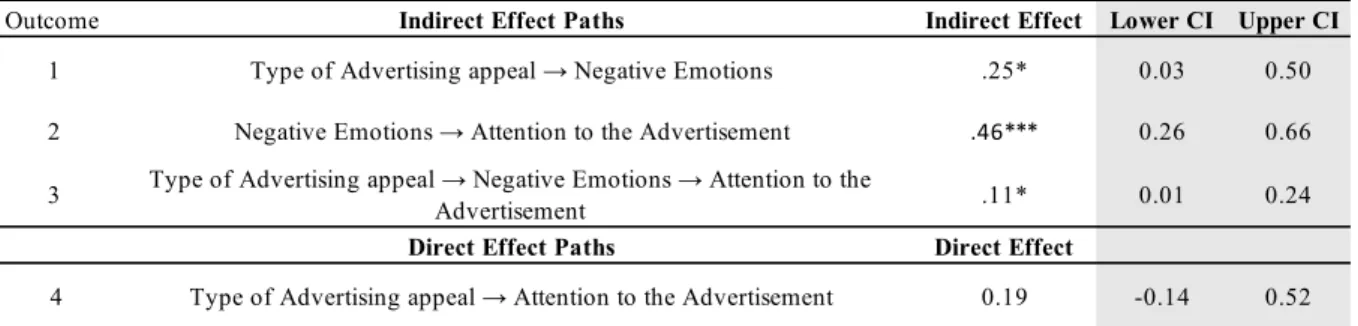
obtained before with the positive emotions’ index. Both the impact of the type of advertising appeal on negative emotions (b = .25, SE = .11, p < .05, 95% CI = [0.03, 0.50]) and the impact of negative emotions on attention to the advertisement are significant (b = .46, SE = .10, p < .001, 95% CI = [0.26, 0.66]). Following this analysis, the conditional indirect effects indicate that negative emotions mediate the effect of type of advertising appeal on attention to the advertisement (indirect effect = .11, SE = .06, p < .05, 95% CI = [0.01, 0.24]). Tests of the conditional direct effect of the type of advertising appeal on attention to the advertisement became non-significant when negative emotions were included in the regression (direct effect = .19, SE = .17, p = n.s., 95% CI = [-0.14, 0.52]) indicating full mediation on attention to the advertisement dependent variable (see Table 11).
Table 9: Negative Emotions as a mediator on the effect of the type of ad appeal on attention to the
advertisement
A similar pattern of results was obtained for the Likelihood of Purchase variable. That is, a main effect of type of advertising appeal on negative emotions (b = .23, SE = .11, p < .05, 95%
CI = [0.02, 0.44]) and a main effect of negative emotions on the dependent variable, likelihood
of purchase (b = .63, SE = .13, p < .001, 95% CI = [0.37, 0.89]). Additionally, a full mediation effect of negative emotions was observed on the relationship between the type of advertising appeal and the likelihood of purchase variable (indirect effect = .15, SE = .08, p < .05, 95% CI = [0.01, 0.32]) which is supported by the non-significant test of conditional direct effect (direct
effect = -.28, SE = .22, p = n.s., 95% CI = [-0.71, 0.14]) (see Table 12).
Outcome Indirect Effect Paths Indirect Effect Lower CI Upper CI
1 Type of Advertising appeal → Negative Emotions .25* 0.03 0.50 2 Negative Emotions → Attention to the Advertisement .46*** 0.26 0.66 3 Type of Advertising appeal → Negative Emotions → Attention to the
Advertisement .11* 0.01 0.24
Direct Effect Paths Direct Effect
4 Type of Advertising appeal → Attention to the Advertisement 0.19 -0.14 0.52
Table 10: Negative Emotions as a mediator on the effect of the type of ad appeal on likelihood of
purchase
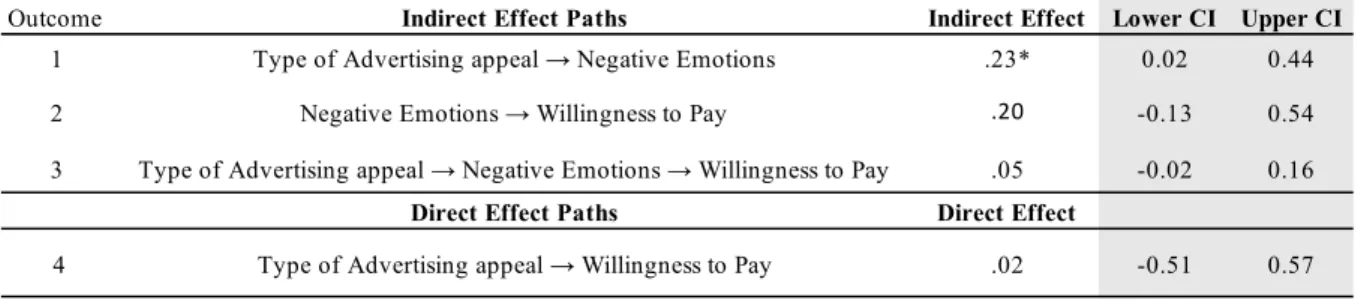
The mediation analysis was also performed for the Willingness to Pay dependent variable. A main effect was also observed for the type of advertising appeal on negative emotions (b = .23,
SE = .10, p < .05, 95% CI = [0.02, 0.44]) However, no other main effect (b = .20, SE = .18, p
= n.s., 95% CI = [-0.13, 0.54]) nor mediation effect of negative emotions on the dependent variable, willingness to pay, were observed (indirect effect = .05, SE = .05, p = n.s., 95% CI = [-0.02, 0.16]).(see Table 13). The conditional direct effect of type of advertising appeal on willingness to pay was also non-significant (direct effect = .02, SE = .27, p = n.s., 95% CI = [-0.51, 0.57]) (see Table 8).
Table 11: Negative Emotions as a mediator on the effect of the type of ad appeal on willingness to pay
Overall, results suggest that negative emotions mediate the relationship between the type of advertising appeal and consumer responses, such as attention to the advertisement and likelihood of purchase. Yet, positive emotions do not exert a mediating role on consumers’ responses towards the type of advertising appeals that are high or low visually emotional. These results, therefore, partially supporting H2.
Outcome Indirect Effect Paths Indirect Effect Lower CI Upper CI
1 Type of Advertising appeal → Negative Emotions .23* 0.02 0.44 2 Negative Emotions → Likelihood of Purchase .63*** 0.37 0.89 3 Type of Advertising appeal → Negative Emotions → Likelihood of
Purchase .15* 0.01 0.32
Direct Effect Paths Direct Effect
4 Type of Advertising appeal → Likelihood of Purchase -0.28 -0.71 0.14
*p < .05; **p < .01;***p < .001; +p ≤ .1; standard deviations are presented between parentheses.
Outcome Indirect Effect Paths Indirect Effect Lower CI Upper CI
1 Type of Advertising appeal → Negative Emotions .23* 0.02 0.44
2 Negative Emotions → Willingness to Pay .20 -0.13 0.54
3 Type of Advertising appeal → Negative Emotions → Willingness to Pay .05 -0.02 0.16
Direct Effect Paths Direct Effect
4 Type of Advertising appeal → Willingness to Pay .02 -0.51 0.57
6. Discussion and Implications
The main objective of the present study was to understand the impact of the type of advertising appeals on consumer responses - attention to the advertisement, likelihood of purchase and WTP. Despite the large portion of previous literature on emotional appeal and the impact emotions have on the consumer buying behavior (Edell et al., 1987; Rossiter et al., 1991; Garg et al., 2007), still very few research has examined the topic of advertising appeals that are low versus high visually emotional on consumers’ attention and intention to purchase eco-friendly products, namely low-involvement.
RQ 1: Do visually emotional appeal advertisements have an impact on consumers’ emotions and consumer responses, including the attention to the advertisement, likelihood of purchase and Willingness to Pay – WTP?
Answering the first research question (RQ1), the study suggests that advertisements that use higher visually emotional appeals, in opposition to low emotional ones, are more likely to generate higher consumers’ consumer responses, especially when it comes to attention to the advertisement.
These findings are in line with the literature that feelings play an important role on the formation of attitudes and judgements about advertisements (Edell et al., 1987).
By focusing on low involvement products, which are usually led by well-established brands in highly competitive and matured markets, this research contributes to the development of different strategies that can be adopted by companies currently striving to build a sustainability-driven business model while remaining competitive in light of more established branded products, wishing also to educate and persuade consumers of the importance of shopping more sustainably.
RQ 2: Does the advertisement message evoke consumers’ emotions and consequently, will help explain the relationship between the type of advertisement appeals and consumer responses? For the second research question (RQ2), results were in line with what was expected. Through the mediation analysis interesting results emerged, revealing that positive emotions do not mediate the relationship between the type of advertising appeal and consumer responses (attention to the advertisement, likelihood of purchase and WTP ). However, dissimilar results
are observed when negative emotion index are used as a mediator in the relationship between the type of advertising appeal and consumers’ responses, more specifically, on attention to the advertisement and likelihood of purchase. These findings suggest that consumers’ negative emotions clarify the nature of the relationship between the type of advertising appeal and consumers’ responses, confirming the literature that negative emotions seem to have a higher impact on consumers’ responses. Indeed, prior literature in this domain suggests that a linkage between altruistic behavior and capability of driving constructive actions seems to exist when negative emotional reactions emerge (Allen et al., 1992; Kim et al., 2013). Therefore, companies that want to use a visually emotional advertisement should focus on evoking consumers’ negative emotions (sad and shocked, for instance) in order to attract them to their sustainable and eco-friendly product/brand and furthermore persuade them into a purchase.
6.1.Theoretical Implications
This study contributes to the literature on advertising and emotional appeals, low involvement products, sustainability and green marketing by examining the impact of the type of advertising appeal on consumer’s responses (Edell et al., 1987; Rossiter et al., 1991; Garg et al., 2007; Carrington et al., 2010; Kotler, 2011; Guerreiro et al., 2015; Constantine et al., 2016).
Overall, the results are in line with the recent literature on advertising and emotional appeals (Buil, et al., 2011) yet introducing a new variable which is the role that high versus low visually emotional advertising types have on consumers’ attention and likelihood of purchase a low-involvement sustainable product, such as toothbrush made out sustainable materials. Our findings suggest that an advertisement that engages consumers in higher visually emotional appeals is more likely to increase their interest for the advertised product.
Emotional reactions are therefore likely to emerge as a consequence of exposure to high visually emotional advertising appeals, as seen in our mediation results, especially negative ones. When comparing between positive and negative emotions through the analysis of the survey, the negative emotions seem to have a more significant impact on consumers’ responses especially when it comes to attention to advertisement and likelihood of purchase. As previously mentioned, emotional mechanisms and attentional processing of information have become key elements in judging a product/brand (Edell et al., 1987; Kemp et al., 2012). Notwithstanding, the mediating role of negative emotions related with sadness and shock, also seem to show that besides guilt, show to be powerful and help explain consumers’ reaction to
advertising appeals that emotionally touching, which is a relevant contribution to the literature in this domain (Guerreiro et al.,2015).
Furthermore, this study contributes for the expansion of the literature on green marketing and sustainability. During the last decade, a great deal of research has been focused on both topics as a consequence of the changes observed in consumer behavior. However, when considering the emotional appeals used in advertising, research has become very narrowed focusing mainly on negative emotions, especially on guilt appeals. Therefore by combining both positive (Encouragement and Pride) and negative emotions (Sadness and Shock) in the same study, confirms not only the lack of success of positive emotions within green advertising but also the power that negative emotions can have on consumer’s responses and furthermore success of a brand. Interestingly, as guilt induces personal emotions directed to the self, sadness and shock, are directed towards the object external to the individual. The emotions’ index hereby created, are therefore more complete manifestation of consumers’ arousal reactions towards the advertisement and make a further contribution in the advertising literature.
Lastly, there is also a contribution to the literature on low involvement eco-friendly and sustainable products. During the last couple of years, companies have started to invest in FMCG with the aim of promoting easier and more sustainable consumption decisions. However, very few research has been developed concerning this topic and on how these type of products should be promoted and advertised.
6.2.Practical Implications
This dissertation provides some powerful and relevant insights for brands that want to adopt a sustainable practice, such as start selling a sustainable product. As it was previously discussed, the usage of dramatic, alarming and shock images has been widely used by marketers with the purpose of generating a different variety of emotions on consumers and furthermore persuading them to buy a specific product (Panda et al., 2013). Confirming these previously mentioned aspects, a high visually emotional advertisement has a much greater impact on attracting consumer’s attention, increasing the likelihood of a campaign’s success. These results suggest that marketers should indeed take into consideration emotions when planning the launch and/or promotion of a sustainable and eco-friendly product.
Moreover, results suggest the actual type of emotions generated on consumers have an impact on how they perceive an advertisement. Nowadays, brands have been starting to adopt a
different variety of rational marketing strategies for the promotion of sustainable products (focusing on product effectiveness, for instance). However, investing in ads that evoke negative emotions should be of great interest for any marketer working in green advertising. Despite being already widely used among different brands, it still seems to be a significant and successful way of advertising and promoting low involvement utilitarian products.
Lastly, it’s still important to refer the importance this study has on low involvement products. Through the analysis, one is capable of understanding how powerful advertising is on the promotion and advertisement of products like bamboo toothbrushes, especially when combined with emotion appeals. Low involvement products are more likely to sustain emotional appeal advertisement since it can directly influence product responses as consumers use their feelings as a shortcut to make the final decision. Contrary to high-involvement and utilitarian products which are usually more expensive and require a deeper research. Consumers usually have already a pretty well-defined product/brand in their mind that they aim to purchase, therefore it becomes quite difficult and challenging to change their belief.
7. Limitations and Future Research
During the development of this research, some limitations started to arise. As previously mentioned, the procedure for this study was quantitative research in order to quantify the data and generalize the results from the sample to the population of interest. Besides being less costly, of easy access and more accurate, there’s little control on the identity of the respondent, whom the respondent consults and the speed of the response. Additionally, the fact that it is a non-probability sampling technique, increases the probability of biases.
The sample collected had a large portion of Portuguese participants (76.5%), although there were still some respondents from the most diverse countries. This aspect can interfere with the present study due to the fact that different cultures can have different perspectives. For instance, it’s not linear that emotional appeal advertisements work the same way for every country therefore it would be necessary to take this aspect into account for further research.
Concerning the topic chosen, it’s important to refer that sustainability by itself usually leads to social desirability bias, in which there is a tendency for respondents to answer the questions in a manner that will be viewed favorably by the others especially in regards to social and ethical issues. This aspect might explain some of results obtained.
Furthermore, the only product taken into account for this study were toothbrushes which is a low involvement and functional product. As previously seen in the Literature Review, the way consumers process the information about the ads may differ across the different products offered, especially when differentiating low involvement and high involvement products. For instance, emotional appeals are usually highly effective on low involvement products whereas rational appeals are more effective on products which consumers are highly involved (Baker et al., 2000; Akbari et al., 2015). Additionally, besides vision being a crucial factor for the consumers shopping habits, smell and sound are as powerful as they can be and weren’t taken into consideration when developing this study.
Finally, it is still important to mention that there is still very few knowledge on the product chosen. The last question of the questionnaire had as main objective to understand the perceived knowledge and purchase habits of each respondent. Results demonstrated that only 11.4% of the total sample uses a Bamboo Toothbrush. Additionally, “Never tried it”, “Bamboo is not that sustainable” are just a couple of sentences used by the respondents to describe their perception concerning the purchase of a Bamboo Toothbrush. For further research, the development of a variable that would have a bigger focus on the topic of sustainable knowledge would be necessary, since it seems to have a big impact on the answers of the respondents.
References
Akbari, M. (2015). Different Impacts of Advertising Appeals on Advertising Attitude for High and Low Involvement Products. Global Business Review, 16(3), 478-493.
Allen, C. T., Machleit, K. A. & Kleine, S. S. (1992). A comparison of attitudes and emotions as predictors of behavior at diverse levels of behavioral experience. Journal of Consumer
Research, 18(4), 493-504.
Baker, W. E., & Lutz, R. J. (2000). An empirical test of an updated relevance-accessibility model of advertising effectiveness. Journal of Advertising, 29(1), 1–14.
Batra, R., & Ray, M. (1986). Affective responses mediating acceptance of advertising. Journal
of Consumer Research, 13, 236-239.
Buil, I., Chernatony, L., & Martínez, E. (2011). Examining the role of advertising and sales promotions in brand equity creation. Journal of Business Research, 66, 115-122.
Burnett, M. S., & Lunsford, D. A. (1994). Conceptualizing guilt in the consumers’ decision-making process. Journal of Consumer Marketing, 11(3), 33–43.
Carrigan, M., & Attalla, A. (2001). The myth of the ethical consumer - do ethics matter in purchase behaviour? Journal of Consumer Marketing, 18(7), 560 – 578.
Carrington, M. J., Neville, B. A., & Whitwell, G. J. (2010). Why Ethical Consumers Don’t Walk Their Talk: Towards a Framework for Understanding the Gap Between the Ethical Purchase Intentions and Actual Buying Behaviour of Ethically Minded Consumers.
Journal of Business Ethics, 97, 139–158.
Constantine, S. K., Constantinos, N. L., & Athina, Z. (2016). Eco-friendly product development strategy: antecedents, outcomes, and contingent effects. Journal of the Academy of Marketing
Science, 44, 660–684.
Coulter, R. H., & Pinto M. B. (1995). Guilt appeals in advertising: What are their effects?
Cronin, J. J. Jr., Smith, J. S., Gleim, M. R., Ramirez, E., & Martinez, J. D. (2011). Green marketing strategies: an examination of stakeholders and the opportunities they present.
Journal of the Academy of Marketing Science, 39, 158–174.
D'Souza, C., & Taghian M. (2005). Green advertising effects on attitude and choice of advertising themes. Asia Pacific Journal of Marketing and Logistics, 17(4), 51-56.
Edell, J. A. & Burke, M. C. (1987). The power of feelings in understanding advertising effects.
Journal of Consumer Research, 14(3), 421–33.
Edell, J. A., & Staelin, R. (1983). The information Processing of Pictures in Print Advertisements. Journal of Consumer Research, 10.
Edell, J., & Burke, M. C. (1987). The power of feelings in understanding advertising effects.
Journal of Consumer Research,14, 421–433.
Garg, N., Wansink, B., & Inman, J. J. (2007). The influence of incidental affect on consumers’ food intake. Journal of Marketing, 71(1), 194–206.
Gorn, G. (1982). The effects of music in advertising on choice behaviour: A classical conditioning approach. Journal of Marketing, 46, 94-101.
Greyser, S. A. (1972). Advertising: Attacks and Counters. Harvard Business Review, 50(2), 22-28/141-146.
Guerreiro, J., Rita, P., & Trigueiros D. (2015). Attention, emotions and cause-related marketing effectiveness. European Journal of Marketing, 49(11-12), 1728-1750.
Haws, K. L., Winterich, K. P., & Naylor, R. W. (2014). Seeing the world through GREEN-tinted glasses: Green consumption values and responses to environmentally friendly products.
Journal of Consumer Psychology, 24(3), 336–354.
Janis, I. L. (1967). Effects of Fear Arousal on Attitude Change: Recent Developments in Theory and Experimental Research. Advances in Experimental Social Psychology, 3, 166-224.
Jiménez, M., Yang, K. C. C. (2008). How Guilt Level Affects Green Advertising Effectiveness?
Kemp, E., Bui, M., & Chapa, S. (2012). The role of advertising in consumer emotion management. International Journal of Advertising, 31(2), 339-353.
Kilbourne, W. (1995). Green advertising: Salvation or Oxymoron? Journal of Advertising,
24(2), 7-19.
Kim, J., & Johnson, K. K. (2013). The impact of moral emotions on cause-related marketing campaigns: a cross-cultural examination. Journal of Business Ethics, 112(1), 79-90.
Kong H. M., Ko E., Chae H., & Mattila P. (2016). Understanding fashion consumers’ attitude and behavioral intention toward sustainable fashion products: Focus on sustainable knowledge sources and knowledge types. Journal of Global Fashion Marketing, 7(2), 103-119.
Kotler, P. (2011). Reinventing marketing to manage the environmental imperative. Journal of
Marketing, 75, 132–135.
Lascu, D. N. (1991). Consumer guilt: Examining the potential of a new marketing construct.
Advances in Consumer Research, 18(1), 290–95.
Lein, S. (2018). Why Sustainable Branding Matters. Retrieved from Forbes website: https://www.forbes.com/sites/theyec/2018/08/20/why-sustainable-branding-matters/
Mackenzie, S. B., & Lutz, R. J. (1989). An Empirical Examination of Attitude Toward the Ad in an Advertising Pretest Context. Journal of Marketing, 53(2), 48-65.
Mehta, A. (2000). Advertising Attitudes and Advertising Effectiveness. Journal of Advertising
Research, 40(3).
Onditi, A. (2016). Green Marketing and Consumer Satisfaction. Journal of Marketing and
Consumer Research, 29.
Osterhus, T. L. (1997). Pro-social consumer influence strategies: when and how do they work?
Journal of Marketing, 61(4), 16-29.
Panda, T. K., & Mishra, K. (2013). Does Emotional Appeal Work in Advertising? The Rationality Behind Using Emotional Appeal to Create Favorable Brand Attitude. The IUP Journal of Brand Management, 10(2).
Passyn, K., Sujan, M. (2006). Self-Accountability Emotions and Fear Appeals: Motivating Behavior. Journal of Consumer Research, 32.
Perera, C., & Hewege, C. (2018). Climate change risk perceptions among green conscious young consumers: implications for green commodity marketing. Journal of Consumer
Marketing, 35(7), 754–766.
Petrova, P. K., Cialdini, R. B. (2005). Fluency of Consumption Imagery and the Backfire Effects of Imagery Appeals. Journal of Consumer Research, 32.
Pinto, M. B., & Priest, S. (1991). Guilt appeals in advertising: An exploratory study.
Psychological Reports, 69, 375–85.
Rosbergen, E., Pieters, R. Wedel, M. (1997). Visual Attention to Advertising: A Segment-Level Analysis. Journal of Consumer Research, 24.
Rossiter, J. R., & Percy L. (1991). Emotions and Motivations in Advertising. Advances in
Consumer Research Volume, 18, 100-110.
Sable, K. (2019). FMCG Market by Type (Food & Beverage, Personal Care, Health Care, and
Home Care) and Distribution Channel (Supermarkets & Hypermarkets, Grocery Stores, Specialty Stores, E-commerce, and Others): Global Opportunity Analysis and Industry
Forecast, 2018–2025. Retrieved from Allied Market Research website:
https://www.alliedmarketresearch.com/fmcg-market.
Scott, L. M., Vargas, P. (2007). Writing with Pictures: Toward a Unifying Theory of Consumer Response to Images. Journal of Consumer Research, 34.
Stafford, M. R., Stafford T. F., & Chowdhury, J. (1996). Predispositions toward green issues: The potential efficacy of advertising appeals. Journal of Current Issues and Research in
Advertising, 18(1), 67–79.
Trudel, R. (2019). Sustainable Consumer Behavior. Consumer Psychology Review, 2, 85-96. Zinkhan, G. M., & Carlson, L. (1995). Green advertising and the reluctant consumer. Journal
Appendices
Appendix 1: Survey Pilot and Main Study
Introduction
Dear participant,
I am a Master Student from Católica Lisbon School of Business and Economics currently developing my dissertation on Consumption and Sustainability. The goal of this survey is to know your true opinion and view on the subject therefore, I kindly ask you to answer the questionnaire as accurate and honest as possible.
There are no right or wrong answers. All data will be kept anonymous, confidential and will be exclusively used for the purpose of my master's dissertation.
This survey will take 7-8 minutes of your time.
Thank you, Marta Andrade :)