The impact of visual elements of package
on consumers purchase intent and the
mediating role of perceived risk
An analysis on food packaged products.
Dissertation by
Maria Inês Fernandes Paz Antunes dos Santos
Student Number: 152116222
Dissertation written under the supervision of
Prof. Paulo Romeiro
Dissertation submitted in partial fulfillment of requirements for the MSc in Management with Specialization in Strategy and Entrepreneurship at
CATÓLICA-LISBON School of Business & Economics June 2018
i
Abstract
Title
The impact of visual elements of package on consumers purchase intent and the mediating role of perceived risk - An analysis on food packaged products.
Author
Maria Inês Fernandes Paz Antunes dos Santos
Nowadays, packaging has been acknowledged to be an important strategic marketing tool, especially at the purchasing moment, and it plays a key role in influencing consumers’ buying behaviour of packaged food products.
The visual design of packaging transmits symbolic meaning to consumers, hereby impacting how the product is evaluated by them.
This dissertation aims to understand the effect of visual elements of packaging; specifically, the effect of incorporating an image of the product or a transparent window on the packaging of the product on purchase intent, giving a special attention to the role of perceived risk.
This dissertation is particularly important regarding low involvement FMCG products, such as packaged salmon and packaged pizza, where packaging is strongly linked with the product in the eyes of the consumer at the point of purchase.
In this dissertation, both primary and secondary data were collected from an online questionnaire and existing literature regarding the topics in study.
The obtained results, described in the last chapters of this study, suggest that food packaged products purchase intention is related with the presence of transparency and product imagery on package as well as by the risk (financial, psychological and functional) associated with the each food category. In addition, according to the dimension of perceived risk, it plays a key role in mediating some relationships between the variables in study.
ii
Resumo
Título
O impacto dos elementos visuais da embalagem na intenção de compra e o papel
mediador do risco associado à compra - Uma análise a produtos alimentares embalados.
Autor
Maria Inês Fernandes Paz Antunes dos Santos
Hoje em dia, a embalagem dos produtos é considerada um elemento estratégico fundamental de marketing, sobretudo no momento da sua aquisição; é por isso um fator decisivo no comportamento dos consumidores na sua escolha de produtos alimentares embalados.
O design da embalagem confere um significado simbólico aos consumidores desencadeando impacto visual no momento da avaliação do produto que pretendem adquirir, afetando a sua avaliação do produto.
Com este estudo pretende-se compreender o impacto dos elementos visuais da embalagem, sobretudo a incorporação da imagem do produto ou de uma janela transparente permitindo, deste modo, a visualização imediata do produto através da embalagem no momento da aquisição por parte dos consumidores. Mais se deseja salientar a importância do papel do risco (financeiro, psicológico e funcional) associado pelo consumidor nesse processo.
De modo a estudar impacto dos elementos visuais da embalagem e na intenção de compra dos consumidores de produtos embalados, a seguinte dissertação concentra-se em produtos alimentícios, tais como salmão e pizza embalados.
Nesta dissertação, dados primários e dados secundários foram reunidos envolvendo a realização de um questionário online e através da literatura existente.
Os resultados finais, descritos nos últimos capítulos desta dissertação, evidenciam que a intenção de compra de produtos alimentares embalados está relacionada com a presença de elementos transparentes ou imagem do produto na embalagem; e pelo risco associado à compra de cada tipo de produto. Dependendo do tipo de risco, este exerce um efeito mediador em algumas das relações entre as diferentes variáveis em estudo.
iii
Acknowledgements
I would firstly like to express my gratitude to my mother, who have constantly supported me through my academic journey and provided me with the best opportunities and the finest education in order to achieve my professional and personal goals. Her optimism and boundless encouragement were truly important and decisive to complete this Dissertation, the final stage of my Master’s degree.
I would like to show my appreciation to my supervisor, Professor Paulo Romeiro, for all his patience, insightful advice, and valuable feedback throughout the entire process. Also, very important for me is to express my sincere appreciation to my friend and talented designer, Matilde Pinheiro de Melo for helping me with the design of the packages presented on my survey.
I am also very grateful to Ana Rita Azevedo, my manager at Colgate-Palmolive, and my co-workers, who have demonstrated enormous support and constant availability for sharing their valuable knowledge with me.
Last but not least, I am very grateful to my amazing friends, who support me unconditionally.
iv
Table of Contents
Abstract ... i Title ... i Author ... i Resumo ... ii Título ... ii Autor ... ii Acknowledgements ... iii Table of Figures ... viList of Abbreviations and Acronyms ... vii
Chapter 1. Introduction ... 1 1.1 Background ... 1 1.2 Problem Statement ... 2 1.2.1 Research Questions ... 2 1.3 Relevance of Research... 3 1.4 Research methods ... 4 1.5 Dissertation outline ... 4
Chapter 2. Literature Review ... 6
2.1 Packaging Relevance ... 6
2.2 The role of Packaging ... 7
2.3 Elements of Packaging ... 8
2.3.1 Visual Elements of Package ... 8
2.4 Purchase Intent ... 11
2.5. Perceived Purchase Risk ... 12
2.5.1 Perceived functional risk ... 13
2.5.2 Financial Risk Perception ... 14
2.5.3 Perceived psychological risk ... 14
2.5.4 Perceived Consequences of Purchase mistake ... 14
Chapter 3. Methodology ... 17
3.1 Conceptual Model and Research Approach Review ... 17
3.2 Primary Data ... 18
3.2.1 Online Survey ... 18
v
3.3 Data Analysis ... 21
Chapter 4. Results and Discussion ... 22
4.1 Sample Characterization ... 22
4.2 Measures Reliability ... 25
4.3 Results from the Hypothesis Test ... 26
4.3.1 Descriptive Statistics ... 26
4.3.2 The effect of visual elements variables over packaged products purchase intent ... 30
4.3.3 The effects of visual elements of package variables on perceived functional risk ... 33
4.3.4 The effects of the different types of perceived risk on packaged products purchase intent ... 35
4.3.5 The mediating effect of risk on the relationship between visual elements of package and purchase intent ... 36
Chapter 5. Conclusions and Limitations ... 41
5.1 Main Findings and Conclusions ... 41
5.1.1 The effect of visual elements of package on consumer’s purchase intent ... 41
5.1.2 The mediating role of perceived risk ... 43
5.2 Academic/ Managerial Implications ... 44
5.3 Limitations and Further Research... 45
Chapter 6. References ... 47
Chapter 7. Appendices ... 51
7.1 Appendix I: Online Survey Guideline ... 51
7.2 Appendix II: SPSS Output - Demographic ... 57
7.3 Appendix III – SPSS Output – Measure variables ... 60
vi
Table of Figures
Figure 1: Conceptual Framework of proposed hypotheses. ... 16
Figure 2: Questionnaire Design. ... 20
Figure 3: Proposed constructs, number of scale items and relevant literature sources. . 20
Figure 4: Survey respondents per scenario. ... 23
Figure 5: Survey respondents about the frequency of purchase per food category. ... 23
Figure 6: Demographic characteristics of the sample. ... 24
Figure 7: Demographic characteristics of the sample (Age). ... 25
Figure 8: Survey items' reliabilities. ... 26
Figure 9: Descriptive statistics for Visual Elements of packaging. ... 27
Figure 10: Descriptive statistics for each dimension of Perceived Financial Risk. ... 27
Figure 11: Descriptive statistics for each dimension of Perceived Functional Risk. ... 28
Figure 12: Descriptive statistics for each dimension of Perceived Psychological Risk. 29 Figure 13: Descriptive statistics for Purchase Intent. ... 29
Figure 14: Variable Relationship for Visual Elements of Package (H1). ... 30
Figure 15: Variable Relationship for each product category and each packaging design (H1a and H1b). ... 32
Figure 16: Variable relationship for Total Sample (H3a e H3b). ... 34
Figure 17: Variable Relationship for total Sample (H4a, H4b and H4c). ... 35
Figure 18: The mediating effect of perceived functional risk in the relationship between visual elements of package and purchase intent. ... 38
Figure 19: The mediating effect of perceived financial risk in the relationship between ... 39
Figure 20: The mediating effect of perceived psychological risk in the relationship between visual elements of package and purchase intent. ... 40
Figure 21: Status of Hypotheses H1. ... 42
Figure 22: Status of Hypothesis H2. ... 42
Figure 23: Status of Hypotheses H3. ... 43
vii
List of Abbreviations and Acronyms
DV Dependent Variable IV Independent Variable PI Purchase Intent
FMCG Fast Moving Consumer Goods
SPSS Statistical Package for the Social Sciences VIF Variance Inflation Factor
PG Package displaying a picture of pizza PS Pizza’s package with a transparent window SG Package displaying a picture of salmon SS Salmon’s package with a transparent window “See-Through” (variable) Transparent packaging “Opaque” (variable) Opaque packaging
“Graphs” (variable) Package displaying an image of the product PRfunc Perceived Functional Risk measure
PRfin Perceived Financial Risk measure PRpsy Perceived Psychological Risk measure
Multicollinearity term used to describe the case when the intercorrelation of predictor variables is high.
C-path is the value that represents the effect of the independent variable on the dependent variable without the mediator variable.
C’path is the value that represents the effect of the indirect variable on the direct variable after controlling for the mediator.
Percent mediation (PM) represents, in percentage, the difference between c and c’ in relation to c.
1
Chapter 1. Introduction
1.1 Background
As a result of all the changes in consumers’ lifestyle and the growing importance of self-service marketing on a daily basis, companies are adopting diverse techniques to compete with each other in order to attract the customers’ attention. Thus, packaging is becoming a primary vehicle of branding and communication (Rettie & Brewer, 2000). Packaging is defined as “the container for a product – encompassing the physical appearance of the container and including the design, colour, shape, labelling and materials used” (Agariya et al.,2012). Following the same path, Malkewitz (2006)’s defined package design as all the different elements selected and blended into a holistic design in order to achieve a specific sensory effect.
Besides the basic function of protecting the product, packaging also has the fundamental function of disclosing the package’s content (Vieira et al., 2015) by providing adequate and detailed information to the consumers about the product. Furthermore, this marketing tool is also used as a valuable technique to gain competitive advantage and it can have an impact, either positive or negative, on consumer purchasing decisions. As a matter of fact, more than half of the shoppers’ final purchase decisions of food and beverages are made at the supermarket. Simmonds & Spence (2017) by Connolly & Davison (1996). Furthermore, the majority of shoppers buy a product only based the front façade of the package; and make the final purchase decision without looking for a substitute product (Urbany, Dickson, & Kalapurakal, 1996).
As stated by Rundh (2005), packaging can capture consumers’ attention and influence their perceptions about the particular product contained within the package. On the other hand, packaging allows shoppers to identify and distinguish a particular product from a plenty of similar products (Underwood, Klein, & Burke, 2001), and it can impart visual presence and uniqueness to the product (Silayoi and Speece, 2004). Nevertheless, it is important to highlight that packaging can have both positive and negative impact on the consumers’ perceptions of products’ quality, as it can either improve the product’s image, or it can be a cause of product’s failure as it is the first contact between the product and the consumer in the store (Silayoi and Speece, 2007; Simmonds et al., 2018).
2 When consumers intend to buy a product or a service, the act of purchasing is evaluated as a risky endeavour as they do not have the certainty that the actual results will not differ from their expectations. This perceived risk can affect their likelihood of purchase (Wood and Sheer, 1996; Roselius, 1971). Consequently, consumer behaviour is motivated to reduce the perceived purchase risk (Kim & Lennon, 2000). Therefore, insights on consumer’s risk perception will enable marketers to understand, anticipate and satisfy consumer’s needs and desires, thereby increasing their purchase intention through optimized packaging design.
According to (Patrick & Peracchio, 2010) despite the increasing awareness of the importance of product packaging, theories to understand how consumers react to the appearance of a product contained within the package are relatively recent. In order to maximize the effectiveness of packaging at the point of purchase, several studies about packaging and its elements, either visual or verbal, and its impact on consumer’s perceptions and consequently purchase decisions should be crucial and a relevant issue.
1.2 Problem Statement
This dissertation aims to study the effect of visual elements of package on consumer purchase intentions, with particular emphasis on the following variables: the effect of incorporating visual product imagery (product pictures) and transparent elements on the package, and how these elements affect consumers’ perceptions about the product, consequently impacting consumers’ purchase intent.
This study will focus on packaged food goods, comparing two categories with distinct levels of perceived risk: packaged pizza and packaged salmon.
In order to have a clearer understanding of the problem statement addressed on this dissertation, its specification could be the following: Is what you see what you get?
1.2.1 Research Questions
This dissertation provides a theoretical framework to address these packaging doubts and it studies some contingencies under which package design is more or less effective:
3 the presence of visual imagery or the presence of transparency on package with exposure of the contained product.
The following research questions were developed:
RQ1: How do visual elements of package influence consumers’ purchase intention? RQ2: Does the inclusion of a product’s picture on the package contribute to lower purchase intentions than the inclusion of a transparent element on the package?
RQ3: How visual elements of package influences the uncertainty perceived by the consumers at the point of purchase?
RQ4: How does perceived risk impact purchase intention?
RQ5: How does the relationship between visual elements of package and purchase intent vary with different dimensions of perceived risk as mediator variable of these relationships?
1.3 Relevance of Research
As per common knowledge, the majority of consumers before they go to a grocery shop to buy a product, they may not spend much time thinking about a specific brand. Moreover, at the point of purchase consumers are exposed to many similar perishable consumer goods on the shelf (Agariya et al., 2012). Thus, package is a key factor in marketing communications, especially at the point of purchase. Findings suggest that most of the buying decisions are made at the point of sale and they are based on the aesthetics package design elements (Ampuero & Vila, 2006; Keizer, 2016).
In academic terms, the topic of this study constitutes a further investigation of what has been studied in literature and can be considered academically relevant in the deepening of the knowledge with regard to the relationship between the variables relative to visual elements of package, perceived risk and purchase intent. Despite the fact that this topic has been widely studied in previous research projects, this dissertation expands the research on the effectiveness of the presence of an image of the product versus transparency on package in consumer’s purchase intent of food packaged products. These findings highlight the importance of including a mediator variable, the perceived risk and how it mediates these relationships across different food product categories.
4 Regarding managerial relevance, one of the key challenges for managers, marketers and designers is to create sustainable as well as acceptable packaging. Thus, companies can benefit from the results and conclusions that dissertation aims to achieve as they can be used towards a company better use of its marketing resources by develop appropriate and attractive packaging solutions that are able to perform in traditional (and non-traditional) channels and thus increase the number of sales of packaged food products.
1.4 Research methods
In order to answer the research questions in an appropriate way, both primary and secondary data were used in this master thesis. Secondary data have been collected through a detailed research on previous studies, books, academic journals and articles in order to gather an in-depth background knowledge about packaging, with a special focus on: the evolution of packaging, the visual elements of packaging, consumer drivers of packaged goods’ purchase intent and how perceived risk mediates the relationship between visual elements of package and consumers buying behaviour. Regarding primary data, the questionnaire was sent to the biggest number of respondents possible by email and through different channels of social media in order to understand the causal effect between the variables in study.
On the fourth chapter, the obtained answers were analysed with IBM’s SPSS statistical software version 23.0. Here, multiple linear regressions, reliability and frequencies analysis as well as a mediation analysis and Cronbach’s Alpha coefficient, were performed in order to analyse those responses and understand the relationship between the variables in study. Especially the mediating role of different dimensions of perceived risk - considered in this study - in the relationship between visual elements of package and purchase intent, by performing statistical tests such as ANOVA and Sobel test.
1.5 Dissertation outline
This dissertation will present a total of five chapters. The following chapter contains the literature review. It provides with an in-depth understanding of the hypothesis that this
5 dissertation proposes to answer and is supported by previous studies. It will explain how each relevant variable have an impact on consumers’ purchase intent for packaged goods.
The third chapter comprises the research methodology which will clarify and described the methods used to collect and analyse the data and how each statistical test will be applied to this data.
The fourth chapter, results analysis, presents an analysis of the results obtained from the collected data and verify the legitimacy of each hypothesis proposed along this study. Finally, the fifth chapter contemplates the main findings and limitations of this study and as well as some recommendations for future researches on the topic in study. It also it provides both academic and managerial suggestions.
6
Chapter 2. Literature Review
The following chapter will provide a detailed analysis of previous academic researches and existing literature to support and justify the hypothesis of this study and establish a context for the dissertation’s research questions. It will be applied to the practical case of how packaging design influences consumers purchase intent of packaged goods. Therefore, it begins by explaining the definition and the evolution of the terms in use.
2.1 Packaging Relevance
In nowadays competitive environment, the focus on packaging design as a strategic marketing tool to boost impulsive purchase decisions is increasing due the increase of self-service and changes on consumers’ lifestyle. Thus, FMCG companies are always looking for improved methods to increase the shelf presence and the impact of their products in consumers’ mind. Following (Schoormans & Robben, 1997) attribution theory, consumers’ evaluations either positive or negative, about a product is directly linked with the packaging capability to get their interest and influence their perceptions about it.
(Agariya et al., 2012) define packaging as the wrapping material used to contain, protect, promote, describe, transport, display and identify the goods; and make the product clean and marketable. Some authors affirm that packaging design is used as a marketing communication strategy to influence consumer’s purchasing decision alternatively to be only an extension of the product.
According to Kotler and Keller (2012), is only through the package that consumers communicate direct or indirect with the packaged product at the shop before making the final purchase decision. Furthermore, as it also transmits to consumers the desired image of a company: thus it should be considered as an important stage of the branding process (Agariya et al.,2012).
7
2.2 The role of Packaging
The move from convenience groceries to hypermarkets has promoted the propagation of products. Consequently, because of the increasingly number of similar products on the shelf, the role of packaging is becoming more important in a more competitive context. Over the last few years, studies with focus on the impact of package appearance on consumer attention, categorization and evaluation of the product and its impact on consumer buying behaviour have been done. For several authors, package is also viewed as part of the brand and not only part of the product itself (Ampuero & Vila, 2006).
According to (Silayoi and Speece, 2004), the original function of packaging is be the container for a product and protect it; however, nowadays the role of packaging has changed, and it is used to describe in detail the characteristics of the product; and to promote its sales by enhancing customer’s interest and conveying an distinctive value to products (Underwood, Klein, & Burke, 2001); Silayoi and Speece, 2004). It may get consumer’s attention to a specific product and brand (Rundh, 2005) from a wide range of similar brands and products. Thus, as declared by Vilnai-Yavetz & Koren (2013), packaging should be perceived as effective, it should be seen as instrumental (because it protects the contents), aesthetic (it should have an attractive appearance), and symbolic (meaning that it communicates directly with the customers by sending them the desired message). Consequently, product packaging not only leads to consumer’s purchase intent, but it also increase companies’ market share and declines the promotional and advertising costs of the organization.
Findings suggest that 50% of grocery purchases are unplanned, meaning that the impulsive purchase intention have been increasing (Cobb and Heyer cited in Rettie & Brewer, 2000). Due to the tendency of an unique weekly groceries shop and the large number of goods purchased in that unique shop, consumers spend less time to make the final purchase decision and consequently the role of the packaging is becoming more important at this point of the purchase (Rettie & Brewer, 2000).
The package design is the “salesman on the shelf” (Pilditch,1972 cited by Rettie & Brewer, 2000); when consumers’ purchase decisions are made at the store, package is extremely important when compared to other marketing communication strategies because of its impact on consumer’s perceptions and availability. For packaged goods
8 that are not purchased in their final appearance, such as several food products, the consumer commonly relies on the package to elaborate an opinion on how the product looks like when in its ready-to-eat state (Underwood & Klein, 2002). It is important to highlight that should be high consistency between this marketing communication strategy and the desired image for the brand.
2.3 Elements of Packaging
Regarding the most important components of packaging, different opinions have been expressed relatively to the classification of packaging components in marketing literature.
According to Kotler (2003), producers and designers must take into account six different elements in order to develop an effective and useful package. These elements are its size and colour, the package’s form and material, text and brand. Silayoi and Speece (2004; 2007).Moreover, (Underwood, 2003) distinguish package between two categories of elements: visual elements which are the aesthetics part of the package and the product’s performance demonstrations (for example its size and shape, the package’s colours and graphics) while the product detailed information and technology are related to the informational elements of packaging. As stated by (Silayoi and Speece, 2004; 2007) aesthetics elements are connected with the affective parts of consumers’ decision-making process, whereas informational elements are associated to the cognitive aspect of consumers’ decision-making process.
Nowadays, evolution in packaging is, to a greater extent, allowing designers to put emphasis on the importance of visual elements of the package by adding transparent elements, which allow shoppers to see the product through the package and not only on the package before buying it.
2.3.1 Visual Elements of Package
Package design involves several elements, but this study will focus only on the visual elements of package – the presence of product imagery and/or transparent elements - aiming to understand the communicative effects on consumer’s evaluation and purchase
9 decision-making. As previously mentioned, the concept of visual elements of package is inherently multidimensional as it includes simultaneously different visual and informative elements that provide complex brand associations (Underwood et al., 2001).
Under the light of (Homer & Gauntt, 1992) visual information on package attracts consumers' attention and creates expectations for the content of the verbal elements presented on product’s package. On the other hand, consumers with limited time to do their grocery shopping, further depend on aesthetic and extrinsic attributes of packaging when making their final purchase decision (Wells et al., 2007). Thus, under these circumstances, consumers prefer visual elements with low information value rather than high. Therefore, regarding food packaged goods, a graphic of the food on its ready-to-eat form food on packaging may enhance later perceptions of the food such as how it looks at is ready-to-eat form, smells or tastes, as well as increasing the probability that the shopper will buy the product (MacInnis & Price, 1987).
To sum up, through the package consumers are able to communicate direclty and indireclty with product within the package in one of two ways: throught the presence of transparant elements on package or through a graphic of the product printed on the package.
In hypothetical terms:
Hypothesis 1: Visual elements of package positively impacts purchase intent.
2.3.1.1 Visual Elements of Package: Product Imagery
According to MacInnis & Price ( 1987), product imagery is “a process by which sensory information is represented in working memory".
According to (Silayoi and Speece, 2007) product imagery on package an fundamental visual element of packaging design as can create a value differentiation, in other words, it permits differentiate a specific product from the competitors' similar products and usually attracts more attention than verbal advertising. These effects are explained by the fact that people learn quicker and more efficiently when information is provided in pictures rather than words (Underwood et al., 2001). An attractive product picture may
10 also elicit positive and memorable product associations with the consumer; as it enables consumers to spontaneously create an image on their mind of how a product looks at its final form and do evaluations about its quality, tastes or smell in comparison with a package without product imagery (Underwood et al., 2001). In addition, product imagery also enhance consumer’s purchase intentions (Gofman et al., 2009).
However, marketers and designers should be aware that product imagery on packaging should be perceived by consumers as realistic instead of dishonest (Underwood & Ozanne, 1998).
Based on the above theories, the following Hypothesis is presented:
Hypothesis 1a: Including a picture of the product on package will positively affect purchase intent.
2.3.1.2 Visual Elements of Package: The presence of transparent elements on package
Nowadays, it is becoming more common the use of transparency on packaging design in order to show the shoppers what’s exactly inside the package and let them interact directly with the product.
However, the efficacy of the use of transparency when compared with product imagery on consumer’s mind is still little known. Thus, the scope of this study is also to understand how the use of transparent elements on package can influence the consumer perceptions about the product and consequently its impact on consumers purchase intention. Moreover, over the past few years, developments in packaging technology and new opportunities for packaging design (Simmonds & Spence, 2017) has allowed designers to add transparent elements into a wide range of products’ packaging design and consequently allowing consumers to see the products through the packaging before the final purchase decision.
According to Deng & Srinivasan (2013), transparency is present from 20% to 77% of all packaging, depending on product category.
Following Billeter, Zhu, and Inman’s (2012) attribution theory, transparent packaging leads to greater purchase intent as the products are perceived as more trustworthy when compared to the exact same products presented in non-transparent packaging. In other
11 words, the use of transparent elements can directly and positively influence consumer’s purchase intent, in the perception of brand transparency and product’s quality.
It is important to highlight that when the consumer can see the product through the package, the evaluation is declared to be functional instead of symbolic, as it is not based on associations elicited by graphical elements on the packaging. Contrarily, it is based on the actual appearance and texture of the product in order to generate this evaluation (Sogn‐Grundvåg & Østli, 2009).
Hypothesis 1b: The presence of transparent elements on package positively impacts purchase intent.
The presence of transparency as a crucial element of packaging can lead to an increased purchase intent of packaged products, across different categories, when compared to the presence of product imagery (Simmonds & Spence, 2017). This effect would be explained by the fact that allowing shoppers to evaluate the product through its package, will create a positive perception about on their mind as they will perceived it as more salient (Deng & Srinivasan, 2013) when compared to an image of the product on its ready-to-eat state on package.
Hypothesis 1c: The inclusion of an image of the product on package will stimulate lower purchase intentions than the inclusion of a transparent element on package.
2.4 Purchase Intent
According to Morrison (1979), purchase intent is the probability that a shopper will choose to buy a good and it is highly related with the extent to which they consider that the purchased product will satisfy their desires and needs (Kupiec and Revell, 2001). However, consumers’ decision-making process is becoming more complex as they have several similar products within the same category and they are affected by internal or external motivations during the buying process.
Purchase intentions have been applied in several articles and studies for predicting actual purchase. Several authors mentioned in this dissertation, who have studied visual elements of package with emphases on the presence or absence of either transparent elements or images of the product on its package, have used purchase intent construct.
12
2.5. Perceived Purchase Risk
As declared by (Sheau-Fen et al.,2012), the willingness to buy a product is associated with the degree of risk perceived by consumers related to a specific product category. In addition, more often than not, consumers have a tendency to avoid any risks as far as purchase decisions are concerned (Batra and Sinha, 2000).
Perceived risk is one of the most important factors in order to understand consumers´ buying behaviour (Bettman, 1973) and it is fundamental for researchers in order to clarify their perceptions of the uncertainty and adverse consequences linked with their final purchase decision. Batra and Sinha (2000) suggest that the “degree of inconvenience of making a mistake” is one of the determinants of the level of perceived risk. The perceived risk is frequent to new product purchase and it can comprise perceived functional and financial risk, psychological risk, physical and also social perceived risk (Bhukya & Singh, 2015).
Although, in the literature there are described different types of perceived risks, social risk and physical risk were not considered for this study as packaged products are typically used at home so they are not highly visible to others. On the other hand, physical and functional risks are the same thing regarding groceries as in the case that a specific product does not function properly; it could damage consumers´ health (Semeijn et al., 2004).
Previous studies have concluded that visual elements of package impact how shoppers perceived product’s quality and also allow direct comparison among products. Therefore, perceived value has significantly influence on consumers purchase intention of packaged products (Simmonds & Spence, 2017).
Both types of packaging either transparent or non-transparent packaging, communicate a message, however the crucial question is: which of the two packaging options better communicate and transmit the desired message of quality and trust?
Transparent packaging can influence consumer’s perceptions of perceived risk as it can prompt an increase in perceived product confidence and product quality as it allows shoppers to evaluate the product by its appearance and consequently reduce the perceived uncertainty regarding the product’s quality (Sogn-Grundvag and Østli 2009)
13 which leads to higher purchase intentions. This effect can also be explained by the fact that one of the determinants of purchase intention is confidence, which is the opposite of perceived risk (Park, Lennon, & Stoel, 2005).
On the other hand, the interest of this dissertation about the use of (food) product imagery on as an element of packaging design is related to its effect on consumers’ beliefs about the product which influences the perceived purchase risk. Following, (Underwood & Klein, 2002) attribution theory, product imagery performs an informational function that directly impacts consumer beliefs about the product which directly affect consumer’s perceived purchase risk, especially in categories for highly experiential products such as food products.
Hypothesis 2a: There is a negative relationship between perceived functional risk and transparent packaging.
Hypothesis 2b: There is a negative relationship between perceived functional risk and product imagery.
2.5.1 Perceived functional risk
Many empirical studies described functional risk as the ambiguity that the outcome of a decision to buy a specific packaged product will not encounter consumer’s beliefs and expectations (Bhukya and Singh, 2015). Accordingly, when consumers are not familiar with the brand or/and the information about product’s functionality and/or characteristics presented on package is limited, the perceived risk is higher (Bhatnagar and Ghose, 2004 cited by Pappas, 2016) as there is more insecurity with intrinsic attributes and, consequently higher level of risk regarding product’s performance and quality (Erdem and Swait, 2004). As previously stated and according to Underwood and Klein (2002), showing food visuals of the product on package lead to an increase on consumer’s positive perceptions of product’s quality than when no images of the packaged product on are displayed.
14 2.5.2 Financial Risk Perception
Financial risk is defined as “the likelihood of suffering a financial loss due to any hidden costs, maintenance costs or replacement cost due to the lack of warrantee and a faulty product” (Kiang et al.,2011 cited by Pappas, 2016). It is also described as the perception of the likelihood that the product is not worth the price that consumers paid for it (Tsiros & Heilman, 2005). According to (Pappas, 2016) this last designation can be extended to consumer’s price-quality schema and it is described as “the generalised belief across product categories that the level of the price cue is related positively to the quality level of the product” (Lichtenstein et al., 1993 cited by Pappas, 2016) , which means that consumers rely on price to evaluate product’s value in terms of value which has a direct impact on perceived risk and consequently an impact on purchase intent.
2.5.3 Perceived psychological risk
Psychological risk can be defined as the psychological state of consumer’s dissatisfaction when they make a wrong purchase decision by buying a low quality product or service and it is associated with consumer’s dissatisfaction with possessing or using those products (Ueltschy el al. (2004) cited by Bhukya and Singh (2015). A product’s image on package can increase consumer self-evaluations and consequently increase the likelihood that consumers will use the image as a product-quality indicator (Krishna et al., 2017) On the other hand, consumer’s evaluations and perceptions of product’s performance can be influenced by the use of transparency as an element of packaging as it let them observe directly how the product looks like and simultaneously evaluate it.
2.5.4 Perceived Consequences of Purchase mistake
The perceived consequences of a wrong purchase decision of products can differ across different categories, for example a bad purchase decision for baby foods (Batra and Sinha. 2000) may seems riskier when compared with others categories due to the severity of the consequences. Therefore, consumers use external cues such as visual elements of package, to establish their expectations of the packaged goods and thereby
15 reduce the perceived risk associated with product’s characteristics and quality, which leads to an increase in purchase probability (Vilnai-yavetz & Koren, 2013).
The evaluation of packaging design elements by consumers, either informational or non-informational, changes as the perceived purchase risk increases. Thus, visual elements positively influence the decision–making at the point of purchase and play an important role on perceived purchase risk, especially for low involvement products such as food products (Silayoi and Speece, 2004).
Considering risk as consumer’s anticipation of the inconveniences of making a bad purchase decision due to perceived quality and functionaly variance, it can be conjectured that an increse on perceived purchase risk is directly linked to an increase on purchase intent of packaged goods, regardless of the type of packaging desing considered in this studey, either the presene of product imagery or transparent elements on package.
Hypothesis 3a: There is a negative relationship between perceived functional risk and purchase intent.
Hypothesis 3b: There is a negative relationship between perceived financial risk and purchase intent.
Hypothesis 3c: There is a negative relationship between perceived psychological risk and purchase intent.
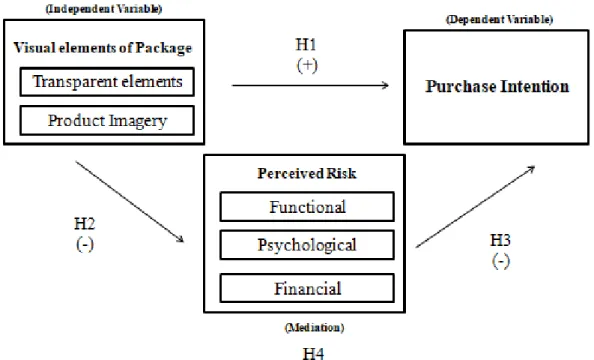
According to the literature presented above, it was considered that perceived risk (perceived functional, financial and psychological risk) has a direct and negative effect on consumers’ buying behaviour. Furthermore, visual elements of package (transparency and product imagery) negatively impact the different dimensions of perceived risk.
On the basis of this rationale, the following Hypotheses are built:
Hypothesis 4a: Perceived functional risk mediates the relationship between Visual Elements of package and Purchase Intent.
16 Hypothesis 4b: Perceived financial risk mediates the relationship between Visual Elements of package and Purchase Intent.
Hypothesis 4c: Perceived psychological risk mediates the relationship between Visual Elements of package and Purchase Intent.
17
Chapter 3. Methodology
The aim of the third chapter is to explain in detail the methodology that formed the basis for this study. It includes the analysis of both the primary and secondary data with the intention of reaching conclusions that will help to confirm the hypotheses projected on the previous chapter.
3.1 Conceptual Model and Research Approach Review
The conceptual framework of the presented paper is based on the impact of visual elements of package on consumers purchase intent of Pizza and Salmon as well as the perceived risk associated with these different categories. The variables associated with visual elements of package are the presence of either transparent elements or a graphic of the product on package. The perceived risk variable is expected to perform as a mediator on the relationship between the independent variable, Visual Elements of Package, on the dependent variable (Purchase Intent).
There are three types of methods used for research purposes that provide insights for the structure of the dissertation methodology skeleton: Exploratory, Descriptive and Explanatory (Saunders et al., 2009). On this dissertation, both exploratory and explanatory methods were applied in this study in order to properly respond to the research questions presented on the previous chapter – Literature Review.
Exploratory research refers to the review of the literature, the clarification of concepts and the construction of hypothesis for the problem or situation to study.
The goal of this type of research, which is mostly qualitative, instead of providing conclusive evidences, is to provide a better understanding of the problem in study. On the other hand, explanatory research aims to explain the existence of a certain phenomenon in study and establish a cause-and-effect relationship between the variables. In other words, this method has the purpose to assess how these variables interact, which is the final step of this dissertation (Saunders et al.,2009).
In order to elaborate the chapter 2 – the Literature Review – the secondary data was collected though journals, books and academic articles. It presents and describes topics such as the relevance of packaging in FMCG industry, the effects of visual elements of
18 package (the presence of product imagery and transparency on packages) on consumer´s purchase intent. After being able to have an overview about the concepts included on this study, the primary data was collected and quantitative investigation was presented in order to associate these concepts and find further relevant insights.
3.2 Primary Data
3.2.1 Online Survey
The perceived risk linked with a specific purchase decision, as presented in the first chapter of this study, has a lot of influence on consumers’ tendency to purchase packaged goods with regard to different packaging design.
Hence, an online questionnaire was developed with the aim to not only understand in what way the visual elements of packaging influence consumer’s final decision to buy a specific food products such as pizza and salmon but also to understand the effect of the different dimensions of perceived risk on consumers’ purchase intent across different food categories on the basis of the conceptual model presented in Chapter 1. In the questionnaire, people surveyed were randomly and evenly assigned to one of six scenarios, three involving a number of questions on packaged pizza (symbolizing visual appealing and tasteful kind of food) and the others scenarios containing the same set of questions regarding packaged salmon ( symbolizing the healthy foods to eat on a daily basis). In general, junk food is perceived by consumers as more visually appealing, with a better packaging design and better promoted when compared with healthy food (Pires and Agante, 2011) and this is one of the main reasons why in this study, both healthy and unhealthy food categories was studied.
The online survey consisted of 25 questions which were divided in four topics: questions about consumers’ purchase regularity within each product category, questions concerning visual elements of packaging and questions to evaluate each different dimension of perceived risk in study. Then participants were asked about their purchase intention of packaged foods and demographic questions.
19 The questionnaire was available online from 8th to 11th May 2018 and it was distributed by e-mail and social media only in English version. The survey can be found in Appendix I.
Since for this research problem, transparent packaging is being compared with opaque packages displaying a picture of the product, it is important to consider plain opaque packaging (without product imagery and transparency) as a “control” scenario in order to understand the importance of the presence of visual displays of the product on package.
Thus, people who did the survey, answered to the same scaled-response questions based on the image - accordingly with the scenario - that appeared at the beginning of each survey. These scenarios were random and evenly distributed among respondents, even for the “control” scenarios where there was no product display on package (opaque packaging), for the exact same products. Thus, in this questionnaire, there were six different scenarios each one with a different image that randomly appeared in each survey. That will allow us to quantify the impact of each scenario – packages with graphical representation of the product versus transparent packaging versus opaque packaging - for each food category.
Despite the fact that all the scenarios were and evenly distributed among respondents, if respondents have never bought before one of the two food categories presented in the online survey, they only answered to the questionnaire regarding the food category that they have already bought at least one time before.
Moreover, people who answered the survey, in order to finish it, needed to evaluate the attractiveness of each the packaging design when the three different images of each scenario were simultaneously shown in the (ranking) question. This will let us understand how the different the visual elements of package affect consumer’s mind with regard to package’s attractiveness.
20 Figure 2: Questionnaire Design.
3.2.2 Construct Measurement
Measurement Model
Construct Literature for Scale Items
Nº of Items
Visual elements of package
(Truong et al.,2016) (Brakus et al.,2009)
(Simmonds,Woods and Spence,2018)
6 Perceived risk
(Functional, Financial and Psychological)
(Bhukya& Singh, 2015) 6
Purchase intent (Vilnai-Yavetz&Koren,2013) 3
Demographic Question (Tsiros and Heilman, 2005)
1 Figure 3: Proposed constructs, number of scale items and relevant literature sources.
Subsequent to a deep review of relevant literature, the most suited measures for this dissertation were selected. In some cases, the constructs were left as their original versions, while in other cases the constructs were either adapted or combined with similar one to better fit the context of this study.
Questionnaire Pizza Transparent packaging Packaging with an image of the product Opaque packaging (Control Group) Salmon Transparent packaging Packaging with an image of the product Opaque packaging (Control Group)
21 In the table above (Figure 3) are presented the authors’ name and the year of the publication of the literature used to do the survey’s questions associated with each variable in study and the number of scale items.
The constructs presented in the online survey were measured mainly using statements with 7-point “Likert- type” scales, with a range from “Strongly disagree” to “Strongly agree” and one ranking question of three options between “Do not like the product at all” and “Like the product very much”.
3.3 Data Analysis
In order to analyse the answers obtained from the online survey, it was used the Statistical Package for the Social Science (SPSS), version 23.0, with the purpose to understand how visual elements of package influence consumers purchase intent of food packaged products and the mediating role of perceived risk between these variables (Hayes, 2013).
The socio-demographic characterization of the sample was studied by doing descriptive statistics analysis as well as the overall obtained results of each scenario. Additionally, the Cronbach's alpha of each variable, with the exception of perceived psychological risk, was perform and then analysed, in order to check the constructs reliability.
In addition, measures of the median, minimum and maximum value were perform as well as statistical tests such as ANOVA test and Sobel test. Linear multiple regression were also performed. It was take into account, for every statistical tests performed, a significance level of 5%.
A Mediation model (Hayes, 2013) is used in this study in order to estimate the impact, which is indirect, of the variable visual elements of package on the variable purchase intent through an intermediary (mediator) variable which in this dissertation is perceived risk (perceived functional risk, perceived financial risk and perceived psychological risk).
Therefore, for each dimension of perceived risk described in the chapter 2, three mediation models were done in separate.
22
Chapter 4. Results and Discussion
The fourth chapter presents a detailed analyse of the data obtained from the online questionnaire. This analysis is based on the methodology already described in the previous chapters, which will let to have conclusions concerning the research questions proposed in the first chapter of this study.
4.1 Sample Characterization
In total, 688 respondents answered the online survey. However, 66 respondents claimed to not buy any of the presented categories (neither pizza nor salmon), thus the valid survey answers for this research were 622.
The online questionnaire has a between-subject design and people who answered the survey were randomly and evenly assigned to one of the six frameworks (different packaging design within different product category) presenting a number of questions on the topic of consumers’ buying behaviour for one of the two food product subcategories: packaged pizza and packaged salmon.
Accordingly, each scenario got more or less the same number of answers. The “graph” scenario ( packages displaying a picture of the product) had 203 answers which is 32,64% of the total valid answers, the “see-through” scenario (package with transparent elements) had 221 answers which is correspond to 35,53% of the total valid answers while the “opaque” scenario had 198 answers which means 31,83% of the total valid answers.
Focuses only on the packaged pizza scenario, 126 respondents answered the survey regarding transparent packaging, 118 respondents in respect to opaque packaging and 131 respondents in regard to packages displaying a picture of the product.
On the other hand, only concerning the packaged salmon scenario, 95 respondents answered the survey regarding transparent packaging, 80 respondents relating to opaque packaging and 72 respondents regarding packages with an image of the product.
Therefore, 375 respondents (60.3%) answered to the questionnaire regarding the packaged pizza category and 247 respondents (39.7%) regarding the packaged salmon
23 category. This difference can be explained by the fact that despite the fact that the scenarios were randomly and evenly distributed among respondents, if respondents have never bought packaged pizza before, they only answered to the questionnaire regarding the packaged pizza category and vice-versa.
Analysing the data presented in figure 5, it can be verified that the majority of the sample elements (60.60%) already bought both packaged pizza and packaged salmon at the supermarket, followed by 24.13% that bought only packaged pizza and 5.67% only bought packaged salmon, which means that 39 respondents never bought packaged
Food Category Package displaying a picture of the product
Transparent packaging Opaque packaging Total Pizza 34,9% (131) 33,6% (126) 31,5% (118) 60.3% (375) Salmon 29,1% (72) 38,5% (95) 32,4% (80) 39.7% (247) Total 32.64% (203) 35.53% (221) 31.83% (198) 100% (622) Figure 4: Survey respondents per scenario.
Distribution of purchase per category n %
Only one category
Pizza 166 24,13%
Salmon 39 5,67%
Both Categories 417 60,60%
Neither of the two categories 66 9,60%
Total 688 100%
24 pizza but already bought packaged salmon. At least, 9.60% of the sample elements never bought both packaged food pizza and salmon.
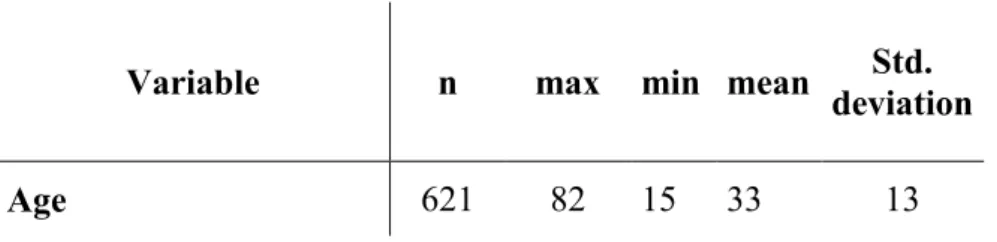
By conducting descriptive analysis on SPSS version 23.0 it was verified that 57.30% of the respondents are female and 33.10% are male. Regarding the 621 valid answers on the topic of the age of the respondents, the sample elements are between the age of 15 and 82 with the mean of 33 years old and with a standard deviation of approximately 13 years old. Furthermore, significant number of the sample elements stated to have finished either bachelor degree (22.8%) or a Master’s degree (52.5%).
Concerning the occupation of people who answered the survey, approximately half of the sample elements (48%) are student-workers and 22.8% are students. From the remaining participants, 8.7% employees working for another person and 1.6% express to be self-employed, a job on their own. From the others participants, 3.9% are retired and 5.4% stated to be in a professional situation that was not mentioned in the survey.
Variable n % Gender Male 228 33,10% Female 394 57,30% Education Middle School 14 2% High School 69 10% Bachelor Degree 157 22,80% Master Degree 361 52,50% Doctoral Degree 21 3,10% Occupation Student 157 22,80% Student-Worker 330 48% Employee 60 8,70% Self-Employee Worker 11 1,60% Retired 27 3,90% Other 37 5,40%
25 Variable n max min mean deviation Std.
Age 621 82 15 33 13
Figure 7: Demographic characteristics of the sample (Age).
4.2 Measures Reliability
In order to verify the constructs' validity of visual elements of packaging, perceived risk and purchase intent, a reliability study was conducted. The study was performed for each of the six scenarios where the constructs were shown. Furthermore, in the visual elements of package variable, the item 3 was inverted (reverse coded) in order to perform Cronbach’s alpha. After that, the Chronbach’s alpha coefficient of each variable was analysed in order to verify the reliability of each measure presented in the online questionnaire. The obtained results are shown in a scale from 0 to 1.
The greater the values, the greater is the homogeneity of the answers, in other words, the internal consistency of the respondent’s answers given to the scale-response questions that were presented on the survey.
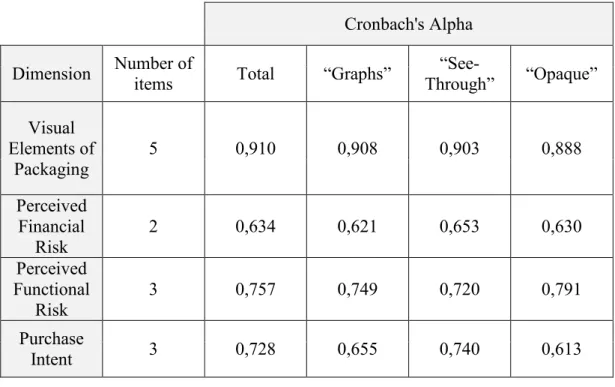
Some authors such as Nunnally (1978) and DeVellis (1991) both cited by Maroco (2007) state that obtained values larger to or equal than 0.70 evidence high internal consistency. The last mentioned author also considers that if the number of items is low, values that are equal to or larger than 0.60 are still admissible. Thus, the results presented in Figure 8, confirm that all the constructs are valid because all the coefficient alpha values of each variable in study are greater than 0.6.
In addition, for the variable visual elements of packaging dimension, two questions (9 and 17) were not considered in the analysis in order to have a value of the internal consistency of the group of item higher than 0.6.
In regard to perceived functional risk dimension, the Cronbach’s alpha of opaque packaging is higher than the “total” Cronbach’s alpha.
26
4.3 Results from the Hypothesis Test
With the purpose to test the hypotheses described and explained in the second chapter, descriptive statistics, linear multiple regression and classical mediation model were performed.
4.3.1 Descriptive Statistics
In order to infer conclusions regarding the research questions presented on chapter 2, we could compare and analyse the different mean values obtained for purchase intent (with 3 items), visual elements of packaging (with 5 items), perceived financial risk (with 2 items), perceived psychological risk (with 1 item) and perceived functional risk (with 3 items) when measuring different contexts concerning the same constructs.Thus, it is important to start by doing a descriptive analysis in order to calculate the mean of all items and then be able to compare them. The means for each scenario are measured using statements with 7-point “Likert- type” scales, which can be seen in the following
Cronbach's Alpha
Dimension Number of
items Total “Graphs”
“See-Through” “Opaque” Visual Elements of Packaging 5 0,910 0,908 0,903 0,888 Perceived Financial Risk 2 0,634 0,621 0,653 0,630 Perceived Functional Risk 3 0,757 0,749 0,720 0,791 Purchase Intent 3 0,728 0,655 0,740 0,613
27 figures. Moreover, they represent the average punctuation that the sample elements attributed for each scenario.
Figure 9: Descriptive statistics for Visual Elements of packaging.
Regarding the items that are part of the visual elements of package, it is verified that respondents evidence preference for the food products within transparent packages, followed by food products within packages displaying an image of the product.
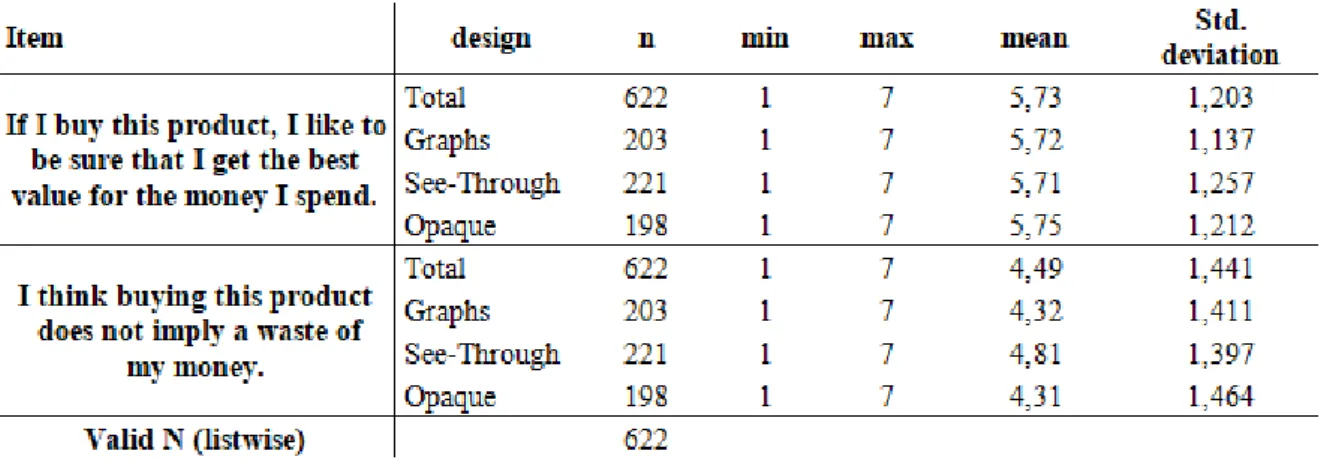
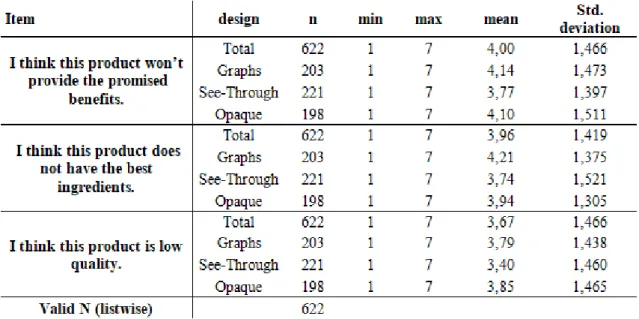
28 Concerning the items that are part of the perceived financial risk, the results that are included in figure 10 allow to verify that the majority of respondents perceived the product as not worth the price they would pay for it when the product was presented in an opaque package when compared to transparent packaging. Moreover, in the eyes of the respondents, the probability that the packaged product’s quality is not equivalent with its price was higher when the product was presented inside a package with an image of the product when compared to packages with transparency as an element of packaging design.
Figure 11: Descriptive statistics for each dimension of Perceived Functional Risk.
According to the figure 11, respondents evidence higher levels of uncertainty that the product’s performance will not encounter their expectations when the product was inside a package displaying a graphic of the food product on its ready-to-eat form (compared to transparent packaging). However, it was also verified a greater number of positive expectations in relation to product’s quality for those products that were presented within opaque packaging (3.94) when compared with packages with product imagery (4.21). Thus, images of food on package do not affect the perception of more favourable evaluations as it was expected. It could be said that such food imagery should not be perceived by consumers as dishonest. This could be a possible explanation for these unexpected results.
29 Figure 12: Descriptive statistics for each dimension of Perceived Psychological Risk.
For perceived psychological risk items, it was observed through the following item “I will be unhappy if this product does not give the expected results”, that respondents would be disappointed if they made a wrong purchase decision by buying a poor product. The results state that perceived psychological is higher when opaque packaging was shown in the survey; it causes consumers to avoid purchasing products within opaque packages.
Figure 13: Descriptive statistics for Purchase Intent.
Regarding purchase intention variable,the results that are included in figure 13 permit to verify that packages that with transparency as an element of packaging design (when being compared to packages displaying an image of the product) were perceived by those who answer the survey as to be more trusty and consequently enhance consumer’s purchase intent.
30 4.3.2 The effect of visual elements variables over packaged products purchase intent Hypothesis 1: Visual elements of package positively impacts purchase intent.
The following linear regression model was performed between the two variables, purchase intent and visual elements of packaging:
i=1,...,622, Where: PI – Purchase Intent
VI – Visual elements of packaging
It allowed to know that the slope of the model 2 is positive and; as shown in the figure
14, that the regression coefficient is +0.443 with p < 0.001. The model is statistically significant (F(1;620) =304,312 ; p < .001) by doing the ANOVA.
Looking at the variable visual elements of packaging, the coefficient shows that for every unit increased in visual elements of package, the purchase intent for food (packaged) products (pizza and salmon) will increase 0.443 units all other variables remaining constant. By doing Durbin–Watson statistic test, it can be concluded that in this model residuals are not autocorrelated. In addition, in the appendix IV it can be observed normality and homocedasticity.
Consequently, Hypothesis 1 is verified.
Figure 14: Variable Relationship for Visual Elements of Package (H1).
Hypothesis 1a: Including a picture of the product on package will positively affect purchase intent.
Hypothesis 1b: The presence of transparent elements on package positively impacts purchase intent.
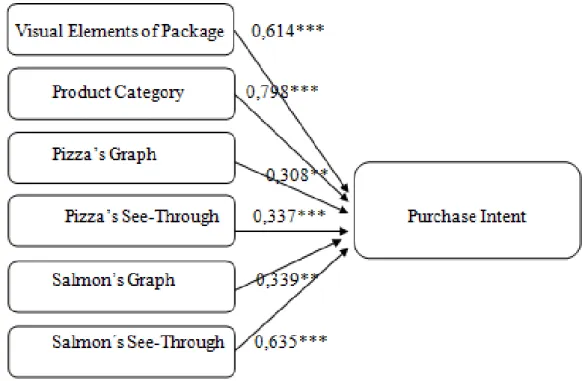
31 In order to understand the effect of the inclusion of a picture of the product or the presence of transparent elements on package or even the impact of opaque packaging on consumer’s purchase intent of food (packaged) products, dummies variables were introduced in the regression model above. In addition, it was also introduced the product category - packaged pizza or packaged salmon - as a dummy variable which is coded as 0 (zero) for pizza and 1 (one) for Salmon. Thus, the impact of each product category can be studied.
Thus, the regression equation can be written as:
i=1,...,622 Where: PG – Package displaying a picture of pizza
PS – Pizza’s see-through packaging
SG - Packages displaying a picture of salmon SS – Salmon’s See-through packaging.
In order to explain in detail the model above described as in one model there are these models:
Opaque packaging for pizza:
(Type=0, PG=0, PS=0, SG=0, SS=0) i=1,...,622 Product imagery for Pizza:
(Type=0, PG=1, PS=0, SG=0, SS=0) ) i=1,...,622 Transparent packaging for Pizza:
(Type=0, PG=0, PS=1, SG=0, SS=0) i=1,...,622 Opaque packaging for salmon:
(Type=1, PG=0, PS=0, SG=0, SS=0) i=1,...,622 Product imagery for Salmon:
(Type=1, PG=0, PS=0, SG=1, SS=0) i=1,...,622 Transparent packaging for Salmon:
32 *** Significant at p<0.1%, ** Significant at p<1%, * Significant at p<5%
The model is statistically significant as (F(6;615) =53,565 ; p < .001) by doing the ANOVA test. Moreover, it was also confirmed that 34.3% of the dependent variable (purchase intention) variance can be explained by the visual elements of package within the different product categories (independent variable). It can be concluded that in this model residuals are neither heterocedastic nor autocorrelated and can be considered having a normal distribution. In this model, there are no signs of multicolinearity since VIF is always under 10.
Based on the obtained results, it can be concluded that the product category, such as salmon or pizza for this study, has a noteworthy impact on consumer’s buying behaviour of packaged food products regarding the type of packaging design (visual elements of package). On the other hand, either the presence of transparent elements or an image of the product on package positively impacts consumer’s purchase intent of salmon and pizza. However, this impact is higher for salmon than pizza.
Figure 15: Variable Relationship for each product category and each packaging design (H1a and H1b).