arXiv:1112.4432v3 [hep-ex] 11 Apr 2012
Measurement of D
∗±meson production in jets from pp collisions
at
√
s
= 7 TeV with the ATLAS detector
The ATLAS Collaboration
This paper reports a measurement of D∗±meson production in jets from proton-proton collisions at a center-of-mass energy of√s = 7 TeV at the CERN Large Hadron Collider. The measurement is based on a data sample recorded with the ATLAS detector with an integrated luminosity of 0.30 pb−1 for jets with transverse momentum between 25 and 70 GeV in the pseudorapidity range |η| < 2.5. D∗± mesons found in jets are fully reconstructed in the decay chain: D∗+ → D0π+, D0
→ K−π+, and its charge conjugate. The production rate is found to be N (D∗±)/N (jet) = 0.025±0.001 (stat.)± 0.004 (syst.) for D∗±mesons that carry a fraction z of the jet momentum in the range 0.3 < z < 1. Monte Carlo predictions fail to describe the data at small values of z, and this is most marked at low jet transverse momentum.
PACS numbers: 13.25.Ft, 13.85.Ni, 13.87.Fh
I. INTRODUCTION
Heavy flavor production in high-energy interactions has produced interesting tests of quantum chromody-namics (QCD) and valuable information on fragmenta-tion and decay properties. Early measurements of b-hadron production cross sections in high-energy p¯p col-lisions [1–4] were higher than the available theoretical calculations. A satisfactory agreement between measure-ment and theory was reached for b-hadron production with improved analysis methods, see for example [5, 6], and more accurate QCD predictions, as discussed in [7– 9]. Measurements of c-hadron production [10–12] are however less conclusive and additional experimental data are needed to probe the theory, in which nonperturba-tive effects such as fragmentation have a significant im-pact on the theoretical calculations. With collisions at higher center-of-mass energy at the CERN Large Hadron Collider (LHC), the kinematical range accessible to ex-periment has been significantly extended [13–16]. New measurements of heavy flavor production will help in testing improved QCD-based models. Moreover, precise knowledge of heavy quark production is important for an understanding of the backgrounds in searches for new phenomena beyond the standard model if they include decays to heavy quarks.
One method to study the production of heavy quarks is to measure D∗± mesons produced inside jets [10, 11, 17, 18] by fully reconstructing the decay chain: D∗+ → D0π+, D0 → K−π+ and its charge conjugate. This pa-per reports a measurement of D∗± meson production in jets from proton-proton collisions at a center-of-mass en-ergy of√s = 7 TeV at the LHC. The measured quantity reported here is R, the ratio of D∗± produced in jets, hereafter denoted “D∗± jets”, to any type of jet, called “inclusive jets”, as a function of the jet transverse mo-mentum pT, and the ratio, z, of the D∗± momentum along the jet axis to the jet energy, z = p||(D∗±)/E(jet). R is defined by
R(pT, z) =ND
∗±(pT, z) Njet(pT)
, (1)
where p||(D∗±) is the momentum of the D∗± meson along the jet axis; E(jet) is the energy of the D∗± jet; ND∗±(pT, z) is the number of jets that contain a D∗± meson, in the corresponding pTand z bin, and Njet(pT) is the number of inclusive jets in the pTbin.
II. THE ATLAS DETECTOR
The ATLAS detector is described in detail else-where [19]; only the components relevant to this analysis are described here. The ATLAS coordinate system has the origin at the nominal beam-beam interaction point. The azimuthal angle φ is measured around the beam axis, z, in the x − y transverse plane, and the polar angle θ is the angle from the beam axis. For particles and jets, the transverse momentum is defined as pT= p sin θ, where p is the momentum, and the pseudorapidity is defined as η = − ln tan θ/2.
The inner tracking detector (ID) has full coverage in φ and is contained inside a central solenoid providing a 2 T magnetic field. The ID consists of a silicon pixel detector, a silicon microstrip detector (SCT) and a transition radi-ation tracker (TRT). The pixel detector and SCT cover the pseudorapidity range |η| < 2.5 and the TRT covers |η| < 2.0. Reconstructed charged tracks traversing the central part of the detector typically have 11 silicon hits (3 pixel clusters and 8 strip clusters), and more than 30 TRT hits.
The calorimeter system used to reconstruct jets is placed immediately outside the solenoid. A high granularity lead liquid-argon electromagnetic sampling calorimeter, with excellent energy and position resolu-tion, covers the pseudorapidity range |η| < 3.2 (a bar-rel covers |η| < 1.475 and two end-caps cover 1.375 < |η| < 3.2). Two different detector technologies are used for the hadronic calorimetry. The barrel (|η| < 1.0) and extended barrel (0.8 < |η| < 1.7) calorimeters are made of steel and scintillator tiles while in the end-caps (1.5 < |η| < 3.2) copper and liquid-argon are used. For-ward copper and tungsten liquid-argon calorimeters
pro-vide both electromagnetic and hadronic measurements with coverage of |η| < 4.9.
The ATLAS detector has a three-level trigger system: Level 1 (L1), Level 2 (L2) and Event Filter (EF). L1 is a hardware trigger system, while L2 and EF are soft-ware based. For the measurement described here, the data are collected using the L1 calorimeter-based jet trig-ger and a system of minimum-bias trigtrig-ger scintillators (MBTS) [20]. The L1 calorimeter trigger uses coarse de-tector information to identify areas in the calorimeter with energy deposits above a certain threshold. A sim-plified jet finding algorithm based on a sliding window of configurable size is used to trigger events. This algorithm uses towers with a granularity of ∆φ × ∆η = 0.2 × 0.2 as inputs. The MBTS consist of 32 scintillator counters that are each 2 cm thick, organized into two disks perpendic-ular to the beam located at z = ±3.56 m. This leads to a coverage of 2.09 < |η| < 3.84. The MBTS trigger is configured to require at least one hit above threshold from each side of the detector.
III. DATA AND MONTE CARLO SAMPLES
The analysis uses an integrated luminosity of 0.30 pb−1, measured with an error of 3.4% [21, 22], recorded between April and July 2010 with three L1 calorimeter jet triggers, requiring a transverse energy as-sociated to the L1 jet above 5, 10 and 15 GeV, respec-tively. Because of the increase in instantaneous lumi-nosity during the data taking period, the 5 and 10 GeV triggers were progressively prescaled. In the subsequent data taking periods the prescale factors of low-threshold jet triggers became too prohibitive to extend the analysis to higher integrated luminosity.
To validate the Monte Carlo (MC) simulation of the jet trigger efficiency, a data sample collected with the MBTS trigger is used, whose integrated luminosity corresponds to approximately 1 nb−1 after taking into account its prescale factor.
The MC simulated events used for the correction of the signal yield for detector effects are produced with
the PYTHIA 6.421 event generator [23]. It implements
leading-order (LO) perturbative QCD (pQCD) matrix elements for 2 → 2 processes, pT-ordered parton show-ers calculated in a leading-logarithmic approximation, an underlying event simulation using multiple-parton inter-actions, and uses the Lund string model for hadroniza-tion. The Martin-Stirling-Thorne-Watt LO proton struc-ture functions [24, 25] with the generator tune described in Ref. [26] are used for the generation of the MC sam-ple. The generated samples are passed through a full simulation [27] of the ATLAS detector and trigger based
onGEANT4[28]. Finally, the simulated events are
recon-structed and selected using identical procedures as for the data.
The measured D∗± jet production rates are compared to predictions from different MC generators: PYTHIA,
described above, and HERWIG 6 [29], with the AUET1 generator tune described in Ref. [30], which also employs LO pQCD matrix elements, but uses an angle-ordered parton shower model and a cluster hadronization model. The underlying event for the HERWIG6 samples is gen-erated using theJIMMY[31] package to model multiple-parton interactions. Further comparison of the measure-ment is performed to the next-to-leading-order (NLO) pQCD calculation implemented inPOWHEG[32–35]. The CTEQ 6.6 [36] parametrization is chosen as the parton density function of the proton. In order to compare with data at the particle level, nonperturbative correc-tions have to be applied. This is done using leading-logarithmic parton shower MC programs: the PYTHIA
andHERWIGmodels introduced above. D∗± mesons are
produced either directly in the fragmentation of charm quarks or via a cascade in the fragmentation of bottom quarks and the subsequent decay of a b hadron. The charm and bottom quark masses are set to 1.5 GeV and 4.75 GeV, respectively. The fraction of charm quarks that fragment to a D∗± meson, f (c → D∗+), is set to 0.224 ± 0.028 [37–41]; the fraction of b hadrons that de-cay to a final state with a D∗± meson, f (b → D∗+X), is 0.17 ± 0.02 [42].
IV. EVENT SELECTION
Events are required to have at least one pp primary ver-tex reconstructed from at least five charged tracks with pT> 150 MeV each. Only vertices lying within ±10 cm along the beam axis of the nominal interaction point are considered. In events with multiple vertices, the ver-tex with the largest P p2
T of associated charged tracks is taken as the primary event vertex. For the values of instantaneous luminosity used in this analysis the aver-age number of additional interactions per beam crossing was small, about 0.3.
The anti-kt algorithm [43] with radius parameter 0.6 is used to reconstruct jets from topological energy clus-ters [44] assuming that the reconstructed primary event vertex is at the origin of the jet. The clusters in the calorimeter are seeded by calorimeter cells with energy |Ecell| > 4σ, where σ is the RMS of the cell noise dis-tribution. All directly neighboring cells are added, then neighbors of neighbors are iteratively added for all cells with signals above a secondary threshold |Ecell| > 2σ. Finally the energy in all further adjacent neighbors is added. Clusters are split or merged based on the posi-tion of local minima and maxima. The energies of cells of a cluster are summed to give the cluster energy, and the clusters are treated as massless with energy E =P Ecell. The baseline calibration for these clusters corrects their energy to the electromagnetic (EM) scale [45–47], which is derived in test-beams, and properly calibrates the en-ergy of particles interacting electromagnetically in the electromagnetic and hadronic calorimeters. Finally, a pT and η dependent jet energy scale (JES) [48, 49] is
ap-plied to the jets to correct effects of hadronic shower response and detector-material distributions. The JES is determined based on the detector simulation and vali-dated with extensive test beam and collision data studies. The jets used in the measurement are required to have 25 < pT < 70 GeV and |η| < 2.5. Jets that are likely to have arisen from detector noise or cosmic rays are re-jected [50].
Candidates for D∗± mesons inside jets are recon-structed in the decay chain: D∗+→ D0π+, D0→ K−π+ and its charge conjugate. Two oppositely-charged tracks with pT > 1 GeV are combined to form a D0 → K−π+ candidate and a second candidate ¯D0 → K+π− with the K and π mass hypotheses swapped. The D0 ( ¯D0) candidate whose mass is within 50 MeV of the PDG value [51], corresponding to slightly more than twice the measured mass resolution, is then combined with a third track with pT> 0.5 GeV having the same charge as the pion to form a D∗+→ D0π+(D∗−→ ¯D0π−) candidate. To reduce the combinatorial background of uncorrelated pairs, the D∗± mesons are required to have a transverse momentum larger than 7.5 GeV, and the measured D0 ( ¯D0) transverse decay length is required to be greater than zero. The transverse decay length is defined as Lxy = ~r · ~pT/|~pT|, where ~r is the displacement vector pointing to the D0 ( ¯D0) decay vertex from the primary vertex in the transverse plane, and the ~pT is the trans-verse momentum of the D0 ( ¯D0) candidate. The D0 ( ¯D0) decay vertex is obtained extrapolating the K and π tracks. The MC simulation predicts that the selection Lxy> 0 rejects half of the combinatorial background and retains 89% of the signal, consistent with what has been observed in the data.
The reconstructed D∗± candidates are matched with the reconstructed jets in the event. A jet is considered as a D∗± jet candidate if the D∗± direction is in a cone of ∆R = p(∆η)2+ (∆φ)2 = 0.6 centered on the jet axis, the same value as the radius parameter of the anti-kt jet algorithm. The momentum fraction z of the D∗± jet candidates is required to be larger than 0.3 due to the low reconstruction efficiency and large combinatorial background for D∗± jets with z < 0.3.
The D∗± jet yield is extracted from the distribution of ∆m = m(K∓π±π±) − m(K∓π±) − m(π±), where m(K∓π±π±) is the invariant mass of the D∗± candidate and m(K∓π±) is the invariant mass of the D0 ( ¯D0) can-didate. The signal probability density function (PDF) is modeled as a double Gaussian with equal mean based on MC studies, and the background is characterized by ∆maeb∆m, where a and b are free parameters in the fit. The D∗±jet candidate sample is divided into several bins in pT and z of the D∗± jet. A simultaneous unbinned maximum likelihood fit is then performed. In the fit, the parameters of the signal and background PDFs are con-strained to be the same in each pT and z bin, and the fit returns the normalizations of the signal and the back-ground. The assumption of shapes being constant with pTand z has been checked in MC. After applying all the
event selection criteria, a total of 4282 ± 93 D∗± jet sig-nal candidates are obtained, where the error is statistical only. Examples of the ∆m distribution for the data are shown in Fig. 1 together with the fit result.
m [MeV] ∆ 0 10 20 30 40 Entries / MeV 0 100 200 300 m [MeV] ∆ 0 10 20 30 40 Entries / MeV 0 100 200 300 ATLAS < 30 GeV T 25 < p 0.3 < z < 0.4 (a) m [MeV] ∆ 0 10 20 30 40 Entries / MeV 0 100 200 m [MeV] ∆ 0 10 20 30 40 Entries / MeV 0 100 200 ATLAS < 40 GeV T 30 < p 0.4 < z < 0.5 (b) m [MeV] ∆ 0 10 20 30 40 Entries / MeV 0 50 100 m [MeV] ∆ 0 10 20 30 40 Entries / MeV 0 50 100 ATLAS < 50 GeV T 40 < p 0.5 < z < 0.6 (c) m [MeV] ∆ 0 10 20 30 40 Entries / MeV 0 10 20 30 40 50 m [MeV] ∆ 0 10 20 30 40 Entries / MeV 0 10 20 30 40 50 ATLAS < 60 GeV T 50 < p 0.6 < z < 0.7 (d) m [MeV] ∆ 0 10 20 30 40 Entries / MeV 0 5 10 15 20 m [MeV] ∆ 0 10 20 30 40 Entries / MeV 0 5 10 15 20 ATLAS < 70 GeV T 60 < p 0.7 < z < 1 (e) m [MeV] ∆ 0 10 20 30 40 Entries / 0.5 MeV 0 500 1000 1500 m [MeV] ∆ 0 10 20 30 40 Entries / 0.5 MeV 0 500 1000 1500 (f) > 25 GeV T p z > 0.3 ATLAS
right charge combinations wrong charge combinations
FIG. 1: Examples of the distributions of the mass differ-ence of the D∗+ → D0
π+
and its charge conjugate in-side jets for different pT and z bins. The solid line is the fit result. The dotted line represents the background com-ponent. For comparison, the distribution of the difference between the invariant mass of the wrong sign candidates, m(K±π±π∓) − m(K±π±) − m(π∓), is also shown with a dashed line in Figure (f), where identical event selection crite-ria as the signal reconstruction have been applied except that the two tracks from the D0 ( ¯D0) candidates are required to have the same charge. No structure is observed and the distri-bution of wrong sign candidates can be also well described by the same PDF as the signal candidates with slightly different values of the PDF parameters.
V. UNFOLDING
The signal yield of the reconstructed D∗± jets is ex-tracted in bins of the jet pTand z. If detector resolution effects are negligible, the D∗± jet production rate can be
calculated as R(pT, z) = Nreco D∗±(pT, z)/ǫD∗±(pT, z) B(D∗±→ K∓π±π±)Nreco jet (pT)/ǫjet(pT) , (2) where B is the decay branching fraction, ǫD∗±is the trig-ger and reconstruction efficiency of D∗±jets identified by the decay D∗± → K∓π±π±, ǫ
jetis the trigger and recon-struction efficiency of inclusive jets, Nreco
D∗± and Njetreco are the numbers of reconstructed D∗± and inclusive jets, re-spectively. MC studies show that for a given D∗±jet that passes the trigger selection and falls within the kinematic range of the measurement, the probability to reconstruct it offline is between 15% and 45%, depending on the jet pT and z. However, the reconstructed values of the pT and z will be different from the true values at the particle level due to the finite resolution of the jet energy mea-surement. In order to obtain the true distributions at the particle level from the measured quantities, a Bayesian iterative unfolding algorithm [52] is used to correct for the detector efficiency and bin-to-bin migration due to the detector resolution. The D∗± jet production rate is subsequently calculated as R(pT, z) = ND∗±(pT, z) B(D∗±→ K∓π±π±)N jet(pT) , (3)
where ND∗± and Njet are the number of the D∗± and inclusive jets after unfolding, respectively.
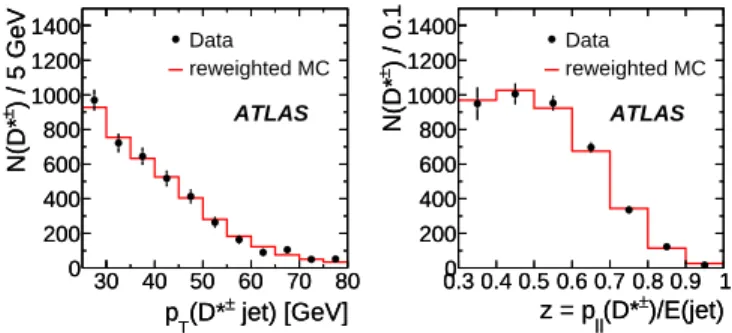
The corrections of this algorithm are based on a re-sponse matrix that is derived from MC simulated events, which encapsulates the probability for a true D∗± jet at the particle level with a particular pT and z to be re-constructed in any possible pT and z bin. The MC pT and z distributions of D∗± jets are reweighted to match the measured distributions, the comparison is shown in Fig. 2. Similar correction procedures are also applied to the reconstructed inclusive jets to obtain the number of jets at the particle level as a function of the jet pT.
jet) [GeV] ± (D* T p 30 40 50 60 70 80 ) / 5 GeV ± N(D* 0 200 400 600 800 1000 1200 1400 Data reweighted MC ATLAS jet) [GeV] ± (D* T p 30 40 50 60 70 80 ) / 5 GeV ± N(D* 0 200 400 600 800 1000 1200 1400 )/E(jet) ± (D* || z = p 0.3 0.4 0.5 0.6 0.7 0.8 0.9 1 ) / 0.1 ± N(D* 0 200 400 600 800 1000 1200 1400 Data reweighted MC ATLAS )/E(jet) ± (D* || z = p 0.3 0.4 0.5 0.6 0.7 0.8 0.9 1 ) / 0.1 ± N(D* 0 200 400 600 800 1000 1200 1400
FIG. 2: Comparison of the pT and z distributions of the D∗±jets between data and MC. The D∗±decay products are matched to jets at the particle level by using a geometrical matching with ∆R < 0.6. The MC distributions are then reweighted and subsequently normalized to have the same number of events as the data.
The unfolding algorithm has been validated using MC simulated events and no bias is observed. To evaluate the
statistical uncertainties on the unfolded variables, 1000 ensembles of the unfolding sample are generated. For each ensemble, the number of reconstructed jets in each bin is generated randomly according to a Gaussian dis-tribution, where its mean is the number of jets recon-structed in that bin before unfolding, and its width is the corresponding statistical uncertainty. The unfolding is subsequently performed for each ensemble. The devia-tions of the numbers of jets after unfolding with respect to the nominal results are fitted to a Gaussian distribu-tion. The means of the Gaussian distributions are found to be consistent with zero. The widths of those Gaussian distributions are taken as the statistical uncertainties of the measured numbers of jets after unfolding.
VI. SYSTEMATIC UNCERTAINTIES
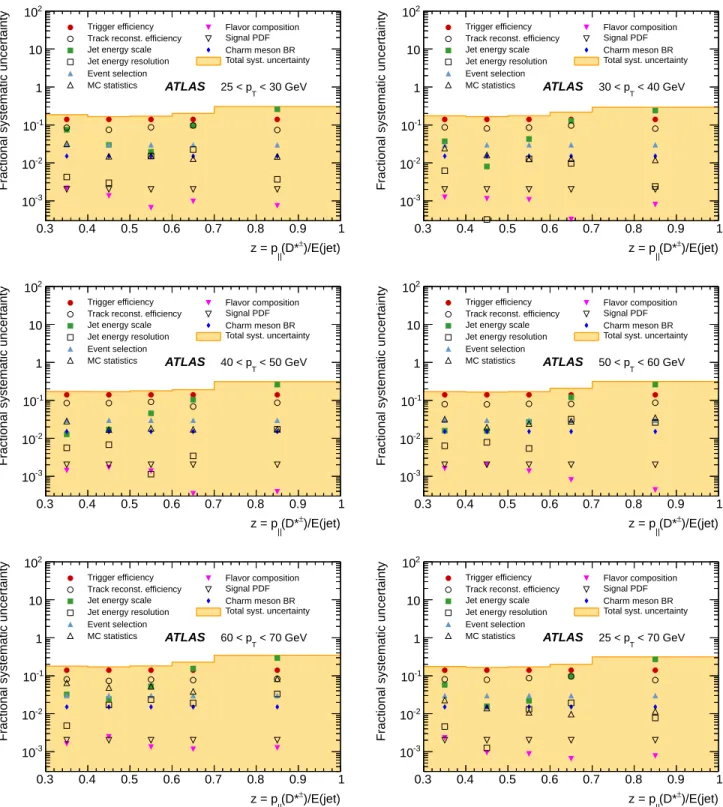
The fractional systematic uncertainties of the mea-sured R in each bin of pT and z are shown in Fig. 3 while the total uncertainties are summarized in Table I. A brief description of the sources of systematic uncer-tainties in the measurement and how they are estimated is given below.
Trigger efficiency effects largely cancel in the calcula-tion of the ratio R. However, the different flavor composi-tion of D∗± jets and inclusive jets could cause differences in the trigger efficiencies of the two samples. To study the effect of these possible differences on R, a variable r = Nreco
D∗±/Njetreco is defined, where NDreco∗± is the number of reconstructed D∗± jets and Nreco
jet is the number of reconstructed inclusive jets. Subsequently a double ra-tio ρ is defined as ρ = rjet trig/rMBTS, where rjet trig and rMBTS are the ratio r measured in the data collected by the L1 calorimeter jet trigger and the MBTS trigger, re-spectively. Since the MBTS trigger makes no jet selection in contrast to the L1 jet triggers, the double ratio ρ gives a good estimate of the size of flavor-dependent trigger efficiency effects. The values of ρ determined in data and MC are found to agree within the statistical uncertainty. Further comparisons between the values of the double ra-tio ρ measured in data and MC simulara-tion are made as a function of the jet pT, z and η, and no significant dif-ference between data and the MC simulation is observed. As a result, the relative statistical uncertainty (14%) of the measured ρ in the data is taken as the relative un-certainty of the measurement due to potential bias from trigger effects. This large systematic uncertainty is due to the limited size of the data sample from the MBTS trigger, which was heavily prescaled during data taking. To estimate the systematic uncertainties due to track reconstruction efficiencies, which only affect the D∗±jets, a weight factor wtrks is assigned to each reconstructed D∗± jet candidate in the MC simulation:
wtrks= (1 + sK) × (1 + sπ1) × (1 + sπ2), (4) where sK, sπ1 and sπ2 are ±1σ of the uncertainties on the track reconstruction efficiencies for the D∗± decay
)/E(jet) ± (D* || z = p 0.3 0.4 0.5 0.6 0.7 0.8 0.9 1
Fractional systematic uncertainty
-3 10 -2 10 -1 10 1 10 2 10 Trigger efficiency Track reconst. efficiency Jet energy scale Jet energy resolution Event selection MC statistics
Flavor composition Signal PDF Charm meson BR Total syst. uncertainty
< 30 GeV T 25 < p ATLAS )/E(jet) ± (D* || z = p 0.3 0.4 0.5 0.6 0.7 0.8 0.9 1
Fractional systematic uncertainty
-3 10 -2 10 -1 10 1 10 2 10 Trigger efficiency Track reconst. efficiency Jet energy scale Jet energy resolution Event selection MC statistics
Flavor composition Signal PDF Charm meson BR Total syst. uncertainty
< 40 GeV T 30 < p ATLAS )/E(jet) ± (D* || z = p 0.3 0.4 0.5 0.6 0.7 0.8 0.9 1
Fractional systematic uncertainty
-3 10 -2 10 -1 10 1 10 2 10 Trigger efficiency Track reconst. efficiency Jet energy scale Jet energy resolution Event selection MC statistics
Flavor composition Signal PDF Charm meson BR Total syst. uncertainty
< 50 GeV T 40 < p ATLAS )/E(jet) ± (D* || z = p 0.3 0.4 0.5 0.6 0.7 0.8 0.9 1
Fractional systematic uncertainty
-3 10 -2 10 -1 10 1 10 2 10 Trigger efficiency Track reconst. efficiency Jet energy scale Jet energy resolution Event selection MC statistics
Flavor composition Signal PDF Charm meson BR Total syst. uncertainty
< 60 GeV T 50 < p ATLAS )/E(jet) ± (D* || z = p 0.3 0.4 0.5 0.6 0.7 0.8 0.9 1
Fractional systematic uncertainty
-3 10 -2 10 -1 10 1 10 2 10 Trigger efficiency Track reconst. efficiency Jet energy scale Jet energy resolution Event selection MC statistics
Flavor composition Signal PDF Charm meson BR Total syst. uncertainty
< 70 GeV T 60 < p ATLAS )/E(jet) ± (D* || z = p 0.3 0.4 0.5 0.6 0.7 0.8 0.9 1
Fractional systematic uncertainty
-3 10 -2 10 -1 10 1 10 2 10 Trigger efficiency Track reconst. efficiency Jet energy scale Jet energy resolution Event selection MC statistics
Flavor composition Signal PDF Charm meson BR Total syst. uncertainty
< 70 GeV T
25 < p ATLAS
FIG. 3: Relative systematic uncertainties of the measured D∗±jet production rate R(p
T, z) in different jet pTand z bins. The values corresponding to the integrated pTrange are shown in the bottom right Figure.
daughters. These uncertainties are derived from data as a function of track pT and η [53]. The response matrix for D∗±jets is recalculated using values of w
trks with the individual factors: sK, sπ1 and sπ2, all positive or all neg-ative and new values of R are derived. The deviations of the newly measured D∗± production rates in each p
T and z bin with respect to their nominal measurement values are taken as the corresponding systematic uncer-tainties. The overall relative systematic uncertainty on R integrated over pTand z due to the track reconstruction efficiency is 8%.
The systematic uncertainty on the jet energy scale is evaluated in Ref. [44]. The maximum JES uncertainty in the central region is approximately 6.5% for jets with 20 < pT < 70 GeV. The uncertainties of jets in the end-cap regions are slightly larger because additional un-certainties due to the intercalibration are added. This brings the uncertainties in the end-cap region up to ap-proximately 9% for jets with 20 < pT < 70 GeV. To estimate the corresponding systematic uncertainties of the measured D∗± jet production rate, the values of the reconstructed pT and z of the D∗± jets and pT of the inclusive jets are varied coherently in the MC according to the JES uncertainties when calculating their response matrices. Measurements of the D∗± jet production rates are then performed with the new response matrices. The deviations of the measured D∗± jet production rate in each pT and z bin with respect to their nominal values are taken as the corresponding systematic uncertainties, which gives a relative systematic uncertainty of 3% in the measurement of R integrated over pT and z.
Using MC simulated events, the JES of D∗± jets and inclusive jets are found to be slightly different in the low pTregion but are consistent with each other in the high pT region. Varying the JES by this full difference, the corresponding systematic uncertainty on the measured R is estimated to be less than 1%.
The resolution of the jet energy measurement has been verified to be in agreement within 14% between data and MC simulation for jets in the pseudorapidity range |η| < 2.8 using control samples [54]. To estimate the cor-responding effects on the measurement, the nominal jet energy resolution in the MC simulation is artificially de-graded to account for this uncertainty for both the D∗± and inclusive jets. The D∗± jet production rate mea-surements are then repeated using the newly calculated response matrices. The deviations of the measured D∗± production rate in each pTand z bin with respect to their nominal values are taken as the corresponding systematic uncertainties, and are found to be below 1%.
In the analysis, an event selection of Lxy> 0 is applied. The D∗±jets can be directly produced in pp interactions (c jets) or from b-hadron decays (b jets). The efficiency of the Lxy > 0 cut depends on the fractions of c and b jets since they have different Lxy distributions. The relative efficiency of the requirement of Lxy> 0 is estimated by comparing the D∗± jet signal yields with and without such a selection. Its value in data is measured to be
0.87 ± 0.03, consistent with the MC predicted value of 0.890 ±0.003, where the uncertainties are statistical only. As a result, a 3% relative systematic uncertainty on the measured R is assigned independent of the jet pTand z. The measurement depends on the decay branching fraction of D∗± [51]. The uncertainties of the decay branching fractions give a 1.5% relative systematic un-certainty of the measured R, independently of the jet pT and η.
Other systematic sources considered in the measure-ment include the finite size of the MC sample, and the signal and background PDFs. All of them are found to have negligible effects on the measurement (∼ 1%). The total systematic uncertainty is calculated by summing the individual systematic uncertainties in quadrature.
VII. RESULTS AND DISCUSSION
The measured D∗± jet production rates R in each bin of pT and z are listed in Table I and shown in Fig. 4. Integrating over all the pT and z bins, the production rate is found to be
R = 0.025 ± 0.001 (stat.) ± 0.004 (syst.), (5) for D∗± jets with transverse momentum between 25 and 70 GeV, in the range |η| < 2.5, and with momentum fraction 0.3 < z < 1.
Comparisons between the measurement and predic-tions from various MC calculapredic-tions are shown in Fig. 4 as a function of z for different pT ranges. The corre-sponding c and b jet fractions predicted by MC are also shown in Fig. 5. The predicted values of R byPYTHIA
and POWHEG+PYTHIA are very similar, which is also
the case when comparing calculations fromHERWIGand
POWHEG+HERWIG, as expected. Since R is defined as
the ratio between the number of D∗± jets and inclusive jets, the changes of total jet cross sections and pT distri-butions between LO and NLO QCD calculations largely cancel. The values of R predicted by MC calculations are lower than the data by a factor 2 to 3 in the bins with lowest z, and this is especially significant at low pT. The predictions are consistent with the data for z > 0.7 at all pT. Integrating over all the pT and z bins, the production rate R is estimated to be 0.0133 ± 0.0008 by
POWHEG+PYTHIA, which is just about half of the
mea-sured value.
The various MC predictions share the feature that the z distribution shape is essentially independent of pT. In the data, there is a general trend that R(pT, z) falls with pTfor a fixed z bin, as is visible in Table I, in qualitative disagreement with the MC prediction.
To further understand the discrepancies between the measurement and the MC predictions, studies of the effects of various sources of systematic uncer-tainty in the MC predictions are carried out using the
POWHEG+PYTHIA MC program. The uncertainties on
TABLE I: D∗± jet production rate R calculated in each p
T and z bin, and in the full pTrange. The first uncertainty shown here is statistical and the second is systematic.
R(pT, z) [10−2] Jet pT[GeV] 0.3 < z < 0.4 0.4 < z < 0.5 0.5 < z < 0.6 0.6 < z < 0.7 0.7 < z < 1.0 25 − 30 0.94 ± 0.11 ± 0.18 0.67 ± 0.05 ± 0.11 0.46 ± 0.03 ± 0.08 0.31 ± 0.01 ± 0.06 0.27 ± 0.01 ± 0.08 30 − 40 0.81 ± 0.09 ± 0.15 0.62 ± 0.04 ± 0.10 0.47 ± 0.02 ± 0.08 0.31 ± 0.01 ± 0.07 0.25 ± 0.01 ± 0.07 40 − 50 0.71 ± 0.09 ± 0.13 0.59 ± 0.04 ± 0.10 0.44 ± 0.03 ± 0.08 0.29 ± 0.02 ± 0.06 0.23 ± 0.02 ± 0.07 50 − 60 0.63 ± 0.09 ± 0.11 0.51 ± 0.05 ± 0.09 0.37 ± 0.03 ± 0.06 0.25 ± 0.02 ± 0.05 0.23 ± 0.02 ± 0.07 60 − 70 0.62 ± 0.16 ± 0.12 0.41 ± 0.08 ± 0.07 0.38 ± 0.07 ± 0.07 0.26 ± 0.05 ± 0.06 0.24 ± 0.05 ± 0.08 25 − 70 0.87 ± 0.08 ± 0.16 0.64 ± 0.03 ± 0.11 0.46 ± 0.02 ± 0.08 0.31 ± 0.01 ± 0.06 0.26 ± 0.01 ± 0.08
the renormalization and factorization scales between 0.5 and 2 times the default scale. The largest shift of R with respect to the default calculation is taken as the corresponding systematic error due to the uncertainties of the renormalization and factorization scales. Sim-ilarly the possible systematic uncertainties associated with the charm and bottom quark masses are estimated by varying them independently within ±0.2 GeV and ±0.25 GeV, respectively. The systematic uncertainties due to f (c → D∗+) and f (b → D∗+X) are evaluated by changing their values according to their measured uncer-tainties [37–42]. Contributions from other sources, such as the value of the strong coupling constant and the un-certainty of the parton density function of the proton are much smaller and they are not taken into account. The total systematic uncertainty of the MC calculations is computed by summing each individual systematic un-certainty in quadrature. As shown in Fig. 4, although the predicted values of R have sizable systematic uncer-tainties in each bin, especially for large pT and z, the systematic errors become much smaller (less than 10%) when integrating over the pT bins. The change of the calculated R in each bin is dominated by the variation of pTdistributions of the D∗± jets and of the inclusive jets when different heavy quark masses and renormalization and factorization scales are used. Nevertheless, it is clear that the systematic uncertainties that are considered in the MC calculation of R do not explain the discrepancies between data and MC predictions.
VIII. CONCLUSIONS
This paper reports a first measurement of D∗± me-son production in jets in proton-proton collisions at a center-of-mass energy of √s = 7 TeV at the LHC us-ing 0.30 pb−1 of ATLAS data. The production rate is found to be N (D∗±)/N (jet) = 0.025 ± 0.001 (stat.) ± 0.004 (syst.) for jets with transverse momentum between 25 and 70 GeV in the range |η| < 2.5, and with D∗± momentum fraction 0.3 < z < 1. Large discrepancies are observed between data and MC predictions for low z, decreasing a little at higher pT. The D∗± z distribu-tions in data differ from the predicdistribu-tions of all the gener-ators considered, PYTHIA, HERWIG and POWHEG, both
in overall normalization and shape. The shapes of the z-distributions arising from c and b jets are expected to be different. However, the differences observed between the data and MC predictions cannot be explained by varying the mixture of c and b jets in the MC. Contrary to the MC predictions, the measured R values listed in Table I show a small, though monotonic decrease as a function of the jet pTin all the z bins. These observations indicate that the production of c jets (b jets) or their fragmenta-tion into D∗± mesons is not well modeled in current MC generators. These results show the need of further QCD refinements to improve the description of high transverse momentum D-meson production in this new energy range of hadron collisions.
IX. ACKNOWLEDGMENTS
We thank CERN for the very successful operation of the LHC, as well as the support staff from our institutions without whom ATLAS could not be operated efficiently. We acknowledge the support of ANPCyT, Argentina; YerPhI, Armenia; ARC, Australia; BMWF, Austria; ANAS, Azerbaijan; SSTC, Belarus; CNPq and FAPESP, Brazil; NSERC, NRC and CFI, Canada; CERN; CON-ICYT, Chile; CAS, MOST and NSFC, China; COL-CIENCIAS, Colombia; MSMT CR, MPO CR and VSC CR, Czech Republic; DNRF, DNSRC and Lundbeck Foundation, Denmark; ARTEMIS, European Union; IN2P3-CNRS, CEA-DSM/IRFU, France; GNAS, Geor-gia; BMBF, DFG, HGF, MPG and AvH Foundation, Germany; GSRT, Greece; ISF, MINERVA, GIF, DIP and Benoziyo Center, Israel; INFN, Italy; MEXT and JSPS, Japan; CNRST, Morocco; FOM and NWO, Netherlands; RCN, Norway; MNiSW, Poland; GRICES and FCT, Portugal; MERYS (MECTS), Romania; MES of Rus-sia and ROSATOM, RusRus-sian Federation; JINR; MSTD, Serbia; MSSR, Slovakia; ARRS and MVZT, Slovenia; DST/NRF, South Africa; MICINN, Spain; SRC and Wallenberg Foundation, Sweden; SER, SNSF and Can-tons of Bern and Geneva, Switzerland; NSC, Taiwan; TAEK, Turkey; STFC, the Royal Society and Lever-hulme Trust, United Kingdom; DOE and NSF, United States of America.
0.3 0.4 0.5 0.6 0.7 0.8 0.9 1 z ∆ ,z)/ T R(p 0.02 0.04 0.06 0.08 0.1 0.12 0.14 PYTHIA HERWIG POWHEG+PYTHIA POWHEG+HERWIG data with stat. uncertainty stat. + syst. uncertainty
-1 Ldt = 0.30 pb
∫
= 7 TeV, s | < 2.5 η < 30 GeV, | T 25 < p ATLAS )/E(jet) ± (D* || z = p 0.3 0.4 0.5 0.6 0.7 0.8 0.9 1 Data/Theory 0 2 0.3 0.4 0.5 0.6 0.7 0.8 0.9 1 z ∆ ,z)/ T R(p 0.02 0.04 0.06 0.08 0.1 0.12 0.14 PYTHIA HERWIG POWHEG+PYTHIA POWHEG+HERWIG data with stat. uncertainty stat. + syst. uncertainty-1 Ldt = 0.30 pb
∫
= 7 TeV, s | < 2.5 η < 40 GeV, | T 30 < p ATLAS )/E(jet) ± (D* || z = p 0.3 0.4 0.5 0.6 0.7 0.8 0.9 1 Data/Theory 0 2 0.3 0.4 0.5 0.6 0.7 0.8 0.9 1 z ∆ ,z)/ T R(p 0.02 0.04 0.06 0.08 0.1 0.12 0.14 PYTHIA HERWIG POWHEG+PYTHIA POWHEG+HERWIG data with stat. uncertainty stat. + syst. uncertainty-1 Ldt = 0.30 pb
∫
= 7 TeV, s | < 2.5 η < 50 GeV, | T 40 < p ATLAS )/E(jet) ± (D* || z = p 0.3 0.4 0.5 0.6 0.7 0.8 0.9 1 Data/Theory 0 2 0.3 0.4 0.5 0.6 0.7 0.8 0.9 1 z ∆ ,z)/ T R(p 0.02 0.04 0.06 0.08 0.1 0.12 0.14 PYTHIA HERWIG POWHEG+PYTHIA POWHEG+HERWIG data with stat. uncertainty stat. + syst. uncertainty-1 Ldt = 0.30 pb
∫
= 7 TeV, s | < 2.5 η < 60 GeV, | T 50 < p ATLAS )/E(jet) ± (D* || z = p 0.3 0.4 0.5 0.6 0.7 0.8 0.9 1 Data/Theory 0 2 0.3 0.4 0.5 0.6 0.7 0.8 0.9 1 z ∆ ,z)/ T R(p 0.02 0.04 0.06 0.08 0.1 0.12 0.14 PYTHIA HERWIG POWHEG+PYTHIA POWHEG+HERWIG data with stat. uncertainty stat. + syst. uncertainty-1 Ldt = 0.30 pb
∫
= 7 TeV, s | < 2.5 η < 70 GeV, | T 60 < p ATLAS )/E(jet) ± (D* || z = p 0.3 0.4 0.5 0.6 0.7 0.8 0.9 1 Data/Theory 0 2 0.3 0.4 0.5 0.6 0.7 0.8 0.9 1 z ∆ ,z)/ T R(p 0.02 0.04 0.06 0.08 0.1 0.12 0.14 PYTHIA HERWIG POWHEG+PYTHIA POWHEG+HERWIG data with stat. uncertainty stat. + syst. uncertainty-1 Ldt = 0.30 pb
∫
= 7 TeV, s | < 2.5 η < 70 GeV, | T 25 < p ATLAS )/E(jet) ± (D* || z = p 0.3 0.4 0.5 0.6 0.7 0.8 0.9 1 Data/Theory 0 2FIG. 4: Comparison of the D∗±production rate R(p
T, z)/∆z in different jet pTand z bins between the measurement and the MC predictions ofPYTHIA,HERWIG,POWHEG+PYTHIAand POWHEG+HERWIG. The values corresponding to the integrated pT range are shown in the bottom right Figure. The insets show the ratio of the measurement to the POWHEG+PYTHIA prediction.
)/E(jet) ± (D* || z = p 0.3 0.4 0.5 0.6 0.7 0.8 0.9 1 z ∆ ,z)/ T R(p 0 0.02 0.04 0.06 0.08 0.1 0.12 0.14 POWHEG+PYTHIA c-fraction b-fraction
data with stat. uncertainty stat. + syst. uncertainty
-1 Ldt = 0.30 pb
∫
= 7 TeV, s | < 2.5 η < 70 GeV, | T 25 < p ATLAS )/E(jet) ± (D* || z = p 0.3 0.4 0.5 0.6 0.7 0.8 0.9 1 z ∆ ,z)/ T R(p 0 0.02 0.04 0.06 0.08 0.1 0.12 0.14 POWHEG+HERWIG c-fraction b-fractiondata with stat. uncertainty stat. + syst. uncertainty
-1 Ldt = 0.30 pb
∫
= 7 TeV, s | < 2.5 η < 70 GeV, | T 25 < p ATLASFIG. 5: Comparison of the D∗±production rate R(p
T, z)/∆z in different jet pTand z bins between the measurement and the MC predictions ofPOWHEG+PYTHIA(left) andPOWHEG+HERWIG(right). The c- and b fractions predicted by MC are also shown. Only the central values of the MC predictions are shown here.
The crucial computing support from all WLCG part-ners is acknowledged gratefully, in particular from CERN and the ATLAS Tier-1 facilities at TRIUMF (Canada), NDGF (Denmark, Norway, Sweden),
CC-IN2P3 (France), KIT/GridKA (Germany), INFN-CNAF (Italy), NL-T1 (Netherlands), PIC (Spain), ASGC (Tai-wan), RAL (UK) and BNL (USA) and in the Tier-2 fa-cilities worldwide.
[1] CDF Collaboration, Phys. Rev. Lett. 71, 500 (1993). [2] CDF Collaboration, Phys. Rev. Lett. 71, 2396 (1993). [3] UA1 Collaboration, Phys. Lett. B 213, 405 (1988). [4] D0 Collaboration, Phys. Lett. B 487, 264 (2000). [5] D0 Collaboration, Phys. Rev. Lett. 85, 5068 (2000). [6] CDF Collaboration, Phys. Rev. D 71, 032001 (2005). [7] M. Cacciari, arXiv:hep-ph/0407187.
[8] M. Mangano, AIP Conf. Proc. 753, 247 (2005).
[9] M. Cacciari, S. Frixione, M. Mangano, P. Nason and G. Ridolfi, J. High Energy Phys. 07 (2004) 033.
[10] UA1 Collaboration, Phys. Lett. B 244, 566 (1990). [11] CDF Collaboration, Phys. Rev. Lett. 64, 348 (1990). [12] CDF Collaboration, Phys. Rev. Lett. 91, 241804 (2003). [13] LHCb Collaboration, Phys. Lett. B 694, 209 (2010). [14] CMS Collaboration, J. High Energy Phys. 03 (2011) 090. [15] ATLAS Collaboration, Eur. Phys. J. C 71, 1846 (2011). [16] ALICE Collaboration, arXiv:1111.1553 [J. High Energy
Phys. (to be published)].
[17] UA1 Collaboration, Phys. Lett. B 147, 222 (1984). [18] STAR Collaboration, Phys. Rev. D 79, 112006 (2009). [19] ATLAS Collaboration, JINST 3, S08003 (2008). [20] ATLAS Collaboration, Eur. Phys. J. C 72, 1849 (2012). [21] ATLAS Collaboration, Eur. Phys. J. C 71, 1630 (2011). [22] ATLAS Collaboration, ATLAS-CONF-2011-011, 2011
(unpublished).
[23] T. Sj¨ostrand, S. Mrenna, and P. Skands, J. High Energy Phys. 05 (2006) 026.
[24] A. Sherstnev and R. S. Thorne, Eur. Phys. J. C55, 553 (2008).
[25] A. D. Martin, W. J. Stirling, R. S. Thorne and G. Watt, Eur. Phys. J. C 63, 189 (2009).
[26] ATLAS Collaboration, ATL-PHYS-PUB-2010-002, 2010
(unpublished).
[27] ATLAS Collaboration, Eur. Phys. J. C 70, 823 (2010). [28] S. Agostinelli et al. (GEANT4 Collaboration), Nucl.
Instrum. Methods Phys. Res., Sect. A 506, 250 (2003). [29] G. Corcella et al., J. High Energy Phys. 01 (2001) 010. [30] ATLAS Collaboration, ATL-PHYS-PUB-2010-014, 2010
(unpublished).
[31] J. M. Butterworth, J. R. Forshaw, and M. H. Seymour, Z. Phys. C 72, 637 (1996).
[32] P. Nason, J. High Energy Phys. 11 (2004) 040.
[33] S. Frixione, P. Nason and C. Oleari, J. High Energy Phys. 11 (2007) 070.
[34] S. Alioli, P. Nason, C. Oleari and E. Re, J. High Energy Phys. 06 (2010) 043.
[35] S. Alioli, K. Hamilton, P. Nason, C. Oleari and E. Re, J. High Energy Phys. 04 (2011) 081.
[36] P. M. Nadolsky et al., Phys. Rev. D 78, 013004 (2008). [37] CLEO Collaboration, Phys. Rev. D 37, 1719 (1988). [38] ARGUS Collaboration, Z. Phys. C 54, 1 (1992). [39] BABAR Collaboration, Phys. Rev. D 65, 091104 (2002). [40] CLEO Collaboration, Phys. Rev. D 70, 112001 (2004). [41] BELLE Collaboration, Phys. Rev. D 73, 032002 (2006). [42] OPAL Collaboration, Eur. Phys. J. C 1, 439 (1998). [43] M. Cacciari, G. P. Salam and G. Soyez, J. High Energy
Phys. 04 (2008) 063.
[44] ATLAS Collaboration, Eur. Phys. J. C 71, 1512 (2011). [45] M. Aleksa et al., ATL-LARG-PUB-2006-003, 2006
(un-published).
[46] ATLAS Collaboration, Eur. Phys. J. C 70, 723 (2010). [47] ATLAS Collaboration, Eur. Phys. J. C 70, 1193 (2010). [48] ATLAS Collaboration, ATLAS-CONF-2010-056, 2010
[49] ATLAS Collaboration, ATLAS-CONF-2010-055, 2010 (unpublished).
[50] ATLAS Collaboration, ATLAS-CONF-2010-038, 2010 (unpublished).
[51] K. Nakamura et al. (Particle Data Group), J. Phys. G 37, 075021 (2010).
[52] G. D’Agostini, Nucl. Instrum. Methods Phys. Res., Sect. A 362, 487 (1995).
[53] ATLAS Collaboration, New J. Phys. 13, 053033 (2011). [54] ATLAS Collaboration, ATLAS-CONF-2010-054, 2010
The ATLAS Collaboration
G. Aad48, B. Abbott111, J. Abdallah11, A.A. Abdelalim49, A. Abdesselam118, O. Abdinov10, B. Abi112,
M. Abolins88, H. Abramowicz153, H. Abreu115, E. Acerbi89a,89b, B.S. Acharya164a,164b, D.L. Adams24, T.N. Addy56, J. Adelman175, M. Aderholz99, S. Adomeit98, P. Adragna75, T. Adye129, S. Aefsky22, J.A. Aguilar-Saavedra124b,a, M. Aharrouche81, S.P. Ahlen21, F. Ahles48, A. Ahmad148, M. Ahsan40, G. Aielli133a,133b, T. Akdogan18a,
T.P.A. ˚Akesson79, G. Akimoto155, A.V. Akimov94, A. Akiyama67, M.S. Alam1, M.A. Alam76, J. Albert169, S. Albrand55, M. Aleksa29, I.N. Aleksandrov65, F. Alessandria89a, C. Alexa25a, G. Alexander153, G. Alexandre49, T. Alexopoulos9, M. Alhroob20, M. Aliev15, G. Alimonti89a, J. Alison120, M. Aliyev10, P.P. Allport73,
S.E. Allwood-Spiers53, J. Almond82, A. Aloisio102a,102b, R. Alon171, A. Alonso79, B. Alvarez Gonzalez88,
M.G. Alviggi102a,102b, K. Amako66, P. Amaral29, C. Amelung22, V.V. Ammosov128, A. Amorim124a,b, G. Amor´os167, N. Amram153, C. Anastopoulos29, L.S. Ancu16, N. Andari115, T. Andeen34, C.F. Anders20, G. Anders58a,
K.J. Anderson30, A. Andreazza89a,89b, V. Andrei58a, M-L. Andrieux55, X.S. Anduaga70, A. Angerami34,
F. Anghinolfi29, N. Anjos124a, A. Annovi47, A. Antonaki8, M. Antonelli47, A. Antonov96, J. Antos144b, F. Anulli132a, S. Aoun83, L. Aperio Bella4, R. Apolle118,c, G. Arabidze88, I. Aracena143, Y. Arai66, A.T.H. Arce44,
J.P. Archambault28, S. Arfaoui83, J-F. Arguin14, E. Arik18a,∗, M. Arik18a, A.J. Armbruster87, O. Arnaez81, A. Artamonov95, G. Artoni132a,132b, D. Arutinov20, S. Asai155, R. Asfandiyarov172, S. Ask27, B. ˚Asman146a,146b, L. Asquith5, K. Assamagan24, A. Astbury169, A. Astvatsatourov52, G. Atoian175, B. Aubert4, E. Auge115, K. Augsten127, M. Aurousseau145a, G. Avolio163, R. Avramidou9, D. Axen168, C. Ay54, G. Azuelos93,d, Y. Azuma155, M.A. Baak29, G. Baccaglioni89a, C. Bacci134a,134b, A.M. Bach14, H. Bachacou136, K. Bachas29, G. Bachy29, M. Backes49, M. Backhaus20, E. Badescu25a, P. Bagnaia132a,132b, S. Bahinipati2, Y. Bai32a,
D.C. Bailey158, T. Bain158, J.T. Baines129, O.K. Baker175, M.D. Baker24, S. Baker77, E. Banas38, P. Banerjee93, Sw. Banerjee172, D. Banfi29, A. Bangert150, V. Bansal169, H.S. Bansil17, L. Barak171, S.P. Baranov94,
A. Barashkou65, A. Barbaro Galtieri14, T. Barber27, E.L. Barberio86, D. Barberis50a,50b, M. Barbero20, D.Y. Bardin65, T. Barillari99, M. Barisonzi174, T. Barklow143, N. Barlow27, B.M. Barnett129, R.M. Barnett14, A. Baroncelli134a, G. Barone49, A.J. Barr118, F. Barreiro80, J. Barreiro Guimar˜aes da Costa57, R. Bartoldus143, A.E. Barton71, V. Bartsch149, R.L. Bates53, L. Batkova144a, J.R. Batley27, A. Battaglia16, M. Battistin29, G. Battistoni89a, F. Bauer136, H.S. Bawa143,e, B. Beare158, T. Beau78, P.H. Beauchemin161, R. Beccherle50a, P. Bechtle20, H.P. Beck16, S. Becker98, M. Beckingham138, K.H. Becks174, A.J. Beddall18c, A. Beddall18c, S. Bedikian175, V.A. Bednyakov65, C.P. Bee83, M. Begel24, S. Behar Harpaz152, P.K. Behera63, M. Beimforde99, C. Belanger-Champagne85, P.J. Bell49, W.H. Bell49, G. Bella153, L. Bellagamba19a, F. Bellina29, M. Bellomo29, A. Belloni57, O. Beloborodova107, K. Belotskiy96, O. Beltramello29, S. Ben Ami152, O. Benary153,
D. Benchekroun135a, C. Benchouk83, M. Bendel81, N. Benekos165, Y. Benhammou153, J.A. Benitez Garcia159b, D.P. Benjamin44, M. Benoit115, J.R. Bensinger22, K. Benslama130, S. Bentvelsen105, D. Berge29,
E. Bergeaas Kuutmann41, N. Berger4, F. Berghaus169, E. Berglund49, J. Beringer14, P. Bernat77, R. Bernhard48, C. Bernius24, T. Berry76, A. Bertin19a,19b, F. Bertinelli29, F. Bertolucci122a,122b, M.I. Besana89a,89b, N. Besson136, S. Bethke99, W. Bhimji45, R.M. Bianchi29, M. Bianco72a,72b, O. Biebel98, S.P. Bieniek77, K. Bierwagen54,
J. Biesiada14, M. Biglietti134a,134b, H. Bilokon47, M. Bindi19a,19b, S. Binet115, A. Bingul18c, C. Bini132a,132b, C. Biscarat177, U. Bitenc48, K.M. Black21, R.E. Blair5, J.-B. Blanchard115, G. Blanchot29, T. Blazek144a, C. Blocker22, J. Blocki38, A. Blondel49, W. Blum81, U. Blumenschein54, G.J. Bobbink105, V.B. Bobrovnikov107, S.S. Bocchetta79, A. Bocci44, C.R. Boddy118, M. Boehler41, J. Boek174, N. Boelaert35, S. B¨oser77, J.A. Bogaerts29, A. Bogdanchikov107, A. Bogouch90,∗, C. Bohm146a, V. Boisvert76, T. Bold37, V. Boldea25a, N.M. Bolnet136, M. Bona75, V.G. Bondarenko96, M. Bondioli163, M. Boonekamp136, G. Boorman76, C.N. Booth139, S. Bordoni78, C. Borer16, A. Borisov128, G. Borissov71, I. Borjanovic12a, S. Borroni87, K. Bos105, D. Boscherini19a, M. Bosman11, H. Boterenbrood105, D. Botterill129, J. Bouchami93, J. Boudreau123, E.V. Bouhova-Thacker71, C. Bourdarios115, N. Bousson83, A. Boveia30, J. Boyd29, I.R. Boyko65, N.I. Bozhko128, I. Bozovic-Jelisavcic12b, J. Bracinik17, A. Braem29, P. Branchini134a, G.W. Brandenburg57, A. Brandt7, G. Brandt15, O. Brandt54, U. Bratzler156, B. Brau84, J.E. Brau114, H.M. Braun174, B. Brelier158, J. Bremer29, R. Brenner166, S. Bressler152, D. Breton115, D. Britton53, F.M. Brochu27, I. Brock20, R. Brock88, T.J. Brodbeck71, E. Brodet153, F. Broggi89a, C. Bromberg88, G. Brooijmans34, W.K. Brooks31b, G. Brown82, H. Brown7, P.A. Bruckman de Renstrom38, D. Bruncko144b, R. Bruneliere48, S. Brunet61, A. Bruni19a, G. Bruni19a, M. Bruschi19a, T. Buanes13, F. Bucci49, J. Buchanan118, N.J. Buchanan2, P. Buchholz141, R.M. Buckingham118, A.G. Buckley45, S.I. Buda25a, I.A. Budagov65, B. Budick108, V. B¨uscher81, L. Bugge117, D. Buira-Clark118, O. Bulekov96, M. Bunse42, T. Buran117, H. Burckhart29, S. Burdin73, T. Burgess13, S. Burke129, E. Busato33, P. Bussey53, C.P. Buszello166, F. Butin29, B. Butler143, J.M. Butler21, C.M. Buttar53, J.M. Butterworth77, W. Buttinger27, S. Cabrera Urb´an167, D. Caforio19a,19b, O. Cakir3a, P. Calafiura14, G. Calderini78, P. Calfayan98, R. Calkins106, L.P. Caloba23a, R. Caloi132a,132b, D. Calvet33, S. Calvet33, R. Camacho Toro33, P. Camarri133a,133b, M. Cambiaghi119a,119b, D. Cameron117, L.M. Caminada14, S. Campana29, M. Campanelli77, V. Canale102a,102b, F. Canelli30,f, A. Canepa159a, J. Cantero80,
L. Capasso102a,102b, M.D.M. Capeans Garrido29, I. Caprini25a, M. Caprini25a, D. Capriotti99, M. Capua36a,36b, R. Caputo148, R. Cardarelli133a, T. Carli29, G. Carlino102a, L. Carminati89a,89b, B. Caron159a, S. Caron48, G.D. Carrillo Montoya172, A.A. Carter75, J.R. Carter27, J. Carvalho124a,g, D. Casadei108, M.P. Casado11, M. Cascella122a,122b, C. Caso50a,50b,∗, A.M. Castaneda Hernandez172, E. Castaneda-Miranda172,
V. Castillo Gimenez167, N.F. Castro124a, G. Cataldi72a, F. Cataneo29, A. Catinaccio29, J.R. Catmore71, A. Cattai29, G. Cattani133a,133b, S. Caughron88, D. Cauz164a,164c, P. Cavalleri78, D. Cavalli89a, M. Cavalli-Sforza11,
V. Cavasinni122a,122b, F. Ceradini134a,134b, A.S. Cerqueira23b, A. Cerri29, L. Cerrito75, F. Cerutti47, S.A. Cetin18b, F. Cevenini102a,102b, A. Chafaq135a, D. Chakraborty106, K. Chan2, B. Chapleau85, J.D. Chapman27,
J.W. Chapman87, E. Chareyre78, D.G. Charlton17, V. Chavda82, C.A. Chavez Barajas29, S. Cheatham85, S. Chekanov5, S.V. Chekulaev159a, G.A. Chelkov65, M.A. Chelstowska104, C. Chen64, H. Chen24, S. Chen32c, T. Chen32c, X. Chen172, S. Cheng32a, A. Cheplakov65, V.F. Chepurnov65, R. Cherkaoui El Moursli135e,
V. Chernyatin24, E. Cheu6, S.L. Cheung158, L. Chevalier136, G. Chiefari102a,102b, L. Chikovani51a, J.T. Childers58a, A. Chilingarov71, G. Chiodini72a, M.V. Chizhov65, G. Choudalakis30, S. Chouridou137, I.A. Christidi77,
A. Christov48, D. Chromek-Burckhart29, M.L. Chu151, J. Chudoba125, G. Ciapetti132a,132b, K. Ciba37, A.K. Ciftci3a, R. Ciftci3a, D. Cinca33, V. Cindro74, M.D. Ciobotaru163, C. Ciocca19a, A. Ciocio14, M. Cirilli87, M. Ciubancan25a, A. Clark49, P.J. Clark45, W. Cleland123, J.C. Clemens83, B. Clement55, C. Clement146a,146b, R.W. Clifft129, Y. Coadou83, M. Cobal164a,164c, A. Coccaro50a,50b, J. Cochran64, P. Coe118, J.G. Cogan143, J. Coggeshall165, E. Cogneras177, C.D. Cojocaru28, J. Colas4, A.P. Colijn105, C. Collard115, N.J. Collins17, C. Collins-Tooth53, J. Collot55, G. Colon84, P. Conde Mui˜no124a, E. Coniavitis118, M.C. Conidi11, M. Consonni104, V. Consorti48, S. Constantinescu25a, C. Conta119a,119b, F. Conventi102a,h, J. Cook29, M. Cooke14, B.D. Cooper77,
A.M. Cooper-Sarkar118, K. Copic14, T. Cornelissen174, M. Corradi19a, F. Corriveau85,i, A. Cortes-Gonzalez165, G. Cortiana99, G. Costa89a, M.J. Costa167, D. Costanzo139, T. Costin30, D. Cˆot´e29, L. Courneyea169, G. Cowan76, C. Cowden27, B.E. Cox82, K. Cranmer108, F. Crescioli122a,122b, M. Cristinziani20, G. Crosetti36a,36b, R. Crupi72a,72b, S. Cr´ep´e-Renaudin55, C.-M. Cuciuc25a, C. Cuenca Almenar175, T. Cuhadar Donszelmann139, M. Curatolo47,
C.J. Curtis17, P. Cwetanski61, H. Czirr141, Z. Czyczula175, S. D’Auria53, M. D’Onofrio73, A. D’Orazio132a,132b, P.V.M. Da Silva23a, C. Da Via82, W. Dabrowski37, T. Dai87, C. Dallapiccola84, M. Dam35, M. Dameri50a,50b, D.S. Damiani137, H.O. Danielsson29, D. Dannheim99, V. Dao49, G. Darbo50a, G.L. Darlea25b, C. Daum105, W. Davey20, T. Davidek126, N. Davidson86, R. Davidson71, E. Davies118,c, M. Davies93, A.R. Davison77, Y. Davygora58a, E. Dawe142, I. Dawson139, J.W. Dawson5,∗, R.K. Daya39, K. De7, R. de Asmundis102a,
S. De Castro19a,19b, P.E. De Castro Faria Salgado24, S. De Cecco78, J. de Graat98, N. De Groot104, P. de Jong105, C. De La Taille115, H. De la Torre80, B. De Lotto164a,164c, L. de Mora71, L. De Nooij105, D. De Pedis132a,
A. De Salvo132a, U. De Sanctis164a,164c, A. De Santo149, J.B. De Vivie De Regie115, S. Dean77, R. Debbe24, C. Debenedetti45, D.V. Dedovich65, J. Degenhardt120, M. Dehchar118, C. Del Papa164a,164c, J. Del Peso80, T. Del Prete122a,122b, T. Delemontex55, M. Deliyergiyev74, A. Dell’Acqua29, L. Dell’Asta21, M. Della Pietra102a,h, D. della Volpe102a,102b, M. Delmastro29, N. Delruelle29, P.A. Delsart55, C. Deluca148, S. Demers175, M. Demichev65, B. Demirkoz11,j, J. Deng163, S.P. Denisov128, D. Derendarz38, J.E. Derkaoui135d, F. Derue78, P. Dervan73,
K. Desch20, E. Devetak148, P.O. Deviveiros158, A. Dewhurst129, B. DeWilde148, S. Dhaliwal158, R. Dhullipudi24 ,k, A. Di Ciaccio133a,133b, L. Di Ciaccio4, A. Di Girolamo29, B. Di Girolamo29, S. Di Luise134a,134b, A. Di Mattia172, B. Di Micco29, R. Di Nardo47, A. Di Simone133a,133b, R. Di Sipio19a,19b, M.A. Diaz31a, F. Diblen18c, E.B. Diehl87, J. Dietrich41, T.A. Dietzsch58a, S. Diglio86, K. Dindar Yagci39, J. Dingfelder20, C. Dionisi132a,132b, P. Dita25a, S. Dita25a, F. Dittus29, F. Djama83, T. Djobava51b, M.A.B. do Vale23a, A. Do Valle Wemans124a, T.K.O. Doan4, M. Dobbs85, R. Dobinson29,∗, D. Dobos29, E. Dobson29, M. Dobson163, J. Dodd34, C. Doglioni118, T. Doherty53, Y. Doi66,∗, J. Dolejsi126, I. Dolenc74, Z. Dolezal126, B.A. Dolgoshein96,∗, T. Dohmae155, M. Donadelli23d,
M. Donega120, J. Donini55, J. Dopke29, A. Doria102a, A. Dos Anjos172, M. Dosil11, A. Dotti122a,122b, M.T. Dova70, J.D. Dowell17, A.D. Doxiadis105, A.T. Doyle53, Z. Drasal126, J. Drees174, N. Dressnandt120, H. Drevermann29, C. Driouichi35, M. Dris9, J. Dubbert99, S. Dube14, E. Duchovni171, G. Duckeck98, A. Dudarev29, F. Dudziak64, M. D¨uhrssen29, I.P. Duerdoth82, L. Duflot115, M-A. Dufour85, M. Dunford29, H. Duran Yildiz3b, R. Duxfield139, M. Dwuznik37, F. Dydak29, M. D¨uren52, W.L. Ebenstein44, J. Ebke98, S. Eckweiler81, K. Edmonds81,
C.A. Edwards76, N.C. Edwards53, W. Ehrenfeld41, T. Ehrich99, T. Eifert29, G. Eigen13, K. Einsweiler14, E. Eisenhandler75, T. Ekelof166, M. El Kacimi135c, M. Ellert166, S. Elles4, F. Ellinghaus81, K. Ellis75, N. Ellis29, J. Elmsheuser98, M. Elsing29, D. Emeliyanov129, R. Engelmann148, A. Engl98, B. Epp62, A. Eppig87, J. Erdmann54, A. Ereditato16, D. Eriksson146a, J. Ernst1, M. Ernst24, J. Ernwein136, D. Errede165, S. Errede165, E. Ertel81, M. Escalier115, C. Escobar123, X. Espinal Curull11, B. Esposito47, F. Etienne83, A.I. Etienvre136, E. Etzion153, D. Evangelakou54, H. Evans61, L. Fabbri19a,19b, C. Fabre29, R.M. Fakhrutdinov128, S. Falciano132a, Y. Fang172, M. Fanti89a,89b, A. Farbin7, A. Farilla134a, J. Farley148, T. Farooque158, S.M. Farrington118, P. Farthouat29, P. Fassnacht29, D. Fassouliotis8, B. Fatholahzadeh158, A. Favareto89a,89b, L. Fayard115, S. Fazio36a,36b, R. Febbraro33, P. Federic144a, O.L. Fedin121, W. Fedorko88, M. Fehling-Kaschek48, L. Feligioni83, C. Feng32d, E.J. Feng30, A.B. Fenyuk128, J. Ferencei144b, J. Ferland93, W. Fernando109, S. Ferrag53, J. Ferrando53, V. Ferrara41,
A. Ferrari166, P. Ferrari105, R. Ferrari119a, A. Ferrer167, M.L. Ferrer47, D. Ferrere49, C. Ferretti87, A. Ferretto Parodi50a,50b, M. Fiascaris30, F. Fiedler81, A. Filipˇciˇc74, A. Filippas9, F. Filthaut104,
M. Fincke-Keeler169, M.C.N. Fiolhais124a,g, L. Fiorini167, A. Firan39, G. Fischer41, P. Fischer20, M.J. Fisher109, M. Flechl48, I. Fleck141, J. Fleckner81, P. Fleischmann173, S. Fleischmann174, T. Flick174, L.R. Flores Castillo172, M.J. Flowerdew99, M. Fokitis9, T. Fonseca Martin16, D.A. Forbush138, A. Formica136, A. Forti82, D. Fortin159a, J.M. Foster82, D. Fournier115, A. Foussat29, A.J. Fowler44, K. Fowler137, H. Fox71, P. Francavilla122a,122b, S. Franchino119a,119b, D. Francis29, T. Frank171, M. Franklin57, S. Franz29, M. Fraternali119a,119b, S. Fratina120, S.T. French27, F. Friedrich43, R. Froeschl29, D. Froidevaux29, J.A. Frost27, C. Fukunaga156,
E. Fullana Torregrosa29, J. Fuster167, C. Gabaldon29, O. Gabizon171, T. Gadfort24, S. Gadomski49,
G. Gagliardi50a,50b, P. Gagnon61, C. Galea98, E.J. Gallas118, V. Gallo16, B.J. Gallop129, P. Gallus125, K.K. Gan109, Y.S. Gao143,e, V.A. Gapienko128, A. Gaponenko14, F. Garberson175, M. Garcia-Sciveres14, C. Garc´ıa167, J.E. Garc´ıa Navarro49, R.W. Gardner30, N. Garelli29, H. Garitaonandia105, V. Garonne29, J. Garvey17, C. Gatti47,
G. Gaudio119a, O. Gaumer49, B. Gaur141, L. Gauthier136, I.L. Gavrilenko94, C. Gay168, G. Gaycken20,
J-C. Gayde29, E.N. Gazis9, P. Ge32d, C.N.P. Gee129, D.A.A. Geerts105, Ch. Geich-Gimbel20, K. Gellerstedt146a,146b, C. Gemme50a, A. Gemmell53, M.H. Genest98, S. Gentile132a,132b, M. George54, S. George76, P. Gerlach174,
A. Gershon153, C. Geweniger58a, H. Ghazlane135b, P. Ghez4, N. Ghodbane33, B. Giacobbe19a, S. Giagu132a,132b, V. Giakoumopoulou8, V. Giangiobbe122a,122b, F. Gianotti29, B. Gibbard24, A. Gibson158, S.M. Gibson29, L.M. Gilbert118, V. Gilewsky91, D. Gillberg28, A.R. Gillman129, D.M. Gingrich2,d, J. Ginzburg153, N. Giokaris8, M.P. Giordani164c, R. Giordano102a,102b, F.M. Giorgi15, P. Giovannini99, P.F. Giraud136, D. Giugni89a, M. Giunta93, P. Giusti19a, B.K. Gjelsten117, L.K. Gladilin97, C. Glasman80, J. Glatzer48, A. Glazov41, K.W. Glitza174,
G.L. Glonti65, J. Godfrey142, J. Godlewski29, M. Goebel41, T. G¨opfert43, C. Goeringer81, C. G¨ossling42,
T. G¨ottfert99, S. Goldfarb87, T. Golling175, S.N. Golovnia128, A. Gomes124a,b, L.S. Gomez Fajardo41, R. Gon¸calo76, J. Goncalves Pinto Firmino Da Costa41, L. Gonella20, A. Gonidec29, S. Gonzalez172, S. Gonz´alez de la Hoz167, G. Gonzalez Parra11, M.L. Gonzalez Silva26, S. Gonzalez-Sevilla49, J.J. Goodson148, L. Goossens29,
P.A. Gorbounov95, H.A. Gordon24, I. Gorelov103, G. Gorfine174, B. Gorini29, E. Gorini72a,72b, A. Goriˇsek74, E. Gornicki38, S.A. Gorokhov128, V.N. Goryachev128, B. Gosdzik41, M. Gosselink105, M.I. Gostkin65, I. Gough Eschrich163, M. Gouighri135a, D. Goujdami135c, M.P. Goulette49, A.G. Goussiou138, C. Goy4, S. Gozpinar22, I. Grabowska-Bold37, P. Grafstr¨om29, K-J. Grahn41, F. Grancagnolo72a, S. Grancagnolo15, V. Grassi148, V. Gratchev121, N. Grau34, H.M. Gray29, J.A. Gray148, E. Graziani134a, O.G. Grebenyuk121, T. Greenshaw73, Z.D. Greenwood24,k, K. Gregersen35, I.M. Gregor41, P. Grenier143, J. Griffiths138,
N. Grigalashvili65, A.A. Grillo137, S. Grinstein11, Y.V. Grishkevich97, J.-F. Grivaz115, M. Groh99, E. Gross171, J. Grosse-Knetter54, J. Groth-Jensen171, K. Grybel141, V.J. Guarino5, D. Guest175, C. Guicheney33,
A. Guida72a,72b, S. Guindon54, H. Guler85,l, J. Gunther125, B. Guo158, J. Guo34, A. Gupta30, Y. Gusakov65, V.N. Gushchin128, A. Gutierrez93, P. Gutierrez111, N. Guttman153, O. Gutzwiller172, C. Guyot136, C. Gwenlan118, C.B. Gwilliam73, A. Haas143, S. Haas29, C. Haber14, R. Hackenburg24, H.K. Hadavand39, D.R. Hadley17,
P. Haefner99, F. Hahn29, S. Haider29, Z. Hajduk38, H. Hakobyan176, J. Haller54, K. Hamacher174, P. Hamal113, M. Hamer54, A. Hamilton49, S. Hamilton161, H. Han32a, L. Han32b, K. Hanagaki116, K. Hanawa160, M. Hance14, C. Handel81, P. Hanke58a, J.R. Hansen35, J.B. Hansen35, J.D. Hansen35, P.H. Hansen35, P. Hansson143, K. Hara160, G.A. Hare137, T. Harenberg174, S. Harkusha90, D. Harper87, R.D. Harrington45, O.M. Harris138, K. Harrison17, J. Hartert48, F. Hartjes105, T. Haruyama66, A. Harvey56, S. Hasegawa101, Y. Hasegawa140, S. Hassani136,
M. Hatch29, D. Hauff99, S. Haug16, M. Hauschild29, R. Hauser88, M. Havranek20, B.M. Hawes118, C.M. Hawkes17, R.J. Hawkings29, D. Hawkins163, T. Hayakawa67, T. Hayashi160, D Hayden76, H.S. Hayward73, S.J. Haywood129, E. Hazen21, M. He32d, S.J. Head17, V. Hedberg79, L. Heelan7, S. Heim88, B. Heinemann14, S. Heisterkamp35, L. Helary4, S. Hellman146a,146b, D. Hellmich20, C. Helsens11, R.C.W. Henderson71, M. Henke58a, A. Henrichs54, A.M. Henriques Correia29, S. Henrot-Versille115, F. Henry-Couannier83, C. Hensel54, T. Henß174, C.M. Hernandez7, Y. Hern´andez Jim´enez167, R. Herrberg15, A.D. Hershenhorn152, G. Herten48, R. Hertenberger98, L. Hervas29, N.P. Hessey105, E. Hig´on-Rodriguez167, D. Hill5,∗, J.C. Hill27, N. Hill5, K.H. Hiller41, S. Hillert20, S.J. Hillier17, I. Hinchliffe14, E. Hines120, M. Hirose116, F. Hirsch42, D. Hirschbuehl174, J. Hobbs148, N. Hod153,
M.C. Hodgkinson139, P. Hodgson139, A. Hoecker29, M.R. Hoeferkamp103, J. Hoffman39, D. Hoffmann83, M. Hohlfeld81, M. Holder141, S.O. Holmgren146a, T. Holy127, J.L. Holzbauer88, Y. Homma67, T.M. Hong120, L. Hooft van Huysduynen108, T. Horazdovsky127, C. Horn143, S. Horner48, K. Horton118, J-Y. Hostachy55, S. Hou151, M.A. Houlden73, A. Hoummada135a, J. Howarth82, D.F. Howell118, I. Hristova15, J. Hrivnac115, I. Hruska125, T. Hryn’ova4, P.J. Hsu81, S.-C. Hsu14, G.S. Huang111, Z. Hubacek127, F. Hubaut83, F. Huegging20, T.B. Huffman118, E.W. Hughes34, G. Hughes71, R.E. Hughes-Jones82, M. Huhtinen29, P. Hurst57, M. Hurwitz14, U. Husemann41, N. Huseynov65,m, J. Huston88, J. Huth57, G. Iacobucci49, G. Iakovidis9, M. Ibbotson82,
I. Ibragimov141, R. Ichimiya67, L. Iconomidou-Fayard115, J. Idarraga115, P. Iengo102a,102b, O. Igonkina105, Y. Ikegami66, M. Ikeno66, Y. Ilchenko39, D. Iliadis154, D. Imbault78, M. Imori155, T. Ince20, J. Inigo-Golfin29, P. Ioannou8, M. Iodice134a, A. Irles Quiles167, C. Isaksson166, A. Ishikawa67, M. Ishino68, R. Ishmukhametov39,