CERN-EP/2016-093 2016/12/05
CMS-SMP-13-012
Measurement of electroweak production of a W boson and
two forward jets in proton-proton collisions at
√
s
=
8 TeV
The CMS Collaboration
∗Abstract
A measurement is presented of the cross section for the electroweak production of a W boson in association with two jets in proton-proton collisions at a center-of-mass en-ergy of 8 TeV. The data set was collected with the CMS detector and corresponds to an integrated luminosity of 19.3 fb−1. The measured fiducial cross section for W bosons decaying to electrons or muons and for pTj1 > 60 GeV, pTj2 > 50 GeV, |ηj| < 4.7,
and mjj > 1000 GeV is 0.42±0.04 (stat)±0.09 (syst)±0.01 (lumi) pb. This result is
consistent with the standard model leading-order prediction of 0.50±0.02(scale) ± 0.02(PDF)pb obtained with MADGRAPH5 aMC@NLO 2.1 interfaced to PYTHIA 6.4.
This is the first cross section measurement for this process.
Published in the Journal of High Energy Physics as doi:10.1007/JHEP11(2016)147.
c
2016 CERN for the benefit of the CMS Collaboration. CC-BY-3.0 license
∗See Appendix A for the list of collaboration members
1
Introduction
The production of a W or Z boson in association with two jets via the t-channel exchange of an electroweak gauge boson (EW production) plays an important role in testing the gauge sector of the standard model (SM), in particular, aspects of gauge boson self interactions. This process is characterized by the presence of two jets with a large separation in rapidity [1, 2]. Experimental studies of this topology are challenging because of large backgrounds and require a precise understanding of extra quark and gluon emissions computed in quantum chromodynamics (QCD) [3].
Three classes of EW diagrams for`νproduction in association with two jets are shown in Fig. 1:
a W boson radiating from a quark line (left), a W boson produced through vector boson fusion (VBF) processes involving a W boson and a Z boson (center), and a multiperipheral diagram with no s-channel W boson (right). These diagrams represent the EW signal in this analysis. The study of the EW W+2-jets process is part of a more general investigation of the SM VBF process. These EW processes have been used to investigate the rapidity gaps at hadron collid-ers [1, 2], as a probe of triple-gauge-boson couplings [4, 5], and as a background to Higgs boson measurements in the VBF channel [6–9].
At the LHC, the EW production of a Z boson in association with forward and backward jets has been investigated by the CMS Collaboration at a center-of-mass energy of 7 TeV [3] (8 TeV [10]). The ATLAS Collaboration has published similar results at√s=8 TeV [11]. The EW production of events with a same-sign W boson pair plus two jets was recently studied by the ATLAS Collaboration [12] and the CMS Collaboration [13] at 8 TeV.
This paper presents a measurement of the EW W+2-jets production cross section. The fiducial cross section is calculated for W bosons decaying to electrons or muons and for pTj1>60 GeV,
pTj2>50 GeV,|ηj| <4.7, and mjj>1000 GeV. The interference term between EW W+2-jets and
QCD W+2-jets is neglected in the calculation of the fiducial cross section, and is considered as a source of systematic uncertainty. The data set corresponds to an integrated luminosity of 19.2 (19.3) fb−1collected by the CMS experiment in the electron (muon) channel at√s=8 TeV.
ν ℓ u u u d Z W u u u d ν ℓ Z W W u u u d Z W ℓ ν
Figure 1: Representative diagrams for EW`νjj productions at the LHC: (left) bremsstrahlung,
(center) VBF, and (right) multiperipheral processes.
2
The CMS detector
The central feature of the CMS apparatus is a superconducting solenoid of 6 m internal diam-eter. Within the solenoid volume are a silicon pixel and strip tracker, a lead tungstate crystal electromagnetic calorimeter (ECAL), and a brass and scintillator hadron calorimeter (HCAL), each composed of a barrel and two endcap sections. Forward calorimeters extend the pseudo-rapidity [14] coverage provided by the barrel and endcap detectors. Muons are measured in gas-ionization detectors embedded in the steel flux-return yoke outside the solenoid.
2 3 Simulated samples
The silicon tracker measures charged particles within the pseudorapidity range|η| < 2.5. It
consists of 1440 silicon pixel and 15 148 silicon strip detector modules and is located in the 3.8 T field of the superconducting solenoid. For nonisolated particles of 1< pT < 10 GeV and
|η| <1.4, the track resolutions are typically 1.5% in pTand 25–90 (45–150) µm in the transverse
(longitudinal) impact parameter [15]
The electron momentum is estimated by combining the energy measurement in the ECAL with the momentum measurement in the tracker. The momentum resolution for electrons with transverse momentum pT ≈ 45 GeV from Z → ee decays ranges from 1.7% for
nonshower-ing electrons in the barrel region to 4.5% for showernonshower-ing electrons in the endcaps [16]. The electron objects in the transition region between the barrel and endcap (1.44< |η| <1.57) are
less precise.
Muons are measured in the range |η| < 2.4, with detection planes made using three
tech-nologies: drift tubes, cathode strip chambers, and resistive plate chambers. Matching muons to tracks measured in the silicon tracker results in a relative pT resolution for muons with
20< pT < 100 GeV of 1.3–2.0% in the barrel and better than 6% in the endcaps. The pT
resolu-tion in the barrel is better than 10% for muons with pTup to 1 TeV [17].
The HCAL, when combined with the ECAL, measures jets with energy resolution amounting typically to 15% at 10 GeV, 8% at 100 GeV, and 4% at 1 TeV. The forward calorimeter modules extend the coverage of hadronic jets to|η| =5.0.
The missing transverse momentum vector~pTmiss is defined as the projection on the plane per-pendicular to the beams of the negative vector sum of the momenta of all reconstructed par-ticles in an event. Its magnitude is referred to as ETmiss. The CMS detector is nearly hermetic, allowing for precise measurements of Emiss
T .
The first level of the CMS trigger system, composed of custom hardware processors, uses infor-mation from the calorimeters and muon detectors to select the events of interest in a fixed time interval of less than 4 µs. The high-level trigger processor farm further decreases the event rate from around 100 kHz to less than 1 kHz, before data storage.
A more detailed description of the CMS detector, together with a definition of the coordinate system used and the relevant kinematic variables, can be found in Ref. [14].
3
Simulated samples
Signal and background samples are simulated using standard packages. The Monte Carlo (MC) event generator MADGRAPH5 [email protected] [18] is used to simulate the EW W(→eν, µν, τν) +2-jets events. Alternative EW W(→ `ν)samples for systematic studies, where ` =e, µ, as well
as QCD induced W+jets, tt, and Drell–Yan (DY) background events are simulated using MAD
-GRAPH5 [19]. Single top quark production is modeled with POWHEG 1.0 [20–24]. Diboson
samples (WW, WZ, ZZ) are generated with PYTHIA 6.4 [25]. All samples are generated us-ing the CTEQ6L1 [26] parton distribution function (PDF) set, except for the POWHEG single top quark sample, for which the CTEQ6M [26] PDF set is used. The parton showering and matching, hadronization, and underlying event simulation for all samples are performed by
PYTHIA6, with the parameters of the underlying event set to the Z2* tune [27, 28]. TheTAUOLA
2.7 generator [29] is used to simulate τ lepton decays. For systematic uncertainty studies the alternative signal sample is also interfaced with HERWIG++ [30], which has different parton
The QCD induced W+jets events, which is the main background, are generated with up to four partons using matrix element (ME) calculations. The ME–parton-shower matching scale is taken to be 10 GeV [31], and the factorization and renormalization scales are both dynamically set to(M2
W+p2T,W+Σp2T,j)1/2, where MW =80.4 GeV is the W boson mass [32] andΣp2T,j is the
sum over the generated jets. The signal events are generated with the same factorization and renormalization scales.
Alternative tt samples are generated withPOWHEG1.0 [email protected] [33, 34]. The tt sample generated withPOWHEG 1.0 is interfaced withPYTHIA6. The PDF set used for this sample is CT10 [35]. The tt sample generated [email protected] is interfaced withHERWIG[36, 37]. The PDF set used for this sample is CTEQ6M.
The cross sections for the signal samples are calculated at leading order (LO) using MAD
-GRAPH5 [email protected]. The cross sections for the QCD W+jets and DY samples are normalized
to the next-to-next-to-leading-order (NNLO) prediction calculated withFEWZ3.1 [38]. A data-driven method is used to normalize the QCD W+jets sample as described in Section 5. The cross section for inclusive tt sample is normalized to the next-to-next-to-leading-logarithm predic-tion from the TOP++v2.0 generator [39]. The cross section for the single top quark production process is obtained from HATHOR v2.1 [40, 41], which is accurate up to next-to-leading-order (NLO). The cross sections for diboson samples are normalized to the NLO prediction calculated with MCFM 6.6 [42].
A GEANT4-based simulation [43] of the CMS detector is used in the production of all simulated samples. Additional proton-proton interactions within a bunch crossing (pileup) are added to the simulation to match those observed in data. During this data-taking period the mean number of interactions per bunch crossing was 21. Simulated events are corrected for efficiency differences relative to data using a tag-and-probe method [44].
4
Event reconstruction and selection
A common event reconstruction algorithm and selection criteria are applied to data and simu-lated events. The event signature is an isosimu-lated lepton (electron or muon), two jets, and EmissT . Candidate events are collected with single-lepton triggers, which require an isolated electron (muon) with a pT threshold of 27 (24) GeV. The overall trigger efficiency is 90% (94%) for the
electron (muon) data, with a small dependence on pTand η.
The analysis relies on a particle-flow (PF) technique [45, 46] that reconstructs various parti-cles in the event (charged and neutral hadrons, electrons, muons, and photons) by optimally combining information from various CMS subdetectors.
Electrons are reconstructed from the combination of the tracker and the corresponding ECAL cluster information, and must pass electron identification requirements according to a multi-variate identification technique [16]. Muons are reconstructed by fitting trajectories based on hits in the silicon tracker and in the outer muon system. Lepton candidates are required to orig-inate from the primary vertex of the event, which is chosen to be the vertex with the highest value of∑ p2T, where the sum is performed over all associated charged particle tracks.
Charged leptons from W boson decays are expected to be isolated from other activity in the event. Leptons are required to fulfill a requirement on their relative isolation, which is de-fined as the ratio of the pT sum of all other PF candidates reconstructed in a cone ∆R =
√
(∆η)2+ (∆φ)2 = 0.3(0.4)around the candidate electron (muon) to the pT of the candidate,
pseu-4 4 Event reconstruction and selection
dorapidity and in azimuthal angle, respectively. For electrons, the isolation selection is tuned together with the multivariate identification requirement to give an signal efficiency of 80% independent of η. Electrons are required to have a relative isolation smaller than 0.11, 0.18, and 0.15 for|η|ranges of 0.00–0.80, 0.80–1.48, and 1.48–2.50. Muons are required to have a relative
isolation smaller than 0.12 over the entire|η| <2.1 range used in the analysis. The efficiency of
the selection requirements for muons originating from W boson decays is approximately 96%. To reduce the contribution from the DY production, the events are required to have no more than one isolated lepton in the final state.
Jets are reconstructed from PF candidates using the anti-kT clustering algorithm [47, 48] with
a distance parameter 0.5. Charged particles not originating from the primary vertex are not considered for jet clustering [49]. Jets from pileup are identified and removed with a pileup jet identification algorithm [50], based on both vertex information and jet shape information. A jet quality requirement, primarily based on the energy ratio between the charged and neu-tral hadrons within the jet cone [51], is also applied in order to remove jets originating from calorimeter noise. Jets overlapping within∆R=0.3 with identified leptons are not considered. Pileup collisions and the underlying event can contribute to the energy of the reconstructed jets. A correction based on the projected area of a jet on the front face of the calorimeter is used to subtract the extra energy deposited in the jet coming from pileup [49, 52]. Furthermore, jet energy corrections are applied to account for the nonlinear energy response of the calorimeters and for other instrumental effects. These corrections are based on in situ measurements using dijet, γ+jet, and Z+jet data samples [53].
Electrons (muons) are required to have pT greater than 30 (25) GeV and |η| <2.5 (2.1). The
electrons found in the transition region between the barrel and endcap (1.44 < |η| < 1.57) are
not considered. Events are required to have at least two jets with pT > 60 GeV (leading) and
pT >50 GeV (subleading), both with|η| <4.7.
To measure the W boson momentum an accurate EmissT measurement is essential. We use EmissT measured in the event with the full PF reconstruction [54] and require ETmiss > 30 (25) GeV in the electron (muon) channel to distinguish the W boson signal from multijet backgrounds. The leptonically decaying W boson is reconstructed by combining the kinematic information from the selected lepton with~pTmiss. The unmeasurable pz component of the neutrino can be
estimated by assuming that the lepton and the Emiss
T arise from a W boson with the nominal
mass of 80.4 GeV. A quadratic equation for the neutrino pz component is obtained that can be
solved up to a two-fold ambiguity. In the case of two real solutions, the neutrino pz solution
that is closer to the charged lepton pz is selected. In the case of two imaginary solutions, the
common real part of the solutions is selected.
To reduce the background from events that do not contain W → `ν decays, we require that
the transverse mass of the W boson candidate exceed 30 GeV. The transverse mass of the leptonically decaying W boson is defined as
√
2p`TEmiss
T [1−cos(∆φ`,~pmiss
T )], where ∆φ`,~pTmiss is the azimuthal angle between the lepton and the~pTmiss directions. In order to further improve the signal over background ratio, two additional requirements are used: the Zeppenfeld vari-able [1], defined as|yW− (yj1+yj2)/2|, where y represents rapidity, must be less than 1.2; the
invariant mass mjjof the jet pair is required to be greater than 1000 GeV.
Table 1: Summary of selection criteria.
W → `νLepton requirements Jet requirements
Single lepton trigger pTj1>60 GeV, pTj2>50 GeV
High-quality lepton ID and isolation |yW− (yj1+yj2)/2| <1.2
Electron (muon) pT>30 (25) GeV mjj>1000 GeV
EmissT >30 (25) GeV for electron (muon) channels W transverse mass>30 GeV
Veto second lepton
5
Background estimation and signal extraction
The EW W(→ τν)+2-jets events, with the τ leptons decaying to electrons or muons, have
signatures similar to those for signal events and they represent 4% (5%) of the signal sample in the electron (muon) channel as estimated from simulation. When calculating the fiducial cross section we require that the W boson decays to e or µ only, so τ events are not included as part of the signal.
A boosted decision tree (BDT) technique is used to distinguish between signal and background events and an unbinned maximum-likelihood fit to the mjj distribution is used to extract the
number of signal events as described below.
The BDT technique is implemented in the Toolkit for multivariate data analysis (TMVA) [55]. The adaptive boost algorithm (AdaBoost) [56] is used in the BDT training, which gives larger weights for decision trees with lower misclassification errors. For good BDT performance, variables well-modeled by simulation are required. The following input variables are used: lepton η,∆η between jets, ∆η and ∆φ between the W boson and each jet, and the W boson pT.
The BDT is trained with simulated samples to discriminate the EW W(→ eν, µν, τν)+2-jets signal from the QCD W+jets events, which is the main background; selected simulated events with mjj > 260 GeV are used. The lower required mjjvalue provides a larger sample of events
that help avoid over-training the BDT. Studies give no indication of a bias as a function of the minimum mjj. On average the EW events have higher BDT values than the background
events. The QCD W+jet simulation overestimates the event yield in the data set, and therefore a data-to-MC scaling factor is extracted as follows. The other background contributions are fixed to their simulated yields while the normalization of the QCD W+jets simulated events is scaled so that the total number of events in simulation equals that in the data set for BDT values less than 0.1. The fit is performed for events with mjj > 1000 GeV. The normalization
uncertainties of the other backgrounds are considered as a source of systematic uncertainty. Systematic uncertainties related to the remaining discrepancy between data and simulation and to the contamination from signal in the BDT<0.1 region, especially in the muon channel as shown in Fig. 2, are discussed in Section 6. The resulting W+jets normalization factors are 0.71±0.02 (stat)±0.03 (syst) and 0.70±0.02 (stat)±0.05 (syst) for the electron and muon chan-nels, respectively. These normalization factors are applied in addition to the NNLO K factor of approximately 1.24, mentioned in Section 3. The scale factor relative to LO is thus around 0.87, which agrees with the result in [57] and has also been verified with MCFM. Finally, similar numbers are found in another CMS analysis involving the VBF topology [58]. The QCD W+jets normalization scale factors are used later in the fit to the mjjdistributions when extracting the
number of signal events.
Figure 2 shows the BDT output distributions for the electron and muon channels, with the simulated QCD W+jets sample multiplied by the normalization scale factors described above
6 5 Background estimation and signal extraction BDT Discriminator -0.3 -0.2 -0.1 0 0.1 0.2 0.3 0.4 0.5 Events/bin 200 400 600 800 1000 1200 1400 Data EW W+2 jets QCD W+jets t t Single-top QCD multijet +jets * γ Z/ Diboson MC uncert. (8 TeV) -1 19.2 fb CMS Electron channel BDT Discriminator -0.3 -0.2 -0.1 0 0.1 0.2 0.3 0.4 0.5 uncertainty Data-MC -2 0 2 BDT Discriminator -0.3 -0.2 -0.1 0 0.1 0.2 0.3 0.4 0.5 Events/bin 200 400 600 800 1000 1200 1400 Data EW W+2 jets QCD W+jets t t Single-top +jets * γ Z/ Diboson MC uncert. (8 TeV) -1 19.3 fb CMS Muon channel BDT Discriminator -0.3 -0.2 -0.1 0 0.1 0.2 0.3 0.4 0.5 uncertainty Data-MC -2 0 2
Figure 2: Comparison of the distributions of BDT discriminant output for data and simulation in the electron (left) and muon (right) channels with mjj > 1000 GeV. The simulated QCD
W+jets sample is multiplied by the normalization scale factors and the simulated signal sample is multiplied by the signal strength.
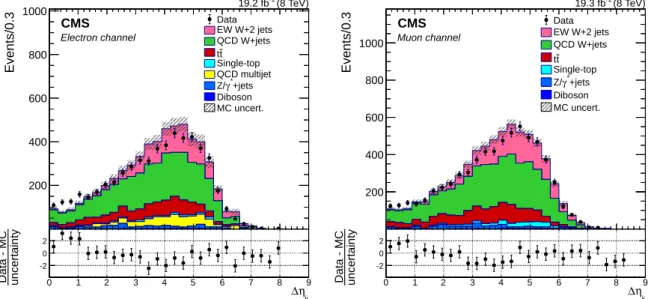
and the simulated signal sample multiplied by the signal strength we obtain later in this sec-tion. The uncertainty band includes the statistical uncertainty of the simulated samples, the integrated luminosity uncertainty, and a systematic uncertainty in the QCD background due to misidentified electrons (to be discussed below). The distributions of the difference between data and simulation divided by the uncertainty, where the uncertainty is computed at each point by combining the uncertainties in data and in simulation, are also shown in these plots. The distributions of the leading jet pT and the∆η between the two jets for data and simulation
after the lepton and jet selection requirements are shown in Figs. 3 and 4, respectively, with the QCD W+jets MC sample multiplied by the normalization scale factors described above. Taking into account the QCD W+jet background normalization, the extraction of the signal yield is performed using an unbinned maximum-likelihood fit to the mjjdistribution in data.
The signal strength µsignal, which is defined as the ratio of the extracted signal yield and the
expected yield predicted by the LO SM calculation, is the free parameter in the fit.
We employ a parametric function to model the mjjdistributions for the signal and each of the
background contributions listed in Table 2. Only dijet masses greater than 1000 GeV are used in the fit, as indicated by the study in Ref. [1]. Based on the simulation we expect the mjj
distributions to be well-described by the two parameter power law function
F = 1
mjja0+a1ln(mjj/8000)
, (1)
where a0and a1are obtained from the simulation and mjjis in GeV. Separate fits are performed
to the simulated distribution for the signal and each of the background contributions. This function provides a good description of the signal and background shapes.
The normalization of the EW W(→eν, µν, τν)+2-jets contribution is a free parameter in the fit to the mjj distribution, while the shape parameters are fixed to the MC prediction. The effect
0 100 200 300 400 500 600 Events/20 GeV 100 200 300 400 500 600 Data EW W+2 jets QCD W+jets t t Single-top QCD multijet +jets * γ Z/ Diboson MC uncert. (8 TeV) -1 19.2 fb CMS Electron channel (GeV) j1 T P 0 100 200 300 400 500 600 uncertainty Data - MC -2 0 2 0 100 200 300 400 500 600 Events/20 GeV 100 200 300 400 500 600 700 Data EW W+2 jets QCD W+jets t t Single-top +jets * γ Z/ Diboson MC uncert. (8 TeV) -1 19.3 fb CMS Muon channel (GeV) j1 T P 0 100 200 300 400 500 600 uncertainty Data - MC -2 0 2
Figure 3: Comparison of the distributions of the leading jet pTbetween data and simulation for
the electron (left) and muon (right) channels with mjj>1000 GeV.
0 1 2 3 4 5 6 7 8 9 Events/0.3 200 400 600 800 1000 Data EW W+2 jets QCD W+jets t t Single-top QCD multijet +jets * γ Z/ Diboson MC uncert. (8 TeV) -1 19.2 fb CMS Electron channel jj η ∆ 0 1 2 3 4 5 6 7 8 9 uncertainty Data - MC -2 0 2 0 1 2 3 4 5 6 7 8 9 Events/0.3 200 400 600 800 1000 Data EW W+2 jets QCD W+jets t t Single-top +jets * γ Z/ Diboson MC uncert. (8 TeV) -1 19.3 fb CMS Muon channel jj η ∆ 0 1 2 3 4 5 6 7 8 9 uncertainty Data - MC -2 0 2
Figure 4: Comparison of the distributions of∆η between the two leading jets between data and simulation for the electron (left) and muon (right) channels with mjj >1000 GeV.
of QCD NLO corrections for the EW W(→ `ν)+2-jets process is tested by modifying the shape
parameters in order to reproduce the prediction ofVBFNLO2.6 [59]; the resulting variation in the evaluated signal strength is below 1%.
The QCD W+jets background shape parameters are left free during the mjjfit to data because
of the poor agreement between data and simulation for this background. The normalization of the QCD W+jets background is fixed to the fit result from the BDT distribution, as described above.
Multijet events can be misidentified as signal because of the nonnegligible probability of jets to be misidentified as electrons. The fraction of fake electrons in the single electron data passing the selection described in Section 4 is obtained from an independent two-component fit to the
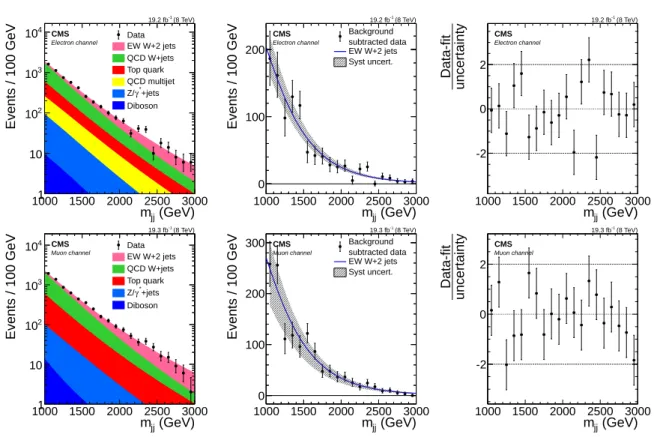
8 5 Background estimation and signal extraction (GeV) jj m 1000 1500 2000 2500 3000 Events / 100 GeV 1 10 2 10 3 10 4 10 Data EW W+2 jets QCD W+jets Top quark QCD multijet +jets * γ Z/ Diboson (8 TeV) -1 19.2 fb CMS Electron channel (GeV) jj m 1000 1500 2000 2500 3000 Events / 100 GeV 0 100 200 subtracted data Background EW W+2 jets Syst uncert. (8 TeV) -1 19.2 fb CMS Electron channel (GeV) jj m 1000 1500 2000 2500 3000 uncertainty Data-fit -2 0 2 (8 TeV) -1 19.2 fb CMS Electron channel (GeV) jj m 1000 1500 2000 2500 3000 Events / 100 GeV 1 10 2 10 3 10 4 10 Data EW W+2 jets QCD W+jets Top quark +jets * γ Z/ Diboson (8 TeV) -1 19.3 fb CMS Muon channel (GeV) jj m 1000 1500 2000 2500 3000 Events / 100 GeV 0 100 200 300 subtracted data Background EW W+2 jets Syst uncert. (8 TeV) -1 19.3 fb CMS Muon channel (GeV) jj m 1000 1500 2000 2500 3000 uncertainty Data-fit -2 0 2 (8 TeV) -1 19.3 fb CMS Muon channel
Figure 5: Distribution of the two-jet invariant mass mjjfor electron (upper) and muon (lower)
channels. Fitted projections of signal and background processes are plotted as shaded regions (left plots). The mjjdistributions are shown after subtraction of all components except the EW
W+2-jets process (center plots). Finally, the (data−fit)/uncertainty distributions are shown (right plots). Here the error bars represent the statistical uncertainties of the data.
ETmissdistribution following Ref. [44]. The normalization and shape parameters are fixed in the fit. We conservatively assume a 50% uncertainty in the QCD multijet yield when fitting the data.
The top quark background is a combination of tt and single top quark processes with the sim-ulated samples normalized according to the known cross sections. The shape parameters are obtained from the simulation and fixed during the fit. The top quark background normaliza-tion is assumed to have a Gaussian probability density funcnormaliza-tion with a width of 7% [39]. Other background processes, such as diboson production and DY, are minor and are repre-sented by their components with the corresponding normalization fixed in the fit. The shape parameters are obtained from simulation and are also fixed.
Figure 5 (left) shows the observed mjjdistributions for the electron and muon channels, together
with the fitted projections of the contribution of the signal and background processes described by the two-parameter power law function. The shapes of the different fit components look similar, nonetheless, their slopes are different. Figure 5 (center) shows the mjjdistribution after
subtracting all SM background contributions. Figure 5 (right) presents the distributions of the difference between the mjj values in data and from the fit, divided by the data uncertainty.
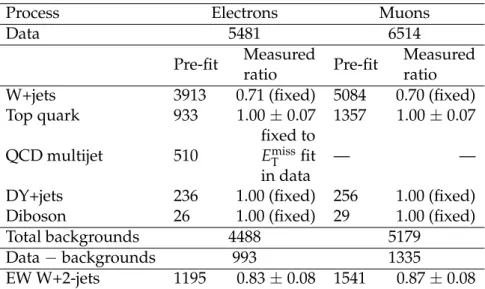
The yields of the various SM components, as determined by the fit, are reported in Table 2. The resulting signal strengths µsignalare 0.83±0.08 (stat) and 0.87±0.08 (stat) for electron and muon channels, respectively. While a simple counting of events in Table 2 can determine the number of EW W+2-jets events, the fitting procedure includes the distribution of Fig. 5 and allows us to use the shape parameters when calculating event yields.
Table 2: The expected event yields and the ratio of the measured and expected yields extracted from the maximum-likelihood fit to data.
Process Electrons Muons
Data 5481 6514
Pre-fit Measured
ratio Pre-fit
Measured ratio W+jets 3913 0.71 (fixed) 5084 0.70 (fixed) Top quark 933 1.00±0.07 1357 1.00±0.07 QCD multijet 510 fixed to EmissT fit in data — —
DY+jets 236 1.00 (fixed) 256 1.00 (fixed) Diboson 26 1.00 (fixed) 29 1.00 (fixed)
Total backgrounds 4488 5179
Data−backgrounds 993 1335
EW W+2-jets 1195 0.83±0.08 1541 0.87±0.08
This approach produces an acceptable model of the data (Fig. 5 left) and allows us to extract the EW W+2-jets signal (Fig. 5 center). In Fig. 5 right the mean value of the pull distribution is−0.04 (0.03), consistent with zero in the electron (muon) channel, and the pull variance is 0.90 (0.87), consistent with unity in the electron (muon) channel.
6
Systematic uncertainties
Systematic uncertainties arising from the jet energy scale and resolution are estimated by vary-ing the calibration parameters up and down by one standard deviation in the simulation and evaluating the impact on the cross sections [53].
A different parametric function is used to model the QCD W+jets shape to estimate the po-tential influence of the choice of parametric function in the fit result, and it is considered as a source of systematic uncertainty. To estimate the systematic uncertainty from the disagree-ment between data and simulation in the BDT output distributions, we divide the sideband in BDT (BDT <0.1) used to estimate the scale factor for the QCD W+jets normalization into two roughly equally populated regions (BDT < 0.02, 0.02 < BDT < 0.1). We recompute the scale factor using these two subsamples and propagate the variation in the normalization to the final result. The uncertainty with respect to the QCD W+jets normalization is 4.9% (7.1%) in the electron (muon) channel. The uncertainty propagated to the cross section is 12.9% (16.6%) in the electron (muon) channel. The uncertainty on the normalization is then added in quadrature with the shape uncertainty as shown in Table 3.
Background tt samples produced with different generators and parton shower models (MC@NLO
+HERWIGandPOWHEG+PYTHIA) are used as alternative to the default tt MADGRAPHshapes.
We also select a tt enriched phase space to compare the tt sample produced with MADGRAPH
with data. Reasonable agreement is found between the MADGRAPHtt sample and data.
The EW W(→ `ν)+2-jets and QCD W(→ `ν)+2-jets processes have a positive interference term,
which is neglected. In order to estimate the effect of the interference, two additional samples are generated using MADGRAPH:
10 7 Results
• EW W(→ `ν)+2-jets + QCD W(→ `ν)+2-jets + interference effect sample (mixture
of EW and strong processes).
We subtract the QCD and EW processes from the mixture sample to estimate the effect of the interference. The contribution of the interference effect is considered as an additional back-ground with a fixed shape and normalization. The true EW signal strength is ≈12% smaller than the apparent signal strength because the interference is positive.
The fraction of jets faking electrons is varied by±50% in the electron channel to estimate the uncertainty. A small difference in ETmissresolution [54] between data and simulation affects the signal acceptance at the 0.5% level. We also consider systematic uncertainties in the trigger efficiency (1%) and in the lepton reconstruction and selection efficiencies (2%) [44]. The uncer-tainty in the luminosity measurement is 2.6% [60]. Finally, we calculated the acceptance for the fiducial region withHERWIG++ signal samples, resulting in a 1.7% change in the measured cross section.
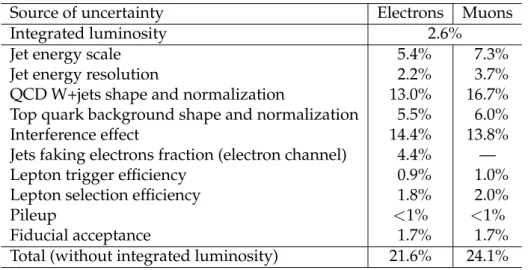
The systematic uncertainties are summarized in Table 3.
Table 3: Sources of systematic uncertainties and the magnitude of their effect on the fiducial cross section.
Source of uncertainty Electrons Muons
Integrated luminosity 2.6%
Jet energy scale 5.4% 7.3%
Jet energy resolution 2.2% 3.7%
QCD W+jets shape and normalization 13.0% 16.7% Top quark background shape and normalization 5.5% 6.0%
Interference effect 14.4% 13.8%
Jets faking electrons fraction (electron channel) 4.4% — Lepton trigger efficiency 0.9% 1.0% Lepton selection efficiency 1.8% 2.0%
Pileup <1% <1%
Fiducial acceptance 1.7% 1.7%
Total (without integrated luminosity) 21.6% 24.1%
7
Results
The fiducial EW W+2-jets cross section is calculated for W bosons decaying to electrons or muons and for pTj1 > 60 GeV, pTj2 > 50 GeV,|ηj| <4.7, and mjj > 1000 GeV. Here we include
neutrinos in our definition of generator jets, which are reconstructed in the same manner as the PF jets mentioned above, but now at generator level.
The fiducial cross section is computed as
σfiducial =σgeneratorµsignaleacceptance, (2)
where σgenerator is the generator level cross section, µsignal is the signal strength, and eacceptance
is the acceptance evaluated with the EW W(→eν, µν, τν)+2-jets sample.
To calculate eacceptance, we divide the number of events in the fiducial region by the total number
of generated events which results in an value of 0.0448. The uncertainty due to the limited size of the simulated sample is 0.7%. The fiducial selections are different from the selections
used for the measurement (as summarized in Table 1), for which the acceptance is 0.0128. The uncertainty due to the limited size of the simulated sample is 1.3%.
We use the best linear unbiased estimate method [61, 62] to combine the results in the electron and muon channels, assuming that the statistical uncertainties are uncorrelated and the sys-tematic uncertainties are 100% correlated between the two channels. Because in this case the (fully correlated) systematic uncertainties are much larger than the statistical uncertainties, the method yields a statistical uncertainty for the combined result that is not much smaller than the statistical uncertainties for the individual channels. The results are summarized in Table 4, and are in agreement with the SM LO prediction of 0.50±0.02(scale) ±0.02(PDF)pb obtained from MADGRAPH5 [email protected] interfaced to PYTHIA6.4. The statistical significance of the
observation is approximately four standard deviations.
Table 4: The measured values for the EW W(→ `ν)+2-jets fiducial cross section.
Channel Measured cross section
Electron 0.41±0.04 (stat)±0.09 (syst)±0.01 (lumi) pb Muon 0.43±0.04 (stat)±0.10 (syst)±0.01 (lumi) pb Combined 0.42±0.04 (stat)±0.09 (syst)±0.01 (lumi) pb
8
Summary
A measurement has been performed of the cross section for the electroweak production of W bosons produced in association with two forward jets in proton-proton collisions. The W bosons were identified through their decay to electrons and muons. The data set was collected by the CMS experiment and corresponds to an integrated luminosity of 19.2(19.3) ±0.5 fb−1 in the electron (muon) channel at√s =8 TeV. The measured value of the fiducial electroweak W+2-jets cross section, for W bosons decaying to electrons or muons and for pTj1 > 60 GeV,
pTj2>50 GeV,|ηj| <4.7, and mjj>1000 GeV, is 0.42±0.04 (stat)±0.09 (syst)±0.01 (lumi) pb,
consistent with the SM LO prediction of 0.50±0.02(scale) ±0.02(PDF)pb obtained via MAD -GRAPH5 [email protected] interfaced withPYTHIA 6.4. This is the first measurement of the cross section for electroweak W+2-jets production.
12 8 Summary
Acknowledgments
We congratulate our colleagues in the CERN accelerator departments for the excellent perfor-mance of the LHC and thank the technical and administrative staffs at CERN and at other CMS institutes for their contributions to the success of the CMS effort. In addition, we gratefully acknowledge the computing centers and personnel of the Worldwide LHC Computing Grid for delivering so effectively the computing infrastructure essential to our analyses. Finally, we acknowledge the enduring support for the construction and operation of the LHC and the CMS detector provided by the following funding agencies: BMWFW and FWF (Austria); FNRS and FWO (Belgium); CNPq, CAPES, FAPERJ, and FAPESP (Brazil); MES (Bulgaria); CERN; CAS, MoST, and NSFC (China); COLCIENCIAS (Colombia); MSES and CSF (Croatia); RPF (Cyprus); SENESCYT (Ecuador); MoER, ERC IUT and ERDF (Estonia); Academy of Finland, MEC, and HIP (Finland); CEA and CNRS/IN2P3 (France); BMBF, DFG, and HGF (Germany); GSRT (Greece); OTKA and NIH (Hungary); DAE and DST (India); IPM (Iran); SFI (Ireland); INFN (Italy); MSIP and NRF (Republic of Korea); LAS (Lithuania); MOE and UM (Malaysia); BUAP, CINVESTAV, CONACYT, LNS, SEP, and UASLP-FAI (Mexico); MBIE (New Zealand); PAEC (Pakistan); MSHE and NSC (Poland); FCT (Portugal); JINR (Dubna); MON, RosAtom, RAS and RFBR (Russia); MESTD (Serbia); SEIDI and CPAN (Spain); Swiss Funding Agencies (Switzerland); MST (Taipei); ThEPCenter, IPST, STAR and NSTDA (Thailand); TUBITAK and TAEK (Turkey); NASU and SFFR (Ukraine); STFC (United Kingdom); DOE and NSF (USA). Individuals have received support from the Marie-Curie program and the European Research Council and EPLANET (European Union); the Leventis Foundation; the A. P. Sloan Founda-tion; the Alexander von Humboldt FoundaFounda-tion; the Belgian Federal Science Policy Office; the Fonds pour la Formation `a la Recherche dans l’Industrie et dans l’Agriculture (FRIA-Belgium); the Agentschap voor Innovatie door Wetenschap en Technologie (IWT-Belgium); the Ministry of Education, Youth and Sports (MEYS) of the Czech Republic; the Council of Science and In-dustrial Research, India; the HOMING PLUS program of the Foundation for Polish Science, cofinanced from European Union, Regional Development Fund, the Mobility Plus program of the Ministry of Science and Higher Education, the National Science Center (Poland), contracts Harmonia 2014/14/M/ST2/00428, Opus 2013/11/B/ST2/04202, 2014/13/B/ST2/02543 and 2014/15/B/ST2/03998, Sonata-bis 2012/07/E/ST2/01406; the Thalis and Aristeia programs cofinanced by EU-ESF and the Greek NSRF; the National Priorities Research Program by Qatar National Research Fund; the Programa Clar´ın-COFUND del Principado de Asturias; the Rachadapisek Sompot Fund for Postdoctoral Fellowship, Chulalongkorn University and the Chulalongkorn Academic into Its 2nd Century Project Advancement Project (Thailand); and the Welch Foundation, contract C-1845.
References
[1] D. L. Rainwater, R. Szalapski, and D. Zeppenfeld, “Probing color singlet exchange in Z + 2 jet events at the CERN LHC”, Phys. Rev. D 54 (1996) 6680,
doi:10.1103/PhysRevD.54.6680, arXiv:hep-ph/9605444.
[2] V. A. Khoze, M. G. Ryskin, W. J. Stirling, and P. H. Williams, “A Z monitor to calibrate Higgs production via vector boson fusion with rapidity gaps at the LHC”, Eur. Phys. J. C
26(2003) 429, doi:10.1140/epjc/s2002-01069-2, arXiv:hep-ph/0207365. [3] CMS Collaboration, “Measurement of the hadronic activity in events with a Z and two
jets and extraction of the cross section for the electroweak production of a Z with two jets in pp collisions at√s=7 TeV”, JHEP 13 (2013) 062,
doi:10.1007/JHEP10(2013)062, arXiv:1305.7389.
[4] U. Baur and D. Zeppenfeld, “Measuring three vector boson couplings in qq→qqW at the SSC”, (1993). arXiv:hep-ph/9309227.
[5] O. J. P. Eboli and M. C. Gonzalez-Garcia, “Probing trilinear gauge boson interactions via single electroweak gauge boson production at the CERN LHC”, Phys. Rev. D 70 (2004) 074011, doi:10.1103/PhysRevD.70.074011, arXiv:hep-ph/0405269.
[6] D. L. Rainwater, D. Zeppenfeld, and K. Hagiwara, “Searching for H→τ+τ−in weak
boson fusion at the CERN LHC”, Phys. Rev. D 59 (1998) 014037, doi:10.1103/PhysRevD.59.014037, arXiv:hep-ph/9808468. [7] T. Plehn, D. L. Rainwater, and D. Zeppenfeld, “A Method for identifying
H→τ+τ− →e±µ∓p/ at the CERN LHC”, Phys. Rev. D 61 (2000) 093005,T
doi:10.1103/PhysRevD.61.093005, arXiv:hep-ph/9911385.
[8] D. L. Rainwater and D. Zeppenfeld, “Observing H→W∗W∗ →e±µ∓p/ in weak bosonT
fusion with dual forward jet tagging at the CERN LHC”, Phys. Rev. D 60 (1999) 113004, doi:10.1103/PhysRevD.60.113004, arXiv:hep-ph/9906218. Erratum:
doi:10.1103/PhysRevD.61.099901.
[9] N. Kauer, T. Plehn, D. L. Rainwater, and D. Zeppenfeld, “H→W+W−as the discovery mode for a light Higgs boson”, Phys. Lett. B 503 (2001) 113,
doi:10.1016/S0370-2693(01)00211-8, arXiv:hep-ph/0012351.
[10] CMS Collaboration, “Measurement of electroweak production of two jets in association with a Z boson in proton-proton collisions at√s=8 TeV”, Eur. Phys. J. C 75 (2015) 66, doi:10.1140/epjc/s10052-014-3232-5, arXiv:1410.3153.
[11] ATLAS Collaboration, “Measurement of the electroweak production of dijets in association with a Z boson and distributions sensitive to vector boson fusion in
proton-proton collisions at√s=8 TeV using the ATLAS detector”, JHEP 04 (2014) 031, doi:10.1007/JHEP04(2014)031, arXiv:1401.7610.
[12] ATLAS Collaboration, “Evidence for electroweak production of W±W±jj in pp collisions at√s=8 TeV with the ATLAS detector”, Phys. Rev. Lett. 113 (2014) 141803,
doi:10.1103/PhysRevLett.113.141803, arXiv:1405.6241.
[13] CMS Collaboration, “Study of vector boson scattering and search for new physics in events with two same-sign leptons and two jets”, Phys. Rev. Lett. 114 (2015) 051801, doi:10.1103/PhysRevLett.114.051801, arXiv:1410.6315.
14 References
[14] CMS Collaboration, “The CMS experiment at the CERN LHC”, JINST 3 (2008) S08004, doi:10.1088/1748-0221/3/08/S08004.
[15] CMS Collaboration, “Description and performance of track and primary-vertex reconstruction with the CMS tracker”, JINST 9 (2014) P10009,
doi:10.1088/1748-0221/9/10/P10009, arXiv:1405.6569.
[16] CMS Collaboration, “Performance of electron reconstruction and selection with the CMS detector in proton-proton collisions at√s=8 TeV”, JINST 10 (2015) P06005,
doi:10.1088/1748-0221/10/06/P06005, arXiv:1502.02701.
[17] CMS Collaboration, “Performance of CMS muon reconstruction in pp collision events at√ s =7 TeV”, JINST 7 (2012) P10002, doi:10.1088/1748-0221/7/10/P10002, arXiv:1206.4071.
[18] J. Alwall et al., “The automated computation of tree-level and next-to-leading order differential cross sections, and their matching to parton shower simulations”, JHEP 07 (2014) 079, doi:10.1007/JHEP07(2014)079, arXiv:1405.0301.
[19] J. Alwall et al., “MadGraph 5: going beyond”, JHEP 06 (2011) 128, doi:10.1007/JHEP06(2011)128, arXiv:1106.0522.
[20] P. Nason, “A new method for combining NLO QCD with shower Monte Carlo algorithms”, JHEP 11 (2004) 040, doi:10.1088/1126-6708/2004/11/040, arXiv:hep-ph/0409146.
[21] S. Frixione, P. Nason, and C. Oleari, “Matching NLO QCD computations with Parton Shower simulations: the POWHEG method”, JHEP 11 (2007) 070,
doi:10.1088/1126-6708/2007/11/070, arXiv:0709.2092.
[22] S. Alioli, P. Nason, C. Oleari, and E. Re, “A general framework for implementing NLO calculations in shower Monte Carlo programs: the POWHEG BOX”, JHEP 06 (2010) 043, doi:10.1007/JHEP06(2010)043, arXiv:1002.2581.
[23] S. Alioli, P. Nason, C. Oleari, and E. Re, “NLO single-top production matched with shower in POWHEG: s- and t-channel contributions”, JHEP 09 (2009) 111,
doi:10.1088/1126-6708/2009/09/111, arXiv:0907.4076. [Erratum: doi:10.1007/JHEP02(2010)011].
[24] E. Re, “Single-top Wt-channel production matched with parton showers using the POWHEG method”, Eur. Phys. J. C 71 (2011) 1547,
doi:10.1140/epjc/s10052-011-1547-z, arXiv:1009.2450.
[25] T. Sj ¨ostrand, S. Mrenna, and P. Z. Skands, “PYTHIA 6.4 physics and manual”, JHEP 05 (2006) 026, doi:10.1088/1126-6708/2006/05/026, arXiv:hep-ph/0603175. [26] J. Pumplin et al., “New generation of parton distributions with uncertainties from global
QCD analysis”, JHEP 07 (2002) 012, doi:10.1088/1126-6708/2002/07/012, arXiv:hep-ph/0201195.
[27] CMS Collaboration, “Measurement of the underlying event activity at the LHC with√ s =7 TeV and comparison with√s=0.9 TeV”, JHEP 11 (09) 109,
[28] CMS Collaboration, “Study of the underlying event at forward rapidity in pp collisions at√s = 0.9, 2.76, and 7 TeV”, JHEP 04 (2013) 072, doi:10.1007/JHEP04(2013)072, arXiv:1302.2394.
[29] S. Jadach, J. H. Kuhn, and Z. Wa¸s, “TAUOLA — a library of Monte Carlo programs to simulate decays of polarized tau leptons”, Comput. Phys. Commun. 64 (1991) 275, doi:10.1016/0010-4655(91)90038-M.
[30] M. B¨ahr et al., “Herwig++ physics and manual”, Eur. Phys. J. C 58 (2008) 639, doi:10.1140/epjc/s10052-008-0798-9, arXiv:0803.0883.
[31] S. Hoeche et al., “Matching parton showers and matrix elements”, in HERA and the LHC: A Workshop on the implications of HERA for LHC physics: Proceedings Part A. 2006.
arXiv:hep-ph/0602031.
[32] Particle Data Group, K. A. Olive et al., “Review of Particle Physics”, Chin. Phys. C 38 (2014) 090001, doi:10.1088/1674-1137/38/9/090001.
[33] S. Frixione and B. R. Webber, “Matching NLO QCD computations and parton shower simulations”, JHEP 06 (2002) 029, doi:10.1088/1126-6708/2002/06/029, arXiv:hep-ph/0204244.
[34] S. Frixione, P. Nason, and B. R. Webber, “Matching NLO QCD and parton showers in heavy flavor production”, JHEP 08 (2003) 007,
doi:10.1088/1126-6708/2003/08/007, arXiv:hep-ph/0305252.
[35] H.-L. Lai et al., “New parton distributions for collider physics”, Phys. Rev. D 82 (2010) 074024, doi:10.1103/PhysRevD.82.074024, arXiv:1007.2241.
[36] G. Corcella et al., “HERWIG 6: an event generator for hadron emission reactions with interfering gluons (including supersymmetric processes)”, JHEP 01 (2001) 010, doi:10.1088/1126-6708/2001/01/010, arXiv:hep-ph/0011363.
[37] G. Corcella et al., “HERWIG 6.5 release note”, (2002). arXiv:hep-ph/0210213. [38] K. Melnikov and F. Petriello, “Electroweak gauge boson production at hadron colliders
throughO(α2S)”, Phys. Rev. D 74 (2006) 114017,
doi:10.1103/PhysRevD.74.114017, arXiv:hep-ph/0609070.
[39] M. Czakon and A. Mitov, “Top++: a program for the calculation of the top-pair cross-section at hadron colliders”, Comput. Phys. Commun. 185 (2014) 2930, doi:10.1016/j.cpc.2014.06.021, arXiv:1112.5675.
[40] M. Aliev et al., “HATHOR: HAdronic Top and Heavy quarks crOss section calculatoR”, Comput. Phys. Commun. 182 (2011) 1034, doi:10.1016/j.cpc.2010.12.040, arXiv:1007.1327.
[41] P. Kant et al., “HATHOR for single top-quark production: updated predictions and uncertainty estimates for single top-quark production in hadronic collisions”, Comput. Phys. Commun. 191 (2015) 74, doi:10.1016/j.cpc.2015.02.001,
arXiv:1406.4403.
[42] J. M. Campbell and R. K. Ellis, “MCFM for the Tevatron and the LHC”, Nucl. Phys. Proc. Suppl. 205–206 (2010) 10, doi:10.1016/j.nuclphysbps.2010.08.011,
16 References
[43] GEANT4 Collaboration, “GEANT4 — a simulation toolkit”, Nucl. Instrum. Meth. A 506 (2003) 250, doi:10.1016/S0168-9002(03)01368-8.
[44] CMS Collaboration, “Measurement of the inclusive W and Z production cross sections in pp collisions at√s =7 TeV”, JHEP 10 (2011) 132, doi:10.1007/JHEP10(2011)132, arXiv:1107.4789.
[45] CMS Collaboration, “Particle–flow event reconstruction in CMS and performance for jets, taus, and EmissT ”, CMS Physics Analysis Summary CMS-PAS-PFT-09-001, 2009.
[46] CMS Collaboration, “Commissioning of the particle–flow event reconstruction with the first LHC collisions recorded in the CMS detector”, CMS Physics Analysis Summary CMS-PAS-PFT-10-001, 2010.
[47] M. Cacciari, G. P. Salam, and G. Soyez, “The anti-ktjet clustering algorithm”, JHEP 04
(2008) 063, doi:10.1088/1126-6708/2008/04/063, arXiv:0802.1189.
[48] M. Cacciari, G. P. Salam, and G. Soyez, “FastJet user manual”, Eur. Phys. J. C 72 (2012) 1896, doi:10.1140/epjc/s10052-012-1896-2, arXiv:1111.6097.
[49] M. Cacciari, G. P. Salam, and G. Soyez, “The catchment area of jets”, JHEP 04 (2008) 005, doi:10.1088/1126-6708/2008/04/005, arXiv:0802.1188.
[50] CMS Collaboration, “Pileup jet identification”, CMS Physics Analysis Summary CMS-PAS-JME-13-005, 2013.
[51] CMS Collaboration, “Measurements of differential jet cross sections in proton-proton collisions at√s=7 TeV with the CMS detector”, Phys. Rev. D 87 (2013) 112002, doi:10.1103/PhysRevD.87.112002, arXiv:1212.6660.
[52] M. Cacciari and G. P. Salam, “Pileup subtraction using jet areas”, Phys. Lett. B 659 (2008) 119, doi:10.1016/j.physletb.2007.09.077, arXiv:0707.1378.
[53] CMS Collaboration, “Determination of jet energy calibration and transverse momentum resolution in CMS”, JINST 6 (2011) P11002,
doi:10.1088/1748-0221/6/11/P11002, arXiv:1107.4277.
[54] CMS Collaboration, “Performance of the CMS missing transverse momentum reconstruction in pp data at√s=8 TeV”, JINST 10 (2015) P02006,
doi:10.1088/1748-0221/10/02/P02006, arXiv:1411.0511.
[55] H. Voss, A. H ¨ocker, J. Stelzer, and F. Tegenfeldt, “TMVA, the toolkit for multivariate data analysis with ROOT”, (2007). arXiv:physics/0703039.
[56] Y. Freund and R. E. Schapire, “A decision-theoretic generalization of on-line learning and an application to boosting”, J. Comput. Syst. Sci. 55 (1997) 119,
doi:10.1006/jcss.1997.1504.
[57] J. M. Campbell, R. K. Ellis, and D. L. Rainwater, “Next-to-leading order QCD predictions for W+2-jet and Z+2-jet production at the CERN LHC”, Phys. Rev. D 68 (2003) 094021, doi:10.1103/PhysRevD.68.094021, arXiv:hep-ph/0308195.
[58] CMS Collaboration, “Search for invisible decays of Higgs bosons in the vector boson fusion and associated ZH production modes”, Eur. Phys. J. C 74 (2014) 2980,
[59] A. Ken et al., “VBFNLO: a parton level Monte Carlo for processes with electroweak bosons”, Comput. Phys. Commun. 180 (2009) 1661,
doi:10.1016/j.cpc.2009.03.006, arXiv:0811.4559.
[60] CMS Collaboration, “CMS luminosity based on pixel cluster counting — Summer 2013 update”, CMS Physics Analysis Summary CMS-PAS-LUM-13-001, 2013.
[61] L. Lyons, D. Gibaut, and P. Clifford, “How to combine correlated estimates of a single physical quantity”, Nucl. Instrum. Meth. A 270 (1988) 110,
doi:10.1016/0168-9002(88)90018-6.
[62] A. Valassi, “Combining correlated measurements of several different physical quantities”, Nucl. Instrum. Meth. A 500 (2003) 391, doi:10.1016/S0168-9002(03)00329-2.
A
The CMS Collaboration
Yerevan Physics Institute, Yerevan, Armenia
V. Khachatryan, A.M. Sirunyan, A. Tumasyan
Institut f ¨ur Hochenergiephysik der OeAW, Wien, Austria
W. Adam, E. Asilar, T. Bergauer, J. Brandstetter, E. Brondolin, M. Dragicevic, J. Er ¨o, M. Flechl, M. Friedl, R. Fr ¨uhwirth1, V.M. Ghete, C. Hartl, N. H ¨ormann, J. Hrubec, M. Jeitler1, V. Kn ¨unz, A. K ¨onig, M. Krammer1, I. Kr¨atschmer, D. Liko, T. Matsushita, I. Mikulec, D. Rabady2, N. Rad,
B. Rahbaran, H. Rohringer, J. Schieck1, R. Sch ¨ofbeck, J. Strauss, W. Treberer-Treberspurg, W. Waltenberger, C.-E. Wulz1
National Centre for Particle and High Energy Physics, Minsk, Belarus
V. Mossolov, N. Shumeiko, J. Suarez Gonzalez
Universiteit Antwerpen, Antwerpen, Belgium
S. Alderweireldt, T. Cornelis, E.A. De Wolf, X. Janssen, A. Knutsson, J. Lauwers, S. Luyckx, M. Van De Klundert, H. Van Haevermaet, P. Van Mechelen, N. Van Remortel, A. Van Spilbeeck
Vrije Universiteit Brussel, Brussel, Belgium
S. Abu Zeid, F. Blekman, J. D’Hondt, N. Daci, I. De Bruyn, K. Deroover, N. Heracleous, J. Keaveney, S. Lowette, L. Moreels, A. Olbrechts, Q. Python, D. Strom, S. Tavernier, W. Van Doninck, P. Van Mulders, G.P. Van Onsem, I. Van Parijs
Universit´e Libre de Bruxelles, Bruxelles, Belgium
P. Barria, H. Brun, C. Caillol, B. Clerbaux, G. De Lentdecker, W. Fang, G. Fasanella, L. Favart, R. Goldouzian, A. Grebenyuk, G. Karapostoli, T. Lenzi, A. L´eonard, T. Maerschalk, A. Marinov, L. Perni`e, A. Randle-conde, T. Seva, C. Vander Velde, P. Vanlaer, R. Yonamine, F. Zenoni, F. Zhang3
Ghent University, Ghent, Belgium
K. Beernaert, L. Benucci, A. Cimmino, S. Crucy, D. Dobur, A. Fagot, G. Garcia, M. Gul, J. Mccartin, A.A. Ocampo Rios, D. Poyraz, D. Ryckbosch, S. Salva, M. Sigamani, M. Tytgat, W. Van Driessche, E. Yazgan, N. Zaganidis
Universit´e Catholique de Louvain, Louvain-la-Neuve, Belgium
S. Basegmez, C. Beluffi4, O. Bondu, S. Brochet, G. Bruno, A. Caudron, L. Ceard, C. Delaere, D. Favart, L. Forthomme, A. Giammanco5, A. Jafari, P. Jez, M. Komm, V. Lemaitre, A. Mertens, M. Musich, C. Nuttens, L. Perrini, K. Piotrzkowski, A. Popov6, L. Quertenmont, M. Selvaggi, M. Vidal Marono
Universit´e de Mons, Mons, Belgium
N. Beliy, G.H. Hammad
Centro Brasileiro de Pesquisas Fisicas, Rio de Janeiro, Brazil
W.L. Ald´a J ´unior, F.L. Alves, G.A. Alves, L. Brito, M. Correa Martins Junior, M. Hamer, C. Hensel, A. Moraes, M.E. Pol, P. Rebello Teles
Universidade do Estado do Rio de Janeiro, Rio de Janeiro, Brazil
E. Belchior Batista Das Chagas, W. Carvalho, J. Chinellato7, A. Cust ´odio, E.M. Da Costa, D. De Jesus Damiao, C. De Oliveira Martins, S. Fonseca De Souza, L.M. Huertas Guativa, H. Malbouisson, D. Matos Figueiredo, C. Mora Herrera, L. Mundim, H. Nogima, W.L. Prado Da Silva, A. Santoro, A. Sznajder, E.J. Tonelli Manganote7, A. Vilela Pereira
20 A The CMS Collaboration
Universidade Estadual Paulistaa, Universidade Federal do ABCb, S˜ao Paulo, Brazil
S. Ahujaa, C.A. Bernardesb, A. De Souza Santosb, S. Dograa, T.R. Fernandez Perez Tomeia, E.M. Gregoresb, P.G. Mercadanteb, C.S. Moona,8, S.F. Novaesa, Sandra S. Padulaa, D. Romero Abadb, J.C. Ruiz Vargas
Institute for Nuclear Research and Nuclear Energy, Sofia, Bulgaria
A. Aleksandrov, R. Hadjiiska, P. Iaydjiev, M. Rodozov, S. Stoykova, G. Sultanov, M. Vutova
University of Sofia, Sofia, Bulgaria
A. Dimitrov, I. Glushkov, L. Litov, B. Pavlov, P. Petkov
Institute of High Energy Physics, Beijing, China
M. Ahmad, J.G. Bian, G.M. Chen, H.S. Chen, M. Chen, T. Cheng, R. Du, C.H. Jiang, D. Leggat, R. Plestina9, F. Romeo, S.M. Shaheen, A. Spiezia, J. Tao, C. Wang, Z. Wang, H. Zhang
State Key Laboratory of Nuclear Physics and Technology, Peking University, Beijing, China
C. Asawatangtrakuldee, Y. Ban, J. Li, Q. Li, S. Liu, Y. Mao, S.J. Qian, D. Wang, Z. Xu
Universidad de Los Andes, Bogota, Colombia
C. Avila, A. Cabrera, L.F. Chaparro Sierra, C. Florez, J.P. Gomez, B. Gomez Moreno, J.C. Sanabria
University of Split, Faculty of Electrical Engineering, Mechanical Engineering and Naval Architecture, Split, Croatia
N. Godinovic, D. Lelas, I. Puljak, P.M. Ribeiro Cipriano
University of Split, Faculty of Science, Split, Croatia
Z. Antunovic, M. Kovac
Institute Rudjer Boskovic, Zagreb, Croatia
V. Brigljevic, K. Kadija, J. Luetic, S. Micanovic, L. Sudic
University of Cyprus, Nicosia, Cyprus
A. Attikis, G. Mavromanolakis, J. Mousa, C. Nicolaou, F. Ptochos, P.A. Razis, H. Rykaczewski
Charles University, Prague, Czech Republic
M. Bodlak, M. Finger10, M. Finger Jr.10
Academy of Scientific Research and Technology of the Arab Republic of Egypt, Egyptian Network of High Energy Physics, Cairo, Egypt
A.A. Abdelalim11,12, A. Awad, A. Mahrous11, A. Radi13,14
National Institute of Chemical Physics and Biophysics, Tallinn, Estonia
B. Calpas, M. Kadastik, M. Murumaa, M. Raidal, A. Tiko, C. Veelken
Department of Physics, University of Helsinki, Helsinki, Finland
P. Eerola, J. Pekkanen, M. Voutilainen
Helsinki Institute of Physics, Helsinki, Finland
J. H¨ark ¨onen, V. Karim¨aki, R. Kinnunen, T. Lamp´en, K. Lassila-Perini, S. Lehti, T. Lind´en, P. Luukka, T. Peltola, J. Tuominiemi, E. Tuovinen, L. Wendland
Lappeenranta University of Technology, Lappeenranta, Finland
J. Talvitie, T. Tuuva
IRFU, CEA, Universit´e Paris-Saclay, Gif-sur-Yvette, France
S. Ganjour, A. Givernaud, P. Gras, G. Hamel de Monchenault, P. Jarry, E. Locci, M. Machet, J. Malcles, J. Rander, A. Rosowsky, M. Titov, A. Zghiche
Laboratoire Leprince-Ringuet, Ecole Polytechnique, IN2P3-CNRS, Palaiseau, France
A. Abdulsalam, I. Antropov, S. Baffioni, F. Beaudette, P. Busson, L. Cadamuro, E. Chapon, C. Charlot, O. Davignon, N. Filipovic, R. Granier de Cassagnac, M. Jo, S. Lisniak, L. Mastrolorenzo, P. Min´e, I.N. Naranjo, M. Nguyen, C. Ochando, G. Ortona, P. Paganini, P. Pigard, S. Regnard, R. Salerno, J.B. Sauvan, Y. Sirois, T. Strebler, Y. Yilmaz, A. Zabi
Institut Pluridisciplinaire Hubert Curien, Universit´e de Strasbourg, Universit´e de Haute Alsace Mulhouse, CNRS/IN2P3, Strasbourg, France
J.-L. Agram15, J. Andrea, A. Aubin, D. Bloch, J.-M. Brom, M. Buttignol, E.C. Chabert,
N. Chanon, C. Collard, E. Conte15, X. Coubez, J.-C. Fontaine15, D. Gel´e, U. Goerlach, C. Goetzmann, A.-C. Le Bihan, J.A. Merlin2, K. Skovpen, P. Van Hove
Centre de Calcul de l’Institut National de Physique Nucleaire et de Physique des Particules, CNRS/IN2P3, Villeurbanne, France
S. Gadrat
Universit´e de Lyon, Universit´e Claude Bernard Lyon 1, CNRS-IN2P3, Institut de Physique Nucl´eaire de Lyon, Villeurbanne, France
S. Beauceron, C. Bernet, G. Boudoul, E. Bouvier, C.A. Carrillo Montoya, R. Chierici, D. Contardo, B. Courbon, P. Depasse, H. El Mamouni, J. Fan, J. Fay, S. Gascon, M. Gouzevitch, B. Ille, F. Lagarde, I.B. Laktineh, M. Lethuillier, L. Mirabito, A.L. Pequegnot, S. Perries, J.D. Ruiz Alvarez, D. Sabes, L. Sgandurra, V. Sordini, M. Vander Donckt, P. Verdier, S. Viret
Georgian Technical University, Tbilisi, Georgia
T. Toriashvili16
Tbilisi State University, Tbilisi, Georgia
Z. Tsamalaidze10
RWTH Aachen University, I. Physikalisches Institut, Aachen, Germany
C. Autermann, S. Beranek, L. Feld, A. Heister, M.K. Kiesel, K. Klein, M. Lipinski, A. Ostapchuk, M. Preuten, F. Raupach, S. Schael, J.F. Schulte, T. Verlage, H. Weber, V. Zhukov6
RWTH Aachen University, III. Physikalisches Institut A, Aachen, Germany
M. Ata, M. Brodski, E. Dietz-Laursonn, D. Duchardt, M. Endres, M. Erdmann, S. Erdweg, T. Esch, R. Fischer, A. G ¨uth, T. Hebbeker, C. Heidemann, K. Hoepfner, S. Knutzen, P. Kreuzer, M. Merschmeyer, A. Meyer, P. Millet, S. Mukherjee, M. Olschewski, K. Padeken, P. Papacz, T. Pook, M. Radziej, H. Reithler, M. Rieger, F. Scheuch, L. Sonnenschein, D. Teyssier, S. Th ¨uer
RWTH Aachen University, III. Physikalisches Institut B, Aachen, Germany
V. Cherepanov, Y. Erdogan, G. Fl ¨ugge, H. Geenen, M. Geisler, F. Hoehle, B. Kargoll, T. Kress, A. K ¨unsken, J. Lingemann, A. Nehrkorn, A. Nowack, I.M. Nugent, C. Pistone, O. Pooth, A. Stahl
Deutsches Elektronen-Synchrotron, Hamburg, Germany
M. Aldaya Martin, I. Asin, N. Bartosik, O. Behnke, U. Behrens, K. Borras17, A. Burgmeier, A. Campbell, C. Contreras-Campana, F. Costanza, C. Diez Pardos, G. Dolinska, S. Dooling, T. Dorland, G. Eckerlin, D. Eckstein, T. Eichhorn, G. Flucke, E. Gallo18, J. Garay Garcia,
A. Geiser, A. Gizhko, P. Gunnellini, J. Hauk, M. Hempel19, H. Jung, A. Kalogeropoulos, O. Karacheban19, M. Kasemann, P. Katsas, J. Kieseler, C. Kleinwort, I. Korol, W. Lange, J. Leonard, K. Lipka, A. Lobanov, W. Lohmann19, R. Mankel, I.-A. Melzer-Pellmann,
22 A The CMS Collaboration
A.B. Meyer, G. Mittag, J. Mnich, A. Mussgiller, S. Naumann-Emme, A. Nayak, E. Ntomari, H. Perrey, D. Pitzl, R. Placakyte, A. Raspereza, B. Roland, M. ¨O. Sahin, P. Saxena, T. Schoerner-Sadenius, C. Seitz, S. Spannagel, N. Stefaniuk, K.D. Trippkewitz, R. Walsh, C. Wissing
University of Hamburg, Hamburg, Germany
V. Blobel, M. Centis Vignali, A.R. Draeger, J. Erfle, E. Garutti, K. Goebel, D. Gonzalez, M. G ¨orner, J. Haller, M. Hoffmann, R.S. H ¨oing, A. Junkes, R. Klanner, R. Kogler, N. Kovalchuk, T. Lapsien, T. Lenz, I. Marchesini, D. Marconi, M. Meyer, D. Nowatschin, J. Ott, F. Pantaleo2, T. Peiffer, A. Perieanu, N. Pietsch, J. Poehlsen, D. Rathjens, C. Sander, C. Scharf, P. Schleper, E. Schlieckau, A. Schmidt, S. Schumann, J. Schwandt, V. Sola, H. Stadie, G. Steinbr ¨uck, F.M. Stober, H. Tholen, D. Troendle, E. Usai, L. Vanelderen, A. Vanhoefer, B. Vormwald
Institut f ¨ur Experimentelle Kernphysik, Karlsruhe, Germany
C. Barth, C. Baus, J. Berger, C. B ¨oser, E. Butz, T. Chwalek, F. Colombo, W. De Boer, A. Descroix, A. Dierlamm, S. Fink, F. Frensch, R. Friese, M. Giffels, A. Gilbert, D. Haitz, F. Hartmann2, S.M. Heindl, U. Husemann, I. Katkov6, A. Kornmayer2, P. Lobelle Pardo, B. Maier, H. Mildner, M.U. Mozer, T. M ¨uller, Th. M ¨uller, M. Plagge, G. Quast, K. Rabbertz, S. R ¨ocker, F. Roscher, M. Schr ¨oder, G. Sieber, H.J. Simonis, R. Ulrich, J. Wagner-Kuhr, S. Wayand, M. Weber, T. Weiler, S. Williamson, C. W ¨ohrmann, R. Wolf
Institute of Nuclear and Particle Physics (INPP), NCSR Demokritos, Aghia Paraskevi, Greece
G. Anagnostou, G. Daskalakis, T. Geralis, V.A. Giakoumopoulou, A. Kyriakis, D. Loukas, A. Psallidas, I. Topsis-Giotis
National and Kapodistrian University of Athens, Athens, Greece
A. Agapitos, S. Kesisoglou, A. Panagiotou, N. Saoulidou, E. Tziaferi
University of Io´annina, Io´annina, Greece
I. Evangelou, G. Flouris, C. Foudas, P. Kokkas, N. Loukas, N. Manthos, I. Papadopoulos, E. Paradas, J. Strologas
Wigner Research Centre for Physics, Budapest, Hungary
G. Bencze, C. Hajdu, A. Hazi, P. Hidas, D. Horvath20, F. Sikler, V. Veszpremi, G. Vesztergombi21, A.J. Zsigmond
Institute of Nuclear Research ATOMKI, Debrecen, Hungary
N. Beni, S. Czellar, J. Karancsi22, J. Molnar, Z. Szillasi2
University of Debrecen, Debrecen, Hungary
M. Bart ´ok23, A. Makovec, P. Raics, Z.L. Trocsanyi, B. Ujvari
National Institute of Science Education and Research, Bhubaneswar, India
S. Choudhury24, P. Mal, K. Mandal, D.K. Sahoo, N. Sahoo, S.K. Swain
Panjab University, Chandigarh, India
S. Bansal, S.B. Beri, V. Bhatnagar, R. Chawla, R. Gupta, U.Bhawandeep, A.K. Kalsi, A. Kaur, M. Kaur, R. Kumar, A. Mehta, M. Mittal, J.B. Singh, G. Walia
University of Delhi, Delhi, India
Ashok Kumar, A. Bhardwaj, B.C. Choudhary, R.B. Garg, S. Malhotra, M. Naimuddin, N. Nishu, K. Ranjan, R. Sharma, V. Sharma
Saha Institute of Nuclear Physics, Kolkata, India
S. Bhattacharya, K. Chatterjee, S. Dey, S. Dutta, N. Majumdar, A. Modak, K. Mondal, S. Mukhopadhyay, A. Roy, D. Roy, S. Roy Chowdhury, S. Sarkar, M. Sharan
Bhabha Atomic Research Centre, Mumbai, India
R. Chudasama, D. Dutta, V. Jha, V. Kumar, A.K. Mohanty2, L.M. Pant, P. Shukla, A. Topkar
Tata Institute of Fundamental Research, Mumbai, India
T. Aziz, S. Banerjee, S. Bhowmik25, R.M. Chatterjee, R.K. Dewanjee, S. Dugad, S. Ganguly, S. Ghosh, M. Guchait, A. Gurtu26, Sa. Jain, G. Kole, S. Kumar, B. Mahakud, M. Maity25, G. Majumder, K. Mazumdar, S. Mitra, G.B. Mohanty, B. Parida, T. Sarkar25, N. Sur, B. Sutar,
N. Wickramage27
Indian Institute of Science Education and Research (IISER), Pune, India
S. Chauhan, S. Dube, A. Kapoor, K. Kothekar, S. Sharma
Institute for Research in Fundamental Sciences (IPM), Tehran, Iran
H. Bakhshiansohi, H. Behnamian, S.M. Etesami28, A. Fahim29, M. Khakzad, M. Mohammadi Najafabadi, M. Naseri, S. Paktinat Mehdiabadi, F. Rezaei Hosseinabadi, B. Safarzadeh30,
M. Zeinali
University College Dublin, Dublin, Ireland
M. Felcini, M. Grunewald
INFN Sezione di Baria, Universit`a di Barib, Politecnico di Baric, Bari, Italy
M. Abbresciaa,b, C. Calabriaa,b, C. Caputoa,b, A. Colaleoa, D. Creanzaa,c, L. Cristellaa,b, N. De Filippisa,c, M. De Palmaa,b, L. Fiorea, G. Iasellia,c, G. Maggia,c, M. Maggia, G. Minielloa,b,
S. Mya,c, S. Nuzzoa,b, A. Pompilia,b, G. Pugliesea,c, R. Radognaa,b, A. Ranieria, G. Selvaggia,b, L. Silvestrisa,2, R. Vendittia,b
INFN Sezione di Bolognaa, Universit`a di Bolognab, Bologna, Italy
G. Abbiendia, C. Battilana2, D. Bonacorsia,b, S. Braibant-Giacomellia,b, L. Brigliadoria,b, R. Campaninia,b, P. Capiluppia,b, A. Castroa,b, F.R. Cavalloa, S.S. Chhibraa,b, G. Codispotia,b, M. Cuffiania,b, G.M. Dallavallea, F. Fabbria, A. Fanfania,b, D. Fasanellaa,b, P. Giacomellia, C. Grandia, L. Guiduccia,b, S. Marcellinia, G. Masettia, A. Montanaria, F.L. Navarriaa,b,
A. Perrottaa, A.M. Rossia,b, T. Rovellia,b, G.P. Sirolia,b, N. Tosia,b,2
INFN Sezione di Cataniaa, Universit`a di Cataniab, Catania, Italy
G. Cappellob, M. Chiorbolia,b, S. Costaa,b, A. Di Mattiaa, F. Giordanoa,b, R. Potenzaa,b, A. Tricomia,b, C. Tuvea,b
INFN Sezione di Firenzea, Universit`a di Firenzeb, Firenze, Italy
G. Barbaglia, V. Ciullia,b, C. Civininia, R. D’Alessandroa,b, E. Focardia,b, V. Goria,b, P. Lenzia,b,
M. Meschinia, S. Paolettia, G. Sguazzonia, L. Viliania,b,2
INFN Laboratori Nazionali di Frascati, Frascati, Italy
L. Benussi, S. Bianco, F. Fabbri, D. Piccolo, F. Primavera2
INFN Sezione di Genovaa, Universit`a di Genovab, Genova, Italy
V. Calvellia,b, F. Ferroa, M. Lo Veterea,b, M.R. Mongea,b, E. Robuttia, S. Tosia,b
INFN Sezione di Milano-Bicoccaa, Universit`a di Milano-Bicoccab, Milano, Italy
L. Brianza, M.E. Dinardoa,b, S. Fiorendia,b, S. Gennaia, R. Gerosaa,b, A. Ghezzia,b, P. Govonia,b, S. Malvezzia, R.A. Manzonia,b,2, B. Marzocchia,b, D. Menascea, L. Moronia, M. Paganonia,b, D. Pedrinia, S. Ragazzia,b, N. Redaellia, T. Tabarelli de Fatisa,b
24 A The CMS Collaboration
INFN Sezione di Napolia, Universit`a di Napoli ’Federico II’b, Napoli, Italy, Universit`a della
Basilicatac, Potenza, Italy, Universit`a G. Marconid, Roma, Italy
S. Buontempoa, N. Cavalloa,c, S. Di Guidaa,d,2, M. Espositoa,b, F. Fabozzia,c, A.O.M. Iorioa,b, G. Lanzaa, L. Listaa, S. Meolaa,d,2, M. Merolaa, P. Paoluccia,2, C. Sciaccaa,b, F. Thyssen
INFN Sezione di Padova a, Universit`a di Padova b, Padova, Italy, Universit`a di Trento c,
Trento, Italy
P. Azzia,2, N. Bacchettaa, M. Bellatoa, L. Benatoa,b, D. Biselloa,b, A. Bolettia,b, R. Carlina,b, P. Checchiaa, M. Dall’Ossoa,b,2, T. Dorigoa, U. Dossellia, F. Gasparinia,b, U. Gasparinia,b, A. Gozzelinoa, S. Lacapraraa, M. Margonia,b, A.T. Meneguzzoa,b, J. Pazzinia,b,2, N. Pozzobona,b, P. Ronchesea,b, F. Simonettoa,b, E. Torassaa, M. Tosia,b, S. Vaninia,b, S. Venturaa, M. Zanetti, P. Zottoa,b, A. Zucchettaa,b,2, G. Zumerlea,b
INFN Sezione di Paviaa, Universit`a di Paviab, Pavia, Italy
A. Braghieria, A. Magnania,b, P. Montagnaa,b, S.P. Rattia,b, V. Rea, C. Riccardia,b, P. Salvinia, I. Vaia,b, P. Vituloa,b
INFN Sezione di Perugiaa, Universit`a di Perugiab, Perugia, Italy
L. Alunni Solestizia,b, G.M. Bileia, D. Ciangottinia,b,2, L. Fan `oa,b, P. Laricciaa,b, G. Mantovania,b, M. Menichellia, A. Sahaa, A. Santocchiaa,b
INFN Sezione di Pisaa, Universit`a di Pisab, Scuola Normale Superiore di Pisac, Pisa, Italy
K. Androsova,31, P. Azzurria,2, G. Bagliesia, J. Bernardinia, T. Boccalia, R. Castaldia, M.A. Cioccia,31, R. Dell’Orsoa, S. Donatoa,c,2, G. Fedi, L. Fo`aa,c†, A. Giassia, M.T. Grippoa,31, F. Ligabuea,c, T. Lomtadzea, L. Martinia,b, A. Messineoa,b, F. Pallaa, A. Rizzia,b, A. Savoy-Navarroa,32, A.T. Serbana, P. Spagnoloa, R. Tenchinia, G. Tonellia,b, A. Venturia, P.G. Verdinia
INFN Sezione di Romaa, Universit`a di Romab, Roma, Italy
L. Baronea,b, F. Cavallaria, G. D’imperioa,b,2, D. Del Rea,b,2, M. Diemoza, S. Gellia,b, C. Jordaa, E. Longoa,b, F. Margarolia,b, P. Meridiania, G. Organtinia,b, R. Paramattia, F. Preiatoa,b, S. Rahatloua,b, C. Rovellia, F. Santanastasioa,b, P. Traczyka,b,2
INFN Sezione di Torino a, Universit`a di Torino b, Torino, Italy, Universit`a del Piemonte
Orientalec, Novara, Italy
N. Amapanea,b, R. Arcidiaconoa,c,2, S. Argiroa,b, M. Arneodoa,c, R. Bellana,b, C. Biinoa,
N. Cartigliaa, M. Costaa,b, R. Covarellia,b, A. Deganoa,b, N. Demariaa, L. Fincoa,b,2, B. Kiania,b, C. Mariottia, S. Masellia, E. Migliorea,b, V. Monacoa,b, E. Monteila,b, M.M. Obertinoa,b, L. Pachera,b, N. Pastronea, M. Pelliccionia, G.L. Pinna Angionia,b, F. Raveraa,b, A. Romeroa,b, M. Ruspaa,c, R. Sacchia,b, A. Solanoa,b, A. Staianoa
INFN Sezione di Triestea, Universit`a di Triesteb, Trieste, Italy
S. Belfortea, V. Candelisea,b, M. Casarsaa, F. Cossuttia, G. Della Riccaa,b, B. Gobboa, C. La Licataa,b, M. Maronea,b, A. Schizzia,b, A. Zanettia
Kangwon National University, Chunchon, Korea
A. Kropivnitskaya, S.K. Nam
Kyungpook National University, Daegu, Korea
D.H. Kim, G.N. Kim, M.S. Kim, D.J. Kong, S. Lee, Y.D. Oh, A. Sakharov, D.C. Son
Chonbuk National University, Jeonju, Korea
Chonnam National University, Institute for Universe and Elementary Particles, Kwangju, Korea
S. Song
Korea University, Seoul, Korea
S. Cho, S. Choi, Y. Go, D. Gyun, B. Hong, H. Kim, Y. Kim, B. Lee, K. Lee, K.S. Lee, S. Lee, J. Lim, S.K. Park, Y. Roh
Seoul National University, Seoul, Korea
H.D. Yoo
University of Seoul, Seoul, Korea
M. Choi, H. Kim, J.H. Kim, J.S.H. Lee, I.C. Park, G. Ryu, M.S. Ryu
Sungkyunkwan University, Suwon, Korea
Y. Choi, J. Goh, D. Kim, E. Kwon, J. Lee, I. Yu
Vilnius University, Vilnius, Lithuania
V. Dudenas, A. Juodagalvis, J. Vaitkus
National Centre for Particle Physics, Universiti Malaya, Kuala Lumpur, Malaysia
I. Ahmed, Z.A. Ibrahim, J.R. Komaragiri, M.A.B. Md Ali34, F. Mohamad Idris35, W.A.T. Wan Abdullah, M.N. Yusli, Z. Zolkapli
Centro de Investigacion y de Estudios Avanzados del IPN, Mexico City, Mexico
E. Casimiro Linares, H. Castilla-Valdez, E. De La Cruz-Burelo, I. Heredia-De La Cruz36,
A. Hernandez-Almada, R. Lopez-Fernandez, J. Mejia Guisao, A. Sanchez-Hernandez
Universidad Iberoamericana, Mexico City, Mexico
S. Carrillo Moreno, F. Vazquez Valencia
Benemerita Universidad Autonoma de Puebla, Puebla, Mexico
I. Pedraza, H.A. Salazar Ibarguen, C. Uribe Estrada
Universidad Aut ´onoma de San Luis Potos´ı, San Luis Potos´ı, Mexico
A. Morelos Pineda
University of Auckland, Auckland, New Zealand
D. Krofcheck
University of Canterbury, Christchurch, New Zealand
P.H. Butler
National Centre for Physics, Quaid-I-Azam University, Islamabad, Pakistan
A. Ahmad, M. Ahmad, Q. Hassan, H.R. Hoorani, W.A. Khan, T. Khurshid, M. Shoaib, M. Waqas
National Centre for Nuclear Research, Swierk, Poland
H. Bialkowska, M. Bluj, B. Boimska, T. Frueboes, M. G ´orski, M. Kazana, K. Nawrocki, K. Romanowska-Rybinska, M. Szleper, P. Zalewski
Institute of Experimental Physics, Faculty of Physics, University of Warsaw, Warsaw, Poland
G. Brona, K. Bunkowski, A. Byszuk37, K. Doroba, A. Kalinowski, M. Konecki, J. Krolikowski, M. Misiura, M. Olszewski, M. Walczak
Laborat ´orio de Instrumenta¸c˜ao e F´ısica Experimental de Part´ıculas, Lisboa, Portugal