ELSEVIER
Printed in Great Britain. All rights reserved 0260-8774/96/$15.00 + 0.00 0260-8774(95)00073-9
The Effect of Mixing Particles with Different Characteristics
on the Residence Time Distribution of Particles in Wo-
phase Flow in a nbular
System
P. N. Baptista, F. A. R. Oliveira,” J. Sannervik & J. C. Oliveira
Escola Superior de Biotecnologia, Universidade Cat6lica Portuguesa, Rua Dr. Ant6nioBernardino de Almeida 4200, Porto, Portugal (Received 21 January 1995; accepted 6 January 1996)
ABSTRACT
The residence time distribution of large solid particles in fluid suspensions was determined in a tubular continuous processing system. Different flow conditions covering both laminar and transient frow regimes were studied for particles with different diameter and density. Experiments were performed for single particles and for suspensions with 1% vlv concentration. The results showed that even for low particle concentrations, particle interactions promote an increased mean residence time and dispersion. Residence time distribution of mixtures of two different types of particles were also measured for diflerent flow conditions. It was concluded that mixing particles with different characteristics often promotes a decrease both in the mean and minimum residence time of each type of particle, although in some situations the opposite was observed. Copyright 0
1996 Elsevier Science Limited
INTRODUCTION
Aseptic processing is very commonly used in pasteurization and sterilization of fluid
foods. This technology has been recently extended to thermal processing of
particulate fluid foods. As in any thermal processing, a critical point is to ensure the ‘commercial sterility’ in the whole product, for which the identification of the coldest point is essential. Berry (1989) associated this point with the centre of the fastest particle in the heating and holding section. However, when the solid phase includes particles with different characteristics, this point might not be the centre of the fastest particle, depending not only on the particles’ velocity but also on the *Author to whom correspondence should be addressed.
362 ff N. Baptista et al.
particles’ characteristics that may control the heat transfer rate, such as diameter,
geometry and physical and thermal properties. Nevertheless, the description of
residence time distribution (RTD) of particles remains one of the two major
problems in this field, along with the heat transfer from liquid to particles
(Heldman, 1989).
The RTD of particles is affected by variables such as flow rate, fluid viscosity, particle shape, size, density and concentration and inclination and blade speed of the mutator in scraped surface heat exchangers (SSHEs). Several works report on the effect of these variables, although contradictory results are often found due to the different processing systems used and the different ranges studied for each variable.
SSHEs are often used to process particulate fluid foods and therefore a significant number of works deal with RTD of particles in this type of heat exchanger (e.g. Taeymans et al., 1985; Alcairo and Zuritz, 1990; Singh and Lee, 1992).
A number of other works analyse RTD of particles in holding tubes. Berry (1989),
studying suspensions of rubber cubes (6%) in carboxymethylcellulose (CMC),
evaluated the effect of flow rate and particle size on RTD. This author also performed experiments with mixtures of particles of different sizes and, for some of
the mixtures studied, reported that mixing affected the mean and the minimum
residence time and the standard deviation of the distribution. However, this was a
preliminary study where particle size was the only variable considered and no
attempt to explain the interactions between particles was presented. McCoy et al. (1987) had previously investigated the effect of flow rate, particle size and fluid viscosity on the RTD of a single spherical particle in CMC solutions. Yang and Swartzel (1992) also used single spherical particles to evaluate the effect of flow rate
and particle density. Dutta and Sastry (1990a; 1990b) studied the velocity
distribution of spherical polystyrene particles in a non-Newtonian CMC solution. Average and fastest particle velocity were the parameters considered and evaluated as functions of flow rate, fluid viscosity and particle concentration. Sandeep and
Zuritz (1991), using the same model system, evaluated the effect of the same
variables as well as particle diameter on the RTD of particles. In both studies, fluid viscosity showed a very important role. Palmieri et al. (1992) investigated the effect of flow rate and particle concentration in the RTD of particles for a real food system composed by 10% w/w cubes of Bintje cultivar potatoes in a sodium chloride solution. It was observed that the increase of flow rate led to a lower dispersion. This effect was also observed by Sandeep and Zuritz (1991).
With the exception of Berry (1989), all the above mentioned works used fluid suspensions with only one type of particle. However, in many practical situations, particles with different characteristics are often mixed. In this case it may be expected that the interactions between particles will affect their RTD. The main objective of this work was to assess how mixing two different types of particles would affect the RTD, for each of the types in the mixture, in a tubular continuous processing system. Spherical particles with different diameters (6.35 and 9.52 mm) and density (1.065 and 1.185 g cm-“) were used, and different flow conditions were
tested for some of the mixtures, covering both laminar and transient regimes
(138 <Re <5800). Another objective was to assess if, even for low particle concentration, the interactions between particles of the same type would promote
different RTDs from the ones measured with experiments performed with single
MATERIALS AND METHODS
The particles and the fluid
Spherical polystyrene (pp = l-065 g cmp3) and acrylic (qp = 1.185 g cm-“) particles (Hoover Precision Products, Inc., USA) with different diameter (6.35 and 9.52 mm) were used as model food particles. Water and CMC solutions (Hoechst AG-Tylose MHB 30000 yp) were used as liquid phases. The CMC solutions were prepared adding the powder to the water at 60°C slowly and with continuous agitation. The
agitation was kept for 48 h at least. Both water and CMC solutions had a
l.OO+_O.Ol g crnp3 density. The CMC solutions used presented non-Newtonian
behavtour and the rheological characteristics were measured experimentally with a
coaxial cylinder viscometer (Contraves RHEOMAT Model 115, Contraves AG,
Zurich, Switzerland). A power-law behaviour was verified with a flow behaviour index of 0.77 and a consistency index of 0.057 Pa sO~“.
The aseptic processing system
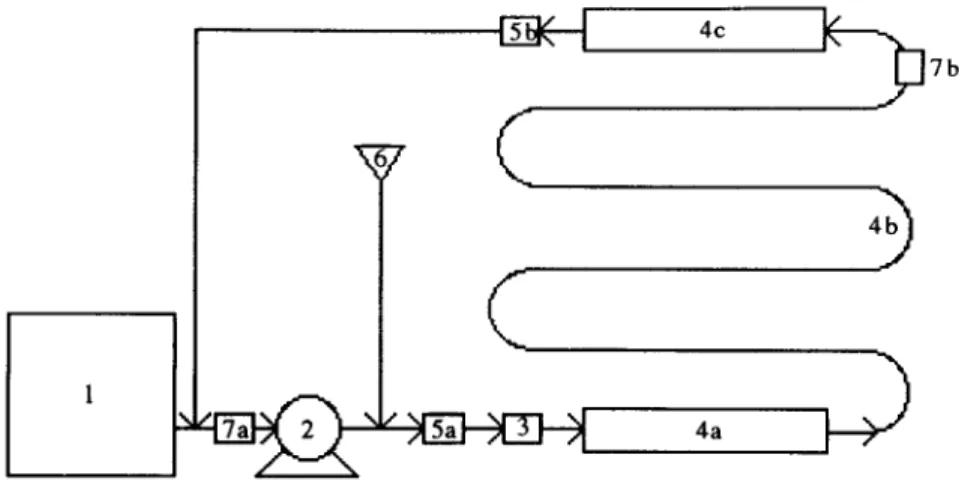
The system used for this study is schematically represented in Fig. 1, consisting basically in a feed tank for the liquid solutions (l), a single rotor rotative pump with
rubber blades (2) a magnetic flowmeter (3) a tubular (2.2 cm i.d.) aseptic
processing unit with heating, holding and cooling sections (4a, 4b and 4c) and two visualization sections, one at the inlet (5a) and another at the outlet (5b) of the aseptic processing unit. A vertical tube (6) and two valves (7a and 7b) were used respectively to introduce the particles and to remove the air from the system. The system has a total length of 31 m.
The experimental procedure
Tank 1 was filled with the adequate liquid solution. The solution was pumped from this tank into the aseptic processing system and recycled until all the air had been purged.
7b
1
364 I? N. Baptista et al.
According to the experiment to be carried out the desired particle mixture was prepared by mixing the two different types of particles. Eight particles of each type were coloured with different colours, to be used as tracers. With the liquid being continuously recycled, the 3-way valve at the bottom of the vertical tube (7 in Fig. 1) was opened and the selected mixture of particles was introduced through the top of the tube connected to this valve. The particles introduced would produce the selected average particle concentration for the experiment. The mixture of particles was slowly introduced and the particle-fluid mixture was recycled for a sufficient time to guarantee a homogeneous particle concentration in the system (as visually observed). The residence time of the tracer coloured particles was then determined by recording the initial time, at the inlet transparent section, and the final time, at the outlet transparent section. In each experiment, the solid/liquid mixture was recycled until the residence time of the tracer particles of each type of particle had
been measured and recorded at least one hundred times. This methodology
corresponds to the direct application of residence time definition (e.g. Yang and Swartzel, 1992; Singh and Lee, 1992; Sandeep and Zuritz, 1994). The experiments were performed at room temperature.
The experiments
The experimental work can be divided in three parts: (i) the effect of using single particles or particle suspensions; (ii) the influence of flow rate and fluid viscosity in the residence time distribution of a given particle mixture; and (iii) the effect of mixing different particles in their residence time distributions.
(1) Thirty two sets of experiments were randomly performed, corresponding to a factorial design at two levels of the variables studied: particle concentration (C,), particle diameter (d,), particle density (pi,), fluid viscosity (p) and flow rate (Q) (Table 1).
(2) The influence of flow rate and fluid viscosity in the residence time distribution was studied using a mixture of the large particles of low density with the small particles of high density, because these two types of particles were found to have residence times significantly different. Eight sets of experiments were randomly performed with all the different combinations of the two levels of flow rate, fluid viscosity and concentration of each type of particle in the mixture. The total concentration of particles was 1% v/v.
TABLE 1
Low and High Levels of Variables used in the Factorial Design at Two Levels for Assessing the Effect of using Single Particles or Particle Suspensions
Level + Particle concentration (70 VIV) Single particles 1.00 Particle diameter (mm) 6.35 9.52 Particle density (g cm - “) 1.065 1.185 Fluid consistency (Pa.s”f%CMC) 0-001/0~00 0~057/0-30 Flow rate (L h-‘) 180 360
(3)
For the third part of the work, additional experiments were performed in a0.30% CMC solution at a flow rate of 360 litres hh’. Mixtures of two
different types of particles were studied. Six different mixtures were used, corresponding to all the possible combinations of the four types of particles used in this work. For each different combination two different fractions (0.35 and O-65) of each type of particle were used, totalling twelve experiments. RTD characterization
Residence time distribution curves [E(t)] were drawn, based on the measured
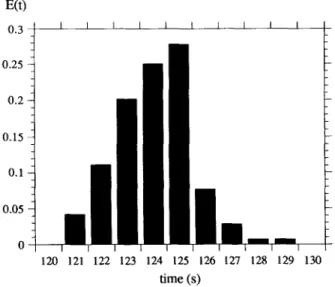
residence time of the tracer particles for each experiment. Figure 2 shows a typical
example. These curves were described in terms of the minimum residence time
(tmi,), the mean residence time (f) and the standard deviation of the distribution (s). For a comparison between different flow conditions, some results were expressed in terms of normalized parameters, as described by Levenspiel (1972):
Normalized Mean RT:
Normalized Minimum RT:
(j.” =
tmin
z
Normalized Standard Deviation:
0.31 ’ ’ ’ ’ ’ ’ ’ ’ ’ ’ k
(2)
120 121 122 123 124 125 126 127 128 129 130 time (s)
Fig. 2. Typical example of a residence time distribution curve (C, = 1.0% v/v, d, = 952
366 l? N. Baptista et al. S sg = - f
(3)
where f=i tE(t)At (4) fl V z=--Q
where V is the volume of the system. The volumetric flow rate includes both liquid and solid phases.
RESULTS AND DISCUSSION
Reynolds numbers between 138 and 5800 were obtained, with laminar flow when CMC was used and in the transient regime when water was used. The particles’ mean residence time was, for most situations, higher than the fluid mean residence time, showing that the particles tend to move slower than the fluid. The only exception was for the large particles with high density at higher flow rate and fluid viscosity, where a normalized mean residence time of 0.85 was obtained. Table 3
shows the average results of the normalized mean residence time for the
experiments periormed with suspensions of 1% v/v particle concentration. These
results clearly show that different particles have different residence times for the same flow conditions. The low density particles showed a lower residence time. For the same density, large particles moved faster. Therefore, the small particles of low density had a mean residence time close to that of the large, high density particles. Similar results were reported by Singh and Lee (1992) in relation to the effect of diameter and by Yang and Swartzel (1992) for the effect of particle density. In an
earlier work (Baptista et al., 1994) a study was presented where single and
interactive effects of particle diameter and density, flow rate and fluid viscosity on particle RTD was fully discussed.
The effect of using single particles or particle suspensions
A factorial design at two levels, as described by Box et al. (1978), was applied with
the thirty-two sets of experiments shown in Table 1 and analysed with the
Statgraphics 5.0 statistics software (Statisticai Graphics Corporation, 1991). The aim of this study was to identify if the presence of other particles with similar characteristics would affect the flow of a single particle, even for low particle concentrations (1% v/v).
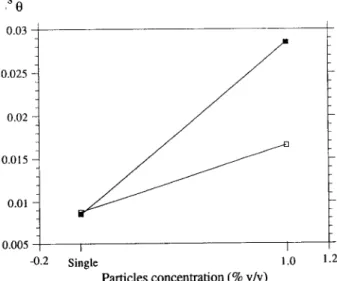
It was observed that the minimum residence time of individual particles was not affected by the presence of other particles, while an increase of the mean residence time was clear (significance level higher than 95%), with no significant interactive effects with the other variables tested. For the standard deviation an interactive effect between particle concentration and particie diameter was found (significance level higher than 95%). The presence of other particles increased the standard deviation (significance level higher than 99%) this effect being more important for the small particles, as shown in Fig. 3. The average particle delay and the increased
standard deviation may be justified by the existence of interactions between
particles. Higher dispersions for smaller particles may be due to the higher number of small particles when compared with the number of large particles for the same
concentration (in v/v). This increases the probability of interactions between
particles and consequently the dispersion. The lack of significant effects on the minimum residence time shows that there are some particles that are not subject to significant interactions with others at this low concentration. These results show that conclusions obtained from flow analysis of single particles (e.g. Yang and Swartzel, 1992; Ramaswamy et al., 1992) should not be extrapolated for particle suspensions, even for low particle concentrations.
The influence of flow rate and fluid viscosity in the residence time distribution of a particle mixture
From the previous study it was concluded that the large particles of low density and the small particles of high density had significantly different mean residence times (Table 2). The effect of mixing these two types of particles was then assessed, for a total concentration of particles of 1.0% v/v and two levels of concentration for each
mS8
0.03 0.02s 0.02 0.015 0.01 I 0.005 IL -0.2 Single 1 .o 1.2 Particles concentration (% v/v)Fig. 3. Interactive effect of particle concentration and particles diameter on the average
368 R N. Baptista et al.
TABLE 2
Average Results of the Mean Residence Time for the Experiments Performed with Suspensions of 1% v/v Particle Concentration
Particle density level C-1 Is; (+> Particle diameter level (-) (+I Average 0 1.19f0.21 1.03f0.13 152+0.38 1.23 kO*27
type of particle: O-35 and 0.65% v/v. Figure 4 shows the mean and the minimum residence time for both types of particles in the mixture, for different conditions of flow rate and fluid viscosity, together with the results previously obtained when just
one type of particle was used. A general tendency for each type of particle to accelerate when mixed with the other type of particles can be observed in these figures. This effect appears to be more evident for the higher flow rates. Because the total concentration of particles is always the same, these changes in the residence time are related to the presence of particles with different diameters and densities and, consequently, with different residence time distributions. In the visualization sections it was observed that when a large particle approached a smaller and slower particle, it would be held back by it for some seconds, pushing it in return, which would increase the small particle’s velocity and consequently reduce its residence
time. This might lead to the conclusion that the large particle would be delayed. However, after this period, the large particle would go over the small particle (leapfrog), moving, therefore, to low tube radius, with higher fluid velocity, and being significantly accelerated in this way. This effect also occurs in saltation flows (Zandi, 1971) and was observed by Dutta and Sastry (1990b) in linear tube flow of low particle concentration (<0+3145% v/v). In the present study, in some situations, this leapfrog was observed immediately on the approach of the two particles. In terms of the standard deviation, mixing different types of particles appears to increase the dispersion for the low flow rates, while no significant effects were detected for the higher flow rates. Table 3 shows the values obtained for the different conditions tested.
The effect of different particle mixtures in their residence time distributions
Figure 5 shows, for a 0.30% CMC solution and for a flow rate of 360 litres hh’, the effect of mixing two different types of particles on their mean residence time, for all the combinations of the four different types of particles used. The effects on the minimum residence time were very similar and are therefore not shown. Each figure shows the behaviour of a given particle type, when mixed with any of the other three types of particles. It may be concluded that all the particles are in general accelerated, except when mixed with the small particles of low density, that usually have a more reduced effect and in some situations even promote a delay of the
particles they are mixed with. The effects on the spread of the distribution were negligible, confirming the results found in the previous section.
For the mixtures of particles with considerably different residence times, the accelerating effect may be the one explained in the previous section. However, this accelerating effect is also clear for situations where particles with quite similar
ReSib’fX time(s) 340 320 _*__---’ 300 1:: .x wc-c
I\
I
______e---0
a)1
0.3 0.4 05 0.6 0.7 0.8 0.9Particles c0ncent’a’ion (so v/v)
0.3 0.4 0.5 0.6 0.7 0.8 0.9 I I.1 Particles mncenmtion(%vlv) 03 0.4 0.5 0.6 0.7 0.8 0.9 , 1.1 palli!zles cmKxnmtion (96 v/v) Km 90 f g____-_
-1
---- __--0 fQ, I ’ I 8 1 ’ I I ’ I I rr-4
0.3 0.4 0.5 06 0.7 0.8 0.9 I I I Particles amenltation(%vh)Fig. 4. Mean and minimum residence time of both types of particles for mixtures of particles with d, = 9.52 mm; pP = 1.065 g cm-j (0); and with d, = 6.35 mm; pP = 1.185 g cm-” (0); mean residence time; - - minimum residence time (a) flow rate = 180 litre h-l, fluidviscosity = 0.00% CMC; (b) flow rate = 180 litre h-‘, fluid viscosity = 0.30% CMC; (c) flow rate = 360 litre h-‘, fluid viscosity = 0.00% CMC; (d) flow rate = 360 litre h-‘, fluid
370 R N. Baptista et al. TABLE 3
Experimental Normalized Standard Deviation in the Study of the Influence of Flow Rate and Fluid Viscosity in the Mixture of Large Particles of Low Density (0) with Small Particles of
High Density (0) Flow rate (L h-‘) 180 360 Fluid consistency (Pa. f/Y0 CMC) 0~001/0~00 0.057/0.30 0~001/0~00 0.057/0~30 Particle d d * d . d
Normalized standard deviation Concentration (% v/v) 0.35 0.65 I .oo 0.033 0.032 0.010 0.021 0.019 0.019 0.090 0.046 0.015 0.05 1 0.072 0.035 0.019 0.014 0.016 0.019 0.017 0.016 0.017 o-019 0.012 0.038 0.014 0.020
residence times were mixed. The small particles of low density and the large
particles of high density showed only 4 s difference, on average, in the mean RT (Table 2), but when mixed, accelerations of 8 to 10 s in the former were obtained. This result was confirmed by visual observation, as the small particles of low density often ‘jumped’ over the large particles of high density, which may be due to the
much higher rotational velocity of the particle of high density and diameter
(Saffman lift force) which, associated with the possible friction between the two particles will promote the leapfrog.
Comparing Figs 5a and b, it may be seen that the acceleration effect of the high density particles is more important for the small particles. These high density particles always move slower than the low density particles and their accelerating effect is therefore due to the leapfrog they promote on the others. It can be easily understood that this leapfrog will be more likely to occur if the particles that are being overtaken are smaller. In addition, in these situations the other particle moves to the centre of the tube, given the particles and tube diameter, where fluid velocity is higher.
Comparing Figs 5c and d, an opposite effect of diameter may be observed for the low density particles. These particles are faster than the high density particles and thus in these situations acceleration is caused by the ‘pushing effect’ that may be expected to be more important for the larger particles. However it is curious to note that the small low density particles may delay the large high density particles.
CONCLUSIONS
The residence time distribution of particles in particulate properly by determining residence time distributions with interactions between particles affect the residence time concentrations (1% v/v).
fluids cannot be assessed single particles, since the distribution even at low
When different types of particles are mixed, the residence time distribution of each type is affected, and in general a reduction of mean and minimum residence
was observed in this study. However, opposite effects were found at some
conditions. This shows that when different types of particles are present in a particulate fluid, RTD studies obtained from suspensions of a single type of particle should not be applied; experiments should be conducted for the mixture in question, and for each type of particle.
0.3 0.4 0.5 0.6 0.7 0.8 0.9 I 1.1 Particle.s~m~lion(%vlv)
921
03 0.4 05 0.6 0.7 0.8 0.9 I Particles concentration (% v/v)1
I.1 i i 122 ISO- I21 145 / II9 ::::ii',: 03 0.4 0.5 0.6 0.7 0.8 0.9 I I.1 0.3 04 0.5 0.6 0.7 0.8 0.9 I I I 120Particle4 wnccnlration (C v/v) Parti&s wncentration (% viv)
Fig. 5. Influence of different particles in the mean residence time of each type of particle in a solution of 0.30% of CMC at a flow rate of 360 litre h-‘: (a) d, = 6.35 mm; p,, = 1.065
g cmd3 (0); (b) d, = 9.52 mm; pP = 1.065 g cm-3 (0); (c) d, = 6.35 mm; p,, = I.185 g cm--’
372 P N. Baptista et al.
ACKNOWLEDGEMENTS
The authors are thankful to Junta National de Investigaqao Cientifica e Tecnologica and to the CEC (FLAIR Programme) for financial support. The authors would also like to acknowledge the invaluable support of ARSOPI, the metallurgical company where the aseptic processing system used in this work was designed and built. A special reference is given to Mr Armando Pinho and Mr Ernest0 Ferreira for their constant support.
REFERENCES
Alcairo, E. R. & Zuritz, C. A. (1990). Residence time distribution of spherical particles suspended in non-Newtonian flow in a scraped-surface heat exchanger. Transactions of the ASAE, 33, 1621-8.
Baptista, P. N., Oliveira, F. A. R., Straul3, A. & Oliveira, J. C. (1994). A general analysis of the residence time distribution of particles in the aseptic processing of particulate fluid foods in tubular systems. In Minimal Processing of Foods and Process Optimization, ed. Singh, R. P. and Oliveira, F. A. R., CRC Press, Boca Raton, FL, 1994, 153-67.
Berry, M. R. (1989). Predicting fastest particle residence time. First International Congress in Aseptic Processing Technologies, Indianapolis, IN, 19-21 March, 6-17.
Box, G., Hunter, W. G. & Hunter, J. S. (1978). Statistics for Experimenters, John Wiley and Sons, New York, 306-51.
Dutta, B. & Sastry, S. K. (1990). Velocity distributions of food particles suspensions in holding tube flow: experimental and modelling studies on average particle velocities.
Journal of Food Science, 55, 1448-53.
Dutta, B. & Sastry, S. K. (1990). Velocity distributions of food particles suspensions in holding tube flow: Characteristics and fastest-particle velocities. Journal of Food Science, 55,1703-10.
Heldman, D. R. (1989). Establishing aseptic thermal processes for low-acid foods containing particulates. Food Technology, 42, 122-31.
Levenspiel, 0. (1972). Chemical Reaction Engineering, John Wiley and Sons, New York. McCoy, S., Zuritz, C. A. & Sastry, S. K. (1987). Residence time distribution of simulated
food particles in a holding tube, ASAE Paper No. 87-6536, American Society of Agricultural
Engineering, St. Joseph, MI.
Palmieri, L., Cacace, D., Dipollina, G., Dall’Aglio, G. & Masi, P. (1992). Residence time distribution of food suspensions containing large particles when flowing in tubular systems.
Journal of Food Engineering, 17, 225-39.
Ramaswamy, H. S., Pannu, K., Simpson, B. K. & Smith, J. P. (1992). An apparatus for particle-to-fluid relative measurement in tube flow at various temperatures under nonpressurized flow conditions. Food Research International, 25, 277-84.
Sandeep, K. P. & Zuritz, C. A. (1991). Residence time distribution of multiple particles in non-Newtonian tube flow. ASAE Paper No. 91-6549, American Society of Agricultural
Engineering, St. Joseph, MI.
Sandeep, K. P. & Zuritz, C. A. (1994). Residence time distribution of multiple particles in non-Newtonian holding tube flow: statistical analysis. Journal of Food Science, 59, 1314-17.
Singh, R. K. & Lee, J. H. (1992). Residence time distribution of foods with/without particulates in aseptic processing systems. In Advances in Aseptic Processing Technologies,
ed. Singh, R. K. and Nelson, P. E., Elsevier Applied Science, London, 1992, 7-62.
Taeymans, D., Roelans, E. & Lenges, J. (1985). Influence of residence time distribution on the sterilization effect in a scraped surface heat exchanger used for processing liquids containing solid particles. In Proceedings of IUFoST Symposium on Aseptic Processing and
Yang, B. B. & Swartzel, K. R. (1992). Particle residence time distributions in two-phase flow in straight round conduit. Journal of Food Science, 57, 497-502.
Zandi, I. (1971). Hydraulic transport of bulky materials. In Advances in Solid-Liquid Flow in