Engagement as an antecedent of the
satisfaction-performance relation: a study with line
managers
Pedro Ferreira*
Department of Economics, Management and Computer Science, University Portucalense and REMIT,
Porto, Portugal
Email: [email protected] *Corresponding author
Paula Rodrigues
Faculty of Business and Economics, University Lusíada-North,
Porto, Portugal
Email: [email protected]
Abstract: The objective of this study is to investigate the relationship between satisfaction and performance, when preceded by employee engagement. Specifically, it examines the relation of job satisfaction and company perceived performance after the influence of the three dimensional concept of employee engagement (vigour, dedication and absorption) on job satisfaction. In order to accomplish this goal, a literature review was undertaken to support the conceptual model and hypotheses. Data was collected from a sample of line managers of several major companies in Portugal. Results show, on the one hand, that vigour and dedication are related with job satisfaction, but absorption does not make a significant contribution. On the other, job satisfaction influences company perceived performance. Some theoretical and empirical implications are discussed.
Keywords: employee engagement; job satisfaction; company performance; Portugal; structural equations model; line managers.
Reference to this paper should be made as follows: Ferreira, P. and Rodrigues, P. (2018) ‘Engagement as an antecedent of the satisfaction-performance relation: a study with line managers’, Int. J. Human Resources Development and Management, Vol. 18, Nos. 1/2, pp.32–50.
1 Introduction
The managing of performance has long been a relevant concern for academics and practitioners. And this is not surprising, since one of the most relevant (if not the most relevant) goals of organisations is to deliver outputs to both internal and external stakeholders, making performance one of the most important processes for managing successfully any organisation. When looking at performance in an organisational setting, several issues have been the focus of research. One of the most important topics is related with what drives performance. All disciplines that study performance in organisational context have been concentrated in examining how performance can be enhanced, shaped and sustained (Bititci et al., 2012).
The job satisfaction-job performance relation is one of the most investigated in organisational research, but by no means more clarified. Judge et al. (2001) conducted one of the most cited and exhaustive reviews on the subject, identifying seven different models supporting research on the relation of job satisfaction and job performance. This confirms the lack of agreement among scholars not only about the direction and type of relation between those two concepts, but also on the concepts that may be considered to mediate this relation.
Despite the variety and richness of perspectives about the relation between job satisfaction and job performance, there are some gaps that need to be addressed. First, the effort placed on understanding the job satisfaction-job performance relation seems to disregard the factors that might instigate job satisfaction. Although some previous research has tried to explore factors influencing job satisfaction (Tomaževič et al., 2014), employee engagement has not been associated with the satisfaction-performance. Irrespective of the approach taken to clarify the satisfaction-performance relation, examining the factors that influence satisfaction would offer an understanding of the path to performance and not just a confirmation of a probable association. Second, and despite the large variety of perspectives and approaches, all the models pinpointed by Judge et al. (2001) present one common aspect, that is, a focus on the individual. Past research has focused mainly on the relation between job satisfaction and individual job performance, with only some few exceptions considering the overall company performance (Harter et al., 2002).
The variety of approaches also extends to how performance is measured. There are numerous forms to measure performance that can vary according the perspective. For example, performance can be measured at the individual (Chung and Angeline, 2010; Gorgievski et al., 2014; van den Bosch and Taris, 2014; Alessandri et al., 2015) and organisational levels (Delaney, 1996; Camps and Arocas, 2009; Fabling and Grimes, 2010; Ferreira and Oliveira, 2012; Aristovnik et al., 2016), or can be measured using objective (Karatepe et al., 2006; Chi and Gursoy, 2009; Hamann et al., 2013; Tews et al., 2013) or subjective indicators (Camps and Arocas, 2009; Fabling and Grimes, 2010; Ferreira and Oliveira, 2012; Gorgievski et al., 2014; Shimazu et al., 2014). Despite the differences between objective and subjective measures, researchers have commonly used the latter, mainly due to reasons of data collection and comparability across countries, sectors and companies (Singh et al., 2016).
The main research question to be addressed in this research is how is employee satisfaction generated and how is it related with company performance? Thus, the main goal of this paper is to examine how employee engagement is related to job satisfaction, and how this relation may influence company performance. In this context, employee engagement is understood as an antecedent of employee satisfaction, which is conceptualised as an individual outcome. On the other hand, performance is understood as an outcome of the interplay between engagement and satisfaction, and is conceptualised at the organisational level and as a perceived, thus subjective, measure.
The paper is structured as follows. First, the literature review will start by untangle the concepts of engagement and satisfaction, moving on to the description of the main arguments that support the employee engagement-satisfaction and the satisfaction- performance relation. Second, methods will be presented, with a special emphasis on the justification of the measures used. The results are presented followed by a discussion of the main findings. Finally, conclusions are drawn and future directions are pinpointed.
2 Literature review
2.1
Employee engagement and job satisfaction
The concept of employee engagement is relatively recent. The Gallup group first coined it in the late 1990s, as a result of several empirical works based on interviewing and surveying managers and employees from around the world. In the academic literature, the initial and most relevant development of the concept is attributed to Kahn (1990, p.700), that considered engagement as combination of self and task, allowing “people who are personally engaged [to] keep their selves within the role, without sacrificing one for the other”. This natural combination of self and role promotes a physical, cognitive and emotional personal presence, stronger connections with ones work and with others.
Bakker and Schaufeli, (2008) use the expression work engagement to define the positive, fulfilling, affective-motivational state of work-related well-being. In fact, engagement has emanated from the positive psychology that stresses the need to investigate and find effective applications of positive traits, states and behaviours of employees within organisations. As such, engagement can be considered the antipode of burnout (Maslach et al., 2001). Schaufeli et al. (2002b, p.74) define engagement as “a positive, fulfilling, work-related state of mind that is characterised by vigour, dedication, and absorption”. Vigour refers to the levels of energy, mental resilience and persistence.
Dedication is about the mental and emotional state that reflects on experience a sense of significance, enthusiasm, inspiration and pride. Finally, absorption means being completely concentrated in ones work.
Saks (2006) distinguishes job engagement and organisation engagement. Drawing from Kahn (1990) research, engagement is conceptualised as role related, reflecting the extent to which an individual is psychologically present in a particular organisational role. Thus, the two most dominant roles for most organisational members are their work role and their role as a member of an organisation. In his research, he found that job and organisation engagement are different, not only because the scores were different, but also their relationship with antecedents and consequences were distinct. Although job and organisation engagement had impact in job satisfaction, organisational commitment, intention to quit, and organisational citizenship behaviour, organisation engagement was a much stronger predictor of all of the outcomes than job engagement. Finally, job characteristics predicted job engagement and procedural justice predicted organisation engagement.
Engagement is considered to have influence on several human resources outcomes such as psychological/physical health, proactive organisational behaviour (Shimazu et al., 2008), job involvement, intention to quit and organisational citizenship behaviour (Saks, 2006; Ram and Prabhakar, 2011; Alfes et al., 2013) among others.
Although some research presents job satisfaction as one of the outcomes that result from higher levels of engagement (Saks, 2006; Shimazu et al., 2008; Ram and Prabhakar, 2011), the literature is not clear regarding this relation. While some research questions the validity of employee engagement as a unique construct (e.g., Shirom, 2003; Rothmann, 2008; Wefald and Downey, 2009; de Bruin and Henn, 2013), others have presented empirical evidence supporting the distinction of the two concepts (Rich et al., 2010; Christian et al., 2011). Recently, Nimon et al. (2016) tried to unlock this discussion arguing that the problem might be, not on the concepts, but how they are measured. To do so, they examined the semantic similarity between three measures of employee engagement and a commonly used measure of job satisfaction. The findings, with high correlations between some items of employee engagement and job satisfaction, suggest that some semantic equivalence may be at play.
Job satisfaction reflects the pleasure experienced based on the intrinsic and extrinsic nature of the job (Rothmann, 2008), and that’s why it should be considered a work attitude (Shuck et al., 2013). As such, job satisfaction represents a stationary state and a measure of fullness or satiation (Christian et al., 2011). On the other hand, engagement is an active psychological state (Shuck et al., 2013) based on vitality, enthusiasm and absorption of individuals in their work (Rothmann, 2008). The nature of employee engagement, namely being a psychological state rather than a sentiment or behaviour, allows assuming that it precedes job attitudes, such as job satisfaction.
Nevertheless, some research has demonstrated the relation between work engagement and job satisfaction. Diedericks and Rothmann (2013) in a study about flourishing of information technology professionals found a significant relation between work engagement and job satisfaction. Aiming to examine role stress (role ambiguity and role conflict) and work engagement as antecedents of job satisfaction, a study conducted in Portugal confirmed the relation engagement-satisfaction (Moura et al., 2014). A similar study conducted in Spain reached the same conclusion (Orgambídez-Ramos et al., 2014).
2.2
Job satisfaction and performance
Job satisfaction is probably one of the most investigated concepts in organisation research. Since the Hawthorne studies back in the 1930s that satisfaction is examined in several contexts, disciplines and using several approaches.
Despite the extensive scientific production on the subject, many disputes remain unsolved and relatively unclear. Among them, the relation of job satisfaction and performance is one of the most studied and still controversial, which can be illustrated by the diversity of approaches and interpretations of the satisfaction-performance relation. Judge et al. (2001) conducted two thorough meta-analyses of the satisfaction- performance relation. Their findings show that the literature comprises at least seven models that have guided research on the topic, including the expected casual effect models (job satisfaction as predictor of job performance and vice-versa), the reciprocal models and models with other variables mediating the relationship, and even a model that tries to reduce or eliminate the relation by including other variables, thus diminishing the strength of the satisfaction-performance relation – known as the spurious model.
The second important dispute is about the real relation between satisfaction and performance. Common sense tells us that more satisfied workers produce more, thus presenting higher performance indicators. An extensive body of research, under the topic of the so-called ‘happy-productive worker hypotheses’ also confirms this assumption (Fisher, 2003). An important contribution to this assumption was made by the already mentioned study by Judge et al. (2001) that found an association (r = 0.30) between satisfaction and performance in their meta-analytic study; they also excluded the zero correlation hypotheses, which reinforces their results.
The satisfaction-performance relation has also been confirmed in macro approaches. Jones et al. (2008) using data from the British workplace employee relations survey, with 2,300 workplaces and 22,500 employees, found that job satisfaction is statistically associated of the several measures of performance, namely absenteeism rate, quit rate, and three subjective measures on the part of managers, financial performance, labour productivity, and product quality.
Job satisfaction as also been successfully used as a mediator between several variables and performance. At the individual level, Sun (2016) demonstrated that job satisfaction can act as mediator between psychological empowerment and job performance (namely task performance and contextual performance). In a study in the Chinese insurance sector, Fu and Deshpande (2014) also found that job satisfaction can act as a mediator of the caring climate-job performance relationship. Bouckenooghe et al. (2013) also found that job satisfaction mediates the relation between affectivity and job performance and turnover. Finally, Vermeeren et al. (2014) demonstrated the relation between HRM practices and performance at the organisational level through job satisfaction.
Other studies confirmed the relation between satisfaction and performance by means of mediators. Arguing that researchers tend to adopt an over simplistic approach to the concept of satisfaction, Schleicher et al. (2004) examined the mediation effect of affective-cognitive consistency by conducting two separate studies. They found affective- cognitive consistency to be a significant moderator of the relation satisfaction- performance, which was confirmed by the second study. Chi and Gursoy (2009) also found an indirect effect of employee satisfaction on financial performance, mediated by customer satisfaction. Notably, they found that employee satisfaction has no direct
significant impact on financial performance. A study conducted in the customer services sector in the US also confirmed the relation of job satisfaction and job performance when mediated by psychological wellbeing (Wright et al., 2007).
But common sense has also been disconfirmed by research. In fact, there are several studies that support the assumption that satisfaction is unrelated with performance. Crossman and Abou-Zaki (2003) in a study in the Lebanese banking sector found no significant relation between satisfaction and performance. However, the most compelling argument for the absence of relation between satisfaction and performance was put forward by Bowling (2007). In a meta-analytic study using 107 previous studies, the researcher explored the so-called ‘spurious relation’, that is, the variables do not share a casual relation, but instead they share similar causes. The causes elected were general and domain-specific personality factors. The results revealed that when the relation satisfaction-performance was controlled by those factors, the relation was very weak. More recently Bowling and colleagues also demonstrated that some mediating variables can weaken the satisfaction-performance relationship. Using a meta-analytical approach they found that situational strength (conceptualised as “a situation [that] contains cues that make it obvious how one is expected to behave, the degree to which the situation limits one’s choice of behaviour, and the degree to which the situation includes incentives that are relevant to these behaviours”, p.90) can attenuate the relationship between job satisfaction and job performance (Bowling et al., 2015).
3 Methods
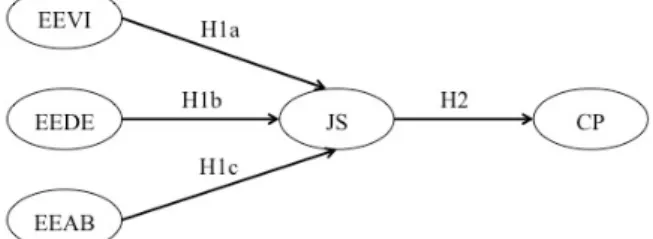
The goal of this paper is to examine the relation between employee engagement, job satisfaction and company performance. In order to accomplish this goal, the following model will be tested (Figure 1). Considering the argument of a multidimensional construct (Shirom, 2003; Rothmann, 2008; Wefald and Downey, 2009; de Bruin and Henn, 2013), employee engagement is conceptualised following the suggestion of Schaufeli et al. (2002a, 2002b). Also, following the conclusions of Nimon et al. (2016), the multi-dimensional approach to engagement may reveal possible overlaps between engagement and job satisfaction. Company performance assumes the form of a subjective measure. According to the work of Singh et al. (2016), subjective measures are a reliable form of measuring companies performance, even more when issues of comparability are at stake.
Figure 1 Conceptual model
Notes: EEVI = employee engagement vigour; EEDE = employee engagement dedication; EEAB = employee engagement absorption; JS = job satisfaction; CP = company performance.
Taking into account the characteristics of the conceptual model, this research is based on a quantitative approach. Following the identification of the main concepts, tested and validated scales were adopted, a sample of workers were surveyed and statistical techniques were used to test the hypotheses.
The following hypotheses are raised:
H1 Employee engagement relates positively with job satisfaction.
H1a The dimension vigour of employee engagement relates positively with job satisfaction.
H1b The dimension dedication of employee engagement relates positively with job satisfaction.
H1c The dimension absorption of employee engagement relates positively with job satisfaction.
H2 Job satisfaction relates positively with company performance.
3.1
Measures
The measurement of employee engagement is bone of contention among scholars. Viljevac et al. (2012) investigated the validity of two measures of engagement – the Utrecht work engagement scale (UWES) and the psychological engagement scale (May et al., 2004) – that have emerged in the academic literature. They found some evidence for convergent, discriminant and predictive validity for both scales, although neither showed discriminant validity with regard to job satisfaction. They contend that important differences in measuring engagement raises questions on how to measure the construct and the results will be specific to the measures used, limiting generalisation.
Employee engagement was measured using the UWES (Schaufeli et al., 2006), using a 7-point Likert scale (1 = not probable; 7 = most probable). A few studies report the use of the UWES scale in Portugal. Schaufeli et al. (2002a) used the scale to research students’ burnout and engagement, adapting the UWES scale to the goal and population of the study. The scale was translated to Portuguese from the Spanish version, not from the original. Salanova et al. (2011) used only two of the three dimensions, meaning they did not use the full version of the scale. Moreover, there is no mention to translation procedures or to the use of Schaufeli’s previous translation.
Since neither of previous studies fitted the purpose of this research, we developed our own translation procedures. First, the items were translated to Portuguese and then were subjected to back translation procedures. The results were very good, meaning that the Portuguese translation kept intact the meaning of the original items. Then, we pre-tested the scale to detect possible misunderstandings.
Job satisfaction was measured using a 3-item scale suggested by Saks (2006), including statements such as “All in all, I am satisfied with my job”, measured with a 7- point Likert scale. Company performance was measured using the 7-item scale suggested by Delaney (1996), asking respondents to rate their company performance in several topics (such as ‘quality of products, services or programs’, ‘growth in sales’, ‘profitability’ or ‘ability to retain essential employees’) when compared with their competitors in a 4-point Likert scale (ranging from 1 = much worse than competitors to
4 = much better than competitors). This scale is a subjective measure of performance. According to the literature (Singh et al., 2016), objective measures may be more robust and accurate. However, the use of subjective measures is sometimes an option, mainly when data is not available (Camps and Arocas, 2009; Singh et al., 2016) and when companies are not required to disclose their financial data. Finally, the sample of this study was based in line managers that are assumed to have some reliable information of their companies’ performance, thus diminishing the risk of bias (Camps and Arocas, 2009).
3.2
Sample and data collection
The population of this study is line managers from several Portuguese major companies. From the initial 30 companies that agreed to participate, only 17 fully complied with all of the requirements. Most of them are publicly traded companies with more than 250 employees, from services (technologies, insurances, banking, retail and others) and industry (furniture, food and beverages, automotive parts and others). Line managers were drawn from participant companies.
The researchers contacted the human resources department of each company that distributed the questionnaire among all line managers, using both offline and online media. The average rate of response was 78%. Total sample comprises 344 line managers.
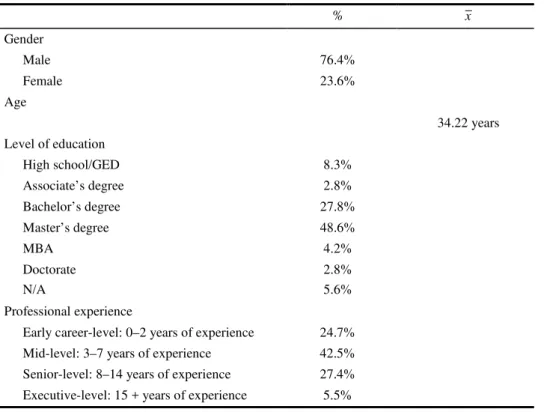
Table 1 Sample demographics
% x Gender Male 76.4% Female 23.6% Age 34.22 years Level of education High school/GED 8.3% Associate’s degree 2.8% Bachelor’s degree 27.8% Master’s degree 48.6% MBA 4.2% Doctorate 2.8% N/A 5.6% Professional experience
Early career-level: 0–2 years of experience 24.7% Mid-level: 3–7 years of experience 42.5% Senior-level: 8–14 years of experience 27.4% Executive-level: 15 + years of experience 5.5%
3.3
Statistical procedures
Data analyses included several statistical techniques. Descriptive analyses were used to describe data namely sample demographics and items from main variables. Correlation analyses allowed a first approach to the relation between main variables. In order to test the model a confirmatory factor analyses was conducted to the scales used to measure the constructs. Following Bollen (1989), the evaluation of the psychometric properties of the scales ensured that the scales were reliable, had validity and were one-dimensional. Finally, the hypotheses were tested using structural equation modelling (SEM).
4 Findings
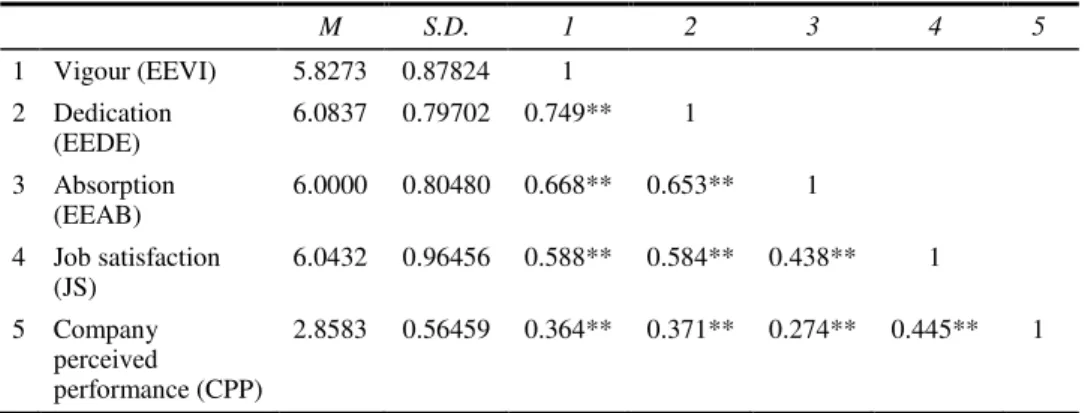
The following table presents mean, standard deviation and correlations for main variables; all correlations are significant. Among employee engagement dimensions, vigour (EEVI) and dedication (EEDE) have the highest correlations with job satisfaction (r = 0.588; r = 0.584, respectively) and absorption (EEAB) has the lowest correlation (r = 0.438). Correlations of employee engagement dimensions (vigour, dedication and absorption) with company perceived performance are inferior to those of job satisfaction (r = 0.364; r = 0.371; r = 0.274, respectively). Finally, job satisfaction and company perceived performance present a moderate correlation (r = 0.445).
Table 2 Correlations of employee engagement, job satisfaction and company perceived performance M S.D. 1 2 3 4 5 1 Vigour (EEVI) 5.8273 0.87824 1 2 Dedication (EEDE) 6.0837 0.79702 0.749** 1 3 Absorption (EEAB) 6.0000 0.80480 0.668** 0.653** 1 4 Job satisfaction (JS) 6.0432 0.96456 0.588** 0.584** 0.438** 1 5 Company perceived performance (CPP) 2.8583 0.56459 0.364** 0.371** 0.274** 0.445** 1
Notes: **Correlation is significant at the 0.01 level (2-tailed). Company perceived performance uses a 5-item scale. Job satisfaction and employee engagement uses a 7-item scale.
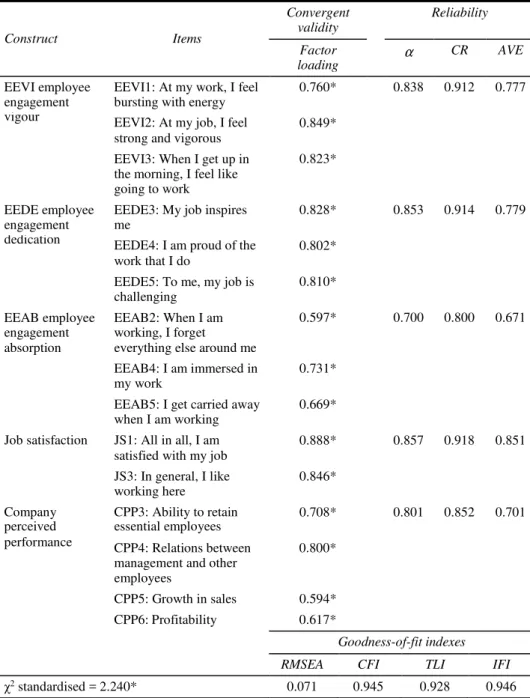
Before carrying out the estimation of the structural equation model, an analyses of reliability and validity of the scales was conducted. To do so, an exploratory factor analyses on all items for each concept was performed, using principal components with varimax rotation. In order to get the necessary confidence measure, items with factor loadings less than 0.5 were removed from the analyses and each construct should be with a single factor, with an acceptable reliability coefficient. The proposed scales present a good reliability value, since the Cronbach’s alpha coefficient is always above 0.7 (Nunnally and Bernstein 1994).
The next step was to test the theoretical model. CFA was used to validate the measurement models consisting of five constructs measured. The only use of the χ2 index provides little guidance in influencing the extent to which the model lacks fit. Thus, the decision was to use other indices of fit. The measurement model shows a good fit when RMSEA is below 0.10 and the CFI are above 0.90 (Hair et al., 2006). The construct validities of the latent constructs are evaluated by convergent validity. All composite reliabilities are greater than the minimum criteria of 0.70 (Nunnally and Bernstein, 1994). The average variance extracted (AVE) provides evidence of overall convergent validity of each construct as it indicates the amount of variance explained by the construct relative to the amount of variance that may be attributed to measurement error, and should exceed 0.50 (Fornell and Larcker, 1981). Showing the constructs are related as expected theoretically and all path weights are significant (p < 0.001), demonstrating high convergent validity.
Reliability was tested by examining the Cronbach’s alpha coefficients and exceeded Nunnally and Bernstein (1994) threshold value. Following the procedures suggested by Fornell and Larcker (1981), convergent and discriminant validity were tested using confirmatory factor analyses. A comparison of the AVE by each construct to share variance between the construct and all other variables was used to test for discriminant validity. For each comparison, the explained variance exceeded all combinations of shared variance. As result, the scales showed acceptable discriminant validity. Verifying the significance of the t values associated with the parameter estimates assessed convergent validity. All t values were positive and significant. Then, the scales showed acceptable convergent validity. The final results show a good measurement model fit (Table 3).
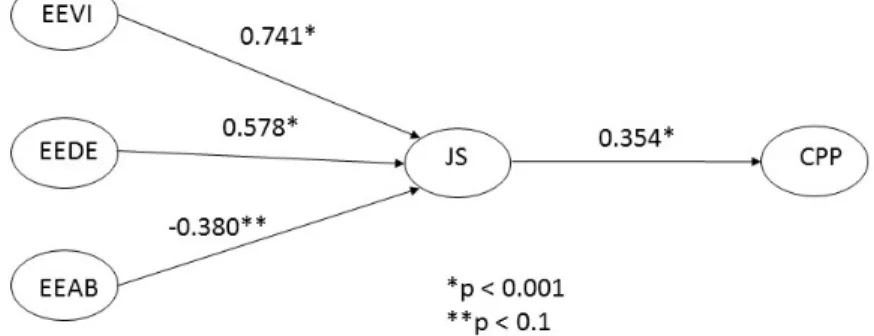
Figure 2 Structural conceptual model estimated
The model was estimated using the covariance matrix. The estimation is performed by the method of maximum likelihood (ML), since the objective is to develop and test the model of engagement as an antecedent of the satisfaction-performance relation. The indicators chosen to analyse the goodness of fit are those suggested by Hair et al. (2006) as the best indicators (Table 4).
Table 3 Psychometric properties of the scales – confirmatory factor analyses
Construct Items
Convergent validity
Reliability
performance CPP4: Relations between management and other employees
0.800*
CPP5: Growth in sales 0.594* CPP6: Profitability 0.617*
Goodness-of-fit indexes
RMSEA CFI TLI IFI
χ2 standardised = 2.240* 0.071 0.945 0.928 0.946
Notes: CR = composite reliability; AVE = average variance extracted; *p < 0.001.
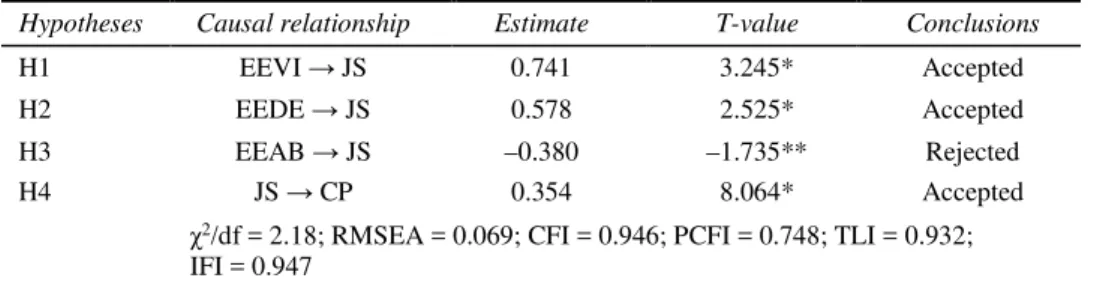
The model fit was very good: χ2 (83) = 181.459, p < 0.000, IFI = 0.947, TLI = 0.932, CFI = 0.946, PCFI = 0.748 and RMSEA = 0.069. Regarding employee engagement, vigour is positively related to job satisfaction (γ1 = 0.741, p < 0.000) (H1a), and dedication is also positively related with job satisfaction (γ2 = 0.578, p < 0.000) (H1b). Contrary to expected, the third dimension of employee engagement, absorption, does not explain job satisfaction (γ3 = –0.380, p < 0.083) (H1c). Finally, job satisfaction is
Factor
loading α
CR AVE
EEVI employee EEVI1: At my work, I feel engagement bursting with energy
0.760* 0.838 0.912 0.777 vigour EEVI2: At my job, I feel
strong and vigorous
0.849* EEVI3: When I get up in
the morning, I feel like going to work
0.823*
EEDE employee EEDE3: My job inspires engagement me
0.828* 0.853 0.914 0.779 dedication EEDE4: I am proud of the
work that I do
0.802* EEDE5: To me, my job is
challenging
0.810* EEAB employee EEAB2: When I am
engagement working, I forget
absorption everything else around me
0.597* 0.700 0.800 0.671
EEAB4: I am immersed in my work
0.731* EEAB5: I get carried away
when I am working
0.669* Job satisfaction JS1: All in all, I am
satisfied with my job
0.888* 0.857 0.918 0.851 JS3: In general, I like
working here
0.846* Company CPP3: Ability to retain
perceived essential employees
positively related with company perceived performance (1 = 0.354, p < 0.000) (H2), as shown in Figure 2.
Table 4 Structural model estimated
Hypotheses Causal relationship Estimate T-value Conclusions
H1 EEVI → JS 0.741 3.245* Accepted
H2 EEDE → JS 0.578 2.525* Accepted
H3 EEAB → JS –0.380 –1.735** Rejected
H4 JS → CP 0.354 8.064* Accepted
χ2/df = 2.18; RMSEA = 0.069; CFI = 0.946; PCFI = 0.748; TLI = 0.932;
IFI = 0.947 Notes: *p < 0.001; **p < 0.1.
5 Discussion
The goal of this paper was to investigate the relation between satisfaction and company perceived performance when employee engagement functions as an antecedent of job satisfaction. Thus, it was assumed that engagement influences job satisfaction (H1) and, in turn, job satisfaction would influence company perceived performance (H2). This set of hypotheses was framed by the satisfaction-performance theoretical discussion. However, it was also added an antecedent – employee engagement – to job satisfaction.
The hypotheses stated in the conceptual model were tested based on structural equations model analyses. The robustness of fit indices show that the model is a good predictor of perceived company performance, confirming the general theoretical model. The general Hypotheses 1 was partially confirmed. Vigour and dedication have a significant positive influence in job satisfaction, while the relation of absorption and job satisfaction was not confirmed.
The general confirmation of H1, i.e., that employee engagement is related with job satisfaction, is according the main body of literature (Harter et al., 2002; Saks, 2006; Avery et al., 2007; Shimazu et al., 2008; Ram and Prabhakar, 2011), showing that employee engagement and job satisfaction are related. In fact, employee engagement makes a strong contribution to explain job satisfaction, meaning that engaged employees will be more satisfied. Moura et al. (2014) reached the same conclusion for a sample of Portuguese workers from public and private organisations while investigating the relation of role stress and work engagement with job satisfaction.
Notwithstanding the general confirmation of H1, employee engagement dimensions presented different results. Contrary to expectations, absorption is not significantly related with job satisfaction. Vigour is about high levels of energy and mental resilience (high activation) and dedication is characterised by feelings of enthusiasm, inspiration, pride and sense of significance (high identification), while absorption means being fully concentrated and showing a positive difficulty of detaching from work (Schaufeli et al., 2002b). Thus, while vigour and dedication are related with positive feelings, absorption is a state of mind (concentration). Thus one might suggest that positive feelings that generate engagement may be more important when it comes to enhance job satisfaction, than the state of mind embedded in engagement.
The results also confirmed the second hypotheses, which stated the relation of job satisfaction with company perceived performance. The positive satisfaction-performance relation is supported by previous research (Judge et al., 2001; Schleicher et al., 2004). It should be noted that most of this support comes from research that conceptualises performance at the individual level (Wright et al., 2007; Riketta, 2008) and as a dimensional measure (Edwards et al., 2008) that is, specific forms of individual performance, such as focal, contextual or task performance. Nevertheless, the few studies that conceptualise performance at the organisational level (Harter et al., 2002; Kim, 2005; Netemeyer et al., 2010; Whitman et al., 2010) also found a relation between satisfaction and performance, thus confirming the findings of the present study.
Finally, some general ideas can be drawn from this study. The relation of engagement and job satisfaction is multi-dimensional. While vigour and dedication are relevant for job satisfaction, absorption is not. This demonstrates that engagement should not be taken as a one-dimensional construct, corroborating the arguments of (Shirom, 2003; Rothmann, 2008; Wefald and Downey, 2009; de Bruin and Henn, 2013). Company performance can also be considered a complex concept and, as such, should include several indicators besides the traditional financial indicators. This study revealed that besides the expected components of performance, such as profitability and growth in sales, aspects related with HR should also be considered.
This study also contributes to the case of line managers as sources of reliable information, since they are in a good position to assess their company’s performance. Although this was not the aim of this research, and as such there is no clear evidence of this, the confirmation of the engagement-satisfaction-performance relationship allows with some degree of confidence to assume that line managers can be a trustful source and should be considered when it comes to use subjective measures of company performance.
6 Conclusions
The goal of this paper was to understand the relation between employee engagement, job satisfaction and company perceived performance. To achieve this goal a quantitative study was conducted with line managers of some of the major companies in Portugal from several sectors.
The results show that the relation of employee engagement with job satisfaction is relevant. More engaged employees will be more satisfied with their job. When looking at employee engagement dimensions, vigour and dedication prove to be related with job satisfaction. Also, job satisfaction is related with companies’ performance, meaning that more satisfied employees perceive their company’s performance more positively.
The main theoretical contribution is the inclusion of antecedents to the satisfaction- performance relation. In fact, as already mentioned, Judge et al. (2001) identified seven different theoretical models to interpret that relation, but none of them considered the antecedents of job satisfaction. The results presented in this paper show that, when explaining the satisfaction-performance relation, antecedents should be considered.
The empirical contribution is mainly related with the results of how employee engagement influences job satisfaction. When considering the individual influence of employee engagement’s dimensions, it was demonstrated that vigour and dedication are important for enhancing job satisfaction while absorption is not significant. This finding makes two specific contributions. First, it shows the importance of considering
engagement as a multifaceted phenomenon, as already Kahn (1990) has postulated, namely the physical, cognitive and emotional personal presence. Acknowledging the multifaceted character of employee engagement, researchers and managers will be in better position to understand its effects and to manage its characteristics.
The limitations of this research can be found in theoretical and methodological options. Theoretically, assuming that to better understand the satisfaction-performance relation it should be considered the antecedents of job satisfaction, raises the issue of not considering mediators between satisfaction and performance. Some research (Crossman and Abou-Zaki, 2003) has proven that some mediators can enhance the relation between satisfaction and performance. On the other hand, considering employee engagement as the antecedent of job satisfaction leaves out other concepts that could be considered theoretically relevant, including environmental and personal antecedents. Future research should consider other antecedents and weigh possible mediators between satisfaction and performance.
Methodological limitations are mainly related with constructs used to measure main concepts and the sample used. First, engagement was measured using Utrecht Work Engagement Scale, when in fact there are other measures (e.g., Saks, 2006; Soane et al., 2012) that could highlight others aspects of the relation of engagement with job satisfaction. Also, companies’ performance was measured using a scale of perception that may not reflect the real and objective performance of companies. Second, this research is based on Portuguese middle managers. The cultural environment is known to have influence on management practices and on employees’ behaviours. In order to explore this influence, a cross-cultural approach should be undertaken in order to understand potential differences regarding employee engagement and job satisfaction. Finally, this research was based on middle managers, which might reduce the diversity of perspectives regarding employee engagement and job satisfaction. Comparative studies with employees from different hierarchical levels should also be encouraged.
References
Alessandri, G., Borgogni, L., Schaufeli, W.B., Caprara, G.V. and Consiglio, C. (2015) ‘From positive orientation to job performance: the role of work engagement and self-efficacy beliefs’, Journal of Happiness Studies, Vol. 16, No. 3, pp.767–788, DOI: 10.1007/s10902- 014-9533-4.
Alfes, K., Shantz, A.D., Truss, C. and Soane, E.C. (2013) ‘The link between perceived human resource management practices, engagement and employee behaviour: a moderated mediation model’, The International Journal of Human Resource Management, Vol. 24, No. 2, pp.330– 351.
Aristovnik, A., Seljak, J. and Tomaževič, N. (2016) ‘A three-stage data envelopment analysis approach to measure the effect of job satisfaction on organisational performance in law enforcement agencies’, International Journal of Services and Operations Management, Vol. 25, No. 3, pp.294–312, DOI: 10.1504/IJSOM.2016.079514.
Avery, D.R., McKay, P.F. and Wilson, D.C. (2007) ‘Engaging the aging workforce: the relationship between perceived age similarity, satisfaction with coworkers, and employee engagement’, The Journal of Applied Psychology, Vol. 92, No. 6, pp.1542–56, DOI: 10.1037/0021-9010.92.6.1542.
Bakker, A.B. and Schaufeli, W.B. (2008) ‘Positive organizational behavior: engaged employees in flourishing organizations’, Journal of Organizational Behavior, Vol. 29, No. 2, pp.147–154, DOI: 10.1002/job.
Bititci, U., Garengo, P., Dorfler, V. and Nudurupati, S. (2012) ‘Performance measurement: challenges for tomorrow’, International Journal of Management Reviews, Vol. 14, No. 3, pp.305–327, DOI: 10.1111/j.1468-2370.2011.00318.x.
Bouckenooghe, D., Raja, U. and Nazir, A. (2013) ‘Combined effects of positive and negative affectivity and job satisfaction on job performance and turnover intentions’, The Journal of Psychology, Vol. 147, No. 2, pp.105–123, DOI: 10.1080/00223980.2012.678411.
Bowling, N.A. (2007) ‘Is the job satisfaction-job performance relationship spurious? A meta-analytic examination’, Journal of Vocational Behavior, Vol. 71, No. 2, pp.167–185, DOI: 10.1016/j.jvb.2007.04.007.
Bowling, N.A., Khazon, S., Meyer, R.D. and Burrus, C.J. (2015) ‘Situational strength as a moderator of the relationship between job satisfaction and job performance: a meta-analytic examination’, Journal of Business Psychology, Vol. 30, No. 1, pp.89–104, DOI: 10.1007/s10869-013-9340-7.
Camps, J. and Arocas, R.L. (2009) ‘High involvement work practices and firm performance’, The International Journal of Human Resource Management, Vol. 20, No. 5, pp.1056–1077, DOI: 10.1080/09585190902850273.
Chi, C.G. and Gursoy, D. (2009) ‘Employee satisfaction, customer satisfaction, and financial performance: an empirical examination’, International Journal of Hospitality Management, Vol. 28, No. 2, pp.245–253, DOI: 10.1016/j.ijhm.2008.08.003.
Christian, M.S., Garza, A.S. and Slaughter, J.E. (2011) ‘Work engagement: a quantitative review and test of its relations with task and contextual performance’, Personnel Psychology, Vol. 64, No. 1, pp.89–136, DOI: 10.1111/j.1744-6570.2010.01203.x.
Chung, N.G. and Angeline, T. (2010) ‘Does work engagement mediate the relationship between job resources and job performance of employees?’, African Journal of Business Management, Vol. 4, No. 9, pp.1837–1843.
Crossman, A. and Abou-Zaki, B. (2003) ‘Job satisfaction and employee performance of Lebanese banking staff’, Journal of Managerial Psychology, Vol. 18, No. 4, pp.368–376, DOI: 10.1108/ 02683940310473118.
de Bruin, G.P. and Henn, C.M. (2013) ‘Dimentionality of the 9-item Utrecht work engagement scale (UWES–9) 1’, Psychological Reports: Human Resources & Marketing, Vol. 112, No. 3, pp.788–799, DOI: 10.2466/01.03.PR0.112.3.788-799.
Delaney, J.T. (1996) ‘The impact of human resource management practices on perceptions of organizational performance’, The Academy of Management Journal, Vol. 39, No. 4, p.949, DOI: 10.2307/256718.
Diedericks, E. and Rothmann, S. (2013) ‘Flourishing of information technology professionals: the role of work engagement and job satisfaction’, Journal of Psychology in Africa, Vol. 23, No. 2, pp.225–234, DOI: 10.1080/14330237.2013.10820618.
Edwards, B.D., Bell, S.T., Arthur, W. and Decuir, A.D. (2008) ‘Relationships between facets of job satisfaction and task and contextual performance’, Applied Psychology, Vol. 57, No. 3, pp.441–465, DOI: 10.1111/j.1464-0597.2008.00328.x.
Fabling, R. and Grimes, A. (2010) ‘HR practices and New Zealand firm performance: what matters and who does it?’, International Journal of Human Resource Management, Vol. 21, No. 4, pp.488–508, DOI: 10.1080/09585191003611994.
Ferreira, P. and Oliveira, E.R.D. (2012) ‘Training and companies’ performance through the lens of the high-performance paradigm: a cross-national study of European countries’, Journal of Knowledge Economy & Knowledge Management, Fall, Vol. 7, pp.133–146.
Fisher, C.D. (2003) ‘Why do lay people believe that satisfaction and performance are correlated? Possible sources of a commonsense theory’, Journal of Organizational Behavior, Vol. 24, No. 6, pp.753–777, DOI: 10.1002/job.219.
Fornell, C. and Larcker, D.F. (1981) ‘Evaluating structural equation models with unobservable variables and measurement error’, Journal of Marketing Research, Vol. 18, No. 1, pp.39–50.
Fu, W. and Deshpande, S.P. (2014) ‘The impact of caring climate, job satisfaction, and organizational commitment on job performance of employees in a China’s insurance company’, Journal of Business Ethics, Vol. 124, No. 2, pp.339–349, DOI: 10.1007/s10551- 013-1876-y.
Gorgievski, Marjan, J., Moriano, A.J. and Bakker, A.B. (2014) ‘Relating work engagement and workaholism to entrepreneurial performance’, Journal of Managerial Psychology, Vol. 29, No. 2, pp.106–121, DOI: 10.1108/jmp-06-2012-0169.
Hair, J.F., Anderson, R.E., Tatham, R.L. and Black, W.C. (2006) Multivariate Data Analysis, 6th ed., Prentice-Hall, Upper Saddle River, N.J.
Hamann, P.M., Schiemann, F., Bellora, L. and Guenther, T.W. (2013) ‘Exploring the dimensions of organizational performance a construct validity study’, Organizational Research Methods, Vol. 16, No. 1, pp.67–87, DOI: 10.1177/1094428112470007.
Harter, J.K., Schmidt, F.L. and Hayes, T.L. (2002) ‘Business-unit-level relationship between employee satisfaction, employee engagement, and business outcomes: A meta-analysis’, Journal of Applied Psychology, Vol. 87, No. 2, pp.268–279, DOI: 10.1037//0021- 9010.87.2.268.
Jones, M.K., Jones, R.J., Latreille, P.L. and Sloane, P.J. (2008) ‘Training, job satisfaction and workplace performance in Britain: evidence from WERS 2004’, Labour, Vol. 23, No. S1, pp.139–175.
Judge, T.A., Thoresen, C.J., Bono, J.E. and Patton, G.K. (2001) ‘The job satisfaction-job performance relationship: a qualitative and quantitative review’, Psychological Bulletin, Vol. 127, No. 3, pp.376–407, DOI: 10.1037/0033-2909.127.3.376.
Kahn, W.A. (1990) ‘Psychological conditions of personal engagement and disengagement at work’, Academy of Management Journal. Academy of Management, Vol. 33, No. 4, pp.692–724, DOI: 10.2307/256287.
Karatepe, O.M., Uludag, O., Menevis, I., Hadzimehmedagic, L. and Baddar, L. (2006) ‘The effects of selected individual characteristics on frontline employee performance and job satisfaction’, Tourism Management, Vol. 27, No. 4, pp.547–560, DOI: 10.1016/j.tourman.2005.02.009. Kim, S. (2005) ‘Individual-level factors and organizational performance in government
organizations’, Journal of Public Administration Research and Theory, Vol. 15, No. 2, pp.245–261, DOI: 10.1093/jopart/mui013.
Maslach, C., Schaufeli, W.B. and Leiter, M.P. (2001) ‘Job burnout’, Annu. Rev. Psychol., Vol. 52, No. 1, pp.397–422, DOI: 10.1146/annurev.psych.52.1.397.
May, D.R., Gilson, R.L. and Harter, L.M. (2004) ‘The psychological conditions of meaningfulness, safety and availability and the engagement of the human spirit at work’, Journal of Occupational and Organizational Psychology, Vol. 77, pp.11–37, DOI: 10.1348/ 096317904322915892.
Moura, D., Orgambidez-Ramos, A. and Goncalves, G. (2014) ‘Role stress and work engagement as antecedents of job satisfaction: results from Portugal’, Europe’s Journal of Psychology, Vol. 10, No. 2, pp.291–300, DOI: 10.5964/ejop.v10i2.714.
Netemeyer, R.G., Maxham III, J.G. and Lichtenstein, D.R. (2010) ‘Store manager performance and satisfaction: effects on store employee performance and satisfaction, store customer satisfaction, and store customer spending growth’, Journal of Applied Psychology, Vol. 95, No. 3, pp.530–545, DOI: 10.1037/a0017630.
Nimon, K., Shuck, B. and Zigarmi, D. (2016) ‘Construct overlap between employee engagement and job satisfaction: a function of semantic equivalence?’, Journal of Happiness Studies, Vol. 17, No. 3, pp.1149–1171, Springer, Netherlands, DOI: 10.1007/s10902-015-9636-6. Nunnally, J.C. and Bernstein, I.H. (1994) Psychometric Theory, 3rd ed., McGraw-Hill, New York. Orgambídez-Ramos, A., Borrego-Alés, Y. and Mendoza-Sierra, I. (2014) ‘Role stress and work
engagement as antecedents of job satisfaction in Spanish workers’, Journal of Industrial Engineering and Management, Vol. 7, No. 1, pp.360–372, DOI: dx.doi.org/10.3926/jiem.992.
Ram, P. and Prabhakar, G. (2011) ‘The role of employee engagement in work-related outcomes’, Interdisciplinary Journal of Research in Business, Vol. 1, No. 3, pp.47–61.
Rich, B.L., Lepine, J.A. and Crawford, E.R. (2010) ‘Job engagement: antecents and effects on job performance’, Academy of Management Journal, Vol. 53, No. 3, pp.617–635, DOI: 10.5465/ amj.2010.51468988.
Riketta, M. (2008) ‘The causal relation between job attitudes and performance: a meta-analysis of panel studies’, Journal of Applied Psychology, Vol. 93, No. 2, pp.472–481, DOI: 10.1037/ 0021-9010.93.2.472.
Rothmann, S. (2008) ‘Job satisfaction, occupational stress, burnout and work engagement as components of work-related wellbeing’, SA Journal of Industrial Psychology, Vol. 34, No. 3, pp.11–16.
Saks, A.M. (2006) ‘Antecedents and consequences of employee engagement’, Journal of Managerial Psychology, Vol. 21, No. 7, pp.600–619, DOI: 10.1108/02683940610690169. Salanova, M., Lorente, L., Chambel, M.J. and Martinez, I.M. (2011) ‘Linking transformational
leadership to nurses’ extra-role performance: the mediating role of self-efficacy and work engagement’, Journal of Advanced Nursing, Vol. 67, No. 10, pp.2256–2266, DOI: 10.1111/ j.1365-2648.2011.05652.x.
Schaufeli, W.B., Bakker, A.B. and Salanova, M. (2006) ‘The measurement of work engagement with a short questionnaire: a cross-national study’, Educational and Psychological Measurement, Vol. 66, No. 4, pp.701–716, DOI: 10.1177/0013164405282471.
Schaufeli, W.B., Martinez, I.M., Pinto, A.M., Salanova, M. and Bakker, A.B. (2002a) ‘Burnout and engagement in university students: a cross-national study’, Journal of Cross-Cultural Psychology, Vol. 33, No. 5, pp.464–481, DOI: 10.1177/0022022102033005003.
Schaufeli, W.B., Salanova, M., Gonzalez-Roma, V. and Bakker, A.B. (2002b) ‘The measurement of engagement and burnout: a two sample confirmatory factor analytic approach’, Journal of Happiness Studies, Vol. 3, No. 1, pp.71–92.
Schleicher, D.J., Watt, J.D. and Greguras, G.J. (2004) ‘Reexamining the job satisfaction-performance relationship: the complexity of attitudes’, Journal of Applied Psychology, Vol. 89, No. 1, pp.165–177, DOI: 10.1037/0021-9010.89.1.165.
Shimazu, A., Schaufeli, W.B., Kamiyama, K. and Kawakami, N. (2014) ‘Workaholism vs. work engagement: the two different predictors of future well-being and performance’, International Journal of Behavioral Medicine, Vol. 22, No. 1, pp.18–23, DOI: 10.1007/s12529-014-9410-x. Shimazu, A., Schaufeli, W.B., Kosugi, S., Suzuki, A., Nashiwa, H., Kato, A., Sakamoto, M.,
Irimajiri, H., Amano, S., Hirohata, K., Goto, R. and Kitaoka-Higashiguchi, K. (2008) ‘Work engagement in Japan: validation of the Japanese version of the Utrecht work engagement scale’, Applied Psychology, Vol. 57, No. 3, pp.510–523, DOI: 10.1111/j.1464- 0597.2008.00333.x.
Shirom, A. (2003) ‘Feeling vigorous at work? The Construct of vigor and the study of positive affect in organizations’, in Perrewe, P.L. and Ganster, D.C. (Ed.): Emotional and Physiological Processes and Positive Intervention Strategies (Research in Occupational Stress and Well-Being, Vol. 3, pp.135–164, Emerald Group Publishing Limited.
Shuck, B., Ghosh, R., Zigarmi, D. and Nimon, K. (2013) ‘The jingle jangle of employee engagement: further exploration of the emerging construct and implications for workplace learning and performance’, Human Resource Development Review, Vol. 12, No. 1, pp.11–35, DOI: 10.1177/1534484312463921.
Singh, S., Darwish, T.K. and Potočnik, K. (2016) ‘Measuring organizational performance: a case for subjective measures’, British Journal of Management, Vol. 27, No. 1, pp.214–224, DOI: 10.1111/1467-8551.12126.
Soane, E., Truss, C., Alfes, K., Rees, C. and Gatenby, M. (2012) ‘Development and application of a new measure of employee engagement: the ISA engagement scale’, Human Resource Development International, Vol. 15, No. 5, pp.529–547 [online] DOI: http://dx.doi.org/ 10.1080/13678868.2012.726542.
Sun, X. (2016) ‘Psychological empowerment on job performance – mediating effect of job satisfaction’, Psychology, April, Vol. 7, No. 4, pp.584–590.
Tews, M.J., Michel, J.W. and Stafford, K. (2013) ‘Does fun pay? The impact of workplace fun on employee turnover and performance’, Cornell Hospitality Quarterly, Vol. 54, No. 4, pp.370– 382, DOI: 10.1177/1938965513505355.
Tomaževič, N., Seljak, J. and Aristovnik, A. (2014) ‘Factors influencing employee satisfaction in the police service: the case of Slovenia’, Personnel Review, Vol. 43, No. 4, pp.209–227, DOI: 10.1108/PR-10-2012-0176.
van den Bosch, R. and Taris, T.W. (2014) ‘The authentic worker’s well-being and performance: the relationship between authenticity at work, well-being, and work outcomes’, The Journal of Psychology, Vol. 148, No. 6, pp.659–681, DOI: 10.1080/00223980.2013.820684.
Vermeeren, B., Kuipers, B. and Steijn, B. (2014) ‘Does leadership style make a difference? linking HRM, job satisfaction, and organizational performance’, Review of Public Personnel Administration, Vol. 34, No. 2, pp.174–195, DOI: 10.1177/0734371X13510853.
Viljevac, A., Cooper-Thomas, H.D. and Saks, A.M. (2012) ‘An investigation into the validity of two measures of work engagement’, International Journal of Human Resource Management, Vol. 23, No. 17, pp.3692–3709, DOI: 10.1080/09585192.2011.639542.
Wefald, A.J. and Downey, R.G. (2009) ‘Construct dimensionality of engagement and its relation with satisfaction’, The Journal of Psychology, Vol. 143, No. 1, pp.91–112, DOI: 10.3200/ JRLP.143.1.91-112.
Whitman, D.S., Van Rooy, D.L. and Viswesvaran, C. (2010) ‘Satisfaction, citizenship behaviors, and performance in work units: a meta-analysis of collective construct relations’, Personnel Psychology, Vol. 63, No. 1, pp.41–81, DOI: 10.1111/j.1744-6570.2009.01162.x.
Wright, T.A., Cropanzano, R. and Bonett, D.G. (2007) ‘The moderating role of employee positive well being on the relation between job satisfaction and job performance’, Journal of Occupational Health Psychology, Vol. 12, No. 2, pp.93–104, DOI: 10.1037/1076- 8998.12.2.93.
Appendix
Utrecht work engagement scale
1 At my work, I feel bursting with energy. (VI1)
2 I find the work that I do full of meaning and purpose. (DE1)
3 Time flies when I am working. (AB1)
4 At my job, I feel strong and vigorous. (VI2)
5 I am enthusiastic about my job. (DE2)
6 When I am working, I forget everything else around me. (AB2) 7 My job inspires me. (DE3)
8 When I get up in the morning, I feel like going to work. (VI3)
9 I feel happy when I am working intensely. (AB3)
10 I am proud of the work that I do. (DE4) 11 I am immersed in my work. (AB4)
12 I can continue working for very long periods at a time. (VI4) 13 To me, my job is challenging. (DE5)
14 I get carried away when I am working. (AB5)
15 At my job, I am very resilient, mentally. (VI5)
16 It is difficult to detach myself from my job. (AB6)
17 At my work, I always persevere, even when things do not go well. (VI6)
Job satisfaction scale
1 All in all, I am satisfied with my job
2 In general, I do not like my job (R)
3 In general, I like working here
Company perceived performance scale
1 Quality of products, services or programs
2 Development of new products, services or programs
3 Ability to retain essential employees
4 Relations between management and other employees 5 Growth in sales
6 Profitability
7 Market share