EUROPEAN ORGANIZATION FOR NUCLEAR RESEARCH (CERN)
CERN-EP/2016-059 2016/07/29
CMS-TOP-15-009
Measurements of tt charge asymmetry using dilepton final
states in pp collisions at
√
s
=
8 TeV
The CMS Collaboration
∗Abstract
The charge asymmetry in tt events is measured using dilepton final states produced in pp collisions at the LHC at√s = 8 TeV. The data sample, collected with the CMS detector, corresponds to an integrated luminosity of 19.5 fb−1. The measurements are performed using events with two oppositely charged leptons (electrons or muons) and two or more jets, where at least one of the jets is identified as originating from a bottom quark. The charge asymmetry is measured from differences in kinematic distributions, unfolded to the parton level, of positively and negatively charged top quarks and leptons. The tt and leptonic inclusive charge asymmetries are found to be 0.011±0.011 (stat)±0.007 (syst) and 0.003±0.006 (stat)±0.003 (syst), respectively. These results, as well as charge asymmetry measurements made as a function of the invariant mass, rapidity, and transverse momentum of the tt system, are in agreement with predictions of the standard model.
Published in Physics Letters B as doi:10.1016/j.physletb.2016.07.006.
c
2016 CERN for the benefit of the CMS Collaboration. CC-BY-3.0 license
∗See Appendix B for the list of collaboration members
1
1
Introduction
The exceptionally large mass of the top quark, measured by this experiment as mt =172.44± 0.48 GeV [1], suggests the top quark could have an important connection to physics beyond the standard model (SM), particularly in the mechanism of electroweak (EW) symmetry breaking. Precision measurements of top quark properties have the potential to identify the first hints of new particles, particularly those with stronger couplings to top quarks than to other fun-damental particles. The SM predicts a charge asymmetry in tt production at hadron colliders through quark-antiquark annihilation. This asymmetry is caused by the interference between the Born and the box diagrams, as well as between the initial- and final-state radiation dia-grams, and is predicted by quantum chromodynamics (QCD) calculations at next-to-leading order (NLO) [2, 3]. Early measurements of this asymmetry by the CDF [4] and D0 [5] collabo-rations exceeded the NLO predictions [2, 3] by about two standard deviations, and the discrep-ancy was more pronounced in the CDF events with large tt invariant mass (Mtt > 450 GeV). These results have led to considerations that the anomalous asymmetry might be generated by tree-level exchanges of new particles or by interference effects from new physics at higher mass scales, not directly observable at the LHC [6]. Recent developments in experimental tech-niques [7, 8] and theoretical predictions such as the inclusion of EW [9–12] and next-to-next-to-leading-order (NNLO) QCD [13, 14] corrections have largely resolved the disagreement be-tween theory and the Tevatron measurements. Nonetheless, the charge asymmetry remains an important probe of new physics.
At the Tevatron, colliding valence quarks from the proton and antiproton beams result in asym-metric rapidity (y) distributions of top quarks and antiquarks. The proton-proton (pp) initial state at the LHC is expected to produce top quark and antiquark rapidity distributions that are symmetric about y= 0. However, since the quarks in the initial state can be from valence, while the antiquarks are from the sea, the larger average momentum-fraction of quarks leads to an excess of top quarks produced in the forward directions. The rapidity distribution of top quarks in the SM is therefore broader than that of the more centrally produced top antiquarks, meaning∆|yt| = |yt| − |yt|is a suitable observable to measure the tt charge asymmetry, defined in terms of event yields N as
AC =
N(∆|yt| >0) −N(∆|yt| <0) N(∆|yt| >0) +N(∆|yt| <0) .
While the measurement of ACrelies on the reconstruction of the top quark and antiquark direc-tions, an advantage of the dilepton final state is that one can alternatively measure the leptonic charge asymmetry defined using only the lepton pseudorapidities [15] η`± as
AlepC = N(∆|η`| >0) −N(∆|η`| <0) N(∆|η`| >0) +N(∆|η`| <0) ,
where∆|η`| = |η`+| − |η`−|. This observable is useful because it is free of the ambiguities as-sociated with the top quark reconstruction, and because the correlation between the direction of a top quark and its decay products transmits an asymmetry in the parent top quarks to the daughter leptons. Furthermore, its dependence on the top quark polarization implies that it is not fully correlated with AC and provides complementary information [16]. Previous AT-LAS and CMS measurements of AC using data from pp collisions at
√
s = 7 TeV [17, 18] and 8 TeV [19–22], and of AlepC using the 7 TeV data samples [23, 24], are consistent with the SM predictions.
In this Letter, measurements are presented of AC and AlepC from tt events in the dilepton final states, using CMS data from pp collisions at√s = 8 TeV corresponding to an integrated
lu-2 3 Event selection and reconstruction
minosity of 19.5 fb−1. The analysis strategy is similar to that presented in Ref. [23] with many improvements, most importantly in the unfolding technique. This allows for full differential measurements of AC and AlepC , which are made as a function of Mtt as well as the absolute rapidity and the transverse momentum of the tt system in the laboratory frame (|ytt|and pttT). Furthermore, the larger data sample used here as well as improvements made in the resolution of the top quark reconstruction lead to better statistical precision.
2
The CMS detector
The central feature of the CMS apparatus is a superconducting solenoid of 6 m internal diam-eter, providing a magnetic field of 3.8 T. Within the solenoid volume are a silicon pixel and strip tracker, a lead tungstate crystal electromagnetic calorimeter, and a brass and scintillator hadron calorimeter, each composed of a barrel and two endcap sections. Forward calorime-ters extend the pseudorapidity coverage provided by the barrel and endcap detectors. Gas-ionization detectors embedded in the steel flux-return yoke outside the solenoid provide ad-ditional measurements of muons. A more detailed description of the CMS detector, together with a definition of the coordinate system used and the relevant kinematic variables, can be found in Ref. [15].
3
Event selection and reconstruction
The event selection for this analysis is identical to that used in Ref. [25] and is only briefly described in this section. The particle-flow (PF) method [26, 27] is used to reconstruct final-state particles. Events are required to have exactly two isolated [25] leptons (electrons [28] or muons [29]) of opposite electric charge, with pT > 20 GeV and |η| < 2.4. The dilepton pair invariant mass M``is required to be above 20 GeV. For same-flavor leptons, M``must also not be within 15 GeV of the Z boson mass to suppress the Drell–Yan (Z/γ?+jets) background. The anti-kTclustering algorithm [30] with a distance parameter of 0.5 is used to form jets from the PF objects. The contribution to the jet energy from additional interactions in the same bunch crossing (pileup) is estimated for each event using the jet area method [31], and is subtracted from the overall jet pT. At least two jets with pT > 30 GeV and|η| < 2.4 are required in each event. At least one of these jets must be consistent with containing the decay of a heavy-flavor hadron, as identified using the medium operating point of the combined secondary vertex (CSV) b tagging algorithm [32]. We refer to such jets as b-tagged jets.
The missing transverse momentum vector~pTmiss is defined as the negative vector sum of the pT of all PF objects over the full calorimeter coverage (|η| <5). Its magnitude is referred to as Emiss
T . The calibrations that are applied to the energy measurements of jets are propagated to a correction of~pmiss
T . The EmissT value is required to exceed 40 GeV in events with same-flavor leptons in order to further suppress the Drell–Yan background. There is no ETmissrequirement for e±µ∓events.
The inclusive measurement of AC and all differential measurements presented here require reconstruction of the tt system. Each signal event has two neutrinos, and there is also a twofold ambiguity in combining the b jets with the leptons. In 62% of the events passing the event selection requirements, only one of the selected jets is b tagged. In those events the untagged jet with the highest ranking by the CSV algorithm is assumed to be the second b jet. Solutions for the neutrino momenta are found analytically assuming mt = 172.5 GeV. Each event can have up to 8 possible solutions, and the one with the maximum weight obtained using the matrix
3
weighting technique [33] is chosen as the most probable. For events with no physical solution, we attempt to find a solution for the sum of neutrino pT as close as possible to the measured ~pTmiss [34, 35]. Nonetheless, no solution is found for approximately 16% of the events, both in data and simulation. Events with no solutions are used only in the inclusive measurement of AlepC , although the results do not significantly change if those events are excluded. The signs of ∆|yt|and∆|η`|are correctly reconstructed in 74.9% and 99.5% of selected simulated tt events, respectively.
4
Event samples and background estimation
The simulated tt events used in this analysis are generated using the MC@NLO 3.41 [36, 37] Monte Carlo (MC) event generator, with mt = 172.5 GeV and the CTEQ6M parton distribu-tion funcdistribu-tions (PDFs) [38]. The subsequent parton showering and fragmentadistribu-tion are done us-ing HERWIG 6.520 [39]. Simulations with different values of mt and the renormalization and factorization scales (µR and µF) are used to evaluate the associated systematic uncertainties. Events with dileptonic tt decays, including tau leptons that decay leptonically, are defined as signal, while all other tt decay modes are treated as background. Background events from the W+jets, Drell–Yan, diboson (WW, WZ, and ZZ), triboson, and tt+boson processes are generated with MADGRAPH5.1.3.30 [40, 41], while single top quark events are generated usingPOWHEG 1.0 [42–46]. The parton showering and fragmentation are performed usingPYTHIA6.4.22 [47], which is also used for an alternative tt event sample generated usingPOWHEG. Cross sections calculated to NLO or NNLO are used to normalize the background samples [48–56].
For all MC generated events, pileup is simulated withPYTHIAand superimposed on the hard collisions using a pileup multiplicity distribution that reflects the luminosity profile of the an-alyzed data. The CMS detector response is simulated using a GEANT4-based model [57], and the events are reconstructed and analyzed with the same software used to process the data. The measured trigger efficiencies are used to weight the simulated events to account for the trigger requirement, while the lepton selection efficiencies (reconstruction, identification, and isola-tion) are consistent between data and simulation [25, 58]. The differences between b tagging efficiencies measured in data and simulation [32] are accounted for using correction factors. The total contribution from background events to the data sample is expected to be 9%, of which about half comes from single top quark production in association with a W boson (tW), with dileptonic decays. Several control regions (CRs) in data are used to validate the back-ground estimates from simulation for tW and Z/γ∗+jets production and for events with in-correctly identified leptons. The CRs are selected to have similar kinematic properties to the signal region, but with one or two requirements inverted, thus enriching them in different background contributions [25]. Agreement between data and simulation is observed in the tW CR, and we assign a 25% uncertainty in the tW cross section based on the recent CMS mea-surement of 23.4±5.4 pb [59]. The other CRs are used to derive scale factors (SFs) to multiply the simulated event yields for the corresponding background process, with systematic uncer-tainties estimated from the envelope of variation in the SF value using the three dilepton flavor combinations and various alternative CRs.
Other processes, including tt production in association with a boson as well as diboson and triboson production, contribute less than 20% of the total background and are estimated from simulation alone. Recent CMS measurements [60–62] indicate agreement between the pre-dicted and measured cross sections for these processes, and their small yields permit the choice of a conservative systematic uncertainty of 50% with negligible effect on the analysis precision.
4 6 Systematic uncertainties
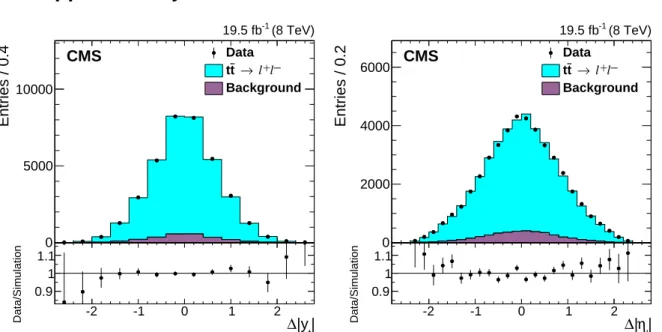
A comparison of the observed and predicted distributions of∆|yt|and∆|η`|can be found in Appendix A.
5
Unfolding the distributions
The measured distributions are distorted, relative to the true underlying distributions, by the acceptance of the detector, the efficiency of the trigger and event selection, and the finite resolu-tion of the reconstructed kinematic quantities. After subtracresolu-tion of the predicted background, we correct the measured distributions for these effects using an unfolding procedure that es-timates the corresponding parton-level distributions. In the context of theoretical calculations and parton shower event generators, the parton-level top quark is defined before it decays and its kinematic properties include the effects of recoil from initial- and final-state radiation in the rest of the event and from final-state radiation from the top quark itself. The parton-level charged lepton, produced from the decay of the intermediate W boson, is defined before the lepton decays or radiates any photons.
We use six bins of varying width in the∆|yt|parton-level distribution that are well matched to the reconstruction resolution and contain approximately equal numbers of events. The ∆|η`| distribution depends only on lepton measurements, and the better resolution allows us to use 12 bins. For the reconstruction-level distributions, we use twice as many bins as those used for the parton-level distributions. The unfolding is performed using the TUNFOLDpackage [63], using regularization based on the curvature of the simulated signal distribution to suppress statistical fluctuations in the high frequency components of the unfolded distribution. The regularization strength is optimized by minimizing the average global correlation coefficient in the unfolded distribution; the resulting regularization is relatively weak, contributing at the level of 5% to the total χ2 minimized by the algorithm. An analogous unfolding procedure is used to measure AC and AlepC differentially, after introducing a further three bins in each of the tt system kinematic variables Mtt,|ytt|, and pttT.
6
Systematic uncertainties
Most of the systematic uncertainties concern detector performance and the modeling of the signal and background processes and are estimated from the change in the measurement when varying the simulated event samples used for the unfolding. The uncertainty from the jet en-ergy scale corrections is estimated by varying the jet energies within their uncertainties [64] and propagating this to the~pTmiss. Similarly, the jet energy resolution is varied by 2–5%, depending on the η of the jet [64], and the electron energy scale is varied by ±0.6% (±1.5%) for barrel (endcap) electrons, as estimated from comparisons between measured and simulated Z boson events [28]. The uncertainty in muon energies is negligible. The uncertainty in the background subtraction is obtained by varying the normalization of each background component by the uncertainties described in Section 4.
Many of the signal modeling and simulation uncertainties are evaluated by using weights to vary the MC@NLO tt sample: the simulated pileup multiplicity distribution is changed within its uncertainty; the correction factors between data and simulation for the b tagging efficiency [32], trigger efficiency, and lepton selection efficiency are shifted up and down by their uncertainties; and the PDFs are varied using the PDF4LHC procedure [65, 66]. Previous CMS studies [67, 68] have shown that the pTdistribution of the top quark in data is softer than in the NLO simulation of tt production. Since the origin of the discrepancy is not fully
un-5
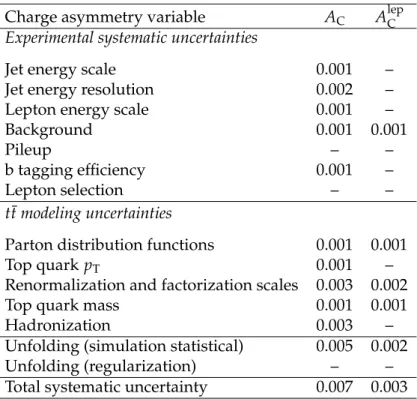
derstood, the change in the measurement when reweighting theMC@NLOtt sample to match the top quark pT spectrum in data is taken as a systematic uncertainty associated with signal modeling. Further signal modeling uncertainties are evaluated using the dedicated tt samples: µR and µF are simultaneously varied up and down by a factor of 2, mt is varied by ±1 GeV, and the tt sample generated with POWHEGandPYTHIAis used to measure the uncertainty in hadronization modeling from the difference between the HERWIG and PYTHIA descriptions. The systematic uncertainty estimates evaluated using dedicated tt samples have a significant statistical uncertainty governed by the number of events in the simulated samples. To avoid underestimation of these uncertainties, the maximum of the estimated systematic uncertainty and the statistical uncertainty in that estimate is taken as the final systematic uncertainty. Table 1: Systematic uncertainties in the inclusive values of the charge asymmetries obtained from the unfolded distributions. Uncertainties of less than 0.0005 are marked by a dash (–).
Charge asymmetry variable AC AlepC Experimental systematic uncertainties
Jet energy scale 0.001 –
Jet energy resolution 0.002 –
Lepton energy scale 0.001 –
Background 0.001 0.001
Pileup – –
b tagging efficiency 0.001 –
Lepton selection – –
t¯t modeling uncertainties
Parton distribution functions 0.001 0.001
Top quark pT 0.001 –
Renormalization and factorization scales 0.003 0.002
Top quark mass 0.001 0.001
Hadronization 0.003 –
Unfolding (simulation statistical) 0.005 0.002 Unfolding (regularization) – – Total systematic uncertainty 0.007 0.003
The uncertainty in the unfolding procedure is dominated by the statistical uncertainty arising from the limited number of events in the MC@NLO tt sample. The uncertainty from the reg-ularization is found to be small in comparison. The systematic uncertainties in the inclusive charge asymmetry values obtained from the unfolded distributions are summarized in Table 1. The individual terms are added in quadrature to estimate the total systematic uncertainties. For both AC and AlepC , the dominant systematic uncertainty arises from the limited number of simulated events used for the unfolding.
7
Results
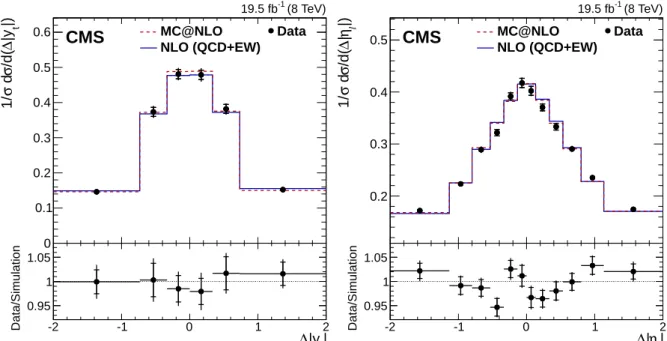
The unfolded normalized differential cross section from the selected events in data is shown as a function of∆|yt|and∆|η`|in Fig. 1, along with the parton-level predictions for tt produc-tion obtained from calculaproduc-tions at NLO in the SM gauge couplings (QCD+EW) [12] and with theMC@NLOgenerator (which does not include EW corrections). The corresponding AC and AlepC values are presented in Table 2. Correlations between the contents of different bins, in-troduced by the unfolding process and from the systematic uncertainties, are accounted for in
6 7 Results |) t |y ∆ /d( σ d σ 1/ 0 0.1 0.2 0.3 0.4 0.5 0.6 MC@NLO Data NLO (QCD+EW) | t |y ∆ -2 -1 0 1 2 Data/Simulation 0.95 1 1.05 (8 TeV) -1 19.5 fb CMS |)η|∆ l /d( σ d σ 1/ 0.2 0.3 0.4 0.5 MC@NLO Data NLO (QCD+EW) | l η | ∆ -2 -1 0 1 2 Data/Simulation 0.95 1 1.05 (8 TeV) -1 19.5 fb CMS
Figure 1: Background-subtracted and unfolded distributions of ∆|yt| (left) and ∆|η`| (right) from data (points), normalized to unit area. Parton-level predictions from theMC@NLO sim-ulation and calcsim-ulations at NLO (QCD+EW) [12] are shown by dashed and solid histograms, respectively. The ratio of the measured bin values to theMC@NLOprediction is shown in the bottom panel. The vertical bars show the total uncertainty, the statistical component of which is marked by a horizontal tick. The first and last bins of each plot include underflow and overflow events, respectively.
Table 2: The inclusive charge asymmetry measurements obtained from the unfolded distribu-tions and the parton-level predicdistribu-tions from the MC@NLOsimulation and calculations at NLO (QCD+EW) [12]. For the data, the first uncertainty is statistical and the second is systematic. The uncertainties in theMC@NLOresults are statistical and the uncertainties in the NLO calcu-lations come from varying together µRand µFup and down by a factor of two.
Variable Data MC@NLO NLO (QCD+EW) AC 0.011±0.011±0.007 0.006±0.001 0.0111±0.0004 AlepC 0.003±0.006±0.003 0.004±0.001 0.0064±0.0003
7
the calculation of the uncertainties. The measured values are consistent with the expectations from the SM. The charge asymmetries as a function of Mtt,|ytt|, and pttT are also measured. The results, which are shown in Fig. 2, are consistent with theMC@NLOsimulation predictions, as well as with the NLO (QCD+EW) calculations for the Mttand|ytt|dependencies. No compar-ison is made with NLO calculations for the pttT dependencies as it is expected that the effect of the parton shower process on the pttTdistribution makes fixed-order calculations an inadequate approximation of the data.
8
Summary
Measurements are presented of the charge asymmetry in tt dilepton final states from distri-butions, unfolded to the parton level, of the absolute rapidity (pseudorapidity) difference of top quarks (leptons) with positive and negative charge. The data sample corresponds to an integrated luminosity of 19.5 fb−1from pp collisions at √s = 8 TeV, collected by the CMS ex-periment at the LHC. The tt and leptonic inclusive charge asymmetries are found to be, respec-tively, 0.011±0.011 (stat)±0.007 (syst) and 0.003±0.006 (stat)±0.003 (syst) when measured inclusively. The charge asymmetries are also measured as a function of the invariant mass, ab-solute rapidity, and transverse momentum of the tt system in the laboratory frame. Although statistically limited, all measurements are in agreement with the standard model predictions. Future measurements at√s =13 TeV with larger data sets are expected to have better statisti-cal precision outweighing the dilution of the charge asymmetry from the decreased fraction of events with the quark-antiquark initial state.
Acknowledgments
We would like to thank W. Bernreuther and Z.-G. Si for calculating the theoretical distribu-tions shown in this paper. We congratulate our colleagues in the CERN accelerator depart-ments for the excellent performance of the LHC and thank the technical and administrative staffs at CERN and at other CMS institutes for their contributions to the success of the CMS effort. In addition, we gratefully acknowledge the computing centres and personnel of the Worldwide LHC Computing Grid for delivering so effectively the computing infrastructure essential to our analyses. Finally, we acknowledge the enduring support for the construction and operation of the LHC and the CMS detector provided by the following funding agencies: BMWFW and FWF (Austria); FNRS and FWO (Belgium); CNPq, CAPES, FAPERJ, and FAPESP (Brazil); MES (Bulgaria); CERN; CAS, MoST, and NSFC (China); COLCIENCIAS (Colombia); MSES and CSF (Croatia); RPF (Cyprus); MoER, ERC IUT and ERDF (Estonia); Academy of Finland, MEC, and HIP (Finland); CEA and CNRS/IN2P3 (France); BMBF, DFG, and HGF (Germany); GSRT (Greece); OTKA and NIH (Hungary); DAE and DST (India); IPM (Iran); SFI (Ireland); INFN (Italy); MSIP and NRF (Republic of Korea); LAS (Lithuania); MOE and UM (Malaysia); CINVESTAV, CONACYT, SEP, and UASLP-FAI (Mexico); MBIE (New Zealand); PAEC (Pakistan); MSHE and NSC (Poland); FCT (Portugal); JINR (Dubna); MON, RosAtom, RAS and RFBR (Russia); MESTD (Serbia); SEIDI and CPAN (Spain); Swiss Funding Agencies (Switzerland); MST (Taipei); ThEPCenter, IPST, STAR and NSTDA (Thailand); TUBITAK and TAEK (Turkey); NASU and SFFR (Ukraine); STFC (United Kingdom); DOE and NSF (USA). Individuals have received support from the Marie-Curie programme and the European Re-search Council and EPLANET (European Union); the Leventis Foundation; the A. P. Sloan Foundation; the Alexander von Humboldt Foundation; the Belgian Federal Science Policy Of-fice; the Fonds pour la Formation `a la Recherche dans l’Industrie et dans l’Agriculture
(FRIA-8 8 Summary (GeV) t t M 400 600 800 1000 1200 C A Data MC@NLO NLO (QCD+EW) (8 TeV) -1 19.5 fb CMS -0.04 -0.02 0 0.02 0.04 0.06 0.08 (GeV) t t M 400 600 800 1000 1200 lep C A Data MC@NLO NLO (QCD+EW) (8 TeV) -1 19.5 fb CMS -0.04 -0.02 0 0.02 0.04 0.06 | t t |y 0 0.5 1 1.5 C A Data MC@NLO NLO (QCD+EW) (8 TeV) -1 19.5 fb CMS 0 0.05 | t t |y 0 0.5 1 1.5 lep C A Data MC@NLO NLO (QCD+EW) (8 TeV) -1 19.5 fb CMS -0.04 -0.02 0 0.02 0.04 0.06 (GeV) t t T p 0 100 200 300 C A Data MC@NLO (8 TeV) -1 19.5 fb CMS -0.05 0 0.05 0.1 0.15 0.2 (GeV) t t T p 0 100 200 300 lep C A Data MC@NLO (8 TeV) -1 19.5 fb CMS -0.04 -0.02 0 0.02 0.04 0.06
Figure 2: Dependence of the tt and leptonic charge asymmetries AC (left) and AlepC (right) obtained from the unfolded distributions in data (points) on Mtt (upper), |ytt| (middle), and ptt
T (lower). Parton-level predictions from the MC@NLO simulation and calculations at NLO (QCD+EW) [12] are shown by dashed and solid histograms, respectively. The vertical bars show the total uncertainty, the statistical component of which is marked by a horizontal tick. The last bin of each plot includes overflow events.
9
Belgium); the Agentschap voor Innovatie door Wetenschap en Technologie (IWT-Belgium); the Ministry of Education, Youth and Sports (MEYS) of the Czech Republic; the Council of Sci-ence and Industrial Research, India; the HOMING PLUS programme of the Foundation for Polish Science, cofinanced from European Union, Regional Development Fund; the OPUS pro-gramme of the National Science Center (Poland); the Compagnia di San Paolo (Torino); MIUR project 20108T4XTM (Italy); the Thalis and Aristeia programmes cofinanced by EU-ESF and the Greek NSRF; the National Priorities Research Program by Qatar National Research Fund; the Rachadapisek Sompot Fund for Postdoctoral Fellowship, Chulalongkorn University land); the Chulalongkorn Academic into Its 2nd Century Project Advancement Project (Thai-land); and the Welch Foundation, contract C-1845.
10 References
References
[1] CMS Collaboration, “Measurement of the top quark mass using proton-proton data at√s = 7 and 8 TeV”, Phys. Rev. D 93 (2016) 072004, doi:10.1103/PhysRevD.93.072004, arXiv:1509.04044.
[2] J. H. K ¨uhn and G. Rodrigo, “Charge Asymmetry in Hadroproduction of Heavy Quarks”, Phys. Rev. Lett. 81 (1998) 49, doi:10.1103/PhysRevLett.81.49,
arXiv:hep-ph/9802268.
[3] J. H. K ¨uhn and G. Rodrigo, “Charge asymmetry of heavy quarks at hadron colliders”, Phys. Rev. D 59 (1999) 054017, doi:10.1103/PhysRevD.59.054017,
arXiv:hep-ph/9807420.
[4] CDF Collaboration, “Evidence for a mass dependent forward-backward asymmetry in top quark pair production”, Phys. Rev. D 83 (2011) 112003,
doi:10.1103/PhysRevD.83.112003, arXiv:1101.0034.
[5] D0 Collaboration, “Forward-backward asymmetry in top quark-antiquark production”, Phys. Rev. D 84 (2011) 112005, doi:10.1103/PhysRevD.84.112005.
[6] J. A. Aguilar-Saavedra, D. Amidei, A. Juste, and M. P´erez-Victoria, “Asymmetries in top quark pair production at hadron colliders”, Rev. Mod. Phys. 87 (2015) 421,
doi:10.1103/RevModPhys.87.421, arXiv:1406.1798.
[7] CDF Collaboration, “Measurement of the top quark forward-backward production asymmetry and its dependence on event kinematic properties”, Phys. Rev. D 87 (2013) 092002, doi:10.1103/PhysRevD.87.092002, arXiv:1211.1003.
[8] D0 Collaboration, “Measurement of the forward-backward asymmetry in top
quark-antiquark production in p ¯p collisions using the lepton+jets channel”, Phys. Rev. D
90(2014) 072011, doi:10.1103/PhysRevD.90.072011, arXiv:1405.0421. [9] W. Bernreuther and Z.-G. Si, “Distributions and correlations for top quark pair
production and decay at the Tevatron and LHC”, Nucl. Phys. B 837 (2010) 90, doi:10.1016/j.nuclphysb.2010.05.001, arXiv:1003.3926.
[10] W. Hollik and D. Pagani, “Electroweak contribution to the top quark forward-backward asymmetry at the Tevatron”, Phys. Rev. D 84 (2011) 093003,
doi:10.1103/PhysRevD.84.093003, arXiv:1107.2606.
[11] J. H. K ¨uhn and G. Rodrigo, “Charge asymmetries of top quarks at hadron colliders revisited”, JHEP 01 (2012) 063, doi:10.1007/JHEP01(2012)063,
arXiv:1109.6830.
[12] W. Bernreuther and Z.-G. Si, “Top quark and leptonic charge asymmetries for the Tevatron and LHC”, Phys. Rev. D 86 (2012) 034026,
doi:10.1103/PhysRevD.86.034026, arXiv:1205.6580.
[13] M. Czakon, P. Fiedler, and A. Mitov, “Resolving the Tevatron Top Quark Forward-Backward Asymmetry Puzzle: Fully Differential
Next-to-Next-to-Leading-Order Calculation”, Phys. Rev. Lett. 115 (2015) 052001, doi:10.1103/PhysRevLett.115.052001, arXiv:1411.3007.
References 11
[14] M. Czakon, P. Fiedler, D. Heymes, and A. Mitov, “NNLO QCD predictions for fully-differential top-quark pair production at the Tevatron”, JHEP 05 (2016) 034, doi:10.1007/JHEP05(2016)034, arXiv:1601.05375.
[15] CMS Collaboration, “The CMS experiment at the CERN LHC”, JINST 3 (2008) S08004, doi:10.1088/1748-0221/3/08/S08004.
[16] D. Krohn, T. Liu, J. Shelton, and L.-T. Wang, “A polarized view of the top asymmetry”, Phys. Rev. D 84 (2011) 074034, doi:10.1103/PhysRevD.84.074034,
arXiv:1105.3743.
[17] CMS Collaboration, “Inclusive and differential measurements of the tt charge asymmetry in proton-proton collisions at 7 TeV”, Phys. Lett. B 717 (2012) 129,
doi:10.1016/j.physletb.2012.09.028, arXiv:1207.0065.
[18] ATLAS Collaboration, “Measurement of the top quark pair production charge
asymmetry in proton-proton collisions at√s=7 TeV using the ATLAS detector”, JHEP
02(2014) 107, doi:10.1007/JHEP02(2014)107, arXiv:1311.6724.
[19] CMS Collaboration, “Inclusive and differential measurements of the tt charge asymmetry in pp collisions at√s=8 TeV”, Phys. Lett. B 757 (2016) 154,
doi:10.1016/j.physletb.2016.03.060, arXiv:1507.03119.
[20] CMS Collaboration, “Measurement of the charge asymmetry in top quark pair production in pp collisions at√s =8 TeV using a template method”, Phys. Rev. D 93 (2016) 034014, doi:10.1103/PhysRevD.93.034014, arXiv:1508.03862. [21] ATLAS Collaboration, “Measurement of the charge asymmetry in top-quark pair
production in the lepton-plus-jets final state in pp collision data at√s=8 TeV with the ATLAS detector”, Eur. Phys. J. C 76 (2016) 87,
doi:10.1140/epjc/s10052-016-3910-6, arXiv:1509.02358.
[22] ATLAS Collaboration, “Measurement of the charge asymmetry in highly boosted top-quark pair production in√s=8 TeV pp collision data collected by the ATLAS experiment”, Phys. Lett. B 756 (2016) 52, doi:10.1016/j.physletb.2016.02.055, arXiv:1512.06092.
[23] CMS Collaboration, “Measurements of the tt charge asymmetry using the dilepton decay channel in pp collisions at√s =7 TeV”, JHEP 04 (2014) 191,
doi:10.1007/JHEP04(2014)191, arXiv:1402.3803.
[24] ATLAS Collaboration, “Measurement of the charge asymmetry in dileptonic decays of top quark pairs in pp collisions at√s=7 TeV using the ATLAS detector”, JHEP 05 (2015) 061, doi:10.1007/JHEP05(2015)061, arXiv:1501.07383.
[25] CMS Collaboration, “Measurements of tt spin correlations and top quark polarization using dilepton final states in pp collisions at√s=8 TeV”, Phys. Rev. D 93 (2016) 052007, doi:10.1103/PhysRevD.93.052007, arXiv:1601.01107.
[26] CMS Collaboration, “Particle-flow event reconstruction in CMS and performance for jets, taus, and Emiss
T ”, CMS Physics Analysis Summary CMS-PAS-PFT-09-001, 2009. [27] CMS Collaboration, “Commissioning of the particle-flow event with the first LHC
collisions recorded in the CMS detector”, CMS Physics Analysis Summary CMS-PAS-PFT-10-001, 2010.
12 References
[28] CMS Collaboration, “Performance of electron reconstruction and selection with the CMS detector in proton-proton collisions at√s=8 TeV”, JINST 10 (2015) P06005,
doi:10.1088/1748-0221/10/06/P06005, arXiv:1502.02701.
[29] CMS Collaboration, “Performance of CMS muon reconstruction in pp collision events at√ s =7 TeV”, JINST 7 (2012) P10002, doi:10.1088/1748-0221/7/10/P10002, arXiv:1206.4071.
[30] M. Cacciari, G. P. Salam, and G. Soyez, “The anti-ktjet clustering algorithm”, JHEP 04 (2008) 063, doi:10.1088/1126-6708/2008/04/063, arXiv:0802.1189.
[31] M. Cacciari and G. P. Salam, “Pileup subtraction using jet areas”, Phys. Lett. B 659 (2008) 119, doi:10.1016/j.physletb.2007.09.077, arXiv:0707.1378.
[32] CMS Collaboration, “Identification of b-quark jets with the CMS experiment”, JINST 8 (2013) P04013, doi:10.1088/1748-0221/8/04/P04013, arXiv:1211.4462. [33] CMS Collaboration, “Measurement of the tt production cross section and the top quark
mass in the dilepton channel in pp collisions at√s =7 TeV”, JHEP 07 (2011) 049, doi:10.1007/JHEP07(2011)049, arXiv:1105.5661.
[34] R. H. Dalitz and G. R. Goldstein, “Analysis of top-antitop production and dilepton decay events and the top quark mass”, Phys. Lett. B 287 (1992) 225,
doi:10.1016/0370-2693(92)91904-N.
[35] B. A. Betchart, R. Demina, and A. Harel, “Analytic solutions for neutrino momenta in decay of top quarks”, Nucl. Instrum. Meth. A 736 (2014) 169,
doi:10.1016/j.nima.2013.10.039, arXiv:1305.1878.
[36] S. Frixione and B. R. Webber, “Matching NLO QCD computations and parton shower simulations”, JHEP 06 (2002) 029, doi:10.1088/1126-6708/2002/06/029, arXiv:hep-ph/0204244.
[37] S. Frixione, P. Nason, and B. R. Webber, “Matching NLO QCD and parton showers in heavy flavor production”, JHEP 08 (2003) 007,
doi:10.1088/1126-6708/2003/08/007, arXiv:hep-ph/0305252.
[38] J. Pumplin et al., “New generation of parton distributions with uncertainties from global QCD analysis”, JHEP 07 (2002) 012, doi:10.1088/1126-6708/2002/07/012, arXiv:hep-ph/0201195.
[39] G. Corcella et al., “HERWIG 6: an event generator for hadron emission reactions with interfering gluons (including supersymmetric processes)”, JHEP 01 (2001) 010, doi:10.1088/1126-6708/2001/01/010, arXiv:hep-ph/0011363. [40] J. Alwall et al., “MADGRAPH5: going beyond”, JHEP 06 (2011) 128,
doi:10.1007/JHEP06(2011)128, arXiv:1106.0522.
[41] J. Alwall et al., “The automated computation of tree-level and next-to-leading order differential cross sections, and their matching to parton shower simulations”, JHEP 07 (2014) 079, doi:10.1007/JHEP07(2014)079, arXiv:1405.0301.
[42] P. Nason, “A new method for combining NLO QCD with shower Monte Carlo algorithms”, JHEP 11 (2004) 040, doi:10.1088/1126-6708/2004/11/040, arXiv:hep-ph/0409146.
References 13
[43] S. Frixione, P. Nason, and C. Oleari, “Matching NLO QCD computations with parton shower simulations: thePOWHEGmethod”, JHEP 11 (2007) 070,
doi:10.1088/1126-6708/2007/11/070, arXiv:0709.2092.
[44] S. Alioli, P. Nason, C. Oleari, and E. Re, “NLO single-top production matched with shower in POWHEG: s- and t-channel contributions”, JHEP 09 (2009) 111,
doi:10.1088/1126-6708/2009/09/111, arXiv:0907.4076. [Erratum: doi:10.1007/JHEP02(2010)011].
[45] S. Alioli, P. Nason, C. Oleari, and E. Re, “A general framework for implementing NLO calculations in shower Monte Carlo programs: thePOWHEGBOX”, JHEP 06 (2010) 043, doi:10.1007/JHEP06(2010)043, arXiv:1002.2581.
[46] E. Re, “Single-top Wt-channel production matched with parton showers using the POWHEG method”, Eur. Phys. J. C 71 (2011) 1547,
doi:10.1140/epjc/s10052-011-1547-z, arXiv:1009.2450.
[47] T. Sj ¨ostrand, S. Mrenna, and P. Skands, “PYTHIA 6.4 physics and manual”, JHEP 05 (2006) 026, doi:10.1088/1126-6708/2006/05/026, arXiv:0706.2334.
[48] J. M. Campbell and R. K. Ellis, “MCFM for the Tevatron and the LHC”, Nucl. Phys. Proc. Suppl. 205-206 (2010) 10, doi:10.1016/j.nuclphysbps.2010.08.011,
arXiv:1007.3492.
[49] J. M. Campbell, R. K. Ellis, and C. Williams, “Vector boson pair production at the LHC”, JHEP 07 (2011) 018, doi:10.1007/JHEP07(2011)018, arXiv:1105.0020.
[50] R. Frederix et al., “Four-lepton production at hadron colliders: aMC@NLO predictions with theoretical uncertainties”, JHEP 02 (2012) 099,
doi:10.1007/JHEP02(2012)099, arXiv:1110.4738.
[51] J. M. Campbell and R. K. Ellis, “ttW±production and decay at NLO”, JHEP 07 (2012) 052, doi:10.1007/JHEP07(2012)052, arXiv:1204.5678.
[52] M. V. Garzelli, A. Kardos, C. G. Papadopoulos, and Z. Tr ´ocs´anyi, “ttW±and ttZ hadroproduction at NLO accuracy in QCD with Parton Shower and Hadronization Effects”, JHEP 11 (2012) 056, doi:10.1007/JHEP11(2012)056, arXiv:1208.2665. [53] R. Gavin, Y. Li, F. Petriello, and S. Quackenbush, “W Physics at the LHC with FEWZ 2.1”,
Comput. Phys. Commun. 184 (2013) 208, doi:10.1016/j.cpc.2012.09.005, arXiv:1201.5896.
[54] N. Kidonakis, “Next-to-next-to-leading-order collinear and soft gluon corrections for t-channel single top quark production”, Phys. Rev. D 83 (2011) 091503,
doi:10.1103/PhysRevD.83.091503, arXiv:1103.2792.
[55] N. Kidonakis, “NNLL resummation for s-channel single top quark production”, Phys. Rev. D 81 (2010) 054028, doi:10.1103/PhysRevD.81.054028, arXiv:1001.5034. [56] N. Kidonakis, “Two-loop soft anomalous dimensions for single top quark associated
production with a W−or H−”, Phys. Rev. D 82 (2010) 054018, doi:10.1103/PhysRevD.82.054018, arXiv:1005.4451.
[57] GEANT4 Collaboration, “GEANT4 — a simulation toolkit”, Nucl. Instrum. Meth. A 506 (2003) 250, doi:10.1016/S0168-9002(03)01368-8.
14 References
[58] CMS Collaboration, “Search for top-squark pair production in the single-lepton final state in pp collisions at√s = 8 TeV”, Eur. Phys. J. C 73 (2013) 2677,
doi:10.1140/epjc/s10052-013-2677-2, arXiv:1308.1586.
[59] CMS Collaboration, “Observation of the associated production of a single top quark and a W boson in pp collisions at√s=8 TeV”, Phys. Rev. Lett. 112 (2014) 231802,
doi:10.1103/PhysRevLett.112.231802, arXiv:1401.2942.
[60] CMS Collaboration, “Measurement of the sum of WW and WZ production with W+dijet events in pp collisions at√s =7 TeV”, Eur. Phys. J. C 73 (2013) 2283,
doi:10.1140/epjc/s10052-013-2283-3, arXiv:1210.7544.
[61] CMS Collaboration, “Measurement of WZ and ZZ production in pp collisions at√ s =8 TeV in final states with b-tagged jets”, Eur. Phys. J. C 74 (2014) 2973, doi:10.1140/epjc/s10052-014-2973-5, arXiv:1403.3047.
[62] CMS Collaboration, “Observation of top quark pairs produced in association with a vector boson in pp collisions at√s =8 TeV”, JHEP 01 (2016) 096,
doi:10.1007/JHEP01(2016)096, arXiv:1510.01131.
[63] S. Schmitt, “TUnfold, an algorithm for correcting migration effects in high energy physics”, JINST 7 (2012) T10003, doi:10.1088/1748-0221/7/10/T10003, arXiv:1205.6201.
[64] CMS Collaboration, “Determination of jet energy calibration and transverse momentum resolution in CMS”, JINST 6 (2011) P11002,
doi:10.1088/1748-0221/6/11/P11002, arXiv:1107.4277. [65] S. Alekhin et al., “The PDF4LHC Working Group Interim Report”, (2011).
arXiv:1101.0536.
[66] M. Botje et al., “The PDF4LHC working group interim recommendations”, (2011). arXiv:1101.0538.
[67] CMS Collaboration, “Measurement of differential top-quark pair production cross sections in pp collisions at√s =7 TeV”, Eur. Phys. J. C 73 (2013) 2339,
doi:10.1140/epjc/s10052-013-2339-4, arXiv:1211.2220.
[68] CMS Collaboration, “Measurement of the differential cross section for top quark pair production in pp collisions at√s =8 TeV”, Eur. Phys. J. C 75 (2015) 542,
15
A
Supplementary material
Entries / 0.4 0 5000 10000 Data − l + l → t t Background | t |y ∆ -2 -1 0 1 2 Data/Simulation 0.9 1 1.1 (8 TeV) -1 19.5 fb CMS Entries / 0.2 0 2000 4000 6000 Data − l + l → t t Background | l η | ∆ -2 -1 0 1 2 Data/Simulation 0.9 1 1.1 (8 TeV) -1 19.5 fb CMSFigure A.1: Reconstructed∆|yt|and∆|η`|distributions from data (points) and simulation (his-togram), with the predicted signal (tt→ `+`−) and background distributions shown separately. The simulated signal yield is normalized to that of the background-subtracted data. The ver-tical bars on the data points represent the statisver-tical uncertainties. The lower panels show the ratio of the numbers of events from data and simulation.
17
B
The CMS Collaboration
Yerevan Physics Institute, Yerevan, Armenia
V. Khachatryan, A.M. Sirunyan, A. Tumasyan
Institut f ¨ur Hochenergiephysik der OeAW, Wien, Austria
W. Adam, E. Asilar, T. Bergauer, J. Brandstetter, E. Brondolin, M. Dragicevic, J. Er ¨o, M. Flechl, M. Friedl, R. Fr ¨uhwirth1, V.M. Ghete, C. Hartl, N. H ¨ormann, J. Hrubec, M. Jeitler1, A. K ¨onig, M. Krammer1, I. Kr¨atschmer, D. Liko, T. Matsushita, I. Mikulec, D. Rabady, N. Rad, B. Rahbaran, H. Rohringer, J. Schieck1, R. Sch ¨ofbeck, J. Strauss, W. Treberer-Treberspurg, W. Waltenberger, C.-E. Wulz1
National Centre for Particle and High Energy Physics, Minsk, Belarus
V. Mossolov, N. Shumeiko, J. Suarez Gonzalez
Universiteit Antwerpen, Antwerpen, Belgium
S. Alderweireldt, T. Cornelis, E.A. De Wolf, X. Janssen, A. Knutsson, J. Lauwers, S. Luyckx, M. Van De Klundert, H. Van Haevermaet, P. Van Mechelen, N. Van Remortel, A. Van Spilbeeck
Vrije Universiteit Brussel, Brussel, Belgium
S. Abu Zeid, F. Blekman, J. D’Hondt, N. Daci, I. De Bruyn, K. Deroover, N. Heracleous, J. Keaveney, S. Lowette, S. Moortgat, L. Moreels, A. Olbrechts, Q. Python, D. Strom, S. Tavernier, W. Van Doninck, P. Van Mulders, I. Van Parijs
Universit´e Libre de Bruxelles, Bruxelles, Belgium
H. Brun, C. Caillol, B. Clerbaux, G. De Lentdecker, G. Fasanella, L. Favart, R. Goldouzian, A. Grebenyuk, G. Karapostoli, T. Lenzi, A. L´eonard, T. Maerschalk, A. Marinov, A. Randle-conde, T. Seva, C. Vander Velde, P. Vanlaer, R. Yonamine, F. Zenoni, F. Zhang2
Ghent University, Ghent, Belgium
L. Benucci, A. Cimmino, S. Crucy, D. Dobur, A. Fagot, G. Garcia, M. Gul, J. Mccartin, A.A. Ocampo Rios, D. Poyraz, D. Ryckbosch, S. Salva, M. Sigamani, M. Tytgat, W. Van Driessche, E. Yazgan, N. Zaganidis
Universit´e Catholique de Louvain, Louvain-la-Neuve, Belgium
S. Basegmez, C. Beluffi3, O. Bondu, S. Brochet, G. Bruno, A. Caudron, L. Ceard, S. De Visscher, C. Delaere, M. Delcourt, D. Favart, L. Forthomme, A. Giammanco, A. Jafari, P. Jez, M. Komm, V. Lemaitre, A. Mertens, M. Musich, C. Nuttens, L. Perrini, K. Piotrzkowski, L. Quertenmont, M. Selvaggi, M. Vidal Marono
Universit´e de Mons, Mons, Belgium
N. Beliy, G.H. Hammad
Centro Brasileiro de Pesquisas Fisicas, Rio de Janeiro, Brazil
W.L. Ald´a J ´unior, F.L. Alves, G.A. Alves, L. Brito, M. Correa Martins Junior, M. Hamer, C. Hensel, A. Moraes, M.E. Pol, P. Rebello Teles
Universidade do Estado do Rio de Janeiro, Rio de Janeiro, Brazil
E. Belchior Batista Das Chagas, W. Carvalho, J. Chinellato4, A. Cust ´odio, E.M. Da Costa, D. De Jesus Damiao, C. De Oliveira Martins, S. Fonseca De Souza, L.M. Huertas Guativa, H. Malbouisson, D. Matos Figueiredo, C. Mora Herrera, L. Mundim, H. Nogima, W.L. Prado Da Silva, A. Santoro, A. Sznajder, E.J. Tonelli Manganote4, A. Vilela Pereira
Universidade Estadual Paulistaa, Universidade Federal do ABCb, S˜ao Paulo, Brazil
18 B The CMS Collaboration
E.M. Gregoresb, P.G. Mercadanteb, C.S. Moona,5, S.F. Novaesa, Sandra S. Padulaa, D. Romero Abadb, J.C. Ruiz Vargas
Institute for Nuclear Research and Nuclear Energy, Sofia, Bulgaria
A. Aleksandrov, R. Hadjiiska, P. Iaydjiev, M. Rodozov, S. Stoykova, G. Sultanov, M. Vutova
University of Sofia, Sofia, Bulgaria
A. Dimitrov, I. Glushkov, L. Litov, B. Pavlov, P. Petkov
Beihang University, Beijing, China
W. Fang6
Institute of High Energy Physics, Beijing, China
M. Ahmad, J.G. Bian, G.M. Chen, H.S. Chen, M. Chen, T. Cheng, R. Du, C.H. Jiang, D. Leggat, R. Plestina7, F. Romeo, S.M. Shaheen, A. Spiezia, J. Tao, C. Wang, Z. Wang, H. Zhang
State Key Laboratory of Nuclear Physics and Technology, Peking University, Beijing, China
C. Asawatangtrakuldee, Y. Ban, Q. Li, S. Liu, Y. Mao, S.J. Qian, D. Wang, Z. Xu
Universidad de Los Andes, Bogota, Colombia
C. Avila, A. Cabrera, L.F. Chaparro Sierra, C. Florez, J.P. Gomez, B. Gomez Moreno, J.C. Sanabria
University of Split, Faculty of Electrical Engineering, Mechanical Engineering and Naval Architecture, Split, Croatia
N. Godinovic, D. Lelas, I. Puljak, P.M. Ribeiro Cipriano
University of Split, Faculty of Science, Split, Croatia
Z. Antunovic, M. Kovac
Institute Rudjer Boskovic, Zagreb, Croatia
V. Brigljevic, K. Kadija, J. Luetic, S. Micanovic, L. Sudic
University of Cyprus, Nicosia, Cyprus
A. Attikis, G. Mavromanolakis, J. Mousa, C. Nicolaou, F. Ptochos, P.A. Razis, H. Rykaczewski
Charles University, Prague, Czech Republic
M. Finger8, M. Finger Jr.8
Universidad San Francisco de Quito, Quito, Ecuador
E. Carrera Jarrin
Academy of Scientific Research and Technology of the Arab Republic of Egypt, Egyptian Network of High Energy Physics, Cairo, Egypt
Y. Assran9,10, A. Ellithi Kamel11,11, A. Mahrous12, A. Radi10,13
National Institute of Chemical Physics and Biophysics, Tallinn, Estonia
B. Calpas, M. Kadastik, M. Murumaa, M. Raidal, A. Tiko, C. Veelken
Department of Physics, University of Helsinki, Helsinki, Finland
P. Eerola, J. Pekkanen, M. Voutilainen
Helsinki Institute of Physics, Helsinki, Finland
J. H¨ark ¨onen, V. Karim¨aki, R. Kinnunen, T. Lamp´en, K. Lassila-Perini, S. Lehti, T. Lind´en, P. Luukka, T. Peltola, J. Tuominiemi, E. Tuovinen, L. Wendland
Lappeenranta University of Technology, Lappeenranta, Finland
19
DSM/IRFU, CEA/Saclay, Gif-sur-Yvette, France
M. Besancon, F. Couderc, M. Dejardin, D. Denegri, B. Fabbro, J.L. Faure, C. Favaro, F. Ferri, S. Ganjour, A. Givernaud, P. Gras, G. Hamel de Monchenault, P. Jarry, E. Locci, M. Machet, J. Malcles, J. Rander, A. Rosowsky, M. Titov, A. Zghiche
Laboratoire Leprince-Ringuet, Ecole Polytechnique, IN2P3-CNRS, Palaiseau, France
A. Abdulsalam, I. Antropov, S. Baffioni, F. Beaudette, P. Busson, L. Cadamuro, E. Chapon, C. Charlot, O. Davignon, N. Filipovic, R. Granier de Cassagnac, M. Jo, S. Lisniak, P. Min´e, I.N. Naranjo, M. Nguyen, C. Ochando, G. Ortona, P. Paganini, P. Pigard, S. Regnard, R. Salerno, Y. Sirois, T. Strebler, Y. Yilmaz, A. Zabi
Institut Pluridisciplinaire Hubert Curien, Universit´e de Strasbourg, Universit´e de Haute Alsace Mulhouse, CNRS/IN2P3, Strasbourg, France
J.-L. Agram14, J. Andrea, A. Aubin, D. Bloch, J.-M. Brom, M. Buttignol, E.C. Chabert, N. Chanon, C. Collard, E. Conte14, X. Coubez, J.-C. Fontaine14, D. Gel´e, U. Goerlach, C. Goetzmann, A.-C. Le Bihan, J.A. Merlin15, K. Skovpen, P. Van Hove
Centre de Calcul de l’Institut National de Physique Nucleaire et de Physique des Particules, CNRS/IN2P3, Villeurbanne, France
S. Gadrat
Universit´e de Lyon, Universit´e Claude Bernard Lyon 1, CNRS-IN2P3, Institut de Physique Nucl´eaire de Lyon, Villeurbanne, France
S. Beauceron, C. Bernet, G. Boudoul, E. Bouvier, C.A. Carrillo Montoya, R. Chierici, D. Contardo, B. Courbon, P. Depasse, H. El Mamouni, J. Fan, J. Fay, S. Gascon, M. Gouzevitch, B. Ille, F. Lagarde, I.B. Laktineh, M. Lethuillier, L. Mirabito, A.L. Pequegnot, S. Perries, A. Popov16, J.D. Ruiz Alvarez, D. Sabes, V. Sordini, M. Vander Donckt, P. Verdier, S. Viret
Georgian Technical University, Tbilisi, Georgia
T. Toriashvili17
Tbilisi State University, Tbilisi, Georgia
Z. Tsamalaidze8
RWTH Aachen University, I. Physikalisches Institut, Aachen, Germany
C. Autermann, S. Beranek, L. Feld, A. Heister, M.K. Kiesel, K. Klein, M. Lipinski, A. Ostapchuk, M. Preuten, F. Raupach, S. Schael, J.F. Schulte, T. Verlage, H. Weber, V. Zhukov16
RWTH Aachen University, III. Physikalisches Institut A, Aachen, Germany
M. Ata, M. Brodski, E. Dietz-Laursonn, D. Duchardt, M. Endres, M. Erdmann, S. Erdweg, T. Esch, R. Fischer, A. G ¨uth, T. Hebbeker, C. Heidemann, K. Hoepfner, S. Knutzen, M. Merschmeyer, A. Meyer, P. Millet, S. Mukherjee, M. Olschewski, K. Padeken, P. Papacz, T. Pook, M. Radziej, H. Reithler, M. Rieger, F. Scheuch, L. Sonnenschein, D. Teyssier, S. Th ¨uer
RWTH Aachen University, III. Physikalisches Institut B, Aachen, Germany
V. Cherepanov, Y. Erdogan, G. Fl ¨ugge, H. Geenen, M. Geisler, F. Hoehle, B. Kargoll, T. Kress, A. K ¨unsken, J. Lingemann, A. Nehrkorn, A. Nowack, I.M. Nugent, C. Pistone, O. Pooth, A. Stahl15
Deutsches Elektronen-Synchrotron, Hamburg, Germany
M. Aldaya Martin, I. Asin, N. Bartosik, K. Beernaert, O. Behnke, U. Behrens, K. Borras18, A. Burgmeier, A. Campbell, C. Contreras-Campana, F. Costanza, C. Diez Pardos, G. Dolinska, S. Dooling, G. Eckerlin, D. Eckstein, T. Eichhorn, E. Gallo19, J. Garay Garcia, A. Geiser, A. Gizhko, P. Gunnellini, J. Hauk, M. Hempel20, H. Jung, A. Kalogeropoulos, O. Karacheban20,
20 B The CMS Collaboration
M. Kasemann, P. Katsas, J. Kieseler, C. Kleinwort, I. Korol, W. Lange, J. Leonard, K. Lipka, A. Lobanov, W. Lohmann20, R. Mankel, I.-A. Melzer-Pellmann, A.B. Meyer, G. Mittag, J. Mnich, A. Mussgiller, A. Nayak, E. Ntomari, D. Pitzl, R. Placakyte, A. Raspereza, B. Roland, M. ¨O. Sahin, P. Saxena, T. Schoerner-Sadenius, C. Seitz, S. Spannagel, N. Stefaniuk, K.D. Trippkewitz, G.P. Van Onsem, R. Walsh, C. Wissing
University of Hamburg, Hamburg, Germany
V. Blobel, M. Centis Vignali, A.R. Draeger, T. Dreyer, J. Erfle, E. Garutti, K. Goebel, D. Gonzalez, M. G ¨orner, J. Haller, M. Hoffmann, R.S. H ¨oing, A. Junkes, R. Klanner, R. Kogler, N. Kovalchuk, T. Lapsien, T. Lenz, I. Marchesini, D. Marconi, M. Meyer, M. Niedziela, D. Nowatschin, J. Ott, F. Pantaleo15, T. Peiffer, A. Perieanu, N. Pietsch, J. Poehlsen, C. Sander, C. Scharf, P. Schleper, E. Schlieckau, A. Schmidt, S. Schumann, J. Schwandt, V. Sola, H. Stadie, G. Steinbr ¨uck, F.M. Stober, H. Tholen, D. Troendle, E. Usai, L. Vanelderen, A. Vanhoefer, B. Vormwald
Institut f ¨ur Experimentelle Kernphysik, Karlsruhe, Germany
C. Barth, C. Baus, J. Berger, C. B ¨oser, E. Butz, T. Chwalek, F. Colombo, W. De Boer, A. Descroix, A. Dierlamm, S. Fink, F. Frensch, R. Friese, M. Giffels, A. Gilbert, D. Haitz, F. Hartmann15, S.M. Heindl, U. Husemann, I. Katkov16, A. Kornmayer15, P. Lobelle Pardo, B. Maier, H. Mildner, M.U. Mozer, T. M ¨uller, Th. M ¨uller, M. Plagge, G. Quast, K. Rabbertz, S. R ¨ocker, F. Roscher, M. Schr ¨oder, G. Sieber, H.J. Simonis, R. Ulrich, J. Wagner-Kuhr, S. Wayand, M. Weber, T. Weiler, S. Williamson, C. W ¨ohrmann, R. Wolf
Institute of Nuclear and Particle Physics (INPP), NCSR Demokritos, Aghia Paraskevi, Greece
G. Anagnostou, G. Daskalakis, T. Geralis, V.A. Giakoumopoulou, A. Kyriakis, D. Loukas, A. Psallidas, I. Topsis-Giotis
National and Kapodistrian University of Athens, Athens, Greece
A. Agapitos, S. Kesisoglou, A. Panagiotou, N. Saoulidou, E. Tziaferi
University of Io´annina, Io´annina, Greece
I. Evangelou, G. Flouris, C. Foudas, P. Kokkas, N. Loukas, N. Manthos, I. Papadopoulos, E. Paradas, J. Strologas
Wigner Research Centre for Physics, Budapest, Hungary
G. Bencze, C. Hajdu, P. Hidas, D. Horvath21, F. Sikler, V. Veszpremi, G. Vesztergombi22, A.J. Zsigmond
Institute of Nuclear Research ATOMKI, Debrecen, Hungary
N. Beni, S. Czellar, J. Karancsi23, J. Molnar, Z. Szillasi
University of Debrecen, Debrecen, Hungary
M. Bart ´ok22, A. Makovec, P. Raics, Z.L. Trocsanyi, B. Ujvari
National Institute of Science Education and Research, Bhubaneswar, India
S. Choudhury24, P. Mal, K. Mandal, D.K. Sahoo, N. Sahoo, S.K. Swain
Panjab University, Chandigarh, India
S. Bansal, S.B. Beri, V. Bhatnagar, R. Chawla, R. Gupta, U.Bhawandeep, A.K. Kalsi, A. Kaur, M. Kaur, R. Kumar, A. Mehta, M. Mittal, J.B. Singh, G. Walia
University of Delhi, Delhi, India
Ashok Kumar, A. Bhardwaj, B.C. Choudhary, R.B. Garg, S. Keshri, A. Kumar, S. Malhotra, M. Naimuddin, N. Nishu, K. Ranjan, R. Sharma, V. Sharma
21
Saha Institute of Nuclear Physics, Kolkata, India
R. Bhattacharya, S. Bhattacharya, K. Chatterjee, S. Dey, S. Dutta, S. Ghosh, N. Majumdar, A. Modak, K. Mondal, S. Mukhopadhyay, S. Nandan, A. Purohit, A. Roy, D. Roy, S. Roy Chowdhury, S. Sarkar, M. Sharan
Bhabha Atomic Research Centre, Mumbai, India
R. Chudasama, D. Dutta, V. Jha, V. Kumar, A.K. Mohanty15, L.M. Pant, P. Shukla, A. Topkar
Tata Institute of Fundamental Research, Mumbai, India
T. Aziz, S. Banerjee, S. Bhowmik25, R.M. Chatterjee, R.K. Dewanjee, S. Dugad, S. Ganguly, S. Ghosh, M. Guchait, A. Gurtu26, Sa. Jain, G. Kole, S. Kumar, B. Mahakud, M. Maity25, G. Majumder, K. Mazumdar, S. Mitra, G.B. Mohanty, B. Parida, T. Sarkar25, N. Sur, B. Sutar, N. Wickramage27
Indian Institute of Science Education and Research (IISER), Pune, India
S. Chauhan, S. Dube, A. Kapoor, K. Kothekar, A. Rane, S. Sharma
Institute for Research in Fundamental Sciences (IPM), Tehran, Iran
H. Bakhshiansohi, H. Behnamian, S.M. Etesami28, A. Fahim29, M. Khakzad, M. Mohammadi Najafabadi, M. Naseri, S. Paktinat Mehdiabadi, F. Rezaei Hosseinabadi, B. Safarzadeh30, M. Zeinali
University College Dublin, Dublin, Ireland
M. Felcini, M. Grunewald
INFN Sezione di Baria, Universit`a di Barib, Politecnico di Baric, Bari, Italy
M. Abbresciaa,b, C. Calabriaa,b, C. Caputoa,b, A. Colaleoa, D. Creanzaa,c, L. Cristellaa,b, N. De Filippisa,c, M. De Palmaa,b, L. Fiorea, G. Iasellia,c, G. Maggia,c, M. Maggia, G. Minielloa,b, S. Mya,b, S. Nuzzoa,b, A. Pompilia,b, G. Pugliesea,c, R. Radognaa,b, A. Ranieria, G. Selvaggia,b, L. Silvestrisa,15, R. Vendittia,b
INFN Sezione di Bolognaa, Universit`a di Bolognab, Bologna, Italy
G. Abbiendia, C. Battilana15, D. Bonacorsia,b, S. Braibant-Giacomellia,b, L. Brigliadoria,b, R. Campaninia,b, P. Capiluppia,b, A. Castroa,b, F.R. Cavalloa, S.S. Chhibraa,b, G. Codispotia,b, M. Cuffiania,b, G.M. Dallavallea, F. Fabbria, A. Fanfania,b, D. Fasanellaa,b, P. Giacomellia, C. Grandia, L. Guiduccia,b, S. Marcellinia, G. Masettia, A. Montanaria, F.L. Navarriaa,b, A. Perrottaa, A.M. Rossia,b, T. Rovellia,b, G.P. Sirolia,b, N. Tosia,b,15
INFN Sezione di Cataniaa, Universit`a di Cataniab, Catania, Italy
G. Cappellob, M. Chiorbolia,b, S. Costaa,b, A. Di Mattiaa, F. Giordanoa,b, R. Potenzaa,b, A. Tricomia,b, C. Tuvea,b
INFN Sezione di Firenzea, Universit`a di Firenzeb, Firenze, Italy
G. Barbaglia, V. Ciullia,b, C. Civininia, R. D’Alessandroa,b, E. Focardia,b, V. Goria,b, P. Lenzia,b, M. Meschinia, S. Paolettia, G. Sguazzonia, L. Viliania,b,15
INFN Laboratori Nazionali di Frascati, Frascati, Italy
L. Benussi, S. Bianco, F. Fabbri, D. Piccolo, F. Primavera15
INFN Sezione di Genovaa, Universit`a di Genovab, Genova, Italy
V. Calvellia,b, F. Ferroa, M. Lo Veterea,b, M.R. Mongea,b, E. Robuttia, S. Tosia,b
INFN Sezione di Milano-Bicoccaa, Universit`a di Milano-Bicoccab, Milano, Italy
22 B The CMS Collaboration
S. Malvezzia, R.A. Manzonia,b,15, B. Marzocchia,b, D. Menascea, L. Moronia, M. Paganonia,b, D. Pedrinia, S. Pigazzini, S. Ragazzia,b, N. Redaellia, T. Tabarelli de Fatisa,b
INFN Sezione di Napolia, Universit`a di Napoli ’Federico II’b, Napoli, Italy, Universit`a della Basilicatac, Potenza, Italy, Universit`a G. Marconid, Roma, Italy
S. Buontempoa, N. Cavalloa,c, S. Di Guidaa,d,15, M. Espositoa,b, F. Fabozzia,c, A.O.M. Iorioa,b, G. Lanzaa, L. Listaa, S. Meolaa,d,15, M. Merolaa, P. Paoluccia,15, C. Sciaccaa,b, F. Thyssen
INFN Sezione di Padova a, Universit`a di Padova b, Padova, Italy, Universit`a di Trento c, Trento, Italy
P. Azzia,15, N. Bacchettaa, L. Benatoa,b, D. Biselloa,b, A. Bolettia,b, R. Carlina,b, P. Checchiaa, M. Dall’Ossoa,b,15, T. Dorigoa, U. Dossellia, F. Gasparinia,b, U. Gasparinia,b, F. Gonellaa, A. Gozzelinoa, S. Lacapraraa, M. Margonia,b, A.T. Meneguzzoa,b, F. Montecassianoa, M. Passaseoa, J. Pazzinia,b,15, N. Pozzobona,b, P. Ronchesea,b, F. Simonettoa,b, E. Torassaa, M. Tosia,b, M. Zanetti, P. Zottoa,b, A. Zucchettaa,b,15, G. Zumerlea,b
INFN Sezione di Paviaa, Universit`a di Paviab, Pavia, Italy
A. Braghieria, A. Magnania,b, P. Montagnaa,b, S.P. Rattia,b, V. Rea, C. Riccardia,b, P. Salvinia, I. Vaia,b, P. Vituloa,b
INFN Sezione di Perugiaa, Universit`a di Perugiab, Perugia, Italy
L. Alunni Solestizia,b, G.M. Bileia, D. Ciangottinia,b, L. Fan `oa,b, P. Laricciaa,b, R. Leonardia,b, G. Mantovania,b, M. Menichellia, A. Sahaa, A. Santocchiaa,b
INFN Sezione di Pisaa, Universit`a di Pisab, Scuola Normale Superiore di Pisac, Pisa, Italy
K. Androsova,31, P. Azzurria,15, G. Bagliesia, J. Bernardinia, T. Boccalia, R. Castaldia, M.A. Cioccia,31, R. Dell’Orsoa, S. Donatoa,c, G. Fedi, L. Fo`aa,c†, A. Giassia, M.T. Grippoa,31, F. Ligabuea,c, T. Lomtadzea, L. Martinia,b, A. Messineoa,b, F. Pallaa, A. Rizzia,b, A. Savoy-Navarroa,32, P. Spagnoloa, R. Tenchinia, G. Tonellia,b, A. Venturia, P.G. Verdinia
INFN Sezione di Romaa, Universit`a di Romab, Roma, Italy
L. Baronea,b, F. Cavallaria, G. D’imperioa,b,15, D. Del Rea,b,15, M. Diemoza, S. Gellia,b, C. Jordaa, E. Longoa,b, F. Margarolia,b, P. Meridiania, G. Organtinia,b, R. Paramattia, F. Preiatoa,b, S. Rahatloua,b, C. Rovellia, F. Santanastasioa,b
INFN Sezione di Torino a, Universit`a di Torino b, Torino, Italy, Universit`a del Piemonte Orientalec, Novara, Italy
N. Amapanea,b, R. Arcidiaconoa,c,15, S. Argiroa,b, M. Arneodoa,c, R. Bellana,b, C. Biinoa, N. Cartigliaa, M. Costaa,b, R. Covarellia,b, A. Deganoa,b, N. Demariaa, L. Fincoa,b, B. Kiania,b, C. Mariottia, S. Masellia, E. Migliorea,b, V. Monacoa,b, E. Monteila,b, M.M. Obertinoa,b, L. Pachera,b, N. Pastronea, M. Pelliccionia, G.L. Pinna Angionia,b, F. Raveraa,b, A. Romeroa,b, M. Ruspaa,c, R. Sacchia,b, A. Solanoa,b, A. Staianoa
INFN Sezione di Triestea, Universit`a di Triesteb, Trieste, Italy
S. Belfortea, V. Candelisea,b, M. Casarsaa, F. Cossuttia, G. Della Riccaa,b, B. Gobboa, C. La Licataa,b, A. Schizzia,b, A. Zanettia
Kangwon National University, Chunchon, Korea
S.K. Nam
Kyungpook National University, Daegu, Korea
D.H. Kim, G.N. Kim, M.S. Kim, D.J. Kong, S. Lee, S.W. Lee, Y.D. Oh, A. Sakharov, D.C. Son
Chonbuk National University, Jeonju, Korea
23
Chonnam National University, Institute for Universe and Elementary Particles, Kwangju, Korea
S. Song
Korea University, Seoul, Korea
S. Cho, S. Choi, Y. Go, D. Gyun, B. Hong, H. Kim, Y. Kim, B. Lee, K. Lee, K.S. Lee, S. Lee, J. Lim, S.K. Park, Y. Roh
Seoul National University, Seoul, Korea
H.D. Yoo
University of Seoul, Seoul, Korea
M. Choi, H. Kim, J.H. Kim, J.S.H. Lee, I.C. Park, G. Ryu, M.S. Ryu
Sungkyunkwan University, Suwon, Korea
Y. Choi, J. Goh, D. Kim, E. Kwon, J. Lee, I. Yu
Vilnius University, Vilnius, Lithuania
V. Dudenas, A. Juodagalvis, J. Vaitkus
National Centre for Particle Physics, Universiti Malaya, Kuala Lumpur, Malaysia
I. Ahmed, Z.A. Ibrahim, J.R. Komaragiri, M.A.B. Md Ali34, F. Mohamad Idris35, W.A.T. Wan Abdullah, M.N. Yusli, Z. Zolkapli
Centro de Investigacion y de Estudios Avanzados del IPN, Mexico City, Mexico
E. Casimiro Linares, H. Castilla-Valdez, E. De La Cruz-Burelo, I. Heredia-De La Cruz36, A. Hernandez-Almada, R. Lopez-Fernandez, J. Mejia Guisao, A. Sanchez-Hernandez
Universidad Iberoamericana, Mexico City, Mexico
S. Carrillo Moreno, F. Vazquez Valencia
Benemerita Universidad Autonoma de Puebla, Puebla, Mexico
I. Pedraza, H.A. Salazar Ibarguen
Universidad Aut ´onoma de San Luis Potos´ı, San Luis Potos´ı, Mexico
A. Morelos Pineda
University of Auckland, Auckland, New Zealand
D. Krofcheck
University of Canterbury, Christchurch, New Zealand
P.H. Butler
National Centre for Physics, Quaid-I-Azam University, Islamabad, Pakistan
A. Ahmad, M. Ahmad, Q. Hassan, H.R. Hoorani, W.A. Khan, T. Khurshid, M. Shoaib, M. Waqas
National Centre for Nuclear Research, Swierk, Poland
H. Bialkowska, M. Bluj, B. Boimska, T. Frueboes, M. G ´orski, M. Kazana, K. Nawrocki, K. Romanowska-Rybinska, M. Szleper, P. Traczyk, P. Zalewski
Institute of Experimental Physics, Faculty of Physics, University of Warsaw, Warsaw, Poland
G. Brona, K. Bunkowski, A. Byszuk37, K. Doroba, A. Kalinowski, M. Konecki, J. Krolikowski, M. Misiura, M. Olszewski, M. Walczak
Laborat ´orio de Instrumenta¸c˜ao e F´ısica Experimental de Part´ıculas, Lisboa, Portugal
24 B The CMS Collaboration
M. Gallinaro, J. Hollar, N. Leonardo, L. Lloret Iglesias, M.V. Nemallapudi, F. Nguyen, J. Rodrigues Antunes, J. Seixas, O. Toldaiev, D. Vadruccio, J. Varela, P. Vischia
Joint Institute for Nuclear Research, Dubna, Russia
I. Golutvin, I. Gorbunov, A. Kamenev, V. Karjavin, V. Korenkov, A. Lanev, A. Malakhov, V. Matveev38,39, V.V. Mitsyn, P. Moisenz, V. Palichik, V. Perelygin, S. Shmatov, S. Shulha, N. Skatchkov, V. Smirnov, E. Tikhonenko, N. Voytishin, A. Zarubin
Petersburg Nuclear Physics Institute, Gatchina (St. Petersburg), Russia
V. Golovtsov, Y. Ivanov, V. Kim40, E. Kuznetsova, P. Levchenko, V. Murzin, V. Oreshkin, I. Smirnov, V. Sulimov, L. Uvarov, S. Vavilov, A. Vorobyev
Institute for Nuclear Research, Moscow, Russia
Yu. Andreev, A. Dermenev, S. Gninenko, N. Golubev, A. Karneyeu, M. Kirsanov, N. Krasnikov, A. Pashenkov, D. Tlisov, A. Toropin
Institute for Theoretical and Experimental Physics, Moscow, Russia
V. Epshteyn, V. Gavrilov, N. Lychkovskaya, V. Popov, I. Pozdnyakov, G. Safronov, A. Spiridonov, E. Vlasov, A. Zhokin
National Research Nuclear University ’Moscow Engineering Physics Institute’ (MEPhI), Moscow, Russia
M. Chadeeva, R. Chistov, M. Danilov, O. Markin, E. Tarkovskii
P.N. Lebedev Physical Institute, Moscow, Russia
V. Andreev, M. Azarkin39, I. Dremin39, M. Kirakosyan, A. Leonidov39, G. Mesyats, S.V. Rusakov
Skobeltsyn Institute of Nuclear Physics, Lomonosov Moscow State University, Moscow, Russia
A. Baskakov, A. Belyaev, E. Boos, V. Bunichev, M. Dubinin41, L. Dudko, A. Ershov, V. Klyukhin, O. Kodolova, N. Korneeva, I. Lokhtin, I. Miagkov, S. Obraztsov, M. Perfilov, V. Savrin
State Research Center of Russian Federation, Institute for High Energy Physics, Protvino, Russia
I. Azhgirey, I. Bayshev, S. Bitioukov, V. Kachanov, A. Kalinin, D. Konstantinov, V. Krychkine, V. Petrov, R. Ryutin, A. Sobol, L. Tourtchanovitch, S. Troshin, N. Tyurin, A. Uzunian, A. Volkov
University of Belgrade, Faculty of Physics and Vinca Institute of Nuclear Sciences, Belgrade, Serbia
P. Adzic42, P. Cirkovic, D. Devetak, J. Milosevic, V. Rekovic
Centro de Investigaciones Energ´eticas Medioambientales y Tecnol ´ogicas (CIEMAT), Madrid, Spain
J. Alcaraz Maestre, E. Calvo, M. Cerrada, M. Chamizo Llatas, N. Colino, B. De La Cruz, A. Delgado Peris, A. Escalante Del Valle, C. Fernandez Bedoya, J.P. Fern´andez Ramos, J. Flix, M.C. Fouz, P. Garcia-Abia, O. Gonzalez Lopez, S. Goy Lopez, J.M. Hernandez, M.I. Josa, E. Navarro De Martino, A. P´erez-Calero Yzquierdo, J. Puerta Pelayo, A. Quintario Olmeda, I. Redondo, L. Romero, M.S. Soares
Universidad Aut ´onoma de Madrid, Madrid, Spain
J.F. de Troc ´oniz, M. Missiroli, D. Moran
Universidad de Oviedo, Oviedo, Spain
J. Cuevas, J. Fernandez Menendez, S. Folgueras, I. Gonzalez Caballero, E. Palencia Cortezon15, J.M. Vizan Garcia
25
Instituto de F´ısica de Cantabria (IFCA), CSIC-Universidad de Cantabria, Santander, Spain
I.J. Cabrillo, A. Calderon, J.R. Casti ˜neiras De Saa, E. Curras, P. De Castro Manzano, M. Fernandez, J. Garcia-Ferrero, G. Gomez, A. Lopez Virto, J. Marco, R. Marco, C. Martinez Rivero, F. Matorras, J. Piedra Gomez, T. Rodrigo, A.Y. Rodr´ıguez-Marrero, A. Ruiz-Jimeno, L. Scodellaro, N. Trevisani, I. Vila, R. Vilar Cortabitarte
CERN, European Organization for Nuclear Research, Geneva, Switzerland
D. Abbaneo, E. Auffray, G. Auzinger, M. Bachtis, P. Baillon, A.H. Ball, D. Barney, A. Benaglia, L. Benhabib, G.M. Berruti, P. Bloch, A. Bocci, A. Bonato, C. Botta, H. Breuker, T. Camporesi, R. Castello, M. Cepeda, G. Cerminara, M. D’Alfonso, D. d’Enterria, A. Dabrowski, V. Daponte, A. David, M. De Gruttola, F. De Guio, A. De Roeck, E. Di Marco43, M. Dobson, M. Dordevic, B. Dorney, T. du Pree, D. Duggan, M. D ¨unser, N. Dupont, A. Elliott-Peisert, G. Franzoni, J. Fulcher, W. Funk, D. Gigi, K. Gill, M. Girone, F. Glege, R. Guida, S. Gundacker, M. Guthoff, J. Hammer, P. Harris, J. Hegeman, V. Innocente, P. Janot, H. Kirschenmann, V. Kn ¨unz, M.J. Kortelainen, K. Kousouris, P. Lecoq, C. Lourenc¸o, M.T. Lucchini, N. Magini, L. Malgeri, M. Mannelli, A. Martelli, L. Masetti, F. Meijers, S. Mersi, E. Meschi, F. Moortgat, S. Morovic, M. Mulders, H. Neugebauer, S. Orfanelli44, L. Orsini, L. Pape, E. Perez, M. Peruzzi, A. Petrilli, G. Petrucciani, A. Pfeiffer, M. Pierini, D. Piparo, A. Racz, T. Reis, G. Rolandi45, M. Rovere, M. Ruan, H. Sakulin, J.B. Sauvan, C. Sch¨afer, C. Schwick, M. Seidel, A. Sharma, P. Silva, M. Simon, P. Sphicas46, J. Steggemann, M. Stoye, Y. Takahashi, D. Treille, A. Triossi, A. Tsirou, V. Veckalns47, G.I. Veres22, N. Wardle, H.K. W ¨ohri, A. Zagozdzinska37, W.D. Zeuner
Paul Scherrer Institut, Villigen, Switzerland
W. Bertl, K. Deiters, W. Erdmann, R. Horisberger, Q. Ingram, H.C. Kaestli, D. Kotlinski, U. Langenegger, T. Rohe
Institute for Particle Physics, ETH Zurich, Zurich, Switzerland
F. Bachmair, L. B¨ani, L. Bianchini, B. Casal, G. Dissertori, M. Dittmar, M. Doneg`a, P. Eller, C. Grab, C. Heidegger, D. Hits, J. Hoss, G. Kasieczka, P. Lecomte†, W. Lustermann, B. Mangano, M. Marionneau, P. Martinez Ruiz del Arbol, M. Masciovecchio, M.T. Meinhard, D. Meister, F. Micheli, P. Musella, F. Nessi-Tedaldi, F. Pandolfi, J. Pata, F. Pauss, G. Perrin, L. Perrozzi, M. Quittnat, M. Rossini, M. Sch ¨onenberger, A. Starodumov48, M. Takahashi, V.R. Tavolaro, K. Theofilatos, R. Wallny
Universit¨at Z ¨urich, Zurich, Switzerland
T.K. Aarrestad, C. Amsler49, L. Caminada, M.F. Canelli, V. Chiochia, A. De Cosa, C. Galloni, A. Hinzmann, T. Hreus, B. Kilminster, C. Lange, J. Ngadiuba, D. Pinna, G. Rauco, P. Robmann, D. Salerno, Y. Yang
National Central University, Chung-Li, Taiwan
K.H. Chen, T.H. Doan, Sh. Jain, R. Khurana, M. Konyushikhin, C.M. Kuo, W. Lin, Y.J. Lu, A. Pozdnyakov, S.S. Yu
National Taiwan University (NTU), Taipei, Taiwan
Arun Kumar, P. Chang, Y.H. Chang, Y.W. Chang, Y. Chao, K.F. Chen, P.H. Chen, C. Dietz, F. Fiori, U. Grundler, W.-S. Hou, Y. Hsiung, Y.F. Liu, R.-S. Lu, M. Mi ˜nano Moya, E. Petrakou, J.f. Tsai, Y.M. Tzeng
Chulalongkorn University, Faculty of Science, Department of Physics, Bangkok, Thailand
B. Asavapibhop, K. Kovitanggoon, G. Singh, N. Srimanobhas, N. Suwonjandee
Cukurova University, Adana, Turkey
26 B The CMS Collaboration
E. Eskut, S. Girgis, G. Gokbulut, Y. Guler, E. Gurpinar, I. Hos, E.E. Kangal51, G. Onengut52, K. Ozdemir53, A. Polatoz, D. Sunar Cerci54, B. Tali54, C. Zorbilmez
Middle East Technical University, Physics Department, Ankara, Turkey
B. Bilin, S. Bilmis, B. Isildak55, G. Karapinar56, M. Yalvac, M. Zeyrek
Bogazici University, Istanbul, Turkey
E. G ¨ulmez, M. Kaya57, O. Kaya58, E.A. Yetkin59, T. Yetkin60
Istanbul Technical University, Istanbul, Turkey
A. Cakir, K. Cankocak, S. Sen61, F.I. Vardarlı
Institute for Scintillation Materials of National Academy of Science of Ukraine, Kharkov, Ukraine
B. Grynyov
National Scientific Center, Kharkov Institute of Physics and Technology, Kharkov, Ukraine
L. Levchuk, P. Sorokin
University of Bristol, Bristol, United Kingdom
R. Aggleton, F. Ball, L. Beck, J.J. Brooke, D. Burns, E. Clement, D. Cussans, H. Flacher, J. Goldstein, M. Grimes, G.P. Heath, H.F. Heath, J. Jacob, L. Kreczko, C. Lucas, Z. Meng, D.M. Newbold62, S. Paramesvaran, A. Poll, T. Sakuma, S. Seif El Nasr-storey, S. Senkin, D. Smith, V.J. Smith
Rutherford Appleton Laboratory, Didcot, United Kingdom
K.W. Bell, A. Belyaev63, C. Brew, R.M. Brown, L. Calligaris, D. Cieri, D.J.A. Cockerill, J.A. Coughlan, K. Harder, S. Harper, E. Olaiya, D. Petyt, C.H. Shepherd-Themistocleous, A. Thea, I.R. Tomalin, T. Williams, S.D. Worm
Imperial College, London, United Kingdom
M. Baber, R. Bainbridge, O. Buchmuller, A. Bundock, D. Burton, S. Casasso, M. Citron, D. Colling, L. Corpe, P. Dauncey, G. Davies, A. De Wit, M. Della Negra, P. Dunne, A. Elwood, D. Futyan, Y. Haddad, G. Hall, G. Iles, R. Lane, R. Lucas62, L. Lyons, A.-M. Magnan, S. Malik, L. Mastrolorenzo, J. Nash, A. Nikitenko48, J. Pela, B. Penning, M. Pesaresi, D.M. Raymond, A. Richards, A. Rose, C. Seez, A. Tapper, K. Uchida, M. Vazquez Acosta64, T. Virdee15, S.C. Zenz
Brunel University, Uxbridge, United Kingdom
J.E. Cole, P.R. Hobson, A. Khan, P. Kyberd, D. Leslie, I.D. Reid, P. Symonds, L. Teodorescu, M. Turner
Baylor University, Waco, USA
A. Borzou, K. Call, J. Dittmann, K. Hatakeyama, H. Liu, N. Pastika
The University of Alabama, Tuscaloosa, USA
O. Charaf, S.I. Cooper, C. Henderson, P. Rumerio
Boston University, Boston, USA
D. Arcaro, A. Avetisyan, T. Bose, D. Gastler, D. Rankin, C. Richardson, J. Rohlf, L. Sulak, D. Zou
Brown University, Providence, USA
J. Alimena, G. Benelli, E. Berry, D. Cutts, A. Ferapontov, A. Garabedian, J. Hakala, U. Heintz, O. Jesus, E. Laird, G. Landsberg, Z. Mao, M. Narain, S. Piperov, S. Sagir, R. Syarif
University of California, Davis, Davis, USA