FACULDADE DE
ENGENHARIA DA
UNIVERSIDADE DO
PORTO
Decentralized Autonomous Vehicles and
Control Stations Data Sharing for
Partially Disconnected Operation
Locations
Eduardo de Mendonça Rodrigues Salgado Ramos
Mestrado Integrado em Engenharia Informática e Computação Supervisor at FEUP: Pedro Alexandre Guimarães Lobo Ferreira do Souto Supervisor at Laboratório de Sistemas e Tecnologia Subaquática: Paulo Sousa Dias
c
Decentralized Autonomous Vehicles and Control Stations
Data Sharing for Partially Disconnected Operation
Locations
Eduardo de Mendonça Rodrigues Salgado Ramos
Mestrado Integrado em Engenharia Informática e Computação
Approved in oral examination by the committee:
Chair: André Monteiro de Oliveira RestivoExternal Examiner: Paulo Sérgio Soares Almeida
Supervisor: Pedro Alexandre Guimarães Lobo Ferreira do Souto
Abstract
Marine research is, nowadays, still one of the most challenging research fields in today’s science. Reasons for this include factors like the adverse environments, the elevated costs and isolation introduced by the vastness of the earth’s oceans.
To produce this work I worked together with Laboratório de Sistemas e Tecnologia Sub-aquática (LSTS), a research laboratory that develops software and hardware solutions for Marine exploration. Our goal was to develop a software system that could easily be integrated into the existing toolchain and provide a solution to existing problems. Said existing problems concern limitations in data sharing between connected systems, laborious manual processes concerning data sharing and information loss in certain recurring scenarios. After analyzing the existing sys-tem, the operation context and the desired functionalities, we defined the expected system as a data replication system capable of tolerating network partitions while working in both local and wide-area networks and being integrated into LSTS’ target systems, Dune and Neptus.
We divide the solution into four modules. The core module bridges the interaction of this system with the target systems in the toolchain, it is responsible for receiving and sending updates of the existing system. LSTS uses its application layer protocol for data exchange so the second module is the communication interface provided by the target systems. The third module and by far where most of my work was directed, is the consistency manager. In this module, I implement a solution for consistent data replication capable of supporting network partitions. This solution leverages the Strong Eventual Consistency properties provided by Conflict-Free Replicated Data Types to provide the system with high availability and a guarantee of eventual consistency. I implement State-based CRDTs including the documented Grow-Only Set and Observed-Remove Set, as well as, custom ones built from these, Dictionary and LSTS Plan. Lastly, the election manager is a module required to allow efficient wide-area communication and aims at solving the problem of leader election in a dynamic network where partitions occur.
Testing procedures were conducted under controlled conditions due to the COVID-19 pan-demic. Two scenarios were developed by LSTS to simulate real operations. Both scenarios were completed successfully and a comparison in performance between the pre-existing system with and without the developed framework is presented. The preliminary results obtained in a con-trolled environment are very promising for future, real-world, testing.
Integration in Neptus was limited to the Plan data type. Integration in Dune was relatively simpler allowing for an extended integration to vehicle state data types. The prototype system solved most of the problems initially set, but since it is essentially a proof of concept, it can still be improved. The existing system had no problem when faced with an eventual consistency model, which was an initial concern. CRDTs proved to be an effective solution for high availability when faced with network partitions and eventual consistency fulfills the system’s requirements.
Keywords: data replication, eventual consistency, conflict-free replicated data types
Acknowledgements
I wish to express my deepest gratitude to everyone who helped me make this work possible. Firstly, I would like to thank Pedro Souto, my supervisor, for the outstanding availability and support he showed in answering any of my doubts, propositions and requests. Also remarkable were his efforts in making this document engaging, correct and best deliver the contents of the developed work.
Secondly, I thank Laboratório de Sistemas e Tecnologia Subaquática, for welcoming my work and making their systems available throughout the development of this work. Specifically to Paulo Dias, who closely accompanied my work and showed unparalleled availability and commitment to make this work a reality.
Thirdly, I express my gratitude to my friends and family who were always there to fulfill my needs and listen to my ramblings.
Eduardo Salgado Ramos
“To be neutral does not mean to be indifferent or insensitive. You don’t have to kill your feelings. It’s enough to kill hatred within yourself.”
Andrzej Sapkowski, Krew elfów
Contents
Abstract i
1 Introduction 1
1.1 LSTS Stack . . . 1
1.2 Motivation and Goals . . . 2
1.3 Approach . . . 4 1.4 Results . . . 5 2 Background 7 2.1 Distributed Architectures . . . 8 2.2 Network Discovery . . . 10 2.3 Election . . . 10 2.4 Data Replication . . . 12 2.4.1 Consistency Models . . . 12
2.4.2 Conflict-free Replicated Data Types . . . 14
2.5 CAP Theorem . . . 16
2.6 LSTS Toolchain . . . 17
2.6.1 Neptus . . . 18
2.6.2 Vehicles and Dune . . . 20
2.6.3 Manta . . . 21
3 Automated Consistent Data Sharing 23 3.1 System Architecture . . . 23
3.2 Consistency in a local network . . . 24
3.2.1 Grow-Only Set (G-Set) . . . 27
3.2.2 Observed-Remove Set (OR-Set) . . . 27
3.2.3 Dictionary . . . 28
3.2.4 LSTS Plan . . . 29
3.3 Consistency in Wide-area Networks . . . 29
3.4 Local Speaker . . . 32
3.4.1 Model . . . 32
3.4.2 Algorithm . . . 33
3.4.3 Limitations . . . 34
3.5 Data Exchange Protocol . . . 35
4 Implementation 39 4.1 Integration with Neptus . . . 39
4.2 Integration with Dune . . . 44
viii CONTENTS
5 Results 47
5.1 Individual Module Testing . . . 47
5.2 Testing in real scenarios . . . 48
5.3 Impact on LSTS’ Workflow . . . 50
5.4 Resulting Software . . . 51
6 Conclusions and Future Work 53 6.1 Conclusions . . . 53
6.2 Future Work . . . 54
List of Figures
1.1 LSTS’ Toolchain Visualization . . . 3
2.1 Neptus Interface with the Plan Editor tool active . . . 18
2.2 Two Noptilus category submarine vehicles . . . 20
2.3 Manta with an antenna and acoustic modem installed . . . 21
4.1 Representation of the 4 modules constituent of this work and their interaction . . 40
4.2 Developed Neptus Interfaces . . . 41
4.3 Representation of the 4 modules implementation in Neptus and their interaction . 42 4.4 Data layers in Neptus and data flow between them . . . 43
4.5 Representation of the four modules implementation in Dune and their interaction 45 4.6 Data layers in Dune and data flow between them . . . 46
List of Algorithms
1 State-based Grow-only Set (G-Set) . . . 27
2 State-based Observed-Remove Set (OR-Set) . . . 28
3 State-based Dictionary . . . 30
4 State-based LSTS Plan . . . 31
5 Initial Election process for any node N . . . 34
6 Re-election process for any node N . . . 35
7 Improved Election process for any node N . . . 36
Abbreviations
AUV Autonomous Underwater Vehicle ASV Autonomous Surface Vehicle CCU Command and Control Unit CRUD Create, Read, Update, Delete CRDT Conflict-Free Replicated Data Type CS Critical Section
EC Eventual Consistency IP Internet Protocol JVM Java Virtual Machine LAN Local Area Network
LSTS Laboratório de Sistemas e Tecnologia Subaquática M2M Machine-to-Machine
OT Operational Transformation P2P Peer-to-Peer
SEC Strong Eventual Consistency TCP Transmission Control Protocol UAV Unmanned Aerial Vehicle WAN Wide Area Network
Chapter 1
Introduction
Marine exploration is still one of the greatest challenges in today’s science. This thesis focus on potentiating the work developed by Laboratório de Sistemas e Tecnologia Subaquática(LSTS), a research laboratory based in Faculdade de Engenharia da Universidade do Porto, which focus on providing hardware and software solutions for marine research. LSTS also conducts its missions in partnership with other institutions even taking part in international collaborative missions that bring together several research groups from different countries.
The focus of this work is on improving the distributed data replication capabilities of the current software by building a platform through which data can be shared automatically and con-sistently with minimal user intervention. At first sight, such a problem has already been solved for several different scenarios but in the context of LSTS’ operation, some limitations arise that make existing solutions less viable or outright non-applicable. The main hurdle to overcome is the sup-port of a very dynamic and weakly connected network. Such network properties originate from the limited communication range in extensive operational areas, limitations in surface to underwater communications and the dynamic nature of vehicles moving in operational courses. The limited time of connectivity to vehicles is also an issue since only when these surface can communication be established. In short, this work proposes to develop a framework that improves on the current data sharing between nodes, establishing a network of consistent replicated data despite adverse connectivity environments.
1.1
LSTS Stack
LSTS and its partners participate in different types of missions which cover a very wide scope. We can define two environments, aerial and marine, some examples of aerial operations include surveillance of forest fires for spread path predictions or surface water temperature scan over exten-sive oceanic areas. Submarine operations compose the bulk of LSTS research and include several scenarios such as collecting sensory data important to marine biology research and ocean floor mapping, which includes 3D modeling of shipwrecks. To support all these operation scenarios a wide range of hardware and software is required
2 Introduction
LSTS’ range of hardware includes two main kinds of autonomous vehicles (aerial and sub-marine), each equipped specifically for an operation scenario. Vehicles are categorized by their capabilities, mainly battery life which directly correlates to vehicle size and maximum operating range, but they all have one thing in common, the autonomous control software and communica-tion devices. Another major hardware item which is not explicitly featured in Figure1.1, is called Manta. Mantas run the same software as vehicles but in this case, the focus is communication, since they do not require autonomous control or sensory properties. The purpose of a Manta in LSTS’ hardware kit is to bridge the communication gap between vehicles and a ground station (located either on land or aboard a vessel), operators’ main location during a mission. Mantas pro-vides a flexible and portable communication infrastructure as they can be equipped with a range of radio and ultrasonic transmitter for surface and underwater communication. Furthermore, it is also able to exchange data transparently between IP, acoustic, and satellite links, as well as, using mobile internet networks like 3G and 4G.
In terms of software, LSTS has two solutions focused on local operation (Neptus and ACCU), and one cloud-based solution (Ripples), presented in Figure1.1. Neptus is the main multi-purpose software that allows for mission planning, data analysis and vehicle operation and configuration. The ACCU, short for Android Command and Control Unit, is a more limited version of Neptus that runs on any Android-based device and is mainly used for live vehicle remote control. Any system running either of these software is referred to as a Command and Control Unit (CCU) since its main goal is to configure, command, and control the vehicles prior to autonomous operation. Ripples is a cloud-based solution useful for data aggregation and dissemination, it has got a web interface where the user can quickly view operating vehicles, weather information and, for exam-ple, other marine traffic all in near real-time. The other portion of LSTS’ software stack includes Dune, IMC and GLUED, presented in Figure1.1. Dune is the software that autonomously operates and controls every vehicle used by LSTS. Since vehicles have limited resources, a minimal distri-bution of the GNU/Linux Kernel is curated and named GLUED, this is the operating system that runs in the vehicles’ main processing core in which Dune is executed. Finally, the Inter-Module Communication Protocol (IMC), is an application-level protocol developed by LSTS so that all communication between nodes running their software is standardized.
1.2
Motivation and Goals
To better understand the motivation for this work, let us start with what is missing, could be improved, or would be a valuable feature. Empirical observation and usage of the current system provide insight into some points that, if addressed, could highly improve the ease-of-use and the assurance that no data will be lost in case of an unexpected crash. Exposing two relatively simple scenarios will help understand these limitations. (1) A handover between operating teams occurs after one has been operating for an extended period of time. The full picture of the currently operating vehicles must be transferred between instances of Neptus, including executing plans, and various data types that compose a vehicle’s state. (2) Another scenario is when one vehicle
1.2 Motivation and Goals 3
4 Introduction
performs the role of a data mule to rendezvous with currently operating vehicles to share new data and fetch the existing one. The data mule is commanded from a base operation station to which it returns after completing the rendezvous to share the collected data. I now outline the current problems in these scenarios:
• Sharing information between CCUs is not complete, important information about the ve-hicle state cannot be shared. This includes accurate positioning, battery level, subsystems running. Excluding vehicle related data some other desirable data types are also not share-able and require the use of external software to do so;
• Sharing data between CCUs and Vehicles is a fully manual process, that involves individual data item sharing;
• There is no stable data storage to prevent information loss in case of an unexpected system shutdown. More precisely, some critical pieces of information that are lost include vehicle properties such as accurate positioning, battery level and active subsystems. In extreme cases even the plans that are currently being executed can be lost;
• Data sharing between vehicles is a laborious task that is custom implemented for every occasion;
Facing these issues takes time and attention away from the real goals of operations. Improving these would bring more consistent and less risky operations allowing researchers to focus on the main operational goals and their work. The problems’ origin can mostly be traced to the lim-itations the system presents in automated data sharing and, indirectly, communication between components.
With this work, we aim to develop a framework that can be integrated into any component of LSTS’ toolchain and would allow these systems to consistently replicate data between them. Replication provides better performance or even availability to data and helps prevent data loss, the innovative proposition is that we aim to achieve this in a partially disconnected environment with a very dynamic network. The system should also be able to cope with the different communication infrastructures that LSTS operations involve, meaning being able to optimize local and wide-area communication. A successful solution to these problems would, not only, considerably improve LSTS’ operational efficiency but could also be further adapted to other systems.
1.3
Approach
In this work, I targeted two big issues in LSTS’ toolchain: information loss; information sharing. With the correct solution, both of these could be simultaneously solved. Data replication would prevent information loss to a significant level by sharing and keeping replicated information over several machines. To share data the underlying communication infrastructure was critical and so it was carefully analyzed. I could separate local-area and wide-area communications in terms of
1.4 Results 5
the network properties assumptions. Nonetheless, these were not significant to require a different solution for each context, only slight adjustments would do.
I make use of Conflict-free Replicated Data Types (CRDT), a relatively recent technology in the field of data replication that is built with object-like data types which guarantee eventual consistency once all systems exchange the expected messages and provide near infinite availability independent of a system’s network state. CRDTs can be state-based or operation-based, both of which come with their requirements, benefits and drawbacks. I use a state-based only approach as this allowed for a solution that did not require causal delivery, which would be extremely costly to achieve in a highly dynamic network.
To optimize wide-area communication between local-area systems, a local leader, dubbed speaker, is elected and takes on the responsibility of sharing local data and receiving external data to share in the local network. The election algorithm used was an adaptation of existing ones to best suit the assumptions of the local network and provide a stable leader to avoid overhead work intrinsic to a change in leadership.
Concerning the implementation, together with LSTS, we defined data categories, based on data features, to establish different standard types of data we wanted the systems to support. To achieve consistent data sharing I made use of documented state-based CRDTs to build my CRDTs and provide a solution that would be able to cover all the standard data categories defined before.
Flexibility was key to the integration in the different components of LSTS’ toolchain, both current and future. Unfortunately, achieving a high degree of integration with Neptus proved harder than initially predicted so instead of providing a full integration I opted for maintaining the flexibility and integrate only one of the main data objects in the toolchain, the Plan. Other CRDTs were implemented based on existing data types future outlooks on useful data to share, however, these were only verified in artificial testing without the full integration.
1.4
Results
The work was deemed successful as CRDTs proved to be a great solution when working with dy-namic networks and partitioned environments. This work resulted in a highly independent frame-work that can be quickly adapted to other systems and guarantee eventual consistency as long as good system integration is achieved.
Testing was conducted in a controlled environment using Wi-Fi connections with more than one machine, no physical testing with vehicles has been conducted at the time of writing because of the COVID-19 pandemic and the limitations in place. The testing procedures, initially, targeted individual components such as the full range of CRDTs and the election algorithm. At a later stage, testing was then expanded to simulated scenarios devised by LSTS. A detailed comparison is presented assessing the testes scenarios using the pre-existing system with and without the de-veloped data-sharing framework. Significant improvements to the workflow and user dependency were verified.
6 Introduction
At first, the use of CRDTs raised some concerns about the negative impact its consistency model would have on the system. I verified that some ambiguity is introduced when concurrent edits occur and it is not desirable to just merge or choose one of the instances. Another negative note about CRDTs is their complex implementation, however, most of the time, it can be overcome by the aggregation of different documented ones. The positive points, on the other hand, are overwhelming, on LSTS’ toolchain updated data is key for optimal results and the implemented systems allow any machine to automatically replicate data to/from other machines in the same network, making data flow seamless to the user.
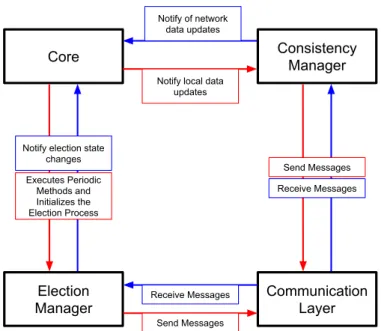
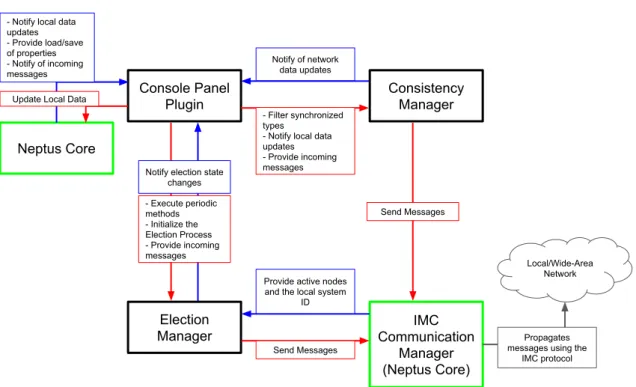
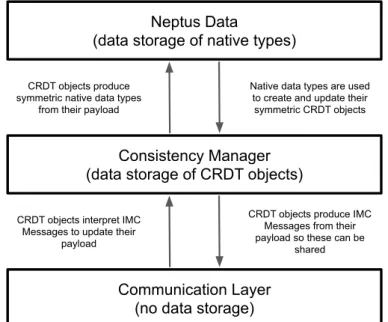
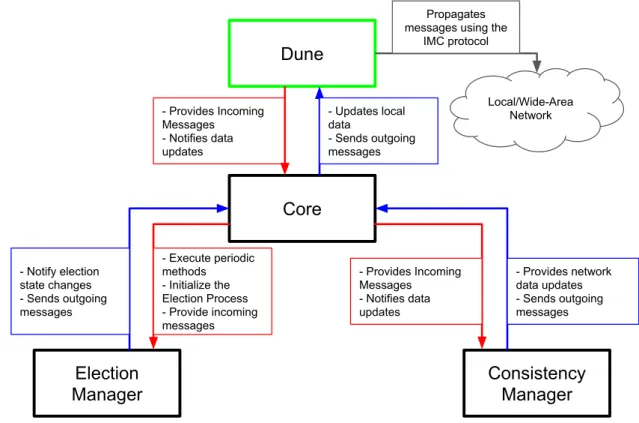
The resulting software architecture is also worth noting. We achieved a framework-like archi-tecture, that can easily be adapted to any system. Four modules can be distinguished and only two of then are strictly application dependent. A communication module that may already exist or be implemented from scratch and adhere to application layer protocol. The election manager is fully independent of the integrating system but uses the communication module to send messages. The Core module manages the election manager and bridges the interface between the existing system data and the consistency manager. Finally the consistency manager depends on the data provided by the Core and is responsible for guaranteeing consistency between nodes. This architecture was proven by the effortless porting of the solution developed for Neptus to Dune, a radically different system, that shares some data types and the same application layer protocol.
The rest of this document is structured as follows. A background analysis and literature review mainly on the topics of distributed data replication and distributed systems architecture is pre-sented in the first part of Chapter2, still on this chapter, election algorithms, network discovery and CRDTs are also covered. A deeper look at LSTS’ systems is presented in the second part of Chapter2. Chapter 3focuses on the methods used to solve the problems targeted by this work, starting with how data is shared in both local, including the choice of CRDTs. Secondly, I cover how the local network solution was adapted to wide-area networks. Finally, still in Chapter3, I expose the solution implemented to elect a local speaker and the data exchange protocol. Chapter
4covers the concrete implementation of the solution to work with Neptus and Dune. The impact on LSTS’ workflow is discussed in detail in Chapter 5. Conclusions are drawn from the work accomplished and suggestions for future work are discussed in Chapter6.
Chapter 2
Background
Distributed Systems, the area of research that aims at developing complex systems where several computers connected over a network must work together to achieve a common goal and appear as a single coherent unit to its users(Tanenbaum and Van Steen,2007). LSTS’ tool-chain itself is already a distributed system, any number of CCUs interact between themselves and with vehicles to form a cohesive working system that potentiates marine exploration.
A Distributed System is highly complex with several different and sometimes uncontrollable parts. In general, we can think of a distributed system as an aggregation of these, usually tightly coupled, modules:
• Communication - In most cases, this is the major source of limitations and problems, it refers to how systems can communicate with each other. In most cases this will be out of reach for the developers to make any changes and control its behavior, hence being a source of limitations. Distributed systems can even be developed so far that as to adapt to different communication mediums and still work without a major negative impact. The communication infrastructure can be reduced to a few crucial parameters which include the time range of possible message delivery delay and whether messages can be lost or duplicated. Establishing a good picture of the communication available is a crucial starting point for any work in distributed systems.
• Architecture - This point covers how participants relate to each other. Depending on what we aim to achieve the privileges of each participant of the system can be different, we might have participants that only save and provide data, some might just do processing while others can just serve as an inspecting tool. This allows for the most diverse hierarchies and layouts and highly impacts the efficiency of the system. To better explain this last point, lets assume we have one participant in Europe who wants to read some data, he should read data from the closest possible data storage instead of using one that is on another continent, so the network should be able to define some sort of structure as to guide the participants about where to find resources.
8 Background
• Data - By far one of the most complex problems in modern distributed systems, systems rely on this aspect on varying levels, one can be more data focused like cloud-based storage which lets you store, change and read your files from any point in the globe with very good consistent results and others like a distributed computing network which does not support data-heavy operations but still need to guarantee that work is not being double processed or lost. Both systems have extremely different needs when it comes to data accessibility and consistency which gives rise to several different methods and algorithms that help a system manage its data while keeping to a stricter/looser set of guidelines.
In this Chapter, we will go over existing literature, concepts inherent to the problem and an-alyze existing technologies and proven systems that could help build, support and explain the solution that solves the problem. No works were found that addressed a similar challenge, this can be attributed to the detailed and customized specification of the problem at hand and the fact that we are limited to the use of existing software. Instead, research was conducted following the topics presented above as a guideline. Since the communication layer is already in place and provided by Neptus and Dune no research was conducted in this direction, in Section2.6we cover this communication layer and other topics related to the existing system.
2.1
Distributed Architectures
In this work there were no architecture specifications so it is necessary to select an appropriate architecture, Neptus and Dune already work in their architecture but it does not mean we are tied to it. To define the architecture that works best for our objective we will start by analyzing one big differentiating factor when it comes to distributed systems, their architecture. This is an important first step when analyzing existing research to find solutions that are adequate for our proposed architecture. Also, defining an architecture is a key step in analyzing a system’s predicted quali-ties and its ability to accommodate changes. Bass et al.(2003) defend that software architecture is determinant in enabling or inhibiting a system of certain features. One key aspect, before we start, is to differentiate system from software architectures. While software architectures concern how different components of a software interact with each other, independent of their physical location (can even be on different machines), system architecture covers how these software com-ponents’ instances are placed in different machines. This section will cover both types starting with software.
Tanenbaum and Van Steen(2007) identify four important software architectural styles:
Lay-ered, Object-based, Data-CentLay-ered, Event-Based. From these we will focus mainly on the data-centered and event-based styles as these are the more pertinent for this work. The data-data-centered style is defined by a central common repository which is used as the main means of communi-cation between processes, the most common applicommuni-cation of this style is a distributed file system. As for the event-based style, processes communicate through a shared channel where they can publish and subscribe to Events, this being the main means of interaction. Furthermore, the author defends that a combination of both these styles can be an efficient solution to build what he refers
2.1 Distributed Architectures 9
to as shared data spaces. The combination of these architectures would allow for the decoupling in time of every system since a system no longer need be active when an event is published to observe its impact. For this joint architecture to work two things are necessary, a persistent data space and all participants must have access to it.
The author continues to develop the topic by analyzing exiting system architectures and makes the distinction between centralized, decentralized and hybrid. A centralized approach defines a partitioning in at least two parts of the full application logic, often referred to as client-server ar-chitecture. The amount of split is application dependant and there have been several successful examples of different split levels. The split levels refer to how the complete application compo-nents: user interface, application logic, data storage; are distributed over the existing machines. The way these can be split between client and server can also be applied to being split between different machines on the server side in full transparency for the client. An important aspect to clarify is that centralized does not mean non-replicated, the inherent feature of a centralized archi-tecture is that some part of the application is in exclusive control of a subset of the machines that compose the system. We can think of these networks as being like a dictatorship where a group of machines has exclusive control over the application, independently of how many or few machines they control. If we are looking for a more "democratic" solution we must look into decentralized architectures.
The characteristic feature of a decentralized architecture is that all participants are equal, act-ing both as a client and server. Contrary to centralized architectures, there is no expected data flow as node communication is symmetric, to solve this another layer of structuring is required. Overlay networks, as they are referred to, represent the processes as nodes and the possible com-munication channels between these as edges. Overlay networks can be structured or unstructured, in sum, structured networks provide deterministic identifiers for both nodes and data items making it possible for any process to locate the data item it is looking for and who is currently holding it. There are many more complex mechanics to the workings of structured peer-to-peer networks but they are not important for this work. Structured networks entail high costs and complexity in defining the deterministic processes to obtain identifiers and whenever a node leaves or joins the network it must transfer all data items it is holding or should hold. As such, in a very dy-namic network like the one the problem presents this is far from an ideal solution. Unstructured peer-to-peer networks construct their overlay network in a close to random manner, meaning there are no guarantees of data exchange flows raising the problem of network flooding when a request needs to be made. At the same time, since there is no information about the full network, some nodes might become overloaded if they contain a lot of adjacent peers. However there is not a clear cut separation between these two types of network structuring, with careful management of the adjacent peers, an unstructured network can become organized enough to allow for balancing of the number of connections and prevent random look-ups and network flooding. One of the most popular methods for data lookup in unstructured peer-to-peer networks is the introduction of super-peers. These may or may not have extra responsibilities like maintaining an index of data items, these extra responsibilities introduce a soft hierarchy to a network otherwise flat but with
10 Background
the advantage of having peers which any other peer can rely on for operation that require higher coordination (data lookup is one of the most common use cases). Since these peers are very im-portant for the network to work at its best they are expected to have very high up-times, but in case some fail, the issue of selecting another peer to elevate to super-peer class arises.
2.2
Network Discovery
Network discovery is the process of mapping other processes to which a connection can be estab-lished. This challenge can be separated into two different approaches for this work. For this work, we intend the protocol to work in a Local Area Network (LAN) environment and a Wide Area Network (WAN) environment. In both environments, possessing the knowledge of which systems are actively connected provides significant insight into the network allowing for potentially sim-pler and more efficient solutions. When specifically considering a wide-area environment, it is even more important, as solutions like multicast or broadcast, are not an option. Discovering other active systems over a wide-area connection is critical to share data with these.
In the case of a LAN environment, we can use the multicast or broadcast capabilities of the Internet Protocol (IP), in fact, Neptus already accomplishes local network discovery and each instance has access to a list of currently active systems, this will be further covered in Section2.6. As for a wide-area environment, there are not many options available, given our assumptions: systems can connect and disconnect at any point in time and are few in total so creating a stable network is not an option, IP solutions like multicasting are also blocked in wide-area networks unless some kind of tunneling is being used which defeats the purpose of discovery. One of the most popular solutions is to rely on well-known machines which can provide a list of active systems to which a connection can be established. These well-known machines are expected to keep a list of connected machines and have very high up-times to provide the discovery service all the time.
2.3
Election
The election of a leader break what could otherwise be a flat hierarchy and delegates one leader to perform the role of coordinator, initiator or just have an elevated role. In this Section, we will go through some of the more traditional election algorithms, the concept of a stable leader and how to achieve it finishing with a small reflection about the topic.
One of the most famous and flexible algorithm for leader election is the Bully algorithm
(Garcia-Molina, 1982), this algorithm assumes every process is defined by a unique identifier.
It can be described in the lines of the bigger identifier forcing smaller ones into submission. It is extremely simple but effective if the communications network proves reliable. A process that identifies the leader as being unresponsive, broadcasts an election message, processes with higher IDs respond to the broadcaster and broadcast another election themselves. One a broadcaster does not obtain an answer it means he is the one with the highest active ID in the network. At any point
2.3 Election 11
recovering processes can send a coordinator message to bully smaller IDs into accepting him as the leader.
Awerbuch(1987) makes one of the earliest mentions in the literature that an election algorithm can be solved by the construction of a tree-like structure. This is an important advancement due to the properties of tree structures and how these can be balanced and healed after losing a node. The leader will be whoever ends up at the root of the tree but unfortunately building a tree-like structure is very complex in dynamic and unreliable networks.
Aguilera et al.(2001) introduce the idea of a stable leader election, this concept can be reduced to the fact that as long as a leader maintains a correct state it will continue to be the leader. A more complete definition of stability is that if process p is the leader at time t and is accessible during the period [t − kδ ,t + 1] at time t + 1 process p will still be the leader. This work also includes several solutions for a stable leader election algorithm when faced with different assumptions. The basic proposed algorithm builds upon Ω, introduced byLamport(1998), outlining two problems that do not guarantee stability and solving these. Two solutions are proposed, one that works with the assumption of no message loss and a second one that is resilient to message loss. The latter one, however, includes an added level of complexity as it requires clock synchronization with a bounded drift to eliminate delayed messages. The advantage of having a stable leader in a dynamic network is preventing some costly setup work for the leader to perform its elevated role.
Tanenbaum and Van Steen(2007) surveys some well-known election algorithms. The author
refers to the work byVasudevan et al.(2004) when covering wireless environments. Vasudevan proposes a solution specialized in mobile, ad hoc networks. Said solution is capable of electing a leader in conditions where node mobility, node crashes, link failures, network partitions and merging of partition occur. One of the big innovative factors is the capacity for choosing the best leader and it works with the concept of neighbours to propagate an election message through the network, each node that receives an election message will then also propagate back another message with the best result found for a network leader.
Another interesting algorithm is presented byFranceschetti and Bruck(1998), because it cov-ers election in a complete graph model and, also important, for the problem at hand it addresses partial link failures which is a scenario we might be dealing with. Again several solutions are presented that build upon a base solution, the author defends a solution focused on agreeing on the network state instead of the usual selection of a leader. The algorithm works with candidate and acceptance messages, in short, a node that detects a link failure to some other node will share it with the network through a candidate message, to which nodes will respond with an accept mes-sage if they also detected a failure. A node is elected if it receives the same number of accept messages as the number of connected links. Since all processes can send a candidate message, nodes will only answer to the system with the smaller ID so that a common decision is made about the selected process. This system guarantees that all nodes agree on a failed process before it is declared as failed and a new election takes place, worth noting is that only the leader knows that it has been elected.
12 Background
2.4
Data Replication
Data Replication refers to the process of storing, accessing and editing data on two or more lo-cations. In this section we will analyze the basic principles of data replication and how to define the level of consistency a system provides, to help us with that we introduce four of the most well-known consistency models definitions.
2.4.1 Consistency Models
The work on data consistency was first aimed at analyzing multi-processor shared-memory sys-tems. This research aimed at defining models and methods to make the behaviour of write and read operations predictable and optimized when processes used a shared memory space. Another very popular application of these models were caches, data stores that kept replicated data from each other. Fast-forward some years and the same research was now being applied in the context of shared data distributed systems. The principles are the same, replicated data stores that all should store the same exact data, and, although the implementations are very far from each other, it does not concern the model.Tanenbaum and Van Steen(2007) survey, the more up to date, consistency models which they separate in terms of data-centric and client-centric.
2.4.1.1 Data-Centric Models
Data-centric models focus on the data storage interaction with accessing processes, models should provide a certain set of rules that if correctly implemented by both the processes and data stor-age should guarantee a certain level of consistency. Starting with the more strict and loosening constraints we will start with sequential consistency.
Sequential Consistency was first defined byLamport(1979) in the context of correctly execut-ing multi-process programs in multi-processor systems with shared memory. The author defines sequential consistent data stores as those that satisfy the following: the result of any execution is the same as if the operations of all the processors were executed in some sequential order, and the operations of each individual processor appear in this sequence in the order specified by its program. A complex concept that is also later covered by Tanenbaum and Van Steen(2007) in a more in-depth analysis. In other words, a sequentially consistent data store is one that for a multi-processor system (possibly with processors in different machines) guarantees that all pro-cesses see the same interleaving of operationsno matter their ordering, a sequence of operations is established for all processors.
Causal Consistency is a model introduced byHutto and Ahamad(1990) with the goal of weak-ening the Sequential Consistency model to achieve better performance. They base their model on the work of Lamport (1978) and the notion of potential causality. They suggest the restriction of sequencing only to operations that are causally related, in other words, any pair of operations
2.4 Data Replication 13
where a relation of potential causality can be established must respect the sequential model. Op-erations outside this scope, called concurrent, may differ in the order they are observed by each process.
Operations Grouping is the consequence of evolution and the shift in the target for the data-centric models. While sequential and causal consistency models concern individual operations or memory access (as they were developed to work at a hardware level) this level of granularity is not practical for application programming so the concept of operation grouping was outlined. Read and Write operations can be grouped into critical sections (CS), a critical section includes a set of operations that are guaranteed to have exclusive access to the data that is being operated on and the most up to date values and thus lowering the level of granularity. In reality, the simple interface of a CS hides a lot of precise working for guaranteeing exclusive access and updated data, synchronization variables helped processed manage how had effective access to the what shared data and tight protocols defined how synchronization variables could be claimed to have exclusive (usually for write operations) and non-exclusive (usually for read operations) access to the data store.
2.4.1.2 Session-based
To understand Session-based models, also called client-centric in Tanenbaum and Van Steen
(2007), we need to first review their origin, which stemmed from the introduction of Eventual Consistency (EC) shared-data systems. Eventual consistency focus on systems where several pro-cesses have permissions to execute write operations and how quickly these updates are actually required to be viewed by the reading processes. In essence, this model allows systems to reach high levels of inconsistency, assuming they can tolerate them. The inconsistency derives from allowing concurrent updates to the same data object which may lead to different processes (running on dif-ferent machines) having difdif-ferent values for that object. If once the updates stop, replicas progress towards and eventually reach a consistent state then the system guarantees eventual consistency. An obvious requirement for eventual consistency is thus an update propagation mechanism that guarantees eventual propagation to all replicas. One of the biggest issues when implementing an eventually consistent system is how conflicts can be resolved and how often this process is ex-pected to occur. In case of seldom concurrent writes and easy resolution of the conflicts, eventual consistency is a very cost-effective model. However, if conflict resolution is a complex and heavy process, expected to happen often, eventual consistency can quickly become inefficient.
Another problem introduced by the weakening of consistency is how clients perceive data changes. If a client can connect to different replicas and these are allowed to have different values for the same data object this difference will also be reflected on the client interface. The introduc-tion of Session-based consistency models focuses on solving this problem within the scope of a session although in some cases they also affect other sessions. no guarantees are established when it comes to accesses by different clients. The seminal work on these models was conducted in the development of the Bayou database system (Terry et al.,1995,1994;Demers et al.,1994) and originated these four guarantees:
14 Background
• Monotonic Reads - For a given arbitrary process read operation either return the last read value or a more recent one for the same data item;
• Read Your Writes - For a given arbitrary process, a write operation will always be observed by a successive read operation on the same data item;
• Writes Follow Reads - If a read operation R1 precedes a write operation W2 in a session, then any process which already knows of W2 must also have the knowledge of any write operations present at the process which performed R1 and state that W2 follows all those write operations. This guarantee is different from the previous two, in that it also affects clients in other sessions;
• Monotonic Writes - For a given arbitrary process only after a write operation has been com-pleted can any consecutive writes be executed to the same data item; Like Write Follows Reads, this guarantee also affects users in other sessions.
Another important aspect of the Bayou System for this work lies in the way it implements a process of anti-entropy to resolve conflicts. This process is executed pair-wise between two communicating replicas, it starts by performing an analysis and detection of conflicts followed by a resolution process adequate for the problem, which at times results in a highly undesirable rollback.
2.4.2 Conflict-free Replicated Data Types
Eventual consistency is a good flexible solution for systems where consistency is not critical but even when applied with session-based models still presents some serious problems. The allowance for high availability comes at the compromise of consistency which originates replicas with con-flicting values. When faced with concurrent modification in different replicas, a complex and/or costly resolution processes must be executed and there is the possibility of this ending up in a rollback if it’s not possible to resolve the conflicts.
The bulk of this work is toward resolving the delicate balance between a strong enough consis-tency while keeping the system highly available, CRDTs are one of the more recent investigation topics when it comes to distributed data replication that tackles eventual consistency problems while keeping a very high availability level. Although the concept of CRDT is recent its precedent work is quite extensive. Wuu and Bernstein(1984) studied the problem of a replicated log and key-value stores. The area of Operational Transformation (OT) potentiated concurrent modifica-tion of sequence-like structures and was the base for what today are Google Drive’s collaborative solutions.Preguiça et al.(2009) introduce the abstraction of a CRDT for the first time, this concept is then further formalized inShapiro et al.(2011c,b).
The definition of Strong Eventual Consistency (SEC) (Shapiro et al., 2011b) is crucial for the concept of a CRDT, it takes the definition of Eventual consistency (EC), which states that an update delivered at some correct replica is eventually delivered to all correct replicas and correct replicas that have delivered the same updates eventually reach equivalent state, after all
2.4 Data Replication 15
methods terminate EC is guaranteed. SEC builds on this definition with an aspect called strong convergence: Correct replicas that have delivered the same updates have equivalent state. The difference lies in the fact that SEC does not require costly or complex resolution processes since the underlying object (CRDTs) already provides methods that aim at resolving these conflicts in a streamlined manner. This concept now requires formal proof of how CRDTs achieve it, two possibilities are available: state-based or operation-based.
2.4.2.1 State-based
A state-based object or an object in the state-based style is defined by a tuple (S,s0,q,u,m), set S is the possible states of the object which individually produce the payload of the object, s0 ∈ S is the initial state, q is the set of query methods, u is the set of update methods and m is the merge method which resolves differences and merges the payload of two objects into one. A state-based CRDT must be equipped with one fundamental inner structure, a join semi-lattice, therefore the comparison of any two CRDTs of the same type must produce a partial order ≤ equipped with a least upper bound. This structure allows for the introduction of a new definition the Monotonic semi-lattice object, an object is included in this definition if the set S of its payloads defines a semilattice ordered by ≤ ; the merging method of the object with a similar one calculates the LUB; the state is monotonically non-decreasing between updates.Shapiro et al.(2011b) theorize that any state-based object which is also a monotonic semi-lattice object will provide SEC as long as eventual delivery and termination are assumed, a formal proof can be found in the referenced work. Eventual delivery is defined by "An update delivered at some correct replica is eventually delivered to all correct replicas"and termination is the requirement that all methods executing at all replicas eventually terminate.
2.4.2.2 Operation-based
Another possible implementation of a CRDT can be operation-based, informally these can be abstracted to an optimization of a replicated state-machine, every CRDT has its own internal state which can be changed by applying operations which are then communicated to other replicas. Using state-machine replication, all replicas must apply operations in the same order, the way CRDTs optimize this definition is by defining commutative and non-commutative updates. This allows commutative updates to be immediately delivered without requiring any order while non-commutative must respect causal-delivery. Causal delivery, however, is a problem when network partitioning can occur, we must keep a log of all registered operations so that at a future date this log can be used to update the partitioned network and vice-versa. This raises the problem of knowing when to prune the log or otherwise we incur the risk of it growing indefinitely (Wuu and Bernstein,1984). To effectively prune the log without losing any information from either the local (emitter) or the remote (receiver) CRDTs we would require a confirmation that all nodes in the network acknowledged the update.
16 Background
An object in the operation-based style is defined by a tuple (S,s0, q, t, u, P). Similarly to the state-based object we have a set of payloads S, an initial state s0 and a set of queries q. As expected the merge methods are no longer needed since we are not merging states, instead, we make use of a prepare (t) and effect (u) sets of methods. The way these work is a method from (t) executes before an update is effective at the local replica, immediately followed by the update method from (u). Method u is then delivered to all other replicas, parameters included. Like queries (q) prepare-update methods (t) do not have any side effects so they do not enter the causal history (C) of an object, an object’s causal history is solely composed by the update methods executed at that object so we say an update uj(a) has been delivered to replica i when uj(a) ∈ Ci. From this
causal history a "happened before" relation is easily extracted in the form of (t,u) happened before (t’,u’) iff when (t’,u’) executes, (t,u) is already present in C. In case updates happen concurrently it is not possible to define a happened before relation so we must prove that concurrent methods are commutative between them, another required measure that needs to be implemented is that of a delivery precondition (P), in other words, when is an update allowed to be accepted by a replica, but for simplicity sake the authors restrict the scopes of preconditions to those where the precondition is assured by causally-ordered broadcast.
2.5
CAP Theorem
One of the most accepted works in defining limitations to distributed data replication is the CAP theorem. The CAP Theorem, first presented byBrewer(2000), defends that shared-data systems are limited to just two of the following three properties: consistency, availability, tolerance to network partitions. In practice a system can either be exposed to network partitions or not, so what the theorem implies is that if network partitions are present a compromise must be made between consistency and availability. If there are no network partitions a system can be both consistent and available. Consistency refers to the values read from the different machines that compose the system, a system is consistent if the values read from every constituent machine will output the same value at any moment in time. Availability refers to how "available" the system is to accept write and read operations, a system with high availability will accept any write or read operations even if the values read are not the most up to date ones. Tolerance to network partitions refers to the system’s ability to continue functioning as expected when components lose communication with each other. In this work network partition is inevitable so we can expect there will be no solution that provides a high level of both consistency and availability. The most important take away from the CAP theorem is understanding that when faced with network partitions to optimize a distributed data system what we are truly optimizing is the balance between availability and consistency.
2.6 LSTS Toolchain 17
2.6
LSTS Toolchain
In this Section, I will cover LSTS’ toolchain in detail to better understand the pre-system this work will be integrated with. LSTS works with several different systems, autonomous vehicles, communication modules, and software that is used to program and control the vehicles as well as analyze data. For all these systems to work together an application level protocol was developed internally, the Inter Module Communication Protocol or IMC. This protocol defines a message structure of header and body fields for a set of known message types.
The IMC Protocol is provided as a java library which includes all components necessary to make an application comply with the IMC protocol. The library includes all the necessary defi-nitions and interface methods, including binary serialization and de-serialization methods. Above all, it contains the definition of an extensive set of IMC defined messages, for this work we used the Event type as a placeholder since the implementation of a new message type would require an update throughout the toolchain which was not truly necessary for the time being. The structure of the Event message was very flexible and hence its selection for this work, message headers do not contain any specific information so there is no need to cover them, the body of an Event message contains two String fields, labeled topic and data.
This work’s focus resides mainly in Neptus since it provides a very stable and flexible plat-form for development which can, ideally, be adapted with ease to work with other systems in the toolchain. Vehicles are also a very important link in LSTS’ data flow as they provide a mobile platform for data to be shared in these scenarios:
• Data can be stored on a vehicle that will travel between vessels where crews are operating using Neptus. When close to a vessel data can be transferred over a wireless network instead of using paid satellite links to communicate between vessels.
• For long-range missions, a smaller, short-range, vehicle will rendezvous with one perform-ing a long-range plan to transfer data back to the main vessel where researchers can imme-diately start to analyze it.
These, among other less common scenarios, justifies the necessity of vehicles also being in-cluded in this work. Hence a solution was also developed around the Dune platform which runs in GLUED, a light-weight Linux distribution tailored for the use-case of LSTS. Dune is the heart of the vehicles, it controls navigation, sensory activities, networking and the interchangeable sys-tems present in each vehicle. It also provides a simulation mode which proved extremely useful for development as no physical vehicle was necessary for deployment.
A very important step for development was categorizing the data types which flow between the different systems. These three data categories were defined:
• Timestamped - This type of data includes a pair (device, timestamp) that provides a perma-nent unique identifier which allows for simple ordering since the timestamps all originate from the same process and cannot be edited;
18 Background
• Read-only - This type of data is read-only, as the name indicates, but the same data item can be produced by different systems leaving the system ID as the unique identifier;
• Editable - editable data can be edited by anyone with the proper permissions;
2.6.1 Neptus
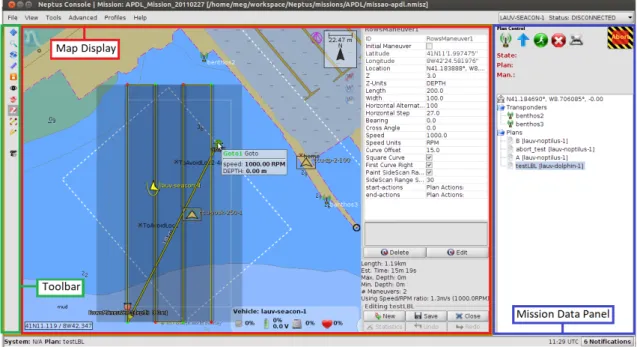
Neptus is the flagship software of LSTS, it is a Java-based GUI application that provides users with many different tools. In Figure2.1, I present a labeled picture of Neptus’ interface. The toolbar allows the user to quickly access the most used tools without the need to navigate the menu bar. The Mission data panel concentrates the direct controls of the selected vehicle, immediately above it, and also information like the transponders and plans to be used in the operation. The map display is where the user can visualize the active vehicles’ live position and the selected plan course. Other important data like restricted navigation zones or other necessary data layers are also displayed. In Figure 2.1, the Plan Editor tool is active so we have a detailed view of the selected plan and, on the right the Plan Editor properties interface.
Figure 2.1: Neptus Interface with the Plan Editor tool active
Neptus architecture relies on plugins for expansion, this is useful in the sense that a plugin does not need to be fully integrated with the rest of the code structure but can still access it. A plugin can take different forms, the main ones are a Console Panel or a Map Layer. A Console Panel allows for a fully customizable interface window while the Map Layer is restricted to drawing over the existing map. I will not cover the Map Layer as it was not used and its functionality is mostly similar except for the user interface. All plugins have direct access to Neptus core code, in this work we make use of mainly four big modules:
2.6 LSTS Toolchain 19
• IMC Java - This is the IMC protocol library, it provides message objects and all the serial-ization process related to them. It also provides some other required definitions for IMC; • IMC Message Manager - The IMC message manager aggregates a lot of information for
IMC based communication, including (i) active IMC enabled nodes in the local network; (ii) the local system’s IMC ID; (iii) a range of individual properties of connected nodes. The major feature of the message manager is the interface for IMC message sending, it includes a generic send message method that can be parametrized with which transport to use (UDP, TCP) and whether or not to use multicast/broadcast. It also takes responsibility for filling in the header fields of messages;
• Message Subscription - Neptus uses Java Annotations1to provide a subscription mechanism
to its message bus. Meaning, methods annotated with the Subscription tag will be invoked every time a relevant message is received by the Neptus instance;
• Properties Provider - One of the most useful features in Neptus is the system-wide properties saving and loading mechanism, this allows plugins to save and load configurations with ease, the only requirement on the plugin side is to annotate a field with the Property annotation1. Network properties were analyzed using the IMC Communication Manager. The communi-cation interface provided both TCP and UDP transport layers, TCP’s properties are very well-documented so I will not go into detail (Postel,1981). The UDP transport is the most interesting to cover, there are no significant properties outlined in the transport definition, so these are usually added in the application layer when needed. In local networks, Neptus communication interface guarantees, by managing the optional parameters, the following communication properties:
• No message duplication; • Messages may be lost;
• There are no transmission errors, if node i receives message M from node j the received message is the same as sent by node j;
• Received messages must at some prior point in time have been sent by another node, in essence, no spontaneous messages are generated.
An important Neptus data type to cover, due to its impacting role in this work is the Plan. A Plan in Neptus is a representation of the planned course for a vehicle to execute. This course is defined by waypoints called Maneuvers which are connected by Transitions, an abstraction to a graph is easily achieved. Maneuvers store several data items, concerning the behaviour of the vehicle, which are not relevant for this work. Transitions also store some data but not on the same scale as Maneuvers. Both Maneuvers and Transitions are identified by a string type field which must be unique within the containing Plan.
1Java Annotations documentation can be consulted here:
20 Background
Other features of Neptus include various data visualization tools, map exploration with over-lays for different data types, plan simulation with capabilities to account for tides, among several others which are not relevant for this work and for that reason will not be covered.
2.6.2 Vehicles and Dune
Vehicles are the most dynamic system in LSTS’ toolchain, these are focused on the autonomous operation in different conditions which are generalized to aerial and submarine environments. LSTS possesses vehicles with different ranges of operation and sensory equipment but all of them share the same control software, Dune. Dune is a C++ program that provides autonomous control and interfaces with the several systems aboard vehicles. An image of two Noptilus class vehicles is presented in Figure2.2.
Figure 2.2: Two Noptilus category submarine vehicles
Most of the current sub-marine vehicles possess two computing systems. The main one is where Dune runs and has access to external communications and on-board systems/sensors. A secondary processor, dubbed backseat, is connected to the main one via a network switch which allows for two-way communication. This backseat system is usually used to run non-critical applications that may interface with Dune over a TCP connection.
Dune instead of plugins uses the concept of tasks, tasks operate primarily on an event-based behaviour and are the symmetric to plugins in Neptus (Section 2.6.1). Tasks are usually specif-ically designed to interact with sensors or internal electronic systems. They are also provided a
2.6 LSTS Toolchain 21
system-wide configuration system which loads on startup and can be edited as plain text files of key-value entries before startup. For example, the communication with the backseat processor is the responsibility of a task that can be configured with respect to which types of IMC messages are sent through.
Contrary to Neptus (Section2.6.1), Dune’s data types are mostly in the format of IMC mes-sages. Lets take the example of the Plan data type, its representation as an IMC message contains mostly the same data but with a different structure. Maneuvers and Transitions are now their IMC Message counterparts and data fields present in the Neptus Plan are no longer available the same way new data fields are available in the IMC message Plan.
2.6.3 Manta
Manta is not a vehicle but its inner workings are very similar, it also operates using Dune so the same architecture of tasks and configuration applies. A Manta works as a portable communication interface, with support for several communication mediums provided the correct attachment is connected. As such, it is a very interesting system for our work since it processes a lot of data going through the network.
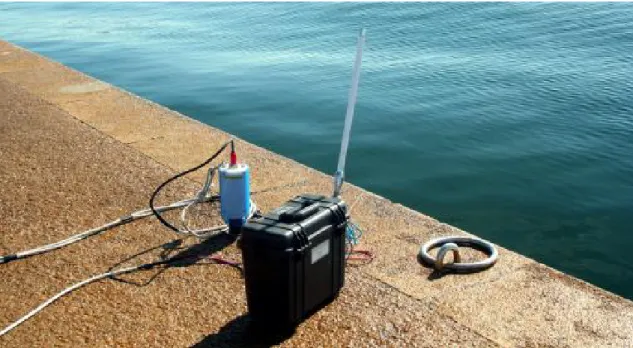
For example, Mantas can be used to connect a vehicle using sub-aquatic acoustic communica-tion to systems using other more regular communicacommunica-tion methods, like Ethernet and WiFi or even some less common ones such as satellite or 3G/4G mobile networks. In essence, a Manta serves as a proxy for switching communication technology and allows a more extensive coverage of the communication space. In Figure2.3, I present a picture of a Manta (black box) equipped with an antenna and an acoustic modem (blue cylindrical shape).
Chapter 3
Automated Consistent Data Sharing
This Chapter will present and argue the proposed solution that aims at solving the problems pre-sented in Section1.2. In Section3.1I will discuss how the system architecture was selected. Then in Section3.2, I will start by covering how consistent data sharing was achieved in a local network. This includes the analytic process which lead to the selection of CRDTs as the approach to follow and the reasoning behind which CRDT should compose the solution to achieve consistent data replication. Following, in Section3.3, I discuss how the solution implemented at a local level was adapted to also work at a wide-area level, highlighting the limitations of the local-area solution and how these were solved or minimized, taking into account the restrictions of LSTS’ operation scenarios. Section 3.4 covers the solution for a leader election problem introduced by the sup-port of wide-area consistency. Finally, Section3.5, defines the communication protocol and the reasoning behind it.
One of the most important steps I considered during development was defining the underlying network properties of the existing communication layer provided by both Neptus and Dune. Since designing a new protocol was not in the scope of this work I had to keep with these communication layers. With this information in mind, selecting the appropriate architecture, an equally important step in building a distributed system, ensued.
3.1
System Architecture
According to LSTS’ specification the system assumes all nodes in the network should be replace-able with or without prior notice, effectively meaning no number of machines can hold enough significance that their disconnection would compromise the correct behaviour of other nodes. Re-ferring back to Section2.1, this clearly points at a decentralized solution similar to a peer-to-peer network, even though the name usually refers to large scale networks and we are talking about a network size of, at most, around ten machines. A decentralized architecture was ideal to cope with the common network partitioning that occurs at any time. To keep availability in systems that become isolated, each machine keeps its own record of all the data. The high amount of par-titioning is justified by the particular dynamics of the nodes. The main causes are vehicles being
24 Automated Consistent Data Sharing
able to freely move in and out of communication range and the connection inside the vessels being vulnerable to relocation of the operators’ machines rendering it unstable.
With this dynamics in mind I opted for a less costly unstructured network overlay over a structured one. This implementation was possible partly because Neptus and Dune, in their com-munication interface, already provide a list of connected nodes and the possibility to broadcast messages. Another somewhat related factor supporting this decision was the fact that we do not require any network resource lookup (one of the biggest features of structured network overlays). An important aspect to consider in other areas of development was also outlined during this stage. Although it is not possible to distinguish a node based on it is communication, it is commu-nication identifier provides insight into what kind of system we are communicating with. Different systems types (Section2.6), can be expected to behave in different ways, physically speaking, a vehicle can be expect to leave and re-enter a network more often than a CCU or a Manta.
In sum, the goal of this architecture is to make it possible that any system remains available as long as itself persists. The same logic indirectly applies to network data, as long as there is one active system, data contained on that system can potentially be re-introduced into a broader network.
Network Security was considered as well, LSTS has no security layer built into it is software, although this may seem like a serious oversight and considerations took place to assess if it should be included in this work’s scope, we opted to leave it out due to time limitations and the deep, complex integration that would need to be achieved for it to have any significant impact on LSTS’ work. Since communication on a public network is seldom and not sensitive, this problem could be over-looked.
3.2
Consistency in a local network
Achieving local network consistency was the main area of development, I analyzed the different degrees of consistency presented in Section 2.4, outlining existing algorithms to achieve them while tolerating network partitions.
To start with, we will needed a communication infrastructure to share data with other nodes, the IMC communication interfaces of Neptus and Dune were used (Section 2.6). Referring to the CAP Theorem (Section 2.5), I based my analysis on the consistency level, starting with the strongest consistency models and weakening them to introduce the desired availability while al-ways keeping partition tolerance. The desired levels were defined in conjunction with LSTS’ empirical input and expected system behaviour. Once the acceptable levels of availability, in the presence of partition tolerance, was achieve I considered to have found the strongest consistency level possible for the system.
One of the strongest models defined is that of sequential consistency, we analyzed the more traditional algorithms that fulfil the specification. These, proved very capable in terms of con-sistency, mostly providing a consistency level stronger than effectively necessary. However, the major drawback was the requirement of tight synchronization among processes, which cannot