DOI: ISSN: 2594-3553 Abstract — The hydrocyclone separator is a processing
equipment very used in the mineral industry for size separation of solid particles in ore slurries. It is also an equipment with low concerns about its control for an efficient performance. Traditionally, the monitoring and control of hydrocyclone is done by means of its operational variables as the flowrate Q, the density , and the pressure P of the feed slurry stream of the hydrocyclone. However, the main outcome variable of interest in a hydrocyclone is its “cut-off size”, d50, which is the size at which 50% of the solids particles, in average, go to the coarse output (underflow) of the hydrocyclone, and the remaining 50%, in average, go to its fine output (overflow). The vast majority of hydrocyclone applications in mineral processing do not measure d50 on-line, because this requires the use of very expensive particle size analyzers. Because of this, hydrocyclones are usually operated in open loop with regards to its cut-off size d50, yet under closed loop control of the operational variables that affect d50 as the flowrate Q and the density of the feed slurry stream. Nevertheless, most hydrocyclone applications suffer from bad performance due to the lack of understanding about the quantitative impact of the operational variables on the main outcome variable, the cut-off size d50. In this context, this article intends to quantify the relative impact of the flowrate Q and the density on the cut-off size d50 by running Monte Carlo simulation on a mathematical model of the hydrocyclone. The results obtained provide useful knowledge for
proper control of hydrocyclone performance.
Index Terms — hydrocyclone, mineral processing, Monte Carlo simulation, size separation.
Resumo — Hidrociclones são equipamentos de processamento largamente usados na indústria mineral para separação por tamanho das partículas sólidas existentes em polpas de minério. Tais equipamentos ainda recebem pouca atenção quanto ao seu controle visando uma operação eficiente. Tradicionalmente, o monitoramento e controle automático de hidrociclones é feito com base em variáveis operacionais, como a vazão Q, a densidade e a pressão P do fluxo de polpa de entrada (alimentação). Entretanto, a principal variável de interesse em um hidrociclone é o seu “tamanho de corte”, d50, que é o tamanho em que 50% das
partículas sólidas, em média, seguem para a saída grossa (underflow) do hidrociclone, enquanto os 50% restantes de partículas, em média, seguem para a saída fina (overflow). Na grande maioria das aplicações de hidrociclones em processamento mineral, o tamanho de corte d50 não é medido em tempo-real,
porque isso demanda o uso de complexos e dispendiosos analisadores de partículas. Como consequência, hidrociclones são geralmente operados em malha aberta, em relação à variável de saída d50, ainda que existam controles em malha fechada para as
demais variáveis operacionais que afetam o d50, como a vazão Q e
a densidade da polpa de entrada. Mesmo assim, muitas instalações de hidrociclones apresentam desempenho ruim devido à falta de conhecimento sobre o impacto quantitativo das variáveis operacionais sobre a variável principal de saída, o tamanho de corte d50. Neste contexto, o presente artigo propõe-se a quantificar
o impacto relativo da vazão de entrada Q e da densidade de
Sensitivity Analysis of Hydrocyclone
Performance in Mineral Processing Using
Monte Carlo Simulation
Análise de Sensibilidade do Desempenho de
Hidrociclones em Processamento Mineral
Usando Simulação de Monte Carlo
Sidney A. A. Viana
__________________________________________________________________________________
_______________________________________________
S. A. A. Viana is a Senior Member of the IEEE – The Institute of Electrical and Electronics Engineers. He is currently with the Ferrous Automation Engineering Department of VALE, Belo Horizonte, MG, Brazil (e-mail: [email protected]).
DOI: ISSN: 2594-3553 entrada sobre o tamanho de corte d50, usando Simulação de
Monte Carlo sobre um modelo matemático de hidrociclone. Os resultados obtidos fornecem informações úteis para aprimorar o controle do desempenho de hidrociclones.
Palavras-Chave — hidrociclone, processamento mineral,
separação por tamanho, Simulação de Monte Carlo.
I. INTRODUCTION
INERAL processing plants make use of several types of size separation (size classification) equipments to segregate ore particles into coarse and fine partitions, either in the form of bulk solids or slurries [1,2,3]. Size separation is needed due to reasons as: (1) feeding coarse particles back to breakage processes, like crushing and milling; (2) meeting product particle size requirements; or (3) segregating different mineral species present in the ore, to meet chemical content requirements.
In this context, this article presents a performance analysis of hydrocyclone separators – a size separation equipment widely used in mineral processing. The article is organized as follows: Section II introduces two key concepts related to any size separation process: particle size distributions, and partition curves. Section III presents the hydrocyclone separator, explaining its working principle and operation. A mathematical model of the hydrocyclone, the Plitt’s model, is also summarized. Section IV proceeds with a sensitivity analysis of hydrocyclone performance by running Monte Carlo simulation
on the equipment model. Finally, Section V discuss the results obtained and provide useful insights for proper control of hydrocyclones.
II. QUANTIFYING A SIZE SEPARATION PROCESS Size separation equipments usually have one input stream (feed) and two output streams (coarse and fine), as shown in Fig. 1. A size separation process is quantified by two key concepts:
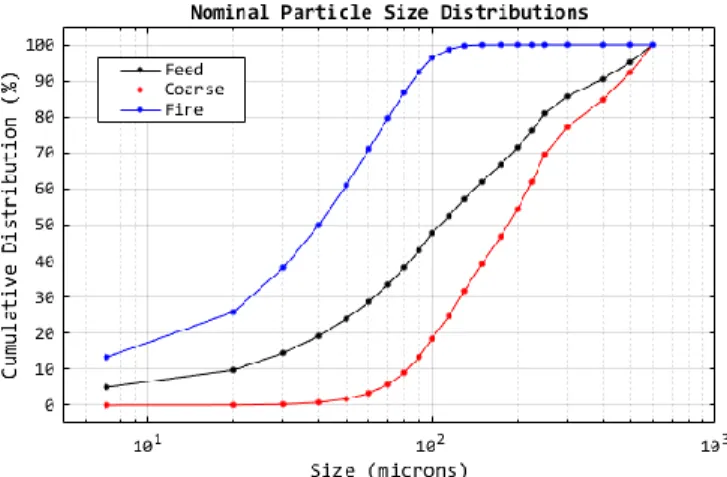
The particle size distribution of a stream, which corresponds to the cumulative percent amount of solids mass within the particle size range of interest. Fig. 2 shows theoretical examples of particle size distributions, in the size range from 7 to 600 microns, for the feed, coarse, and fine streams of a size separation equipment. Notice that the particle size distribution of the coarse stream has lower amounts of fine particles than the feed (and the fine) stream, whereas the fine stream has lower amounts of coarse particles than the feed (and
the coarse) stream.
The partition curve of a size separation equipment, which corresponds to a function that defines how the particle size distribution of an output stream results from the particle size distribution of the feed stream. The partition curve of an equipment must be referred to a specific output stream, either the coarse or the fine output stream.
Fig. 3 shows three theoretical examples of partition curves. The black curve is an “ideal” partition curve, for which there is a “perfect” separation at a hard cut-off size dH. In Fig. 3, dH = 90 m. All solid particles with sizes lower or equal than dH (fine particles) will go to the fine output stream of the separation equipment, whereas all particles with sizes greater than dH (coarse particles) will go to the coarse output stream. In contrast, the blue curve is a theoretical curve for a real separation equipment, with regards to its coarse stream. The size separation performed by a real equipment is not perfect: some amount of fine particles will unduly go to the coarse stream (indicated by the bottom shadowed area); and some amount of coarse particles will unduly go to the fine stream, so that the probability that coarse particles will go to the coarse stream increases gradually with the particle size (indicated by the upper shadowed area). Because of this, the partition curve of a real equipment typically has a “slope” or “sharpness”, and
M
Fig. 2. Particle size distributions in a size separation equipment.
Fig. 3. Examples of theoretical partition curves. Fig. 1. Diagram of a size separation equipment.
Size Separation Equipment Feed stream Fine stream Coarse stream
DOI: ISSN: 2594-3553 its cut-off size is defined as the size at which 50% of the solids
mass from the feed stream goes to the coarse stream (since the partition curve is referred to this output stream), and it is termed as d50. The closer to vertical is the slope, the higher is the
separation efficiency. Additionally, in a real equipment, a fixed amount of fine particles is unduly “dragged” to the coarse stream, and this is termed as “short-circuit” or “by-pass”. In the real partition curve in Fig. 3, the short-circuit is 19.0%. The blue curve in Fig. 3 is termed as the “corrected” partition curve, obtained by disregarding the by-pass effect. Both the “slope” and the “by-pass” represent imperfections in the separation process of a real equipment. The 50% cut-off size in the corrected partition curve is denoted as d50c and is always higher
than d50 in the corresponding real partition curve. Since the
difference between the real and the corrected partition curves is due to the “by-pass”, the performance of a size separation equipment can be fully specified by either its real or corrected partition curve (d50 or d50c) and its “by-pass”.
Notice that the particle size distribution and the partition curve are distinct concepts, although they share the same quantitative representation, as shown in Fig. 2 and Fig. 3. The particle size distribution is the cumulative distribution of solid particles in a stream, whereas the partition curve represents a “probabilistic” aspect of the size separation process performed by an equipment. The particle size distributions of the coarse and the fine streams will depend not only on the equipment performance (its partition curve), but also on the particle size distribution of the feed stream. However, no matter is the shape of a partition curve, it will always have a 50% cut-off size, d50.
III. THE HYDROCYCLONE SEPARATOR
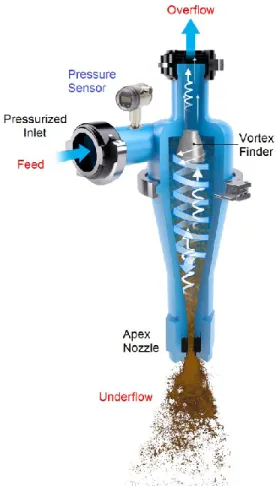
A particular type of size separation equipment for processing of ore slurries is the hydrocyclone separator, or simply hydrocyclone [1,2,3,4], shown in Fig. 4. It has a cylindrical body which becomes conical downwards, an input nozzle (feed inlet), a bottom output nozzle called apex or spigot, whose stream is termed as underflow, and an upper output nozzle whose stream is termed as overflow. The hydrocyclone has no moving parts, although there are pneumatic-actuated apex nozzles with variable aperture.
The pressurized stream entering the feed inlet is provided by a slurry pump. The input nozzle is tangential to the hydrocyclone body, creating two rotational flows (vortexes) within the hydrocyclone: an outer vortex that goes to the apex and carries most of the coarse particles downwards to the underflow, and an inner vortex that carries most of the fine particles upwards to the overflow. The size separation between coarse and fine particles is due exclusively to differences in the centrifugal forces acting on the solids particles according to their sizes and densities. The hydrocyclone does not need any kind of energy to perform the separation process, so that it is a passive separation equipment.
Hydrocyclones are widely used in mineral processing due to their favorable capacity-to-size ratio and reasonable low maintenance [3]. As a size separation equipment, the performance of a hydrocyclone can be defined by its partition
curve. The main goal of a hydrocyclone is to produce an underflow with most of the coarse particles and considerably less fine particles than the feed stream, according to its designed cut-off size d50. The cut-off size is an indicator of the separation
performance of a hydrocyclone, and is the ultimate variable to be controlled in a hydrocycloning process. Therefore, a quantitative understanding on how d50 changes in response to
variations in the operational conditions of the hydrocyclone can be obtained if a mathematical model of the equipment is available. Before discussing a hydrocyclone model, one needs to understand the parameters and variables involved in a hydrocycloning process.
Fig. 4. Illustration of a hydrocyclone separator.
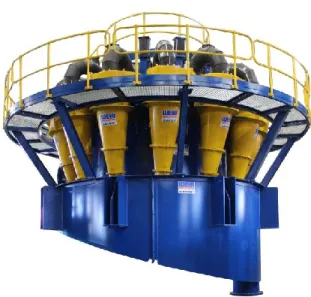
Fig. 5 shows a typical layout of a hydrocycloning process for mineral processing applications. A slurry tank receives an input stream of raw concentrated slurry from an upstream processing unit, and a dilution water stream so that the density (or solids concentration) of the pumped output stream from the tank can be lowered to a desired value. The diluted slurry pumped from the tank feeds a hydrocyclone cluster (or hydrocyclone battery), shown in Fig. 6, which is simply a set of hydrocyclones arranged in a common mechanical unit. The number of hydrocyclones in a cluster is defined during its design, as the ratio between the maximum pumped slurry flowrate QPmax and the maximum feed flowrate for a single hydrocyclone QFmax. As an example, a cluster of hydrocyclones with QFmax = 90 m3/h designed to operate with a maximum pumped flowrate QPmax =
DOI: ISSN: 2594-3553 650 m3/h requires Q
Pmax/QFmax = 650/90 ≈ 7.22 ≈ 8 hydrocyclones. The number is rounded up, otherwise QPmax is not satisfied.
Fig. 5. Typical layout of a hydrocycloning process.
Fig. 6. Example of a hydrocyclone cluster for mineral processing. (Source: WEIR Minerals, Inc)
The basic instrumentation necessary for monitoring and control of hydrocyclones comprises: a volumetric flow instrument (FIT) and a density instrument (DIT) in the feed pipeline; a pressure instrument (PIT) close to the hydrocyclone inlet; and an on-off valve at the feed inlet. The most commonly used technologies for those instruments are: magnetic flowmeters [11], radioactive density meters [12,13], flanged seal pressure meters [14], and knife-gate valves [15]. Such instrumentation allows the measurement of the feed volumetric flowrate Q, the feed density , and the input pressure P of the hydrocyclone. The inlet valve is used only to release or block the hydrocyclone for operation. In a hydrocyclone cluster, it is not necessary to install one pressure meter at each hydrocyclone inlet. A single pressure meter can be installed at the feed chamber of the cluster, where the pressure is virtually equal to the inlet pressure of all hydrocyclones in the cluster.
A hydrocycloning process must ensure that the cut-off size d50c (or d50, when considering the real partition curve) meets a
given requirement, for which the hydrocyclones were designed.
It is necessary to keep d50c stabilized from closed loop control
of the variables Q, , and P. The density is controlled by the water addition to the slurry tank. The input flowrate Q is controlled by manipulating the rotating speed of the slurry pump. The pressure P is mainly a consequence of the input flowrate, and should be manipulated by opening or closing the on-off valves of the hydrocyclones in the cluster.
How much does the cut-off size d50c changes in response to
variations in the operational variables Q and ? In other words, what is the sensitivity of d50c regarding to those variables?
Understanding this sensitivity is fundamental for proper design of control systems for hydrocyclones. The lack of knowledge about the sensitivity of d50c regarding to Q and leads to poor
design and tuning of control loops to regulate those variables for open loop control of d50c. The goal of this article is to
quantify the sensitivity of d50c regarding to those operational
variables by using a mathematical model of the hydrocyclone, providing conclusions to improve the closed loop control of the operational variables that define the open loop control of d50c.
The cut-off size of a hydrocyclone depends on two class of parameters [2], summarized in Table I:
1) Constructive or Design Parameters
Parameters related to physical aspects of the hydrocyclone, mainly its geometry. This include its inlet diameter, body diameter, apex diameter, overflow outlet diameter, and free vortex height. Those are fixed parameters, however, one exception is the pneumatic apex with variable diameter. 2) Operational parameters
Parameters related to process variables that set the operational condition of the hydrocyclone. Usually, those are varying parameters related to properties of the slurry stream processed by the hydrocyclone, such as: particle size distribution and density (or solids concentration) of the feed slurry, feed flowrate and pressure, and solids density.
TABLEI
CONSTRUCTIVE AND OPERATIONAL PARAMETERS OF A HYDROCYCLONE
Parameter Notation
Constructive parameters
Cylindrical body diameter DC
Inlet diameter DF
Overflow diameter DO
Underflow diameter DU
Free vortex height H
Operational parameters
Liquid density L
Solids density S
Feed slurry density F
Feed solids concentration by volume CvF
Feed solids concentration by mass CmF
Feed flowrate QF
Feed pressure P
By-pass (short circuit) fraction
Outcome variable
Corrected cut-off size d50c
DOI: ISSN: 2594-3553 In past decades, some empirical models of the hydrocyclone
were developed using experimental data and theoretical knowledge on fluid mechanics. The high complexity involving modeling the rotational flows in a hydrocyclone and the interactions between the solids particles and the liquid, impose limitations for the development of an exact mathematical model of the hydrocyclone. Among the currently available models of the hydrocyclone, the models due to Lynch & Rao [7], Plitt [8], and Mullar & Jull [9] have been the most used in the design and analysis of hydrocyclones.
In this work, the Plitt’s model of a hydrocyclone was used for the sensitivity analysis of the cut-off size d50c with regards
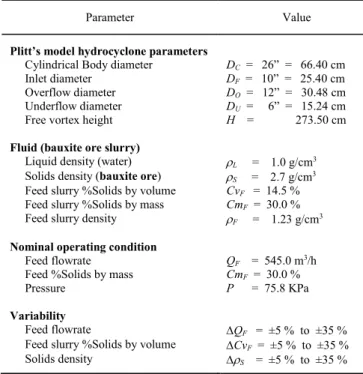
to the operational parameters of a hydrocyclone with fixed constructive parameters. Table II summarizes the constructive and operational parameters of a real hydrocyclone [16] considered in this work.
In the 1970’s, L. R. Plitt developed a mathematical model of the hydrocyclone [8] using a set of experimental data from 300 experiments with hydrocyclones, some of which were performed by the author, and some were performed by other researchers and previously published in the literature. The Plitt’s model assumes that the corrected partition curve of a hydrocyclone has the form of a Rosin-Rammler equation [5,6]:
m d d .
e
d
Y
50c 6931 0 c(
)
1
(1)where d (m) is the size fraction of interest, d50c (m) is the
corrected cut-off size, and m is the “slope” or “sharpness” of the partition curve, given by:
15 . 0 2 58 . 1
93
.
1
Q
H
D
e
m
Rv c (2)The corrected cut-off size d50c (m) is defined as:
5 . 0 45 . 0 38 . 0 71 . 0 063 . 0 21 . 1 6 . 0 46 . 0 c 50 ) ( 5 . 52 L S U Cv O I C Q H D e D D D d S
(3)The pressure drop P (KPa) and the feed flowrate Q (l/min) are defined as:
78 . 1 87 . 0 2 2 28 . 0 94 . 0 37 . 0 0055 . 0
)
(
88
.
1
Q
D
D
H
D
D
e
P
O U I C CvS
(4) 562 . 0 0031 . 0 489 . 0 2 2 157 . 0 528 . 0 208 . 0(
)
3251
.
0
P
e
D
D
H
D
D
Q
S Cv U O I C
(5)As an example, the corrected partition curve (blue curve) shown early in Fig. 3 was obtained from equation (1), for specific values of constructive and operational parameters.
According to equation (3), the operational parameters that affect directly the corrected cut-off size d50c (and also the real
cut-off size d50) are the feed flowrate Q, the feed solids
concentration by volume CvF, and the solids specific gravity S. Assuming a hydrocyclone with fixed constructive parameters, its cut-off size d50c will be theoretically fixed, and the
performance of its separation process will be due to the operational variables Q, CvS, and S. Hence, for practical applications, it is important to understand the sensitivity of the cut-off size d50c regarding to Q, CvS, and S. This is discussed in the next section.
IV. SENSITIVITY ANALYSIS
In a process control context, understanding how much the cut-off size d50c of a hydrocyclone is affected by variations in
its operational parameters Q, CvS, and S, around a nominal operating point {Q0, Cv
S0, S0}, allows us to understand what should be the permissible amount of variability in the operational variables that do not lead to a bad performance.
A sensitivity analysis can be done in either an analytical or a numerical way. An analytical evaluation requires computing the derivatives of d50c in equation (3) with regards to the
operational variables of interest. On the other hand, a numerical analysis, using Monte Carlo simulation, simply uses equation (3) to compute the statistical distribution of d50c given simulated
distributions of the operational variables of interest.
In this work, the sensitivity analysis of d50c was performed
using Monte Carlo simulation, using the Plitt’s model of the hydrocyclone, but using the parameters of a real equipment [16]. The analysis was done with the following steps:
1) Choose one or more of the variables Q, CvS, and S to be varied.
2) Generate a set of N=10,000 random values for the variable(s) under a normal distribution with mean and variability according to Table II.
TABLEII
PARAMETERS OF A REAL HYDROCYCLONE USED FOR SENSITIVITY ANALYSIS
Parameter Value
Plitt’s model hydrocyclone parameters
Cylindrical Body diameter DC = 26” = 66.40 cm Inlet diameter DF = 10” = 25.40 cm Overflow diameter DO = 12” = 30.48 cm Underflow diameter DU = 6” = 15.24 cm Free vortex height H = 273.50 cm
Fluid (bauxite ore slurry)
Liquid density (water) L = 1.0 g/cm3
Solids density (bauxite ore) S = 2.7 g/cm3
Feed slurry %Solids by volume CvF = 14.5 % Feed slurry %Solids by mass CmF = 30.0 % Feed slurry density F = 1.23 g/cm3
Nominal operating condition
Feed flowrate QF = 545.0 m3/h Feed %Solids by mass CmF = 30.0 %
Pressure P = 75.8 KPa
Variability
Feed flowrate QF = ±5 % to ±35 %
Feed slurry %Solids by volume CvF = ±5 % to ±35 %
DOI: ISSN: 2594-3553 3) Apply the mean (nominal) values to the hydrocyclone
model to compute the nominal cut-off size d50c.
4) Apply the random values to the hydrocyclone model to compute the resulting values for the cut-off size d50c.
5) Quantify the sensitivity of d50c regarding the variables
using the Pearson’s Coefficient of Variability.
6) Identify the implications of the sensitivity of d50c in a
process control context.
The results of the sensitivity analysis are described in the following.
A. Sensitivity to the feed flowrate QF
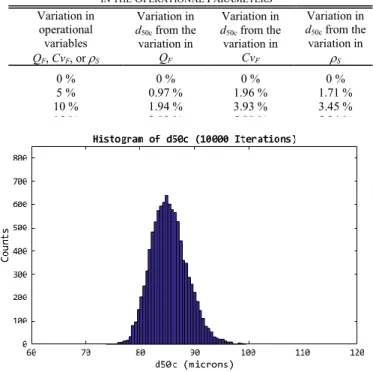
The first sensitivity analysis took into account the feed flowrate QF. A set of 10,000 random values for QF were generated under a normal distribution with average (nominal) value of 545.0 m3/h and a variability of ±20%, according to
Table II. The resulting partition curves are shown in blue lines in Fig. 7 (the lines are superimposed) along with the partition curve for the nominal condition (black line). The corresponding variation in the cut-off size d50c is shown in the histogram in
Fig. 8. It was found that the variation of ±20% in QF leads to a variation of around ±3.93% in d50c. This suggests that the feed
flowrate QF has a little impact on d50c. However, QF should be controlled by a well designed and tuned control loop because its impact on d50c is not negligible.
B. Sensitivity to the feed solids concentration CvF
The second sensitivity analysis was regarding the feed solids concentration by volume CvF, according to the nominal condition and the variability shown in Table II. The resulting partition curves are shown in Fig. 9. The corresponding variation in the cut-off size d50c is shown in the histogram in
Fig. 10. It was found that the variation of ±20% in the feed solids concentration CvF leads to a variation of around ±7.88% in d50c. This indicates that CvF has a greater impact on d50c
compared to QF. In a process control context, this means that the density of the feed stream to the hydrocyclone must be very well controlled around the nominal value, to prevent excessive variations that will have a major impact on the cut-off size d50c
of the hydrocyclone.
TABLEIII
SENSITIVITY OF THE CUT-OFF SIZE d50c TO VARIATIONS
IN THE OPERATIONAL PARAMETERS
Variation in operational variables QF, CvF, or S Variation in d50c from the variation in QF Variation in d50c from the variation in CvF Variation in d50c from the variation in S 0 % 0 % 0 % 0 % 5 % 0.97 % 1.96 % 1.71 % 10 % 1.94 % 3.93 % 3.45 % 15 % 2.93 % 5.90 % 5.24 % 20 % 3.93 % 7.88 % 7.12 % 25 % 4.96 % 9.84 % 9.19 % 30 % 6.02 % 11.83 % 11.53 % 35 % 7.11 % 13.85 % 14.26 %
Fig. 7. Partition curves for 20% variation in QF. Fig. 8. Histogram of d50c for 20% variation in QF
DOI: ISSN: 2594-3553 C. Sensitivity to the solids density S
The solids density S was considered in the third sensitivity analysis. The resulting partition curves and histogram are shown in Fig. 11 and Fig. 12. The variation of ±20% in the solids density S leads to a variation of ±7.12% in d50c. This
indicates that S has a high impact on d50c. In a process control
context, this means that S should be well controlled. However, the solids density of an ore is due to its geological characteristics that cannot be controlled by automation systems. Therefore, the variations in S should be regarded as disturbances in the process.
Table III shows the variations in d50c corresponding to specific
variations from ±5% to ±35% in the operational parameters QF, CvF, and S. For better understanding of the sensitivity of d50c
regarding each operational parameter, those values are show in Fig. 13.
V. DISCUSSION OF THE RESULTS
The sensitivity results shown in Fig. 13 clearly indicate the operational parameters of a hydrocyclone which have major impact on its cut-off size d50c. The feed solids concentration CvF and the solids density S are such highly impacting parameters. In a real hydrocycloning process, the observed variabilities in
the operational parameters can be used in a sensitivity analysis to compute the resulting variability of d50c. This variability can
be compared to the desired performance of the hydrocyclone, in order to identify which operational parameters may need better control.
Suppose that the hydrocycloning process from Table II requires that d50c has less than ±6% variation, measured by the
Pearson’s Variability Coefficient. Then, from Table III, one should prevent, for example:
A variation of ±20% in CvF, which leads to a variation of ±7.88% in d50c.
A variation of ±20% in S, which leads to a variation of ±7.12% in d50c.
A variation of ±35% in QF, which leads to a variation of ±7.11% in d50c.
Notice that the results from Table III and Fig.13 were obtained from variation in one operational parameter. In practice, those parameters vary independently, and the effects of their variations will be added, causing an even greater impact on the cut-off size d50c of the hydrocyclone. This is another
reason to invest in well designed and tuned control loops for the operational parameters.
The solids density S cannot be controlled, since it is an intrinsic property of the solids, and should be considered as an unmeasured disturbance in the process.
VI. CONCLUSION
The results obtained in this work clearly indicate the important to assess the sensitivity of the cut-off size d50c of a
hydrocyclone regarding to its operational parameters. In spite this work considered only the feed flowrate, feed solids concentration, and solids density, other operational parameters can be taken into account in the sensitivity analysis of d50c,
according to the hydrocyclone model being used. As a suggestion for further works, the sensitivity analysis could be extended to other hydrocyclone models.
REFERENCES
[1] B. A. Wills, and T. J. Napier-Munn. Wills’ Mineral Processing
Technology. Oxford, UK: Butterworth-Heinemann, 2006.
Fig. 13. Sensitivity of the cut-off size d50c to variations in the operational parameters of the hydrocyclone.
DOI: ISSN: 2594-3553 [2] M. C. Fuerstenau, and K. N. Han. “Principles of Mineral Processing”,
Littleton, CO, USA: SME - Society for Mining, Metallurgy, and Exploration, 2003.
[3] A. P. Chaves. Teoria e Prática do Tratamento de Minérios, vol. 1, 2ª edição, 2002.
[4] H. Trawinski. “Teoria, Aplicações e Emprego Prático dos Hidrociclones”,
Revista Mineração e Metalurgia, no. 394 (separata), 1978.
[5] P. Rosin and E. Rammler. “Laws Governing the Fineness of Powdered Coal”, Journal Inst. Fuel, vol. 7, pp. 29-36, 1933.
[6] P. A. Vesilind. “The Rosin-Rammler Particle Size Distribution”.
Resource Recovery and Conservation, no. 5, pp. 275-277, 1980.
[7] A. J. Lynch and T. C. Rao. “Studies on the Operating Characteristics of Hydrocyclone Classifiers”, Indian Journal of Technology, no. 6, pp. 106-114, Apr. 1968.
[8] L. R. Plitt, “A Mathematical Model of the Hydrocyclone Classifier”, CIM
Bulletin, no. 69, pp. 114-123, Dec. 1976.
[9] R. A. Arterburn, “The Sizing of Hydrocyclones”, Krebs Engineers, Menlo Park, CA, USA, 1976.
[10] E. Kreyszig, Advanced Engineering Mathematics. Hoboken, NJ: Wiley, 2011.
[11] Proline Promag 10W: Electromagnetic Flow Measuring System –
Technical Information (TI093D/06/EN/11.09), Endress+Hauser, Switzerland, 2016.
[12] Gammapilot M FMG60: Radiometric Measurement – Technical
Information (TI00363F/00/EN/15.14), Endress+Hauser, Switzerland,
2016.
[13] Source Container FQG61/62: Radiometric Measurement – Technical
Information (TI00435F/00/EN/16.15), Endress+Hauser, Switzerland,
2016.
[14] Celabar M, PMC51, PMP51, PMP55: Process Pressure Measurement –
Technical Information (TI00436P/00/EN/24.16), Endress+Hauser,
Switzerland, 2017.
[15] Urethane Lined Knife Gate Valves – Technical Specifications
(BULLETIN 32.00-2), DeZURICK, USA, 2015.
[16] DF-523BP-24-1003-02-1501 – Ciclonagem Primária de Finos CI-523BP-31. VALE, Usina de Bauxita de Paragominas, 2006.
Received: 02 Jun 2017; Accepted: 26 January 2018; Published: 06 April 2018
© 2017 by the author. Submitted for possible open access publication under the terms and conditions of the Creative Commons Attribution (CC-BY) license (http://creativecommons.org/licenses/by/4.0/).