STUDENTS’ ENGAGEMENT IN SCHOOL: ANALYSIS ACCORDING
TO SELF-CONCEPT AND GRADE LEVEL
F. Veiga
1, V. Robu
2, J. Appleton
3, I. Festas
4, D. Galvão
1 1Universidade de Lisboa (PORTUGAL)
2
University of Bucarest (ROMANIA)
3University of Georgia (UNITED STATES)
4
Universidade de Coimbra (PORTUGAL)
Abstract
Conceptual Framework: The value and current relevance of the construct students’ engagement in
school (SES) have been highlighted in literature, despite of the lack of empirical studies and validated multidimensional instruments. Purpose: the purpose of this study is to study how the relationship between SES and the student’s concept of self (self-concept), varies throughout adolescence.
Method: The sample consisted of 685 students from different regions of the country, of both sexes,
divided by grade level (6th, 7th, 9th and 10th). Data were collected in classroom context through a survey that included items from “Piers-Harris Children’s Self-Concept Scale” (PHCSCS) and the questionnaire “Student’s Engagement in School - A Four Dimensional Scale (SES-4DS)”, which includes cognitive, affective, behavioral and agentic dimensions (Veiga, 2013), and shows high psychometric qualities. Results: Results from variance analysis of engagement (anova two-way 2x2), according to grade level (6th and 7th versus 9th and 10th grades) and self-concept (low and high), allowed to find a main effect of the grade level on the cognitive dimension of SES and total scale (p <0.001); the effect of self-concept (ac) manifested itself in all dimensions of SES, with a high level of significance (p <0.001); the significant effects of the interaction of the variables grade level and self-concept emerged in cognitive and agentic dimensions, as well as in the total scale, and were due to a greater differentiation in the 6th and 7th grades, comparing with the 9th and 10th grades. A greater decrease, over the years, of such dimensions in the higher self-concept group when compared with the lower self-concept group was also found. The study of this same variable in the modality of anova two-way 2x3 (low, medium and high self-concept) confirmed the main effects but not the variables interaction. Conclusions: Considering the lack of studies on these concepts, results are framed within the context of social-cognitive perspective of adolescence development, emphasizing the importance of the activation of variables such as self-concept.
Keywords: students’ engagement in school, self-concept, grade level, adolescence.
1 INTRODUCTION
Recent research highlights the relevance of students’ engagement in school (SES) concept and suggests the necessity of studying its relation with self-concept, assumed as the concept that an individual has of himself, as such, and also of himself in relation with others (Reeve & Tseng, 2011; Veiga et al., 2012).
This study examines the relationship between students’ SES and self-concept, throughout adolescence years.
2 STUDENTS’ ENGAGEMENT IN SCHOOL
Students’ Engagement in School (SES) is defined as the experience of centripetal connection of the student to the school in specific dimensions –cognitive, affective, behavioural and agentic (Reeve & Tseng, 2011; Veiga et al. 2012; Veiga, 2013). SES has been has been operationalized so as the extent to which students are committed to school and motivated to learn (Simon-Morton & Chen, 2009). Overall, there is an agreement concerning its multidimensional nature, and is often presented as a meta-construct, with two to four dimensions (Fredricks, Blumenfeld, & Paris, 2004; Glanville &
A considerable amount of literature describes SES as a construct which includes three dynamically related dimensions: cognitions, emotions, and behaviours (Fredricks et al., 2004; Glanville & Wildhagen, 2007; Jimerson, Campos, & Greif, 2003). However, recent research (Reeve & Tseng, 2011; Veiga et al., 2012) suggests a fourth dimension, personal agency, conceptualized as students’ constructive contribution to the course of the instruction they receive. The cognitive dimension refers to the students’ personal investment (Ainley, 1993), as well as to learning approaches and self-regulatory strategies (Fredricks et al., 2004). The emotional dimension is related to the affective reactions aroused by school, colleagues and teachers (Glanville & Wildhagen, 2007; Marks, 2000); it refers to connection and sense of belonging to school (Johnson, Crosnoe, & Elder, 2001) and to the sense of identification with school (Skinner & Belmont, 1993; Voelkl, 1997). The behavioural dimension is defined by the actions and practices directed towards school, encompassing several positive conducts, such as homework completion (Finn & Rock, 1997), attendance to classes and attention during lessons (Johnson et al., 2001), effort in school tasks and obtaining good grades (Jordan & Nettles, 2000), participation in extra-curricular activities (Finn, Pannozzo, & Voelkl, 1995), and the absence of disruptive conducts regarding school norms (Fredricks, et al., 2004; Veiga et al., 2012).
Students’ engagement is seen as an antecedent of academic performance, assumed as school achievement and adequate behaviour, in school and later in life (Appleton, Christenson, & Furlong, 2008; Fredricks et al., 2004; Furrer & Skinner, 2003; Reeve & Tseng, 2011; Veiga et al., 2012), justifying the relevance of its study. If, on one hand, SES is pointed out, in the literature reviewed, as a mean to address the problems affecting our schools and their students, on the other hand, the lack of engagement appears related to low academic achievement, conduct problems and school dropout. The importance of studying self-concept is highlighted as it may establish an antecedent for SES, and also, for students’ academic achievement.
3 SELF-CONCEPT AND SCHOOL CONTEXT
Self-concept is seen as the perception one has of oneself, and is assumed as a significant element in personality development. Despite the terminological multiplicity, being frequently mistaken with others, and not always sufficiently studied (Marsh & Craven, 1997), there have been noteworthy progresses regarding its conceptualization and assessment (Marsh, Relich, & Smith, 1983; Marsh, Walker, & Debus, 1991; Marsh & Yeung, 1997). Some studies have found that the specific domains of self-concept would be less stable than global self-self-concept, depending on the considered domain (Cole et al., 2001; Wigfield, Eccles, MacIver, Reuman, & Midgley, 1991). Several authors (Marsh & Craven, 1997; Skaalvik & Rankin, 1992) regard self-concept as a multidimensional construct, which is implicit in the most commonly used assessment instruments, such as "Piers-Harris Children's Self-Concept Scale" - PHSCS (Piers, 1988), or the "Self-Description Questionnaire" - SDQ (Marsh & Craven, 1997). It is also worth to highlight some studies concerning the relationship between self-concept and school achievement (Marsh & O’Mara, 2008). The relation between these variables was studied by Ghazvini (2011), who found that self-concept predicts, in a positive manner, global achievement in literature and mathematics. Veiga (1996) came across a relation between self-concept and achievement in sciences and mathematics, with the best students presenting a higher global self-concept; the most significant differences were found in the contrast between extreme groups. Some authors (Jones & Grieneeks, 1970; Machargo, 1991) describe self-concept as the best predictor of school achievement. Other authors present school achievement as a determinant of self-concept (Marsh & Parker, 1984), whereas others suggest that self-concept determines school achievement. Nevertheless, most authors consider the mutual influence of self-concept and school achievement (Garcia et al., 2000; Marsh, 1990; Marsh & Yeung, 1997; Reeve & Tseng, 2011; Veiga, 1996; Veiga et al. 2012). Numerous researches show the existence of a significant and persistent relationship between these two variables, although the relations between school achievement and global self-concept appear relatively low.
The purpose of this study is to study how the relationship between SES and the student’s concept of self (self-concept) varies throughout the adolescence school years.
4 METHODOLOGY
4.1 Sample
The sample included 685 students, from several regions of the country and both sexes, from 6th grade (n=138), 7th grade (n=170), 9th grade (n=197) and 10th grade (n=180). The students’ ages vary from 11 to 19 years, being the mean age 13.8 years old (SD = 1.90).
4.2 Instruments and Procedure
The data were collected in classroom context and all ethic procedures required in research were respected.
The data were collected using the Student’s Engagement in School - A Four Dimensional Scale (SES-4DS) and six items from the Piers-Harris Children’s Self-Concept Scale (PHCSCS).
The SES-4DS was developed by Veiga (2013) in the context of the Project PTDC/CPE-CED/114362/2009 - Student’s Engagement in School: Differentiation and Promotion. It includes a set of 20 statements which aim to assess student’s engagement in school, in its cognitive (items1-5), affective (items 6-10), behavioural (items 11-15) and personal agency (items 16-20) dimensions. The response scale is Likert type, 6 points, where 1 corresponds to total disagreement and 6 to a total agreement. The majority of the items are formulated in a positive way, however, the items from the behavioural dimension are expressed in a negative manner, being necessary to read the responses in reversed score (lower scores indicate higher engagement). Overall, higher scores indicate a higher engagement. The study of the scale’s psychometric properties suggests a promising instrument (Veiga, 2013).
The 6 items from the “Piers-Harris Children’s Self-Concept Scale” (PHCSCS) presented responses from 1 to 6 (totally disagree to totally agree) and were the following: I am a happy person; My physical appearance displeases me (R); I am a nervous person (R); I get myself into trouble often (R); I am confident in my ability to get good results at school. I have many friends. (R) Indicates reversed items. The study of PHCSCS’s internal consistency showed a 0,62 alpha (global sample).
5 RESULTS
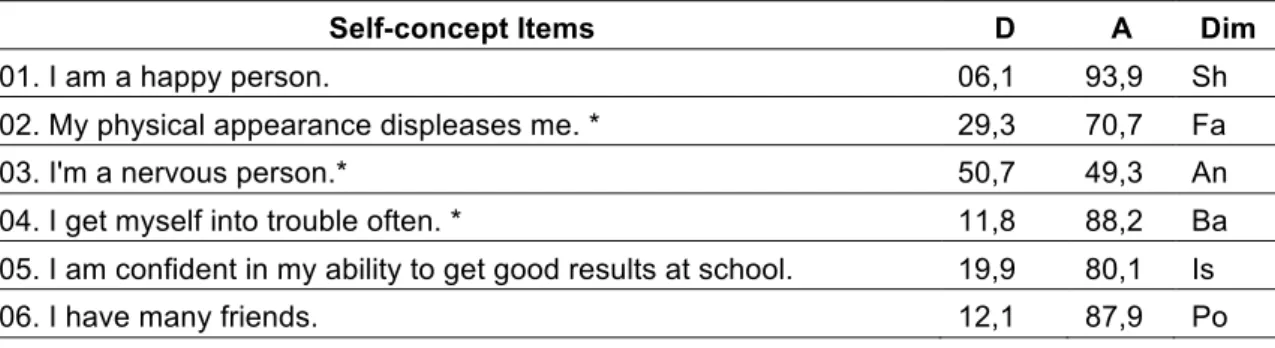
Before considering more specific data, focused on the research question, statistics on the students’ distribution by engagement (table 1) and self-concept (table 2) items, and respective dimensions, are presented, considering agreement versus disagreement with their content.
In what refers to engagement, the items with a higher percentage of participants in agreement are item 8 - My school is a place where I feel integrated – and item 7 - My school is a place where I make friends easily – (86,1% e 83,6%), both from the affective dimension. The items with a lower percentage of agreement are: 12 - I am absent from classes while in school – and 14 I am rude toward teachers - (3,6% e 2,3%), both from the behavioural dimension. It is worth noting that 18% of the students disagree with the item My school is a place where it seems to me that others like me (item 9) and that 24,5% agree with the item I am distracted in the classroom (item 15). In what concerns to the item I review my notes regularly, even if a test is not coming up, only about half of the students does it (49,5%). Also worthy is item 6, with 9,3% of the students feeling excluded from school.
In what refers to self-concept (table 2), items 1 and 5 stand out, due to the amount of students disagreeing with the sentences I am a happy person (6,1%) and I am confident in my ability to get good results at school (19,9%).
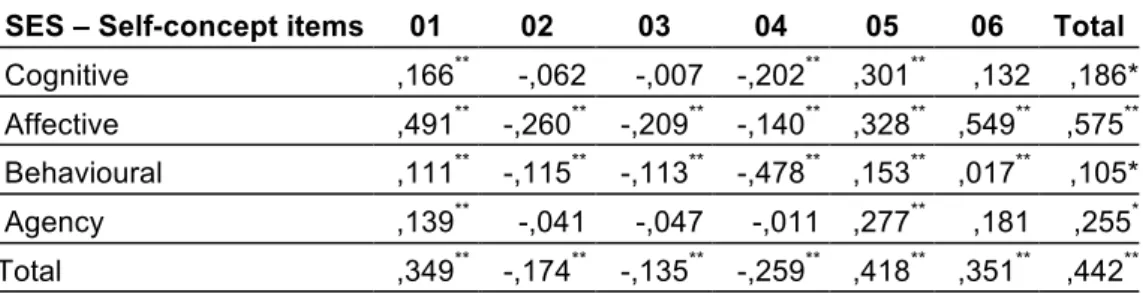
Given the research problem, we determined the correlations between SES dimensions and self-concept items (table 3). We came across the existence of significant, and in the expected direction, correlations, particularly in the affective dimension and total SES, as well as in items 1 (I am a happy person) and 5 (I am confident in my ability to get good results at school) of self-concept.
Table 1. Students’ distribution by engagement items content, in terms of disagreement (D) versus agreement (A)
Engagement Items D A Dim.
08. My school is a place where I feel integrated. 13,9 86,1 Afe
07. My school is a place where I make friends easily. 16,4 83,6 Afe
09. My school is a place where it seems to me that others like me. 18,0 82,0 Afe
04. When I'm reading, I try to understand the meaning of what the author wants to transmit.
25,3 74,7 Cog
16. During classes, I put questions to the teachers. 30,7 69,3 Age
01. When writing my work, I begin by making a plan for drafting the text 32,4 67,6 Cog
02. I try to connect what I learn in one discipline with what I learn in others.
32,6 67,4 Cog
18. I comment with my teachers, when something interests me. 34,5 65,5 Age
19. During lessons, I intervene to express my opinions. 35,9 64,1 Age
17. I talk to my teachers about my likes and dislikes. 47,7 52,3 Age
05. I review my notes regularly, even if a test is not coming up. 50,5 49,5 Cog
20. I make suggestions to teachers about how to improve classes. 60,0 40,0 Age
03. I spend a lot of my free time looking for more information on topics discussed in class.
68,6 31,4 Cog
15. I am distracted in the classroom. 75,5 24,5 Beh
06. My school is a place where I feel excluded. 90,7 09,3 Afe
10. My school is a place where I feel alone. 90,9 09,1 Afe
11. I am absent from school without a valid reason. 92,6 07,4 Beh
13. I deliberately disturb classes. 94,2 05,8 Beh
12. I am absent from classes while in school. 96,4 03,6 Beh
14. I am rude toward teachers. 97,7 02,3 Beh
* Reversed items: 6, 10, 11, 12, 13, 14, 15.
Note: Cog – cognitive; Afe – affective; Beh – behavioral; Age – agency.
Table 2. Students’ distribution by self-concept items content, in terms of disagreement (D) versus agreement (A)
Self-concept Items D A Dim
01. I am a happy person. 06,1 93,9 Sh
02. My physical appearance displeases me. * 29,3 70,7 Fa
03. I'm a nervous person.* 50,7 49,3 An
04. I get myself into trouble often. * 11,8 88,2 Ba
05. I am confident in my ability to get good results at school. 19,9 80,1 Is
06. I have many friends. 12,1 87,9 Po
* Reversed items
Note: Sh – Satisfaction happiness; Pa – Physical appearance; An – anxiety; Ba – Behavioral aspect; Is - intellectual status; Po – popularity.
Table 3. Correlations between SES dimensions and self-concept items
SES – Self-concept items 01 02 03 04 05 06 Total
Cognitive ,166** -,062 -,007 -,202** ,301** ,132 ,186*
Affective ,491** -,260** -,209** -,140** ,328** ,549** ,575**
Behavioural ,111** -,115** -,113** -,478** ,153** ,017** ,105*
Agency ,139** -,041 -,047 -,011 ,277** ,181 ,255*
Total ,349** -,174** -,135** -,259** ,418** ,351** ,442**
** Correlation is significant at the 0.01 level (2-tailed).
Note: 01. I am a happy person.02. My physical appearance displeases me. 03. I'm a nervous person. 04. I get myself into trouble often. 05. I am confident in my ability to get good results at school. 06. I have many friends.
According to studies using two-way ANOVA, it is highlighted that the concept of effect must be understood as a relation or an association – and never be mistaken with cause (Gorard, 2003; Veiga, 2013).
In view of psychological development theories, we aimed to study the participants’ results distributed by two distinct moments of the evaluative process, and considering two groups: one including students from 6th and 7th grades, and another composed by 9th and 10th grades. We sought to analyze if there were statistically significant differences, in the engagement dimensions, between students with high and low self-concept. One other purpose was to examine if any significant interaction effect, between the variables self-concept and grade level, occurred on the engagement results.
Thus, the mean and standard deviation scores, on engagement dimension, obtained for groups divided by grade level and dichotomized self-concept (low and high), are presented in table 4. Two-way ANOVA results are shown on table 5. We may observe a principal effect of grade level; results are higher for the 6th and 7th graders, when compared with the 9th and 10th grade students, in the cognitive (COG) and agentic (AGE) dimensions, as well as in total SES (SESTOT); mean differences were not found in the affective (AFE) and behavioural (BE) dimensions. The main effect of self-concept was more extensive. Results were greater in those students showing a higher self-self-concept, in all engagement dimensions; variance analyses (ANOVAs 2x2) showed that engagement differences, between higher and lower self-concept students, and the superiority of the last, acquire high levels of statistical significance in all engagement dimensions (p<0.001).
Table 4. Mean and standard deviation in engagement (SES) dimensions, according to grade level and self-concept (SC)
SES Cognitive Affective Behavioural Agency Total
Grade level SC N M SD M SD M SD M SD M SD 6º e 7º low 114 18,5 0,4 22,9 0,4 26,0 0,3 17,6 0,5 84,9 1,1 high 194 20,8 0,3 26,6 0,3 27,8 0,2 20,4 0,4 95,5 0,8 9º e 10º low 204 17,3 0,3 22,6 0,3 26,2 0,2 17,8 0,4 83,9 0,8 high 173 18,0 0,4 26,5 0,3 27,1 0,2 18,5 0,4 90,2 0,9
Table 5. Variance analyses in engagement (SES) dimensions, according to grade level and self-concept (SC)
GL QM F P S GL QM F P S GL QM F P S
Cognitive Affective Behavioural
Grade
level 1 610,6 27,2 0,00 *** 1 6,1 0,3 0,57 ns 1 8,8 0,8 0,37 ns
SC 1 363,9 16,2 0,00 *** 1 2281,4 123,5 0,00 *** 1 323,0 30,1 0,00 ***
SC*Grade
level 1 100,0 4,4 0,04 * 1 1,9 0,1 0,75 ns 1 31,2 2,9 0,09 ns
Agency TOTAL SES
Grade level 1 118,3 3,7 0,05 * 1 1682,9 13,1 0,00 *** SC 1 520,1 16,2 0,00 *** 1 11581,1 89,8 0,00 *** SC*Grade level 1 176,4 5,5 0,02 * 1 755,9 5,9 0,02 * * p < .05; ** p < .01; *** p < .001
The interaction effect of the variables self-concept and grade level occurred in the cognitive, agency and total SES dimensions (figs. 1, 2, 3).
Figs. 1, 2, 3. Interaction effect of the variables self-concept and grade level
In the cognitive dimension, the interaction was due to the increase in engagement from 6th/7th grade to 9th/10th grade, in the group of students with high self-concept (t=5,34; Gl=365; p<0.001), while it remained stable in the group of students with low self-concept. In the affective dimension, a similar effect occurred: a decrease in affective engagement in the group with high self-concept (t=3,29; Gl=365; p<0.001), and stability in the group with low self-concept (ns). Total SES revealed a similar decrease (t=4,62; Gl=365; p<0.001) and stability, according to the respective group.
6 CONCLUSIONS
The literature reviewed, together with the data found, highlight that school deals with several difficulties in keeping its students engaged, particularly, those showing a weak self-concept, throughout adolescence. Results found in the present study indicate specific, still not high,
adolescent students participated. As expected, a greater engagement was found in students showing a higher self-concept, suggesting the benefit of measures to promote students’ self-concept, particularly of those showing lower engagement, as a mean to increase their connection to school and decrease school dropout, as a response to school problems.
The engagement decrease, throughout adolescence (cognitive and agency dimensions), requires further clarification, suggesting, though, that school loses the expected effect over time. The interaction between the variables self-concept and grade level occurred in those same dimensions (cognitive and agency), as well as in total SES. In the cognitive dimension, the interaction was due to the decrease of engagement from 6th/7th grade to 9th/10th grade, in the group of students with higher self-concept, while it remained stable in the group of students with lower self-concept. In what concerns to the agentic dimension, the same variations were found: a decrease of engagement in the group with high self-concept and stability in the group with low self-concept. Total SES showed the same tendency.
These oscillations in engagement may indicate that school has been lacking the necessary support to those students with lower self-concept, from 6th/7th to 9th/10th grade; thus, school hasn’t been able to stimulate 6th/7th grade students’ engagement and development, which, on the contrary, decreases. This deficit in school efficacy has been suggesting the introduction of support and monitoring structures, directed toward those extreme students. The activation of school psychology services may constitute a path in that direction. The lack of previous studies creates an obstacle to comparing data, and calls attention to the need for further deeper studies.
In short, the study of school engagement, throughout adolescence, acquires importance, as research has been highlighting the idea that engaged students show better socio-scholar adjustment, both in terms of achievement and behaviour (Klem & Connel, 2004; Reeve & Tseng, 2011; Veiga et al., 2012), which, consequently, may carry benefits for families and society.
ACKNOWLEDGEMENTS
This article is a product of the project PTDC/CPE-CED/114362/2009 - Envolvimento dos Alunos na escola: Diferenciação e Promoção/Students Engagment in School: Differentiation and Promotion, financed by National funding, through the Fundação para a Ciência e Tecnologia (FCT).
REFERENCES
[1] Veiga, F. H. (2013). Envolvimento dos alunos na escola: Elaboração de uma nova escala de
avaliação. International Journal of Developmental and Educational Psychology. 1(1), 441-449.
[2] Reeve, J., & Tseng, C. (2011). Agency as a fourth aspect of students’ engagement during
learning activities. Contemporary Educational Psychology. 36(4), 257-267.
[3] Veiga, F. H., Carvalho, C., Almeida, A., Taveira, C., Janeiro, I., Baía, S., Festas, I., Nogueira, J.,
Melo, M., & Caldeira, S. (2012). Students’ engagement in schools: differentiation and promotion In M. F. Patrício, L. Sebastião, J. M. Justo, & J. Bonito (Eds.), Da Exclusão à Excelência: Caminhos Organizacionais para a Qualidade da Educação (pp. 117-123). Montargil: Associação da Educação Pluridimensional e da Escola Cultural.
[4] Fredricks, J., Blumenfeld, P., & Paris, A. (2004). School Engagement: Potential of the Concept,
State of the Evidence. Review of Educational Research Spring, 74(1), 59–109.
[5] Glanville, J. L., & Wildhagen, T. (2007). The measurement of school engagement: Assessing
dimensionality and measurement invariance across race and ethnicity. Educational and Psychological Measurement, 67(6), 1019-1041.
[6] Jimerson, S., Campos, E., & Greif, J. (2003). Towards an understanding of definitions and measures of student engagement in schools and related terms. The California School Psychologist, 8, 7-28.
[9] Johnson, M. K., Crosnoe, R., & Elder, G. H., Jr. (2001). Students’ attachment and academic engagement: The role of race and ethnicity. Sociology of Education, 74, 318-340.
[10] Skinner, E. A., & Belmont, M. J. (1993). Motivation in the classroom: Reciprocal effects of teacher behavior and student engagement across the school year. Journal of Educational Psychology, 85, 571-581.
[11] Voelkl, K. E. (1997). Identification with school. American Journal of Education, 105, 294–318. [12] Finn, J., & Rock, D. (1997). Academic success among students at risk for school failure. Journal
of Applied Psychology, 82(2), 221-234.
[13] Jordan, W., & Nettles, S. (2000). How students invest their time outside of school: Effects on school-related outcomes. Social Psychology of Education, 3, 217-243.
[14] Finn, J. D., Pannozzo, G. M., & Voelkl, K. E. (1995). Disruptive and inattentive-withdrawn behavior and achievement among fourth graders. The Elementary School Journal, 95, 421–434. [15] Appleton, J., Christenson, S., & Furlong, M. (2008). Student engagement with school: critical conceptual and methodological issues of the construct. Psychology in the Schools, 45(5), 369-386.
[16] Furrer, C., & Skinner, E. (2003). Sense of relatedness as a factor in children’s academic engagement and performance. Journal of Educational Psychology, 95, 148 – 162.
[17] Marsh, H. W., & Craven, R., (1997). Academic self-concept: Beyond the dustbowl. In: Phye, G., Editor, Handbook of classroom assessment: Learning, achievement, and adjustment (pp. 131-198). Orlando: Academic Press.
[18] Marsh, H. W., Relich, J. D., & Smith, I. D. (1983). Self-Concept: The construct validity of interpretations based upon the SDQ. Journal of Personality and Social Psychology, 45, 173-187.
[19] Marsh, H. W., Walker, R., & Debus, R. (1991). Subject-specific of Academic Self-Concept and Self- Efficacy. Contemporary Educational Psychology, 16, 331-345.
[20] Marsh, H. M. & Yeung, A. S. (1997). Causal effects of academic self-concept on academic achievement: Structural equation models of longitudinal data. Journal of Educational Psychology, 84, 41-54.
[21] Cole et al. (2001). The development of multiple domains of child and adolescent self-concept: A cohort sequential longitudinal design. Child Development, 72(6), 1723–1746.
[22] Wigfield, A., Eccles, J. S., Mac Iver, D., Reuman, D. A., & Midgley, C. (1991). Transitions during early adolescence: Changes in children’s domain-specific perceptions and general self-esteem across the transition to junior high school. Developmental Psychology, 27, 552-565. [23] Marsh, H. W. & Craven, R. (1997). Academic self-concept: Beyond the dustbowl. In G. Phye
(Ed.), Handbook of classroom assessment: Learning, achievement, and adjustment (pp.131– 198). Orlando, FL: Academic Press.
[24] Skaalvik, E., & Rankin, R. (1992). Math and verbal achievement and self-concepts: Testing the internal/external frame of reference model. Journal of Early Adolescence, 12(3), 267-279. [25] Piers, E. V. (1988). Manual for the Piers-Harris Children's Self-Concept Scale (The Way I Feel
About Myself) (2ª Ed. rev.). Tennesse: Counselor Recording and Tests.
[26] Marsh, H. W., & O'Mara, A.J. (2008). Reciprocal effects between academic concept, self-esteem, achievement and attainment over seven adolescent-adult years: Unidimensional and multidimensional perspectives of self-concept. Personality and Social Psychology Bulletin, 34, 542-552.
[27] Ghazvini, S. (2011). Relationships between academic self-concept and academic performance in high school students. Procedia Social and Behavioral Sciences, 15, 1034–1039. Retrieved
[29] Jones, J. G., & Gieneeks, L. (1970). Measures of self-perceptions as predictors of scholastics achievements. Journal of Educational Research, 63, 201-203.
[30] Machargo, J. (1991). El Profesor y el auto concepto de sus alumnos: teoría y práctica. Madrid: Escuela Espanola.
[31] Marsh, H. W. & Parker, J. (1984). Multidimensional adolescent self-concept: Their relationship to age, sex and academic measures. American Educational Research Journal, 22, 422-444. [32] Garcia, J. L. et al. (2000). Estranhos: Juventude e Dinâmicas de Exclusão Social em Lisboa.
Oeiras: Celta Editora.
[33] Marsh, H. W. (1990). The structure of academic self-concept: The Marsh/Shavelson model. Journal of Educational Psychology, 82(4), 623-636.
[34] Gorard, S. (2003). Quantitative methods in social science. New York: Continuum.
[35] Klem, A., & Connell, J. (2004). Relationships Matter: Linking Teacher Support to Student Engagement and Achievement. Journal of School Health, 74(7), 264-274.