Quality Criteria and Concepts for the
Development of Mobile Health Applications
Por
Matthias Frohner
Orientador: Stefan Sauermann
Co-orientador: Jo˜
ao Agostinho Batista Lacerda Pav˜
ao
Tese submetida `a
UNIVERSIDADE DE TR ´AS-OS-MONTES E ALTO DOURO para obten¸c˜ao do Grau de
DOUTOR
em Engenharia Electrot´ecnica e de Computadores, de acordo com o disposto no DR – I s´erie – No151, Decreto-Lei n.o115/2013 de 7 de agosto e no
Regulamento Geral dos Ciclos de Estudo Conducentes ao Grau de Doutor DR, 2.a s´erie - No 133 de 13 de julho de 2016
Quality Criteria and Concepts for the
Development of Mobile Health Applications
Por
Matthias Frohner
Orientador: Stefan Sauermann
Co-orientador: Jo˜
ao Agostinho Batista Lacerda Pav˜
ao
Tese submetida `a
UNIVERSIDADE DE TR ´AS-OS-MONTES E ALTO DOURO para obten¸c˜ao do Grau de
DOUTOR
em Engenharia Electrot´ecnica e de Computadores, de acordo com o disposto no DR – I s´erie – No151, Decreto-Lei n.o115/2013 de 7 de agosto e no
Regulamento Geral dos Ciclos de Estudo Conducentes ao Grau de Doutor DR, 2.a s´erie - No 133 de 13 de julho de 2016
Orienta¸c˜ao Cient´ıfica :
Stefan Sauermann
FH-Prof, Dr. do
Department Life Science Engineering University of Applied Sciences Technikum Wien
Jo˜ao Agostinho Batista Lacerda Pav˜ao
Professor Auxiliar, Doutor do
Departamento Engenharias da Escola de Ciˆencias e Tecnologia Universidade de Tr´as-os-Montes e Alto Douro
”He had found a Nutri-Matic machine which had provided him with a plastic cup filled with a liquid that was almost, but not quite, entirely unlike tea.”
The Hitchhiker’s Guide to the Galaxy, Douglas Adams (1952 - 2001)
UNIVERSIDADE DE TR ´AS-OS-MONTES E ALTO DOURO Doutor em Engenharia Electrot´ecnica e de Computadores
Os membros do J´uri recomendam `a Universidade de Tr´as-os-Montes e Alto Douro a aceita¸c˜ao da disserta¸c˜ao intitulada “Quality Criteria and Concepts for the Development of Mobile Health Applications” realizada por Matthias Frohner para satisfa¸c˜ao parcial dos requisitos do grau de Doutor.
Dezembro 2018
Presidente: Professor Doutor Jos´e Boaventura Ribeiro da Cunha, Professor Associado com Agrega¸c˜ao do Departamento de
Engenharias da Universidade de Tr´as-os-Montes e Alto Douro
Vogais do J´uri: Professor Doutor Nelson Fernando Pacheco da Rocha, Professor Catedr´atico do Departamento de Ciˆencias M´edicas da Universidade de Aveiro
Professor Doutor Salviano Filipe Silva Pinto Soares, Professor Auxiliar do Departamento de Engenharias da
Universidade de Tr´as-os-Montes e Alto Douro
FH-Prof Dr. Johannes Martinek,
Professor do Department of Life Science Engineering da University of Applied Sciences Technikum Wien
Professor Doutor Lu´ıs Jos´e Cal¸cada Torres Pereira, Professor Auxiliar do Departamento de Engenharias da
Universidade de Tr´as-os-Montes e Alto Douro
Stefan Sauermann,
FH-Prof, Dr. do Department Life Science Engineering da University of Applied Sciences Technikum Wien
Crit´
erios de Qualidade e Conceitos
para o Desenvolvimento de Aplica¸c˜
oes M´
oveis para a Sa´
ude
Matthias FrohnerSubmetido na Universidade de Tr´as-os-Montes e Alto Douro para o preenchimento dos requisitos parciais para obten¸c˜ao do grau de
Doutor em Engenharia Electrot´ecnica e de Computadores
Resumo — A qualidade ´e uma medida do desempenho de um sistema ou software com base nas expectativas do utilizador. Para aplicativos m´oveis, os aspetos de qualidade tamb´em s˜ao importantes, se n˜ao ainda mais importantes, em compara¸c˜ao com aplicativos de desktop, j´a que a grande quantidade de aplicativos m´oveis dispon´ıveis permite que um utilizador alterne para outra solu¸c˜ao que atenda ao mesmo prop´osito. Este trabalho investiga a aplicabilidade de modelos de qualidade de software estabelecidos e descreve as caracter´ısticas de qualidade mais importantes para aplica¸c˜oes m´oveis de sa´ude (mHealth), as quais foram identificadas atrav´es de entrevistas com especialistas. O trabalho mostrou que a ”interoperabilidade” ´e de suma importˆancia e coloca em evidˆencia os recursos do sistema/software para trocar dados com outros sistemas. Primeiro, os casos de uso foram identificados e especificados usando um modelo desenvolvido para o efeito. O primeiro caso de uso lida com a aquisi¸c˜ao de dados usando dispositivos pessoais de sa´ude em combina¸c˜ao com smartphones, e o segundo caso de uso descreve a comunica¸c˜ao de dados entre um dispositivo m´ovel e um provedor de sa´ude, usando interfaces padronizadas e formata¸c˜ao de documentos. Esses casos de uso foram implementados como prot´otipos Android e foram validados com base num conjunto de crit´erios derivados de diferentes diretrizes e especifica¸c˜oes dispon´ıveis para comunica¸c˜ao de dados de sa´ude. E tamb´´ em fornecida informa¸c˜ao acerca de desafios de interoperabilidade envolvidos no campo de sistemas de energia, uma vez que a experiˆencia reunida nesta ´area para testes de conformidade e interoperabilidade, tamb´em pode ser aplicada a sistemas de IT e aplicativos m´oveis da ´area da sa´ude. Os esfor¸cos de padroniza¸c˜ao e harmoniza¸c˜ao atuais s˜ao discutidos ao n´ıvel t´ecnico
de comunica¸c˜ao propriet´arios e terminologia n˜ao harmonizada, essas informa¸c˜oes n˜ao poder˜ao ser usadas facilmente para processamento posterior
Palavras Chave: eHealth, mHealth, Qualidade, Telemonitoriza¸c˜ao, Normas de Comunica¸c˜ao, Valida¸c˜ao, Testes.
Quality Criteria and Concepts for the Development of Mobile Health
Applications
Matthias Frohner
Submitted to the University of Tr´as-os-Montes and Alto Douro in partial fulfillment of the requirements for the degree of Doctor of Philosophy in Electrical Engineering and Computers
Abstract — Quality is a measure of how well a system or software performs based on its user’s expectations. For mobile applications, quality aspects are important as well, if not even more important compared to desktop applications, since the multitude of available mobile applications enables a user to switch to another solution that fulfills the same purpose. This work investigates the applicability of established software quality models and depicts the most important quality characteristics for mHealth applications that were identified in expert interviews. It showed that ”interoperability” is of paramount importance and denotes the system/software features to exchange data with other systems. First, use cases were identified and specified using a developed use case template structure. The first use case deals with the data acquisition using personal health devices in combination with smartphones, and the second use case describes the communication of health data from a mobile device to a health care provider using, standardized interfaces and document formats. These use cases were implemented as Android prototype applications and were validated against a set of criteria derived from different guidelines and specifications available for health data communication. Insights from interoperability challenges in the field of energy systems are provided, since experience has been gathered for conformance and interoperability testing that can be applied to health IT systems and mobile application, as well. Ongoing standardization and harmonization efforts are discussed on a technical and on a regulatory level. Interoperability is only one of the quality criteria that need to be addressed, but once data is exchanged using proprietary communication protocols and non-harmonized terminology, a further use of the data is aggravated,
Standards, Validation, Testing
Acknowledgments
My gratitude goes to my parents, Andrea and Werner, for their support, not only in those last years when I was working on this thesis, but for paving the way in order to become the person I am today.
I would like to thank my dear colleagues and best friends, Philipp, Birgit, Mathias, Veronika and Richard with whom I not only share an office but also ideas. They were always able to either help me when I got stuck, dispel doubts or cheer me up with their unique sense of humor.
Many thanks to Stefan Sauermann, who, as a role model, has always inspired me with his exceptional knowledge in the various fields that are connected to the term eHealth he always managed to point out the relevance and the connections between the single areas. His experience with interoperability of health care systems acted as the giant’s shoulder enabling me to participate in the world of standardization. Furthermore, I can consider myself very lucky to have got in touch with the colleagues and friends that I found at UTAD in Portugal. Especially Jo˜ao Pav˜ao, Luis Pereira, Rute Bastardo, and Victor Costa for their hospitality and the efforts they took to introduce me to the Portuguese culture and making me feel very welcome every single time I visited this beautiful country.
My deepest gratitude goes to my wife Victoria, who never got tired of motivating
Table of Contents
Resumo xi
Abstract xiii
Acknowledgments xv
Index of Tables xxi
Table of Figures xxiii
Glossary, Acronyms and Abbreviations xxix
1 Introduction 1
1.1 Motivation . . . 7
1.2 Structure of this Work . . . 8
1.3 Genesis of this Work . . . 9
2 Background 13 2.1 Quality Requirements for Software Development . . . 14
2.2 Software Engineering Requirements Methodologies. . . 21
2.3 Interoperability Challenges . . . 25
2.3.1 European Interoperability Framework . . . 26
2.3.2 Organizations Interoperability . . . 28
2.3.3 Testing and Certification . . . 30
2.3.4 Interoperability for Mobile Applications . . . 32 xvii
2.4 Privacy and Security Considerations of Software Systems . . . 60
2.5 Chronic Disease Management . . . 63
3 Materials and Methods 67 3.1 User/Mobile-Application Engagement Model . . . 70
3.1.1 Phases in the User/Mobile-Application Engagement Model . . 71
3.1.2 Different User Types . . . 72
3.2 Use Case Design and Definition . . . 74
3.3 Software Quality Characteristics . . . 77
3.4 Frameworks and Criteria Catalog Addressing Interoperability. . . 78
3.4.1 Downstream Data Exchange . . . 80
3.4.2 Upstream Data Exchange . . . 82
3.4.3 Criteria Catalog . . . 84
3.5 Prototype Implementations . . . 88
3.5.1 Interfacing a Personal Health Device . . . 88
3.5.2 Send Clinical Document to Health Care Provider . . . 91
3.6 Validation of Prototype Implementations . . . 94
3.7 Interoperability Testing of Mobile Applications. . . 96
3.8 Smart Grids - Transfer of Knowledge . . . 99
4 Results 103 4.1 Results of the Expert Interviews . . . 103
4.1.1 Stakeholders . . . 103
4.1.2 Quality in Use Model . . . 104
4.1.3 System/Software Product Quality . . . 107
4.1.4 Need for Certification Programs . . . 108
4.1.5 User/Mobile-Application Engagement Model . . . 109
4.2 Use Case Definition . . . 110
4.2.1 Use Case I: Interfacing a Personal Health Device. . . 111
4.2.2 Use Case II: Send Clinical Document to Health Care Provider 113 4.3 Implemented Prototypes . . . 116
4.3.1 Interfacing a Personal Health Device . . . 116
4.3.2 Send Clinical Document to Health Care Provider . . . 117
4.4 Validation of the Implementation Against Criteria Catalog . . . 122
4.5 Mobile Health Applications Tested . . . 130
4.5.1 Personal Health Device Simulator for Bluetooth Low Energy Testing and Education . . . 131
4.6 IES Interoperability Test Using Gazelle . . . 133
5 Discussion 137
6 Conclusion and Future Work 151
Bibliography 155
A Appendix 169
A.1 Survey . . . 169
A.2 Use Case PHD-IF based on IEC 62559 . . . 172
About the Author 187
Index of Tables
2.1 Categorization of the Use Cases stated in HL7 Consumer Mobile
Health Application Functional Framework . . . 21
2.2 Comparison of identified blood glucose meters, data transport, and standardization statuses . . . 39
2.3 CDA Levels according to HL7 Deutschland . . . 57
3.1 Template for Use Case Identifiers and Short Narrative of the Use Case 76 3.2 Template for Use Case Architecture and Information Exchange. . . . 77
3.3 Criteria and Requirements for Downstream Data Exchange . . . 85
3.4 Criteria and Requirements for Data at Rest . . . 87
3.5 Criteria and Requirements for Upstream Data Exchange . . . 87
3.6 Specification of the weight scale feature characteristic . . . 91
3.7 Concepts used for blood glucose . . . 95
4.1 Use Case I: PHD-IF . . . 111
4.2 Use Case I: Architecture of the Systems and Transactions . . . 112
4.3 Use Case II: CDA generation and XDM email . . . 114
4.4 Use Case II: Architecture of the Systems and Transactions . . . 115
4.5 Validation of Downstream Data Exchange . . . 123 xxi
A.1 Use Case Identification - Acquiring Data from a PHD . . . 172
A.2 Use Case Version Management for Use Case Telemon-001 . . . 173
A.3 Scope and Objectives of Use Case Telemon-001 . . . 174
A.4 Narrative of Use Case - Telemon-001 . . . 175
A.5 Key Performance Indicators (KPI) - Telemon-001 . . . 176
A.6 Use Case Conditions - Telemon-001 . . . 177
A.7 Use Case Classification - Telemon-001 . . . 178
A.8 Use case diagram - Telemon-001 . . . 179
A.9 Actors - Telemon-001 . . . 180
A.10 References to Standards, Specifications and Recommendations -Telemon-001 . . . 181
A.11 Overview of Scenarios - Telemon-001 . . . 182
A.12 Scenario steps . . . 183
A.13 Information exchanged . . . 184
Table of Figures
1.1 mHealth Initiatives, globally . . . 5
2.1 External and internal quality criteria of software . . . 15
2.2 Quality in use model . . . 17
2.3 Application Life Cycle stated by HL7 Consumer Mobile Health Application Functional Framework . . . 20
2.4 Architecture Development Method (ADM) defined by The Open Group Architecture Framework . . . 23
2.5 Use case methodology . . . 24
2.6 Interoperability model of the European Interoperability Framework . 26
2.7 PCHAlliance high level architecture . . . 30
2.8 Different mHealth application scenarios . . . 36
2.9 Google Trend Analysis for IEEE 11073 and Bluetooth Low Energy. . 40
2.10 Domain information model for blood pressure monitor . . . 42
2.11 Overview of the Generic Attributes and the hierarchical structure as defined for BLE . . . 45
2.12 HL7 CDA R-MIM. . . 50
2.13 The six classes of the HL7 CDA RIM . . . 51 xxiii
2.15 The XSLT transformation process . . . 54
2.16 The three CDA Levels based on the structure of the CDA R-MIM . . 56
2.17 Actors/Transaction Diagram of IHE’s Cross-Enterprise Document Sharing (XDS) profile. . . 59
2.18 Austrian framework guideline for IT infrastructure for telemonitoring purposes . . . 66
3.1 The user/mobile-application engagement model . . . 74
3.2 Specification of the Record Access Control Point services for blood glucose . . . 90
3.3 The actor diagram from IHE’s XDM profile . . . 92
3.4 Personal health device simulator . . . 98
3.5 Use case diagram Send Planned Schedule (SPS) as defined in Technical Framework Virtual Power Plant . . . 101
4.1 Number of answers to the question of quality in use characteristics for primary users, secondary users, and indirect users . . . 105
4.2 Number of answers to the characteristic Satisfaction, itemized for the subcharacteristics and the different stakeholder groups . . . 106
4.3 Number of answers to the characteristic Freedom of risk, itemized for the subcharacteristics and the different stakeholder groups . . . 106
4.4 Number of answers to the characteristic Context coverage, itemized for the subcharacteristics and the different stakeholder groups . . . . 107
4.5 ISO/IEC 25010 System/software product quality model . . . 108
4.6 Number of answers for the characteristics based on the system/software product quality model . . . 109
4.7 Visual representation of the blood glucose reading using the ELGA reference stylesheet . . . 118
4.8 XDM folder structure . . . 121 xxiv
4.9 Snapshot of the incoming email containing the XDM zip file and the information that this email has been signed and encrypted . . . 121
5.1 Suggested graphical representation of the most important application characteristics . . . 149
A.1 Page 1 of the Survey . . . 170
A.2 Page 2 of the Survey . . . 171
Table of Listings
2.1 ASN.1 specification for the ApduType taken from the ISO/IEEE 11073-20601 (IEEE Engineering in Medicine and Biology Society,
2011b).. . . 42
2.2 HL7 Version 2.x example for the communication of vital parameters . 48
2.3 Basic structure of a CDA section (neither elements nor attributes contain data in this example; only the structure of a section is described) 52
4.1 CDA observation coding a single blood glucose reading . . . 119
4.2 Structure of the test case XML as suggested in Frohner et al.(2017) . 132
4.3 Data Format Definition Language example for the InvokeId element . 134
4.4 Example of the binary representation of the invokeId using three bytes134
4.5 Example of an invokeId after the transformation to XML . . . 135
Glossary, Acronyms and
Abbreviations
Glossary
App –short for Application
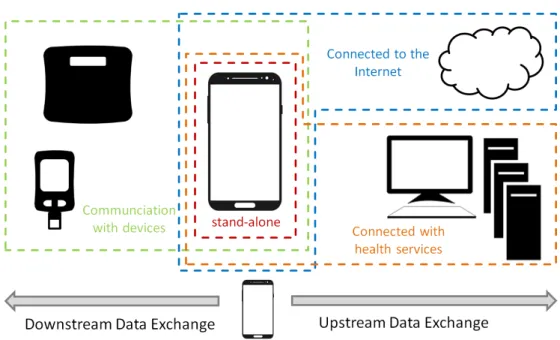
Downstream Data Exchange –Data exchange between a mobile phone and devices that are used in the context of eHealth as an external data source (e.g. blood pressure device) and are connected to the mobile device via short range transport channels
eHealth –use of IT technologies for health applications
mHealth –eHealth application for the mobile devices
Mobile Application –Applications that are supposed to run on a mobile device. Mobile applications are available on market platforms and can get installed by the mobile device’s user
Mobile Device –Device that is wearable and is personalized by its (mostly) single user. These devices are smartphones, tablets, or wearables, where the latter
ANT –wireless technology for data communication in the field of sports- and wellness monitoring
ANT+ –profile based specification for ANT communication
Data at Rest –State of data when it is stored on the phone
Gazelle –Test framework developed and used by IHE for interoperability and conformance testing
IHE –Integrating the Healthcare Enterprise. A consortia promoting the use of already existing standards by profiling the identified standards to be applied for a certain use case. IHE provides test events for interoperability and conformance test.
LOINC –Logical Observation Identifiers Names and Codes, terminology that is used mainly - but not exclusively - for coding laboratory parameters
PCHAlliance –founded based on the Continua Health Alliance. Providing interface specification to communicate data from the patients’ home towards an electronic health record system
SNOMET-CT –Systematized Nomenclature of Medicine - Clinical Terms; Taxonomy of clinical vocabulary
Upstream Data Exchange –Data exchange between a mobile phone and a remote service, where data is mainly sent from the phone to the service (e.g. sending vital data from the users phone to a health professional) via wide range transport channels
Wearables –short for wearable computers. Wearables are supposed to be worn on the body or mounted to clothing during usage
ZigBee –wireless technology introduced overcoming the shortcomings of classic Bluetooth regarding the energy consumption
List of Acronyms
Initials Expanded
ASN.1 Abstract Syntax Notation One API Application Programming Interface
App Application
BAN Body Area Network BER Basic Encoding Rules
BT Bluetooth
BLE Bluetooth Low Energy
CDA Clinical Document Architecture CDG Continua Design Guidelines
CMHAFF HL7 Consumer Mobile Health Application Functional Framework
DEC Device Enterprise Communication DFDL Data Format Description Language EDR Enhanced Data Rate
EHR Electronic Health Record GPS Global Positioning System HCP Healthcare Provider HDP Health Device Profile
HIPAA Health Insurance Portability and Accountability Act IEC International Electrotechnical Commission
IEEE Institute of Electrical and Electronics Engineers IHE Integrating the Healthcare Enterprise
ISO International Standard Organization IT Information Technology
LAN Local Area Network
NHS National Health Service OID Object Identifier
PAN Personal Area Network PCD Patient Care Device
PCHAlliance Personal Connected Health Alliance PHD Personal Health Device
RCAP Record Control Access Point
SCADA Supervisory Control and Data Acquisition SIG Special Interest Group
SOAP Simple Object Access Protocol
TCP/IP Transmission Control Protocol / Internet Protocol UML Unified Modeling Language
UUID Universally Unique Identifier WAN Wide Area Network
WHO World Health Organization XML eXtensible Markup Language
List of Abbreviations
Abbreviation Significance
e.g. exempli gratia, for example et al. et aliae, and the other people etc. et cetera, and so on
(continued on the next page)
(continued)
Abbreviations Significance i.e. id est, that means
1
Introduction
Mobile devices like smartphones or tablets seem to be the most personalized digital devices that accompany us during our days. No matter if the users of the smartphones are digital natives or digital immigrants, more and more features of these devices are used in our daily lives. Staying in contact with family and friends, doing the banking, keeping track of schedules, proving identity (two way authentication), navigation, or accessing the Internet; for various reasons daily routines where changed due to technological advances and mobile phones. These devices changed our daily lives on multiple levels, since they enabled users to access information more or less all over the planet and be (virtually) available 24/7.
One can categorize the vast amount of devices on the market nowadays based on the platform they run. On the one hand, there is Apple, the pioneer that introduced smartphones in form of the iPhone for the broader public, and on the other hand, Google with its Android operating system. The strategies of these ”big players” on the mobile market are very different since Apple provides and manages the whole ecosystem of hardware and software on its own. Google is mainly the provider of the operating system and its services. The needed hardware is developed and sold by different companies that bring their devices onto the market with a more or less
adapted version of Google’s Android operating system. Nonetheless, both share the principle of a market platform for distributing mobile applications (apps) that users can install conveniently in order to fulfill their individual needs. Hence, one smartphone in use will differ from the next based on its personalizations, such as different wallpapers, the distribution of icons on the home screen, the applications installed on the device, and, last but not least, the device itself. Due to the success of smartphones, the next step was the introduction of tablets. Those new devices use the smartphone technology but offer larger screens that ease their use, but (often) lack - compared to smartphones - direct connection capabilities to mobile networks. Furthermore, they are at a disadvantage when it comes to size and weight. They run the same operating systems like smartphones and therefore also enable users to customize their tablets based on different applications downloaded from the marketplaces.
Recent numbers of the US market, presented byComScore(2017) for the year 2017, state that 50% of all digital media is consumed using smartphone applications, and only 34% on the classical desktop computer. The remaining 16% are divided by tablet applications, tablet web, and smartphone web. In total, 87% of the time users spend with their devices is by using applications, and only 14% on mobile web. (ComScore, 2017)
Statista, Inc., presents on their webpage that with March 2017, Google’s Play store hosted 2.8 million applications and Apple’s App Store provided 2.2 million applications for download (Statista,2017a). Statista also states that the number of mobile applications downloaded worldwide in 2016 reached almost 150 billions and Statista estimated approximately 200 billions and 350 billions in the years 2017 and 2021, respectively (Statista, 2017b).
The number of new applications that try to catch the users’ attention and canvass to be used is increasing day by day and makes it difficult for users to choose between multiple different applications fulfilling the same, or very similar, demands. The majority of the applications available in the application stores can be purchased for free. Current numbers for the Google Play store show that almost 95% of the
3
offered applications are for free (Statista Ltd., 2018). But for free is not always free free, since developers and publishers of applications depend on revenues and earn money indirectly, either by placing advertisements in the free to use versions or by offering only a reduced set of features. For both cases, normally an upgrade to the pro-version will free the applications from ads and reveal the whole set of features. Guidelines on how to price an application, see for example the article How to Price Your App: Free or Paid by Ryan Chang (2014), describe that users are more and more unwilling to pay for an application, but by considering advertisements and in-app purchases the vendors can shift cash flows. Apart from the purpose of earning money directly with an application, whether by putting a price on the application, using advertisement, or providing in-app purchases, another means to earn money is by collecting large amounts of data from the user population. The utterance
if you are not paying for it, you’re not the customer; you’re the product being sold,
which seems to date back to a post by a user called blue beetle in an online forum back in 2010 (Blue beetle, 2010) seems to illustrate exactly this idea. Making users aware that there is no such thing as a free lunch might enable them to reflect on what data they are willing to share and what price they are willing to pay for that. This circumstance will influence the experience a user will gather with a certain application and will result in the overall personal quality rating of the application. Article 13 of the European General Data Protection Regulation (GDPR) (European Union,2016), which has been enforced since the 25th of May 2018, regulates - beside
other items - that the data subject must be informed about what kind of personal data is collected, the purpose for processing these data and the legal basis to do so. Besides, Article 13 defining the responsibilities of the controller in cases when data is directly collected by the data subject, Article 14 continues to define the controllers’ responsibilities when personal data is not directly acquired by the data subject but by third parties.
applications that are run on the users’/patients’ smartphones. Data describing the physical condition of a patient by measuring vital parameters, blood glucose levels, or psychological conditions by asking the patients to answer questionnaires are considered sensitive information and are addressed as personal data in the context of the GDPR. The patient, as the data owner, is entitled to administrate the collected data, even if he or she takes part in a professional telemonitoring program. These facts are addressed, for example, in the recent HL7 (Health Level 7) technical report describing a functional framework for consumer mobile health applications released as a draft in January 2018 (Health Level Seven International, 2018).
Frey et al.(2017) empirically investigated if the stages of life of users can be predicted based on the applications they have installed. Part of their work was to collect information concerning installed applications from the 1425 participants who took part in the survey. One finding was that the average user decided to have 44 applications installed. These applications can be assigned to different categories, like games, business, education, or travel. Another category on the markets is health & fitness. Health and fitness applications encompass a wide area of health and fitness topics, from tracking and sharing fitness data, or keeping a diary with vital parameters or nutrition, to tele-medical solutions.
The Greenpaper on mobile health published by the European Commision (2014) uses the definition for mHealth from the World Health Organization (2011). They state that mHealth covers ”medical and public health practice supported by mobile devices, such as mobile phones, patient monitoring devices, personal digital assistants (PDAs), and other wireless devices”, and extends this definition by including lifestyle and wellbeing applications.
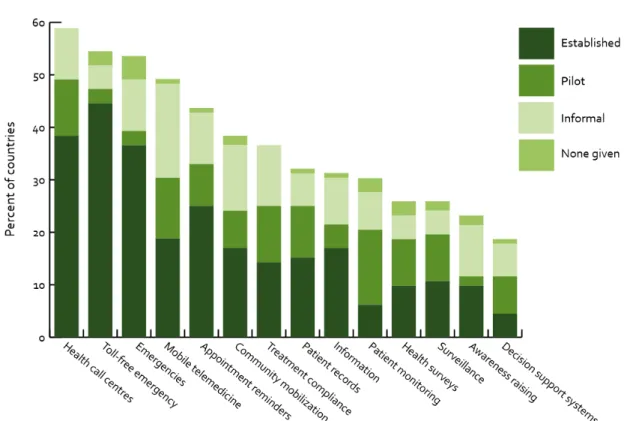
The World Health Organization further stresses that mHealth implements the use of mobile data services, voice and text services, Bluetooth technologies, as well as data gained from a mobile phone’s GPS receiver. This WHO report gives an overview of the implemented and to-be-implemented mHealth initiatives on a global scale (based on WHO countries). The most often reported applications include health call centers and helplines, emergency telephone services, and applications for emergencies and
5
Figure 1.1 – mHealth Initiatives, globally (taken from World Health Organization(2011))
mobile telemedicine (Figure 1.1). (World Health Organization, 2011)
Facilitation of mHealth applications can a be a tool for detecting diseases, especially chronic diseases, at an early stage, since patients are stronger engaged in their own health by assessing conditions using medical devices at home on a regular basis and are enabled by mobile technologies to share the gathered information with health professionals easily. The patient will likely develop a healthy lifestyle if feedback from health professionals arrive on a regular basis and fast. Extrapolated to a larger population, it can be expected that a healthier society has positive effects on the overall financial cost of the stressed healthcare systems within the European member countries. (European Commision, 2014)
A report on ”Patient Adoption of mHealth” by the IMS Institute for Healthcare Informatics (2015) summarizes that in the year 2015, 50% of mHealth applications offered only limited functionality, as they only informed, instructed, recorded, or
displayed health related information and did not offer additional features. Hence, their role in healthcare was rather limited. An interaction or form of communication with healthcare providers is not possible with such applications. Since health professionals are not involved in the design of this kind of applications, plenty of applications are available to be used by the end-users. These users have no guidance in the decision which application might be best suited for them. Hence, the end-users can only rely on ratings available in the application store (or elsewhere on the Internet), and they might have to try multiple application before they find an appropriate application. This circumstance unveils the fact that ”mechanisms to rate, certify and select apps” are needed. The report from IMS continues by stating that 10% of the investigated mHealth applications implement the possibility to connect to an external sensor or device. While most of these applications can be categorized as fitness applications, the number of applications that can connect to medical devices, e.g. blood pressure monitor devices, is rising. Consumers are interested in connecting their phones with external sensory devices and they embrace this feature fast. Healthcare providers or organizations are not that fast to include these technologies in their care paths. (IMS Institute for Healthcare Informatics,
2015)
A common issue of software development and usage, including mobile applications, is a certain concern about quality. Multiple definitions for quality exist in literature, stating a common concept, but it might still depend on different points of view. Quality can be a measure for (not exclusively) the stability, the performance, or the usability of a software system. It might also be a measure representing security, safety or privacy issues. However, maybe simplified, quality can describe the extent to which a software solution suits the needs of the users. Quality is only achievable if the users’ needs are known during the development phases of the software product. For standard software, or off-the-shelf software, programmers have an idea about the intended customers, but might not be able to know specific needs of all the addressed customers in detail. Since this potential group is very heterogeneous, and the distribution via application markets reaches all mobile users to the same extent, it is difficult to satisfy the requirements/demands of all users equally.
1.1. MOTIVATION 7
1.1
Motivation
In our daily routine, digital mobile devices and software solutions are accompanying components and the increasing number of mobile and affordable devices cement their importance in our lives. New fields of applications have been introduced in order to assist a user in various tasks. Especially in the area of mobile applications, single software solutions collect enormous amounts of data that a single user - with or without knowing - generates. A lot of these data are of sensitive character (Gilbert et al.,2011), and the use of these data is mostly not obvious to the user (McAllister,
2014). The gathered information is mainly used for commercial purposes and user profiling, but could also be used for open data applications. Apart from the implementation based aspects of modern applications, social and cognitive factors also play a more and more important role.
Mobile applications are mainly distributed via the device specific online application stores. Developers can sign up for a distribution license and can offer their software products to users globally (Holzer and Ondrus, 2011). This easy to use form of distribution channel - almost without any entry barriers - has led to an increasing number of companies and implementers offering their products. Nonetheless, in many cases, the quality of new implementations cannot keep up with the increasing speed and shortened time periods of the software development cycle. A lack of a classification system (Nickerson et al., 2007), missing quality criteria and missing functional and especially non-functional requirements (like data security, data privacy and usability) make it difficult to compare and validate these applications. These problems become tangible whenever a person, a company or a public body has the task to choose, to select or to recommend applications.
1.2
Structure of this Work
In the Chapter Background, this work introduces different scenarios where mHealth applications are used and introduces different types of applications, based on their capabilities to connect and interact with external devices and/or server applications. This chapter continues with different aspects of requirement engineering, since the set of features to be implemented in a mobile application needs to fit the requirements that are stated by the users and/or can be derived from regulatory frameworks. Based on requirements and the users’ needs, quality criteria can be derived and different software quality models are described. Relevant stakeholders, like HL7, for standardizing communication interfaces are presented and their relevance is discussed. To clarify the field of interoperability, interoperability challenges that effect the communication of data from an external sensor device (e.g. Personal Health Device (PHD)) to the mobile application, and interoperability challenges that effect the communication of data from the mobile application to server based systems are described separately. The first, the communication with external sensor devices, deals with the availability of wireless interfaces and communication standards, where the latter, the communication with remote services, deals with communication protocols and formats following HL7 specifications. Furthermore, profiles from Integrating the Healthcare Enterprise (IHE) that are relevant for mHealth scenarios are described. The chapter ends with security requirements and disease management programs where the implemented prototype application described in this work, can be applied.
The Chapter Materials and Methods defines the approach that was used to validate the applicability of quality models for mHealth applications and give a prioritization of the quality characteristics and quality sub-characteristics introduced in the quality models. In addition, a user/mobile-application engagement model from a user’s viewpoint is introduced. Based on existing use case methodologies, a condensed use case template is developed. This work was continued by identifying relevant frameworks that target to provide guidance on how to implement the
1.3. GENESIS OF THIS WORK 9
requirements stated in the use cases. Conditions and techniques are stated for the development of the prototype mHealth applications and a criteria catalog is defined for validation purposes. This criteria catalog considers the defined use cases and the frameworks and guidelines that were identified. This chapter ends with the transfer of gained knowledge from the medical IT domain and introduces synergistic aspects of interoperability in the field of energy.
In the Results section, the outcomes of the conducted expert reviews for validating the applicability of quality models and quality characteristics for mHealth applications are presented. This survey also contains the validation of the user/mobile-application engagement model. Using the introduced use case template, two use cases in the field of mHealth are presented, and the prototype implementation for these use cases is described. The prototypes are validated using the defined set of criteria and the outcome of this validation is stated in this work. Furthermore, the outcomes of an Android application simulating PHDs is addressed. Finally, experiences from interoperability testing in the field of energy, using IHE’s testing framework Gazelle are reflected.
The Discussion interprets the presented results and provides the big picture and the strategies to develop mHealth applications. Insights from the work of standardization of CDA (Clinical Document Architecture) documents are provided and the connections to other relevant fields of standardization and harmonization are presented.
1.3
Genesis of this Work
The results presented in this work reflect the research activities of the author from the last years. Parts of the results were published and presented at national and international scientific conferences. The following list states only the publications with lead authorship of the author of this thesis:
S., and Mense, A. (2012). Development of an android app in compliance with the continua health alliance design guidelines for medical device connectivity in mhealth. Biomedizinische Technik, 57(SUPPL. 1 TRACK-N).
• Frohner, M., Urbauer, P., and Sauermann, S. (2017). Bluetooth Low Energy Peripheral Android Health App for Educational and Interoperability Testing Purposes. Studies in health technology and informatics, 236:336-342.
• Frohner, M., Meyer, M., Donsa, K., Urbauer, P., David, V., and Sauermann, S. (2018b). Telemonitoring of Blood Glucose - A Prototype Android Application Enhancing the Patient / Health Professional Experience Using Health IT Communication Standards. In DSAI 2018: 8th International Conference on Software Development and Technologies for Enhancing Accessibility and Fighting Info-exclusion. in Press.
• Frohner, M., Gottschalk, M., Franzl, G., Pasteka, R., Uslar, M., and Sauermann, S. (2018a). Smart grid interoperability profiles development. 2017 IEEE International Conference on Smart Grid Communications, SmartGridComm 2017, 2018-Januar(October):189-194.
Besides this scientific publications the author of this thesis was leading author for the following HL7 Austria standard documents, written for the Austrian electronic health record system ELGA and the Austrian federal ministry of health and women:
• ELGA GmbH (2017a). ELGA CDA Implementierungsleitfaden - HL7 Implementation Guide for CDA (R) R2: Laborbefund Version 2.06.2 -31.01.2017
translates to: ELGA CDA Implementation Guide for Laboratory Reports
• BMGF (2017). Implementierungsleitfaden Meldung an das Epidemiologische Meldesystem (EMS) - Labor- und Arztmeldung - Version 2.00
translates to: Federal Ministry of Health and Women. Implementation Guide for Reporting to the Epidemiological Vigilance System
1.3. GENESIS OF THIS WORK 11
Currently, normative specifications are developed for the Pensionsversicherung (public pension insurance), Statistic Austria, and the Austrian Medical Chamber and will be publicly released on a Wiki page.
2
Background
This work investigates different quality models for software and system development and their applicability for mHealth applications. Based on a survey showing the relevance of different quality characteristics stated in the quality models, especially the need for interoperability capabilities of systems and software, quality criteria are defined for mHealth applications. These criteria address aspects of use, as well as existing frameworks and guidelines for standardized communication interfaces. Prototype implementations are introduced in this work based on a developed use case template and two identified and specified use cases in the field of data acquisition using personal healthcare devices, and the standardized communication of clinical documents. Software test methodologies for conformance and interoperability tests are described, implemented in a prototype application simulating personal healthcare devices, and a report on ongoing test efforts in the different, but related, field of interoperability in energy systems are introduced. The work also develops a user/mobile-application engagement model, describing the user engagement with a certain application. Hence, this chapter provides an insight into ongoing efforts of the above mentioned topics that are covered within this work.
2.1
Quality
Requirements
for
Software
Development
Quality, in the context of software development, is a concept to describe how well a software product fulfills the demanded requirements. These requirements can be stated by the customer, be established based on a business context, they can be derived from statutory provisions, they can be deducted from standards that are in place for certain fields of application, or existing guidelines and best practices. Different quality models are available that define various dimensions of quality consisting of single quality characteristics. Some of the characteristics can be used to describe if the software product accomplishes the pre-defined tasks (functional requirements) where other characteristics are used to describe how well the task is performed (non-functional requirements). The different flavors of characteristics demand different approaches how to validate to which degree the requirements are fulfilled. Hence, there is no common methodology to test the quality of a product in terms of the system’s performance, its security measures, or its usability. In addition, the perspective of how the system is evaluated can change from a more technological perspective to a perspective of an end-user. Where the first is dealing with quality characteristics and properties that are assigned to the software system itself, the latter deals with characteristics that the user of the system perceives.
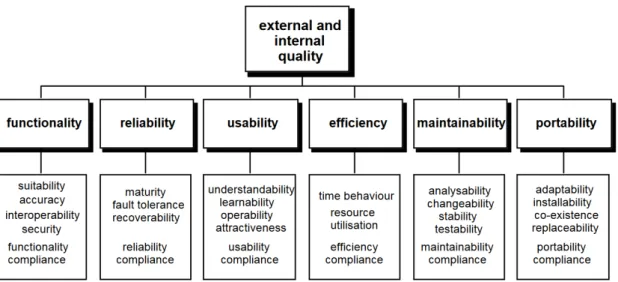
The ISO/IEC standard 9126-1, Information technology - Software product quality, define the ”Quality Model” in its part 1. This model is depicted in Figure 2.1 and it shows the relevant quality characteristics for external and internal quality. Apart from the other characteristics stated in this figure, the functionality of the software product is of major importance, since a system might be very efficient and very stable, but if the intended purpose of the software is not fulfilled, the system cannot be used. The standard describes functionality as follows:
2.1. QUALITY REQUIREMENTS FOR SOFTWARE DEVELOPMENT 15
Figure 2.1 – External and internal quality criteria of software according toISO 9126(2000)
This characteristic is concerned with what the software does to fulfil needs, whereas the other characteristics are mainly concerned with when and how it fulfils needs. (ISO 9126, 2000)
Based on this basic requirement of functionality, the subcharacteristics interoperability and security seem to be of major importance, since they are not directly connected to solving a specific task. Their purpose is to ensure connection features with other software/systems and to ensure data privacy and security.
Bøegh (2008) describes that for software requirement engineering and software quality requirements, an isolated view on the upcoming software product is not sufficient. A broader approach is necessary to take the whole system into consideration, which combines the computer system itself, including its hardware, its software and data, mechanical parts, and human processes. Each of the stated parts of this holistic approach can be reflected in a quality model and needs to be considered for a software product.
There are multiple definitions for the term quality in place. Prominent definitions are available from standard developing organizations, one example being from the ISO/IEC/IEEE system and software engineering vocabulary (ISO/IEC/IEEE
24765, 2010) referencing to other standards like IEEE 829, a standard for software and system test documentation (IEEE Computer Society, 2008) where quality is defined as ”the degree to which a system, component, or process meets specified requirements” (ISO/IEC/IEEE 24765, 2010) or ”the degree to which a system, component, or process meets customer or user needs or expectations” (IEEE Computer Society,2008). The first definition clearly states that validation can result in a metric, showing to which extend quality has been achieved. Based on a set of specific requirements, someone is able to check what criteria have been achieved and where quality is lacking. The second definition is more critical since quality is defined partially on ”soft”-criteria. For a customized software solution, the chance to clarify the specific needs with the customers and to discuss the targeted solutions is given, however, it is not an easy task. For off-the-shelf solutions targeting a broad cohort, the collection of criteria to satisfy the need and expectations is more difficult. Each individual of this cohort is going to grade the quality of the application when it is used in the individuals’ specific context. Therefore, a more detailed look at this type of quality has been defined in ISO/IEC 9126-1 (ISO 9126,2000) and it has now been taken over in the newer ISO/IEC 25010 standard (ISO/IEC 25010, 2011).
These standards take existing definitions of quality into consideration (focused on product quality) and define a more complete quality model. This quality model introduces (1) internal and (2) external quality attributes, and (3) quality in use attributes. Internal quality attributes address techniques and approaches for software, or document validation and might consider internal instructions for e.g. reusability. External quality attributes summarize requirements the software’s capabilities to satisfy needs when the system is used under specified conditions. The concept of quality in use stresses the characteristics of the software when used by the end-users within their environment and in the users’ specific context. ISO/IEC 25010 extends the former model from ISO/IEC 9126-1 so that quality in use is no longer a product but a system quality parameter. It includes additional sub-characteristics for satisfaction and ”freedom from risk” (formerly called ”safety”) and introduces the ”context coverage” characteristic. Those three quality characterizations are dependent on each other, i.e. internal quality attributes
2.1. QUALITY REQUIREMENTS FOR SOFTWARE DEVELOPMENT 17
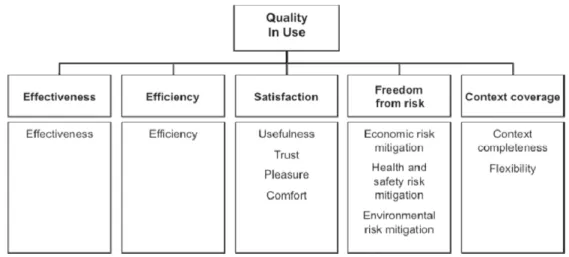
Figure 2.2 – Quality in use: this model represents the quality characteristics of a product from a user’s perspective (figure taken from ISO/IEC 25010(2011))
influence the external quality attributes and those influence the quality in use attributes. Internal and external quality attributes are modeled based on classical functional (suitability, accuracy, interoperability, security, functional compliance) and non-functional (reliability, usability, efficiency, maintainability, and portability) characterizations of a product.
The quality in use model, as depicted in Figure2.2, shows the quality characteristics and sub-characteristics that are relevant from an end-user’s perspective.
Whenever an application meets the quality in use criteria for a certain user or user group, the chances of getting better ratings or reviews on the application market rise and result in ”ratings and reviews are benchmarks of app quality” (Google,
2018). Based on an application’s ranking and reviews, the emotional perception of potential users is influenced (Huang and Korfiatis, 2015). Kim et al. (2013) write about a model describing the connection between the users’ engagement in mobile applications, the perceived value, the users’ satisfaction, and the continued engagement intention of the users. These findings have been used to formulate the hypothesis that ”increased engagement has a positive impact on a consumer’s continued intention to use mobile applications” and supported this by a survey.
Stressing the different views on quality (internal, external and in use) once more, it can be stated that the first two are more attached to the development phases of an application, i.e. criteria for reaching a certain level of internal and external quality can be reached before the application is brought to a market. The latter - the quality in use - is perceived by the users - therefore after the launch of a product - and it reflects the potential difference between the user requirements engineering phase and the actual user behavior and the user perception of the application. Poor quality in use might be the result of the gap between the user’s expectations (pre-install or pre-use of the application) and the user’s experiences with the application (after installing or after using it). One reason for this variance are functional capabilities that do not work the way the user had expected. Furthermore, a mismatch between certain expectations and perceptions is likely to occur when the user is not able to find or interpret the described features of the application and finds them missing during usage. The latter will result in the fact that the user might consider not to use the application any longer and substitute this application for another.
Vagrani et al. describe the ”smaller life cycle” of applications and developed and tested a model stating the reasons for uninstalling applications. They cluster the different reasons for the smaller application life cycle into four categories; (1) Unsupported Telecom Infrastructure, (2) Post Adoption Performance, (3) Mobile Equipment Hardware Concerns/issues, and (4) Data Privacy and Security Issues. They found that high data consumption, higher GPS usage, and higher resource consumption increase the possibility of uninstalling an application. Furthermore, as data security concerns, where they stress that the latter ”comes up as a new significant factor”. (Vagrani et al.,2017)
A report from the British Standard Institution (BSI), named Health and wellness apps - Quality criteria across the life cycle - Code of practice (PAS 277:2015) (BSI, 2015), starts with highlighting the term Fitness for purpose, meaning that an application should meet all technical requirements and quality criteria in order to be accepted by the involved parties (users and application publisher). Moreover, fitness for purpose is aligned with the intended use that should be considered during all
2.1. QUALITY REQUIREMENTS FOR SOFTWARE DEVELOPMENT 19
project phases and within the application’s documentation. The report continues with the definition of the application life cycle from the developer’s perspective and introduces the quality criteria based on ISO/IEC 25010. This report maps identified criteria for health and wellness application to the Health on the Net (HoN) quality criteria that have been introduced for medical and health websites. The HoN foundation state as their mission
to promote the effective and reliable use of the new technologies for telemedicine in healthcare around the world (Health on the Net Foundation, 2018)
and provides a certification program for health websites. This certification includes an assessment of the eight HONcode principles, which include Authoritative, Complementary, Privacy, Attribution, Justifiability, Transparency, Financial disclosure and Advertising policy principles. (Health on the Net Foundation, 2018)
Another document dealing with mobile applications and their quality aspects and requirements was drafted by HL7. The HL7 Consumer Mobile Health Application Functional Framework, Release 1 (CMHAFF) (Health Level Seven International,
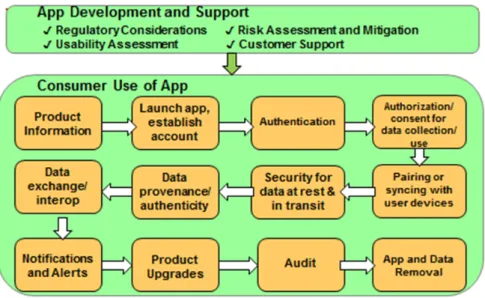
2018) was released by HL7 in the beginning of the year 2018 and is currently available as a standard for trial use and is, at the time being, balloted by the community. The intended audience for this document are mainly developers and vendors of mobile health applications. This document should provide a guideline for the development and the placement on the market for mobile health applications that are not intended to be used and operated by health professionals. Saying that, it also excludes certain clinical and health application functionalities as well as ”general” device security requirements and infrastructure requirements. It should be a guide for general requirements that can be found in mobile health applications on the consumer market and enables the audience to further start profiling. Based on a mobile application life cycle (see Figure2.3) the single corresponding chapters provide recommendations concerning the implementation.
Figure 2.3 – Application Life Cycle stated by HL7 Consumer Mobile Health Application Functional Framework, taken fromHealth Level Seven International (2018)
The first deals with a standalone application in the context of wellbeing, e.g. an application recording the walked distances using the GPS sensors of mobile phones. The second use case describes a wellness application connected with a back-end service that hosts information. A weight management application can be considered as an example. The last use case describes a disease management application, characterized by a connection to an electronic health record system. Based on these use cases, different categorizations are further depicted and shown in Table 2.1. The matrix that is described in this table shows on the one hand that different categories of mHealth applications can be considered: wellness applications or medical applications. On the other hand, the matrix discusses topics of interoperability (data collection and data transmission) and the possibility to use either unregulated or regulated (medical) devices. Finally, this table discusses security and safety aspects by stating the importance of data integrity for mobile applications that are part of medical scenarios. As an example of legal requirements that need to be considered for medical devices, the matrix contains references to the Health Insurance Portability and Accountability Act (HIPAA) (Pub. L. No. 104-191,
2.2. SOFTWARE ENGINEERING REQUIREMENTS METHODOLOGIES 21
Table 2.1 – Categorization of the Use Cases stated in HL7 Consumer Mobile Health Application Functional Framework, taken from Health Level Seven International(2018).
Simple Device
Integrated
EHR Integrated
Medical Device App Categorization wellness wellness or medical medical Device Data Collection none unregulated or regulated device regulated device
PHI Data Collection smartphone smartphone/PHR cloud/EHR Data transmission by
App
none device-app-PHR device-app-cloud-EHR Importance of Data
Integrity
low mid high
(USA) HIPAA
covered?
no no, only if white-labeled
yes
information exchange and management. Concerning use cases where devices (PHDs) are integrated to communicate with mobile devices, HIPAA provisions must only be considered if the product is provided by a HIPAA regulated organization (even if the product is not distributed under the organization’s name but as a white-labeled product).
2.2
Software
Engineering
Requirements
Methodologies
The first step in a product life cycle is the definition and clarification of the needed functions that the customer states. The artifacts that arise from this phase are the basis for further development. Both parties need to ensure that the desired goal is very clear from the beginning of the project. Abran and Moore (2004) describe different topics that are affected and included in the overall term Software Requirement, besides the software requirement fundamentals and the process itself. Those are:
• Requirements Elicitation: defining the origin of the software requirements and how those can be collected by the software engineer
• Requirements Analysis: investigation of the collected requirements for conflicts between the individual requirements and how they can be solved, how the requirements are reflected by the future environment, and the derivation of software requirements based on the system requirements
• Requirements Specification: the generation of a document stating the requirements that can be used for review or evaluation purposes
• Requirement Validation: the requirements may be reviewed to ensure that their specification is understood and conforms to standards used in the company
ISO/IEC/IEEE 29148 (ISO/IEC/IEEE 29148, 2011), the international standard for life cycle processes of system and software engineering, defines requirements engineering as
interdisciplinary function that mediates between the domains of the acquirer and supplier to establish and maintain the requirements to be met by the system, software or service of interest.
This standard then describes requirement engineering as an iterative process where the suppliers’ requirement definition process, the requirements analysis process, and the architectural design process all include feedback loops. The overall process is stated to be recursive, i.e. outcomes from one process act as the input for the next, more detailed, process.
The different levels of abstraction - from requirement engineering from a system perspective to requirement engineering on a software level - are also depicted by the Architecture Development Method (ADM) from the The Open Group Architecture Framework (TOGAF), but with a higher focus on management layers (The Open
2.2. SOFTWARE ENGINEERING REQUIREMENTS METHODOLOGIES 23 Requirements A Architecture Vision B Business Architecture C Information System Architecture D Technology Architecture E Opportunities and Solutions F Migration Planning G Implementation Governance H Architecture Change Management Prelim. Framework and Principles
Architecture Development Method (ADM)
The Open Group Architecture Framework (TOGAF)
Figure 2.4 – Architecture Development Method (ADM) defined by The Open Group Architecture Framework (adapted and based on (The Open Group,2009))
Group, 2009). The process is described in eight subprocesses that depend on each other and are all part of the overall requirements management process (Figure 2.4).
Defining the requirements is dependent on the users’ and/or acquirers’ needs. In order to formulate the needs, the definition of the intended use case or use cases is desirable. Based on these use cases, the first iterative requirements engineering processes can start to provide a formal representation of the use cases. The IEC standard 62559-2 (IEC 62559, 2015) specifies templates for use cases, actors and requirements lists.
Figure 2.5 – Use case methodology according toGottschalk et al. (2017). The reference to the sections (orange boxes) are based on the IEC 62559-2 standard (IEC 62559,2015)
Gottschalk et al. (2017) explain how the IEC 62559-2 standard can be applied and included in the conceptional approach of IHE for profile definitions. This work shows how the generic use case methodology can be implemented and aligned with already existing processes and methodologies used in different fields. Furthermore, it elaborates the available templates from the IEC standard. The whole process of the use case methodology is depicted in Figure 2.5.
2.3. INTEROPERABILITY CHALLENGES 25
2.3
Interoperability
Challenges
of
Software
Systems in eHealth
According to Healthcare Information and Management Systems Society (2013) (HIMSS), interoperability is the capability of healthcare IT systems and software applications to exchange and share information with each other. HIMSS stresses that besides the exchange and sharing of information, the receiver should be enabled to use the data. Especially this point is of most importance whenever data should be interpreted, managed and analyzed automatically using IT systems. This society takes over the definition of three different levels of interoperability that are stated in a report on Uniform Data Standards for Patient Medical Records Information by the National Committee on Vital and Health Statistics (NCVHS) (2000). These three levels are:
• Basic: meaning that information can be exchanged between two computer based systems but the receiver might not be able to interpret the data.
• Functional: meaning that information that is exchanged can be interpreted by the receiving system at least on a data field level, i.e. the syntax of the message needs to be defined. However, the receiving system might not be able to interpret the information that can be found in the single data fields.
• Semantic: meaning that the receiver is able to interpret the received information. This requires the use of a harmonized set of terminologies both communication partner are able to understand. Hence, further processing of the receiver data can be achieved.
Beside these levels of interoperability, other definitions of levels are available and extend these levels. These extensions might include interoperability of processes, interoperability on an organizational level, or aspects of legal interoperability.
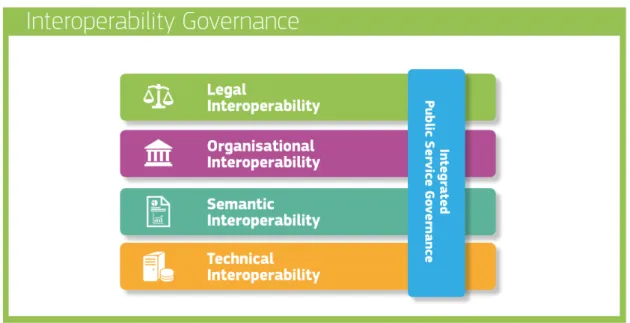
Figure 2.6 – Interoperability model of the European Interoperability Framework. Taken fromEuropean Union (2017)
2.3.1
European Interoperability Framework
Interoperability of systems is also one challenge that is recognized and addressed by the European Union. The European Interoperability Framework (EIF) (European Union, 2017) defines interoperability as the ability of organizations to ”interact towards mutually beneficial goals”. This includes the sharing of data using IT systems. This definition suggests that EIF is not only focusing on technical challenges but approaches the issue of interoperability on a more holistic level. EIF is not addressing the healthcare sector specifically but describes the mean to exchange information between public administration bodies. Figure 2.6 depicts the different levels of interoperability as stated by the EIF. The first two align with the three levels stated by HIMSS, being Technical Interoperability and Semantic Interoperability, and the last two address issues on Organisational Interoperability and Legal Interoperability.
EIF tries to overcome administrative burdens that are the results of the historical development of isolated systems that are used by the single member countries.
2.3. INTEROPERABILITY CHALLENGES 27
Interoperability is an enabling technology enabling European member countries to exchange information for the sake of the citizens. The report presents a set of common models, recommendations, and principles in order to contribute to a digital single market. The 47 recommendations are assigned to the 12 principles. These principles cover topics from Subsidiarity and proportionality, Reusability, Security and Privacy, to Assessment of Effectiveness and Efficiency. In the context of this work, recommendation number 21 is of specific interest. This recommendation state:
Put in place processes to select relevant standards and specifications, evaluate them, monitor their implementation, check compliance and test their interoperability. (European Union, 2017)
It has been recognized by the European Commission that interoperability is a basic requirement, also for public administration purposes within the member countries. EIF is used by the European Interoperability Architecture (EIA) where single building blocks are defined and can be reused for multiple purposes. Both of these efforts are part of the Interoperability solutions for public administrations, businesses and citizens (ISA2) (European Commission,2018).
In the world of medical IT, organizations are already in place that use methodologies which are aligned with this recommendation 21. Organizations like Integrating the Healthcare Enterprise (IHE) and the Personal Connected Health Alliance (PCHAlliance) promote the use of standardized interfaces to be used for exchanging health data. Both parties identify applicable communication standards, specify those standards in terms of profiling, provide specifications that are publically available, and provide software test tools to validate the conformity of tested software systems.
2.3.2
Organizations Addressing Interoperability Challenges
in Medical IT Systems
In architectural designs, intended to bring the different sources of information together and linking the different software solutions of the systems’ stakeholders, interoperability capabilities of the systems involved become a crucial factor. Whenever data is needed to be shared between IT based systems, the implemented interfaces need to be designed based on prior defined specification. These specifications are described in communication standards, but often lack very restricted requirements in order to satisfy the involved parties with a certain level of flexibility. In terms of interoperability, this flexibility has contra-productive effects, since the solutions of different vendors might implement the requirements stated in the standards differently. Hence, the intended information exchange is no longer possible, although all vendors state that they have implemented their software in accordance with the standard.
This mismatch of implementations was observed in the field of medical IT, where the first implementations of radiology systems claim to implement the Digital Imaging and Communications in Medicine (DICOM) standards from The Association of Electrical Equipment and Medical Imaging Manufacturers (2018). Based on these experiences, the Integrating the Healthcare Enterprise (IHE) (IHE International Inc.,
2018c) initiative was founded.
Integrating the Healthcare Enterprise (IHE)
Integrating the Healthcare Enterprise promotes the use of existing communication standards to ease the orchestration of decentralized services to achieve a common goal: sharing medical information. Based on single use cases, the IHE develops integration profiles that specify how the use case’s demands can be solved technically. Profiles are connected to a specific medical domain (e.g. cardiology, pathology, laboratory medicine, etc.) or to overarching domains, like the IT infrastructure.
2.3. INTEROPERABILITY CHALLENGES 29
For each domain, IHE defined technical frameworks where profiles and underlying use cases can be found. The technical frameworks came in different volumes with a continuously rising level of technical detail specification. Volume I documents introduce the profiles, the needed software entities involved (IHE actors) and their interaction capabilities in form of IHE transactions. Volume II specifies transactions, i.e. which communication standards need to be implemented and further restrictions based on the standard. An example of a profile that is relevant within this work tries to specify how measured parameters can be communicated from a device to an enterprise. This Patient Care Device profile (IHE International,2015) solves the use case when data should be transmitted from a device that is located outside the boundaries of the healthcare facility. The IHE actor on the side of the data source can be implemented on a smartphone or tablet.
When it comes to professional health IT systems, IHE is the leading organization for addressing and solving interoperability issues. Concerning telemonitoring issues, another organization, beside IHE is available that also has the intention of promoting already existing standards, and not defining new ones: the Personal Connected Health Alliance (2018d) (PCHAlliance).
Personal Connected Health Alliance (PCHAlliance)
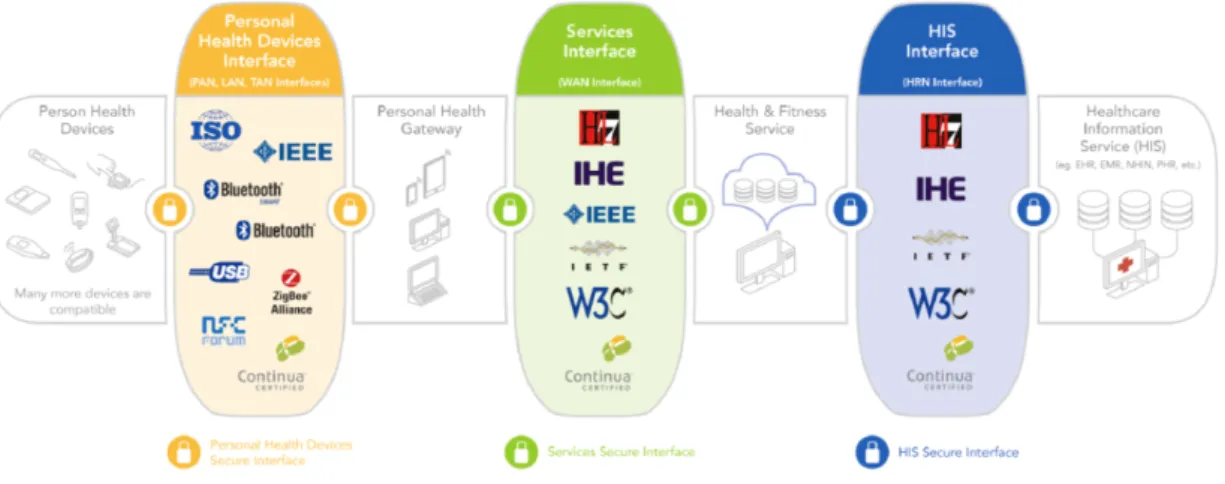
The Personal Connected Health Alliance, formerly known as Continua Health Alliance, is an organization that introduces Continua Design Guidelines (CDG) for software implementations focusing on interoperability. The design guidelines define the Personal Healthcare Device (PHD) interface, for the communication of data from the PHD to IT health infrastructure (Personal Connected Health Alliance,
2016). PCHAlliance relies on the Device Enterprise Communication (DEC) profile from IHE. Therefore it is not a competitor of IHE, but adds to their specification and focuses on ”the first mile” of the data to be transmitted. Figure 2.7 shows the communication steps and the interfaces of the CDG. This steps describe how health data can be communicated from a PHD (the left side of the architecture shown in Figure 2.7) to an Healthcare Information Service (depicted on the right side of