UNIVERSIDADE CATÓLICA PORTUGUESA FACULDADE DE TEOLOGIA
MESTRADO INTEGRADO EM TEOLOGIA (1.º grau canónico)
NELIA SOARES DA SILVA PINHEIRO
COMTEMPORARY MISSION AND CHALLENGES OF RELIGIOUS WOMEN CONGREGATIONS IN THE CONTEXT OF THE
PHILIPPINES AND EAST TIMOR
Dissertação Final sob orientação de: Franz Gassner
Lisboa 2015
ii
Acknowledgement
First of all I am thankful to the Almighty God for enabling me to complete this study.
I would like to express my sincere thanks to my Supervisor, Father Franz Gassner for his guidance, patience, encouragement and valuable ideas, which helped me to complete this work.
I would like to express my deepest gratitude to Father Peter Stillwell, Rector of the University, for providing me with all the necessary facilities.
I place on record, my sincere gratitude to Professor Dr. Arnold Monera, Dean of the Faculty of Religious Studies and to all faculty members for their constant help and encouragement.
Special thanks to Sister Teresa Errea OP, Sister Evangelina Evangelista OP and Sister Julieta Da Costa OP. Through their interviews and access to their projects, I learned more than I could imagine about the History of the Congregation of the Missionary Dominican Sisters of the Rosary. I would like to thank all my Sisters who are always helping me, supporting and caring for me.
I express my thanks also to my classmates, my friends, my family, especially to Fr. Domingos Soares. Their unwavering support has meant more to me than they will ever know. I also place on record, my sincere gratitude to all who, directly or indirectly, have lent their helping hand in this venture.
iii
Abbreviations
AMRSP Association of Major Religious Superiors in the Philippines
EA Ecclesia in Asia: Apostolic Exhortation of Popo John Paul II (1999)
FABC Federation of Asia Bishop Conferences
Fretelin Frente Revolucionária de Timor-Leste Independente (English: Revolutionary Front for an Independent East Timor)
GS Gaudium et Spes: Pastoral Constitution on the Church in the Modern
World of Second Vatican Council (1965)
LG Lumen Gentium: Dogmatic Constitution on the Church of Second Vatican
Council (1965)
Matt Matthew
Mark Mark
NRSV New Revised Standard Version NCR National Catholic Reporter
NA Nostra Aetate: Declaration on the Church‟s Relations with non-Christian
Religions of Second Vatican Council (1965)
OP Order of Preacher
UDT União Democrática Timorense (English: Timorese Democratic Union)
USCCB United States Catholic Conference of Bishops
Table of Contents
Acknowledgement ... ii
Abbreviations ... iii
Table of Contents ... v
Introduction ... 1
Chapter I: History and Profile of Women Religious Congregations in the Philippines and in East Timor... 3
A. Historical Overview: Philippines ... 3
a. Locations of Sisters in the Philippines ... 8
b. Growth and Expansion of Women Religious then and now ... 13
B. Historical Overview: East Timor ... 19
a. The Presence of the Catholic Church and the Participation of Congregation of the Canossian and Dominican Sisters in East Timor ... 20
b. The Mission of the Catholic Church in East Timor ... 23
c. Growth and Expansion of Women Religious then and now ... 25
Chapter II: Contemporary Challenges of Religious Women Congregations according to Universal Church Documents ... 28
A. Vita Consecrata ... 31
a. The Challenge of consecrated Chastity ... 36
b. The Challenge of voluntary Poverty ... 37
c. The Challenge of Freedom to Obedience ... 39
B. Ecclesiae in Asia ... 42
Chapter III: Apostolate of Religious Women Congregations in contemporary Philippines and East Timor ... 47
vi
A. Challenges for Religious Women Congregations in the Philippines ... 50
B. Challenges for Religious Women Congregations in East Timor exemplified in the Mission of the Dominican Sisters ... 54
a. The Mission of the Missionary Dominican Sisters of the Rosary ... 54
b. History of the Opening of the Mission in East Timor ... 60
Conclusion ... 65 Bibliography ... 67 A. Primary Source... 67 B. Secondary Literature ... 67 C. Internet Resources ... 69 D. Interviews ... 70
Introduction
All Christians by virtue of their baptism are called to a life of discipleship and to be a missionary. All Christians are somehow involved in the missionary work of the Church by different roles such as in family life, as single, or religious consecrated life. Mary, the mother of Jesus, is the first disciple, a missionary and a model for all missionaries in following her son. In the time of Jesus, women were considered as second class and did not have much chance in participating in religious rituals in the Temple. However, Jesus always gives favor to women, for instance: women always accompany him in his mission, Jesus appears after his resurrection first to a woman, Mary Magdalene, and Jesus forgives the woman publicly who was caught in adultery. Christian faith and the Church contribute a lot to the proper education and liberation of women. The Second Vatican Council gave more chance to women concerning the work in the Church with an open mind including in women religious congregations.
In the beginning, the religious women Congregations were introduced by missionaries. Later on some of the local women could start local women congregations with many challenges such as financially, politically, and many others.
This thesis paper is divided into three parts. In the first chapter, the writer is going to discuss the history and profile of religious women congregations in the Philippines and in East Timor, follow by the challenges of women congregations according to church documents and in the third chapter the challenges of contemporary religious women regarding their apostolate work are the main focus.
2
The purpose of writing this research paper is to get a better understanding of the original root of the religious women congregations in the Philippines and in East Timor, which are the only dominantly Christian countries in Asia. Once Theodore Roosevelt says, “The more you know about the past, the better prepared you are for the future.” As a future missionary of Dominican Sisters of the Rosary and to prepare for my further mission, the writer believes that this research will help for the future work as a missionary. This research paper can also serve as a reference for those who want to know more about the history of religious women congregations in the context of the Philippines and East Timor.
3
Chapter I: History and Profile of Women Religious
Congregations in the Philippines and in East Timor
This Chapter develops a framework for the study of the spirituality and the Congregational lives of women religious in the Philippines and in East Timor. From the 1930s to the early 1970s and up to today and set within the historical developments of women religious in the Catholic Church, the following study explains the developments of religious women in these two countries, while especially drawing on the experiences of women leaders in these religious congregations.
This first chapter looks at the leadership in the Philippines and East Timor and the subsequent reshaping of congregational principles in the context of the colonization regime following developments of the Second Vatican Council.
A. Historical Overview: Philippines
The Philippines is a country, an archipelago formed by 7,107 islands in Southeast Asia, situated in the Western Pacific Ocean. During the recent visit of Pope Francis to that country, from January 15-19, 2015, the whole world could witness an outburst of faith and devotion of millions of Filipinos attending and participating in the different events in the presence of the Pope as the leader of 1.2 Billion Catholics. The mass media reporting on the visit have noticed that the Philippines is one of only two dominantly catholic countries in Asia, the other one being East Timor. The Philippines with a population of 100 million people, is one of the largest catholic countries in the world.
The evangelization of the Philippines started more than 450 years ago, with the arrival of the first missionaries following the incorporation of the islands into the Spanish
4
Empire in 1565.1 The Spanish rule lasted from the sixteenth century until 1898, when, after a short lived first Philippine Republic, the country came under United States control as a consequence of the Philippine-American War. The Japanese occupation during World War II ended on 5 August 1945, after which the Philippines declared itself an independent country during the presidency of Manuel Roxas.2
The initial work of evangelization was carried out by religious orders, especially the Augustinians, starting from 1565, the Franciscan arrived in 1578, followed by the Jesuits in 1581. Dominican missionaries arrived in 1587, and also the Recollects. They became the source of religious congregations; they started their missions in different forms such as serve the people as pastors, as teachers, doctors and as leaders of villages. These religious orders had three different branches, which were also called “Orders”.3 The monks or friars constituted the First Order, the nuns the Second order, and the affiliated laypersons, the Third Order. A so called Third Order can be constituted by three types of members: to the first type belonged secular members who lived together with their families; a second type of members lived by themselves like hermits, and a third type were called the “Beatas”4
(blessed Women) who lived in a community called “Beaterios” and who wore habits and took simple vows. These “Beatas” were the first
1
Luciano P.R. Santiago, “To Love and To Suffer: The Development Of The Religious Congregations For Women In The Philippines During The Spanish Era (1565-1898),” Philippine Quarterly of Culture and Society, vol. 23, no, 2 (1995): 151-195, esp. 151.
2
Bryan T. Froehle & Mary L. Gautier, Global Catholicism: Portrait of a World Church (Maryknoll, New York: Orbis Books, 2003), 95.
3
Santiago, “To Love and To Suffer,” 152-156.
4
The “Beata” is a general term used in Portugal and Spain as well as colonial America to name a group of pious women who dedicate themselves to pious practices and visiting Churches. They are similar to the Beguines in Northern Africa. They are either living with their families or in a community and may be affiliated to a religious order as tertiaries. Such women also dedicated themselves to some form of apostolate and other social services. Many of these Beatas were later involved into becoming local religious congregations for women.
5
religious women present in the Philippines, who contributed in various ways to the growth and expansion of the Christian faith in this country.5
The scholar‟s interest in Nuns from the 1980s into the present was spurred by the highly visible and often-controversial positions women religious took in the wake of the Second Vatican Council.6 In habit or in ordinary dress nuns throughout the Catholic world took advantage of the relaxation of rules that had previously circumscribed their lives, claiming greater responsibility and freedom as they involved themselves in social and political work well beyond the limits of schools, hospitals, and convents.7When the Second Vatican Council expresses in Lumen Gentium that the Catholic Church focuses her attention on the world of men and women, calling it as the theatre of human history, an ecclesiological shift happened.8Every Christian is called to perfection by the Lord, as it is written in LG: “The Lord Jesus, the divine Teacher and Model of all perfection, preached holiness of life to each and every one of his disciples of every condition of life.”9
From the Church‟s earliest times on there were women and men who set out to follow Christ more freely and to imitate him more closely by practicing the evangelical counsels.10 The Gospels portray women who Jesus accepted both as followers and as
5
Ibid., 164.
6
Coeli Barry, “Women Religious and Sociopolitical Change in the Philippines,” 1930s-1970s,” Philippine Studies: Historical and Ethnographic Viewpoints 62, nos. 3–4 (2014): 377-397, here 378.
7
Barry, “Women Religious and Sociopolitical Change in the Philippines”, 378.
8
Rhoderick John S. Abellanosa, “Philippine Catholicism and Secularization: Face-off, Denial or Dialogue?” Asian Horizons, vol. 7, no. 3, (2013): 547-567, esp. 547.
9
Second Vatican Council, Dogmatic Constitution on the Church Lumen Gentium (1964) no.40.
10
Second Vatican Ecumenical Council, Decree on the up to date Renewal of Religious Life Perfectae Caritatis, (1965), nos. 1.
6
apostolic companions (Luke 8:1-3).11 Jesus encouraged women to listen and learn from him as disciples. The gospel of Matthew 19:3-12, may contain Jesus own vindication of his own celibate lifestyle, which also allowed and inspired both women and men to remain single for the sake of the Kingdom of God.12 Being given the opportunity to live single for the sake of the Kingdom opened the door for women to assume roles in the Jesus movement (Church) other than traditional domestic ones. The Gospel tradition records that women were among the witnesses of Jesus‟ crucifixion, burial, empty tomb and resurrection.13 Here we see the liberating effect the teaching and life of Jesus had on women and the loyalty with which they responded to this call to a new life. The religious women in history continue in this tradition to serve God‟s people and the Kingdom of God proclaimed by Jesus Christ. The “Beatas,” as already mentioned, are the first important group of Christian women giving witness for the Kingdom of God in such a way.
Before the years of turbulence there is a century of history of women religious in the Philippines-even longer if the few congregations established prior to the last quarter of the nineteenth century are taken into account.14 From that time onwards the women were working as teachers and nurses, caring for instance for orphans and unwed mothers. They were first mainly Spanish and Filipina by birth, until the early 1900s when their
11Ben Witherington, III, “Women (NT),” Anchor Bible Dictionary, 6 vols., ed. David Noel
Freedman (New York: Doubleday, 1992), 6: 958.
12
Witherington, III, “Women (NT),” 959.
13
Witherington, III, “Women (NT),” 959.
14
7
number included Belgian, German, Irish, and French, American, as well as Philippine nationals.15
Religious women devoted themselves to the preservation of the Catholic faith where it had already taken root, and introduced it in new mission areas. These women traversed geographic, social, and national boundaries to live by their congregational rules and to instill the ideals of human virtue and Catholic womanhood into their charges.16
This dissertation traces changes in the perception and self-understanding of women religious in the Philippines from the 1930s through to the early 1970suntil today, with a particular emphasis on the considerations around national identity. The compromises women made in the name of their religious community could be tolerated for a time; by the late 1960s, however, the political climate within the Philippines had shifted along with reforms in the global Catholic Church, which also changed the situation of women religious in the Philippines.17
During this period religious women were encouraged to make religious life more locally meaningful by promoting inculturation across various aspects of Catholicism as suggested by the reforms of Second Vatican Council. As a result national differences in the communities surfaced, causing strains inside of communities. Even the communities that were founded in the 1950s and which included only Philippine sisters, but operated with a great influence of European cultural practices inside the convents, were seen more
15
Ibid., 378.
16
Barry, “Women Religious and Sociopolitical Change in the Philippines,”378.
17
8
negatively or critically.18 By highlighting narratives and congregational practices before the 1960s this theses draws attention not only to the issues of vocations (calls to religious life), but also to the social and cultural background within which the choices of women were made. The theses shows the construction of a new way by which women religious related to each other within and across communities, as well as with Filipinos outside the church, in the wake of the conciliar reforms that changed the old language/ideology of religious life.
a. Locations of Sisters in the Philippines
With the exception of a few orders of women religious, either founded in the colony or coming from Spain, those congregations came to the Philippines in the latter part of the nineteenth century. Hence there was only a minority of religious communities for women at the close of over three centuries of Spanish colonial rule. Some communities had secured a place on the edges of the religious landscape as cloistered nuns, living behind thick walls, hidden from the world. Others assumed the work typical of their fellow sisters in Europe: caring for the sick and educating young women, in this case the daughters of the newly developing elites.19 Women congregations deal more with groups rather than with individuals.
According to Luciano P. R. Santiago it is a long saga of courageous struggles and commitments to their cause, with great sacrifices, human failures and unique accomplishments, which invested the Philippine nuns‟ moral authority and charisma in
18
Ibid., 378
19
9
this only Christian nation in Asia.20 Behind their development was the creative force of Christian love and sacrifice. During the three centuries of Spanish rule in the Philippines, 14 religious congregations for women were formed. Nine of them were local foundations and five were foreign or international congregations. (One Japanese and four Spanish), which established an autonomous branch on the archipelago. Of the nine local communities almost all Beaterios were founded by native Filipinas, one by a Spanish sister and other four by a cooperation of Spanish and Filipino founders. Three of the five foreign congregations did not admit Filipinas and one local Beaterio did not accept Filipinas as full-fledged member.21
In the 19th century there was a remarkable resurgence of contemplative and active congregations for women in the Catholic Church. A number of these new orders also arrived also in the Philippines towards the end of the Spanish rule. They are: The Daughters of Charity in 1862, The Augustinian Sisters of the Assumption in 1892, The Missionary Sisters of the Immaculate Heart of Mary in 1910, The Sisters of Saint Paul of Chartres in 1904, and the Benedictine Sisters in 1912.22In 1892 a school for women teachers was created under the direction of the Augustinian Religious of the Assumption, but this school lasted only a few years due to the revolution of 1896 and the ensuing Spanish-American War, which caused the sisters to leave for Spain.23Although the Spanish were forced to go out from the Philippines, the messages of faith and virtue were
20
Santiago, “To Love and To Suffer,” 153-155
21
Santiago, “To Love and To Suffer,”28.
22
Ibid., 152.
23
10
core to the teaching of nuns who established schools and convents for the twentieth century.
A speech given in 1897 by the Directress the Superior Normal School, in Manila Sr. Maria de la Cruz, is revealing in its tone the detached acceptance about the likelihood that Spain might be forced to leave the Philippines and the inevitability of her own necessity to leave the country as well.
Who knows whether this war that is fast assuming national proportions will change the political status of your country? If that should happen, I shall be obliged to go. Bear in mind, therefore, that it is you who will take our place. Be ready to shoulder with your countrymen the new responsibilities you will have to face. […]Stay together, unite and help each other in propagating the true Faith and the virtues essential to the advancement of your people. […] Prepare yourselves to do all that is within your power to open up a new path that will lead to the happiness and glory of your race.24
Their history is one of courageous struggles, and commitment to their cause, magnificent sacrifices, but also of human weakness and failures. Their unique accomplishment highlights their charism and moral authority. Working in the background, in multiple activities and services, they played a crucial role in holding the Filipino Church together. We can say that their collective motto was “to love and to suffer,”25 which describes in short the essence of their mission and history. The motivational force behind their development was indeed love and sacrifice. In seeking personal and group sanctification, they discovered that God manifests His love through the gifts of peace and joy, strength and healing. These women congregations helped in
24
Maria Carmen, “The Superior Normal Scholl for Women Teachers in Manila 1893-1898”, Philippine Studies, vol. 2, no.3 (1954): 227-28.
25
11
the different tasks of the parishes, and the barrio apostolate, but their main concern was related to catholic education and health care.26
The local Sisters were not only concerned with the evangelization in their own home country, but also with the missionary wish to go and work among other people. Two Filipino Sisters from the “Beaterio de Santa Catalina,”27
were the first religious women to arrive on the Chinese mainland, in 1858. Before the end of that same year they founded the Asilo de la Santa Infancia (Asylum of the Holy Childhood) in Foochow, Fujian Province. They gathered together abandoned girls, cared for them, educated them in the Catholic faith, and eventually baptizing them. They saved more than 3,700 girls in a year. These Beatas established three more orphanages with schools in China before the end of the 19th century. In the early 20th century they opened six more asylums and five colleges for girls in China, Taiwan and Japan. This missionary zeal brought about also an increase in the number of vocations for the Beaterios in the Philippines and their missionary activity developed inside the country.28
According to the Catholic Directory 2013-2014 of the Philippines, there are currently 269 different religious female Congregations serving in the country. Their work, activities and missions are numerous, aside from parish pastoral work, education and health ministries they are involved in social work, youth programs, in the work with victims of domestic violence, human trafficking, prostitution, homelessness, and different
26
Bugnot et al., Living Faith in God Series: Becoming a Community of Disciples III, (Manila: Rex Book Store, 1998), 118.
27
Santiago, “To Love and To Suffer,” 26.
28
12
addictions. They clearly show to the poor and abandoned the care and love of our heavenly Father. When Pope Francis visited the Philippines in his first Mass, Pope Francis called on the Filipino flock to embrace the poor and to live simple lives of piety and to please the Lord. Pope asked his religious brothers and sisters to reject materialism and embrace a Christ-like poverty.29 He said:
For us priests and consecrated persons, conversion to the newness of the Gospel entails a daily encounter with the Lord in prayer. For religious, living the newness of the Gospel also means finding ever anew in community life and community apostolates the incentive for an ever closer union with the Lord in perfect charity. For all of us, it means living lives that reflect the poverty of Christ, whose entire life was focused on doing the will of the Father and serving others…
Religious life must not only mean being confined in convents and monasteries, as is the case of contemplative congregations. Every active congregation has the opportunity and even Christian duty to help the people in need in line with their charism. A Christian life in service of God cannot be separated from the people, especially the poor and the needy. To serve God means to do everything for His sake, receiving his blessings for the missionary work. The best Sisters are always ready to suffer for God‟s kingdom. “It is not only the poor who need the church. It is the Church. It is the Church and religious congregations that need the poor in order to find new meaning and to become alive again.”30
Every nun or Sister receives a different but appropriate formation in her community depending on the congregation she belongs to and according to the specific Charism and task of this order.
29
Patricia Denise Chiu, “Pope Francis preaches love for the poor, life of piety in his first Mass in
Philippines” GMA News January 16, 2015.
http://www.gmanetwork.com/news/popefrancis/story/406511/pope-francis-preaches-love-for-the-poor-life-of-piety-in-his-first-mass-in-phl Accessed on July 31, 2015.
13
The Philippines have a big number of Religious men and women serving the people. But some dedicated their selves only to God, especially the cloistered nuns. The non-cloistered nuns are more in the schools, orphanages, hospitals and poor areas. Missionary life is not easy as a life of total dedication and service. Being a religious is not a bed of roses because it implies to be far away from loved ones and it requires many and great sacrifices. It is also not a life easy to understand for outsiders, since many people believe and think that men and women who consecrated their life to religious life, are like angels, or statues with no problems, with no weaknesses, difficulties, trials and challenges as for instance lay people are facing. Faith in God is what gives strength to missionaries. God called them to continue what Jesus did on earth, to witness and spread the good news in the whole World. “A new image of God involves, changing the way we believe, hope, trust, love, pray, confess, celebrate our faith and do mission.”31
The spirituality of religious missionaries is to become open towards an authentic encounter with the people and to learn to love them as God loves them. Only sustaining love can heal the wounds, and end violence and terror in the world.
b. Growth and Expansion of Women Religious then and now
The end of the Second World War brought many changes to the church around the world. The Philippines Church experienced an expansion of its administrative structure all over the country, encouraged by the church and religious orders with an increase of the number of educational institutions in the provinces, which were now under independent bishoprics. After the war more centers for congregations were opened
31
14
in the Philippines to train and to respond to the needs of women‟s orders, especially new congregations that were established.32
This expansion meant that women from the provinces, who might not have had a chance to join the “international” Manila-based orders, could join the more numerous orders that were founded in the 1950s and 1960s, for which the training did not require going overseas.33 During the 1950s the number of women joining congregations increased. According to the Catholic Directory of1953, the number of Filipinas who were fully professed (excluding those still in training) was 1,490 sisters. By 1963 there were 3,606 Filipinas and 1,039 foreigners.34For more detailed information see Figure 1. Certainly the Catholic Church in the Philippines in the first and a half-decade after the independence served to embody this development. But there were those within the church who were impatient with the fact that so many positions of leadership were still held by foreigners.35
From the 1930s through the early 1970s, the religious women congregations in the country built educational and social welfare institutions.36 As the country transformed from being colonized by the US to an independent nation, the nuns educated the young women and provided them with a good education. As Filipinas came to know vocational life through their own time in these schools, those who chose to enter religious life were
32
Barry, “Women Religious and Sociopolitical Change in the Philippines, 1930s-1970s”. 62, nos. 3–4 (2014): 386-387
33
Ibid., 386-387.
34
Catholic Directory of the Philippines. 1953. [Manila]: Catholic Trade School.
35
Ibid., 389
36
15
taught to accommodate national differences. Adhering to practices inside of their communities, which derived from European Catholicism led by Europeans or North Americans, these women contributed to the growth and expansion of the church in the Philippines. However, the Second Vatican Council inspired directives on religious life that provided Philippine Sisters a vocabulary with which they tried to articulate a more enculturated and personally meaningful spirituality and vision.37
The Catholic Church convened the historic Second Vatican Council, in the early 1960s.Between 1962 and 1965, the council signaled openness to the modern, secular world which she had fought to keep at bay for the previous two centuries.38 The wide – reaching changes that the Second Vatican Council ushered in touched upon every aspect of Catholicism and affected the lives of Catholics throughout the world.39As the Catholic Church sanctioned the vernacularization of the liturgy and rituals and encouraged priests and nuns to work more closely with the poor-not simply for them in the conventional charity – based understanding of that relationship – nun in the Philippines reassessed their lives as members of their congregations.40 The reforms of the Second Vatican Council came to the Philippines in a climate of radical nationalism and student activism, a fact that added to the impact of the historic changes in Catholicism.41
The conciliar document Decree on Religious Renewal, which guided nuns in their initial efforts to redefine themselves as religious, begins by advocating:
37
Barry, “Women Religious and Sociopolitical Change in the Philippines, 1930s-1970s”, 395
38
Barry, “Women Religious and Sociopolitical Change in the Philippines, 1930s-1970s”, 388.
39 Ibid., 389. 40 Ibid., 389 41 Ibid., 389
16 The manner of living, praying, and working should be suitably adapted
everywhere, especially in missionary territories, to the modern physical and psychological circumstances of the members and also, as required by the nature of each institute, to the necessities of the apostolate, the demands of culture, and social and economic circumstances. (Second Vatican Council 1965)42
Congregations could modify the standards of their congregation by being faithful to their identity. They began to be divided between those who remained in classrooms and those who went to work in the expanded “social action” networks. Competing political outlooks guided the ways in which the Sisters articulated their faith. To date religious women congregations in the Philippines have come to life in the scholarly and popular imagination after they moved more directly into social activities during the dictatorship of Ferdinand Marcos.43
Consequently the decades leading up to the late 1960s and beyond have been often treated as being merely a backdrop. By contrast, this theses lays the framework for a more historically grounded and nuanced approach to the study of women religious, and in so doing it brings into sharp relief the differences between pre-and post-Second Vatican Council Catholic thought and practice regarding women religious in the Philippines. When studying the lives of women who chose to live in vows, the Catholic community provides a prism through which prevailing ideals of womanhood can be appreciated. Looking closely at how they embraced a way of life that rejected somehow “the world” and the conventional paths to marriage and motherhood, enables us to
42
Second Vatican Council, Decree on the renewal of religious life, Perfectae Caritatis.(1965), 3.
43
17
appreciate the social, cultural as well as the spiritual values and norms that defined the new developments in the society and the Church.44
More research on the histories of women religious will deepen our understanding of their place in the religious and society all and scape. There are around 269 Religious congregations for women working in the Philippines, local and foreign foundations. There are 7, 908 sisters, in 2015, included those who work outside of the country, 10 % of whom are foreigners, and 506 candidates are in the novitiate stage.45
44
Barry, “Women Religious and Sociopolitical Change in the Philippines, 1930s-1970s”, 387.
45
Claretian Publications, http://www.claretianpublications.com/women-religious
Year Women Religious
1950 1,230 1953 1,490 1963 3,606 1970 3,315 1980 3,149 1990 4,807 1999 4,928 2000 5,803 2001 5,463 2002 4,156 2003 3, 710 2004 4,730
18 Figure 1: Number of Women Religious in the
Philippineshttp://www.claretianpublications.com/women-religious
In the year 2003 the number of women religious dropped, due to the crisis that affects them until today; namely the “loss of relevance” and in a world that has become a “global village” and the “loss of power” in a church that has become a “world Church”.46This drop happened mainly because of social and economic reasons. Many families do not encourage their daughters to explore their vocation because they need them to help earn income for the family.47Many youth of today no longer have the generosity and idealism required for religious life. The perception that the religious life is no longer a meaningful life option, the reluctance or unwillingness of the youth of today to make a lifelong commitment, reveals the apparent lack of relevance of Religious Life today.
According to Cardinal Tagle, between 2008 and 2012, the congregations, which, Tagle has been dealing with, administrated 11, 805 dispensations, releasing women and men from their religious vows, requiring from clergy also dispensation from the Vatican. The average number of religious in perpetual vows leaving their order reached about
46
Antonio Pernia, “Powerless servants of Humanity, humble Witnesses of the Kingdom: The state of the Consecrated Life Today,” Religious Life Asia (Quezon City, Philippines, 2015), 6.
47
N.J. Viehland, “Cardinal Tagle in latest appointment could help revive religious life,”
http://ncronline.org/blogs/ncr-today/cardinal-tagle-latest-appointment-could-help-revive-religious-life
accessed July 21, 2015.
2013 5,899
19
3.000 on average every year. The reasons for leaving were not revealed, and should be further investigated.48
B.
Historical Overview: East Timor
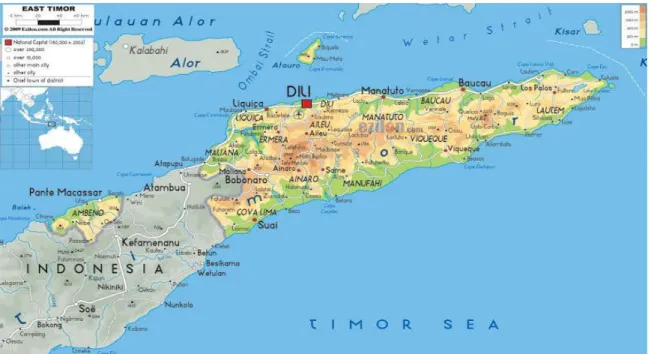
The Democratic Republic of Timor-Leste is a nation in Southeast Asia. It comprises the eastern half of the island of Timor, the nearby islands of Atauro and Jaco, and Oecusse, an exclave on the northwestern side of the island, within Indonesia West Timor (see Figure 2). It is divided administratively into thirteen districts. East Timor has the second smallest population of any other country in Southeast Asia with a total of 1.212.107 people. It is considered to be one of the world‟s poorest countries.49
Figure 2: East Timor Map (www.google.com)
48Viehland, “Cardinal Tagle in latest appointment could help revive religious life,”
http://ncronline.org/blogs/ncr-today/cardinal-tagle-latest-appointment-could-help-revive-religious-life accessed July 21, 2015.
49
Michael G. Smith with Morren Dee, Peacekeeping In East Timor: The Path to Independence (Boulder Colorado, USA: Lynne Rienner, 2003), 33
20
East Timor has a culture steeped deep in tradition, rituals and mysticism. Traditionally, the inhabitants of the island practice animism, a belief system revolving around the sacred elements of the natural world, which regulate behavior, ceremony (such as birth, contractual alliances, marriages and burial). Later in the sixteenth century, when the Dutch and Portuguese arrived, the proximity of Timor to major trade routes and its abundance of sandalwood led these two colonial powers to divide the island into east and west.50 Portuguese missionaries later arrived on the island to spread the Catholic faith. The Timorese population is today largely Catholic but an adherence to animist forms of religious traditions still remains.51 By 1780 Portuguese Timor was home to fifty churches, and during this time the Dominican and Jesuit missionaries often served as instruments of both the Church and the Country.52 The way to solve the problems encountered was to work together, as Government, the Church and the Religious Missionaries, to find appropriate solutions for the people.
a. The Presence of the Catholic Church and the Participation of Congregation of the Canossian and Dominican Sisters in East Timor
This subchapter highlights some aspects of the role of the Catholic Church in East Timor, since it exercised a very important influence on the Timorese society, being an active institution that participates fully in evangelization, emancipation and progress in the country since colonial times.
50
Ibid., 33
51
Bryan T. Froehle & Mary L. Gautier, Global Catholicism: Portrait of a World Church (Maryknoll, New York: Orbis Books, 2003), 96.
52
Alynna J. Lyon, “The Activist Catholic Church in Independent East Timor: The Church is not a Political Institution.” http://www.wiscnetwork.org/porto2011/papers/WISC_2011-721.pdfAccessed July 17, 2015.
21
To date the performance of the Catholic Church on the island remains strong in comparison to her influence in other countries. Her commitment was always aimed at those who suffer and are vulnerable. Her long-term commitment spans the time of the Portuguese colonization, pervades the times of the Indonesian invasion and is maintained in today's society of East Timor.53 Her actions promoted actively the education of the Timorese citizen and the development of the whole country, especially through formation, health care, communication, and agriculture. The Church helped to address the structural causes of poverty, promoted development and was questioning any political and economic orientation contrary to the promotion of social justice and the values of the Gospel.54
The congregation of the Canossian Sisters is now present in East Timor for 133 years. Their mission continues to be promote the personal human dignity through integral formation of the youth. The activities of the congregation are especially directed towards the neediest people, both in the physical and spiritual sense.55The initiative to start in East Timor came from the vicar general and superior of the missions of the Timor district, Father Antonio Joaquim de Medeiros, and from Msgr. Manuel Bernardo de Sousa Enes, Bishop of Macau. Both asked the mother superior of the Canossian Daughters of Charity in Hong Kong to open their congregation for work in East Timor with the aim to educate
53
Ervinia Martins Brito, “A Proposta Educacional Da Congregação Canossiana para Educação em Timor Leste” (MA. Dissertação, Universidade de São Paulo, 2012), 53.
54
Lawrence C. Reardon, and Clyde Wilcox, The Catholic Church and the Nation-State: Comparative Perspectives Religion & Politics (Washington, DC Georgetown University Press, 2006), 138.
55
Brito, “A Proposta Educacional Da Congregação Canossiana para Educação em Timor Leste.” 58.
22
the Timorese female youth.56 The Canossian Sisters accepted this invitation and arrived in East Timor on November 9, 1879, being the first religious women congregations reaching this islands, with the second being the Missionary Dominican Sisters of the Rosary on June 25, 1953.57About the mission of the Dominican Sisters in East Timor the writer shall focus in chapter III.
On March 7, 1880 the Canossian Sisters began their operations in East Timor, establishing an internal college for girls in Dili. In additions, they began to teach in three public schools. In their mission the Canossian Sisters responded to the call of providing a better life for women, for which goal education is crucial. Their method of formation has always been consisted of two important dimension: on the one side the formal education with a school, religious and cultural formation; the other dimension covers non-formal education, including the empowerment of women for domestic tasks, enabling for cleaning work, sewing, embroidery and weaving. Therefore, in the convents of the sisters in East Timor, since colonial times, there were commonly dormitories available for students. With the expansion of their mission to other areas, even more schools were opened.58
56
Carlos Filipe Ximenes Belo, História da Igreja em Timor –Leste: 450 anos de Evangelização (1562-2012) primeiro volume 1562- 1940. (Porto, Portugal, Sersilito-Empresa Gráfica, 2013). 353.
57Timor Portugués Province of “San Luis Beltrán”, 1953. 58
23 b. The Mission of the Catholic Church in East Timor
Since the sixteenth century, the Catholic Church operates in East Timor in evangelization. It started its activities with missionaries who introduced in that country this new holy religion and the new dimensions of Christian values. At first in 1556, Friar Antonio Taveira, a Dominican, baptized about five thousand people.59 The missionaries of the Catholic Church, during this epoch of European expansionism especially in countries such as Portugal, were also intermediaries regarding political security and the administration of the colonies. In the case of East Timor one Portuguese government's policy strategy for the missionaries, was seeking to convert local people.60
The evolution of the administration of the Catholic Church involves two important aspects: on the one side the political and administrative side with the submission to the Portuguese‟s leadership, and on the other, the Faith development and manifestation followed by an increase of the number of the faithful. Although the island was visited by trading people from China and India since the beginning of the sixteenth century, who brought religions influences such as Hinduism, Buddhism and Islam, Catholicism grew and maintained its predominance in East Timor, especially during the invasion of Indonesia.61 The scope of the mission of the Catholic Church was first to evangelize, which means the focus and attention on religious formation and to assist in the formation of the Timorese clergy.
59
Ibid., 131.
60
Brito, “A Proposta Educacional Da Congregação Canossiana para Educação em Timor Leste,” 57.
61
24
Currently, to the Catholic Church belong 98% of the population, showing with clear evidence that the Catholic faith is an important factor in the constitution and sustenance of the identity of the people and also the preservation of its historical aspects. During the twenty-four years of Indonesian dominance, the Catholic Church strengthened its formation principle of quality of life and strengthening the Timorese identity, by keeping the language Tetum62 as the national language and preserving the specific Timorese values which evolved in a period of four centuries in the context of Christian life.63
The church today insists on her function of evangelizing and educating, following the Social Doctrine as expressed in the following documents: Rerum Novarum of Pope Leo XIII (1891), Mater et Magistra of John XXIII (1961), the encyclical Pacem in Terris of John XXIII (1963), Populorum Progressio Paul VI (1967); and Solicitudo Rei Socialis, of John Paul II (1987), Caritas in Veritate (2009) by Pope Benedict and Laudato Si
62
In the fifteenth century, before the arrival of the Portuguese, Tetum had spread through central and eastern Timor as a contact language under the aegis of the Belunese-speaking Kingdom of Wehali, at that time the most powerful kingdom in the island. The Portuguese (present in Timor from c. 1556) made most of their settlements in the west, where Dawan was spoken, and it was not until 1769, when the capital was moved from Lifau (Oecusse) to Dili that they began to promote Tetum as an inter-regional language in their colony. Timor was one of the few Portuguese colonies where a local language, and not a form of Portuguese, became the lingua franca: this is because Portuguese rule was indirect rather than direct, the Europeans governing through local kings who embraced Catholicism and became vassals of the King of Portugal. Tetun-Prasa is the form of Tetum that is spoken throughout East Timor. Although Portuguese was the official language of Portuguese Timor until 1975, Tetun-Prasa has always been the predominant lingua franca in the eastern part of the island. When Indonesia occupied East Timor between 1975 and 1999, declaring it "the Republic's 27th Province", the use of Portuguese was banned, and Indonesian was declared the sole official language, but the Roman Catholic Church adopted Tetum as its liturgical language, making it a focus for cultural and national identity. When East Timor gained its independence on 20 May 2002, Tetum and Portuguese were declared as official languages.
Cited from Encyclopedia http://www.encyclopedia.com/topic/Tetum.aspx and Wikipedia
https://en.wikipedia.org/wiki/Tetum_language
63
Brito, “A Proposta Educacional Da Congregação Canossiana para Educação em Timor Leste”. 55.
25
(2015) by Pope Francis. And many other Church documents, which deal with cultural and social questions, among them also the numerous radio messages of Pius XII.
Today the mission of the Catholic Church exists in three dioceses with the liturgical language being Tetum. The Catechesis operates still very traditionally and consists of memorizing prayers, and answering catechetical questions.64
c. Growth and Expansion of Women Religious then and now
The invasion of Indonesia on December 7, 1975causedmany Timorese women to struggle for liberation from the Indonesian rule.65 They explored how the participation in this struggle has empowered them and set them also on a path towards greater equality with men. This study examines the challenges that lie ahead for women as they work today together to consolidate the achievements of a newly independent nation.
Throughout the Indonesian invasion most of the women congregations‟ expanded in East Timor, and many women joined religious orders to avoid rape or abductions. Other young women and girls married quickly, to avoid being forced to „marry‟ Indonesian soldiers.66
64
Brito, “A Proposta Educacional Da Congregação Canossiana para Educação em Timor Leste”. 54.
65
Deborah Cummins, Local Governance in Timor-Leste: Lessons in Postcolonial State-building Volume 69 of Routledge Contemporary Southeast Asia Series (Milton Park, Abingdon: Routledge, 2015), 29.
66
Irena Cristalis, Catherine Scott and Ximena Andrade, Independent Women: The Story of Women's Activism in East Timor (London: Catholic Institute, 2005), 1-38.
26
Many of the members of the Canossian Sisters, and foreign priests and nuns in particular, fled the country when the civil war between the Fretilin and the UDT,67 broke out, but a significant minority, including some foreign missionaries, stayed on. They saw their special mission in remaining close to the people, come what may. Their status as members of religious orders initially provided a measure of protection. The other Religious orders returned after the bloodiest years of the resistance war and by the early 1980s Indonesian orders were encouraged to repopulate East Timor‟s convents and presbyteries.68 From that time on many religious women congregations were established in East Timor, therefore, many young girls were joining them as well as others left the congregations.
Figure 2gives in a simple table that give us the numbers of women religious in the respective year. Due to the limited sources the writer can only provide information till 2013.
67
UDT means The Timorese Democratic Union (in Portuguese means União Democrática Timorense) which is a conservative political party in East Timor. It was the first party to be established in the country in 1974. Fretilin means The Revolutionary Front for an Independent East Timor (Portuguese: Frente Revolucionária de Timor-Leste Independente) a left its political party in East Timor. They presently hold a number of seats in the National Parliament and form the government in East Timor from the independence until 2007. The party began as a resistance movement that fought for the independence of East Timor, first from Portugal and then from Indonesia, between 1974 and 1998. It was originally called the Timorese Social Democratic Association (ASDT). After East Timor gained its independence from Indonesia, FRETILIN became one of several parties competing for power in a multi-party system. Cited from Wikipedia.
https://en.wikipedia.org/wiki/Revolutionary_Front_for_an_Independent_East_TimorSee also, Heike Krieger, Dietrich Rauschning (eds), East Timor and the International Community: Basic Documents, (New York: Cambridge University Press, 1997). 70-71.
68
27
Year Women Religious
1949 30 1970 60 1980 90 1990 120 1998 254 2001 303 2002 443 2006 679 2010 562 2013 441
Figure 3 Number of Women Religious in East Timor69
According to the information available to the writer, the total number of women congregations in East Timor is about 80.All have their different charism, but their goal is the same, like caring for disabled and orphaned children from central and rural parts of East Timor. Still Indonesian and Timorese Sisters work together to care and educate children in need, whose families no longer can support and take care of them. The nuns are trying to develop more schools and improve facilities so that the children can experience a brighter future in this country still rocked by extreme poverty.
69
28
Chapter II: Contemporary Challenges of Religious Women
Congregations according to Universal Church Documents
A number of Church documents of the past few decades and their orientations have greatly affected religious women. By underlining the common mission received by all Christians at baptism, Lumen Gentium opened the door for deeper women participation in the life of the Church. The mutuality of the mission implies co-responsibility between men and women, lay and consecrated person, clergy and the hierarchy. Further, Gaudium et Spes adds another dimension to the understanding of the Church‟s mission. By pushing a positive view of the world, Gaudium et Spes reversed the Church‟s centuries-old stance of separation from the world. It spoke of mutual relations between the Church and the world and encourages a genuine dialogue between them,70(GS 40).
Other ecclesial declaration are even clearer in their statement about religious women. Vita Consecrata contains by far some of the most significant affirmations on consecrated women ever made by a pope. VC no. 58 and Evangelium Vitae 99, urges the promotion of “a new feminism that rejects the temptation of imitating models of male
domination in order to … overcome all discrimination, violence and exploitation”. And Pacem in Terris 41 had earlier identified the aspirations of women as one of the “signs of
the times.” Mulieris Dignitatem affirms the dignity and role of women today.71
70
Second Vatican Ecumenical Council, Pastoral Constitution on the Church in the Modern World Gaudium et Spes, (1965), nos. 44.
71
Cf. Sister Julma Neo, “Consecrated Women in the Church and in Society: The role of Consecrated Women in the Church and in Society today”, http://cmglobal.org/vincentiana/cgi- bin/library.cgi?e=d-00000-00---off-0vincenti--00-0----0-10-0---0---0direct-10---4---dtx--0-1l--11-en-50---
29
Moreover, there are other similar references in documents issued by various Synods of Bishops and major religious superiors on the continental level. Those documents frequently discuss the development of consecrated women in religious life.
Vita Consecrata and Ecclesia in Asia make clear that all men and women religious, who
consecrate their life, are to get appropriate formation and training, but most especially the women religious. These two documents emphasize that the Church is very much concerned with the formation of people in consecrated life, meanwhile formation can prepare them to reflect on the life, mind and heart of Jesus in any kind of circumstances they encounter. Therefore, the Church stresses that the formation of consecrated people should be all-round, systematic and life-long, (Vita Consecrata, no.65-71).72The Synodal Fathers also judge the wider participation of women in the life and mission of the Church in Asia to be of especially pressing need,73 (Ecclesia in Asia, 44, 45). In this way consecrated life can be a powerful witness in today‟s world particularly in Asia. Due to the historical and social situation in Asia, the formation of consecrated persons has its own unique challenges and needs.
Challenges, which consecrated persons in today‟s world are mainly facing is an increasingly globalized world, social change, secularization, overwhelming poverty, cultural and religious pluralism, migration, environmental pollution and degradation. Hence, it is extremely difficult to make accurate observation which are applicable
72
John Paul II, Vita Consecrata Apostolic Exhortation of Pope John Paul II, (Pasay City, Philippines: Paulines, 2004), 102-112.
73
John Paul II, Ecclesia in Asia: Post-Synodal Apostolic Exhortation of Pope John Paul II, (Libreria Editrice Vaticana, 1999), 44-45.
30
everywhere. A religious who has his or her own vocation and motivation to live for God is always coping with challenges in living out ones commitment.74
In the globalized world, for instance, communication today looks increasingly likely to claim not simply to represent reality, but to control it. This has in some way contributed to the shallowness of life of religious women. There is an obsession for creating a good image in the public rather than focusing on living a faithful life. The pastoral instruction on social communication rightly points out “reality for many, is what the media recognize as real; what it does not acknowledge seems of little importance” (cf.
Aetatis Novae, 4). There is need for a critical use of the social media. The Church has as a
considerably positive, sympathetic and encouraging approach to the means of social communication, and the Church considers them as gift of God and true sign of the times. But several changes related to new social media have been for the better but many others have been for the worse. There is the need of wisdom and the spirit of discernment in using social media
The writer will now deal with the two documents VC and EA in more detail, especially regarding their message and relevance for women religious in Asia.
74
Nobin Narzary, “Challenges to Religious Life: Philosophical Reflections from an ethical perspective”http://nobinnarzary.blogspot.com/2012/01/challenges-to-religious-life-from.html Accessed July 21, 2015.
31
A. Vita Consecrata
Generally Consecrated life is a gift of God the Father. By the profession of the evangelical counsels, the most characteristic traits of the life of Jesus, the chaste, poor and obedient one (cf. Matthew 8:20; Phil. 2:8), and the unfathomable riches of his ministry and mystery (cf. Eph. 3:8), the nearness of the Kingdom of God is proclaimed by witnessing the presence of the Lord in our World.75 By practicing the vows, religious life becomes a living icon, a parable of Jesus life: to be chaste, poor and obedient.76People, who consecrate their life, have a commitment to serve God and the other. The person who is concerned for God and others people needs to be properly trained and guided. The Consecrated person testifies that the chastity of their hearts, bodies, lives, is the full and strong expression of a total love for God that renders a person free, full of deep joy and ready for mission.77
In the post Synodal Apostolic Exhortation Vita Consecrata, Pope John Paul II explains the concept of chastity as, “the pure love which consecrated persons draw from the contemplation of the Trinitarian love revealed to us in Christ. Consecrated chastity is a joyful and liberating experience.”78
Certainly, religious men and women, as witnesses of such a love, and life are important for the people in Asia today
75
Ibid., 3.
76
Quirico Pedregosa, “Living out Mysticism and Prophecy in Asia Today,” vol. XVI, no.1,Towards an Integral Vision for the Future of Religious Life: New Insights on the Mystical and Prophetic elements (Quezon City, Philippines: Institute for Consecrated Life in Asia, 2014), 99.
77
Congregation for Catholic Education, Consecrated Persons and their Mission in Schools, (Pasay City, Philippines: Paulines, 2003), 24.
78
32
As the study mentioned already the formation for religious life has its own unique challenges and needs. Formation for the consecrated life is not only to attain or gain knowledge or studying a theology course, but consecrated life is more than that: it is a specific Christian way of life. For Quirico Pedregosa, religious life within the religious traditions in Asia is primarily a way of life, not just a set of obligations to follow.79Therefore, the eventual challenges of Christian religious life in Asia is to become an authentic way of life in the service of God‟s reign, to live prophetically within a certain social, economic, political, cultural and religious context. Furthermore, the most important basis in the formation for religious life is the meaning, the focus, and the direction of this way of life. In addition, knowledge, life experiences and role models are essentials to support their teaching.
The present situation in Asia makes it difficult for sisters to apply their knowledge and what they have learned to their everyday life, causing a conflict between their knowledge and their real life situation. For instance, when someone is talking about the relevance of community life for consecrated persons, we know that a religious community is evangelical by nature as it bears witness to the kingdom of God. However, often in reality, because of pastoral needs, financial and/or personnel reasons, most often only one or two sisters live in a parish. And the Sisters may not even have the chance to get together as community.
The Church recognizes the contributions which the Sisters give to the society, with their different skills, their sensitivity and intuition. Many Sisters share pastoral responsibilities, help people, guide families, groups and offer new contributions to
79
33
theological reflection. According to Father Diarmuid O‟Murchu, MSC, modern apostolic Congregations tend to prioritize ministries related to teaching, health care, social work, retreat ministry and parochial service.80Most of the Religious women are formed and trained with those skills, and are considered to be most suitable to serve the Church in Asia. When Pope Francis delivered his homily on the World Day for Consecrated Life, he said that the Sisters and Nuns are great women, “They are a gift, the leaven that carries the message of Christ. These women are great”81
Again Pope Francis highlighted the great value that Sisters or Nuns bring to the Church. He said "What would happen if there were no Sisters or Nuns? No Sisters or Nuns in hospitals, in missions, in charitable institutions, in schools… Can you even imagine a Church without Nuns…? No it is unthinkable!"82 Religious Women consecrated their life to God in the service to the people of God, in every situation of their life. Women are focused on their mission and are reflecting the call of God, to live a peaceful and fulfilled life, tending to the needs of others and also to be good servants to the Father above all things in life.
To accomplish this mission religious women are called to give their singular and communitarian witness in a prophetic way.83 As discussed in the first chapter on the
80
Diarmuid O‟Murchu, “Religious Life Witness in the 21st Century: Mystical-Prophetic Horizons”, vol. XVI, no.1, “Towards an Integral Vision for the Future of Religious Life: New Insights on the Mystical and Prophetic elements” (Quezon City, Philippines: Institute for Consecrated Life in Asia, 2014), 79.
81“Francis: Church without Nuns „Unimaginable‟”
National Catholic Reporter.http://ncronline.org/blogs/francis-chronicles/francis-church-without-nuns-unimaginiable.
Accessed July 17, 2015.
82
NCR staff, “Francis: Church without Nuns „Unimaginable‟ | National Catholic Reporter.”
http://ncronline.org/blogs/francis-chronicles/francis-church-without-nuns-unimaginiable.Accessed July 17, 2015.
83
Cardinal Eduardo Pironio, Archbishop Augustine Mayer, “Religious and Human Promotion” Plenaria of the Sacred Congregation for Religious and for Secular Institutes, 25-28 April 1978, (Vatican City, 12 August 1980), 3-9.
34
history of women religious congregations in the earlier time, they faced particular problems and difficulties when they tried to intervene in areas of great injustice and oppression. Religious Women were bound to face difficult challenges in their manner of presence and in their apostolic works. There are various challenges religious life is facing today. One of them is the decrease of the number of people in religious life and vows.
The three major challenges of Consecrated life addressed to the Church herself, are the same as ever, posed only in new ways, and perhaps more radically in our contemporary society. These challenges relate directly to the evangelical counsels of obedience, chastity and poverty, impelling the Church, and particularly consecrated person, to clarify and testify to the profound anthropological and religious significance of these counsels.84These evangelical counsels are a sacred promise made publicly with the approval of the Church. Through these vows a religious women responds with her whole life to God and to love Him completely without reserve. As the United States Catholic Conference of Bishop (USCCB), expresses:
All Christians are called to live the virtues of chastity, poverty and obedience; these vows provide for a purification of heart and spiritual freedom that uniquely mark the life of the consecrated women religious. Living these vows enables them to focus their entire being on God and his people. All women religious profess this three vows Obedience, Chastity and Poverty. The vows of consecrated life are means by which the women religious seeks to be more closely to the one they love. Living these vows draws them into the Paschal Mystery of Jesus. They embrace a transforming love who gives meaning to all suffering and sacrifice.85
84
John Paul II, Vita Consecrata, no. 87-88. P.138.
85
“The Vowed Life”, United States Conference of Catholic Bishop (USCCB),
http://www.usccb.org/beliefs-and-teachings/vocations/discerning-women/the-vowed-life.cfm accessed on July 25, 2015.
35
To find meaning in suffering and to give meaning to suffering is a specific Christian understanding and practice an important contribution in the Asian context. Suffering is understood differently in Buddhism, which is the way to overcome suffering. “Both regard [suffering] as an evil but in Christianity, the evil has a salvific purpose, but for Buddhism, suffering is regarded as the result of ignorance and craving, an enlightened one does not suffer. The French poet, Paul Claudel, said: „Jesus did not come to explain suffering, nor to take it away; he came to fill it with his presence.‟”86In other words Jesus‟s purpose was to enter into suffering in order to be with us and to draw us to himself and to give suffering the deepest meaning. Religious women caring for the poor in Asia give a new meaning to suffering and a specific dignity to every suffering being.
The vows always have a paramount importance in the life of the religious woman. Due to the renewal of religious life fostered by the Vatican Council, religious vows have been brought out from a rather formula bound understanding to acquire a deeper and more relational meaning. Let us see what VC says about some important aspects of religious life as expressed through the vows.
86
Stratford Caldecott, Catholicism & other Religions: Introducing Interfaith Dialogue (London: Catholic Truth Society, 2009), 31.
36 a. The Challenge of consecrated Chastity
VC explains the concept of chastity as “the pure love which consecrated person
draw from the contemplation of the Trinitarian love revealed to us in Christ. Consecrated chastity is a joyful and liberating experience”.87Today we see that a hedonistic culture separates sexuality from all objective moral norms, often treat it as a mere diversion and a consumer good and, together with the complicity of the means of social communication, justifying a kind of idolatry of the sexual instinct. The consequences of this are before everyone‟s eyes: transgressions of every kind, sexual abuse and exploitation, abortion, with resulting psychic and moral suffering on the part of individuals and families.88
As we look at the reality in the globalized world nowadays, there are so many technologies that affect people. This has brought also a big challenge for the religious people, especially for those in celibate lives. Many are tempted by those technologies and therefore, they lose contact with what they supposed to be and fail to live their vows. For instance, there is a crisis within the religious life regarding sexuality, leading even to sexual abuse. Some nuns or priests are no longer faithful to her/his vow of chastity. Cases of infidelity to the celibate and chaste life have shocked the Church in recent time.
The view on religious life today has reached such a bad state which can make people untouched by it as the people do not always see in a religious women a credible witness of Jesus and his radical commitment to the Reign of God.
87
John Paul II, Vita Consecrata, no. 88-89.
88