UNIVERSIDADE DE LISBOA FACULDADE DE CIÊNCIAS
FACULDADE DE LETRAS FACULDADE DE MEDICINA FACULDADE DE PSICOLOGIA
Modelling Semantic Relations with
Distributional Semantics and Deep Learning:
Question Answering, Entailment Recognition
and Paraphrase Detection
Vladislav Maraev
Thesis supervised by
Prof. António Branco, PhD
co-supervised by
Prof. Carlos Lourenço, PhD
MASTER IN COGNITIVE SCIENCE
Resumo
Nesta dissertação apresenta-se uma abordagem à tarefa de modelar relações semân-ticas entre dois textos com base em modelos de semântica distribucional e em apren-dizagem profunda. O presente trabalho tira partido de várias disciplinas da ciência cognitiva, com especial relevo para a computação, a linguística e a inteligência arti-ficial, e com fortes influência da neurociência e da psicologia cognitiva.
Os modelos de semântica distribucional (também conhecidos como ”word embed-dings”) são usados para representar o significado das palavras. As representações semânticas das palavras podem ainda ser combinadas para obter o significado de um excerto de um texto recorrendo ao uso da aprendizagem profunda, isto é, com o apoio das redes neurais de convolução.
Esta abordagen é utilizada para replicar a experiência realizada por Bogdanova et al. (2015) na tarefa de deteção de perguntas que podem ser respondidas as mes-mas respostas tal como estas foram respondidas em fóruns on-line. Os resultados do desempenho obtidos pelas experiências apresentadas nesta dissertação são equiva-lentes ou melhores que os resultados obtidos no trabalho de referência mencionado acima.
Apresentao também um estudo sobre o impacto do pré-processamento apropriado do texto, tendo em conta os resultados que podem ser obtidos pelas abordagens adotadas no trabalho de referência supramencionado. Este estudo é levado a cabo removendo-se certas pistas que podem levar o sistema, indevidamente, a detetar perguntas equivalentes. Essa remoção das pistas leva a uma diminuição significativa no desempenho do sistema desenvolvido no trabalho de referência.
Nesta dissertação é ainda apresentado um estudo sobre o impacto que os word embeddings treinados previamente têm na tarefa de detetar perguntas semantica-mente equivalentes. Substituindo-se, aleatoriasemantica-mente, word embeddings previasemantica-mente treinados por outros melhora-se o desempenho do sistema.
Além disso, o modelo foi utilizado na tarefa de reconhecimento de implicações para Português, onde mostrou uma taxa de acerto similar à da baseline.
Este trabalho também reporta os resultados da aplicação da abordagem adotada numa competição para a deteção de paráfrases em Russo. A configuração final apre-senta duas melhorias: usa character embeddings em vez de word embeddings e usa vários filtros de convolução. Esta configuração foi testado na execução padrão da Tarefa 2 da competição relevante, e mostrou resultados competitivos.
Abstract
This dissertation presents an approach to the task of modelling semantic relations be-tween two texts, which is based on distributional semantic models and deep learning. The present work takes advantage of various disciplines of cognitive science, mainly computation, linguistics and artificial intelligence, with strong influences from neu-roscience and cognitive psychology.
Distributional semantic models (also known as word embeddings) are used to represent the meaning of words. Word semantic representations can be further com-bined towards obtaining the meaning of a larger chunk of a text using a deep learning approach, namely with the support of convolutional neural networks.
These approaches are used to replicate the experiment carried out, by Bogdanova et al. (2015), for the task of detecting questions that can be answered by exactly the same answer in online user forums. Performance results obtained by my experiments are comparable or better than the ones reported in that referenced work.
I present also a study on the impact of appropriate text preprocessing with respect to the results that can be obtained by the approaches adopted in that referenced work. Removing certain clues that can unduly help the system to detect equivalent questions leads to a significant decrease in system’s performance supported by that referenced work.
I also present a study of the impact that pre-trained word embeddings have in the task of detecting the semantically equivalent questions. Replacing pre-trained word embeddings by randomly initialised ones improves the performance of the system.
Additionally, the model was applied to the task of entailment recognition for Por-tuguese and showed an accuracy on a level with the baseline.
This dissertation also reports on the results of an experimental study on the appli-cation of the adopted approach to the shared task of sentence paraphrase detection in Russian. The final set up contained two improvements: it uses several convolu-tional filters and it uses character embeddings instead of word embeddings. It was
tested in Task 2 standard run of the relevant shared task and it showed competitive results.
Acknowledgements
I am grateful to my supervisor António Branco for his extraordinary support, for helping me with choosing the right directions all the way through my work on this dissertation, and for showing me how the research should be carried out in NLX-Group.
I also would like to thank my co-supervisor Carlos Lourenço for his help on early stages of my work and for his useful comments regarding the sensitive part of my dissertation.
Working at NLX-Group has always been fun and a pleasure. I would like to thank everyone in the group for their help, for sharing their experience and for keeping my mood up. Especially I would like to thank João Rodrigues for spotting the clues in the StackExchange datasets and João Silva for his friendly guidance and for his significant help with organising my code.
I think that the acknowledgement page is a right place to mention great tools that helped me a lot and made my procrastination more productive (and indeed interesting), namely Emacs, Org mode and LATEX.
Lastly, my thanks go to my family and friends. Either in St. Petersburg or in Lisbon my work would be impossible without your support.
∗
The work was partially supported by the Portuguese Government’s P2020 program under the grant 08/SI/2015/3279: ASSET-Intelligent Assistance for Everyone Ev-erywhere, and by the EC’s FP7 program under the grant number 610516: QTLeap-Quality Translation by Deep Language Engineering Approaches.
Table of contents
1 Introduction 1
1.1 Motivation . . . 1
1.2 Contributions . . . 2
1.3 Impact in cognitive science . . . 3
1.4 Outline of the thesis . . . 4
2 Task Overview 5 2.1 Question Answering . . . 5
2.1.1 Differences from IR and IE systems . . . 5
2.1.2 Open-domain vs Domain-specific QA . . . 6
2.1.3 Communities for Question Answering . . . 7
2.2 Task Definition . . . 8
2.2.1 Semantically Equivalent Questions . . . 8
2.2.2 Architecture and Corpora . . . 9
2.2.3 Results to be replicated . . . 10
3 Background 11 3.1 Approaches to Community Question Answering . . . 11
3.1.1 Duplicate and near-duplicate detection . . . 12
3.1.2 Paraphrase identification . . . 12
3.1.3 Semantic Textual similarity . . . 12
3.2 Distributional Semantics . . . 13
3.2.1 Forms of Meaning Representation . . . 13
3.2.2 Distributional Semantic Models Explained . . . 14
3.2.3 Psychological and Linguistic Viability of DSMs . . . 16
3.2.4 Neural Word Embeddings . . . 18
3.2.5 Compositionality of DSM . . . 19
Table of contents
3.3.1 Machine learning . . . 20
3.3.2 Inspirations from neuroscience . . . 21
3.3.3 Deep feedforward neural networks . . . 22
3.3.4 Convolutional neural networks . . . 23
3.3.5 Recurrent neural networks . . . 24
3.4 Summary . . . 25
4 Implementation and evaluation 27 4.1 CNN for the detection of semantically equivalent questions . . . 27
4.1.1 Word representation layer . . . 28
4.1.2 Convolution layer . . . 29
4.1.3 Pooling layer . . . 30
4.1.4 Measuring the question similarity . . . 30
4.1.5 Training procedure . . . 30
4.2 Implementing the CNN . . . 31
4.2.1 Data preprocessing . . . 31
4.2.2 Corpora parameters . . . 31
4.2.3 Building and training the DSM . . . 32
4.2.4 Building and training the CNN . . . 33
4.3 Replication . . . 34
4.4 Impact of text preprocessing . . . 34
4.5 Impact of word embeddings . . . 36
4.6 Summary . . . 36
5 Portuguese Entailment Recognition Task 39 5.1 Task definition . . . 39
5.2 Evaluation and results . . . 40
5.3 Future work . . . 42
5.4 Summary . . . 43
6 Russian Paraphrase Detection Task 45 6.1 Task definition . . . 45
6.2 Evaluation and results . . . 46
6.2.1 Evaluation metrics . . . 46
6.2.2 Non-standard run . . . 47
6.2.3 Standard run . . . 48
Table of contents
6.3 Discussion and future work . . . 51
6.4 Summary . . . 52
7 Conclusions 53 7.1 Summary of contributions . . . 53
7.2 Further work . . . 54
References 55 Appendix A User guide 61 A.1 Prerequisites . . . 61
A.2 About the program . . . 62
A.3 Replication of my work . . . 63
A.3.1 Question Answering . . . 63
A.3.2 Portuguese Entailment Recognition . . . 64
Chapter 1
Introduction
Question Answering (QA) has been a long-standing goal in Artificial Intelligence. To pose the question to a knowledge base we should do our best to provide a semantic representation of a question. Therefore, QA is also a good task to assess natural language semantic representation theories.
There are different approaches to natural language semantics that can either be symbolic (e.g. truth-value semantics), or distributional (e.g. vector space semantics). Many areas of language technology have recently explored deep learning and dis-tributional semantic representation. In the present dissertation I am resorting to distributional semantic models and deep learning approaches to a question answer-ing task.
1.1
Motivation
Document and information retrieval systems, such as G, B and many others, do a really good job by accepting a user query and retrieving a set of relevant documents and webpages. They lack, however, the ability to answer a query in a more natural and specific form, i.e. a form in which the question may be asked by a user in a natural language, and not just as a sequence of keywords.
Over the years, a great variety of question answering systems have been created. Some systems are intended to retrieve factoid answers in very specific domains, such as one of the first QA systems L (Woods and Kaplan, 1977) that answered questions about the geological analysis of rocks returned by the Apollo 11 moon missions. Other systems are more open-domain oriented such as IBM W (Fer-rucci, 2012) that could compete with champions at the game of Jeopardy!™.
Introduction
There are dozens of textual question answering systems described in the literature. Following (Mitkov, 2005, Chapter 31) two basic types of question answering systems can be distinguished: systems that try to answer a question by using a structured information contained in a database, and systems that try to answer a question by analysing plain-text information. Of course, plain-text based systems can be enriched with structured data constituting a hybrid system aimed to provide more accurate reply.
The topic of question answering, along with many other areas of Artificial In-telligence (AI) and Natural Language Processing (NLP), recently received a huge research boost due to two main reasons: availability of massive amounts of data from the web and increasing growth of computational power, including by the use of Graphics Processing Units (GPUs). The area of question answering was also sup-ported by the emergence of Web 2.0-based online QA communities, that enhance online information seeking by allowing users to exchange their knowledge in the form of asking and answering questions.
This enhanced the success of AI and a broad category of machine learning systems, that can learn to carry out different tasks just by being exposed to examples of the relevant raw input data and the corresponding output. Machine learning approaches play an important role in on the fly adaptation of systems and provides an option for question answering capabilities to be learned from the data itself.
My work seeks to apply models that are based on machine learning approaches: distributional semantic models (DSMs) and convolutional neural networks (CNNs) to the question answering task. DSM is a very effective approach to word meaning representation and CNN is a type of ‘deep’ neural networks, that achieved huge success, especially in the computer-vision area.
1.2 Contributions
My masters research work is driven by the goal of replicating the experiments and the excellent results obtained by Bogdanova et al. (2015) and by reusing them in further experiments. The authors of this paper applied CNNs and DSMs to detect semantically equivalent questions in online user forums, such as AU and META SE. Bogdanova et al. (2015) defined questions as semantically equivalent if they can be adequately answered by the exact same answer. In their study they have a goal to predict if two questions are semantically equivalent. A major part of my work is a replication of this study, that includes preparation of
1.3 Impact in cognitive science
dataset, building DSM for word meaning representation and CNN for representing a similarity between pairs of questions.
My replication used similar dataset (but not exactly the same) and reaches very similar accuracy score for this task (results of Bogdanova et al. (2015) are shown in brackets): 94.1% (92.9%) for AU dataset and 94.2% (92.7%) for META SE dataset.
Additionally, in the present work I discuss that in the study undertaken by Bog-danova et al. (2015) there, presumably, exists a drawback regarding text preprocess-ing, which did not ensure the removal of certain clues that can indicate that a given question is a duplicate of other question. Removal of these clues significantly drops the performance of the system (to less 20.8 p.p. for the AU dataset, for instance).
Another contribution of the dissertation, in the application of similar models to other tasks, is the textual entailment recognition for Portuguese and paraphrase detection for Russian.
In the Portuguese task, I used the ASSIN evaluation set (Fonseca et al., 2016) for the task of classifying the presence of textual entailment. The model that I had developed for the QA task showed easy adaptation for this new domain and task and it obtained a score of 69.1% in terms of classification accuracy.
In the Russian task, I used the ParaPhraser dataset (Pronoza et al., 2015) for the task of classifying the pair of sentences as paraphrases (precise or near paraphrases) or non-paraphrases. I participated in the Russian paraphrase detection shared task which was co-located with AINL 2016 and my solution obtained the fifth place with 72.74% accuracy (difference to the best team is 3.12%).
1.3
Impact in cognitive science
The present work connects different disciplines of cognitive science, mainly artificial intelligence, computation and linguistics, with a strong inspiration from neuroscience and cognitive psychology.
Regarding neuroscience my work takes advantages of using artificial neural net-works (ANNs), that are inspired by biological neural netnet-works, and it derives im-portant features from them. The distributional semantic models (DSMs), widely applied in my work, are also supported by neuroscience. For further information about the role of neuroscience please refer to Section 3.3.2, regarding ANNs, and to Section 3.2.3 regarding DSMs.
Introduction
Regarding cognitive psychology distributional semantic models are widely used to model and simulate various psychological phenomena. Please refer to Section 3.2.3 for specific examples.
1.4 Outline of the thesis
A brief overview of the thesis structure, chapter by chapter, is provided below.
Chapter 2: Task Overview This chapter provides an overview of the approaches to the question answering task and the review of the paper, by Bogdanova et al. (2015), to be replicated.
Chapter 3: Background This chapter introduces the fundamental concepts and meth-ods used throughout this thesis. I start with describing different approaches to the task of question answering. Then, I provide an overview of distributional semantic models. Finally, I introduce the concept of deep learning and offer a brief description of convolutional neural networks.
Chapter 4: Implementation and evaluation This chapter describes the tools that were implemented to tackle the task defined in Chapter 2. I start by explaining how con-volutional neural networks work in further detail. Then, I review the structure of corpora and continue with a description of how to handle the data and the imple-mentation of the proposed architecture. This chapter concludes with a presentation of the results obtained.
Chapter 5: Portuguese Entailment Recognition Task This chapter describes the appli-cation of the proposed architecture to the Portuguese entailment detection task.
Chapter 6: Russian Paraphrase Detection Task This chapter describes the application of the proposed architecture to Russian paraphrase detection task.
Chapter 7: Conclusions The final chapter concludes this dissertation with a summary of the research contributions, followed by an outline of possible future work.
Appendix A: User guide The appendix consists of the User Guide describing how to download and run the code in order to replicate the present work.
Chapter 2
Task Overview
This chapter defines the major goal of the dissertation, namely the replication of the experiment undertaken by Bogdanova et al. (2015).
In Section 2.1, the goal of the task of Question Answering (QA) will be detailed together with making explicit the differences with respect to other tasks and with narrowing the scope of the task to domain-specific community question answering systems. Section 2.2 provides a definition of the task addressed by Bogdanova et al. (2015), namely the detection of duplicate questions that will be replicated in the dissertation.
2.1
Question Answering
2.1.1 Differences from Information Retrieval and Information Extraction
The main feature of a Question Answering (QA) system is the ability to identify or return answers to questions; both, a question and an answer should be in plain natural language. Firstly, it is important to make a distinction between Question Answering, Information Retrieval (IR) and Information Extraction (IE).
The goal of an Information Retrieval (IR) system is to retrieve relevant documents by matching a query against the collection of documents. For example, for a query ‘acts that Barack Obama signed’, an IR system should return documents containing the description of the acts signed by Barack Obama.
Information Extraction (IE) systems extract information from a set of documents according to a target template, that is predefined. For example, an IE system can extract the year, the authors and other features for a certain act.
Task Overview
Question Answering systems return, in turn, an answer in natural language to an input question also in natural language. For example, an answer such as ‘He signed it on October 28, 2009’ can be returned to the input question ‘When did Barack Obama signed Matthew Shepard Act’.
It might appear that for setting up a QA system, we just would need to combine IR and IE techniques, but that would not be viable because it would require extraction rules for all possible domains, and would restrict the types of questions that may be asked to the forms of information modelled by extraction templates (Mitkov, 2005, Chapter 31).
2.1.2 Open-domain vs Domain-specific QA
Question Answering technology can be very broad: it can help users ask simple factual question, e.g. about nature, politics, etc. On the other hand questions can be very specific: users may ask about the functioning of a specific device or a program, they can enter a query about stock market, or ask about very specific health or forensic information, etc.
Open-domain QA systems discover answers in large document collections, and use
natural language processing tools to provide the most relevant and accurate answer. Examples of open-domain QA system are XisQuê, developed in our NLX–Natural Language and Speech Group1, or IBM W system, that was “taught” to play Jeopardy!™. Example 2.1.1 shows a correct question-answer pair from Jeopardy!™ quiz, however IBM W gave a wrong reply “Toronto” (Markoff, 2011).
Example 2.1.1 (Open-domain QA)
Question: U.S. city; its largest airport was named for a World War II hero; its second largest, for a World War II battle.
Answer: Chicago.
In domain-specific (or canned) QA systems, a new input question is matched against a set of predetermined pairs of questions and answers. The domain is re-stricted and, if a question is congruent with the domain, this type of systems have more chances to perform better than open-domain systems. Example 2.1.2 shows a question-answer pair taken from W FAQ2; a domain-specific system can receive a question, decide whether its meaning is close to a meaning of a question
1XisQuê is described in Branco et al. (2008), and it is available at http://xisque.di.fc.ul.pt/en/ 2https://en.wikipedia.org/wiki/Wikipedia:FAQ/Editing
2.1 Question Answering
stored in frequently asked questions database (FAQ DB) and extract an answer from the database.
Example 2.1.2 (Domain-specific QA)
Question: How do I insert a new line?
Answer: Normally, Wikipedia doesn’t start a new line when you press the Enter key. If you press the Enter key twice, Wikipedia will start a new paragraph. To force a single new line (for instance, when you want to insert a poem) insert the HTML element <br />after the line.
2.1.3 Communities for Question Answering
The rapid development of the Internet and Web 2.0, that empowered the Internet with social interactivity, allowed the emergence of many online social communities that bring people together and help them to exchange knowledge.
Online Q&A communities are a subset of asynchronous online communities that facilitate knowledge sharing in the form of asking and answering questions. Typically, answers from a Q&A community are available for all users and indexed by search engines. Membership in Q&A communities is also available for all users, but not all users may be able to post questions and answer them as this may be restricted by some policies of a specific Q&A community. For example, SE commu-nities resort to user reputation3 to control users’ privileges on asking and answering questions, commenting them, voting for favourable answers, etc. Voting system and reputation helps Q&A communities to self-regulate, which brings more power to more relevant and expert answers.
These characteristics have resulted in the rapid growth of online Q&A communities during the last decade. For example, Y! A, one of the largest English-language online Q&A communities, had 200 million users by December 2009, and over one billion questions-and-answers by October 20094. Jin et al. (2013) made an online survey among Y! A C community and claim that users’ intention to continue answering questions (which is also an intention to share the knowledge) was directly influenced by two factors: satisfaction and knowledge self-efficacy.
3http://meta.stackexchange.com/questions/7237/how-does-reputation-work
4
Task Overview
Some Q&A communities are domain-specific, such as AU, which is spe-cialised on questions about the Ubuntu operating system. AskUbuntu is a part of Stack Exchange Network and in September 2016 it had about 376,000 registered users5and more than 240,000 questions6. In such domain-specific communities users’ intention to keep answering questions can grow even further, with an intention of a user to become an active member of a certain community (i.e. Ubuntu users com-munity), and not only a specific Q&A community (i.e. AU).
This section has provided a background information for defining a task we are concerned with in this dissertation. Further information on background and state-of-the-art of question answering is given in Section 3.1.
2.2 Task Definition
2.2.1 Semantically Equivalent Questions
The (Bogdanova et al., 2015) is the study I seek to replicate, and this paper tackles an important characteristic of Q&A communities that wasn’t mentioned in Section 2.1.3 above, which is a duplication policy. Typically in online Q&A communities nearly exact duplicates and copy-and-paste questions are quickly detected and removed from the website. However, some duplicates are kept and the main reason for that, as it is stated by AU, is the following:
There are many ways to ask the same question, and users might not be able to find the answer if they’re asking it a different way.
Accordingly, Bogdanova et al. (2015) adopt the following definition for semanti-cally equivalent questions:
Definition 2.2.1
Two questions are semantically equivalent if they can be adequately answered by the exact same answer.
Examples 2.2.1 and 2.2.2 below are two questions taken from AU com-munity that were marked as duplicates. They state a problem in two different ways, however they can be answered by one answer (short version given):
5https://stackexchange.com/leagues/31/alltime/askubuntu/ 6https://askubuntu.com/questions/
2.2 Task Definition
.exe files are not binary-compatible with Ubuntu. There are, however, compatibility layers for Linux, such as Wine, that are capable of running .exe
When one steps into the domain of detecting semantically equivalent questions, one faces to basic problems, namely (1) the same question may be formulated in different ways; and (2) two questions may be asked about two different things but look for the same solution.
Example 2.2.1 (Question)
Title: How can I install Windows software or games?
Body: Can .exe and .msi files (Windows software) be installed in Ubuntu? Example 2.2.2 (Question, marked as a duplicate)
Title: I can’t download anything and I can’t watch videos [duplicate]
Body: Two days ago I tried to download skype and it says an error occurred it says
end of central directory signature not found Either this file is not a zipfile, or it constitutes one disk of a multi-part archive. In the latter case the central directory and zipfile comment will be found on the last disk(s) of this archive. zipinfo: cannot find zipfile directory in one of /home/maria/Downloads/SkypeSetup-aoc-jd.exe or /home/maria/Downloads/SkypeSetup-/home/maria/Downloads/SkypeSetup-aoc-jd.exe.zip, and cannot find /home/maria/Downloads/SkypeSetup-aoc-jd.exe.ZIP
<...>this happens whenever I try to download anything like games and also i can’t watch videoss it’s looking for plug ins but it doesn’t find them i hate this Bogdanova et al. (2015) mention several other tasks related to identifying se-mantically equivalent questions, namely (1) near-duplicate detection; (2) paraphrase identification; and (3) textual semantic similarity estimation. The main difference is these tasks are not concerned with searching for a relevant solution to a question, and are just looking for an alternative formulation of an utterance.
2.2.2 Architecture and Corpora
The architecture used by Bogdanova et al. (2015) combines two approaches in order to detect semantically equivalent questions: (1) distributional semantic model (DSM) for representing a meaning of each word in a question; and (2) convolutional neural
Task Overview
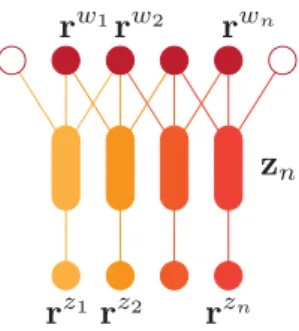
network (CNN) for combining word meaning representations into a question
repre-sentation. DSM ensures a vectorial representation of words, and words are combined by CNN into a vectorial representation of questions.
The architecture works with pairs of questions, and the resulting score, which is computed by similarity measure between vectors, supports a decision whether two questions are duplicates or not.
A main characteristic of the architecture is its machine learning capability that makes the QA system able to learn a better representations of a question from each new portion of labelled data.
Bogdanova et al. (2015) use two data dumps from two Q&A communities: (1) AU forum that was briefly described in the previous section; and (2) META SE community that is used to discuss about the StackExchange com-munity itself. Bogdanova et al. (2015) prepare an input to their system in a form that contains a pair of two questions and a label showing if they are duplicates.
More detailed description of the architecture is provided in the next chapters: Chapter 3 will dwell on the notion of DSM and CNN, and in Chapter 4 I will give a detailed description of a CNN architecture that was replicated.
2.2.3 Results to be replicated
Firstly, the resulting model obtained by Bogdanova et al. (2015) outperforms SVM (support vector machine) baseline with a significant margin: accuracy 92.9% for CNN vs 82.4% for SVM (for AU dump). And, this margin was even more significant on the limited training set.
Secondly, these authors show that their architecture is easily adaptable to different domains. They use data from META SE community to show that with their model they are getting similar accuracy (92.68%) as the one obtained for the AskUbuntu community.
A major goal of my work is to replicate these results. Table 2.1 shows the results along with the characteristics of the corpora used by Bogdanova et al. (2015). It is expected that my work obtains comparable results within comparable settings.
Community Corpus date Millions of tokens Test Accuracy
AskUbuntu May 2014 121 92.90%
Meta May 2014 19 92.68%
Chapter 3
Background
This chapter introduces the most important concepts that will be used throughout the dissertation.
Section 3.1 reviews existing approaches to the task of question answering. In Sec-tion 3.2, I introduce the noSec-tion of distribuSec-tional semantics, which is used to obtain a representation of the meaning of a word from the contexts in which it is used. The final Section 3.3 describes the deep learning computational techniques that are used to combine vectorial distributional representations of words into larger entities, such as phrases, sentences or paragraphs.
3.1
Approaches to Community Question Answering
We recall the definition of semantic equivalence of two questions: Definition 2.2.1
Two questions are semantically equivalent if they can be adequately answered by the exact same answer.
There are different tasks that are aimed at detecting semantically equivalent utter-ances: duplicate and near-duplicate detection, paraphrase identification and textual semantic similarity prediction. Hereby we present state-of-the-art results for each of the tasks bearing in mind the difference with our task that was indicated in previ-ous chapter: we are searching for a relevant solution to a question, and are not just looking for an alternative formulation of an utterance.
Background
3.1.1 Duplicate and near-duplicate detection
The task of duplicate and near-duplicate detection is very important for search engines that deal with a list of retrieved documents that needs to be narrowed down to a list of unique documents in order to improve search results. Documents that have small dissimilarities are identified as near-duplicates. Approaches to near-duplicate detection can be broadly classified into syntactic, URL based and semantic techniques (Alsulami et al., 2012).
A state-of-the-art technique that is used for QA task was introduced by Wu et al. (2011). It is based on Jaccard coefficient, which is used to measure similarities be-tween the two sets. They use various techniques to capture similarities bebe-tween different parts of Q&A threads and, then, they use predefined threshold to deter-mine whether threads are near-duplicates or not. Wu et al. (2011) approach was also used in the paper that we replicate (Bogdanova et al., 2015) as a baseline.
Semantically equivalent questions can have no word overlap, so duplicate detection task can not entirely address this issue.
3.1.2 Paraphrase identification
Two sentences with the same meaning are defined as paraphrases. A data set that is commonly used to support research on this task is Microsoft Research Paraphrase Corpus (Dolan et al., 2004). There are different state-of-the-art techniques for para-phrase identification, such as combination of machine translation solutions (Madnani et al., 2012), deep learning techniques (Cheng and Kartsaklis, 2015; He et al., 2015) and tensor factorization (Ji and Eisenstein, 2013).
3.1.3 Semantic Textual similarity
Semantic Textual Similarity (STS) measures the degree of semantic equivalence in the underlying semantics of paired snippets of texts. This task is very important for research in sentence-level semantics and there is a SemEval Shared Task dedicated to this issue that is held annually since 2012. Participating systems are asked to return a continuous valued similarity score on a scale from 0 to 5, with 0 indicating that the semantics of the sentences are completely independent and 5 signifying semantic equivalence. Performance is assessed by computing the Pearson correlation between machine assigned semantic similarity scores and human judgments (Agirre et al., 2016). Part of the test set uses data from Q&A online forums for making judgments
3.2 Distributional Semantics
about semantic similarity. The best system of SemEval-2015 uses word alignments and distributional semantic vector composition (Sultan et al., 2015).
3.2
Distributional Semantics
3.2.1 Forms of Meaning Representation
In cognitive science there has been a long debate regarding how semantic knowledge is organized and used in human language understanding and production. Known accounts of semantic representation can be grouped into three broad families, namely semantic networks, feature-based models and semantic spaces.
Semantic networks (Collins and Quillian, 1969) reproduce concepts as nodes in a
graph whose edges denote semantic relationships between the concepts. For exam-ple, relation of hyponymy between the concept salmon and the concept fish can be represented as an edge of a graph that will connect two nodes that denote aforemen-tioned concepts with indicating the relation between them. In semantic networks word meanings can be obtained by collecting relations from the graph. Semantic networks are representations that abstract away from real-world usage as they are constructed manually by human modelers.
As an alternative to the network approach, the meaning of a word can be described in terms of feature lists (Smith et al., 1974), that can be obtained by polling native speakers about what features they consider as relevant for the meaning of a word. This approach is limited due to the size of vocabulary and also the number and quality of attributes are highly dependent on time devoted to each word.
Semantic spaces, the third family of semantic representations is based on the
assumption that word meanings are determined by linguistic environment (Wittgen-stein, 1953). Words with similar meanings occur in similar contexts and one can talk about the common semantic value of expressions as word co-occurrence among them (Harris, 1954).
Distributional semantic models (DSMs) belong to the latter family of meaning
representations and are typically implemented through vector space models, where the semantic representation for a word is a vector in a high-dimensional space. The dimensions stand for context items (for example, co-occurring words), and the coor-dinates depend on the co-occurrence counts or probabilities. Distributional models can be learned from a corpus in unsupervised fashion. Similarity between the
seman-Background
tic representations of words is usually computed using cosine similarity between the respective vectors.
3.2.2 Distributional Semantic Models Explained
Distributional semantic models are motivated by so-called distributional hypothesis. (Harris, 1954, page 156) stated the core assumption of it:
The fact that, for example, not every adjectives occurs with every noun can be used as a measure of meaning difference. For it is not merely that different members of the one class have different selections of members of the other class with which they are are actually found. More than that: if we consider words or morphemes A and B to be more different than A and C, then we will often find that the distributions of A and B are more different than the distributions of A and C. In other words, difference in meaning correlates with difference in distribution.
A great illustration of capturing the meaning of the word from linguistic context is given by Stefan Evert1:
Example 3.2.1 (Bardiwac)
⋄ He handed her a glass of bardiwac.
⋄ Beef dishes are made to complement the bardiwacs.
⋄ Nigel staggered to his feet, face flushed from too much bardiwac.
⋄ Malbec, one of the lesser-known bardiwac grapes, responds well to Aus-tralia’s sunshine.
⋄ I dined off bread and cheese and this excellent bardiwac.
⋄ The drinks were delicious: blood-red bardiwac as well as light, sweet Rhen-ish.
Even without any previous intuition about the meaning of a fictional word ‘bardi-wac’ we can easily capture the meaning of it from the context. After reading the sentences from the Example 3.2.1 we can easily understand that ‘bardiwac’ is a heavy red alcoholic beverage made from grapes.
Distributional semantic model can be defined as following:
3.2 Distributional Semantics Definition 3.2.1
A distributional semantic model (DSM) is a co-occurrence matrix M, such that each row x represents the distribution of a target term across contexts where the target term appears.
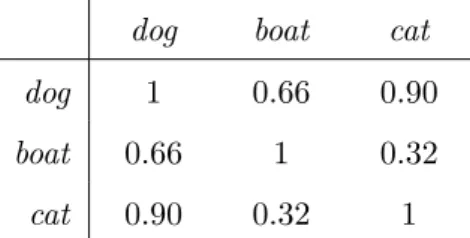
Table 3.1 presents a toy example of a co-occurrence matrix, where rows represent target terms and columns represent contexts. Here, contexts directly characterised by word counts, for example, in each sentence that contains target terms. A feature vector of a word ‘boat’ would be 𝑥𝑏𝑜𝑎𝑡⃗ = (42, 30, 0).
run bark cuddle
dog 45 35 65
boat 42 30 0
cat 36 1 85
Table 3.1 Toy co-occurence matrix
Semantic similarity between words can be predicted from the DSM as proximity between the corresponding feature vectors. One widely used measure is the cosine of the angle 𝜃 between the two vectors ⃗𝑎 and ⃗𝑏:
cos(𝜃) = 𝑎 ⋅ ⃗𝑏⃗ ‖ ⃗𝑎‖‖ ⃗𝑏‖ = 𝑛 ∑ 𝑖=1 𝑎𝑖𝑏𝑖 √ 𝑛 ∑ 𝑖=1 𝑎2 𝑖√ 𝑛 ∑ 𝑖=1 𝑏2 𝑖 , (3.1)
where 𝑎𝑖 and 𝑏𝑖 are components (contexts) of vectors ⃗𝑎 and ⃗𝑏 respectively. The value 0 indicates absence of semantic similarity and 1 indicates full semantic similarity.
According to our toy example cosine similarity between the words ‘dog’, ‘boat’ and ‘cat’ can be computed:
dog boat cat
dog 1 0.66 0.90
boat 0.66 1 0.32
cat 0.90 0.32 1
Background
According to toy example, the cosine similarity between ‘dog’ and ‘boat’ is 0.66 and the cosine similarity between ‘dog’ and ‘cat’ is 0.90, which means that ‘dog’ is more similar to ‘cat’ than to ‘boat’.
It is important to mention that real examples of DSMs with word counts might be very sparse, producing matrix of hundreds of thousands cells with zero value. This would lead to manageability and high computational complexity of operations with such matrix. In practice, various dimensionality reduction techniques are used, such as Principal Component Analysis (PCA), Singular Value Decomposition (SVD), etc.
3.2.3 Psychological and Linguistic Viability of DSMs
DSMs show good results in modelling psychological and linguistic phenomena. In this section we are going to present state-of-the-art results showing how DSMs ap-proximate human performance in various tasks.
TOEFL synonym identification task The TOEFL is an obligatory test for foreign stu-dents who would like to study at a university in an English speaking country. One of the task contains 80 items with candidate synonyms, e.g. presenting a choice of four candidates for the word ‘urgently’: ‘typically’, ‘conceivably’, ‘tentatively’ or ‘desper-ately’. On average, for this task the performance of the native speakers was 97.75%, whereas the performance of the non-native speakers was 86.75% (Rapp, 2004). Mod-els based on distributional hypothesis are able to reach 100% accuracy on this test set, namely Principal Component vectors with Caron P (PCCP) model that was introduced by Bullinaria and Levy (2012).
RG-65 semantic similarity judgment task Rubenstein and Goodenough (1965) (RG-65) data set contains 65 pairs of nouns that were rated by 51 subjects that gave a score from 0 to 4 to each pair (see Example 3.2.2). With DSMs, for each pair of words, feature vectors are taken and then cosine similarity can be measured. Resulting similarities can be checked for correlations with RG-65 data set using Pearson’s 𝑟 correlation coefficient, with a value between +1 and −1 inclusive, where 1 is total positive linear correlation, 0 is no linear correlation, and −1 is total negative linear correlation. Padó and Lapata (2007) use dependency-based DSM, that takes semantic relations into account. Their model shows strong correlations with human judgements (𝑟 = 0.8).
3.2 Distributional Semantics Example 3.2.2 (Judgments from RG-65 task)
noon string 0.04 bird cock 2.63 gem jewel 3.94
Semantic priming There is evidence from a range of experimental paradigms that the effort that is required for processing a word is influenced by the context where that word occurs. This phenomena is called contextual facilitation and is caused by various forms of semantic priming. A task can include taking a decision whether a target word is a word or not, primed with stimulus word that is in certain semantic relation with the target word. For example, subjects can perform better with reading or recognizing the word ‘avocado’ after they encountered the word ‘apple’. DSM-based experiments are using cosine similarity to distinguish related and unrelated primes for target word. McDonald and Brew (2004); Padó and Lapata (2007) show significant effects for various semantic relations between a prime and target word.
Language learning and acquisition DSMs achieve good performance using only large amount of linguistic data as learning input that is similar to the input received by human learners. Though, language acquisition theorists as Bloom (2001) emphasize the importance of interaction and attention in the language acquisition, they recog-nize that the vocabulary size that teenagers command by end of high-school (in the order of tens of thousands of words) can only be acquired by bootstrapping from linguistic data. This bootstrapping is similar to distributional models, as we learned the meaning of the word ‘bardiwac’ from sentences presented in Example 3.2.1. How-ever, humans are often offered a single exposure to a word in context to acquire its meaning, and there are no studies that systematically evaluate the quality of DSMs to model single occurrences of the word (Baroni et al., 2014).
Neuroscience There is support from neuroscience for the view that concepts can be represented as neural activation patterns over broad areas (Haxby et al., 2001), and can be naturally encoded as vectors. Murphy et al. (2012) shows how corpus-based methods can predict brain activation pattern while subject is thinking of a concept, which can lead to quite speculative hypothesis of connection between DSM and structure of concept encoding in human brain.
Background
Grounding counterargument There is an important argument against DSM, saying that representing a meaning of the word just in terms of other symbols lacks
ground-ing in sensory-motor system and thus lacks connection with external word. Chinese
Room thought experiment (Searle, 1988) is a traditional argument that is given against symbolic models. Also, there is a theory of embodied cognition that proposes that concepts are organized in the brain, based on their sensory and motor prop-erties, and that simulation of actions and perceptions in the brain plays a central role in cognition (Barsalou, 2010). However, it seems that not all the concepts are obviously presented in external world, such as ‘truth’ or ‘politics’, that suggests that both embodied cognition and relation between symbols can play an important role.
3.2.4 Neural Word Embeddings
Notorious and widely applied models that learn vector representations by using recurrent neural network (RNN) were proposed by Mikolov et al. (2013). In Sec-tion 3.3.5 I will briefly introduce the noSec-tion of recurrent neural network.
RNN is trained with back-propagation that adjusts the word vectors by walking through huge corpus of texts. They are often referred as word2vec (by the name of a tool, provided by the authors) or word embeddings; and, use one of two model architectures to produce a distributed representation of words: continuous bag-of-words or continuous skip-gram. In the continuous bag-of-bag-of-words architecture, the model predicts the current word from a window of surrounding context words. In the continuous skip-gram architecture, the model uses the current word to predict the surrounding window of context words.
Thought the model itself doesn’t have any knowledge of morphology or semantics, it provides interesting results on both semantic and syntactic tests. Test sets were composed of analogy questions of the form “𝑎 is to 𝑏 as 𝑐 is to _?” testing different syntactic and semantic relations.
Syntactic tests contain examples like “see is to saw as return is to _” (the system should reply with the word returned). On the other hand semantic test contain also analogy questions like “clothing is to shirt as dish is to _” (the system should reply with the word bowl).
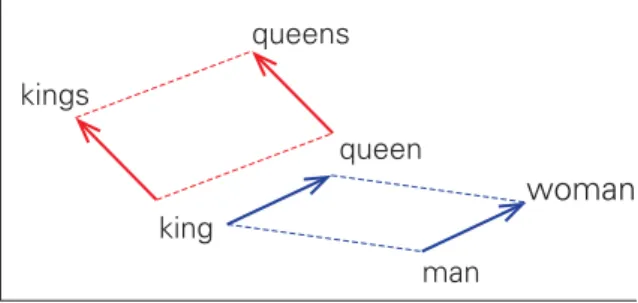
Mikolov et al. (2013) showed that these relations can be obtained using a vector offset model denoting which pairs of words share a particular relation according to the offset between their vector representations. Figure 3.1 depicts how vector offset can be represented in 2-dimensional space.
3.2 Distributional Semantics
Mikolov et al. (2013) claim that RNN language model and vector offset model to-gether provide good results on capturing semantic and syntactic regularities. Namely they showed almost 40% correct matches on syntactic dataset and outperformed pre-vious state-of-the-art on the semantic similarity task of SemEval-2012.
queens queen kings
king woman
man
Fig. 3.1 Syntactic (shown in red) and semantic (shown in blue) regularities in vector space. Adapted from Mikolov et al. (2013).
3.2.5 Compositionality of DSM
As we have distributional semantic concepts that are showing great results in differ-ent tasks, it is important to point the ambitious aim of obtaining a general-propose semantics for natural language. Current approaches use logic to represent sentence semantics, which has little traction in capturing word similarity that can be obtained using distributional semantics.
Approaches on composition of sentence meaning propose different vector compo-sition techniques. For example, Grefenstette and Sadrzadeh (2011) represent sub-ject and obsub-ject verbs as vectors, combining them using tensor product and use component-wise multiplication to matrix that represents transitive verbs. The mean-ing of a phrase “subj verb obj” is computed as for example (𝑗𝑜ℎ𝑛 ⊗⃗ 𝑑𝑢𝑐𝑘) ⊙⃗ 𝑠𝑒𝑒 for⃗ the sentence “John sees ducks”.
There are many open problems for sentence semantics. One of these problems is the scaling problem that raise a following question: how fixed-length vectors can provide a representation for sentence of arbitrary length and structure in order to obtain fine-grained sentence similarity. Another problem is about representing function words, such as “not”: how should they be encoded in vector space to adjust the meaning of a constituent (Erk, 2012).
Background
3.3 Deep Learning
In recent years deep learning computational techniques dramatically improved state-of-the-art in such areas as computer vision, speech recognition, genomics, etc. Deep learning models include multiple processing layers that support different abstractions of the data.
The main difference between deep learning techniques and conventional machine learning is that the latter requires handcrafted feature extraction from the raw data. Typically, input is transformed into certain representation (i.e. feature vectors). For example, computer vision system will receive input image as an array of pixel colour values and extract other additional handcrafted features. These features will be passed to a classifier, that will learn important features with respect to the task (e.g. distinguishing cars from houses) and classify patterns in the input.
Deep learning methods automatically learn multiple levels of representation, each one is slightly more abstract than the previous one. For example, for computer vision deep learning system will receive as input a raw image given as a matrix with pixel colour values. The first layer will detect which edges are present in a picture and how are they inclined. The next layer will detect how these edges are connected together. The next layer will represent a more abstract features and so on. Important feature of deep learning systems is that these representational layers are not created by humans, but they are learned from data.
The main ideas behind deep learning came from the 1970s and earlier but it took time to spread. Key drivers that led to deep learning emergence are: (1) consistent growth of computational power including GPUs (graphical processing units) and (2) availability and ubiquity of huge amounts digital data (i.e. texts and images) in digital form that emerged with the tremendous growth of the Internet.
In this section I will describe key ideas behind deep learning and briefly review main architectures that are most important for solving natural processing tasks.
3.3.1 Machine learning
Learning from data performed by computer was defined by Mitchell (1997) in the following way:
A computer program is said to learn from experience 𝐸 with respect to some class of tasks 𝑇 and performance measure 𝑃 , if its performance at tasks in 𝑇 , as measured by 𝑃 , improves with experience 𝐸.
3.3 Deep Learning
Machine learning tasks 𝑇 typically describe, how machine should process a given
example, which is usually represented as a collection of features. There is a wide va-riety of tasks that could be solved using machine learning approaches: classification, numerical value prediction, transcription (i.e. speech-to-text), machine translation, anomaly detection, synthesis, etc. In the present work, the machine learning task can be defined as the following: “Given two questions as examples, discover if they are semantically equivalent”.
Performance measure 𝑃 is usually specific for the task that is conducted by the
system. The typical measures are accuracy and error rate, which are proportions of correct or incorrect outputs respectively. Error rate, or loss can be measured as a binary or a continuous-valued score. For some tasks, such as machine transla-tion, measures should be more fine-grained and the selection of such measures is an important research issue.
Important condition for measuring the performance of a model is its evaluation on unseen data. This would show how well the model will perform when deployed in the real world. For this reason performance is measured on a test set that is separated from the one used for training the system.
In terms of the experience that the system is allowed to get during training, ma-chine learning techniques can be split into two broad categories: supervised and
unsupervised.
A supervised learning algorithm operates with examples which are associated with a certain label. For example, training dataset of questions is tagged with labels that determine if the questions in the pair are semantically equivalent.
In contrast, unsupervised learning systems handle examples that are not labelled and are learning to extract some sense without any guidance. For example, unsu-pervised systems of network security domain can be used to detect patterns and anomalies in network traffic.
3.3.2 Inspirations from neuroscience
One of historical names for deep learning is artificial neural networks (ANNs). This name came from the loose inspiration that computer scientists and engineers received from the biological brain structure. Neural networks were serving as models that were used to understand how human or animal brain functions.
Another inspiration from neuroscience is a reason to hope that lots of different tasks can be solved by a single algorithm that will operate through deep neuron structure. The studies on ferret’s brain shown that if certain areas of their brain
Background
would be rewired to receive visual signals, they will learn to “see” with a brain area that is different from the visual cortex (Von Melchner et al., 2000) .
Despite of these inspirations, we should take into account that neurons compute functions that are different from those functions computed by units used in artificial neural networks. Making this functions closer to biological reality does not lead to any performance improvements of deep learning algorithms (Goodfellow et al., 2016). Also, while several neural network architectures were inspired by neuroscience, we do not have yet enough evidence about biological learning. So it is not yet practical to use neuroscience to provide guidance for the learning algorithms that are used to train deep learning architectures.
The main difference between deep learning algorithms research and computational neuroscience is that the latter is aimed to build accurate models of how the brain works, while deep learning research deals with building computer systems that would solve tasks that require intelligence with the most favourable result.
3.3.3 Deep feedforward neural networks
Feedforward neural networks are the most basic and expressive deep learning mod-els. Feedforward networks that are used for classification purposes maps an input x to a category 𝑦 approximating some function 𝑓. The resulting best function approx-imation can be defined as mapping 𝑦 = 𝑓(x; 𝜃), where 𝜃 is a set of parameters which provide this approximation.
This kind of model is a network because it is constructed by chain composition of layer of functions, e.g. 𝑓(1), 𝑓(2) and 𝑓(3) that are used to approximate function 𝑓(𝑥) = 𝑓(3)(𝑓(2)(𝑓(1))). Each of the functions represents a layer of a network. The last layer is called output layer and the others are called hidden layers because training data does not show the desired output for each of them.
The term feedforward means that there are no feedback connections in which outputs of layers are connected back into the same or bottom layer.
For computing the values for each of the layers various activation functions (typi-cally non-linear) are used. One of the most important functions for computing hidden layer values is linear rectifier function 𝑔(𝑧) = 𝑚𝑎𝑥{0, 𝑧}
The values of hidden layer h are computed using the following transformation:
3.3 Deep Learning
where 𝑊 provides the weights of a transformation of input x into h and c provides the biases. Another popular activation functions are sigmoid 𝜎(𝑧) and hyperbolic tangent 𝑡𝑎𝑛ℎ(𝑧). Output layer values, denoted as ̂y, are computed in a similar fashion.
The forward flow of information from input x to the series of hidden units up to the final value ̂y is called forward propagation. The scalar cost 𝐽 (𝜃) produced by the network represents its current performance measure. The backpropagation (Rumel-hart et al., 1988), an abbreviation for backward propagation of errors calculates the gradient of a cost function with respect to all the weights in the network. Gradient is used to update the weights and minimize the cost improving the performance of the network for the next training examples.
input layer hidden layer output layer
Fig. 3.2 Feedforward fully-connected neural network.
Figure 3.2 shows a simple example of a feedforward fully-connected neural network. It contrasts with recurrent neural network because it does not have any feedback connections. The feature of a network being fully-connected meaning that each of the layer units is connected to each of the units of the adjacent layer(s) contrast with convolutional neural network. Convolutional neural networks and recurrent neural networks will be briefly explained in the next sections.
3.3.4 Convolutional neural networks
Convolutional neural networks (CNNs) (LeCun et al., 1989) are a subset of feed-forward artificial neural network in which the neurons connectivity is inspired by the organization of the animal visual cortex. Individual cortical neurons respond to stimuli in a restricted region of space known as the receptive field. The receptive fields of different neurons partially overlap such that they tile the visual field. The response of an individual neuron to stimuli within its receptive field can be math-ematically approximated by a convolution operation. Key ideas behind CNNs are: sparse connectivity, shared weights, pooling and the use of many layers.
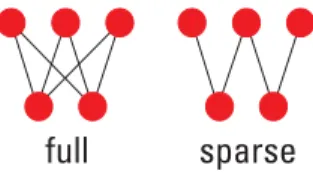
CNNs have sparse connectivity between layers, for example the input image might have thousands of pixels and meaningful features are extracted not from individual pixels but from the regions that occupy certain patch of an image (e.g. 10 × 10 pixel
Background
sparse full
Fig. 3.3 Fully-connected layers vs sparsely connected layers.
area). Patches of an image are connected to the set of network units called feature
maps. Convolutional layers stack together such that each convolutional layer apply
certain set of feature maps. All units in a feature map share the same set of weights called filter bank. For one layer different feature maps with correspondent filter bank can exist.
A pooling layer is used to merge similar features into one and typically it computes the maximum of a local patch into one or several feature maps (however, in the work by Bogdanova et al. (2015), they sum up the local patch, see Section 4.1.3).
Convolution neural networks are deep: two or three stages of convolution and pooling are stacked, followed by more convolutional and fully-connected layers.
CNNs brought huge revolutionary success in computer vision and are important for various recognition and pattern detection tasks, such as traffic sign recognition, the segmentation of biological images for the detection of faces, text, pedestrians and human bodies in natural image (see LeCun et al. (2015) for the collection of papers that reach or overcome the current state-of-the-art in various tasks).
Recent CNN architectures have 10 to 20 layers of non-linear rectifier units, hun-dreds of millions of weights, and billions of connections between units. Training such large networks could have taken weeks in 2013, but progress in hardware, software and algorithm parallelisation have reduced training times to a few hours in 2015 (LeCun et al., 2015).
Section 4.1 of the next chapter will describe a particular architecture of CNN that was used in the present work for the task of detecting semantically equivalent questions.
3.3.5 Recurrent neural networks
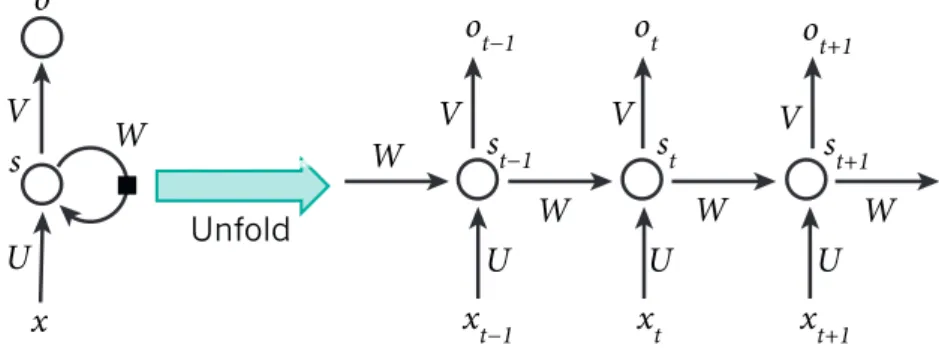
Recurrent neural networks (RNNs) are notorious for their utilisation in tasks that involve sequential input such as speech and language.
Hidden layers of RNNs represent discrete time steps (states) of the network where each subsequent state receives an input from the preceding state. This can help to predict the next word given previous words, for example, in statistical language