A Work Project presented as part of the requirements for the Award of a Master Degree in Management from the NOVA – School of Business and Economics.
CONDITIONAL INDIRECT EFFECTS OF CLIMATE FOR SERVICE ON OCB THROUGH WORK ENGAGEMENT: THE ROLE OF SUPERVISOR’S
ORGANIZATIONAL EMBODIMENT.
LUÍS ARMANDO BRANDÃO CASTANHO PAES 30419
A Project carried out on the Master in Management Program, under the supervision of: Professor. Filipa Castanheira
ABSTRACT
This present research aims to analyze the concept of climate for service and the mediating and moderating processes through which it is associated with organizational citizenship behavior (OCB). It has been tested whether work engagement mediated the relationship between climate for service and OCB by using a sample of 593 employees from one large retail store. It was also examined whether the supervisor’s organizational embodiment (SOE) would moderate the link between climate for service and work engagement. Results confirmed both mediating and moderating effects in the research model, highlighting the relevance of such variables in a climate for service scenario.
Keywords: climate for service, work engagement, organizational citizenship behavior,
TABLE OF CONTENTS
LIST OF FIGURES AND TABLES ... 4
1. INTRODUCTION ... 5
2. LINK BETWEEN CLIMATE FOR SERVICE AND OCB ... 7
3. THE MEDIATING ROLE OF WORK ENGAGEMENT ... 10
4. THE MODERATING ROLE OF SOE ... 12
5. METHOD ... 14
5.1 Sample And Procedure ... 14
5.2 Measures... 15
5.2.1 Climate for Service... 15
5.2.2 Supervisor’s Organizational Embodiment ... 15
5.2.3 Work Engagement ... 15
5.2.4 Organizational Citizenship Behavior – Loyalty ... 16
5.2.5 Organizational Citizenship Behavior – Helping Behavior ... 16
5.2.6 Control variables ... 17
5.3 Statistical Analysis ... 17
6. RESULTS... 18
6.1 Test of Mediation ... 19
6.2 Test of Moderated Mediation ... 21
7. DISCUSSION ... 22
7.1 Study Recap... 22
7.2 – Limitations and Future Studies ... 25
7.3 – Implications for Practitioners ... 26
8. CONCLUSION ... 27
LIST OF FIGURES AND TABLES
Figure 1 - Research Model 7
Figure 2 - Interaction Effects: Climate for Service x SOE x Work Engagement 21 Table 1 - Descriptive statistics and study variable inter-correlations 19 Table 2 - Regression results for moderated mediation (Conditional Indirect Effects) 20
1. INTRODUCTION
Many organizations are turning customer’s perceptions on quality of service into a priority in management operations in order to claim crucial competitive advantage (Berry, 1995; Zeithaml & Bitner, 1996). The business approach of increasing significantly the quality of a service is also believed and supported by the marketing literature to directly lead to customer retention and consequently to higher profits (Deshpande, Farley, & Webster, 1993; Narver & Slater, 1990; Rust & Zahorik, 1993; Storbacka, Strandvik, & Gronroos, 1994). There are internal structures that aim to encourage customers to perceive a particular service as superior. However, to efficiently act on those processes there must exist a climate for service within the organization (Schneider, White, & Paul, 1998). Earlier research has found that favorable climate for service moderates the influence of employee’s commitment to the supervisor on organizational citizenship behavior, such that the influence of commitment to the supervisor is more positive when climate for service is high than when it is low
(Walumbwa, Hartnell, & Oke, 2010). Organizational citizenship behavior or OCB is the “individual behavior that is discretionary, not directly or explicitly recognized by the formal reward system, and that in the aggregate promotes the effective functioning of the
organization” (Organ, 1988, p. 4).
Some authors have stated that the concept of employee’s performance, within the service organizational context, should be framed in a more complex manner considering on the one hand the active role of clients (Ryan & Ployhart, 2003) and on the other, the double role of selling and serving which workers are faced with (Batt & Doellgast, 2003). For that reasoning, many studies have been searching how to add up the notion of OCB, both general and specific to customer service, while being able to integrate with the concept of employee’s performance as well (Bettencourt, Gwineer, & Meuter, 2001; Castanheira & Chambel, 2010; Moliner, Martinez-Tur, Ramos, Peiró, & Cropanzano, 2008; Payne & Weber, 2006). It has
also been discussed that high values of climate for service positively influences employee instrumentality and promotes service quality behaviors as the valued currency within the organizational context (Schneider, 1990). Employees invest in better OCB levels in order to fulfill normative social expectations and to obtain positive appreciation for their work
(Walumbwa, Hartnell, & Oke, 2010). However, this linkage has only been assumed, and work engagement was not explicitly considered in those studies. Work engagement is defined by ‘‘… a positive, fulfilling, work-related state of mind that is characterized by vigor, dedication, and absorption’’ (Schaufeli, Salanova, Gonza´lez-Roma´, & Bakker, 2002, p. 72). Employees who are engaged with the work they are performing have presented energetic behavior and enthusiasm about their job, immersed in their tasks and creating a sense of time flying (Macey & Schneider, 2008; May, Gilson, & Harter, 2004; Schaufeli & Bakker, in press). Modern organizations are now constantly seeking pro-activism and initiative from employees, which is a relevant case considering that work engagement is presented to make a real difference for employees regarding energy and dedication at the workplace (Bakker & Schaufeli, 2008). More studies are still needed to examine the role of work engagement on organizational citizenship behaviors, and we were unable to find research that has specifically investigated the indirect effect of climate for service through work engagement on OCBs.
In addition, authors have analyzed the relationship between supervisors’ conducts and employees’ motivation and engagement at work, concluding that positive levels of work engagement are perceived in workers whose direct supervisors presented high relationship-oriented behavior and also that supportive supervisor behaviors facilitate engagement (Kahn, 1990; May, Gilson, & Harter, 2004; Saks, 2006). However, to our knowledge, the influences of the supervisor’s organizational embodiment on work engagement and climate for service is yet to be explored. Supervisor’s organizational embodiment (SOE), which analyses the extension of employee’s perception on the identity of their supervisor as a representation of
the organization itself, can function to increase the commitment to the organization and also the way employees believe and react to the organizational practices (Eisenberger, Karagonlar, Stinglhamber, Neves, Becker & Gonzalez-Morales, 2010). As a result, we want to explore whether and how the extent to which the employee sees the supervisor as a representative of the organization may change the expected influence of climate for service on work
engagement.
There still is the necessity to a better comprehension of the applications and
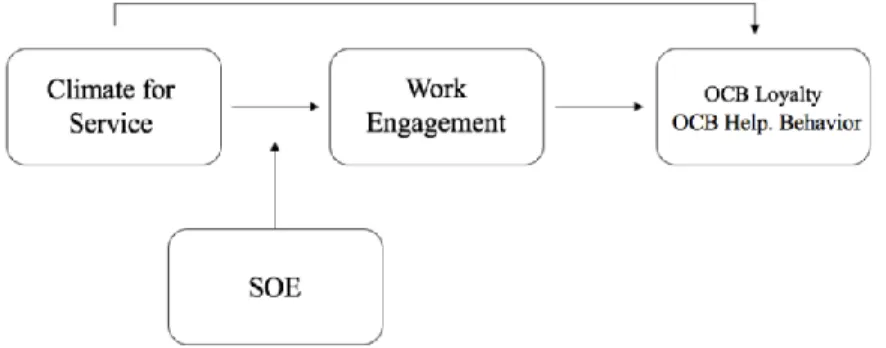
interactions among the variables mentioned. This current research adds to the literature by testing a model which takes in consideration mediated and moderated influences of work engagement and SOE in the relationship between climate for service and employee’s OCB concerning loyalty and helping behavior (Figure 01).
Figure 1 - Research Model
2. LINK BETWEEN CLIMATE FOR SERVICE AND OCB
When organizations design and cultivate a climate for service by expecting and rewarding quality within the performance of tasks, employees are more likely to deliver exemplary service to customers (Schneider, Ehrhart, Mayer, Saltz, & Niles-Jolly, 2005). The climate within this context is the employee’s collective perception of operations, processes, procedures, and behaviors that sustain a particular business system (Schneider, 1990). Still,
the term “climate” must serve as a climate to a specific area (e.g., service, support,
innovation, safety; Schneider, Gunnarson, & Niles-Jolly, 1994). Climate for service relates then to the extent that employees believe they are acknowledged for delivering quality service and to the overall perception that high standards for customer service are a relevant
component for business performance (Schneider, White, & Paul, 1998).
Employees perform constant workplace evaluation in order to analyze procedures and behaviors that are supported and appreciated by the organization’s management (Schneider et al., 1998). On that basis, workers may have a sense of an actual climate for service if their company presents measures and policies to reward high-quality service provided to customers (Ray, Barney, & Muhanna, 2004). Schneider and colleagues (1994) also suggested that employees set their priorities only after observing occurrences of what happens around them and coming up with conclusions regarding the organization’s concerns first. An example of how that process takes place is presented by authors Gabler, Rapp, Richey, & Adams (2016), who explained that organizations which have reward systems based on customer satisfaction levels might be perceived to have a climate for service. Accordingly, if the human resources department of the same companies also provided constant training focused on how to deliver better service, employees are also likely to identify a better climate for service in the
workplace.
There is argumentation in the literature that supports the notion of work performance being a result of the environment and resources provided by an organization, also known as the Contingency view (Weitz, 1981). Besides, the perceptions of the organizational
procedures related to concerns over service quality may provide employees a sense of
direction and orientation on where they should focus their work and competences, improving work performance along the way (Gabler et al., 2016). Such idea is supported by other authors who openly stated that a climate for service leads to better performance outcomes
(Mayer, Ehrhart, & Schneider, 2009; Schneider, Macey, Lee, & Young, 2009). There is also research that backs up the idea of employees delivering better performance in all job functions when there is a comprehension that there will be some reward for providing high-quality service to customers (Ahearne, Mathieu, & Rapp, 2005). Still, work performance within the service-oriented organizations’ context should be understood in a broader spectrum in order to include other relevant dimensions, such as organizational citizenship behavior (OCB).
Despite the current existence of studies based on leadership and employee retention associated with OCB (e.g., Chen, Hui and Sego 1998; MacKenzie, Podsakoff and Ahearne 1998; Takeuchi, Chen and Lepak, 2009; Walumbwa, 2010; Paille´ and Grima 2011), there is no substantial amount of research on how a climate for service influences such practices that go above task performance and job requirements. The origin of the term OCB was created to disclose work behaviors not acknowledged by an organization’s reward system (Organ, 1988). It is necessary to indicate and comprehend employee conducts that generally go unnoticed in many job performance assessments and that also enhances organizational effectiveness and functionality (Bienstock, DeMoranville, & Smith, 2003).
In order to adopt extra-role behaviors that also occur within and without the work environment, this study dedicates awareness specifically on OCB concerning helping behavior and organizational loyalty. Helping behavior relates to the extension of employees voluntarily assisting co-workers and supervisors on extra-role tasks even though it is not required or expected from them; Organizational loyalty implies not only being loyal within the workspace among peers, but spontaneously promoting a positive image of the corporation to the general public, such as family members, neighbors, colleagues and friends (Podsakoff, MacKenzie, Paine, & Bachrach, 2000).
Climate for service rests on a support foundation that requires quality social
et al., 1998). The quality of such social interactions influences conducts of deliberately returning favors to those who have done them right in a certain way; that comes from a concept presented as the social exchange theory, which arguments a form of reciprocity until a balance of exchanges is reached (Blau, 1964).
Therefore, this study proposes the following:
H1a: Climate for service is positively associated with OCB – Loyalty.
H1b: Climate for service is positively associated with OCB – Helping Behavior.
3. THE MEDIATING ROLE OF WORK ENGAGEMENT
Work engagement by its definition represents a work-related state of mind that is shaped by three dimensions: vigor, dedication, and absorption (Schaufeli, Salanova,
Gonza´lez–Roma´, & Bakker, 2002). Vigor relates to a physical condition which indicates the mental resilience, energy and eagerness to devote any effort while performing a task;
Dedication is an emotional characteristic which involves the sense of significance,
enthusiasm, pride and challenge with work-related activities; Absorption indicates a cognitive component which represents the attitude of becoming highly immersed into a task,
experiencing time passing promptly (Bakker, Hakanen, Demerouti, & Xanthopoulou, 2007). Climate for service has been associated in previous empirical studies with the
employees’ perception of organizational and human resources processes regarding customer service quality, considering them as contextual factors and also to be the foundational issues on which climate for service should rely on (Schneider et al., 1998). The positive association between climate for service and work engagement studied previously goes back to Schneider and his colleagues (1998), who disclaimed that the foundational issues (e.g., HR actions, Managerial processes) are not a sufficient cause of climate for service, arguing that it should also be considered a broader background with subjective characteristics, such as
psychological predictors as well. On that basis, the way any climate is established also should depend on the feelings and motivational aspects of employees (Salanova, Agura, & Peiró, 2005). It is expected that a climate for personnel’s well-being should also play an antecedent role for climate for service, meaning that when employees’ feelings are associated with vigor, involvement, and happiness at the workplace, they may perceive work characteristics as positive more often, including the climate for service itself (Schneider & Bowen, 1993; Schneider et al., 1998). To our knowledge, there has not been a specific analysis disclosing how a better climate for service could also enhance or positively affect levels of work engagement. However, on the basis of researches on the positive outcomes of work engagement on job satisfaction, low absenteeism, low turnover, high organizational performance and also on climate for service itself (Salanova, Llorens, Cifre, Martínez, & Schaufeli, 2003; Schaufeli & Bakker, 2004; Schaufeli, Martínez, et al., 2002; Schaufeli, Salanova, et al., 2002; Salanova, Agura, & Peiró, 2005), we expect that those conclusions on the role of work engagement may indicate a positive cycle, whereas a climate for service enhances work engagement and vice-versa.
When it comes to research on the potential association between work engagement and organizational citizenship behaviors, it has been found results that indicate positive
association on both in-role and extra-role performances (Schaufeli, Bakker, & Salanova, 2006). The reasoning behind those results is explained by the fact that employees who are engaged in their work have a sense of professional accomplishment which enables them to perform extra-role behaviors (Christian et al. 2011). The process of work engagement developing extra-role behaviors may be again related to the previously mentioned social exchange theory (Blau, 1964) and with the norm of reciprocity (Gouldner, 1960) as well, which can be comprehended as the expectation of responding favorably to one another by returning favors with assistance and reciprocating with antipathy to mischiefs. There have
been argumentation and studies (Hannah & Iverson, 2004; Kinnie, Hutchinson, Purcell, Rayton, & Swart, 2005; Ostroff & Bowen, 2000; Takeuchi, Lepak, Wang, & Takeuchi K, 2007; Whitener, 2001) over the fact that once one institution or its members develop the well-being of a particular individual by the implementation of good organizational practices, this person starts having a sense of obligation to reciprocate with constructive conducts, such as affective commitment.
Also, when organizations develop job resources, such as social support from colleagues and supervisors, learning opportunities, constant feedback and autonomy, employees tend to elevate their work engagement and OCB levels (Bakker & Demerouti, 2008; Halbesleben, in press; Schaufeli & Salanova, 2007).
Therefore, in order to expand the comprehension of the interaction of those elements, this study proposes the following:
H2a: Work engagement partially mediates the relation between climate for service and OCB – Loyalty.
H2b: Work engagement partially mediates the relation between climate for service and OCB – Helping Behavior.
4. THE MODERATING ROLE OF SOE
Supervisor’s Organizational Embodiment (SOE) is defined as the employee’s perception of his supervisor as being a representation of the overall organization’s identity; This perception is also based on the subordinate’s series of interaction and his perceived shared characteristics of a chief or manager with a company (Eisenberger et al., 2010).
According to the social identity theory (Brown, 2006), an employee cognitively evaluates interactions and relationships within the organization’s environment and also establishes the degree of identification with social units; Including the professional
relationship with a supervisor and doing so by the extension of SOE levels (Eisenberger et al., 2010). In that sense, an employee may interpret simple actions and procedures, such as
praises, encouragements, compliments, and the establishment of professional goals as coming from the professional entity itself (Eisenberger, Stinglhamber, Vandenberghe, Sucharski, & Rhoades, 2002).
When there is indeed a relevant sense of identity from a supervisor with an organization, it is more likely that an employee will demonstrate positive professional practices and behavioral outcomes (Eisenberger, Armeli, Rexwinkel, Lynch, & Rhoades, 2001). Therefore, SOE’s awareness influences managers and supervisors to better
comprehend how to sustain relationships with subordinates in order to have them display better attitudes concerning efforts and achievements on a task and benefiting the outcomes for the organization (Shore, Lynch, Tetrick, & Barksdale, 2006). Because SOE is a relatively recent term, it has not been found until the development of this study much information or a considerable amount of results on the role, outcomes and levels of interaction among other variables in the literature; indicating the need for further studies on this dimension.
An exception is a study by Eisenberger et al. (2010) that demonstrates SOE’s potential moderating role in the relationship between leader-member exchange (LMX) and affective organizational commitment. Authors discuss the results using the lenses of the associative theory of attitude formation (Worchel, Cooper, & Goethals, 1988; Zimbardo & Leippe, 1991). The purpose is to propose that when SOE levels are elevated and when a subordinate has a positive exchange relationship with the supervisor, “the favorable feelings conditioned to the supervisor might generalize strongly to the organization, resulting in a more positive mood at work and greater affective organizational commitment” (Eisenberger et al., 2010).
embodiment may also play a moderating role in strengthening the relationship between climate for service and employees’ engagement. Therefore, we propose the following:
H3: Supervisor’s organizational embodiment moderates the relationship between climate for service and work engagement.
Assuming SOE’s indicators moderate the relationship between climate for service and work engagement, it is likely that climate for service should also influence organizational citizenship behavior, both regarding loyalty and helping behavior, through an increase in work engagement, conditional on SOE levels. Based on that reasoning, we suppose the following:
H4a: The indirect effect of climate for service to organizational citizenship behavior regarding loyalty through work engagement will be stronger when the supervisor’s
organizational embodiment is high.
H4b: The indirect effect of climate for service to organizational citizenship behavior regarding helping behavior through work engagement will be stronger when the supervisor’s organizational embodiment is high.
5. METHOD
5.1 SAMPLE AND PROCEDURE
This study includes 593 workers of a large retail store (75 percent of response rate). The sample is composed of 75.6 percent of the female gender. Regarding the tenure, 62.3 percent of the respondents have worked for the company for more than ten years; 20.5 percent for less than one year; 9.1 percent between three to five years followed by 8.1 percent
between one to three years. When considered education levels, most employees finished high-school (60.2 percent), and 12.0 percent held a college degree. The Human Resources
Department from the retail store sent an email to all employees explaining research aims, the researchers’ affiliation and a link to the survey. It was given 15 days to complete the survey,
and it was made clear that workers’ participation was voluntary and all participants were assured that their responses would remain confidential.
5.2 MEASURES
5.2.1 Climate for Service
The perception that quality of service is a priority factor was evaluated through 9 items of the Schneider, White and Paul (1998) instrument (e.g., Our procedures facilitate the delivery of quality services; In my section, there is an effort to evaluate the quality of service provided). Responses on climate for service were documented on a 5-point Likert scale ranging from 1 "Strongly Disagree" to 5 "Strongly Agree". The Cronbach alpha value of the scale (.89) shows a high internal consistency.
5.2.2 Supervisor’s Organizational Embodiment
The supervisor organizational embodiment (SOE) assesses the extent to which employees perceive the supervisor’s leadership and practices as a representative of the company itself. It includes a set of 9 questions adapted from the Eisenberger, Karagonlar, Stinglhamber, Neves, Becker, Steiger-Mueller, & Gonzalez-Morales (2010) instrument (e.g. When my boss encourages me, I believe the company is encouraging me; My boss and the company have a lot in common; my boss represents the company). Responses on the supervisor's organizational embodiment were documented on a 5-point Likert scale ranging from 1 "Strongly Disagree" to 5 "Strongly Agree". The Cronbach alpha value of the scale (.93) shows a high internal consistency.
5.2.3 Work Engagement
This psychological state can be considered a positive, persistent, work-related cognitive-affective state characterized by vigor, dedication, and absorption. The force
work; the dedication is characterized by a sense of relevance, enthusiasm, inspiration, pride, and challenge to work; and the absorption, in which the person concentrates totally, loses the notion of time passing and gets carried away in his involvement with the work (Scahufeli et al., 2002). The engagement was evaluated through 9 items adapted from the Utrecht Work Engagement scale (Schaufeli, et al., 2002), which included 3 items related to vigor (e.g., In my work, I feel full of energy and vigor), 3 items with dedication (e.g., I feel enthusiastic about my work) and 3 items with absorption (e.g., I forget about non-business related concerns while I am working). Responses were documented on a scale 7-point scale (1 = never at 7 = Everyday), and higher values indicate higher levels of engagement. The Cronbach alpha value of the scale (.93) shows a high internal consistency.
5.2.4 Organizational Citizenship Behavior – Loyalty
This dimension includes worker behaviors that reflect loyalty to the company. Those behaviors were self-evaluated through 5 items adapted from the Bettencourt, Gwineer, and Meuter (2001) scale. (e.g., I tell "outsiders" that the company is a good place to work; I actively promote the company’s products and services). Items were answered on a 5-point Likert scale, (1 = Almost never, 5 = Almost always) and higher scores indicated more Loyalty OCB. The Cronbach alpha value of the scale (.87) shows adequate internal consistency.
5.2.5 Organizational Citizenship Behavior – Helping Behavior
This dimension includes employee’s behaviors that correspond to active participation in the improvement of the service provided to the client. Those behaviors were self-evaluated through 5 items adapted from the Bettencourt, Gwineer, and Meuter (2001) scale. (e.g., I contribute with ideas for sales campaigns and customer communication; I often present creative solutions to customer issues). The items were answered on a 5-point Likert scale (1 = Almost never, 5 = Almost always) and higher scores indicated more OCB’s Helping
5.2.6 Control variables
There is research that presents gender as a dimension related to the way people present feelings and attitudes related to work engagement (Schaufeli & Salanova, 2007). In addition, tenure has been analyzed to be related to organizational outcomes regarding strategic change and employee perception on supervisors at the workplace (Brookman & Thistle, 2009; Bernstein, Buse, & Bilimoria, 2016). Therefore, gender and tenure were included as control variables. Accordingly, gender was codified as a dummy variable, coded 0 if the respondent was male and 1 if female. Tenure was answered as an ordinal variable coded as 1 - less than one year; 2 – one to three years; 3 – three to five years; 4 – five to ten years; 5 – more than ten years.
5.3 STATISTICAL ANALYSIS
In order to evaluate the hypotheses presented, it was applied a regression-based analysis adopting PROCESS operating system, which is a technological resource that estimates and performs examinations on conditional indirect effects of moderated mediation models as well as on interactions among scientific variables. (Hayes, 2012; Preacher, Rucker, & Hayes, 2007).
More specifically, PROCESS is an SPSS software macro which supports the
evaluation of indirect effects, by adopting a normal theory approach (e.g., the Sobel test) and a bootstrap method to compute confidence intervals (CI). The practice of bootstrapping has been recommended in the scientific research methods scenario by authors Mackinnon, Lockwood, and Williams (2004).
In the interest of avoiding power issues imported by asymmetric and more nonnormal sampling distributions of an indirect effect, the utilization of Bootstrapped confidence
Initially, it was examined a simple model 4 (Hypothesis 1ab and 2ab) in PROCESS adopting 10000 bootstrap samples, 95% bias-corrected bootstrap confidence intervals for all indirect effects. There has been suggested a multistep approach (Baron and Kenny, 1986), which has also been incorporated within this model. As a second procedure, it was integrated the proposed moderator variable into the model (Hypothesis 3), and it was empirically evaluated the overall moderated mediation hypothesis (Hypothesis 4a and 4b).
Respectively, the procedures used to test Hypotheses 3 and 4 were integrated such that it was considered the possibility of a statistically significant indirect effect being contingent on the value of the proposed moderator.
In pursuance of testing for these Hypotheses, we estimated Model 7 in PROCESS, which accounts for a conditional indirect effect of climate for service on organizational citizenship behavior – loyalty and helping behavior through work engagement with 5000 bootstrap samples and 95% bias-corrected bootstrap confidence intervals for all indirect effects.
According to Aiken and West’s (2001) propositions, predictor variables were mean-centered, and the conditional indirect effect was analyzed at different values of the moderator variable: the mean, one standard deviation above, and one standard deviation below the mean. Control variables were also included in all analysis.
6. RESULTS
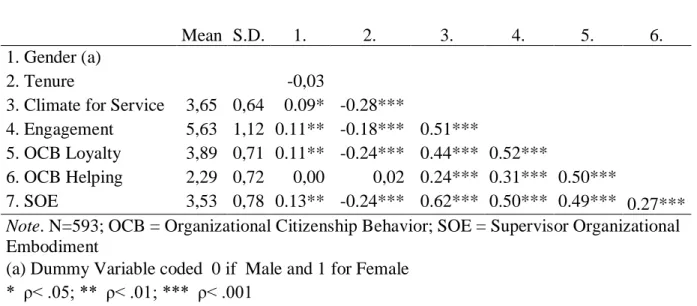
Table 1 presents the means, standard deviations and the inter-correlations of the researched variables.
Table 1 - Descriptive statistics and study variable inter-correlations
Mean S.D. 1. 2. 3. 4. 5. 6.
1. Gender (a)
2. Tenure -0,03
3. Climate for Service 3,65 0,64 0.09* -0.28***
4. Engagement 5,63 1,12 0.11** -0.18*** 0.51***
5. OCB Loyalty 3,89 0,71 0.11** -0.24*** 0.44*** 0.52***
6. OCB Helping 2,29 0,72 0,00 0,02 0.24*** 0.31*** 0.50***
7. SOE 3,53 0,78 0.13** -0.24*** 0.62*** 0.50*** 0.49*** 0.27***
Note. N=593; OCB = Organizational Citizenship Behavior; SOE = Supervisor Organizational
Embodiment
(a) Dummy Variable coded 0 if Male and 1 for Female * ρ< .05; ** ρ< .01; *** ρ< .001
6.1 Test of Mediation
Hypothesis 1 proposed that climate for service was associated with more OCB Loyalty (H1a) and OCB Helping Behavior (H1b), and Hypothesis 2 stated that this
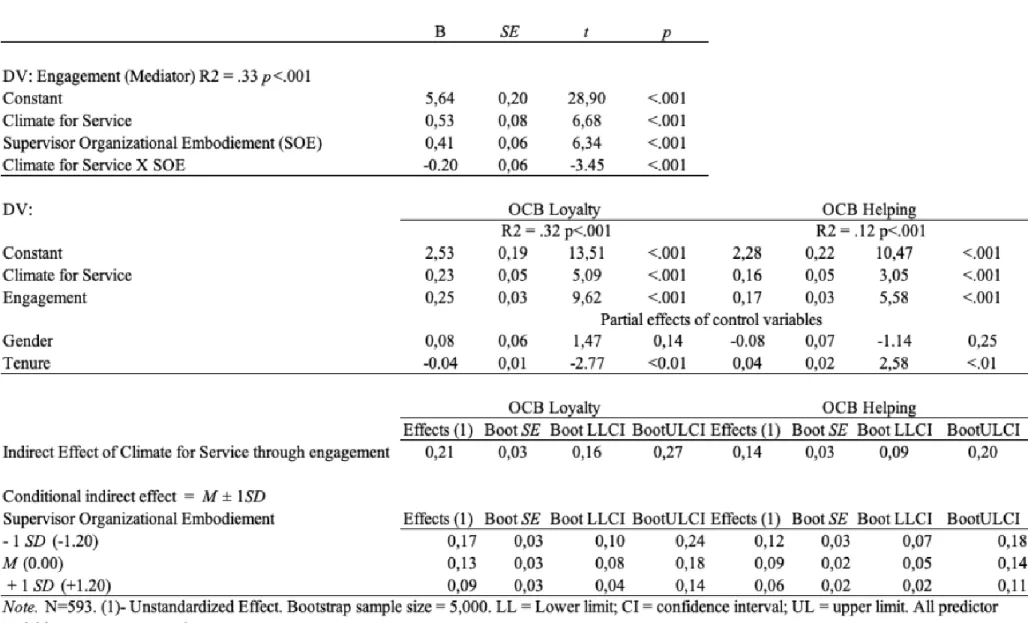
relationship was mediated by work engagement (H2a and H2b, respectively). Table 1 shows that climate for service was positively associated with OCB Loyalty and Helping (r=.44, ρ<.001 and r=.24, ρ<.001), thereby supporting H1a and H1b. Table 2 demonstrates that both climate for service and work engagement were positively associated with OCB Loyalty (B= .23, t=5.09, ρ<.001; and B= .25, t= 9.62, ρ<.001, respectively) and OCB Helping (B= .16, t= 3.05, ρ<.001; and B= .17, t= 5.58, ρ<.001, respectively). Furthermore, we observed
significant indirect effects of climate for service on OCBs Loyalty and Helping Behavior through work engagement (indirect effect =.21; 95% CI from .16 to .27 and indirect effect =.14; 95% CI from .09 to .20, respectively). Therefore, results supported hypotheses 2a and 2b.
6.2 Test of Moderated Mediation
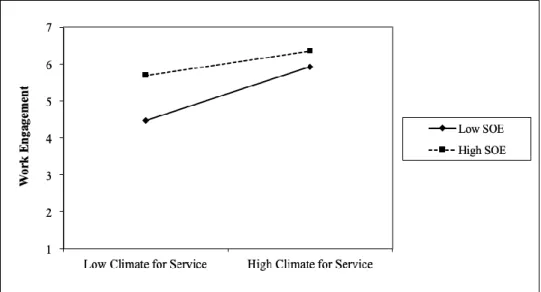
Table 2 also presents the results for the moderator effect of supervisor organizational embodiment (H3), and the conditional indirect effects of climate for service on OCB Loyalty (H4a) and Helping Behavior (H4b). Results indicated that the cross-product term between climate for service and supervisor organizational embodiment on work engagement was significant (B=-.20, t= -3.45, ρ<.001). These interaction effects are represented in Figure 2. Results indicate that the highest levels of work engagement are found in individuals who report high climate for service. Although, the effect of climate for service on work
engagement is always positive and significant, when supervisor organizational embodiment is low, a climate for service has a stronger effect on work engagement. Therefore, results
supported H3.
Figure 2 – Interaction Effects: Climate for Service x SOE x Work Engagement
Although outcomes show that climate for service interacted with supervisor organizational embodiment to influence work engagement, they do not directly assess the
proposed moderated mediation. Accordingly, we examined the conditional indirect effect of climate for service on OCB (through work engagement) at three levels of supervisor
organizational embodiment (Table 2): the mean (0.00), one-standard-deviation above the mean (1.20), and one-standard-deviation below the mean (-1.20).
Results supported a conditional indirect effect of climate for service on predicting OCB via work engagement when workers reported supervisor organizational embodiment (Table 2). Results indicated that the conditional indirect effects (based on moderator values at mean and +1 standard-deviation) were positive and significantly different from zero. Thus Hypothesis 4a and 4b were supported, such that the indirect and positive effects of climate for service on OCB Loyalty and Helping Behavior (through work engagement) were stronger depending on levels of supervisor organizational embodiment.
7. DISCUSSION 7.1 Study Recap
The purpose of this research was to elaborate and perform an analysis of mediated and conditional indirect effects through which climate for service relates to organizational
citizenship behavior (OCB) concerning helping practices and employee’s loyalty. The
complexity of the study is expanded to also include the mediation effect of work engagement and the supervisor’s organizational embodiment (SOE) as a significant moderator variable in the hypothesized mediated relationship. While not being able to detect any investigation with the same approach, this research represents a step further in the HRM literature by
incorporating supervisor’s organizational embodiment as a valid instrument to increase work engagement on account of climate for service.
Results indicate that climate for service is positively related to organizational citizenship behavior. As expected, within an organizational context, when there are
operational and managerial systems that support a better perception and practice of a climate for service, employees deliver better performance in all job functions (Ahearne, Mathieu, & Rapp, 2005). The results of this research, however, demonstrate that there is an extension of this outcome as organizational citizenship behaviors are also relevantly increased when a climate for service is perceived. Such implications support the idea that climate for service impacts how employees will be more participative in tasks that they are not required to work on, and how they may shape organization’s reputation outside the workplace by
communicating good job experiences.
Regarding the analysis of work engagement as a significant component that shapes the relationship between climate for service and OCB, it has also been found its positive indirect effect in the model. It has been anticipated that work engagement would perform a significant role in that association since it was previously proven to be related individually with both climate for service (Schneider & Bowen, 1993; Schneider et al., 1998) and organizational citizenship behavior (Schaufeli, Bakker, & Salanova, 2006). However, the results in this study add up to the potential role of work engagement as supports the notion of it being a
mechanism through which climate for service influences higher levels of organizational citizenship behavior.
The implications of this finding supports the previously argumentation that organizations should design training and rewarding service quality systems (e.g.,
compensation benefits aligned with service performance; internal communication on relevant aspects of delivering high-quality service) in order to motivate employees to excel in job tasks and customer service procedures (Schneider, Ehrhart, Mayer, Saltz, & Niles-Jolly, 2005). When institutions develop and implement such managerial practices, employees will elevate work engagement levels while consequently increasing organizational citizenship behaviors, such as helping other workers in their tasks and making usage of a positive communication
over the work experiences to people outside of the organizational environment (Bakker & Demerouti, 2008; Halbesleben, in press; Schaufeli & Salanova, 2007).
Indeed, designing a whole structure to better assist the awareness and relevancy of a climate for service requires managerial decisions that ought to be made by managers or supervisors, but also perceived by general employees. Therefore, the SOE was expected to have a moderating role between climate for service and work engagement as employees could interpret management decisions as coming from the company itself, rather than from a
supervisor, using such sense of organizational belonging as triggers to their own behaviors and conducts within the workplace (Eisenberger, Stinglhamber, Vandenberghe, Sucharski, & Rhoades, 2002).
Regarding the results of this moderated effect in this study’s research model, it has been supported the idea that when climate for service is low, a high level of supervisor’s organizational embodiment has a significant positive impact on work engagement. In contrast, if the climate for service is high, a greater level of SOE still positively influences the levels of work engagement; However, it would not impact as much as it did in the previously
mentioned context. This finding indicates that enhancing SOE levels is consistently a
favorable approach in climate for service scenarios, but in a low climate for service context, it is critical to develop SOE levels in order to enhance substantial work engagement.
Moreover, the supervisor’s organizational embodiment is built based on employees’ perceptions and it can be enhanced by developing favorable social exchange relationships between workers and managers, consequently converting into instrumental value of increased organizational involvement and organizational citizenship behaviors as well (e.g., helping coworkers and volunteering for new projects) (Eisenberger et al., 2010). The foundation of this principle and the obtained results support the accordance to the social exchange theory and the norm of reciprocity (Blau 1964; Gouldner, 1960), whereas employees who interpret
supervisor’s positive behaviors (e.g., attention, encouragement, praise) as coming from the company itself would feel obligated to return those conducts by increasing its organizational commitment (Eisenberger et al., 2010).
Overall a climate for service may be already perceived as competitive advantage component regarding enhancing customer service and raising revenue statistics (Deshpande et al., 1993; Narver & Slater, 1990; Rust & Zahorik, 1993; Storbacka et al.,1994). However, based on previous argumentation in the literature (Mayer et al., 2009; Schneider et al., 2009) and the results achieved with this research, a climate for service plays a significant role as a strategic element concerning human resources management as well. Therefore, organizations that fail to develop operational mechanisms to support such climate or lack procedures to track down how it relates to employee’s perception of supervisor’s organizational
embodiment, organizational citizenship behaviors and on work engagement levels, may not be taking full advantage of its potentialities.
7.2 – Limitations and Future Studies
The outcomes of this research must also be comprehended by considering some limiting factors. First, the survey was made available to respondents through an online
platform. By doing so, it was not possible to determine the conditions which the answers were given and if any external factors may have affected the responses’ authenticity. In order to try to diminish such issues, the respondent’s confidentiality was expressly guaranteed. Second, although achieving a response rate of 75%, it is not known the reasons why the remaining did not take the survey; thus there are variables and relevant elements (e.g., disengagement, strong dissatisfaction) that could potentially have left crucial data out of the analysis. Third, the cross-sectional design of the study does not permit the formulation of causal associations between research variables; Also the data on these variables were collected based on
opinions and different perceptions over specific issues if it was considered other social respondents (e.g., clients, suppliers, third-party employees).
While considering the analysis in this research, future studies should include a broader spectrum on how OCB under the influence of work engagement may play a role in areas such as customer satisfaction and talent retention, which were variables not considered in this present work. Retaining talented employees has become a key component for companies to be economically competitive (Hiltrop, 1999). Moreover, researches should also consider
analyzing within the service industry the overall company’s reputation on the consumers’ point of view, by tracing down how it could be shaped by organizational citizenship behavior concerning employees loyalty.
7.3 – Implications for Practitioners
Based on the obtained results in this study, there can be mentioned some relevant implications to be considered by practitioners. It has been found that a climate for service perception scored on average 3.65 (in a scale of 1 to 5). Still, there is room to improve, especially considering the importance of employee’s awareness of the climate of service and how it affects the work engagement and organizational citizenship behaviors. An initial approach to improving the climate for service perception is to build stable managerial processes to validate appreciation to service quality, such as designing rewarding systems based on customer satisfaction levels and developing training sessions focused on methods to deliver extraordinary service while working (Gabler et al., 2016).
Besides, making strategic and consistent usage of internal communication channels to expose those systems to employees may increase the perception of a climate for service as well. Those platforms may include newsletters, surveys, professional meetings with presentations, in-house television, face-to-face interactions, suggestions boxes, Intranet, videoconferences, corporate events, notice boards, reports, open forums and company blogs
(Argenti, 1998; Asif & Sargeant, 2000; Baumruk, Gorman, & Gorman R.E, 2006; Debussy, Ewing,& Pitt, 2003; Goodman & Truss, 2004; Hunt & Ebeling, 1983; Yates, 2006).
The internal communication platforms should also be considered to develop a
perception of supervisor’s organizational embodiment especially because results demonstrate the capacity of high SOE levels to enhance the strength of the association between climate for service and work engagement. Thus it is critical that the company’s imagery is perceived within the guidance provided by managers while working with their subordinates.
One way to approach and create consistency with what is being communicated by a manager and what is the company’s real identity on it, would be to nurture social-exchange relationships positively (e.g., encouraging, praising, providing feedback) and backing it up with official communication platforms to showcase fundamental corporate changes and to also acknowledge relevant employee achievements. Consequently, as revealed by this research, work engagement may also be improved. In addition, it is critical to address that work engagement is considered to be a persistent and pervasive cognitive-affective state (Schaufeli et al., 2007), so even if a climate for service would be highly developed and
appropriately communicated to workers, work engagement may still be weakened if managers do not put effort into developing SOE levels consistently.
8. CONCLUSION
The determination throughout this whole research was to create a framework which could approach pertinent issues found mostly in the human resources literature; Doing so by analyzing a possible association between climate for service and organizational citizenship behaviors and respectively including the mediating and moderating roles of work engagement and supervisor’s organizational embodiment in the study model.
It was possible to conclude that indeed a climate for service influences employee’s behaviors when it comes to loyalty to the company within and without the workplace. It was
also proven to enhance OCB levels regarding helping behaviors, consisting of employees going out of their way to assist even though it was not asked nor expected from them.
Nevertheless, this research adds up to the literature by also investigating the moderated mediated effects through which climate for service enhances organizational citizenship behaviors. It was emphasized the pertinence of the supervisor’s organizational embodiment, which relates to the employee’s perception of managerial decisions as representative of the organization itself.
In that sense, any implemented changes regarding climate for service should not be interpreted as the supervisor’s decision as an individual, but rather the authentic
representation of the company’s business vision for all workers. Consequently, while employees being able to perceive high levels of SOE within an organizational context, the study demonstrates its potential influence on work engagement as well, which has been proven to partially mediate the relationship between climate for service and OCB.
Therefore, findings in this research highlight the relevance to invest in management and operational systems that aim to improve the climate for service in order to develop organizational citizenship behaviors of loyalty and helping practices. It has been proven that when this approach is combined with high levels of SOE, work engagement (which plays a mediating role in the relationship between climate for service and OCB) is also significantly increased. With this research and the pertinence of future studies considered, organizations should be able to see even more evidence of how impactful a climate for service may
positively interfere with the elements presented in this research model. Such comprehension and implementation of change in management procedures may even be further analyzed to reflect on other relevant variables which may shape critical business outcomes.
REFERENCES
Ahearne, M., Mathieu, J., & Rapp, A. 2005. “To empower or not to empower your sales force? An empirical examination of the influence of leadership empowerment
behavior on customer satisfaction and performance.” Journal of Applied Psychology, 90(5): 945–955.
Aiken, L. S., & West, S. G. 1991. Multiple regression: Testing and interpreting interactions. Newbury Park, CA: Sage.
Argenti, P.A. 1998. “Strategic employee communications.” Human Resources Management, 37(3&4): 199-206.
Asif, S., & Sargeant, A. 2000. “Modelling internal communication in the financial services sector.” European Journal of Marketing, 34: 299-317.
Bakker, A. B., & Demerouti, E. 2008. “Towards a model of work engagement.” Career
Development International, 13: 209–223.
Bakker, A.B. & Schaufeli, W.B. 2008. “Positive organizational behavior: Engaged
employees in flourishing organizations.” Journal of Organizational Behavior, 29: 147-154.
Bakker, A.B., Hakanen, J.J., Demerouti, E. & Xanthopoulou, D. 2007. “Job resources boost work engagement particularly when job demands are high.” Journal of
Educational Psychology, 99: 274-284.
Batt, R., & Doellgast, V. 2003. Organizational performance in services. In D. Holman, T.D.
Wall, C.W. Clegg, P. Sparrow, & A. Howard (Eds.) The new workplace: A guide to the human impact of modern working practices (pp.291-310). John Wiley & Sons.
Baron, R. M., & Kenny, D. A. 1986. “The moderator-mediator variable distinction in social psychological research: Conceptual, strategic and statistical considerations.” Journal
Baumruk, R., Gorman, B., & Gorman, R.E. 2006. “Why managers are crucial to increasing engagement.” Strategic HR Review, 5(2): 24-27.
Berry, L. 1995. “Relationship marketing of services—Growing interest, emerging perspectives.” Journal of the Academy of Marketing Science, 23: 236-245.
Bernstein, R. S., Buse, K., & Bilimoria, D. 2016. “The Impact of CEO Tenure and Effective Board Performance on Organizational Change.” American Journal of Management, 16(4): 26-38.
Bettencourt, L.A., Gwineer, K.P., & Meuter, M.L. 2001. “A comparison of attitude, personality and knowledge predictors of service-oriented organizational citizenship behaviors.” Journal of Retailing, 73: 39-61.
Bienstock, C.C., C.W. DeMoranville and R.K. Smith. 2003. “Organizational citizenship behavior and service quality.” J. Serv. Market., 17: 357-378.
Blau, P. (1964). Exchange and power in social life. New York, NY: Wiley.
Brookman, J., & Thistle, P. D. 2009. “CEO Tenure, the Risk of Termination and Firm Value.” Journal of Corporate Finance, 15: 331-344.
Brown, A. D. 2006. “A narrative approach to collective identities.” Journal of Management
Studies, 43(4): 731–753.
Castanheira, F., & Chambel, M.J. 2010. “Burnout in salespeople: A Three-wave study to examine job characteristic’s predictions and consequences to performance.” Economic
and Industrial Democracy, 31(4): 409-429.
Chen, X. P., Hui, C., & Sego, D. J. 1998. “The role of organizational citizenship behavior in turnover: Conceptualization and preliminary tests of key hypotheses.” Journal of
Applied Psychology, 83: 922–931.
Christian, M.S., Garza, A.S., and Slaughter, J.E. 2011. “Work Engagement: A Quantitative Review and Test of Its Relations With Task and Contextual
Performance.” Personnel Psychology, 64(1): 89–136.
DeBussy, N., Ewing, M., & Pitt, L. 2003. “Stakeholder theory and internal marketing communications: A framework for analysing the influence of new media.” Journal of
Marketing Communications, 9:147-161.
Deshpande', R., Farley, J., & Webster, F. 1993. “Corporate culture, customer orientation, and innovativeness in Japanese firms: A quadrad analysis.” Journal of Marketing, 57: 23-27.
Eisenberger, R., Armeli, S., Rexwinkel, B., Lynch, P. D., & Rhoades, L. 2001.
“Reciprocation of perceived organizational support. Journal of Applied Psychology”, 86(1): 42–51.
Eisenberger, R., Karagonlar, G., Stinglhamber, F., Neves, P., Becker, T. E., Gonzalez-Morales, M. G., & Steiger-Mueller, M. 2010. “Leader-Member Exchange and Affective Organizational Commitment: The Contribution of Supervisor’s Organizational Embodiment.” Journal of Applied Psychology, 95: 1085-1103. Eisenberger, R., Stinglhamber, F., Vandenberghe, C., Sucharski, I. L., & Rhoades, L.
2002. “Perceived supervisor support: Contributions to perceived organizational support and employee retention.” Journal of Applied Psychology , 87(3): 565–573. Gabler C., Rapp A., Richey G. Jr., & Adams F. 2016. “Can Service Climate Detract from
Employee Performance? The Role of Experience in Optimizing Satisfaction and Performance Outcomes.” Decision Sciences, 49(1): 7-24
Goodman, J., & Truss, C. 2004. “The medium and the message: communicating effectively during a major change initiative.” Journal of Change Management, 4(3): 217-228. Gouldner, A. W. 1960. “The norm of reciprocity.” American Sociological Review, 25:161–
178.
burnout, demands, resources and consequences. In A.B. Bakker & M.P. Leiter (Eds.), Work engagement: Recent developments in theory and research. New York:
Psychology Press.
Hannah, D., & Iverson, R. 2004. Employment relationships in context: Implications for
policy and practice. In J. Coyle-Shapiro, L. M. Shore, M. S. Taylor, & L. M. Tetrick (Eds.), The employment relationship: Examining psychological and contextual perspective (pp. 232–350). New York, NY: Oxford University Press.
Hayes, A. F. 2012. “An analytical primer and computational tool for observed variable moderation, mediation, and conditional process modeling.” Retrieved from http:// www.afhayes.com/public/process2012.pdf
Hiltrop, J. M. 1999. “The quest for the best: human resource practices to attract and retain talent.” European Management Journal, 17(4): 422–430.
Hunt, G.T., & Ebeling, R.E. 1983. “The impact of a communication intervention on work-unit productivity and employee satisfaction.” Journal of Applied Communication
Research, 7(1): 57-68.
Kahn, W.A. 1990. “Psychological conditions of personal engagement and disengagement at Work.” Academy of Management Journal, 33(4): 692-724.
Kinnie, N., Hutchinson, S., Purcell, J., Rayton, B., & Swart, J. 2005. “Satisfaction with HR practices and commitment to the organisation: Why one size does not fit all.”
Human Resource Management Journal, 15(4): 9–29.
Macey, W.H. & Schneider, B. 2008. “The meaning of employee engagement.” Industrial
and Organizational Psychology, 1:3-30.
MacKenzie, S. B., Podsakoff, P. M., & Ahearne, M. 1998. “Some possible antecedents and consequences of in-role and extra-role salesperson performance.” Journal of
May, D.R., Gilson, R.L. & Harter, L.M. 2004. “The psychological conditions of meaningfulness, safety and availability and the engagement of the human spirit at work.” Journal of Occupational and Organizational Psychology, 77: 11-37. Mayer, D. M., Ehrhart, M. G., & Schneider, B. 2009. “Service attribute boundary
conditions of the service climate-customer satisfaction link.” Academy of Management
Journal, 52(5):1034–1050.
Moliner, C., Martinez-Tur, V., Ramos, J., Peiró, J.M., & Cropanzano, R. 2008. “Organizational justice and extra-role customer service: the mediating role of well-being at work.” European Journal of Work and Organizational Psychology, 17:327-348.
Organ, D. W. 1988. Issues in organization and management series. Organizational
citizenship behavior: The good soldier syndrome. Lexington, MA, England: Lexington
Books/D. C. Heath and Com.
Ostroff, C., & Bowen, D. 2000. Moving HR to a higher level: Human resource practices and
organizational effectiveness. In K. J. Klein & S. W. J. Kozlowski (Eds.), Multilevel theory, research, and methods in organizations (pp. 211–166). San Francisco, CA:
Jossey-Bass.
Paillé, P., & Grima, F. 2011. “Citizenship and Withdrawal in the Workplace: Relationship Between Organizational Citizenship Behavior, Intention to Leave Current Job and Intention to Leave the Organization” The Journal of Social Psychology, 151(4):478-493.
Payne, S.C., & Webber, S.S. 2006. “Effects of service provider attitudes and employment status on citizenship behaviours and customers’ attitudes and loyalty behaviour.”
Journal of Applied Psychology, 91:365-378.
“Organizational citizenship behaviours: A critical review of the theoretical and empirical literature and suggestions for future research.” Journal of Management, 26: 513–563.
Preacher, K. J., Rucker, D. D., & Hayes, A. F. 2007. “Assessing moderated mediation hypotheses: Theory, method, and prescriptions.” Multivariate Behavioral Research, 42, 185–227.
Ray, G., Barney, J. B.,&Muhanna,W. A. 2004. “Capabilities, business processes, and competitive advantage: Choosing the dependent variable in empirical tests of the resource-based view.” Strategic Management Journal, 25(1): 23– 37.
Ryan, A.M., & Ployhart, R.E. 2003. “Customer Service Behavior. In W. Borman, D.R. Ilgen, & R. Klimoski (Vol. Eds.)” Handbook of Psychology: Industrial and
Organizational Psychology, 12: 377-397.
Saks, A.M. 2006. “Antecedents and consequences of employee engagement.” Journal of
Managerial Psychology, 21(6): 600-619.
Salanova, M., Agut, S. and Peiró, J.M. 2005. “Linking Organizational Resources and Work Engagement to Employee Performance and Customer Loyalty: The Mediation of Service Climate.” Journal of Applied Psychology, 90: 1217-1227.
Salanova, M., Llorens, S., Cifre, E., Martı´nez, I., and Schaufeli, W.B. 2003. “Perceived Collective Efficacy, Subjective Well-being and Task Performance among Electronic Work Groups: An Experimental Study.” Small Group Research, 34:43–73.
Schaufeli, W.B. & Salanova, M. 2007. Work engagement: An emerging psychological
concept and its implications for organizations. In S.W. Gilliland, D.D. Steiner & D.P. Skarlicki (Eds.), Research in social issues in management: Vol. 5. Managing social and ethical issues in organizations. Greenwich, CT: Information Age Publishers.
engagement: A review. In A.B. Bakker & M.P. Leiter (Eds.), Work engagement: Recent developments in theory and research. New York: Psychology Press.
Schaufeli, W.B., Bakker, A.B., and Salanova, M. 2006. ‘The Measurement of Work Engagement With a Short Questionnaire: A Cross-National Study.” Educational and
Psychological Measurement, 66:701–716.
Schaufeli, W.B., Salanova, M., Gonza´lez-Roma´, V. & Bakker, A.B. 2002. “The
measurement of engagement and burnout: A two sample confirmatory factor analytic approach.” Journal of Happiness Studies, 3: 71-92.
Schneider, B. 1990. The Climate for Service: An Application of the Climate Construct. In:
Organisational Climate and Culture, Schneider, B. (Ed.). Jossey-Bass, San
Franscisco, CA., USA.
Schneider, B., & Bowen, D. 1993. “The service organization: Human resource management is crucial.” Organizational Dynamics, 21:39–52.
Schneider, B., Ehrhart, M. G., Mayer, D. M., Saltz, J. L., & Niles-Jolly, K. 2005. “Understanding organization– customer links in service settings.” Academy of
Management Journal, 48:1017–1032.
Schneider, B., Gunnarson, S. K., & Niles-Jolly, K. 1994. “Creating the climate and culture of success.” Organizational Dynamics, Spring:7-19.
Schneider, B., Macey, W. H., Lee, W. C., & Young, S. A. 2009. “Organizational service climate drivers of the American Customer Satisfaction Index (ACSI) and financial and market performance.” Journal of Service Research, 12(1): 3–14.
Schneider, B., White, S. S., & Paul, M. C. 1998. “Linking service climate and customer perceptions of service quality: Test of a causal model.” Journal of Applied
Psychology, 83:150–163.
exchange: Construct development and validation.” Journal of Applied Social
Psychology, 36(4): 837–867.
Sulea C., Virga D., Maricutoiu L., Schaufeli W., Dumitru C., & Sava F. 2012. "Work engagement as mediator between job characteristics and positive and negative extra-role behaviors", Career Development International, 17 (3):188-207.
Takeuchi, R., Chen, G., & Lepak, D. P. 2009. “Through the looking glass of a social system: Cross-level effects of high-performance work systems on employees’ attitudes.” Personnel Psychology, 62:1–29.
Takeuchi, R., Lepak, D., Wang, H., & Takeuchi, K. 2007. “An empirical examination of the mechanisms mediating between high performance work systems and the
performance of Japanese organizations.” Journal of Applied Psychology, 92(4): 1069– 1083.
Walumbwa, F. O., Hartnell, C. A., & Oke, A. 2010. “Servant Leadership, Procedural Justice Climate, Service Climate, Employee Attitudes, and Organizational Citizenship Behavior: A Cross-Level Investigation.” Journal of Applied Psychology, 95(3): 517-529.
Weitz, B. A. 1981. “Effectiveness in sales interactions: A contingency framework.” Journal
of Marketing, 45(1): 85–103.
Whitener, E. 2001. “Do high commitment human resource practices affect employee commitment? A cross-level analysis using hierarchical linear modeling.” Journal of
Management, 27(5): 515–535.
Worchel, S., Cooper, J., & Goethals, G. R. 1988. Understanding social psychology (4th
ed.). Chicago, IL: Dorsey.
Yates, K. 2006. “Internal communication effectiveness enhances bottom-line results.”
Zimbardo, P. G., & Leippe, M. R. 1991. The psychology of attitude change and social