AIP Conference Proceedings 1981, 020091 (2018); https://doi.org/10.1063/1.5045953 1981, 020091 © 2018 Author(s).
Injectable hydrogels based on pluronic/
water systems filled with alginate
microparticles: Rheological characterization
Cite as: AIP Conference Proceedings 1981, 020091 (2018); https://doi.org/10.1063/1.5045953
Published Online: 11 July 2018
Injectable Hydrogels Based on Pluronic/Water Systems
Filled with Alginate Microparticles: Rheological
Characterization
M.T. Cidade
a, D.J. Ramos
a, J. Santos
b, N. Calero
b, J. Muñoz
band J.P. Borges
a aDepartamento de Ciência dos Materiais and CENIMAT/I3N, Faculdade de Ciências e Tecnologia, UniversidadeNova de Lisboa, 2829-516, Caparica, Portugal
.b1Reología Aplicada. Tecnología de Coloides. Departamento de Ingeniería Química. Facultad de Química.
Universidad de Sevilla c/ P. García González, 1, E41012, Sevilla, Spain.
Abstract. In this paper the rheological characterization of Pluronic/water systems filled with alginate
microparticles is presented. The rheological characterization of the Pluronic/water systems allowed for the choice of the best Pluronic concentration taking into account its applications as injectable hydrogels for tissue repair. The
effect on the rheological behavior of the addition of alginate microparticles, to be loaded with the drug, was analyzed and the maximum concentration of microparticles determined.
Keywords: Pluronic/water systems, alginate microparticles, composites, injectable gels, rheology PACS: 82.70.Gg, 83.50.Ax
INTRODUCTION
Thermoresponsive hydrogels use temperature change as the trigger that determines their gelling behavior without any additional external factor. They have attracted a lot of attention recently due to their several applications such as drug delivery and cell encapsulation for tissue repair. These systems are prepared using biodegradable products, which can be injected via a syringe into the body, and once injected, solidify to form a semi-solid depot. Hence, the interest in new injectable drug delivery systems has increased due to their advantages, which include the ease of application, localized delivery for a site-specific action [1,2], prolonged delivery periods and reduction of body drug dosage.
Pluronic F127® is a non-ionic linear triblock copolymer, based on polyethylene oxide (PEO)–polypropylene oxide(PPO)–polyethylene oxide (PEO), approved by FDA. One of its main characteristic is that it forms a gel at relatively low concentrations and temperatures close to room temperature [3,4], which is very interesting for biomedical applications. In addition, it is widely used due to its simple phase diagram with water compared to other pluronics [4]. Because of these features, the binary systems Pluronic F127/water have been used in clinical applications such as drug and gene delivery [5] and cell separation [6].
In this paper we report the effect of the addition of alginate microparticles to the Pluronic F127/water system, in what concerns the rheological behavior of the composites in view of its application as injectable hydrogel that may present two different rates of drug release, one from the gel itself and another one from the added microparticles.
EXPERIMENTAL
Materials and Sample Preparation
The triblock copolymer Pluronic®F127 (Sigma-Aldrich) was used as received. The micellar solutions of F127 were prepared by cold method: required amounts of deionized water and copolymer was weighted and mixed in a
different Pluronic concentrations, ranging from 12.5 to 22.5 wt% were prepared. For the preparation of the microspheres a 1 wt% aqueous solution of Na-alginate was used. The solution was extruded dropwise into a 5 wt% CaCl2 aqueous solution. Upon contact with the crosslinking solution (CaCl2) spherical-shaped particles instantaneously formed and were allowed to harden overnight. The size was controlled by regulating the flow rate using a syringe pump (KDS) and by applying a coaxial air stream (Encapsulation Unit Nisco, model Var J1). After completion of the gelling period the microspheres were recovered, rinsed with water to remove CaCl2 in excess and dried overnight in a vacuum oven at 30 ºC. The volume mean diameter (D[4,3]), as determined by Laser Diffraction (results not shown) of microparticles is 400 Pm For a selected concentration of Pluronic/water system, different amounts of alginate microparticles were added: 5, 10 and 15 wt%.
Rheological Characterization
The rheological characterization was performed in a AR2000 rotational rheometer (TA Instruments), using a plate/plate geometry (60 mm diameter) and a gap of 1mm in case of Pluronic/water system and 2 mm in case of the composites. A solvent trap was used to prevent water evaporation. Steady state and oscillatory shear measurements were performed at different temperatures and in function of temperature. The influence of time was also recorded in order to mimic the injection process. Each experiment was repeated twice, showing good reproducibility.
RESULTS AND DISCUSSION
Pluronic/Water Systems
Figure 1a presents the sol-gel transition followed by oscillatory shear measurements for two Pluronic concentrations as an example, while Figure 1b shows the sol-gel transition temperature (Tsol/gel) for all the concentration studied, except for the less concentrated ones (below 15 wt%) that did not show any gelation.
FIGURE 1. Elastic modulus in function of temperature for 15 and 17.5 wt% Pluronic concentrations, as examples (a) and Tsol/gel
in function of the Pluronic concentration (b).
The sol/gel transition temperature were determined from the abrupt increase in G’, considering the temperature at which G’ becomes higher than G’’.
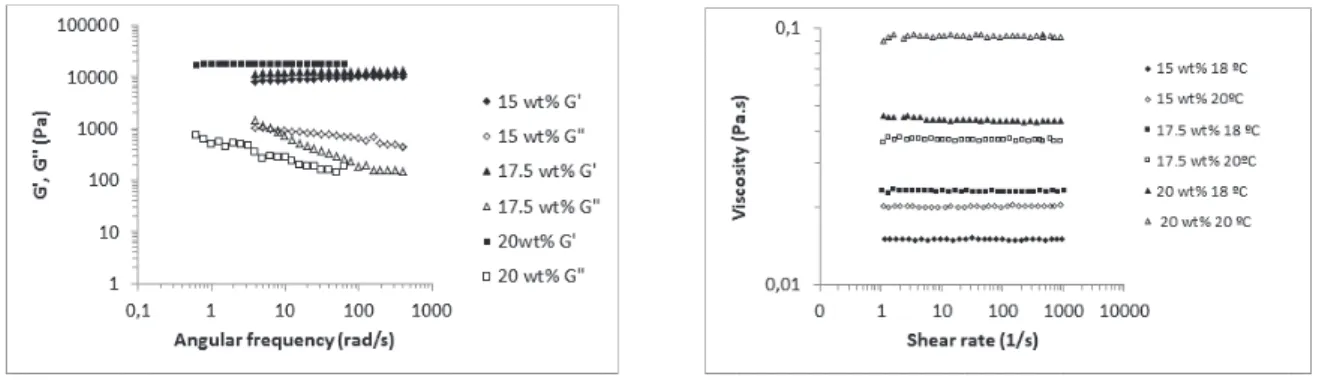
Figure 2a shows the results of the frequency dependence of elastic (G’) and viscous (G’’) modulus at 37ºC (body temperature) for selected concentrations, and the steady state apparent viscosity results at 18 and 20 ºC (around surgery room temperature) are presented in Figure 2b for the same concentrations.
The elastic modulus slight increase with concentration of Pluronic at 37 ºC, while differences are noticeable in the apparent viscosities in the aqueous phase. An increase of viscosity is also observed when increasing the temperature from 18 to 20 ºC, which is due to the closest approximation to Tsol/gel and a higher structuration of the micellar structure.
Taking into account the envisaged application, the optimal system would be the one presenting a Tsol/gel as closest as body temperature as possible, higher elastic modulus at body temperature and smallest apparent viscosity (Ka) during the injection process. The 15 wt% system fulfills two of those requirements, however, the G’ values at 37ºC of 15 wt% Pluronic/water system, despite being the smallest ones, are high enough for keeping it in place in body cavity, so this concentration was chosen for basis of the composite system.
FIGURE 2. G’ and G’’ in function of angular frequency at 37ºC (a) and viscosity curves at 18 ºC (b) for selected Pluronic
concentrations.
Pluronic/Water Systems Filled with Alginate Microparticles
Figure 3a presents the sol-gel transition followed by oscillatory shear measurements for two different contents of alginate microparticles, as examples, while Figure 3b shows the dependence of the sol-gel transition temperature (Tsol/gel) for the same systems. As observed the higher the alginate microparticles content the smallest Tsol/gel.
FIGURE 3. Elastic modulus in function of temperature for 2 contents of alginate microparticles in a 15wt% Pluronic/water
system (a) and corresponding Tsol/gel in function of alginate microparticles content (b).
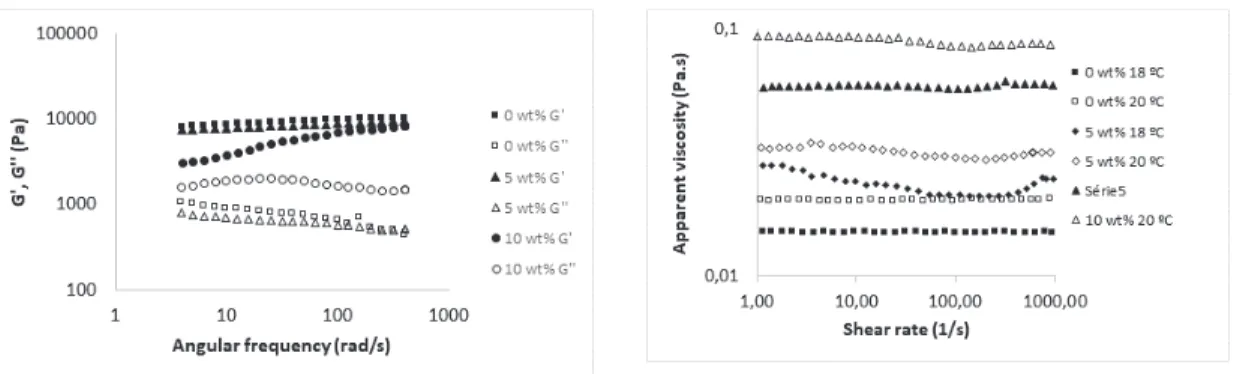
Figure 4a shows the results of the frequency dependence of elastic (G’) and viscous (G’’) modulus at 37ºC (body temperature) for different contents of alginate microparticles, and figure 4b presents the steady state apparent viscosity results at 18 and 20ºC (around surgery room temperature) for the same composites. Note that the 15 wt% alginate microparticles results are not presented since the sol/gel transition temperature is already too low, for the envisaged application.
As seen in Figure 4a the elastic modulus does not present a significant dependence on alginate microparticles content, however there is a tendency for decrease with microparticles content increase. This is particularly true for the lower angular frequencies and the higher microparticles content. The increase of the alginate microparticles
FIGURE 4. G’ and G’’ in function of angular frequency (a) and viscosity curves (b) for different contents of alginate
microparticles in a 15 wt% Pluronic/water system.
CONCLUSIONS
The Pluronic F127®/water system with different polymer concentrations were characterized rheologically, showing that 15 wt% polymer concentration is an adequate concentration for use as injectable gel. The effect of the addition of different amounts of alginate microparticles to the 15 wt% Pluronic/water system in the rheological behavior was analyzed. The results obtained showed that the addition of the microparticles slightly increases the elastic modulus at body temperature, increases the viscosity of the solutions and decreases the sol/gel transition temperature, this decrease being bigger for higher amounts of microparticles, which limits the percentage of microparticles to be added. The best percentage is, taking into account both the rheological behavior and drug delivery process, 10 wt% relative to the weight of hydrogel.
ACKNOWLEDGMENTS
The financial support received from the Portuguese Foundation for Science and Technology through the strategic project 288 UID/CTM/50025/2013 (Cenimat/I3N) and from the Spanish Ministerio de Economia y Competitividad as well as from V Plan Propio Universidad de Sevilla, and the European Commission (FEDER Programme) is kindly acknowledged.
REFERENCES
1. A.J. Tipton, R.L. Dunn, “In situ gelling systems”, in Sustained Release Injectable Products, Edited by J.H. Senior and M. Radomsky, Interpharm Press, Denver, CO, 2000, pp. 71–102.
2. L.E. Hollister, Neurobiol. Aging 10, 628–631 (1989).
3. P. Alexandridis and T. A. Hatton, Colloids Surf. A 96, 1–46 (1995).
4. G. Wanka, H. Hoffmann, and W. Ulbricht, Macromolecules 27, 4145–4159 (1994).
5. S. Ganta, H. Devalapally, A. Shahiwala, and M. Amiji, J. Controlled Release 126, 187–204 (2008).
6. A. Higuchi, N. Aoki, T. Yamamoto, T. Miyazaki, H. Fukushima, T. M. Tak, S. Jyujyoji, S. Egashira, Y. Matsuoka, and S. H. Natori, J. Biomed. Mater. Res. Part A 79A, 380–392 (2006).