Open Access. Printed in Greece. All rights reserved.
PIGMENT IN WESTERN IBERIAN
SCHEMATIC ROCK ART: AN ANALYTICAL
APPROACH
H. Gomes
1*, H. Collado
2, A. Martins
3, G.H. Nash
4, P. Rosina
5, C. Vaccaro
6, and
L. Volpe
61 University of Trás-os-Montes and Alto Douro, UTAD, Portugal, Geosciences Centre, Earth and Memory
Institute, Portugal.
2 ACINEP- Prehistoric Studies Institute, Spain; Geosciences Centre, Earth and Memory Institute, Portugal. 3 Associação Arqueólogos Portugueses, Portugal.
4 Department of Archaeology & Anthropology, University of Bristol, England. Geosciences Centre, Earth
and Memory Institute, Portugal.
5 Polytechnic Institute of Tomar, Geosciences Centre, Earth and Memory Institute, Portugal. 6Physics and Earth Sciences Department of Ferrara University, Italy.
Received: 30/07/2014
Accepted: 27/10/2014 Corresponding author: Hugo Gomes ([email protected])
ABSTRACT
This paper explores the processes involved in the production of prehistoric paintings using inorganic pigmentation. The focus for discussion involves a number of rock-shelter sites that contain rock art within the western part of the Iberian Peninsula, with particular reference to the sites that contain Schematic rock art. A direct date cannot be obtained on rock art that is made with inorganic pigments. However, sampling and subsequent analysis has clearly shown that pigments were produced using tried and tested recipes that involved the use of sometimes organic binders. This paper will explore the chemical and mineralogical qualities of sampled pigments from a selected number of sites within Spain and Portugal and suggest that pigmentation was more than just applying paint to rock.
1. INTRODUCTION
The project, which commenced in June 2010, forms part of a much wider research programme entitled Rupscience. For this work pigment and natural ochre samples were extracted from the rock art sites of Pego da Rainha rock-shelter and Lapa dos Coelhos in Portugal; and in Spain, La Calderita in Badajoz and Frizo del Terror (Monfrague National Park) in Cáceres. The different technological approaches recognised for each site required a variety of different laboratory strategies. Based on our research the technological processes applied were essential in order to determine which materials (e.g. hematite, goethite) were used in subsequent pigment recipes. Pigments from several rock painting panels were analysed using micro-Raman spectroscopy and
x-microfluorescence. The
x-microfluorescence results revealed that the main chemical element was iron (Fe). The micro-raman spectra indicated the presence of iron oxides/hydroxides (hematite and goethite) in the pigment samples taken from selected sites. Inorganic iron-rich red pigmentation appears to be having been the preferred substance used within prehistoric paintings and is found in many of the rock art areas of the world. Depending on where the sources of the pigments were extracted, the natural chemical processes would have produced many different shades of red; a case in point is the richly-decorated rock art panels of the western Iberian Schematic rock art.
1.1. Constraints and methods
Pigment (or dye) for painting is produced using an array of mined or quarried organic and inorganic substances (Burgio & Clark 2001; Gomes et al. 2013). The majority of pigments identified within prehistoric rock art are constructed from iron oxides and hydroxides (originating from hematite and goethite) (e.g. Hradil et
al. 2003; Faria & Lopes, 2007; Salomon et al. 2012; Gialanella et al. 2011). The main
sources of these oxides are the so-called
ochres (coloured in shades of red and yellow) (Elias et al. 2006; Iriarte et al. 2009).
As colouring agents, natural iron oxide pigments, termed ochre, have served modern and archaic hominids for at least 150,000 years (Marean et al. 2007). Despite the fragmentary archaeological record, their use was associated with the production of rock paintings, funerary ritual activity and personal cosmetic use (body decoration) (Vanhaeren & D‘Errico 2002; Hovers et al. 2003).
The rock paintings from selected rock-shelters are considered to be part of the Schematic rock art tradition, an artistic style that is, archaeologically-speaking relatively common within the Iberian Peninsula, extending chronologically from the early Neolithic to the end of the Bronze Age (Collado, 2006, 2009). Motifs are distinct and are organised into three typological groups: anthropomorphic and zoomorphic figures, and non-representative motifs. The post-Palaeolithic Schematic rock art is found in numerous locations throughout the Iberian Peninsula. Various regional complexes are described by Garcia Arranz et al. (2012) whose chronologies range from Neolithic and early Bronze Age. Any direct dating of these painting sites is considered very difficult owing to the absence of organic material for direct chronometric dating. Painting is an adhesive technique, where it is applied to a natural rock surface. The colouring agent – a fluid or semi-fluid pigment is usually applied directly to the rock surface (Sanchidrián, 2001). This technique requires a complex process that begins with the selection and supply of raw materials, followed by the preparation of the pigment, the choice of utensils to use in the application and the execution technique.
Analysis has shown that pigments found in a variety of Iberian locations, used the mineral hematite (Hernanz et al. 2009, Nuevo et al. 2012, Mas et al. 2013). Generally, this and other minerals would
have originated from nearby sources; in some cases from various parts of the cave or rock shelter which contained the rock art. It is only within the historic period that we witness the wholesale importation of such substances into non-mineral pigment areas (Derksen et al. 2004). Pigments could be prepared using distinct techniques such as grinding, burning (thermally-treated minerals) (Hradil et al. 2003, Gialanella et al. 2010), and for greater durability, the use of organic binders such as egg yolk, saliva and blood (Whitley 2001, Prinsloo et al. 2008).
The presence of chemical and mineralogical constituents within prehistoric pigments using tried and tested recipes has, up until recently been difficult to scientifically analyse. Although organic
materials used as binders are rarely identified, due mainly to conservation issues (i.e. the fragility of painted images) and inconsistent methodological approaches, the minerals used in pigment recipes are frequently recognised (Faria & Lopes, 2007).
1.2. The data set and context
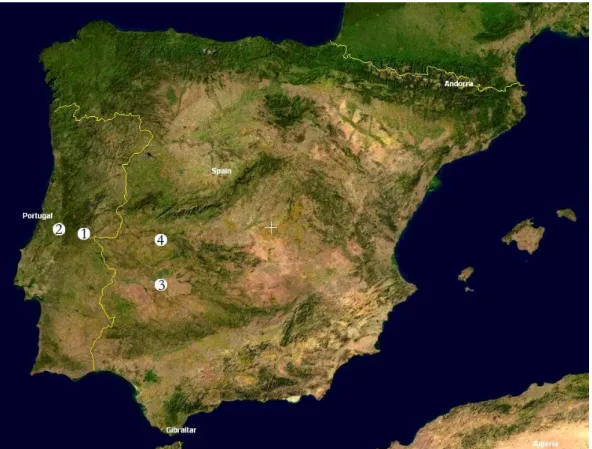
The selected areas containing rock paintings were to be found in the quartzite crests belonging to an extensive ancient massif within the western extent of the Iberian Peninsula. In the peripheral areas of this massif area are a large number of painted rock shelters that are sited within limestone outcropping (Figure 1).
Figure 1 – Location map of the sites
(1: Pego da Rainha; 2: Lapa dos Coelhos; 3: La Calderita; 4: Frizo del Terror)
The paintings from each site are Schematic in form and dated to the Neolithic/Chalcolithic periods. The chosen rock art sites in Portugal included the Pego da Rainha rock-shelter in Mação, Lapa dos
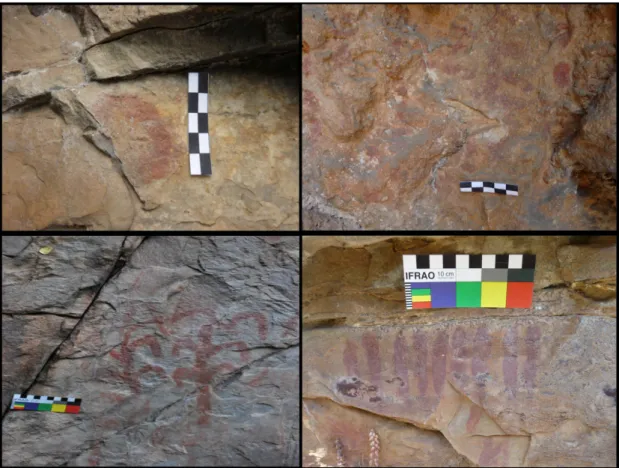
Coelhos (the only limestone rock shelter) in Torres Novas; the shelters of La Calderita in Badajoz and Frizo del Terror in Cáceres, Spain (Figure 2).
Figure 2 - Schematic art paintings. (top left: Pego da Rainha; top right: lapa dos Coelhos; bottom left: La Calderita; bottom right: Frizo del Terror)
In order to identify the raw-material, samples of ochre were collected near the rock shelters or recovered in excavations (Lapa dos Coelhos).
The Pego da Rainha rock shelters I-II (near Mação, Portugal) contains a small group of schematic motifs. These figures (unlike their counterparts elsewhere) are not superimposed by later painted figures. The iconographic repertoire includes mainly linear (bandings), digits, and semi-circular geometric forms, although a possible anthropomorphic figure is also present (Oosterbeek 2002; Martins 2013b).
In central Portugal, in the area of the Estremadura Limestone Massif is the Lapa dos Coelhos rock-shelter (Martins et al. 2004, Martins 2007, 2013a). The artistic repertoire of the Lapa dos Coelhos comprises a ramiform theme and some digits. The sedimentary cavity infilling, reveals a complex archaeological stratigraphic succession, corresponding to different moments of sediment deposition, the earliest including a Mousterian
chronology, followed by a Gravettian occupation and an important level of Magdalenian occupation; the latest level dates to the Holocene, where ochre was recovered (Almeida et al. 2004).
The rock shelter of La Calderita is located near the town of La Zarza, in the central province of Badajoz (Spain). This remarkable site, located within the north-western foothills of the Sierra de Peñas Blancas with the Guardiana Valley is well-known and has been documented many times using a variety of methods over the past century (e.g. Breuil 1929; Viniegra 1929; Ortiz Macías 1998). In recent times the site has undergone a comprehensive and detailed documentation of all its rock art (Collado & Garcia 2005). The site has over 300 figures that are painted on a panel that extends c. 50 meters in length. The pictograms at La Calderita are distributed over 22 panels and include a varied iconographic corpus of material with
remarkable preservation of
along with a wide variety of probable geometric motifs (including a series of points, angular figures and téctiform motifs).
The Frizo del Terror rock shelter is one of 29 sites which is collectively part of the largest concentrations of Schematic rock art in Arroyo Barbaón. This assemblage is located on the western edge of the Monfragüe National Park (Collado & Garcia 2005). The Frizo del Terror panel is located c. 15 meters above the current ground level where access to the rock shelter and the panel is currently limited. The rock shelter extends some 60 meters in length and has 54 panels located on its vertical back wall. Our investigations revealed the presence of boldly-painted red vertical banding of varying lengths. The vertical bands converged with similarly painted horizontal banding, each element, arguably, forming a frame for each panel narrative.
These rock shelter sites usually possess panoramic views of an expansive landscape (or territory) – one can assume
that at a time of prehistoric use, the occupants would have claimed ownership over this landscape. Contained within many of these rock shelters are painted panels which are classified as belonging to the Schematic art tradition and chronologically attributed to agro-pastoralist activities.
The rock art is characterized by a set of iconographic motifs of eminently symbolic character; all figures identified in the shelters are produced using red pigmentation.
2. METHODS AND MATERIALITY
Red pigments (with different hues, from shades of red to orange) are present within our chosen four sites and were sampled and analysed. Micro-Raman spectroscopy was our preferred methodology in order to determine the mineralogical components within the samples of selected paintings (figure 3).
Figure 3 – Pigment samples (PR: Pego Rainha; Oc: Ochre Pego Rainha; Mon: Frizo del Terror; LC: La Calderita).
Methodologically, the analyses for this study included microstratigraphy, X-ray fluorescence and Raman spectroscopy.
Micro-stratigraphy: the only suitable samples from the Frizo del Terror plaque were prepared and analysed with an
optical microscope PCE - MM 200 Digital Microscope 60x and 210x magnification.
Energy Dispersive X-ray Fluorescence (EDXRF): the analyses were carried out with portable Bruker ARTAX 200 μEDXRF spectrometer (TekneHub, Ferrara University – Italy). The instrument was equipped by Mo X-ray tube and the use of the collimator with diameter of 200 μm. This allowed the precise focusing of a beam into a preferred area of each sample. The analysis was conducted with voltage of between 15 to 50 kV; a current, respectively, from 1500 μA to 700 μA and acquisition time 60 seconds, using Helium flow to better detect any light elements (i.e. Na, etc.). XRF spectra were acquired by ARTAXControl 7.2 software, thus obtaining desirable results.
Raman Spectroscopy: Raman measurements were performed with a HORIBA Jobin Yvon LabRam HR800 spectrometer (Physics and Earth Science
department, Ferrara University – Italy), matched with an Olympus BXFM optical microscope and equipped with an air-cooled CCD detector (1024 x 256 pixels), set at -70 ° C. The instrument worked with He-Ne laser source with a wavelength set at 632.81 nm. The spectrometer had a focal length of 80 mm and it was geared with two gratings (600 and 1800 groove/mm). The laser beam diameter was around 1 mm and the spectral resolution was about 2 cm -1. The laser power was kept between 0.2 and 4 mW and the exposure time varied between 3 and 5 seconds with 5-10 scans. The Raman signals were collected using 50× microscope objective, calibrating and checking the spectrometer with silicon at 520 cm -1. The Raman spectra were recorded by the LabSpec5 software and, for the identification of pictorial materials, they were compared with databases (www.Ruff.org; http: //www.mindat.org/) and available literature.
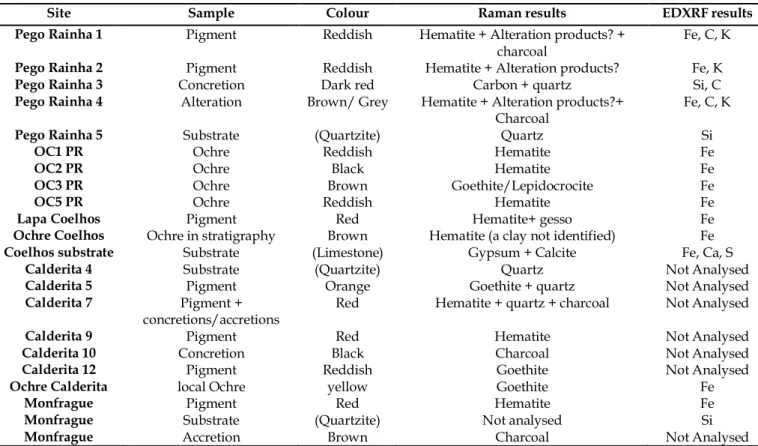
3. RESULTS
Table 1: Results
Site Sample Colour Raman results EDXRF results
Pego Rainha 1 Pigment Reddish Hematite + Alteration products? +
charcoal
Fe, C, K
Pego Rainha 2 Pigment Reddish Hematite + Alteration products? Fe, K
Pego Rainha 3 Concretion Dark red Carbon + quartz Si, C
Pego Rainha 4 Alteration Brown/ Grey Hematite + Alteration products?+
Charcoal
Fe, C, K
Pego Rainha 5 Substrate (Quartzite) Quartz Si
OC1 PR Ochre Reddish Hematite Fe
OC2 PR Ochre Black Hematite Fe
OC3 PR Ochre Brown Goethite/Lepidocrocite Fe
OC5 PR Ochre Reddish Hematite Fe
Lapa Coelhos Pigment Red Hematite+ gesso Fe
Ochre Coelhos Ochre in stratigraphy Brown Hematite (a clay not identified) Fe
Coelhos substrate Substrate (Limestone) Gypsum + Calcite Fe, Ca, S
Calderita 4 Substrate (Quartzite) Quartz Not Analysed
Calderita 5 Pigment Orange Goethite + quartz Not Analysed
Calderita 7 Pigment +
concretions/accretions
Red Hematite + quartz + charcoal Not Analysed
Calderita 9 Pigment Red Hematite Not Analysed
Calderita 10 Concretion Black Charcoal Not Analysed
Calderita 12 Pigment Reddish Goethite Not Analysed
Ochre Calderita local Ochre yellow Goethite Fe
Monfrague Pigment Red Hematite Fe
Monfrague Substrate (Quartzite) Not analysed Si
The x-microfluorescence results reveal that all pigment samples contained predominantly Iron (Fe). Other chemical elements were detected in association with concretions, accretions and substrates (Figure 4).
Figure 4 – X-microfluorescence spectra (Frizo del Terror)
The micro-raman results were also similar. All analysed pigments were composed of iron oxides (Hematite or Goethite).
Micro-Raman spectroscopy results of red pigment samples taken from Pego da Rainha show the presence of hematite (the same composition that was recognized in three samples of natural ochre collected near the rock shelter), alteration products (biological concretions present elsewhere in the rock shelter), and charcoal (due to probable fire activity) (Figure 5).
Figure 5 – Pego da Rainha micro-Raman spectra. Qz: Quartz; H: hematite; Gt: goethite; Ch: charcoal)
At Lapa dos Coelhos the ochre and pigment samples have hematite as a common link, but detected in the pigment sample was calcite (substrate) and gypsum (alteration product of calcite) (Figure 6).
Figure 6 – Lapa dos Coelhos micro-Raman spectra (H: hematite; G: goethite; C: calcite)
The Raman analyses results of Calderita on red pigments samples LC7 and LC9, show the presence of hematite and some quartz particulates (probably from a localised quartzite substratum). Contained in samples LC5 and LC12 was goethite, the same result of ochre found near by the rock shelter (Figure 7). In sample LC12, the multicolour points had a similar result. However Marshall et al. (2005) has intimated that the colour could be related to particle size (Figure 6).
Figure 7– La Calderita micro-Raman Spectra. Top-substrate, middle- pigment, bottom-concretion (Qz: Quartz; H: hematite; Gt: goethite; Ch: charcoal)
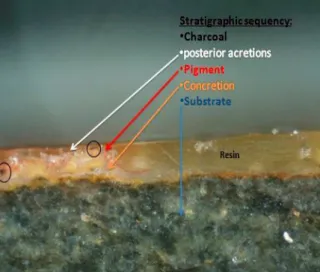
The micro raman analysis at Frizo del Terror revealed the presence of hematite and charcoal. Observations of the micro-stratigraphy cross-section of the pigment layers of the Monfrague painting revealed the presence of three main elements: the rock substrate, pigment and concretions or accretions. The only organic matter recognized was charcoal which seems to be linked to recent fire activity (Note, the charcoal was not chronometrically dated). Probably, oxalates and phosphates of mineral or biological origin represent the concretions/accretions observed (Figure 8). The thickness and the relationship between the concretions and the pigment are variable (Figure 9).
Figure 8 – Frizo del Terror (Monfrague) micro-Raman Spectra. (H: hematite; Ch: charcoal)
Figure 9 – Microstratigraphy (Frizo del Terror).
The lower layer (substrate) was covered by concretions in which the pigment was applied (and later covered by natural concretions and accretions). The stratigraphic sample has at its base the substrate (layer). The thickness of the
concretion was ≈ 0.19 mm and the pigment layer of ≈ 0045 mm. Thickness values varied in some areas of the painting, which apparently went deeper into the concretion and in other places and in some areas it was not visible at all (Figure 9). Certain dark spots and other occurrences were observed in the pigment components. Charcoal particles were characterised by a non-standard size, shape and distribution and appear to have been independent from the pigment; probably the result of fire making through anthropogenic activity.
Charcoal was also identified in other samples (PR3 PR 4, LC7, LC10) and was considered to originate for natural fire activity. However, it was only in Pego da Rainha samples that charcoal appears to have been included in the pigment as part of a recipe.
The issue regarding the combination of carbon and iron oxides in a red colorant is that the pigment might be associated with recent fire activity but further analyses is needed in order to confirm this.
4. DISCUSSION
Red pigmentation (and its derivatives) is the most common painting material used in the production of prehistoric painted rock art in the Iberian Peninsula (if not the World). The choice of red pigments could be down to the relative abundance and availability of raw-materials (Thomas 1980; Fuller 1988; Mas et al. 2013) or possible associations with colour symbolism (Wreschner 1980; Michaelsen et al. 2000 Zilhão 2007, Zilhão et al. 2010; Peresani et al. 2013).
Results from our analysis demonstrate that pigments per se incorporate many different minerals (Table 1). Whether or not the pigment colour was specifically chosen for its symbolic qualities is not an issue for this paper, although these qualities cannot be ruled out. One can suggest that an association between the technology of pigment (mineral) abstraction, application
and ritual/symbolic activity may have existed.
Microscopic observations on red pigment samples analysed for this paper show a widespread range of different colour hues, from yellow to red (Figure 2). The difference in hue perception can be explained by the mineralogical composition of the pigments (Bikiaris et al. 2000), by weathering processes (Faria & Lopes 2007) or from particle size analysis (Marshall et al. 2005). Our results point out that the different mineralogical composition is the principle cause of the variation in the pigment hue.
The majority of pigments from the Iberian Peninsula using iron oxides or hydroxides appear to have been prepared similarly (Hernanz et al. 2009; Pike et al. 2012). These chromophore mineral elements are generally associated with other substances, the most common of which are clays. When mixed they form a malleable ochre paste. Yellow ochre contains goethite whilst red ochre possesses hematite (Mortimore et al. 2004; Iriarte et al. 2009; Montagner et al. 2013). Other pigment variants contain other mineral types that largely determine coloration.
Chemical analysis on ochre shows that recipe variants are numerous, mostly applied to pure goethite, pure hematite and the dehydration of goethite to form hematite, especially in prehistoric paintings.
Moreover the organic substances (although their use is widely described in the literature) (Fortea & Hoyos, 1999; Navarro, 2003, Balbin et al. 2003) are rarely identified using spectroscopic analyses.
Natural raw material collected near the Pego da Rainha site includes one sample of yellow ochre (goethite and lepidocrocite) and three samples of red ochre (hematite) (Table 1). Comparative analyses from the sampled sites, including the natural ochre retrieved from each site allowed the team to consider the possibility that ochre utilization was linked to the local availability of the raw material (see Mas et
al. 2013).
There is also the question of colour hue and brightness of pigment which may have had an association with the symbolic nature of the painting and why the artist was concerned in the way it was displayed; for example the use of pigmentation to create shading and bi-colour images, in particular those of zoomorphs. Within the La Calderita rock shelter site reddish and orange pigments are present and were created using goethite or hematite (Table 1). In Monfrague, pure red hematite was applied to the walls; this sample was shown to be the most vibrant of all pigments used on the panels (Figure 2).
In Lapa dos Coelhos the ochre and pigment samples gave the same spectra as
pure hematite.
The identified techniques of pigment production and application from the four sites are not directly correlated to chronology nor to the pictograms style, or in this case, Schematic art (see García Arranz et al. 2012). Therefore, pigment extraction and preparation must be in part the result of raw material availability; other reasons may be associated with colour symbolism and meaning (Dams 1984; Nash 2008).
5. CONCLUDING REMARKS
The rock paintings from the selected rock shelters are all similar in style and form part of a much wider Schematic rock art tradition within this part of Western Europe. All originate from a broad chronology, dating between early Neolithic to Bronze Age periods.
Red (or more generally, shades of red) pigmentation used in the pictograms, were produced by adding different minerals such as goethite or hematite and the possible application of certain organic and inorganic binders.
Results from our analysis show that pure untreated hematite or goethite was applied to the panels and no organic matter was identified.
Within the Pego da Rainha rock shelter, red pigment sample analysis revealed the
presence of iron oxides (hematite) and limited carbon residues.
In Lapa dos Coelhos, like in Pego da Rainha, pigments and natural ochre were distinguished by the presence of natural alteration products.
Pigments for the La Calderita and Monfrague rock shelters were made from hematite (red) or goethite (producing shades of red, reddish or orange pigmentation). Currently (and based on the scientific equipment available) it is difficult to distinguish through macroscopically the visible and chemical qualities of colouration and iron oxides. Time and weathering, along with human agency (e.g. fire hearth activity within rock shelters) have accelerated the discolouration of many painted figures. One can say with certainty that the pigments would have been more vibrant, probably in some cases displaying greater detail between different hues and colour shading. Pigments observed with an optical microscope revealed typical red tones of hematite, whose presence is also confirmed by Raman analysis. EDXR-Flourescence has highlighted the total absence of impurities such as transition elements, including aluminum and silicon. The absence of impurities such as aluminum hydroxide allowed the team to exclude the extraction of the pigment from deposits of red earths or laterites, therefore, a possible extraction of the iron minerals such as magnetite or iron sulphides (pyrite). The absence of transitional impurity elements points toward the extraction of the pigment from iron sulphides after de-sulfation by calcination in accordance with the techniques of production of artificial pigments were identified by Elias et al. 2006; Legodi et al. 2007 Mastrotheodoros et al. 2010; Pomiès et al. 1999.
Analysis on ochre collected from within the surrounding areas of these sites
suggests that pigment production is mainly down to the availability of raw materials (hematite or goethite).
In several areas of the Iberian Peninsula, including the Spanish Levant, various shades of red hematite were applied to paintings of anthropomorphic and zoomorphic figures in order to create perspective, shading and movement. The preparation of such pigments implies intentionality and forward planning (see García Arranz et al. 2012). One could assume that colour may have acted as a metaphor for the figures displayed; linking the artist, the substance and the subject matter together (Nash 2008).
It is not clear why different application techniques or different iron oxides were used to prepare the red pigments, although it could be linked to the ritual process involving mineral identification, extraction (quarrying), preparation, application and use, and that a number of identified stages in producing the painted image required forethought, imagination and the intimate knowledge of the natural constituents that created pigments.
ACKNOWLEDGEMENTS
The authors would like to thank the following people and organisations: The
Rupscience FCT project, Portugal coordinated by Pierluigi Rosina from Tomar Politecnic Institut (IPT) and the
Estudio y recuperación del abrigo con pinturas rupestres de La Calderita (La Zarza, Badajoz) Project, coordinated by Hipólito Collado and founded by the General Director of Cultural Heritage in Extremadura Spain, and to the researchers from Extremadura University. Finally, thanks to the colleagues at the Prehistoric Archaeology Museum of Mação in Portugal for their help and guidance.
REFERENCES
Almeida, F., Angelucci, D., Gameiro, C. Correia, J. & Pereira, T., (2004) Novos dados para o Paleolítico Superior final da Estremadura Portuguesa: resultados preliminares dos trabalhos arqueológicos de 1997-2003 na Lapa dos Coelhos (Casais Martanes, Torres Novas). Promontoria, Ano 2, nº 2, Faro, p.157-192.
Balbín Behrmann, R., De Alcolea González, J.J. & González, M.A., (2003) El macizo de Ardines, Ribadesella, España. Un lugar mayor del arte paleolítico europeo. In R.Balbín Behrmann, de, P. Bueno Ramírez (Eds.), Primer Symposium Internacional de Arte
Prehistórico de Ribadesella. Associación Cultural Amigos de Ribadesella, pp. 91–151
Bikiaris D., Daniilia, S., Sotiropoulou, O., Katsimbiti, E., Pavlidou A.P., Moutsatsou, C. Y. & Chryssoulakis, Y., (2000) Ochre-differentiation through micro-Raman and micro-FTIR spectroscopies: application on wall paintings at Meteora and Mount Athos, Greece.
Spectrochimica Acta. Part A 56, 3–18.
Breuil, H., (1929) Les roches peintes de Zarza (Badajoz). IPEK. Jahrbuch für Prahistorisehe
und Etnographische Kunst, V, pp. 14-30.
Burgio, L.; Clark, R. J. H., (2001) Library of FT-Raman spectra of pigments, minerals, pigment media and varnishes, and supplement to existing library of Raman spectra of pigments with visible excitation. Acta Spectrochimica, Part A, 57, 1491-1521.
Collado, H. & García, J.J., (eds.) (2005) Arte rupestre en el Parque Natural de Monfragüe: el sector oriental. Corpus de Arte Rupestre en Extremadura, Vol. I. Consejería de Cultura. Collado, H., (2006) Arte rupestre del valle del Guadiana. El conjunto de grabados del Molino
Manzánez (Alconchel - Cheles, Badajoz). Memorias de Odiana, No. 4. EDIA.
Collado, H., (2009) Propuesta para la clasificación funcional y cronológica del arte rupestre esquemático a partir del modelo extremeño. Estudios de Prehistoria y Arqueología
en homenaje a Pilar Acosta, Universidad de Sevilla, pp. 89-108.
Dams, M., (1984) Les Pientures Rupestres du Levant Espagnol. Paris: Picard.
Derksen, G.C.H., Lelyveld, G.P., Van Beek, T.A., Capelle, A. & De Garoot, Æ., (2004)
Phytochemichel Analysis,15, pp. 397–406.
Elias, M., Chartier, C., Prévot, G., Garay, H., & Vignaud, C., (2006) The colour of ochres explained by their composition. Materials Science and Engineering B, 127, 70–80.
Faria, D.L.A. & Lopes, F.N., (2007) Heated goethite and natural hematite: can Raman spectroscopy be used to differentiate them? Vib. Spectrosc.; 45: 17–21.
Fortea, P.F.J. & Hoyos, M., (1999) La table ronde de Colombres et les études de protection et conservation en Asturies réalisées de 1992 à 1996, Bulletin de la Société Préhistorique
Fuller, C., (1988) Natural Colored Iron Oxide Pigments, In P. Lewis (ed.)Pigment Handbook, 2nd Edition. New York: John Wiley & Sons. pp. 281–6.
García Arranz, J.J., Collado Giraldo, H. and Nash, G.H. (eds.), (2012) El problema
“Levantino”: Arte rupestre postpaleolitico en le Peninsula Ibérica. Budapest: Archaeolingua. Gialanella, S., Girardi, F., Ischia, G., Lonardelli, I., Mattarelli, M., Montagna, M., (2010) On the Goethite to hematite phase transformation. J. Therm. Anal Calorim. 102, 867-873 DOI:10.1007/s1973-010-0756-2.
Gialanella, S., Belli, R., Dalmeri, G., Lonardelli, I., Mattarelli, M. Montagna, M. & Toniutti, L., (2011) Artificial or natural origin of hematite-based red pigments. Archaeometry 53, 5, 950–962.
Gomes, H., Rosina, P., Martins, A. & Oosterbeek, L., (2013) Pinturas Rupestres: Matérias-Primas, Técnicas e Gestão do Território. Estudos Do Quaternário, 9, Apeq, Braga, pp. 45-55. Hernanz, A., Ruiz-Lopez, J., Gavira-Vallejo M., Martin, S. & Gavrilenkod, E., (2009) Raman Microscopy of prehistoric rock paintings from the Hoz de Vicente, Minglanilla, Cuenca, Spain 1394–1399.
Hovers, E., Ilani, S., Bar-Yosef, O. & Vandermeersch, B., (2003) An early case of colour symbolism: ochre used by modern humans in Qafzeh Cave, Current Anthropology, 44(4), 491–522.
Hradil, D., Grygar, T., Hradilova J. & Bezdic P., (2003) Clay and iron oxide pigments in the history of painting. Clay Science 22, pp. 223– 236.
Iriarte, E., Foyo, A., Sánchez, M.A. Tomillo, C. & Setién J., (2009) The Origin and Geochemical Characterization of Red Ochres from the Tito Bustillo and Monte Castillo Caves (Northern Spain). Archaeometry 51, issue 2 231-251.
Legodi M. A. & de Waal D., (2007). The preparation of magnetite, goethite, hematite and maghemite of pigment quality from mill scale iron waste, Dyes and Pigments, 74, pp. 161-168.
Marean, C. W., Bar-Matthews, M., Bertnachez, J., Fisher, E., Goldberg, P., Herries, A. I. R., Jacobs, Z., Jerardino, A., Karkanas, P., Minichillo, T., Nilssen, P. J., Thompson, E., Watts, I. & Williams, H. M. (2007) Early human use of marine resources and pigment in South Africa during the Middle Pleistocene. Nature, 449, 905–8.
Marshall, L., Williams, J. R., Almond, M. J., Atkinson, S.D.M., Cook, S. R., Matthews, W. &Mortimore, J. L., (2005) Analysis of ochres from Clearwell Caves: the role of particle size in determining colour. Spectrochimica Acta, Part A, 61, 233–241.
Martins, A., (2007) Arte Rupestre no concelho de Torres Novas: a Lapa dos Coelhos, Nova
Augusta - Revista de Cultura, nº 19, Ed. Município de Torres Novas, pp. 377-388.
Martins, A., (2013a) Arte Esquemático en Portugal: los abrigos con pinturas del Macizo Calcáreo Extremeno, coord. Julián Martínez García y Mauro S. Hernández Pérez, Arte
Rupestre Esquemático en la Península Ibérica – II Congreso 2010, Ayuntamiento de Vélez-Blanco, pp. 317-323.
Martins, A., (2013b) A Pintura Rupestre Esquemática em Portugal: muitos sítios, mesmas pessoas?, coord. José Arnaud, Andrea Martins e César Neves, Arqueologia em Portugal –
150 anos, Associação dos Arqueólogos Portugueses, pp. 495-505.
Martins, A., Rodrigues, A. & Garcia Díez, M., (2004) Arte esquemática do Maciço Calcário Estremanho: Abrigo do Lapedo I e Lapa dos Coelhos, Arkeos 15 – Perspectivas em diálogo:
Arte Rupestre, Pré-história e Património, coord. Ana Rosa Cruz e Luiz Oosterbeek, CEIPHAR, pp. 15 – 27.
Mas, M., Jorge A., Gavilán, B., Solís, M., Parra E. &Pérez P.P. (2013) Minateda rock shelters (Albacete) and post-palaeolithic art of the Mediterranean Basin in Spain: pigments, surfaces and patinas. Journal of Archaeological Science 40, 4635-4647.
Mastrotheodoros, G., Beltsios, K.G. & Zacharias, N., (2010). Assessment of the production of antiquity pigments through experimental treatment of ochres and other iron based precursors. Mediterranean Archaeology and Archaeometry 10 (1), pp. 37–59.
Michaelsen, P., Ebersole, T.W., Smith, N.W. & Biro, P. (2000) Australian ice age rock art may depict Earth’s oldest recordings of Shamanistic rituals. Mankind Quarterly, 41(2) 131– 146.
Montagner, C., Sanches, D., Pedroso, J., Melo, M.J. & Vilarigues, M., (2013) Ochres and earths: Matrix and chromophores characterization of 19th and 20th century artist materials. Spectrochimica Acta Part A: Molecular and Biomolecular Spectroscopy 103, 409– 416.
Mortimore, J. L., Marshall, L.-J. R., Hollins, M. P. & Matthews, W., (2004) Analysis of red and yellow ochre samples from Clearwell Caves and Çatalhöyük by vibrational spectroscopy and other techniques. Spectrochimica Acta, Part A, 60, pp. 1179–88.
Nash, G.H. (2008) Northern European hunter/fisher/gatherer and Spanish Levantine rock-art: A
study in performance, cosmology and belief. Trondheim: NTNU.
Navarro Gascón, J. V., (2003) Nuevos resultados obtenidos en el estudio de pigmentos y posibles materias colorantes de las pinturas de la Cueva de Tito Bustillo, in Primer
symposium internacional de arte prehistórico de Ribadesella:el arte prehistórico desde los inicios del diglo XXI (eds. R. de Balbín Behrmann and P. Bueno Ramírez), pp. 173–84
Nuevo M. J., Sánchez A. M., Oliveira, C. & Oliveira, J., (2012) In situ energy dispersive X-ray fluorescence analysis of rock art pigments from the ‘Abrigo dos Gaivões’ and ‘Igreja dos Mouros’ caves (Portugal). X-ray Spectroscopy Journal. 41, 1, 1-5.
Oosterbeeck, L., (2002) Le culte de l’eau dans le Alto Ribatejo, Portugal. Arkeos, No. 12, pp. 227-256.
Ortiz Macías, M., (1998) Pintura rupestre esquemática al sur de la comarca de Mérida. Serie Arqueológica nº 17. Diputación de Badajoz.
Peresani, M., Vanhaeren, M., Quaggiotto, E., Queffelec, A. & D’errico, F., (2013) An Ochered Fossil Marine Shell From the Mousterian of Fumane Cave, Italy. PLOS ONE, 8, 7. E68572.
Pike, A.W.G., Hoffmann, D. L., Garcia-Diez, M., Pettitt, P. B., Alcolea, J., De Balbin, R., Gonzalez-Sainz, C., De Las Heras, C., Lasheras, J. A., Montes, R. & Zilhao, J., (2012) U-Series Dating of Palaeolithic Art in 11 Caves in Spain. Science 336 (6087), 1409–1413. Pomiès, M. P. & Menu, M., (1999). Red palaeolithic pigments: natural hematite or heated goethite?, Archaeometry, 41 (2), pp. 275-285.
Prinsloo, L. B. W., Meiklejohn, I. & Hall, K., (2008) The first Raman spectroscopic study of San rock art in the Ukhahlamba Drakensberg Park, South Africa, Journal of Raman Spectroscopy, 39: 646–654.
Salomon, H., Vignaud, C., Coquinot, Y., Beck, L., Stringer, C., Strivay, D., & D’errico, F., (2012) Selection and Heating of Colouring Materials in the Mousterian Level of Es-Skhul (c. 100 000 Years Bp, Mount Carmel, Israel). Archaeometry 54, 4, pp. 698–722.
Sanchidrian, J.L., (2001) Manual de arte prehistórico, Ariel Prehistoria, pp. 339-484 Thomas, A., (1980) Colours from the Earth. New York: Van Nostrand Reinhold.
Vanhaeren, M. & D‘Errico F., (2002) The Body Ornaments Associated with the Burial. In J. Zilhão J and E. Trinkaus (eds.), Portrait of the artist as a child: The Gravettian Human Skeleton
from the Abrigo do Lagar Velho and its Archaeological Context. Lisboa, Instituto Português de Arqueologia. Trabalhos de Arqueologia, 22: 154-186.
Viniegra, V., (1929) El arte rupestre en la provincia de Badajoz. Cornisa de la Calderita, Sierra de la Zarza. Revista del centro de estudios extremeños, Vol. III, pp. 63-82.
Whitley, D.S., (2001) Handbook of Rock art Research. Walnut Creek: AltaMira Press.
Wreschner, E. E., (1980) Red Ochre and Human Evolution: A Case for Discussion. Current
Anthropology, Vol. 21: 631–644.
Zilhão, J., (2007) The emergence of ornaments and art: An archaeological perspective on the origins of behavioural modernity. Journal of Archaeological Research 15: 1–54.
Zilhão, J., Angelucci D.E., Badal-García E., D´Errico F., & Daniel F. (2010) Symbolic use of marine shells and mineral pigments by Iberian Neanderthals. Proceedings of the National