Francisca Luísa Grilo Fernandes
Master
’s Thesis
- Fashion Made in China, the
leverage to succeed or the doom
to fail in the globalized world -
Hand-in date:
01.09.2014
Campus:
BI Oslo
Examination code and name:
GRA 1900
Master Thesis
Supervisor: Debbie Harrison Programme:
Acknowledges
This master thesis represents the end of my Double Degree, of Master of Science in Business and Economics at BI Norwegian Business School. The process of accomplishing this thesis has demanded motivation, hard work and dedication, resulting in a much greater development of my academic skills and knowledge of how to apply strategic frameworks, to analyze an industry and its relevant players.
This has been an all-absorbing and enriching journey. Accordingly, I would like to thank to my thesis supervisor Debbie Harrison for guidance and useful input. And also, I would like to thank all my strong ties, with special emphasis to my family, for social support and motivation to end this period of my life.
Francisca Fernandes Oslo, 01.09.2014
Abstract
Key Words: Apparel Industry, China, Fashion Retailers, Porter’s Diamond Model.
Context of study: The rise of China’s labor costs, and the fact that lower-wage
countries have now manufacturing capacity, has pushed domestic apparel
manufacturers to emphasize on two more profitable sectors: product development, and retail. This reflects a shift from Original Equipment Manufacturer (OEM) to Original Brand Manufacturer (OBM), which brings challenges for the Chinese apparel companies, since domestic apparel manufacturers didn’t invest much in product development and design ability. Chinese fashion retailers do not play a leading role in the global industry, having only a few influential international brands. However, efforts have been made in order to innovate their merchandise distribution channels and improve promotion policies, to frame the domestic retail networks, appealing to consumers’ attention, and attain market share (Li 2002).
Statement of Purpose: The aim of this paper is to firstly identify the difficulties
that these private labels can face due to the typical Chinese consumer profile that is characterised by high spenders in haute couture in foreign markets rather than in the domestic market. Secondly, this phenomena might influence these private label brands to expand to international markets, which creates new difficulties due to the world’s perception of the low quality of products manufactured in China. Finally, how these Chinese private-label companies will create a brand equity, in domestic and foreign markets, in order to positioning themselves in the fashion market.
Methodology: A multiple case study involving three Chinese apparel companies
was employed. The information collected had as final aim, to apply each company to a Porter’s framework, and realize if they gathered the sustained competitive advantage factors necessary to succeed according to its strategy adopted.
Contribution: This study has attempted to contribute to the research field of types
of strategy and firm performance within an industry recent trend. Hence, the findings in this study should provide a criticism to Porter’s theory of sustained
companies can perform well, even when they pursue more than one type of strategy, or when they don’t accomplish all necessary factors, stated by Porter, to achieve competitive advantage.
Abbreviations
This page provides a summary of the abbreviations applied in this thesis. Most of them are related to technology used in apparel industry.
ASEAN - Association of South East Asian Nations BOC – Brand of Origin Confusion
CAD – Computer Aided Design
CAM - Computer Aided Design Manufacturing
CNCIC - China National Chemical Information Center COO – Country of Origin Confusion
CSR – Corporate Social Responsibility NIC – Newly Industrialized Countries OBM – Original Brand Manufacturer OEM - Original Equipment Manufacturer POS – Point-of-Sale
R&D – Research and Development SKU – Stock Keeping Unit
List of tables
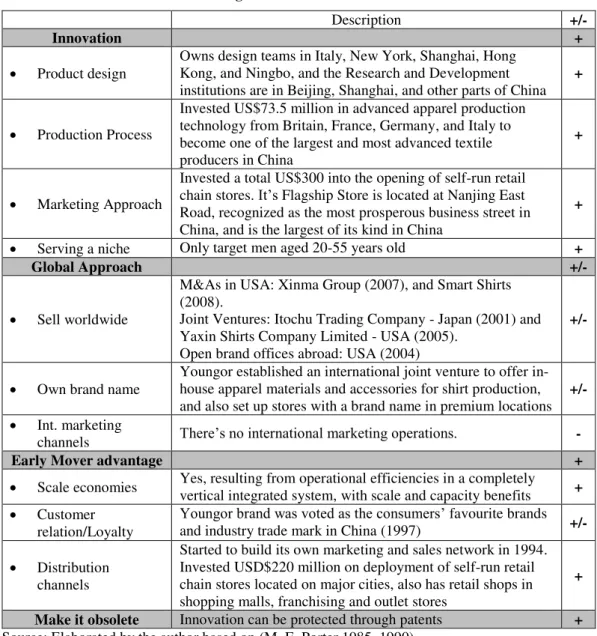
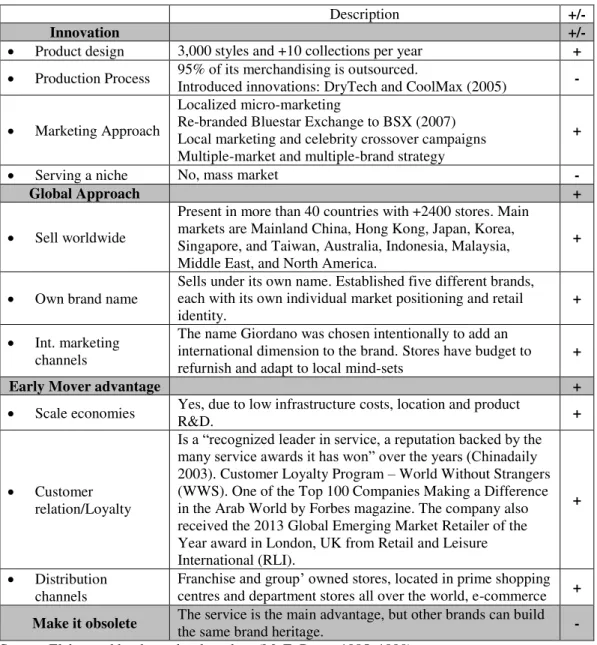
Table 1 – China volume and value of apparel, in terms of sales. ____________ 17 Table 2 - Summary table of Chinese Apparel Consumers _________________ 20 Table 3 - China Apparel Diamond Model – Summary table ________________ 23 Table 4 – China Strengths and Threats in apparel industry _________________ 25 Table 5 - Product-Country (Mis)Match Framework and Strategic Implications 30 Table 6 - Youngor's Market Share ____________________________________ 37 Table 7 - Porter’s CA Factors: Youngor _______________________________ 38 Table 8 - Porter’s CA Factors: Meters/bonwe ___________________________ 41 Table 9 - Porter’s CA Factors: Giordano _______________________________ 44 Table 10 - Meters/bonwe Market Share _______________________________ 62
Content
ACKNOWLEDGES __________________________________________________________________ I ABSTRACT _________________________________________________________________________ II ABBREVIATIONS _________________________________________________________________ IV LIST OF TABLES ___________________________________________________________________ V CONTENT _________________________________________________________________________ VI 1. INTRODUCTION _____________________________________________________________ 1 Research Question __________________________________________________________ 1 Empirical Problem __________________________________________________________ 2 Thesis Structure ____________________________________________________________ 2 2. LITERATURE REVIEW ______________________________________________________ 32.1 UNDERSTANDING NATION AND FIRMS’ COMPETITIVE
ADVANTAGE _______________________________________________________________________ 3 Porter’s Dia o d Model of Natio al Advantage __________________________________ 3 How firms achieve competitive advantage? _____________________________________ 5 How firms sustain their competitive advantage? _________________________________ 5 Porter’s Fir s Type of Strategy ________________________________________________ 6 2.2 UNDERSTANDING THE APPAREL INDUSTRY _________________________ 6 Apparel Industry-Specific features _____________________________________________ 7 Competitive advantage factors in Apparel _______________________________________ 9
2.3 UNDERSTAND CONSUMER PURCHASES IN APPAREL ______________10
Managing brands in apparel _________________________________________________ 11 Country-of -Origin Effects (COO) / Made in _____________________________________ 12 Emergence of own brands (i.e., private label) ___________________________________ 14 3. METHODOLOGY ____________________________________________________________15 Research Strategy __________________________________________________________ 15 Research Design ___________________________________________________________ 16 Research Methods _________________________________________________________ 16 4. ANALYSIS ____________________________________________________________________17 Porter’s Dia o d Model a d Chi ese Apparel I dustry ___________________________ 17 Chi ese fir s’ Co petitive Adva tages i Apparel i dustry _______________________ 25 5. CASE STUDIES _______________________________________________________________34 Youngor: Focus Strategy ____________________________________________________ 35 Meters/bonwe: Cost Leadership Strategy ______________________________________ 39 Giordano: Differentiation Strategy ____________________________________________ 42
6. CONCLUSION ________________________________________________________________45 7. LIMITATIONS AND FUTURE RESEARCH ________________________________47 8. REFERENCES ________________________________________________________________48 9. APPENDICES ________________________________________________________________55 Porter’s Dia o d Model ____________________________________________________ 55 China's share of Global Production (2011) ______________________________________ 55 Characteristics of two global commodity chains _________________________________ 55 Summary table of Chinese Manufacturing Path _________________________________ 56 Chinese Apparel main firms __________________________________________________ 59 Case studies additional information ___________________________________________ 62
1.
Introduction
China is recognized for its low cost manufacture of worldwide distributed retail products, whether of non-Chinese global brands and successful foreign retailers. Some relevant authors have found that, in the last 20 years, fashion trends in industrialized countries have moved from an emphasis on practicality, simplicity, and standardization to a collapse of conventional standards of dress, through freedom of expression, and individuality (Gereffi 1994; Lardner 1988). This trend made automation become difficult, because forced manufacturers to offer a wide diversity of styles and colors. As a consequence, sourcing offshore apparel production to low-wage countries became denominative to lower the labor costs (Gereffi 1994; Hsu 1993; Jan Chan 1993; Ladner 1988). The low labor costs made China one of the most appealing countries to manufacturing products for years, and the reason why many foreign companies outsourced their production to China. This phenomena allowed the Chinese manufacturing factories to become highly specialized in apparel products (clothing and footwear). Despite labor may have been a Chinese competitive factor to date, other indicators may be relevant to explain China’s competitive advantage.
Due to the value of this industry sector for the global Chinese Economy, and also, through the high level of specialization that Chinese manufacturing factories have in producing apparel, a new trend arise recently in this market. The national manufacturing factories are applying their acquired tacit knowledge to create and produce their own private label apparel.
Research Question
This paper research question is based on the link that is created between the countries and the national companies/brands. When a company is linked to a country it immediately reveals certain national characteristics in consumers’ according to the countries’ stereotype they have in mind.
In this specific case, the most important features of the Chinese brands are: low price, poor value and quality, unreliable and unknown, unsophisticated,
innovative, lack of historic, old fashion, and aggressive (Swystun, Burt and Ly 2005). Facing these characteristics, the question is
How can we analyze the Chinese Apparel Private Label Industry in the Global Fashion Market? Do Top 3 Chinese Brands have relative competitive advantage in terms of the market?
Empirical Problem
China as a manufacturing country is currently facing diversified problems that are consequences of the Global position that the country adopted previous years ago. The first problem is that, although China is a manufacturing country, it imports the majority of the raw materials, and with the increase of these raw materials’ prices, the cost of production increased, driving up the cost of the Chinese products. This problem is followed by the increase of labor-cost in China, which places China’s position under threat, and made ASEAN countries (such as Vietnam, Cambodia, and Indonesia), appealing low cost alternatives to move out from China. Furthermore, a trend being witnessed recently, the “reshoring” phenomena, consists in the moving of production closer to the larger end markets, particularly from China and Mexico.
China has also a brand problem, explained by the Country-of-Origin Theory and the consumers’ perceptions. “Made in China” too often aggregates the image of cheap goods of dubious quality. Much of China’s economic growth has been based on low-cost production for foreign brands, but now the economic gap is decreasing as labor and other costs are rising. China also has a brand problem, mainly based on a lack of integrity, which is vital to build loyalty. In fact, Chinese made goods have succeeded more for their low price rather than for quality
(Taylor 2013).
The main problem to address is if the Private Label can succeed in the domestic market where the preference of the consumers is haute couture clothes or, if the brands goal is to target the foreign market, will they be able to succeed in a market where consumers’ don’t have the best impression about the Chinese products.
Thesis Structure
This master thesis is organized in three main chapters. The first chapter, the literature review, gives insights about how nations’ and firms’ can gain
competitive advantage, summarizes the main aspects of the apparel industry, and finally, what are the consumers main related issues in terms of purchasing apparel. The second chapter, the analysis, applies the Porter’s Diamond Model introduced before, to the Chinese Apparel Industry, then elaborates if Chinese apparel firms
have sustained competitive advantage in this industry, and ends with the last trend of apparel industry in China, the boom of private labelling and
internationalization. The third and last chapter, explores in detail three Chinese apparel companies that are interest to study, where the main goal is to see how they are doing in terms of the new trend, and serve as a criticism to Porter’s factors of sustained competitive advantage and firms’ performance.
2.
Literature Review
Globalization has altered the competitive dynamics of nations, firms and industries. In this section, the theoretical review will start from a broad point of view in terms of nations’ and firms’ competitive advantage, and how to sustain it and types of strategy, followed by analysis of apparel industry and consumer behavior, and later on, narrow to how companies can strengthen their own brands.
2.1
Understanding Nation and firms’ competitive
advantage
Porter’s Diamond Model of National AdvantageA nation’s competitiveness depends on its industry capacity to innovate and upgrade. Competitive advantage is created and sustained through a localized process, whereas every factor contributes to success, from differences in national values, culture, economical structures, institutions, to history. According to Porter, in “The Competitive Advantage of Nations”, “no nation can or will be competitive in every or even most industries” (M. E. Porter 1990).
Porter (1990) also has identified four attributes of a nation, that individually, and as a system, constitute the diamond of a national advantage: (i) factor conditions, the nation’s position in production factors, such as skilled labor or infrastructure, required to compete in a specific industry; (ii) demand conditions, nations get competitive advantage in industries where the domestic demand anticipates the buyer needs, and when demanding buyers pressure firms to innovate quickly and achieve more sophisticated competitive advantages than their foreign rivals. Meaning that, if home demand size is large, firms invest to reach scale economies (Jin 2004); (iii) related and supporting industries, the presence or absence in the nation of supplier and other related industries that are internationally competitive.
Suppliers and end-users located near each other can take advantage of communication lines, rapid and constant information flow, and an ongoing brainstorm and innovations; and finally; (iv) firm strategy, structure, and rivalry, meaning the conditions that influence the creation, organization, and management of companies, as well as the nature of domestic competition. Porter, in the
“Competitive Advantage of Nations”, suggested that the industry benefit from “constructive forms of government support, such as assistance in opening foreign markets, investments in educational institutions or other specialized factors” (M. E. Porter 1990).
To Porter (1990), in the same article, the specific government policies that guide nations looking for competitive advantage include: (i) focus on specialized factor creation; (ii) avoid intervening in factor and currency markets; (iii) enforce rigorous’ product, safety, and environmental standards, to anticipate rules that might spread internationally, giving a head start in developing goods that will be globally valuable; (iv) promote goals that lead to sustained investment in human skills, in innovation, and in physical assets; (v) deregulate competition. Rivalry regulation through policies, such as holding a state monopoly, controlling industry entries, or fixing prices, has two heavy negative consequences: it strangles
competition and innovation, because companies become worried to protect what they already have, becoming a less dynamic industry, and less desirable buyer or supplier; (vi) enforce strong domestic antitrust policies which are fundamental to innovation. National competitiveness demand governments to disallow mergers and acquisitions, and industry leaders’ alliances. Furthermore, the mergers and alliances’ standards should apply to both domestic and foreign companies. Lastly, government policy should (vii) reject managed trade, pursuing open market access in every foreign nation. Porter, in “The Competitive Advantage of Nations”, concluded that a country succeeds in a given industry if it owns a relative competitive advantage to the best worldwide competitors (M. E. Porter 1990).
However, not everyone agrees that the diamond model is without its faults. Some literature casts doubts on the diamond framework in the context of Eastern Asia (Fitzgerald 1994). Others criticize that Porter focuses exclusively on home-based economic activities and does not capture inbound and outbound foreign direct investment (Moon et al., 1995, 1998). Some evaluate that while the model can assist the investigator in arranging the evidence by the frame, it is not enough to
explain what exactly determines the competitive advantage of one nation (Singleton 1997).
How firms achieve competitive advantage?
According to Porter (1990), in “The Competitive Advantage of Nations”, “It often takes more than a decade for an industry to create competitive advantage; the process entails the long upgrading of human skills, investing in products and processes, building clusters, and penetrating foreign markets” (M. E. Porter 1990).
Porter (1990), in “The Competitive Advantage of Nations”, suggests that companies obtain competitive advantage through innovation acts, which can be manifested in a new product design, production process, marketing approach, or a new way of conducting training with the intention of perceiving an entirely new market opportunity or by serving a market segment that others have ignored (Porter 1990). In addition to innovation, Johnson and Scholes (2002), add
technology, effective organizational management, brand, quality of products and services, and human capital, as vital sources of firms’ competitiveness. Further, it is also important to enforce and exploit external knowledge through networks and inter-firm relationship (e.g. alliance and partnership) in a fierce global competition environment (Castells 1996; Child and Faulkner 1998). For Lasserre and Schutte (2006), in “Strategies for Asia Pacific: meeting new challenges”, brand
management is also essential to sustain and increase organisational competitiveness, especially in a competitive ambience where product
differentiation is not easy to achieve. Similarly, Drucker (1988), in “The coming of the new organization”, has recognized that competitive advantage is more likely to be achieved through human resources’ development and deployment (Drucker 1988).
How firms sustain their competitive advantage?
Sometimes early-mover advantages, such as customer relationships, scale
economies in existing technologies, or distribution channels, are enough to enable a company to retain its entrenched position for years. However, according to Porter (1990) in “The Competitive Advantage of Nations”, more dynamic
competitors will, sooner or later, find a way to innovate around these advantages, or create a better or cheaper way of doing it (Porter 1990).
Porter (1990) also stated two additional prerequisites for sustaining competitive advantage: (i) a company must adopt a global approach to strategy. It must sell its product worldwide, under its own brand name, through international marketing channels that it controls; and (ii) the company must make its existing advantage obsolete while it is still an advantage.
Porter’s Firms Type of Strategy
According to Kim (2013), in “Competitive priorities and supply chain strategy in the fashion industry”, when a firm chooses its competitive priorities (i.e. low cost, quality, aesthetics) “influences and is also influenced by its choice of target market (i.e. market segmentation)”, therefore heavily decided by corporate strategy (Mintzberg 1978). Other strategy authors, have found this correlation between firm’s target market and competitive priorities. Porter (1980), in
“Competitive Strategy”, established three general strategies that were linked with a specific competitive priority, i.e. cost leadership and differentiation that were for the general industry – wide market were respectively linked with low cost and quality, and focus related to one segment only was linked with aesthetics.
In order to achieve a precise adjustment of product and marketing efforts the process begins with the identification of target market (often based upon
demographic, geo-demographic, psychographic bases), prior to the allocation of organizational resources (McDonald and Dunbar 2004). Grover and Srinivasan (1987), in “A simultaneous approach to market segmentation and market
structuring” defined a market segment “to be a group of consumers homogeneous in terms of the probabilities of choosing the different brands in a product class”. In fact, when a company defines its market segment (e.g., premium/niche market), its competitive priorities are linked with excellence and quality. On the other hand, when a firm targets a wide range of market, its competitive priorities are linked with low cost, functionality and performance. Therefore, an apparel retailer focuses on a specific, specialized market segment when it has unique and valuable proprietary knowledge or experience consistent with its competitive priorities.
2.2
Understanding the Apparel Industry
According to Christerson and Appelbaum (1995), in “Global and local
apparel production is “vertically disintegrated, transactions-intensive, and involves extremely volatile demand conditions and highly specialized niche markets”.
Apparel Industry-Specific features
Gereffi (1994, 1999) has been studying the global apparel industry by focusing on how the organizational governance differed by product when involving global production. The author also introduced two types of governance structures, in the global commodity chain1: producer-driven vs buyer driven (Gereffi, 1994, 1999)2.
In his research, apparel production is a concrete example of a buyer driven
commodity chain, where the brand name (or design, marketing), and the ability to organize the decentralized and horizontal production system by managing
production and trade networks and to make sure all the pieces of the business come together as an integrated whole are the most important assets (Gereffi 1994, 1999). Even more researchers have supported the idea of having an efficient supply chain strategy, as vital for an apparel firm to respond quickly to dynamic market conditions (Christopher et al., 2004; Masson et al., 2007).
Indeed, according to Kim (2013), in “Competitive priorities and supply chain strategy in the fashion industry”, every apparel firm has to make decisions about its supply chain strategy, regarding sourcing and channel (Swoboda et al., 2009). This sourcing decision process, decides how much of the process to make its products a firm should internalize (i.e. inside its own plants or facilities) or adopt an outsourcing strategy (i.e. use external suppliers) (Kim 2013). Regarding the company’s channel decision in the downstream, the options are centralize or decentralize (McCann and Galbraith 1981). By centralizing, the firm has a strict control of the key decision making factors (i.e., price, product mix, and
inventory). By opposite, decentralizing means a more flexible distribution channel, responding faster to the local market needs. A third strategy designated by (Kim 2013) as concentrated strategy, gathers both in-house sourcing and centralization of distribution channel. By opposite, Kim’s (2013) fourth strategy
1 A commodity chain concerns all the activities involved in the design, production, and marketing
of a product - Gereffi (1999) in “International trade and industrial upgrading in the apparel commodity chain”.
designated by dispersed supply chain strategy, gathers outsourcing and decentralized distribution.
Kim (2013), in “Competitive priorities and supply chain strategy in the fashion industry” suggests that these strategy decisions are especially important for apparel firms. Firstly, it’s a global market with fierce competition from raw material suppliers to retail channels. Secondly, responding to buyers’ needs is becoming harder, because their requirements are always changing.
According to Jin (2004), in “Apparel industry in East Asian newly industrialized countries”, the apparel industry has six unique features: (i) market instability as a consequence of seasonal and fashion factors, which make the apparel demand volatile, and the forecasting extremely important. As such, producing an accurate volume of apparel products becomes difficult; (ii) numerous SKU3s in a season.
Jin (2004), in the article mentioned above, alleged for apparel products, a SKU “represents a unique product with a specified manufacturer, color, fabric, style and size”. According to Abernathy et al. (1999), an apparel company may develop an average of 15.000 SKUs in its collection at a particular season; (iii) subjective evaluation criteria, due to its dependence on buyers´ taste, culture, and aesthetic standards, and also its willingness to pay the product price. However, according to Leigh and Gabel (1992), price has a relatively unimportant role in apparel
products compared to electronic products; (iv) automation and computerization are limited. Apparel is made of flexible materials, and the needed technique of cutting and sewing apparel makes it harder to introduce labor-saving technology. As such, Computer-Aided Design (CAD) and Computer-Aided Manufacturing (CAM) technology have been developed, but are not used by all manufactures; (v) combination of high and low technologies in order to be possible plan and
coordinate the production and merchandising of all SKUs in a season, at all development phases. This contradicts the stereotype of apparel as an entirely low-tech industry; (vi) wide variety of products from basic to fashion items. According to (F. Abernathy, et al. 1999), in “A Stitch in Time: Lean Retailing and the
Transformation of Manufacturing: Lessons from the Apparel and Textile
Industries”, apparel items can be labeled in three categories: fashion, fashion-basic products, and fashion-basic products. Depending on product characteristics, items like socks can be viewed as a commodity with standardized volume production. On the other hand, business suits production is less successful as the production volume increases. Meaning scale economies are not applicable to all apparel items.
According to Sen (2008), today’s apparel industry is characterized by high level of market demand uncertainty and short product life cycles. In the following section, will be addressed which are the competitive advantage factors to succeed in apparel.
Competitive advantage factors in Apparel
After years of studying hundreds of American apparel firms, Abernathy et al. (1995), found that direct labour content is not the primary issue in apparel industry, instead of that, the companies that have adopted new information
systems and management practices, participating in a well-integrated channel, are the ones with the strongest performance. Indeed, apparel industry is driven by price-based competition among generally small manufacturing and contracting establishments where labor costs represent a significant portion of cost for many garment categories (F. Abernathy, et al. 1995).
In his research, Abernathy et al. (1995), concluded the apparel industry has been affected globally by better communications, faster transport, speed to market, increasing product proliferation and lean retailing. In fact, product proliferation and shorter product cycles (i.e., collections), are a consequence of buyer’s changing demand, and also constant styles’ change. In today’s world, the key success factors, to be able to supply the increasing number of fashion products in apparel, are: speed and flexibility (F. Abernathy, et al. 1995). The lean retailing have forced apparel manufactures to rethink the way they work, from customer and supplier relations, to distribution, and to forecast and plan production (F. Abernathy, et al. 1995).
However, this study can be criticized due to the limited research sample, only the US apparel market, which can have different “new” competitive advantage from the other geographical apparel markets.
More recently, Jin (2004) in “in “Apparel industry in East Asian newly
industrialized countries”, stated both global brand and sourcing as “vital tools of firms seeking to be competitive in the global apparel market”. Furthermore, with the exception for underwear and stocking, the majority of apparel items are affected by seasonal and fashion changes (i.e., style preferences), making agility, to meet the changing market demand, a third vital tool to succeed in apparel.
According to Jin (2004), having a global brand is critical nowadays in every product due to highly competitive markets, but is even more vital in apparel industry since “differentiation and evaluation among items often depend on the items’ brand”. A brand communicates symbolic meaning or unique design. As mentioned previously, apparel represents a buyer-driven commodity chain, where the main profits are correlated with marketing, retailing, and design. Related to the second Jim’s vital tool, global sourcing in apparel, meaning “the integration and coordination of procurement across worldwide business units”, is a case of success, being one of the largest industries involved in global sourcing. For instance, multiple apparel firms with brand-name labels source globally without owning any production plants (e.g., Gap, Nike), allowing the firm to focus on other activities (e.g., marketing). Thirdly, to Jin (2004) agility means more than speed, it means fast response like canceling lines that do not sell, avoiding clearance sales, and operating with low stock levels and lower inventory holding costs, and thorough merchandising management (McGuire, 2001; Vitzthum, 2001).
How do apparel firms manage the apparel competitive factors with the purchasing choices of consumers?
2.3
Understand Consumer Purchases in Apparel
According to Lysonski, Durvasula and Zotos (1996), a consumer that intends to purchase apparel, spend some time evaluating the “alternatives in terms of brand, style, design, color, price and country-of-origin”
Managing brands in apparel
Kotler (2000) has defined brand as “a name, term, and/or symbol” that represents the unique characteristics a firm may give to its buyers, through its products or services, in terms of value and culture.
“Brand Management is the process of controlling the equity of the brand in a market by means of various strategies intended to increase the positive
perceptions of the brand and to minimize the impact of any negative associations with the brand” (Keller 2003; Rubinson and Pfeiffer (2005).
Apparel is a buyer-driven commodity chain, as such branding is considered by Gereffi (1999) its main asset. The decision process of developing a global brand or using a local brand specifically adapted to the local market conditions, is ambivalent (Usunier & Shaner 2002), and empirical studies demonstrate it when multiple researchers concluded that local brands are more effective (Pecotich et al. 2007), while others alleged a global brand as more effective.
Simultaneously, there is support for both global and local strategy, as long as the “firm effectively communicates the nature of the attributes that should be valued by the consumers in each national market where the firm conducts business” (Roll 2005). The same author claims the brands’ proliferation in the apparel industry at both levels is due to an intangible attribute, “the self-expressive nature of
clothing”. As a consequence, every brands it’s connected with a unique attribute that gives a sense of personal image to people through their clothes. This is the reason why brand management is so relevant in this industry, since the impact on the apparel brands’ competitive positioning can be greater when compared to other industries.
However, empirical research have conceptualized consumer’s purchasing behaviors as having three components: (i) cognitive, knowledge about specific products and brands; (ii) affective concerned with feelings, evaluations and
emotions; and (iii) behavior/conative, related to actual purchase of a foreign brand (Fishbein 1975); Hawkins et al. 2004; Papadopoulos et al. 1993). Moreover, studies show that buyers’ recognition of the majority apparel brands can be easily
substituted based on consumers’ perceptions of influencing factors such as: packaging, brand, advertisement, and country-of-origin (Papadopoulos, 1993).
Country-of -Origin Effects (COO) / Made in
The Country-of-Origin Effect has been studied since the earlier 90s by many researchers, and refers to the potential bias in product evaluation that results from the knowledge of the country in which the product was made (Hong and Wyer, 1989). This knowledge may be used to infer the quality of the product being evaluated and also affect purchase and consumption behavior. (Hong & Wyer, 1990).
Furthermore, Nagashima (1970) suggested the country image is created by
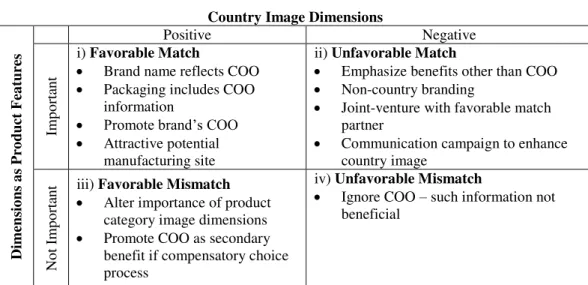
variables as products, national characteristics, economic and political background, history, and traditions. In Roth and Romeo study (1992), four dimensions4 of country image became apparent: (i) innovativeness, use of new technology and engineering advances; (ii) design, appearance, style, colors, and variety; (iii) prestige, exclusivity, status, brand name reputation; and (iv) workmanship, reliability, durability, craftsmanship, manufacturing quality. In addition, Iyer and Kalita (1997) suggested that the higher the perceived level of industrialization of a country, the more positive is the perception of the quality of its workers (Li et al. 1994), which was reflected in the perceived quality of its products. If a country is perceived as having a positive image, and this image is important to a product category, consumers will be more willing to buy the product from that country (Roth and Romeo 1992).
Indeed, Pecotich et al. (1996) found that developed countries such as Japan, Germany, and USA are associated with high quality products, whereas newly developing nations such as Korea, China, and Philippines are associated with poorer quality products. Confirmed later, by Loo and Davies (2006), products from less developed nations are seen as inferior (Wang and Lamb 1983). Meaning that country names amount to brands and help consumers evaluate products and make purchasing decisions (Chao 1989; Kotler and Gertner 2002).
Most previous studies treated COO as a multidimensional construct that evokes various product-attribute-related responses construct (Jaffe and Nebenzahl 1984; Han and Terpstra 1988), however, some critics can be made: (i) studies frequently use a single measure of product quality rating to understand the impact of "made-in" stereotypes (Hong and Wyer 1989), and (ii) the dimensions found to underlie country image are all production and marketing oriented (Crawford and Garland 1988). Moreover, some recent studies have shown that COO is not a merely cognitive cue for product quality, but an affective image attribute that relates to emotions, identity, pride, and autobiographical memories that directly influence consumers' decision making (Verlegh and Steenkamp 1999).
However, a multitude of empirical studies, indicate that most country images are in fact stereotypes, reality simplifications that are not necessarily accurate and, then, are used for product evaluation and purchase intentions – brand of origin confusion (Hong and Wyer 1989; Kotler & Gertner 2002). In fact, simple
modifications have been observed in order to influence consumers’ attitudes, such as manipulation of the country-of-origin or “made-in” label (Kotler & Gertner 2002). Indeed, previous research alleged that local brands benefit from using brand names or advertising with foreign elements, because consumers get confuse about the origin of the brand and perceive them as foreign (Zhang 2001; Zhou and Hui 2003; Zhou et al., 2007).
Two factor categories may cause brand confusion (Howard and Sheth, 1967; Engel et al., 1994). First, consumers’ cognition processes, such as their cognitive ability, attention paid to the brand and its origin, and memory. Second, when a firm intentionally causes brand origin confusion.
Furthermore, research has reported that, because developed countries are
perceived as producing items with superior quality (Pecotich et al. 1996); Loo and Davies 2006), in developed countries there is a clear preference for local brands and a consequent resistance to foreign brands (Albaum and Peterson, 1984; Netemeyer et al., 1991), while in most developing countries, consumers tend to prefer foreign brands (Batra et al., 2000; Steenkamp et al., 2002; Wang et al., 2004), especially when purchasing luxury brands (Zhou and Belk, 2004).
Besides all the effects presented above, consumers’ purchases are also influenced by the fact that apparel is a mature industry with stores’ overcapacity, resulting in an oversaturated market, where consumers have a wide range of purchasing options, and apparel players find it difficult to differentiate themselves (Deloitte 2008).
Emergence of own brands (i.e., private label)
In order to differentiate themselves, apparel players (i.e., manufactures and retailers) have started their own product development teams to create exclusive designs and brands (Ryan 2004; Plunkett Research, 2007).
Designs and brands that are exclusive to one store and owned by the retailer are referred to as own brands or private labels (Dickerson 1995; Stone 2004). By designing, sourcing, and distributing all items in-house, thereby eliminating the middleman, the retailers are able to provide the same good of equal or superior quality for less money than a comparable national brand. Retailers can then sell the good at a lower price to the consumer while still making a higher profit margin, creating a sustainable competitive advantage (Coolidge 2003; Parker and Kim 1997). Further, private label margins, on average, run 6 percent to 10 percent higher (Ryan 2004), due to costs reduction, such as in licensing of names and trademarks, involved in the purchase of other producers’ brands (Keiser and Garner 2008).
By 2008, private labels estimated to account for 15 to 25 percent of a retailer’s merchandise assortment (Keiser and Garner, 2008), and according to a Price WaterCoopers study, in 2015, will account for 70 percent. This may create a risk of cannibalization5 (Parrish 2009), and in order to prevent it, apparel players should concentrate on differentiation and focus within their private label lines. Previous research concluded that by having a thorough understanding of the product and the consumer, those companies will be better positioned to compete in the global marketplace and achieve higher margins for products while yielding
5 When one product offering “eats” away at the current market of an established product (Raynor
greater profitability (Dalgic and Leeuw 1994; Linneman and Stanton 1991, Porter 1998).
This means, they have to be able to create a brand equity in their private labels. A definition of brand equity is a set of assets and liabilities linked to a brand that create value for both customers and the firm (Aaker 1991), or the incremental utility and value that a brand name adds to a product, such as Coke, Kodak, Levi’s, and Nike (Farquhar et al., 1991). Ailawadi and Keller (2004), gave multiple ways how retailers could built a brand image within their private labels, as promoting the quality of their service, the brand range of products and
merchandising, price and credit policy.
The set of assets and liabilities could be classified into five categories: brand loyalty; awareness; association; perceived quality; and other brand proprietary assets (Aaker 1991). Moreover, other factors regarding a marketing strategy, such as advertising costs, sales’ team, public relations, slogans or catchphrase, symbols and packaging, warranties, and social events, have been proposed as brand equity contributors (Simon and Sullivan 1993; Keller 2002).
3.
Methodology
Research Strategy
The research strategy consisted in a non-experimental method, which means that there will not be explicit manipulation of the information. Further, the nature of the relationship between theory and research is deductive, in other words, the theory guided the research.
For the literature review, the research strategy was based in an archival research (documents analysis) in the EBSCO database, as well as, Google scholar that provided some chapters of relevant books. The criteria to select the secondary source material were: the number of citations, the year of the publication, and the relevance of the academic journal. The majority of the journals used were related to the management and marketing fields, had on average more than 70 citations in EBSCO, and were published a few years to provide up-to-date insights to the analysis (with exception of Porter’s Diamond Model).
To complement the academic articles, some tertiary source material was reviewed, such as Statistical Compendiums from Euromonitor International, industry reports from relevant consulting firms (e.g., BCG, PWC, and Deloitte), and relevant firm news in the online version of Financial Times. The reason why Euromonitor International was chosen as a preferable source rather than IBIS World, is because it provides more data in terms of years analyzed and countries’ variables, and also due to easier access to information.
Furthermore, some periodical articles about firms were consulted in EBSCO.
In terms of time planning, I worked on this paper on my days without classes, which were Monday and Friday, and respecting the working calendar already established that can be found in appendices.
Research Design
This paper will be based in an Action Research Design intended to foster deeper understanding of the Chinese Private Label Apparel in the Fashion Market, starting with conceptualizing the Apparel Global Market and particularizing the problem of the Chinese Domestic Market. The paper ends with a multiple case study design to analyze if the domestic apparel firms actually follow Porter’s sustain competitive advantage to succeed or adopt other strategies, in the sense that, firms can perform well, even without accomplishing some of the Porter’s requirements, and can also follow more than one type of strategy simultaneously. Three key Chinese apparel retailers were chosen (Youngor, Merters/bonwe, and Giordano) based on specific criteria explained in detail in the case studies’ chapter.
This analysis was conducted to allow me to have a broader basis to compare and contrast the findings deriving from each of the cases, and in the final stage to conclude about firms’ strategy, and to be able to criticize Porter’s Diamond Model.
Research Methods
This paper uses both quantitative and qualitative methods. For the literature review chapter only qualitative data was used, from the academic articles. For the analysis and multiple case study chapters, the qualitative data was complemented with some quantitative sources, related to the statistics provided from the
Euromonitor International, to support the qualitative analysis done through the selected academic articles, and industry reports.
4.
Analysis
In this chapter, I will analyze Porter’s Diamond Model, nation and firm’s competitive factors, applied specifically to China’s apparel industry and firms.
Porter’s Diamond Model and Chinese Apparel Industry6
Porter’s (1998) diamond model of national competitive advantage is based on four determinants: factor conditions, demand conditions, related and supporting
industries, and firm strategy, structure and rivalry.
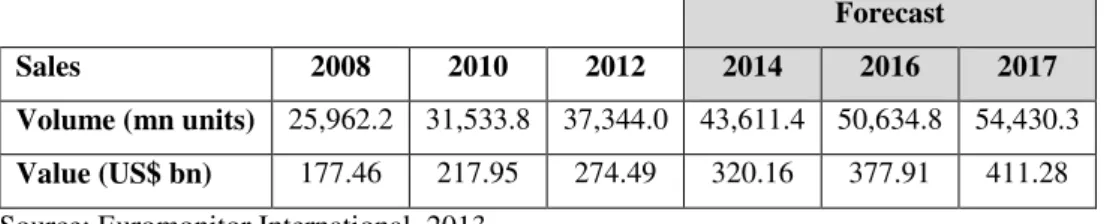
In fact, the importance of the apparel industry for the Chinese economy cannot be overstated. In 2011, China produced half of the world total number of apparel items7, representing more than US$2 Bn of apparel export revenues.
Table 1 – China volume and value of apparel, in terms of sales.
Forecast
Sales 2008 2010 2012 2014 2016 2017
Volume (mn units) 25,962.2 31,533.8 37,344.0 43,611.4 50,634.8 54,430.3
Value (US$ bn) 177.46 217.95 274.49 320.16 377.91 411.28
Source: Euromonitor International, 2013.
i. Chinese factor conditions
Porter (1998) asserted that new competitive factor conditions in apparel industry rely in advanced or specialized factors, such as highly educated workforce (e.g., creative designers), and production and process technology that are specific to global sourcing and management (e.g., Electronic Data Interchange, information technology, etc).
The competitive advantage factors for the Chinese apparel industry has been cheap labor, taking advantage of their low-cost and mass production, rather than innovation and quality. However, according to Euromonitor International (2013), wages have increased 18–20% over the last three years which has lowered the nation’s competitiveness. Further, there is a reduction of the number of skilled
workers in the Chinese apparel manufacturing industry, in fact, the majority come from rural areas, and do not have enough education to perform specialized tasks. (IBISWorld 2012).
Acknowledging that unskilled labor is not a viable factor, especially since is no longer the cheapest, since 2002 the Chinese Government has been supporting Education, creating an educated labor force that is able to expand the economy beyond simple manufacturing (Bustillo 2013).
Indeed, according to the World Bank Data, in 2011, China produced more than 6 million four-year college, which amount to the total work force of Denmark and Norway together. Furthermore, the Chinese Government requires that firms use part of their profits for continuing education. CEOs, managers, supervisors, engineers, and technicians have short business courses in universities to learn occidental management systems, and have the vital tools to compete in the global market (L. Li 2013).
This shows a huge investment in human resources as determinant factor to have competitive advantage (Drucker 1988).
In terms of direct impact in the apparel industry, one of the examples, is the
partnership between Shanghai University of Engineering Sciences and IFA Paris – IFA’s Shanghai School - the first-ever Sino-French joint venture in fashion
education approved by the Chinese government. Today, there are eleven leading fashion schools in China.
For specialized production and process technologies that are specific to global sourcing and management, China's State Council approved, in 2009, the Three-Year Textile and Clothing (T&C) Stimulus Plan. The aim of the plan was to ensure stable development and to upgrade the infrastructures by eliminating obsolete capacity, reducing energy consumption, improving efficiency, and encouraging a shift to higher value-added products plus improvements in product quality and variety. Moreover, concerns regarding a slowdown in global exports, made China as a leading apparel supplier, to focus on domestic market. This allowed to speed up the innovation process associated with moving beyond assembly and full-package supply to original design manufacturing (ODM) and original brand manufacturing (OBM). Today, the most successful factories in China work with Production Line, Information and Communications Technology
(ICT) that are also the machines and software used by developed countries to manufacture apparel (McNamara 2008).
According to the “Textiles Manufacturing – “Made in China” Tag Under Threat?” report, China is the worldwide leader in apparel production, with a capacity to process roughly 41.3 million metric tons of fibers in 2010 (about 52 % of the global total), and has developed capabilities that permit a completely vertical integration in apparel. Furthermore, Gereffi (2010), described China’s apparel functional capabilities as a Full Package Provider (ODM), and as a Strategic and Steady Growth Supplier.
The benefits obtained through such investments are significant. First, according to Euromonitor International (2013), the Chinese apparel industry grew 10 percent from 2007 until 2012, this represented a market size of US $280 Bn in sales (2012). Furthermore, the sales’ forecast from 2012 to 2017, is to grow 8.4 percent, representing a US $422.8 Bn industry. Secondly, the apparel firms are targeting bigger markets by expanding internationally, therefore the technology is important to handle efficiently large volumes of orders (Technopak 2012).
Porter (1990) affirmed that, sometimes world-class suppliers become new entrants in the industry they have been supplying. That’s the phenomenon that is
happening, today, in China. According to Li (2013), China is shifting from low-tech manufacturing to high-low-tech manufacturing, as is evidenced by high-low-tech exports as a percentage of manufacturing exports in the period 2002 to 2010 (17%), by the R&D expenditure that increased 37% from 2002 to 2008, and by the fact that, in 2010, was the world leader in patent applications (L. Li 2013). And by 2012, China alone had a share of around 45% of world’s total installed capacity for spinning and weaving machinery (Technopak 2012).
ii. Chinese demand conditions
As stated before, the size of the home market is more than a reason for firms to invest in reaping economies of scale. Although, Porter (1998) acknowledge the size of domestic demand in a particular industry as being important to national advantage (e.g., economies of scale or learning), he considered the presence of sophisticated and demanding buyers more relevant (Jin and Moon 2006). In countries where apparel industry is less developed, functionality and
consumers demand a certain premium design level to please their taste (e.g., time, place, occasions) (Jin and Moon 2006).
Chinese apparel consumers became more sophisticated and demanding after the economic reforms. They tend to choose clothes that reflect their personalities (Kwan, Yeung and Au 2003).
Chinese consumers are known for their exquisite taste, especially for luxurious foreign brands (Zhou and Belk, 2004). Indeed, China’s total consumption of luxury goods such as jewelry, fashion apparel, leather products and perfume reach $8 billion in 2007, accounting for 18% of global spending in this area. The
forecast for 2014, is that China is likely to be the biggest luxury market (China Retail News 2008).
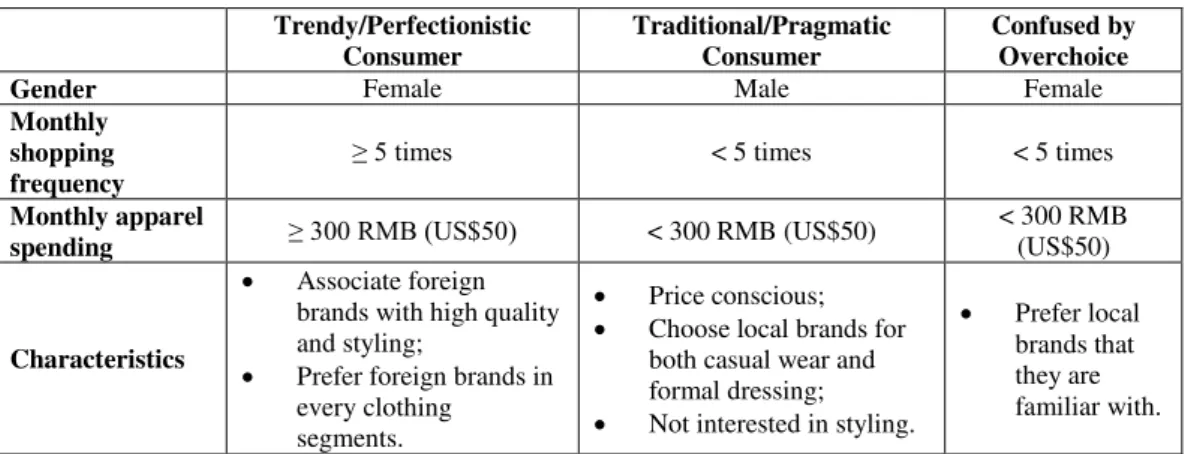
However, there is a multitude of studies about the apparel Chinese consumers. For instance, a study conducted by Hiu et al. (2001), identified three types of Chinese apparel consumers: (i) Trendy; (ii) Traditional; and (iii) Confused by overchoice. The following table summarizes the results.
Table 2 - Summary table of Chinese Apparel Consumers
Trendy/Perfectionistic Consumer Traditional/Pragmatic Consumer Confused by Overchoice Gender Female Male Female
Monthly shopping frequency
≥ 5 times < 5 times < 5 times
Monthly apparel
spending ≥ 300 RMB (US$50) < 300 RMB (US$50)
< 300 RMB (US$50)
Characteristics
Associate foreign brands with high quality and styling;
Prefer foreign brands in every clothing
segments.
Price conscious; Choose local brands for
both casual wear and formal dressing; Not interested in styling.
Prefer local brands that they are familiar with.
Source: Elaborated by the author based on (A. Y. Hiu, et al. 2001).
According to CBRE, in terms of store numbers, China has already become the most important international market for major fast fashion brands. It is the largest international market for Zara (125) and Uniqlo (211), and the largest international market in Asia for H&M (135) and C&A (52).
Domestic brands dominate the mass market, especially in lower-tier cities and the rural market. Generally they have more extensive sales channels than their foreign counterparts (Fung Business Intelligence Center 2013).
Chinese apparel firms have started to internationalize their own brands/private label to overseas to maintain growth, because the domestic market has suffered with the slowing global economy and rising (Fung Business Intelligence Center 2013).
For example, Bosideng, the largest down apparel company in China, in June 2011, acquired an UK retailer, Greenwoods menswear, for approximately 40 million yuan ($6.4 million), where it plans to house its down apparel and men’s wear flagship store, and the group’s European headquarters (company website). Also Meters/bonwe, China’s leading casualwear apparel companies, opened a flagship store in London in July 2013, and plans to open more stores in Paris, New York, and Tokyo (Fung Business Intelligence Center 2013).
While the above examples are a start, there are some challenges for the Chinese apparel industry. First, regarding the tastes of diverse international consumers. Second, how to establish strong brands and effectively expand.
From 2002 to 2011, there was a 346% increase of net foreign direct investment in China which allow to grow internally, based on an export-driven manufacturing (Bustillo 2013).
iii. Chinese related and supporting industries
In 2008, China exported 33.2% of the world total amount of apparel exports translated into a US$120 Bn industry, which means that China was the top apparel exporter country (Gereffi 2010), whereas the second place was occupied by UE – 27 that produces 31.1% (US $112.4 Bn). Unlike some of its competitors, China produces raw materials, being the world’s biggest cotton producer. However, the Chinese garments factories’ demand for raw materials often exhausting the country’s own domestic supply, forcing them to acquire it from other countries to meet their sourcing requirements. This is the reason why is estimated that about half of China’s exported clothing is made from imported textiles (The Global Textile and Garments Industry Report, 2008).
Jin and Moon (2006), don’t agree with Porter (1998) related to the fact that apparel raw materials are source globally, for them having a competitive national supplier is not important, but it’s essential to be able to coordinate the production and communication with suppliers.
For example, Hong Kong’s first and largest buying office, Li & Fung, was founded in 1906 and provides an integrated service, called “virtual factory” or “private label manufacturing program”, which incorporates product design assistance, through materials sourcing for its production to the handling of logistics (George 1998, Magretta 2000).
iv. Chinese firm strategy, structure, and rivalry
Domestic brands collectively lack technology innovation and fashionable designs, whereas their strengths come from advantages in widespread, distribution
networks and low prices (Euromonitor International 2013). The majority of
Chinese apparel companies focus on cost leadership, and are currently investing in inventory and forecasting control systems to better manage their stocks, and lower their costs. Others try to differentiate their brand by higher international design teams.
Chinese apparel retailers which are not full package provides, usually have in-house design teams, but outsource production to foreign countries that have cheaper raw materials and labor force.
In 2012, the main distribution channel utilized in China was store-based retailing (92.5%), and e-commerce represented 7.4%. In stores based, department stores and mixed retailers are the main channels with 36.8% share each (Euromonitor International 2013).
Foreign players acting in the domestic market still represent the main interest for domestic consumers, since Chinese consumers perceive international brands as having superior quality.
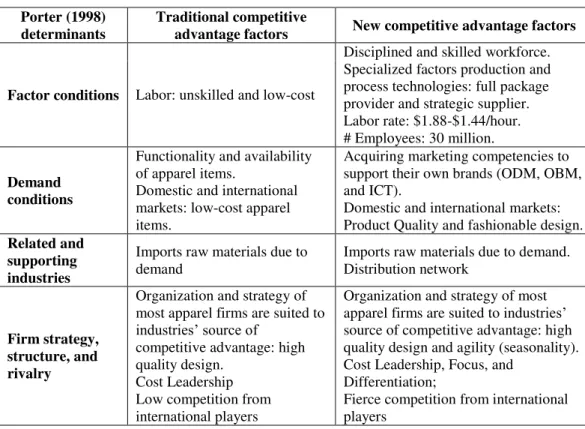
Table 3 - China Apparel Diamond Model – Summary table Porter (1998)
determinants
Traditional competitive
advantage factors New competitive advantage factors
Factor conditions Labor: unskilled and low-cost
Disciplined and skilled workforce. Specialized factors production and process technologies: full package provider and strategic supplier. Labor rate: $1.88-$1.44/hour. # Employees: 30 million.
Demand conditions
Functionality and availability of apparel items.
Domestic and international markets: low-cost apparel items.
Acquiring marketing competencies to support their own brands (ODM, OBM, and ICT).
Domestic and international markets: Product Quality and fashionable design.
Related and supporting industries
Imports raw materials due to demand
Imports raw materials due to demand. Distribution network
Firm strategy, structure, and rivalry
Organization and strategy of most apparel firms are suited to industries’ source of
competitive advantage: high quality design.
Cost Leadership Low competition from international players
Organization and strategy of most apparel firms are suited to industries’ source of competitive advantage: high quality design and agility (seasonality). Cost Leadership, Focus, and
Differentiation;
Fierce competition from international players
Source: Elaborated by the author based on (Porter 1998).
However, China’s dominance in apparel is likely to be in danger. As a result of increasing manufacturing, distribution, and labor costs, the price of apparel in China continued to experience an on-going upward trend in 2012. Furthermore, increase in average apparel unit price is likely to continue. Even if raw material costs stabilize, the rising labor and rental costs will continue to propel the growth of apparel in China. Therefore, instead of simply price cutting, players will increasingly focus on price-adding features such as fashionable designs and technology innovation to attract consumers.
In addition, multiple Southeast Asian countries are using China’s rising labor costs, to change their governmental policies and incentives. For example, on every Chinese apparel item exported to Japan a 10% tariff is charged, while Vietnam does not charge any tax yet. As a consequence, Japanese apparel manufacturers have made invested approximately $190–200 million. Also, apparel produced in Cambodia enjoys duty free access to the EU, Canada, Japan and China.
Consequently, apparel manufacturers are moving out their operations from China to other places with lower raw materials costs and to avoid currency appreciation. As Porter (1990), in “The Competitive advantage of Nations”, affirmed “where
government finds a trade barrier in another nation, it should concentrate its remedies on dismantling barriers, not regulating imports or exports”.
v. Governance
China has, for long, been the worldwide manufacturing hub for a broad products’ range, mainly due to the low labor cost. Since the economic reform program initiated by Deng Xiaoping and the open door policy to foreign investors, China has moved away from an agriculture-based economy into an industrial economy, that processes or assembles 90% of the worldwide manufactured goods, and by the end of 2012, was the world's leader in manufacturing operations and the second largest economic force (L. Li 2013).
The knowledge of how China deployed its manufacturing strategy to become a manufacturing powerhouse is limited. Ling Li (2013)8 has identified three periods in this path: (i) the Incubation Years (1978-1991), when Deng Xiaoping and the government dismantled a strict centrally planned system to incubate a model with free-market principles - the Open-door policy of Chinese Government (1980-90) encouraging rapid development of all trades and professions, economic reform, policy formulations and major structural changes; (ii) Navigation Years (1992-2001), when China came out of its isolation by its historic accession to the World Trade Organization (WTO) and reached out to the nations of the world. The major focus of this period was on manufacturing infrastructural development with soft competencies: flexible, low-cost workforce, value-added manufacturing
capability, and R&D investment (Li 2012). Furthermore, in 1999, the Chinese Government initiated a ‘Go global’ strategy, to enforce nation’s most promising state-owned firms to become international relevant players, aiming to create between 30 to 50 national champions by 2010; lastly, (iii) Dynamic Years (2002-present), when China became the second largest economy in the world. In this stage, China enter in a soft capability development to change the worldwide manufacturing paradigm, by investing in education, developing workforce, value-add manufacturing capacity, and R&D.
Table 4 – China Strengths and Threats in apparel industry
Strengths Weaknesses/Threats
Labor: High Productivity, Competency, and
experience: China excels at improving productivity in light of rising inflation.
Cost: Labor & Quota Elimination Quality: fabric and garments Reliability
Technology Investment (logistics)
Product Diversity: fabric and finished goods Mentality & Management: “can do”
business approach
Government Support
Inflation (increases producer prices), and labor
competition from higher paying, non-apparel sector industries
Labor Costs & Labor Laws: rising domestic
wages, expected to increase further as a result of new labor laws
Currency Appreciation Energy Costs: increasing Shipping cost: major increases Product Safety
Source: Elaborated by the author based on Gereffi (2010).
Will ASEAN countries match China’s dominance in supply chain efficiency, distribution networks and technical knowhow? While China’s labor costs have risen, the 12th Five-Year Plan (approved in March 2012) focuses on domestic consumption growth, and in high value-added manufacturing.
Chinese firms’ Competitive Advantages in Apparel industry
The factors identified as needed for firms to have competitive advantage in an industry were innovation, early mover advantages, and global approach (Porter 1998), and brand management (Lasserre and Schutte 2006). More recently, Jin (2004), posit three competitive factors regarding apparel industry and Asian NIC-specific success factors: global brand; global sourcing; and agility.
i. Innovation
Chinese private businesses easily adapt to market trends, due to their simple product structure and technology, and operating mainly in the niches unexplored by larger firms (Cooke 2008).
With the increasing level of operational freedom, the cheap workforce, the potential for market growth, the high level of technology, and the ascending number of Chinese entrepreneurs have led to a considerable number of good private firms (Nolan 2004).
Although, Product Life Cycle theory (Vernon 1966) explains the production shift of many innovative products, some categories, such as products with short life cycles (e.g., fashion items), cannot be adequately explained (Dickerson 1999).
Innovation in Chinese firms takes two forms: in products and services, and/or in technology and techniques (Cooke 2008). Companies strive to be market leaders in exploring new markets and compete in the upper end of the product market. Many of them have in-house R&D facilities and collaborate with external partners, domestic and international, to obtain faster product development (e.g., universities and research institutions). For these firms, investing in advanced technology is the key to their global competitiveness, and assurance of product quality (Cooke 2008).
In point of fact, the Asian NIC firms’ success has been attributed to their “agility, the capacity for meeting changing demand volumes, for prompt and precise commercialization of new styles, and for fast and timely delivery” (Jin, Apparel industry in East Asian newly industrialized countries. Competitive advantage, challenge and implications 2004), but at the same time, without investing in technology. In fact, unlike developed countries, NIC have other unique success factor regarding agility: social networking.
ii. Early Mover Advantages
As the constant fake and poor-quality products made in China have become a serious issue, the top privately owned enterprises have shift their strategy to build their reputation on product quality, honesty and trust. This new strategy englobes product and corporate branding, and CSR, in order to communicate quality the production quality, as starting to build a relationship with consumers based on trust and business ethics. A good example is the Kangna Group that was
considered the “Best Chinese Shoe Maker” in 1993, and since then has struggle to keep this reputation.
iii. Global Approach
Although domestic mergers and acquisitions have been the common form to expansion, a significant number of the top-50 private enterprises have also adopted an internationalisation strategy to grow, by improving technological and managerial competence, brand image, and by acquiring distribution network from foreign firms, with a little help from the international capital market (Cooke 2008).
According to Jin (2004), without a powerful global brand, Asian NIC9 cannot add
value to products rather than trust on manufacturing skills, which will lead to a constant competition with other emerging NIC. In fact, Asian NIC’s possibility to expand worldwide is based on their sourcing network expertise by building a global brand through design and manipulation of consumer’s taste across advertising. These brand creation requires wealthy advertising budgets and promotional campaigns to sustain it, and benchmark trends in developed countries, such as private labels (Wilson 2000).
Concerning global sourcing, Asian NIC countries are in a privileged position when compared to other emerging NIC (i.e., Mexico), this is mainly because for a long time they have been investing in setting up manufacturing facilities in lower-wage countries and using triangle manufacturing10 to export for developed
countries. Although Mexican firms have been exporting products to North America under NAFTA agreement, they have never experienced systematic integration like triangle manufacturing. For developed countries with high market size, as USA, global sourcing has been a competitive advantage, benefiting with lower sourcing costs. However, a firm with a great global strategy may not obtain the expected outcome (i.e. cost leadership), if it does not assure the global market. Therefore, Jin (2004), in “Apparel industry in East Asian newly industrialized countries”, alleged if Asian NIC are to utilize global sourcing strategies, “establishing a global brand should come first, so that the firm can reap the benefits from economies of scale”.
iv. Brand Management
The main objective of Consumer Style Inventory (CSI) framework, developed by Sprotles and Kendall (1986) in the Chinese market, was to measure consumer decision-making styles. In the study, eight decision styles were identified: (i) quality conscious; (ii) brand conscious; (iii) fashion conscious; (iv) recreational
9 China, India, Taiwan, Singapore, Indonesia, Malaysia, Philippines, Thailand, and South Korea. 10 Triangle manufacturing is a mechanisms that facilitates Asian NIC shift to higher value added
activities. The East Asian NIC initiated triangle manufacturing in the 1970s and 1980s. Under this arrangement, US buyers place their orders with the NIC manufacturers they have sourced from the past. Those manufacturers, in turn, subcontract some or all of the requested production to factories in lower-wage locations to reduce production costs (Bonacich and Appelbaum, 2000; Christerson and Appelbaum, 1995; Gereffi, 1999). Triangle manufacturing allowed Asian NIC to move beyond OEM production and into a facilitator role in organizing global production, which is an