UNIVERSITY OF LJUBLJANA FACULTY OF ECONOMICS
MASTER'S THESIS
SUCCESS FACTORS OF KNOWLEDGE MANAGEMENT
IMPLEMENTATION IN SMALL AND MEDIUM ENTERPISES IN
UNITED ARAB EMIRATES, QATAR AND PAKISTAN
AUTHO RSHI P ST ATEMENT
The undersigned Arslan Murtaza, a student at the University of Ljubljana, Faculty of Economics, (hereafter: FELU), author of this written final work of studies with the title Success Factors of Knowledge Management Implementation in SMEs in UAE, Qatar and Pakistan, prepared under the supervision of prof. dr. Mojca Indihar Štemberger PhD and co-supervision of prof. Guilherme Martins Victorino.
D E C L A R E
1. this written final work of studies to be based on the results of my own research;
2. the printed form of this written final work of studies to be identical to its electronic form;
3. the text of this written final work of studies to be language-edited and technically in adherence with the FELU’s Technical Guidelines for Written Works, which means that I cited and/or quoted works and opinions of other authors in this written final work of studies in accordance with the FELU’s Technical Guidelines for Written Works;
4. to know plagiarism (in written or graphical form) is a criminal offence and can be prosecuted in accordance with the Criminal Code of the Republic of Slovenia;
5. to be aware of the consequences of a proven plagiarism charge based on the this written final work could have for my status at the FELU in accordance with the relevant FELU Rules;
6. to have obtained all the necessary permits to use the data and works of other authors which are (in written or graphical form) referred to in this written final work of studies and to have clearly marked them;
7. to have acted in accordance with ethical principles during the preparation of this written final work of studies and to have, where necessary, obtained the permission of the Ethics Committee;
8. my consent to use the electronic form of this written final work of studies for the detection of content similarity with other written works, using similarity detection software that relates to the FELU Study Information System;
9. to transfer to the University of Ljubljana free of charge, non-exclusively, geographically and time-wise unlimited the right of saving this written final work of studies in the electronic form, the right of its reproduction, as well as the right of making this written final work of studies available to the public on the World Wide Web via the Repository of the University of Ljubljana;
10. my consent to the publication of my personal data that are included in this written final work of studies and in this declaration, when this written final work of studies is published.
i
TABLE OF CONTENTS
INTRODUCTION ... 1
1 KNOWLEDGE MANAGEMENT ... 3
1.1 Knowledge, Information, and Data ... 3
1.2 Knowledge Management Characterization ... 4
1.3 Knowledge Management Types ... 5
1.3.1 Tacit Knowledge ... 6
1.3.2 Explicit Knowledge ... 7
1.4 Knowledge Management Framework and Models ... 7
1.4.1 Knowledge Management Framework ... 7
1.4.2 Knowledge Management Models ... 8
1.5 Knowledge Management Processes ... 11
1.5.1 Knowledge Creation ... 11
1.5.2 Knowledge Detection and Discovery ... 11
1.5.3 Knowledge Assessment and Organization... 12
1.5.4 Knowledge Sharing ... 13
1.5.5 Knowledge Acquisition ... 14
1.5.6 Knowledge Reuse ... 16
1.6 Knowledge Management Strategy ... 17
1.6.1 Organizational Structure ... 18
1.6.2 Organizational Culture Change ... 18
1.6.3 Knowledge Retention ... 20
1.6.4 KM Core Competencies... 20
1.6.5 Knowledge Management Systems ... 21
1.6.6 Knowledge Management Best Practices ... 21
2 SMALL AND MEDIUM ENTERPRISES & ORGANIZATION LEARNING ... ...23
2.1 Small and Medium Enterprises (SMEs) ... 23
2.2 Systematic Approach to Learning ... 25
2.3 Organizational Learning ... 26
2.3.1 Organizational Learning Processes ... 27
2.3.2 Organizational Learning Theory ... 27
2.4 Intra-Organizational Processes ... 29
2.4.1 Socialization ... 29
2.4.2 Organizational Culture and Knowledge Sharing ... 30
2.4.3 Organization of Social Network ... 30
2.4.4 Organizational Commitment ... 30
2.4.5 Job Satisfaction ... 30
3 KNOWLEDGE MANAGEMENT AND ORGANIZATIONAL LEARNING IN SMALL AND MEDIUM ENTERPRISES IN UAE, QATAR, AND PAKISTAN ... 31
3.1 Background of UAE, Qatar, and Pakistan ... 31
3.2 Aspects of Knowledge Management in SMEs in UAE, Qatar and Pakistan ... 32
3.2.1 Cultural ... 32
3.2.2 Psychological ... 33
3.2.3 Theoretical ... 33
3.3 Ongoing Knowledge Management status and Challenges ... 33
3.3.1 Ongoing KM Status ... 33
ii
3.4 Effective Innovation Management ... 35
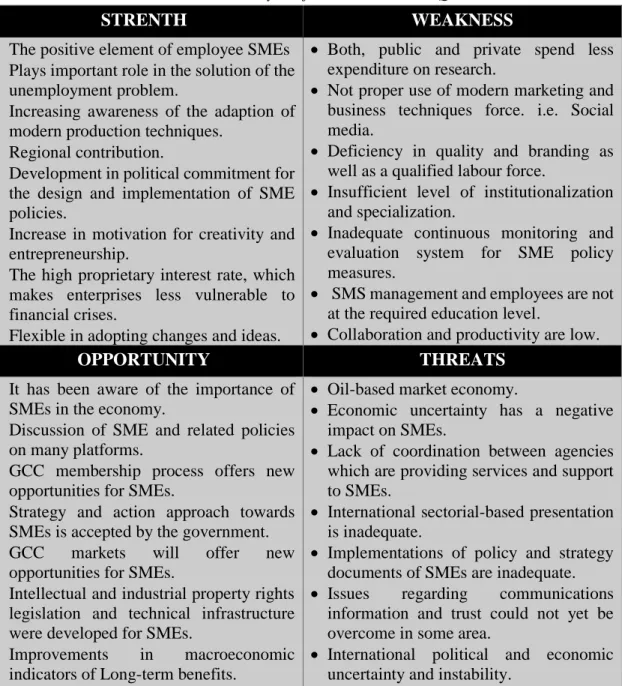
3.4.1 SWOT Analysis of SMEs in Pakistan ... 36
3.4.2 SWOT Analysis of SMEs in UAE and Qatar ... 37
3.5 Similarities and Differences in KM in SMEs Between UAE, Qatar and Pakistan ... 38
3.5.1 Competitive Advantages ... 38
3.5.2 Change and Innovation ... 39
3.5.3 Learning & Training ... 40
4 METHODOLOGY ... 40
4.1 Research Methods ... 40
4.2 Research Questions ... 41
4.3 Qualitative Research Design ... 41
4.3.1 Qualitative Data Gathering Respondents ... 42
4.3.2 Qualitative Data Analysis ... 42
4.4 Quantitative Research Design ... 43
4.4.1 Quantitative Sample Gathering ... 44
4.4.2 Quantitative Data Analysis ... 45
4.5 Reliability and Validity ... 45
5 RESULTS ... 46
5.1 Expert's view about Knowledge Management and Oragizational Learning in UAE, Qatar and Pakistan ... 47
5.1.1 Expert's recommendations for UAE ... 49
5.1.2 Expert's recommendation for Qatar ... 50
5.1.3 Expert's recommendation for Pakistan ... 50
5.2 The content of Knowledge Management and Oragizational Learning in Manufacturing SMEs in UAE, Qatar and Pakistan ... 50
5.2.1 Statistical comparison of KM and OL in UAE, Qatar and Pakistan ... 51
5.2.2 Statistical comparison of KM and OL in UAE and Qatar ... 52
5.2.3 Statistical comparison of KM and OL in Qatar and Pakistan ... 58
5.2.4 Statistical comparison of KM and OL in Pakistan and UAE ... 62
6 DISCUSSION ... 66
6.1 Findings and Contributions ... 67
6.2 Recommendations ... 68
6.3 Limitations ... 72
CONCLUSION ... 73
iii
LIST OF TABLES
Table 1: The Knowledge Creation Model...6
Table 2: The KM Matrix...10
Table 3: SWOT Analysis of Pakistani SMEs...37
Table 4: SWOT Analysis of UAE and Qatari SMEs...38
Table 5: Overview of Respondents from UAE, Qatar, and Pakistan ... 42
Table 6: Locations Coverage of Respondents in Dubai, Doha, and Lahore ... 44
Table 7: Qualitative Respondents ... 16
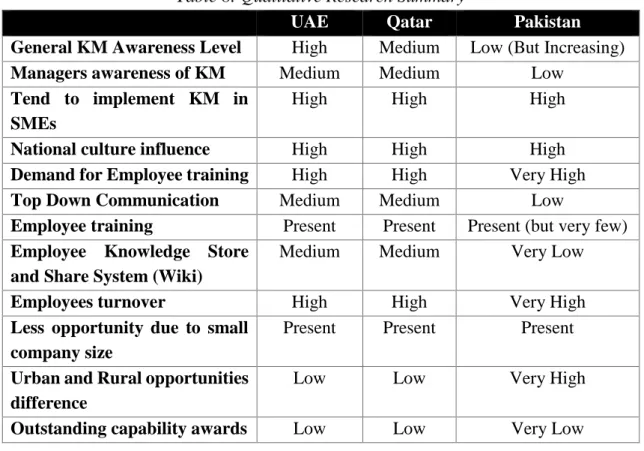
Table 8: Qualitative Research Summary ... 19
Table 9: Normality Test of Mean for Organizational Policy in SMEs ... 24
Table 10: Mean Values (from Normality Test) for Organizational Policy in SMEs ... 28
Table 11: Independent Sample T-test in SMEs in UAE and Qatar ... 28
Table 12: Normality Test for Statistically Difference in Variables ... 28
Table 13: Independent Sample T-test for Statistically Difference ... 28
Table 14: Normality Test of Mean for Organizational Policy in SMEs ... 28
Table 14A: Mean Values (from Normality Test) for Organizational Policy ... 28
Table 15: Independent Samples Test Difference in Variables in SMEs ... 28
Table 16: Normality Test of Mean for SMEs in Pakistan and UAE... 28
Table 16A: Mean Values (from Normality Test) for SMEs in Pakistan and UAE ... 28
iv
LIST OF FIGURES
Figure 1: Knowledge, Information, Data ... 3
Figure 2: SECI model of knowledge creation ... 28
Figure 3: The KM Process Framework ... 28
Figure 4: The KM Process Model ... 28
Figure 5: Cultural web model ... 28
Figure 6: Single-, Double-, and Triple-Loop Learning ... 28
Figure 7: Fiscal Indicators, Lending and deposit growth of Qatar ... 28
Figure 8: Overview of the Group Variables for UAE, Qatar and Pakistan ... 28
Figure 9: Comparison of Mean for Organizational Policy in UAE and Qatar ... 28
Figure 10: Independent Sample T-test for Statistically Difference in Variables ... 28
Figure 11: Similarities in SMEs in UAE and Qatar ... 28
Figure 12: Comparison of Mean for Organizational Policy in Qatar and Pakistan ... 28
Figure 13: Independent Sample T-test for Statistically Difference in Variables ... 28
Figure 14: Similarities in SMEs in Qatar and Pakistan... 28
Figure 15: Comparison of Mean for Organizational Policy in Pakistan and UAE ... 28
Figure 16: Independent Sample T-test for Statistically Difference in Variables ... 28
Figure 17: Similarities in SMEs in Pakistan and UAE ... 28
Figure 18: Proposed Hybrid Knowledge Management Model ... 28
v
LIST OF APPENDIXES
Appendix 1: Summary of the thesis in Slovenian Language ... 1
Appendix 2: Definitions of SMEs in UAE, Qatar, and Pakistan ... 4
Appendix 3: General Economic Data of UAE, Qatar, and Pakistan... 6
Appendix 4: Interview Questions ... 7
Appendix 5: Questionnaire for Under-Study Companies ... 8
Appendix 6 Questionnaire for SMEs in UAE, Qatar and Pakistan ... 10
Appendix 7: Category / Groups ... 12
Appendix 8: Individual Question Analysis of SMEs in UAE, Qatar and Pakistan ... 13
Appendix 9: Groups Statistics of UAE, Qatar and Pakistan ... 16
Appendix 10: Independent Sample T-test Between UAE and Qatar ... 19
Appendix 11: Independent Sample T-test Between Qatar and Pakistan ... 24
vi LIST OF ABBREVIATIONS
Abbreviation Meaning
AI Artifical Intelligence
B2B Business to Business
CMS Content Management System
CSF Critical Success Factors
DMS Document Management System
F2F Face to Face
HRM Human Resource Management
IT Information Technology
KSF Key Success Factors
KM Knowledge Management
LO Learning Organizations
NGO Non-Governmental Organization
OCED Organization for Economic Co-operation and Development
OL Organizational Learning
1
INTRODUCTION
The research field of the master's thesis is in Knowledge Management (hereinafter: KM). During the last few years, KM becomes one of the essential factors for the successful business and companies are becoming more knowledge-based, and they are focusing more on the people's 'minds' rather than their 'hands' to fulfil the need to knowledge (Wong, 2005). The main focus of this study is in success factors of KM having in consideration that Small and Medium Enterprises (hereinafter: SMEs) have fewer resources and opportunities, both human and financial (Farvaque & Voss, 2009). This research is about the main factors of KM that plays a successful role in SMEs in the United Arab Emirates (hereinafter: UAE), Qatar & Pakistan. SMEs in the manufacturing and services sector have taken under study to evaluate the success factors of KM implementation. To implement the KM in the organization can be hard for those who are not ready to accept the change in the organizational structure but with the implementation of KM they can survive, grow and maintain the sustainable competitive advantage (Antoncic & Omerzel, 2008). The research itself is focused on information and manufacturing SMEs sector keeping in mind that it's a service industry, e.g., where both, computer and human resources interaction are visible, and the industry has involved with many stakeholders.
The purpose of this research is to explore the success elements, importance, implementation, advantages, processes, strategies, challenges of KM which are being faced by SMEs in Pakistan, United Arab Emirates and Qatar. Moreover, the benefits that affect and inspire the implementation of knowledge management in SMEs will be analyzed. A comparison of SMEs based on the UAE, Qatar and Pakistani market will also be made to learn the similarities and differences. This study will help SMEs to grow in their field of business to explore the current situation of awareness level and to get the advantages of uninterrupted learning within the SMEs in the UAE, Qatar, and Pakistan. It is important to explore the reason of SMEs failure, which represents as a baseline for recommend and suggest about how we can enhance and improve the SMEs by implementing the Knowlege Management System (hereinafter: KMS). Due to not enough information and knowledge about the concept of KM as enterprise actions and activities that enhance and also increases skills of business strategies to process within companies (Dreyfus, 1998). I selected the specific organizations like Tagit RFID Solutions JLT, Fortes holding, Al Faisal holding and End to End Solutions Provider because they were interested in this research study and they wanted to check their current KM status and required KM level in their organizations. These companies deal in RFID, information gathering, software programming, digital marketing, customer services, third-party contracting, search engine optimization (hereinafter: SEO), user data collection and analysis, to check their knowledge sharing system and how they can improve also for the other service sector SMEs in UAE, Qatar, and Pakistan. Defining the complications on
2
more broad and abstract, more critical question then can be raised that how who we can present the outcomes of a helpful and productive knowledge-based system to all the stakeholders in the SMEs in UAE, Qatar, and Pakistan to achieve the SME's business goals and to provide them benefits. The KM success factors were investigated from different perspectives. Organizational culture is a key to develop the KM as it helps people to share their idea, information, and knowledge (Von-Krogh & Roos, 1995). KM strategies, infrastructure, anthologies, repositories, tools, and incentives are used to increase the knowledge sharing, and supportive culture Development of KM competencies and leadership are also challenging. Therefore the proper implementation of KM in organizations can get a prominent position in their surroundings and can help the organizations to perform better in the complex situation (Iftikhar, Steven, & Ahmed, 2010). Implementation of KM in a company considerably is not easy but its the success criterion for the company (Shepard & Steven, 2002). KM is not only important only for large-scale enterprises but also equally important for SMEs. One of the success reason for KM is to manage the organization's knowledge. For KM implementation in SMEs, there are specific factors that are fundamentals knows as Key Success Factors (hereinafter: KSF) (Wong, 2005). KM help in increasing productivity, effectiveness and efficiency of the organizational operations (Iftikhar, Steven, & Ahmed, 2010). The results of this research will promote the need for KM implementation in SMEs among stakeholders in service-oriented industries in UAE, Qatar, and Pakistan based on KM's success factors. SMEs play a vital role in the growth of the economy in any country. To improve the organizational operations and financial results in SMEs should consider the implementation of KM (Wong & Aspinwall, 2005). The research design is of scientific quantitative and qualitative methods; the first phase focuses on qualitative research which will base on interviews with relevant stakeholders. The interview questions will be both closed and open-ended. Interviews will be taken online via video and audio conferencing, emails and recording. Interviews with managers and employees of knowledge management will conduct a better understanding of KM success factors that can encourage KM implementation in SMEs as well as ongoing and newly proposed elements in the knowledge-based organization. The research will be on an individual level. After getting interviews, SWOT analysis was performed to understand in the implementations of KM in SMEs. The second phase focuses on quantitative research among the SMEs in the manufacturing and services sector. During this phase quantitative exploration of the sample areas of UAE, Qatar and Pakistan will use for statistical analysis purpose. The planned region of Dubai, Doha, and Lahore will take into consideration, to perform and compare the same statistical unit in the manufacturing and services sector. The most important research questions are answered after the quantitative and qualitative analysis of this research in the selected sectors of UAE, Qatar, and Pakistan. The structural definition of this master's thesis divided into five different sections. In Section I, I am describing the KM characterization,
3
definition, and types. Then I am giving a brief overview of KM Models, Processes, and Strategy. In the second section am explaining the SMEs and KM. The third Section is the main part of the thesis, where I briefly explain the KM in SMEs, implementation, and SWOT analysis also to get the similarities and differences between these countries. The fourth section is Research Methodology to find answers to the research questions through quantitative, qualitative research and case study analysis and at the end, I describe the obtained results. And the last section is the conclusions and recommendation of success factors that are important for an organization to implement knowledge management.
1 KNOWLEDGE MANAGEMENT
In this section, first is to discuss and understand the actual meaning of knowledge and KM, KM characterization and to make KM easy to implement and accessible in SMEs. Knowledge is a combination of information, experience, understanding, and awareness that facilitate the structure of analyzing and implementing your practices, understanding, and information. In the companies, knowledge is enclosed not only in repository or documents but it also includes organizational culture, norms, routines, practices and process (Davenport & Prusak, 1998).
1.1 Knowledge, Information, and Data
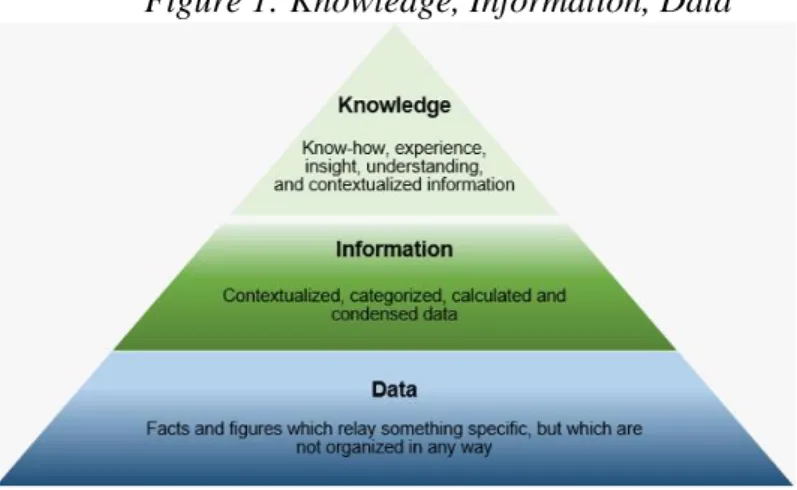
Before explaining the KM, KM user must understand the difference and definition of knowledge, information, and data (figure 1). Also, it is fundamental to understand what are the values that define the knowledge and what comes under the category of data and information. (Thierauf, 1999) Defined the three components level as data is at the lowest level component; it contains an unstructured collection of figures and facts. The information comes at the next level of data, and it contains structured data, and at the end, it comes knowledge, and it can be defined as '' required/desired information about the information''.
Figure 1: Knowledge, Information, Data
4
Data: Figures and facts contain something, but these facts, figures are not managed by
the proper structure, and they cannot give any information or clue about their context, pattern, etc. Unstructured figures and facts that have the minimum impact on the manager (Thierauf, 1999).
Information: To convert data into information it must be categorized, contextualized and
enriched (Davenport & Prusak, 1998). Information is the broader picture of data (Rajeev & Wickramasinghe, 2009).
Knowledge: Closely associated with doing and implies the experience, understanding,
and skills. Each person knows a specific product of his experience and understanding, and by understanding, he can evaluate new inputs from his surrounding environments (Davenport & Prusak, 1988).
1.2 Knowledge Management Characterization
KM has gained a lot of attention in the recent past (Mortern, Nohria, & Thomas, 1999). KM is a young field and has a closely related to different fields like information science, business administration and management, economics, philosophy, etc. It is popular with consultants, practitioners, and academics but still, KM is at a developmental level and continues to explain the core and important concepts, boundaries, and terminologies (Jashapara, 2006). KM is defined as the systematic, renewal, explicit, and to maximize the knowledge of an enterprise related to effectiveness to achieve from the tacit knowledge assets (Wong, 2005). KM is an interdisciplinary approach which can be defined as by (Jashapara, 2006): ''the adequate learning is the process to link with analyzing and take advantages of sharing the knowledge of both tacit and explicit that use cultural environment and technology to increase the organization level and its performance''. KM is one of the terms which is very basic and important part of an organization. What is the meaning of knowledge and what is management, how I can understand to manage something that's not static, it dynamic and developing (Davenport & Prusak, 1998). If we think of knowledge as what we have in your heads and what we can write down from it (Denning, 2005). We can visualize the knowledge that is in our minds but we need is to start managing it (Davenport & Prusak, 1988).
To get successful KM results SMEs need a way to combine all types of knowledge, I will focus on KM practices design to help both, individual and organizational (Eisenhart, 2001). KM is processed to get knowledge gathering from the right people, time, and knowledge. To ensure that the company can learn from the available knowledge and it will be available to use the organizational knowledge assets in the system, as the organization needs. It the cooperation and analysis of organizational knowledge resources to create the competitive advantages of KM and to get benefits from it (Peter, 1999). KM
5
involves internal and external organizational information and turning it into prospective knowledge through the technological platform (Susan & Norman, 1997). A new set of organizational design, structure, technologies operational rules and processes that supports and helps knowledge workers to increase their innovative skills and capability to deliver business goals (Gurteen, 1998). One of the main purposes of KM is to drive values for the organization by providing them with the stream of information to the right person and time. KM is not just only using processes and technology platforms to get the explicit knowledge, but KM provides the ability to share the tacit knowledge that resides in the minds of people (Papows, 1998). Despite the advantages of KM to transform knowledge from explicit to tacit, the less implementation of KM in SMEs shows that these SMEs are not currently getting benefits from the advantages and outcomes of adopting KM strategy, models and processes for business growth and innovation purposes. Acquisition of knowledge in SMEs is interesting when knowledge can be easily gathered, analyzed and will get positive results in an increase of efficiency, profit, and competitive advantages in an organization. For an organization in implementing KM, the advantages of KM must be clear and easily obtainable (Kerste & Muizer, 2002).
1.3 Knowledge Management Types
The concept of KM is introduced and developed by Nonaka in the 1990's. There are two types of knowledge, tacit and explicit (Nonaka, 1991). According to different researchers, tacit and explicit are the major types of KM (Kanti & Koenig, 2000; Nonaka & Konno, 1998; Cavusgil & Calantone, 2003). Tacit knowledge and explicit knowledge, both should see a wide range despite definitive points (Botha, Kourie, & Snyman, 2008). That's why in KM practices, whole knowledge system is a mix of explicit and tacit instead of each other. It is important to fully understand the meaning of knowledge. Some researchers took a step further and defined the third type of knowledge as, embedded knowledge. (Horvath, 2000), defined embedded as the differences between knowledge located in the people's mind and the knowledge embedded in the company's cultures, processes, routines, etc. (Paul & Blackwell, 2001) used a scale to represent embodied-embedded-knowledge, where the first two results closely match the explicit-tacit knowledge (figure 2).
6
Figure 2: SECI model of knowledge creation.
Source: Nonaka & Takeuchi, (1995).
Knowledge starts with the individuals and making it available to others at the main point of the process (table 1). A framework with four different dimensions was built to better explain the creation of Knowledge within an organization (Nonaka & Toyama, 1995).
Table 1: The Knowledge Creation Model
Socialization Externalization
The share of Tacit knowledge directly with another; Socialized: a limited form of knowledge creation; Share experience (can be individual or team meetings)
Codification and documentation (e.g., documenting a brainstorming session
Internalization Combination
Translates into explicit knowledge;
Standardizes this knowledge into a manual;
Individualization of experiences, e.g., learn
from a report and deduce new ideas
Information synthesis;
Expansion of knowledge, e.g., create a
website from some form of explicit knowledge.
Source: Adapted from Nonaka & Toyama (1995).
1.3.1 Tacit Knowledge
In 1966, Originally Polanyi describes this type of knowledge. It is also referred to as the
experience, skill, and understanding (John & Duguid, 1998) and this type of knowledge based on large experience and hard to define. Because it is hard to define, therefore we can say that tacit knowledge is personal knowledge and context dependent. It is also difficult to communicate and mainly depends on actions, involvement, and commitment
7
(Nonaka, 1994). Tacit knowledge is the most important and valuable source of knowledge, and this type of knowledge lead the organization of breakthrough (Jerry, 2009). Lack of focus on tacit knowledge can be the direct impact of decrease the organization’s capability for sustainable competitiveness and innovation (Paul & Blackwell, 2001).
The Knowledge of that resides in the people’s minds including values mental model, cultural beliefs, attributes, etc. also contains skills, experience and capabilities (Botha, Kourie, & Snyman, 2008). Three dimensions of tacit knowledge can describe as, depth, width, and tacit-ness (Nooteboom, 1999). According to (Chanminda, Dilangti, & Richard, 2007), tacit knowledge divided into two dimensions, technical and cognitive. The cognitive dimension consists of mental models and technical dimension deal with the information and expertise about know-how that includes experience, skills, etc. Tacit knowledge embodied in cognitive skills, which makes the tacit knowledge hard to extract (Leonard & Sensiper, 1998).
1.3.2 Explicit Knowledge
This specific type of knowledge can be stored and documented as compare to tacit knowledge (Lee & Choi, 2003). This type of knowledge stored in codification and formal reports, often it is also known as know-what (John & Duguid, 1998). According to (Jerry, 2009), this type is mostly controlled and managed by KMS. Therefore it is much easier to identify, retrieve and store also it is very effective in facilitating to do modifications, storage, retrieval of texts and documents. This knowledge is found in repositories including documents, databases, memos, notes, etc. (Botha, et al., 2008).
Many researchers explained that explicit knowledge is less important than tacit knowledge. It is considered as similar and does not include the rich experience based on know-how to produces a competitive organizational advantage for a firm (Brown & Duguid, 1991; Cook & Brown, 1999; Bukowitz & Williams, 1999). (Nonaka & Toyama, 1995) describes as ‘knowledge is a spiral and has four patterns or modes of interactions
between explicit and tacit knowledge, these four modes are socialization, externalization, combination, and internalization (hereinafter: SECI).’
1.4 Knowledge Management Framework and Models 1.4.1 Knowledge Management Framework
A successful model can be combined with the different components and can show relationships too easily understand (Alan, 2014).
8
According to (Alan, 2014), at the basic level of KM, it consists of the following steps: • Requirement Identifications,
• Knowledge Resource Identifications,
• Create, modify eliminate knowledge resource, processes or factors, • Retrieve and share knowledge,
• Knowledge of storage.
All KM processes, components, factors, are dependent, and all of them are affected by different factors. Because of this reason KM frameworks are usually very different and can implement in a different way for each organization. Since KM is related on each discipline (strategy, management, information, project management, HR, etc.) and has a broad range of KM systems, processes and factors, so a KM model can become very complex. Therefore, KM does not have fully detailed or fully integrated framework (Alan, 2014). Also (Alan, 2014) described the three important questions that the KM framework could answer:
• What/How: The actual process of KM,
• Why: Indication of reasons behind use one KM model or the other, • When: Timing of using one or another KM model.
1.4.2 Knowledge Management Models
The followings are the major Knowledge Management Models: 1. The KM Process Framework
2. The KM Matrix
3. The KM Process Model
1.4.2.1 The KM Process Framework
This framework is introduced by (Bukowitz & Williams, 1999), it emphasizes the “why” and “when” factors of KM framework (figure 3). It represents the KM process to define and enhance the organizational strategy to create and enhance the knowledge repository assets of an organization.
Strengths: This model mainly focuses on strategy, which gives the ability to convert the
KM actions into context.
Weaknesses: This KM model does not include any deeper insight where activities are
9
Results: In response to knowledge-based assets the result of tactical and strategic changes
and organizational needs. The model provides an abstract overview of the strategy using KM.
Figure 3: The KM Process Framework
Source: Bukowitz & Williams, (1999).
1.4.2.2 The KM Matrix
According to (Paul & Blackwell, 2001), “This KM model represents an overall theoretical KM framework and some specific guidelines for the implementation of the KM (table 2). In this model, KM processes divided into four steps. First organization management must find the sources of the knowledge. The second step is that the organization must arrange the found knowledge sources, this knowledge is helping the organization to get the strengths, weaknesses, and to determine its reusability and relevance. The third step is to follow the socialization, to use different techniques to disseminate, help and share this with whoever requires it in the organization. And at the end, the knowledge is adopted by its use. Like in all sequential models, the steps are different, but this KM model provides the overview of the role and responsibilities of KM managers (Alan, 2014).
Limitations:
This KM model has one limitation in its focus. First, the overall strategy role defined by (Bukowitz & Williams, 1999) are not part of this model. Second, the role of KM in this model is limited to knowledge creation, analysis, ignoring and sharing the knowledge process. This model is a perfect approach to implement KM, where most of the focus is on the sharing the knowledge and getting the existing knowledge, but still, it does not covers the entire scope of the KM definition.
10
Table 2: The KM Matrix
Source: Gamble & Blackwell, (2001)
1.4.2.3 The KM Process Model
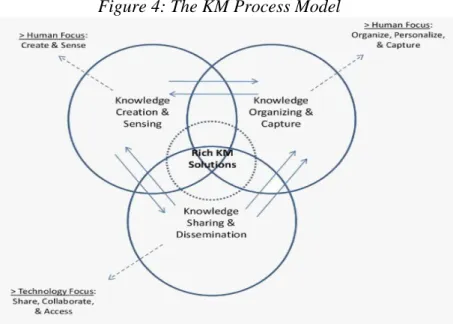
According to (Botha, Kourie, & Snyman, 2008), This KM model defines more representative in term of an overall view of the KM processes. In this model, there are three categories joined and interrelate with each other (figure 4). The approach of this KM model is like The KM Matrix that defined by (Paul & Blackwell, 2001), it focuses on managerial enterprises, based on strategic focus which can answer of "when" "why" and "what." This process model includes the creation of new knowledge as a focused KM step. This model also explains the different categories which are more people and technology focused. Most of the organizations are largely focused on technology. However, this is how organizations want to solve the issues by using technology instead of an organizational and social challenge.
Figure 4: The KM Process Model
11 1.5 Knowledge Management Processes
According to (Alan, 2014), KM processes can divide into six sections as: • Knowledge Creation,
• Knowledge Detection & Discovery, • Knowledge Assessment & Organization, • Knowledge Sharing,
• Knowledge Acquisition, • Knowledge Reuse.
These different sections are the backbone of KM processes. And these are involved in the implementation of KM.
1.5.1 Knowledge Creation
The capability of new knowledge creation starts with the organization's competitive advantages. From time to time this issue of competitive advantages for the organization is not considered as part KM because of these issues are borders and overlapping with the innovation management within the organization. (Jerry, 2009). According to the (Nonaka & Toyama, 1995), New knowledge creation model of SECI model explores the ideas of consistent socialization, combination, and convert the different branches of knowledge as the knowledge users activities, actions, practice, learning, and interaction. (Cook & Brown, 1999) Differentiate between knowing about things and knowledge, and they recommend that the creation of a knowledge system is an interaction between knowledge and knowing. The shift in understanding and knowledge comes from actions, practices, and interaction; these are the main factors of new knowledge creation.
1.5.2 Knowledge Detection and Discovery
After the knowledge creation, it resides within the organization. Thus it is important to properly categorize and recognized the knowledge before sharing and reusing (Alan, 2014).
Explicit Knowledge of Knowledge discovery and detection:
It’s a large process of knowledge sorting through documents and other organizational records, knowledge discovery within the existing knowledge data and repositories. Also, it used to extract the hidden / not explored knowledge by its relationships and pattern within data in the text. Tools for this business intelligence gathering are data mining (used
12
for finding patterns of information and data), and text mining (used for text analysis for knowledge) (Alan, 2014). According to (Rajeev & Wickramasinghe, 2009) “Intelligence gathering is closely related to the expert systems where the KM processes try to capture the knowledge of an expert user.” Although the ability to perform this task and are they competent to do this is questionable (Botha, et al., 2008).
Tacit Knowledge in Knowledge discovery and detection:
Tacit knowledge is more complex as compared to the Explicit Knowledge of Knowledge discovery and detection. It’s up to the organization’s management to get an understanding of what their employees exactly know. The most important type is tacit knowledge, to sustain the competitive advantages of the organization. It involves awareness and observation. Different quantitative and qualitative tools can use in KM processes like questionnaires, surveys, interviews, observation, and analysis (Alan, 2014).
1.5.3 Knowledge Assessment and Organization
Knowledge organization and assessment is not new. (Horvath, 2000; Bukowitz & Williams, 1999). To determine the available resources that are important for the organizational strength and weakness of management must access and organize their knowledge into controllable hands. Knowledge-based organizations include the practices like knowledge classification, indexing, and categorization for knowledge storage and retrieving (Botha, et al., 2008). (Markus, 2001) Defined and assigned the role of knowledge management is to prepare, sanitizing and organizing the knowledge to a knowledge repository, knowledge manager may also call actual knowledge producer. To share or reuse the knowledge it must be arranged in a way that the knowledge user can identify, understood and retrieved the desired knowledge from the knowledge repository.
Explicit Knowledge of Knowledge Organization:
Information Technology (hereinafter: IT) is an important part of an organization and to encourage the means of knowledge retrieving and organizing (Paul & Blackwell, 2001). IT organization use different topologies to store and organize information and knowledge (Rajeev & Wickramasinghe, 2009). These categorizations method of IT organizations create a hierarchical, logical knowledge flow that enables knowledge user to search/go through by category and these topologies are costly to create (Botha, Kourie, & Snyman, 2008). Explicit not measured as important as tacit knowledge, due to its method, processes, factors, volume, classification and retrieval (Paul & Blackwell, 2001).
13 Tacit Knowledge of Knowledge Organization:
Tacit knowledge uses in groups, individuals, experts, Social Network Analysis (hereinafter: SNA) and coordination of knowledge (Paul & Blackwell, 2001). The main role of tacit knowledge in a knowledge organization is to understand which context created. Such as yellow pages, SNA, maps can use for location and categorization of the important expertise of tacit knowledge resources. (Liebowitz, 1999).
1.5.4 Knowledge Sharing
To create the right knowledge to reuse and share, KM is important to acquire the right knowledge or resource (including people) available. Perhaps sharing that knowledge is one of the main roles of the KM process because most of the KM initiatives depend upon sharing. It can describe as either pull or push. Knowledge sharing depends on the practice and disposition of the knowledge worker to pursue out and be receptive to these knowledge sources. The right incentive, culture, and so on must, therefore, be present (Alan, 2014).
Explicit Knowledge and Knowledge Sharing:
According to (Bukowitz & Williams, 1999), the determination of successful explicit knowledge defined by the following criteria:
• Articulation: The exact requirement of a user to ask, what he needs.
• Awareness: Knowledge awareness ability, that encourages the user to make maps, directions, yellow pages, etc.
• Access: Knowledge Access.
• Guideline: Knowledge Managers play an important role in building a knowledge sharing system (Paul & Blackwell, 2001; Davenport & Prusak, 1998). KMs must define the expert areas of each member of the organization, guide, and responsible for publications and other material to avoid knowledge and information overload within the organization.
• Completeness: To access the self-published knowledge and centrally managed knowledge within the organization.
Tacit Knowledge and Knowledge Sharing:
Socialization is required to share the tacit knowledge. Knowledge sharing can be in different forms (Davenport & Prusak, 1998) defined some factors:
14
• Informal network activities: For day to day interaction with different departments, employees within the organization and these activities are considered very important for the organization.
• Functions and hierarchical structure: Unlike the formal structure of the organization, the activities flow in a combination of function/groups and step-by-step also they are hard to monitor and identify.
• Management Support: Organizational management must support these network activities by providing them with the communicational resources. A specific location is helpful for the people of the organization to meet but it's not mandatory. Management support also can occur in cafeterias etc. It is the responsibility of organizational management to facilitate the means for their employees for casual network activities and tacit knowledge of the organization.
• Value of Choas: It is very important for the management to understand the value of mismanagement. It is unstructured activities in the organization the encourage social interaction and experimentation. The importance of less structural working environment within the organization is also known in innovation management. In tacit knowledge, the codification is difficult and sometimes nearly impossible to do so, and in the result of this problem knowledge loss occurs (Bukowitz & Williams, 1999; Prusak, 2000).
1.5.5 Knowledge Acquisition
According to (Paul & Blackwell, 2001), the organization tries to obtain the knowledge from the external sources and these external sources are important, and one must, therefore, take a comprehensive overview of the value chain. These sources are customers, suppliers, partners, and competitors.
Customers: Customer-based knowledge comes in different forms. (Gebert & Riempp,
2002) identify the three different types of customer knowledge:
• Knowledge of the customer
: The knowledge which customer can gain to satisfy their
knowledge need. It includes market, product and supplier's knowledge. It can source from internal and external knowledge sources like other competitors and customers (Zanjani & Roshanak, 2008).• Knowledge about customers: This knowledge provides the better overview of a
customer approach and to understand the customer's motivation and how to address them better for the organizational strategy.
15
• Knowledge of a customer: This knowledge deals with suppliers, products, and markets and can be used to improve the company's services and products.
These three knowledge categories apply to get actual knowledge acquisition also to information and data, which the organization can process and use to create the knowledge (Zanjani & Roshanak, 2008). Thus, knowledge sharing is very important although it has different forms depending on the business area. KM is important for a business to business (hereinafter: B2B) relationships. Where the customers are more visible, and the products are more customized to fulfil the customer's requirements (Gebert & Riempp, 2002).
Suppliers: (Joseph, 2009) Defined the classification of supplier knowledge based on the
idea and concepts of customer knowledge, defined by (Gebert & Riempp, 2002). He identifies the different types of supplier knowledge as:
• Knowledge of supplier: The knowledge that suppliers require and include production, inventory, forecast, customers, and market.
• Knowledge of suppliers: The knowledge used to understand how a supplier can meet the customer requirements, provide customer insight on delivery, quality, defects, financial risk, etc.
• Knowledge from the supplier: This type of knowledge refers to the suppliers who have gathered the knowledge from their dealing with other organizations.
(Paul & Blackwell, 2001) Define key factors for sustained, long-term and productive relationship with the organizations as culture alignment, compatible goal, and organizational leadership commitment.
Competitors: This knowledge involves collecting, arranging, presenting the knowledge,
data, and information, that the organization has gathered in such a way that employees can search, analyze and retrieve. Some of the knowledge comes in the wide scope of information management (hereinafter: IM), but the process of using these components to make new knowledge and to take better decision.
Partners: Partners meant to increase knowledge as a valuable resource, and they must
properly manage. KSF includes trust, learning from the other partner, effective management of knowledge creation is important to all partners. Knowledge transfer can do through mutual projects, personal ideas exchanging, regular interaction, technology, etc. (Paul & Blackwell, 2001). (Joseph, 2009) again presented the formulation for supplier knowledge based on the idea and concepts defined by (Gebert & Riempp, 2002) regarding partner knowledge:
16
• Knowledge of partners: Knowledge that satisfies the needs, including products, suppliers, and the market.
• Knowledge about the partner: Knowledge gathering focus on understanding the the capacity of the partners to perform their role in the relationship that included products, services, channels, distribution, etc. (Joseph, 2009).
• Knowledge of partners: The form of Knowledge that partners collected from the company.
1.5.6 Knowledge Reuse
The Role of Knowledge Reuse: (Markus, 2001) Identifies the following roles:
• Knowledge Producer: The original producer of knowledge.
• Knowledge Intermediary: The responsible person who prepared the knowledge to share, store, and retrieve. It can include categorization, indexing, publishing, etc. • Knowledge Consumer: The person who use and receive the knowledge based on the
question.
Also, (Markus, 2001) explained the function that may involve different people or by one person, e.g., knowledge can be reused from a single person who is getting the research report (explicit knowledge). Or who is in a different part or department of the organization required that the producer created the document by him, or someone else prepared the documents so that they can be retrieved and used.
Knowledge Reuse Types and Situations
(Fruchter & Demian, 2002) Identifies the general and main type of knowledge reuse as for internal and external knowledge reuse.
• Internal knowledge resues: Within the organization where the knowledge producer uses his own created knowledge.
• External knowledge reuse: The knowledge user, uses someone else's knowledge.
The higher failure rate within the organizations because of the lose of contextual knowledge, data and information, the main reason of failure is not properly capturing the knowledge from information and data due to the high cost (Fruchter & Demian, 2002). (Markus, 2001) defined a more detailed framework to who identify four knowledge
reuse situations, they share work practices, producers, expertize-seeking novices, and
17 knowledge reuse situations.
• Shared Work Producers
People produce knowledge for own use and also for the team. These people have a well understanding of the system and what, where, and how to find including both experts and documents. For cross-functional teams knowledge, resue will be harder to use (Alan, 2014). (Markus, 2001) also warned that the reasons for the making some decisions are mostly forgotten or changed they need knowledge about what, how and why it did and what enhancements they can make.
• Shared Work Practitioners
People who do the same kind of work in different projects like similar responsibilities but at different locations. Produce knowledge for someone other's use. Depending on the need for knowledge is not as complex as the knowledge resides the right expert systems within the network. The basic idea is, practitioners need to know how they can do and why something work.
• Expertise-Seeking Novices
Everybody search for knowledge, which normally they with does not work. They are far from knowledge-distance. The main problem of those people is to define a question, judging, and locating the quality of knowledge and their sources, and apply that knowledge to the expertise (Timbrell & Jewels, 2002).
• Miners Secondary Knowledge:
Everyone tries to look for the knowledge which produced a different type of knowledge contexts. These knowledge and different contexts of the user questions may be different to the knowledge producer. The essential problem for the user is to define the question to get the required knowledge. It often requires search algorithms, and these algorithms are hard to code.
1.6 Knowledge Management Strategy
In the previous subsection of KM process, I defined the general overview of how organizations can manage knowledge in this subsection implementation of KM allows long-term KM strategies and it will allow the knowledge-based organization to enhance the business processes. Strategy investment represents the company's options to enable and increase the KM processes (Alan, 2014).
18 1.6.1 Organizational Structure
Organizational structure based on how the organization is organized and the way relationship between the employees with each other.
According to (Steven, 2005), there are two types of organizational structure formal and informal. Both, formal and informal are dependent, and the formal structure influences both positively and negatively.
Formal: The official structure of an organization, with an organizational chart and which
refers to a hierarchical relationship structure between the members of the organization. The formal organizational structure, especially in the big enterprises with different departments, will impact knowledge flow. Specifically, no structure is the best, advantages and disadvantages depend on the business type, size of the organization, etc. However, the study shows that decentralized structures are much effective for KM (Choi & Lee, 2000; Claver & Pertusa, 2007; Chen & Huang, 2007).
Informal: Unofficial structures that are the one created through informal network activities work within the organization. They represent the actual result of the way of people. (Brown & Duguid, 1991) Defines look at a company as a community of communities, the value of these informal structures is understood, the knowledge managers must learn how to support and identify the informal structures in informal network activities. This process is relatively close to KM because knowledge flows and knowledge repositories are dependent on the structure.
1.6.2 Organizational Culture Change
The process did in an organization surrounded to have values, attitudes, and beliefs that generate an interactive framework (Johnson, 2001).
Organizational Culture Mapping
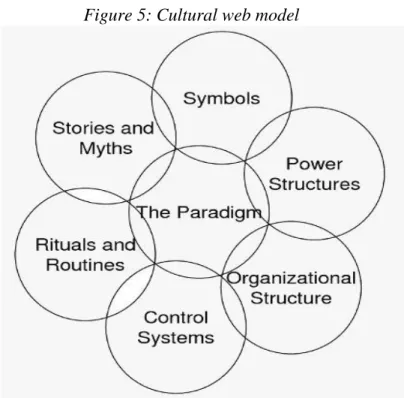
(Johnson, 2001) Designed a model known as the cultural web, he outlined the different components of organizational culture (figure 5).
19
Figure 5: Cultural web model
Source: Johnson, (2001).
The paradigm: Collection of shared assumptions and the organization consider those
assumptions.
Rituals and Routines: “The way we do in the organization,” including behaviours and
important values and consider those behaviours value for the organization.
Stories and myths: The organizations get wisdom from the past events, try to implement
in the organization for the newcomers.
Symbols: The symbolic elements of the organization, including organizational dress code
and titles.
Control Systems: System designed for the focused activities and to reward the employees
for correct performance and behaviour.
Organizational Structures: Usually cultural environment has an influence on
organizational formal structure.
Power structures: The powerful groups expected to be involved in determining the
paradigm. Those who hold power are also the main changeable targets (Rajeev & Wickramasinghe, 2009). (Johnson, 2001) Supporters culture mapping to measure the culture and can determine its efficiency and compatibility with strategy.
20 1.6.3 Knowledge Retention
It includes knowledge capturing within the organization you users can use it later. (James & Gerardo, 1991) Defined five knowledge repositories for knowledge retention as a culture, individuals, structure (formal and informal systems), external activities, transformations (formalized and procedural systems). In those knowledge repositories knowledge exit or retained in an organization. According to (Liebowitz, 2011), some people miss understanding knowledge retention as losing the important employee and use techniques like exist interviews to capture the applicant’s knowledge. Knowledge retention is the system to integrate the organizational process and start before the key employees are about to depart. This task considerably crucial to the long-term organizational success, only a few firms have the formal knowledge retention strategy. By knowledge retention, organizations keep their knowledge inside the organization for long-term success.
1.6.4 KM Core Competencies
This term was first defined by (Prahalad & Hamel, 1990) as '' The collective organizational intelligence, focused on how different skills and integrate streams of technology''. Then, this basic concept redefined in different ways, but KM core competencies subjects to the primary organizational expertise, are sources of sustainable competitive advantage for the organization. KM core competencies have large knowledge component; integrated with each other. And they work as corporate strategy product, with innovation management and KM. KM transforms the dynamic knowledge, innovation management into core products and profit. To understand the how KM, convert its core competencies into core products and profit. (Prahalad & Hamel, 1990) defined the overview, how core competencies manage with Knowledge:
1. Identifying core competencies: An Organization defines its fundamental skills, link
with the specific core products. Then, the assessment must take place, what the customer has and what they need to have to estimate the organizational strategy and competitive advantages.
2. Sustaining core competencies: All the core competencies like knowledge assets can
improve. On the other hand, lack of use of any core competency will lead lose it.
3. Building new core competencies: Creating new KM core competencies is an
interaction between practice, knowledge, refinement, and coordination. Assets must build, integrated, and improved in an organizational environment that supports testing and enhancement. Making new core competencies is not easy since a sustainable
21
competitive advantage in the result of knowledge assets are hard to reproduce (Dierickx, & Cool, 1989).
4. Unlearning core competencies: Some organization has problems to repeat the same
business process again and again for the long term. When some key skill of an organization no longer uses the organizational processes, it unlearns core competency.
1.6.5 Knowledge Management Systems
Any Information Technology System (hereinafter: ITS) that saves and retrieves knowledge, to improve collaboration, integration, captures and reuse knowledge, locate knowledge source, or in another form to improve the KM processes. (Robertson, 2007) Argues that the companies should not think in-terms of KMS, though enhanced by technology, it is not a technology discipline, and thinking in-terms of KMS leads to expectations of an organization. Therefore, the focus should be determining the functionality and the efficiency of the ITS that needed for the specific tasks, activities and initiatives within the firm.
(Rajeev & Wickramasinghe, 2009) defined the general category of KMS as : • Groupware & KM 2.0,
• Extranet and Intranet,
• Data warehousing and mining,
• Decision Support System (hereinafter: DSS), • Content Management System (hereinafter: CMS), • Document Management System (hereinafter: DMS), • Artificial Intelligence (hereinafter: AI),
• Simulation tools.
These categories by (Rajeev & Wickramasinghe, 2009) can cover most of the systems that normally associated with a KMS.
1.6.6 Knowledge Management Best Practices
According (Botha, Kourie, & Snyman, 2008) the KM best practices are:
Culture: The supportive environment of KM, and the processes it involves particularly
the knowledge sharing process.
• Infrastructure: Teams, supporting system, collaborations.
• Measures: Creating and design a process for change management inside the company.
22
• Technology: KM offers huge advantages in a few fields. If you use technology for
bad purposes it can destroy the process.
Best Practices in Tacit Knowledge Management
Knowledge Sharing: It's the essential process or task in KM because KM based on
sharing. It performs a critical role in both, creation and reuses. The tacit and explicit knowledge factors summarize the considerations except cultural issues are as follows: • Tacit Knowledge: It depends on socialization within informal network activities.
Particularly tacit knowledge is important in an informal network environment, based on codification without losing the data values (Paul & Blackwell, 2001).
• Explicit Knowledge: It is about the clarity of needs, access, understanding, and
guidance of knowledge, sharing the process, and source completeness (Bukowitz & Williams, 1999).
Knowledge Reuse: According to (Markus, 2001), contains three main roles, knowledge
creator, intermediary, and consumer, these roles are used in knowledge making, sorting, and reusing. Cost and culture are two important elements of knowledge reuse; normally they are related to tacit knowledge.
In 2001, (Markus, 2001) described the four knowledge reuse situations: • Shared work producers,
• Shared work practitioners, • Expert seeking novices,
• Miners of secondary knowledge.
Knowledge Creation: The creation of new knowledge depends on sharing, access, and
group involvement, to the required data and other information. (Cook & Brown, 1999) suggested that it is an interaction between what you know and what knowledge you have.
Knowledge Acquisition: According to (Paul & Blackwell, 2001), the organization tries
to obtain the knowledge from the external sources and these external sources are essential, therefore, you must take a comprehensive overview of the value chain. These sources are customers, suppliers, partners, and competitors.
23
2 SMALL AND MEDIUM ENTERPRISES AND ORGANIZATION
LEARNING
Recent research indicates that the SMEs need a new innovative knowledge and learning (OCED, 2010) (Appendix 2). In this section, I explained and discussed the relationship between SME and KM. The first part of this study is to explore the SMEs, their ongoing/current status, systematic approach to KM. In the further section to explain the OL in the knowledge-based system and how it works within the organizational structure and some practices which the organization is performing in the inter-organizational processes and at the end to overview some of the inter-organizational models.
2.1 Small and Medium Enterprises (SMEs)
In a company, positive norms and values are essential and important in achieving the organizational beliefs and values to create, share knowledge and use created knowledge for decision making (Alavi & Leidner, 2001). Quantitatively is defined that the independent business who managed by their owners or semi-owners have a small market share, but it is more important the SMEs are contributing in the economy and their competitive advantages to growing and success of a country (Bolton, 1971). According to the Organization for Economic Co-operation and Development (hereinafter: OCED), Paris SMEs growth productivity fueled by its competitive processes (OECD, 2002). The question is which is the best KM adoption approach in the organization, and for this question (Moffett, McAdam, & Parkinson, 2002) described that many organizations are not sure about the right KM adoption approach, there are few fundamental factors are very fundamental for the successful implementation and adoption of KM in any company. Another question comes, how to choose the key KM adoption factors that lead the organization to its success level and according to (Wong & Aspinwall, 2005), those factors which are fundamental to the organizational success called critical success factors (hereinafter: CSF) these CSFs address the importance of KM in SMEs. One of the early studies of CSF in the implementation of KM is carried out by (Skyrme & Amidon, 1997), they studied experiences and practices in leading companies using KM and identified seven key success factors. (Davenport & Beers, 1998) explored 24 organization and 31 different KM projects and identified eight success factors.
11 fundamental factors that can be basics for the implementation of KM in SMEe are Culture, IT, support & leadership, purpose and strategy, process & activities, organizational infrastructure, measurement, motivation, training & education, resources, and human resource management (hereinafter: HRM) (Wong, 2005). In 2005 (Wong & Aspinwall, 2005), conduction a survey focusing on SMEs and presented the quantifiable results. Their survey was in three sections, first was on the specification of SMEs, i.e.,
24
type of firm, size, and the to check KM practising level if they are using KM. The second part was of responses; the important was they gave the seven success factors to each organization. And the last part was to determine why some organizations and did not implement KM practices the actual reasons to not adopt the KMS.
11 important CSFs in the implementation of KM, defined as (Wong, 2005):
1. IT: KM depends on IT, it connects both, human and information. Effective database
technology, information storage, workflows, access, document management, all are essential parts of IT.
2. Management Support and leadership: Management must support the
implementation of KM in the organization, they must share knowledge and its sources also the management introduce/start the knowledge sharing trends so the employee can follow them and introduce knowledge sharing culture where people are more knowledgeable and informed.
3. Culture: Cultures is also an essential factor for successful KM implementation and
adoption. It contains values and norms that are practised in a company. A positive cultural environment encourages the knowledge creation and sharing for KM adoption for the organization to collaborate and invent.
4. Purpose and Strategy: A well defined and clear strategy is very important to for the
implementation of KM. Available recourses must show in the formation of an organizational strategy, and all employees must support and collaborate the vision.
5. Process and Activities: Important organizational processes should include the
knowledge creation, storage, retrieval, application, and share. KM processes should be structured.
6. Organizational Infrastructure: Need to assign specific people to the role and
responsibilities of KM implementation.
7. Measurement: All the activities in the organization must be measurable, and to
measure there must be a took to check the success of KM implementation, benefits, and effectiveness.
8. Motivation: Employees should be motivated to learn and create knowledge.
9. Training and Education: Employees must know how to use the knowledge also they
25 the company can perform and understand better.
10. Resouces: Successful implementation of KM depends on reliable resources including
financial and human resources.
11. Human Resource Management: You cannot ignore the importance of HRM, all the
value that KM implementation can get from only the existing HRM. All the employees must carefully select the right jobs, their knowledge and skill level should take into consideration. HRM needs to provide opportunities for the employees to grow and enhance their skills.
2.2 Systematic Approach to Learning
As an individual, the person can achieve his goals and improve skills and abilities through learning so that the organization can do the same. According to (Senge, 1990), the Organization Learning (hereinafter: OL) offers unlimited opportunities to create interactions and to use an advantage to improve the firm. Keeping in mind that to conclude the basis of a process in the organization is the ability to structurally organize and lead the OL process to organizational added values (James, 1991).
Why an organization needs a systematic approach:
To learn practices in the organization from the adopted unstructured learning among employees to organize all the OL processes. Planning department of a firm must consider the interaction created for sharing and re-use to enhance the organization and to get benefits from the firm. In an organization, many individuals are from different educational and experience backgrounds, needs, and interests so those individuals the systematic organizational approach can solve many big problems. Well functioned organizations are aware of the collective intelligence of its employees is more than the individual intelligence. Among the other factors, there is one main to get the successful organization is that each employee's gained knowledge; it leads the organization to improve performance and get all the benefits and advantages that the organization can achieve. By implementing this approach, the organization can achieve very crucial objects of success, personal interest, and performance (Guinn, 2017). The interaction creation between the employees within the organization can achieve differently by using different OL approaches with systematic actions to create off the winning situation for the organization and the for that employee who is part of it. Introduce learning process in the organizations to achieve the goals and objectives through a systematic learning approach. The idea of long-term learning comes as a base for the process to start; it is not just an idea to enhance business performance but a philosophy. Defined as support to educate processes, more participation and for economic growth (Field & Leicester, 2003).
26 2.3 Organizational Learning
In 1990 (Brown & Duguid, 1991) defined OL as ''a path between innovation and work'', he also defined two type as:
• Technical Organization Learning, • Social-Organizational Learning,
Technical Organizational Learning
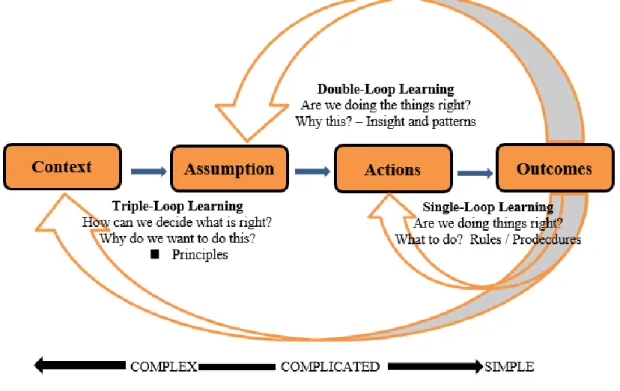
Technical view of the OL is explicit in interpretation, processing, and the response or feedback to the information. In 1978 (Argyris & Schön, 1978), defined the concept of this type of an OL. According to them, there are single-loop learning and double-loop learning processes in an organization. Single-loop OL, recognize and correct the errors in a way to introduce change in an organization. Double loop OL is the higher level of single loop OL; it involves the action to perform for the specific variables and also fundamental changes. In 1996 (Argyris & Schön, 1996) also analyzed the OL in tacit sources of impact.
Social-Organizational Learning
The social approach of the OL explores the explicit or tacit behaviours of people within the organization with their experiences and skills. Lave and Wenger are renowned researchers whoprovided few inputs on a concept called communities of practice, (Lave & Wenger, 1991) defined that the organizations are an example of communities of practice and the organization works as a team of people who worked on the same roles in different organizations. People from different organization and with different skills and experiences share information and experiences to learn from each other they improve there personal and professional skills. (Kolb, 1984) used the concept of active learning and feedback and he also gives some inputs in the social approach of OL.
Previous Research and the theory of OL stated that OL process must analyze the organizational strategy, goal, objectives, structure, or adoption. (Cyert & March, 1963) Defined that the OL is a complete function of better organizational communication and makes easy to adopt OL time within the firm. The Recent research took one step further to set a new foundational definition of OL. (Škerlavaj & Dimovski, 2007) Defined OL from a network perspective to conclude that it builds on many social network concept and theories to give an overview of learning processes in the organization on organization levels including group, individual and intra-organization. This network perspective suggests and recommends the combination of acquisition of knowledge and skills. Practising systematic learning approach in organizations brings the fresh knowledge for