Synergistic Effect of High Pressure Processing and Pediococcus acidilactici in inactivation of Listeria innocua in Ready-to-Eat sausages
by
MARGARITA KOLOMEYTSEVA
A REPORT
submitted in partial fulfilment of the requirements for the degree
EUROPEAN M.Sc
in
Food Science, Technology and Nutrition
ABSTRACT
Following consumers’ demand for safe and nutritious foods without chemical preservatives, food industries are looking for new preservation solutions. Among these, high pressure processing (HPP) and biopreservation are non-thermal technologies showing significant potential for effective food preservation without altering nutritional value and organoleptic properties of food. It has been shown that biopreservation using lactic acid bacteria (LAB) and/or their bacteriocins inhibit pathogens, but at present time there were no studies about the influence of HPP on the antimicrobial activity of LAB. The objectives of this study were to evaluate the effects of HPP on the antimicrobial activity of a bacteriocinogenic strain of LAB (Pediococcus acidilactici HA-6111-2) and its bacteriocin and to evaluate the effectiveness of HPP combined with P. acidilactici for inactivation of Listeria
innocua N27 (used as a surrogate for Listeria monocytogenes) in RTE sliced meat
sausages. Pediococcus acidilactici was exposed to pressures between 200 and 500 MPa at 25 °C for 5 min and subsequent freezing at -20 °C. A pressure of 200 MPa did not affect bacteriocin production, whereas 300 MPa caused a two times reduction in antimicrobial activity of P. acidilactici. Further increase of pressures (400 MPa and 500 MPa) reduced bacteriocin activity 4 to 8 times. High hydrostatic pressures and freezing postponed bacteriocin production. Bacteriocin production began 9 h earlier when the samples were not frozen. The antimicrobial activity of bacteriocins produced by P. acidilactici was reduced after pressurization. The synergistic effect of high hydrostatic pressure (300 MPa, 5 min, 25 °C) combined with P. acidilactici against L. innocua in ready to eat sliced meat sausages during storage at 4 °C for 60 days was assessed. Application of pressure and P. acidilactici resulted in 2 log inactivation of L. innocua. The food matrix had a protective effect on pressure inactivation of L. innocua. The results of this work clearly illustrate the potential of pressure combined with bacteriocinogenic cultures as an alternative for chemical preservation. Yet, synergistic effect of high pressure processing and P. acidilactici requires further investigation on more suitable foods.
ACKNOWLEDGMENTS
This study was partly supported by international fund grant from KAHO Sint-Lieven University. I would like to express my deepest gratitude to Professor Dr. Paula Cristina Maia Teixeira, for the opportunity to pursue my master thesis research in her laboratory, for her excellent scientific guidance throughout whole project, correction of my thesis and presentation. I would like to sincerely thank my major advisor and daily supervisor, Dr. Sonia Marilia de Almeida e Castro for invaluable guidance, for teaching me high pressure processing and giving me advises on food microbiology, correction of my thesis, encouragement and support throughout all the time of study, even on weekends and holidays. I am deeply grateful to Dr. Paul Anthony Gibbs for correction and proofreading of my thesis and his suggestions for my work. My sincere appreciation goes to Dr. Jorge Saraiva and Mr. Rui Queirós from the High Pressure Processing Laboratory in Aveiro University for help in conducting the pressurization treatment and to staff of the Center for Innovation and Technological Support in UCP for their help in my research. On a more personal note, I would like to thank all the researchers and students of the Professor Paula Teixeira laboratory for their friendship and support during my studies in Portugal. All my love to my family and friends for their unconditional love and support.
TABLE OF CONTENTS
INTRODUCTION ... 6
CHAPTER 1. LITERATURE REVIEW. EMERGING TECHNOLOGIES APPLIED TO READY-‐TO-‐EAT MEAT PRODUCTS: FOCUS ON Listeria monocytogenes INACTIVATION ... 8
1.1 HIGH PRESSURE PROCESSING ... 8
1.1.1 HPP AND LIPID OXIDATION ... 13
1.1.2 HPP AND SENSORY QUALITY ... 14
1.2 OTHER TECHNOLOGIES ... 15
1.2.1 IRRADIATION ... 15
1.2.2 PULSED LIGHT (PL) TREATMENT ... 17
1.3 COMPARISON OF HPP WITH OTHER INNOVATIVE TECHNOLOGIES ... 19
1.4 APPLICATIONS OF HPP AND CONSUMER ACCEPTANCE ... 21
1.5 CONCLUSION ... 22
CHAPTER 2. EXPOSURE TO HIGH HYDROSTATIC PRESSURE OF Pediococcus acidilactici AND PRODUCTION OF BACTERIOCINS ... 24
2.1 INTRODUCTION ... 24
2.2 MATERIALS AND METHODS ... 25
2.2.1 THE GROWTH CURVE AND BACTERIOCIN PRODUCTION DURING GROWTH ... 25
2.2.2 HIGH HYDROSTATIC PRESSURE TREATMENT ... 25
2.2.3 MICROORGANISMS ENUMERATION ... 26
2.2.4 PREPARATION OF PLATES OF TARGET ORGANISMS AND TITRATION ... 26
2.3 RESULTS AND DISCUSSION ... 27
2.3.1 DEFROSTED SAMPLES ... 27
Bacteriocin production -‐ No High Hydrostatic pressure (Control) ... 27
Bacteriocin production High Hydrostatic pressure vs Control ... 28
2.3.2 NON-‐FROZEN SAMPLES ... 33
300 MPa-‐treated samples ... 33
Non-‐pressurised samples ... 34
Bacteriocin supernatants samples ... 35
2.4 CONCLUSION ... 36
CHAPTER 3. EXPOSURE OF Listeria innocua AND Pediococcus acidilactici TO SUB-‐ LETHAL TREATMENTS ... 37
3.1 INTRODUCTION ... 37
3.2 MATERIALS AND METHODS ... 37
3.2.1 BACTERIAL STRAINS ... 37
3.2.2 EXPOSURE TO SUB-‐LETHAL TEMPERATURE, PH AND BILE SALT STRESS ... 38
3.3 RESULTS AND DISCUSSION ... 38
TREATMENTS OF L. innocua ... 38
TREATMENTS OF P. acidilactici ... 40
3.4 CONCLUSION………41
CHAPTER 4. SYNERGISTIC EFFECT OF HIGH PRESSURE PROCESSING AND Pediococcus acidilactici INACTIVATION OF Listeria innocua IN READY-‐TO-‐EAT SAUSAGES ... 42
4.1 INTRODUCTION ... 42
4.2 MATERIALS AND METHODS ... 42
4.2.1 PRODUCT CHARACTERIZATION ... 42
4.2.2 BACTERIAL STRAIN AND INOCULUM PREPARATION ... 43
4.2.3 SLICING, PACKAGING AND INOCULATION ... 43
4.2.4 HIGH HYDROSTATIC PRESSURE TREATMENT ... 44
4.2.6 MICROORGANISMS ENUMERATION ... 45
4.3 RESULTS AND DISCUSSION ... 45
4.3.1 CONTROL SAMPLES ... 45
4.3.2. WITH HIGH HYDROSTATIC PRESSURE ... 49
4.4 CONCLUSION ... 53
CHAPTER 5. GENERAL CONCLUSION ... 54
REFERENCES ... 56
INTRODUCTION
Globalization has brought lifestyle changes to most countries and as a consequence, global changes in eating behaviours are happening daily. Increasing health concerns throughout the world have ushered in a new awareness in consumers about chemical additives used for food preservation and the detrimental effects of high temperature processing on the nutritional value of foods. To assure customers, as well as succeed in a competitive market, food industries try to adapt to these changes and develop convenient minimally processed food products. As a result, ready-to-eat (RTE) foods have evolved from a niche market to a key sector, especially cooked meat products, such as sliced delicatessen meats, which have increased their market share due to the rise of their popularity and concerns regarding nutrition. There are several food safety issues associated with RTE meat products, in particular the risk of contamination with
Listeria monocytogenes, which can occur during slicing (Vorst et al., 2006) and
packaging (Hierro et al., 2011) related to cutting, handling and mechanical equipment. Food safety has become a predominant issue in the food industry. However, the well-known, accepted and studied traditional food safety preservation methods such as chilling, freezing and thermal processing, no longer fully meet consumers’ expectations and the needs of a modern food industry. For instance, in spite of maintaining food at a certain level of freshness, chilling and freezing only slow down or inhibit enzymic activity and growth of microorganisms without completely destroying them. On the other hand, heat treatments can inactivate both microorganisms and enzymes providing safer food products with an extended shelf life, but at the same time decreasing their organoleptic properties and nutritional values. Following consumers’ demands for fresh-like and highly nutritious food products with supreme organoleptic quality and an acceptable shelf life, it is vital to employ innovative technologies, some related with cold pasteurization. Among these technologies, high hydrostatic pressure, pulsed light, irradiation, and biopreservation can be included. When combined with each other or with traditional technologies, as hurdle technologies, they have already demonstrated preservative potential with regard to effective antimicrobial protection. The ability to inactivate undesirable microorganisms without significantly altering organoleptic properties and nutritional values of food, as well as having no harmful impact on the environment, are the main features which highlight these novel technologies and motivates their application.
Sometimes they can be used together with traditional preservation methods or as a substitute for them. Several research projects have investigated possible applications for different products. The main objective of this thesis was to study the synergistic effect of high-pressure processing (HPP) and a bacteriocinogenic strain of lactic acid bacteria, Pediococcus acidilactici HA-6111-2, in the inactivation of Listeria innocua N27 in food systems, such as ready-to-eat (RTE) sliced meat products. This work assessed impact of pressurization on P. acidilactici, its function to produce bacteriocins and their stability after HPP application. An overview of HPP and other innovative food preservation technologies, their effect on the quality parameters as well as application in the food industry and consumer acceptance is discussed in Chapter 1. A review on hurdle preservation methods focused on L. monocytogenes inactivation in meat products is also presented. Preliminary studies identifying the ability of P. acidilactici HA-6111-2 to produce bacteriocins after being subjected at pressures 200 – 500 MPa and the impact of HPP on the antimicrobial activity were done in Chapter 2. The anti-listerial activity of bacteriocins exposed to HPP and subsequent freezing was also assessed. Afterwards, the experimental work focused on application of the pressure treatment of 300 MPa together with bacteriocinogenic strain P. acidilactici HA-6111-2 as a possible alternative to chemical preservatives was presented in Chapter 4. Finally, Chapter 5 gives general conclusion drawn from the previous chapters with the suggestions of future work.
CHAPTER 1
LITERATURE REVIEW. EMERGING TECHNOLOGIES APPLIED TO READY-TO-EAT MEAT PRODUCTS: FOCUS ON Listeria monocytogenes
INACTIVATION
Chapter 1 gives an updated overview of emerging and innovative technologies available for food industrial applications, mainly in RTE meat products, including the mechanisms of their action, providing information and some details about their advantages and drawbacks.
1.1 High pressure processing
Though it has been in existence since the end of the nineteenth century, and often referred to as an emerging technology, high pressure processing (HPP) is a relatively new technology since it has only been applied in the food industry during the last few decades (Rendueles et al., 2011). Back in 1899, Hite discovered that milk subjected to pressure of 600 MPa for an hour and stored at room temperature had four days shelf-life extension. A decade later, new opportunities, regarding fruits and vegetables preservation were observed (Hite et al., 1914). But it took almost a century for HPP technology to become commercialized, when in 1990, manufacture of high-pressurized jams and jellies was launched in Japan. Starting from that period, mechanisms of microbial and enzyme inactivation as well as food changes were thoroughly researched for mechanisms of microbial and enzyme inactivation, food changes after pressure application, and so forth. Today, having major consumer acceptance (Baron et al., 1999; Butz et al., 2003; Olsen et al., 2010; Sorenson et al., 2011), HPP is industrially applied all over the world for preservation and food safety assurance in several food products, which include RTE whole muscle and sliced meats, fruits and vegetables, juices and smoothies, deli salads, dips and salsas, dairy products and seafood. In addition, HPP is successful in shellfish shucking and meat retrieval.
High hydrostatic pressure is often applied to pre-packaged food, with pressure ranges of 100 to 900 MPa. To conduct HPP, a strong mechanical cylindrical chamber and high-pressure pumps are needed. After pre-packaging, the food is placed in the cylinder containing a liquid with low-compressibility, for example water or oil, which can be then filtered and reused in the following pressure cycles. During the process applied pressure is isostatic i.e. uniform application simultaneously in all directions
according to Le Chatellier’s principle and Pascal’s law (Aymerich et al., 2008). Pressure holding time may vary from 3 to 10 minutes, followed by a decompression time after which the treated product can be released. HPP is usually accompanied by adiabatic heating with the approximate temperature increase of 3 °C per 100 MPa (Rendueles et al., 2011) depending on the food matrix composition. To ensure food safety of the final product, pressure, temperature and the holding time can be controlled and recorded for each processing cycle. HPP is predominantly applied as a batch process though for products compressed without containers and afterwards aseptically packaged semi-continues systems have been developed. Approximate performance of batch HPP system is 5–6 cycles per hour (Campus, 2010). HPP equipment is commercially available from several companies throughout the world, e.g. Hiperbaric (Spain and USA), Stansted Fluid Power Ltd (UK) and Avure Technologies Inc. (USA). HPP results in microorganisms’ reduction or complete inactivation extending the shelf life of the RTE and other food products. HPP does not affect vitamins and flavor molecules, preserving sensory properties and nutritional value of food.
The primary effect of HPP depends on applied pressure and holding time. During HPP covalent bonds remain not affected; consequently primary structures of large molecules are minimally disturbed. Pressurization stabilizes formation of hydrogen bonds and enhances breaking of ions leading to a volume decrease (Norton & Sun, 2008). Altering secondary, tertiary and quaternary structures of proteins, HPP disrupts cell structures and inactivates enzymes (Campus, 2010). Cell death of L.
monocytogenes and other microorganisms, e.g. Salmonella enterica, Yersinia enterocolitica, Campylobacter jejuni, Escherichia coli etc., under HPP seems to be
provoked by multiple or accrued impairments in the cell (Garriga et al., 2004; Jofre ́ et al., 2009). The effect of HPP was studied using electron microscopy by Ritz et al. (2002) who observed that after 400 MPa applied during 10 min, the previously smooth cell surface of L. monocytogenes had bud scars and their number was proportional to applied pressure, which shows that HPP targets the cellular wall and membrane. Later, Marcos et al., (2008) reported that HPP impairs cytoplasmic membrane and cell wall function. Consequent to the membrane damage caused by applied pressure, modifications in cell transport systems and cell permeability take place. It seems that the cell wall disconnects from the membrane, proteins denature,
and changes occur in enzyme-mediated replication and transcription processes (Hugas et al., 2002; Aymerich et al., 2008; Rivalain et al., 2010). Denaturation of proteins occurs at pressures 300-400 MPa (Lullien-Pellerina & Balny, 2002; Jay et al., 2005). The cell finally dies when cellular ability to repair is lost due to accumulated pressure damage.
Eukaryotic cells are usually more pressure-sensitive than prokaryotes (Rendueles et al., 2011). Gram-positive microorganisms were observed to be less sensitive to HPP than Gram-negatives because of the difference in cell membrane structure and chemical composition. Spores from bacteria, molds and yeasts are more resistant to pressure than their vegetative cells (Aymerich et al., 2008; Norton & Sun, 2008). Pressures ranging from 450 MPa to more than 1000 MPa are required to destroy spores (Jay et al., 2005).
Being a highly suitable environment for the growth of food-borne pathogens due to the high amount of nutrients available, meat requires the application of effective preservation technologies. Use of HPP has been shown in several studies, to reduce the levels of pathogenic microorganisms in RTE meats, including those capable of growing under refrigerated temperatures and surviving freezing and surface dehydration, e.g. L. monocytogenes (Garriga et al., 2004; Hereu et al., 2012; Muñoz-Cuevas et al., 2013; Myers et al., 2013; Vaudagna et al., 2012; Wilson et al., 2008). Being unique among pathogenic microorganisms, having the ability to grow at refrigerated temperatures and being widespread in many environments, L.
monocytogenes is a major concern for RTE meats, consumed without cooking.
Several studies showing that HPP is efficacious for eliminating L. monocytogenes, are summarized in Table 1. As shown in Table 1, pressure treatments of 600 MPa, and even lower, have been used in order to be industrially acceptable in terms of operational costs and available equipment. Pressure resistance of L. monocytogenes and other pathogens is affected by several factors, such as water activity (aw), growth phase of the microorganism, growth temperature, fat content, and application of bacteriocins. Low aw serves as a protection from pressure for microorganisms. An increase in aw of the growth media results in a decrease in bacterial resistance to HPP.
Table 1. HPP studies on L. monocytogenes and L. innocuainactivation in RTE meat products.
Product Conditions Results Reference
Cooked ham 400 MPa/10 min/17 ºC 1.9 log reduction L. monocytogenes (42 days)
Aymerich et al., 2005
Cooked pork ham 100-400 MPa/5-15 min Samples were inoculated with L. monocytogenes and after HPP had shelf life extension up to 56 days
Fonberg-Broczek et al., 2005 Dry cured ham 600 MPa /6 min/16 ºC Absence of L. monocytogenes during
storage period (120 days)
Garriga et al., 2004
Sliced cooked ham 600MPa/5 min/10 ºC Reduction of L. monocytogenes to levels below 10 CFU/g.
Jofre et al., 2008 Dry-cured ham 600 MPa/5 min/15 ºC 3.5 log inactivation of L. monocytogenes Hereu et al., 2012 Sliced cooked ham 500 MPa/10 min/25 ºC 5 log inactivation of L. monocytogenes Koseki et al., 2007
Dry-‐cured fermented ham neck and striploin
400-600 MPa/1.5-20
min More than 5 log reduction of L. innocua at 600 MPa/20 min without organoleptic changes
Krepelkova & Sovjak, 2011
Turkey breast and ham
600 MPa/3 min/17 ºC 3.85-4.35 log reduction in L. monocytogenes; during storage remained below detection limit during 154 days
Myers et al., 2013
Salami 600 MPa or 483 MPa/1-12 min
Reduction of L. monocytogenes numbers by an additional 1.6 to ≥5.0 log CFU/g compared to their levels after
fermentation and drying; during 28 d of storage at 4 °C, L. monocytogenes levels decreased by up to an additional 3.0 log CFU/g
Porto-Fett et al., 2010
Sliced beef cured ham
500 MPa/5 min/18 ºC Reduction of L. monocytogenes 2 log after 210 days (6 °C)
Rubio et al., 2007
Cooked poultry 450 MPa / 1.5 min; 700MPa /15 min
450 MPa (15 min) resulted in reduction of 6 log CFU/ml of L. monocytogenes; 1.5 min at 700 MPa resulted in reduction of 2 log CFU/ml
Youart et al., 2010
The cells in the exponential phase are more pressure sensitive than cells in the stationary phase. Increase in baroresistance of the stationary phase cells could be explained by the synthesis of more stress proteins. The cross-relation between growth phase of the microorganism, temperature and pressure sensitivity is reported in several articles (Casadei et al., 2002; Juck et al., 2012; McClements et al., 2001) with
L. monocytogenes stationary phase cells grown at 35 °C and
43 °C
being the most resistant (Hayman et al., 2007). Furthermore, Shearer et al. (2010) reported approximately a 6 log difference between treated 400 MPa L. monocytogenes grownat 43 °C and grown in the range of 10 to 25 °C. Increased growth temperature results in an increase of L. monocytogenes pressure resistance, which appears to be the outcome of variances in the composition of cell membrane. On the contrary, decreased growth temperature reduces membrane flexibility resulting in increased sensitivity to HPP (Hayman et al., 2007). Food composition may affect survival of microorganisms, because some food products can serve as a rich medium to pressure-stressed bacterial cells providing required amino acids and vitamins. Presence of carbohydrates and minerals was shown to help bacterial survival by cell membrane stabilization and its protein functions (Black et al., 2007; Considine et al., 2008). Fat content also appears to serve as a protection for pathogenic cells during HPP. It was observed in the study of Hereu et al. (2012) that HPP applied on dry-cured ham with higher aw, lower sodium chloride (NaCl) and fat concentrations caused significantly greater reduction of L. monocytogenes when compared to ham with lower aw, higher NaCl concentration and fat amounts. Pressure resistance varies among different strains of the same pathogen, for instance L. monocytogenes strain CA has higher
baroresistance than strain ScottA and strain SLR1 (Alpas et al., 1999).
Bacteriocins work synergistically with HPP inactivating pathogens and increasing their death rate (Gálvez et al., 2007). Surviving pressure, cells of the pathogenic bacteria become injured and can be easily inhibited by bacteriocins (Liu et al., 2012). This synergistic action is the basis of the hurdle concept, which implies simultaneous or sequential use of several treatments to achieve product preservation and prolonged shelf life. These treatments include induced changes in aw, pH, temperature and the addition of bacteriocins (Jay et al., 2005). Studies related to hurdle technology applied to meat products are reviewed in Table 2. As can be observed, combinations between HPP and bacteriocins have been applied successfully, indicating valuable potential for industrial application. However, process parameters should be established for every food matrix prior to industrial use for food safety and shelf life extension. The hurdle concept, related to HPP, requires further investigation.
Table 2. Hurdle preservation studies on L. monocytogenes inactivation in meat products.
Product Conditions Results Reference
Sliced cooked ham
HPP: 400 MPa/10 min/17 ºC Enterocin: 2560 AU/g
Shelf life extension to above 90 days
Product Conditions Results Reference Dry-cured ham HPP: 600 MPa/5 min/15 ºC
Nisin: 200 AU/cm2
Increased inactivation of L.
monocytogenes Hereu et al., 2012
Cooked ham HPP: 400 MPa/10 min/17 °C
1.4% potassium lactate and 0.1% sodium diacetate Enterocin: 2400 AU/g
HPP+lactate–diacetate: reduced the levels of L. monocytogenes during storage at 1 ºC by 2.7 log CFU/g;
HPP+enterocin: inactivation of L. monocytogenes to 4 MPN/g after three months of storage at 1 ºC Marcos et al., 2008 Canned Vienna sausages HPP: 500 MPa/1 min
Lactobacillus casei cell extract: 100 colicin-equivalent activity units (CEAU)/g
>5 log reduction in the viability of L. monocytogenes
Chung
& Yousef, 2010
1.1.1 HPP and lipid oxidation
Quality of meat products is highly dependent on levels of lipid oxidation. It plays an important role in flavour of meat products. Lipid oxidation however, can be responsible for the formation of undesirable flavours, such as warmed over flavour and rancidity (Ma & Ledward, 2013). HPP is reported to accelerate lipid oxidation and the formation of lipid-derived volatiles in some meat products (Fuentes et al., 2010). Lipid oxidation in pressurized meat products seems to be linked with membrane damage (Orlien et al., 2000). Most of the studies on lipid oxidation induced by HPP have been completed using thiobarbituric acid reactive substances (TBARS). Influence of HPP on lipid oxidation is directly proportional to applied pressure levels (Cava et al., 2009). Pressures between 300 and 400 MPa seem to be critical for inducing catalysis of lipid oxidation (Andrés et al., 2004). Campus et al. (2008) found almost no effect of HPP on oxidative stability of the dry-cured loins, only on the first day the non-pressurized samples showed higher TBARS values than samples subjected to 300-400 MPa pressure. However, studies on dry-cured Iberian ham pressurized at 400 MPa, showed a detrimental effect of pressure on oxidation of lipids during chilled storage (Andrés et al., 2006). De Alba et al. (2012) also detected higher oxidation levels in dry-cured hams pressurized for 5 min at 400, 500 and 600 MPa, after 30 and 60 days refrigerated storage in comparison to non-pressurized samples. The results of the study of Clariana & García-Regueiro (2011) demonstrate that while pressurization at 600 MPa does not stimulate cholesterol oxidation in
dry-cured ham, significantly higher levels of pressure, such as 900 MPa, may increase cholesterol oxidation. Use of antioxidants, application of lower pressures, oxygen removal and carbon dioxide addition are preventive measures to reduce or prevent lipid oxidation during HPP (Weiss et al., 2010).
1.1.2 HPP and sensory quality
Apart from evident advantages for food safety protection, HPP plays a beneficial role on the sensory characteristics of food. Denaturation, aggregation, or gelatinization of meat proteins during HPP, can result in tenderization or toughening of meats. The changes depend on the temperature, pressure and length of treatment (Sun & Holley, 2010). In the study of Mor-Mur & Yuste (2003) a sensory panel preferred sausages treated at 500 MPa than heat-treated samples, because they had better appearance, more pleasant taste, and a more succulent, consistent texture. HPP improves juiciness, springiness, and chewiness of meat. The flavour of the treated food is almost not affected during HPP, because hydrostatic pressures used are non-thermal and there is no breakage of covalent bonds. Campus et al. (2008) reported a reduction of several flavour compounds of dry cured loin caused by pressurization, specifically those originating from Maillard reactions, although they were redeveloped during storage. When applied to fresh meat, HPP caused several transformations, such as colour loss and texture changes. Changes in meat pigments and muscle structure alter the colour properties of foods treated with pressures (Fuentes et al., 2010). Possible reduction of actin and myosin solubility by HPP influences meat structure. Furthermore, HPP causes oxidation of muscle proteins that has an important influence on colour change. While HPP brings on severe changes in the colour of fresh meat, RTE meat products do not become seriously affected. Serra et al. (2007) reported no significant effect on sensory properties of dry-cured ham samples pressurized at 600 MPa, although a reduction in crumbliness and increase in fibrousness was also observed in the texture of dry-cured hams. HPP-induced changes in lightness were noticed in dry-cured ham subjected to 400 MPa, in the study of de Alba et al. (2012), but these modifications were less compared to those induced by refrigerated storage. Though pressurized RTE meat products are reported to have lighter colour than before HPP (Campus et al., 2008), intensity of colour change depends on the myoglobin and water content of the meat. Colour properties of RTE meat products with low water content do not become significantly affected by HPP (Ferrini et al., 2012). Meat becomes gel-like in texture,
but the intensity of transformations depends directly on the pressure level used; therefore to minimize these changes, it is better to use milder pressures in combinations with hurdle technologies. For instance, colour stability of meat can be enhanced by sodium carbonate addition and increased pH (Bajovic et al., 2012). Fulladosa et al. (2012) reported a decrease in adhesiveness and an increase of brightness and saltiness of hams pressurized at less than 600 MPa. Alterations in the cellular structure could be partly responsible for the increase in saltiness perception. The accessibility of Na+ ions increases as stimulated by HPP diffusion to the surface of dry-cured ham of water molecules linked to proteins takes place (Clariana et al., 2012). Influence of HPP on saltiness could be advantageous for application on RTE processed meats with reduced salt content.
Globally, based on several studies focused on the antimicrobial protection benefits of HPP of RTE meat products, it has been shown that this non-thermal technology is able to exhibit specific effects to eliminate or reduce the growth of microorganisms, without affecting sensory and nutritional characteristics of food. However, more research is needed before foods subjected to HPP can be equated to thermally processed products in relation to their safety and shelf life (Jay et al., 2005).
1.2 Other technologies
As previously mentioned, apart from HPP there are other novel technologies, such as irradiation and pulsed light (PL) that have been researched extensively.
1.2.1 Irradiation
Though irradiation still needs to overcome problems of consumer acceptance, it has already been approved in many countries and widely applied in the food industry, especially in the USA, for instance for poultry and red meats. Discovered at the end of nineteenth century with the first patents on use of this technology for killing bacteria in foods issued in the USA and UK in 1905, the irradiation applied in the food industry involves exposing the product to ionising radiation in order to achieve its decontamination. The techniques of ionising irradiation include those created by commercial electron accelerators e-beam radiation; produced by fast-moving electrons impinging on a metal object, X-ray processing; and made by radionuclides, a source of gamma ray irradiation treatment (Aymerich et al., 2008).
Flow of high-energy electrons is used in e-beam irradiation with penetration power of just around 5 cm. Cabeza et al. (2007) reported shelf-life doubled and microbiological safety achievement by treating vacuum packed RTE cooked ham with e-beam irradiation. In these experiments, doses of 1 kGy and 2.5 kGy were used; the lower dose allowed conformability with the required EU safety levels for L. monocytogenes (A Food Safety Objective = 102 CFU/g at the time of consumption) without significant sensory changes and higher dose allowed attainment of the USDA criterion, which is L. monocytogenes zero tolerance in 25g.
Deeper product irradiation can be achieved using x-ray or gamma irradiation. Produced by using atomic waste products and by-products of atomic fission as a source, radiation by gamma rays is the cheapest method of food irradiation (Jay et al., 2005). Gamma irradiation can be used even for bulk foods due to its higher penetration power with gamma rays from cobalt 60 or cesium 137 (Zhu et al., 2005). Throughout the irradiation process, the high levels of energy associated cause radiolysis, i.e., breakdown of components vital for cell growth, and integrity of chemical bonds in molecules, which lead to inactivation or even death of the microorganisms. The chromosome is the main site of damage in cells. Caused by hydroxyl radicals single-strand and double-strand breaks in DNA molecule are the results of hydrogen removal from deoxyribose and molecule cleavage by beta-elimination of phosphate (Adams & Moss, 2003). Pathogens in seafood, fruits and vegetables, meat and RTE meat products, can be inactivated by ionizing radiation (Sommers & Boyd, 2006). Radiation resistance of L. monocytogenes in RTE meat products has been determined in USDA’s Eastern Regional Research Center. The dose of ionising radiation needed to eliminate 5 log10 (more than 99.99 per cent) of L.
monocytogenes from ham, frankfurters, bologna, and deli turkey varied from 2.45 to
3.75 kGy. The effective dose depends on type and product formulation (Sommers et al., 2004).
Having a powerful bactericidal action, UV light is the most effective wavelength in the ‘visible’ spectrum. This radiation is non-ionizing. Being strongly absorbed by nucleic acids and proteins, UV light leads to photochemical changes resulting in production of lethal mutations during action on cellular nucleic acids. The outcome of such produced mutations is the death of bacteria. Advantages of UV light include effective food preservation with less influence on nutritional and sensory properties of
food compared to thermal preservation. This technology was shown to be effective against pathogenic bacteria and could be used as a substitute to the chemical sterilisation of food. For example, in RTE ham, 8000 J/m2 UV-C irradiation reduced populations of L. monocytogenes by 2.74 log CFU/g in comparison to the non-treated samples (Chun et al., 2009). Despite significant advantages, application of this technology is limited only to food surfaces, because of poor penetrative capacity of UV light (Jay et al.,2005).
Ability of the microorganism to repair the damages caused, determines its resistance to irradiation. Similar to HPP, Gram-positive bacteria show more resistance to irradiation than Gram-negative. Non-spore forming bacteria are more sensitive to radiation than spore formers (Adams & Moss, 2003). Food irradiation is now permitted in more than 50 countries. However, specific labelling is required for irradiation treated food. Doses of irradiation and food authorised for irradiation treatment vary from country to country (Directive 1999/2/EC; Directive 1999/3/EC).
1.2.2 Pulsed Light (PL) treatment
Food processing by PL is a promising novel technology, which is still not used in food manufacturing. Being 90,000 times more intense than sunlight, short length flashes of an intense broad-spectrum light radiation are applied to products (Ganan et al., 2013). Energy dose is the principal factor determining the inactivation effectiveness of PL applied on the product. Important parameters that should be carefully considered and adjusted for obtaining maximum effectiveness of PL treatment without significant alteration of products, are composition of the emitted light spectrum, the number of lamps, thickness of the treated sample, its colour, opacity, viscosity, the distance from the light source, and flow conditions for liquid products (Pataro et al., 2011). Existing literature on PL food applications is relatively limited, predominantly allocating PL technology for decontamination and maintenance of physical and nutritional quality of solid and semisolid food products such as vegetables (Izquier & Gómez-López, 2011), mushrooms (Ramos-Villarroel et al., 2012), fruits (Charles et al., 2013), dairy products (Miller et al., 2012), infant foods (Choi et al., 2010), seafood (Cheigh et al., 2013) and RTE meat products (Wambura & Verghese, 2011).
foods may be treated with a selected wavelength or the full spectrum. Filtering the light pulses through glass or liquid filters eliminates production of undesirable products by specific wavelengths in PL-treated food.Photochemical reactions caused by UV-rich light and photothermal changes caused by visual and infrared lights can be produced in food by intense light pulses (Ramos-Villarroel et al., 2012). Distinct effects of the broad-spectrum of the flash and high peak power are responsible for PL action and mediated through absorption by highly conjugated carbon-to-carbon double-bond structures in proteins and nucleic acids. Targeting nucleic acids, PL causes microbial inactivation by chemical modifications and DNA cleavage. Simultaneously with nucleic acids destruction, PL affects proteins, membranes, and other cellular material. Shorter wavelengths of UV range of 200-320 nm appear to have a more effective antimicrobial action than the longer wavelengths, because of their higher energy levels (Gomez-Lopez et al., 2007). Photochemical irreversible impairment of DNA together with damage to proteins and organelles induced by the UV-C component, seemed to be responsible for PL antimicrobial action. Produced by individual wavelengths, destruction of cellular components is amplified by the high energy and intensity of PL.
There are controversies in the literature on whether or not the PL technique is capable of causing complete inactivation of microorganisms. The first opinion is that PL cannot cause inactivation of pathogens internalized in produce tissues, due to the fact that food components absorb light, and therefore opaque solid foods could only be disinfected superficially because of light absorbance at the product surface (Gomez-Lopez et al., 2007). Disinfection below the surface will be much reduced according to the thickness and opacity of the product, meaning that there will be no complete assurance of microbial safety of treated food. Another opinion is that though affecting mainly the surface level of the treated food item, PL technology is still applicable for RTE meat products, because it is their surface that undergoes post-production contamination (Ganan et al., 2013). Superior input of energy and reduced time of exposure in contrast to continuous UV systems, characterizes PL technology (Takeshita et al., 2003). Allowing more energy input and decreasing the exposure time in contrast to continuous UV systems, PL technology has stimulated interest in terms of effectiveness of its application against pathogenic microorganisms. The sensitivity of pathogens towards PL application was demonstrated in a variety of
foods including RTE meat products. For instance, Hierro et al. (2011) provided evidence of L. monocytogenes reduction of 1.78 log CFU/cm2 by PL treatment of 8.4 J/cm2 in RTE cooked ham. Similar effects were observed by Ganan et al. (2013) on dry cured meat slices when 11.9 J/cm2 were applied. Sensory properties of experimental products had not been changed after treatment. Based on the above results and ease of PL integration at the processing lines, this technology could be a simple and cost-effective alternative to increase the safety of these products. PL technology has the potential to reduce or eliminate the use of chemical preservatives and disinfectants. It can be applied to simultaneously prolong shelf life and to improve the quality of the product. However, prior to commercial application to foods, the effect of PL should be assessed on target matrices, because some of its properties, e.g. transparency and topography, may affect the efficacy of this technology (Ganan et al., 2013). Table 3 summarizes the results of irradiation and PL treatment applied to various RTE meat products.
Table 3. Irradiation and PL studies on L. monocytogenes in RTE meat products
Product Conditions Results Reference
Ham E-beam irradiation Shelf-life doubled (from 20 to 40 days). Dose of 1 kGy meets the safety levels FSO = 102 CFU for
L. monocytogenes
Cabeza et al., 2007
Ham 8000 J/m2 UV-C
irradiation
2.74 log CFU/g reduction of L. monocytogenes of Chun et al., 2009 Ham PL treatment of 8.4 J/cm2 1.78 log CFU/cm2 L. monocytogenes reduction Hierro et al., 2011 Dry cured salchichón and loin PL treatment of 11.9 J/cm2 1.81 log CFU/cm 2 L. monocytogenes reduction Ganan et al., 2013 Frankfurters and bologna 1.5 kGy ionizing irradiation; 0.125% sodium diacetate solution >9 log10 units L. monocytogenes reduction
Sommers & Fan, 2003
1.3 Comparison of HPP with other innovative technologies
In assessing the benefits from application of HPP and irradiation technologies, there are several similar features between them. Both of the treatments can be used to
produce minimally processed pre-packed food products using the cold pasteurization concept and be applied to raw food. Moreover, these technologies showed an effective inactivation of food-borne pathogens, including L. monocytogenes, E. coli O157:H7, and Salmonella, and an extended shelf life. However, irradiation technology has several disadvantages, which are generally not applicable for HPP. First, irradiation can have an undesirable sensory impact on the treated food; it can affect colour, flavour and texture (Huang et al., 1997). The irradiated meat products were described having sensory properties of rotten egg, barbecued corn, cooked meat, burnt, metallic, sulphur, acetic acid, alcohol, liver-like, and bloody. To limit these negative properties it is necessary to select cautiously the irradiation doses to attain a sufficient level of microbial inactivation and to produce only minor sensory changes preventing consumer rejection of the irradiated meat product (Benedito et al., 2011). Some of these irradiation side effects can be partially eliminated by irradiating food under anaerobic conditions and at sub-freezing temperatures with the addition of free-radical scavengers in order to reduce off-flavours and off-odours (Jay et al., 2005). Secondly, and together with the inactivation of harmful microorganisms, irradiation disrupts the total chemical composition of food constituents. Not existing naturally in food, “radiolytic products’’ can be produced during irradiation. There is no evidence proving their safety. One of the “radiolytic products’’ 2-dodecylcyclobutanone, can cause genetic and cellular damage in human cells and promote the development of cancers and cause genetic damage in rats (Arvanitoyannis, 2010). Despite the fact that use of irradiation technology has already been permitted in many countries, research in this area is still needed in terms of identifying “radiolytic products’’ produced in food during its treatment and their long-term influence on human health. For example, in the study of Zhu et al. (2004), the odour and flavour of RTE turkey breast rolls were notably influenced by irradiation, as well as the formation of benzene and toluene which are both harmful for human health, raising concerns about the chemical safety of irradiated RTE meat products. Methods for preventing negative changes in the quality of irradiated RTE meats are essential.
The advantages of PL technology are quite analogous to HPP, and include absence of harmful chemicals, residual compounds and fast decontamination. However, the limiting factors of PL technology, such as product heating from light absorption or lamp heating and possible food safety concerns listed above, other issues may
determine food industry choice of HPP technology in favour of PL.
1.4 Applications of HPP and consumer acceptance
HPP is the post packaging treatment that uses pressures instead of high temperatures to achieve inactivation of foodborne pathogens and spoilage microorganisms in various products. Being environmentally friendly and a waste-free technology, HPP is a non-thermal pasteurization process used for safety enhancement, shelf life extension, and improvement of the nutritional value of food (Campus, 2010). The main targets for HPP application instead of thermal treatment, are food products which are not suitable for thermal treatments, such as raw and RTE meats, seafood, fresh fruit and vegetable beverages, and deli salads. HPP has already been approved by the U.S Department of Agriculture/Food Safety Inspection Service as an acceptable method for elimination of L. monocytogenes in processed meat products (USDA, Food Safety Inspection Service, 2006). The seafood industry effectively uses HPP as a shucking process of shellfish including mussels, oysters, crabs, clams, scallops, and lobsters. Applied high pressures denature the adductor muscle, which enables easy opening of the shellfish shell. Application of HPP offers significant economical advantages for the seafood industry such as increased microbiological safety of shellfish, elimination of physical injuries, labour cost reduction, higher yield and product quality (Torres & Velazquez, 2005). The cost of HPP application varies from 4–10 cents/lb including costs of operation and depreciation. Production of pressurized products currently costs from 3 to 10 cents per pound more than thermally processed food (Sàiz et al., 2008). Growing demand for HPP technology and increasing food industry application will allow further reduction of capital and operational costs. Consumers are often sceptical and conservative towards new technologies and changes, especially concerning their diet even if the novel technologies offer some advantages. However, according to results of TRD Frameworks research company which led a study (2000) on reaction of consumers in Seattle on HPP, consumers accepted the use of HPP. In this study, 500 primary USA shoppers had been interviewed to find out their opinion on pressure treated products. More than 70% of study participants gave HPP a rating between 6-7 on a 1-7 scale, presenting the significant acceptance of this technology. The main benefits of HPP reported by the USA consumers are assurance of product safety whilst maintaining the original quality. A study by Hicks et al. (2009) indicated that HPP technology was
recognised by less than 10% of 1204 adults who participated in the survey in the USA. When the method of HPP and advantages that it offers were explained to survey participants, almost 40% were willing to pay an extra cost ($0.25 to $0.50) for the pressurized food products. Another study made by using computer-assisted personal interviews (Butz et al., 2003) with 3000 European consumers, found that nearly 70% of the respondents accepted HPP. Results of these interviews showed that consumers are ready to buy HPP processed food if it has advantages compared to non– pressurized products. It appears that consumers appreciate the benefits that food products manufactured by means of HPP, have to offer when the information is provided (Nielsen et al., 2009).
1.5 Conclusion
High hydrostatic pressurization is a novel technology with a great potential to become an effective alternative to thermal treatments. The main feature which differentiates the use of HPP from other technologies, is manufacturing of value-added food products with an extended shelf life by inactivation of microorganisms and enzymes at low temperatures, without changes in organoleptic and nutritional properties and without the use of preservatives and additives. Applications of HPP expanded from Japan and the USA reaching international markets and attracting food producers. This technology has already been successfully used for a variety of products in several countries. Although applications of HPP are quite limited and it cannot be used for all food products, this technology has its niche. Application of HPP has been effective to ensure microbiological safety and prolong the shelf life of RTE meat products including sliced and diced cooked meat and dry cured meats, which are favourable environments for growth of pathogenic microorganisms. HPP successfully inactivates pathogens, such as L. monocytogenes which can be a problem for RTE meat products companies. This technology impairs the cytoplasmic membrane of the microorganism, cell wall function, cell transport and permeability. Together with control of L. monocytogenes in RTE meat products, HPP can effect protein denaturation, aggregation, and gelation; it can change meat colour, juiciness and chewiness; tenderize or toughen the meat depending on the applied pressure, meat protein system, and temperature. Hurdle technologies such as application of high pressure with bacteriocins could be effective to ensure microbiological safety of RTE meat products. For the current time, it is an area, which requires further research and
experiments combining application of bacteriocins extracted from various lactic acid bacteria and HPP. Besides HPP, irradiation and PL are promising novel technologies, however, they have some significant disadvantages in comparison to HPP. Nevertheless, these technologies can also have their niche in the food sector where their application is most relevant. Although this paper is reviewing application of HPP on RTE meat products for L. monocytogenes inactivation, this technology has also been used in other types of food such as fruits, vegetables, seafood and dairy. In conclusion, HPP is a very useful technology of the present and future, but it seems to be unfamiliar to consumers. Further work is required for marketing of pressurized products to provide consumers with clear information about the treatments, its purposes and gained benefits.
CHAPTER 2
EXPOSURE TO HIGH HYDROSTATIC PRESSURE OF Pediococcus
acidilactici AND PRODUCTION OF BACTERIOCINS
2.1 Introduction
Bacteriocins are bacterial ribosomally synthesised peptides, which have antimicrobial activity. Synthesised by bacteria, bacteriocins have diverse structures and activity spectrum. Most research is focused on the bacteriocins produced by LAB, because these bacteria are naturally present in many foods and are considered to be safe for consumption. Bacteriocins are divided into four main classes as they differ in composition and physicochemical characteristics. The most studied and widely used bacteriocin is nisin. It belongs to class I lantibiotics, which contain post-translationally modified peptides with thioether-based intra-molecular rings of lanthionine and b-methyl-lanthionine. Class II bacteriocins includes heat stable non- modified peptides, which do not contain lanthionine rings. This class of bacteriocins has certain importance for food preservation as pediocin-like bacteriocins show anti-listerial activity. Class III bacteriocins includes large and heat-labile proteins. Class IV bacteriocins are complex peptides characterized by a peptide bond between the C- and N-terminus. Having cationic and hydrophobic nature, bacteriocins can act as membrane permeabilizers. Pore formation results in the dissipation of the proton motive force causing cell death. Several methods are used for bacteriocins application. They include in situ production by starter or protective cultures, use fermentate of a bacteriocinogenic strain as an ingredient and use an additive (Garcıa et al., 2010).
Various studies show that bacteriocins inhibit pathogens, but at present time there were no studies found about the influence of pressure on the level of bacteriocins production. The aim of this study was to identify if P. acidilactici was able to produce bacteriocins after being subjected to pressures of 200 to 500 MPa and if the level of antimicrobial activity was affected by the level of applied pressure. The second question addressed in this work was to what extent antimicrobial activity of already extracted bacteriocins in the form of cell-free supernatant of P. acidilactici adjusted to pH 6 and heated at 80 ºC would be reduced by pressurization. This work also aimed to find out if freezing of P. acidilactici inoculum had an effect on bacteriocins production. The results of this study were further used for the main research of the present thesis to identify the level of pressure to apply on RTE meats in order for
pressurized P. acidilactici to maintain antimicrobial activity and be able to inactivate
L. innocua, used as a surrogate for L. monocytogenes. 2.2 Materials and Methods
2.2.1 The growth curve and bacteriocin production during growth
The objective was to compare growth and bacteriocin production by P. acidilactici cells pressurized at different pressure levels ranging from 200 to 500 MPa with non-pressurized cells. First, samples of P. acidilactici were subjected to pressure, afterwards all samples were put in the freezer with the exception of samples pressurized at 300 MPa, half of which were frozen and half were used to perform growth curve on the day of pressurization in order to compare bacteriocin production of non-frozen and defrosted P. acidilactici. For non-pressurized (control) samples the same procedure was used.
Cultures of P. acidilactici HA-6111-2were grown for 24 h in MRS broth at 37 °C, centrifuged (7000 × g, 10 min, 4 °C) and used for pressurization. The supernatant was retained and adjusted to pH 6 with sterile NaOH 1 M as this pH was shown to be suitable for bacteriocin stability (Altuntas et al., 2010); afterwards it was heated at 80 ºC for 10 min to inactivate cells not removed by centrifugation and subjected to HHP. For growth curves cultures, P. acidilactici were grown from cells that had previously been pressure treated and compared with controls. Two millilitres of P. acidilactici cultures (controls and pressurized) were inoculated into 200 ml MRS broth (Difco) and incubated at 37 °C. Growth was monitored by plate counts (CFU/ml), optical density (OD) and pH. Changes in OD (at 600 nm using a spectrophotometer, Shimadzu UV-1800) and pH were determined hourly for 24 h. Viable counts (CFU/ml) and bacteriocin activities were determined every 3 h. Bacteriocin activity was calculated, according to Van Reenen et al. (1998) as described in section 2.2.4. Results were compared on the growth curves.
2.2.2 High hydrostatic pressure treatment
High hydrostatic pressure treatments of P. acidilactici and supernatants containing bacteriocin were performed in U33 high-pressure apparatus (Unipress Equipment Division, Institute of High Pressure Physics, Warsaw, Poland). Water with propylene glycol was used as the pressure-transmitting medium. An experimental design was
and bacteriocin supernatants in Eppendorf tubes were subjected to 200, 300, 400 and 500 MPa with an end temperature of 25 °C, for 5 min. Decompression occurred within 2-3 s.
2.2.3 Microorganisms enumeration
Pressurized samples of P. acidilactici containing bacteriocins, and non-pressurized control samples (1 ml), were transferred to 9 ml of sterile quarter strength Ringer’s solution (Lab M) and homogenized with a vortex. From this dilution, subsequent dilutions were made. Depending on the sample type, aliquots of 0.02 ml were placed on the surface of MRS agar plates using the drop method. The plates were incubated at 37 °C and colonies enumerated after 48 h of incubation.
2.2.4 Preparation of plates of target organisms and titration
Listeria innocua was the target microorganism. It was grown for 24 h at 37 ºC in
TSBYE broth. The resulting culture was diluted (100 µl of the culture in 9.9 ml of Ringer’s solution). 1% soft agar TSAYE was prepared and held at 60 ºC. 1 ml of the target culture was added to the Petri dishes, and then approximately 10 ml of the soft agar at ± 45 ºC were added and homogenized. After solidification, 10 µl of the supernatants extracted from pressurized and non-pressurized P. acidilactici cultures were tested on prepared plates and incubated at 37 ºC.
Titration: in order to determine bacteriocin activity (AU/ml), phosphate buffer (pH 6.5) was used as a diluent in microplates for pressurized and non-pressurized bacteriocin supernatants (Van Reenen et al., 1998) as shown in the figure 1.
Phosphate buffer pH 6.5 was prepared by adding 68.5 ml solution A to 31.5 ml solution B; adjusting volume aseptically to 200 ml with sterile water.
50 µl buffer 50 µl buffer 50 µl buffer 50 µl buffer 50 µl buffer 50 µl buffer 50 µl buffer 100 µl supernatant 50 µl 50 µl 50 µl 50 µl 50 µl 50 µl 50 µl 50 µl buffer 50 µl buffer 50 µl buffer 50 µl buffer 50 µl buffer 50 µl buffer 50 µl buffer 100 µl supernatant 50 µl 50 µl 50 µl 50 µl 50 µl 50 µl 50 µl 50 µl 50 µl 50 µl 50 µl 50 µl 50 µl 50 µl
Solution A: 27.2 g/l KH2PO4 (0.2 M); Autoclaved Solution B: 34.8 g/l K2HPO4 (0.2 M); Autoclaved After dilutions were made, 10 µl of each
was tested on the target organism (L.
innocua) prepared in 1% soft agar plates,
and incubated at temperature 37 ºC.
Every 3 h of all growth curves prepared as described above cell-free supernatant was tested on prepared carpets of L.
innocua, as shown on Fig. 2.
The results were calculated using the following formula where antimicrobial activity is expressed as arbitrary units (AU) per ml. One AU is defined as the reciprocal of the highest dilution showing a clear zone of growth inhibition.
n – dilution factor
2.3 Results and discussion 2.3.1 Defrosted samples
Bacteriocin production No High Hydrostatic pressure (Control)
For cells not subjected to HHP, but which were previously stored in the freezer at -20
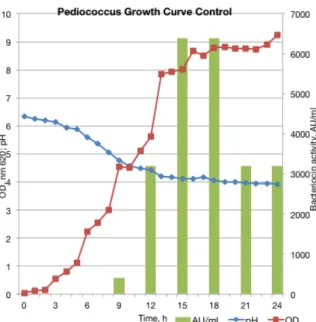
°C for 2 days and defrosted before inoculation, Fig. 3 shows the level of bacteriocin production and pH and OD alterations during growth. Maximal activity of bacteriocin against L. innocua (6400 AU/ml) was recorded after 15 and 18 h of growth in MRS broth when pH value was 4.1. These results correspond to findings of Albano et al. (2007), who observed maximum bacteriocin activity at 18 h of P. acidilactici growth. Bacteriocin activity was detected after 9 h at pH 4.8, the culture pH decreased from 6.3 to 3.9 and the cell density increased from 0.05 to 9.3 (Fig.3).
AU/ml = 2 n x 100
Fig. 3. Growth and bacteriocin production of non-pressurized P. acidilactici (control) after freezing
Bacteriocin production High Hydrostatic pressure vs Control
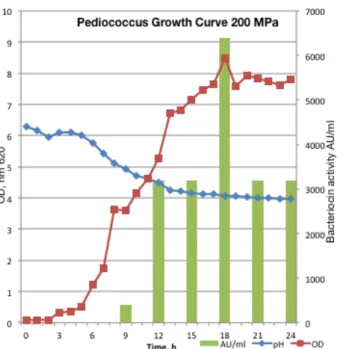
The level of bacteriocin production at all performed pressures and control samples is compared in Fig. 4. As can be seen from the figure, the results show little difference in antimicrobial activity between control and 200 MPa samples; exception was maximum bacteriocin activity that was detected after 15 h in the control and after 18 h in treated cells. A higher cell density was achieved after 24 h in control sample (9.3; Fig. 3) than in pressure treated cells (7.8; Fig. 5).
Fig. 4. Activity of bacteriocins produced by P. acidilactici, after pressurization and subsequently exposed to freezing
Bacteriocin production of cultures from cells that had previously been pressure treated decreased with the increase in applied pressure. At pressure 300 MPa (Fig. 6) antimicrobial activity of P. acidilactici was only ca. 50% of that compared to controls and 200 MPa. This decrease matched the reduction of cell density, which, for example, at 12 h was 3.6 (300 MPa; Fig. 6) and 5.6/5.3 (control/200 MPa; Figs. 3 and 5). It is interesting that samples compared above had similar levels of pH and CFU/ml. Production of bacteriocins was therefore postponed with increase of pressure.
Figure 4 demonstrates that antimicrobial activity of control and 200 MPa treated samples was recorded after 9 h of growth. Antimicrobial activity was detected only after 12 h and 15 h of growth, respectively for samples subjected to 300 MPa and 400 or to 500 MPa. Pressurization at 400 MPa resulted in four times reduction of antimicrobial activity at 15-18 h compared to 300 MPa. Further pressure increase by 100 MPa causes additional four times reduction of levels AU/ml at 18 h, double decrease at 15 and 21 h and difference in time of production start. So, pressurization above 200 MPa caused antimicrobial activity reduction and time of bacteriocins detection.
These results indicate that protein synthesis is probably affected by HPP. After experiencing physical stress, such as high pressure, cells need time to recover and it leads to postpone of detection time, as observed in 400-500 MPa samples. At 24 h, recovered from 300-500 MPa pressure stress P. acidilactici show identical antimicrobial activity (1600 AU/ml). The recovery of cells from induced by HPP damage can be observed through changes in cell density.
The findings show that time of maximal antimicrobial activity of P. acidilactici varies
at different pressures. Subjected to 200 MPa and 300 MPa samples have the highest level of bacteriocin production at 18 h, but 400 MPa and 500 MPa show maximal activity at 21-24 h. This also can be explained by the fact that the more pressure is applied on P. acidilactici, the more time it takes to fully recover and demonstrate
Fig. 5. Growth and bacteriocin production by P. acidilactici after 200 MPa pressurization and subsequently exposed to freezing
Fig. 5 shows the growth of P. acidilactici after being exposed to 200 MPa. Similar to defrosted control samples, pressure treated samples production of bacteriocin was recorded only after 9 h of growth at 37 °C (OD 3.6, pH 4.9), rapidly increasing from 400 AU/ml to 6400 AU/ml during the following 9 h of growth at 37 °C and then declining to 3200 AU/ml at 21-24 h. The cell density of pressurized P. acidilactici increased from 0.09 to 3.6 during 9 h. The pH decreased from 6.3 to 4.9, over the same period of time.
Fig.6. Growth and bacteriocin production by P. acidilactici after 300 MPa pressurization and subsequently exposed to freezing
Fig. 6 shows the curves of P. acidilactici growth after exposure to 300 MPa. The cell density increased from 0.1 to 6.1 during 24 h of growth at 37 °C. The pH decreased from 6.6 to 3.8, over the same period. The production of bacteriocin began three hours later in comparison with 200 MPa-treated samples starting from 1600 AU/ml at 12 h (OD 3.6, pH 4.4) and reaching a maximum at 3200 AU/ml at 18 h (OD 6.4, pH 3.9). Antimicrobial activity of P. acidilactici after 400 MPa (Fig.7) is considerably lower than after 300 MPa, however, OD and pH (Figs. 6 and 7) values are similar.
Fig.7. Growth and bacteriocin production by P. acidilactici after 400 MPa pressurization and subsequently exposed to freezing
Fig. 7 shows the curves of P. acidilactici bacterial growth in 400 MPa pressure-treated samples. The cell density of cultures of P. acidilactici subjected to pressure increased from 0.3 to 6.4 during 24 h of growth at 37 °C. The pH decreased from 6.6 to around 4.0, over the same period. Similar to cells treated at 300 MPa cells exposed to 400 MPa started producing bacteriocins only after 12 h of growth at 37 °C (OD 2.37, pH 5.0), gradually increasing from 200 AU/ml to 1600 AU/ml during the following 12 h. The highest bacteriocin production (1600 AU/ml) was recorded after 21-24 h of incubation of pressurized cells (Fig. 7). The sudden increase in activity of bacteriocins from 800 AU/ml to 1600 AU/ml occurred without pH change (4.0). As previously reported by Albano et al. (2007), but in non-pressurised P. acidilactici, bacteriocin production is not correlated with changes in culture pH, so pH change could not be responsible for a sudden release of bacteriocins; metabolism of remaining nutrients or medium components not vital for growth of the cell could be responsible for the activity proliferation.
Fig.8. Growth and bacteriocin production by P. acidilactici after 500 MPa pressurization and subsequently exposed to freezing
In cells treated at 500 MPa, bacteriocin production of P. acidilactici was recorded only after 15 h from the beginning of the fermentation process at OD 0.3 (pH 6.0). During the first five hours cell density, near zero, did not increase, signifying that this HPP level considerably damaged cells. The highest bacteriocin production (1600 AU/ml) was recorded at 24 h growth period with cell density 6.03. The pH of the culture decreased from 6.3 at the start of growth period to approximately 4.3 at the end of 24 h. During the first 15 h of growth, the pH was relatively stable with just a slight decrease to 6.1. The following decrease of pH during the following 9 h is the period of production of bacteriocins (Fig. 8).
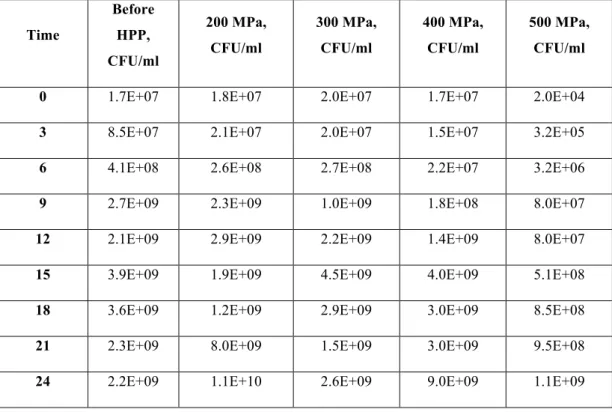
The data from enumeration of pressurized and non-pressurized samples suggest that levels of viable counts CFU/ml of P. acidilactici do not affect the level of antimicrobial activity. As can be seen from Table 1, before pressurization and at pressures ranged 200-400 MPa, P. acidilactici has similar CFU/ml levels. However, application of higher pressure (500 MPa) results in about 3-log decrease of P.
Table 1. Growth of P. acidilactici (CFU/ml) after being exposed to different pressure levels Time Before HPP, CFU/ml 200 MPa, CFU/ml 300 MPa, CFU/ml 400 MPa, CFU/ml 500 MPa, CFU/ml
0 1.7E+07 1.8E+07 2.0E+07 1.7E+07 2.0E+04
3 8.5E+07 2.1E+07 2.0E+07 1.5E+07 3.2E+05
6 4.1E+08 2.6E+08 2.7E+08 2.2E+07 3.2E+06
9 2.7E+09 2.3E+09 1.0E+09 1.8E+08 8.0E+07
12 2.1E+09 2.9E+09 2.2E+09 1.4E+09 8.0E+07
15 3.9E+09 1.9E+09 4.5E+09 4.0E+09 5.1E+08
18 3.6E+09 1.2E+09 2.9E+09 3.0E+09 8.5E+08
21 2.3E+09 8.0E+09 1.5E+09 3.0E+09 9.5E+08
24 2.2E+09 1.1E+10 2.6E+09 9.0E+09 1.1E+09
2.3.2 Non-frozen samples
300 MPa-treated samples
In order to observe how freezing has a possible influence on antimicrobial activity of P. acidilactici, the 24 h growth curves of control and pressurized cells at 300 MPa
were performed.
Fig.9. Bacteriocin activity (AU/ml) of P. acidilactici exposed to 300 MPa non-frozen (NF) and after freezing (F)