FRANCESCO GIACOMI 2019
INTERNSHIP REPORT AT
EVANGELISTI Y CIA:
THE RELATIONSHIP BETWEEN
MASTER / APPRENTICE.
2019
FRANCESCO
GIACOMI
INTERNSHIP REPORT AT
EVANGELISTI Y CIA:
THE RELATIONSHIP BETWEEN
MASTER / APPRENTICE.
Relatório de Estágio apresentado ao IADE – Universidade Europeia, para cumprimento dos requisitos necessários à obtenção do grau de Mestre em Design e Cultura Visual, realizado sob a orientação científica do Doutor Fernando Martins, Professor Auxiliar do IADE – Universidade Europeia.
A voi, che siete sempre stati al mio fianco in questi anni, mando la mia riconoscenza. Al nuovo arrivato Giovi, sole della famiglia. Al mio caro babbo e alla sua presenza silenziosa. Alla mia dolce mamma e alla sua inesauribile energia. Al mio prezioso fratello per avermi guardato crescere con una mano sulla spalla.
A Cati per la sua dolcezza. Ai nonni.
A voi amici, situazionisti, compagni di mille battaglie. Vasily, Giorgio, Teo, Gabu, Lollo, Vincio, B-Rocco, Andri F., Tommi, Tallo, Passarini, Bamba, Abel, Ama, Michi, Paolino, Dado, Giammi. Euso e Manu.
agradecimentos Aos meus colegas e amigos da Agência Nacho, Mari Cármen e Santiago, pelo acompanhamento, ajuda, orientação, amizade ao longo da minha estadia na Agencia.
Sem vocês e o espírito de equipa todo o percurso teria sido mais difícil de superar.
Aos meus amigos Carlo, Roberto, Antonio e Stefano por ter sido companheiros insuperáveis.
palavras-chave
resumo
Design; branding; creativity, identidade; mestre; aprendiz.
Este relatório surge na sequência do estágio realizado na Agência Evangelisti y Cia, em Alicante – Espanha, para a obtenção do grau de mestre na especialização de Design e Cultura Visual.
Este relatório apresenta a descrição dos projetos desenvolvidos durante o período de estágio na agência, que permitiu consolidar e aprofundar os conhecimentos e as competências adquiridas na Licenciatura em Arquitetura no Politécnico de Milão e, posteriormente, no Mestrado em Design e Cultura Visual no IADE – Universidade Europeia.
A oportunidade de realizar projetos reais em colaboração com uma equipa experiente foi ótima, tendo permitido desenvolver muitas capacidades praticas e profissionais e uma boa preparação para o desenvolvimento de novos projetos.
Este estagio tocou diferentes áreas do Design, desde o Design Editorial ao Design de Identidade. Começou com a realização do projeto Cola e terminou com projeto ENSO 19, contribuindo desta forma para o desenvolvimento das capacidades criativas e responsabilidade na tomada de decisões rápidas, para cumprimentos dos prazos previstos.
Keywords
abstract
Design; branding; creativity, identity; master; apprendice.
This report follows the internship held at the Evangelisti y Cia agency in Alicante – Spain to obtain the Master degree in the specialization of Design and Visual Culture. This report represents the description of the projects developed during the period of work in the agency, which allowed the consolidation and deepening of the knowledge and competences acquired in the architecture degree in the Polytechnic of Milan, followed by the master’s degree in Design and Visual Culture at IADE – Universidade Europeia.
The opportunity to carry out real projects in collaboration with an experienced team was excellent, allowing for the development of many practical and professional skills, and it was a good preparation for the development of new projects.
This internship touched on different areas of Design, from Editorial Design to Identity Design. It began with the realization of the Cola project and ended with the ENSO 19 project, thus contributing to the development of creative capacities and areas of responsibility for making fast decisions and meet deadlines.
INDEX
Index of figures XV 1. What is Design? . . . 3
1.1 Creative Nature 1.2 Design Knowledge 1.3 The relationship between
the Master and the Apprentice 1.4 Artisan in History
1.5 Role of Learning
1.6 The importance of the Message 1.7 Conclusion
2. Introduction . . . 17 2.1 Internship choice at Evangelisti y Cia
2.2 Report’s Structure
3. The Internship . . . 21 3.1 Scope of the internship
3.2 Where 3.3 Duration 3.4 Tutor 3.5 Scientific Orientation 3.6 Learning Goals 3.7 Weekly Goals 4. The Agency. . . 27 4.1 Mission and Vision
4.2 Influence in Education 4.3 Agency’s History 4.4 Organization and team 4.5 Agency in the market 4.6 Clients
4.7 Working methodology 4.8 Integration in the agency
Project #1 - Cola’s Label. . . 41 1. Development and first proposal
2. Briefing change and second proposal 3. Last proposal
4. Conclusion
Project #2 - Scout shield / El Campello. . . 50 1. Analysis
2. Proposal 3. Conclusion
Project #3 – Catalog photos / Molar. . . .56 1. Analysis 2. Conclusion Project #4 - SAYAKO. . . 66 1. Studio SAYAKO 2. Competition study 3. Reference 4. Proposal 5. Final proposals 6. Conclusion
Project #5 – Piel de Mariposa. . . .102 1. Reference search 2. Proposal 3. Conclusion Project #6 – ENSO 2019. . . . 108 1. Reference search 2. Proposal 3. Conclusion Final conclusion . . . 118 Bibliography and Sitography. . . 120
LIST OF FIGURES
PAGE CHAPTER 1
Fig 1: Supreme’s Logotype
Source: https://logo-logos.com/supreme-logo-162.html
3
Fig 2: Cubo, Bruno Munari, 1957, Danese.
Source: https://www.danesemilano.com/it/productDetails?idProduct=52
5
Fig 3: Sunday Sketches by Christoph Niemann
Source: https://www.christophniemann.com/detail/sunday-sketches-2/
8 Fig 4: Table of differences between artisanal workshop’s model and classical model. ( Orsi,2015 )
CHAPTER 4
11
Fig 5: Evangelisti y Cia’s Logotype
Source: https://www.evangelistiycia.com/
27
Fig 6: Pepe Mendoza - Casa Agricola’s Logotype
Source: https://www.evangelistiycia.com/pepe-mendoza/
28
Fig 7: Pepe Mendoza - Casa Agricola’s Label
Source: https://www.evangelistiycia.com/pepe-mendoza/
28
Fig 8: David Carson’s works
Source: https://www.google.com/search?q=david+carson+work&source=lnms&tbm=isch&sa=X&ved =0ahUKEwi4ouub-5PjAhVSalAKHUXrDIYQ_AUIECgB&biw=1280&bih=572#imgrc=3HN7OlNqdd6A_M: https://www.google.com/search?q=david+carson+work&source=lnms&tbm=isch&sa=X&ved =0ahUKEwi4ouub-5PjAhVSalAKHUXrDIYQ_AUIECgB&biw=1280&bih=572#imgrc=NLtcyBIzOCtDaM: 29
Fig 9: Massimo Vignelli’s works
Source: https://www.google.com/search?q=massimo+vignelli+work&tbm=isch&source=lnt&tbs=isz:l &sa=X&ved=0ahUKEwj0nsHj_ZPjAhVJyhoKHe4jClIQpwUIIg&biw=1280&bih=572&dpr= 2#imgdii=O3cTcbUPiskWwM:&imgrc=404nvXX7nZMtmM: https://www.google.com/search?q=massimo+vignelli+work&tbm=isch&source=lnt&tbs=isz:l &sa=X&ved=0ahUKEwj0nsHj_ZPjAhVJyhoKHe4jClIQpwUIIg&biw=1280&bih=572&dpr= 2#imgrc=-61LbwuydW_PHM: 30
Fig 10: Mateo Cambra’s Label
Source: http://www.nachoevangelisti.com/portfolio/diseno-labelling-mateo-cambra/
31
Fig 11: Organization Chart 32
Fig 12: Nacho Evangelisti y Cia’s Methodology work CHAPTER 5 – PROJECT #1
34
Fig 13: Cola’s bottle 42
Fig 14: Label prototype 1 43
Fig 15: Label prototype 2
Fig 16: Label prototype 3 Fig 17: Label prototype 4
Fig 18: Label prototype 5 44
Fig 19: Label prototype 6 Fig 20: Label prototype 7 Fig 21: Label prototype 8
Fig 22: Label prototype 9 45
Fig 23: Label prototype 10
Fig 24: Label prototype 11 46
Fig 25: Label prototype 12 Fig 26: Label prototype 13 Fig 27: Label prototype 14
Fig 28: Label prototype 15 47
Fig 29: Label prototype 16 47
Fig 30: Label prototype 17 48
Fig 31: Label prototype 18 Fig 32: Label prototype 19 Fig 33: Label prototype 20
Fig 36: Proposal 3 52
Fig 37: Digitized proposal 1 53
Fig 38: Digitized proposal 2 Fig 39: Digitized proposal 3 Fig 40: Digitized proposal 4 Fig 41: Scout Shield’s Final Art CHAPTER 5 – PROJECT #3 55
Fig 42: Photography Lab 56
Fig 43: Photography’ Final Art 1 57
Fig 44: Photography’ Final Art 2 58
Fig 45: Photography’ Final Art 3 59
Fig 46: Photography’ Final Art 4 60
Fig 47: Photography’ Final Art 5 61
Fig 48: Photography’ Final Art 6 62
Fig 49: Photography’ Final Art 7 63
Fig 50: Photography’ Final Art 8 CHAPTER 5 – PROJECT #
4
64Fig 51: SAYAKO’s old logotype 66
Fig 52: SAYAKO’s old mock up 67
Fig 53: Dior’s Logotype Source: https://www.google.com/search?q=dior+logotype&tbm=isch&source=lnt&tbs=isz:l&sa=X&ved=0ahUKEwid spWThZvjAhVGUcAKHRLuAYUQpwUIIg&biw=1280&bih=619&dpr=2#imgrc=OdqN_Io8XRViDM:
68
Fig 54: Dior’s Product - Dior Prestige Source: https://www.google.com/search?biw=1280&bih=619&tbs=isz%3Al&tbm=isch&sa=1&ei=A9MdXYOrKNC W8gKuk4qYDg&q=Dior+Prestige&oq=Dior+Prestige&gs_l=img.3..0j0i30l9.31028.31028..31573...0.0..0.178.1 78.0j1...0....2j1..gws-wiz-img.uFYWaHSt_A0#imgrc=Itj0flg3db_6LM: Fig 55: Dior’s Product - Dior Prestige & Diorific Source: https://www.google.com/search?biw=1280&bih=619&tbs=isz%3Al&tbm=isch&sa=1&ei=A9MdXYOrK NCW8gKuk4qYDg&q=Dior+Prestige&oq=Dior+Prestige&gs_l=img.3..0j0i30l9.31028.31028..31573...0.0..0
.178.178.0j1...0....2j1..gws-wiz-img.uFYWaHSt_A0#imgrc=_eruPaOsqVgYIM: 69
https://www.google.com/search?biw=1280&bih=619&tbs=isz%3Al&tbm=isch&sa=1&ei=xNUdXd-XLNTrgAb_rKsw&q=dior+diorific+mat&oq=Dior+diori&gs_l=img.3.0.35i39j0i19l7j0i5i30i19l2.6911.7454. .9197...0.0..2.499.1595.0j1j1j2j1...0....1..gws-wiz-img...0j0i30.9lFMWnF_vJs#imgrc=s6yPSfbEOM_z7M: Fig 56: Lancome’s Logotype
Source: https://www.google.com/search?biw=1280&bih=619&tbs=isz%3Al&tbm=isch&sa=1&ei=0N UdXbvTMLyFhbIP08mm0A8&q=Lancome%E2%80%99s+Logotype+&oq=Lancome%E2%8 0%99s+Logotype+&gs_l=img.3...114354.114354..114989...0.0..0.80.80.1...0....2j1..gws-wiz-img.yfDvsk4xWXw#imgrc=6dBD3_vptSblwM: 70
Fig 57: Lancome’s Product - Roses Berberanza Source:
https://www.google.com/search?biw=1280&bih=619&tbs=isz%3Al&tbm=isch&sa=1&ei=RtYdXaa3AoidgQb
s64_IDg&q=Lancome+-+Roses+Berberanza&oq=Lancome+- +Roses+Berberanza&gs_l=img.3..0i30.106128.108009..108389...0.0..0.237.666.1j2j1...0....2j1..gws-wiz-img.g31K2yHiNaE#imgrc=hbwEKGyThXtpfM:
Fig 58: Lancome’s Product - Absolue l’Extrait, Absolue Precious cells & Energie French Lift Source: https://www.google.com/search?biw=1280&bih=619&tbs=isz%3Al&tbm=isch&sa=1&ei=s9YdXdDhMp KJlwTvgLmAAw&q=Lancome+-+Absolue+l%E2%80%99Extrait&oq=Lancome+- +Absolue+l%E2%80%99Extrait&gs_l=img.3...57706.57706..57901...0.0..0.0.0...0....2j1..gws-wiz-img.MhBZ1bhS1gM#imgrc=d2PnIji8kHo5hM: https://www.google.com/search?biw=1280&bih=619&tbs=isz%3Al&tbm=isch&sa=1&ei=79YdXZCaG4 yWlwSFrY64Ag&q=Lancome+-+Absolue+Precious+cells+&oq=Lancome+- +Absolue+Precious+cells+&gs_l=img.3..0i30l8j0i8i30l2.56465.56465..56989...0.0..0.381.381.3-1...0....2j1..gws-wiz-img.arOixlgO9HY#imgrc=VIcwLUsoaoBEAM: https://www.google.com/search?biw=1280&bih=619&tbs=isz%3Al&tbm=isch&sa=1&ei=KtcdXYXuCoi ua_adndgH&q=Lancome+-+Energie+French+Lift.&oq=Lancome+- +Energie+French+Lift.&gs_l=img.3...73805.73805..74296...0.0..0.290.290.2-1...0....2j1..gws-wiz-img.oUaHUlu0-TE#imgrc=q064u3Hkp-3E_M: 71
Fig 59: Narciso Rodriguez’s Logotype Source: https://www.google.com/search?biw=1280&bih=619&tbs=isz%3Al&tbm=isch&sa=1&ei=dtcdXc24LOq clwTh367QAQ&q=Narciso+Rodriguez%E2%80%99s+Logotype&oq=Narciso+Rodriguez%E2%80%99s +Logotype&gs_l=img.3...98282.98282..98510...0.0..0.83.83.1...0....2j1..gws-wiz-img.n-CcxfgP2Nc#imgrc=S8P_n3I4gUNGJM: 72
Fig 60: Narciso Rodriguez’s Product - Eau de Parfum
Fig 61: Narciso Rodriguez’s Prodcut - Eau de Parfum, Eau de Toilette & Drawing Source: https://www.google.it/search?hl=it&q=narciso+rodriguez+narciso+edp&tbm=isch&tbs=simg:CAQSkw EJpxyvOiQWZ9AahwELEKjU2AQaAAwLELCMpwgaYgpgCAMSKI8SixL5BecFkgGsB-oFjBL-Bf8F1iCGIM0gzSG1KO027TGfKLYo7jYaMGEEoILtIK6u4Y7J4OP_125plhMKdN8GYqa0bgZdAkpC agYjE953RD1KDNBHo2NgF6iAEDAsQjq7-CBoKCggIARIES9UqjAw&sa=X&ved=0ahUKEwjL5Lvmi5vjAhUNalAKHdKGD7IQwg4IKygA&biw= 1280&bih=619#imgrc=cEaXbrKkDNxYUM: https://www.google.it/search?q=narciso+rodriguez+Eau+de+Toilette&hl=it&tbm=isch&tba s=0&source=lnt&sa=X&ved=0ahUKEwiDibDIjJvjAhVgQ0EAHbRZC74QpwUIIA&biw=1 280&bih=619&dpr=2#imgrc=rf180PbARXhjlM: https://www.google.com/imgres?imgurl=https://blogscdn.thehut.net/app/uploads/sites/483/2019/08/narciso3_156 73
Fig 62: Peter Thomas Roth’s Logotype Source: https://www.google.it/search?hl=it&biw=1280&bih=619&tbm=isch&sa=1&ei=7tsdXbiAPYzVwAK4yoK4Dg&q=Peter+ Thomas+Roth%E2%80%99s+Logotype&oq=Peter+Thomas+Roth%E2%80%99s+Logotype&gs_l=img.3...38282.38282..3 8653...0.0..0.309.309.3-1...0....2j1..gws-wiz-img._qpiaAOoIDs#imgrc=UzKSm8YURDBCjM: 74
Fig 63: Peter Thomas Roth’s Product - 24K Gold Source:
https://www.google.it/search?hl=it&biw=1280&bih=619&tbm=isch&sa=1&ei=F9wdXannB9DXgQaR9ZKIDA&q=Pet er+Thomas+Roth++24K+Gold+&oq=Peter+Thomas+Roth++24K+Gold+&gs_l=img.3..0i19l5j0i30i19l3.28697.28697. .29648...0.0..0.97.97.1...0....2j1..gws-wiz-img.xejFW6TpxLc#imgrc=uFHMuPsyryEh-M:
Fig 64: Peter Thomas Roth’s Product - Water Drench, Green Releaf & Camu Camu Power Source: https://www.google.it/search?hl=it&biw=1280&bih=619&tbm=isch&sa=1&ei=7tsdXbiAPYzVwAK4yoK4Dg&q=Pe ter+Thomas+Roth%E2%80%99s+Logotype&oq=Peter+Thomas+Roth%E2%80%99s+Logotype&gs_l=img.3...3828 2.38282..38653...0.0..0.309.309.3-1...0....2j1..gws-wiz-img._qpiaAOoIDs#imgrc=UzKSm8YURDBCjM: https://www.google.it/search?hl=it&biw=1280&bih=619&tbm=isch&sa=1&ei=l9wdXamAHpCigAagtKGYDg&q=Peter+ Thomas+Roth++%2C+Green+Releaf+&oq=Peter+Thomas+Roth++%2C+Green+Releaf+&gs_l=img.3..0i30.39693.3969 3..39875...0.0..0.141.141.0j1...0....2j1..gws-wiz-img.tA92F-6zzJ8#imgrc=MpL536XMZwcIhM: https://www.google.it/search?hl=it&biw=1280&bih=619&tbm=isch&sa=1&ei=w9wdXc-zAouU8gKrra64Aw&q=Peter+Thomas+Roth++Camu+Camu+Power&oq=Peter+Thomas+Roth++Camu+Camu+Power &gs_l=img.3...37354.37354..37675...0.0..0.0.0...0....2j1..gws-wiz-img.IdaiL_XXqVo#imgrc=H29x53AAfapiIM: 75
Fig 65: L’Oreal’s Logotype Source:
https://www.google.it/search?hl=it&biw=1280&bih=619&tbm=isch&sa=1&ei=6twdXdyOGPW58gKtl5DIBA&q=L %E2%80%99Oreal%E2%80%99s+Logotype&oq=L%E2%80%99Oreal%E2%80%99s+Logotype&gs_l=img.3...13776 1.137761..138057...0.0..0.287.287.2-1...0....2j1..gws-wiz-img.f_gwqr3Q-YE#imgrc=UETcGU5lecC6-M:
76
Fig 66: L’Oreal’s Product - Extraordinary Oil Source:
https://www.google.it/search?hl=it&biw=1280&bih=619&tbm=isch&sa=1&ei=qt0dXYP2HJOpgAaKv5WAAw&q=L% 27Oreal+Extraordinary+Oil+age+perfect&oq=L%27Oreal+Extraordinary+Oil+age+perfect&gs_l=img.3...12094.16211.. 16614...0.0..0.896.4509.2j2j1j2j2j1j2...0....1..gws-wiz-img...0i19j0i30i19.hSqq4_UY2hI#imgrc=mo9EF6qP23GuZM:
Fig 67: L’Oreal’s Products Source:
https://www.google.it/search?hl=it&biw=1280&bih=619&tbm=isch&sa=1&ei=vN0dXY3zFNOP8gKu5aXwCw&q=L%2 7Oreal+Golden+Age+age+perfect&oq=L%27Oreal+Golden+Age+age+perfect&gs_l=img.3..0i8i30l4.98326.98326..98487.. .0.0..0.85.85.1...0....2j1..gws-wiz-img.q0SV1geuGhg#imgrc=WNqWGQPJscN9yM:
77
Fig 68: Logotype’s Board Analysis Source:
https://www.google.it/search?hl=it&biw=1280&bih=619&tbm=isch&sa=1&ei=IN4dXfj4F5aQ8gLk36aQCA&q=L%27Oreal+Cell+Renewa l++age+perfect&oq=L%27Oreal+Cell+Renewal++age+perfect&gs_l=img.3..0i8i30l3.41087.41087..41774...0.0..0.77.77.1...0....2j1..gws-wiz-img.5IHwygl6PDQ#imgrc=wshAgPC_d7IERM:
Fig 69: Logotype’s Board Analysis 2 Source: https://www.google.it/search?hl=it&biw=1280&bih=619&tbm=isch&sa=1&ei=TN4dXbOzAY6U8gKgj6X4DA&q= L%27Oreal+NIGHT++age+perfect&oq=L%27Oreal+NIGHT++age+perfect&gs_l=img.3..0i8i30l3.43850.45280..455 00...0.0..0.281.869.4j2j1...0....1..gws-wiz-img...0j0i7i30j0i30j0i8i7i30.nnqKtozM2zg#imgrc=8WRrZBapW9XWfM: 81 Fig 70: Prototype 1 82 Fig 71: Prototype 2 83 Fig 72: Prototype 3 84 Fig 73: Prototype 4 85 Fig 74: Prototype 5 86 Fig 75: Prototype 6 87
Fig 76: Prototype 3 – changes 89
Fig 77: Prototype 5 – changes
Fig 78: Prototype 5 – version A 90
Fig 79: Prototype 5 – version B
Fig 80: Prototype 5 – version C 91
Fig 81: Prototype 5 – version D
Fig 82: Prototype 5 – Final Client Choice 92
Fig 83: Prototype 3 – Version A 93
Fig 84: Prototype 3 – Version B
Fig 85: Prototype 3 – Version C 94
Fig 86: Prototype 3 – Version D
Fig 87: Student’s Drawing 95
Fig 88: Final Version A 96
Fig 89: Final Version B 97
Fig 90: Final Version C 98
Fig 91: Final Version D 99
Fig 92: Final Client Choice CHAPTER 5 – PROJECT #5
Fig 94: Reference 2 Source: https://www.pinterest.it/pin/267190190371213465/ Fig 95: Reference 3 Source: https://www.wemakeapair.com/wp-content/uploads/2016/06/instagram-Peechaya-Burroughs-9.jpg Fig 96: Drawing 1 104 Fig 97: Drawing 2 Fig 98: Proposal 1 105 Fig 99: Proposal 2
Fig 100: Final Art A 106
Fig 101: Final Art B Fig 102: Final Art C
CHAPTER 5 – PROJECT #6
107
Fig 103: ENSO 2018’s Flyer 108
Fig 104: ENSO Proposal 1 – A 109
Fig 105: ENSO Proposal 1 – B 110
Fig 106: ENSO Proposal 1 – C 111
Fig 107: ENSO Proposal 2 – A 112
Fig 108: ENSO Proposal 2 – B
Fig 109: ENSO Proposal 2 – C 113
Fig 110: PhonoPaper’s Barcode
Source: http://warmplace.ru/soft/phonopaper/
Fig 111: Phonopaper’s Soundwave 114
1. What is Design?
As humans we like to feel unique and special, in comparison to other species, especially because of the discovery of our evolution and the use of technology, that led us to differentiate ourselves from our cohabitants in a very clear manner.
We started with stone tools, the first ever used, up to ever more complex means, which allowed us to reach where we are now; we are therefore intelligent individuals eager to understand the cognitive nature of the environment and, to do so, we rely on design. But so many definitions have been made of 'design'. To solve the question “what is design” profound theoretical and practical exercises have been carried out to understand how it is made.
But is it so easy to define?
The knowledge given in a design is rather unusual, since the cognitive activity in this field indicates a wider contribution, much more than its specific field. In fact it has a particular nature, which is important to understand, particularly with an intellectual level capable of resolving uncertainty and complexity; in fact in agreement with Jorge Frascara “To design is to invent, to project, to program, to coordinate a long list of human and technical factors, to translate the invisible into the visible, and to communicate.”. The hybrid nature of design, which is placed between art and technique, makes its operation intricate, a difficulty that is revealed precisely in the practice of the exercise in the context of the profession. On one hand we have reserved an option to serve consumer designs in a model of capitalist economy, based among other things on technical rationality; while on the other hand we are witnessing a design or designer intervention, in the search for concrete answers to the needs outside the spheres of market functioning.
Figure 1: Supreme’s Logotype
Today, Design, as it was born and developed with Arts & Crafts by William Morris or in the Bauhaus of Walter Gropius etc etc, no longer concerns only objects, but the whole world as an ecological and social structure and even the name itself had different connotations and meanings such as: Gestaltung or Applied Arts.
The opinion we have today is therefore the daughter of all these levels that have gradually developed and stratified. Starting from the nineteenth century, the industrial era made possible an unprecedented massification in the history of humanity. With little time to create its own formal language, the starting point for such creations were always the
combination or rather imitations of old craft objects. In this regard Gottfried Semper admonished and considered these objects inferior both from the aesthetic and material point of view.
The reform movements therefore born after the strong criticism of design of the nineteenth century allowed us to understand design, especially design as social change: “Change only occurs in two ways: by accident or by prefigured intent (which is de facto design)” ( Fry, 2010 )
Design must therefore be an attitude, not only a profession. Thanks to the imaginative nature, we can achieve excellent results, with which the designer can manage to solve problems that challenge traditional methods. Of course, we must not only consider it a profession limited to such exercises, but rather a culture of everyday life that affects everyone, which sees ways of life and individual expressions since each of us is a designer, and quoting Joseph Beuys "Everyone is an artist.".
To conclude, we are therefore talking about a global design capable of dealing with far more serious problems, capable of igniting social engines, and succeeding in stimulating people to carry out more sustainable lives. With this in mind, David Torrents1 in a recent
interview for the Dia D 2019 in Murcia, says he is worried because we are leaving the conversation of messages on the street to urban artists while instead, we designers rush into social networks. Having a space of one's own, certifying where to express one's opinions, claims, through drawing, is important, since in the cities those visual messages are disappearing. That serves precisely as a metaphor and that we make to reflect during a walk. But how can we summarize two worlds that move between different objectives and create a modern design concept? The designers now carry out a multidisciplinary activity, collaborating with other professionals, psychologists, sociologists, doctors, a "world design", thus becoming a discipline so complex in continuous evolution.
1.1 Creative Nature
Ellen Lupton2 tells us that throughout this time, the effects of creativity and the
creative process have created a huge seduction effect in people. Every country, culture and society has tried to develop explanations to understand the art of creation and how it takes place. ( Lupton, 2011).
We all need the creative process, from the artist to the scientist, as it is predominant of our nature, a mixture of intuitive and deliberate actions. But among all, the designer is the one who most needs the divergent and convergent actions to be applied with adequacy and congruity, since they must solve the problems that come from the outside, satisfy the needs of others and create objects from which amazement arises.
But be careful as the Dutch architect reminds us Herman Hertzberger3:
For me creativity is, you know, finding solutions for all these things that are contrary, and the wrong type of creativity is that you just forget about the fact that sometimes it rains, you forget that some- times there are many people, and you just make beautiful stairs from the one idea you have in your head. This is not creativity; it is fake creativity.
(Lawson 1994a) This is because we must not confuse the clear distinction that exists between originality and creativity in Design, since being creative does not necessarily mean being original.
The importance of good design lies behind the right choices that lead to significant results, whereas the apparently original eccentricity falls as soon as it shows itself for its true features.
Design means design, and not simply the ability to transform common objects into exclusive objects. Bruno Munari 4 regarding this suggests: "We must know how to observe in
order to design", in other words, remembering that in order to achieve a balance and harmony between the parts, the designer must take into account different aspects such as attention to detail, the search for an aesthetic form and also experimentation.
Figure 2: Cubo, Bruno Munari, 1957, Danese.
The concept of Design Thinking refers to a concept of idealization, which seeks out prototypes and interactions with the user, ie the creation of a physical end product that must be communicated to others that could also help design or build it.
“The design process, at its best, integrates the aspirations of art, science, and culture.” Jeff Smith
3 Herman Hertzberger is a well-known Dutch architect graduated from the University of Delft. He can be
considered together with Aldo Van Eyck, one of the most influential post-war Dutch architects. He was a member of TeamX and many of his works were published among the most important architectural magazines.
4 Bruno Munari is a well-known Italian architect and designer, one of the leading figures in the art, design and
graphics of the 20th century. He has also made essential contributions in other investigative fields such as painting, sculpture and above all non-visual, such as writing, poetry and teaching for children. A versatile artist who lives the economic boom of the 50s, he is able to look out for any kind of world and transform it with elegance and refinement, and presents the figure of the visual-operator artist who becomes a business consultant and will contribute to the Italian industrial renaissance.
In the human creative process, problems and solutions follow one another and are nourished in an individual, group and cultural way, which are produced during and over time. Group processes, or individual processes, are phases or periods of this global process; and we cannot, even if we wanted to, remain on the margins of this process that humanity develops. From the appearance of the work of Dondis (Dondis, 1973 ), for example, in developing the activities necessary for the use of visual language, man also develops his creative capacity; therefore, creativity could be considered the ability to manage knowledge, combining it in a way depending on how big the problem we are facing.
In psychoanalysis, for example, the first to try out a definition of creativity was Freud, who claimed that creativity consisted of a deviation that suffered the energies of libido from the original goal. The energy drive coming from the deepest dimensions of the mind would constitute the "secret" of creative people with respect to subjects more defended and closed towards their own unconscious.
In conclusion, creativity, if accompanied by method as an organizer of thought, ends up producing surprising results. However, if the method and creativity separate, the results could be of lower quality or take a much longer time than expected.
1.2 Design Knowledge.
What a designer knows is not really a very simple purpose to answer, and even if we asked ourselves the generic question, what does the designer do, we wouldn’t be able to pin point the answer. Although designers acquire inputs and transform them into outputs, the passage in these two phases may seem logical and simple, but in reality, it is anything but, as mentioned above, the creative process is an integral part of the designer's nature.
“The kinds of knowledge that may enter into a design solution are practically limitless. ”
(Goel and Pirolli, 1992) The knowledge of design is special in itself, starting first of all from the education of the youngest, since these teachings are the same in all the universities of the world from China to England, from Italy to the United States, because they all share the "learning by doing" method as a study format (Lawson, 2004 ). Finally, we can see a substantial difference from the use we make of the library and access to information, from the use of design as a means to absorb design ideas, to forfeit them and use them as links from one project to another. Herman Hertzberger in his Lesson for students in Architecture (1991) says: “Possibly this sensible experience is not something that can be included only in school, but a continuous
me forty years to get this communication of my brain and my paper… and I feel I am now quite eloquent in my way of doing it ”.
Regarding the practical knowledge, Kees Dorst states 5 levels of knowledge that allow us to have different ways of perception ( Dorst, 2004):
• Novice: usual to use the guidelines and comply with the rules and instructions; • Beginner: he begins to have a little more freedom;
• Competent: he has, in different ways, more selective and has more complex work plans;
• Proficient: one who has acquired enough experience and reflects accurate and important characteristics;
• Expert: recognizes the nature of the situation intuitively and performs appropriate actions, without the aid of any conscientious mental effort.
With this, Dorst means that the designer needs much more time than the classical professions to arrive at a category of knowledge of the subject, since the knowledge acquired in each job increases the knowledge of the guidelines.
“ Genius is one per cent inspiration and ninety-nine per cent perspiration. ” Thomas Alva Edison
Figure 3: Sunday Sketches by Christoph Niemann
These lines are of particular importance because they help the designer to carry out an important filter among the materials collected during his experience, leading him in simple terms to the composition of a real personal style.
1.2 The relationship between the Master and Apprentice
Having concluded this first part which concerned a more complete vision of design, we will draw a parallel between the Renaissance craftsman and try to reintegrate the way of acting and word of mouth that led to the formation of great characters, through the workshops. The diversity of language, "learning by doing" and above all the possibility of joining an excellent teacher are the key to good education and above all the evolution of different expressive modes.
This chapter is related to the fruitful experience of the student, who having a Mentor, was able to observe how it is easier to learn and complete the knowledge gained during his long years of education.
1.4 Artisan in History
We designers are children of the ancient craftsmen, those from ancient times until the Middle Ages were considered simple workers and who carried out a functional and/or decorative trade.
Known since ancient Egypt, as carpenters, potters, sculptors, painters and jewelers, they were highly qualified in their profession, however they were part of the lower middle class of society. Only from the medieval period on, with the creation of corporations that protected the rights, and allowed the artisans to have important positions within the societies we see a change. This will then be radical from the renaissance period forward, since the genius began to be universally recognized, which had never been heard of before.
The particularity in these historical moments was given by the so-called “ botteghe ” or artisan workshop, where in the fifteenth century Florence, the artists were busy teaching newcomers their knowledge, where they worked new techniques and new art forms came to light, and where the artists who were competing with each were also working together.
The Florentine workshops were centers of creativity and innovation, passions and projects intertwined with each other; the engineers, the apprentices etc, were all under the guidance of a leading artist, the center of the shop, the so-called “ Maestro ”, who coordinated the projects, helped discover and mentor talents, not defining the work of others in any way.
An example in this regard may be Andrea del Verrocchio (1435 - 1488) excellent sculptor, painter and goldsmith, who did not limit himself to following in his students’ footsteps but rather pushing his students to follow his own idea, engineering, architecture or others that were: some of the greatest Renaissance artists of the time were born from his workshop including Leonardo da Vinci ( 1452 - 1519 ) Sandro Botticelli ( 1445 - 1510 ), Pietro
Perugino ( 1450 - 1523 ), Domenico Ghirlandaio ( 1449 - 1494 ).
1.5 Role of Learning
Nowadays the study is no longer what it has always been, today we talk about multitasking precisely because while reading a book we can send an email; the study then breaks down and recomposes, giving free rein to interdisciplinarity. The idea is to avoid a knowledge that in the end, as happens in universities, remains confined to the areas of a paroxysmal specialization that loses the essence of a wider culture, which was typical of Renaissance man. (Giunta, 2008).
In this panorama, the school risks becoming obsolete if the classic model of teaching is allowed to remain where it is, without accepting the need to overcome the division between those who teach and those who learn.
In primary schools, secondary schools and universities, in fact, the environment must be drained until it disappears because it is the language or the word that builds the surrounding world, without which, it would not exist; we are not talking about abolishing language, but rather finding the right collocation, giving back to the world, objectivity, experience and skills are developed in a context of community of practices designed as a dynamic and not closed educational environment, and where traditional role or space divisions are missing.
In this context, the craftsman's model for both teaching and entering the world of labor is fundamental to follow innovative practices for learning processes and this it is relevant to refer to the model of cognitive apprenticeship of Brown e Duguid (Brown and Duguid, 1994) which is divided into 5 moments or phases that are modeling, scaffolding, coaching, fading and
organizing.
• Organizing, the teacher / lecturer / tutor has his own workshop, which is the fundamental element where people work and where ideas and solutions are needed. This space accompanies us everywhere, and although intuitions often arise at the time of leisure or rest, the skilled craftsman must be able to well equip his own workshop since in this way he can recombine the experience with his tools. Teaching your apprentice what maintenance, organization, and cleaning mean and not just how to use them become therefore fundamental;
• Modeling, at this point we talk about the Master who becomes an example and the object that becomes exemplary, precisely because they must be imitated or copied. It is about showing and illustrating, rather than the classic behavior with words. A practical example of the field of design/architecture, the professor or tutor must show what he can do before he can even correct, he must know how to guide his student in such a way that he can perfect himself. It is divided into 5 phases: A) professor shows object, without explanation; B) professor asks to describe the experience seen; C) professor shows artifact, focusing on the steps; D) professor asks the students to perform the task; E) professor performs the task again explaining the difference between step D / E.
• Scaffolding, in this phase it is necessary to equip the student with educational facilities to follow, but it is important to know when the latter are no longer necessary and must be removed.
• Coaching, the teacher / professor must know how to stand aside to begin to understand talent and competence, let's not forget above all that the world of design / architecture makes use of the exercise. At this point the professor becomes a director.
• Fading, last of the phases is that of removal, a phase of autonomy and responsibility where the competences are such as to allow it. The final exam is no longer seen as the classic traditional evaluation, but as a moment in which all knowledge comes into play and is applied, and evaluation thus becomes an integral part of the growth process. Very important is the recognition by the teacher / tutor, to step aside and let his student free rein, acknowledging his growth and giving the final help since in this phase Creativity and Invention play a fundamental role. The student left alone is sovereign of his own creation and is able to confront himself with his ideas, thus seeking his personal inclination.
Craft Workshop Model Class model
Significance of the space in terms of attention to the preparation of furnishings in work areas ( organizing ).
Little significance of the space seen only in a perspective of surface quantity where a certain number of students can be seated. Room order and indications to maintain
order. (organizing/modeling). Poor attention to order.
Few people in space ( organizing ). Lots of people in a small space.
Teaching action centered on the example, the demonstration and the test as triple and error (modeling).
Teaching action centered on explanation and test as a test.
Use of specimens, documents to be seen,
viewed, copied, imitated (modeling). Ways of working: all at the same time you perform the usual job or task (stardardizzazione).
Teamwork and differentiation (coaching). Only exercise and progress activities. Presence of a multiplicity of tools and
instruments to make products; presence also of lists of materials and tools (scaffolding).
Poor instrument equipment; absence of any list of teaching tools (except the list of textbooks).
Presence of documents describing how the class works (class manual / instructions for use) (scaffolding)
There is no such documentation.
Tendency of the teacher towards presence / absence, disposition to disappear to recognize the maturation of the student in the moment of creation and invention (fading).
Management attitude of the teacher.
The model of craftsmanship summarizes practices and ideas necessary for teaching both in school and in the working world. As you will see in the next chapter where the student's internship will be discussed, this clear model has been used since the beginning. An ordered place with the necessary tools to make a laboratory where not only a trade is learned but more things are handled simultaneously, few people in a collaborative space, where the order dimension, visually perceived refers to our brain, next to the image of beauty, also a perspective of organization and rationality: knowledge is, ultimately, putting order in the world, it is a passage from disorder to organization and, ultimately, to order (Morin, 2001).
To summarize, the place-laboratory, where explanations are practical and where independence and responsibility of students are applied, create equal cooperation.
If then this discourse can go further and deepened as has been done in many other countries, then the school can well be seen as a significant adventure that immediately engages boys and girls, involving them deeply in body and mind in rich, organized, aesthetically beautiful environments, equipped with tools, an environment where one engages with a real, authentic activity, an environment where actual training is done (Federighi and Boffo, 2014). 1.6 The importance of the message
With the influence of the workshop, the student has realized insights on the future of design, and on a sustainable future in what education lacks. Considering the time spent in school, there is a lack of passion in education; since we were children we have been taught with the classic prize-punishment dualism, to have to raise our hands and try to satisfy the demands of adults beyond their content (Juul, 1995), developing a sense of competitiveness and individualistic behavior in us, which in no way generates success, as freedom, autonomy and collaboration are totally inhibited, and failure, especially nowadays, is absolutely not tolerated. This chapter may appear somewhat disconnected with design, yet the education issue must be brought because it is an important part of our development as human beings and, sometimes, it may seem detached from our lives the real world. We as designers more than anyone should know what the group and the community stand for and work for it, as we are bearers of strong messages that we address to other people. For a quarter of our lives we spend our time inside classrooms, so it is essential that students don’t feel apathetic or without character, or as empty boxes waiting to fill up. Therefore, this institution called "school" must be the basis for building a sustainable, radiant future, rich in values; the younger generations are bearers of innovation and ideas, which together with their teachers play a role of primary importance.
The competitive school model is based on prizes and punishments, which must give the idea of how the jungle will be out there and is quite rooted; but how can we change and understand others when the culture of exchange, do ut des, is not recognized? The Ministry of Education of the Italian University and Research (MIUR, 2012), for example explicit "[...] students' need for knowledge is not satisfied with the simple accumulation of so much information in various fields, but only with the full domination of the individual disciplinary and, simultaneously with the elaboration of their multiple connections. A new alliance
between science, history, humanities, arts and technology is therefore decisive, able to outline the perspective of a new humanism ". And again "teaching how to recompose the great objects of knowledge - the universe, the planet, nature, life, humanity, society, body, mind, history - in a complex perspective, that is to say to overcome the fragmentation of disciplines and to integrate them into new frameworks “.
This last sentence is addressed to teachers who must be able to exchange practices and ideas, with the need for cooperation between the disciplines to build a complete knowledge, and not by operating each one in a separate way with respect to other colleagues and above all with discordant methodologies. The school environment should promote mutual encouragement, a sense of belonging, adherence to a thought, something that is not possible in a place where the general climate is competition. Therefore, an environment where passion and the group are the main engines, the journey towards maturation in school can produce the most beneficial for the whole, unlike approaches in which the individual expects to become an adult passively and in isolation. The role of the leader in this case becomes central, first of all he must be able to share his knowledge with others, as in the case of the master of the workshop, activating what Massimo Recalcati calls the Erotic of Knowledge; so, he writes. "The evaluative impetus would impose equal learning scans for all, depersonalizing, making everything measurable and quantifiable. This docimological degeneration of the School reflects the fetishistic cult of number and quantification which [...] is an idol reigning in our time. At the school centered on the erotic of teaching, the performative school of the transmission of skills is replaced. The principle of performance overtakes the process of eroticization of knowledge "(Recalcati, 2014, pp. 88-89). Therefore, it is necessary to remove the concern for evaluation because it distances the real objective that the school must provide, which is to research, explore, push curiosity and not focus on performance because in this case the school would lose meaning. The intrinsic motivation is the one who motivates and stimulates curiosity, and is willing to a problem-solving model, recognizing merit, but connecting it to a role of responsibility, making its talents available to others, which this traditional organizational culture does not recognize and cannot develop various forms of intelligence (Gardner, 1991). It is precisely this motivation that should be encouraged, motivating partnership and involvement, enabling students to make choices about the work to be done, managing responsibility and being part of the assessment system, so that they can design the future together. The interchangeability of teaching processes can have different top-down movements (professor / student) but also bottom-up (student / professor), where the student teaches and the teacher learns; and finally, it can be peer-to-peer in the exchange between students and between teachers. By carrying out a radical change in the educational path, as happened in the Renaissance or as happened for the student during the internship, the mind is stimulated by the environment, where leadership is the responsibility of each to achieve shared goals, and the tutor / teacher places as the "guide next to", to promote improvement efforts.
1.8 Conclusion
Everything that surrounds us is made up of sensations that we experience through our body that allow us to realize, to become aware of the world of which we are a part of. The body, therefore, is the origin of knowledge. Through it and the sensations it induces thanks to its senses, it becomes an instrument of knowledge, but in this society the body is anesthetized, since knowledge is considered as a mental and purely verbal fact. Man is considered the creator of the world, because without his thought and language there would not be one, but it is not so in reality. The world precedes us. But man, alone can do nothing, he is only a naked knowledge, since he needs tangible objects that allow him the real knowledge of things, food, clothing, living that allow man to build a connection between him and his surroundings and make it hospitable and habitable. But these objects are not meaningless, they too are knowledge and carry a message, which lead man to a specific action, to emphasize that human action is not decontextualized, on the contrary. In conclusion, we emphasize that the condition of school contexts is very important, since it is the one that teaches the culture of civilization, citizenship and above all belonging to a community, eliminating the single vision of the individual. A system of relationships between subjects and objects, allow each young person to be part of a path of growth and integration into adult life. Perhaps we could talk about a global design, using those object tools, to leave important messages and build together a more sustainable future, where young people are at the center of the project together with their tutors.
2. Introduction
The present report was produced as part of the Master in Design and Visual Culture, with a specialization in Visual Culture, of the IADE - Institute of Art, Design and Enterprise, with the aim of obtaining the Master's degree. It describes the experience spent by the
student Francesco Giacomi, in the Design agency Evangelisti y Cia6, in the role of Junior
Designer, in the period between 14 January 2019 to 5 April 2019.
The projects carried out by the student were the first direct contacts with the customer, which certainly contributed for professional training and above all to get in touch with the possible difficulties that this vast world of the labor market has.
2.1 Internship choice at Evangelisti y Cia Agency.
This internship was carried out through the collaboration of the IADE - Universidade Europeia and the Evangelisti y Cia agency, for the development of the curricular internship. To be honest the student thought that the research process for this internship was much simpler, but in reality, the first contact with the working world was not the brightest and most satisfying, perhaps because of his resume and his portfolio or perhaps given by a dilapidated system. The original intention was to undertake a project perhaps bigger than him and his possibilities, that is to fly to Japan and discover a world, so far and different from this West in terms of in culture, architecture & design. Alas, this possibility could not be realized either because of language problems and lack of relationships with those institutions on the other side of the world, meaning that he had to fall back on the old continent.
Fortunately, after much research he discovered a small studio that welcomed him inexperienced and gave to the student confidence from all points of view, giving him a beautiful experience and launching him more than ever towards the future.
The main objective was to gain experience and above all complete the knowledge acquired during the long years of study, first at the Politecnico di Milano and then at IADE, both on a personal and professional level.
The main areas of work in the agency have been branding, packaging, naming, web-design, editorial, together with work methods and team play skills, the latter being important for inclusion within the agency.
2.2 Report’s structure
This report is structured in various chapters, which are, Introduction, Internship, Agency, Theoretical Framework, Case Studies and finally Conclusion.
In the first chapter, the Introduction, a brief contextualization of the topics addressed in the report is made. In the second chapter, Internship, he presents the scope of the selection of the internship, the place, the duration, the tutor and the scientific orientation, such as the learning objectives and the weekly goals. In the third chapter, Agency, the student will talk about Evangelisti y Cia and he will explain the vision behind the man and his mission, his history, clients and the positioning of the studio in the regional and national market. He will also make a brief explanation of the work methodology and his integration into the agency. In continuation, in the fourth chapter, Theoretical Framework, the student puts forward a brief personal analysis regarding the condition of the Designer in the present day and explain why it is not easy to get out of educational institutions without minimum experience, and what agencies and companies often ask in order to start anything. So, it is a return to the past, where apprentices were taken under the wing of a master and guided towards the discovery of a world, with a continuous and bilateral exchange of ideas between teacher and pupil that led to the evolution of art itself.
In the fifth chapter, Case Studies, the student makes a description of several projects that developed during his stay in the studio.
In each project he will present the brand, the work methodology, the concept, and the problems encountered during the making of them.
Finally, in the sixth and final chapter the student will present the conclusion, where he made an evaluation of his experience from Evangelisti y Cia, and included an evaluation of the agency and the tutor.
3. Internship
3.1 Scope of the internship
As the last step for the Visual Design & Culture Master, with a specialization in Visual Culture, the student opted for an internship in the Evangelisti y Cia agency, with the very first objective of improving the knowledge acquired during his 5 years at the university, first in Milan, where he attended the Architectural Design course at the Polytechnic and then at IADE- Universidade Europeia. This step was fundamental to close the circle and complete the studies and most of all to realize real projects and highlight possible limitations or difficulties that the student could meet or face in the near future.
3.2 Where
Evangelisti y Cia agency is based in Alicante, a province of the Valencian region, in Spain. The agency was born a few years ago, although Nacho has more than 15 years of experience in the sector having worked with several studios and having participated in and won several national competitions.
3.3 Duration
The curricular internship lasted 3 months, between 14 January 2019 and 4 April 2019.
3.4 Tutor
For the realization of the internship the existence of a tutor, defined by the entity of acceptance, is mandatory. The tutor is the person responsible for the accompaniment and quality assurance of the various projects developed by the student throughout his stay in the study. The tutor chosen as guarantor to accompany him during this trip, was the Artistic Director, Architect and Designer Ignacio Evangelisti, he being the most experienced person within the group, and above all having a past close to his own since he also followed the same course of study as the student in the distant University Faculty of Cordoba (Argentina). Having this part in common, allowed the communication to be much faster and closer, and this artistic closeness always led them to follow the same streets and the same bizarre ideas, so a few words were enough to reach a shared point. Nacho, together with his companions Mari Carmen and Santiago, did an excellent job, not only from the creative point of view, following
thorny doubts is comforting. They shared their stories, several times on coffee break; the problems they had with customers, or simply the warmth of the coffee that blurred the view helped them to find out which was the best name for a company.
3.5 Scientific orientation
In addition to the on-site tutor, the student also had a scientific advisor, Dr. Professor Fernando Martins, professor at IADE - Universidade Europeia. The role of the advisor is fundamental for the structuring of the work developed, since it has ensured that the objectives of the internship plan fit well with the academic objectives of the master's degree in Design and Visual Culture.
The presence of Professor Fernando Martins was important for integrating and maturing the internship relationship and above all, in always pushing the student beyond the limits of his possibilities.
3.6 Learning goals
The choice of the internship as a final work was made to achieve some general objectives of a personal, functional and team nature:
• Personal goals: - Ambition; - Compromise; - Motivation; - Initiative. • Functional goals:
- Technical and practical knowledge; - Attention to details;
- Quality of work; - Creativity; • Team goals:
- Team work;
- External and internal relation; - Cooperation;
3.7 Weekly goals
Every Monday of every week, the group gathered around a table to discuss the weekly commitments, the various deliveries that had to be carried out in the short and large period of time and the projects to which each person was assigned. This process was fundamental in the distribution of work and above all to respect and guarantee the timing established with the client, but also to gain autonomy in the execution of the various tasks, and acquisition and solidification of basic knowledge.
This planning was held by the managers, in this case Nacho and Mari Carmen, whose main purpose was to divide the tasks adequately in the case of each client and for every challenge that came within those walls.
The directors of the meeting would then transfer all the information regarding the project to be carried out, the briefing, information about the customer, and the delivery times, and any concerns and questions were welcome to lighten any cloud that hindered the route.
Frequently the division of the jobs could change according to the priorities and the difficulties encountered during the journey, such as delivery times, change of briefing, so that sometimes some projects were left aside and others started or they gave each other a helping hand to overcome obstacles that have arisen.
The student had important interviews on a weekly basis, including with all the members of the staff, who always offered excellent suggestions, not only from the practical point of view but also from the personal point of view, which allowed him to make clear analysis on how he worked and how he could improve, technically and creatively. This step is considered a fundamental point, since the student did not really expect their enormous availability and willingness on their part, instead they turned out to be very good people from the human point of view, who care about giving their contribution and donating their experience to those who have none, so that in the future the student can do the same with others.
4. Agency
As already mentioned about the agency that welcomed the intern during the internship at Evangelisti y Cia, a brand identity agency specialized in editorial design, packaging, digital identity, space design. The internship offered a first chance to enter the world of work in the area of Design and to apply all the knowledge and experiences acquired up to that point.
Figure 5: Evangelisti y Cia’ Logo
4.1 Vision and Mission
The vision for Evangelisti y Cia, has no limits. Lovers of investigation and constant evolution, they bring value and concrete, simple and effective solutions to the design. Over time they have developed their own style and work process to face every new project and accompanied by collaborators, with whom they work as a living system where the shape changes but not the essence.
Graphic Design for them is a tool that allows them to establish a coherent and adequate communication between the brand and a consumer or between an activity and a specific use; let's say that middle point that gives shape to the message. The notable difference compared to other agencies or graphic design studios, comes from the fact that
Figure 6: Pepe Mendoza - Casa Agricola’s Logotype
Figure 7: Pepe Mendoza - Casa Agricola’s Logotype
As a studio they work in groups with their clients, aiming at effectiveness and results as the ultimate goal. And it is precisely for this constant search for balance that they are recognized for their abilities, and to ensure a service of additional value.
Evangelisti y Cia disengages in different areas producing and developing solutions in different areas:
• Design:
4.2 Influence in Education
As anticipated in the first chapter, the knowledge of a Designer is something very broad, whose inventory is enriched at any time, day after day.
Certainly, the academic education of each student plays an important role because it guarantees access to a certain type of knowledge, but as already said, every education differs from the others starting from the basics. It is therefore essential to dedicate a small chapter to the difference that can exist between a classic type of education, Fine Arts and the others characterized by an architectural or graphic path, as they shape the student's thought and the elastic capacity of the mind. About this Richard Seymour, an important product designer says: - Branding; - Packaging; - Editorial; - Creativity; - Art Direction; - Space Design; - Naming; - Labelling;
“Although some architecture and some product designs look very close it is really the extreme end of the bow of the architecture tree rubbing up against a leaf at the extremity of the product design tree. We tend to think that they are very similar, but they are not. Fundamentally their roots are completely different.
(Lawson, 1994) This is to emphasize the clear difference we have between the two fields, even though design is a branch of architecture. In all the areas we are talking about the technical part that has to be well developed but having a certain aesthetic appreciation is certainly equally important. In fact the designer must capture the aesthetic experience of this final product, the one that he will create, flowing into the world of artists and sharing it with them.
An important example in the world of designers is David Carson, with which the student had the opportunity to participate in a workshop. His basic training given to Oregon
College of Commercial Art, raises a purely artistic approach, which we see reflected in its way of
doing design, the use of typography (Grunge Typography), which became one of the most used in the history of design (see Figure 8 below).
Figure 8: David Carson’s work
Looking at the cover made for Ray Gun magazine in the 90s, we see how Carson is one of those brilliant people, who despite his lack of education in the field really brought out his works. In fact, the total absence of grids, which make his work seemingly chaotic, has led him to break all the rules but trying to connect emotionally with the viewer. His work has therefore influenced the whole world, brought a new way of approaching, without grid, leaving the total freedom to the contents to dictate the direction and that it was not the layout to decide for them.
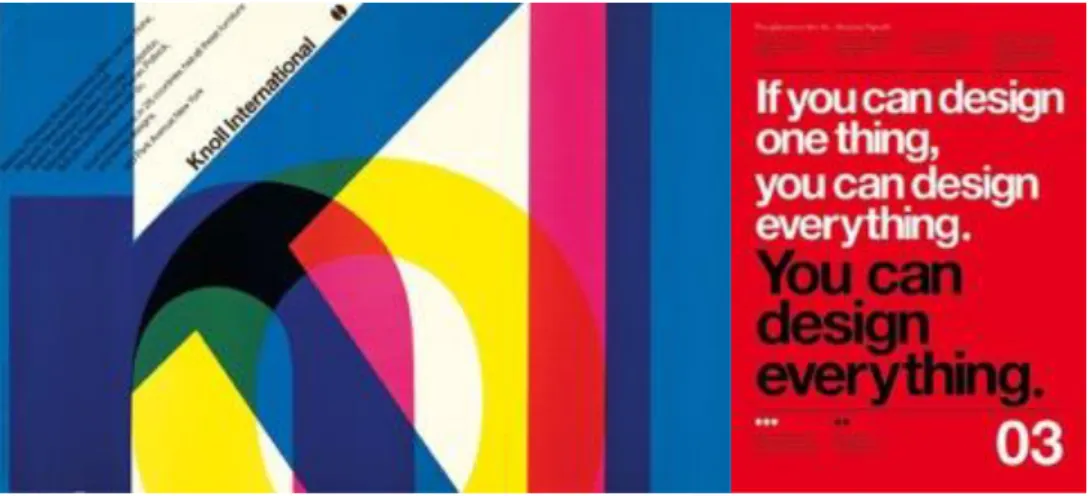
On the other hand, an example taken for its influence in the modern world is, Massimo
Vignelli7, another great designer of our times, who in contrast to Carson attended the
maxim arises: "Design is one, it is not many different ones". His way of feeling design was part of his philosophy, where functionality became the core of any of his work.
Figure 9: Massimo Vignelli’s work
In conclusion whatever the education, the ultimate goal is always to leave a message to other people, that if the designer realizes something that is not understood, it means that he did not do his job well. The object of design, must respond to a certain need, must speak to its interlocutors, destined never to lose the meaning.
4.3 Agency’s history
Nacho, following his graduation in Architecture at the University of Cordoba (Argentina) moved to Spain where he carried out his first freelance work and later became a founding member of other agencies (Small) and was Professor of Packaging and Labeling at the Coco School - Escuela de Diseño in Alicante. Therefore, after years of experience in the sector, he decides, in May 2013, to set up on his own and create his own Graphic Design studio. This great experience and knowledge of the field has allowed him several times over the years to receive important awards and publications in several major Diseño magazines, the most recent being that of 2016, the Alce Award for Best Packaging, for the realization of the label of a wine for Bodega Rafael Cambra, Alicantina area prize, which will soon participate in an exhibition at Burgos for the Wine Design Space. An important mention must also be made
for Mari Carmen, a partner-founder of Hoy es el Día8, another study of sustainable graphic
design, which operates within the same walls but with projects totally independent of one another. Both receive requests from different customers for which the management is done individually but for convenience both collaborate in each of the projects.
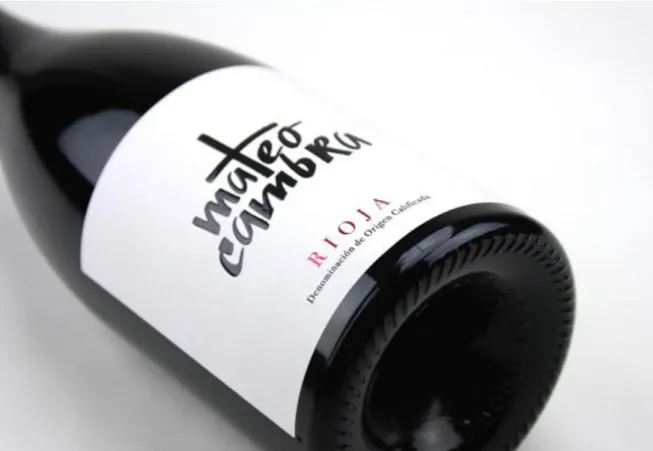
Figure 10: Mateo Cambra’s Label
An important mention must also be made for Mari Carmen, a partner-founder of Hoy
es el Día9, another study of sustainable graphic design, which operates within the same walls
but with projects totally independent of one another. Both receive requests from different customers for which the management is done individually but for convenience both collaborate in each of the projects.
4.4 Organization and team
The Evangelisti y Cia studio presents a hierarchical organization by function, in accordance with Figure 11:
Figure 11: Organization Chart
The two directors and managers of the two studios or CEOs meet and are responsible for all the arear of graphic studies, from the communication to the design side.
Both CEOs manage the package of clients they own, the relationships and responsibilities with them and they assume by themselves the burden of creative projects being carried out and implemented correctly.
Both creative directors then rely on the Senior Designer (Santiago Montoya) who accompanies them daily and other professionals who collaborate depending on the case in other fields of investigation such as animation, 3D printing, etc.
The team was composed of the three figures, Artistic Directors and Senior Designers who carried out the main tasks, to which the student joined, in the area of Design and Communication, as Junior Designer.
Officially, the internship was under the guidance of Nacho Evangelisti, but being two the agencies, and collaborating with each other in progress projects, the student often had Mari Carmen as a referent, with whom he repeatedly carried out different projects (see. page 55).
The directors of the different studios had an important role in the beginning of the project, orientation, work organization and development of the same, and when there was a project that required a quick response from the agency, it was necessary for an element of the team to take in hand the situation to respond to a condition where time was reduced.
Nacho Evangelisti Mari Carmen
Estevan
Senior Designer: Santiago Montoya
Senior Designer: Santiago Montoya