Attitudes and perceptions regarding research and clinical practice:
a cross-cultural study comparing Portuguese, Brazilian and
Angolan first year medical students
Dissertation presented to obtain a Master’s degree in Epidemiology at the Faculty of Medicine of the University of Porto
Faculty of Medicine of the University of Porto Institute of Public Heath of the University of Porto
Department of Medical Education and Simulation, Faculty of Medicine of the University of Porto
Author: Gustavo Daniel de Barros Correia, Department of Biochemistry, Department of Medical Education and Simulation, Institute of Public Heath of the University of Porto, Faculty of Medicine of the University of Porto, Porto, Portugal; Institute for Research and Innovation in Health (I3S), University of Porto, Porto, Portugal
Supervisor: Laura Virgínia Pereira Teixeira Ribeiro, PhD, Assistant Professor of the Faculty of Medicine of the University of Porto, Department of Biochemistry, Department of Medical Education and Simulation, Faculty of Medicine of the University of Porto, Porto, Portugal; Institute for Research and Innovation in Health (I3S), University of Porto, Porto, Portugal
III | P a g e
Agradecimentos
Os meus mais sinceros agradecimentos ao Departamento de Educação Médica e Simulação, sobretudo à Professora Doutora Maria Amélia Ferreira, que permitiu a minha fácil integração neste projeto.À Professora Doutora Rosário Sambo, Decana da Faculdade de Medicina da Universidade Katyavala Bwila, e à Professora Doutora Silke Weber, da Faculdade de Medicina da Universidade Estadual Paulista “Júlio de Mesquita Filho”, pela coordenação e recolha de dados em Angola e no Brasil, respetivamente.
À Professora Doutora Laura Ribeiro, um exemplo de dedicação e profissionalismo, que desde 2009, contra todas as dificuldades, me apoia e acolhe no seu grupo, orientando-me não só na minha carreira académica mas, também, tendo sempre uma palavra amiga e compreensiva para me dirigir.
Aos meus amigos e colegas do Departamento de Bioquímica e da Faculdade de Medicina da Universidade do Porto, em especial à Andreia Sá Gomes e à Margarida Pereira, por toda a ajuda preciosa em diferentes etapas do desenvolvimento deste trabalho.
À Fundação para a Ciência e Tecnologia, pelo financiamento do projeto “RES4MED: learning medicine through research” (EXPL/IVC-PEC/1302/2013), que permitiu o financiamento parcial deste trabalho.
Aos meus amigos, a família que escolho e me acolhe, irmãos de luta, companheiros da e para a vida, sem os quais nada faz sentido e tudo se completa.
Finalmente, tento agora expressar por palavras aquilo, que com um simples olhar conseguimos subentender, um sentimento capaz de extravasar esta dimensão e qualquer outro plano de realidade, capaz de ultrapassar qualquer barreira espacial e temporal, incapaz de, jamais, se extinguir. Agradeço, com toda a minha existência e mais além à Schöne Frau, a minha mãe, e aos meus muito queridos avós.
Dedico esta tese, marcante para o início de novas conquistas, às memórias, às boas lembranças, à esperança e aos sucessos.
V | P a g e
Table of Contents
List of Figures ... VII List of Tables ... IX List of Abbreviations... XI1 RESUMO ... 1
2 ABSTRACT ... 5
3 INTRODUCTION ... 9
3.1 Medical Education and undergraduate research ... 11
3.2 Undergraduate medical research worldwide: the case of three Portuguese Speaking Countries ... 14
3.3 Attitudes of medical students towards science and scientific research ... 15
3.4 Objectives ... 17
4 METHODS ... 19
4.1 Study design and sampling ... 21
4.2 Instruments of evaluation, data collection and outcome variables ... 22
4.3 Statistical analysis ... 25 4.4 Disclaimer ... 26 5 RESULTS ... 27 6 DISCUSSION ... 35 6.1 Limitations ... 41 7 CONCLUSIONS ... 43 8 REFERENCES ... 47 Appendix ... 59
VII | P a g e
List of Figures
Figure 1 - Confirmatory Factor Analysis for three-factor model of the scale of the Scientific Skills to Clinical Practice ... 61IX | P a g e
List of Tables
Table 1 - Summary of regional indicators ... 24 Table 2 - Comparison of General Information between Portugal, Brazil and Angola ... 29 Table 3 - Comparison of Attitudes, Motivation, Skills and Ability between Portugal, Brazil and Angola ... 30 Table 4 - Multiple liner regression model of association between Positive Attitudes, Negative Attitudes, Skills to Clinical Practice, Ability and age, sex, School, Research Project, GDP per capita, Population Density rate, Literacy rate and Basic Sanitation Access rate by country . 32 Table 5 - Selected multiple liner regression model of association between Positive Attitudes, Negative Attitudes, Skills to Clinical Practice, Ability and age, sex, School, Research Project, GDP per capita, Population Density rate, Literacy rate and Basic Sanitation Access rate for each country ... 33
XI | P a g e
List of Abbreviations
Azores RA - Autonomous Region of Azores CFA - Confirmatory Factor Analysis
CFI - Comparative Fit Index
FMB/Unesp - Botucatu Medical School/São Paulo University FMUKB - Faculty of Medicine of the University of Katyavala Bwila FMUP - Faculty of Medicine of the University of Porto
FU – Federal Unites
GDP - Gross Domestic Product GPA - Grade Point Average
Madeira RA - Autonomous Region of Madeira MD - Doctor of Medicine
North w/out GP - North without Great Porto
NUTS II - Nomenclature of Territorial Units for Statistics II RMSEA - Route Mean Square Error of Approximation SRMR - Standardized Root Mean Square Residual TLI - Tucker–Lewis Index
1 | P a g e
3 | P a g e
Na tentativa de melhorar a base dos sistemas de saúde, no início do século XX foi apontada a necessidade de serem integrados, precoce e sistematicamente, os princípios da investigação científica no ensino da medicina. Apesar das vantagens indubitáveis, esta integração nas escolas médicas é ainda hoje insuficiente, estando o número de médicos-cientistas a decair, bem como o número de estudantes de medicina com tais aspirações.
Uma atitude positiva perante a investigação científica e o seu desenvolvimento são fulcrais para garantir um tratamento mais eficaz dos doentes.
O objetivo principal deste trabalho centrou-se na comparação de atitudes e perceções de estudantes de medicina do primeiro ano de três escolas lusófonas em Portugal, Brasil e Angola, relativamente à investigação e à prática clínica. Como objetivo secundário, foi também avaliado se fatores como o sexo, idade, tipo de escola secundária, participação prévia em projetos de investigação, e ainda indicadores económicos, geodemográficos, educacionais e de saúde pública, para cada região, explicam diferenças nas atitudes perante a ciência e a investigação científica, motivação para desenvolver durante o curso, na importância atribuída às competências científicas para a prática clínica e na sua própria capacidade para as executar.
Um total de 455 estudantes de medicina do primeiro ano, 234 da FMUP, em Portugal, 158 da FMB/Unesp, no Brasil e 63 da FMUKB, em Angola, participaram neste estudo.
Os estudantes portugueses atribuíram uma maior importância às competências científicas para a prática clinica, e foram os mais confiantes na sua própria capacidade para as realizar. Também foram os estudantes com a atitude mais positiva perante a ciência e a investigação científica. Os estudantes angolanos foram os mais interessados na integração da investigação científica no currículo médico, e os mais motivados em realiza-la durante o curso, apesar de terem a atitude mais negativa, atribuírem menor importância as competências científicas para a prática clínica e serem os menos confiantes para as realizar. Os estudantes Brasileiros tiveram a atitude menos positiva perante a ciência e a investigação científica e foram os menos motivados para a sua realização.
Relativamente a Portugal, as atitudes dos estudantes foram dependentes do PIB per
capita, já em Angola e no Brasil foram dependentes do tipo de escola secundária que
frequentaram.
As perceções dos estudantes portugueses estavam associadas com o sexo, PIB per
capita, o tipo de escola secundária que frequentaram e a participação prévia em projetos de
investigação. As perceções dos estudantes brasileiros e angolanos estavam associadas, respetivamente, com o sexo e a participação prévia em projetos de investigação.
Estes resultados salientam a necessidade de aumentar a consciência dos estudantes para a importância da ciência e investigação científica e são fundamentais para a
4 | P a g e
implementação nas escolas médicas de um programa de investigação adequado. Além disso, estes têm importantes implicações para a educação médica uma vez que realçam a necessidade de adotar políticas financeiras e educativas para aumentar a literacia científica, atenuar diferenças e promover a excelência na prática clinica em nome da saúde das populações.
Estudos adicionais poderão constituir um valor acrescentado para o planeamento de programas de investigação adequados às escolas médicas lusófonas.
5 | P a g e
7 | P a g e
In the attempt of enhancing the basis of health systems, in the beginning of the 20th century was appointed the need to integrate the principles of scientific research prematurely and systematically in medical curricula. Despite its undeniable advantages, today this integration is still not frequent enough in medical schools, being the number of physician-scientists and medical students with such aspirations declining.
A positive attitude towards scientific research and its development are crucial to ensure a more effective treatment of patients.
The primary objective of this study focused on the comparison of attitudes and perceptions of first year medical students from three medical schools in three Portuguese Speaking Countries, Portugal, Angola and Brazil, regarding research and clinical practice. Moreover, as secondary objective was assessed if factors such as sex, age, type of secondary school attendance, place of residence and previous participation in research projects and economic, geodemographic, educational and public health indicators for each region as well explain differences in attitudes towards science and scientific research, motivation to do research while in medical school, perceived importance of scientific skills to clinical practice and one’s self-perceived ability to perform scientific skills.
A total of 455 first year medical students, 234 from FMUP, in Portugal, 158 from FMB/Unesp, in Brazil and 63 from FMUKB, in Angola, participated in this study.
Portuguese students attributed a greater importance to scientific skills to clinical practice and were the most confident in their own ability to perform them. Additionally, they had the most positive attitude towards science and scientific research. Angolan students were the most willing to integrate scientific research into medical curriculum and were the most motivated to perform scientific research during medical school. However, they had the most negative attitude towards science and scientific research, attributed the least importance to scientific skills to clinical practice, and were the least confident in their own ability to perform them. As to Brazilian students they had the least positive attitude towards science and scientific research and were the least motivated to perform research during medical school.
Concerning Portugal, attitudes were dependent on GDP per capita, as in Angola and Brazil were type of secondary school attendance dependent.
As to perceptions, Portuguese students’ attributions were associated with sex, GDP per
capita, type of secondary school attendance and previous participation in research projects.
Brazilian and Angolan students’ perceptions were, respectively, associated with sex and previous participation in research projects.
These findings highlight the need for undergraduate awareness on science and scientific research and are valuable for the implementation of an adjusted research program in medical schools. Furthermore, they have important implications in medical education, as they underline
8 | P a g e
the need of adoption of both financial and educational policies, to enhance scientific literacy, mitigate differences and promote excellence in clinical practice, on behalf of populations’ health.
Additional follow-up studies could constitute an added-value when designing best-adjusted research programmes to Portuguese-speaking medical schools.
9 | P a g e
11 | P a g e
3.1 Medical Education and undergraduate research
For more than a century it has been described the need to integrate the principles of scientific research in medical curricula comprehensively (1-10), as a vehicle to improve the quality of health care systems (5, 6, 11-13), integrating constantly new information and scientific developments (5, 14) although its occurrence is still not frequent enough in medical schools (15-17).
It is already accepted the necessity of active scientific education for the complete development of medical students as part of their medical training (4, 5, 8, 17-28), for the enhancement of critical appraisal and problem solving skills, needed for excellent clinical practice (4, 5, 15, 29, 30). However, recently, it has been observed a reduction of both physicians interested in research (6, 12, 13, 23, 29, 31-45), the so called physician-scientist (13, 36, 42), and future physicians interested or already involved in research worldwide (5, 6, 29, 31, 33, 36-38, 41, 46-48). A decrease in governmental financial support to higher education institutions (31, 46) has been noticed as well, justifying the complaint regarding the absence of opportunities for physicians to develop medical research (49), even though basic science research is still expanding (42, 46, 50-52).
Furthermore, it seems that physicians are forced to choose between medical research and medical practice, finding very difficult to reconcile both activities due to their expensive costs (11, 21, 32-37, 39, 42, 44, 46, 49, 53) , time (4, 11, 21, 23, 32-35, 37, 39, 46, 53) and intellectual demands that those activities require (4, 21, 31, 32, 35, 37, 42, 46). In order to counter these facts, from an early stage in their career, medical students have to be exposed to scientific research, broadening their scientific training (4, 5, 11, 18, 21, 23, 24, 29, 33, 44, 46, 54, 55) and allured to academic medicine (23-25, 29). Other appointed barriers are the lack of a proper research role-model and mentorship (4, 23, 37, 46, 53, 56-58), making medical students exclude a research career in an early stage of their academic education; lack of pertinent curricular research experience; lack of a proper linkage between students and researchers and/or research environment (12, 46); and lack of adequate taught of the basic principles of scientific research in medical schools (16, 23).
A physician-scientist is described as a Doctor of Medicine (MD) who conducts clinical research as main professional activity (13, 36, 42) and applies the latest discoveries directly to the care of patients and the cure of diseases (12, 42, 59).
In academic settings, medical students who develop scientific research turn out to be exceptional physicians (5, 10, 11, 15, 46), through their better use and knowledge of evidence based medicine (5, 10, 11, 15, 17, 22, 26, 48), that would otherwise be compromised; most
12 | P a g e
likely will contribute to that evidence with their own research; and are more likely accepted on residences and fellowship programs of their choice (15). Additionally, scientific research helps medical students to develop the aptitude to become leaders in their fields, creativity (5), critical (4, 5, 10, 29, 44, 46, 48, 60) and communication skills as well as spreading (5, 29, 46), evolving (5, 29) and applying (10, 61-65) new medical knowledge. Research skills are vital effects of higher education and students must be allowed to improve theirs (46). It has already been stated that the most natural approach for the acquirement and improvement of research skills is for the students to initiate a mentored research project (4, 5) while undergraduates, to publish it (46) and to attend conferences (29, 66, 67), as part of a socialization process (66) that will allow students to mould their idea of professionalism concerning clinical practice (4, 66, 68) and to feel integrate in research communities (66, 67). Furthermore, mentored projects seem to encourage self-directed learning (5), by promoting autonomy (4), nonetheless asserting the knowledge of adequate research role-models. More, active mentoring reflects on greater scientific research production (53, 69).
Many world-renowned medical schools, especially in Europe and North America, have already integrated mandatory undergraduate research experiences into the curriculum to better prepare their student. Examples of such models may be found in the University College London, Southampton University, University of Sydney (70), University of Melbourne, (71), Vanderbilt University, Duke University, Yale University, Mayo Medical School, Stanford University, Icahn School of Medicine at Mount Sinai (29), University of Leeds, University of Liverpool, Newcastle University, University of Sheffield (28), Baylor University (20), University of Nottingham (48), University of Edinburgh (66), every University Medical Centre in the Netherlands (21), in Germany in order to obtain the title of MD medical students must develop a research project (72). Other programs, such as a combined MD-PhD (36), where research is equally mandatory, may also be found in Harvard University, Johns Hopkins University, University of Cambridge, University of California (Los Angeles), Boston University, Brown University, Columbia University; University of Washington, University of Michigan, New York University, Pennsylvania University, University of Chicago, Université de Montréal, University of British Columbia, University of Helsinki, University of Toronto, University of Zurich, Medical University of Vienna, among others (73).
In this work, skills are anything that may be taught, practiced and mastered in which one might become proficient (46). Research is intended to be seen as a learning process involving the search for knowledge by the establishment of facts, consideration of new ideas and formulation of new theories that might allow knowledge development (46), including knowledge regarding best practices (4, 5, 66, 74). Thus, research skills include the ability to optimise the learning process. Organization skills involve the ability to best use time and effort in both work
13 | P a g e
and personal aspects of life (37). Communication skills comprise the ability to effectively communicate with patients (75), including non-verbal and verbal elements (76) as well as the ability to efficiently communicate research results to scientific communities, where proper data presentation and scientific writing have a vital role (77), including in the progress of young scientists (78).
14 | P a g e
3.2 Undergraduate medical research worldwide: the case of three Portuguese
Speaking Countries
Worldwide, medical schools are trying to cope with essential requirements and core competences that all medical students must have at the end of their degree to be excellent physicians, and Angolan (30, 79) and Brazilian (11) schools are not different. Some African medical schools are adjusting their degrees and qualifications according to European reforms (30, 80), despite lacking resources and undefined quality parameters, which would ensure the acquisitions of core medical competences (30, 79, 81), apart from environmental, cultural and educational conditions (30).
The assurance of the needed infrastructures, reliable high school education and medical school teachers’ preparation for both medical curriculum and to be professional role-models for future physicians are appointed as a necessity for the future of Portuguese Speaking African Countries’ medical schools (79), coping with the lack of physicians in Africa (81-83). Likewise, these investments might also help students to acquire interest in basic science and its development (79), essential for the practice of evidence based medicine (84). Additionally, many other medical schools in developing countries suffer from the same lack of resources, undefined quality parameters and proper means to ensure quality (11, 81). In Brazil, due to the indiscriminate establishment of new medical schools since the year 2000, the efforts made to enhance the quality of medical education appear to be compromised (11), though the awareness to its necessity for quality health care services is obvious (11, 85-87).
On the other hand, Portuguese medical courses were reformulated (10) and an attempt was made to promptly integrate undergraduate medical students into medical research as soon as the Bologna Process initiated (80, 88), in 2007 (10, 88, 89). Since then, the arising number of Portuguese medical students has far exceeded the necessity of the country’s population and, for the first time, led to the prospect of medical unemployment and emigration, nonetheless constituting an opportunity to further acquire specific scientific skills and become more skilful and differentiated (10).
15 | P a g e
3.3 Attitudes of medical students towards science and scientific research
Attitudes are defined as context dependent (51, 90, 91) and hardly mutable predispositions towards a positive or negative response to an idea (51, 91).
Medical education has the immediate goal of developing attitudes and behaviours concerning future physicians’ professional competences, including the attitude towards science, which further enhances medical students’ progression (17, 22, 51). It is known that positive attitudes towards scientific research should be nourished immediately in the beginning of medical school (22). However, there is little information concerning the attitudes of medical students towards scientific research (17, 92), nor how can they be affected and, ultimately, altered (17, 51, 93, 94). Also, attitudes towards science and scientific research had never been examined before regarding Angolan and Brazilian first year medical students.
It has already been described that positive attitudes towards scientific research and its method increase during first and second year of medical school and continue positive until the conclusion of the degree (51). Furthermore, minor mandatory courses regarding scientific methodology in the second year of medical school increase students’ positive attitudes towards science and its method (17, 51) for a short period of time (51). This brief change of attitudes does not seems to be related with the initial attitudes at the admission of medical school nor Grade Point Average (GPA), though late years’ changes regarding positive attitudes seem to be exclusively related with the increase of GPA (51) and academic success (17, 94). Plausibly, only long lasting interventions would be able to produce considerable long term modifications concerning attitudes towards science (51). Nonetheless, it has been proved a direct correlation between the improvements of positive attitudes towards science and the teaching of scientific methodology in medical schools (17, 51, 94).
Positive attitudes regarding scientific research are key elements of contemporary medical education (17). Moreover, positive attitudes towards science might enhance critical reasoning and assessment skills throughout the learning of evidence based medicine (17, 22). Generically, attitudes concerning scientific research and future research career choices are shaped by previous scientific research training (94), students’ sex (10, 12, 58, 95-97), academic year (10) and social, cultural and academic environment stimuli relating to scientific research (98). The lack of success in developing positive attitudes might further exclude medical students from research careers and research projects, taking further apart the gap between the laboratory bench and patients’ bedside (“bench-to-bedside”) (13, 99). Ultimately, assessing undergraduate medical students’ attitudes towards science and scientific research would be an helpful element when guiding students in the direction of academic medicine,
16 | P a g e
whether it is basic medical research (17, 45) or even academic clinic (6, 17), as practice may lead medical science to further new challenges (37).
Withal, in this work, integration was defined as the predisposition to integrate undergraduate medical research into the curriculum (10).
17 | P a g e
3.4 Objectives
The primary objective of this work was to compare attitudes and perceptions of first year medical students from three medical schools in three Portuguese Speaking Countries, Portugal, Angola and Brazil regarding research and clinical practice.
As secondary objective it was evaluated if factors such as sex, age, type of secondary school attendance, place of residence, previous participation in research projects and also economic, geodemographic, educational and public health regional indicators explain differences in attitudes towards science and scientific research, motivation to do research while in medical school, perceived importance of scientific skills to clinical practice and one’s self-perceived ability to perform scientific skills.
19 | P a g e
21 | P a g e
4.1 Study design and sampling
This cross-cultural study involved three selected medical schools with traditional curricula in three Portuguese Speaking Countries: the Faculty of Medicine of the University of Porto (FMUP), Porto, Portugal; the Botucatu Medical School/São Paulo University (FMB/Unesp), São Paulo, Brazil; and the Faculty of Medicine of the University of Katyavala Bwila (FMUKB), Benguela, Angola. None of the institutions in analysis have incorporated structured research programs directly into their undergraduate curriculum.
At the beginning of the school year, all medical students enrolled in the first year at FMUP, FMB/UNESP and FMUKB, respectively in 2011, 2012 and 2013 were asked to self-administrate the “Importance of Scientific Skills for Clinical Practice (ISS4CP)” questionnaire (10) voluntarily and non-anonymously, given that a transversal study is currently running. In total, 455 eligible students, 234 (51.43%) from Portugal, 158 (34.72%) from Brazil and 63 (13.85%) from Angola, participated in this study, with a response rate around 81%, 88% and 90%, respectively.
22 | P a g e
4.2 Instruments of evaluation, data collection and outcome variables
The questionnaire consisted of 4 domains: 1) General Information, comprising age, sex, type of secondary school attendance, place of residence and previous participation in research projects; 2) Attitudes of medical students towards science and scientific research; 3) Motivation of medical students to do research during the medical course; and 4) Perception of medical students both on their own scientific skills and its importance to clinical practice. Domains 2) and 4) were divided into sub-domains consisting of, respectively, Positive and Negative Attitudes and Integration; and perceived importance of scientific skills to clinical practice (constituted by Communication, Research and Organization Skills, has described shortly) and one’s self-perceived ability to perform those skills (10). In order to simplify this work’s development, from this point on, domain 3) will be called Motivation, the perceived importance of scientific skills to clinical practice will be named Skills to Clinical Practice and one’s self-perceived ability to perform the scientific skills will be Ability.
Domain 1) consists of basic demographic information gathering for every respondent, information about secondary school attendance (public or private) and about previous experience in scientific research. Domain 2) consisted of several 4 point Likert scale and 8-item knowledge test concerning personal considerations about science and scientific facts, respectively. Domain 3) and 4) consisted of 4 point Likert scale regarding, respectively, how motivated medical students are in developing scientific research; and how medical students perceive their acquired communication, research and organization skills as well as its importance to future clinical practice.
The 4 Likert scales, inverted for the purpose of this work, were scored on a scale of 1 to 4, ranging from 1 - total disagreement, low, not important or bad to 4 - total agreement, very high, very important or good. The average of responses was computed in order to calculate the score of each item and its interpretation is straightforward (100, 101).
Regarding students’ perceived importance of scientific skills to clinical practice, the scale presented a good reliability, high for the 11 skills and three factors, described below, and good construct validity, set by Confirmatory Factor Analysis (CFA). The 11 skills were grouped into three factors: Communication Skills, including writing communication, oral communication and visual communication; Research Skills, including the ability to perform literature searching, ability to cope with information technology, ability to analyse data and English proficiency; and Organisation Skills, including team work ability, time management ability, the ability to solve problems and to self-improve learning. CFA was used to test the fit of the model with 3-factor structure considering the 11 skills as items. CFA fit was assessed using the following indexes:
23 | P a g e
the Tucker–Lewis Index (TLI) (102), the Comparative Fit Index (CFI) (103), the Route Mean Square Error of Approximation (RMSEA) (104) and the Standardized Root Mean Square Residual (SRMR) (105). A good model fit is obtained when TLI and CFI values are 0.90 or higher (105) and values of RMSEA and SRMR are close to 0 (106). The internal reliability of the scales was tested using the Cronbach’s alpha coefficient.
To determine possible differences between students’ populations legal administrative divisions for every region, decreed by proper governmental procedures, were used. Accordingly, for Portugal the Nomenclature of Territorial Units for Statistics II (NUTS II) that divides the country in 5 regions (107), for Brazil it was used the Federal Units (FU) system, dividing the country in 27 regions (108) and for Angola the Provinces system, dividing the country in 18 regions (109).
In this study, regions that were the place of conclusion of secondary education of less than five first year medical students were excluded. Therefore, for Portugal were considered, North, Centre, Autonomous Region of Madeira (Madeira RA) and Autonomous Region of Azores (Azores RA), for Brazil, São Paulo, Minas Gerais and Goiás and for Angola, Benguela, Huila and Luanda.
Moreover, in Portugal, the North might be divided into several smaller administrative regions alike (107). One of those smaller regions is Great Porto, which here has additional importance, since 44.44% (104) of the respondents studying at FMUP concluded their secondary education in that region. Additionally, Great Porto represents 63.03% of North’s population in this sample. Thus, first year medical students from Great Porto were also analysed independently and the remaining North’s region was renamed North without Great Porto (North w/out GP).
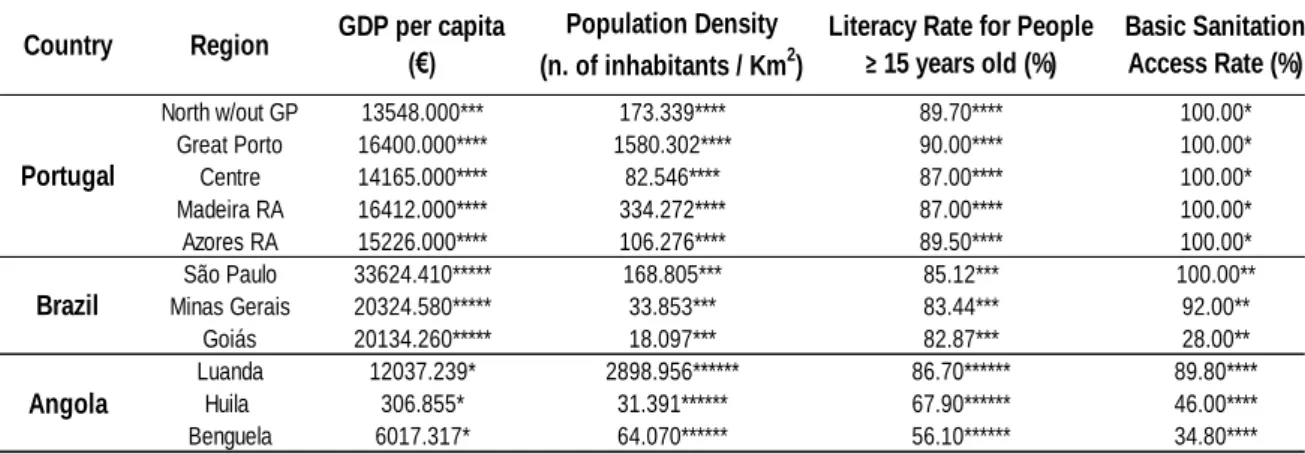
To evaluate if economic differences affect attitudes and perceptions of different populations of first year medical students regarding research and clinical practice, Portuguese (110, 111), Angolan (112) and Brazilian (113) regional Gross Domestic Product (GDP) per
capita (114, 115), from the same year as the enquiries, or the closest available, was used as
indicator. Every conversion made to Euros used the appropriate average conversion rate for each year of data recollection, made available by the Bank of Portugal (116).
Existing geodemographic impacts on different populations (117) of first year medical students were assessed by the population density (number of total inhabitants/ area in Km2). For the total population living in Portuguese regions (118), Brazilian UF (119) and Angolan Provinces (120) were used the latest and closest Census’ results from each country, according with the date of the enquiries. The area of Portuguese regions (107, 121), Brazilian UF (122) and Angolan Provinces (120) was assessed also using appropriate government information.
24 | P a g e
To estimate educational influences on different populations of first year medical students, regional literacy rate for people with 15 years old or more was assessed, according with the available Census’ data as well. Although Portugal (118, 123, 124) and Brazil (125) have literacy rates for the full extension of the population, both regional and national level, Angolan data (120) availability is restricted to this age group.
In order to evaluate possible public health effects on different populations of first year medical students’ attitudes and perceptions, regional basic sanitation access rate was considered as a proxy for infant, child (126, 127) and maternal mortality rate (126). Once more, though Portugal (128) and Brazil (129) have regional data available and up to date, regarding this indicator and others alike, such as mortality rate, infant, neonatal and maternal mortality rate, Angolan database (120, 130) is limited to the basic sanitation access rate. The nonexistence of basic sanitation has been broadly described as one of the major factors responsible for larger burdens of disease and higher mortality rates (126, 127, 131-135).
Generically, present indicators, as seen in Table 1, were chosen due to the accessibility to Angolan data. As previously stated, while Portugal and Brazil have a wide index of social, economic, health related indicators accessible and up to date, Angola has a scarce number of indicators, limiting the resources for the analysis.
Table 1 - Summary of regional indicators
*data from 2007; **data from 2008; ***data from 2010; ****data from 2011; *****data from 2012; ******data from 2014.
North w/out GP 13548.000*** 173.339**** 89.70**** 100.00* Great Porto 16400.000**** 1580.302**** 90.00**** 100.00* Centre 14165.000**** 82.546**** 87.00**** 100.00* Madeira RA 16412.000**** 334.272**** 87.00**** 100.00* Azores RA 15226.000**** 106.276**** 89.50**** 100.00* São Paulo 33624.410***** 168.805*** 85.12*** 100.00** Minas Gerais 20324.580***** 33.853*** 83.44*** 92.00** Goiás 20134.260***** 18.097*** 82.87*** 28.00** Luanda 12037.239* 2898.956****** 86.70****** 89.80**** Huila 306.855* 31.391****** 67.90****** 46.00**** Benguela 6017.317* 64.070****** 56.10****** 34.80**** GDP per capita (€) Population Density (n. of inhabitants / Km2)
Literacy Rate for People ≥ 15 years old (%) Basic Sanitation Access Rate (%) Angola Brazil Portugal Country Region
25 | P a g e
4.3 Statistical analysis
Descriptive statistics for continuous variables was reported through Mean (± Standard Deviation) and categorical variables through n (%).
Normality of data distribution was assessed using the Kolmogorov-Smirnov’s test with Lilliefors' significance correction and homogeneity of variance was assessed using the Levene’s test.
Welch’s ANOVA followed by pairwise comparisons with Games-Howell post-hoc test (for continuous variables) was used to compare age and average scores of students’ responses in Positive and Negative Attitudes, Integration, Motivation, Communication Skills, Research Skills and Organization Skills between all countries.
Chi-Square test (for dichotomous categorical variables) was used to define differences in proportions of distributions regarding General Information (sex, type of secondary school attendance (School) and previous participation in research projects (Research Project)) between countries and regions.
A stepwise linear regression model was performed to predict Attitudes, Motivation, Skills to Clinical Practice and Ability of Portuguese, Brazilian and Angolan first year medical students based on age, sex, School, Research Project, regional GDP per capita, regional Literacy rate for people with 15 years old or more, regional Basic Sanitation Access rate and regional Population Density rate.
Missing cases were deleted.
Every assumption for these procedures were met.
Significance level was set at 0.05. All statistics analyses were performed with IBM SPSS Statistics for Windows, Version 21.0 (2012, Armonk, NY: IBM Corp).
Ethical principles for this project followed the guidelines approved by FMUP, FMB/Unesp and FMUKB.
26 | P a g e
4.4 Disclaimer
The author was not involved in the production of the “Importance of Scientific Skills for Clinical Practice (ISS4CP)” questionnaire nor in the collection of the data.
As mentioned along the text, some of the results obtained with first year medical students from FMUP and included in this thesis were already published (10).
27 | P a g e
29 | P a g e
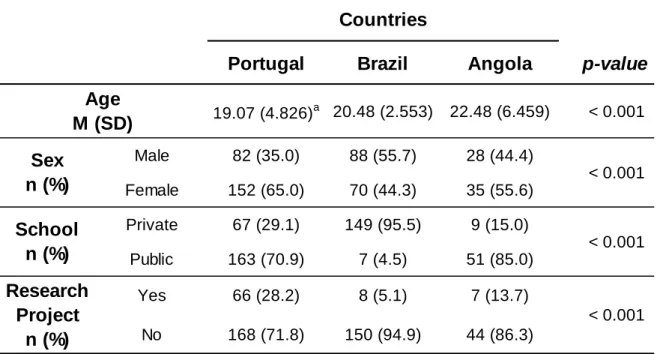
As seen in Table 2, the sample was constituted by a total of 455 students, approximately, 51% from Portugal, 35% from Brazil and 14% from Angola, being Portuguese students the youngest at first year of medical school (p 0.001). Of the total Portuguese, Brazilian and Angolan responding students, 35%, 56% and 44%, respectively, were male. Regarding the secondary level, 29%, 96% and 15% of the Portuguese, Brazilian and Angolan students, respectively, attended a private school. As to the participation in research projects, Portuguese, Brazilian and Angolan students reported, respectively, 28%, 5% and 14% participation.
The Cronbach's alpha of the analysis of the 11 skills indicated a moderate to high internal consistency, ranging from 0.651 to 0.818. According to the theoretical model, in the CFA it was assumed that the items writing communication, oral communication and visual communication belong to the factor Communication Skills; the items literature searching, information technology management, ability to analyse data and English proficiency belong to the factor Research Skills; and the items team work ability, time management, ability to solve problems and self-improve learning belong to the factor Organization Skills; and they were correlated with each other, as seen in Figure 1 (Appendix). The tested model’s global fitness was confirmed. The Cronbach’s alpha was 0.69, 0.81 and 0.80 for factor Communication Skills, Research Skills and Organization Skills, respectively.
Table 2 - Comparison of General Information between Portugal, Brazil and Angola
Post-hoc analysis: a) Portugal is different from Brazil (p = 0.001) and Angola (p = 0.001). M – Mean; SD – standard deviation.
Portugal
Brazil
Angola
p-value
19.07 (4.826)a 20.48 (2.553) 22.48 (6.459) < 0.001 Male 82 (35.0) 88 (55.7) 28 (44.4) Female 152 (65.0) 70 (44.3) 35 (55.6) Private 67 (29.1) 149 (95.5) 9 (15.0) Public 163 (70.9) 7 (4.5) 51 (85.0) Yes 66 (28.2) 8 (5.1) 7 (13.7) No 168 (71.8) 150 (94.9) 44 (86.3)
Countries
Research
Project
n (%)
< 0.001School
n (%)
< 0.001 < 0.001Age
M (SD)
Sex
n (%)
30 | P a g e
On the subject of Attitudes, as seen in Table 3, Brazilian students attributed the lowest score to Positive Attitudes (p 0.001) whether Angolan students attributed the highest score to Negative Attitudes (p 0.001). All students’ populations attained different scores to the integration of undergraduate medical research into the curriculum (p 0.001).
Angolan students were the most motivated to do research during the medical course (p 0.001).
Portuguese students attributed the highest importance to the scientific skills to clinical practice, whether they were Communication, Research and Organization Skills, and also attained the highest score when evaluating their own ability to perform those scientific skills (p 0.001). All students, regardless the country, attributed an higher score to Organization Skills.
Table 3 - Comparison of Attitudes, Motivation, Skills and Ability between Portugal, Brazil and Angola
Post-hoc analysis: a) Brazil is different from Portugal (p < 0.001) and Angola (p < 0.001); b) Angola is different from Portugal (p < 0.001) and Brazil (p < 0.001); c) All countries are different between them (p < 0.001); d) Angola is different from Portugal (p < 0.001) and Brazil (p < 0.001); e) Portugal is different from Brazil (p < 0.001) and Angola (p = 0.002); f) Portugal is different from Brazil (p = 0.009) and Angola (p < 0.001); g) Portugal is different from Brazil (p = 0.003) and Angola (p = 0.003); h) Portugal is different from Brazil (p < 0.001) and Angola (p = 0.001).
M – Mean; SD – standard deviation.
Portugal (n=234) Brazil (n=158) Angola (n=63) p-value Positive 3.360 (0.314) 3.046 (0.330)a 3.272 (0.312) < 0.001 Negative 1.995 (0.306) 2.034 (0.344) 2.299 (0.435)b < 0.001 Integration 3.135 (0.330)c 2.932 (0.357)c 3.361 (0.324)c < 0.001 2.758 (0.595) 2.698 (0.630) 3.161 (0.507)d < 0.001 Communication 3.469 (0.411)e 3.085 (0.551) 3.203 (0.540) < 0.001 Research 3.311 (0.414)f 3.156 (0.522) 2.974 (0.561) < 0.001 Organization 3.512 (0.424)g 3.349 (0.479) 3.241 (0.547) < 0.001 3.425 (0.349)h 3.191 (0.452) 3.131 (0.505) < 0.001 Ability M (SD) Attitudes M (SD) Skills to Clinical Practice M (SD) Countries Domains Motivation M (SD)
31 | P a g e
As shown in tables 4 and 5, the multiple linear regression revealed that 2.8% of the variability of Brazilian students’ Positive Attitudes was explained by the type of secondary school attendance, and significantly increased when they attended private secondary schools (0.268 points), comparing with students who attended public schools. Portuguese and Angolan students’ Positive Attitudes were not able to be predicted by this model.
2.6% of the variability of Portuguese students’ Negative Attitudes was explained by GDP
per capita, being its increase positively associated with higher GDP (0.000039 points for each
Euro). 17.9% of the variability of Angolan students’ negative attitudes towards science and scientific research was explained by School and it significantly increased when they attended private secondary schools (0.526 points), comparing with students who attended public. Brazilian students’ Negative Attitudes were note able to be predicted by the variables included in this model.
6.3% of the variability of the perceived importance of the scientific skills to clinical practice attributed by Portuguese students was explained by GDP per capita and students’ sex. Its importance was negatively associated with higher GDP (0.000034 points for each Euro) and female students attributed a greater importance to those skills to clinical practice (0.114 points) than males. 13.9% of the variability of Angolan students’ perceptions about the importance of skills to clinical practice was explained by previous participation in research projects. Its importance significantly increased when students previously participated in research (0.260 points) comparing to those who did not. In the case of Brazilian students 3.9% of this variability was explained by sex, where female students attributed a greater importance to scientific skills to clinical practice (0.137 points) than males.
4.3% of the variability of the reported Portuguese students’ own ability to perform scientific skills was explained by both School and Research Project. This perception was significantly increased when they attended private schools (0.129 points) and participated in research projects (0.111 points), when comparing with students who attended public schools and did not participate in research, respectively. Angolan and Brazilian students’ Ability was not able to be predicted.
32 | P a g e
Table 4 – Multiple liner regression model of association between Positive Attitudes, Negative Attitudes, Skills to Clinical Practice, Ability and age, sex, School, Research Project, GDP per capita, Population Density rate, Literacy rate and Basic Sanitation Access rate by country
Predictors: a) (Constant), School; b) (Constant), GDP per capita; c) (Constant), School; d) (Constant), Sex; e) (Constant), Sex and GDP per capita; f) (Constant), Research Project; g) (Constant), Sex; h) (Constant), School; i) (Constant), School and Research Project. Linear regression model coefficients adjusted to age, sex, School, Research Project, GDP per capita, Population Density rate, Literacy rate and Basic Sanitation Access rate.
Domain Country Model Sum of
Squares dF F p-value Regression 0.413 1 Residual 14.086 140 Total 14.498 141 Regression 0.530 1 Residual 19.702 206 Total 20.231 207 Regression 1.412 1 Residual 6.466 38 Total 7.878 39 Regression 0.691 1 Residual 16.809 211 Total 17.500 212 Regression 1.094 2 Residual 16.406 210 Total 17.500 212 Regression 0.344 1 Residual 2.129 38 Total 2.473 39 Regression 0.621 1 Residual 15.134 131 Total 15.756 132 Regression 0.630 1 Residual 26.657 213 Total 27.287 214 Regression 1.167 2 Residual 26.121 212 Total 27.287 214 Positive Attitudes Negative Attitudes Skills to Clinical Practice Ability Portugal h 5.036 0.026 i 4.734 0.010 0.001 Angola f 6.145 0.018 Brazil g 5.376 0.022 Angola c 8.297 0.006 Portugal d 8.672 0.004 e 7.003 Portugal b 5.537 0.020 Brazil a 4.104 0.045
33 | P a g e
Table 5 – Selected multiple liner regression model of association between Positive Attitudes, Negative Attitudes, Skills to Clinical Practice, Ability and age, sex, School, Research Project, GDP per capita, Population Density rate, Literacy rate and Basic Sanitation Access rate for each country
Note: sr2 is the squared semi-partial correlation.
Domain Country Model b β R2 Adjusted R2 sr2 p-value
Constant 2.778 < 0.001 School 0.268 0.169 0.028 0.045 Constant 1.402 < 0.001 GDP per capita 0.000039 0.162 0.026 0.020 Constant 2.238 < 0.001 School 0.526 0.423 0.179 0.006 Constant 4.089 < 0.001 Sex -0.114 -0.189 0.038 0.005 GDP per capita -0.000034 -0.152 0.025 0.024 Constant 3.642 < 0.001 Research Project 0.260 0.373 0.139 0.018 Constant 3.479 < 0.001 Sex -0.137 -0.119 0.039 0.022 Constant 3.359 < 0.001 School 0.129 0.163 0.027 0.017 Research Project 0.111 0.141 0.020 0.038 Portugal 0.047 0.034 Positive Attitudes Negative Attitudes Skills to Clinical Practice Ability Angola 0.139 0.117 Brazil 0.039 0.032 Angola 0.179 0.158 Portugal 0.063 0.054 Brazil 0.028 0.022 Portugal 0.026 0.021
35 | P a g e
37 | P a g e
Portugal, Brazil and Angola are three Portuguese-speaking countries in different stages of development, whether it is social, cultural, economic or even demographic. Portugal, located in southern Europe, is a developed and high-income country, Brazil, in South America, and Angola, in Southern Africa, are upper middle income countries and considered developing countries (136).
Since 1986, Portugal has been a member of the European Union and, in 2007, has adapted its medical curricula to the latest directives of the Bologna Process and core competences, essential for the practice of medicine, follow the same directives (10, 30, 88, 89, 137). Portuguese medical schools are cutting edge learning, research and health care institutions, prepared to face current challenges and to guide Portuguese speaking medical schools in their modernizing process by sharing the already acquired information and experience for a more conscientious policy and decision-making (30).
In Brazil, in the late 20th century, literature already alerted for the absence of both integration of research in medical curricula and of distinction between basic and clinical research (138). Additionally, it was also advocated the need to further integrate clinical research and to encourage and motivate students to participate in these activities, both for their professional development and, ultimately, for patients’ benefit (138). Nowadays, many Brazilian medical schools have integrated undergraduate research into the curriculum, and others are debating its importance to medical course (60). Nonetheless, in Brazil, both human and economic resources, have to be redistributed, optimized and continuously supervised, ensuring quality in the best interest of education, students and of a better future for its population. Still, students continue to complaint about the lack of institutional support for undergraduate medical research (60).
Angola, a surprising example of a developing sub-Saharan African County, since its independency from Portugal in 1975, has spent 27 years in a civil war, that finally ended in 2002, has been making a serious effort towards progress by creating, reforming and solidifying all (infra)structures and human resources in favour of population (79, 139). Angolan decision makers are now capable of making conscience resolutions based in reliable information (139). Still, investments are far from being adequate (140) and from reaching the demanding goals (139, 141). More investments in education prior to medical school and actual Angolan medical schools are in need to accomplish cost-effective changes in medical education (79, 81) and ensure the quality of health resources (30).
This study affirms that Portuguese students are the youngest admitted in medical school, comparing to Brazilian and Angolan. In Portugal, the prospects of a medical career are widely embraced, and highly scored students usually are, often, regardless of their vocation,
38 | P a g e
stimulated to pursuit this professional path and enter medical school, as soon as they conclude secondary education.
The differences observed between countries regarding sex, type of school attendance and participation in research projects are most likely due to cultural, social and political differences. For instance, regarding sex, it has already been broadly described a feminization tendency among medical students (79, 142, 143).
When comparing positive attitudes towards science and scientific research, Brazilian students have the lowest score when comparing to others, which seem to be in accordance with the fact that they were also the least willing to integrate research in medical curriculum and to be motivated to do research. Thus, the acquisition of scientific skills seems not to be seen as a priority for professional improvement by Brazilian medical students. They are still, probably, unaware of the importance of research training to professional development and clinical practice and do not demonstrate interest for science, as previously reported by other studies (98).
Angolan students were the most willing to integrate research in medical curriculum and the most motivated to do research during the medical course. Nonetheless, they were the most negative towards science, attributed less importance to scientific skills to clinical practice and were the least confident on their own ability to perform those skills. The recent efforts to expand and develop medical education in Angola seem to be effective near first year medical students, though they still mistrust science. Indeed, although highly motivated towards science and research, and agreeing with its inclusion into medical curricula, in accordance with others (20), they are not fully aware of the benefits of engaging in research to professional development and clinical practice (98).
From all, Portuguese students attributed the greatest importance to scientific skills to clinical practice and were the most confident on their own ability to perform those skills. Given the high GPA needed for admittance in Portuguese medical schools, especially in FMUP where the highest GPA is required, it is not surprising that students feel very confident in their abilities. Antithetically, they are not the most motivated students to perform scientific research during the medical course, a finding that might be due to the previous theoretical based education they had, that do not stimulates research training, but directs students towards clinical practice.
This study shows that positive attitudes towards science and scientific research of Brazilian students varies according to the type of secondary school attendance, being higher when they attended private, comparing to those who attended public schools. The same was observed for negative attitudes of Angolan students. Although almost every Brazilian students attended a private school and Angolan students a public one, the observed differences between public and private schooling reinforce the idea of a, much needed, reliable and
39 | P a g e
equalising high school educational system (79), adaptable to students’ social, cultural and environmental backgrounds to better prepare them for challenges in medical school and promoting excellence in later professional life.
Portuguese students’ negative attitudes towards science are worryingly associated with GDP per capita: the wealthier students are, the more negative attitudes towards science they will have. Accordingly, a rapidly change of social paradigm and conscience is in need to counter this fact. Moreover, resources are now scarce and their use has to be enhanced and prioritised in the attempt to overcome the lack of scientific literacy of medical students.
As previously published by our group (10), our results suggest that Portuguese students’ perceived importance of scientific skills to clinical practice by first year medical students varies according to sex. The same association was observer for Brazilian students. Once more, female students accredited greater importance to the use of scientific skills to clinical practice, comparing to male students. Additionally, Portuguese students’ perceived importance of scientific skills to clinical practice also differ according to GDP per capita: the most deprived students attributed greater importance to scientific skills to clinical practice. Public policies have to prioritise efforts to promote opportunities to economically less-advantaged students so they might have the same chances of developing their skills, as they further seem to be aware of their importance.
Angolan students who participated in research projects attributed a greater importance to scientific skills to clinical practice, reinforcing the ever growing relevance of research activities for students’ professional development. Greater financial support (79) to these projects are in absolute need to overthrow the limiting social and financial barriers (81) to participation in research projects, encouraging students’ participation on theirs and patients best interest alike.
Portuguese students’ self-reported ability to perform scientific skills differs according to type of secondary school attendance and participation in research projects. Once more, students who attended private schools seem to higher self-evaluate their preparedness than students who attended public schools. Similarly, participation in research projects also improves students’ confidence on their own abilities to perform scientific skills, as already published by our group (10). As this self-confidence is reported to be associated with personal interest in research, prospects of positive results, and higher academic achievements, medical educators are now accountable for disclosing and promoting research opportunities and efficiently allocate students’ self-perceived abilities to meaningful learning experiments (10).
Contrary to early beliefs, given the regional social, cultural and economic disparities, especially in Angola and Brazil, none of the indicators, such as regional Population Density rate, regional Literacy rate and regional Basic Sanitation Access rate, affected the attitudes
40 | P a g e
and perceptions of first year medical students. These findings might be explained by the inclusion of only one medical school from each country, involving highly selected samples, despite the different students’ regional backgrounds and, in the case of Angola, by the low sample size, comparing to Portugal and Brazil. Furthermore, the efforts made by the three medical schools to minimize educational differences among students, adjusting the educational system in the attempt to overcome their needs, that, otherwise, would later compromise the quality of patients’ treatment, are probably expressed in this work.
Self-perceived competences is an element of self-efficacy (10, 43) and its assessment denotes the motivation to continuously develop specific competences, identifying areas of improvement. Thus, proper assessment of students’ perceptions regarding their education is capable of, validly, measure the quality of medical education itself (10, 144, 145).
Further studies involving these, and other, medical schools, exploring subsequent follow-up studies, could provide more accurate information aiming to design and implement best-adjusted research programmes into the medical curriculum. In addition, these studies will allow the adoption of education policies to mitigate the differences and to improve the teaching of medicine, always in the best interest of patients.
41 | P a g e
6.1 Limitations
The three groups in analysis did not exist at the same point in time.
The nonrandomized design was the only possible, as the hole population of first year medical students from the participating schools was selected.
Despite the adjustments for different educational, economic, geodemografic and public health backgrounds, the participation of only one school from each country might have compromised the external validity of the study. Additionally, it was the first time that the ISS4CP questionnaire was applied to non-Portuguese populations and further adjustments might be required.
As this work was based on a questionnaire the results were open to latent responder bias. Furthermore, the lack of anonymity might have led to social desirability bias, where students try to describe themselves favourably.
Moreover, sample size and scarcity of data might restrict the comparability between countries, especially in the case of Angola, where the sample was much smaller and data less available than Portugal and Brazil.
Despite knowing students’ self-assessment regarding their competences, no data for real performance could be evaluated.
As described previously in methods, the legal administrative divisions for every country, aside from being used in the regional distribution of the indicators, as seen in Table 1, had the goal of compare the different regions and evaluate those differences, as well. However, due to the limited sample size, exacerbated by further divisions, it was not feasible to infer any conclusion. Hereafter, this step might be developed if increment of sample size is possible.
43 | P a g e
45 | P a g e
These results demonstrate vehemently the presence of differences between first year medical students in three different schools from three different Portuguese-speaking countries, concerning their attitudes and perceptions regarding research and clinical practice.
Portuguese students showed the highest positive attitude towards scientific research, attributed a greater importance to scientific skills, and were the most confident in their own abilities. Their attitudes were affected by GDP per capita, while their perceptions were associated with GDP per capita, sex, type of secondary school attendance and previous participation in research.
Angolan students were the most willing to integrate scientific research into medical curriculum and were the most motivated towards research, although they had the most negative attitude to scientific research, gave the least importance to scientific skills and were the least confident in their own abilities. Their attitudes were affected by the type of secondary school and their perceptions by previous participation in research projects.
As to Brazilian students, they had the least positive attitude towards science and research and were the least motivated to perform research. Their attitudes were affected by the type of secondary school and their perceptions by sex.
These findings arise the need for undergraduate awareness of science and scientific research’s importance, and have a vital role on the implementation of an adjusted research program in medical schools. Furthermore, highlight the need of the adoption of policies, both financial and educational, to enhance scientific literacy, mitigate differences and promote excellence in clinical practice, having, permanently, in mind the best interest of patients.
Additional follow-up studies could provide more accurate information regarding the design of best-adjusted research programmes to Portuguese-speaking medical schools.
47 | P a g e
49 | P a g e
1. Flexner A. Medical Education in the United States and Canada: A Report to the Carnegie Foundation for the Advancement of Teaching: Carnegie Foundation for the Advancement of Teaching; 1910.
2. Flexner A. Medical education in the United States and Canada. Bulletin of the World Health Organization. 2002;80(7):594-602.
3. Cooke M, Irby DM, Sullivan W, Ludmerer KM. American medical education 100 years after the Flexner report. The New England journal of medicine. 2006 Sep 28;355(13):1339-44. PubMed PMID: 17005951. Epub 2006/09/29. eng.
4. Weatherall D. Science and medical education: is it time to revisit Flexner? Medical education. 2011;45(1):44-50.
5. Zier K, Wyatt C, Muller D. An innovative portfolio of research training programs for medical students. Immunologic research. 2012 Dec;54(1-3):286-91. PubMed PMID: 22418729. Pubmed Central PMCID: 3584715.
6. Moskowitz J, Thompson JN. Enhancing the clinical research pipeline: training approaches for a new century. Academic Medicine. 2001;76(4):307-15.
7. Kuper A, D’Eon M. Rethinking the basis of medical knowledge. Medical education. 2011;45(1):36-43.
8. Whitehead C. Scientist or science-stuffed? Discourses of science in North American medical education. Medical education. 2013 Jan;47(1):26-32. PubMed PMID: 23278822. 9. Finnerty EP, Chauvin S, Bonaminio G, Andrews M, Carroll RG, Pangaro LN. Flexner revisited: the role and value of the basic sciences in medical education. Academic Medicine. 2010;85(2):349-55.
10. Ribeiro L, Severo M, Pereira M, Ferreira MA. Scientific Skills as Core Competences in Medical Education: What do medical students think? International Journal of Science Education. 2015:1-11.
11. de Oliveira NA, Luz MR, Saraiva RM, Alves LA. Student views of research training programmes in medical schools. Medical education. 2011 Jul;45(7):748-55. PubMed PMID: 21649708. Epub 2011/06/09. eng.
12. Salgueira A, Costa P, Gonçalves M, Magalhães E, Costa MJ. Individual characteristics and student’s engagement in scientific research: a cross-sectional study. BMC medical education. 2012;12(1):95.
13. Rosenberg LE. Physician-scientists--endangered and essential. Science. 1999;283(5400):331-2.
14. Dienstag JL. Relevance and rigor in premedical education. New England Journal of Medicine. 2008;359(3):221-4.
50 | P a g e
15. Ribeiro L, Severo M, Soares R, Ferreira MA. Perspectives of undergraduate medical students about scientific research and its integration into medical curriculum. EDULEARN12 Proceedings. 2012:1498-504.
16. Parkes J, Hyde C, Deeks JJ, Milne R. Teaching critical appraisal skills in health care settings. The Cochrane Library. 2001.
17. Hren D, Lukic IK, Marusic A, Vodopivec I, Vujaklija A, Hrabak M, et al. Teaching research methodology in medical schools: students’ attitudes towards and knowledge about science. Medical education. 2004;38:81-6.
18. Thiry H, Weston TJ, Laursen SL, Hunter AB. The benefits of multi-year research experiences: differences in novice and experienced students' reported gains from undergraduate research. CBE life sciences education. 2012 Fall;11(3):260-72. PubMed PMID: 22949423. Pubmed Central PMCID: 3433299.
19. Education TECotWFfM. International standards in medical education: assessment and accreditation of medical schools'educational programmes. A WFME position paper. Medical education. 1998 Sep;32(5):549-58. PubMed PMID: 10211301. Epub 1999/04/22. eng.
20. Burgoyne LN, O'Flynn S, Boylan GB. Undergraduate medical research: the student perspective. Medical education online. 2010;15:5212. PubMed PMID: 20844608. Pubmed Central PMCID: 2939395.
21. van Eyk HJ, Hooiveld MH, Van Leeuwen TN, Van der Wurff BL, De Craen AJ, Dekker FW. Scientific output of Dutch medical students. Medical teacher. 2010;32(3):231-5.
22. Ghali WA, Saitz R, Eskew AH, Gupta M, Quan H, Hershman WY. Successful teaching in evidence‐based medicine. Medical education. 2000;34(1):18-22.
23. Siemens DR, Punnen S, Wong J, Kanji N. A survey on the attitudes towards research in medical school. BMC medical education. 2010;10(4):4. PubMed PMID: 20096112. Pubmed Central PMCID: 2823602.
24. Lloyd T, Phillips BR, Aber RC. Factors that influence doctors' participation in clinical research. Medical education. 2004;38(8):848-51.
25. Fang D, Meyer RE. Effect of two Howard Hughes Medical Institute research training programs for medical students on the likelihood of pursuing research careers. Academic Medicine. 2003;78(12):1271-80.
26. Khan H, Khan S, Iqbal A. Knowledge, attitudes and practices around health research: the perspective of physicians-in-training in Pakistan. BMC medical education. 2009;9(1):46. 27. Burazeri G, Civljak M, Ilakovac V, Jankovic S, Majica-Kovacevic T, Nedera O, et al. Survey of attitudes and knowledge about science in medical students in southeast Europe. British medical journal. 2005 Jul 23;331(7510):195-6. PubMed PMID: WOS:000230910700023. English.