PROOF COPY 052808JAS
Courtship and agonistic sounds by the cichlid fish
Pseudotropheus zebra
J. Miguel Simões,a兲Inês G. Duarte, and Paulo J. Fonseca
Departamento de Biologia Animal e Centro de Biologia Ambiental, Faculdade de Ciências da Universidade de Lisboa, Bloco C2 Campo Grande, 1749-016 Lisboa, Portugal
George F. Turner
Department of Biological Sciences, University of Hull, HU6 7RX, United Kingdom M. Clara Amorim
Unidade de Investigação em Eco-Etologia, ISPA, Rua Jardim do Tabaco 34, 1149-041 Lisboa, Portugal 共Received 22 March 2007; revised 6 May 2008; accepted 28 May 2008兲
Courtship and agonistic interactions in an African cichlid species present a richer diversity of acoustic stimuli than previously reported. Male cichlids, including those from the genus Pseudotropheus (P.), produce low frequency short pulsed sounds during courtship. Sounds emitted by P. zebra males in the early stages of courtship共during quiver兲 were found to be significantly longer and with a higher number of pulses than sounds produced in later stages. During agonistic intrasexual quiver displays, males produced significantly longer sounds with more pulses than females. Also, male sounds had a shorter duration and pulse period in courtship than in male–male interactions. Taken together, these results show that the acoustic repertoire of this species is larger than what was previously known and emphasize the importance of further research exploiting the role of acoustic stimuli in intra- and interspecific communication in African cichlids. © 2008 Acoustical Society of America. 关DOI: 10.1121/1.2945712兴
PACS number共s兲: 43.80.Ka 关MCH兴 Pages: 1–XXXX
I. INTRODUCTION
In recent years much attention has focused on the role of interspecific mate choice on the impressive rate of speciation of cichlid fishes from the Great African Lakes that have un-dergone some of the fastest and most extensive adaptive ra-diations among vertebrates 共e.g.,Turner, 1999;Albertson et
al., 2003兲. Many authors have proposed that sexual selection
driven by female choice acting on male courtship colors may have been a significant factor on the rapid speciation of these fishes 共e.g., Couldridge and Alexander, 2001; Genner and Turner, 2005兲. Males of several African cichlid fishes are
known to produce sounds during courtship关reviewed in Lo-bel共1998兲andAmorim共2006兲兴 and recently acoustic
signal-ing has also been pointed out as a possible mechanism in-volved in reproductive isolation共Lobel, 1998;Amorim et al., 2004兲 among African Great Lake cichlids.
Less attention has been given to the role of acoustic communication in intraspecific mate choice in these fishes. In the early stages of courtship, male Pseudotropheus (P.) quiver to females, producing low-frequency short-pulsed sounds 共Amorim et al., 2004兲, but there are no published
records of sound production associated with behavioral ele-ments characteristic of the later stages of courtship共Baerends and Baerends van Roon, 1950兲, or during agonistic displays.
If there is sufficient intraspecific variability in sound produc-tion then acoustic communicaproduc-tion may play a role in intra-and intersexual selection intra-and influence the outcome of fights
and mating decisions in Pseudotropheus, as observed in other animals 共e.g.,Ladich et al., 1992兲.
The present study was aimed at investigating the full acoustic repertoire of P. zebra males and females associated with both courtship and agonistic contexts.
II. METHODS
A. Fish stocks and maintenance
Twenty adult male and twelve adult female first-generation offspring bred from a stock of wild-caught adult Pseudotropheus zebra from Nkhata Bay, Malawi共11°36
⬘
N; 34° 17⬘
E兲 were used in this study. After each trial, the fish were returned to stock tanks. Each tank was fitted with an external power filter and maintained at 25– 27 ° C by an in-ternal 250-W heater, on a 12: 12 h light:dark cycle provided by room lights. A third of the tank’s water共pH 7.5–8.5兲 was changed weekly. Fish were fed twice daily with a mixture of commercial cichlid sticks and koi pellets.B. Experimental protocol
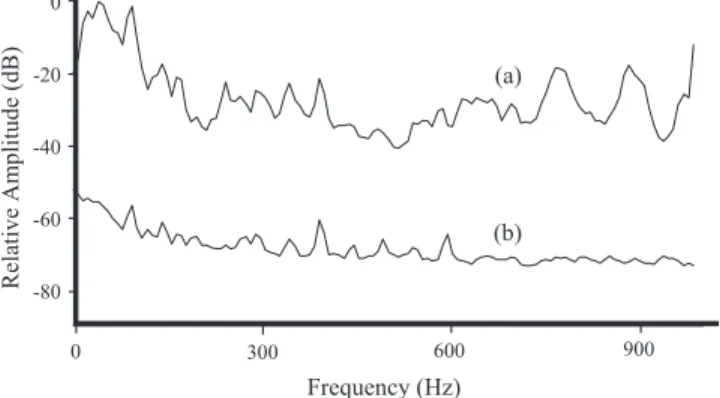
Experiments were conducted between January and Sep-tember 2005. Trials were conducted in two aquaria 共120 ⫻60⫻45 cm high兲 placed on top of a concrete plate sup-ported by two rockwool blocks 共100⫻50⫻30 cm兲. This setup proved to be effective to minimize external noise trans-mitted through the building improving considerably noise to signal ratio at the low frequencies considered in this study 共Fig. 1兲. Each experimental tank was divided transversally
a兲Electronic mail: [email protected] 1 2 3 4 5 6 7 8 9 10 11 12 13 14 15 16 17 18 19 20 21 22 23 24 25 26 27 28 29 30 31 32 33 34 35 36 37 38 39 40 41 42 43 44 45 46 47 48 49 50 AQ: #1 51 52 53 54 55 56 57 58 59 60 61 62 63 64 65 66 67 68 69 70 71 72 73 74 75 76
PROOF COPY 052808JAS
by two opaque removable partitions into three compart-ments: one of 50 cm in the middle and two of 35 cm.
During courtship experiments, a single male was intro-duced into each of the smaller lateral compartments. These compartments were provided with terracotta pots that served as refuges and prospective spawning sites. In the central compartment, six or seven females were kept permanently. Males were left visually isolated to acclimatize for a mini-mum of 36 h prior to the beginning of the recordings. This period was required for males to become territorial, as shown by “digging” behavior around the refuge. Before the record-ing period, all electrical devices were switched off, apart from the room lights. Then, one of the opaque partitions was removed, and one male had free access to the females in the central compartment. During courtship behavior, male P. ze-bra perform a number of distinct types of displays to the females, which are not always shown in a fixed order. These include the behavioral patterns dart, quiver, lead swim, and circling with the female共Baerends and Baerends van Roon, 1950; Amorim et al., 2004兲. Although recording, we noted
which visual displays were accompanied by sound produc-tion. However, sometimes males would produce sounds when not performing any behavioral display, such as during swimming or when standing still in the water column. Once recording was complete, the tested subject was weighed共wet mass, M兲, measured 共standard length, SL兲 and returned to a stock tank. Only 12 males and 5 females emitted sounds suitable for analysis. Male size averaged 107.1 mm SL 关⫾SD 共range兲= ⫾11.8 共88.0–122.0兲 mm, where SD is stan-dard deviation兴 and 40.5 g M 关⫾9.7 共22.0–57.7兲 g兴, whereas females averaged 103.6 mm SL 关⫾0.02 共100.0– 106.5兲 mi兴 and 30.4 g M 关⫾2.5 共27.4–33.5兲 g兴.
Sounds from females were recorded from female– female interactions that naturally occurred when they were in the middle compartment isolated from the males. Sounds from male–male interactions were recorded by placing an-other male in the middle compartment 共instead of the fe-males兲, and following a similar procedure to the courtship sound recordings. Agonistic encounters consisted of frontal and lateral displays and chasing, occasionally escalating to
physical contact, including biting 共Baerends and Baerends van Roon, 1950兲. During lateral displays, animals often
quiver, a behavior that is similar to the courtship quiver. To avoid physical injuries, fish were separated before or at the first sign of escalation to physical contact.
Recordings lasted 10 min for female–female, 15 min for male–male, and 20 min for male–female interactions. The duration of the recording sessions was derived from prelimi-nary observations. All individuals were identified by natural features, such as number and position of eggspots, fin length, and marks on the body and fins.
C. Sound recording and analysis
Sounds were recorded using two High Tech 94 SSQ hy-drophones 共sensitivity of −165 dB re 1 VPa−1, flat
fre-quency response ⫾1 dB up to 6 kHz兲 and a Pioneer DVD Recorder DVR-3100 共⫾1.5 dB from 40 Hz to 2 kHz, sampled at 48 kHz, 16 bit兲. One hydrophone was placed above the terracotta pot, where the territorial individuals would most likely exhibit courtship or agonistic behaviors. A second hydrophone was placed in the middle of the main compartment or in the location where individuals would more actively display at each other. The use of two hydro-phones improved the probability of recording sounds close to the sound producer and also provided information on the degradation of the acoustic signals with distance. Recorded sounds could be attributed to the subject males because their intensity varied with distance from the hydrophones and were consistently associated with particular courtship dis-plays.
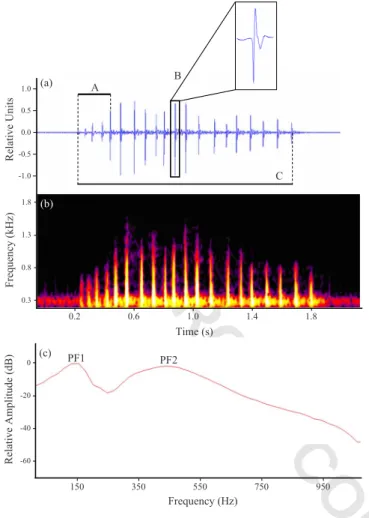
Sounds were analyzed with Adobe Audition 2.0.共Adobe Systems Inc., 2005兲 and Raven 1.2.1 for Windows 共Cornell Lab of Ornithology, 2003兲. Only sounds that showed a clear structure and a high signal-to-noise ratio were considered. These were typically recorded at a distance of 1-2 body lengths of the focal fish. The acoustic parameters analyzed 共Fig.2兲 were sound duration; number of pulses in a sound;
mean pulse period of the entire sound共Mean PP兲; and sound-peak frequency共for a description of the acoustic parameters seeAmorim et al., 2004兲. In addition, other parameters also
considered included the mean pulse period of the first five pulses in a sound共Initial PP兲, and a second previously unde-tected sound-peak frequency共PF1兲 typically around 150 Hz, which is of higher energy than the sound peak in the 450 Hz region共PF2兲 described byAmorim et al.共2004兲. PF1 is eas-ily confounded with background noise if the recording aquarium is insufficiently acoustically insulated. When com-paring an uninsulated stock tank with the experimental tanks, background noises differed by approximately 50 dB at 100 Hz, i.e., around the frequency region of PF1, and by 30 dB at 450 Hz, i.e., around the frequency of PF2共Fig.1兲.
Temporal features were measured from oscillograms and sound peak frequencies from power spectra based on 2048 point FFT with a Hamming window applied. Data are pre-sented in relative units as it was not possible to measure absolute sound levels.
Statistical analyses were performed using Statistica 7.0 共StatSoft Inc., 2005兲. Nonparametric statistics were used
Frequency (Hz) 0 -20 -40 -60 -80 0 300 600 900 (b) (a) Re lat ive Amp li tu de (d B )
FIG. 1. Comparison between spectra of laboratory background noise re-corded in共a兲 a stock tank, placed on top of a thin layer 共2 cm兲 of expanded polystyrene and in共b兲 an experimental tank, placed on top of a thick layer 共50 cm兲 of rockwool. Amplitude levels 共dB兲 are relative to the maximum value of the spectra. Sampling frequency 48 kHz, 2048 point FFT, filter bandwidth 15 Hz, Hamming window, and 50% overlap.
77 78 79 80 81 82 83 84 85 86 87 88 89 90 91 92 93 94 95 96 97 98 99 100 101 102 103 104 105 106 107 108 109 110 111 112 113 114 115 116 117 118 119 120 121 122 123 124 125 126 127 128 129 130 131 132 133 134 135 136 137 138 139 140 141 142 143 144 145 146 147 148 149 150 151 152 153 154 155 156 157 158 159 160 161 162 163 164 165 166 167 168 169 170 171 172 173
PROOF COPY 052808JAS
whenever the assumptions for parametric tests were not met after applying data transformations. One-way analysis of variance共ANOVA兲 was used to compare differences among means of the acoustic parameters of male courtship quiver sounds. The square root transformation was applied to the number of pulses to meet the ANOVA assumptions. Spear-man rank correlation was used to estimate whether courtship quiver sound parameters were related to male morphological features 共standard length, weight, and number of eggspots兲. Twelve males with an average of 17 sounds per male共⫾12.1 SD兲 were considered for these analyses.
The Kruskal–Wallis nonparametric test was used to compare the acoustic characteristics of sounds produced dur-ing different stages of courtship共lead swim, quiver, no visual display, and circle兲. Because few interactions proceeded to late stages of courtship, relatively few sounds were recorded during activities characteristic of such phases. The following sample sizes were considered: 36 quiver sounds from 9 males; 12 lead-swim sounds from 5 males; 10 circle sounds from 1 male; and 8 no display sounds from 4 males. Note that in this analysis, data concerning quiver sounds were re-stricted to 36 randomly selected sounds from 9 males from the whole data set 共i.e., 4 sounds per each male兲, to avoid
large imbalances between factor levels sample sizes. Circling sounds were extremely hard to record, not only due to the fact that this species rarely got to the ending stages of court-ship during trials, but also because circling did not always occur near the hydrophone. Thus, even though a few other circling interactions were observed, it was possible in only one case to analyze their uttered sounds. Nevertheless, the comparison between circling and other sounds seemed nec-essary to ascertain the variability in the acoustic repertoire of this species and was included for analyses. Post-hoc pairwise comparisons were made with Dunn tests to determine differ-ences between groups of courtship behaviors共Zar, 1984兲.
The hypothesis that sounds produced by males when courting females could be different from those produced by both sexes during agonistic interactions was also tested with one-way ANOVA. For these analyses, 198 courtship quiver sounds from the 12 analyzed males 共i.e., all quiver sounds recorded during courtship interactions兲, as well as 124 ago-nistic sounds emitted by 9 males and 27 sounds produced in agonistic contexts by 5 females were considered. An average of 14 sounds 共⫾4.4兲 and 5 sounds 共⫾2.1兲 were considered per male and per female, respectively, in agonistic contexts. The square root transformation was applied to the number of pulses, whereas logarithmic transformations were carried out for sound duration and the mean pulse period of the first five pulses to meet the requirements of normality and homosce-dasticity. Because PF2 is correlated with male SL 共see Sec. III兲, an analysis of covariance 共ANCOVA兲 was used to com-pare this frequency parameter among sexes and social con-text, having fish SL as a covariate to control for the effect of male size. Post-hoc pairwise comparisons were made with Tukey tests for unequal sample sizes.
III. RESULTS
A. Male courtship sounds
During intersexual courtship trials, female sounds were not detected. Focal male Pseudotropheus zebra varied in their tendency to court females. Sounds were more fre-quently produced when individuals from both sexes showed a greater courtship activity. Eight of the twenty males tested neither attempted courtship nor produced any sound suitable for analysis. Only four males displayed late-stage courtship behavior. Most recorded sounds 共86.4%兲 were produced by males during quivering, the main early stage courtship be-havior. Because few encounters proceeded to the late stages of courtship, such as lead swim and circle, there was a rela-tively scarce sample共13.2%兲 of sounds produced during final courtship.
Male quiver sounds had two main sound-peak frequen-cies at approximately 150 Hz共PF1兲 and 450 Hz 共PF2兲. The mean quiver sound duration was around 700 ms with ap-proximately 9 pulses per sound. The mean pulse period was approximately 90 ms and the initial pulse period circa 80 ms. There were significant differences between males in all sonic characteristics measured, except for sound duration共TableI兲.
Intraindividual variation was generally high, especially for sound duration and number of pulses and lowest for PF1 and PF2, as shown by their coefficients of variation 共TableI兲.
Frequency (kHz) C B A (a) 1.8 1.3 0.8 0.3 Time (s) 0.2 0.6 1.0 1.4 1.8 (b) Rel ative Units Re lat ive Amp li tu de (d B ) (c) PF1 PF2 Frequency (Hz) 0 -20 -40 -60 1.0 0.5 0.0 -0.5 -1.0 150 350 550 750 950
FIG. 2.共Color online兲 共a兲 Oscillogram, 共b兲 sonogram, and 共c兲 power spec-trum of a Pseudotropheus zebra male courtship sound, representing some of the acoustic parameters measured: mean pulse period of the共A兲 first five pulses, 共B is an example of a pulse兲 number of pulses, and 共C兲 sound duration in共a兲 and peak frequency 1 共PF1兲 and 2 共PF2兲 in 共c兲. Sampling frequency 48 kHz, 2048 point FFT, filter bandwidth 15 Hz, Hamming win-dow, and 50% overlap.
174 175 176 177 178 179 180 181 182 183 184 185 186 187 188 189 190 191 192 193 194 195 196 197 198 199 200 201 202 203 204 205 206 207 208 209 210 211 212 213 214 215 216 217 218 219 220 221 222 223 224 225 226 227 228 229 230 231 232 233 234 235 236 237 238 239 240 241 242 243 244 245 246 247 248 249 250 251 252 253
PROOF COPY 052808JAS
Larger males produced quiver courtship sounds with lower frequencies at PF2 共mass: rS= −0.62, N = 12, P
= 0.028; length: rs= −0.81, N = 12, P = 0.001兲. Eggspot
num-ber was not significantly related to male size 共M and SL: rs= 0.50, P⬎0.05兲. Males with larger number of eggspots
tended to make calls with lower PF1 frequencies共rs= −0.82,
N = 9, P = 0.001兲 and higher pulse repetition rates, i.e., shorter pulse periods共mean pulse period: rs= −0.68, N = 9, P = 0.04兲.
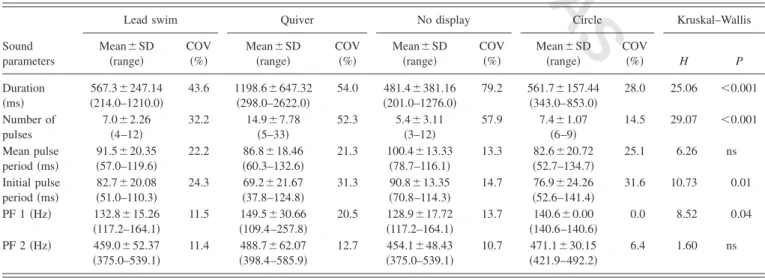
The duration of sounds and their number of pulses dif-fered according to the courtship behavior performed by the males with longer sounds containing more pulses emitted during quivering bouts 共Table II, Fig. 3兲. The mean pulse
period of the first five pulses was shorter in sounds associ-ated with quivering than in sounds registered when males
were not displaying, with lead-swim and circle sounds being intermediate共TableII, Fig.3兲. The PF1 also differed
signifi-cantly according to which behavior the sound was associated with共TableII兲, but Dunn tests were unable to distinguish any
pair of behavioral categories. B. Agonistic sounds
Sound production by males during agonistic interactions frequently occurred after a brief fight, where males would silently display frontally or laterally. Following such a con-test, the dominant male 共normally the resident or the larger fish兲 displayed laterally and quivered to the submissive male. Submissive males rapidly lost their bright colors, becoming
TABLE I. Characteristics of sounds produced by P. zebra males and females during quiver in inter- and intrasexual interactions共male–female—courtship interactions; male–male and female–female—agonistic interactions兲. Means, SD, and range are based on fish means. Coefficients of variation 共COV = SD/mean⫻100兲 represent intraindividual variability of the acoustic parameters. Results for one-way ANOVA testing differences between males for courtship quiver acoustic parameters, and testing differences between sounds made during different contexts and gender are presented.
Male–female Male–Male Female–female
Differences between males 共courtship quiver兲 Differences between contexts/gender Sound parameters Mean⫾SD 共range兲 COV 共%兲 Mean⫾SD 共range兲 COV 共%兲 Mean⫾SD 共range兲 COV 共%兲 F11,186 P F2,23 P Duration 共ms兲 671.7⫾135.59 共421.4–856.8兲 60.37 960.5⫾295.29 共549.1–1429.5兲 69.13 524.2⫾152.95 共358.3–732.6兲 72.00 0.87 ns 8.56c 0.002 Number of pulses 8.6⫾1.67 共6.6–12.4兲 51.23 8.7⫾3.48 共4.7–13.8兲 52.59 4.9⫾0.99 共3.8–6.3兲 52.46 1.86a 0.047 6.16a 0.007 Mean pulse period共ms兲 86.8⫾14.37 共67.5–113.3兲 22.32 125.7⫾23.91 共90.1–160.9兲 36.39 123.8⫾27.06 共92.9–165.3兲 39.83 3.69 ⬍0.001 11.10 ⬍0.001 Initial pulse period共ms兲 76.7⫾15.31 共52.1–103.6兲 26.43 110.8⫾27.97 共79.2–149.8兲 34.64 116.7⫾34.52 共91.7–176.4兲 41.15 3.77 ⬍0.001 8.45c 0.002 PF1共Hz兲 155.6⫾26.20 共129.4–220.7兲 15.17 138.0⫾14.97 共117.2–164.1兲 5.99 143.1⫾6.72 共133.9–152.3兲 8.33 10.80 ⬍0.001 2.04 ns PF 2共Hz兲 488.8⫾40.84 共423.9–557.8兲 8.77 462.9⫾35.40 共433.6–550.8兲 6.06 480.2⫾29.14 共445.3–525.0兲 8.05 8.13b ⬍0.001 1.80b ns Squared root transformation is applied.
Results from ANCOVA using fish SL as a covariate. Logarithmic transformation is applied.
TABLE II. Characteristics of courtship sounds made by P. zebra during lead swim, quiver, with no associated display and circle. Data are pooled for all recorded individuals due to the small sample size共for quiver sounds only a subsample of 4 sounds per male was considered in the analyses—see Sec. II兲. Coefficients of variation are also given: COV= SD/mean⫻100. Results for Kruskal–Wallis statistics testing differences between sounds associated with different courtship behaviors are presented.
Lead swim Quiver No display Circle Kruskal–Wallis Sound parameters Mean⫾SD 共range兲 COV 共%兲 Mean⫾SD 共range兲 COV 共%兲 Mean⫾SD 共range兲 COV 共%兲 Mean⫾SD 共range兲 COV 共%兲 H P Duration 共ms兲 567.3⫾247.14 共214.0–1210.0兲 43.6 1198.6⫾647.32 共298.0–2622.0兲 54.0 481.4⫾381.16 共201.0–1276.0兲 79.2 561.7⫾157.44 共343.0–853.0兲 28.0 25.06 ⬍0.001 Number of pulses 7.0⫾2.26 共4–12兲 32.2 14.9⫾7.78 共5–33兲 52.3 5.4⫾3.11 共3–12兲 57.9 7.4⫾1.07 共6–9兲 14.5 29.07 ⬍0.001 Mean pulse period共ms兲 91.5⫾20.35 共57.0–119.6兲 22.2 86.8⫾18.46 共60.3–132.6兲 21.3 100.4⫾13.33 共78.7–116.1兲 13.3 82.6⫾20.72 共52.7–134.7兲 25.1 6.26 ns Initial pulse period共ms兲 82.7⫾20.08 共51.0–110.3兲 24.3 69.2⫾21.67 共37.8–124.8兲 31.3 90.8⫾13.35 共70.8–114.3兲 14.7 76.9⫾24.26 共52.6–141.4兲 31.6 10.73 0.01 PF 1共Hz兲 132.8⫾15.26 共117.2–164.1兲 11.5 共109.4–257.8兲149.5⫾30.66 20.5 共117.2–164.1兲128.9⫾17.72 13.7 共140.6–140.6兲140.6⫾0.00 0.0 8.52 0.04 PF 2共Hz兲 459.0⫾52.37 共375.0–539.1兲 11.4 488.7⫾62.07 共398.4–585.9兲 12.7 454.1⫾48.43 共375.0–539.1兲 10.7 471.1⫾30.15 共421.9–492.2兲 6.4 1.60 ns 254 255 256 257 258 259 260 261 262 263 264 265 266 267 268 269 270 271 272 273 274 275 276 277 278 279
PROOF COPY 052808JAS
pale. They sometimes bit at the dominant male’s anal fin eggspots, in a similar manner to a female during courtship. Commonly, dominant males produced sounds during such agonistic quivering. In female-female encounters, sounds were generally produced during agonistic quivers, often by females that showed sexual readiness or during mouthbrood-ing, which also seemed to be more aggressive共three out of five females producing recorded sounds were mouthbrood-ing兲.
Sounds produced in male–female, male–male, and female–female encounters differed significantly in all tempo-ral parameters but not in the frequency domain共TableI, Figs.
4and5兲. Male sounds were longer and included more pulses
than those emitted by females; moreover, male sounds also differed in duration according to social context 共Fig. 4兲.
Courting male sounds also showed significantly shorter ini-tial and mean pulse periods than agonistic sounds by either sex共Fig.4兲.
IV. DISCUSSION
A. Male courtship sounds
The present study has shown that Pseudotropheus zebra males produce sounds not only in the early stages of court-ship, during quiver, but also during courtship displays that occur closer to spawning. Moreover, the sound production in
the presence of females but without any other noticeable be-havioral display, consistent with observations on another Malawian haplochromine cichlid Tramitichromis interme-dius, suggests that sound can be a purposely generated uni-modal courtship display 共Ripley and Lobel, 2004兲.
Courtship sounds varied in their characteristics
accord-FIG. 3. Variation of courtship sound parameters in Pseudotropheus zebra males during lead swim共LS兲, quiver 共Q兲, sounds produced with no apparent body movement共X兲, and circle 共C兲. Groups that are significantly different 共␣= 0.05兲 are indicated by different letters 共results from Tukey tests兲. Both “Mean PP” and “Initial PP” refers to mean values of pulse periods; whereas the first is the mean of the pulse periods throughout the entire sound, the second indicates the mean of the first five pulses. Note that comparisons considered data pooled for all males due to the small sample sizes obtained for LS, X, and C. Only a subsample of quiver sounds was considered for the analyses共see methods兲.
FIG. 4. Variation of the acoustic parameters of quiver sounds emitted in courtship共male–female兲 and agonistic interactions 共male–male and female– female兲 by Pseudotropheus zebra. Groups that are significantly different 共␣= 0.05兲 are indicated by different letters 共results from Dunn tests兲.
FIG. 5. Oscillograms of sounds produced associated with different contexts and gender:共A兲 male courtship quiver, 共B兲 circle, 共C兲 male agonistic quiver, and共D兲 female agonistic quiver. Sampling frequency 48 kHz.
280 281 282 283 284 285 286 287 288 289 290 291 292 293 294 295 296 297 298 299 300 301 302 303 304 305 306 307 308 309
PROOF COPY 052808JAS
ing to the associated courtship behavior, being longer and with a higher pulse rate during quivering 共Fig.3兲. Although
only a small sample size of late stage courtship sounds was recorded, the present results indicate that acoustic communi-cation is more diversified during the courting activities than previously reported. In other cichlids, sound production seems mostly restricted to male quivering during the early stages of courtship 共Ripley and Lobel, 2004, reviewed in
Amorim et al., 2004兲, except in the Mozambique tilapia
Oreochromis mossambicus that produces sounds throughout courtship共Amorim et al., 2003兲. In O. mossambicus, sounds
are longer and with a faster pulse rate during the late-courtship behavior of tail wagging共Baerends and Baerends van Roon, 1950兲 than during other courtship activities
共Amorim et al., 2003兲. Although performed in different
phases of courtship, the quivering of P. zebra and the tail wagging of O. mossambicus are probably equivalent in func-tion. Both consist of displays in which males quiver their bodies vigorously, simultaneously emitting sounds in close proximity of the female, and may convey information of their quality and motivation. In addition, both P. zebra and O. mossambicus males may quiver and tail wag in all stages of courtship 共Baerends and Baerends van Roon, 1950兲,
par-ticularly when females begin to wander out of a male’s core spawning area.
Male motivation and quality may be advertised by higher calling rates, longer calls, and higher pulse repetition rates that are likely to be more energetically expensive. At least in some species these parameters may be assessed by females during mate choice. For example, in the gray tree frog Hyla versicolor, females prefer longer male calls with a higher pulse number to shorter calls共Gerhardt et al., 2000兲,
and this parameter is an indicator of male genetic quality 共Welch et al., 1998兲. In fishes,Thorson and Fine共2002兲 dem-onstrated that males Opsanus beta call faster at twilight, shortening and simplifying their multiboop calls, suggesting a tradeoff between call repetition rate and complexity in fe-male choice. In invertebrates, pulse number and rate, to-gether with sound frequency, are the most important acoustic features involved in female choice共e.g., Simmons, 1988兲.
Other sound parameters may transmit additional infor-mation relevant to female mate choice. Quiver sounds dif-fered considerably among individual males, for example with larger males producing lower frequencies at PF2. This parameter was also the one that showed the least intraindi-vidual variation共TableI兲, probably because it may be
depen-dent on male size共Lobel, 2001;Amorim et al., 2003兲 rather
than motivation. Male size is often regarded as an indication of higher fitness and in cichlids may be related to social status and breeding success共e.g.,Oliveira et al., 1996兲.
The association of courtship quiver sound parameters 共PF1 and pulse period兲 with the number of eggspots in the anal fin is less obviously explicable. Perhaps these param-eters are independent indicators of some common cause, such as overall male fitness. Eggspot number was correlated with fish size in other cichlids共Goldschmidt, 1991兲, although
it does not seem the case in P. zebra perhaps because of species differences or the restricted size of fish used. Females of several haplochromine cichlids are known to choose
mat-ing partners on the basis of their eggspot number 共 Could-ridge and Alexander, 2001兲 and in some Pseudotropheus
spe-cies, females prefer a larger number of eggspots共Couldridge and Alexander, 2001兲. In P. zebra, lower sound-peak
fre-quency at PF2 and especially higher pulse rate may indicate better male condition and could be used with additional vi-sual cues from the eggspots in mate sexual selection.
B. Agonistic sounds
Sound produced by both sexes during agonistic contexts is described in this study for P. zebra for the first time and has been documented for a number of cichlid species 共re-viewed by Lobel, 1998; Amorim, 2006兲. We found several
significant differences in the sounds produced in agonistic context by males and females 共Fig. 4兲. Aggressive males
produced significantly longer and more pulsed sounds than females. In addition, male sounds also differed according to the social context. Courtship sounds were shorter and also had a faster pulse repetition rate than male agonistic sounds 共Fig.4兲. In line with our observations, in the croaking
goura-mis共Trichopsis vittata兲, where only females produce sounds during mating共Brittinger, 1991;Ladich, 2007兲, female
court-ship croaks are also produced at a faster rate than the aggres-sive croaks produced by both sexes共Brittinger, 1991兲.
Simi-larly, the intervals between the double pulses that make up a croak also differ between sexes and social context 共 Brit-tinger, 1991兲. Although there are relatively few published
quantitative comparisons of the influence of sex and social context on fish sounds, taken together, the results with T. vittata and the present study data with P. zebra suggest that temporal parameters of fish sounds may contain information on the motivation and gender of the sound producer. Sounds may carry information about male quality or motivation, which may influence the outcome of contests, in a manner similar to that proposed for female mating decisions. Play-back of conspecific aggressive sounds may inhibit aggression in Cichlasoma 共now Archocentrus兲 centrarchus, a Central American cichlid fish 共Schwarz, 1974兲, whereas Trichopsis
males that vocalized during contests had an increased chance of winning 共Ladich et al., 1992兲. In other taxa, a classical
example is provided by male toads, Bufo bufo, that settle contests for the possession of females by signaling body size and hence fighting ability with call frequency 共Davies and Halliday, 1978兲.
Sound production by female P. zebra was noted in a previous study, but not analyzed or compared with sounds made by males共Amorim et al., 2004兲. Sound was only
pro-duced when females appeared to be sexually receptive共when the ovipositor was visible兲 or mouthbrooding, both situations where females typically become more aggressive. Similarly, sound production by mouthbrooding females has been docu-mented for O. mossambicus 共Marshall, 1971兲. In another
cichlid fish, A. centrarchus, both sexes made sounds during the breeding cycle in an aggressive context共Schwarz, 1980兲.
Females of this substrate spawning species emit sounds mainly during brood defence but also during nest preparation before spawning. It has been suggested that sound produc-tion by female fish may be more frequent than previously
310 311 312 313 314 315 316 317 318 319 320 321 322 323 324 325 326 327 328 329 330 331 332 333 334 335 336 337 338 339 340 341 342 343 344 345 346 347 348 349 350 351 352 353 354 355 356 357 358 359 360 361 362 363 364 365 366 367 368 369 370 371 372 373 374 375 376 377 378 379 380 381 382 383 384 385 386 387 388 389 390 391 392 393 394 395 396 397 398 399 400 401 402 403 404 405 406 407 408 409 410 411 412 413 414 415 416 417 418 419 420 421 422 423 424 425
PROOF COPY 052808JAS
thought, perhaps because the sound producing apparatus is often less developed than in the male, resulting in weaker vocalizations, which are harder to detect 共Hawkins, 1993;
Ladich, 2007兲.
C. Concluding remarks
The variation in sounds we have documented indicates that P. zebra vocalizations have the potential to carry infor-mation about sex, size, motivation, and other fitness param-eters that may play a role in sexual selection. Although ab-solute sound pressure levels have yet to be measured, it is clear that the sounds made by P. zebra are of low amplitudes and attenuate severely within short distances from the sender 共Fig.6兲, and it is unlikely that they are used to attract mating
partners or to repel rivals at distance 共Krebs et al., 1978兲.
More probably, and consistent with the behavioral contexts in which the sounds were observed, acoustic signals may be important during close-range encounters already initiated on the basis of visual signals. As females may reject males at this stage of a courtship sequence, and territorial rival males may decide to flee or continue fighting, close range sounds may play a major and complex role in the social behavior of P. zebra and other African cichlid fishes.
This study is a detailed description of sounds produced during courtship and agonistic interactions in the cichlid Pseudotropheus zebra and reveals an acoustic repertoire richer than previously thought. It emphasizes the need of additional research to clarify the behavioral functions of the sounds that may have also played a role in the rapid specia-tion of African cichlids.
ACKNOWLEDGMENTS
The authors are grateful to J. Simões senior for the lo-gistic support, N. Wreathall for helping with the fish ship-ment, and all of those who helped building the tanks and maintaining the fish. This study was supported by the Natural Environment Research Council共NERC兲 that initially funded our collections of fish from Malawi, Program No. POCTI-ISFL-4-329/FCT, 共UI&D 331/94兲/FCT and a Grant No. POSI SFRH/BPD/14570/2003/FCT共MCA兲.
Albertson, R. C., Streelman, J. T., and Kocher, T. D.共2003兲. “Directional selection has shaped the oral jaws of Lake Malawi cichlid fishes,” Proc. Natl. Acad. Sci. U.S.A. 100, 5252–5257.
Amorim, M. C. P.共2006兲. “Diversity of sound production in fish,”
Commu-nication in Fishes, edited by F. Ladich, S. P. Collin, P. Moller, and B. G.
Kapoor共Science Publishers, Enfield兲, Vol. I, pp. 71–104.
Amorim, M. C. P., Fonseca, P. J., and Almada, V. C.共2003兲. “Sound pro-duction during courtship and spawning of the cichlid Oreochromis
mossa-mbicus: male-female and male-male interactions,” J. Fish Biol. 62, 658–
672.
Amorim, M. C. P., Knight, M. E., Stratoudakis, Y., and Turner, G. F.共2004兲. “Differences in sounds made by courting males of three closely related Lake Malawi cichlid species,” J. Fish Biol. 65, 1358–1371.
Baerends, G. P., and Baerends van Roon, J. M.共1950兲. “An introduction to the study of the ethology of cichlid fishes,” Behaviour 1, 1–235. Brittinger, W.共1991兲. “The significance of the sound generating organ in the
behavioural context in Trichopsis vittatus共Cuvier and Valencienne, 1831兲 共Belontiidae, Teleostei兲,” M.Sc. thesis, Univ. of Vienna, Vienna, Austria 共in German兲.
Couldridge, V. C. K., and Alexander, G. J. 共2001兲. “Color patterns and species recognition in four closely related species of Lake Malawi cichlid,” Behav. Ecol. 13, 59–64.
Davies, N. B., and Halliday, T. R.共1978兲. “Deep croaks and fighting assess-ment in toads, Bufo bufo,” Nature共London兲 74, 683–685.
Genner, M. J., and Turner, G. F. 共2005兲. “The mbuna cichlids of Lake Malawi: a model for rapid speciation and adaptive radiation,” Fish Fish. 6, 1–34.
Gerhardt, H. C., Tanner, S. D., Corrigan, C. M., and Walton, H. C.共2000兲. “Female preference functions based on call duration in the gray tree frog 共Hyla versicolor兲,” Behav. Ecol. 11, 663–669.
Goldschmidt, T. 共1991兲. “Egg mimics in Haplochromine cichlids 共Pisces, Perciformes兲 from Lake Victoria,” Ethology 88, 177–190.
Hawkins, A.共1993兲. “Underwater sound and fish behaviour,” Behavior of
Teleost Fishes, 2nd ed., edited by T. Pitcher共Chapman and Hall, London兲,
pp. 129–169.
Krebs, J., Ashcroft, R., and Webber, M.共1978兲. “Song repertoires and ter-ritory defence in the great tit,” Nature共London兲 271, 539–542. Ladich, F., Brittinger, W., and Kratochvil, H.共1992兲. “Significance of
ago-nistic vocalization in the croaking gourami 共Trichopsis vittatus, Teleo-stei兲,” Ethology 90, 307–314.
Ladich, F.共2007兲. “Females whisper briefly during sex: context- and sex-specific differences in sounds made by croaking gouramis 共Teleosts兲,” Anim. Behav. 73, 379–387.
Lobel, P. S.共1998兲. “Possible species specific courtship sounds by two sym-patric cichlid fishes in Lake Malawi, Africa,” Environ. Biol. Fishes 52, 443–452.
Lobel, P. S. 共2001兲. “Acoustic behavior of cichlid fishes,” J. Aquaricult. Aquat. Sci. 9, 167–186.
Marshall, J. A.共1971兲. “Sound production by Tilapia mossambica 共Pisces: Cichlidae兲,” Am. Zool. 11, 632.
Oliveira, R. F., Almada, V. C., and Canário, A. V. M.共1996兲. “Social modu-lation of sex steroid concentrations in the urine of male cichlid fish
Oreo-chromis mossambicus共Teleostei: Cichlidae兲,” Horm. Behav. 30, 2–12.
Ripley, J. L., and Lobel, P. S.共2004兲. “Correlation of acoustic and visual communication in the Lake Malawi cichlid Tramitichromis intermedius,” Environ. Biol. Fishes 71, 389–394.
Schmitt, A., Friedel, T., and Barth, F. G. 共1993兲. “Importance of pause between spider courtship vibrations and general problems using synthetic stimuli in behavioral studies,” J. Comp. Physiol. 172, 707–714. Schwarz, A.共1974兲. “Sound production and associated behavior in a cichlid,
Cichlasoma centrarchus,” Z. Tierpsychol 35, 147–156.
Schwarz, A. L. 共1980兲. “Sound production and associated behavior in a cichlid fish, Cichlasoma centrarchus. II. Breeding pairs,” Environ. Biol. Fishes 5, 335–342.
Simmons, L. W. 共1988兲. “The calling song of the field cricket, Gryllus
bimaculatus共De Geer兲: constraints on transmission and its role in
inter-male competition and feinter-males choice,” Anim. Behav. 36, 380–394. Thorson, R. F., and Fine, M. L.共2002兲. “Crepuscular changes in emission
Rel ative Units Time (s) 0.0 0.1 0.2 0.3 0.4 0.5 0.6 0.7 0.8 (b) (a) -1.0 0.5 0.0 -0.5 -1.0 -0.5 0.0 -0.5
FIG. 6. Oscillograms of a courtship sound produced by a Pseudotropheus
zebra male recorded at a distance of 共a兲 5 cm and 共b兲 40 cm from the
hydrophone, in this case, sound attenuation was approximately 20 dB. Sam-pling frequency 48 kHz. 426 427 428 429 430 431 432 433 434 435 436 437 438 439 440 441 442 443 444 445 446 447 448 449 450 451 452 453 454 455 456 457 458 459 460 461 462 463 464 465 466 467 468 469 470 471 472 473 474 475 476 477 478 479 480 481 482 483 484 485 486 487 488 489 490 491 492 493 494 495 496 497 498 499 500 501 502 503 504 505 506 507 508 509 510 511 512 513 514 515 516 517 518 519 520 521 522 523 524 525 526 527 528 529 530 531 AQ: #2 AQ: #3
PROOF COPY 052808JAS
rate and parameters of the boatwhistle advertisement call of the gulf toad-fish, Opsanus beta,” Environ. Biol. Fishes 63, 321–331.
Turner, G. F.共1999兲. “Explosive speciation of African cichlid fishes,”
Evo-lution of Biological Diversity, edited by A. E. Magurran and R. M. May
共Oxford University Press, Oxford兲, pp. 217–229.
Welch, A. M., Semlitsch, R. D., and Gerhardt, H. C.共1998兲. “Call duration as a reliable indicator of genetic quality in the gray tree frog,” Science
280, 1928–1930.
Zar, J. H.共1984兲. Biostatistical Analysis, 2nd ed. 共Prentice–Hall, Englewood cliffs, NJ兲. 532 533 534 535 536 537 538 539 540 541
PROOF COPY 052808JAS
AUTHOR QUERIES — 052808JAS#1 AQ: Myrberg-Not in reference list
#2 AQ: Please supply full journal title, CODEN and/or ISSN for Refs. Couldridge and Alexander 2001, Ripley and Lobel 2004, Genner and Turner 2005, Schwarz 1980, Gerhardt et al. 2000, Thorson and Fine 2002, Lobel 1998 and 2001
#3 AQ: Are the following references in text? If not, please either cite them in text or delete them from the reference list: Schmitt et al. 1993