Spatial and seasonal changes in benthic macrofauna from two dissipative
sandy beaches in eastern Brazil)*
Praias arenosas são ambientes dinâmicos com
in-teração entre sedimento, energia de ondas e marés,
com marcantes efeitos sobre assembléias
bentôni-cas. Existem numerosos esforços no entendimento
da variação espaço-temporal da macrofauna
bentô-nica em praias no Brasil, sendo a maioria
concen-trados na Ecorregião Marinha Sudeste e Rio Grande
(20
oS a 35
oS), mas limitada amostragem em praias
tropicais na Ecoregião Marinha Leste (EML). Este
estudo examinou as escalas de variabilidade
espa-ço-temporal da macrofauna bentônica (> 500 µm)
através de amostragem hierárquica em duas praias
dissipativas dentro da EML em duas estações
(inver-no de 2011/verão de 2012). Testou-se a hipótese que
mudanças espaciais (escala de metros a centenas de
metros) na estrutura das assembléias bentônicas são
menos pronunciadas em comparação com as fracas
-contradas pequenas mudanças espaço-temporais na
diferenças nas assembléias macrofaunais.
Contra-riando a hipótese deste estudo, a amostragem
hierár
-ção e densidade da macrofauna em múltiplas escalas
locais (metros a centenas de metros) e em escalas
temporais. A densidade e composição da
macrofau-na está relaciomacrofau-nada com mudanças no teor de
maté-ria orgânica do sedimento e tamanho do grão.
Descritores: Praias arenosas, Macrofauna, Ecologia
Bêntica, Ecorregião Marinha Leste.
A
BSTRACT
Mariane Silva Coutinho
1**,
Angelo Fraga Bernardino
11
(Avenida Fernando Ferrari, 514 – Vitória - Espírito Santo, 29075-910 – Brazil)
** Corresponding author: [email protected]
Sandy beaches are dynamic ecosystems with strong
interaction of sediments, waves and tidal energy,
-spatial-temporal variation of benthic macrofauna on
sandy beaches along the southern and southeastern
Marine Ecoregions in Brazil, there is poor sampling
along beaches of the Eastern Marine Ecoregion
(EME). Here we examined spatial and temporal
scales of variability in benthic macrofauna (> 500
µm) through a hierarchical sampling of two
dissi-pative sandy beaches within the EME between two
seasons (winter 2011 and summer 2012). We tested
the hypothesis that spatial changes (i.e., meters to
hundreds of meters scales) in the structure of benthic
assemblages will be more pronounced compared to
-gion. We found weak temporal and spatial changes
-ences in macrofaunal assemblages were evident.
Contrary to our hypothesis, hierarchical sampling
-position and density at multiple local scales (meters
to hundreds of meters) and on seasonal scales. The
macrofauna density and composition was directly
related to changes on the sediment organic matter
and grain size.
Descriptors: Sandy beaches, Macrofauna, Benthic
ecology, Eastern Marine Ecoregion.
R
ESUMO
Received: November 9, 2015 Approved: July 7, 2017
* Paper presented in the International Sandy Beach Symposium, 7. 2015, Ilhabela, São Paulo, Brazil .
BRAZILIAN JOURNAL OF OCEANOGRAPHY, 65(4):666-677;2017
Coutinho & Bernardino: Changes in benthic macrofauna from beaches
667
INTRODUCTION
Sandy beaches are dynamic ecosystems physically
structured by sediment particle size, waves and tidal en -ergy. They are at the transition between continents and oceans and have societal and ecological importance. Sandy beaches dominate the world’s coastlines in temperate and
tropical zones, are important sites for human recreation
maintaining many coastal economies around the world, and provide habitat for a diversity of terrestrial and
ma-rine life (MCLACHLAN; ERASMUS, 1983; ALONGI, 1998; MCLACHLAN; BROWN, 2006; SCHLACHER et al., 2007; DEFEO; MCLACHLAN, 2013). These ecosys -tems host a diversity of terrestrial and marine life, with multiple ecological functions including recycling of
nutri-ents, supporting coastal fisheries though benthic produc -tion, and providing nesting sites for turtles and shorebirds
(MCLACHLAN, 1989; MCLACHLAN; BROWN, 2006;
SCHLACHERet al. 2007).
Sandy beaches differ greatly on the interaction of
physical parameters according to spatial and temporal changes in wave climate, sediment types and tidal re-gimes, which result in beach types with variable
mor-phology. Spatial differences in sandy beach morphody
-namics vary greatly; from microtidal reflective beaches
that are usually narrow, steep and with coarse sand, to macrotidal dissipative beaches that are typically wide
and flat, under high wave energy resulting in a gentle slope and fine sand (MCLACHLAN; BROWN, 2005; DEFEO; MCLACHLAN, 2005). These spatial morpho
-dynamic changes strongly influence benthic assemblage abundance, composition and diversity (e.g. BARROS et al., 2001; BARBOSA et al., 2012; CARCEDO et al., 2014). At larger scales, dissipative beaches typically have
higher diversity and biomass due to less wave energy
conditions, if compared to reflective beaches (DEFEO;
MCLACHLAN, 2005; BARBOSA et al., 2012). Spatial changes within alongshore and across-shore gradients are
also important in some sand beaches, and reflect
meter-scale gradients of physical and biological factors includ-ing food availability, wave energy and sediment transport
(DEFEO; MCLACHLAN, 2005).
Temporal changes on beach morphodynamics, food availability and climate stressors are also important to benthic macrofaunal assemblages at sand beaches
(DEFEO; MCLACHLAN, 2005). Episodic or continu -ous physical stressors, including stochastic physical events (e.g. wave climate), increasing temperatures
and a combination of local-scale chemical and biologi-cal variables can rapidly change population dynamics
of macrofaunal organisms on sandy beaches (DEFEO; MCLACHLAN, 2005; CISNEROS et al., 2011). In Brazil, there has been a continuous decadal increase on
average temperatures on all Marine Ecoregions, with potential impacts on several coastal ecosystems
includ-ing sand beaches (BERNARDINO et al., 2015; 2016; AMARAL et al., 2016). On dissipative sandy beaches,
the seasonal changes on sediment organic availability, nutrients and salinity are highly important to macrofau-nal abundance and diversity, with increases in abundance and richness in periods of higher organic availability
(CISNEROS et al., 2011). Therefore, temporal and spa -tial changes in beach productivity, temperature and mor-phodynamics are likely to cause strong impacts on its associated benthic fauna.
Sandy beaches are among the most vulnerable coastal ecosystems as they are under stress from terrestrial and
marine impacts (DEFEO et al., 2009). In Brazil, human in -terference and tourism are the main sources of disturbance
to these ecosystems (VELOSO et al., 2008). The urban
development transformed the coastal landscape with large expanses of beaches and removal of dunes to allow civil construction including barriers to protect the coastline,
which markedly change sediment transport and modified erosion processes (AMARAL et al., 2016; MUEHE, 2003; 2006). Human impacts also include tourism, which in -crease the movement of vehicles and trampling, eliminat-ing species and interfereliminat-ing in the breedeliminat-ing and nesteliminat-ing of
birds (VELOSO et al., 2008; DEFEO et al., 2009; VIEIRA
et al., 2012). These impacts result in marked changes in beach morphodynamics, altering sediment composition and beach slope leading to further impacts on the benthos
(AMARAL et al., 2016; DEFEO et al., 2009).
Brazil has more than seven thousand kilometers of
coastline, with numerous sandy beaches. These
eco-systems have been widely studied along the Brazilian
coast, with most studies in the Southeastern and Rio
Grande Marine Ecoregions (MMA, 2007; SPALDING et al., 2007, AMARAL et al., 2016). The Eastern Marine Ecoregion of Brazil (EME) has been very poorly stud -ied with respect to its sandy beach fauna, including its biodiversity and ecological patterns, which prevent as-sessment of baseline status in face of regional and
glob-al impacts on these ecosystems. For example, a recent (October 2015) environmental disaster spilled an un
coast with impacts to coastal ecosystems in the region
(MARTA-ALMEIDA et al., 2016; GOMES et al., 2017).
Several other pressures to sand beaches occur in the
re-gion, including urbanization, ports and tourism. In this
context, this study aimed to identify and describe spatial and temporal patterns of benthic macrofaunal assem-blages of two sandy beaches within the EME. Through a hierarchical spatial sampling, in two time periods (winter 2011 and summer 2012) at two beaches with similar morphology, we tested the hypothesis that spatial variations (i.e. scales of meters to hundreds of meters) in the structure of benthic assemblages would be more
significant and directly related to the abiotic variables if compared to low seasonal fluctuations in temperature,
organic availability and beach morphology.
MATERIAL AND METHODS
Study Area
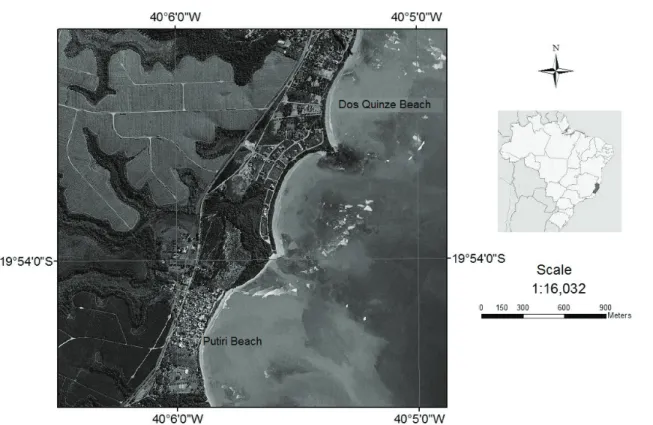
The study site is located within the EME
character-ized by a tropical climate with mean temperatures of 22-24oC and annual rainfall of 1000-1600 mm (Figure 1, SPALDING et al., 2007; BERNARDINO et al.., 2015).
Wind direction is predominantly from the East - Northeast (NE trade winds), but high intensity SE winds associated with cold fronts occasionally reach the area. The coast has a microtidal semidiurnal tidal regime (<2 m). Two sandy beaches located within an environmental protection area
were sampled, the Putiri beach (19°54’20”S, 40°5’54”W) and Dos Quinze beach (19°53′45.6″S, 40°05′31.3″W).
Both sandy beaches show retrogression due to the small river intake and abrasive vulnerability of carbonate
sands, being characterized as exposed and semi-exposed beaches with bioclastic sediments (ALBINO et al., 2001).
Abrasion terraces are located from the inner continental shelf to coastal shores, which dissipate the energy of the incident waves, reduce wave height and result in small
seasonal topographic variation of beach profiles.
BRAZILIAN JOURNAL OF OCEANOGRAPHY, 65(4):666-677;2017
Coutinho & Bernardino: Changes in benthic macrofauna from beaches
669
Sampling and Laboratory Procedures
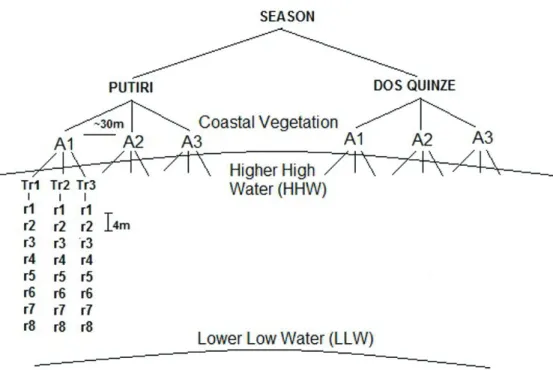
Sampling occurred during a year along six campaigns on each beach, with three random campaigns in each season (Winter 2011 and Summer 2012). Benthic mac-rofaunal assemblages were sampled from each beach in a hierarchical design. Longitudinal sampling wasran-domly divided along three areas (A1, A2 and A3, Figure
2), separated by at least 50 meters that were sampled in each campaign. Each area was subdivided into three ran-dom transects perpendicular to the shoreline, which were
systematically sampled at every 4 meters, resulting in 8-9 replicates (each with 0,0314 m2, 20cm depth) distributed along the intertidal area, totaling 894 samples of fauna (14
m2 sampled in each beach). Macrofaunal samples were fixed in 4% formalin in the field, washed on a 500µm mesh and preserved on 70% ETOH in the laboratory. Samples were sorted, and the fauna identified into spe -cies whenever possible. The biomass (wet weigth) was determined by measuring preserved specimens divided
into five major taxonomic groups including Annelida, Nemertean, Isopoda, Amphipod and Others (AMARAL; ROSSI-WONGTSCHOWSKI, 2004). Salinity and water
temperature were determined with a multiparameter. Wave height (Hb), period (T) and beach topography were also determined in each beach and campaign by standard
pro-tocols (EMERY, 1961). Beach stage (Ω) was determined by Dean’s parameter (WRIGHT; SHORT, 1984).
Sediment samples were also sampled for grain size,
total organic matter and sediment chlorophyll-a analyses. Composed sediment samples were taken randomly from the
transects in each area (8-9 replicates) with a 7cm corer to a depth of 10cm. Sediment samples were frozen at -20°C until analyses. Grain size was determined by standard washing, drying (60oC) and sieving protocols. Total organ-ic matter was determined by the mass difference of dried (60°C) and calcined (450°C) sediments (SUGUIO, 1973).
Sediment chlorophyll-a and pheopigments were extracted
from frozen sediment samples after addition of acetone fol -lowing standard protocols (QUINTANA et al., 2015). After extraction, the absorbance pf Chl-a extracts was measured
in a spectrophotometer (665 and 750nm) before and after acidification (10% HCl), and final Chl-a concentration was calculated following LORENZEN (1967).
Figure 2. Sampling design showing the positions of three areas sampled alongshore in each beach with three random
tran-sects and across-shore replicates at every 4 meters between the higher high water mark and the lower low water mark. A:
Statical Analyses
Spatial and temporal variations on macrofaunal
abun-dance and abiotic variables (grain size, total organic mat -ter and humidity) from the beaches were tested by
two-way ANOVA. Seasonal changes were tested between
the six campaigns in each beach (winter and summer seasons). Hierarchical spatial changes within each beach were tested across areas level (n=3), transects level (n=3) and beach level (n=2) for abiotic data, and area level (n=3) for fauna density. Multivariate analyses were applied in assemblage abundance data, environmental indicators and diversity indices to test the response for environmen-tal conditions. To test variability in assemblage compo-sition, abundance data were forth root transformed and
Bray-Curtis coefficient were applied (BARROS et al.,
2001). The data was plotted using multidimensional
scal-ing (MDS) to visualize difference between beaches and
seasons. A Similarity Percentage (SIMPER) analysis was used to identify the taxa that most contributed to
dissimi-larities among beaches and seasons (CLARKE; GORLEY, 2006). A permutation analysis (PERMANOVA) was used to test hierarchical significance in spatial and temporal
variations in macrofaunal abundance, biomass, species richness, Margalef dominance Index and Shannon diver-sity. The Permanova was run with a nested design, with transects (n=3, random) nested in areas (n=3, random), nested in beach (n=2, random), and nested in season (n=2,
fixed). All these analysis were run with PRIMER 6.0 & PERMANOVA software (CLARKE;WARWICK, 2001;
CLARKE; GORLEY, 2006). The influence of environ -mental variables in the composition and distribution of the fauna were tested by a Canonical Correspondent Analysis (CCA), with PAST software.
RESULTS
Changes in beach dynamics
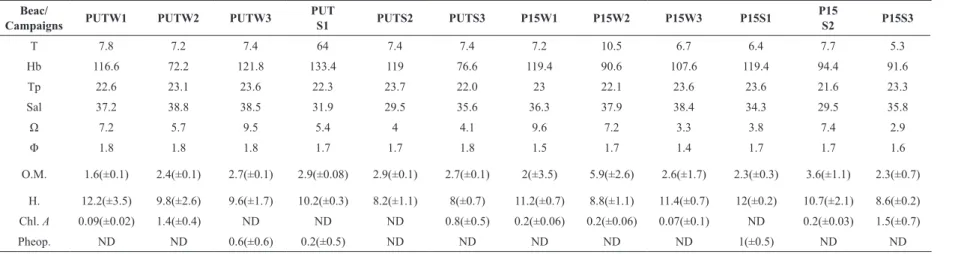
We observed small variations in beach
morphodynam-ics, sediment grain size and organic matter content on all
spatial scales and on both seasons at the beaches studied
(Table 1). Putiri and Dos Quinze beaches were typically
intermediate to dissipative, in summer and winter,
respec-tively (Dean’s 2.9 to 9.6). Sediment grain size followed
seasonal changes in morphodynamics with higher medium
sand in summer at Putiri beach (41%; F=5,67 p= 0,0001).
Sediment organic matter was also higher during summer
at Putiri (p=0,0001 F=11,75), followed by a decrease in the humidity (p=0,0001 F=21,91) in this same season.
There was an increase in sediment humidity in the summer
at Dos Quinze beach (p=0,0001 F=54,42). In general, the
sediment was moderately selected at Putiri beach whereas
poorly selected at Dos Quinze beach in both seasons. The beaches profiles indicated periods of erosion or accretion during the period sampled. On Putiri beach, beach erosion
during winter and accretion on summer were more
BRAZILIAN JOURNAL
OF OCEANOGRAPHY
, 65(4):666-677;2017
Coutinho & Bernardino: Changes in benthic macrofauna from beaches
671
Table 1. Abiotic data collected during the sampling. Wave period in seconds (T); wave height in centimetres (Hb); Temperature (Tp.); Salinity (Sal); Dean’s Parameter (Ω);
Mean Grain Size (Φ); Organic matter content (O.M; g); Humidity (H; g); Chlorophyll a (Chl. a; µgg-1) and Pheopigments (Pheop.; µgg-1). Put: Putiri Beach, P15: Dos Quinze
Beach; W: winter campaign; S: summer campaign. ND: not detected
Beac/
Campaigns PUTW1 PUTW2 PUTW3
PUT
S1 PUTS2 PUTS3 P15W1 P15W2 P15W3 P15S1
P15
S2 P15S3
T 7.8 7.2 7.4 64 7.4 7.4 7.2 10.5 6.7 6.4 7.7 5.3
Hb 116.6 72.2 121.8 133.4 119 76.6 119.4 90.6 107.6 119.4 94.4 91.6
Tp 22.6 23.1 23.6 22.3 23.7 22.0 23 22.1 23.6 23.6 21.6 23.3
Sal 37.2 38.8 38.5 31.9 29.5 35.6 36.3 37.9 38.4 34.3 29.5 35.8
Ω 7.2 5.7 9.5 5.4 4 4.1 9.6 7.2 3.3 3.8 7.4 2.9
Φ 1.8 1.8 1.8 1.7 1.7 1.8 1.5 1.7 1.4 1.7 1.7 1.6
O.M. 1.6(±0.1) 2.4(±0.1) 2.7(±0.1) 2.9(±0.08) 2.9(±0.1) 2.7(±0.1) 2(±3.5) 5.9(±2.6) 2.6(±1.7) 2.3(±0.3) 3.6(±1.1) 2.3(±0.7)
H. 12.2(±3.5) 9.8(±2.6) 9.6(±1.7) 10.2(±0.3) 8.2(±1.1) 8(±0.7) 11.2(±0.7) 8.8(±1.1) 11.4(±0.7) 12(±0.2) 10.7(±2.1) 8.6(±0.2)
Chl. A 0.09(±0.02) 1.4(±0.4) ND ND ND 0.8(±0.5) 0.2(±0.06) 0.2(±0.06) 0.07(±0.1) ND 0.2(±0.03) 1.5(±0.7)
Figure 3. Putiri and Dos Quinze beach profiles in summer and winter.
Macrofaunal spatial-temporal dynamics
We found local (across-shore) to regional (betweenbeaches) differences on macrofaunal abundance, biomass,
species richness, diversity and assemblage composition
between the two sandy beaches studied. Overall, mac
-rofaunal abundance was significantly different between
the two sand beaches studied with higher densities at dos
Quinze beach (p= 0,001; F=29,9; Table 3). Macrofaunal
assemblages were typically dominated by polychaetes
(33%), nemerteans (23%) and isopods (22%). Isopods
were the second most abundant group at Puriti beach
(24%) and nemerteans at Dos Quinze beach (25%).
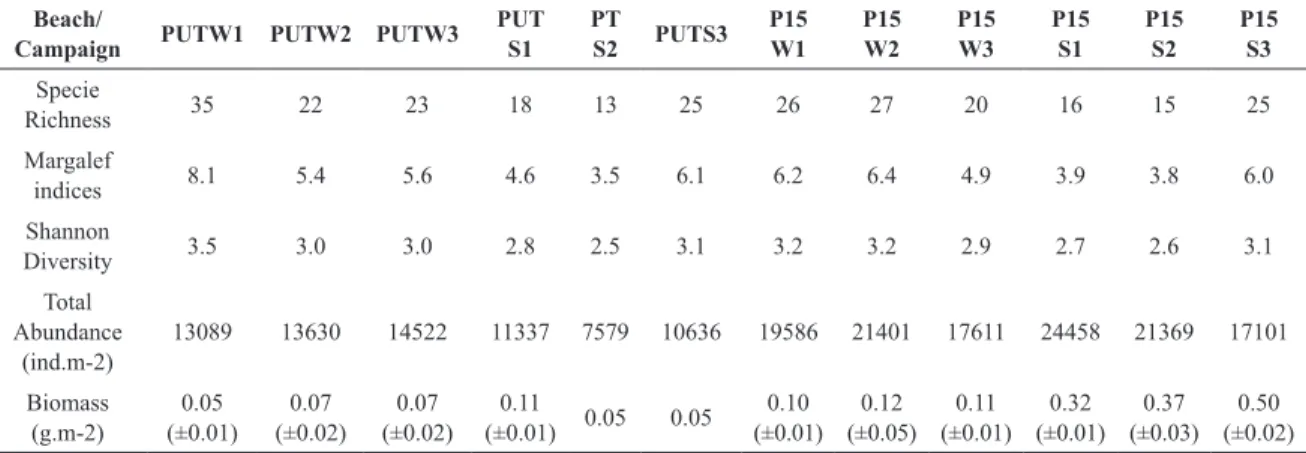
Macrofaunal biomass followed spatial patterns in abundance and changes between the two beaches studied
(p=0,02 F=4,3; Table 3). Isopods and annelids contributed most to macrofaunal biomass on Putiri and Dos Quinze beaches (> 70% of total macrofaunal biomass). At Putiri
beach, macrofaunal biomass was similar between winter and summer seasons, whereas biomass increased
mark-edly on summer at Dos Quinze beach (p= 0.023; Table 2; Figure 4). During the winter season, Putiri beach showed a higher isopod biomass if compared to Dos Quinze beach, whereas Annelid biomass was higher at Dos Quinze beach. In the summer season, Dos Quinze beach showed
a higher isopod biomass and a smaller Annelid biomass, if compared to Putiri beach.
BRAZILIAN JOURNAL OF OCEANOGRAPHY, 65(4):666-677;2017
Coutinho & Bernardino: Changes in benthic macrofauna from beaches
673
Species richness and diversity varied at the scale of tens
of meters (across-shore) at Putiri and dos Quinze beaches (p=0,002 F=4,2; Table 3), with no differences between
beaches or seasons. Polychaetes dominated the sand beach macrofauna, followed by nemerteans and isopods. The most dominant polychaetes were the genera’s Scolelepis (39%),
Psionidens (35%), and their abundance decreased during
winter on both beaches. The isopods Excirolana (17%) and
Alcirona (4%) increased in abundance during summer on
both beaches (Table 2). Macrofaunal assemblages were highly similar between both sand beaches, with the spatial changes in abundance most responsible for the
multivari-ate differences regionally (ANOSIM, p= 0,001; Figure 5).
Polychaetes were mainly responsible for the seasonal and spatial dissimilarity between beaches.
Table 2. Macrofaunal diversity and assemblage indexes: Species Richness, Margalef Indices, Shannon Diversity, Total
Abundance and Macrofaunal biomass. PUT: Putiri Beach; P15: Dos Quinze Beach; W: winter campaign; S: summer campaign.
Beach/
Campaign PUTW1 PUTW2 PUTW3 PUT
S1 PT
S2 PUTS3 P15 W1
P15 W2
P15 W3
P15 S1
P15 S2
P15 S3
Specie
Richness 35 22 23 18 13 25 26 27 20 16 15 25 Margalef
indices 8.1 5.4 5.6 4.6 3.5 6.1 6.2 6.4 4.9 3.9 3.8 6.0 Shannon
Diversity 3.5 3.0 3.0 2.8 2.5 3.1 3.2 3.2 2.9 2.7 2.6 3.1 Total
Abundance (ind.m-2)
13089 13630 14522 11337 7579 10636 19586 21401 17611 24458 21369 17101
Biomass (g.m-2)
0.05
(±0.01) (±0.02)0.07 (±0.02)0.07 (±0.01)0.11 0.05 0.05 (±0.01)0.10 (±0.05)0.12 (±0.01)0.11 (±0.01)0.32 (±0.03)0.37 (±0.02)0.50
Table 3. Hierarchical permutation analyses of fauna abundance, species richness, Margalef Indices, Shannon Diversity and Biomass.
Components of variation Gl QM F P
Total Abundance
Season (Se) 1 1307.3 0.139 1
Beach (Be(Se)) 2 9396 29.932 0.001
Area (Ar(Be(Se))) 8 313.91 0.788 0.663 Transect (Tr(Ar(Be(Se)))) 24 397.93 1.272 0.149
Res 72 312.84
Specie richness
Season (Se) 1 2055.6 6.2487 0.332 Beach (Be(Se)) 2 328.97 0.90595 0.443 Area (Ar(Be(Se))) 8 363.12 4.2857 0.002
Transect (Tr(Ar(Be(Se)))) 24 84.729 0.65311 0.912
Res 72 129.73
Margalef Indices
Season (Se) 1 1564.8 13.891 0.355 Beach (Be(Se)) 2 112.64 0.36883 0.762 Area (Ar(Be(Se))) 8 305.41 4.3682 0.002
Transect (Tr(Ar(Be(Se)))) 24 69.916 0.63351 0.931
Res 72 110.36
Components of variation Gl QM F P
Season (Se) 1 563.94 6.785 0.338
Beach (Be(Se)) 2 83.116 0.72712 0.549 Area (Ar(Be(Se))) 8 114.31 6.1265 0.001
Transect (Tr(Ar(Be(Se)))) 24 18.658 0.53681 0.947
Res 72 34.757
Biomass
Season (Se) 1 12270 2.1871 0.345
Beach (Be(Se)) 2 5610.2 4.3356 0.023
Area (Ar(Be(Se))) 8 1294 1.3843 0.206 Transect (Tr(Ar(Be(Se)))) 24 934.73 1.26 0.137
Res 72 741.84
Figure 5. Non-metric Multi-Dimensional Scaling (MDS)
between Putiri and Dos Quinze beaches in each season, winter and summer. PUT: Putiri beach; P15: Dos Quinze
beach; W: winter campaign; S: summer campaign.
Environmental variables, including grain size, chloro -phyll a, and sediment organic matter were mainly respon-sible for assemblage distribution on both sandy beaches
(80%, CCA). Fine sand and pheopigments influenced most
macrofaunal assemblages in Putiri beach, whereas organic
matter content influenced macrofaunal assemblages at Dos Quinze beach during the winter and summer. Macrofaunal species composition was related to sand grain size and or
-ganic matter content, with polychaetes associated with finer
sand and oligochaetes and nemerteans with mud. The axis
1 were related with the fine sand factor and the axis 2 with medium sand (0.39; 0.79, respectively; Figure 6; Table 4).
The third axis was associated with the very coarse particles
(0.36) and the fourth with pheopgiments (0.35).
Figure 6. Canonical Correspondence Analyses of environmental data and
BRAZILIAN JOURNAL OF OCEANOGRAPHY, 65(4):666-677;2017
Coutinho & Bernardino: Changes in benthic macrofauna from beaches
675
Table 4. Eigenvalues of CCA. S.R.: species richness; O.
M.: organic matter; F. G.: fine gravel; Chlr: clorophyll a;
Pheop.: pheopigments.
Variable/Axis Axis1 Axis 2 Axis 3 Axis 4
SR 0.13 -0.62 -0.45 -0.22
O.M. -0.03 -0.24 0.10 0.07
F.G. -0.27 -0.49 0.21 0.00 Sand -0.06 -0.18 0.04 -0.02 Mud -0.12 -0.23 -0.53 -0.01
Biomass -0.56 0.26 -0.43 0.24 Chlr. -0.22 -0.16 -0.32 -0.37 Pheop. 0.24 0.10 0.31 0.35
DISCUSSION
Putiri and Dos Quinze beaches were highly similar in
respect to their sedimentary and environmental variables, and exhibited small seasonal morphodynamic changes within intermediate and dissipative states. These
sea-sonal changes resulted in variable predominance of finer
sediments during winter (dissipative), or an increase in
sediment grain size, leading to sand accumulation during
summer, which likely changed water and organic
accumu-lation on the beaches (MCLACHLAN; BROWN, 2006).
However, seasonal increases on sediment organic matter were not uniform between beaches, nor were the response
of macrofaunal assemblages. Spatial differences between organic matter availability were significantly associated
with higher macrofaunal abundance and biomass in one of the beaches studied, as observed on dissipative and
intermediate sandy beaches (BROWN; MCLACHLAN, 1990; OMENA; AMARAL, 1997; BORZONE et al., 2003; CISNEROS et al., 2011). The seasonal differences
and opposite patterns of macrofaunal abundance and bio-mass between the two nearby sandy beaches illustrate how complex are the benthic dynamics of sand beaches and highlight the need to include multiple scales of study to investigate changes in these ecosystems (SCHLACHER et al., 2008).
Spatial changes in macrofaunal richness and diversity were evident on across-shore scales at both sandy
beach-es, which partially supported our hypothesis of significant
spatial changes in assemblage structure and weaker vari-ability at seasonal scales. Morphodynamic state is one of the key physical forces controlling the sandy beach
macrofauna, with an increase in species richness and
abundance from reflective to dissipative beaches, due to hard swash climate and coarse sands (CARCEDO et al.,2014; DEFEO; MCLACHLAN, 2005; DEFEO et al.,
2001). Comparing the two sandy beaches with other
san-dy beaches, Putiri and Dos Quinze showed higher species richness than reflective beaches at Rio de Janeiro State, both in winter and in summer season (VELOSO et al., 1997; VELOSO; CARDOSO, 2001). The Putiri and dos Quinze sand beaches had a similar species richness with intermediate sandy beaches at California (SCHOOLER et al., 2014), suggesting similar physical and biological con -trols on the fauna and within expected latitudinal gradients of diversity.
Macrofaunal density was highest during winter in on-ly one of the beaches, also evidencing contrasting spatial patterns between nearby sandy beaches. Sandy beaches
with low profiles, common in intermediate and dissipative
beaches typically support a high abundance, rich and diverse macrofauna due to less physical stress (MCLACHLAN;
DORVLO, 2005; MCLACHLAN; BROWN, 2006). Although Putiri and Dos Quinze beaches were very similar
in their beach state, it is likely that increased organic input
led to higher macrofaunal abundance at dos Quinze beach. Therefore, although sediment grain size was similar dur -ing the period studied, the organic matter availability and quality (i.e. as measured by chla-a content) influenced dif -ferences on macrofaunal abundance between the two sand
beaches (VELOSO et al., 2003; RODIL; LASTRA, 2004; MCLACHLAN; DORVLO, 2005; LERCARI; DEFEO, 2006). However, patterns of diversity and species rich -ness varied at local scales, supporting the strong small-scale spatial changes in macrofaunal assemblages
associ-ated with organic matter content and sediment grain size (LERCARI; DEFEO, 2006, MCLACHLAN; DORVLO, 2005; VELOSO et al., 2003).
Tropical sand beaches exhibit lower temporal fluctua -tions in density and diversity because seasonality is not
pronounced (VELOSO; CARDOSO, 2001). At temper -ate and subtropical regions, including southern regions
of Brazil, temporal changes on macrofaunal diversity are evident (DEFEO; MCLACHLAN, 2005). In the sand
beaches of the EME studied, benthic assemblage compo-sition was similar across spatial and temporal scales, and was dominated by typical Crustacean and Annelid taxa. Crustaceans were the most representative taxa in both
most dominant isopods and is typical of fine sandy beaches on the Southeast Brazilian Marine Ecoregion and Uruguay beaches (DEFEO et al., 1997; FERNANDES; GOMES, 2006). The dominant polychaetes Scolelepis sp. are also widely common on Atlantic sandy beaches and were high-ly abundant at both sand beaches, indicating that the sandy beach macrofauna of the EME shares several species with
other sandy beaches in Brazil (SOUZA; GIANUCA, 1995; BORZONE et al., 1996; FERNANDES; GOMES, 2006). Other common sand beach taxa including Talitridae, Ocypodidae and Cirolanidae also occur abundantly in most beaches of Southern Brazil (SOUZA; GIANUCA, 1995; BARROS et al., 2001; BORZONE et al., 2003).
Some temperate taxa were also abundant, including oli-gochaetes and nemerteans, probably due the high content
of organic matter. Nemerteans are abundant in fine sand
sandy beaches and are common in low latitude
beach-es (DEFEO; MCLACHLAN, 2005; MCLACHLAN; BROWN, 2006).
The benthic macrofauna of the two sandy beaches studied showed expected responses to food availability
and sediment grain size, supporting similarities with other oligotrophic sandy beaches (CISNEROS et al., 2011).
Although the macrofaunal composition is strongly similar at the regional scale, spatial-temporal changes in abun-dance of polychaetes and crustaceans contribute to dissim-ilarity of assemblages and highlight how complex these
abiotic interactions occur on these ecosystems (DEFEO;
MCLACHLAN, 2005). This study presented the most comprehensive evaluation of multiple spatial scales of variability of the macrofauna on sandy beaches of Espirito Santo State to date, which may have been impacted by a large scale mining tailing accident that released toxic
plumes from the Rio Doce River 150 Km North (Marta-ALMEIDA et al., 2016). The hierarchical sampling design was essential to differentiate spatial patterns that occurred
at across-shore and between sandy beaches, revealing con-trasting changes between two nearby sandy beaches along seasonal scales. As a result, monitoring and impact assess-ment programs on coastal areas, including sandy beaches, need to incorporate such sampling designs in order to adequately assess impacts on benthic communities from regional and climatic stressors.
ACKNOWLEDGEMENTS
We thank all participants of intensive fieldwork cam
-paigns for their valuable effort. We thank the reviewers
and the editors of this special volume for their carefull comments that improved this manuscript. MSC was sup-ported by a CAPES (Coordenação de Aperfeiçoamento de
Pessoal de Nível Superior) master’s scholarship. AFB was supported by a CNPq PQ grant 301412/2013-8.
REFERENCES
ALBINO, J.; PAIVA, D. S.; MACHADO, G. M. Geomorfologia, Tipologia, Vulnerabilidade erosiva e ocupação urbana das praias do litoral do Espírito Santo, Brasil. Revta Geografares,
n. 2. Vitória, 2001.
ALONGI, D. M. Coastal ecosystem processes. New York: CRC
Press, 1998.
AMARAL, A. C. Z.; ROSSI –WONGTSCHOWSKI, C. L. D. B. Biodiversidade Bentônica da Região Sudeste-Sul do Brasil –
Plataforma Externa e Talude Superior. Revizee – Score Sul,
Instituto Oceanográfico, USP. 2004.
AMARAL, A. C. Z; ET. AL. Brazilian Sandy Beaches: character -istics, ecosystem services, impacts, knowledge and priorities.
Braz. J. Oceanogr., v. 64, p. 5-16, 2016.
BARROS, F.; BORZONE, C. A.; ROSSO, S. Macroinfauna of six beaches near Guaratuba Bay, southern Brazil. Braz. Arch. Biol. Technol., v. 44, n. 4, p. 351-364, 2001.
BARBOSA, F. R.; GÓMEZ, J.; LERCARI, D. DEFEO, O. Dis -entangling diversity patterns in sandy beaches along environ-mental gradients. PloS ONE, v.7, n. 7, 2012.
BERNARDINO, A.F.; NETTO, S.A.; PAGLIOSA, P.R.; BAR
-ROS, F.; CHRISTOFOLETTI, R.A., FILHO, J.S.R.; COLLING, A.; LANA, P.C. Predicting ecological changes on
benthic estuarine assemblages through decadal climate trends
along Brazilian Marine Ecoregions. Estuar. coast. Shelf Sci.,
166: 74-82, 2015.
BERNARDINO, A.F.; PAGLIOSA, P.R.; CHRISTOFOLETTI, R.A.; BARROS, F.; NETTO, S.A.; MUNIZ, P.; LANA, P.C. Benthic estuarine communities in Brazil: moving forward to
long term studies to assess climate change impacts. Braz. J. Oceanogr., v. 64, p.83-97, 2016. http://dx.doi.org/10.1590/ S1679-875920160849064sp2
BORZONE, C. A.; MELOÀ, S. G; REZENDE, K. V.; VALE, R.; KRUL, R. Macrobenthic intertidal communities from wave
to tide dominated beach environments. A case study in two
Brazilian beaches. J. coast. Res., p. 472-480, Spr 2003. BORZONE, C. A.; SOUZA, J. R. B.; SOARES, A. G. Morpho
-dynamic influence on the structure of inter and subtidal mac -rofaunal communities of subtropical sandy beaches. Revta
Chilena Hist Nat,v. 69, n. 4, p. 565-577, Dec 1996.
BROW, A.C., MCLACHLAN, A. Ecology of Sandy Shores. El
-sevier, Amsterdam. 1990.
CARCEDO, C.; FIORI, S.; BREMEC, C. Macrobenthic surf zone
communities of temperate sandy beaches: spatial and tempo-ral patterns. Mar. Ecol., p. 1-14, 2014.
CLARKE, K.R.; GORLEY, R.N. PRIMER v.6: User
manual/Tu-torial, Plymouth. 2006.
CLARKE, K.R.; WARWICK, R.M. Change in marine communi -ties: an approach to statistical analysis and interpretation. 2ed.
BRAZILIAN JOURNAL OF OCEANOGRAPHY, 65(4):666-677;2017
Coutinho & Bernardino: Changes in benthic macrofauna from beaches
677
CISNEROS, K. O.; SMIT, A. J.; LAUDIEN, J.; SCHOEMAN,
D. S. Complex, dynamic combination of physical, chemical and nutritional variables controls spatio-temporal variation of sandy beach community structure. PloS ONE, v. 6, n. 8, 2011.
DEFEO, O.; BRAZEIRO, A; ALAVA DE A.; RIESTRA, G. Is
sandy beach macrofauna only physically controlled? Role of substrate and competition in isopods. Estuar. coast. Shelf Sci,
v. 45, n. 4, p. 453-462, Oct 1997.
DEFEO, O.; GOMEZ, J. Morphodynamics and habitat safety in
sandy beaches: life-history adaptations in a supralittoral am-phipod. Mar. Ecol. Progr. Ser., v. 293, p. 143-153, 2005.
DEFEO, O.; MCLACHLAN, A. Patterns, processes and regula -tory mechanisms in sandy beach macrofauna: a multi-scale analysis. Mar. Ecol. Progr. Ser., v. 295, p. 1-20, 2005.
______. Global patterns in sandy beach macrofauna: Species
richness, abundance, biomass and body size. Geomorp.,v.
199, p. 106-114, Oct 2013.
DEFEO, O.; MCLACHLAN, A.; SCHOEMAN, D. S.; SCHLACHER, T. A.; DUGAN, J.; JONES, A.; LASTRA, M.; SCAPINI, F. Threats to sandy beaches ecosystems: a re -view. Estuar. coast. Shelf Sci, v. 81, n. 1, p. 1-12, 2009.
DEFEO, O, GOMEZ J, LERCARI, D. Testing the swash exclusion
hypothesis in sandy beach populations: the mole crab Emerita
brasiliensis in Uruguay. Mar Ecol Prog Ser, 212:159–170, 2001. EMERY, K. O. A simple method of measuring beach profiles.
University of Southern California. Los Angeles. 1961. FERNANDES, R. S. R; GOMES, A. S. Community structure of
macrobenthos in two tropical sandy beaches with different morphodynamic features, Rio de Janeiro, Brazil. Mar. Ecol., v. 27, p. 160-169, 2006
GOMES, L. E. O.; CORREA, L. B.; SÁ, F.; NETO, R. R.; BER
-NARDINO, A. F. The impacts of the Samarco mine tailing spill on the Rio Doce estuary, Eastern Brazil. Mar. Poll. Bull. v. 120, p. 28-36, 2017.
LERCARI, D.; DEFEO, O. Large-scale diversity and abundance
trends in sandy beach macrofauna along full gradients of sa-linity and morphodynamics. Estuar. coast. Shelf Sci,v. 68, n. 1-2, p. 27-35, Jun 2006.
LORENZEN, C. J. Determination of chlorphyll and pheo-pig
-ments – spectrophotometric equations. Limnol. Oceanogr.,v.
12, n. 2, p. 343-&, 1967 1967.
MARTA-ALMEIDA, M.; MENDES, R.; AMORIM, F.N.; CIRANO, M.; DIAS, J.M. Fundão Dam collapse: Oceanic dispersion of River Doce after the greatest Brazilian environ
-mental accident. 2016. Mar. Pollut. Bull., v. 112, p.359-364. MCLACHLAN, A. Water filtration by dissipative beaches.
Lim-nol. Oceanogr., v. 34, n. 4, p. 774-780, Jun 1989.
MCLACHLAN, A.; BROWN, A. C. The Ecology of Sandy
shores. New York. Elsevier, 373 p., 2006.
MCLACHLAN, A.; DORVLO, A. Global patterns in sandy beach
macrobenthic communities. J. coast. Res., v. 21, n. 4, p.
674-687, Jul 2005.
MCLACHLAN, A; ERASMUS, T. Sandy beaches as ecosystems. W Junk, The Hague. 1983.
MINISTÉRIO DO MEIO AMBIENTE. Áreas prioritárias para a conservação, uso sustentável e repartição de benefícios da biodiversidade brasileira: atualização, Portaria MMA 09, de 23 de janeiro de 2007. MMA.Brasília, 300 p., 2007. MUEHE, D. Beach Morphodinamic Research in Brazil: evolution
and Applicability. J. coast. Res., v. SI, n. 35, p. 32-42, 2003.
MUEHE, D. Erosão e progradação no litoral brasileiro. Brasília:
Ministério do Meio Ambiente (MMA), 2006.
OMENA, E. P.; AMARAL, A. C. Z. Distribuição espacial de
polychaeta (Annelida) em diferentes ambientes entremarés de praias de São Sebastião (SP).Oecologia Brasiliensis, v.
3, p. 183-196, 1997.
QUINTANA, C. O.; BERNARDINO; A. F.; MORAES, P. C.; VALDEMARSEN, T.; SUMIDA, P. Y. G. Effects of coastal
upwelling on the structure of macrofaunal communities in SE
Brazil. J. Mar. Sys., v.143, p. 120-129.
RODIL, I. F.; LASTRA, M. Environmental factors affecting
benthic macrofauna along a gradient of intermediate sandy beaches in northern Spain. Estuar. coast. Shelf Sci, v. 61, n. 1,
p. 37-44, Sep 2004.
SCHLACHER, T. A. et al. Sandy beaches at the brink. Divers. Distrib.,v. 13, n. 5, p. 556-560, Sep 2007.
SCHLACHER, T.A., SCHOEMMAN, D.S., DUGAN, J.E., LAS
-TRA, M., JONES, A., SCAPINIi, F., MCLACHLAN, A..
Sandy beach ecosystems: key features, sampling issues, man-agement challenges and climate change impacts. Mar. Ecol.
– Evolutionary Perspective 29 (S1), 70–90, 2008.
SCHOOLER, N. K; DUGAN, J. E.; HUBBARD, D. M. Detect -ing change in intertidal species richness on sandy beaches: calibrating across sampling designs. Estuar. coast. Shelf Sci, v. 150, p. 58-66, 2014.
SOUZA, J. R. B.; GIANUCA, N. M. Zonation and seasonal
variation of intertidal macrofauna on a sandy beach of Paraná
State, Brazil. Sci. Mar., v. 59, n. 2, p. 103-111, 1995.
SPALDING, M. D. et al. Marine Ecoregions of the World: A
bio-regionalization of coastal and shelf áreas. BioScience, n. 7, v. 57, p. 573-583, Jul-Aug 2007.
SUGUIO, K. Introdução à sedimentologia. São Paulo: E.
Blüch-er: Ed. da USP xii. 317 p, 1973.
VELOSO, V. G.; CAETANO, C. H. S.; CARDOSO, R. S. Composi
-tion, structure and zonation of intertidal macroinfauna in relation
to physical factors in microtidal sandy beaches in Rio de Janeiro
state, Brazil. Sci. Mar., v. 67, n. 4, p. 393-402, Dec 2003. VELOSO, V. G.; CARDOSO, R. S. Effects of morphodynamics
on the spatial and temporal variation of the macrofuana on
three sandy beaches, Rio de Janeiro State, Brazil. J. Mar. Biol. Ass. U.K., v. 81, p. 369-375, 2001.
VELOSO, V. G.; CARDOSO, R. S.; FONSECA, D. B. Adapta -ções e biologia da macrofauna de praias arenosas expostas
com ênfase nas espécies da região entre-marés do litoral flu -minense. Oecologia Brasiliensis: Ecologia de praias arenosas
do litoral brasileiro, Rio de Janeiro, v. 3. p. 135-154, 1997. ________. Spatio-temporal characterization of intertidal macro
-faunal at Prainha becha (Rio de Janeiro Satate). Oecologia Brasiliensis, v.3, p. 213-225, 1997.
VELOSO, V. G. et al. Responses of talitrid amphipods to a gradi
-ent of recreational pressure caused by beach urbanization. Mar. Ecol.-an Evolutionary Perspective, v. 29, p. 126-133, Jul 2008. VIEIRA, J. V.; BORZONE, C. A.; LORENZI, L.; CARVALHO,
F. G. Human impact on the benthic macrofauna of two beach environments with different morphodynamic characteristics in southern Brazil. Braz. J. Oceanogr., v. 60, n. 2, p. 137-150, 2012. WRIGHT, L. D.; SHORT, A. D. Morphodynamic variability of