Versão Online ISSN 1981-1268
http://periodicos.ufpb.br/ojs2/index.php/gaia/index
Traditional use of the flora in the "el chile" the
Pomoca Ejido, Tacotalpa,
Tabasco, Mexico
José Guadalupe Chan-Quijano
1, Gilberto Villanueva-López
2, Dora Elía
Ramos-Muñoz
3y Alfonso Juárez-García
41Estudiante del programa de Maestría en Ciencias en Recursos Naturales y Desarrollo Rural. El Colegio de la Frontera Sur (ECOSUR). Carretera a Reforma Km 15.5 S/N, RA. Guineo 2a. Sección, Villahermosa,
Tabasco, México. CP 86280. E-mail: [email protected]
2Investigador de El Colegio de la Frontera Sur. E-mail: [email protected] 3Investigadora de El Colegio de la Frontera Sur. E-mail: [email protected]
4Estudiante del programa de Maestría en Ciencias en Recursos Naturales y Desarrollo Rural (ECOSUR). E-mail: [email protected]
Abstract
Plant diversity in our country and indeed all over the world is used in different ways; therefore, the number of botanical families can vary depending on indigenous peoples and the culture that these human groups have maintained for generations, as well as their geographical area. This fact has led to a wealth of botanical knowledge and the development of traditional medicine. In this paper, the ethnobotanical knowledge used by the villagers in the “El Chile” Ridge area within the Pomoca Ejido of Sierra Tacotalpa inTabasco is presented. Uni-structured interviews were carried out with the cooperation of the villagers to generate basic information about the use of plants in the region, using the ethnobotanical methodology proposed by Martin (2001). Subsequently, the entire area of the Pomoca Ejido was explored in order to gather information on the ethnobotanical knowledge in the “El Chile” ridge area. It was determined that 19% is used for medicinal purposes, 16% for consumption, 14% ornamental, 10% construction, 7% is used as firewood, 6% is timber-yielding, and another 6% provides edible fruit, 5% is used as forage, 4% is used for craftwork and the remaining 13% is used in various ways. In this sense, the main feature of ethnobotany is accomplished, which is to study the relationship between humans and plants through time in different cultural and ecological environments. The Pomoca Ejidos cultural wealth is further enriched by hers inhabitants knowledge; nevertheless, this is gradually being lost, as the younger members of the community are now more involved in outside activities and, in general, show little interest in learning traditional knowledge. However, there are still a few who are keen to learn; thus, it is in the best interests of the community to create areas of environmental culture in order to disseminate plant knowledge.
Key words: Ancestral Knowledge, anthropogenic factors, deforestation, ethnobotanical uses.
Resumen
Uso tradicional de la flora en “el chile”, del Ejido Pomoca, Tacotalpa, Tabasco, México. La diversidad
de plantas en nuestro país y en el mundo es usada de distintas maneras, por lo que el número de las familias botánicas varían dependiendo de los pueblos indígenas y de la cultura que estos grupos humanos han tenido por generaciones, así como del área geográfica donde se ubican. Este hecho ha favorecido a la riqueza del conocimiento botánico y al desarrollo de la medicina tradicional. En este artículo se presenta el conocimiento etnobotánico utilizado por los pobladores en el cerro “El Chile” del ejido de Pomoca, en la Sierra de Tacotalpa, Tabasco, México. Se realizaron entrevistas uniestructuradas a los pobladores para la generación de información básica acerca del uso de las plantas de la
región, utilizando la metodología de etnobotánica propuesta por Martín (2001). Posteriormente, se realizó un recorrido en toda la superficie correspondiente al Ejido Pomoca para la colecta de información sobre el conocimiento etnobotánico existente en el cerro “El Chile”. Se determinó que el 19% es de uso medicinal, 16% de autoconsumo, 14% de ornato, 10% para construcción, 7% es usado como leña, 6% son maderables y otro 6% sus frutos son comestibles, el 5% son forrajeras, el 4% sirve para elaborar artesanías y el 13% restante son utilizados de diversas formas. En este sentido, se cumple la principal característica de la etnobotánica: estudiar la interrelación entre los seres humanos y las plantas a través del tiempo y de los distintos ambientes culturales y ecológicos. La riqueza cultural del Ejido Pomoca se construye por el
173
conocimiento que los habitantes han sido capaces de conservar; sin embargo, esto se está perdiendo poco a poco, los miembros más jóvenes de la comunidad ahora están más involucrados en otras actividades y, en general, muestran poco interés en el aprendizaje de los conocimientos tradicionales. Sin embargo, todavía hay algunos que están dispuestos a aprender; por lo tanto, es
en el mejor interés de la comunidad para crear áreas de la cultura ambiental con el fin de difundir el conocimiento.
Palabras clave: Saberes ancestrales, factores antropogénicos, deforestación, usos etnobotánicos.
Resumo
Uso tradicional da flora "el chile" emPomoca Ejido, Tacotalpa, Tabasco, Mexico. A diversidade de plantas
em nosso País e no mundo é usada de diferentes maneiras, de modo que o número de famílias botânicas varia de acordo com os povos indígenas e a cultura que estes grupos humanos tiveram ao longo das gerações e da área geográfica onde estão localizados. Este fato levou à riqueza de conhecimento botânico e o desenvolvimento da medicina tradicional. Este conhecimento etnobotânico documentado é utilizado pelos colonos na colina "El Chile" ejido de Pomoca em Sierra Tacotalpa, Tabasco, México. Foram entrevistados moradores por meio de entrevistas semiestruturadas para a geração de informações sobre o uso de plantas na região, utilizando a metodologia etnobotânica proposta por Martin (2001). Posteriormente, verificou-se uma turnê por toda a região correspondente a Ejido Pomoca para coletar informações sobre o conhecimento etnobotânico na colina "El Chile". Determinou-se que 19% é usada para fins medicinais, 16% para consumo consumo, 14% ornamental, 10% da construção, 7% é usada como lenha, 6% são de madeira e outros 6% são frutas comestíveis, 5% são forragem, 4% é usado para artesanato e os 13% restantes são usados de várias maneiras. Neste sentido, a principal característica da etnobotânica é verdade: a inter-relação entre os seres humanos e as plantas através do tempo e em diferentes ambientes culturais e ecológicos.A riqueza cultural de Ejido Pomoca é enriquecido com o conhecimento que as pessoas têm sido capazes de reter; no entanto, isso está lentamente perdendo, porque os membros mais jovens da comunidade estão mais envolvidos em outras atividades e, geralmente, demonstram pouco interesse em aprender conhecimentos tradicionais. No entanto, ainda existem alguns que estão dispostos a aprender; portanto, é no melhor interesse da comunidade para criar áreas de cultura ambiental, a fim de difundir o conhecimento.
Palavras-chave: conhecimento ancestral, fatores antrópicos, desmatamento, usos etnobotânicos.
Introduction
According to Aguilar (2003) and Valdés-Cobos (2013), traditional knowledge (TK) can be defined as the collective insight of indigenous peoples with respect to their relationship with their habitat and nature,
which has developed over many generations. Toledo (1992, 2001) addresses this type of study through the body of knowledge, held by the inhabitants of the communities, of themselves and their surroundings; in other words, the aim is to try to understand the interactions between the inhabitants and their environment which would facilitate the participatory elaboration of plans and programs for the sustainable management of their own natural resources; in this case, the use, management and conservation of plant resources. However, this TK is under threat due to the increasingly rapid degradation of the rain forest, the lack of interest of younger generations living in the communities and the reduced availability of many species (Norris et al. 1999, Rebollar-Domínguez et al. 2008, Gómez-Álvarez 2012). In spite of this, the use of medicinal plants does represent an alternative by providing a measure of support, given the paucity of health services. In this respect, Aguilar (2003) reports that 80% of the world’s population depends on indigenous knowledge to attend their medical needs, and at least 50% of the inhabitants of this planet depends on TK for their own subsistence, the subsistence of ecosystems and, more importantly, as a source of food.
Mexico is home to an enormous floristic diversity (Nepomuceno-Sánchez and Ishiki-Ishihara 2010), which most of the current uses of the plants come from the ancestral knowledge of the native groups (Espinosa-Moreno et al. 2012). However, this does not mean that the plants are used in the same way in every culture, thus the number of botanical families can vary according to the human group, and their culture, as well as the geographical area (Waizel-Bucay 2006), a fact that has propitiated a wealth of botanical knowledge and the development of traditional medicine.
The trajectory of traditional botanical culture in Tabasco is quite interesting
174
considering the environmental deterioration undergone by the area in recent years (De Ita 1994, Van der Wal et al. 2011). The use of natural resources has played an important role since the beginning of mankind as they have always been used by humans to satisfy their basic needs, such as food sources, medicines, material for the construction of houses, fences and tools, as well as a diversity of raw materials, (Isidro-Vázquez 1997, Magaña-Alejandro 2012), all of which are a result of years of experience handed down in traditions from generation to generation.
In this way, the traditional knowledge held by farmers and indigenous people regarding the properties and uses of plant resources is one of the products of this mankind-nature identity (González-Esquinca et al. 2013). However, the rain forests of the state of Tabasco have undergone changes due to the dramatic deforestation carried out over the last five decades. At present, between 40 000 and 50 000 ha still exist, located in the mountainous area of the state, in the municipalities of Tenosique, Teapa, Tacotalpa, Macuspana and Huimanguillo (De Ita 1994, Castillo-Acosta and Zavala-Cruz 1996, Sánchez and Maldonado-Mares 2010).
In light of the above, it can be said that the existing plant resources of every community may be taken as tools to give direction to and shed light on the value of local and regional natural resources in order to achieve optimal management (Arcila-Torres et al. 2006). The aim of this study, therefore, is to analyze the ethnobotanical knowledge registered in the “El Chile” Ridge area of the Pomoca Ejido, which are used by the inhabitants.
Material and Methods
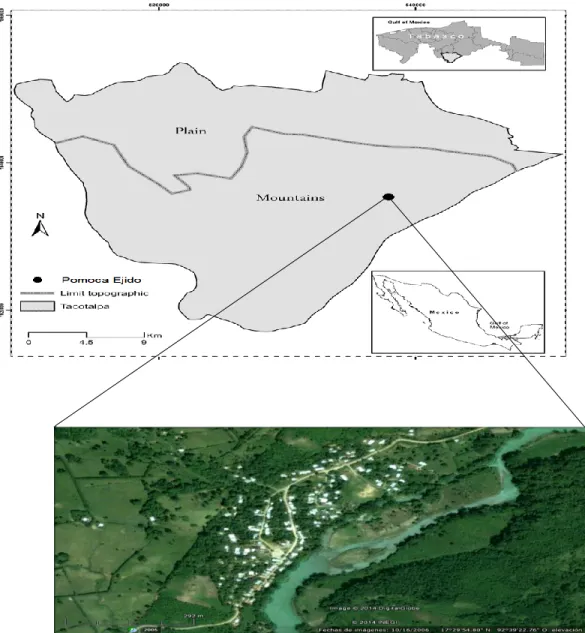
Study areaThis study was conducted in the Pomoca Ejido (communal land) located in the municipality of Tacotalpa in the State of Tabasco, Mexico (Figure 1). This region is much more mountainous and consequently experiences higher rainfall than the rest of the
state. The Pomoca Ejido is located in the south of the state, at a height of 63 meters; between coordinates 92°39’33’’ longitude and 17°29’50’’ latitude (INEGI 2001). In 2005, the Ejido registered 570 inhabitants, and by 2010, the population had increased to 654 inhabitants, of which 330 are male and 324 are female (SEDESOL 2010).
Edafoclimatological information
The climate is warm-humid with rainfall throughout the year; code Af (m) w” (i’) g according to the Köppen climatic classification, modified by García 1988. The region is characterized by a rainfall average of 3,000 to 4,000 mm per year. Although this kind of climate presents rainfall the whole year, this diminishes in December when the percentage of winter rainfall with respect to the annual is below 18%. The highest precipitation is registered in the month of September with 534 mm, and the lowest in April with 125 mm. Temperatures range between 22°C and 29°C; the hottest month is May with 28.9°C and the coldest is December with 22.4°C. There is one area at greater altitude where temperatures between 22°C and 24°C predominate (INEGI 2001).
The most representative soils of the Sierra (mountainous area) are leptosols, which are generally found in abrupt mountainous landscapes and vast plains of surface limestone. Vertisols are also found in depressions in flatlands or low hilly areas. In this region, fluvisols develop in the alluvial plains and are characterized by their formation over alluvial deposits, in areas subjected to periodic flooding. (Álvarez-Merino et al. 2013).
Characteristics of vegetation
The Sierra micro-region has a surface area of 19,754.40 ha of rain forest, which is equivalent to 12.7% of the surface area of the state (Arreola-Muñoz et al. 2011). The main type of vegetation corresponds to high and medium evergreen forest. In the community, medium-height evergreen forest predominates and the most common species are: cachimbo (macawood) (Platymiscium yucatanum
175
(Sterculia mexicana R. Br.), ramón (ramon or breadnut tree) (Brosinum alicastrum Swartz.),
cedrillo (mahogany) (Guarea bijuca
DeCandolle), jobo (yellow mombin) (Spondias mombin L.), among others. Other plant associations found are the acahuales (secondary vegetation), potreros (pastures) and seasonal crops. Most of the area is employed as pastureland (approximately 42.60% of the territory). Similarly, 905 species have been identified: six families with
nine species of Bryophytes, eight families and 23 species of Pteridophytes, one species of Cycadophytes and 886 species of Magnoliophytes. In this last group, 75 families are dicotyledonous and 18 families are monocotyledonous; of these, 112 species are new reports for the flora of Tabasco (Centurión-Hidalgo et al. 2003, Magaña-Alejandro 2010, Beauregard-Solís et al. 2011, López-Hernández et al. 2011).
Figure 1. Location of the State of Tabasco and the Pomoca Ejido in Tacotalpa.
Information gathering
To evaluate the local availability of species, the vegetation in the studied
community was sampled. A visit to the Pomoca Ejido in the municipality of Tacotalpa in the State of Tabasco was
176
organized and carried out from the 1st to the 3rd of April, 2013. The methodology used to gather information on botanical diversity and ethnobotanical knowledge consisted of a transect walkthrough or exploration of the “El Chile” Ridge area which is located at a height of 1,047 m, with a very abrupt terrain and steep slopes (up to 80%). Exploration of the ejido was carried out in cooperation with a number of the inhabitants. During the transect, 12 stops were made at distances varying from 2 to 5 m in order to examine the surrounding vegetation.
Where possible, photographs were taken of the bark, branches, leaves and flowers of each plant species. In the extent possible the plants were identified in the field to prevent damage the ecosystem. All samples collected plants were placed in a press according to
Martínez-Alfaro (2012). The identification of the plants was carried out with the help of the inhabitants’ knowledge and if this was not possible, dendrological characteristics from a manual elaborated by Ochoa-Gaona et al. (2008, 2012) were used, and by comparison with material from the herbarium of the University of Quintana Roo, Campus Cozumel. Any species that were not identified in this way were subsequently identified with the use of dendrological and taxonomic keys (Jiménez-Saa 1969, Navarro-Martínez 1992, López-García 1999, Rodríguez and Porras 2002, Pennington and Sarukhán 2005, Magaña-Alejandro 2006, Mariaca-Méndez 2012).
In addition 50 uni-structured interviews were carried out with the inhabitants of the ejido (25 women between 30 and 70 years of age and 25 men between 17 and 60) using the methodological model of ethnobotany proposed by Martin (2001) which, according to Magaña-Alejandro (2012), consists in obtaining maximum information from the population through active participation in the data-gathering stage. The information obtained was enriched and confirmed with direct observation during guided tour (Alburquerque et al. 2010). The plants were recorded in a list that inhabitants have under their charge.
Results
Floristic compositionA total of 61 individuals, belonging to 36 botanical families were registered during the transect exploration of the “El Chile” Ridge area. The Fabaceae family has 10 species, followed by Euphorbiaceae with 6 species and families Moraceae and Bignoniaceae with 4 species each, the rest of the families have between 1 to 2 species. The Fabaceae comprises a large number of predominantly herbaceous species, with very little representation in tropical regions, where most of them are woody. The importance of these is that most species are edible both human and animals and many of them have properties medicinal. However, other families while not having access to many species, some of which are used for construction, medical and even livestock feed, among other uses (Table 1).
Ethnobotany information
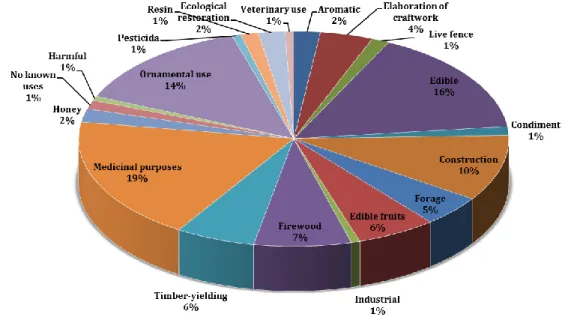
In relation to the above, the uses of the plant species registered are: 19% is for medicinal purposes, 16% is for consumption (food- different parts of the plant), 14% is for ornamental use, 10% is used in construction (door panels, tool parts, houses, etc.), 7% is used for firewood, 6% timber-yielding and another 6% with edible fruits, 5% is used as forage (for cattle or poultry), 4% is used in the elaboration of craftwork, and the remaining 13% is used in a number of ways (Figure 2). The plants found, and the uses they are given, are shown in Table 1.
This finding describe human-environment relationships; ie plants and traditional culture; but younger generation knows less uses, showing disminishing knowledge transfer between generations in the region that matches mentioned by Hernández-Xolocotzi (2012). The results show that of seven young men, who applied interviews, only three of them had this knowledge. Instead of women to be dedicated to the kitchen dominated a little more about the knowledge of certain plants.
177
Figure 2. Use of plants in the “El Chile” Ridge area by the inhabitants of the Pomoca Ejido Table 1. Plant species found in the “El Chile” Ridge area of the Pomoca Ejido, and their principle
uses by the inhabitants.
Species Use
Scientific name: Acacia mayana Lundell Common name: Piñuela
Family: Fabaceae
Edible fruit, firewood and medicinal.
Scientific name: Acalypha hispida Burm. f. Common name: Colega de gato (Chenile Plant)
Family: Euphorbiaceae
Ornamental
Scientific name: Acalypha macrostachya Jacq.
Common name: Chamarrito (Copper leaf) Family: Euphorbiaceae
Edible young leaves
Scientific name: Acalypha setosa A. Rich. Common name: Japachobo (Cuban Copperleaf)
Family: Euphorbiaceae
Cattle forage
Scientific name: Alpinia purpurata K. Schum.
Common name: Japachobo (Red Ginger) Family: Zingiberaceae
Ornamental
Nombre científico: Alpinia speciosa (J.C. Wendl.) K. Schum.
Nombre común: Hawallana (Shellflower) Familia: Zingiberaceae
Ornamental
Scientific name: Annona reticulata L. Common name: Nona (Custard apple) Family: Annonaceae
178
Scientific name: Annona muricata L. Common name: Guanábana (Prickly custard apple)
Family: Annonaceae
Edible fruit, firewood and medicinal
Scientific name: Artocarpus altilis (Parkinson) Fosberg
Common name: Castaño (Breadfruit) Family: Moraceae
Edible fruit, ornamental, medicinal
Scientific name: Artocarpus communis J.R. Forst. & G. Forst.
Common name: Castaña (Jackfruit) Family: Moraceae
Edible
Scientific name: Asclepias curassavica Griseb.
Common name: Rompe o quiebra muelas (Scarlet milkweed)
Family: Asclepiadaceae
Resin, medicinal, veterinary use and pesticide
Scientific name: Astrocaryum mexicanum Liebm.
Common name: Chichón (Chocho palm) Family: Arecaceae
Edible flower and fruit, ornamental, wood for construction
Scientific name: Bixa Orellana L.
Common name: Achiote (Achiote or lipstick tree)
Family: Bixaceae
Edible, medicinal, condiment, firewood, industrial
Scientific name: Blepharidium mexicanum Standl.
Common name: Popiste (Hackberry) Family: Rubiaceae
Construction
Scientific name: Bougainvillea glabra Choisy
Common name: Bugambilia (Paper flower) Family Nyctaginaceae
Ornamental, medicinal
Scientific name: Brosimum alicastrum Sw. Common name: Ramón (Breadnut)
Family: Moraceae
Medicinal, forage, firewood
Scientific name: Bursera simaruba (L.) Sarg. Common name: Palo mulato (Gumbo-limbo) Family: Burseraceae
Medicinal, firewood, construction, forage and melliferous
Scientific name: Byrsonima crassifolia (L.) Kunth
Common name: Nance (Nance) Family: Malpighiaceae
Edible fruit, firewood, medicinal, craftwork, construction
Scientific Name: Cedrela odorata L. Common name: Cedro (Spanish Cedar) Family: Meliaceae
Timber-yielding, medicinal, construction, craftwork, ornamental
Scientific name: Cenchrus echinatus L. Common name: Cadillo (Southern sandspur) Family: Poaceae
179
Scientific name: Cestrum racemosum Ruiz & Pav.
Common name: Amargoso (Green Milkweed)
Family: Solanaceae
Edible
Scientific name: Citrus aurantium Common name: Naranja agria (Bitter orange)
Family: Rutaceae
Edible fruit, medicinal
Scientific name: Cnidoscolus chayamansa McVaugh
Common name: Chaya (Tree spinach) Family: Euphorbiaceae
Edible, medicinal
Scientific name: Cojoba arborea (L.) Britton & Rose
Common name: Coralillo (Wild tamarind) Family: Fabaceae
Wood for the elaboration of tools, edible, firewood
Scientific name: Crescentia cujete L. Common name: Jícara (Calabash tree) Family: Bignoniaceae
Ornamental, craftwork, construction, melliferous
Scientific name: Croton glabellus L.
Common name: Cascarilla (Wild cinnamon) Family: Euphorbiaceae
Timber-yielding and medicinal
Scientific name: Dendropanax arboreus (L.) Decne. & Planch.
Common name: Mano de mico (Angelica Tree)
Family: Araliaceae
Wood for the elaboration of door panels, edible, fences
Scientific name: Desmodium canum Schinz & Thell.
Common name: Cadillo (Wild granite) Family: Fabaceae
Aromatic, dangerous (toxic)
Scientific name: Oeceoclades maculate Lindley
Common name: Orquídea (Monk orchid) Family: Orquidaceae
Ornamental
Scientific name: Erythrina americana Mill. Nombre común: Alcaparra (Dabdab) Familia: Fabaceae
Edible
Scientific name: Erythrina folkersii Krukoff & Moldenke
Common name: Madre (Coral tree) Family: Fabaceae
Ornamental
Scientific name: Ficus benjamina L. Common name: Laurel (Weeping fig) Family: Moraceae
Comestible, ornamental
Scientific name: Garcinia intermedia (Pittier) Hammel
Common name: Limoncillo (Lemon drop mangosteen)
Family: Clusiaceae
180
Scientific name: Gliricidia sepium Kunth ex Steud.
Common name: Cocoite (Cacao shade) Family: Fabaceae
Living fences, forage, construction, craftwork, firewood
Scientific name: Guazuma ulmifolia Lam. Common name: Guácimo (West Indian elm) Family: Malvaceae
Edible, medicinal, forage, melliferous
Scientific name: Heliconia latispatha Benth. Common name: Platanillo (Golden lobster claw)
Family: Heliconiaceae
Ornamental
Scientific name: Hisbiscus rosa-sinensis L. Common name: Tulipán (Red hibiscus) Family: Malvaceae
Ornamental, aromatic
Scientific name: Inga jinicuil Schltdl. Common name: Jinicuil (Ice cream bean) Family: Fabaceae
Ornamental, edible fruit, used for ecological restoration
Scientific name: Lippia dulcis Trevir. Common name: Hierba dulce (Aztec sweet herb)
Family: Verbenaceae
Edible, medicinal
Scientific name: Lysiloma latisiliquum (L.) Benth.
Common name: Tzalám (Wild tamarind) Family: Fabaceae
Timber-yielding, firewood, furniture construction
Scientific name: Macfadyena uncata (Andrews) Sprague & Sandwith Common name: Peine de mico (Yellow bignonia)
Family: Bignoniaceae
No known uses
Scientific name: Manihot esculenta Crantz Common name: Yuca (Tapioca)
Family: Euphorbiaceae
Edible
Scientific name: Manilkara zapota (L.) P. Royen
Common name: Zapote (Sapodilla) Family: Sapotaceae
Edible fruit and resin for the elaboration of chewing gum
Scientific name: Maranta arundinacea L. Common name: Sagú (Arrowroot) Family: Marantaceae
Edible
Scientific name: Petiveria alliacea L. Common name: Zorrillo (Guinea-hen weed) Family: Phytolaccaceae
Edible, medicinal
Scientific name: Pimenta dioica (L.) Merr. Common name: Pimienta (Jamaica pepper) Family: Myrtaceae
Edible, condiment, craftwork, firewood, medicinal
Scientific name: Plecthranthus amboinicus (Lour.) Spreng
Common name: Oreganón u orégano brujo (Mexican Mint)
Family: Lamiaceae
181
Scientific name: Plumeria rubra L. Common name: Tabasqueña (Frangipani) Family: Apocynaceae
Edible
Scientific name: Psidium guajava L. Common name: Guayaba (Apple guava) Family: Myrtaceae
Edible, wood for construction, ornamental, medicinal
Scientific name: Senna occidentalis (L.) Link
Common name: Hormiguera (Coffee weed) Family: Fabaceae
Aromatic, medicinal
Scientific name: Spondias mombin L. Common name: Jobo (Hog plum) Family: Anacardiaceae
Edible, medicinal, craftwork, construction, timber-yielding
Scientific name: Sterculia apétala (Jacq.) H. Karst.
Common name: Bellota (Panama tree) Family: Sterculiaceae
Edible seeds
Scientific name: Tabebuia donnell-smithii Rose
Common name: Primavera (Gold tree) Family: Bignoniaceae
Timber-yielding, edible
Scientific name: Tabebuia rosea (Bertol.) DC.
Common name: Macuilis (Pink trumpet tree) Family: Bignoniaceae
Timber-yielding, for ecological restoration, ornamental, construction, medicinal
Scientific name: Tabernaemontana
chrysocarpa S.F. Blake
Common name: Bola de venado (White milkwood)
Family: Apocynaceae
Medicinal, ornamental and forage for birds
Scientific name: Tamarindus indica L. Common name: Tamarindo (Tamarind) Family: Fabaceae
Edible fruit, construction, medicinal
Scientific name: Tectona grandis L. f. Common name: Teca (introduced) Common Teak)
Family: Lamiaceae
Timber-yielding, for ecological restoration, edible, ornamental
Scientific name: Thelypteris interrupta (Willd.) K. Iwats.
Common name: Helecho (Willdenow’s Fern)
Family: Thelypteridaceae
No known uses
Scientific name: Tradescantia spathacea Sw. Common name: Maguey morado (Moses-in-the-cradle)
Family: Commelinaceae
182
Scientific name: Xanthosoma sagittifolium (L.) Schott
Common name: Macal (Arrowleaf elephant’s ear)
Family: Araceae
Ornamental, edible
Scientific name: Zephyranthes lindleyana Herb.
Common name: Brujita (Fairy Lily) Family: Amaryllidaceae
Ornamental, medicinal
Source: compiled by the authors based on the exploration or transect carried out and the interviews applied.
Discussion
Sistematization traditional ethnobotanic knowledge (TEK), in that context gains importance as a core strategy in research and medicine, as well as the conservation of both (Valdés-Cobos 2013). According to Chan-Quijano et al. (2013), TK of plant management must be rescued, given their importance as natural medicinal remedies, food sources (human and animal consumption) and in the elaboration of craftwork, among other uses. It is important therefore to continue documenting all information – verbally and informally - in order to conserve and propitiate cultural affirmation for future generations in the Pomoca Ejido.
The discussion is organized in four aspects: 1) TK in contrast with regional contexts, 2) the medicinal plants uses in Pomoca, 3) particular diferences in plant uses comparion with other study and 4) A missing information of plant TK .
1. It is important to highlight the use
given to the diversity of plant species in the regional communities. Regardless of the actual number of species from market (some of them were found in this studio, such as
Annona muricata L., Artocarpus communis J.R., Bixa Orellana L.,
Byrsonima crassifolia L., etc.),
ethnobotanical wealth is a cultural aspect. In relation to this, in a market of Comalcalco, Tabasco, Magaña-Alejandro and Rivera-Rosales (2014) elaborated a list of 259 species; 25% of the species sold in the market are brought from other states of the
republic, mainly Puebla and Mexico, while 75% are species produced in the state of Tabasco. Of the species originating in Tabasco, 93.2% are vegetable species cultivated in the same municipality, making this an important regional market. Nine categories of use were recognized, the most common being medicinal purposes with 54%, thus demonstrating the extent of plant wealth within the state of Tabasco. 2. In a study carried out on a community
of Quintana Roo (Chancah Veracruz), Chan-Quijano et al. (2013) also registered 29 ethnobotanical species, of which 53% are used for medical purposes, 20% for consumption (food), 20% for both uses (medicinal and food) and 7% for ornamental purposes. However, the most important aspect presented in this work is the wealth of knowledge in the use of plants from the surroundings, giving alternatives for their management so as to continue enriching traditional knowledge. 3. A significant number of plants (145
species) used in indigenous areas of Colombia, have been recognized and registered in accordance with the following categories of use: food (58), animal feed (8), condiments (2), commercial (40), construction (3), insecticide (7), timber-yielding (2), medicinal (82), ornamental(11), reforestation (3), ritual (30), seed (5), shade (3), toxic (5) and other uses (32)
183
(Arteaga-Oliveros and Dueñas-Gómez 2014), demonstrating that, in these regions, traditional knowledge goes hand in hand with the cultural and plant diversity of its natural surroundings. However, in this study is presented which have more uses as
medicinal (28), edible (24), ornamental (21) Construction (15), firewoord (11), edible fruits (9), timber-yielding (9), forage (7), other applications ranging from 3 to 1 in the community (Table 2).
Table 2. Number of times that the uses of the species found are mentioned.
Uses Number of mentions
Aromatic 3 Elaboration of craftwork 6 Live fence 2 Edible 24 Condiment 2 Construction 15 Forage 7 Edible fruits 9 Industrial 1 Firewood 11 Timber-yielding 9 Medicinal purposes 28 Honey 3 No known uses 2 Harmful 1 Ornamental use 21 Pesticida 1 Resin 2 Ecological restoration 3 Veterinary use 1
Source: own elaboration based on interviews.
4. González-Esquinca et al. (2013) presents 60 plant species of the Zoque communities (Rayón, Tapalapa, Tapilula and Copainalá in Chiapas), and registers the preparation and use given to each one of the species. The most interesting aspect of that study is the bio-cultural wealth reflected in the technique and characteristics used in the preparation of these recipes, thereby generating a cohesive element in the knowledge of the different
communities. This issue would be aproach in other field research.
Our study describe biocultural diversity in Pomoca and following. Moreno-Calles et al. (2013) – in this case the “El Chile” Ridge area – valued for our contribution to the biocultural diversity of the ejido, due to:
1. The large number of useful native and exotic plants, resulting from the cultural history of the ejido.
184
However, they are in danger due to the gradual deforestation of the area. 2. Each household is where the processes of experimentation and domestication of these plants take place (family vegetable gardens, orchards, field crops, etc.), and where traditional knowledge must be transmitted from one generation to the next. )
3. The development of experiences in the management of medicinal plants and their consumption by the inhabitants of the ejido and for their enormous variety in the agricultural areas. According to Pérez-Ramirez et al. (2012) it is possible to occupy open areas in the lower levels of the orchards, using containers (plant pots) as they are easy to move around.
4. The plants not only produce benefits, but also provide a setting for ritualistic activities; Carvajal-Correa and Huicochea-Gómez (2010) describe how religious ceremonies are frequently observed with agricultural production, as the owners-producers of the agricultural areas offer part of their first harvest to the gods to show their gratitude. These four points demonstrate a large part of the current ethnobotanical wealth of Mexico. In relation to this, Luna-Morales (2002) states that more than five thousand vascular plants are exploited, by approximately eight million speakers of 54 indigenous languages.
A significant aspect of this cultural importance is the economic sustenance deriving from the commercialization of plants. It is important to take into consideration that the natural environment, in this case the plants, offers many services, which must be kept in mind while endeavoring to recover the desire to learn more from our ancestors regarding the use of these plants.
Conclusions
In the Pomoca Ejido, a rural community of Tabasco, the adjacent ecosystems were found to play an important role in satisfying the needs of the inhabitants as well as generating assets and services for their families, while plant resources in the “El Chile” Ridge area are also exploited with good management; unfortunately, however, the area is being affected by deforestation.
The cultural wealth of the Pomoca Ejido is further enriched by the knowledge that the inhabitants have been able to conserve; nevertheless, this is gradually being lost, as the younger members of the community are now more involved in other activities and, in general, show little interest in learning traditional knowledge. However, there are still a few who are keen to learn; thus, it is in the best interests of the community to create areas of environmental culture in order to disseminate plant knowledge. The majority of the species presented in this document are used for medicinal purposes; this is most likely due to the fact that there is only one small health center in Pomoca which is insufficient for the number of inhabitants. Edible plants occupy second place since every home has small vegetable gardens and orchards; some families also have hectares on the outskirts of the community where they can cultivate other crops, following the customs described for Tabasco regarding the use of local products. Finally, ornamental plants take third place due to the scenic beauty they represent and the manner in which they embellish every house in the community. In the case of the medicinal plants found in the ejido, it would be pertinent to create areas for the promotion of environmental awareness such as: interpretive trails and botanical gardens in the schools or, where possible, sites or spaces could be assigned for the creation of these conservation areas and their subsequent exploitation to create ecotourism centers.
Success in building community resilience often relates to adaptation strategies oriented to spread risk across asset classes
185
(diversification) and households or communities (sharing and pooling).
Further work must be carried out on the documentation of traditional knowledge held by indigenous communities, as these rural areas are a source of insight into traditions, flora usage and the rich cultural diversity of the region. There are still many communities and ejidos in Mexico where the uses given to the plants found in the surrounding areas have been recorded.
Acknowledgements
First of all, our thanks to the inhabitants of the Pomoca Ejido, the commisioner Salvador Gutiérrez Gómez and the delegate Felipe Montero for their warm hospitality and for allowing us to work in their community. Thanks also to Lucero Yazmin Díaz Martínez, Aturo Marcial Alvárez Merino, Amisaday Vázquez Jiménez, Luis Alberto Vázquez Jiménez and Ahisahar Vázquez Jiménez for their support in the fieldwork, and to the El Colegio de la
Frontera Sur for the help given in the field; to
Don Daniel Cruz Zenteno and Eneida Cruz for the additional information to improve this work, and to the graduate Lorena Reyes Sanchez of the Information Systems – Library of the El Colegio de la Frontera Sur for her support in researching information. To Leonardo Noriel López Jiménez for their support desk at work.
References
AGUILAR G. 2003. Conocimiento tradicional sobre la biodiversidad en el proyecto manejo integrado de ecosistemas por pueblos indígenas y comunidades. Panamá: Unidad Regional de Asistencia Técnica (RUTA), 62 p.
ÁLVAREZ-MERINO AM, BENÍTEZ-ABUD JA, CABRERA-BALLONA A, CHAN-QUIJANO JG, DÍAZ-MARTÍNEZ LY, HERNÁNDEZ-GÓMEZ JB, LORENZO-MÁRQUEZ H, NÚÑEZ-GÓMEZ JC, RAMOS-CRUZ DJ y YEDRA-HERNÁNDEZ H. 2013.
Diagnóstico rural del Ejido Pomoca, Tacotalpa, Tabasco. El Colegio de la Frontera Sur. Villahermosa, Tabasco,
México, 27 p.
ALBUQUERQUE UP, LUCENA RFP y ALENCAR NL. 2010. Métodos e técnicas para a coleta de dados. En: ALBUQUERQUE UP, LUCENA RFP y CUNHA LVFC (Eds), Métodos e
técnicas na pesquisa etnobotânica.
Recife: Editora NUPEEA, p. 41-72. ARCILA-T0RRES E, MUÑOZ-GÓMEZ A,
UC-HUCHIN W y LÓPEZ-MEJÍA M. 2006. Guía del sendero interpretativo Yum Kaax de la Universidad de Quintana Roo, Unidad Académica Cozumel.
Cozumel, Quintana Roo, México: Universidad de Quintana Roo, 24 p. ARREOLA-MUÑOZ A,
SÁNCHEZ-CASTILLO J, VARGAS DE LA MORA A y HERNÁNDEZ-ZARATE L. 2011. Ordenamiento territorial:
microrregión Sierra de Tabasco. Villahermosa, Tabasco, México: Secretaría de Recursos Naturales y Protección Ambiental e Instituto para el Desarrollo Sustentable en Mesoamérica A.C. y Petróleos Mexicano. 121 p.
ARTEAGA-OLIVEROS JC y DUEÑAS-GÓMEZ H. 2014. Categorías y valor general de uso de plantas en el Resguardo Indígena Yanacona (San Agustín, Huila, Colombia). En: IX
CONGRESO MEXICANO DE
ETNOBIOLOGÍA, San Cristóbal de
las Casas, Chiapas, México, p 223. BEAUREGARD-SOLÍS G,
LÓPEZ-HERNÁNDEZ ES, LÓPEZ-RICALDE CD y CÁMARA-CÓRDOVA J. 2011. La sierra, una región con patrimonio natural, cultural e histórico. En: LÓPEZ-HERNÁNDEZ ES (Ed),
Educación ambiental para la conservación de la biodiversidad: bases de información para la sierra de Tabasco, Villahermosa, Tabasco,
México: El Colegio de Investigadores de Tabasco y Universidad Juárez Autónoma de Tabasco, p. 25-42.
186
CARVAJAL-CORREA M y HUICOCHEA-GÓMEZ L. 2010. Ceremonia del
Wahil kol en la comunidad de Ich Ek,
Campeche; identidad y patrimonio cultural de los mayas peninsulares. En: HUICOCHEA-GÓMEZ L y CAUICH-CAMPOS MB (Eds), Patrimonio
biocultural de Campeche. Experiencias, saberes y prácticas desde la antropología y la historia, Campeche, Campeche, México: El
Colegio de la Frontera Sur, p. 83-103. CASTILLO-ACOSTA Oy ZAVALA-CRUZ
J. 1996. Fisiografía, recursos vegetales y alternativas de manejo en el Parque Estatal Agua Blanca Tabasco.
Universidad y Ciencia 12 (23): 63-70.
CENTURIÓN-HIDALGO D, ESPINOSA-MORENO J, POOT-MATU JE y CÁZARES-CAMERO JG. 2003.
Cultura alimentaria tradicional de la región sierra de Tabasco.
Villahermosa, Tabasco: Universidad Juárez Autónoma de Tabasco, 97 p. CHAN-QUIJANO JG y LÓPEZ-MEJÍA M.
2012. Riqueza etnobotánica de los senderos interpretativos de la Universidad de Quintana Roo, Cozumel, México. En: VIII
CONGRESO MEXICANO DE
ETNOBIOLOGÍA, Villahermosa, Tabasco, México, p 1-2.
CHAN-QUIJANO JG, PAT-CANCHÉ MK y SARAGOS-MÉNDEZ J.2013. Conocimiento etnobotánico de las plantas utilizadas en Chancah Veracruz, Quintana Roo, México.
Teoría y Praxis 14: 9-24.
DE ITA C. 1994. Playa del Tigre: estrategia nutricional en una comunidad zoque de la selva tabasqueña. America Indígena 54 (1-2): 299-340.
ESPINOSA-MORENO J, CENTURIÓN-HIDALGO D, MAYO-MOSQUEDA A, CÁZARES-CAMERO JG y POOT-MATU JE. 2012. Conocimiento tradicional de la flora tropical tabasqueña. Villahermosa, Tabasco,
México: Universidad Juárez Autónoma de Tabasco. p. 168.
GÓMEZ-ÁLVAREZ R. 2012. Plantas medicinales de una aldea del Estado de Tabasco, México. Revista Fitotecnia
Mexicana 35: 43-49.
GONZÁLEZ-ESQUINCA AR, LUNA-CAZÁRES LM, GISPERT-CRUELLS M, SCHLIE-GUZAMÁN MA y GUTIÉRREZ-JIMÉNEZ J. 2013.
Plantas medicinales zoques: padecimientos gastrointestinales y respiratorios. Tuxtla Gutiérrez, Chipas, México: Universidad de Ciencias y Artes de Chiapas, 92 p. HERNÁNDEZ-XOLOCOTZI E. 2012. El
concepto de etnobotánica.
Etnobiología, 10, Clásicos de la etnobiología en México (suplemento 1). A. Argueta-Villamar, E. Corona-M. y A. Moreno-Fuentes (comps.), 91-973.
INEGI. 2001. Síntesis de Información
Geográfica del Estado de Tabasco.
Aguascalientes, Aguascalientes, México: Instituto Nacional de Estadística, Geografía e Informática. p. 89.
ISIDRO-VÁZQUEZ MA. 1997.
Etnobotánica de los Zoques de Tuxtla Gutiérrez Chiapas. México,
D.F.: Instituto de Historia Natural, 59 p.
JIMÉNEZ-SAA H. 1969. Un método para facilitar el aprendizaje de la dendrología tropical. Turrialba, Costa Rica 19 (1): 109-116.
LÓPEZ-GARCÍA JL. 1999. Estudio dendrológico de las especies más comunes de la selva Lacandona, Chiapas. Chapingo, Estado de México:
Tesis de Licenciatura, Universidad Autónoma Chapingo. 372 p.
LÓPEZ-HERNÁNDEZ ES, HERNÁNDEZ-VÁZQUEZ MA y SÁNCHEZ-MUNGUÍA A. 2011. Los ecosistemas vegetales de la sierra. En: López-Hernández ES (Ed), Educación ambiental para la conservación de la biodiversidad: bases de información para la sierra de Tabasco, Villahermosa, Tabasco, México: El
187
y Universidad Juárez Autónoma de Tabasco, p. 43-66. LUNA-MORALES CC. 2002. Ciencia, conocimiento tradicional y etnobotánica. Etnobiología 2: 120-135. MAGAÑA-ALEJANDRO MA. 2006.
Catálogo de nombres vulgares y científicos de plantas de Tabasco.
Villahermosa, Tabasco, México: Universidad Juárez Autónoma de Tabasco, 196 p.
MAGAÑA-ALEJANDRO MA. 2010.
Vegetación y flora del municipio de Paraíso. Universidad Juárez Autónoma de Tabasco. Villahermosa,
Centro, Tabasco: Universidad Juárez Autónoma de Tabasco, 154 p.
MAGAÑA-ALEJANDRO MA. 2012. Etnobotánica de las plantas medicinales en los huertos familiares de Tabasco. En: MARIACA-MÉNDEZ R. (Ed), El huerto familiar del
sureste de México, Villahermosa, Tabasco, México: Secretaría de Recursos Naturales y Protección Ambiental del Estado de Tabasco y El Colegio de la Frontera Sur, p. 176-195. MAGAÑA-ALEJANDRO MA y RIVERA-ROSALES KJ. 2014. Etnobotánica del mercado 27 de Octubre de Comalcalco, Tabasco, un banco de germoplasma típico de una región maya-chontal. En:
IX CONGRESO MEXICANO DE ETNOBIOLOGÍA, San Cristóbal de
las Casas, Chiapas, México, p 263.
MALDONADO-SÁNCHEZ EA y
MALDONADO-MARES F. 2010. Estructura y diversidad arbórea de una selva alta perennifolia en Tacotalpa, Tabasco, México. Universidad y
Ciencia, 26 (3): 235-245.
MARIACA-MÉNDEZ R. 2012. La complejidad del huerto familiar maya del sureste de México. En: MARIACA-MÉNDEZ R (Ed), El
huerto familiar del sureste de México, Villahermosa, Tabasco, México: Secretaría de Recursos Naturales y Protección Ambiental del
Estado de Tabasco y El Colegio de la Frontera Sur, p. 7-97.
MARTÍN GJ. 2001. Etnobotánica: manual
de métodos. Montevideo, Uruguay:
Editorial Nordan, Comunidad, 240 p. MARTÍNEZ-ALFARO MA. 2012. La
etnobotánica: metodología, desarrollo y orientaciones en México.
Etnobiología, 10, Clásicos de la etnobiología en México (suplemento 1). A. Argueta-Villamar, E. Corona-M. y A. Moreno-Fuentes (comps.), 98-101.
MORENO-CALLES AI, Toledo VM y Casas A. 2013. Los sistemas agroforestales tradicionales de México: una aproximación biocultural. Botanical
Sciences 91 (4): 375-398.
NAVARRO-MARTÍNEZ MA. 1992.
Estudio dendrológico de algunas especies de la Fraylesca, Chiapas.
México, D.F.: Tesis de Licenciatura, Universidad Nacional Autónoma de México. 247 p.
NEPOMUCENO-SÁNCHEZ AE y ISHIKI-ISHIHARA M. 2010. Las plantas empleadas para el tratamiento de las infecciones respiratorias en los altos de Chiapas (México). Etnobiología 8: 11-30.
NORRIS R, WIBBER JS y MORALES-MARÍN LO. 1999. Ecoturismo basado en la comunidad en la selva maya: problemas y potencial. En: Primack RB, Bray D, Galletti HA y Ponciano I (Eds), La Selva Maya: Conservación
y Desarrollo, México, D.F.: Editorial
Siglo XXI, p. 374-390.
OCHOA-GAONA S, PÉREZ-HERNÁNDEZ I y JIMÉNEZ-PÉREZ NC. 2008.
Descripción de las especies de árboles más comunes de la Sierra de Tenosique, Tabasco, México. San
Cristóbal de las Casas, Chiapas, México: El Colegio de la Frontera Sur, 137 p.
OCHOA-GAONA S,
ZAMORA-CORNELIO LF, CABRERA-PÉREZ S, GONZÁLEZ-VALDIVIA NA, PÉREZ-HERNÁNDEZ I y LÓPEZ-MORENO V. 2012. Flora leñosa útil
188
de la Sierra de Tenosique, Tabasco, México. San Cristóbal de las Casas,
Chiapas, México: El Colegio de la Frontera Sur, 312 p.
PENNINGTON TD y SARUKHÁN J. 2005.
Árboles tropicales de México: manual para la identificación de las principales especies. México, D.F.:
Universidad Nacional Autónoma de México y Fondo de Cultura Económica, 523 p.
PÉREZ-RAMÍREZ I, VAN DEL WAL H y ISHIKI-ISHIHARA M. 2012. Plantas
en recipientes en los huertos familiares de Tabasco. Villahermosa,
Tabasco, México: Secretaría de Recursos Naturales y Protección Ambiental y El Colegio de la Frontera Sur, 138 p.
REBOLLAR-DOMÍNGUEZ S, SANTOS-JIMÉNEZ VJ, TAPIA-TORRES NA y PÉREZ-OLIVERA CP. 2008. Huertos familiares, una experiencia en Chancah Veracruz, Quintana Roo. Polibotánica 25: 135-154.
RODRÍGUEZ B y PORRAS MC. 2002.
Botánica sistemática (compilación). Chapingo, Texcoco, Estado de México: Universidad Autónoma Chapingo, 328 p.
SEDESOL. 2010. Microrregiones. Secretaría de Desarrollo Social.
Disponible en:
http://www.microrregiones.gob.mx/catl oc/contenido.aspx?refnac=270150049. [verificado 19.03.2013].
TOLEDO VM. 1992. What is ethnoecology? Origins, scope, and implications of a rising discipline. Etnoecologica, 1: 5-21.
TOLEDO VM. 2001. Indigenous peoples and biodiversity. In: LEVIN SA (Ed),
Encyclopedia of Biodiversity, San
Diego: Academic Press, p. 1181-1197 VALDÉS-COBOS A. 2013. Conservación y
uso de plantas medicinales: el caso de la región de la Mixteca Alta Oaxaqueña, México. Ambiente y
Desarrollo 13 (33): 87-97.
VAN DER WAL H, HUERTA-LWANGA E y TORRES-DOSAL A. 2011. Huertos
familiares en Tabasco: elementos para una política integral en materia de ambiente. Biodiversidad, alimentación, salud, producción y economía. San Cristóbal de las Casas,
Chiapas, México: El Colegio de la Frontera Sur, 123 p.
WAIZEL-BUCAY J. 2006. Plantas con utilidad en las diferentes terapéuticas. En: WAIZEL-BUCAY J (Ed), Las
plantas medicinales y las ciencias: una visión multidisciplinaria, México, D.F.: Instituto Politécnico