eISSN: 2237-2083
DOI: 10.17851/2237-2083.28.2.871-891
Playing through metaphors: an analysis
of metaphor use in life simulation games
Jogando com metáforas: uma análise do uso
de metáforas em jogos de simulação de vida
Flávia Alvarenga de Oliveira
Universidade Federal de Minas Gerais (UFMG), Belo Horizonte, Minas Gerais / Brasil [email protected]
http://orcid.org/0000-0002-6454-2461
Abstract: From consistent narratives to cutting-edge graphic design, designers have been investing heavily in making their items competitive in the market. Given the high level of interaction between the players and the games they play, it is to be expected that much of how real-life representations are built in our minds will, in one way or another, influence how we interact with virtual reality, impacting on the playability of a game. Studies on the role of metaphors in (video)games are rather recent and much is yet to be investigated. Through simulations of family life and school routine, for example, these games imply human behavior as systematic and goal-oriented. For this study, we selected popular free life simulation games available at a popular App Store for smartphones. When listing the existing metaphors, we noticed a systematic difference: while conceptual metaphors were multimodal, consisting of a combination of verbal and visual information, primary metaphors showed to be intrinsically monomodal, consisting of visual information. In this study, we argue that metaphors in life simulation games start off as text-dominant, but become image-dominant after some time. That is, players rely on both images and verbal cues while learning how to play the games, but after some time they can just look at the symbolic cues for information. We therefore propose that the classification for metaphors in games should be continuous and as dynamic as the game itself, since there seems to be a movement from text-dominant to visual-dominant metaphors throughout the games.
Resumo: De narrativas consistentes a design gráfico de ponta, designers têm investido em tornar seus produtos atrativos para o mercado. Dado o alto nível de interação entre jogadores e os jogos que usam, é esperado que muitas das representações das quais fazemos uso na vida real influenciem, até certo ponto, o modo como interagimos com a realidade virtual, o que impacta, portanto, sua jogabilidade. Estudos sobre o papel da metáfora em jogos são bastante recentes e muito ainda precisa ser investigado. Jogos de simulações de vida que envolvem relações familiares e rotinas escolares, por exemplo, parecem sugerir que o comportamento humano seja sistemático e orientado a objetivos específicos. Para o presente estudo, selecionamos jogos de simulação de vida populares em uma App Store para smartphones. Ao listar as metáforas encontradas, notamos uma sistemática diferença: enquanto metáforas conceituais eram multimodais (consistindo de combinações entre informações verbais e visuais), metáforas primárias se mostraram intrinsecamente multimodais (consistindo de informações visuais). Neste estudo, defendemos que metáforas em jogos de simulação de vida começam como texto-dominante, mas, à medida que o jogo se desenrola, tornam-se visualmente dominantes. Ou seja, jogadores dependem de ambos os tipos de informação ao aprender a jogar, mas depois de algum tempo, a informação pode ser obtida ao olhar para os símbolos na tela. Por esta razão, propomos que a classificação de metáforas em jogos se dê de forma contínua, ou seja, que seja tão dinâmica como os próprios jogos, uma vez que o movimento de texto-dominante para imagem-dominante parece se fazer presente no decorrer dos jogos.
Palavras-chave: metáfora; jogos; simulação; metáfora multimodal; metáforas primárias. Submitted on October 31th, 2019 Accepted on February 07th, 2020
1. Introduction
Technology has grown to be an integral part of our lives. Going out of grid is, for many, practically impossible, given the new social need to be always reachable and connected. According to the Pew Research Center website, about 91% of teenagers have access to the internet through a mobile device and about 72% of them play video games on a computer, game console or smartphone (LENHART, 2015).
Not only do teens play, but they also help the market to develop, since they are a big target of game designing companies. In the past few years, app companies have seen their revenues increase tremendously through investments in games. According to news website Newzoo, more
than 7 billion dollars were generated from game apps downloaded by phone users in 2017 (BALLARD, 2017). These numbers, however, are not restricted to teen smartphone users, but represent the popularity of game apps for the general public.
In order to attract new users, designers must pay attention to a series of elements that will be part of their final product. From consistent narratives to cutting-edge graphic design, they have been investing heavily in making their item competitive in the new market. Not only that, they have also been investing in recreating and adapting old game console classics to fit in the small screen, which can be downloaded easily from the store. Also, while trying to appeal to a range number of app users, it seems to be inevitable not to come across cultural aspects that surround the target players.
It is to be expected that much of how real-life representations are built in our minds will, in one way or another, influence how we interact with virtual reality, impacting, therefore, on the playability of a game. Studies in multimodal metaphors have been exploring the role metaphors have and how important they are for building meaning through one’s playing experience (MÖRING, 2013). These studies show that metaphors not only allow the understanding of semiotic elements inside the games, but are also of fundamental relevance for the understanding of its mechanisms (see MÖRING, 2013).
The relationship between thought, language, and culture will be explored in the present paper through the analysis of multimodal metaphoric representations in life simulation games. Besides, our study will propose a classification for these metaphors in life simulation games, based on an existing classification of these metaphors in comic books.
2 Theoretical framework
It is broadly accepted that metaphor use is not only frequent, but also indispensable for understanding and producing language (see LAKOFF; JOHNSON, 1980). Whereas much of what we want to say is highly abstract and therefore more clearly conveyed through the use of metaphoric language, its use is not limited to non-concrete contexts. They are often used in order to give more detailed information, as well as for stylistic purposes.
Metaphor and language are closely related, and so are language and culture. In terms of language and culture, the latter seems to work
as a border, which is used to group people according to their linguistic backgrounds. Culture is supposedly affected by economics and social aspects, which include the language a population uses, which is probably one of the reasons why countries have standard languages spoken by the majority of the population: speaking a language is a means of belonging to a culture. In terms of metaphor and language, however, there is no border, and its use is sometimes so conventionalized that people do not even notice its presence.
Metaphor use reflects to a great degree the culture people are inserted in. The target and source domains chosen when speaking metaphorically are not totally random, but dependent on a structured mapping that works logically in the speaker’s language. This means that a metaphor is not necessarily meaningful in all languages, and even when it is, not necessarily must this metaphor have the same meaning in both of these languages. That is, culture plays a big role in metaphor understanding and creation and, depending on cultural aspects, structural mappings may be different or convey different meanings.
2.1 Metaphor and thought
It is broadly accepted that language and thought are closely related. Sapir, for example, believed that the grammatical structure of one’s language would influence their view of the world (PENN, 1972). In support to that, Whorf theorized not only that language structures influence environment understanding, but also shed light to the fact that more abstract thoughts are dependent on language (CARROLL, 1956). On a more production-related view, Clark proposes that language is not able to map all experience, since a schematic representation may not be present in all languages (CLARK, 2003). However, this absence of structurally conventionalized categories would not at all be sufficient to state that the concepts and ideas do not exist in such languages. What happens is simply a change of focus to which each language understands as crucial information to be said.
Additionally, human beings have an exceptional cognitive capability. Gentner (2003) proposes that our intelligence is due to our ability of learning by analogy, which makes it possible for us to perceive more abstract information as we get older, as compared to concrete perception in children. Besides, Gentner (2003) attributes to structure-mapping process our ability to make comparisons and learn grammar.
Even though the process of aligning and mapping seems to be central for the use of language, and, therefore, for metaphor use, speakers are not limited by well-established lexicalized relations (GENTNER, 2003).
Lakoff and Johnson (1980) also proposed a connection between language and thought. The authors understand that the human conceptual system is basically metaphorical (LAKOFF; JOHNSON, 1980). The impact of this affirmation lies on the fact that our ability to conceptualize and categorize things is what makes our interaction with the world possible. A metaphor such as LIFE IS A JOURNEY would, according to their understanding, map the relationship between a more concrete domain (JOURNEY) and a more abstract domain (LIFE). This mapping would account for the many licenced expressions through which we refer to life in terms of going on a journey (e.g. He did not take the easy road,
that’s what brought him to this point.).
However, not only concrete domains can be used to map abstract concepts. From the Conceptual Metaphor Theory (CMT) by Lakoff and Johnson (1980), Grady (1997) found that people also make use of their bodily experience to understand non concrete ideas. Since those metaphors depend on human basic senses, Grady called them
primary metaphors. One example of a primary metaphor would be the
understanding of a feeling such as anger in terms of heat sensation (e.g.
My blood boiled when I saw her at the party.). Lakoff (2008) suggests
that people around the world have similar daily physical experiences, which would lead to similar primary metaphors across languages.
Also, in our daily interactions, it is not uncommon for us to think of ideas and feelings, which would be harder to express through literal language. Gibbs (2017) believes that metaphors fill gaps in the available vocabulary and that, at times, people are not even able to identify such expressions as being metaphorical. This would mean that metaphors in natural language are also a means of providing details regarding the situation for which literal words and expressions do not convey the expected meaning.
In this paper we will argue that the same thing happens in games, since metaphors seem fill a gap between the semiotic elements on the screen and the reality they attempt to simulate. Their existence, however, is not always obvious.
2.2 Metaphors in life simulation games
Studies on the role of metaphors in (video)games are rather recent and much is yet to be investigated. One example is the discussion on whether life simulation games can be considered metaphorical (see MÖRING, 2013). Through simulations of family life and school routine, for example, these games imply human behavior as systematic and goal-oriented. Each step toward a greater objective comes with a prize, which instigates players to keep trying to win.
Such an understanding of LIFE AS A GAME is clearly a simplification, since real life behavior is motivated by much more than a series of punishments and reinforcements. Even though Skinner’s operant-conditioning was influential in the first half of the twentieth century, we now know that human cognition plays a bigger role in the way we interact with the world (see DIAMOND, 2013).
Simplification, however, is not at all negative. Given the limited number of resources in human cognition (e.g. episodic memory and working memory), it is expected that our minds will search for ways to categorize and map the world that surrounds us. One of the many ways through which this is performed is by making use of well-known categorized elements in order to understand abstract ideas (GLUCKSBERG; KEYSAR, 1990). By this account, understanding life as a game allows the understanding of nuances as well as the systematization of the targeted concept.
As for the game itself, Galloway (2006) describes it as:
[...] an activity defined by rules in which players try to reach some sort of goal. Games can be whimsical and playful, or highly serious. They can be played alone or in complex social scenarios. (GALLOWAY, 2006, p. 1)
Such an understanding of games foreshadows a vast number of familiar elements, since humor can only be understood through a comparison to common ground knowledge, leading to incongruity (see MORREALL, 2016). The way each of those semiotic elements is represented in the screen may or may not be metaphoric.
2.3 Multimodal metaphor
In multimodal metaphor studies, this specific type of metaphor consists of mapping domains in different modalities (image and words, for example) in order to yield meaning. According to Urios-Aparisi, even
though we might be able to see the target or the source, either might be merely suggested (URIOS-APARISI, 2009). That is, a multimodal metaphor may be highly inferential, depending on the connections the reader makes in order to understand it.
Tasic and Stamenkovic (2015) analysed multimodal metaphors in comic books and graphic novels. The authors proposed a classification of these metaphors depending on the type of relationship between written and visual language: (i) image-dominant metaphors, (ii) text-dominant metaphors, (iii) complementary metaphor (TASIC; STAMENKOVIC, 2015). While image-dominant metaphors are the ones in which metaphor meaning relies mainly on the visual component, text-dominant metaphors find their meaning mainly on the verbal utterance. Symmetrically, complementary metaphors depend equally on both visual and verbal cues.
In this study, we argue that metaphors in life simulation games start off as mainly text-dominant, but as players develop, they become image-dominant. That is, players rely on both images and verbal cues while learning how to play the games, but after some time they can just look at the symbolic cues for information.
3 Method
For this study, we selected popular free life simulation games available at a popular App Store for smartphones. About twenty games were tested, in order to check whether they were in accordance to our requirements.
First of all, all games should feature a human-like element as main character, regardless of whether this character was featured in the game or simply mention in the contextualization stage. Even though it is completely possible (and not uncommon) to personify non-human elements in a game, there is the possibility that the human-non human transition may influence the player’s perception and conceptual systems. That is, some metaphorical structural mappings, which are what we wished to observe, might be represented differently when characters are objects or animals. We, therefore, excluded games that did not correspond to this requirement.
Second, games should feature human habits and behavior through its characters. There are a vast number of games featuring human characters in the App Store we visited, but many of them feature wars and fantasized experiences that do not relate to our study. Our main goal was to observe how daily life metaphors are used in virtual interactions.
In order to reach our goal and establish the relationship between the two realities, games should include daily tasks to be accomplished by its characters, such as working, studying, and leading a healthy social life, for example. By doing them, other aspects of human life could be introduced to character’s lives, such as needs and desires.
Lastly, Games should make use of verbal-cues and imagery in order to show players’ progress through characters’ current states. Since metaphors can be either monomodal or multimodal, this requirement increased the probability of finding more multimodal metaphors in our analysis. Multimodality in these games was showed mainly by combining (functional) symbols1 and their subtitles.
Five games fit our requirements and were then analysed. Table 1 shows how often each of the games was downloaded at an App Store.
TABLE 1 – Number of downloads for each game and users’ ratings23
Game1 Number of downloads Number of reviews Ratings
(out of 5 stars)2 #1 100.000 1.000 3.4 #2 500.000 9.000 3.6 #3 1.000.000 37.000 4.1 #4 100.000.000 5.000.000 4.0 #5 5.000.000 78.000 4.1
Source: material produced by the author for this research
As can be seen in Table 1, games with a higher number of downloads have, consequently, a higher number of reviews. Ratings, however, represent the means of all stars given by each player and range from 1 to 5 stars only. The higher the number of reviews, the less one single players’ rating for a given game will influence its overall
1 Symbols in games are not mere illustrations, they are purposefully inserted in a game
and have informative function that is indispensable to the player.
2 The games are as follows: #1: Life Simulator 2; #2: Life Sim: simulador de vida, tycoon
and casino slots; #3: Virtual villagers – origins; #4: The sim freeplay; #5: Life is a game.
3 These ratings, as well as the number of reviews, were accessed through the Play
evaluation. That is, from a players’ point of view, a game with more players will have more reviews, which will lead to a more reliable general impression of the game quality.
Initially, metaphors were listed regardless of their classification as conceptual or primary metaphors. They were then analysed through Tasic and Stamenkovic’s (2015) classification of multimodal metaphors.
4 Data Presentation
In order to understand how we extracted and analysed the metaphors, a brief description of each game is necessary, since the elements in the game are needed for the existence of metaphors.
4.1 Games description
The first game simulation selected for this study consists of the image of a room with a bed and a fridge at the center of the screen. As the player opens the game, many buttons can be seen, each with their correspondent symbol. At the top there are three buttons: one for shopping, one for gambling, and another for game settings. Below these buttons there are buttons for upgrading and another for stats, which describes the buttons symbols and their meaning. Finally, at the bottom of the screen there are 6 buttons regarding life-related activities (education, work, household, shopping, money, and achievements).
The game progresses as the character, who is featured as the player himself, sleeps, eats and works at the right proportion, always aware of the vitality, stamina and resilience levels, measured through status bars that must be always full. These stats become stronger as the player becomes more successful in the game. A more advanced player has more money, a bigger house, practices sports, and reads more than a beginner.
As for the second game, players choose their avatars and profession before starting. A tutorial guides the player as he becomes familiarized with the symbols and buttons in the game as well as their meaning. There is a total of 4 status bars (energy, food, money and happiness), as well as four buttons for shopping, working, relationships and going to the city. At the top the player also sees a button related to their achievements.
In this game, the most important objective is to become professionally successful. The button to check on career-related accomplishments is represented by the image of a man who is going up
the stairs. The player’s advances are shown through a bar, that is filled according to how players progress in the game.
The third game is different from the others as it is set on an island, with the player controlling five characters simultaneously. Characters’ lives consist of solving problems and mysteries, while learning and improving their own skills. The button that shows development has the symbol of a puzzle. Success in the game is represented by bars that are filled as characters improve.
The fourth game is very similar to the third one, but more sophisticated. Avatars are chosen before starting the game. Characters start the game with no money, but become successful with time. They can build their own houses and have control over their activities throughout the game. A tutorial guides the player until he is familiarized with the buttons and necessities of their character.
Desires and necessities are shown at the left bottom of the screen through six different status bars (bladder, sleep, food, bath, social life and happiness). Players are responsible for keeping the bars full and green and should be aware when they start to get empty and red.
Lastly, the fifth game is simpler than the others, with fewer buttons on the screen. As the background images move, players have the impression that their characters are moving forward. The objective of the game is to make life choices by pressing the select-button. The character starts off as a baby and makes life choices until he is an old man. The 2 bars at the top show life and happiness status, which determine when the character will die. The tutorial in this game is optional.
In the next subsection we will present the twenty metaphors we found in these five life simulation games.
4.2 Metaphors List
Through interactions Among the context, the tutorials, the status descriptions, and the symbols presented in the games, we were able to observe a big number of metaphors. After grouping similar metaphors together, we found that there were at least 22 conceptual metaphors and 15 primary metaphors in them. Even though they were more numerous, conceptual metaphor types did not vary, with 96% of them categorizing elements as containers.
We noticed, however, a systematic difference between them. While conceptual metaphors were multimodal, consisting of a
combination of verbal and visual information, primary metaphors showed to be intrinsically monomodal, consisting of visual information. Table 2 shows the list of multimodal metaphors for each of the five games, as well as the visual and verbal forms in which they were presented.
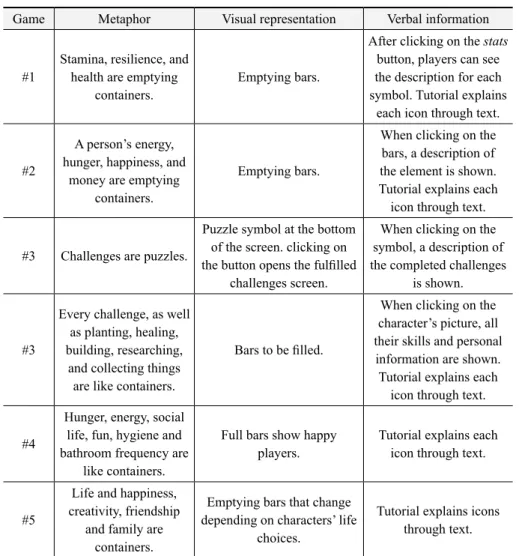
TABLE 2 – Conceptual metaphors
Game Metaphor Visual representation Verbal information #1 Stamina, resilience, and health are emptying
containers. Emptying bars.
After clicking on the stats button, players can see the description for each symbol. Tutorial explains
each icon through text. #2
A person’s energy, hunger, happiness, and
money are emptying containers.
Emptying bars.
When clicking on the bars, a description of the element is shown. Tutorial explains each
icon through text. #3 Challenges are puzzles.
Puzzle symbol at the bottom of the screen. clicking on the button opens the fulfilled
challenges screen.
When clicking on the symbol, a description of the completed challenges
is shown.
#3
Every challenge, as well as planting, healing, building, researching,
and collecting things are like containers.
Bars to be filled.
When clicking on the character’s picture, all their skills and personal
information are shown. Tutorial explains each
icon through text. #4
Hunger, energy, social life, fun, hygiene and bathroom frequency are
like containers.
Full bars show happy
players. Tutorial explains each icon through text.
#5
Life and happiness, creativity, friendship
and family are containers.
Emptying bars that change depending on characters’ life
choices.
Tutorial explains icons through text. Source: material produced by the author for this research
As described in Table 2, verbal information on games are usually presented through tutorials. Figure 1 below shows an example of how tutorials associate symbols and their functionality.
FIGURE 1 – Tutorial for game #5 Life is a Game – “felicidade é um container/uma barra cheia”
Source: App Store
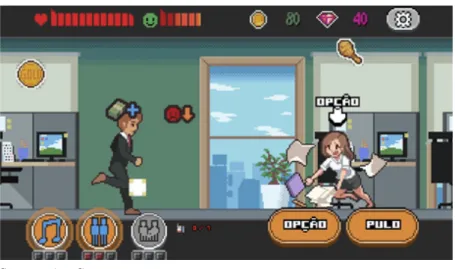
This game has yet another specificity: not only does it show the emptying bar (which, in Figure 1, represents happiness), it also adds an icon to it (a green smiley face, which also represent the same concept).4 However, when players start their journey, metaphor-related verbal information is nowhere to be seen and gamers are left with only visual information, as shown in Figure 2.
FIGURE 2 – Game #5 Life is a Game
Source: App Store
4 It is important to notice that the difference between icons and metaphors is quite
significant. Whereas icons resemble the thing/person they represent (e.g. a smiley face resemble a smiley/happy person), conceptual metaphors are not as direct and represent concepts/ideas instead of materialized objects.
It should be noted that many games such as the one in Figures 1 and 2, combine conceptual metaphors and iconic information together in order to increase playability and make it easier for players to remember relevant information.
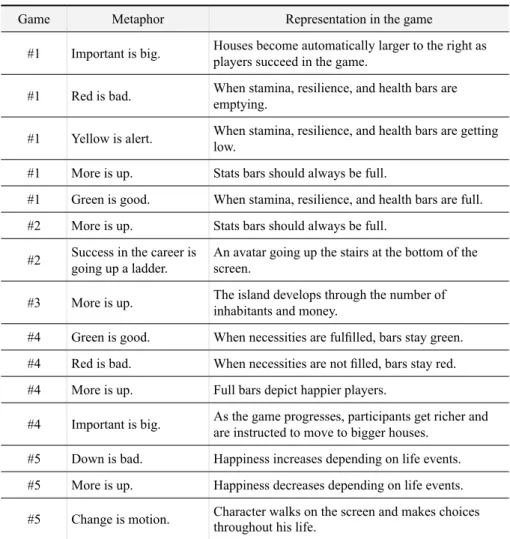
In a similar fashion, Table 3 illustrates the primary monomodal metaphors that appeared in each of the games, as well as the way they were presented.
TABLE 3 – Primary metaphors
Game Metaphor Representation in the game
#1 Important is big. Houses become automatically larger to the right as players succeed in the game. #1 Red is bad. When stamina, resilience, and health bars are emptying. #1 Yellow is alert. When stamina, resilience, and health bars are getting low. #1 More is up. Stats bars should always be full.
#1 Green is good. When stamina, resilience, and health bars are full. #2 More is up. Stats bars should always be full.
#2 Success in the career is going up a ladder. An avatar going up the stairs at the bottom of the screen. #3 More is up. The island develops through the number of inhabitants and money. #4 Green is good. When necessities are fulfilled, bars stay green. #4 Red is bad. When necessities are not filled, bars stay red. #4 More is up. Full bars depict happier players.
#4 Important is big. As the game progresses, participants get richer and are instructed to move to bigger houses. #5 Down is bad. Happiness increases depending on life events. #5 More is up. Happiness decreases depending on life events. #5 Change is motion. Character walks on the screen and makes choices throughout his life. Source: material produced by the author for this research
As Tables 2 and 3 show, there is a bigger number of multimodal metaphors than there is of primary metaphors. In the next section we will analyze the reasons behind these numbers and attempt to classify the multimodal metaphors according to Tasic and Stamenkovic’s (2015).
5 Data Analysis
In order to fulfil our purpose of investigating and classifying metaphors in life simulation games, our analysis will be divided in two different parts. First, we will investigate the reasons behind the differences between primary and conceptual metaphors, regarding their frequency. Second, we will attempt to classify the games’ multimodal metaphors.
5.1 Conceptual and Primary Metaphors
Conceptual metaphors found in our analysis have a big role in the playability of the games. Not only do they help players keep tab on their progress and current status, they are easy to recognize because of the user-friendly icons they use. This means players do not need to go back to the instructions or read the labels again in order to understand what is happening to their characters.
As shown in Table 1, out of 22 of the multimodal metaphors in the games, 21 can be represented through the form X IS A CONTAINER TO BE FULFILLED. This suggests that in a life simulation games almost everything could be X, from a player’s more abstract needs (e.g. making friends or being close to the family) to their most physical urges (such as going to the bathroom). Additionally, those needs can be represented in a continuous bar that goes from good (always represented as a full bar) to bad (depicted as an empty bar).
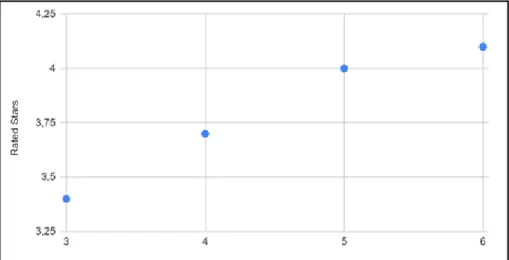
When analysing the relationship between users’ ratings of the game and the depiction of X AS A CONTAINER, we observed that the more this metaphor was used in a given game, the higher were its ratings. This correlation can be observed in Figure 3 below.
FIGURE 3 – Correlation between users’ ratings and container-like elements in the game
Source: material produced by the author for this research
As we see it, even though the number of games analyzed here is not big, it represents popular games and the types of metaphors they typically depict. Therefore, Figure 3 may as well be considered evidence to the idea that multimodal metaphors contribute to the playability of life simulation games. Moreover, the fact that a game is designed this way reflects the attempt to increase playability, since players can automatically connect the symbols to the concepts to which they relate.
In regards to the primary metaphors in the games, they basically varied among directional, quantity-, and color-related metaphors. Their total distribution can be observed in Figure 4.
FIGURE 4 – Primary metaphors type distribution
Source: material produced by the author for this research
Differently from multimodal metaphors, however, neither the total number of primary metaphors nor their separation into types influenced users’ ratings, as can be seen in Figure 5.
FIGURE 5 – Correlation between users’ ratings and the number of visual primary metaphors
As can be noticed when comparing Figures 3 and 5, the presence of multimodal metaphors seems to influence users’ opinions of the game and its playability more than primary metaphors. This difference is likely to reflect the fact that the multimodal metaphors used in the games play a big role in informing users of their progress. The same metaphor referring to progress in terms of containers is present in all the five games. Primary metaphors, in their many forms, nonetheless, seem to have a more stylistic role, instead of a functional one.
5.2 Multimodal Metaphors Classification
According to Tasic and Stamenkovic’s (2015) analysis, there are 3 types of multimodal metaphors. Since the authors studied language in comic books, the two modalities that contributed for their classification were the texts and the images that composed metaphorical meaning. As both texts and images are used with varying degrees of dominance, it is possible to infer that Tasic and Stamenkovic’s (2015) classification is based on a continuum. That is, if a metaphor is image-dominant, it is less text-dominant, and vice-versa. If, on the other hand, a metaphor is complementary, it cannot be text-dominant nor image-dominant. Figure 6 shows the authors’ proposal as a fixed continuum, as we understand it.
FIGURE 6 – Tasic and Stamenkovic’s classification illustrated as a continuum
Source: material produced by the author for this research
As we observed in the life simulation games we analyzed, this classification seems to work well. There are metaphors that are visually dominant, as well as games that rely heavily on text tutorials. In most games, text and image complement each other and give life to metaphors.
We argue, however, that the interaction between the two modalities (text and image) is not static in the metaphors of life simulation games. There seems to be an intrinsic movement from text to image dominance. As mentioned before, most games start with a tutorial in which the shown texts are crucial for the understanding of the images
and their functionality in the game. Even after the end of the tutorial, labels on the screen serve as a reminder of the role of each symbol and image in the game.
As players evolve and get more familiarized with the games, their need for the texts start diminishing and, eventually, disappear completely. While texts become less important to the player, their reliance on the symbols and images in the game increase, as these are the ones that show how the characters are progressing. Without these visual cues, players would not be able to automatize their moves and do what they need in order to keep their characters alive and well.
Figure 7 illustrates the movement of a multimodal metaphor in life simulation games, which starts as text dominant, but progresses until becoming image-dominant metaphors.
FIGURE 7 – Multimodal metaphors in games as a movement towards visual stimulus
Source: material produced by the author for this research
One might argue that our proposal of classifying multimodal metaphors as dynamic ends up erasing one of its components as the movement reaches its peak. Nonetheless, it is important to remember that even when players do not need the written stimulus in order to play a game anymore, they still exist and can be used when necessary. Besides, without the written stimulus, it would be a lot harder for players to recognize the function of each image, since most of them are not iconic.
6 Conclusion
As time goes by, downloading apps to one’s phone has become a customary practice. And as interacting with phones and computers becomes part of people’s routines, applications start developing into something more interactive. The same is true for smartphone game apps, which have been gaining a lot of popularity for the past few years.
State-of-the-art games are highly interactive. They present mechanisms of interactions with users that are highly developed and
poor in linguistic input. Images and symbols make up for the decreasing necessity of long explanations throughout the player’s interaction with the interface. That is, language is only used during the contextualization stage of playing, which sets up the mood and the logic of the games, and as a reminder of symbols’ meanings, when players need them.
This development of games into something more playable and user-friendly is closely related to the presence of multimodal metaphors. These could be understood as an extension of conceptual metaphors (such as not being hungry is an emptying container), combining, in the case of virtual games, both the imagery related to the vehicle of the conceptual metaphor (such as a full green bar as a positive indicator for not being hungry) and the word related to the source of that given metaphor (such as “hunger”). That is, the combination of a symbol and a word, which result in the vehicle and the source of the metaphor being expressed in different modalities, give meaning to the symbolism in the game. The important is: players can only recognize the meaning of such symbols and images because they are highly relatable to their own life experiences.
In our study with five popular smartphone gaming apps, we observed that the types of metaphors presented related to how players rate the game itself. Games that provide interactions through visual metaphors are usually better rated than their counterparts. We also noted that container-related metaphors are not only productive, but also contribute to higher ratings from players, since they help in making virtual interaction easier. This can be explained by the fact that container-metaphors are prolific in many languages and, therefore, are easier for speakers of many languages to relate to a great number of human experiences. Since they might be generalized, it is also practical for designers to make use of them and reach a bigger number of players throughout the world.
We also attempted to expand Tasic and Stamenkovic’s (2015) classification of multimodal metaphors. While analysing the data we collected, we realized that, differently from cartoons, in which these metaphors can be categorized in one of the three types, their occurrence in games did not allow such categoric labelling. We therefore propose that the classification for metaphors in games should be as dynamic as the game itself, since there seems to be a movement from text-dominant to visual-dominant metaphors throughout the games.
Even though there has been a growth in the studies on multimodal metaphors, studies on multimodal metaphors in games are still scarce.
Such studies conducted by linguists are even rarer. The present study, therefore, contributes to this field of research, in a way that it attempts to explore games from a linguistic point of view, not focusing on the game designing strategies used to build the interfaces.
Besides showing the relationship between playability and the number of visual metaphors in games, this study innovates in proposing a classification for multimodal metaphor in games. From the expansion of an existing theory of classification for these metaphors in comic books, we suggest a new approach to the classification of this type of metaphor in virtual games.
References
BALLARD, J. The Best Way to Invest in Mobile Gaming. Alexandria: The Motley Fool, 2017. Available at: https://www.fool.com/ investing/2017/03/24/the-best-way-to-invest-in-mobile-gaming.aspx. Accessed on: Aug. 22, 2019.
CARROLL, J. (org.). Language, Thought, and Reality. Cambridge: MIT/J Wiley, 1956.
CLARK, E. Languages and Representations. In: GENTNER, D.; GOLDIN-MEADOW, S. (org.) Language in Mind. Cambridge and London: A Bradford Book and The MIT Press, 2003. p. 17-24
DIAMOND, A. Executive Functions. Annual Review of Psychology, Palo Alto, v. 64, p. 135-168, 2013. DOI: https://doi.org/10.1146/annurev-psych-113011-143750
GALLOWAY, A. Gaming: Essays on Algorithmic Culture. Minneapolis: University of Minnesota Press, 2006.
GENTNER, D. Why We’re So Smart. In: GENTNER, D.; GOLDIN-MEADOW, S. (org.). Language in Mind. Cambridge; London: A Bradford Book; The MIT Press, 2003. p. 195-235. DOI: https://doi. org/10.7551/mitpress/4117.001.0001
GIBBS, R. W. Metaphor Wars. Cambridge: Cambridge University Press, 2017. DOI: https://doi.org/10.1017/9781107762350
GLUCKSBERG, S.; KEYSAR, B. Understanding Metaphorical Comparisons: Beyond Similarity. Psychological Review, [S.l.], v. 97, p. 3-18, 1990. DOI: https://doi.org/10.1037/0033-295X.97.1.3
GRADY, J. Foundations of Meaning: Primary Metaphors and Primary Scenes. 1997. 300 pages. Dissertation (PhD in Linguistics) – University of California, Berkeley, 1997.
LAKOFF, G. The Neural Theory of Metaphor. In: GIBBS, R. (org.).
Cambridge Handbook of Metaphor and Thought. Cambridge; New
York: Cambridge University Press, 2008. p. 17-38. DOI: https://doi. org/10.1017/CBO9780511816802.003
LAKOFF, G.; JOHNSON, M. Metaphors We Live By. Chicago: University of Chicago Press, 1980.
LENHART, A. Mobile Access Shifts Social Media Use and Other Online
Activities. Washington, D.C.: Pew Research Center, 2015. Available at:
https://www.pewinternet.org/2015/04/09/mobile-access-shifts-social-media-use-and-other-online-activities. Accessed on: Aug. 22, 2019. MÖRING, S. M. Games and Metaphor: A Critical Analysis of the Metaphor Discourse in Game Studies. 2013. 343 pages. Dissertation (Doctor of Philosophy) – Center for Computer Games Research, University of Copenhagen, 2013.
MORREALL, J. Philosophy of Humor. Stanford: Center for the Study of Language and Information, 2016. Available at: https://plato.stanford. edu/entries/humor/. Accessed on: Aug. 22, 2019.
PENN, J. M. Linguistic Relativity Versus Innate Ideas. Berlin: Mouton de Gruyter, 1972. DOI: https://doi.org/10.1515/9783110818444
TASIĆ, M.; STAMENKOVIC, D. The Interplay of Words and Images in Expressing Multimodal Metaphors in Comics. Procedia - Social
and Behavioral Sciences, [S.l.], v. 212, p. 117-122. DOI: https://doi. org/10.1016/j.sbspro.2015.11.308
URIOS-APARISI, E. Interaction of Multimodal Metaphor and Metonymy in TV Commercials: Four Case Studies Multimodal Metaphor. In: FORCEVILLE, C. J.; URIUS-APARISE, E. (org.). Multimodal
Metaphors. Berlin; New York: Mouton De Gruyter, 2009. p. 95-118.