CHANGES IN SOIL ACIDITY AND ORGANIC CARBON IN A
SANDY TYPIC HAPLUDALF AFTER MEDIUM-TERM
PIG-SLURRY AND DEEP-LITTER APPLICATION
(1)Gustavo Brunetto(2), Jucinei José Comin(3), Djalma Eugênio Schmitt(4), Renato Guardini(5), Célito Pescador Mezzari(6), Bruno Salvador Oliveira(6), Marcel Pires de Moraes(6), Luciano Colpo Gatiboni(7), Paulo Emilio Lovato(3) & Carlos Alberto Ceretta(8)
SUMMARY
Successive applications of liquid swine waste to the soil can increase the contents of total organic carbon and nutrients and change acidity-related soil chemical properties. However, little information is available on the effects of swine waste application in solid form, as of swine deep-litter. The objective of this study was to evaluate alterations of organic carbon and acidity-related properties of a soil after eight years of pig slurry and deep-litter application. In the eighth year of a field experiment established in Braço do Norte, Santa Catarina (SC) on a sandy Typic Hapludalf samples were taken (layers 0-2.5; 2.5-5; 5-10; 10-15; 15-20 and 20-30 cm) from unfertilized plots and plots with pig slurry or deep-litter applications, providing the simple or double rate of N requirement of Zea mays and Avena strigosa in rotation. Soil total organic carbon, water pH, exchangeable Al, Ca and
(1) Partial funding of this work by the Project of Social Technologies for Water Management (TSGA), the Foundation for Support of Scientific and Technological Research of the State of Santa Catarina (FAPESC) and to the National Committee of Technological and Scientific Development (CNPq). Received for publication in January 20, 2012 and approved in August 9, 2012.
(2) Agronomist, PhD in Soil Science, Adjunct Professor at Rural Engineer Department (Departamento de Engenharia Rural -ENR) and Agricultural Ecosystems Graduation Program (PGA) at Federal University of Santa Catarina (Universidade Federal de Santa Catarina - UFSC). Bairro Itacorubi. CEP 88034-000 Florianópolis (SC). E-mail: [email protected]. (3) Agronomist, Phd, Associated Professor of PGA, ENR, UFSC. E-mail: [email protected], [email protected] (4) Agronomist, Master Science student at PGA, UFSC. CAPES scholarship. E-mail: [email protected].
(5) Agronomist, Master Science in Agricultural Ecosystems, CCA, ENR, UFSC. Bairro Itacorubi. CEP 88034-000, Florianópolis (SC). CAPES scholarship holder. E-mail: [email protected].
(6) Agronomy student at UFSC. CCA, ENR, UFSC. Scientific initiation scholarship holder. E-mail: [email protected]; [email protected]; [email protected]
(7) Agronomist, PhD in Agronomy, Associate Professor at the State University of Santa Catarina (Universidade do Estado de Santa Catarina - UDESC). Av. Luis de Camões, 2090. CEP 88520-000 Lages (SC). Research award of CNPq. E-mail: [email protected].
(8) Agronomist, Soil Science PhD, Professor of Graduation Program in Soil Science (PPGCS - Programa de Pós-Graduação em Ciência do Solo) and of Soil Departament (DS), Federal University of Santa Maria (Universidade Federal de Santa Maria -UFSM), Centro de Ciências Rurais. Caixa Postal 221. CEP 97105-900, Santa Maria (RS). Research award of CNPq. E-mail: [email protected]
Mg, and cation exchange capacity (CECeffective and CECpH7.0), H+Al, base saturation,
and aluminum saturation were measured. The application of pig slurry and deep-litter for eight years increased total organic carbon and CEC in all soil layers. The pig slurry and deep-litter applications reduced active acidity and aluminum saturation and increased base saturation down to a depth of 30 cm. Eight years of pig slurry application did not affect soil acidity.
Index terms: manure, water pH, base saturation, aluminum saturation, no tillage.
RESUMO: ALTERAÇÕES NA ACIDEZ DO SOLO E NO CARBONO ORGÂNICO EM UM ARGISSOLO COM HISTÓRICO DE APLICAÇÃO DE DEJETOS LÍQUIDOS DE SUÍNOS E CAMA SOBREPOSTA
As aplicações sucessivas de dejetos de suínos, na forma líquida, podem incrementar os teores de carbono orgânico total no solo e de nutrientes, bem como alterar os atributos relacionados à acidez do solo, porém há pouca informação acerca do efeito do uso de cama sobreposta de suínos sobre os atributos da acidez do solo e o carbono orgânico. Este trabalho objetivou avaliar a alteração nos teores de carbono orgânico e nos atributos relacionados à acidez em um solo com histórico de aplicação de dejetos líquidos de suínos e cama sobreposta. Após oito anos da instalação de um experimento localizado no município de Braço do Norte, Santa Catarina (SC), sobre um Argissolo Vermelho, foram coletadas amostras de solo nas camadas de 0-2,5, 2,5-5, 5-10, 10-15, 15-20 e 20-30 cm, em tratamentos sem aplicação de dejeto e com a aplicação de dejetos líquidos de suínos e de cama sobreposta de suínos em duas doses: para suprir uma e duas vezes a necessidade de N para a sucessão milho e aveia-preta. O solo foi seco, moído, passado em peneira e submetido à análise de carbono orgânico total, pH em água, Al, Ca e Mg trocáveis; com base nos dados obtidos, calcularam-se a capacidade de troca de cátions efetiva (CTCefetiva) e a pH 7.0 (CTCpH7,0), H+Al e a saturação por bases e Al. Os
resultados mostram que as aplicações de dejetos líquidos de suínos e cama sobreposta durante oito anos aumentaram o teor de COT e a CTC no solo até a profundidade de 30 cm. A aplicação de cama sobreposta de suínos diminuiu os valores de acidez ativa e de saturação por Al e aumentou os valores de saturação por bases até 30 cm de profundidade. O uso de dejetos líquidos por oito anos não provocou nem acidificação nem correção da acidez do solo, indicando que o efeito desse resíduo nos atributos da acidez do solo foi pequeno ou nulo.
Termos de indexação: esterco, pH em água, saturação por bases, saturação por alumínio, sistema plantio direto.
INTRODUCTION
Pig slurry, resulting from washing pens with water, and deep-litter manure, generated when animals are raised on a bedding layer of organic material, usually consisting of wood shavings or straw, are used as nutrient sources in different crop management systems, including in no-tillage. The amount to be applied is determined based on the dry matter percentage, the nutrient concentration and efficiency rate of the manure; the latter is related to the total nutrient amount contained in the manure that can be transformed from organic to mineral form after soil application (CQFSRS/SC, 2004). However, since the volume of manure produced on swine farms is usually great and crop fields are small, farmers frequently repeat applications of swine fertilizer on the same areas. Thus, nutrient contents in the soil are expected to increase over the years (Mcdowell et al., 2001; Basso et al., 2005; Gatiboni et al., 2008;
(Scherer et al., 2007). Moreover, manure can increase exchangeable aluminum adsorption, especially in the fractions of humic and fulvic acids of the organic matter (Ceretta et al., 2003), reducing the toxicity to plant roots and increasing H+ adsorption (Hue &
Licudine, 1999; Lourenzi et al., 2011). These changes may also be associated to an increase in soil water pH. The reduction of acidity by manure can also be incremented by the dissociation of CaCO3, which is usually found in animal excreta (Whalen et al., 2000). As a result of these changes, an increase in the soil effective CEC (CECeffective) is also to be expected.
Aside from other nutrients, swine manure contains calcium (Ca) and magnesium (Mg), originating especially from feed consumed by the animals and not absorbed by the digestive tract. Thus, in soils treated with pig slurry for some time, an increase of exchangeable contents of Ca and Mg is expected over the years in the soil profile (Ceretta et al., 2003; Assmann et al., 2007). This may be due to the migration of ions, as those linked to water-soluble organic substances, such as those originating from root senescence (Miyazawa et al. 1993; Oliveira & Pavan 1996; Franchini et al., 1999, 2000, 2001; Kaminski et al., 2005). Thus, it is believed that the sum of base cations increases along the soil profile, leading to an increase in CECeffective , increasing base
saturation, decreasing aluminum saturation, and resulting in soil chemical conditions that are more favorable for plant growth and development.
A significant amount of research evidences the improvement in soil properties after pig slurry application, but no information is available on the effect of swine manure applied in solid form, as deep-litter. The objective of this study was to evaluate alterations of acidity-related soil properties in a Sandy Typic Hapludalf fertilized with pig slurry and deep-litter for eight years.
MATERIALS AND METHODS Site description and treatments
The experiment was established on a pig farm located in the municipality of Braço do Norte, in the South of Santa Catarina (SC), Southern region of Brazil (latitude 28º 14’ 20.7’’; longitude 49º 13’ 55.5’’; 300 m asl). The climate in the region is humid sub-tropical (Cfa), with annual averages of 18.7 oC and 1,471 mm
rainfall. The soil studied was a sandy Typic Hapludalf (Soil Survey Staff, 1999). Prior to the experiment, the soil properties (0-10 cm layer) in the area were as follows: water pH = 5.1; clay = 330 g kg-1; organic
matter = 33.0 g kg-1; exchangeable, in cmol c dm-3:
Al = 0.8; and Mg = 0.8; Ca = 3.0; available P (19 mg dm-3) and K (130 mg dm-3) extracted by Mehlich-1.
In December 2002, in a Natural Field area with
predominantly Paspalum notatum, P. plicatulum,
Eryngium ciliatum, and Stylosanthes montevidensis,
after sporadic spreading of pig slurry on the soil
surface, 6 Mg ha-1 limestone (PRNT = 87.5 %) was
surface-applied, without incorporation, to raise the water pH to 6.0 (CFSRS/SC, 1994). In January 2003, the pasture was desiccated and five treatments were installed: control (C); annual pig slurry fertilization at rates of 90 and 180 kg N ha-1 (PS90 and PS180)
and annual fertilization with deep-litter at rates of 90
and 180 kg N ha-1 (DL90 and DL180). The
recommended nutrient quantity in pig slurry and deep litter is 90 kg N ha-1 year-1 for no-tillage successions
of Zea mays - Avena strigosa, according to the
Commission of Soil Fertility (CFSRS/SC, 1994) and the Commission of Chemistry and Soil Fertility of Rio Grande do Sul and Santa Catarina (CQFSRS/SC, 2004). To calculate the manure doses, the total N content of each manure type was used and no residual effect of these materials on N availability in the second year was taken into consideration. The composition, rate and amounts of K, Ca and Mg applied in the experiment are shown in table 1. Aside from the pig waste, no other nutrient source was provided over the years. The experiment was arranged in a randomized block design with three replicates on experimental plots of 27 m2 (4.5 x 6.0 m).
Pig slurry was fertilized 32 times from 2002 to 2010 (four applications per year during the growing seasons of Zea mays and Avena strigosa). The waste was spread on the soil surface four times per year: before corn sowing, 51 and 95 days after corn sowing and 15 days after black oat sowing. In the same period (2002-2010), deep-litter was spread on the soil surface eight times, once a year, between 15 and 30 days before corn sowing.
Soil collection and analysis of soil chemical properties related to acidity
In March 2010, a trench (40 x 40 x 40 cm) was opened in the center of each experimental unit and soil samples were collected (layers 0-2.5, 2.5-5, 5-10, 10-15, 15-20, and 20-30 cm). The samples were air dried, sieved through a 2-mm mesh, ground in a mortar, sieved through a 1-mm mesh and stored for analysis.
The particle size distribution of soil constituents was determined by the Pipette Method (Embrapa, 1997). The soil pH was measured in water (1:1 soil:solution ratio), exchangeable Ca, Mg and Al were
extracted by 1.0 mol L-1 KCl, in which Ca and Mg
were quantified by atomic absorption spectrometry and exchangeable Al was determined by base titration. Organic carbon content was determined by sulfocromic wet digestion, according to the method proposed by Tedesco et al. (1995). The pH-SMP value was used to estimate H+Al by the equation proposed by Kaminski et al. (2001) and adopted by CQFSRS/ SC (2004): H+Al = [(e10.665-1.1483SMP)/10]. The effective
cation exchange capacity (CECeffective), cation
saturation and CECeffective aluminum saturation were
computed by equations proposed by CQFSRS/SC (2004).
Statistical treatment of the data
Total organic carbon content, water pH, contents
of exchangeable Al, Ca and Mg, CECeffective,
CECpH7.0, base CECpH7.0 saturation, CECeffective aluminum saturation and H+Al in different layers and treatments were subjected to analysis of variance (p < 0.05); soil depth data were analyzed as a split-plot using SAS 9.1.3 (SAS, 2003). As the interaction between treatments and soil layers was significant for all studied parameters, the averages in different layers in the same treatment and in the same layer among treatments were compared by the Tukey test (p < 0.05).
RESULTS AND DISCUSSION Changes in total organic carbon
The contents of total organic carbon (TOC) in the soil of the control and the pig slurry (PS90 and PS180) as well as deep-litter (DL90 and DL 180) treatments were highest in the top soil layer (0-2.5 cm) and decreased in the deeper layers (Table 2). This may be due to the shoot dry matter yield of black oats over eight years, which accumulated a total of 64, 76, 84, 86 and 81 Mg ha-1, in the treatments control,
PS90, PS180, DL90 and DL180, respectively. Corn residues left on the soil surface after grain harvest must also be considered since a lower decomposition rate can stimulate TOC accumulation in no-till soils (Falleiro et al., 2003; Jantalia et al., 2007; Leite et al., 2010). The greatest TOC contents were found to a depth of 30 cm in PS180, DL90 and DL180, which exceeded the contents in the soil with no manure application and of treatment PS90, which did not differ from each other. The highest TOC contents, particularly in the treatments PS180, DL90 and DL180, may be caused by the high crop biomass production and also by the application of pig waste to the soil surface. Also, assuming that the mean TOC content in dry matter of pig slurry and
deep-litter over the years was 6.75 and 23%(data not
shown), respectively, and considering 32 applications of pig slurry and 8 applications of deep-litter, the total amount of TOC input was 34, 54 and 68 Mg ha-1,
in the treatments PS180, DL90 and DL180, respectively. It should be mentioned that the TOC increase in the soil profile in PS180, DL90 and DL180 may be due to a possible saturation of functional groups of relative particles in the soil surface by organic compounds, especially because the soil texture is sandy and/or to the cover of soil aggregates by organic particles; these processes could stimulate
the migration of organic particles along the soil
profile. Similar results were found by Lourenzi et al. (2011), who found an increment in TOC to 60 cm deep in the same sandy Typic Hapludalf of this study, after pig slurry applications of 0, 20, 40 and 80 m3
ha-1 year-1, for eight years.
Changes in soil acidity properties
The values of water pH were > 5.5 in all treatments, to a depth of 15 cm, and therefore, values of exchangeable Al were equal to zero, since above this value, monomeric Al no longer exists (Table 2), but is transformed into Al hydroxyl forms. The highest water pH to a depth of 15 cm in all treatments can be explained partially by the surface liming prior to the experiment. However, in all layers, the soil water pH was highest in treatment DL 180, showing that this material raises the soil pH. Animal manure, as for example swine deep-litter, which is solid and has a greater percentage of dry matter than pig slurry (Table 1), is likely to have greater contents of carbonate, promoting the consumption of H+ after being dissolved in the soil,
which is reflected in an increase of water pH (Whalen et al., 2000; Anami et al., 2008). In addition, the increase in water pH may be associated to the increase in the content of TOC in the soil to a
depth of 30 cm, which stimulates H+ adsorption,
therefore raising the water pH (Hue & Licudine, 1999; Lourenzi et al., 2011). Similar results were reported by Lourenzi et al. (2011), who found increased water pH to a depth of 8 cm, under different pig slurry applications (0, 20, 40 and 80 m3 ha-1), for eight years in a no-till soil.
The highest exchangeable Ca concentrations in the soil with manure application or in the control treatment were found in the 0-2.5 cm layer, due to the liming prior to the experiment. Higher exchangeable Ca in PS90, PS180 and DL90 was found to a depth of 5 cm, but down to 10 cm in the soil in treatment DL180 (Table 2). However, the highest exchangeable Ca concentrations to a depth of 30 cm were found in treatment DL180. On the other hand, the highest exchangeable Mg concentrations were recorded in the 0-2.5 cm layer of soil with no manure application and in treatment PS90, but to a depth of 5 cm in the treatments PS180 and DL90, and to a depth of 10 cm in treatment DL 180 (Table 2). The exchangeable Mg concentrations to a depth of 20 cm were equal among treatments, except for treatment DL 180. The highest exchangeable Ca concentrations in treatment DL 180 may be due to the higher application of the nutrient over the years, because the total accumulation of Ca applied was 549, 1,099,
2,579 and 5,159 kg ha-1, in PS90, PS180, DL90,
of Mg applied over the years was 1,366 kg ha-1, more
than the amounts applied in PS90, PS180, DL90, which were 210, 420 and 683 kg ha-1, respectively
(Table 1). It is important to highlight that the increase of exchangeable Ca in the soil treated with manure, especially of deep-litter (DL 180), may be due to the migration of Ca ions in deeper layers
through biopores (Kaminski et al., 2005; Lourenzi et al., 2011). However, water-soluble organic substances, especially in cultivation systems with crop residues left on the soil surface, as in no-tillage, may also intensify Ca migration to deeper soil layers (Miyazawa et al., 1993; Oliveira & Pavan, 1996; Franchini et al., 1999, 2000, 2001; Kaminski et al., 2005). In other studies with application of pig waste, for example slurry, an increase in exchangeable Ca concentrations was observed in the deeper soil layers, e.g., in Ceretta et al. (2003), where an increment in Ca was detected to a depth of 5 cm. Likewise, Lourenzi et al. (2011) reported an increase in Ca content to a depth of 16 cm in a sandy Typic Hapludalf.
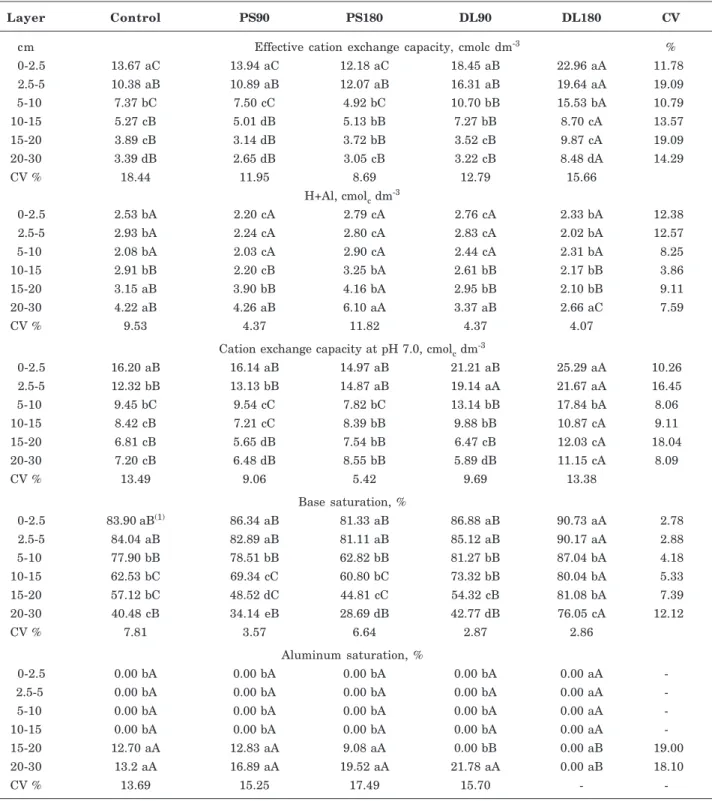
The greatest values of effective cation exchange capacity were found in the soil surface layers (0-2.5 and 2.5-5 cm) (Table 3) in all treatments. Moreover, the highest values of effective cation exchange capacity were found to a depth of 30 cm in the treatment DL 180 (Table 2). However, the greatest values of H+Al were found in the deepest layer (20-30 cm) in all treatments, which can be associated to the highest concentration of H+, reflected in the lowest values of
water pH and also in the greatest exchangeable Al concentrations (Table 2). On the other hand, the CECpH7.0 was highest in the surface layers (0-2.5 and
2.5-5 cm) in the deep-litter treatments (DL90 and DL180) (Table 3). However, the CECpH7.0 was highest
in treatment DL180 in all layers. This is probably associated to the highest TOC (Table 2), which agrees with results of Scherer et al. (2007), who tested the application of increasing doses of pig slurry to an Oxisol in two experiments in the western region of Santa Catarina. Higher values of CECpH7.0 in the soil can
result in a greater adsorption of cations, e.g., of exchangeable Ca and Mg.
Base saturation was highest in the surface layers (0-2.5 and 2.5-5 cm) in all treatments (Table 3), which is associated, particularly in the 0-2.5 cm layer, to the higher TOC contents, which potentiates cation adsorption, as for example Ca and Mg, applied to the soil in the manure (Table 2). However, base saturation was highest to a depth of 30 cm in treatment DL 180, which can be attributed to the highest TOC contents in this treatment (Table 2). The values of base saturation in the layers 10-15 cm and 15-20 cm of treatment DL 90 were higher than in the soil with and without pig slurry application. The increase in base saturation in the deeper layers agrees with the data obtained by Lourenzi et al. (2011), who found increases in base saturation in soil treated with pig slurry to 12 cm deep, also in a sandy Typic Hapludalf. It is however worth mentioning that base saturation was greater than 65 % to a depth of 15 cm in treatment DL90 and to 30 cm in DL180. The base saturation of 65 % was associated with a water pH of 5.5 (CQFSRS/ SC, 2004).
Source Year Dry Application Nutrient
matter rate input
Ca Mg K
% m3 ha-1 kg ha-1
PS90 2003 2.94 20.0 21 8 25
2004 3.00 24.4 25 10 30
2005 1.63 78.5 80 31 74
2006 2.54 59.5 61 23 68
2007 2.32 63.3 65 25 69
2008 2.10 67.0 68 26 70
2009 0.20 176.0 180 69 101
2010 3.28 49.5 50 19 65
Total 549 210 502
PS180 2003 2.94 40.6 41 16 50
2004 3.00 48.8 50 19 61
2005 1.63 157.0 160 61 147
2006 2.54 119.0 121 46 136
2007 2.32 126.6 129 49 138
2008 2.10 134.0 137 52 140
2009 0.20 352.0 359 137 202
2010 3.28 99.0 101 39 130
Total 1,099 420 1,003
Mg ha-1
DL90 2003 69.20 13.0 306 81 232
2004 38.10 44.1 571 151 238
2005 43.80 20.9 311 82 149
2006 41.10 23.7 331 88 149
2007 39.00 25.6 339 90 145
2008 61.00 10.7 222 59 146
2009 69.90 8.1 193 51 148
2010 45.00 20.0 306 81 149
Total 2,579 683 1,358
DL180 2003 69.20 26.0 612 162 465
2004 38.10 88.2 1,143 302 476
2005 43.80 41.8 622 165 299
2006 41.10 47.4 662 175 299
2007 39.00 51.2 679 180 291
2008 61.00 21.4 444 117 292
2009 69.90 16.2 385 102 296
2010 45.00 40.0 612 162 299
Total 5,159 1,366 2,716
Table 1. Characteristics of pig slurry (PS) and deep-litter (DL) applied for eight years at annual rates of 90 kg N ha-1 (PS90 and DL90) and 180 kg N ha-1
The Al saturation was zero to a depth of 15 cm in soil of the treatments control, PS90, PS180 and DL90 (Table 3). Nevertheless, in the soil of treatment DL 180, Al saturation was zero to a depth of 30 cm, which
is associated to the greatest values of water pH, causing Al complexation by OH- when above 5.5. This
is reflected in the saturation values, but also in the greater content of organic carbon in the soil (Table 2),
Layer Control PS90 PS180 DL90 DL180 CV
cm Total organic carbon, g kg-1 %
0-2.5 33.23 aB(1) 34.67 aB 40.65 aA 43.55 aA 53.90 aA 4.63
2.5-5 22.15 bB 24.37 bB 29.47 bA 31.95 bA 46.60 bA 3.39
5-10 19.20 cB 18.53 cB 21.30 cA 25.67 cA 27.00 cA 4.29
10-15 15.02 cB 15.27 dB 16.60 dA 15.53 dA 15.40 dA 5.44
15-20 12.10 dB 13.20 dB 14.70 dA 13.73 dA 13.47 dA 6.40
20-30 8.54 eB 10.90 eB 11.80 eA 11.50 eA 12.50 eA 5.15
CV % 3.67 3.42 4.33 5.22 5.75
Water pH
0-2.5 6.57 aA 6.28 aA 5.89 aA 6.31 aA 6.45 aA 5.01
2.5-5 6.47 aA 6.28 aA 5.80 aA 6.28 aA 6.44 aA 2.63
5-10 6.15 bA 6.19 aA 5.73 aA 6.26 aA 6.40 aA 2.51
10-15 5.79 cB 5.89 aB 5.69 aB 6.14 aA 6.35 aA 3.31
15-20 5.31 dB 5.06 bB 5.12 bB 5.65 aB 6.34 aA 2.14
20-30 4.94 dB 5.09 bB 4.84 bB 5.33 bB 5.88 bA 3.15
CV % 1.08 3.78 5.62 3.90 1.32
Exchangeable aluminum, cmolc dm-3
0-2.5 0.00 bA 0.00 bA 0.00 bA 0.00 bA 0.00 aA
-2.5-5 0.00 bA 0.00 bA 0.00 bA 0.00 bA 0.00 aA
-5-10 0.00 bA 0.00 bA 0.00 bA 0.00 bA 0.00 aA
-10-15 0.00 bA 0.00 bA 0.00 bA 0.00 bA 0.00 aA
-15-20 0.53 aA 0.40 aA 0.33 aA 0.00 bB 0.00 aB 19.01
20-30 0.40 aA 0.43 aA 0.60 aA 0.70 aA 0.00 aB 24.10
CV % 12.47 16.40 12.72 0.00 0.00
Exchangeable calcium, cmolc dm-3
0-2.5 8.17 aC 9.19 aC 7.44 aC 12.22 aB 14.60 aA 6.66
2.5-5 6.83 bB 7.81 aB 8.09 aA 11.02 aA 13.83 aA 22.06
5-10 5.24 bC 4.53 bC 3.48 bC 7.58 bB 11.57 aA 9.84
10-15 3.51 cB 3.27 bB 3.19 bB 4.63 cB 6.09 bA 12.27
15-20 2.55 dB 1.40 cB 1.86 cB 1.99 dB 6.95 bA 19.74
20-30 1.77 dB 1.23 cB 1.23 cB 1.70 dB 5.98 bA 19.63
CV % 14.64 13.46 9.35 9.57 20.30
Exchangeable magnesium, cmolc dm-3
0-2.5 4.35 aA 3.48 aA 3.04 aA 4.23 aA 5.67 aA 22.54
2.5-5 2.47 bA 2.23 bA 2.77 aA 3.73 aA 3.50 aA 26.32
5-10 1.28 bA 2.03 bA 0.86 bA 1.82 bA 2.45 aA 24.93
10-15 0.96 bA 0.95 bA 0.93 bA 1.42 bA 1.22 cA 24.52
15-20 0.73 bA 0.63 cA 1.30 bA 0.45 cA 1.74 cA 20.16
20-30 0.39 bB 0.35 cB 0.63 bB 0.12 cB 1.17 cA 18.34
CV % 17.38 18.29 19.48 13.86 12.95
Table 2. Total organic carbon, water pH, exchangeable aluminum, calcium and magnesium in soil layers subjected to applications of pig slurry (PS) and deep-litter (DL) for eight years at annual rates of 90 kg N ha-1 (PS90 and DL90) and 180 kg N ha-1 (PS180 and DL180)
enabling Al adsorption, particularly to the fulvic and humic fraction (Ceretta et al., 2003). These authors also reported a reduction in Al saturation to a depth
Layer Control PS90 PS180 DL90 DL180 CV
cm Effective cation exchange capacity, cmolc dm-3 %
0-2.5 13.67 aC 13.94 aC 12.18 aC 18.45 aB 22.96 aA 11.78
2.5-5 10.38 aB 10.89 aB 12.07 aB 16.31 aB 19.64 aA 19.09
5-10 7.37 bC 7.50 cC 4.92 bC 10.70 bB 15.53 bA 10.79
10-15 5.27 cB 5.01 dB 5.13 bB 7.27 bB 8.70 cA 13.57
15-20 3.89 cB 3.14 dB 3.72 bB 3.52 cB 9.87 cA 19.09
20-30 3.39 dB 2.65 dB 3.05 cB 3.22 cB 8.48 dA 14.29
CV % 18.44 11.95 8.69 12.79 15.66
H+Al, cmolc dm-3
0-2.5 2.53 bA 2.20 cA 2.79 cA 2.76 cA 2.33 bA 12.38
2.5-5 2.93 bA 2.24 cA 2.80 cA 2.83 cA 2.02 bA 12.57
5-10 2.08 bA 2.03 cA 2.90 cA 2.44 cA 2.31 bA 8.25
10-15 2.91 bB 2.20 cB 3.25 bA 2.61 bB 2.17 bB 3.86
15-20 3.15 aB 3.90 bB 4.16 bA 2.95 bB 2.10 bB 9.11
20-30 4.22 aB 4.26 aB 6.10 aA 3.37 aB 2.66 aC 7.59
CV % 9.53 4.37 11.82 4.37 4.07
Cation exchange capacity at pH 7.0, cmolc dm-3
0-2.5 16.20 aB 16.14 aB 14.97 aB 21.21 aB 25.29 aA 10.26
2.5-5 12.32 bB 13.13 bB 14.87 aB 19.14 aA 21.67 aA 16.45
5-10 9.45 bC 9.54 cC 7.82 bC 13.14 bB 17.84 bA 8.06
10-15 8.42 cB 7.21 cC 8.39 bB 9.88 bB 10.87 cA 9.11
15-20 6.81 cB 5.65 dB 7.54 bB 6.47 cB 12.03 cA 18.04
20-30 7.20 cB 6.48 dB 8.55 bB 5.89 dB 11.15 cA 8.09
CV % 13.49 9.06 5.42 9.69 13.38
Base saturation, %
0-2.5 83.90 aB(1) 86.34 aB 81.33 aB 86.88 aB 90.73 aA 2.78
2.5-5 84.04 aB 82.89 aB 81.11 aB 85.12 aB 90.17 aA 2.88
5-10 77.90 bB 78.51 bB 62.82 bB 81.27 bB 87.04 bA 4.18
10-15 62.53 bC 69.34 cC 60.80 bC 73.32 bB 80.04 bA 5.33
15-20 57.12 bC 48.52 dC 44.81 cC 54.32 cB 81.08 bA 7.39
20-30 40.48 cB 34.14 eB 28.69 dB 42.77 dB 76.05 cA 12.12
CV % 7.81 3.57 6.64 2.87 2.86
Aluminum saturation, %
0-2.5 0.00 bA 0.00 bA 0.00 bA 0.00 bA 0.00 aA
2.5-5 0.00 bA 0.00 bA 0.00 bA 0.00 bA 0.00 aA
-5-10 0.00 bA 0.00 bA 0.00 bA 0.00 bA 0.00 aA
-10-15 0.00 bA 0.00 bA 0.00 bA 0.00 bA 0.00 aA
-15-20 12.70 aA 12.83 aA 9.08 aA 0.00 bB 0.00 aB 19.00
20-30 13.2 aA 16.89 aA 19.52 aA 21.78 aA 0.00 aB 18.10
CV % 13.69 15.25 17.49 15.70 -
-Table 3. Effective cation exchange capacity, potential acidity (H+Al), cation exchange capacity at pH 7.0, base saturation and aluminum saturation, in soil layers treated with pig slurry (PS) and deep-litter applications (DL) for eight years at annual rates of 90 kg N ha-1 (PS90 and DL90) and 180 kg N ha-1
(PS180 and DL180)
(1) Mean values with the same lower case letter in a column and same capital letter in the soil layer are not significantly different (Tukey test, p<0.05).
of 20 cm, in a typical sandy Typic Hapludalf with
natural pasture and treated with 0, 20 and 40 m-3
et al. (2007) reported a decrease in Al saturation in a pig slurry-treated Oxisol. This is in agreement with results of Lourenzi et al. (2011), who found reduced saturation values to a depth of 20 cm, in a pig slurry-treated soil (0, 20, 40 and 80 m-3 ha-1 year-1).
However, in the 15-20 cm layer of the treatments control and PS90, Al saturation exceeded 10 %, a value considered average by CQFSRS/SC (2004), and therefore with potential plant toxicity, which was repeated in the 20-30 cm layer in the same treatments, as well as in the others, except for DL180.
CONCLUSIONS
1. Application of deep-litter for eight years increased the TOC content and cation exchange capacity in soil down to a depth of 30 cm, whereas pig slurry had no effect on these properties.
2. Applications of pig slurry or swine deep-litter for eight years to a previously limed soil did not change active acidity, indicating a small or no effect of these residues on acidity-related traits.
3. Application of swine deep-litter reduced aluminum saturation and increased base saturation down to a depth of 30 cm while pig slurry only had this effect to a depth of 20 cm.
ACKNOWLEDGEMENTS
This work was funded by the project Social Technologies for Water Management (TSGA), Foundation for Support of Scientific and Technological Research of the State of Santa Catarina (FAPESC) and National Committee of Technological and Scientific Development (CNPq). The authors are indebted to the Brazilian Federal Agency for Support and Evaluation of Graduate Education (CAPES), for the scholarship of D. J. Schmitt.
LITERATURE CITED
ADELI, A.; BOLSTER, C.H.; ROWE, D.E.; McLAUGHLIN, M.R. & BRINK, G.E. Effect of long-term swine effluent application on selected soil properties. Soil Sci., 173:223-235, 2008.
ANAMI, M.H.; SAMPAIO, S.C.; SUSZEK, M.; DAMASCENO, S. & QUEIROZ, M.M.F. Deslocamento miscível de nitrato e fosfato proveniente de água residuária da suinocultura em colunas de solo. R. Bras. Eng. Agríc. Amb., 12:75-80, 2008.
ASSMANN, T.S.; ASSMANN, J.M.; CASSOL, L.C.; DIEHL, R.C.; MANTELI, C. & MAGIERO, E.C. Desempenho da mistura forrageira de aveia-preta mais azevém e atributos químicos do solo em função da aplicação de esterco líquido de suínos. R. Bras. Ci. Solo, 31:1515-1523, 2007. BASSO, C.J.; CERETTA, C.A.; DURIGON, R.; POLETTO, N.
& GIROTTO, E. Dejeto líquido de suínos: II – Perdas de nitrogênio e fósforo por percolação no solo sob plantio direto. Ci. Rural, 35:1305-1312, 2005.
CERETTA, C.A.; DURIGON, R.; BASSO, C.J.; BARCELLOS, L.A.R. & VIEIRA, F.C.B. Características químicas de solo sob aplicação de esterco líquido de suínos em pastagem natural. Pesq. Agropec. Bras. 38:729-735, 2003.
CERETTA, C.A.; LORENSINI, F.; BRUNETTO, G.; GIROTTO, E.; GATIBONI, L.C.; LOURENZI, C.R.; TIECHER, T.L.; DE CONTI, L.; TRENTIN, G. & MIOTTO, A. Frações de fósforo no solo após sucessivas aplicações de dejetos de suínos em plantio direto. Pesq. Agropec. Bras., 45:593-602, 2010a.
CERETTA, C.A.; GIROTTO, E.; LOURENZI, C.R.; TRENTIN, G.; VIEIRA, R.C.B. & BRUNETTO, G. Nutrient transfer by runoff under no tillage in a soil treated with successive applications of pig slurry. Agric. Ecosyst. Environ., 139:689-699, 2010b.
COMISSÃO DE FERTILIDADE DO SOLO - CFSRS/SC. Recomendação de adubação e calagem para os estados do Rio Grande do Sul e Santa Catarina. 3. ed. Passo Fundo, SBCS/NRS/EMBRAPA/CNPT, 1994. 224p.
COMISSÃO DE QUÍMICA E FERTILIDADE DO SOLO -CQFSRS/SC. Manual de adubação e calagem para os estados do Rio Grande do Sul e Santa Catarina. 10. ed. Porto Alegre, 2004. 400p.
EMPRESA BRASILEIRA DE PESQUISA AGROPECUÁRIA -EMBRAPA. Centro Nacional de Pesquisa do Solo. Manual de métodos de análise de solos. Rio de Janeiro, 1997. 212p.
FALLEIRO, R.M.; SOUZA, C.M.; SILVA, C.S.W.; SEDIYAMA, C.S.; SILVA, A.A. & FAGUNDES, J.L. Influência dos sistemas de preparo nas propriedades químicas e físicas do solo. R. Bras. Ci. Solo, 27:1097-1104, 2003.
FRANCHINI, J.C.; MALAVOLTA, E.; MIYAZAWA, M. & PAVAN, M.A. Alterações químicas em solos ácidos após a aplicação de resíduos vegetais. R. Bras. Ci. Solo, 23:533-542, 1999.
FRANCHINI, J.C.; BORKERT, C.M.; FERREIRA, M.M. & GAUDÊNCIO, C.A. Alterações na fertilidade do solo em sistemas de rotação de culturas em semeadura direta. R. Bras. Ci. Solo, 24:459-467, 2000.
FRANCHINI, J.C.; MEDA, A.R. & CASSIOLATO, M.E. Potencial de extratos de resíduos vegetais na mobilização do calcário no solo por método biológico. Sci. Agric., 58:357-360, 2001.
GIROTTO, E.; CERETTA, C.A.; BRUNETTO, G.; SANTOS, D.R.; SILVA, L.S.; LOURENZI, C.R.; LORENSINI, F.; RENAN VIEIRA, C.B. & SCHMATZ, R. Acúmulo e formas de cobre e zinco no solo após aplicações sucessivas de dejeto líquido de suínos. R. Bras. Ci. Solo, 34:955-965, 2010.
HUE, N.V. & LICUDINE, D.L. Amelioration of subsoil acidity through surface application of organic manures. J. Environ. Qual., 28:623-632, 1999.
JANTALIA, C.P.; RESCK, D.V.S.; ALVES, B.J.R.; ZOTARELLI, L.; URQUIAGA, S. & BODDEY, R.M. Tillage effect on C stocks of a clayey Oxisol under a soybean-based crop rotation in the Brazilian Cerrado region. Soil Tillage Res., 95:97-109, 2007.
KAMINSKI, J., RHEINHEIMER, D.S. & BARTZ, H.R. Proposta de nova equação para determinação do valor de H+Al pelo uso do índice SMP em solos do RS e SC. In: REUNIÃO ANUAL DA ROLAS, 23., Frederico Westphalen, 2001. Anais... Frederico Westphalen, 2001.
KAMINSKI, J.; RHEINHEIMER, D.S.; GATIBONI, L.C.; BRUNETTO, G. & SILVA, L.S. Eficiência da calagem superficial e incorporada precedendo o sistema plantio direto em um Argissolo sob pastagem natural. R. Bras. Ci. Solo, 29:573-580, 2005.
LEITE, L.F.C.; GALVÃO, S.R.S.; HOLANDA NETO, M.R.; ARAÚJO, F.S. & IWATA, B.F. Atributos químicos e estoques de carbono em Latossolo sob plantio direto no cerrado do Piauí. R. Bras. Eng. Agríc. Amb., 14:1273-1280, 2010.
LOURENZI, C.R.; CERETTA, C.A.; SILVA, L.S.; TRENTIN, G.; GIROTTO, E.; LORENSINI, F.; TIECHER, T.L. & BRUNETTO, G. Soil chemical properties related to acidity under successive pig slurry application R. Bras. Ci. Solo, 35:1827-1836, 2011.
McDOWELL, R.; SHARPLEY, A. & FOLMAR, G. Phosphorus export from an agricultural watershed: Linking source and transport mechanisms. J. Environ. Qual., 30:1587-1595, 2001.
MIYAZAWA, M.; PAVAN, M.A. & CALEGARI, A. Efeito de material vegetal na acidez do solo. R. Bras. Ci. Solo, 17:411-416, 1993. OLIVEIRA, E.L. & PAVAN, M.A. Control of soil acidity in no tillage system for soybean production. Soil Tillage Res., 38:47-57, 1996.
SAS Institute Inc®.. SAS Ver. 9.1. 3 Cary, 2003.
SCHERER, E.E.; BALDISSERA, I.T. & NESI, C.N. Propriedades químicas de um Latossolo Vermelho sob plantio direto e adubação com esterco de suínos. R. Bras. Ci. Solo, 31:123-131, 2007.
SOIL SURVEY STAFF. Soil taxonomy: A basic system of soil classification for making and interpreting soil surveys. Washington, DC: U.S. Government Printing Office, 1999. TEDESCO, M.J.; GIANELLO, C.; BISSANI, C.A.; BOHNEN, H. & VOLKWEISS, S.J. Análises de solo, planta e outros materiais. 2.ed. Porto Alegre, Universidade Federal do Rio Grande do Sul, 1995. 174p.