Psychological Science 21(4) 551 –559 © The Author(s) 2010 Reprints and permission: sagepub.com/journalsPermissions.nav DOI: 10.1177/0956797610363406 http://pss.sagepub.com
Alphabetic orthographies differ with respect to how consis-tently letters map onto sounds. For example, in Finnish, Ital-ian, or Greek, a given letter is almost always pronounced the same in different words. These writing systems are referred to as consistent or transparent. In contrast, in English and to a lesser degree in French, a given letter is often pronounced dif-ferently in different words (e.g., a in cat, was, saw, made, and car). These writing systems are referred to as inconsistent or opaque. The orthographic consistency of a writing system has been shown to influence fundamental aspects of skilled read-ing, such as the importance of phonological information or the grain size of basic reading units (Frost, Katz, & Bentin, 1987; Ziegler, Perry, Jacobs, & Braun, 2001).
Over the past decade, it has become clear that orthographic consistency is the key factor determining the rate of reading acquisition across different languages (for a review, see Ziegler & Goswami, 2005). One of the most striking demonstrations comes from a cross-language investigation in which reading performance was measured at the end of Grade 1 in 14
European countries (Seymour, Aro, & Erskine, 2003). Whereas reading accuracy in most transparent languages (e.g., Italian, German, Greek, Spanish, and Finnish) reached ceiling at this time, accuracy in less transparent languages (e.g., Portuguese, French, and Danish) was lower, around 80%. However, read-ing performance in English, the least transparent of the orthog-raphies studied, was only 34%. This basic finding has been replicated in a number of small-scale experiments (Bruck, Genesee, & Caravolas, 1997; Frith, Wimmer, & Landerl, 1998; Goswami, Gombert, & de Barrera, 1998; Goswami, Ziegler, Dalton, & Schneider, 2001).
The outlier position of English has led some scientists to question the very foundations of current knowledge of skilled reading, reading development, and dyslexia. For example,
Corresponding Author:
Johannes C. Ziegler, Laboratoire de Psychologie Cognitive, CNRS and Aix-Marseille University, 3 place Victor Hugo, 13331 Aix-Marseille, Cedex 3, France E-mail: [email protected]
Orthographic Depth and Its Impact on
Universal Predictors of Reading: A
Cross-Language Investigation
Johannes C. Ziegler
1, Daisy Bertrand
1, Dénes Tóth
2, Valéria Csépe
2, Alexandra Reis
3,4,
Luís Faísca
3, Nina Saine
5, Heikki Lyytinen
5, Anniek Vaessen
6,7, and Leo Blomert
6,71Laboratoire de Psychologie Cognitive, CNRS and Aix-Marseille Université; 2Institute for Psychology, Hungarian Academy of Sciences, Budapest, Hungary; 3Cognitive Neuroscience Research Group, Departamento de Psicologia, Faculdade de Ciências Humanas e Sociais, Universidade do Algarve; 4Cognitive
Neurophysiology Research Group, Stockholm Brain Institute, Karolinska Institutet; 5Agora Research Center and Department of Psychology, University of
Jyväskylä; 6Department of Cognitive Neuroscience, Faculty of Psychology and Neuroscience, Maastricht University; and 7Maastricht Brain Imaging Institute
(M-BIC), Maastricht, The Netherlands
Abstract
Alphabetic orthographies differ in the transparency of their letter-sound mappings, with English orthography being less transparent than other alphabetic scripts. The outlier status of English has led scientists to question the generality of findings based on English-language studies. We investigated the role of phonological awareness, memory, vocabulary, rapid naming, and nonverbal intelligence in reading performance across five languages lying at differing positions along a transparency continuum (Finnish, Hungarian, Dutch, Portuguese, and French). Results from a sample of 1,265 children in Grade 2 showed that phonological awareness was the main factor associated with reading performance in each language. However, its impact was modulated by the transparency of the orthography, being stronger in less transparent orthographies. The influence of rapid naming was rather weak and limited to reading and decoding speed. Most predictors of reading performance were relatively universal across these alphabetic languages, although their precise weight varied systematically as a function of script transparency.
Keywords
reading development, phonological awareness, orthographic depth, rapid automatized naming Received 2/6/09; Revision accepted 7/10/09
Share (2008) recently argued that “the extreme ambiguity of English spelling-sound correspondence has confined reading science to an insular, anglocentric research agenda addressing theoretical and applied issues with limited relevance for a uni-versal science of reading” (p. 584). The most worrisome con-cern is that English-based research might have overestimated the importance of phonological awareness in reading develop-ment (Landerl & Wimmer, 2000; Share, 2008). This is an important concern because some researchers have argued that phonological awareness is the most important predictor of reading development in English (e.g., Schatschneider, Fletcher, Francis, Carlson, & Foorman, 2004; Share, Jorm, Maclean, & Matthews, 1984).
Phonological awareness refers to the ability to identify and manipulate units of sound (e.g., to delete the initial phoneme of a spoken word). Phonological awareness predicts not only the reading level of normally developing children, but also poor reading and dyslexia (e.g., Bradley & Bryant, 1983). It has been shown to predict reading outcomes even before read-ing instruction (Puolakanaho et al., 2007). Moreover, trainread-ing in phonological-awareness skills significantly improves chil-dren’s ability to read and spell (Ehri et al., 2001).
Why would English-based research have exaggerated the effects of phonological awareness? It is well known that the link between phonological awareness and reading is bidirec-tional. High levels of phonological awareness facilitate read-ing development, and at the same time, successful readread-ing development boosts phonological-awareness skills (Perfetti, Beck, Bell, & Hughes, 1987). Phonological awareness of the smallest units of sound in language, phonemes, might actually develop only through learning to read and write (Castles & Coltheart, 2004). If so, transparent orthographies with a one-to-one mapping between letters and sounds should naturally promote high levels of phonological awareness. As a conse-quence, phonological awareness might be a weaker predictor of reading development in transparent than in opaque orthog-raphies. In contrast, some researchers have argued that rapid automatized naming (RAN) is a more important predictor of reading development in transparent than in opaque orthogra-phies (e.g., de Jong & van der Leij, 2003; Wimmer, Mayringer, & Landerl, 2000).
These hypotheses have been tested in a number of cross-language studies, which typically have compared reading development in English and one other language. The results have been rather mixed. Whereas some studies found that pho-nological awareness was important only in English, and not in other languages, such as Greek or German (Georgiou, Parrila, & Papadopoulos, 2008; Mann & Wimmer, 2002), others found that phonological awareness was equally important in English and in other languages, such as Dutch and Czech (Caravolas, Volin, & Hulme, 2005; Patel, Snowling, & de Jong, 2004). Similarly, whereas some studies found that RAN was more important in transparent languages than in English (Georgiou et al., 2008; Mann & Wimmer, 2002), others reported equal influences across languages (Patel et al., 2004).
The Present Study
The goal of the present study was to shed new light on whether predictors of reading development vary with orthographic transparency. The novel aspect of our approach was that we compared a number of languages with scripts varying in trans-parency. Three distinct claims regarding the role of phonologi-cal awareness in reading development can be distinguished. The first, which we refer to as the strong claim, is that phono-logical awareness is the most important factor in each lan-guage. The second, which we refer to as the weak claim, is that phonological awareness is important in all languages, but has a varying impact across languages. Finally, the third claim is that phonological awareness is equally important in all lan-guages. We were also interested in other commonly studied factors: phonological short-term memory (PSTM), RAN, vocabulary knowledge, and nonverbal intelligence.
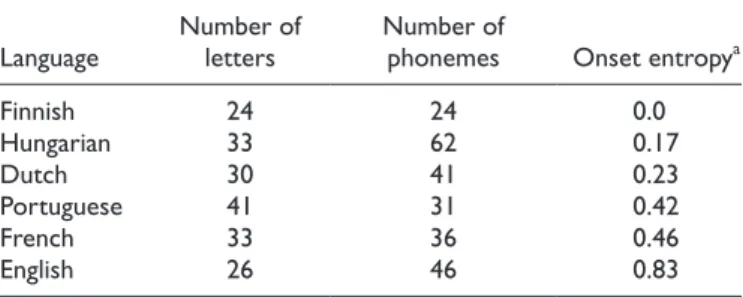
Orthographic transparency was quantified using entropy computations for the initial letter-sound mappings in each lan-guage (Borgwaldt, Hellwig, & De Groot, 2005). The advantage of using word onsets is that one can meaningfully compare lan-guages with different orthographic and phonological structures because all languages have word onsets. Thus, onset entropy provides a fairly objective and assumption-free index of the transparency of a writing system. The mean entropy values for the five languages used in the present study (along with the num-bers of letters and phonemes in these languages) are presented in Table 1; English is included in the table as a comparison.
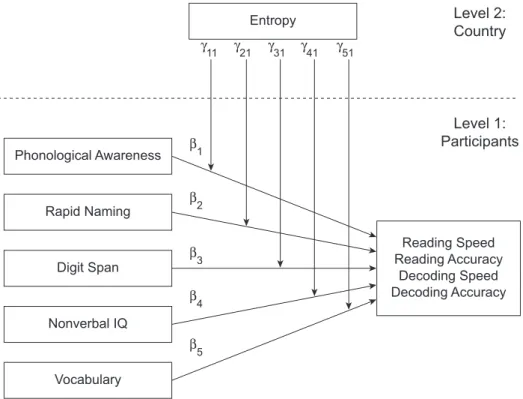
The basic design of the study is summarized in Figure 1. In short, we were interested in how five major cognitive compo-nents relate to reading and decoding ability across five differ-ent languages. We used a multilevel analysis with Level 1 representing the individual-subject level and Level 2 repre-senting entropy.
Within each country, we targeted a Grade 2 school popula-tion. A total of 1,265 children participated in the study. For each country, we developed a test battery that measured read-ing and decodread-ing, as well as the five predictor variables. Note that one of the trickiest issues in cross-language research is how to devise parallel tests that can be compared meaning-fully. One strategy is to use literally identical materials across
Table 1. Characteristics of English and the Five Languages Used in
the Present Study
Language Number of letters Number of phonemes Onset entropya
Finnish 24 24 0.0 Hungarian 33 62 0.17 Dutch 30 41 0.23 Portuguese 41 31 0.42 French 33 36 0.46 English 26 46 0.83
languages (e.g., Frith et al., 1998; Ziegler et al., 2001). How-ever, this strategy works only for languages that are fairly similar with respect to orthographic and phonological struc-ture, such as German and English. When languages differ on too many dimensions, this strategy no longer works. In this case, creating parallel tests by simply translating a “common” test into different languages is likely to produce insensitive and artificial measures that may be subject to ceiling effects (e.g., Seymour et al., 2003). Thus, a more appropriate strategy is to use language-specific tests that are maximally sensitive for measuring each particular component in a given language. Performance on these language-specific tests can then be com-pared across countries after standardizing performance within each country. Thus, rather than comparing absolute perfor-mance levels across countries, we compared z-score distribu-tions across countries.
Method
Entropy measure
Entropy for initial letter-sound mappings was calculated as follows:
H = ∑ pi× log21/pi,
where p1 is the probability of the first pronunciation of a given letter, p2 is the probability of the second pronunciation of the letter (if a second pronunciation exists), and so on for all n possible pronunciations of that letter. When this calculation is
done for all letters of a script, one obtains an entropy value for that script. If all letters always correspond to a single pho-neme, then the entropy value is zero (e.g., Finnish). The more letters with ambiguous pronunciations and the greater the number of pronunciations of ambiguous letters, the higher the entropy value. The entropy values for Hungarian, Dutch, Por-tuguese, French, and English were taken from Borgwaldt et al. (2005). The values for Finnish were calculated using a Finnish text corpus. One concern is the extent to which the onset mea-sure is comparable to meamea-sures that have been used in previ-ous studies (e.g., rhyme consistency). Perry and Ziegler (2002, Table 1) compared spelling-to-sound entropy for onsets and rhymes in German and English and found fairly similar values for onsets and rhymes. Moreover, if one compares onset and rhyme consistency in German, English, French, and Dutch, one obtains exactly the same entropy rank order regardless of whether onset or rhyme is used.
Participants
The study was conducted in five different European countries: Finland, France, Hungary, The Netherlands, and Portugal. For each country, we selected a sample of Grade 2 children (total N = 1,265) that was thought to be typical of the country’s Grade 2 students in terms of socioeconomic makeup, ethnic composition, level of reading achievement, and overall cogni-tive performance. The children were tested in the second half of the school year (between January and June).1 The sample
consisted of 166 Finnish children (mean age = 107.6 months, SD = 4.2 months), 181 French children (mean age = 92.4
Entropy Phonological Awareness Rapid Naming Digit Span Nonverbal IQ Vocabulary Reading Speed Reading Accuracy Decoding Speed Decoding Accuracy Level 1: Participants Level 2: Country β1 β2 β3 β4 β5 γ11 γ21 γ31 γ41 γ51
Fig. 1. Basic design of the study displaying the five factors that influence reading and decoding at the individual level (Level 1) and their potential modulation by script entropy (Level 2).
months, SD = 6.2 months), 139 Hungarian children (mean age = 105.9 months, SD = 6.4 months), 597 Dutch children (mean age = 93.3 months, SD = 5.3 months), and 182 Portu-guese children (mean age = 92.4 months, SD = 5.7 months).
Tests
Word reading. Reading speed and accuracy were measured in
each country with a 1-min reading test. This choice was ideal for the present purpose because a standardized version of this test was available in each country. For this test, children were given 1 min to read as many words as possible from a word list ordered in terms of word difficulty. Our measure of reading speed was the number of words read per second; our measure of reading accuracy was the percentage of words read aloud that were read correctly.
Phonological decoding. In each country, a list of
orthograph-ically legal and pronounceable pseudowords was devised. This was done by replacing a single letter or letter cluster at the beginning, middle, or end of an existing word. As for the word test, children were given 1 min to read as many items as possible. All plausible pronunciations were taken as correct. Decoding speed was defined as the number of pseudowords read correctly per second; decoding accuracy was the percent-age of words read aloud that were read correctly.
Phonological awareness. Phonological awareness was assessed
by a classic phoneme-deletion task with words and pseudo-words. That is, children were presented with a recording of a given item (e.g., /trik/) and were asked to delete the first sound in their mind and say the remaining sequence (/rik/) out loud. Because performance on classic phoneme-deletion tasks is at ceiling by Grade 2 in Finland, a more complex task focusing on the comparison of final phonemes was used in that country. Each test was language-specific in the sense that the selected phonological structures were the ones that are the most typical for that language. The dependent variable was the percentage of correct responses.
RAN. The object version of the original RAN task was used in
each country (Denckla & Rudel, 1974). That is, a child was presented with an object matrix that contained the line draw-ings of five objects that were randomly repeated. The task was to name the objects as rapidly as possible. The dependent vari-able was the number of items named correctly per second.
PSTM. PSTM was assessed using the Forward Digit Span task
from the Wechsler Intelligence Scale for Children (WISC; Wechsler, 2003). On each trial, a sequence of digits was real aloud to the child, and the task was to repeat the sequence in the exact same order (two trials per sequence length, sequence lengths from two to nine digits). The test stopped when the child failed both trials of a given length. The dependent
variable was memory span, which corresponds to the largest sequence reported correctly.
Nonverbal IQ. Nonverbal IQ was assessed with different
standardized tests in different countries. In Finland, France, and Hungary, the WISC (Wechsler, 2003) was used, whereas in The Netherlands and Portugal, Raven’s Progressive Matri-ces (Raven, 1976) was used.
Vocabulary. The Vocabulary subtest of the WISC (Wechsler,
2003) was used in all countries except for The Netherlands, where a passive vocabulary test was used.
Results
Absolute reading and decoding performance across the five countries is shown in Table S1 in the Supplemental Material available on-line. Here, we focus on simultaneous regressions for each country and multilevel analyses of reading and decod-ing speed and accuracy.
Regression analyses by country
For each country, the raw data of each variable were trans-formed into z scores. Simultaneous regression analyses were conducted separately for each country for reading (accuracy and speed) and decoding (accuracy and speed). Table 2 pres-ents the standardized beta weights and the amount of variance accounted for in each country.
Inspection of Table 2 shows that the regression structure was fairly similar across the five countries (for the full correla-tion matrix, see Table S2 in the Supplemental Material avail-able on-line). Most notably, phonological awareness was the strongest correlate of reading (speed and accuracy) in all coun-tries but Finland. Phonological awareness was the strongest correlate of phonological decoding in all countries. RAN was a significant correlate of reading and decoding speed in most countries (the exceptions were Finland for both reading and decoding speed and France for reading speed), but was not a significant correlate of reading and decoding accuracy in any country. However, the influence of RAN was much weaker than that of phonological awareness. PSTM had a significant influence on reading and decoding accuracy (but not speed) in a few countries, most notably Hungary. Vocabulary ability predicted reading speed and accuracy and decoding accuracy in Finland and reading speed in France. Finally, nonverbal IQ had no significant influence on reading or decoding.
Multilevel regression analysis
Multilevel regressions were conducted to investigate the impact of script entropy on the various components of reading and decoding. We used a two-level hierarchical linear model (HLM) with the effects of script entropy being represented at
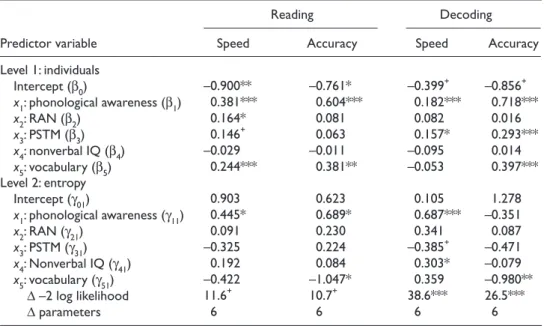
Level 2 and the effects of the five components on reading (or decoding) being represented at Level 1 (see Fig. 1). The analy-ses were performed using the HLM procedure (Proc Mixed) of SAS Version 9.1. Maximum likelihood estimation with robust standard errors was used to estimate the parameters, and the overall fit of the models was evaluated with the likelihood ratio test. The results are presented in Table 3.
The Level 1 correlations showed that phonological aware-ness, RAN, PSTM, and vocabulary all had a positive associa-tion with reading speed and accuracy. According to the regression coefficients, phonological awareness was the most important factor associated with reading speed and accuracy. At Level 2, entropy had a statistically significant positive influence on the relationship between phonological awareness and read-ing and a significantly negative influence on the relationship between vocabulary and reading accuracy. These results suggest
that the impact of phonological awareness on reading was more important when entropy was high (i.e., inconsistent scripts) than when entropy was low (i.e., consistent scripts). On the contrary, the impact of vocabulary on reading was stronger when entropy was low than when it was high. To check whether this result was mainly due to the Finnish sample, we repeated the HLM analy-sis without the Finnish sample, and, indeed, the effects of entropy were not longer significant in the case of vocabulary. Thus, the significant negative relationship in the original analy-sis was largely due to the Finnish sample.
The decoding data yielded similar results. Entropy had a statistically significant positive influence on the relationship between phonological awareness and decoding speed and a significantly negative influence on the relationship between vocabulary and decoding accuracy. Thus, as for reading, the influences of phonological awareness and vocabulary were Table 2. Standardized Regression Coefficients From the Simultaneous Regression Analyses of
Reading and Decoding Speed and Accuracy
Predictor variable (n = 166)Finland (n = 139)Hungary Netherlands (n = 597) (n = 182)Portugal (n = 181)France Reading speed Phonological awareness 0.31*** 0.49*** 0.41*** 0.54*** 0.53*** RAN 0.08 0.30*** 0.12** 0.15* 0.11 PSTM 0.03 0.04 0.04 –0.01 0.05 Vocabulary 0.32*** –0.12 0.06 –0.01 0.14* Nonverbal IQ –0.05 –0.10 0.03 0.09 0.03 Radj2 .25 .34 .23 .41 .38 Reading accuracy Phonological awareness 0.27*** 0.45*** 0.39*** 0.49*** 0.52*** RAN 0.05 0.11 0.05 0.12 0.05 PSTM –0.26* 0.22* 0.05 0.07 0.08 Vocabulary 0.41*** –0.10 0.00 –0.02 0.06 Nonverbal IQ 0.05 –0.14 0.05 –0.03 0.03 Radj2 .21 .28 .19 .31 .32 Decoding speed Phonological awareness 0.18* 0.44*** 0.33*** 0.55*** 0.44*** RAN 0.06 0.29** 0.10** 0.13* 0.16* PSTM 0.19 –0.07 0.06 0.01 0.02 Vocabulary 0.09 –0.11 0.00 –0.01 0.12 Nonverbal IQ –0.17 –0.13 –0.01 0.11 0.00 Radj2 .05 .24 .146 .43 .24 Decoding accuracy Phonological awareness 0.38*** 0.38*** 0.40*** 0.43*** 0.55*** RAN 0.08 0.01 –0.06 0.02 0.12 PSTM 0.11 0.32*** 0.10** 0.15* –0.01 Vocabulary 0.36*** –0.14 0.06 0.02 0.06 Nonverbal IQ 0.01 –0.04 0.08 –0.03 –0.02 Radj2 .33 .26 .22 .24 .34
Note: RAN = rapid automatized naming; PSTM = phonological short-term memory; Radj2 = adjusted variance
accounted for.
modulated such that phonological awareness was a more important component in opaque orthographies, whereas vocabulary was a more important component in transparent orthographies. Again, the effects of vocabulary disappeared when Finnish was excluded from the analysis.
General Discussion
The main goal of this study was to investigate the major com-ponents of early reading achievement across five languages that vary systematically in script transparency. The most important question concerned the importance of phonological awareness as a universal predictor for reading development. With respect to the three claims presented in the introduction, the strong claim that phonological awareness is the most important factor in all languages was not entirely confirmed, as it was the most important factor in only four of the five languages. The claim that phonological awareness is equally important in all languages (e.g., Caravolas et al., 2005; Patel et al., 2004) was not supported because the impact of phono-logical awareness on reading and decoding was systematically modulated by script entropy, with phonological awareness being more important in less transparent languages. Together, then, the results strongly support the weak claim that phono-logical awareness is important in all languages but that its impact is modulated by script entropy. This finding is in line with the main conclusions of the National Reading Panel (see also Ehri et al., 2001). The significant influence of phonologi-cal awareness in all languages counters previous claims that phonological awareness plays little or no role in transparent languages (Georgiou et al., 2008; Landerl & Wimmer, 2008; Mann & Wimmer, 2002).
The modulation of phonological awareness by transpar-ency is certainly a direct consequence of the reciprocal influ-ence of phonological awareness and reading. The higher phonological awareness is at the beginning of reading, the bet-ter the expected reading level of a child. At the same time, the easier it is for children to learn about letters and their sounds, the quicker children develop phoneme-sized representations, which support phonological decoding. That is, the one-to-one mapping between letters and sounds in a transparent orthogra-phy promotes access to phonemes, thus boosting basic phono-logical-awareness skills and helping to trigger the development of phoneme-sized representations (see Goswami, Ziegler, & Richardson, 2005). This orthography-dependent refinement process should work even in children with initially poor pho-nological skills (dyslexics). Differences in preliterate phono-logical awareness should become homogenized more quickly in children learning to read transparent scripts than in children learning to read opaque scripts, and this would automatically lead to weaker correlations between phonological awareness and reading in transparent orthographies.
This scenario suggests a number of predictions: First, effects of phonological awareness should be relatively transient in transparent orthographies. That is, the impact of phonological awareness on reading should be more important prior to reading or in early grades than it is later on. Such a developmental trend has indeed been observed in a number of studies (de Jong & van der Leij, 2003; Landerl & Wimmer, 2000, 2008; Leppanen, Niemi, Aunola, & Nurmi, 2006). Note that our study was prob-ably favorable to detecting strong effects of phonological awareness because it was assessed fairly early (Grade 2). Sec-ond, measures of phonological awareness should be more sub-ject to ceiling effects in transparent than in opaque orthographies. Table 3. Regression Coefficients From the Hierarchical Linear Modeling Analyses
Reading Decoding Predictor variable Speed Accuracy Speed Accuracy Level 1: individuals Intercept (β0) –0.900** –0.761* –0.399 + –0.856+ x1: phonological awareness (β1) 0.381*** 0.604*** 0.182*** 0.718*** x2: RAN (β2) 0.164* 0.081 0.082 0.016 x3: PSTM (β3) 0.146+ 0.063 0.157* 0.293*** x4: nonverbal IQ (β4) –0.029 –0.011 –0.095 0.014 x5: vocabulary (β5) 0.244*** 0.381** –0.053 0.397*** Level 2: entropy Intercept (γ01) 0.903 0.623 0.105 1.278 x1: phonological awareness (γ11) 0.445* 0.689* 0.687*** –0.351 x2: RAN (γ21) 0.091 0.230 0.341 0.087 x3: PSTM (γ31) –0.325 0.224 –0.385+ –0.471 x4: Nonverbal IQ (γ41) 0.192 0.084 0.303* –0.079 x5: vocabulary (γ51) –0.422 –1.047* 0.359 –0.980** Δ –2 log likelihood 11.6+ 10.7+ 38.6*** 26.5*** Δ parameters 6 6 6 6
Note: RAN = rapid automatized naming; PSTM = phonological short-term memory.
This point has been demonstrated most clearly by Caravolas et al. (2005), who showed that phonological awareness has identical effects on reading in transparent and nontransparent orthographies as long as phonological-awareness tasks are ren-dered sufficiently difficult in the transparent orthography. Ceil-ing effects or lack of power might indeed explain why some of the previous studies failed to find robust effects of phonological awareness in transparent orthographies (e.g., Harris & Giannouli, 1999; Holopainen, Ahonen, & Lyytinen, 2001; but see Puolakanaho et al., 2007). Finally, reading accuracy reaches ceiling very quickly in transparent orthographies (Seymour et al., 2003), leaving reading speed as the primary useful depen-dent variable. Thus, a phonological-awareness measure capable of predicting reading speed must probably include a speed com-ponent that is sensitive to how quickly children can access pho-nemes (see Vaessen, Gerretsen, & Blomert, 2009).
Contrary to our expectations, RAN was only a weak compo-nent; it was limited to reading and decoding speed, and its influ-ence was not significantly modulated by script transparency. This finding stands in contrast to previous findings that RAN was more important than phonological awareness in predicting reading in transparent orthographies, such as Dutch and German (e.g., de Jong & van der Leij, 1999; Wimmer et al., 2000). How can this discrepancy be explained? First, we assessed object RAN rather than alphanumerical RAN. Although we believe that object RAN is a purer measure of naming-speed deficits (because it is not confounded by letter recognition), it has to be acknowledged that object RAN tends to have lower correlations with reading performance than alphanumerical RAN does (Vaessen et al., 2009). Second, it is probably misleading to think of RAN as an independent nonphonological component (for a review, see Vaessen et al., 2009). Indeed, Chiappe, Stringer, Sie-gel, and Stanovich (2002) showed that 25% of the variance in reading explained by naming speed is unique; the other 75% is shared with phonological awareness. Therefore, even if the rather modest correlation between naming speed and phono-logical awareness might be taken to suggest that RAN tasks incorporate only a relatively small phonological component (e.g., Swanson, Trainin, Necoechea, & Hammill, 2003), it appears to be just this phonological component that predicts reading performance the best (see Vaessen et al., 2009). If so, whenever phonological-awareness measures are not sufficiently sensitive or reach ceiling, the lion’s share of the shared variance is left to RAN, which will become the dominant predictor. Given the sensitivity of phonological awareness in our study, it is not surprising that RAN was somewhat reduced to explaining smaller amounts of variance in reading and decoding speed. This explanation seems consistent with the cross-language results obtained by Patel et al. (2004). They included a speed measure of phonological awareness, which is less subject to ceiling effects, and reported almost identical results for English and Dutch: strong effects for phonological awareness (both accuracy and speed), but no effects for RAN.
The data for the fully transparent Finnish orthography seem to deviate from the patterns in the other languages in several important ways. First, Finnish was the only script for which
phonological awareness was not the most important correlate of reading performance. Second, only Finnish showed strong cor-relations of vocabulary with both reading and decoding. Strong correlations between vocabulary and reading are somewhat at odds with the literature suggesting that readers of transparent orthographies rely less on lexical, supralexical, and contextual variables than do readers of opaque orthographies (for a review, see Share, 2008). However, correlations go in both directions, and it is likely that the proficient reading level of Finnish chil-dren in Grade 2 allowed the Finnish readers to considerably boost their vocabulary knowledge through reading.
One limitation of the present study is its focus on alpha-betic scripts. One might argue that our findings do not apply to nonalphabetic scripts, such as Chinese, which is spoken and read by at least 20% of the world’s population. However, a number of cross-cultural studies comparing English and Chi-nese have reported strikingly similar results. For example, McBride and Kail (2002) measured phonological awareness, speeded naming, visual-spatial skills, and processing speed in Chinese and English and found that phonological aware-ness was the strongest predictor of reading in both languages. Despite these striking similarities, there might be some important differences between alphabetic and nonalphabetic scripts in terms of orthographic and morphological awareness (McBride-Chang, Shu, Zhou, Wat, & Wagner, 2003; Tan, Spinks, Eden, Perfetti, & Siok, 2005). Such differences would deserve sys-tematic cross-script exploration.
In conclusion, phonological awareness is a key component of reading acquisition and decoding in all languages included in this study, although its influence is weaker in transparent than in opaque writing systems. This finding highlights the importance of phonological awareness not as a pure phono-logical variable, but rather as a variable that is itself influenced by learning to read and by the transparency of a language (Castles & Coltheart, 2004). Comparatively, RAN had a much weaker influence that was limited to reading and decoding speed (Vaessen et al., 2009). Thus, the bottom line is that the predictors of reading performance, at least in alphabetic lan-guages, are relatively universal, although their precise weight varies systematically as a function of script transparency. Acknowledgments
We thank the schools, children, parents, and teachers for their enthu-siastic participation.
Declaration of Conflicting Interests
The authors declared that they had no conflicts of interest with respect to their authorship or the publication of this article.
Funding
This study was supported by Grant 2006-2798/001-001 SO2 61OBGE of the EU-SOCRATES program Action 6.1.2 and 6.2 to Leo Blomert.
Supplemental Material
Additional supporting information may be found at http://pss.sagepub .com/content/by/supplemental-data
Note
1. In Finland, phonological awareness and rapid naming were tested at the end of first grade.
References
Borgwaldt, S.R., Hellwig, F.M., & De Groot, A.M.B. (2005). Onset entropy matters—letter-to-phoneme mappings in seven lan-guages. Reading and Writing, 18, 211–229.
Bradley, L., & Bryant, P.E. (1983). Categorizing sounds and learning to read: A causal connection. Nature, 301, 419–421.
Bruck, M., Genesee, F., & Caravolas, M. (1997). A cross-linguistic study of early literacy acquisition. In B.A. Blachman (Ed.),
Foun-dations of reading acquisition and dyslexia: Implications for early intervention (pp. 145–162). Mahwah, NJ: Erlbaum.
Caravolas, M., Volin, J., & Hulme, C. (2005). Phoneme awareness is a key component of alphabetic literacy skills in consistent and inconsistent orthographies: Evidence from Czech and English children. Journal of Experimental Child Psychology, 92, 107–139. Castles, A., & Coltheart, M. (2004). Is there a causal link from pho-nological awareness to success in learning to read? Cognition,
91, 77–111.
Chiappe, P., Stringer, R., Siegel, L.S., & Stanovich, K.E. (2002). Why the timing deficit hypothesis does not explain reading dis-ability in adults. Reading and Writing, 15, 73–107.
de Jong, P.F., & van der Leij, A. (1999). Specific contributions of phonological abilities to early reading acquisition: Results from a Dutch latent variable longitudinal study. Journal of Educational
Psychology, 91, 450–476.
de Jong, P.F., & van der Leij, A. (2003). Developmental changes in the manifestation of a phonological deficit in dyslexic children learning to read a regular orthography. Journal of Educational
Psychology, 95, 22–40.
Denckla, M.B., & Rudel, R. (1974). Rapid “automatized” naming of pictured objects, colors, letters and numbers by normal children.
Cortex, 10, 186–202.
Ehri, L.C., Nunes, S.R., Willows, D.M., Schuster, B.V., Yaghoub-Zadeh, Z., & Shanahan, T. (2001). Phonemic awareness instruction helps children learn to read: Evidence from the National Reading Panel’s meta-analysis. Reading Research Quarterly, 36, 250–287. Frith, U., Wimmer, H., & Landerl, K. (1998). Differences in
pho-nological recoding in German- and English-speaking children.
Scientific Studies of Reading, 2, 31–54.
Frost, R., Katz, L., & Bentin, S. (1987). Strategies for visual word recognition and orthographical depth: A multilingual compari-son. Journal of Experimental Psychology: Human Perception
and Performance, 13, 104–115.
Georgiou, G.K., Parrila, R., & Papadopoulos, T.C. (2008). Predictors of word decoding and reading fluency across languages varying in orthographic consistency. Journal of Educational Psychology,
100, 566–580.
Goswami, U., Gombert, J.E., & de Barrera, L.F. (1998). Children’s orthographic representations and linguistic transparency: Non-sense word reading in English, French, and Spanish. Applied
Psycholinguistics, 19, 19–52.
Goswami, U., Ziegler, J.C., Dalton, L., & Schneider, W. (2001). Pseu-dohomophone effects and phonological recoding procedures in reading development in English and German. Journal of Memory
and Language, 45, 648–664.
Goswami, U., Ziegler, J.C., & Richardson, U. (2005). The effects of spelling consistency on phonological awareness: A comparison of English and German. Journal of Experimental Child
Psychol-ogy, 92, 345–365.
Harris, M., & Giannouli, V. (1999). Learning to read and spell in Greek: The importance of letter knowledge and morphological awareness. In M. Harris & G. Hatano (Eds.), Learning to read
and write: A cross-linguistic perspective (pp. 51–70). Cambridge,
England: Cambridge University Press.
Holopainen, L., Ahonen, T., & Lyytinen, H. (2001). Predicting delay in reading achievement in a highly transparent language. Journal
of Learning Disabilities, 34, 401–413.
Landerl, K., & Wimmer, H. (2000). Deficits in phoneme segmenta-tion are not the core problem of dyslexia: Evidence from German and English children. Applied Psycholinguistics, 21, 243–262. Landerl, K., & Wimmer, H. (2008). Development of word
read-ing fluency and spellread-ing in a consistent orthography: An 8-year follow-up. Journal of Educational Psychology, 100, 150–161. Leppanen, U., Niemi, P., Aunola, K., & Nurmi, J.E. (2006).
Develop-ment of reading and spelling Finnish from preschool to Grade 1 and Grade 2. Scientific Studies of Reading, 10, 3–30.
Mann, V., & Wimmer, H. (2002). Phoneme awareness and pathways into literacy: A comparison of German and American children.
Reading and Writing, 15, 653–682.
McBride-Chang, C., & Kail, R.V. (2002). Cross-cultural similarities in the predictors of reading acquisition. Child Development, 73, 1392–1407. McBride-Chang, C., Shu, H., Zhou, A.B., Wat, C.P., & Wagner, R.K.
(2003). Morphological awareness uniquely predicts young chil-dren’s Chinese character recognition. Journal of Educational
Psychology, 95, 743–751.
Patel, T.K., Snowling, M.J., & de Jong, P.F. (2004). A cross-linguistic comparison of children learning to read in English and Dutch.
Journal of Educational Psychology, 96, 785–797.
Perfetti, C.A., Beck, I., Bell, L.C., & Hughes, C. (1987). Phonemic knowledge and learning to read are reciprocal: A longitudinal-study of 1st-grade children. Merrill-Palmer Quarterly: Journal
of Developmental Psychology, 33, 283–319.
Perry, C., & Ziegler, J.C. (2002). Cross-language computational investigation of the length effect in reading aloud. Journal of
Experimental Psychology: Human Perception and Performance, 28, 990–1001.
Puolakanaho, A., Ahonen, T., Aro, M., Eklund, K., Leppanen, P.H., Poikkeus, A.M., et al. (2007). Very early phonological and lan-guage skills: Estimating individual risk of reading disability.
Journal of Child Psychology and Psychiatry, 48, 923–931.
Raven, J.C. (1976). Standard progressive matrices: Sets A, B, C, D & E. Oxford, England: Psychologists Press.
Schatschneider, C., Fletcher, J.M., Francis, D.J., Carlson, C.D., & Foorman, B.R. (2004). Kindergarten prediction of reading skills: A longitudinal comparative analysis. Journal of Educational
Seymour, P.H.K., Aro, M., & Erskine, J.M. (2003). Foundation lit-eracy acquisition in European orthographies. British Journal of
Psychology, 94, 143–174.
Share, D.L. (2008). On the anglocentricities of current reading research and practice: The perils of overreliance on an “outlier” orthography. Psychological Bulletin, 134, 584–615.
Share, D.L., Jorm, A.F., Maclean, R., & Matthews, R. (1984). Sources of individual-differences in reading acquisition. Journal of
Edu-cational Psychology, 76, 1309–1324.
Swanson, H.L., Trainin, G., Necoechea, D.M., & Hammill, D.D. (2003). Rapid naming, phonological awareness, and reading: A meta-analysis of the correlation evidence. Review of Educational
Research, 73, 407–440.
Tan, L.H., Spinks, J.A., Eden, G.F., Perfetti, C.A., & Siok, W.T. (2005). Reading depends on writing, in Chinese. Proceedings of
the National Academy of Sciences, USA, 102, 8781–8785.
Vaessen, A., Gerretsen, P., & Blomert, L. (2009). Naming problems do not reflect a second independent core deficit in dyslexia: Dou-ble deficits explored. Journal of Experimental Child Psychology,
103, 202–221.
Wechsler, D. (2003). Wechsler Intelligence Scale for Children—
Fourth Edition. San Antonio, TX: Psychological Corp.
Wimmer, H., Mayringer, H., & Landerl, K. (2000). The double-deficit hypothesis and difficulties in learning to read a regular orthography. Journal of Educational Psychology, 92, 668–680. Ziegler, J.C., & Goswami, U. (2005). Reading acquisition,
develop-mental dyslexia, and skilled reading across languages: A psy-cholinguistic grain size theory. Psychological Bulletin, 131, 3–29.
Ziegler, J.C., Perry, C., Jacobs, A.M., & Braun, M. (2001). Identical words are read differently in different languages. Psychological