A METHODOLOGY FOR THE VULNERABILITY ASSESSMENT OF HERITAGE BUILDINGS AND CONTENTS UNDER CATASTROPHIC HAZARD
1. Author: Paupério, Esmeralda
Affiliation: Instituto da Construção da Faculdade de Engenharia da Universidade do Porto Correspondance: Instituto da Construção. Rua Dr. Roberto Frias. 4200-465 Porto. Portugal E-mail: [email protected]
2. Author: Romão, Xavier
Affiliation: Faculdade de Engenharia da Universidade do Porto
Correspondance: Faculdade de Engenharia da Universidade do Porto. Rua Dr. Roberto Frias. 4200-465 Porto. Portugal
E-mail: [email protected] 3. Author: Costa, Aníbal
Affiliation: Universidade de Aveiro
Correspondance: Departamento de Engenharia Civil. Universidade de Aveiro. Campus Universitário de Santiago. 3810-193 Aveiro. Portugal
E-mail: [email protected] Summary
The development of a framework for the quantification of the cultural heritage vulnerability for different hazard sources is presented. Given the advantages of having different areas of expertise contributing for the assessment of vulnerability, the proposed framework involves a multidisciplinary approach for the definition of heritage vulnerability. The general scope and the conceptual definition of the proposed framework are discussed and it is established that vulnerability assessment must be carried out with respect to three fundamental components: the building, the collections and the building surroundings. Implementation details of the framework are presented for the specific case of church heritage under seismic hazard. The applicability of the vulnerability assessment approach is illustrated using a real case scenario.
Key Words: vulnerability assessment, seismic hazard, church, heritage
1. Introduction
Time has demonstrated the inevitability of disasters, either natural or resulting from other sources. Minimization of human losses is the first and foremost priority when developing disaster mitigation strategies. Nevertheless, efforts must also be made to preserve the tangible cultural heritage, such as the archaeological heritage, the historical built environment and the movable heritage that is also at risk. As disasters ultimately cause an irreversible loss of heritage, adequate preventive disaster risk management policies should be devised to protect cultural heritage. However, the long and continuing destruction of irreplaceable cultural resources as a consequence of disasters indicates that awareness about the need to reduce risk is still low. Recent events continue to show a weak record of implementation of protective measures to control or limit damage to cultural heritage, and also show a lengthy recovery time after the disaster. Thus, both the high vulnerability of cultural heritage to disasters and the need to develop adequate tools to reduce this vulnerability are apparent.
The development of sustainable risk mitigation strategies to preserve tangible cultural heritage threatened by disasters must be based on adequate data quantifying the vulnerability. Since disastrous events can generally be seen to affect larger areas, an overall representation of the referred heritage vulnerability should be made available, for example, at the city level (Jigyasu et al., 2010). Such need calls for the development of an urban vulnerability matrix which consists of a geographical information system mapping the heritage vulnerability of a
given area for a number of hazard sources. The purpose of the data represented by the urban vulnerability matrix is then seen to be twofold: 1) it can be the basis for planning and carrying out preventive risk mitigation measures; 2) it can help defining rescue strategies and operations that will minimize heritage losses after a disastrous event.
Although the fundamental concept behind the development of an urban vulnerability matrix is not new, its usefulness depends on the adequacy of the information that it features. Therefore, the present article focuses on the development of a framework specifically devised for cultural heritage. This framework allows the quantification of the vulnerability for different hazard sources in a format suitable to be used as a risk management tool. The framework, currently under development, proposes a multidisciplinary approach to assess heritage vulnerability in which different areas of expertise contribute to evaluate several vulnerability indicators which are then combined to establish a single vulnerability index. A discussion about the need for such type of vulnerability assessment approach is presented next, followed by the conceptual definition of the proposed framework. Implementation details of the framework are presented for the case of church heritage under seismic hazard and are illustrated by a real case scenario.
2. Hazard sources and vulnerability assessment in cultural heritage
Effective risk management for cultural resources is a complex task, in many cases due to the inability to obtain adequate knowledge of the assets and to the difficulty of calculating the true cost of the loss and damage. This situation is particularly important when addressing the vulnerability of building contents such as art collections or other movable assets with a significant value and a large number of items that may have different levels of sensitivity to a given hazard. Several methods have been proposed over the years to address the vulnerability of this type of cultural heritage for different hazards, more specifically in the context of museum collections. The concepts behind most of these approaches involve the quantification of global measures such as the probability of occurrence of the hazard, the percentage of objects in the collection that might be affected or the expected loss of value to the collection (Ashley-Smith, 1999). Currently, the most recognized vulnerability assessment methodologies of this category are those proposed by Waller (1995) and Michalski (2007). These are found to be more adequate to assess the vulnerability of cultural assets for a particular type of damage scenarios, namely those referred by Ashley-Smith (1999) as “deterministic”, i.e. that occur more frequently. The importance of threats of this kind, which have a direct effect on the collection, is often found to depend mostly on the materials and on specific properties of the collection items. In such cases, the expertise of conservators and collection caretakers is paramount to apply adequately these approaches.
Besides the referred “deterministic” damage scenarios, the vulnerability of cultural assets must also be analysed for less certain events. Ashley-Smith (1999) refers to some of these damage scenarios as “catastrophic”, i.e. those involving events with a low probability of occurrence that have severe consequences and for which the source of hazard is usually external to the building housing the collection (external hazard source). However, there are other scenarios involving uncertain damaging events that must also be considered. For example, vulnerability must also be assessed with respect to hazard sources within the building (internal hazard source) such as the likelihood of a fire or the loss of structural integrity of the construction due to structural ageing, degradation of the building materials or inadequate construction works that may have been carried out. By referring to these less certain events as “probabilistic” (as opposed to the “deterministic” events), damaging scenarios can then be characterized according to their likelihood of occurrence (“deterministic” or “probabilistic”) and according to their hazard source (internal or external). When analysing the vulnerability for scenarios involving “probabilistic” events, the adequate
characterization of the building properties is often fundamental for a reliable vulnerability assessment. Therefore, the use of methods such as those in Waller (1995) and Michalski (2007) oversimplify the assessment since they do not explicitly include the influence of the construction characteristics which are known to be fundamental. Therefore, construction and structural engineering expertise is a primary asset when dealing with such risk scenarios. There is a large number of methods for the assessment of building safety under different types of “probabilistic” hazards such as earthquakes, fire, floods or structural failure of the building. From an engineering point of view, these methods involve different degrees of refinement depending on the level of detail that is required, on the hazard under consideration and on the building typology under analysis. In general, these methods are divided into: 1) methods requiring extensive numerical simulation of the construction behaviour, and 2) rapid safety assessment methods based on empirical vulnerability indicators that use data from in-situ surveys of the construction. Given its greater simplicity, the second type of methods is favoured for the proposed vulnerability assessment framework.
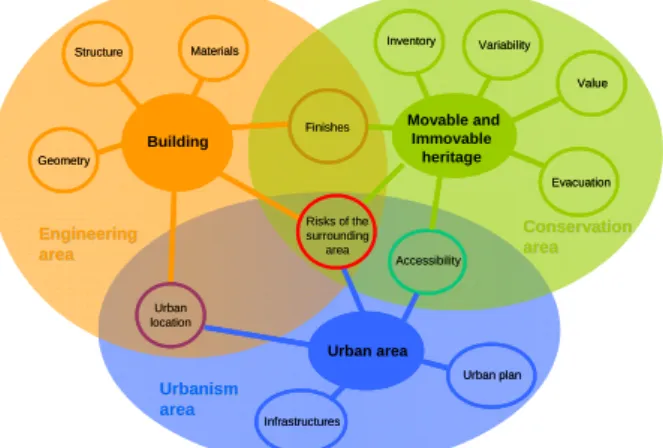
In addition to the collection and building characteristics, some factors related to the construction surroundings should also be considered to obtain a reliable description of the vulnerability (Jigyasu et al., 2010). For example, for earthquake risk, extensive damage or collapse of buildings surrounding the cultural heritage under analysis can block the access roads, as a result of which fire brigades and civil protection services would not be able to carry out rescue and safety assessment operations readily, (Jigyasu et al., 2010; Ahn et al., 2011). Based on the presented arguments, the assessment of heritage vulnerability and the development of the urban vulnerability matrix for several hazard sources can be seen to require the combination of three fundamental data inputs: 1) data about the building; 2) data about the collections; and 3) data about the building surroundings and access routes. These three data inputs require the involvement of different areas of expertise (engineering, conservation, urbanism), thus emphasising the need for a vulnerability assessment multidisciplinary framework. To illustrate this concept, Fig. 1 represents the referred multidisciplinary connections levels of the proposed vulnerability assessment framework.
Movable and Immovable heritage Inventory Variability Value Evacuation Finishes Building Structure Materials Geometry Urban location Urban area Infrastructures Accessibility Risks of the surrounding area Urban plan Engineering Engineering area area Urbanism Urbanism area area Conservation Conservation area area Movable and Immovable heritage Inventory Variability Value Evacuation Finishes Building Structure Materials Geometry Urban location Urban area Infrastructures Accessibility Risks of the surrounding area Urban plan Engineering Engineering area area Urbanism Urbanism area area Conservation Conservation area area
Figure 1. Multidisciplinary connections of the proposed vulnerability assessment framework.
3. Description of the proposed vulnerability assessment framework
3.1. Scope and general concepts
The proposed framework addresses the vulnerability assessment of tangible cultural heritage under “probabilistic” hazard sources either internal or external to the building under analysis. Cultural heritage includes movable and immovable tangible heritage according:
Movable heritage includes objects and collections such as paintings, sculptures, ceramics or books. From an engineering perspective these are considered to be building contents. Immovable heritage includes the part or totality of a building which has been designated
heritage for historical, architectural, decorative, religious, or other reasons. Immovable heritage also includes other cultural assets attached to the building (non-structural architectural elements such as statues, tiles and mosaics or fresco paintings).
The vulnerability assessment of heritage buildings requires skilled human resources, time and money which are always limited. The can be especially problematic where many heritage buildings exist in a given area. Therefore, one of the objectives of the proposed framework is to define a vulnerability assessment methodology that combines simplicity, efficiency and reliability in order to produce useful data especially in areas with a larger density of heritage building by optimizing the available resources. Such optimization requires basic data about the heritage construction has to be available to carry out the assessment (e.g. architectural layouts as well as basic information about the structural system and the building materials). Finally, the proposed approach is not a risk assessment method since the probability of occurrence of the hazard in not included. Therefore, the proposed framework only addresses part of the risk problem, namely that which deals with the vulnerability (i.e. the exposure ) of the heritage to a given hazard. Although this could be seen as a disadvantage, there are two main reasons for addressing the vulnerability only. For disastrous events such as those considered herein, the probability of occurrence is known to be very low, i.e. less than 1% each year. For example, for the seismic design of buildings, the commonly considered probability of occurrence for a life-safety design situation is 10% in fifty years, i.e. roughly 0.2% in one year. Moreover, since, as stated before, extreme events may not be avoided, one should focus on reducing their disastrous consequences. Therefore, to develop efficient measures that are able to mitigate the effects of potentially disastrous events, an adequate
characterization of the heritage’s level of exposure to a given hazard is paramount. 3.2. Conceptual description of the proposed vulnerability assessment framework
To analyse the vulnerability for a given hazard, the proposed approach defines a vulnerability index VI involving the weighted contribution of three vulnerability components: the building
(VI,B), the contents (VI,C) and the surroundings (VI,S). In this context, the vulnerability index VI
represents the heritage’s susceptibility to lose value (cultural, historical, religious, monetary, etc). The vulnerability index VI,B represents the building’s susceptibility to lose value due to
damages resulting from the hazard. The vulnerability index VI,C represents the susceptibility
of losing part of the collection’s value. The vulnerability index VI,S represents the potential
increase in the loss in value of the previous components. These indicators should be determined by professionals from the corresponding areas of expertise that should interact with each other to share expert knowledge, thus making the proposed vulnerability assessment a truly multidisciplinary analysis. Hence, the value of VI,C should be established
by conservators and collection care takers, the value of VI,B should be defined by construction
or structural engineers, and the value of VI,S should be set by emergency management officers.
The vulnerability index VI is then obtained by
, , , B I B C I C S I S I B C S w V w V w V V w w w (1)
where wB, wC and wS are the weights of indicators VI,B, VI,C and VI,S, respectively. The weights
wB and wC are defined in Table 1 while wS is considered to be the average of wB and wC. In a
situation where the immovable heritage includes valuable cultural assets attached to the building, the value of w should be increased by one level according to the values in Table 1.
By defining the vulnerability indicators VI,B, VI,C or VI,S such as to have them ranging between
0 and 1, where 0 represents a state of no vulnerability and 1 represents a state of maximum vulnerability, the index VI is then seen to range also from 0 to 1, where 0 and 1 have the same
meaning as before. If any one of the methods considered to define VI,B, VI,C and VI,S can
produce a vulnerability value above 1, the corresponding indicator must be set to 1. In order to include the vulnerability assessment in risk management tool such as the referred urban vulnerability matrix, the value of index VI must be assigned to a vulnerability level according
to a given vulnerability scale. Although other scales could be developed, Table 2 establishes a possibility that is suggested herein. In addition to this scale assignment based on the value of
VI, the individual values of the indicators VI,B, VI,C or VI,S must also influence the level of
vulnerability that is assigned to a given heritage building. It is fairly reasonable to assume that an assessment scenario where the three vulnerability indicators VI,B, VI,C and VI,S have values
below 1 must be treated differently than a situation where at least one of the referred indicators has a value of 1, even if the value of VI is the same for both scenarios. For example,
considering a simple assessment scenario where wB wC wS, the situation where the three values of VI,B, VI,C and VI,S are 0.5, which then yields a VI value of 0.5, is different than the
situation where VI,B, VI,C and VI,S are 1, 0.5 and 0, although VI is also 0.5. To address this later
situation, it is suggested that the vulnerability level of the heritage building should be increased to the following level whenever one of the vulnerability indicators VI,B, VI,C or VI,S is
1. Therefore, for the simple case previously referred, the vulnerability level of the first scenario is 3 while that of the second scenario should be increased to 4.
Table 1 – Definition of weights wB and wC
wB wC
Normal building with no special value. 0.2
B
w Collection with no special value. wC 0.2 Normal building exhibiting architectural or
constructive features with value. 0.3wB0.5
Collection with some religious and cultural value but that can be easily replaced.
0.3wC 0.5 Building with value for the Municipality. Building with
an important cultural value for a town. 0.5wB0.7
Collection with a significant religious, cultural or historical value for a town.
0.5wC 0.7 Building with value for the general public. Building
with an important cultural value. 0.7wB0.9
Irreplaceable collection with a significant religious, cultural or historical value.
0.7wC 0.9 Building listed as a National Monument. Building with
a nationwide cultural value. 1.0
B
w
Priceless collection with a nationwide value. 1.0
C
w
Table 2 – Vulnerability scale
Vulnerability level VI range Description
1 0VI 0.2 Vulnerability is very small. The occurrence of the hazardous event will have small consequences. 2 0.2VI 0.4 Vulnerability is small. The occurrence of the hazardous
event will have some consequences.
3 0.4VI 0.6 Vulnerability is medium. A significant part of the asset will be lost if the hazardous event occurs. 4 0.6VI 0.8 Vulnerability is high. Most of the asset will be lost if the hazardous event occurs. 5 0.8VI 1 Vulnerability is extremely high. All of the asset will be
As previously referred, the optimization of available resources plays a fundamental role when assessing the vulnerability of a larger number of heritage buildings in order to define a risk management tool such as the urban vulnerability matrix. In this context, the availability of resources can be a specially important issue in the case of the building vulnerability indicator VI,B since its characterization usually requires external expertise. In light of these concerns,
the presented framework proposes a two-level vulnerability assessment methodology that accounts for situations governed by the need to optimize time, money and reliability, as well as for the possibility of using more detailed assessment approaches.
How to explore the benefits of a two-level methodology?
The two-level methodology can be defined for any of the three vulnerability indicators VI,B,
VI,C and VI,S. Therefore, any one of the indicators contributing to the vulnerability index VI can
be obtained by a Level 1 or a Level 2 methodology. To establish the workings of the proposed two-level methodology, its description is detailed herein for the case of the building indicator
VI,B since it leads to a simpler explanation. In the first level (Level 1), VI,B is assessed using a
simplified and more conservative method while in the second level (Level 2), it is obtained by a more in-depth analysis. The Level 1 procedure is devised to allow for the characterization of
VI,B based on a rapid screening of the building, while the Level 2 procedure involves a more
detailed analysis that requires more information. After obtaining VI,B, by the Level 1
assessment, hereon termed VI,B,1, the result leads to one of the two following situations: 1) If
VI,B,1 is lower than 1, VI is calculated according to Eq. (1) and this information is included in
the urban vulnerability matrix; 2) If VI,B,1 is higher than 1, a recommendation is issued to
re-assess the vulnerability using a Level 2 approach. However, VI is also calculated in order to
include this temporary information in the urban vulnerability matrix.
After re-calculating VI,B using now a Level 2 assessment approach, hereon termed VI,B,2, the
new result then leads to one of the two following situations: 1) If VI,B,2 is lower than 1, VI is
re-calculated and the information in the urban vulnerability matrix is updated; 2) If VI,B,2 is
higher than 1, the factors that influence this result must be carefully examined and the possibility of making changes to the building must be analysed (i.e. propose repair works or strengthen the building structure for the hazard under analysis). Meanwhile, VI is re-calculated
and the information in the urban vulnerability matrix is updated. If resources are available to make the referred changes, VI,B,2 and VI must be re-calculated to observe the effectiveness of
the modifications and update urban vulnerability matrix.
4. Implementation details of the proposed vulnerability assessment framework
To understand more clearly the issues involved in the proposed framework, implementation details are discussed in the following for the case of churches under seismic hazard. Specific methods are proposed for the quantification of the vulnerability indicators VI,B, VI,C and VI,S
based on existing methodologies (with minor adaptations in some cases). To illustrate the general discussion and applicability of the proposed indicators, these are quantified for a case-study application involving two churches of the Pico Island, Azores, Portugal.
4.1. Brief description of the selected case-study church
The churches under study are the two neoclassical buildings illustrated in Fig. 2. The Bandeiras church (Fig. 2a) was built in 1860, Pico island, Azores. The original Madalena church (Fig. 2b) was built in the fourteenth century. In the mid seventeenth century, this church was rebuilt and it was completed in 1891. The Bandeiras and Madalena churches have
a similar typology and are made of three bodies that can be identified in Fig. 3: the first is the main entry, which includes the entrance lobby, the upper choir and the two lateral towers; the second is the main body with three longitudinal naves; finally, the third one includes the central altar, the lateral sacristies and the altar backside. The churches also have similar structural characteristics. The main structure is made of walls, arches resting on top of columns, and the roof which is made of wood, such as the floor of the upper choir above the main entry. The exterior walls are made of two-leaf stone masonry, with a total thickness of 0.90 m, and are the main structural elements. The tiles of the two-ways roof structure are laid on a liner supported by a wooden structure which, in turn, is supported by the exterior walls and the interior longitudinal archways.
a) b)
Figure 2. The Bandeiras church (a) and the Madalena church (b)
9.0 10.9 10.2 11.9 9.0 6.1 3.4 3.4 5.5 4.6 0.7 0.9 26.7 a) 16.3 3.4 6.3 3.4 4.3 0.7 0.9 29.7 4.7 b)
Figure 3. Plan and longitudinal cross section views of the Bandeiras (a) and the Madalena (b) churches
4.2. Indicators for seismic vulnerability assessment
4.2.1. Description of the indicators
Three procedures are presented in the following to determine the vulnerability indicators VI,B,
VI,C and VI,S for the seismic vulnerability assessment of churches. In light of the two-level
vulnerability assessment methodology referred in Section 3.2, the proposed methods are considered to be Level 1 approaches. As previously referred, the selected procedures are not entirely original but instead make use of previously developed research on the matter.
For the case of the collection’s vulnerability indicator V , a variant of the risk indicator
X Y
X Y
presented by Waller (1995) is suggested. The proposed adaptation defines VI,C as
, I C
V FS LV (2)
where FS is the fraction susceptible which represents part of the collection susceptible to a loss in value from exposure to a certain hazard (in this case an earthquake) and LV is the maximum expected loss in value of FS. Both values are rates expressed as percentages. The surroundings’ vulnerability indicator VI,S was developed using a format similar to that of the
indicator proposed by Rodrigues (2009) to grade the fire risk of the Porto streets. The proposed expression defines VI,S as
, 27
I S
V A C P (3)
where A grades the level of accessibility of the heritage building location, C grades the state of conservation of the buildings surrounding the heritage building, and P grades the level of preparedness of the city emergency services to cope with the occurrence of an earthquake. In order to quantify VI,S, the reference values presented in Table 3 are suggested for A, C and P.
Table 3 – Reference values for parameters A, C and P.
A (access) C (state of conservation) P (preparedness)
3 – Easy 1 – Good 0 – Low
6 – Some difficulties 2 – Average 1.5 – Average
9 – Difficult 3 – Bad 3 – Good
With respect to the quantification of VI,B, the suggested vulnerability indicator is adapted from
one of the indicators presented by Lourenço and Roque (2006) and is defined by
0 1 , 0 , 1 m i i i i I B n vk i d i i i A h V f A tg h
(4)Where α is a coefficient reflecting the expected level of seismic intensity of the region (RSA,
1983), β0 is an equivalent static seismic coefficient considered to be 0.22 (Lourenço and
Roque, 2006), φ is a friction angle considered to be 22º (Lourenço and Roque, 2006), fvk0 is
the cohesion of the wall material, γi is the volumetric weight of the ith wall, hi is the height of
the ith wall, Ai,d is the in plan area of the ith earthquake resistant wall that is active when the
earthquake effects are considered to occur in direction “d”, and n is the number of active walls when the earthquake effects are considered to occur in direction “d”. With respect to the definition of direction “d”, it is noted that seismic vulnerability assessment of buildings is usually performed for two orthogonal plan directions to analyse the performance of the two main directions of the structural system. Therefore, considering the usual X and Y directions (e.g. see Fig. 3) two VI,B indicators are then obtained which are termed VI,B,x and VI,B,y. The
term ∑Ai represents the total weight of the m earthquake resistant walls. i hi 4.2.2. Application to the selected case-study church
For the quantification of VI,C, 90% of the contents of the Madalena church (i.e. everything
except cloths and vestments) were considered to be vulnerable to seismic hazard (FS=0.9).
For the case of the Bandeiras church, FS was considered to be 0.7 since its was found to be collection less susceptible. With respect to LV, given the high seismicity of the Azores, the earthquake effects and damages are expected to be high. Therefore, LV was considered to be 0.70 for both churches. The value of VI,C was then found to be 0.49 for the Bandeiras church
be the same for both churches and with values of 3 (easy access to the church), 2 (the surrounding buildings have an average state of conservation) and 1.5 (average level of preparedness), respectively. Hence, VI,S was found to be 0.17 for both churches.
With respect to VI,B, as previously noted, it was analysed for the X and Y directions of the
church indicated in Fig. 3, thus leading to indicators VI,B,x and VI,B,y. Parameter α, which
reflects the level of seismic intensity, is 1.0 for the Azores region (RSA, 1983) (1.0 is the maximum value in Portugal). Based on the authors’ knowledge about the referred churches and on values proposed by the Italian Code (OPCM 3274, 2003), the cohesion of the walls fvk0
was estimated to be 35kPa for the Bandeiras church and 50kPa for the Madalena church, while their volumetric weight γ was considered to be 18kN/m3 (Arêde et al., 2012). Based on Eq. (4), indicators VI,B,x and VI,B,y were found to be 0.51 and 0.79, respectively, for the
Bandeiras church, and 0.43 and 0.66, respectively, for the Madalena church. Given that VI,B,x
and VI,B,y must be between 0 and 1, it can be seen that, as expected, both churches are more
vulnerable for the Y direction. Still the vulnerability values obtained for direction X are significant and should not be disregarded. Furthermore, according to the analysis of the damage of these two churches after the 1998 Azores earthquake presented by Azevedo and Guerreiro (2008), the values of VI,B,x and VI,B,y are seen to correlate well with those results
which refer that the level of damage of the churches resulting from the earthquake required structural repair interventions before being able to reuse them.
In order to obtain a value for the vulnerability index VI, values for the weights wB and wC must
be defined according to Table 1. After analysing the characteristics of the churches and of their collections, the weights wB and wC were set as 0.5 and 0.6 for the Bandeiras church, and
as 0.6 and 0.4 for the Madalena church. The value of wB for the Madalena church was initially
found to be 0.4 but since this church possesses valuable cultural assets attached to the building, wB was increased to next level of Table 1. Since the indicator VI,B,1 was defined for
two directions, yielding indicators VI,B,x and VI,B,y, two vulnerability indexes VI, VIx and VIy,
were also obtained for each church. However, the vulnerability of a given church must be characterized by a single value. Hence, only the higher of the two values is considered for each church. Therefore, for the Bandeiras church VIx and VIy were seen to be 0.39 and 0.47,
respectively, and for the Madalena church, they were seen to be 0.39 and 0.49, respectively. The final VI values are then 0.47 for the Bandeiras church and 0.49 for the Madalena church.
Although Level 1 methods such as the one proposed for the quantification of VI,B are simpler
to apply, they are also expected to yield more conservative results. This level of conservatism reflects the simplified manner by which such approach accounts for the behaviour of the building structure under earthquake loading. For example, it can be seen that the proposed methodology only accounts for the walls that are expected to form the structural system of the church for each one of the main directions X and Y, but does not account for other characteristics such as the level of connection between these walls or to other structural elements such as the floors and the roof. Despite the fact that for locations where the level of vulnerability is expected to be physically lower (e.g. in regions of lower seismic hazard) it is believed that such approaches are sufficient, for regions of higher seismic hazard more rigorous approaches should be utilized (e.g. Level 2 methods). One specific advantage of using a more detailed approach to assess seismic vulnerability is that such methods can also be used to determine which part of the structure is more vulnerable and where to recommend structural strengthening in order to reduce the vulnerability if necessary. Given this, the benefits of having specific expertise, such as that of a construction or structural engineer, to carry out the quantification of VI,B using a Level 2 method clearly go beyond those inherent to
the assessment task. Finally, as previously referred, it can be seen that even for an adequate application of Level 1 vulnerability assessment approaches, architectural layouts and as well as a basic knowledge about the characteristics of the building structure are required.
5. Final comments
Since disaster events cannot be prevented completely, adequate mechanisms must be developed to mitigate their effects. The consequences of recent disastrous events emphasize the need for adequate preventive disaster risk management measures incorporating the protection of cultural heritage. Hence, the advantages of having a framework to quantify the vulnerability of cultural heritage under disastrous hazard sources are evident.
The proposed vulnerability assessment framework presents two main advantages. First, it enables the quantification of vulnerability of a large number of cultural assets in a simple format suitable to be used in a valuable tool for risk management such as the urban vulnerability matrix (a geographical information system mapping the heritage vulnerability of a given area for a number of hazard sources). Second, by establishing that vulnerability must be assessed with respect to three fundamental components (the building, the collections and the building surroundings), it proposes a multidisciplinary approach for the characterization of heritage vulnerability that enables different areas of expertise to contribute for the assessment. The general scope and the conceptual definition of the proposed framework, which is currently under development, were discussed and the importance of specific issues when assessing the vulnerability of a larger number of heritage buildings was also highlighted. For example, the need to optimize the resources available and to have a basic level of information about the heritage constructions under assessment were seen to be fundamental aspects for the adequate development of an efficient vulnerability assessment campaign.
Some implementation details were discussed for the specific case of church heritage under seismic and fire hazard, and a real case scenario was also presented to illustrate some of the proposals. Advantages of using more detailed approaches to analyse the building vulnerability component and of having specific expertise (e.g. a construction or a structural engineer) to analyse such component were discussed for the case of seismic vulnerability assessment.
REFERENCES
Ahn, Y., Tsukaguchi, H., Ogawa, K., Tanaka, K. (2011) Study on Disaster Risk Assessment of
Cultural Heritage and Road Network Improvement in Historical City. Journal of Disaster Research
6(1), 119-120.
Ashley-Smith, J. (1999) Risk assessment for object conservation. Butterworth-Heinemann, Oxford. Arêde, A., Costa, A., Moreira, D., Neves, N. (2012) Seismic analysis and strengthening of Pico
Island Churches. Bulletin of Earthquake Engineering 10(1), 181–209.
Azevedo, J., Guerreiro, L. (2008) Damage in churches: a first evaluation. In Sismo 1998 – Açores.
Uma década depois. Oliveira C.S., Costa, A., Nunes, J.C. (eds). (in Portuguese)
Jigyasu, R., King, J., Wijesuriya, G. (2010) Managing Disaster Risks for World Heritage. World
Heritage Resource Manual. United Nations Educational, Scientific and Cultural Organization.
Lourenço, P., Roque, J. (2006) Simplified indexes for the seismic vulnerability of ancient masonry
buildings. Construction and Building Materials 20(4), 200-208.
Michalski, S. (2007) ABC risk assessment scales for museum collections. ICCROM-CCI-ICN
Reducing Risks to Collections Course, Sibiu, Romania.
OPCM 3274 (2003) Primi elementi in materia di criteri generali per la classificazione sismica del
territorio nazionale e di normative tecniche per le costruzioni in zona sismica. Suppl. ord. n.72 alla G.U. n. 105 del 8/5/2003, e successive modifiche ed integrazioni (in Italian).
RSA (1983) Safety and actions code for building and bridge structures. Legal Decree nº 235/83. Porto
Editora, Porto, Portugal (in Portuguese).
Rodrigues, L. (2009) Fire safety in buildings of the historical city centre of Porto. MSc Thesis.
Faculty of Engineering of the University of Porto, Porto (in Portuguese).
Waller, R. (1995) Risk Management Applied To Preventive Conservation. In: Storage of Natural