c
Authentication Protocols for D2D Communications
Ana Paula Golembiouski Lopes
DISSERTAÇÃO DE MESTRADO EM ENGENHARIA ELÉTRICA
FACULDADE DE TECNOLOGIA
UNIVERSIDADE DE BRASILIA
UNIVERSIDADE DE BRASILIA Faculdade de Tecnologia
DISSERTAÇÃO DE MESTRADO EM ENGENHARIA ELÉTRICA
Authentication Protocols for D2D Communications
Ana Paula Golembiouski Lopes
Orientador: Paulo Roberto de Lira Gondim
Banca Examinadora
Prof. Paulo Roberto de Lira Gondim, UnB/ENE, Orientador
Prof. Joel José Puga Coelho Rodrigues, UFPI, Membro Externo
Prof. Paulo Henrique Portela de Carvalho, ENE/UnB, Membro Interno
Prof. Marcelo Menezes de Carvalho, ENE/UnB, Suplente.
UNIVERSIDADE DE BRASÍLIA
FACULDADE DE TECNOLOGIA
DEPARTAMENTO DE ENGENHARIA ELÉTRICA
AUTHENTICATION PROTOCOLS FOR D2D COMMUNICATIONS
ANA PAULA GOLEMBIOUSKI LOPES
DISSERTAÇÃO DE MESTRADO SUBMETIDA AO DEPARTAMENTO DE ENGENHARIA ELÉTRICA DA FACULDADE DE TECNOLOGIA DA UNIVERSIDADE DE BRASÍLIA, COMO PARTE DOS REQUISITOS NECESSÁRIOS PARA A OBTENÇÃO DO GRAU DE MESTRE.
APROVADA POR:
___________________________________________________________________ PAULO ROBERTO DE LIRA GONDIM, Dr., ENE/UNB
(ORIENTADOR)
___________________________________________________________________ PAULO HENRIQUE PORTELA DE CARVALHO, Dr., ENE/UNB
(EXAMINADOR INTERNO)
__________________________________________________________________ JOEL JOSÉ PUGA COELHO RODRIGUES, Dr., UFPI
(EXAMINADOR EXTERNO)
FICHA CATALOGRÁFICA
REFERÊNCIA BIBLIOGRAFICA
LOPES, A. P. G. (2019). Authentication Protocols for D2D Communications. Dissertação de Mestrado em Engenharia Elétrica, Publicação PPGEE.DM-737/19, Departamento de Engenharia Elétrica, Universidade de Brasília, Brasília, DF, 155p.
CESSÃO DE DIREITOS
AUTORA: Ana Paula Golembiouski Lopes
TITULO: Authentication Protocols for D2D Communications. GRAU: Mestre ANO: 2019
É concedida à Universidade de Brasília permissão para reproduzir cópias desta dissertação de mestrado e para emprestar ou vender tais cópias somente para propósitos acadêmicos e científicos. O autor reserva outros direitos de publicação e nenhuma parte dessa dissertação de mestrado pode ser reproduzida sem autorização por escrito do autor.
Ana Paula Golembiouski Lopes UNIVERSIDADE DE BRASÍLIA Faculdade de Tecnologia.
Departamento de Engenharia Elétrica. 70910-900 – Brasília – DF – Brasil.
LOPES, ANA PAULA GOLEMBIOUSKI
Authentication Protocols for D2D Communications. [Distrito Federal] 2019. xvii, 155p., 210 x 297 mm (ENE/FT/UnB, Mestre, Dissertação de Mestrado – Universidade de Brasília. Faculdade de Tecnologia.
1.Autenticação e Acordo de Chaves (AKA)
2. Comunicações Dispositivo-a-Dispositivo (D2D)
3. Internet das Coisas (IoT) I.ENE/FT/UnB
4. Segurança da Informação II. Mestre
Agradecimentos
Agradeço a Deus por mais esta conquista e por sempre ter me amparado em orações. Aos meus pais e a minha irmã, que me incentivam desde muito pequena a ser dedicada aos meus estudos e que mais uma vez foram o principal ponto de apoio para que eu pudesse alcançar meu objetivo acadêmico. Às minhas amigas Aline Santos e Luciana Brito, por todos os anos de amizade e por terem sido meus ombros amigos durante os anos de mestrado. Por fim, a todos os meus professores, em especial ao meu orientador Paulo Gondim, pelos ensinamentos que possibilitaram a execução deste trabalho.
Resumo
A comunicação Dispositivo-a-Dispositivo (D2D) é uma das tecnologias promissoras para ser usada na conexão de grandes quantidades de dispositivos, como previsto para a Internet das Coisas (IoT, do inglês Internet of Things), ao proporcionar a oportunidade de conexão direta entre dispositivos, sem a obrigatoriedade de emprego da infraestrutura de redes tradicionais.
A segurança é um item crucial para o sucesso da IoT e das comunicações D2D e pode ser proporcionada por protocolos de autenticação e acordo de chaves (AKA, do inglês Authentication and Key Agreement). Entretanto, os protocolos de autenticação utilizados nas redes tradicionais (como os protocolos EPS-AKA e EAP-AKA) não estão adaptados para D2D, e seu emprego em situação de grande aumento no número de dispositivos conectados imporia um elevado consumo de recursos, especialmente de banda e de processamento computacional. Adicionalmente, no início do trabalho foram identificados poucos protocolos dessa categoria, especificamente voltados para D2D.
Este trabalho apresenta o projeto e a avaliação de 3 (três) protocolos de autenticação e acordo de chaves para comunicações D2D, desenvolvidos para 3 (três) cenários:1) dispositivos integrantes de Telecare Medical Information Systems (TMIS) baseados em sistema de nuvem computacional; 2) grupos de dispositivos em cenário genérico de emprego de comunicações D2D, onde sejam esperadas grandes quantidades de dispositivos; 3) grupos de dispositivos em comunicações D2D em cenário m-health.
A metodologia para obtenção de novos protocolos seguros considerou, como passo inicial, uma revisão da literatura, buscando identificar protocolos que tenham sido empregados, de forma específica, em cada cenário considerado. Em seguida, foi definida uma arquitetura específica de cada cenário considerado, bem como propriedades de segurança a serem alcançadas e possíveis ataques contra os quais caberia oferecer proteção. Foram então criados novos protocolos de autenticação para os cenários e arquiteturas citados, considerando o emprego de comunicações D2D.
Em todos os três cenários, dentre as propriedades de segurança tidas como requisitos para o correto funcionamento da comunicação D2D, incluem-se a preservação da confidencialidade, a integridade e a disponibilidade do sistema; em termos de possíveis ataques, ataques tais como os dos tipos man-in-the-middle, repetição e personificação foram tratados, visando proteção pelo protocolo contra os mesmos.
Após a descrição de cada protocolo, esta dissertação apresenta comparações em relação a propriedades de segurança entre cada um dos protocolos propostos e alguns de seus respectivos trabalhos relacionados. Uma comparação envolvendo custos de computação, de comunicação e de energia é então realizada. Os resultados obtidos mostram
bom desempenho e robustez em segurança para os três esquemas propostos. As propostas mostram-se adequadas para uso futuro, na autenticação de dispositivos IoT que utilizarem comunicação D2D, dentro dos cenários adotados e sob as condições em que foram avaliadas.
Uma validação semiformal dos protocolos é também apresentada. A ferramenta AVISPA é utilizada para verificar a robustez da segurança dos protocolos desenvolvidos.
Palavras-chave – Autenticação e Acordo de Chaves (AKA), Comunicação Dispositivo-a-Dispositivo (D2D), Internet das Coisas (IoT), segurança, mobile health (m-health).
Abstract
Device-to-Device (D2D) communication is one of the promising technologies to be used to connect the large quantity of devices, as forecasted for the Internet of Things (IoT), by providing to devices the opportunity of connecting each other without mandatory use of traditional networks infrastructure.
Security is a crucial item for the success of IoT and D2D communication and can be provided by robust authentication and key agreement protocols (AKA). However, the authentication protocols used for traditional networks (such as EPS-AKA and EAP-AKA) are not adapted for D2D and their use in the situation of large number of devices connected would impose high consume of resources, specially bandwidth and computational processing. Additionally, in the beginning of the work, it was identified a small quantity of protocols of the described category, specifically for D2D.
This work provides the project and evaluation of 3 (three) authentication protocols designed to meet the demand on Device-to-Device (D2D) communications authentication and key agreement protocols, developed for 3 (three) scenarios: 1) devices that are members of Telecare Medical Information Systems (TMIS) based on cloud system; 2) groups of devices in generic scenario for the use of D2D communications, which there are expected large quantities of devices; 3) groups of devices for D2D communication in m-health scenario.
The methodology for obtaining of new secure protocols considered, as initial step, a literature review, searching for protocols that might be specifically used in each of the scenarios considered. Next, a specific architecture for each scenario considered was developed, as well as security properties to be accomplished and possible attacks that might be suitable for the protocol to have protection. Therefore, authentication protocols were created for the scenarios and architecture cited, considering the use of D2D.
In all three cases, among the security objectives required for the proper functioning of D2D communication, there are included the preservation of confidentiality, integrity, and availability of the system; in terms of attacks, such as man-in-the-middle, replay and impersonation were treated, aiming the protection of the protocols against the cited attacks.
After the description of each protocol, this dissertation presents comparisons regarding security properties among each of the proposed protocols and some of their respective related works. A comparison involving computational, communication and energy costs is executed. The results obtained show good performance and robust security to the
three proposed schemes. The proposals show up suitable future use, in the authentication of IoT devices using D2D communication, in the scenarios adopted and under the conditions evaluated.
A semi-formal validation of the protocols is also presented. The tool AVISPA is used to verify the security robustness of the protocols developed.
Keywords – Authentication and Key Agreement (AKA), Device-to-Device (D2D) communication, Internet of Things (IoT), security, mobile health (m-health).
Table of Contents
1.INTRODUCTION ... 17 1.1. Initial Considerations ... 17 1.2. Motivation ... 18 1.3. Objectives ... 19 1.4. Methodology ... 20 1.5. Contributions... 20 1.6. Publications ... 21 1.7. Organization ... 21 1.8 References ... 22 2.THEORETICAL BACKGROUND ... 23 2.1. Preliminary Definitions ... 23 2.2. Security Attacks ... 242.3. Some other relevant concepts ... 25
2.4. Device-to-Device (D2D) Communication ... 25
2.5. Elliptic Curves Diffie-Hellman (ECDH) ... 27
2.6. Billinear Pairing ... 28
2.7. Shamir Secret ... 29
2.8. Aggregated Signatures ... 29
2.9. AVISPA Tools ... 30
2.10 References ... 31
3.MUTUAL AUTHENTICATION PROTOCOL FOR D2D COMMUNICATIONS IN A CLOUD-BASED E-HEALTH SYSTEM ... 33
3.1. Introduction ... 33 3.2. Related Work ... 36 3.3 Proposed Protocol ... 38 3.4. Security Analysis ... 49 3.5. Performance Analysis ... 52 3.6. Validation ... 57 3.7. Conclusions ... 59 3.8. References ... 61
4.GROUP AUTHENTICATION PROTOCOL BASED ON AGGREGATED SIGNATURES FOR D2D COMMUNICATION ... 64
4.1 Introduction ... 64 4.2.Related Work ... 67 4.3.Proposed Protocol ... 69 4.4.Security Analysis ... 79 4.5.Performance Analysis ... 82 4.6.Formal Validation ... 90
4.7.Conclusions and Future Work ... 91
4.8. References ... 96
5.A LIGHTWEIGHT AUTHENTICATION SCHEME FOR D2D COMMUNICATION IN M-HEALTH WITH TRUST EVALUATION ... 99
5.1. Introduction ... 99 5.2 Related Work ... 102 5.3 Proposed Scheme ... 106 5.4 Security Analysis ... 115 5.5 Performance Analysis ... 118 5.6 AVISPA verification ... 125
5.7 Conclusions and Future Work ... 127
5.8 References ... 128
6.CONCLUSION ... 131
APPENDIX 1 – Mutual Authentication Protocol for Cloud-based E-health Systems . 133 APPENDIX 2 – Papers submitted to journals ... 151
List of Figures
FIGURE 2.1 – ECDH EXAMPLE. ... 28
FIGURE 3.1. THE ARCHITECTURE OF THE PROPOSED SCHEME. ... 39
FIGURE 3.2. MESSAGE EXCHANGE IN HUP. ... 43
FIGURE 3.3. MESSAGE EXCHANGE IN PUP FOR DIRECT ACCESS TO 3GPP INFRASTRUCTURE. ... 45
FIGURE 3.4 MESSAGE EXCHANGE IN PUP WHEN D2D COMMUNICATION IS ADOPTED TO REACH THE 3GPP INFRASTRUCTURE AND THE CLOUD SERVER. ... 45
FIGURE 3.5. MESSAGE EXCHANGE IN TP. ... 47
FIGURE 3.6. MESSAGE EXCHANGE IN CP. ... 48
FIGURE 3.7.COMPUTATIONAL COST COMPARISON ... 54
FIGURE 3.8. COMMUNICATION COST COMPARISON ... 55
FIGURE 3.9. ENERGY COST COMPARISON ... 56
FIGURE 3.10. ROLE OF D2D DEVICE DPI IN PUP PHASE. ... 58
FIGURE 3.11. ROLE OF THE CLOUD SERVER IN PUP PHASE. ... 58
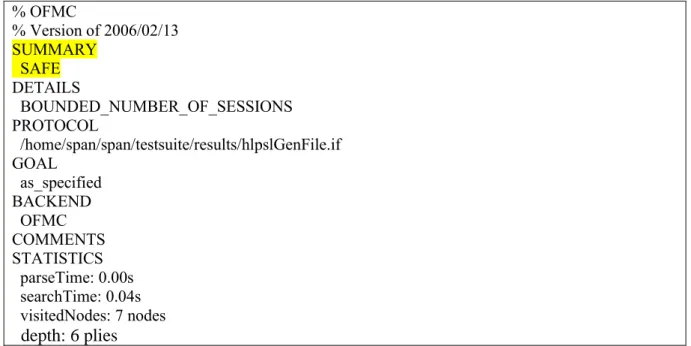
FIGURE 3.12. OFMC ANALYSIS RESULT. ... 59
FIGURE 3.13. CL-ATSE ANALYSIS RESULT FOR PUP PHASE. ... 59
FIGURE 4.1. ARCHITECTURE OF THE SYSTEM. ... 70
FIGURE 4.2. BINARY TREE GROUP MANAGEMENT. ... 73
FIGURE 4.3. REGISTRATION/GROUP ORGANIZATION PHASE. ... 75
FIGURE 4.4. MUTUAL AUTHENTICATION PHASE. ... 77
FIGURE 4.5. COMPARISON OF COMPUTATIONAL COSTS. ... 85
FIGURE 4.6. COMPARISON OF COMMUNICATION COSTS... 88
FIGURE 4.7. COMPARISON OF ENERGY COSTS. ... 89
FIGURE 4.8. SIMULATION GOALS ... 90
FIGURE 4.9. OFMC BACKEND RESULT. ... 91
FIGURE 4.10. CL-ATSE BACKEND RESULT. ... 91
FIGURE 4.11. DEVICE ROLE. ... 93
FIGURE 4.12. LEADER DEVICE ROLE. ... 94
FIGURE 4.13. HSS ROLE. ... 95
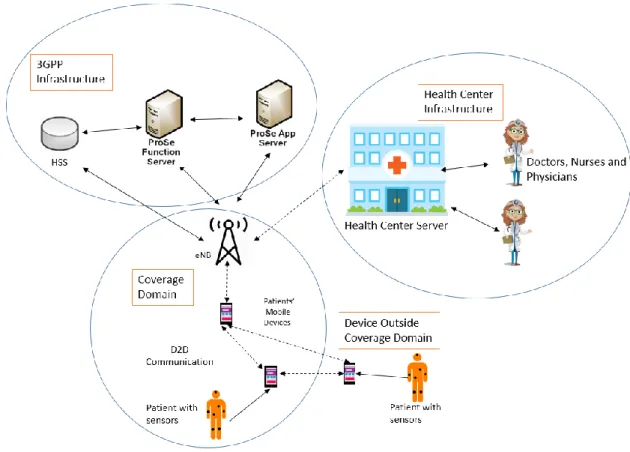
FIGURE 5.1. 3GPP PROSE REFERENCE ARCHITECTURE (BASED ON YAN ET AL. [7]. ... 104
FIGURE 5.2. SYSTEM ARCHITECTURE. ... 107
FIGURE 5.3. MESSAGES EXCHANGED IN THE REGISTRATION PHASE. ... 111
FIGURE 5.4. MESSAGE EXCHANGED IN THE MUTUAL AUTHENTICATION PHASE. ... 113
FIGURE 5.5. MESSAGES EXCHANGED WHEN LT IS USED... 114
FIGURE 5.6. ENCRYPTED DATA SENT TO HSS. ... 115
FIGURE 5.7. COMPARISON OF COMPUTATIONAL COSTS. ... 120
FIGURE 5.8. COMPARISON OF COMMUNICATION COSTS... 123
FIGURE 5.10. ROLE OF A DEVICE IN HLPSL LANGUAGE FOR AVISPA SOFTWARE. ... 125 FIGURE 5.11. OFMC ANALYSIS. ... 126 FIGURE 5.12. CL-ATSE ANALYSIS. ... 127
List of Tables
TABLE 3.1. COMPARISON AMONG SOME PROTOCOLS. ... 38
TABLE 3.2. NOTATIONS USED IN THE PROTOCOL. ... 40
TABLE 3.3. COMPARISON OF SECURITY OBJECTIVES AMONG PROTOCOLS ... 52
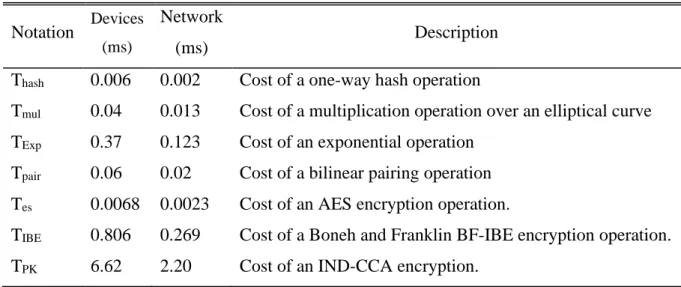
TABLE 3.4. EXECUTION TIME OF EACH OPERATION CONSIDERED. ... 53
TABLE 3.5. COMPUTATIONAL COST OF PROTOCOLS. ... 53
TABLE 3.6 – PARAMETERS AND COSTS IN BITS... 54
TABLE 3.7. COMPARISON OF COMMUNICATION COSTS IN BITS. ... 55
TABLE 3.8. ENERGY COST OF PROTOCOLS ... 56
TABLE 4.1. GENERAL COMPARISON AMONG PROTOCOLS. ... 69
TABLE 4.2. SYSTEM PARAMETERS. ... 71
TABLE 4.3. SECURITY OBJECTIVES. ... 82
TABLE 4.4. COST OF EACH OPERATION EXECUTED. ... 83
TABLE 4.5. COMPARISON OF COMPUTATIONAL COSTS... 84
TABLE 4.6. SIZE OF EACH PARAMETER. ... 86
TABLE 4.7. COMPARISON OF COMMUNICATION COSTS. ... 87
TABLE 4.8. COMPARISON OF ENERGY COSTS. ... 89
TABLE 5.1. PARAMETERS USED IN THE PROTOCOL. ... 108
TABLE 5.2. COMPARISON OF SECURITY OBJECTIVES AMONG PROTOCOLS. ... 118
TABLE 5.3. COST OF EACH OPERATION. ... 119
TABLE 5.4. COMPARISON OF COMPUTATIONAL COSTS... 119
TABLE 5.5. SIZE OF EACH PARAMETER EXCHANGED. ... 121
TABLE 5.6. COMPARISON OF COMMUNICATION COSTS. ... 122
Abbreviations
3GPP 3rd Generation Partnership Project 5G 5th generation of mobile networks AKA Authentication and Key Agreement AuC Authentication Center
AVISPA Automated Validation of Internet Security Protocols and Applications BAN Body Area Network
BF-IBE Boneh-Franklin Identity-based Encryption BS Backward Secrecy
CL-AtSe Constraint Logic-based Attack Searcher CLGSC Certificateless Signcryption Scheme
CN-GD2C Group Anonymity for D2D Communication with Core Network Assistance CP-ABE Ciphertext-Policy Attribute-based Encryption
CTN Communicating Things Network D2D Device-to-Device
DHKE Diffie Hellman Key Exchange DoS Denial of Service
ECDLP Elliptic Curves Discrete Logarithm Problem EPC Evolved Packet Core
E-UTRAN Evolved Universal Terrestrial Radio Access Network eNB Evolved NodeB
eNodeB Evolved NodeB FS Forward Secrecy
GRAAD Group Anonymous and Accountable D2D Communication in Mobile Networks.
HLPSL High Level Protocol Specification Language HMAC Hash-based Message Authentication Code HSS Home Subscribe Server
IBE Identity Based Encryption IBS Identity Based Signature
IMSI International Mobile Subscriber Identity
IND-CCA Indistinguishability Under Adaptively Chosen Ciphertext Attack IoT Internet of Things
LAI Location Area Identity M2M Machine-to-Machine
MAC Message Authentication Code MitM Man-in-the-Middle
OFMC On-the-Fly Model Checker PAS ProSE App Server User PFS ProSE Function Server
PPAKA Privacy-Preserving Authentication and Key Agreement ProSe 3GPP Proximity Services
SeDS Secure Data Sharing Strategy
TMIS Telecare Medical Information System UE User Equipment
Chapter 1
1.
INTRODUCTION
1.1. Initial Considerations
The Device-to-Device communications (D2D) is an access technology that provides to devices the opportunity of direct connection among each other, without the necessity of traditional networks assistance. We are currently experiencing the emergence of the Internet of Things (IoT) that forecasts to increase the number of connected devices to the order of billions in the next few years, as highlighted by Gartner [1]. D2D communication is expected to be key part of IoT, because the direct connection among devices might be crucial for the success of IoT communication.
Those devices have several characteristics in common and, consequently, requirements in common. Among those characteristic and requirements is the fact that they are mostly resource constrained devices. Consequently, the technology developed to operate with them must consider that they have limited amounts of energy and reduced computational capacity, for example.
Some security challenges emerge because the traditional networks are not suitable to IoT and D2D communication scenario and there is a lack of suitable mutual authentication schemes available. The consequence is the vulnerability to several attacks and unauthorized access that results in confidentiality, integrity and privacy problems. Security is crucial for the success of IoT and, consequently, to D2D communication.
The authentication and key agreement (AKA) of devices is one of the ways that permit devices and network to verify the authenticity of each other prior to sending valuable data to each other, helping in the avoidance of the described security vulnerabilities. The AKA standardized protocols available for traditional networks still do not comprises the scenario of IoT and D2D communication and must be adapted or reformulated to attend the new security requirements.
There are some researches engaged in developing security surveys and authentication protocols suitable for IoT and D2D. Considering several situations that might include
electronic health (e-health), mobile health (m-health), vehicular communication, sensors networks and many others. All of the researches believing that efficient authentication protocols can provide the attributes necessary to accomplish the security needs of these new and diverse scenarios.
1.2. Motivation
The motivation for the research is the lack of authentication protocols designed and adapted for D2D communication. The traditional schemes that are proposed by 3GPP (as EPS-AKA [2]) are not adapted to support the new requirements of IoT and new technologies as D2D. The current standard EPS-AKA designed for 3GPP LTE does not comprises a scenario with large amounts of devices willing to be connected.
The 3GPP already have some standardization material that can be used to guide the development of new protocols for D2D communication. It is the case of the technical specifications TS 23.303 and TS 36.843, which regards the Proximity Services (ProSe) in discovery of nearby devices using direct radio signals and of the TS 33.303 that comprises ProSe security requirements.
The Internet of Things (IoT) forecasts several new applications in diverse scenarios, including the e-health/m-health systems that aims at providing health services through information and communication technologies. The integration with IoT can include the monitoring of patients’ health, made with sensors coupled to their body and connected by Body Area Network (BAN). It may also include the diagnosis and remote provisioning of health services to patients over public channels. D2D communication is a promising technology that might connect those devices and provide the proper message exchange for those systems.
The security of the mentioned devices must be assured to guarantee the success of IoT, thus governments and private institutions must address the discussion of cyber security of IoT. Brazilian`s government, for example, has a national plan of IoT established in a decree [3], which considers security and privacy as themes to be treated as an important part of the plan. Other themes include international insertion, regulation, professional education and infrastructure of connectivity and interoperability. Moreover, it must be reinforced the need for the adoption of international standards for information security by private and governmental initiatives and the encouragement of cooperation and interaction of private
initiative, academy and civilian society to promote the awareness and funding to cyber security importance.
A large number of devices has been emerging and the extra number of control messages of the authentication and key agreement (AKA) might worsen problems of congestion already present in current communication channels. Therefore, a good solution is to group devices to be authenticated towards simplifying the process and reducing the consumption of resources.
The trust among devices is an issue that occur if D2D communication is used to perform relay among devices without direct access to network infrastructure. Not all devices are trustworthy, which can occasion in loss of data and security problems. Therefore, is it necessary to assure trust for D2D applications.
Consequently, it is necessary to develop new authentication protocols that can deal with the modifications in architecture, security and performance required for IoT and its promising access technologies as D2D communication. New schemes must be created based on the combination of new models and models already proved to be efficient for traditional communication systems.
1.3. Objectives
The general objective of this work is to propose new authentication protocols for D2D communication, considering different scenarios as m-health, e-health and situations where devices can be organized in groups to better perform their authentication. Fulfilling the D2D security requirements and having good performance when compared to other protocols published in the literature.
The specific objectives include:
1. Generation of three new authentication protocols for D2D communication, which might be used in different scenarios;
2. The application of security concepts to accomplish objectives as confidentiality, integrity, privacy and protection to several attacks as man-in-the-middle, impersonation and replay;
3. The evaluation and comparison of D2D and non-D2D protocols available in the literature, regarding general characteristics, security and computational, communication and energy costs;
4. The validation of the proposed protocols using AVISPA [5], an application that provides semiformal verification of authentication protocols.
1.4. Methodology
A methodology divided into phases was adopted in this work, as follows:
• Phase 1: bibliographic review of relevant themes for the work in development, which comprises the study of the D2D security requirements, a study of the existent authentication protocols for D2D communications;
• Phase 2: a study of a TMIS scenario, and some authentication protocols and development of a D2D TMIS-based authentication protocol;
• Phase 3: a study of the existent group authentication protocols for D2D communication and the development of a new protocol for the mentioned scenario;
• Phase 4: a study of trust among devices and the development of a D2D group authentication protocol that consider the trust problem among the devices involved;
• Phase 5: comparison of security and performance of the three proposals and their respective related work, considering bandwidth consumption for communication cost, the processing time of each operation performed, and the energy used during the authentication procedure;
• Phase 6: formal validation of the proposed protocols using AVISPA, a tool developed for the verification of authentication protocols;
• Phase 7: development of papers describing and evaluating the proposed protocols, in a comparative manner with other proposals;
• Phase 8: dissertation text writing and defense.
1.5. Contributions
The main contributions of the work are:
1. The discussion of authentication protocols for D2D communications;
2. The proposal of an authentication protocol for TMIS with cloud-based networks that is adapted to D2D communication of the patients’ devices;
3. Proposal of a group authentication protocol for D2D communication, which might be used in situations with large quantities of devices, such as m-health and agriculture;
4. Proposal of a group authentication protocol for D2D communication in m-health scenario, which considers the necessity of trust among devices;
5. The evaluation of the proposed schemes regarding security properties and computational, communication and energy costs;
6. The semi-formal validation of the proposed schemes.
1.6. Publications
During the research work, a scientific paper has been published and three papers have been submitted to international journals.
Publication on a scientific event (as appears in the Appendix 1):
Ana Paula G. Lopes, Paulo R. L. Gondim, Jaime Lloret: "Mutual Authentication Protocol for Cloud-based E-health Systems", Simpósio Brasileiro de Segurança da Informação e de Sistemas Computacionais (SBSeg'18), Natal-RN, 2018.
Publications submitted to International Journals:
Ana Paula G. Lopes, Paulo R. L. Gondim, "Mutual Authentication Protocol for D2D Communications in a Cloud-Based E-Health System” – Appendix 2;
Ana Paula G. Lopes, Paulo R. L. Gondim, "A Lightweight Authentication Scheme for D2D Communication in M-Health with Trust Evaluation " – Appendix 2;
Ana Paula G. Lopes, Paulo R. L. Gondim, "Group Authentication Protocol Based on Aggregated Signatures for D2D Communication” - submitted to Computer Networks Journal (manuscript nr. COMNET_2019_1135) – Appendix 3.
1.7. Organization
The remainder of this dissertation is organized as follows: Chapter 2 presents some relevant concepts regarding authentication and security considered during the development of the three proposed protocols.
Chapter 3 presents a new cloud-based mutual authentication and key agreement protocol for e-health/TMIS systems adapted for D2D communication focused on reduction of
computational and communication resources consumption, if compared with other protocols proposed in the literature. It considers both situations: devices with direct access to the 3GPP network and devices that need to perform D2D relay to reach the network.
In chapter 4, it is proposed a new authentication and key agreement protocol for groups of D2D devices that are assisted by the 3GPP infrastructure. It uses aggregated signatures to authenticate devices among each other and with the network as a group. It is provided a security and a performance analysis and a comparison among other D2D authentication protocols and the semi-automated formal validation of the proposed protocol.
In chapter 5, it is presented a mutual authentication and key agreement scheme for D2D devices in m-health for permitting patients to securely send their medical information to a health center and doctors. It is designed forecasting the relay of data in cases where devices are outside the 3GPP coverage area or inside of the coverage area but without access to the network, considering the necessity of computational trust for this described scenario.
Finally, in chapter 6 the conclusions of the dissertation are presented with some future work.
1.8 References
[1] Hung, M., "Leading the iot, gartner insights on how to lead in a connected world", Gartner Research, pp.1-29, 2017.
[2] 3GPP TS 33.401, 3GPP System Architecture Evolution (SAE). Security Architecture, V8.2.1, https://www.3gpp.org/ftp/Specs/archive/23_series/23.303/ , Visited on June 2019. [3] BRASIL. Decreto no 9854, de 25 de junho de 2019. Institui o Plano Nacional de Internet das Coisas e dispõe sobre a Câmara de Gestão e Acompanhamento do Desenvolvimento de Sistema de Comunicação Máquina a Máquina e Internet das Coisas.
[5] The AVISPA Project: European Union in the Future and Emerging Technologies (FET Open). http://www.avispa-project.org , Visited on November 2019.
Chapter 2
2.
THEORETICAL BACKGROUND
Abstract. Some important concepts to understand the schemes proposed in this work are presented in the theoretical background chapter. Concepts as authentication, encryption, security objectives and attacks, D2D communication, device discovery and trust are treated. In addition, there is a brief explanation of the verification tool used to validate the proposed protocols.
2.1. Preliminary Definitions
System’s security has as foundation three main objectives. They are confidentiality, integrity and availability and together are referred as the CIA triad. Stallings [1].
Confidentiality: Is the guarantee that information is only accessible and available to authorized entities. Information must be controlled and protected from attackers and eavesdroppers to avoid the leakage of secret data and data manipulation.
Integrity: Is the guarantee that information has not been manipulated, modified or destructed by unauthorized entities. Ensures that information source is authentic and supports nonrepudiation of the origin of data.
Availability: Is the guarantee that the system is operating properly to authorized and authentic entities whenever they need to access its components. Attackers might compromise availability by infection with malicious code or exploring computational vulnerabilities.
Some other relevant concepts are:
Authentication: The authentication of entities provides the chance of guaranteeing their authenticity among each other’s, using parameters as identities and information that profs their unicity. It is executed prior to the occurrence of data exchange to guarantee CIA triad.
Authorization: It to grant access to determined information only to entities or individuals that have proven their authenticity through an authentication process.
Nonrepudiation: It is the guarantee that an entity cannot deny the origin of determined message or information. Therefore, it is part of the procedure of assuring the authenticity of information.
Privacy: It is the assurance that an entity has its information secure from unauthorized individuals.
Anonymity: Is the guarantee that individuals involved in a system have not their real identities disclosed. Avoiding the chance of being impersonated by bad intentioned individuals.
Trust: It is the assurance that an entity or individual can fulfill the commitments made regarding security, delivery of messages, computational capacity and many others.
Backward and Forward Secrecy (BS/FS): It is the assurance that information is secure in previous and subsequent sessions, by the utilization of secret keys at each authentication session. Even if the current key is disclosed, information exchanged in previous or future sessions cannot be accessed, because each key has its validity expired by the end of each session executed.
2.2. Security Attacks
There are some security attacks that are relevant for the protocols proposed in this work, because they are the most relevant regarding D2D communication. They are described by Stallings [1] as follows:
Replay Attack: The obtention of secret parameters by an intruder that eavesdrops the communication channel, which are used in the subsequent process executions to forge authenticity to the entities involved. It is imperceptible to the victim. It can be solutioned with the use of freshly generated parameters at each session and expiration of old parameters already used by the entities involved in the process.
Impersonation Attack: It occur when an intruder succeeds in obtaining enough information to pretend to be an authentic entity. Deceiving the other entities involved in the session execution to send to the intruder the messages destined to the genuine device. It can be avoided by the use of temporary or pseudo identities, that are valid only for a determined session. The permanent identities of the entities are never exposed over insecure channel.
Man-in-the-Middle (MitM) Attack: Performed by an intruder that can eavesdrop the communication channel and access all the information that is passing through it. Then, it joins
the channel as a third entity, without being noticed. In a scenario with two entities, named A and B, the intruder, C, tricks A by intercepting the messages sent by A to B and making A to believe that it is B. The reverse also is executed: C tricks B by intercepting the messages sent from B to A and makes B believe that it is A. The intruder forwards the messages from entity A to entity B, which makes this attack hard to be detected. It can be avoided by the use of parameters shared offline and not transmitted in plaintext through insecure channel. Therefore, the attacker cannot forge valid parameters and impersonate the genuine entities.
Denial of Service Attack (DoS): The DoS attack is executed by attackers decided to make the services unavailable to authentic entities. It can be performed by overloading the network, a server or some entity with a large quantity of messages, which demands much time to be processed and interrupt the entire service. Entities with limited resources can be affected by just one attacker, while more complex system requires a group of attackers to occasion the unavailability of the system. It can be avoided by the inclusion of simple verification parameters to be verified before verification that require more complex calculations are performed. In this way, if an invalid timestamp or nonce is detected, the procedure is interrupted before the execution of the complex authentication calculations and the DoS attack is avoided.
2.3. Some other relevant concepts
Hash-based Message Authentication Code (HMAC) – The HMAC is a Message Authentication Code (MAC) generated through a one-way hash function. MAC values are a bloc of bits used in the authentication of entities.
Identity Based Signcryption (IBS) – It is a scheme that combines encryption and signatures (signcryption) and uses identities (or an arbitrary string) to produce system parameters and keys. Then, a plaintext can be signcrypted to obtain a ciphertext [2]. It is used in secure data exchange.
Diffie-Hellman Key Exchange (DHKE) - It has the purpose of enabling two or more users two securely exchange a key for symmetric encryption [1]. Its security depends on the attacker ability of solving the discrete logarithm problem.
2.4. Device-to-Device (D2D) Communication
Device-to-device (D2D) communication is a technology that enables the direct communication among devices, without the intervention of traditional network infrastructure
such as 3GPP’s. This technology was not well developed in the past cellular network, but it is supposed to be a vital part of 3GPP 5G networks [3]. The current cellular network infrastructure is not adapted for D2D communication and the studies are just beginning. Therefore, D2D communication must be subject of many studies in order to fulfill the expectations for 5G networks.
According to Shen [4] “5G cellular networks are envisioned to attain 1,000 times higher mobile data volume per unit area, 10-100 times higher number of connecting devices and user data rate, 10 times longer battery life, and five times reduced latency.” , which might be accomplished by the aggregation of technologies such as spatial modulation, millimeter waves and massive MIMO [4].
Some advantages of devices’ direct connection are the offload of data, enlargement of coverage area, improvement of communication capability and reduction of communication delay and power consumption [4].
Gandotra and Jha [3] categorized D2D communication in four types:
1. Device relaying with controlled link establishment from the operator Devices that are located outside the coverage area or with poor connection can communicate with traditional network infrastructure through direct connection with other D2D devices that can relay their information. The communication establishment and control is made by the base station (BS).
2. Direct communication between devices with controlled link establishment by the operator.
Devices can communicate directly with each other’s. The communication establishment and control is made by the base station (BS).
3. Device relaying with controlled link establishment from the device.
Similarly to item 1, devices that are located outside the coverage area or with poor connection can communicate with traditional network infrastructure through direct connection with other D2D devices that can relay their information. However, the establishment and control are made entirely by the devices involved in the communication.
4. Direct communication between devices (Direct D2D) with controlled link establishment by the device.
Similarly to item 2, Devices can communicate directly with each other’s. However, the establishment and control are made entirely by the devices involved in the communication.
2.5. Elliptic Curves Diffie-Hellman (ECDH)
The Elliptic Curve Diffie-Helman protocol (ECDH) is described by Stallings [1] as a secret shared among two or more entities that is based on their information. It can be used as a shared key of the respective entities.
It uses elliptic curves cryptography associated to the Diffie-Hellman problem. Therefore, the security of the scheme is founded in the difficulty of resolving the discrete logarithm problem.
Here we have an example of ECDH key exchange among two entities, Alice and Bob: • Step 1: Some system parameters are set, such as a large finite prime number p, an elliptic curve E over a large finite field Fp. and a point P on that curve, which is a public value.
• Step 2: Alice and Bob chose a random number, Ra to Alice and Rb to Bob, and execute a multiplication over the elliptic curve RaP and RbP.
• Step 3: Alice sends to Bob RaP and Bob sends to Alice RbP.
• Step 4: Both calculate RaRbP and set it as the secret shared among them. Now they can use RaRbP as an encryption key to be used in data exchange. In the case described above, the security of the system relies on the difficulty of an intruder to obtain Ra or Rb if it knows RaP, RbP and P. The discrete logarithm problem proves that it is computationally infeasible to recover these values. However, the original ECDH is vulnerable to Man-in-the-Middle attack, because an intruder can infiltrate the channel and intercept the messages from the entities and impersonate them. Figure 2.1 illustrates the message exchange.
The protocols proposed in this work uses a modified ECDH, which uses some other secret parameters that are not exchanged over insecure channel and consequently, not vulnerable to attacks.
2.6. Bilinear Pairing
The bilinear pairing operation is used in this work in chapter 4, for group authentication. It provides the verification of entities among each other based on manipulation of critical parameters.
It was described by Menezes [5] as follows:
• Step 1: A prime number p, G1 an additive group and GT a multiplicative
group of order p are generated.
• Step 2: A bilinear pairing on (G1, GT) is generated considering the map:
ê: G1 × G1 → GT (2.1)
The bilinear pairing satisfies the following conditions and properties
1. Bilinearity: For all R, S, T ∈ G1, ê(R+S,T) = ê(R, T)ê(S, T) and ê(R,S+T) = ê(R,S)ê(R,T).
2. Non-degeneracy: ê(P,P) ≠ 1.
3. Computability: ê can be efficiently computed.”
4. ê(S,∞) = 1 and ê(∞, S) = 1 5. ê(S,−T ) = ê(−S, T ) = ê(S, T )−1 6. ê(aS, bT ) = ê(S, T )ab for all a, b ∈ Z
7. ê(S, T ) = ê(T, S)
8. If ê(S,R) = 1 for all R ∈ G1, then S = ∞
The bilinear pairing operation can be used combined to ECDH and Aggregated Signatures schemes. In the DHKE example, Alice and Bob could exchange RaP and RbP and validate each other using bilinear pairing:
ê(S,T)RaRbP (2.2)
2.7. Shamir Secret
Adi Shamir proposed a scheme named Shamir's secret [6] that permit entities to obtain group authentication and to authenticate each other. Each entity sends to the other entities in the group its own share of the secret. In the (k,n) threshold scheme [6], a secret D is divided into n pieces D1, D2, …, Dn, and only with at least k pieces the secret D can be rebuild. In addition, the secret only can be restored if the pieces are legit.
The advantage of using Shamir's Secret in authentication protocols is that it is fast. Just one verification is necessary to authenticate the whole group of devices. The devices only are authenticated if all devices have proven to have a legit share of the secret. Consequently, a disadvantage is the impossibility of discovering which device is the intruder. However, Shamir’s Secret is used in many areas nowadays, such image compression, cryptography algorithms and authentication protocols.
2.8. Aggregated Signatures
Boneh et al. [7] says that “An aggregated signature scheme is a digital signature that supports aggregation.” Considering a scenario with n signatures from n distinct users, all signatures can be aggregated into a single short signature, which is enough to prove to a verifier that the n users signed the n original message.
Aggregated signatures can be used in authentication protocols to provide fast authentication, because all devices can be authenticated at one unique authentication procedure. Therefore, it is suitable to group authentication, which is in the scope of this work.
In the work of [7], it is also described the bilinear aggregation, which uses bilinear map on two groups G1 and G2 and a bilinear map e on G1 ×G2 → GT. Each group has its own generators g1 and g2.
First, each entity calculates its public key vi ← g1x , where x is a random number
chosen by the entity. Then, each device calculate the hash of a message M and its signature σi
, as follows:
hi = H(M) (2.3)
σi = hix (2.4)
The signatures are aggregated as follows:
σ = (2.5)
Then, the verification of the aggregated signature is made using bilinear pairing, as follows:
(2.6)
The verification is accepted if the equality above holds.
2.9. AVISPA Tools
Automated Validation of Internet Security Protocols and Applications (AVISPA) is a verification tool that provides the validation of security-sensitive protocols, which was created by the AVISPA project [8]. The objective is to formalize protocols, security goals and threat models by automatically validating them and detecting errors.
The validation if performed with the message exchange writing in High-Level Protocol Language (HLPSL), which are organized in a sender/receiver style [8]. It supports asymmetric and symmetric encryption, cryptographic hash functions, nonatomic keys and exponentiation [9]. The code is divided into roles performed by the agents (or entities) involved in the authentication procedure.
AVISPA has four back-ends and two are used in the validation of the protocols proposed in this work, the On-the-fly-Model-Checker (OFMC) and the Constraint-Logic-based Attack Searcher (CL-AtSe). The back-ends return “SAFE” if the verification judges the
protocol message exchange safe and “UNSAFE” if any security properties were violated, and the protocol is vulnerable attacks.
The OFMC back-end generates a binary tree with the decisions that can be executed by the protocol and return the following results, as described in [10]: ParseTime, the time took to analyze the system; SearchTime, the time took for the system to search for attacks; VisitedNodes, the number of nodes visited in the verification; Depth, the depth reached in the visit.
The CL-AtSe back-end each step is modeled by constraints on the adversary ‘s knowledge and the analysis are designed for a bounded number of protocol steps (loops). It translates the HLPSL of the protocol into constraints that can be used to find attacks [10]. It returns the following results, as described in [10]: Analyzed, number of loops analyzed; Reachable, number of steps reached by the analysis; Translation, the time took to translate the HLPSL code; Computation, time took in the analysis of the protocol.
2.10 References
[1] Stallings, William. “Cryptography and network security: principles and practice”, v.6, 2014.
[2] Malone-Lee, John. "Identity-Based Signcryption", IACR Cryptology ePrint Archive, v. 2002. n.98, 2002.
[3] Gandotra, P., and Jha, R. K., “Device-to-device communication in cellular networks: A survey”, Journal of Network and Computer Applications, n.71, pp.99-117, 2016.
[4] Shen, X., “Device-to-device communication in 5G cellular networks.” IEEE
Network, v.29, n.2, pp.2-3, 2015.
[5] Menezes, Alfred. “An introduction to pairing-based cryptography”, Recent trends in cryptography, v.477, pp.47-65, 2005.
[6] Shamir, A. “How to share a secret”, Communications, pp. 612-613, 1979.
[7] Boneh, D., Gentry, C., Lynn, B., and Shacham, H. “Aggregate and verifiably encrypted signatures from bilinear maps.” International Conference on the Theory and Applications of Cryptographic Techniques, pp. 416-432, 2003.
[8] The AVISPA Project: European Union in the Future and Emerging Technologies (FET Open). http://www.avispa-project.org , Visited on November 2019.
[9] Basin, D., Moedersheim, S., and Vigano, L., “OFMC: A symbolic model checker for security protocols”, International Journal of Information Security, v.4, n.3, p.181-208, 2005.
[10]AVISPA Team, “AVISPA v1.0 User Manual”, Project funded by the European Community under the Information Society Technologies Programme, v. 1, 2006, from http://www.avispa-project.org , Visited on November 2019.
Chapter 3
3.
MUTUAL AUTHENTICATION PROTOCOL
FOR D2D COMMUNICATIONS IN A
CLOUD-BASED E-HEALTH SYSTEM
Abstract. The development of the Internet of Things has predicted several new applications, of which some will be incorporated into e-health systems, and some technologies, such as cloud computing and device-to-device communication (D2D), are promising to be used as a support to resource-constrained devices employed in m-health and Telecare Medicine Information Systems (TMIS) for the avoidance of performance problems and lack of spectrum in a scenario with billions of devices predicted for establishment of IoT, performance and security problems, among other issues, must be avoided. Security is fundamental for the achievement of optimal performance, regarding sensibility of e-health shared data and, especially, anonymity of patients and other entities, and scarcity of bandwidth in wireless networks must also be considered. This research proposes a new mutual authentication protocol for m-health systems, which supports D2D communication, ensuring security and surpassing the performance and security of other authentication procedures reported in the literature.Keywords: authentication, device-to-device, m-health, security, IoT
3.1. Introduction
Among the several applications for the development of Internet of Things (IoT), e-health/m-health aims at providing health services through information and communication technologies. Such applications include, for example, monitoring by sensors coupled to the body of patients and connected by Body Area Network (BAN), diagnosis and remote provisioning of health services to patients over public channels.
The assistance of cloud servers is an alternative for supplying the large demands of storage and processing generated by multiple medical service providers and increasing operational efficiency. According to Mohit et al. [1], in Telecare Medical Information Systems (TMIS), doctors and patients would work together through the cloud server. Patients send a report containing the sensors’ measures to the cloud server and a doctor collects the data, provides a diagnosis and finally sends a diagnosis report to the cloud server. Both data exchanges are performed through public channels.
Additionally, the use of cloud servers as auxiliaries to the storage and processing in e-health/m-health/TMIS requires special attention, due to the high sensitivity of the information exchanged among the cloud server and the entities involved. Information of the sensor measurements report and patient diagnosis can be crucial for saving lives and must not be accessed or modified by possible attackers.
A good example is the anonymity of entities, since the user of those systems may not be interested in having their identity disclosed. In certain cases, the disclosure of a patient’s identity can leave it vulnerable to the action of attackers against their life, or to the access to personal information. One of the requirements for a proper functioning of e-health/m-health/TMIS and other systems for IoT is reduction in both the consumption of computational and communication resources for energy-savings and the congestion on communication channels, given the large number of new emerging devices. Most devices destined to e-health/m-health and IoT are small, e.g., sensors, and do not show high processing capacity and long battery life. Therefore, computational costs must be reduced for the optimization of power resources.
Device-to-Device (D2D) communication provides a direct connection of devices with or without the intervention of a traditional network infrastructure (e.g., 3GPP standards). Therefore, the ability of connecting devices can provide data offload through nearby devices, thus reducing problems, such as congestion and scarcity of spectrum, and expanding network coverage by enabling devices to relay their data. D2D communication is promising for 5G technology and IoT due to its adaptation to support small and resource-constrained devices predicted by those two technologies. However, security schemes for D2D communication are still in initial development steps, which require more research and studies for their improvements and consolidation, and authentication and key agreement protocols adapted to them.
D2D is suitable for e-health/m-health/TMIS, since it can accelerate the transmission of data and provide a connection to devices located outside the coverage of 3GPP networks. This might be the key for the success of e-health/m-health/TMIS applications, because most data exchanged provide information of patients’ health, e.g., heartbeats, blood sugar and pressure, which is sensible to delays for saving lives. Moreover, since e-health/m-health/TMIS devices are mostly resource-constrained, they require adapted traditional authentication protocols that consider their limitations and avoid costly data exchanges and computations. Therefore, new authentication and key agreement protocols can be designed towards fulfilling such requirements, when used for e-health/m-health/TMIS, while being secure and light to not overload them.
3.1.1 Main Contributions
The main contributions of the protocol proposed in this chapter involve:
a) a new symmetric cryptography-based mutual authentication and key agreement protocol for e-health/m-health/TMIS that is adapted to support D2D communications;
b) the guarantee offered by the proposed protocol of several security properties (e.g., confidentiality and anonymity) and resistance to attacks, such as replay, denial-of-service and man-in-the-middle;
c) computational, communication and energy costs evaluation and comparison with other authentication protocols, which demonstrated the scheme proposed provided the best results.
d) semi-formal validation of the proposed protocol, using Automated Validation of Internet Security Protocols and Applications (AVISPA) [18].
The new cloud-based mutual authentication and key agreement protocol for e-health/m-health/TMIS systems has been adapted for D2D communication towards reducing computational and communication resources consumption, in comparison with other protocols from the literature.
3.1.2 Structure of the chapter
Section 3.2 describes some related works; Section 3.3 introduces the protocol; Sections 3.4 and 3.5 address security and performance analyses, respectively; Section, 3.6
describes a semi-formal validation of the protocol; finally, Sections 3.7 and 3.8 provide the conclusions and future work and the references, respectively.
3.2. Related Work
Chiou et al. [2] and Mohit et al. [1] considered a cloud server an auxiliary entity that stores patient data, such as measures collected from sensors coupled to their bodies. Such data are encrypted and transmitted over public channels, from the entities involved to the cloud server and vice versa, after the execution of mutual authentication and generation of a session key.
The authors designed protocols based on asymmetric and symmetric cryptography and composed of four phases, namely health center upload (HUP), patient upload (PUP), treatment (TP) and checkup (CP). A security analysis conducted revealed some issues in the protocol of Chiou et al. [2]. According to Mohit et al. [1], it fails to preserve the system anonymity and security if the patient’s device is lost or stolen. On the other hand, the protocol of Mohit et al. [1] fails to avoid the Denial of Service (DoS) attack.
Jiang et al. [3] and Li et al. [4] also developed interesting approaches. Although the protocols considered no an auxiliary cloud server, (the entities authenticate themselves directly with the health center server through the Internet), they were developed for e-health/m-health/TMIS, similarly to the protocol proposed in this chapter. The proposal of Li et al. [4] is based on asymmetric cryptography, whereas the one designed by Jiang et al. [3] is based on symmetric cryptography. Both are composed of three phases in common, namely Initialization, Registration and Authentication. Li et al. [4] accomplished all the security objectives considered in the security analysis section of this manuscript. However, the proposal of Jiang et al. [3] is vulnerable to the loss/stealing of a patient’s device and shows some lack of confidentiality.
The protocols of Jiang et al. [5], Amin et al. [6] and Shen et al. [7] differ from those of Chiou et al. [2] and Mohit et al. [1] because they consider only the communication channel between the user (patient) and the cloud. They also employ asymmetric cryptography based on Elliptic Curves Discreet Logarithm Problem (ECDLP) and comprise three phases, namely initialization, registration and login/authentication. Jiang et al. [5] and Amin et al. [6] accomplished all the security objectives analyzed in this study, however, the protocol of Shen et al. [7] shows some security issues, such as lack of confidentiality and vulnerability to patient trackability due to loss/stealing of the patient’s mobile device.
Gunes et al. [8] proposed a hybrid model for LTE network assisted D2D discovery and communication towards the integration of D2D into the current 3GPP LTE architecture through the development of a device’s direct discovery model and optimization of the establishment of communications. It is based on the Proximity Services (ProSe) standard developed by 3GPP and its security requirements for D2D communication.
Zhang et al. [9] developed an m-health authentication scheme for D2D communication. Based on the Elliptic Curve Discrete Logarithm Problem (ECDLP), it is a certificateless signcryption scheme (CLGSC) that considers the necessity of protecting data from eavesdropping on the relays involved in D2D communication. However, it differs from ours because it does not consider a cloud server as an auxiliary in the scheme.
The protocol proposed in this chapter uses D2D communication for e-health/m-health/TMIS for enabling the transmission of large amounts of data, such as health reports with images, sound and video, between devices in a short range. It can accomplish high data rate and lower energy consumption in comparison with traditional access technologies (e.g., 3GPP LTE, according to Kar and Sanyal [10].
D2D communication enables patients’ devices to connect directly to a medical entity to send health data collected by sensors and receive diagnosis faster than in the traditional way. The constant monitoring of patients and analyses of health reports are crucial for the avoidance of medical conditions, such as strokes and heart attacks, because the chances of a person being sick can be detected much faster. 3GPP has started to standardize D2D communication for its network architecture and developed several technical reports (TR) and technical specifications (TS) (e.g., TS 33.303 [11], TS 23.303 [12] and TR 36.843 [13], which describe security aspects, device discovery and configuration for D2D communication.
The literature reports several authentications and key agreements for D2D communication, they are not designed for m-health environments. It is the case in the works of Wang and Yan [14] and Hsu et al. [15]. However, they are not designed for m-health environments. Wang and Yan [14] developed two authentication protocols for D2D, one based on hash Message Authentication Code (HMAC) and the other based on Identity-Based Signatures (IBS). Hsu et al. [15] proposed a group authentication protocols for D2D based on Identity-Based Encryption (IBE) and Diffie Hellman Key Exchange (DHKE). Table 3.1 shows a comparison among some studies relevant for the design of the protocol proposed in this chapter.
3.3 Proposed Protocol
The protocol proposed in this chapter is based on challenge-response and was developed as a secure and efficient mutual authentication scheme alternative, without incurring high computational and communication costs. The use of symmetric cryptography may generate security issues due to key exchanges over public channels. However, the protocol does not exchange keys or real identities over insecure channels, as explained in sections 3.4.4 and 3.4.7, and consequently, it is not affected by such problems. Symmetric cryptography and challenge response are adopted in this chapter because they can provide secure authentication with lower costs when compared to asymmetric cryptography. We also propose a D2D communication environment that enables devices inside the 3GPP network to perform data offloading and those outside the coverage area to be connected and send their owner’s health reports.
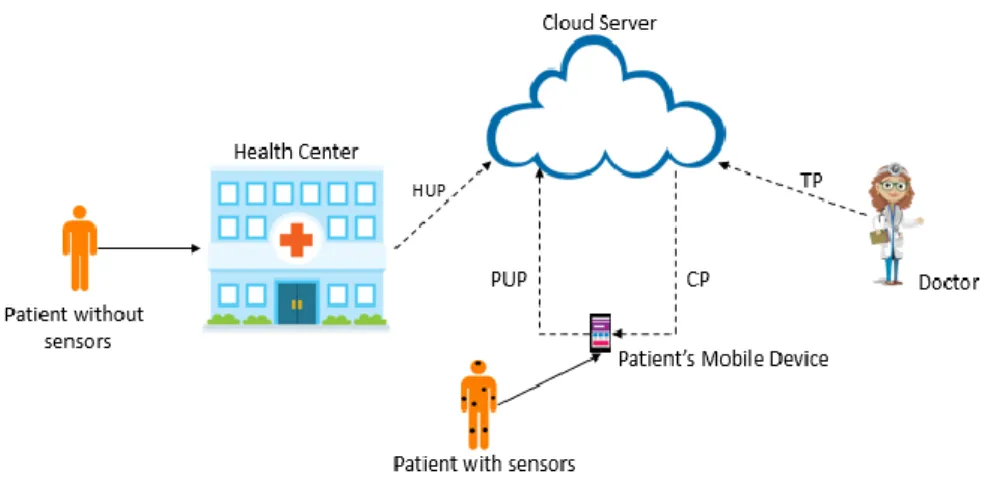
Figure 3.1 shows the system architecture, composed of a health center, a cloud server, patients with and without sensors, patients’ devices, doctors, the 3GPP access technology, Evolved Node B (eNB) and 3GPP Evolved Packet Core (EPC), represented by the Home Subscriber Server (HSS). It is also comprised of two coverage domains: a device’s coverage domain, comprehending devices located both inside the 3GPP coverage area and outside the
1Table 3.1. Comparison among some protocols.
D2D
Communication
m-health/e-health/TMIS
Type of
Cryptography Cloud Server
Chiou et al. [2] No Yes Asymmetric Yes
Mohit et al. [1] No Yes Asymmetric Yes
Jiang and Lian
[3] No
Yes
Symmetric No
Li et al. [4] No Yes Asymmetric No
Wang and Yan
[14] Yes
No
Asymmetric No
Hsu et al. [15] Yes No Asymmetric No
Zhang et al. [9] Yes Yes Asymmetric No
Proposed
Protocol Yes
Yes
coverage area (patients located outside the coverage area can access the 3GPP network relaying their data through devices located inside the coverage area), and the 3GPP domain, where the doctor is located.
2Figure 3.1. Architecture of the proposed scheme.
Patients without sensors visit the health center to collect identity information to be used in future mutual authentication sessions. The health center must perform mutual authentication with the cloud server prior to sending its patients’ data. Patients’ devices perform mutual authentication with the cloud server prior to sending the data collected from the respective sensors. Devices with direct access to the 3GPP infrastructure might use it to reach the cloud server. Those devices located outside the coverage area can perform mutual authentication using D2D communication, prior to sending health reports. In the second case, the other D2D devices in the path to the cloud server are used as relays. A device with direct connection to the 3GPP infrastructure might choose to send its information through D2D communication to perform data offload, which is not addressed in this study.
Finally, each doctor also performs mutual authentication to obtain patients’ reports, evaluate their health conditions and guide them to the most suitable treatment.
The following sections detail each of the phases required for the mutual authentication of the entities considered and the cloud server, named registration, health center upload, patient upload, treatment and checkup. Table 3.2 shows the notations used.
3.3.1 Device Discovery Scheme
The devices must perform a device discovery to detect and identify devices in proximity [8] for establishing D2D communication. 3GPP technical specification TS 23303 [12] describes two models of devices discovered with no permission necessary from the UE to be discovered or with authorization required. The first is model Model A “I am here”, in which devices broadcast some information to announce their existence and monitor if interested have devices also shared their information. In the second, i.e., Model B “Who is there?”, devices work as discoverers by broadcasting the characteristics they expect to find in the nearby devices and wait for the response of those eligible to fulfill their expectations. Symbol Description
x, y Entities: patient (P), health center (H), doctor (D), cloud server (C). IDx /TIDx Real identity of entity x/ Temporary identity of entity x.
k Random numbers generated in the registration phase. Rk k random number generated.
MACxy Message Authentication Code generated from entity x to entity y. Rx Random number generated by entity x.
RCy Random number generated by the cloud and sent to entity y. Tx Timestamp generated by entity x.
Kxy Session key generated by entities x and y.
Cxy Validator of the session key generated by x and y.
EKxy /DKxy Encryption/Decryption operation that used the session key generated by x and y.
IMSIx International Mobile Subscriber Identity of device x h1 Temporary identity generation hash function. h2 MAC generation hash function.
h3 Session key generation hash function. h4 Session key verifier hash function.
Secure channel. Insecure channel.
We have adopted Model A and the device discovery follows the solution presented in Gunes et al. [8] and the technical specification TS 23303 [12], which is described as below:
Each device must prove authentic to the HSS, which checks if its International Mobile Subscriber Identity (IMSI) has matched the identity of the device registered in the database and if the device is eligible to perform D2D. If the verification succeeds, the device performs D2D communication. The authorization is stored in the eNB and refreshed at the expiration of a validity timer.
Next, it adopts a model with direct discovery among devices through a dedicated ProSe server, one of the solutions presented by [8] and based on the specifications of TS 23303 [12]. The devices detect and identify each other using E-UTRAN or WLAN direct radio signals to share their identities.
3.3.2 Registration Phase
This phase enables the exchange of important authentication-related parameters used in the subsequent phases. The International Mobile Subscriber Identity (IMSI) of each device must be registered occurs offline in the Home Subscriber Server (HSS) by the manufacturer.
The health center, patients and doctors are then registered in the cloud server through a secure channel. Each entity generates k different random numbers Rk and calculates a set of temporary identities, TIDx = h1(IDx || Rk), which are individually used in each authentication session initiated by the entities. The use of real identities associated with a random number in the calculation of temporary identities guarantees their uniqueness. They send their real identity IDx, and temporary identities TIDx to the cloud server, which stores the data to be used in the following phases. If all temporary identities of a certain entity are used, a new registration phase is performed. If a real identity is revoked, a special registration phase is performed to indicate the identity revoked and the new equivalent identity. Only registered entities can perform the following phases.
3.3.3 Health Center Upload Phase (HUP)
An insecure channel is considered for this phase. The aim is the mutual authentication among entities for a secure transmission of the patient’s collected data, from the health center to the cloud server. The complete procedure is shown in Figure 3.2. The phase starts when the user goes to the health center for a health inspection and receives a login and a password to access the patient’s system in his/her mobile device. Patients can access his/her health information whenever wanted by inserting the login/password pair on their device.
![Figure 3.7 shows a graphic representation of costs that confirms the best performance of the protocol proposed in this chapter regarding computational costs, in compared to [1] and [2]](https://thumb-eu.123doks.com/thumbv2/123dok_br/18827709.927796/54.892.182.704.269.689/representation-confirms-performance-protocol-proposed-regarding-computational-compared.webp)
![Figure 5.1 shows the reference architecture proposed by 3GPP for Proximity Services [7]](https://thumb-eu.123doks.com/thumbv2/123dok_br/18827709.927796/104.892.196.725.511.946/figure-shows-reference-architecture-proposed-gpp-proximity-services.webp)
![Table 5.4 shows a comparison of the computational costs (in milliseconds) among protocol and those designed by [9] and [13]](https://thumb-eu.123doks.com/thumbv2/123dok_br/18827709.927796/119.892.131.787.166.432/table-shows-comparison-computational-costs-milliseconds-protocol-designed.webp)
![Table 5.6 displays the results of the communication cost analysis and the comparison with [9] and [13]](https://thumb-eu.123doks.com/thumbv2/123dok_br/18827709.927796/122.892.119.768.267.492/table-displays-results-communication-cost-analysis-comparison.webp)
![Figure 5.8 shows a graphic with the results and comparison among the proposed scheme and [9] and [13] in a situation in which 25% of the devices are involved in the relay of data](https://thumb-eu.123doks.com/thumbv2/123dok_br/18827709.927796/123.892.168.750.378.857/figure-graphic-results-comparison-proposed-situation-devices-involved.webp)
![Figure 5.9 shows a comparison based on the energy costs displayed in Table 5.7. The red line representing the protocol proposed in this chapter proves its lower energy consumption in comparison to the protocols of [9] and [13]](https://thumb-eu.123doks.com/thumbv2/123dok_br/18827709.927796/124.892.123.768.170.391/comparison-displayed-representing-protocol-proposed-consumption-comparison-protocols.webp)