Resear
ch article
Resumo
Objetivando traçar a evolução histórica da distribuição de médicos no Brasil segundo sexo, foi realizado es- tudo epidemiológico do tipo ecológico, por meio do cruzamento de bancos de dados secundários (linkage). Para a caracterização geral dos médicos foram consideradas as bases de dados dos 27 conselhos regionais de medicina, complementadas pelas bases de dados da Comissão Nacional de Residência Médica e da Associa- ção Médica Brasileira. Os resultados mostram que, desde 2009, entre os novos médicos registrados há mais mulheres que homens. Na população de médicos em atividade os homens ainda predominam (60,1%), mas no grupo com 29 anos ou menos as mulheres já são maioria. A tendência consistente de maior participação das mulheres na profissão médica no Brasil, observada ao longo das últimas décadas e acentuada nos últimos anos, indica a necessidade de reavaliar e readequar as propostas para implementação de políticas públicas na área.
Palavras-chave: Feminização. Medicina. Distribuição de médicos. Brasil.
Resumen
La feminización de la Medicina en Brasil
Con el fin de trazar la evolución histórica de la distribución de los médicos en Brasil por sexo, se llevó a cabo un estudio epidemiológico del tipo ecológico, a través de la intersección de las bases de datos secundarias (linkage). Para la caracterización general de los médicos, se han considerado las bases de datos de los 27 Consejos Regionales de Medicina, complementados con las bases de datos de la Comisión Nacional de Resi- dencia Médica y de la Asociación Médica Brasileña. Los resultados muestran que entre los nuevos médicos colegiados hay más mujeres que hombres desde 2009. En la población de los médicos en actividad todavía predominan los hombres (60,1%), pero en el grupo con 29 años o menos, las mujeres son la mayoría. La ten- dencia constante de aumento de la participación de las mujeres en la profesión médica en Brasil, observada durante las últimas décadas y notablemente en los últimos años, indica la necesidad de reevaluar y reajustar las propuestas para la implementación de políticas públicas en el área.
Palabras-clave: Feminización. Medicina. Distribución de médicos. Brasil.
Abstract
The feminization of Medicine in Brazil
Aiming to settle the historical evolution of physicians’ distribution in Brazil by gender, an ecological study was conducted by secondary database cross-checking (linkage). For a general characterization of the physicians were considered the 27 Regional Medicine Council, complemented by the National Medical Residency and the Brazilian Medical Association databases. The results show that since 2009, among new registered doctors there are more women than men. Although men still prevail (60.1%) in the active physicians population, in the group aged less than 29 years old, women have become majority. The consistent trend of increased par- ticipation of women in the medical profession in Brazil, observed over the past decades and intensified over the past few years, indicates the need to reassess and readjust the proposals for implementation of public policies in the area.
Keywords: Feminization. Medicine. Physicians distribution. Brazil.
1. Doctor [email protected] 2. PhD Student [email protected] – Universidade de São Paulo (USP), São Paulo/SP, Brasil.
Correspondence
Mário César Scheffer – Departamento de Medicina Preventiva – FMUSP
Av. Dr. Arnaldo, 455, 2o andar Cerqueira César CEP 01246-903. São Paulo/SP, Brasil.
Resear
ch article
The world is witnessing a gradual decrease of gender differences, and the barriers that impede women from having the same access as men to ed-ucation, job opportunities and social benefits are being removed, generating more productivity and competitiveness for the countries’ economies1. In
Brazil, together with the increasing predominance of women in the population, there are records of a bigger presence of women in the labor market and the growth of female education is present in several sectors of economic activities.
The enrollments in higher education courses were mostly of women in the period between 2001 and 20102. According to the Brazilian Institute of
Geography and Statistics (IBGE - Instituto Brasileiro
de Geografia e Estatística), in 2000 there were 96.9
men for every 100 women. In the 2010 census, the ratio dropped to 96 men for every 100 women3.
Bra-zilian women with higher education have higher or similar participation in jobs – 45.4% were employed in 2011 –, but their wages are still lower than those of men, according to 2012 data from the IBGE4.
These changes in recent decades are also re-flected in the growing presence of women in Bra-zilian medicine. Such transformation may constitute a structural element of the profession’s evolution, with consequences in medical practices, in the qual-ity of care and in the organization of health services. In order to support the reflection about this pattern, this study aims to trace an overview of the historical evolution of the distribution of physicians in Brazil according to their gender, describing the phenome-non of the feminization of medicine in the country.
Method
We conducted an ecological study to assess the distribution of physicians in Brazil by gender, number of professional records, and presence at
medical specialties and units of the Federation, con-sidering a period of a century, from 1910 to 2010. Besides analyzing the literature, we crossed second-ary databases (linkage), aiming to get descriptions, evolution scenarios and trends of women's partici-pation in the exercise of the medical profession.
Our main source was the database of the Fed-eral Council of Medicine (CFM - Conselho FedFed-eral
de Medicina), with the registration of all physicians
in regional councils of Medicine (CRM – Conselho
Regional de Medicina). In addition, to obtain
infor-mation related to medical specialties, we used the databases of the National Commission of Medical Residency (CNRM – Comissão Nacional de
Residên-cia Médica) and of the Brazilian Medical AssoResidên-ciation
(AMB – Associação Médica Brasileira), which com-bines the specialty societies. We also used data from the 2010 Census conducted by the IBGE.
The databases used for the evaluation were made available by the CFM, CRM and CNRM institu-tions, containing individual data for each state of the Federation, in ".txt" format. The data were trans-ferred to the Statistical Pockage of the Social Science software, version 20. The bases were integrated through the command merge files, thus forming a national database aggregated by state and another database aggregate by medical specialty.
Results
There is a consistent trend of feminization of medicine in Brazil, which has been observed during the past decades and that has accelerated recently. The growth of female participation in the profession becomes evident in the evolution of the number of women that get a degree each year and are entering the labor market, according to national data of new registrations in the CRM (Figure 1).
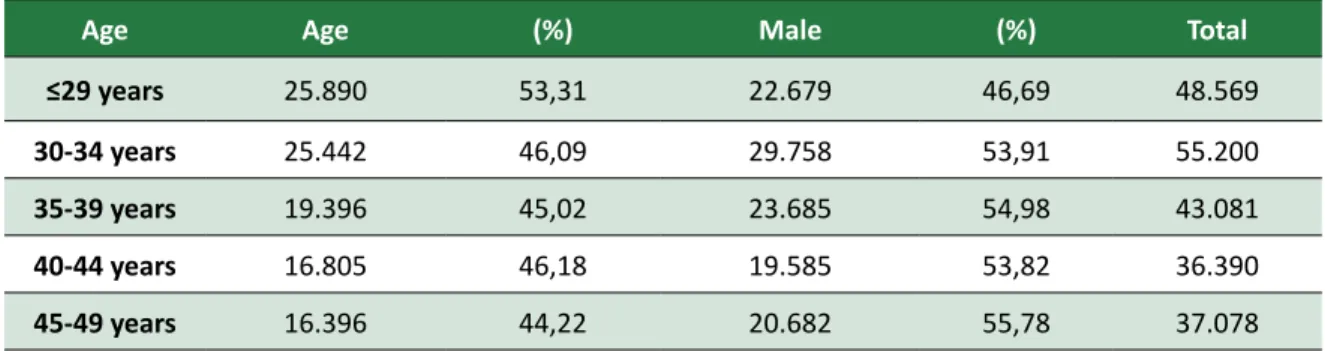
Table 1. Practicing physicians, according to age and gender, Brazil, 2012
Age Age (%) Male (%) Total
≤29 years 25.890 53,31 22.679 46,69 48.569
30-34 years 25.442 46,09 29.758 53,91 55.200
35-39 years 19.396 45,02 23.685 54,98 43.081
40-44 years 16.805 46,18 19.585 53,82 36.390
Resear
ch article
Age Age (%) Male (%) Total
50-54 years 15.070 41,41 21.318 58,59 36.388 55-59 years 13.498 35,36 24.673 64,64 38.171 60-64 years 8.336 25,62 24.197 74,38 32.533 65-69 years 2.355 17,35 11.215 82,65 13.570 ≥70 years 1.952 18,08 8.847 81,92 10.799 Total 145.140 41.26 206.639 58,74 351.779
In fact, the inversion occurred in 2009, when 7,301 female and 7,235 male physicians were reg-istered in the country, a phenomenon that was re-peated in the following year, 2010, in which 7,634 women and 6,917 men were registered. This recent event has so far not changed the fact that the med-ical profession in Brazil is still predominantly male. In 2010, 219,189 (60.09%) of the 364,757 registered physicians were men.
However, as a result of the recent records, analyzing the population of practicing physicians, women are majority in the group of physicians
with 29 years or less (Table 1). In 2011, there were 53.31% women and 46.69% men from a total of 48,569 physicians in this age group. Among the older physicians, the scenario is still predominantly male. Of the total of 10,799 professionals over 70 years old, only 18.08% are women. From this age to the younger age groups, the number of female doctors always grows. There are already 41.41% women among professionals with 50 to 54 years and the percentage reaches 46.09% in the age group between 30 and 34 years, being over 50% in the age group under 29 years.
Figure 1. Evolution of new medical records, 1910-2010, according to gender, Brazil, 2012
When analyzing the evolution of the physi-cians’ population according to gender (Table 2), women appear with 22% and 21% in the years 1910 and 1920, in relation to the total. The number of registered female physicians drops in the
subse-quent periods, decreasing to 19.10% in 1930 and decreasing even more in the following years, reach-ing 12.99% in 1960, with only 4,519 female doctors against 30,273 male doctors.
Resear
ch article
Table 2. Evolution of the physicians’ population, 1910-2010, according to gender, Brazil, 2012
Year Female % Male %
1910 2.956 22,28 10.314 77,72 1920 3.015 21,49 11.016 78,51 1930 3.037 19,10 12.862 80,90 1940 3.131 15,09 17.614 84,91 1950 3.450 13,21 22.670 86,79 1960 4.519 12,99 30.273 87,01 1970 9.341 15,83 49.653 84,17 1980 32.239 23,47 105.108 76,53 1990 67.483 30,80 151.601 69,20 2000 104.554 35,82 187.372 64,18 2010 145.568 39,91 219.189 60,09
It is important to note that the population of practicing physicians in 1960 had the highest male proportion of history of medicine in the country, with 87 men for each group of one hundred doctors. From 1970 on, there is a steady growth of women in medicine, rising to 23.47% in 1980; 30.80% in 1990; 35.82% in 2000; and up to 39.91% in 2010.
While for Brazil, in 2011, there were 1.45 male practicing doctors for each female doctor, quantitative differences were observed between Federation units.
There are states with higher male physicians popula-tion, such as Rondonia, in which, among the practicing physicians, there are 2.20 men for each woman; Goiás, with 2.19; and Piauí and Santa Catarina, both with 2.06 doctors for each female physician. São Paulo presents the same number as Brazil (1.45), but eleven states have a lower male/female ratio than the national one. Alagoas is the only state in which there is already a fe-male predominance: from a total of 3,659 practicing physicians, 50.70% are women (Table 3).
Table 3. Número de médicos em atividade nas unidades federativas, segundo sexo, Brasil, 2012
Female % Male % M-FR* Acre 269 35,77 483 64,23 1.796 Alagoas 1.847 50,74 1.793 49,26 0.971 Amapá 212 33,49 421 66,51 1.986 Amazonas 1.626 42,89 2.165 57,11 1.331 Bahia 7.341 45,53 8.782 54,47 1.196 Ceará 3.589 38,34 5.773 61,66 1.609 Distrito Federal 4.466 43,40 5.825 56,60 1.304 Espírito Santo 3.083 41,78 4.297 58,22 1.394 Goiás 3.103 31,36 6.792 68,64 2.189 Maranhão 1.623 36,38 2.838 63,62 1.749 Mato Grosso 1.236 33,33 2.472 66,67 2.000
Mato Grosso do Sul 1.334 33,53 2.645 66,47 1.983
Minas Gerais 14.122 36,52 24.549 63,48 1.738
Resear
ch article
Female % Male % M-FR* Paraíba 2.159 44,19 2.727 55,81 1.263 Paraná 6.590 34,75 12.376 65,25 1.878 Pernambuco 6.046 45,66 7.194 54,34 1.190 Piauí 1.018 32,64 2.101 67,36 2.064 Rio de Janeiro 25.464 44,81 31.363 55,19 1.232Rio Grande do Norte 1.804 41,22 2.572 58,78 1.426
Rio Grande do Sul 9.424 38,17 15.268 61,83 1.620
Rondônia 542 31,22 1.194 68,78 2.203
Roraima 214 44,58 266 55,42 1.243
Santa Catarina 3.847 32,64 7.939 67,36 2.064
São Paulo 43.515 40,89 62.903 59,11 1.446
*Male-Female Ratio.
In 2011, 55.1% of the 371,788 Brazilian prac-ticing physicians were specialists, i.e., they con-cluded a residency program and/or obtained the specialist title issued by a medical specialty society. The remaining 44.9% did not have a specialization in these modalities. Among these medical special-ists, 59.39% are men and 40.61% women, a fact that corresponds to the male-female ratio of the gener-al physician population. However, among the spe-cialties, there are important gender differences, as shown in Table 4, at the end.
Among the 53 officially recognized special-ties5, 13 are performed mostly by women. Men pre-dominate in the other 40. Women are the majority in five of six basic specialties: Pediatrics (70.0%), Gynecology and Obstetrics (51.5%), General Prac-tice (54.2%), Family and Community Medicine (54 2%) and Preventive Medicine (50.3%). The number of women is also higher in Endocrinology and Me-tabology, Medical Genetics, Hematology and He-motherapy, Homeopathy, Infectious Diseases and Pathology. However, there is less women in general surgery, only 16.2%.
Men, in turn, represent more than 80% in 13 of 53 specialties, including nine surgical specialties. Among the six specialties in which men represent 90.0% or more, four are surgical: Cardiovascular Surgery (90.0%), Digestive Surgery (91.4%), Thoracic Surgery (93.5%) and Neurosurgery (91.8%). Further-more, men also represent 95.0% of the Orthopedics and Traumatology professionals and likewise pre-ponderate in Urology, with 98.8%.
The surgical specialty with the greatest pres-ence of women, which is 32.5%, is the Pediatric Surgery.
Discussion
Understanding the process of the increasing participation of women in medicine in Brazil is indis-pensable in a scenario of demographic and epide-miological transitions, of growth in the population’s health demands and needs, of problems in concen-tration and settlement of doctors, and of challeng-es in the organization and operation of the health system. Several authors show that female physicians differ from men in the choice of specializations, in settlement, in working hours and way of practicing6-9.
In addition to the global phenomenon of the expansion of women's access to education and work, the largest amount of female doctors in Brazil follows the expansion of effective doctors in general, within the last 40 years. In 1970, there were 58,994 physicians, and in 2011, Brazil had 371,788 phy-sicians, a growth of 530%, considering that, in the same period, the Brazilian population grew 105%. The increase in the number of doctors is related to the opening of new medical schools, to the expan-sion of the health system and the health needs of the population10.
The increased participation of women in the medical profession is not a recent phenomenon and it does not happen only in Brazil. The pro-portion of female physicians in countries of the Organisation for Economic Co-operation and De-velopment (OECD) grew between 1990 and 2005; it went from 28.7% to 38.3% of the total of phy-sicians11. In the early 2000s women were already
majority among medical students in the United States12 and Canada13. Before that, in the 1990s,
Resear
ch article
majority in several countries, such as England14,
Ireland15, and Norway16.
Men predominate in surgical specialties and those specialties that involve urgent and emergen-cy care, such as orthopedics. Studies indicate that the idea that there is need for greater strength and physical endurance, that the graduation takes lon-ger, that there is a demand for greater time avail-ability and the trouble to co-ordinate professional practices and family life are the main reasons that keep women away of certain specialties, especially surgical ones17,18.
In this sense, Brazilian female physicians tend to choose basic specialties, such as Pediatrics and Gynecology and Obstetrics, rather than surgical spe-cialties. Likewise, in Canada, 70% of female physi-cians are concentrated in primary care specialties, such as Pediatrics, Gynecology and Obstetrics, and also Dermatology and Psychiatry6,13,19,20. This
situa-tion can be characterized as a global phenomenon, although in the United States, Australia and in Eu-ropean countries like England and Finland there is a greater gender balance in General Practice, Family Medicine, Pediatrics and Anesthesiology.
The increased participation of women in med-ical practice has been identified as a factor of the reduced availability of practicing physicians in Eu-ropean countries. This is due to the tendency of partial workdays, once female doctors work fewer hours per week, accepting lower service volume and choosing a shorter working life than male doctors. Women also make fewer night shift services, when compared to male physicians, and do not frequently move to rural or peripheral areas, for which it is dif-ficult to provide professionals11,21.
In some countries in which women are the ma-jority in the area, such as Russia and Estonia, the pro-fession is considered as a low-status occupation 22,23.
This is because, as in most professions, women tend to receive lower wages than men in similar posi-tions24. In the United States, for example, female
physicians have a lower income than their male counterparts – 25% to 35% less, depending on the specialty -, because of being more engaged with pri-mary care or because of working fewer hours25.
In contrast, some authors argue that female physicians are more likely to harmonize the doc-tor-patient relationship than their male counter-parts, as they adopt more democratic communi-cation styles, promote collaborative relationships, discuss more about the treatments and involve pa-tients in decision-making26,27.
Furthermore, studies also show that the con-duct and practices of female doctors may lead to more effective preventive actions; they adapt more easily to operations and to the leadership of multi-disciplinary health teams; they lead to resources op-timization, as they tend less to incorporate unnec-essary technologies; they best help populations in contexts of vulnerability; and respond to situations that need understanding of cultural uniqueness and individual preferences of patients28.
Final considerations
The demographic profile of medicine in Brazil is undergoing a historic transformation. Although it is still a predominantly male profession, the new medical records show more women than men, con-firming a consistent medicine feminization trend in the country, a phenomenon that may shape the fu-ture of the medical profession, influence the type of patient care and the organization of the health system.
Due to the characteristics of the practicing of women and the preference for medical specializa-tion in certain areas, studies will be necessary to assess the possible impacts of the feminization of medicine in the national context, marked by new epidemiological and demographic challenges, with the growth of noncommunicable chronic diseases and the aging population. Another issue to be con-sidered in future research about the feminization of medicine is the need for a reorientation of the Bra-zil’s health system model, starting at primary care focused on teamwork, targeting territorial popula-tions, geared towards solving more frequent health problems and guided by the principles of the bond and the humanization of care.
The feminization of medicine requires special attention from the bioethics 29. The androcentrism,
the inferiority and the devaluation of women ap-pear in wage and functional disparities between male and female doctors. Women opt to work part-time, presumably to better serve their families. The perpetuation of the oppression on female doctors is systemic and not just a personal and deliberate decision of male physicians. It is a result of social and institutional practices that act impersonally and jointly to favor the interests of men over women, a fact that requires new and permanent bioethics theoretical contributions in order to understand these and other power imbalances that are present throughout society – and not only in medicine.
Resear
ch article
In the view of bioethics plurality, women and men may differ in the way of seeing, feeling and solving problems in the daily professional practice of medicine. The fact that male and female doc-tors are different, and that the differences should be preserved, is not related to the perpetuation of a professional practice dominated by the male gender.
The "ethics of care", related to the work of women, and the "ethics of justice", typically male30,
are possible approaches for further debate. The analysis of physicians’ discourses31 is another viable
way for a bioethical reflection that considers the opposition between human, relational and affective values, supposedly more "feminine", and technical,
scientific and rational values, which would be more "masculine".
Considering the critical bioethics of feminist inspiration32,33, the inclusion of a gender perspective
in studies on medical demography may provide visi-bility to the existing power structures and the asym-metries that arise from the process of socialization between men and women, which happen in the ex-ercise of the medical profession.
In addition to the statistical findings of medical demography and gender approaches of occupation-al sociology 34, the reference to the feminization of
the world of medicine requires new bioethical ana-lyzes that may contribute to the understanding of the dynamic dimension of the phenomenon.
Institutional support (databases): Conselho Regional de Medicina do Estado de São Paulo (Cremesp), Conselho Federal de Medicina (CFM), Associação Médica Brasileira (AMB) and Comissão Nacional de Residência Médica (CNRM).
References
1. Banco Mundial. Relatório sobre o desenvolvimento mundial de 2012: igualdade de gênero e desenvolvimento. Washington: Banco Mundial; 2012.
2. Instituto Brasileiro de Geografia e Estatística. Censo demográfico 2010: características gerais da população, religião e pessoas com deficiência. Rio de Janeiro: IBGE; 2010.
3. Instituto Nacional de Estudos e Pesquisas Educacionais Anísio Teixeira. Censo da educação superior de 2010: resumo técnico. Brasília: Inep; 2010.
4. Instituto Brasileiro de Geografia e Estatística. Mulher no mercado de trabalho: perguntas e respostas. Pesquisa mensal de emprego – PME. Rio de Janeiro: IBGE; 2012.
5. Conselho Federal de Medicina. Resolução CFM no 1.973/11, de 1o de agosto de 2011. Dispõe
sobre a nova redação do Anexo II da Resolução CFM no 1.845/08, que celebra o convênio de
reconhecimento de especialidades médicas firmado entre o Conselho Federal de Medicina (CFM), a Associação Médica Brasileira (AMB) e a Comissão Nacional de Residência Médica (CNRM). Diário Oficial da União. 1o ago. 2011:Seção1, p. 144-7.
6. Contandriopoulos AP, Fournier MA. Féminisation de la profession médicale et transformation de la pratique au Québec. Montreal: Université de Montréal; 2007.
7. Dubernet ACH. Femmes en médecine: vers un nouveau partage des professions? Revue Française des Affaires Sociales. 2005;59(1):35-58.
8. Eisenberg C. Medicine is no longer a man’s profession. Or when the men’s club goes coed it’s time to change the regs. N Engl J Med. 1989;321(22):1.542-4.
9. Machado MCS. A feminização da medicina. Análise Social. 2003;38(166):127-37.
10. Scheffer M, coordenador. Demografia médica no Brasil: dados gerais e descrições de desigualdades. São Paulo: Cremesp; 2011. p. 118.
11. Organisation for Economic Co-Operation and Development. OECD health data 2009: comparing health statistics across OECD countries. [Internet]. OECD; 2009 [acesso 8 nov. 2012]. Disponível: http://www. oecd.org/document/57/0,3746,en_21571361_44315115_43220022_1_1_1_1,00.html
12. Jonasson O. Leaders in american surgery: where are the women? Surgery. 2002;131(6):672-5. 13. Beagan BL. Neutralizing differences: producing neutral doctors for (almost) neutral patients. Soc
Sci Med. 2000;51(8):1253-65.
14. McManus IC, Sproston KA. Women in hospital medicine in the United Kingdom: glass ceiling, preference, prejudice or cohort effet? J Epidemiol Community Health. 2000;54(1):10-6. 15. Mcdonough CM, Horgan A, Codd MB, Casey PR. Gender differences in the results of the final
medical examination at University College Dublin. Med Educ. 2000;34(1):30-4.
16. Kvaerner KJ, Aasland OG, Botten GS. Female medical leadership: cross sectional study. BMJ. 1999;318(7176):91-4.
17. Baxter N, Cohen R, McLeod R. The impact of gender on the choice of surgery as a career. Am J Surg. 1996;172(4):373-6.
18. Neumayer L, Freischlag J, Levinson W. Demographics of today’s woman surgeon. Bull Am Coll Surg. 1994;79(2):28-33.
19. Baker LC. Differences in earnings between male and female physicians. New Engl J Med. 1996;334(15):960-4.
Resear
ch article
20. Phillips SP, Austin EB. The feminization of medicine and population health. Jama. 2009;301(8):863-4.
21. Simoens S, Hurst J. The supply of physician services in OECD countries: health working papers no
21. Paris: OCDE; 2006.
22. Harden J. ‘Mother Russia’ at work: gender divisions in the medical profession. European Journal of Women’s Studies. 2001;8(2):181-99.
23. Barr DA, Boyle EH. Gender and professional purity: explaining formal and informal work rewards for physicians in Estonia. Gender and Society. 2001;15(1):29-54.
24. Wallace AE, Weeks WB. Differences in income between male and female primary care physicians. J American Med Womens Assoc. 2002;57(4):180-4.
25. Darves B. Women in medicine force change in workforce dynamics? NEJM. [Internet]. 2005 [acesso 8 nov. 2012] NEJM Career Center. Disponível: http://www.medrecruitersalliance.com/ newsletter/archive/011906.pdf
26. Roter DL, Hall JA, Aoki Y. Physician gender effects in medical communication: a meta-analytic review. Jama. 2002;288(6):756-64.
27. Hall JA, Roter DL. Medical communication and gender: a summary of research. J Gend Specif Med. 1998;1(2):39-42.
28. Levinson W, Lurie N. When most doctors are women: what lies ahead? Ann of Inter Med. 2004;141(6):471-4.
29. Lindemann H. The woman question in medicine: an update. Hastings Cent Rep. 2012;42(3):38-45. 30. Gilligan C. In a different voice: psychological heory and women’s development. Cambridge:
Harvard University Press, 1982.
31. Dubernet ACH. Femmes en médecine: vers un nouveau partage des professions? Revue française des affaires sociales. [Internet]. 2005 [acesso 8 nov. 2012];1(1):35-58. Disponível: www.cairn. info/revue-francaise-des-affaires-sociales-2005-1-page-35.htm
32. Guilhen D. Bioética, gênero e saúde pública. In: Fortes PAC, Zoboli ELCP, organizadores. Bioética e saúde pública. São Paulo: Edições Loyola; 2003.
33. Diniz D. Bioética e gênero. Rev. bioét. (Impr.) 2008;16(2):207-16.
34. Malochet G. La féminisation des métiers et des professions: quand la sociologie du travail croise le genre, sociologies pratiques. Sociologies Pratiques. [Internet]. 2007 [acesso 8 nov. 2012];1(14):91-9. Disponível: www.cairn.info/revue-sociologies-pratiques-2007-1-page-91.htm
Author’s participation
The authors worked jointly in all stages of the article.
Received: 14. 4.2013 Reviewed: 27. 6.2013 Approved: 8. 7.2013
Resear
ch article
Annex
Table 4. Specialist physicians, according to specialty and gender, Brazil, 2012
Female % Male % Total
Acupuncture 881 48,7 928 51,3 1.809
Allergy and Immunology 467 60,8 301 39,2 768
Anesthetics 5.250 35,4 9.571 64,6 14.821 Angiology 62 22,0 220 78,0 282 Oncology 508 34,9 947 65,1 1.455 Cardiology 2.254 25,9 6.452 74,1 8.706 Cardiovascular Surgery 110 10,0 992 90,0 1.102 Hand Surgery 27 13,4 175 86,6 202
Head and Neck Surgery 53 13,8 331 86,2 384
Gastrointestinal Surgery 91 8,6 964 91,4 1.055 General Surgery 2.206 16,2 11.400 83,8 13.606 Pediatric Surgery 294 32,5 611 67,5 905 Plastic Surgery 799 19,9 3.213 80,1 4.012 Thoracic Surgery 32 6,5 459 93,5 491 Vascular Surgery 331 17,7 1.543 82,3 1.874 General Practice 5.770 54,2 4.868 45,8 10.638 Coloproctology 203 23,3 670 76,7 873 Dermatology 3.731 72,7 1.400 27,3 5.131
Endocrinology and Metabology 1.631 63,9 921 36,1 2.552
Endoscopy 266 25,2 789 74,8 1.055
Gastroenterology 811 38,1 1.320 61,9 2.131
Medical Genetics 100 64,1 56 35,9 156
Geriatrics 348 48,6 368 51,4 716
Gynecology and Obstetrics 11.735 51,5 11.069 48,5 22.804
Hematology and Hemotherapy 810 57,0 610 43,0 1.420
Homeopathy 964 54,6 802 45,4 1.766
Infectiology 1.143 55,6 912 44,4 2.055
Mastology 275 41,1 394 58,9 669
Family and Community Medicine 1.426 54,2 1.206 45,8 2.632
Occupational Medicine 2.898 32,0 6.165 68,0 9.063
Traffic Medicine 454 24,6 1.392 75,4 1.846
Sports Medicine 63 15,3 350 84,7 413
Physical Medicine and Rehabilitation 259 45,4 311 54,6 570
Intensive Medicine 744 30,2 1.720 69,8 2.464
Resear
ch article
Female % Male % Total
Medicina nuclear 186 37,3 312 62,7 498
Medicina preventiva e social 474 50,3 468 49,7 942
Nefrologia 971 43,6 1.255 56,4 2.226 Neurocirurgia 169 8,2 1.902 91,8 2.071 Neurologia 952 36,2 1.677 63,8 2.629 Nutrologia 305 44,3 384 55,7 689 Oftalmologia 3.450 37,2 5.828 62,8 9.278 Ortopedia e traumatologia 471 5,0 9.044 95,0 9.515 Otorrinolaringologia 1.491 32,1 3.148 67,9 4.639 Patologia 943 54,7 782 45,3 1.725 Patologia clínica/medicina laboratorial 524 45,6 624 54,4 1.148 Pediatria 19.052 70,0 8.170 30,0 27.222 Pneumologia 854 42,8 1.143 57,2 1.997 Psiquiatria 2.890 41,1 4.140 58,9 7.030
Radiologia e diagnóstico por imagem 2.481 34,4 4.730 65,6 7.211
Radioterapia 133 30,0 311 70,0 444
Reumatologia 614 49,4 629 50,6 1.243