UNIVERSIDADE DO ALGARVE
FACULDADE DE ECONOMIA
MODELING CONSUMER BEHAVIOR IN THE PORTUGUESE RECYCLING PROGRAM: THE LOGISTICS AND
COMMUNICATION PLANN1NG IMPLICATIONS
-VOLUME I-
Tese para a obtenção do Grau de Doutor em
Métodos Quantitativos Aplieados à Economia e à Gestão na especialidade de Estatística
PATRÍCIA SUSANA LOPES GUERRILHA DOS SANTOS PINTO OOM DO VALLE
FARO 2004
UNIVERSIDADE DO ALGARVE
FACULDADE DE ECONOMIA
MODELING CONSUMER BEHAVIOR IN THE PORTUGUESE RECYCLING PROGRAM: THE LOGISTICS AND
COMMUNICATION PLANNING IMPLICATIONS
- VOLUME I-
Tese para a obtenção do Grau de Doutor em
Métodos Quantitativos Aplicados à Economia e à Gestão na especialidade de Estatística
PATRÍCIA SUSANA LOPES GUERRILHA DOS SANTOS PINTO OOM DO VALLE
I ARO 2004
::r; ->«<T •
âl io oç s^oo^ U GS-%.f '
rfe-^l-OgL . ! Io ^
PATRÍCIA SUSANA LOPES GUERRILHA DOS SANTOS PINTO OOM DO VALLE
FACULDADE DE ECONOMIA
Orientadores: Professora Doutora Elizabeth Reis
Professor Doutor Efigênio da Luz Rebelo Professor Doutor João Menezes
Faro, 30 de Maio de 2004
MODELING CONSUMER BEHAVIOR IN THE PORTUGUESE RECYCLING PROGRAiM: THE LOGISTICS AND COMMUNICATION PLANNING 1MPLICATIONS
Volume I
Júri:
Presidente: Professor Doutor Adriano Lopes Gomes Pimpão Vogais: Professor Doutor Fernando Manuel Fialho Rosado
Professora Doutora Elizabeth Reis
Professor Doutor João Albino Matos da Silva Professor Doutor Eduardo Lopes de Almeida Casais Professor Doutor Manuel Alberto Martins Ferreira Professor Doutor Efigênio da Luz Rebelo
Professor Doutor Paulo Manuel Marques Rodrigues Professor Doutor João Menezes
TABLE OF CONTENTS VOLUME I Page Dedication i Table of Contents ii List of Figures vi List of Tables vii
Acronyms ix
Acknowledgments
Abslract xjj
Chapter 1 - General Introduction 1 1.1 Introduction I 1.2 Objectives and scope of the thesis 4 1.3 Motivations, contributions and research questions 8 1.4 Thesis outline 11 1.5 Recycling in the Portuguese case 16
1.5.1 Legal framework 16 1.5.2 Sociedade Ponto Verde and the Integrated Recovery System 18 1.5.3 The recent evolution of household packaging recycling in Portugal 22 1.5.4 Promoting household packaging recycling in Portugal 26 1.5.5 The survey on consumers' motivations towards household packaging
recycling 28 References 32
Chapter 2 - Review of Literature 34 2.1 Introduction 34 2.2 Social marketing literature 36 2.2.1 Overvicw 36 2.2.2 Social marketing and pro-ccological bchaviors 47 2.2.3 The current slate of the debate and directions for future research 50 2.3 Reverse logistics literature 52 2.3.1 Overvicw 52 2.3.2 Reverse logistics for recycling 63 2.3.3 The current state of the debate and directions for future research 68 2.4 Consumer behavior literature 70 2.4.1 Overvicw 70 2.4.2 Personal determinants of recycling behavior 74 2.4.3 Situational determinants of recycling behavior 81
Tahle of contents
2.4.5 The current stale of the debate and directions for future research 90 References 93
Chapter 3 - Multivariate Data Analysis Methodologics 105 3.1 Introduction 105 3.2 Principal components analysis 105 3.2.1 Overview 105 3.2.2 Stages in the application of the method 110 3.3 Logistics regression 119 3.3.1 Overview 119 3.3.2 Stages in the application of the method 125 3.4 Structural equation modeling 139 3.4.1 Overview 139 3.4.2 Stages in the application of the method 145 3.5 Discriminant analysis 157 3.5.1 Overview 157 3.5.2 Stages in the application of the method 161 3.6 HOMALS 171 3.6.1 Overview 171 3.6.2 Stages in the application of the method 176 3.7 Missing values analysis 181
3.7.1 Overview 181 3.7.2 Stages in the application of the method 184 References 188
Chapter 4 - Behavioral Dctermínants of Household Recycling
Partícípatíon: The Portugucse Case 194 Abstract 194 4.1 Introduction 194 4.2 Review of litcraturc 196 4.2.1 General pro-cnvironmental altitudes 196 4.2.2 Specific altitudes towards recycling 197 4.2.3 The logistics concept of the recycling program 199 4.2.4 Socio-demographic attributes 200 4.3 Research hypotheses 201 4.4 Method 203 4.4.1 Sample procedures and participants 203 4.4.2 Instruments 203 4.4.3 Stalistical data analysis methodology 204 4.5 Results 205 4.5.1 Principal components analysis 205 4.5.2 Logistic regression 211 4.6 Discussion 219
Table of contents
4.7 Final conclusions and implications 221 References 225
Chapter 5 - Combining Behavioral Theorics to Predict Rccycling
Involvement 229 Abstract 229 5.1 Introduction 229 5.2 Rcview of literature 232 5.2.1 The theory of planned behavior (Ajzen, 1985) 232 5.2.2 The model of altruistic behavior (Schwartz, 1977) 234 5.2.3 The model of environmental concern (Stern, Dietz and Guagnano, 1995) 235 5.2.4 The model of environmental behavior (Grob, 1995) 236 5.2.5 The apparent compatibility of the four behavior models 236 5.3 Research hypotheses 237 5.4 Method 242 5.4.1 Sample procedures and participants 242 5.4.2 Instruments 242 5.4.3 Stalistical data analysis methodology 248 5.5 Results 249 5.6 Discussion 253 5.7 Final conclusions and implications 260 References 262
Chapter 6 - The Importance of Consumer-Service in the Reverse
Logistics System for recycling 265 Abstract 265 6.1 Introduction 265 6.2 Review of literature 267 6.2.1 The reverse logistics research 267 6.2.2 Research on consumer behavior in recycling programs 269 6.3 Research hypotheses 270 6.4 Method 272 6.4.1 Sample procedures and participants 272 6.4.2 Instruments 272 6.4.3 Statistical data analysis methodology 272 6.5 Results 273 6.5.1 Principal components analysis 273 6.5.2 Discriminant analysis 274 6.6 Discussion 275 6.7 Final conclusions and implications 281 References 282
Tahle of contents
Chapter 7 - The Applícabílity of Rclationshíp Marketing in Social Contexts: The Case of Fostering Recycling Bchavior 288 Abstract 288 7.1 Introduction 288 7.2 Review of literature 290 7.3 Research hypotheses 294 7.4 Method 296 7.4.1 Sample procedurcs and participants 296 7.4.2 Instruments 296 7.4.3 Statistical data analysis methodology 297 7.5 Results 298 7.5.1 Preliminary analyses 298 7.5.2 HOMALS 300 7.6 Discussion 304 7.7 Final conclusions and implications 310 References 323
Chapter 8 - General Conclusions 327 8.1 Introduction 327 8.2 General conclusions of the quantitative formative research 331 8.3 General implications in logistics 337 8.4 General implications in communication 341 8.5 Limitations and directions for future research 351 References 354
LIST OF FIGURES
VOLUME I
Chapter 1 Page 1.1 Conceptual model of the thesis 5 1.2 Conceptual model of the thesis and major focus of Chaptcrs 2 to 7 15 1.3 Evolution of the amount of packaging residues (tons) recovered and forwarded for
recycling by SPV from 1998 to May, 2003 24 1.4 Evolution of the amount of packaging residues (tons), by type of material, recovered
and forwarded for recycling by SPV from 1998 to May, 2003 24
Chapter 2
2.1 Strategic social marketing 41 2.2 Reverse logistics process 63 2.3 Alternative reverse logistics channels for recycling household wasle 66 Chapter 5
5.1 The comprehensive model of recycling behavior 238 5.2 Supported and non-supported hypotheses of the model and standardized estimates 25 1 5.3 A multi-group analysis of the relationship between personal norms and recycling
behavior; Rcsults of the unrestricted model 252 Chapter 6
6.1 Determinants, trade-offs and challenges in the reverse logistics system for
recycling household packaging 276 Chapter 7
7.1 Knowledge about recyclable materiais to dispose of at the "Eco-points" 298 7.2 Percenlage of consumers lhat received recycling information through lhe media 299 7.3 Mcan satisfaction levei and mean importance levei conceming each media 299 7.4 Percenlage of consumers lhat would like to received recycling information
through the media 300 7.5 Perceptual map for categorics of the media and adherence levei variables
LIST OF TABLES
VOLUME I
Chapter 1 Page 1.1 Types of recyclable materiais and notes on their recycling process 21 1.2 Types of recyclable materiais, benefits of recycling and the belter known
goods produced with the recycled material 22 1.3 Evolution of the application of SPVs financial resources by its main activities 23 1.4 Evolution in the amount of packaging residues declarcd and recovered by SPV 25 1.5 Demographic characteristics of the sample 32
Chapter 2
2.1 Elements of the social marketing model 50
Chapter 3
3.1 The KMO index and the PC A 112 3.2 Classification table 135 3.3 Evaluation of the overall model fit 151
Chapter 4
4.1 Principal components of general environmental altitudes items
(after varimax rotation) and means differences 207 4.2 Principal components of specifíc altitudes lowards recycling items
(after varimax rotation) and means differences 209 4.3 Principal components of logistics service satisfaction items
(after varimax rotation) and means differences 210 4.4 Results of the estimation of a logistic regression model with lhe initial
independent variables 212 4.5 Results of the estimation of a logistic regression model with the final
independent variables 217
Chapter 5
5.1 Latent variables, observed variables and scales 243 5.2 Evaluation of the overall model fit 250 5.3 Evaluation of the reliability of the latent variables 253
Chapter 6
6.1 Main topics invcstigated in the reverse logistics literature 268 6.2 Principal components of logistics service satisfaction items (after varimax rotation) 274
List oftahles
6.3 Structure matrix of discriminant analysis 275
Chapter 7
7.1 Discriminant measures and eigenvalues 301 7.2 Stages, purposes and communication channels in a social marketing campaign
to foster recycling behavior 3 19
Chapter 8
8.1 Correspondence between the specific objectives of the communication strategy
ACRONYMS
ADF Asymptotically Distribution Free AGFI Adjusted Goodness of Fit índex AMOS Analysis of Moment Structures ATM Automated Teller Machine
CBSM Community-Based Social Marketing CFI Comparative Fit Index
DSP Dominant Social Paradigm ECVI Expected Cross-Validation Index EU European Union
GFI Goodness of Fit Index GLS Generalized Least Squarcs
HOMALS Homogeneity Analysis by Means of Alternating Least Squares IFI Incremental Fit Index
KMO Kaiser, Meyer and Olkin' Measurc LISREL Lineal Structural Rclations
MCA Multiple Correspondence Analysis ML Maximum Likelihood
NEP New Environmental Paradigm NEI Normed Fit Index
PCA Principal Components Analysis
PERSU Strategic Plan of Urban Solid Residues PGFI Parsimonious Goodness of Fit Index PNF1 Parsimonious Normed Fit Index RevLog European Group on Reverse Logistics RFI Rei ative Fit Index
RM Relationship Marketing
RMSEA Root Mean Squarc Residual of Approximalion RMSR Root Mean Square Residual
SEM Structural Equation Modcling
SIGRE Sistema Integrado de Gestão de Resíduos de Embalagem SPSS Statistical Package for the Social Sciences
SPV Sociedade Ponto Verde TL1 Tucker and Lewis Index TOPB Theory of Planned Behavior USA United States of America WLS Weighted Least Squares
ACKNOWLEDGEMENTS
I am pleased to have an opportunity to thank ali those pcople who supported my completion of this thcsis. The list is long but starts with my advisors. I wish to exprcss my gratitude first to Professor Elizabeth Reis for her proposal of this lhesis theme and for her assistance and valuable suggestions that helped me lo surpass the most "criticar' parts of my work. With her example of dedication, simplicity and knowledge, Professor Elizabeth Reis has provided me considerable preparation for the carecr I am trying to set forth. I am also indebted to Professor João Menezes for his constant encouragcment, accompaniment, interest and technical support in the management component of this thesis. To him, I also owe the idea of structuring the central chapters of this work as papers, which, at present, I recognize has much enriched my thesis. Finally, I had the honor of working once again with Professor Efigênio Rebelo, who is, for me, an example as an econometrician, as a manager and as a teacher. Besides his moral support and specific technical orientation through my thesis process, Professor Efigênio Rebelo also helped me in my decision to conduct a thesis on lhe Applied Quantitative Methods area and I am very grateful to him for that.
I must also thank ali the other people who contacted very close to my work. In particular, I would like to thank the anonymous reviewers of the joumal Environment and Behavior and to lhe scientific committees' members and participants of the nalional and international conferences whcrc parts of my thesis have been presented during these last three years. The valuable commcnts and suggestions provided on ali these occasions were essential to guide and improve this work. I also wish to thank the Directive Committee of the Faculty of Economics that financially supported and encouraged my participation in these conferences. On lhe olher hand, the financial support of PRODEP was essential in order to provide lhe proper conditions to conclude this project in only thrcc years.
I also have a greal debt to my friend and colleague Dr. Emília Gabriel for her precious help in reading, sometimes more lhan once, and correcting any English imprecision in
.í cknowledgements
my work. Also conccrning the language levei, I would like to thank Dr. Fátima Moreno as well, from the Wall Street Institute, for the final revision of the whole thesis.
I could not fail to refer to the support of the Scientific Committee of the Faculty of Economics. Firstly, this Committee has dcvelopcd lhe "Doctoral Thesis Rcgulation", which is an invaluable help to ali those who are trying to successfully reach this long- awaited "finish" linc. Secondly, by ycarly organizing the "Doctoral Day", the Scientific Committee is allowing doctoral students to present their work and receive some feedback aboul their investigation, which is very important, not only morally speaking, but primarily in what regards the receptiveness among the scientific community to lhe research direclions that are being followed by each of us. In my particular silualion, lhe "Doctoral Days" truly represenled a worthily and positive contribution to the development of my thesis.
I must also acknowledge Professor Adriano Pimpão, the Principal of University of Algarve, who gave me lhe opportunily of experiencing this profession that, since the first day, has taught me so much and that presenlly makes me feel professionally fulfilled.
1 leave lhe last part of these pages of acknowledgment to my friends, colleagues and family but especially to my husband, Inácio, who gave me the strength to continue and constant encouragement over the past three years. In addition to leading with his very busy professional lite, Inácio was always available whenever I became frustrated and diseouraged. To him, my infinite thanks for the time, energy and moral support he always gave me. I also want to thank my little daughter and inspiration, Filipa, for bringing so much joy to my life, hclping me to overcome lhe most difficult times I had to face during these last ícw years. Final ly, 1 will be forever indebted lo my grandfalher, José Guerrilha, who unconditionally supported and encouraged my studies ever since I was a child. His prescnce was essenlial in shaping the person that I still hope to become.
ABSTRACT
Based on lhe data of lhe most recenl national survey conducted in Portugal for Sociedade Ponto Verde (SPV) conceming the altitudes and motivations towards household packaging separation and selective disposal for recycling, the main objective of this thesis is to explore the use of multivariate statistical methods to provide a quantitative formative research on the determinants of recycling behavior in the Portuguese case. These statistical methods are: principal components analysis, logistic regression, structural equation modeling, discriminam analysis and homogeneity analysis (I IOMALS). In view of the results of this research. it is also intended to discuss some guidelines for planning a future social marketing strategy, in what concems interventions in the logistics and communication domains.
The mains contributions of this work rely on the application of multivariate statistical methods in contexts where they are very uncommon, like in the reverse logistics or social marketing research, but also in the improvement of the applied quantitative techniques in the area of consumer behavior in recycling programs. In addition, this thesis provides a first deeper analysis on the motivations towards recycling in the Portuguese case and initiates the discussion on innovator aspeets in reverse logistics and social marketing areas. These aspeets include the research on the role of consumer- service in the reverse logistics system for recycling and the debate around the applicability of relationship marketing in this context of social marketing.
Overall, results from the application of the statistical methods support the conclusion that general environmental altitudes and socio-dcmographic characteristics are not significam determinants of recycling behavior. Instead, the propensity to participate in the selective collection program is significantly determined by specific altitudes towards recycling and also by variables of logistics nature, which are related with the convenience of the selectivc-collection system. The statistical methods also evidencc lhe need for improving lhe overall logistics conditions of the system and the nced for rethinking the communication strategy. Moreover. this thesis cnables lhe identification of logistics variables that any intervention should prioritize and points oul some problems that may arisc from these interventions. At last, it is proposed a renovate communication strategy within this social marketing context and lhe applicability of relationship marketing in some specific stages of this strategy is discussed.
KEYWORDS: Social marketing, Consumer behavior, Reverse logistics, Recycling Principal components analysis, Logistic regression, Structural equation modeling. Discriminam analysis, HOMALS.
Chapter 1
GENERAL INTRODUCTION
1.1 Introduction
Most of currenl environmental problcms have their genesis in the significant life style changes and in the inherent modifications of production and consumption standards lhal have been occurring over the past three decades. In effect, the strong economic growth reported in several countries was often accompanied by the unsustainable exploitation of the natural resources and by a notable increase in the amount of solid waste residues that were yearly produced. Nowadays, each habitant of lhe European Union produces on average from 250 to 620 kg of residues per ycar. Portugal, in tum, generated 3.34 million tons of solid waste residues in 1997, 4.5 million tons in 2000 and it is expected to produce around 6 million tons in 2010. From the total amount of solid waste residues that are currently yielded in Portugal, around 30% are packaging residues (Sociedade Ponto Verde (SPV), 2003).
Products' packaging have an unquestionable economic and social importance. On one hand, they make their transportation and warehousing easier. On the other hand. lhey support consumers in their buying decisions, by providing information and promoting the products. It is of crucial intercst, therefore, lo find the balance belween the benefits of packaging usage and lhe need to conserve the natural resources, by avoiding the excessive production of packaging and packaging residues bui also by providing lhe conditions for their valorization and recycling.
Chapter I General introduction
Several definitions have been proposed for lhe concept of recycling. Kopicki et ai, for instance, defined this term as "lhe process by which materiais otherwise destined for disposal are collected, processed and remanufactured into ncw products" (Kopicki et ed., 1993: 3). The recycling of packaging residues is an important mechanism of resources- recovery, which allows lhe producing of new objeets and even new packaging in an almost never-ending cycle, with signifícant economic and environmental benefits (Lund, 2001). In general terms, the economic advanlages inherent to this conservalion practice include decreased disposal costs, employment creation and a signifícant contribution to the national goals of energy saving. On the other hand, the environmental advantages encompass the diversion of waste from landfílls and, more
importantly, the decreased use of the limited virgin resources.
The need for orienting the world economies towards a global suslainablc development was the general point of debate of the Conference on Environment and Development carried out in Rio de Janeiro, 1992. A purpose of this evenl was discussing guidelines for a balanced management bctween the need to preserve the ecosystems while keeping the conditions for lhe economic growth. Some of lhese orientations had specifícally focused on the residues management problematic, highlighting, for instance, the principie of shared environmental responsibility among economic agents.
This international conference and the emergent concept of sustainable development were inevitable references in the subsequent policies of environmental strategy proposed by the European Union and, in particular, lhose in lhe domain of the residues management. It was in this framework, and with the particular aim of preventing and reducing the environmental impaets of packaging residues, that the European Direclive
Chapter I General introduction
94/62/CE, which has guidccl since thcn, each State Member's legislation concerning management and final destination of this sort of residues, was created, in 1994.
Based on the European legislation and also on its transposition to the national jurisdiction ordinance, specific quantitativo largets of paekaging valorization and recycling were defmed for the Portuguese ease. To attend these objectives, the Integrated Recovery System of Paekaging Waste Management (SIGRE-Sistema Integrado de Gestão de Resíduos de Embalagem), which has been managed by a private company, the Sociedade Ponto Verde, S. A. (SPV), was created in 1997. With the conception of SIGRE and the promotion of recycling, Portugal is giving higher priority to a behavioral solution to the solid waste problem, rather than to technical alternatives, such as waste incineration and landfills disposal, which usually find significant public opposition, in response to the inereasing awareness of their potentially negative impaets on public health and on the environment.
Changing consumers' behavior in order to improve their personal welfare and that of society is the main objective of social marketing, a marketing sub-discipline that emerged in the early 1970s with the study of Kotler and Zaltman (1971). Social marketers use similar tools as those employcd in traditional commercial marketing bui with the purpose of promoting changes in diverse socially imporlant behaviors, such as health promotion, crime prevention and environmental preservation. The same is lo say that the challenge of changing consumers' behavior lowards the adoption of recycling practices is a typicai application of social marketing in the scope of environmental protection.
Chapler I General introduction
Regardless of the context in which social marketing has to be applied, the defmition of a social marketing strategy should begin by identifying and understanding the determinants of the socially beneficiai behavior that it is intendcd to encourage (Macstravic, 2000; Smith, 2000; Andreasen, 1995). This market research, also referred to as the listening stage of the strategic social marketing process, should be oriented by a model of consumer behavior and, whenever possible, be based on quantitative analyses (Andreasen, 1995). This study of the main characteristics, needs and motivations of the social marketing audience should provide, as a result, the foundations for the second stage of the strategic social marketing process, that is, for planning the strategy itself. As also explained by Andreasen (1995), planning a social marketing campaign involves defining the marketing mission, its purposes and setting the core marketing strategy.
1.2 Objectives and scope of the thesis
Based on the data of the most recent national survey conducted in Portugal for SPV about the altitudes and motivations towards houschold packaging separation and selective disposal for recycling, lhe main objective of this thesis is to explore the application of mullivariate statistical methods to provide a quantitative formative research on lhe determinants of recycling behavior in lhe Portuguese case. In view of the results of this research, it is also intendcd to discuss some guidclines for planning a future social marketing strategy, in what concerns interventions in the logistics and communication domains.
Chapter I General inlroducíion
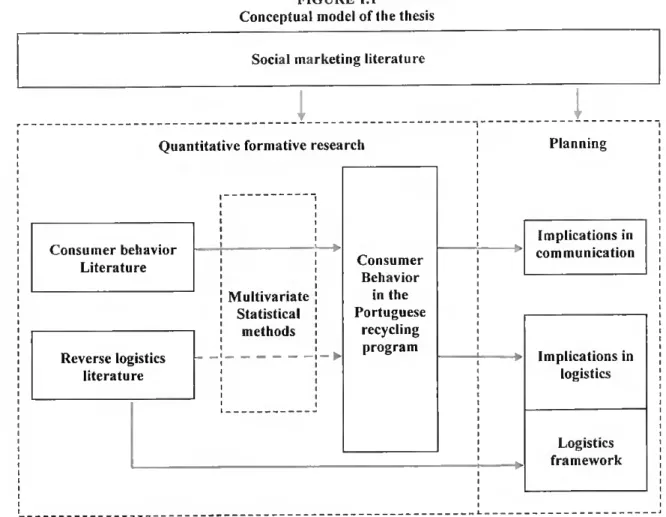
Figure 1.1 presents an overview of the scope of the present thesis.
FIGURE 1.1
Conceptual model of lhe thesis Social marketing literature
l Quantitative formative research
Consumer behavior Literature Multivariate Statistical methods Reverse logistics literature Consumer Behavior in the Portuguese recycling program Pianning Implicatíons ín communication Implications ín logistics Logistics framework
As the rectangle at the top of the figure suggests, the incursion in the social marketing literature provided the general framework for the current thesis. In particular, this literature review of the social marketing setting was needed in order to identify and perceive the stages of strategic social marketing that should be followed to change Portuguese consumers' behavior towards the adoption of recycling practices. As proposed by Andreasen (1995), strategic social marketing should follow six main stages; listening, pianning, structuring, pretesting, implementing and monitoring.
The first stage, listening, involves understanding consumers' wants, needs and satisfaction leveis and offers the basis for the following stages. It must be noted that the
Chapter I General introduction
tcrm "lislening" was replaced in thc figure by the expression "quantitative formative research" because, in this lhesis, statistical methods are applied in order to understand consumers' bchavior in lhe Portuguesc selcclive-eolleclion program. The second stage, planning, also assumes a great relevance in this thesis. Effectively, based on the major results of each quantitative formative research, this thesis derives a set of guidelines for the planning of a new social marketing program. The large broken line rectangle in the figure shows, therefore, lhe two first stages of this marketing process lhal are focused on this thesis: formative quantitative research and planning.
With the purpose of identifying the principal potential determinants of recycling behavior, as well as lheir expected relationship with consumers' adherence to the national selective-collection program, the extant research on this issue was reviewed, most of them carried out wilhin the scope of environmental social-psychology. The importance of this examination of thc previous literalure - not only to idcntify possible relevant explanatory variables to be included in the models but also to justify the underlying research hypotheses - is cmphasized in Figure 1.1 through lhe arrow that links the two boxes "literalure on consumer behavior in recycling programs" and "consumcr bchavior in thc Portuguesc recycling program".
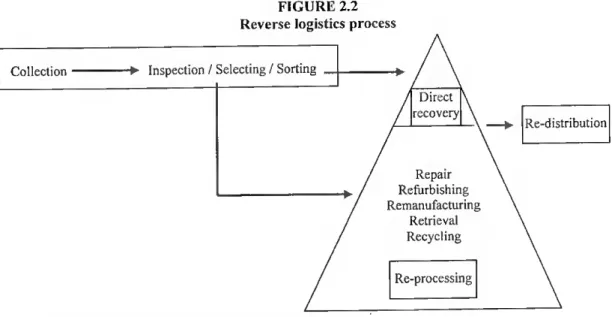
Discussions around the recycling theme have also been conducted in lhe reverse logislics field. In this analysis perspective, recycling is faced as an option of resources recovering that, otherwise, could be rcused, remanufactured or simply disposed of. Although other definitions could be presented, reverse logislics can be perceived as "the process by which organizations recovcr by-products and residuais for reuse, resale, remanufacturing, recycling or disposal" (Johnson, 1998: 217). The consumers being the initiators of any reverse logislics chain for recycling packaging residues, lhe discovery
Chapter I General introduction
of some insights about the prcdictive influence of logistics consumer service's performance, in its diverse components, in consumers' adherence or participation in the reverse logistics system for recycling, in this rescarch area, was expected. However, despile the importance of this aspect bcing recognized in a few studies, it had not been especially addressed in any of them. The absence of research on this subject in the reverse logistics literature, in which coverage was expected, is indicated in the figure by the broken line connecting the boxes "reverse logistics literature" and "consumer behavior in the Portuguese recycling program".
Besides revealing this research gap, lhe review of literature in the reverse logistics area was useful to the understanding of the heterogeneity of activities and concepts that are involvcd in this rather young sub-discipline of logistics. In particular, it enabled the provision of a framework for the Portuguese reverse logistics system for recycling, by integrating, for instance, its principal motivating factors and intervenients. The relevance of the literature survey, in what regards this aspect, is signed in the figure by lhe arrow which relates the box "reverse logistics literature" wilh lhe box "logistics framework".
The literature review on the determinanls of consumers' behavior in recycling programs evidences that no predictive variable seems to act alone and that the relationships among several variablcs should be considercd. This fact suggests the intercst of asscssing the connection between recycling behavior and the various potentially determinant variables by applying multivariate stalislical methods. A clear advantage of depcndcnce multivariate techniques, like logistic regression, discriminant analysis or structural equation modeling, for instance, in comparison to more simple univariate or bivariate analyses, is that they allow lhe identification of lhe most and lhe leasl
Chapter / General introduction
important variablcs which are influcncing this pro-environmental bchavior. This kind of information, in turn, is the foundation for planning a future social marketing program that aims to increase the recycling rates. The indication that the formative market research on the determinants of recycling behavior in lhe Porluguese case will rely on the applicalion of multivariate slatistieal methods is indicated in the figure by the smaller broken line rectangle. As also suggested in the figure, based on these quantitative analyses' results, some contributions will be made to the planning stage of a social marketing campaign, in what regards logistics and communication aspeets.
1.3 Motivations, contributions and research questíons
Diverse factors have motivated the choice of this thesis theme. Firstly, despite the fact that the last three decades have witnessed a growing research effort on the general problematic of recycling and, more particularly, on lhe detenninants of this sustainable behavior, it represenls a very recent subject in lhe Porluguese case. As suggested carlier. Portugal, as other European countries, faces ambitious quantitative targets of packaging residues valorization and recycling that should be accomplishcd until the end of 2005. Naturally, meeting these objectives requires an investment in lhe logistics of the selective-collection system but also in the communication field, which should be oriented by the previous knowledge on the determinants of consumers' behavior in the recycling program as well as on the main relationships among these predictors. To provide insights that could conlribule lo surpassing this important challenge, imposed by lhe European and internai legislations, was certainly a major driver of this thesis.
Secondly, this thesis was much motivated by the (egoistic) opportunity it offered to its author to learn and apply five multivariate slatistieal methods, whose analytical power
Chapter I General introduction
previous (allruistic) motivator behind this study, it can nol be ignored thal the existence of this strong statistical component, in an applied perspective, was decisive in choosing this thesis themc.
Besides these motivator factors, of general nalure, this thesis was quite oriented by the attempt of overcoming punctual research gaps that were detected when reviewing the three fields in which the recycling subject has been focused on: consumer behavior in recycling programs, reverse logistics and social marketing. These breaches in the previous studies can be summarized as follows:
(1) Despite the amount of research on consumer behavior in recycling programs, in most of these studies, the quantitative analyses are based on univariate or bivariate slalistics. On the other hand, the studies that had proposed dependence models do not mention lhe results of the misspecification tests that, evenlually, have been performed. This fact leaves readers with some doubts about the validity of the presented results;
(2) Even the studies using more advanced statistical methodologies like structural equation modeling are, in some sense, restricted in lhe analyses they offer because eithcr they combine few variables in the models or because they only test a specific behavior theory, in which, once again, a limited number of variables are articulated;
(3) Although the role of consumer-service performance in achieving consumers' involvement in lhe reverse logistics system for recycling has been referred before in the reverse logistics research, this topic was not specifically explored yet. with or without the application of quantitative methods;
(4) No rcviewed studies in the social marketing area use quantitative methods. Moreovcr, lhe discussion around the applicability of relationship marketing, which
Chapler I General introduction
privileges the development of close and long term relationships wilh consumers (Berry, 1983), was not conducted before in the context of social marketing and, in particular, as a renovated view of facing the necd of incrcasing consumers' involvement in recycling programs;
In brief, the mains contributions of this thesis rely on the application of multivariate statistical methods in contexts where they are very uncommon, like in the reverse logistics or social marketing research, but also in the improvemenl of the applied quantitative techniques in the area of consumer behavior in recycling programs. In addition, this thesis provides a first deeper analysis on the motivations towards recycling in the Portuguese case and initiates the discussion on innovator aspects in reverse logistics and social marketing areas.
With the purpose of guiding the attendance of the referred objectives, a series of research questions are formulated. These are:
(1) What are lhe main direct detenninants of Portuguese consumers' involvement in the national selective-collection program?
(2) Is it possible to identify the indirect significant dcterminants of recycling behavior? (3) Given an affirmalive answer to the previous qucstion, how would these variables
interact with the direct detenninants in order to improvc the undcrstanding of this phenomenon?
(4) What is the relative importance of consumer-service components as dcterminants of consumers' adherence to lhe reverse logistics system for recycling?
(5) What are lhe main trade-offs that arise when intervening in the logistics detenninants of consumers' behavior in this reverse logistics system?
Chapter I General introduction
(6) Besides the consumers' adherence to the reverse logistics system for recycling, what other factors can affect the success of the Integrated Recovery System in lhe médium / long term?
(7) Is it possible to plan a social marketing slrategy that would be compatible with the principies of relationship marketing, which is considcred nowadays as the new marketing paradigm in the commercial sector?
(8) If yes, what would the objectives, the communication means and the targets of this new marketing strategy be?
(9) And how would this marketing strategy interfere in the main determinants of recycling participation, previously identified, in order to foster this socially desirable behavior?
1.4 Thesis outlíne
This thesis is composed of two volumes. Volume I encompasses the body of the thesis, whereas Volume II contains the appendixes and the annexes.
In Volume I, the current Chapter prolongs itself by providing an overview of the recycling problematic in the Portuguese case. In particular, the legal framework for managing packaging residues in Portugal is pointcd out, the structure, mission and objectives of Sociedade Ponto Verde are described and the functioning of the Integrated Recovery System of Packaging Waste Management is examined. This overview also portrays the recent evolution of recycling in the Portuguese case. It ends with the description of the national survey on altitudes and motivations towards recycling that had represented the starting point of this thesis.
Chapter I General iníroduction
The remainder of this Volume is organized as follows.
Chapter 2 reviews the relevant literature streams within the broad areas of social marketing, reverse logistics and consumer behavior in recycling programs. For each of these branches of research, the current point of the debate is made and some directions for further research are pinpointed.
Chapter 3 is dedicated to the five multivariate statistical methods which support the thesis: principal components analysis, logistic regression, structural equation modeling, discriminant analysis and homogeneity analysis (HOMALS). This chapter introduces each of these techniques, presents their main characteristics and describes how each of them was applied, step-by-step, in the following chapters. Also in this chapter, lhe procedures carried out for dealing with lhe missing values are justified.
Chapters 4 through 7 encompass the innovative aspects of the thesis and were struclured as papers .
Chapter 4, titled as "Behavioral determinants of household recycling participation: the Porluguese case", providcs a first formative research on the predictors of recycling behavior in Portugal, by estimating, testing and interpreting a logistic regression model that uses dimensions derived from lhe applicalion of principal components analysis and also a set of dummy variables, as independent variables.
I he contents of these chapters are, with some adaptations, the contents of four papers that were presented in national and international conferences, and that were submitted for publication in international journals. These adaptations were needed in order to avoid the repetitions along lhe thesis and
Chapter I General introduction
Chapter 5, named "Combining behavioral theories to predict recycling involvement", deeply explores the market research initiated in Chapter 1, by proposing a comprehensive structural equation model of recycling participation. This model establishes and estimates the direct and indirect relationships among a large number of potcntial determinants of this sustainable behavior, in comparison to those considered in previous models using also this statistical method. Bascd on their results, both these chapters also offer some contributions to the planning stage of a future social marketing campaign.
Chapter 6, referred to as "The importance of consumer-service in the reverse logistics system for recycling", is dedicated to surpassing one of the gaps pointed out in the literature review on reverse logistics, since it focuses on the role of consumer-service performance in achieving consumers' involvement in the reverse logistics system for recycling household packaging residues. In this chapter, the interest in attending the consumer-service requirements is demonstrated, once again, through the application of multivariate data analysis methods, in this case, principal components analysis and discriminant analysis. In this chapter, the several consumer service dimensions are ordered, taking into account their importance in detennining recycling behavior, and the several trade-offs that must be managed in improving these dimensions are analyzed. Effectively, planning a social marketing campaign has to go further than communication and create or improve, as well, the physical conditions for facilitating the adoption of the desired behaviors. Chapter 6, therefore, focusing on lhe logistics aspccts of reverse logistics for recycling, contributes to this specific facet of the social marketing planning. This chapter also discusses the challenges facing the future development of this reverse
Chapter I General introducíion
logistics system, providing therefore, some insighls to lhe still scant literature on this topic.
Chapter 7, "The Applicability of Relalionship Marketing in Social Contexts: The Case of Fostering Recycling Behavior", is motivated by the challenge of analyzing the potential of relalionship marketing in the specific context of encouraging recycling practices, a research gap detected in the review of the social marketing literature. Based on the application of a few dcscriptive statistics and also on the application HOMALS, this chapter suggests the lack of success of the current mass marketing strategy that has been followed in Portugal, and proposes guidelines for planning a new social marketing campaign, which could be compatible with lhe main ideas underlying relalionship marketing. Within this framework, this chapter offers some orienlations in what regards the deflnition of the overall goal of a renovated social marketing campaign, its specific objectives, communication means and specification of a targeting option.
Figure 1.2 integrates Chapters 2 to 7 in lhe general scope of this thesis. As suggested by lhe description of the contents of chapters 4 to 7, they ali have a componenl of "quantitative formative research", which is, however, stronger in Chapters 4 and 5. Likcwise, these four chapters have a component of "planning", that is, nonetheless, reinforced in Chapter 6, concerning revcrse logistics aspccts, and in Chapter 7, in what regards the communication domain.
Chapter I General introduction
FIGURE 1.2
Conceptual model of the thesis and the major focus of Chapters 2 to 7 Social marketing líterature
Quantítatíve formative research
Consnmer behavior líterature Reverse logistics líterature Multivariate Statistical methods . i- ► Consumer Behavior in the Portuguese recycling program Planning Implicatíons ín communicatíon Implicatíons ín logistics Logistics framework
Chapter 2 Chapter 3 Chapter 4 Chapter 5 Chapter 6 Chapter 7
Chapter 8 provides the main conclusions of this thesis as well as some suggestions for future investigation.
As referred, ali appendixes and annexes are presented in Volume II. Appendix A includes some líterature review tables. Appendixes B to F correspond to the five multivariate data analysis methods and contain the results of the statistical tests and analyses, which were made in agreement with these methodologies, but were not shown in the Chapters 4 to 7. Appendixes G to I present the results of the missing values analysis carried out in each of these chapters and Appendix J contains results of some statistical tests that were carried out to mislead the initial non-response bias. Lastly,
Chapter I General introduction
Annex A includes the questionnaire that supporled the nalional survey on altitudes and motivations towards recycling and Annex B holds some information concerning lhe structure of the sample.
1.5 Recycling ín the Portuguese case 1.5.1 Legal framework
The guiding principie of the European Directive 94/62/CE is to harmonize the State- Members' legal frameworks in what regards packaging and packaging residues. The objective of this legislation is twofold. On one hand, it intends to preveni and attenuate the environmental impacts of packaging and packaging residues among ali State- Members, ensuring, as consequence, a high levei of environmental protection. On the other hand, the Directive aims at avoiding barriers and restrictions to the internai trade and competilion among the State-Members.
For attaining this double purpose, the Directive encompasses guidelines that aspire, as a first priority, to preventing lhe production of packaging residues. Complementarily, this diploma expresses as fundamental principies, lhe packaging reuse, its recycling and other forms of valorization, in order to reduce the final elimination of this type of residues. Within this framework, a temporal horizon was proposed for each State- Member in which some quantitative targets of packaging valorization and recycling should be accomplishcd. In the Portuguese case, particularly, il was established that, by lhe end of 2005, 50% of the overall packaging weight must be recovered and 25% of this must be recycled, with a minimum goal of 15% per material (papcr / cardboard. glass, plastic, steel and aluminium and wood).
Chapter I General introduction
As imposed by this European Directive, the economic operators must assume the responsibility for managing the packaging and the packaging residues oi the produets they trade, on the basis of the polluter-pays principie. It was also cstablished lhal consumers have a key role on this managing process and, as consequence, that they should be properly informed and motivated in order to change their altitudes and behavior.
This European legislation created the foundations for the legal framework that would later be defmed by each State-Member in what regards the managing and final destination of their packaging and packaging residues. In Portugal, this legal framework comprised of the Decree n0 366-A/97 and the Ordinance n0 29-B/98, which contains ali
basic principies and rules of a Packaging Waste Management System for ali types of packaging (reusable and non-reusable) traded in the Porluguese market-place, whether they have been used or produced, at a domestic, industrial, agricultural or commercial levei, and regardless of their material. Decree n0 366-A/97 of December 20, with the
changes introduced by Decree n0 166/2000 of July 20, defines the same packaging
valorization and recycling goals that were previous determined by the European Directive.
The Communitarian legislation does not force State-Members to follow a specified management model of packaging residues. Within this context. Decree n0 366-A/97 and
Ordinance n0 29-B/98 allow economic operators to transfer their recovcry obligations to
a nationwide syslem-operaling organization, which, however, in order to carry out its activity, has to be approved by lhe Ministries of Environment and Economy. In Portugal, until the present, this entity has been the Sociedade Ponto Verde, S.A.
Chapter I General introduclion
1.5.2 Sociedade Ponto Verde and the íntegrated Recovery System
Sociedade Ponto Verde (SPV) was founded by private sector initiative on November 16, 1996, but it was only officially approved to manage packaging residues in Portugal one year later. SPV is a non-profit private company, whose shareholders' structure represents ali types of activities involved in the logistics packaging chain for ali sorts of packaging materiais. In concrete, SPVs shareholders are 148 private companies, grouped into three holdings: EMBOPAR. DÍSPAR and INTERFILEIRAS. EMBOPAR holds 54.2% of SPVs share capital and represents the filling / packaging companies. DÍSPAR owns 20% of SPVs share capital and is formed by companies and associations of the distribution sector. Finally, INTERFILEIRAS have 20% of SPVs social capital and represents packaging material manufacturers and recyclers. The remaining share capital is detained by minor shareholders associated wilh SPVs activities2.
The SPVs mission is to promote the selective collection, the recovery and the recycling of packaging residues in Portugal. Its fundamental objective is to allow the accomplishment of the national packaging valorization and recycling targets, established by the European Directive 94/62/CE. SPV has six main functions;
0) To provide Municipalities with technical and financial support, by means of selective-collection and trial programs;
(2) To ensure lhe lake back, lhe recovering and the recycling of the trialed residues, through the contracls il holds with lhe packaging materiais' producers;
(3) To manage lhe final destination of the residues that proceed from non-reusable packaging tradcd in lhe national marketplace;
Chapter I General introduction
(4) To ensure distributors that ali non-reusable packaging is embraced by the Integrated Recovery System of Packaging Waste Management (SIGRE);
(5) To promote consumers' awareness and environmental education. In this case, the objective is to achieve the highest possible participation rate and to guarantee lhe quality of the sorted and collected material;
(6) To support research programs that aim at developing the markets of recycled products and materiais.
In order to fulfill its legal and environmental obligations, SPV has organized and dynamized the SIGRE, a complex system that ensures the take back, the valorization and the recycling of the non-reusable packaging residues. SIGRE, vulgarly known in Portugal as "Sistema Ponto Verde", embraces ali sorts of packaging and packaging residues (non-hazardous) placed in Portugal, independently from their material. This packaging can be urban (domestic), compared to urban (the most significant are from restaurants, hotéis and coffee-shops) or non-urban (industrial, agricultural and of distribution). SPV only got lhe license to manage compared to urban packaging materiais on September, 1999 and non-urban packaging residues on Octobcr, 2000.
Like some other European Integrated Systems, the Grecn-Dol System relies on the articulation of responsibilities and processes among a sct of partners, based on the principie of shared environmental responsibility'. These partners are: (1) the fillers / packers and importers; (2) lhe distribution sector; (3) the municipalities; (4) the consumers; (5) and the recycling companies.
: These shareholders are 14 City Halls (each one wilh 0.2% of share capital), the INESC - Institute of
Systems Engineering and Computcrs (2% of share capital) and the LOGOPLASTE -Technical consulters, SA (1 % of share capital).
Overall, there are already 20 countries that share the Green-Point SysteirPs philosophy: Germany, Áustria, Belgium, Canada, Slovenia, Spain, Trance, Greece, Hungry, Ireland, Leetonia, Lithuania, Tuxemburg, Norway, Poland, Portugal. United Kingdom, Czech Republic, Sweden and Turkey.
Chapter I General introduction
On lhe hasis of lhe polluter-pays principie, flllers/packers and imporíers fmance lhe system, paying a license fee that is calculated according to lhe amount and weight of lhe respective packaging material4. In return, they gel lhe permission to mark lheir
packaging with lhe "Green-Dot" symboP which, together with a certificate passed by SPV, ensures that lhe companies belong to lhe SIGRE and that they have transferred their recovery responsibilities to an officially recognized system-operating organization. The distribution sector, in tum, has a fundamental role in indirectly auditing this system because, in agreement with the legal regulations, only non-reusable packaging marked with the "Green-Dot" symbol can be sold in their commercial platforms.
Consumers' responsibility is to separate the used packaging by type of material and dispose of them in the suitable containers, provided by the municipalities. These entities, then, take over the multi-material collection and trial of this sort of residues, using mainly specific containers for a bring-system (also referred to as "drop-off collectors" or, more vulgarly, the "Eco-points"6). The term municipality should be
perceived in a broad sense, by corresponding lo the municipal systems (which are companies that integrate one or more municipalities) that have compromised themselves, by contract with SPV, to carry out the selective-colleclion and trial. The additional costs incurred by the municipal systems with the selective-collection and trial, in rclation to the undifferentiated-collcction costs, are supported by SPV, through
1 By calculating the license fee according to the weight of the packaging material, SPV is encouraging the
prevention of packaging waste. This fee is usually known as the "Green-Dot value".
5 The "Green-Dot" symbol is an internationally registered brand in more that 170 countries and its user
rights are managed by the Packaging Recovery Organization Europe Company (Pro-Europe).
6 An "Eco-point" is a set of three containers for the selective disposal of packaging residues. Each
container receives a type of material: the yellow container collects plastic and metal; the blue container receives paper and cardboard and the grecn container collects glass. Some municipalities also provide door-to-door collection. also referred to as "curbside" collection. In alternative to these collection- systems, consumers can also deliver recyclable packaging material to the "Eco-centers", which are large parks with big containers which receive the same packaging residues as the "Eco-points" but also other sort of residues, separated by lypes of material, like wood, white-goods, furniture. tires. etc.
Chapter I General inlroduction
the "counterpart value"7. SPV also finances and gives tcchnical assistance to campaigns
organized by the municipal systems to foster citizens' participation in their recycling programs. To close the loop, SPV accredits companies {recycling companies) to buy the seleclive-collected residues and that ensures their recycling. To get this certification, lhese companies have to make an agreement with SPV, on the basis of which they assume to accept the total amount of separated packaging residues forwarded by the municipalities.
Table 1.1 provides a summary of the recycling process, for each sort of material that can be recycled in Portugal. The spccific benefits of each type of recycling process, as well as some examples of goods that are produced using each type of recycled material, are outlined in Table 1.2.
TABLE 1.1
Types of recyclable materiais and notes on their recycling process
Notes about the recycling
process
Paper/ Glass Plastic Metal Wood
ca rd boa rd (steel and
aluminium)
1 - Paper residues 1 - Glass residues 1 - Plastic residues 1 — Metal residues 1 - Wood residues are selectively are selectively are selectively are selectively are selectively
collected and collected but are collected and sorted collected and collected and sorted in trial not sorted in trial in trial centers sorted in trial sorted in trial
centers centers 2 - Once separated. centers by centers 2 - Recycling is 2-Once these residues are elcctromagnctism 2 - Recycling is
madc with or collected, glass is transported to lhe into two made with or without the transported to recycling units, in calegorics: steel without the addition of raw units of recycling. agreement with the and aluminium addition of raw
materiais to whcre il is type of plastic 2 - Once separated materiais and the produce paper fragmented. 3 - Plastic residues and pressed, metal resulting material paste. sorted and are lhen cleancd residues are is the basis of the clcancd and fragmented. transported to lhe agglomerates 3 - fhe recycling being transformed corresponding industry
process involves into granulalcd units ofrccycling melting and secondary material 3 - In lhe moiding lhe 4-This material is recycling units, fragmented glass integrated in the
production process of new plastic
materiais
metal residues are meltcd with raw
materiais and transformed into high quality metal
bullions Source: Adapted from various descriptions provided by SPV (2003).
7 Fhe counterpart value is calculated according to the type and weight of materiais selectively collected and trialed by the municipalities and dclivcred to the recycling companies accreditcd by SPV.
Chapíer I General introduction
TABLE 1.2
Types of recyclable materiais, benefits of recycling and the better known goods produccd with the recycled material
Paper/ ca rd boa rd
Glass Plastic Metal Wood
Specific benefits
fof recycling Avoids cutting trees Producing new glass from recycled material requires less energy consumption than producing first generation glass Allows saving
raw-materials Allows saving raw-materials; requires much less energy consumption Avoids cutting trees Technical
limitations fibres can not be The recovered recycled more lhan 4 to 6 times No technical limitations: the rccovcrcd glass can be recycled in an unlimited cycle without loss
ofquality No technical limitations if compaliblc granulated secondary materiais are used
No technical limitations for sleel and aluminium No technical limitations Common goods made of recycled material Newspapers, paper bags, cardboard, new paper packaging
New bottles and olher glass packaging
Pallets for transporting goods, materiais
for the building sector, packaging (for beverage, food and clcaning produets), fibres (for fulfilling wadded produets), elothes, toys.
Almosl ali metal goods currcnlly
used
Building material, Fumiture
Source: Adaptec! from various descriptions provided by SPV (2003).
1.5.3 The recent evolution of Household packaging recycling in Portugal The implementation of the national legal framework about packaging and packaging residues, as well as the foundation of SPV, has allowed a clear perceplion and characterization of the Portuguese situation in what regards the valorizalion and the recycling of this sort of residues. Until then, the recycling sector in Portugal was not totally regulated and the practical experiences were not often relevant8. Moreover, when
K Although some praclices of selective-collection could be reported before 1994, no quantitative
infonnation was available that could enable an analysis of their effectiveness. With the purpose of overcoming this gap, QUERCUS (National Association of Environmental Conservation) conducted a study titled "Recycling is development" in 1994 that allowed the description of the situation of some municipalities towards the selective-collection (QUERCUS, 1994). In particular, for each analyzed municipality, the type of collection that was being implemented, lhe number of available containers for selective-collection (mainly for collecting glass residues) and lhe frequency of collection were assessed. Resides the punctual recycling experiences reported in this study, il is important to make a reference to
Chapter I General introduclion
compared with the recycling leveis in olher European counlries, the national rates had little expression. As referred in the Strategic Plan of Urban Solid Residues (PERSU), only 2.7% of glass residues and 1% of paper residues, were recycled in 1995 (Ministerial of Environment, 1999)9.
Since the beginning of its activity, SPV has made a crucial contribution to institute an effective integrated solid waste management policy in Portugal by technically supporting and financially the municipalities that are willing to implement multi- material collection and trial. The efforts of SPV in these matters are visible by observing Table 1.3, which shows the evolulion in the application of SPVs resources by its major activities.
TABLE 1.3
Evolution of the application of SPV^s financial resources by its main activities (Unit: Euros) 1998 1999 2000 2001 2002 Total Counterpart value 74 361 1 614 095 9 258 467 18 265 655 18 833 826 48 046 407 Research and developmcnt 0 46 054 193 657 276 793 504 811 1 121 315 Communication campaigns 191 114 1 324 681 3 344 260 3 399 179 2 831 222 11 090 456
Total annual costs 265 475 2 984 830 12 896 384 21 941 626 22 169 862 60 258 178 Source: SPV (2003).
As counterpart of these financial applications, the amount of packaging residues, recovered and forwarded for recycling by SPV, has reporled a significant increase. The global results of this evolution are depicted in Figure 1.3. Figure 1.4 illustrates these results by type of collected material.
'' According to SPV. these values are lightly underestimated because the PERSU had overestimated the amount of packaging traded in the Portuguese market-place.
Chapter I General introduction
FIGURE 1.3
Evolution of the total amount of packaging residues (tons) recovered and forwarded for recycling by SPV from 1998 to May, 2003
200000 180000 160000 140000 120000 100000 80000 60000 40000 20000 0 2147'i 4'M 1998 1999 103 003 2000 173 771 2001 193 501.8 2002 81 928,6 Until May 2003 Source: SPV (2003) FIGURE 1.4
Evolution of the total amount of packaging residues (tons), by type of material, recovered and forwarded for recycling by SPV from 1998 to May, 2003
80000 70000 60000 50000 40000 30000 20000 10000 0
Glass Paner Plastic Steel Aluminium Wood 1 □ 1998 □ 1999 CU 2000 □ 2001 B 2002 □ Until May 2003 | Source: SPV (2003)
As Figure 1.3 shows, around 193 thousand tons of packaging residues were recovered and delivered for recycling by SPV in 2002, which represents an overall growth of
11.4% in relation to the previous year. It is worth to say that in 2002, 63.2% of the total amount of recovered packaging materiais has come from the municipalities, that is, are household packaging residues. These percentages were of 64.1% in 2001 and 87.2% in
Chapter I General introduction
2000. In the previous years, only household packaging residues were recovered and forward for recycling by SPV. Also in comparison to 2001, plastic highlights as the type of material that has reported the superior growth rate (39.8%). Glass and paper / cardboard packaging materiais, on the other hand, has accounted for a similar growth rate of 10%. Aluminium was lhe only sort of material whose amount recovered has decreased10.
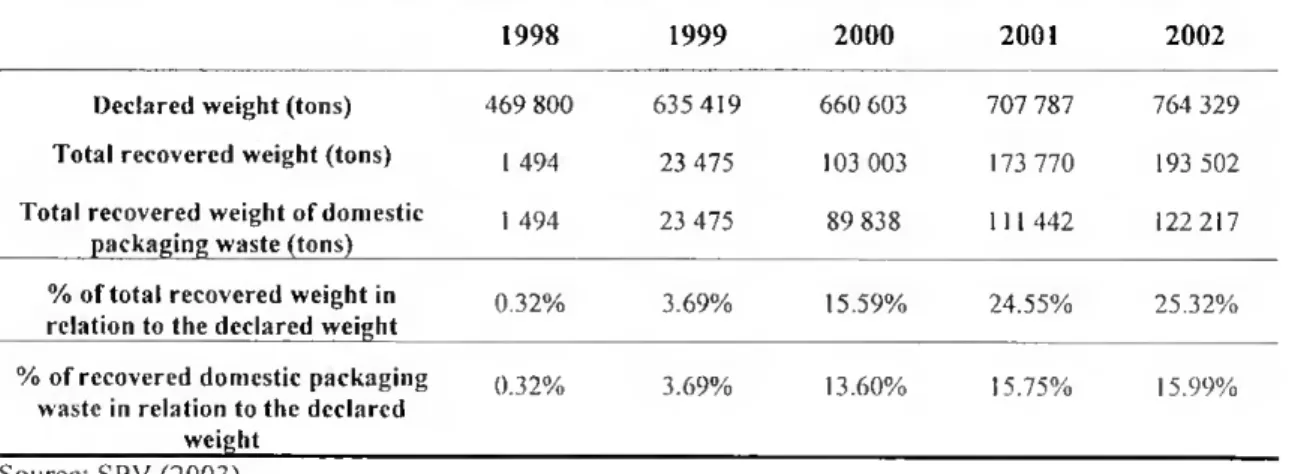
Table 1.4 portrays the progress in lhe amount of packaging residues lhal were declared and recovered by SPV, since the beginning of its activity. The table shows the total recovered weight and the recovered weight of urban (domestic) residues. While the overall packaging weight that has been recovered has reported a growing trend, it is still quite distant of the target recovered rate of 50% that Portugal should accomplish by the end of 2005. Moreover, at the end of 2002, the SIGRE has only allowed the recycling of 14% of the total packaging weight placed in the national market (SPV, 2003). This value is also far distant of lhe desired recycling rate of 25% that was established for Portugal, for the end of 2005, by the European Directive.
TABLE 1.4
Evolution in the amount of packaging residues (total and urban) declared and recovered by SPV
1998 1999 2000 2001 2002
Declared weight (tons) 469 800 635 419 660 603 707 787 764 329 Total recovered weight (tons) 1 494 23 475 103 003 173 770 193 502 Total recovered weight of domestic
packaging waste (tons) 1 494 23 475 89 838 111 442 122 217 % of total recovered weight in
relation to the declared weight 0.32% 3.69% 15.59% 24.55% 25.32% % of recovered domestic packaging
waste in relation to the declared weight
0.32% 3.69% 13.60% 15.75% 15.99%
Source: SPV (2003).
10 According to SPV (2003), technical problems, which have restricted the labor scheduling of some trial
('hapter I General introduction
The Green-Dot System, managed by SPV, finished the year of 2002 by covering around 72% of the national territory, serving 92% of the population and embracing 82% of the municipalities. As recently noticed, Portugal had more "Eco-points" (15 429) in 2002 than ATlVTs (SPV, 2003). On the other hand, since the beginning of its function, SPV has already invested more than 11 million Euros in communication campaigns, as reported in Table 1.3. The analysis of these numbers evidences the effort of SPV in attaining the compromises it has assumed.
However, the challenge of successfully facing the standards of packaging recycling imposed by the European Union is rather high, especially because only a few years have passed since the multi-material collection for recycling began to be seriously faced in Portugal. Besides, it is important to emphasize that the European Union is currently working on the definition of new and more ambitious goals of packaging valorization and recycling that should be attained by the State-Members by the end of 2009 and 2012. To overcome these challenges, a significant proportion of Portuguese citizens have to reorient their behavior towards the recycling problematic, which means that investments in logistics infrastructures for collection and well as in the communication domain have, necessarily, lo persist.
1.5.4 Promoting household packaging recycling in Portugal
SPV has been strongly involved in the communication field, both by conducting promotional campaigns of its own initiative and by co-financing lhe awareness campaigns promoted by the municipalities to motivate citizens to lhe adoption of corrcct procedures of separation and disposal of packaging residues.
Chapter I General introduction
SPV has begun its intervention in the communication arca right at the beginning of ils activity by means of some advertising actions in the press. This advertising was centered on lhe SIGRE, by informing about its existence and shortly explaining its main characteristies and objectives. In 1998, no advertising campaign was implemented. but SPV started ils field actions by assisting, lechnically and íinancially, lhe eommunieation plans proposed by two municipalities.
Al the communication levei, lhe year of 1999 was marked by the use of television as the primary advertising mean. This campaign was intended to inform about lhe meaning of the "Green-Dot" symbol. In parallel, SPV invesled in some advertisements in the press and also in billboards, with the purpose of showing the SIGRE's potential in the environmental preservation. Also in this year, SPV supported three municipal communication plans, initiated field actions in public spaces and commercial platforms and started lhe distribution of flyers and brochures about lhe recycling issue. In July, lhe SPVs official site, which contained diverse information about the company as well as general information about recycling and selective-colleetion, was presented to the public.
The most prominent advertising campaigns were carried oul in 2000. These campaigns were focused on the need of changing consumers' behavior towards the recycling problcmatic. Based on two television spols, by showing the domestic separation of packaging residues as an easy and natural activity, that a litlle child or even a monkey could perform, SPV intended, as a first objective, to demystify the belief that recycling involves eomplex behaviors and, as a result, to convert household separation in a spontaneous and inslinctive routine. Al lhe end of these television spots, an animation of lhe selective-colleetion containers, lhe "Eco-points", illustrating the specific packaging
Chapter I General introduction
material that should be placcd in each one, was presented. In this way, SPV was aiming to achieve a second objective: to increase citizens' knowledge about how to participate in lhe national recycling program. This national campaign was also supported by the distribution of billboards, with similar messages and images, which were considered lhe main complement of the television spots. In 2000. SPV has enlarged its local / regional activity at the communication levei by supporting 11 communication plans developed by the municipalities.
The advertising campaigns conducted in 2000 were so importam to the SPV intervention in the communication field, that they have determined the latter campaigns. In effect, the purposes of the advertising campaigns carried out in 2001 was "to provide value to the citizens' response to the previous campaign" and "to show the practical results of citizens' new recycling behavior". Likewise, the national campaigns that were implemented during 2002 were simply the reposition of the advertisements carried out during 2000 and 2001.
1.5.5 The survey on consumers' motivations towards household packaging recycling
In order to increase the recovery of packaging residues for recycling, SPV has adjudicated to the Statistics and Data Analysis Research Group (GIESTA) of ISCTE Business School, Lisbon, in the beginning of 2000, the performance of a study on the altitudes and motivations of lhe Portuguese population in what regards the household packaging separation and seleclive disposal for recycling. The scope of this study was lo perform "a detailed evaluation of lhe perceived structural importance of the most important variables, which determine lhe participation in the selective-collection