A STUDY ON CULTURAL DIFFERENCES
BETWEEN CHINA AND PORTUGAL
Di Tang
Project submitted as partial requirement for the conferral of Master in International Management
Supervisor:
Prof. António Robalo, Departamento de Marketing, Operações e Gestão Geral
ISCTE Business School
Abstract
Since the launch of the Chinese opening-up and reforming policies, they have been accelerating the development of China in all the fields. In the education field, the notable changes is more and more Chinese students choose to go abroad to pursue their higher education during the last several decades. Although Portugal is not one of the favorite destination countries as a choice of Chinese students, in recent years more and more Chinese students are coming to go to Portugal to continue their study. As a result, misunderstandings and conflicts occur when the students with different cultural backgrounds encounter. In an attempt to identify and help solve these conflicts caused by cultural differences, this thesis focuses on discovering cultural differences between China and Portugal from the perspective of the Chinese students that are studying in Portugal. The findings show that, from Chinese students’ view, the cross-cultural management systems of the Portuguese universities and institutes are satisfactory in general, but flawed in some aspects, for which, some suggestions are proposed by the Chinese students. On a deeper level, the individual motivations of Chinese studying in Portugal are explored, aiming at providing detailed data for cross-cultural management in higher education of Portugal.
Key words: Cultural difference, Cross-culture management, Portugal, China, Motivation, JEL: M12, M14, M16
Resumo
Com a política de abertura e as reformas levadas a cabo pela China, este país experimentou um desenvolvimento acelerado em todos os campos. No campo educacional as mudanças levaram a que cada vez mais estudantes chineses prossigam no exterior a sua educação superior. Embora Portugal não seja um ponto quente no mercado educacional chinês, nos anos mais recentes, mais e mais estudantes chineses decidiram escolher Portugal como destino de estudos. Incompreensões e conflitos ocorrem quando alunos com diferentes culturas se encontram. Na tentativa de identificar e contribuir para a redução desses conflitos, esta tese tenta descobrir as diferenças culturais entre a China e Portugal a partir da perspectiva de estudantes chineses em Portugal. Os resultados mostram que a gestão praticada pelas universidades portuguesas é em geral satisfatória, embora existam pontos fracos identificados pelos estudantes chineses. A um nível mais profundo, as motivações individuais dos estudantes chineses para estudar em Portugal são exploradas com o objectivo de fornecer dados úteis para a gestão das instituições no ensino superior relativamente à atracção de estudantes estrangeiros.
Palavras-chave: Diferença cultural, Gestão Intercultural, Portugal, China, Motivação, JEL: M12, M14, M16
Table of contents
Executive summary...I
Sumário Executivo ... III Acknowledgement... V
1. Introduction ... 1
2. History of Chinese students studying abroad... 3
2.1 Historic review of Chinese students studying abroad ... 3
2.2 From elites to the masses – the transition of opportunity of studying abroad ... 7
2.3 General information on the Chinese students in Portugal... 10
3. Basic theories and literature review ... 15
3.1 The progressing definition of culture ... 15
3.2 Hofstede’s definition culture and the dimensions of culture... 17
3.3 cross-cultural management and intercultural management ... 18
3.4 Participations of cross-cultural management in higher education ... 20
3.5 Motivations of Chinese students studying abroad... 22
4. Methodology and Data analysis ... 25
4.1 Methodology ... 25
4.2 Target population... 27
4.3 Cultural comparisons based on Hofstede’s theory ... 28
4.4 Qualitative interviews ... 33
4.5 Feedback from qualitative Data ... 35
4.5.1 Low efficiency, flexible time orientation and lack of planning. ... 35
4.5.2 Prefer to express personal ideas and flatter hierarchical structures ... 37
4.5.3 Understanding and friendly attitude to foreigners... 39
4.5.4 Good social welfare and less stressful and less competitive life... 40
4.5.5 Tendency to avoid risk ... 41
4. 6 The situation of cross-cultural management in Portuguese universities and institutes ... 42
4.7 Feedback from Quantitative Data ... 45
4.7.1 Basic data of non-exchange students ... 47
4.7.2 Basic data from exchange students ... 49
4.7.3 Motivations analysis of non-exchange students... 51
5. Findings and Discussions ... 57
5.1 Findings of the interviews ... 57
5.2 Findings from questionnaires ... 61
6.1 Conclusions ... 63
6.2 Limitations ... 64
6.3 Contributions... 64
Reference... 67
Annex 1: Power distance index (PDI) values of Hofstede’s research... 69
Annex 2: Individualism index (IDV) values of Hofstede’s research ... 70
Annex 3: Masculinity index (MAS) values of Hofstede’s research... 71
Annex 5: Further research of Index score estimate for countries not in the IBM set ... 73 Annex 6: quantitative on line questionnaire translated from Chinese ... 74 Annex 7: overview of the questions in the interviews ... 81
Index of tables
Table 1. Numbers of Chinese students studying abroad from 2000 to 2010 (Statistics of
Chinese embassy in Portugal). ... 9
Table 2. Chinese students enrolled at Portuguese universities and institutes in 2010... 14
Table 3. Basic information of the interviewees... 33
Table 4. Overview of the responses from the non-exchange students ... 47
Table 5. Overview of the responses from exchange students... 50
Table 6. Feedback on information availability of Portuguese Universities for non-exchange Chinese students. ... 52
Table 7. Responses of questionnaire about motivations of Chinese non-exchange studying in Portugal ... 52
Table 8. Statistic responses of questionnaire of motivations of Chinese non-exchange students studying in Portugal ... 52
Table 9. Feedback of survey on the information availability of Portuguese Universities for Chinese exchange students... 54
Table 10. Responses of questionnaire about motivations of Chinese exchange students studying in Portugal ... 54
Table 11. Statistics of the motivations of exchange Chinese students studying in Portugal ... 55
Index of Figures
Figure 1. Total number of Chinese students in Portugal from 2008 to 2010 ... 11
Figure 2. Number of Chinese exchange students in Portugal from 2008 to 2010 ... 11
Figure 3. The proportion of exchange students from 2008 to 2010 ... 12
Figure 4. The number of Chinese Students and students of each type... 12
Figure 5. Stratified structure of culture ... 16
Figure 6. Three levels of uniqueness in human mental programming ... 16
Figure 7. Adjusted factors influences choices of students study abroad... 27
Figure 8. Power distance index of China and Portugal of Hofstede’s research ... 29
Figure 9. Individualism indices of China and Portugal by Hofstede’s theory ... 30
Figure 10. Masculinity index of China and Portugal of Hofstede’s research ... 31
Figure 11. Uncertainty avoidance indices of China and Portugal ... 32
Figure 12. Long term orientation index of China of Hofstede’s research... 32
Figure 13. Age distribution of the interviewed non-exchange students... 49
Figure 14. Age distribution of the surveyed exchange students... 51
Figure 15. Graphic presentation of the percentage of each factor... 53
Figure 16. Graphic presentation of the percentage of each factor of the motivations of exchange students... 55
Executive summary
During the last several decades, more and more Chinese students went abroad to pursue further education since the Chinese government launched the opening-up and reforming policies to escape from isolationism. Specially in the 1990’s, the movement started booming due to the trend of internationalization and globalization. Since then, studying in foreign countries is no longer an exclusive privilege for elites, but a personal choice of the masses. America, Britain, Germany, France and Australia are the countries that have gained most Chinese students, however more and more Chinese students choose Portugal for their further study, although Portugal is not a popular destination country for Chinese students.
As the Chinese students come to Portugal, the encounter of Chinese culture and Portuguese culture will inevitably cause misunderstandings and conflicts or even offenses. An evaluation of the cross-cultural management of Portuguese universities and colleges is thus important. Although Chinese students account for a very small percentage of the total number of all the foreign students in Portugal, they are a typical sample for the subject of cross-culture management since they have the most different cultural background. The goals of this thesis are: 1) to investigate the cultural differences between China and Portugal from the perspective of the Chinese students that are or have been studying in Portugal; 2) to assess the cross-cultural management system of Portuguese universities and institutes from the perspective of Chinese students; 3) and on the individual level, to explore the motivations of Chinese students coming to study in Portugal, thus aiming at providing specific and analytic data for Portuguese universities and institutes to improve their cross-cultural management.
In order to achieve the three goals, both qualitative interviews and quantitative questionnaires were used in this thesis. Thanks to the social network and Chinese student community, eleven Chinese students in Portugal were interviewed. They were requested to point out the cultural differences from their own experience as well as to answer questions about cross-culture management applied to their Portuguese universities and institutes. Meanwhile, an online survey titled motivations of Chinese students studying in Portugal has been carried out.
After collecting and analyzing the responses from interviewees, five cultural differences between Portugal and China were identified by the frequencies that have been mentioned by the interviewees. These five cultural differences are:
1) Low efficiency, flexible time orientation and lack of planning,
2) Preference to express personal ideas and flatter hierarchical structures, 3) Understanding and friendly attitude to foreigners,
4) Well-developed social welfare system and less stressful and less competitive life and 5) Tendency to avoid risk.
And finally these results were compared to Hofstede’s research.
The responses on situation of cross-culture management in Portuguese universities and institutes revealed some existing problems which are categorized in four aspects: deficient managerial function for international students; inadequate considerations made by supervisors for international students; lack of effective management methods of cross-culture and divergence on culture among students with different cultural background.
Results of the quantitative questionnaire show that, for Chinese non-exchange students, “academic concerns” were the dominant factor while they were deciding to come to Portugal, and “financial concerns” were the subdominant. Most of the Chinese exchange students chose to come to Portugal with the purpose of improving their language skills. This is not surprising at all, knowing that all the exchange majored in Portuguese language and literature.
This thesis provides a specific perspective on both cultural differences and cross-cultural management.
Sumário Executivo
Durante as últimas décadas, mais e mais estudantes chineses foram para o exterior em busca de educação, ainda mais desde que o governo chinês lançou a politica de abertura e de reformas. Na década de 1990, a tendência de internacionalização e globalização impulsionou esta mudança. Desde então, estudar no estrangeiro não é exclusivo das elites, mas é também possível para as massas. América do Norte, Grã-Bretanha, Alemanha, França e Austrália são os países que ganharam a maioria dos estudantes chineses. No entanto Portugal, não sendo um país de destino popular para os estudantes chineses a estudar no estrangeiro, atrai também um número crescente de estudantes chineses.
Com os estudantes chineses em Portugal, é natural o surgimento de conflitos, equívocos e até ofensas entre a cultura chinesa e a cultura portuguesa, o que torna importante uma avaliação da gestão das universidades portuguesas nesta área. Embora o número de estudantes chineses não seja muito elevado, eles constituem um bom objecto de estudo devido às grandes diferenças existentes entre as duas culturas.
Existem três objectivos desta tese: 1) investigar as diferenças culturais entre a China e Portugal a partir da perspectiva de estudantes chineses em Portugal. 2) avaliar a gestão das universidades e institutos portugueses com base nas opiniões dos estudantes chineses em Portugal. 3) a nível individual, explorar as motivações dos estudantes chineses para estudar em Portugal com o objectivo de fornecer dados específicos para as universidades e institutos portugueses no sentido de melhorar a sua gestão neste domínio.
A fim de alcançar os três objectivos, tanto entrevistas qualitativas como questionários foram usados nesta tese. Com base na rede social dos estudantes chineses em Portugal, onze foram seleccionados para fazer entrevistas. Foi-lhes pedido para apontar as diferenças culturais com base na sua própria experiência, bem como para responder a perguntas sobre as práticas de gestão aplicadas relativamente a eles, enquanto estudantes internacionais, nas suas universidades e institutos superiores. Enquanto isso, uma pesquisa on-line intitulada motivações dos estudantes chineses em Portugal foi também efectuada.
Depois de colectar e analisar as respostas dos entrevistados, cinco diferenças culturais entre Portugal e China foram identificadas, de acordo com suas frequências. As cinco diferenças culturais são:
1) baixa eficiência, orientação tempo flexível e falta de planeamento, 2) preferência por expressar ideias próprias e estruturas hierárquicas planas, 3) a atitude compreensiva para os estrangeiros,
4) sistema social desenvolvido e vida menos stressante e competitiva e 5 tendência para evitar o risco.
Os resultados foram ainda comparados com as pesquisas de Hofstede.
As respostas sobre a gestão das universidades e institutos relativamente aos estudantes estrangeiros revelou alguns problemas existentes que são classificados em quatro aspectos: a Deficiências na gestão intercultural ignorando os estudantes internacionais; falta de resposta e de consideração por parte de supervisores e outros responsáveis, a falta de métodos de gestão eficaz na área internacional e falta de convergência entre os estudantes com formação cultural diferente.
Os resultados do questionário mostram que para os estudantes chineses que não vieram em intercâmbio, "preocupações académicas" foram consideradas as mais importantes quando decidiram vir para Portugal, logo seguidas das "preocupações financeiras". Por sua vez, a maioria dos estudantes chineses de intercâmbio veio a Portugal para melhorar as suas competências linguísticas.
Esta tese procura oferecer um contributo para os esclarecimentos das diferenças culturais e também para a gestão intercultural por parte das universidades.
Acknowledgement
Firstly, I would like to appreciate my supervisor, Professor Antonio Robalo for his supports and helpful suggestions during the process of finishing this thesis. Secondly, I would give my respect to the Chinese students who agreed to be interviewed and did the online questionnaire. Meanwhile, I appreciate the Chinese Embassy and Chinese student union of Lisbon for providing the detailed data. Then I would like to thank the coordinator of MIM program, Antje Disterheft for helping me a lot in daily life.
Lastly, I would like to say loudly thank you, MIM, thank you, ISCTE, and thank you, Portugal.
1. Introduction
In the last several decades, cultural differences and how to operate successfully in a cross-cultural or intercultural environment have attracted many researchers. Although the physical distance has much been “reduced” due to globalization and internationalization, issues of cultural difference did not disappear but come up more frequently and severely as the increase of social activities between countries and regions. Nowadays, more and more students study in foreign countries, the encounter of different cultures has also become an issue for the management of universities. How to manage students with different cultural backgrounds challenges all educationists.
Numerous researches and studies have been conducted, and many achievements have been accomplished. Edward Hall provided the concept of intimate space which expresses the different messages between different cultures. He also explored the reasons why people with different cultural background cannot understand each other. Geert Hofstede (2005) proposed four-dimension method for evaluating culture difference: power distance, collectivism vs. individualism, femininity vs. masculinity, and uncertainty avoidance. Trompenaars and Turner (1995) explored culuture in seven dimensions: universalism vs. particularism, individualism vs. communitarianism, Specific vs. diffuse cultures, affective vs. neutral cultures, achievement vs. ascription, sequential (m) vs. synchronic (f) cultures, and internal vs. external control. William Hart concluded the three levels of cultural (a mono-cultural phase, a cross-cultural phase, and the advanced stage-intercultural phase) which focuses on the individual interactions of people with different cultural backgrounds.
Many of the researches on the business environment, cross-culture management have eventually drawn the attention of educationists as a result of more and more cooperation and communication between universities, colleges and institutes. Recent researches on cross-cultural management in educational field consist of two aspects: cross-cultural management in higher education, and how cross-cultural management theories are applied to investigate the situations of foreign students and researchers such as the adaption of foreign students with different cultures backgrounds (Crano &Crano, 1993), multicultural
applications of stress and coping (Slavin, Rainer, McCreary, & Gowda, 1991) and cooperation and synchronization in cross-cultural management on higher education (Dong G.Q., 2007).
Since the 1980s, Chinese government has funded a great number of Chinese students to study abroad, and also hundreds of thousands self-financed students have studied abroad. Certainly they all have gone to the countries all over the world with the Chinese culture in which they grew up, and therefore encounter of difference cultures became inevitable. Since Chinese culture is one of the cultures that differ most from the Portuguese culture, the Chinese students studying in Portugal can serve as a particular and typical sample of students from different cultures for the study of cross-cultural management in the educational field
2. History of Chinese students studying abroad
2.1 Historic review of Chinese students studying abroad
The history of Chinese students studying abroad dates back to the middle 19th century. On the morning of 4th January 1847, a young man named Hong Rong left China and started his journey of pursuing his study abroad. His studying abroad not only for the first time shook the China's “Closed-Door” foreign policy – a policy had been secluding the nation from outside world for many centuries, but also created the history of Chinese students studying abroad. Eight years after, when he graduated from Yale University in America, Hong Rong, “The pioneer of Chinese overseas student”, became the first overseas student of China.
After Hong Rong graduated from Yale, he was hoping that more Chinese students could have the opportunities to study in America like what he did. He petitioned the government to start a program of supporting Chinese students studying aborad. Thanks to his effort, in 1872, a group of 30 Chinese boys aged 9 to 12 passed the selecting exams, and began their journey of their study in America. This event was afterwards referred as “Overseas Children Program”
Although the short-lived “Overseas Children” program was soon disbanded by the corrupted Qing government (the Chinese government at that time), most of these children finally grew up into elites, and made great contributions to the Nation. For example, Shaoyi Tang — the first prime minister of Republic of China, Guoan Tang — the first president of Qinghua University, Tianyou Zhan — the chief engineer of first Chinese railways.
The second generation of Chinese students studying abroad emerged after China lost the Sino-Japanese War in 1894-1895. The Qing government attributed the Japan’s victory to the advanced technology that had been brought back to Japan by the Japanese scientists and technicians who had been studying in western countries. Following the example of Japan, The Qing government decided to cultivate a new generation that would be equipped with western technologies and would help the country to develop and flourish. In order to attract more young students to study abroad, the Qing government enacted an encouraging set of rules:
Rules of encouraging overseas graduate, which afterwards largely boosted and accelerated the overseas studying activities in the following years. According to a survey, about 10 thousands students a year in the following years went to study in Japan. The total number of Chinese students studied in Japan in the 1st decade of 20th century reached 50,000, Interestingly but also ironically, Zhongshan Sun et al, who initiated and led the Revolution of 1911 to overthrow the Qing Dynasty, were also sent to study in Japan by the Qing Government.
In 1907, the US started the Boxer Rebellion Indemnity Scholarship Program, a scholarship program funded by Boxer Rebellion indemnity money paid by the Qing Government to the United States that provided for Chinese students to study in the U.S. It has been called "the most important scheme for educating Chinese students in America and arguably the most consequential and successful in the entire foreign-study movement of twentieth century of China. Following the United States, England, Japan, and France also followed the US way one after another to help develop Chinese higher education with parts of “Boxer Rebellion indemnity” money. In 1911 Tsinghua University was founded in the purpose of selecting and pre-training Chinese students before they were enrolled to American universities. During the following 35 years (1909 to 1945), 1971 students had been funded by the Boxed Rebellion indemnity scholarship program, 80% of them studied science and technology, and specially, some of them made great contribution to the development of China in science and technology, for instance, Yiqi Mei (former president of Tsinghua University), KeZhen Zhu (meteorologist and geographer), Xuesen Qian (aerodynamicist), and Sicheng Liang (architect).
With the understanding that a large amount of well-educated people were required for the development of China, the second generation overseas students Yuanpei Cai and Jingwei Wang launched the "Work-Study in France Program". The program was recruiting students who were willing to pay the studying costs through working earnings. This program lasted 20 years and finally became well-known throughout China, only in the following 5 years after the program was launched; more than 1600 students went to France through this program. It is remarkable that not only many of them grew up into the first generation of leaders of the
Chinese Communist Party, for example, Enlai Zhou Xiaoping Deng, Yi Chen, and Rongzhen Nie; but also compared to previous programs, this program involved more fields, including politics, science and technology, culture, arts, etc. Beihong Xu was also one of the students that went to study arts in France through this program.
In 1917, Moscow Eastern Communism University was founded for the purpose of training outstanding young people from other Asian countries. Shaoqi Liu and Qiubai Qu, two young leaders of Chinese Communist Party were in the first enrollment. . Later, many other young leaders of Chinese Communist Party went to study at Moscow Eastern Communism University, for instance, Xiaoping Deng and De Zhu.
After a pause of activities of Chinese students studying abroad during the second Sino-Japan War and the World War II, the government announced <Regulations on Self-Supported Overseas studying activities> to encourage students studying abroad, in an attempt to improve the situation that the Country had fallen far behind developed countries in science and Technology. It shall be noted, appreciation of the announcement of these regulations should never be ignored, because it made Chinese students studying abroad much easier and simpler.
In 1949 the foundation of People’s Republic of China began a new era of the nation. However, after half a century’s war state, almost all of the industries were damaged and all of the national infrastructures were destroyed. A large amount of elites specialized in every field were required so as to recover and develop the productivity of the country. Driven by this demand, the first batch of students of PRC were sent to study in Poland, Hungary, the Czech Republic, Rumania and Bulgaria. And during the following 20 years, a great number of students were sent to study in the Union of Soviet Socialist Republics, England, America and other countries.
In 1979, the Chinese ministry of education created the subdivision of overseas students and the subdivision of overseas students training. In the same year, the government sent diplomats to Chinese embassies in other countries to manage and help government-funded overseas students. Two years later, the government launched the Rules of self-supported overseas
students in the spirit that “Self-supported studying abroad was one way to cultivate elites and it was also a part of overseas education. Since then on, self-supported students have been treated as same as government funded students in policy.
In 1988, in the purpose of establishing a special organization providing one-stop service for the going-abroad and returning-back scholars, the ministry of education of China initiated the Chinese Service Centre of Scholarly Exchange (CSCSE), In August 1992, the Chinese State Department issued The Notice on Chinese Overseas Students which emphasized on encouraging Chinese students to go abroad for further study. One year later, a new policy was released with the guideline of encouraging Chinese students to go abroad for study and to return after study.
In 1996, the National Funds for studying abroad was created as the Official nationwide organization to select and support government-funded students. In the next year, “Spring Sunshine” plan was initiated to provide special financial support for excellent overseas scholars to come back to China for short-term research work.
Later on, the Chinese government adjusted and issued a series of policies about studying abroad in an attempt to attract more overseas Chinese students to return to China. For instance, in 2008, the government started a planned to bring 2000 international excellent elites in 5 to 10 years. Meanwhile many policies in other related aspects were also modified to assist the plan, for example, simplifying the visa application process. Due to all these efforts, nowadays, nowadays, finely contrasted with the past, more and more students choose to come back to China after their study, and many of them having been making their contributions in their respective fields. Up to now, 77% of the universities’ presidents, 84% of the members of the Chinese National Academy of Science, 75% of the members of the Chinese National Academy of Engineering, and 62% PhD supervisors had either studying or researching abroad experience
According to the government statistics of 2008, 1,391,500 students has been studying abroad during the last 30 years, while self-supported students accounted for the majority in recent
years. The amount of overseas students in 2009 was 229,000 which increased by 27.5% compared to 2008, and the number of self-supported students was about 210,000 (increased by 30%). In 2010 the total number reached 284,700 and more than 91% of them were self-funded. According a survey conducted in 2008, the top 5 favorite countries of Chinese students for oversea studies were America, Australia, England, South Korea and Japan.
2.2 From elites to the masses – the transition of opportunity of studying abroad
Although Chinese students studying abroad started more than one and a half century ago, but overseas studying was labeled as a luxury activity in earlier times. It was just 30 years ago that the masses started going abroad, during which, however, a significant change has taken place, and this change is that studying abroad has become a personal choice of where to study from the prerogative (an exclusive right or privilege) of the elite group.
In 1978, after an end was finally put to the suffering and agonizing China’s “Cultural Revolution”, all fields, science, technology agriculture and culture for instance, were to be recovered and developed. On June 23, 1978, Xiaoping Deng proposed that Chinese government should encourage overseas studies and the amount of overseas students should increase rapidly so as to bring back advanced science, technologies, and ideas of developed countries. At that moment, few people understood the significance of his words and were aware of its subsequent effect on history of overseas studies of Chinese students. However this proposal was the beginning of Chinese government sending students abroad in large scale. And it began a new era.
In the following years, a large number of Chinese students went abroad for further study after a series of plans and agreements on educating students were made between China and many developed countries like America, Japan, Canada, England, German and France; and eventually, an upsurge of studying abroad was induced. During this period, all the students that would be sent to foreign countries were selected by the government from universities and academic institutes, and provided with government financial funds. Due to the feature that all these students that were topped from all candidates and funded by the government, that period has been referred as “Elites studying abroad” period. Another feather of that period is almost
all of the government-funded students were from scientific and engineering fields.
“Self-supported studying abroad” was still much of an impractical dream at that time albeit the Chinese government had reduced restrictions on studying abroad. Self-supported students had to file the application for overseas studying activities a long time in advance; moreover the standards for approval were too high for most of the students to reach. Consequently, “self-supported students” accounted for only a very small percentage from 1978 to 1985. Taking the example of 1978, in contrast with a total number of 860 government-funded students, no one was approved of self-supported studying abroad 30 applications were received.
In 1984, the Chinese government issued <Temporary Rules on self-supported overseas studies>, and one year after, “Qualification Assessment of Self-supported applicants” was abolished. The “door” was finally opened to the students, and since then, self-supported studying abroad started booming. Till the end of 1985, about 7000 self-supported students went to study abroad, and the percentage increased dramatically to 18%.
In the next a few years, as advanced science and technology, ideas and concepts were continuously being brought into China on the return of the students that went to study abroad in earlier years, The Chinese government then realized that it was necessary and urgent to take further action to reduce the restrictions and barriers on self-supported students studying abroad, and launched a series of policies to simplify the procedures for studying abroad.
In 1998, agencies for self-supported studying abroad were permitted to which led to another thriving period. The number of self-supported students was doubled in the next year. In 2003, the government enacted several policies which further simplified the procedure for studying abroad. According to the Ministry of Education’s statistics of 2007, 140,000 students went to study abroad, among which 15,810 were government-funded, while 129,000 were self-supported, which accounted for about 90%. It should also be noted that, 30 years after 1978 the total number of student studying abroad has increased 167.44 times, and this number is still increasing,see Table 1.
As shown in Table 1, the total number of students studying abroad was 39,000 in 2000, in ten years the number went up to 284,700. The self-supported students were 32,000 in 2002 accounted for 82% of the total number, while this number exceeded 260,000 in 2010, accounted for 91.5%.
Table 1. Numbers of Chinese students studying abroad from 2000 to 2010 (Statistics of Chinese embassy in Portugal). Year Total number of students studying abroad Number of Self supported students Number of government funded students 2000 39,000 32,000 7,000 2001 84,000 76,000 8,000 2002 125,000 117,000 8,000 2003 117,300 109,200 8,146 2004 114,700 104,000 10,382 2005 118,500 106,500 12,057 2006 134,000 121,000 13,122 2007 144,000 129,000 15,810 2008 179,800 161,600 12,957 2009 229,000 210,000 19,200 2010 284,700 >260,000 About 20,000
According to statistics, till now there have been 1,620,700 students studying abroad, in more than 100 hosting countries and regions, involving almost all fields. In 2006 China has became the country has the most students studying abroad.
Nowadays, more and more Chinese students are planning on going abroad for their studies. Also China has already become the most potential country for overseas education market. As the development of the Chinese overseas education, some new characteristics appeared which should be noticed. First, the average age of the students studying abroad is about 20, 10 years younger compared to the 1980’s; the population is partly migrating from college students to
high school and middle school juveniles. Second, Academic degrees are no longer the sole pursuit of the students, a variety of short-term study or research has become an important form of acquiring abroad experience. For example, exchange students, students that come to a country to learn the local language, and visiting professors and researchers. And last, the selection of destination countries has been tremendously increased from a few developed countries in the beginning to more than one hundred at present
2.3 General information on the Chinese students in Portugal
Although Portugal is not one of the main destination countries as a choice of Chinese students for studying abroad, the amount of Chinese students studying in Portugal has been increasing in recent years. There were 116 Chinese students enrolled at Portuguese universities and institutes, one year later, this number increased to 150, and in 2010, the amount of Chinese students registered to Portuguese universities and institutes reached to 231, twice the number of 2008. See Figure 1.
In Portugal, the Chinese students enrolled at Portuguese universities and institutions can be categorized by academic degrees into several types: undergraduates, master and doctor students, post-doctors, invited researchers and Chinese employees at Portuguese universities and institutes. The undergraduate students include students that are pursuing at Portuguese universities and institutions in order to obtain bachelor degrees, as well as students through exchange programs to study Portuguese language for one or two years in Portugal without getting bachelor degrees from Portuguese universities and institutions. In fact these exchange students are the main constitution of undergraduates group of Chinese students in Portugal. According to the statistics from the Chinese Embassy in Portugal, there has never been more than five students that were fully enrolled for the complete first cycle of high education (undergraduate program with a Bachelor degree) at the same time, more precisely, there might be one or two of them from time to time. Given this situation, Chinese students that are fully registered to the full first cycle are not accounted for in this study, and the term “undergraduate students” always means language exchange students hereafter in this thesis.
0 50 100 150 200 250 2008 2009 2010 Year
Figure 1. Total number of Chinese students in Portugal from 2008 to 2010
Although the amount of Chinese students studying in Portugal is very small compared to those favorite countries Chinese students like the US and the UK, it is nice to see the total number of Chinese students coming to Portugal is growing. For a better presentation, and especially to better reveal the truth that can reflect the reality, Chinese students in Portugal are divided into 2 categories: Exchange students and Non-Exchange students. Figure 2 shows the number of students of each category in the last three years.
Number of Exchange Students
0 50 100 150 200 250 2007 2008 2009 2010 2011 Exchange Students Non-exchange Students Total
Figure 3. The proportion of exchange students from 2008 to 2010
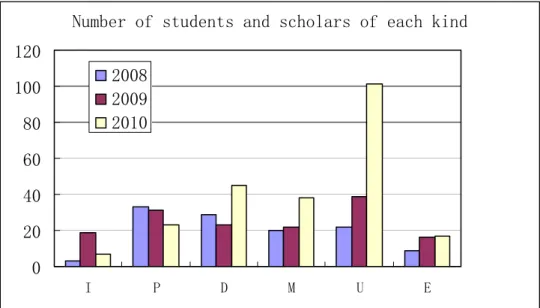
Besides the rapid increase of language exchange students boosted the amount of Chinese students in Portugal, the numbers of Chinese students of other types have also been increasing, as seen in Figure 4
Number of students and scholars of each kind
0 20 40 60 80 100 120 I P D M U E 2008 2009 2010
Figure 4. The number of Chinese Students and students of each type
Note: For easy presentation, acronyms of the student types are used in Figure 4, where: I — invited researchers;
P — post doctors; D — doctor students; M — master students;
E — employees at Portuguese universities and institutes.
It can be seen from figure 4, the numbers of master and doctor students are also increasing, and so is the employee group although it grows at a relatively slower rate, except the numbers of invited researchers and post-doctors which follow a random distribution along the years. Another observation is, together with exchange students, Post-doctors, Doctor and Master students constitute the majority of Chinese Students and Scholars in Portugal.
Financial sources (funding) shall also be mentioned as it is an inevitable factor that influences the final choice of destination country for study or work. Undoubtedly, the Chinese employees working at Portuguese universities and institutes are paid by their employers. Also, the universities and institutions will pay the invited researchers and post-doctors. Beside all the types mentioned above, Chinese doctors, masters and undergraduates in Portugal are either government-funded or self-supported. Students who are funded by Chinese government an amount of money which can cover basic costs of living in Portugal each month, while the self-supported students have to pay all the tuition fees and costs of living by themselves.
However, only a few the Chinese doctor students are funded by Chinese government, and the rest are paid for working on the either research or engineering projects their professors supervisor. Taking the example of 2010, 45 Chinese students were pursuing doctor degrees in Portugal, but only 5 of them were funded by Chinese government, while the rest had other funding sources, which means all the doctors did not need to pay by themselves.
Since the Chinese government only supports Chinese students that study for doctor degrees, Chinese students pursuing master degrees in Portugal are all self-supported. Excluding a few can obtain scholars from Portuguese universities and institutions, most of Chinese students studying master degrees have pay both tuition fees and costs of living by themselves (with family support). Since many years ago, Chinese government has been funding exchange students majoring in Portuguese language and literature in the purpose of encouraging them to learn Portuguese because few Chinese students would choose Portuguese language as their major. Nowadays more and more Chinese universities and colleges are opening courses on
Portuguese language and literature one after another so as to meet the increasing demand of the job market, driven by the growing communication and cooperation between China and Portugal, Brasil, and also other Portuguese-speaking countries. More recently, it seems that this demand has also been appreciated by the students; they would also come to learn Portuguese without funding. Very unlike the situation of the exchange students, only a few non-exchange students are funded by the Chinese government, the rest either have other funding sources or pay by themselves. Table 2 shows the numbers of government-funded and non-government-funded students respectively in 2010.
Table 2. Chinese students enrolled at Portuguese universities and institutes in 2010
Category Government-funded Non -Government-funded Sum
Invited Researcher 3 4 7 Post-doctors 0 23 23 Doctor students 5 40 45 Master students 0 38 38 Bachelor 22 79 101 University Employees 0 17 17 Total Numbers 30 201 231
As shown in Table 2, only 30 Chinese persons were funded by the Chinese government, about 13% of the total amount of Chinese students and scholars in Portugal in 2010.
3. Basic theories and literature review 3.1 The progressing definition of culture
It is no doubt that “culture” is one of the most difficult words to be well defined. The origin of “culture” comes from social field. Thus the definition of this word is actually a social struggle, corresponding to important social issues. For instance, in the 19th century, the word “culture” represented national identity in German, while, in France, it remains as a synonym for “civilization” for a long time. In 1871, Edward Burnett Tylor, a famous anthropologist reminded us in his book <Primitive Culture> that culture is syntheses of knowledge, belief, moral, law and custom, as well as other capabilities and habits of individuals as members of society. And this theory inspired a large number of authorities to develop the definition of “culture” in different fields.
Among the numerous discussions on the definition of “culture”, some were developed based on human ability to provide meanings, and related to all that can be granted sense. “Culture consists of patterns, explicit and implicit, of and for behavior acquired and transmitted by symbols, constituting the distinctive achievements of human groups, including their embodiment in artifacts” (Kroeber & Kluckhohn 1978). This emphasized the ability of creating symbols which express meanings that all human beings have.
Geert Hofstede illustrated “culture” by a visual explanation. He used an onion as a metaphor to manifest culture on different levels of depth. In his view, “culture is like an onion” which means it could be peeled layer by layer, in order to reveal the contents. See Figure 5.
He explained culture on four different levels: symbols, heroes, rituals and values. Symbolic levels visualize culture as words, pictures, artifacts, stories that carry a special meaning. The hero level is the icons admired by society as a whole, which embodies the main social values. Then ritual level shows culture in a dynamic way such as festivals, the way of respects. The deepest level of culture is the core value, “the essential core of culture consists of traditional ideas and especially their attached values” (Kroeber & Kluckhohn 1952: 181). In other words, how people believe things “ought to be”, and this level is invisible, which need to be
manifested through other three layers.
Figure 5. Culture’s Onion Diagram (Source: Hofstede Geert. H. Cultures and Organizations: Software of the mind.)
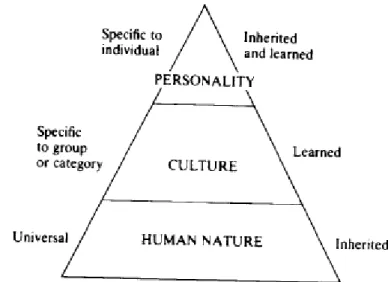
Figure 6. Three levels of uniqueness in human mental programming (Source: Hofstede Geert. H. Culture and Orgnazations : Softwart of the mind. )
Culture is learnt and specific to a group or category. This was concluded by the American anthropologist Franz Boas (1889). In order to understand men’s behavior and attitudes, Boas detached the idea of culture from the idea of races and biological heritage, and found biological conditions were less important than culture. One of the discoveries in this field is that culture is learnt, not inherited. It was affected by one’s living environment or society and not diverse from generation to generation. From the following chart: levels of human mental
programming, it is clearly shown that culture is on the second level in human mind which distinguishes from human nature and personality. See figure 6.
The first level human nature is universal and inherited, which is like eating, drinking, sleeping, the activities or needs do not change as the environment or genres. Different from the human nature, culture is the cluster to certain specific group and needs to be learnt. In contrast, personality emphasizes the aspect of individual.
Lisa Hoecklin (1995) referred the elements of what culture includes: a shred system of meanings, relative, learned and groups. He also reminded that what culture does not involve right or wrong, inherited and individual behavior (Lisa Hoecklin: Management Culture Differences)
3.2 Hofstede’s definition culture and the dimensions of culture
Geert Hofstede, a famous Dutch psychologist and anthropologist, concluded the definition of culture as it is the collective programming of the mind which distinguishes the members of one group or category of people from another.
He dedicated to researching a systematic framework to assess the differences between national cultures. The cultural dimension theory demonstrated four dimensions to assess different cultures from country to country, or region to region. From 1967 to 1973, Hofstede and his colleagues carried out an extensive study on values of people, based on the data collected from their survey questionnaires that were sent to 116,000 people working for IBM in more than 40 countries, and involved more than 20 languages. A statistic analysis of the answers from different countries revealed common problems with different solutions from country to country. And the differences are mainly embodied in the four following aspects: 1. Social inequality, including the relationship with authority;
2. The relationship between the individual and the group;
3. Concepts of masculinity and femininity: the social implications of having been born as a boy or a girl;
of emotions.
These four basic areas represent the different dimensions of culture, which named by Hofstede as power distance, collectivism versus individualism, femininity versus masculinity, and uncertainty avoidance. After that Hofstede scored each country in the four dimensions to reveal its typical values.
Power distance can be defined as the extent to which the less powerful members of
institutions and organizations within a country expect and accept that power is distributed unequally.
Individualism pertains to societies in which the ties between individuals are loose: which can be explained as how much the members of society care about themselves of families. While the concept of collectivism is viewed as the opposite side, which pertains to societies in which people from birth onwards are integrated into strong, cohesive in groups, which throughout people's lifetime continue to protect them in exchange for unquestioning loyalty.
Masculinity conceptually indicates the dominant values of society in competitiveness and assertiveness, which can be distinguished from the opposite concept Femininity.
Uncertainty avoidance can be defined as the extent to which the members of a culture feel
threatened by uncertain or unknown situations and try to avoid such situations.
Researches of Hofstede established the basic elements of dimensions for evaluating cultural difference. Other studies on how to assess culture have been carried based on his research.
3.3 cross-cultural management and intercultural management
The study on Cross-cultural management and intercultural management is developing. Cross-cultural management and intercultural management were influenced by the study of Fronz Boas. He found that culture is more important than biological conditions to understanding men’s behaviors and attitudes. The dispute of influences of cultural aspects on building people’s personalities between French researchers and North American’s researchers also boosted the study on cross-cultural management and intercultural management.
The subject of cross-cultural management started with the disagreement between universalists and cross-cultural theorists on whether there are real differences in managerial principles managing practices in different countries. Galton Frandis (2004) introduced the problem of cultural group independence in the 19th century and after many researchers studied the effects of different cultures on managerial system.
In the past several decades, many theories of cross-cultural management have formed and matured. Abraham Maslow (1973), a well-known American psychologist, launched the theory called Maslow’s hierarchy of needs, which provided the basic theory for the study of cross-cultural management. He noted that the existence of five basic human needs that constitute a hierarchy: physiological needs, security needs, social needs, esteem needs and self-actualization needs. While the following scholars pointed priorities of the needs are different from country to country, for instance, security needs were more important to people who live in a country of high uncertainty avoidance, than finding a job stands as a social need.
Edward Hall (1973) studied the importance of non-language messages which significantly influence the reactions between different cultures and the reasons people from different cultures can not understand each other. He also introduced another concept – intimate space – to describe non-linguistic messages.
Many other researchers also contributed to this field. Geert Hofstede concluded four dimensions of culture for measuring cultural difference. Philippe d’Iribarne’s found different logics when researching French, US and Dutch groups. Later Fonts propounded seven dimensions of culture: universalism vs. particularism, individualism vs. communitarianism, specific vs. diffuse cultures, affective vs. neutral cultures, achievement vs. ascription, Sequential (m) vs. synchronic (f) cultures, and internal vs. external control.
Since then, the study of cross-culture began to develop and mature rapidly. It still attracts the attention of many scholars. Roberts K.H. (2002) studied the evaluation of cross-culture related to organization, also the contribution of the insights of Boddewyn J. (2003) into cross-culture to the understanding of government — multinational enterprise relations have
been widely acknowledged etc.
William Hart, classified three categories or levels of cultural study: a mono-cultural phase, a cross-cultural phase, and intercultural phase, at a more advanced stage. He held the point of view that intercultural communication focuses on the interpersonal interaction of people that represent different cultures.
During 1799 to 1805, “Society of Observes of Men” was established, consisted of a number of great scientist and intellectuals of that time, such as Volney, aiming at understanding how human beings are “built” by education and culture little by little by means of collecting and analyzing the “wild men’s” behaviors. In order to understand how the environment influences the habits of human groups, Volney gathered materials of human history such as revolutions, wars and lifestyles, and analyzed characteristics of human interactions. Hence Volney was the first researcher to launch a reflection on analysis of intercultural relations.
The study by Jacques Demorgon (2010) concluded that intercultural approach is more of a dynamic process of different cultures’ encounter. It could be understood that the intercultural field is dynamic due to it treats the process when different cultures encounter they get crossed, interact, and exchange elements, and doing so. However in recent years in the intercultural field, most studies on different cultures adopt a cross-cultural instead of an intercultural one.
This thesis is not going to discuss in depth how to distinguish the cross-cultural management and intercultural management. This study may be a bit more focused on cross-culture, but these two definitions, to some extent, are quite similar, and sometimes interchangeable leveling this thesis.
3.4 Participations of cross-cultural management in higher education
As the fast development of high-technology, physical distance has been largely reduced between any two regions in the world. Internationalization and globalization penetrated into every field: national infrastructure construction, heavy industry, science and technology research, business, education, etc. As borders of travel and trade expand throughout the world, there is an increased interest in the experiences of people who work or study in other cultures
(Goodman, 1994; Ward & Kennedy, 1993). Problems and conflicts between people from different cultures are of the interest to researchers, who attempted to uncover the factors and reasons that led to.
Most literature about cross-cultural management concerned people’s behaviors, ways of thinking and communication, and core values from different cultures. The differences are not reduced during the process of globalization and internationalization, on the contrary, they speak louder than before.
The cultural issue is more and more important to managers because of the communication, mergers and acquisitions among corporations. In practice, how to reduce or minimize the influences of culture on productivity and how to overcome the conflicts aroused by cultural factors in order to enhance performance are the main challenges for most managers. While in the educational field, this is a new subject.
Due to the rapid increase of cooperation and communications between different universities, colleges and institutes that are located in different countries which stand for different cultures, students, professors and researchers are traveling around the world. Then the problems arises that how to solve the conflicts between different cultures, how to regard different cultures as resource to train students with international consciousness, etc.
The present literature on cross-cultural management in educational field is composed of two levels: cross-cultural management in higher education, and using cross-cultural theories to study foreign students and professors, such as the adjustment of foreign students from different cultures (Crano & Crano, 1993), multicultural applications of stress and coping (Slavin, Rainer, McCreary, & Gowda, 1991), cooperation and synchronization in cross-cultural management on higher education (Dong Qianguang, 2007) and some case studies on cross-cultural management at universities.
Although cross-cultural management is a new topic for higher education, more and more researchers have realized its importance and begun to research.
3.5 Motivations of Chinese students studying abroad
As China has become one of the largest student export country, this population of Chinese students also attracts lots of researchers for two reasons: motivations of those overseas Chinese students and their situations during their stay in foreign countries, for example, how they adjust themselves to foreign cultures.
The papers that have been published show that most of the researches focused on the Chinese students in the US, the UK, Australia, and other a few developed countries. According to statistics, the top 5 countries that gain most Chinese overseas students are the US (23%), The UK (12%), German (11%), France (10%) and Australia (7%).
Although there is no specific researches on the motivations of Chinese students studying in Portugal, discussions and conclusions by other previous researches can reflect to some extent the motivations of Chinese students in Portugal.
The motivations of Chinese students studying abroad can be discussed on two levels: environmental level and individual level. For the early Chinese students who studied in foreign countries, the political factors might have been the most important motivation, especially after the Tiananmen Square incident in 1989, the number of self-supported Chinese students has increased rapidly since then. Also in the 1980’s, the students from Hong Kong were also affected for political reasons; they were in fear of the political environment of Hong Kong after its return to China in 1997 (Agelasto & Adamson, 1998). The political reason may somewhat still have effect on the choice of Chinese students, but it is no longer a significant motivation for Chinese students studying in another country.
Instead of political reason, the families, friends, classmates have much influence on the choice of where to study. It is clear that family recommendation plays an important role in making the decision for self-supported students to study abroad simply because for most of them, parents are the main source of money. It is also demonstrated that friends, classmates or schoolmates also influence the motivations of Chinese students study abroad. According to a study by Shanka, Pope and Ali-knight (2002), 37% of international undergraduate students
were affected by their families and friends when they chose the destination countries, because friends and families could be seen as reliable, objective and non-commercially oriented.
Financial constraints used to be one of the greatest obstacles for Chinese students to study abroad (Tierney, 1980). In earlier years, government-funded students were the main component of Chinese overseas students. It is hard for Chinese overseas students to afford the costs without government funds or scholarships from host countries or universities. While nowadays, the number of self-supported students is increasing fast, financial reason is less important than before. Recently, a survey made by an American university indicates that about half the Chinese students at that university could afford to study abroad using their own resources (Fulbright Report, 2003).
On the individual level, the purpose of Chinese students study abroad is changing from escaping from political environment to proving their abilities in learning and pursuing success careers and future. Besides, age is a factor that affects the choice of studying aboard, or in other words, students in different learning stages may have different motivations. For this reason, the motivations of Chinese students studying in Portugal are an important aspect to investigate.
4. Methodology and Data analysis 4.1 Methodology
There are two definite goals of this paper. The first goal is to examine the cultural differences between China and Portugal using qualitative interviews, as well as the situation of cross-cultural management at Portuguese universities and institutes in the perspective of Chinese students. And the second is, on the individual level, to research the motivations of Chinese students that are studying in Portugal. In order to approach these two goals, both qualitative and quantitative methods are used in this thesis.
In an attempt to evaluate the cultural differences between China and Portugal, a method called “culture standard” is used in this paper. This “culture standard” is defined by a previous researcher named Ann (2009). She used an open questionnaire in the target population to conclude the differences of culture between difference countries which were concerned. In this thesis a series of open ended interviews were made. The interviewees were requested to describe their experiences and feelings in Portugal, for instance, in which aspect the Portuguese culture shocked them mostly. Since they were open ended interviews, there were no constraints for the interviewees so that they could talk every aspect of life or study, the unfavorable shortcoming of open ended interviews are that the interviewee may probably digress from the subjects of conversation the interviewer is interested in, however, the advantage is also obvious, which is the interviewees are not led by some certain questions that the interviewer has designed previously and more information can be obtained. After the interviews the responses were collected and analyzed. In order to more precisely assess the accurate cultural differences between China and Portugal in the eyes of Chinese students, the first step was to summarize the characteristics of Portuguese culture from the feedback of each interviewee. After that, the final cultural differences were selected by frequency at which that difference has been mentioned by all the interviewees. For instance, if most of the interviewees mentioned the Portuguese people are flexible time orientated, then that will be chosen as one difference. If just one or two interviewees pointed it out, then it is not a representative characteristic of Portuguese culture for it might be a personal point of view.
During the interviews, the following questions on the cross-cultural management at their Portuguese universities and institutes were asked:
1. During your study in Portugal, do you think the university or institute at which you are studying considers different cultural background sufficiently when it comes to international students?
2. Did you ever have any problems or dissatisfactions caused by the way your university or institute manages international students by culture (Portuguese culture or convention)? 3. By your own experience, can you give Portuguese universities or institutes some
suggestions on how to deal with affairs related to international students, particularly Chinese students?
Because these questions are open-ended, and the interviewer needs to explain the questions to the interviewees, inspire them as well as answer questions made by the interviewees, qualitative interview was used instead of online survey.
In order to help Portuguese universities and institutes manage Chinese students, it is useful to explore on a deeper level, which is to look into the motivations of these Chinese students studying in Portugal. This was done by means of an online survey which was comprised of four parts: basic personal information, academic information, financial information, and information on career or future plans. The first part was to collect personal information of the respondent, such as gender, the age, the previous major at his or her Chinese universities before coming to Portugal, the environment he or she grew up in, etc. The other three parts were to trace the clues of their motivations studying in Portugal; also the factors that they were affected while making the choice to study in Portugal.
Previous studies on the topic were referred when designing the factors for this survey that affected the choice of the Chinese students to study in Portugal Most of the researchers adopted students’ perspective to investigate the process of decision making when they choose their university. Erdmann (1983) believed that reputation of college, college’s location, and recommendations from parents would affect the decision of students. According to Briggs’ study (2006), when a student decides which college is to be chosen, three main factors are
considered mostly: academic reputation, distance from home, and its location. Chapman (1981) made his study on factors that would influence students’ choice, which involve not only internal factors but also external aspects such as the influence from parents.
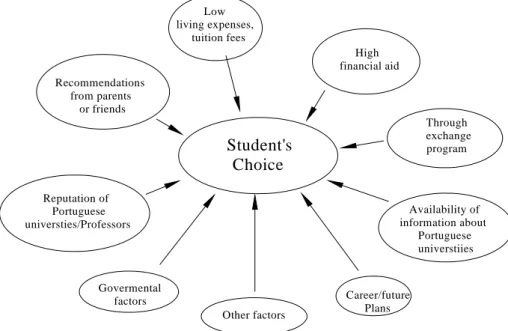
Low living expenses, tuition fees High financial aid Through exchange program Availability of information about Portuguese universtiies Other factors Career/future Plans Govermental factors Reputation of Portuguese universties/Professors Recommendations from parents or friends Student's Choice
Figure 7. Adjusted factors influences choices of students study abroad.
The questionnaire designed in this thesis was based on these previous findings, but adjusted and combined with the particular situation of the Chinese students studying in Portugal. Although the target population is mainly comprised of adults (except the exchange students), which means parental factor is less important, parents’ recommendation also plays an important role. Factors that are considered in this thesis are shown in Figure 7.
4.2 Target population
In 2010, there were 231 Chinese people enrolled at Portuguese universities and institutes, including exchange students, masters and doctor students, post-doctors, visiting researchers and Chinese employees working in Portuguese academic units. The characteristics of the respondents to the questionnaires and interviews are as follows:
1. They were studying or working in the Portuguese universities and institutes at the moment they participated in the survey or interviewed.
students studied in this thesis as the target population were all from China mainland, excluding the students from Hong Kong, Macau and Taiwan.
3. Except the exchange students, the rest of the surveyed Chinese students in Portugal had obtained their bachelor degrees in China. But the second generation of Chinese, i.e. those Chinese students that were born in or moved to Portugal before they went to college were not considered in this thesis, simply because their data were not available. Otherwise it would be nice to have their points of view for comparison, although they lack in studying experiences at Chinese Universities.
4. In this survey, the exchange students were those who enrolled at Chinese universities to study Portuguese language and culture, but could come to study in Portugal for a certain period of time (normally one or two years, depending on which exchange student program through which them came to Portugal).
4.3 Cultural comparisons based on Hofstede’s theory
Dutch psychologist and anthropologist Geert Hofstede organized en extensive investigation to assess how different cultures influence people on providing different solutions for the same questions. And the results of his survey revealed four cultural dimensions named as power distance, collectivism versus individualism, femininity versus masculinity, and uncertainty avoidance. This theory also provides a basic overview of cultures differences between China and Portugal, as well as standards to evaluate the validity of the results from the qualitative interviews.
Power distance
This index measures the extent to which the less powerful members of organizations and institutions (like the family) accept and expect that power is distributed unequally. This dimension embodies the relationships between students and professors, hierarchy in organizations, etc.
Based on Hofstede’s research, the power distance index of China is 80. While for Portugal, the power distance index is 63. See Figure 8.
Power Distance Index 0 10 20 30 40 50 60 70 80 90
China Portugal World Average country
power distance index
Figure 8. Power distance index of China and Portugal of Hofstede’s research
As can be seen Figure 8, the power distance index of both China and Portugal are higher than the world average, especially China. It indicates that China and Portugal are hierarchical countries which emphasize social classes and have strong social structure. Most powers are in the possession of a small number of people, and the social influences of most people that are at the bottom of the society are limited, meanwhile the percentage of the middle class is also small. Unevenly distribution of power is reflected in every aspect, for example, salary and the hierarchy or authority distribution in an organization.
Individualism
In Hofstede’s opinion, the second dimension, termed as individualism, is about the relationships between individuals and social groups. A higher index indicates that people think themselves more as individual instead of a member of a group. And everyone in the society is expected to look after himself or herself and his or her immediate family. The relationship between the members is very loose. On the opposite, a lower value of this index means the relationship between the individual of a society is tight and each one think himself or herself as the member of group, which is called collectivism. It pertains to the societies in which people from birth onwards are integrated into strong, cohesive in groups, which throughout people’s lifetime continue to protect them in exchange for unquestioning loyalty.
According to Hofstede’s research, the index of individualism value of China is 20, while Portugal is 27. See Figure 9
Individualism Index 0 5 10 15 20 25 30 35 40 45 50
China Portugal World Average country
individualism in
dex
Figure 9. Individualism indices of China and Portugal by the Hofstede’s theory
Figure 9 describes the individualism index of China, Portugal and the average value of the world. It can be seen that, the indices of both countries are lower than the world average which is to say, China and Portugal are collective orientated countries which are defined as collectivism countries by the Hofstede’s theory. Compared to the individualism countries, the people in collectivism countries consider themselves more as a member of a group, and harmony is always the first thing to consider. Also, the opinions and decisions are decided by the group instead of an individual. Moreover, interests of group supersede the individual interests.
Masculinity
Masculinity is the third dimension of Hofstede’s theory. It refers to the core value or the dominant value of a society that is seen as the characters of masculinity, which is tough, competitive, aggressive, assertive, etc. In a masculinity society, the gender roles are clearly distinct. For instance, men are supposed to be tough, and focused on success, while women pay more attention to the quality of life. Compared to masculinity, feminine society is much more tender and modest. In such society, people all emphasize on the quality of life, and less concerned about the material success.
Hofstede applied these dimensions to 72 countries, evaluated the masculinity index each country. In his research, China got 66 points, while the masculinity index of Portugal is 31, as