THE IMPACT OF TEAM ORIENTATION ON TEAMWORK
ENGAGEMENT: HAVING INTRAGROUP CONFLICT AS
MODERATOR
Ana Isa Dupret Hopffer Almada Gommel
Dissertation submitted as partial requirement for the conferral of Master of Science in Human Resources Management
Supervisor:
Ph.D., Ana Margarida Soares Lopes Passos, ISCTE Business School Department of Human Resource and Organizational Behaviour
September 2016 Lisbon, Portugal
[THIS PAGE WAS INTENTIONALY LEFT IN BLANK]
i
Acknowledgment
First of all, I am grateful to ISCTE Business School for providing me all these years with such rich education, which made me grow as professional and personal matters.
I wish to express my sincere thanks to Professor Ana Margarida Passos throughout the monitoring, methodological and theoretical support and by also being the person who guided and inspired me to work and research on the issue of teamwork. I also place gratitude to Professor Gabriela Silva Alves for giving me valuable encouragement on never giving up on my ideas and visions.
Special thankfulness to my family, especially my mother, grandmother, and grandfather, for all the support and love. Over all these years you taught me the most important things that I carry for my life and gave me all the conditions to fully focus on my dissertation. I always knew that you believed in me and wanted the best for me.
To all my friends and housemates – Awa, Evi, Noah, Les Twins (Laminy and Leniny), Nadira, Valódia, Romário, Vanessa, Lana, Ivandro, Anna and my “Happy group” – who were always there to cheer me up and to help me survive all the stress. I appreciated all the dinners, parties, conversation and general advice that you gave me across my journey.
Last, but not least, I would like to give a special thanks to Mário Lopes for all the patience, encouragement, friendship and love that was worth more that I can express on paper. You always brought the best out of me.
I will forever cherish in my heart the moments, the stories and the support that all of you gave to me during these months!
Abstract
Teams in organizational settings have a pivotal and vital role in generating the success of a company and the development of each employee. Therefore, the central question is: how can teams engage in order to achieve their maximum performance?
Because of the scarcity of empirical studies, the present study aims to analyze the influence that team orientation – an individual characteristic that takes behaviors of others into account, as well as preferences to work in a group rather than alone - might have on the emergence of teamwork engagement, and consequently on team effectiveness. In addition the moderator effect of intragroup conflicts on the relationship between team orientation and teamwork engagement was also tested.
The sample is composed of 99 employees belonging to 22 Hostels in Lisbon. The questionaries and the data collection was implemented in a structured way, that all of the employees, in every category (cleaning staff, receptionist, and managers), could answer.
The results showed that, contrary to what we expected, the intragroup conflicts do not moderate the relation of individual characteristic - Team orientation- and teamwork engagement. However, the positive relationship was found between the teamwork engagement and effectiveness of teams but not between the orientation to work in a team and the TWE. It is believed that due to the small sample size, the assumptions made could not support the proposed model. In addition to complete, it was conferred the theoretical implications and practical research and finally presented a set of suggestions for future studies.
Key words: Teams, Teamwork engagemen; Intragroup conflict; Hostels
Resumo
As equipas em contextos organizacionais têm um papel fundamental e vital para gerar o sucesso de uma organização e o desenvolvimento de cada funcionário.
Portanto, a questão que se coloca é: Como pode uma equipa engajar de forma a alcançar o seu desempenho máximo?
Devido à escassez de estudos empíricos, o presente estudo tem por objetivo analisar a influência que a orientação para trabalhar em equipa pode ter sobre o surgimento do constructo teamwork engagement e, consequentemente, com a eficácia da equipa. Como moderadores dessa relação foram acrescentados os conflitos intragrupais, sendo esses considerados como variáveis contextuais.
A amostra é composta por 99 funcionários pertencentes a 22 Hostels em Lisboa. Os questionários e a coleta de dados foram implementados de uma forma estruturada e pensada para que todos os funcionários em cada categoria (pessoal de limpeza, recepcionista, e gerentes), pudessem responder.
Os resultados mostraram que, ao contrário do que se esperava, os conflitos dentro da equipa não moderam a relação da característica individual – team orientation - e
teamwork engagement. No entanto, a relação positiva foi encontrada entre o teamwork engagement e eficácia das equipas, mas não entre a orientação para o trabalho em
equipa e da TWE. Acredita-se que, devido ao reduzido tamanho da amostra, não foi possível suportar a maioria das hipóteses e, consequentemente, o modelo proposto. Em conclusão, foi salvaguardado as implicações teóricas e práticas da pesquisa e, por fim, foi apresentado um conjunto de sugestões para futuros estudos.
Palavras-chave: Equipas, Teamwork engagement; Conflictos intragrupais; Hostels Números de classificação do sistema JEL: D23 Comporatamento Organizacional; D74 Conflito
Index
ACKNOWLEDGEMENTS...i ABSTRACT...ii RESUMO...iii Chapter I 1. Introduction...1 Chapter II 2.1 Teamwork • Defining teams...3 • Team effectiveness...4 IPO model IMOI model Outupts Chapter III 3.1 Team Work Engagement: A Model of Emergence • Introduction into Work Engagement...7• Definiton of TeamWork Engagement...8
• Model of Emergence Inputs (Team Orientation) ...11
Teams process…...12
Emergent states…...13
Outupts...15
Chapter IV 4.1 Conflict • Defining Intragroup Conflict ...16
• Types of Intragroup Conflict ...16 Task Conflict
Relationship Conflict Temporal Conflict
Chapter V
Chapter VI 6.1 Methodology Sample ...21 Procedure...21 Measures ...22 Chapter VII 7.1 Results ...25 7.2 Discussion Implications...30
Limitations and suggestions for future research...31
Bibliography...33 Appendixes...38
Table Index
Table 1………...….26 Table 2……….28 Table 3……….……....28Figures Index
Figure 1………...…....5 Figure 2………...10 Figure 3………...………...20 Figure 4………...………...47 Figure 5………...………...47Abbreviation Index
TWE – Teamwork Engagement TO – Team Orientation
TE – Team Effectiveness
PTE – Percieved team effectiveness PEG – Percieved effectiveness for guests IMOI – Input-Mediator-Output-Input IPO – Input – Process - Output
[THIS PAGE WAS INTENTIONALY LEFT IN BLANK]
1. Introduction
At the end of 2008, an economy debt crisis hits Europe. Portugal and several other neighbor countries are affected in a tremendous way and regarding tourism sector, specifically speaking, this one is no exception to the rule (Público, 2011). With less income salary people start looking for cheaper alternatives when it came to short-term accommodation for the holidays and given to this increasing demand, therefore, the offer for this market niche also expands. Thus, since 2010 Portugal has been witnessed a significant growth in the Hostel's sector, which correspond a low-cost alternative in the industry regarded (Jorge & Volante, 2011). Nowadays hostels represent an important part of the tourism sector in Portugal and since 2014 the government has stipulated its own regulation (Decreto-Lei n. º 128/2014). Considering the number of scientific studies that specifically focus on hostel industries is still scarce, projects regarding this subject each time more welcome in Human Resources field. Following the changes in tourism sector in Portugal, organizations also had to adpat over the years, suffering deep changes ith the way work is structured. Moving from a more individual work stucture to more collective system, teams have become an important foundation thoroughly their actions in the current environment (Zaccaro, Rittman, & Marks, 2001). Given this increasing significance of teamwork, teams will be the target of this research, not as an assortment of two or more distinct people who are together to achieve a common goal, but a team as a whole (Hackman 1990).
Hereupon, the primary concern of this study is to examine the dynamics of the teams in the context of hostels based on a new construct - Teamwork Engagement, which is characterized as “a shared, positive and fulfilling, emergent motivational state of work-related well-being.”(Costa, Passos and Bakker, 2014a).
It is expected for a successful team to have all of its teammates synchronized when it comes to the way they perform, the way they express ideas, viewpoints and obey the deadlines. Failing at this synchronization may result in intragroup conflicts and even the failure to meet whichever goals were established. Accordingly, this process is also vice-versa. In others words, having different types of conflict in a team can decrease this “shared motivational states” and therefore the synchronization of teammates. Hence, we choose to intragroup
conflict as contextual variable as it was proposed in the work of Costa, Passos and Bakker (2015), working as a moderator role in the relationship of team orientation and TWE.
The present dissertation is divided into three chapters when it comes to the literature review. First regards the concepts of teams, team effectiveness - namely the evolution from the IPO (Input-Process-Output) model to a more recent one which is IMOI (Input-Meditor-Output-Input)- and the empirical studies that were done related to the subject. In the second one, we enter into the core theory of this research which is engagement regarding team level. The model of Teamwork Engagement is explained minutely, going from inputs passing through its mediators – team process and emergent states – and finishing on its outputs. The third one focuses on intragroup conflict, specifically on task, relationship and temporal conflict matters. Thus, the contributions of this dissertation are twofold. First, it enhances the literature on work engagement subject, specifically on teamwork engagement. This new construct is still in the need to be tested empirically in consideration to contribute to teamwork, team effectiveness, and group conflicts studies. Also, it helps us validate the theoretical model proposed by Costa, Passos & Bakker (2014a) using a sample that possesses a small and limited number of employees.
Chapter II
"None of us is as smart as all of us."
-Ken Blanchard
2.1 Defining Teams
Human history is made of a largely amount of stories of people working together as groups in order to explore, achieve and conquer (Kozlowski & Ilgen, 2006). Nowadays, due to technological advances, innovation, globalization, growing competitively, among other factors (Neves, Garrido and Simões, 2008), effective teams have become a critical factor for industries and organizations in order to enhance performance, profitability, and provide a stable environment (Zaccaro, Rittman & Marks 2001).
Hereupon, the first question to be answered is: What do we understand for work groups or teams?
Holistically, work groups are defined as an interdependent agglomerate of individuals who share responsibility for a specific goal in a certain organization (Sundstrom, DeMeuse, & Futrell, 1990). Also in the work of Guzzo and Dickson (1996), the authors follow the same line but adopting their definition of work groups from Hackman (1987), who says that “a work group is made up of individuals who see themselves and who are seen by others as a social entity, who are interdependent because of the tasks they perform as members of a group, who are embedded in one or larger social systems (e.g. community, organization), and who perform tasks that affect others (such as customers or coworkers)” (p. 309). As it can be seen much of the initial literature focuses on explaining what groups do and how they do it (Koslowzki & Bell, 2013). More recent reviews related to this subject expose an emerging perspective where work groups are viewed as dynamic, emergent and adaptive entities rooted in a multilevel system (Mathieu, & Zaccaro, 2001 Ilgen, Hollenbeck, Johnson, & Jundt, 2005; Kozlowski & Bell, 2003). Therefore, following this line of thought Koslowski and Ilgen, 2006 characterized teams “as complex dynamic systems that exist in a context, develop as members interact over time, and evolve and adapt as situational demands unfold” (p.78). Hence, once answered the first question proposed, now the work proceeds to the core focus of the theory and research on teams and all topics related (Koslowski & Bell, 2013) from the Human Resource and an Organizational psychology perspective, which is the team effectiveness.
Team effectiveness
As the literature has shown over the years, one of the main trends of modern organizations is enhancing teamwork to improve the efficiency and productivity (Salas, Stagl, & Burke, 2004). One of the most prominent concerns in the reviews on teams has been the study of performance and effectiveness, which McGrath (1964) called "Team output".
In order to understand better the conceptualization of team effectiveness, it’s necessary to look way back to the history of research based on teams. More the 50 years ago McGrath (1964) came up with the I-P-O Model to study the effectiveness of the teams. The model is divided into three parts: Inputs, Process, and Outputs or Outcomes. The inputs referred as an aggregation of resources and characteristics – Individual, Groups, and Environmental- that can lead to an outcome. The activities that team members perform in order to combine their resources to task demands are known as processes which function as a mediator between the inputs and the outcomes. The model assumes that the inputs affect the processes and these in turn through mediation or moderations, leads to group results. Thus, at this point, it is clear that effectiveness is a team output.
Hackman (1987) define team effectiveness using three criteria: the first is based on productivity that should meet or exceed the performance criteria; the second is related to the process used while doing the work which should enhance the capability of members to perform together, and last is the satisfaction among the members. The IPO model is the basis of contemporary efficacy models as IMOI and multilevel, but more developed in relation to the initial approach.
The model regarded – IPO - has been criticized for failing to distinguish multiple types of processes and outcomes, and to state that teams function as a linear process (Mathieu et al., 2008). Ilgen et al. (2005) explained, "Many of the mediational factors that intervene and transmit the influence of inputs to outcomes are not processes." And indeed, however, treated as inert terms, “process” are assembled that emerge over time as team members interrelate with each other (Marks et al., 2001).
The authors define team process as “members interdependent acts that convert inputs to outcomes through cognitive, verbal, and behavioral activities directed toward organizing taskwork to achieve collective goals” (Marks et al., 2001: 357). In terms of empirical research, the I-P-O model fails when it comes to capturing the essence about teams as complex adaptative systems. Even with a consensus concerning utility of it, the framework is not sufficient for characterizing teams in some ways. Though, as mentioned above, significant research from nowadays has grown beyond this framework. For Marks, Mathieu e Zaccaro (2001), some variables that are treated as “processes,” such as collective efficacy, potency, cohesion, and situational awareness, should instead be considered as “tap qualities of a team that represents member attitudes, values, cognitions, and motivations” (p.357). They actually prefer to call the variables in cause as emergent states. The authors portray emergent state as “constructs that characterize properties of the team that are typically dynamic in nature and vary as a function of team context, inputs, processes, and outcomes” (Marks et al., 2001: 357). It must be clear that emergent states are not a serie of interaction between neither the team members nor team’s actions that lead toward outcomes. They consist of being products of experiences, and process as well, of the team that becomes new inputs followed by process and outcomes.
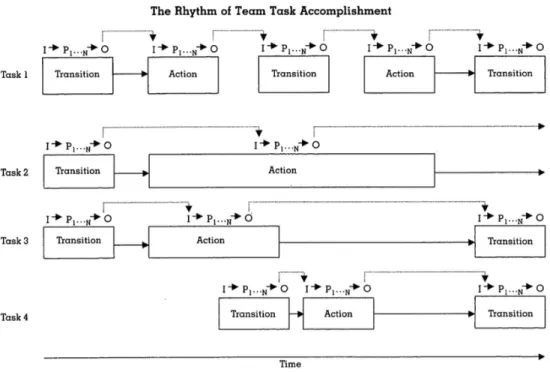
Hence, as an alternative to the IPO model, the authors use the IMOI (Input- Mediator- Output- Input)- figure.1- Substituting “M” for “P” and adding the extra “I” which explicitly invokes the notion of casual cyclical feedback. This model takes into account the ability of the teams perform multiple tasks that vary in length and phases of the cyclic episode. The action stages occur when teams are focused on activities related to the achievement of the objectives, while the phase transition takes place in periods of reflection on the past performance and planning future action.
Although some processes can be transversely relevant, others tend to depend on the phase in which they are triggered (processes related to coordinating and monitoring often occur in the action phase, while planning and evaluation are involved in the transition phase), allowing to realize types of processes are needed at any given moment. However, these phases are not always separate periods and tend to mix often.
Chapter III
“
There are only three measurements that tell you nearly everything you need to know aboutyour organization’s overall performance: employee engagement, customer satisfaction, and
cash flow.”
–Jack Welch
Introduction into Work Engagement
Work engagement is a very mature topic in the body of literature in Human Resource Management. Even being a positive aspect of work and business related, it has been connoted several times with negative aspects such as stress and burnout. Maslah (1999) defined burnout as a three-dimensional negative syndrome which elements are emotional exhaustion, depersonalization or cynicism, and reduced personal accomplishment. One of the most common frameworks for analyzing individual engagement is the Job Demands-Resource model.
The job demands–resources model is a model of employee motivation, where engagement mediates the impact of job resources and personal resources on organizational outcomes (Schaufeli & Bakker, 2010). Job resources refer to those physical, psychological, social, or organizational aspects of the job that may be functional in achieving work goals, reduce job demands and the associated physiological and psychological costs, and stimulate personal growth and development while job demands refer to those physical, social, or organizational aspects of the job that require sustained physical or mental effort and are therefore associated with certain physical and psychological costs (Demerouti et al., 2001).
Empirically, work engagement has been tested in several studies. Demerouti, Bakker, Nachreiner, and Schaufeli (2001) in order to understand the effects of burnout and its cause, concluded that employees that were engaged with their work showed higher levels of organizational commitment. In the work of Bakker and Shaufelli (2010:11), they claimed: “all major human resources consultancy firms are in the business of improving levels of work engagement”. They even say that most of these firms have found evidence, which proves that work engagement increases profitability through higher productivity, but the only problem is that this evidence was just stated and not scientifically proved. Also Schaufeli, Taris and Van Rhenen (2008), who based their study using vigor, dedication and absorption scale,
demonstrated that engaged workers are more predisposed to work extra hours than not engaged ones.
3.1 Team Work Engagement (TWE): A Model of Emergence
Recently, Costa et al. (2014a) proposed the construct of Teamwork engagement, which will be the central focus of this dissertation. The definition given above for work engagement focuses on vigor, dedication, and absorption. The authors Costa et al. (2014a) also follow this line of thought in order to put together the definition of this new construct. They defined teamwork engagement “as a shared, positive and fulfilling, emergent motivational state of work-related well-being.”
Some studies were made before - Salanova (2003) & Bakker (2006) - to measure the teamwork engagement at the team level. The first study opted to measure results through the same variables that were measured the individual work engagement (vigor, absorption, and dedication) and the second went to be a study in individual terms that, in the end, the aggregation of the same could show one collective result. Thus, at this point, many researchers began to wonder at which point individual work engagement would differ from TWE (Costa et al., 2014a: 4). Thus, due to lack of research, theoretical and empirical approaches to teamwork engagement, the opportunities were and still are vast in this field.
For Costa et al. (2014a), the conceptualization of teamwork engagement is more than simply combining several committed individuals and put them to work together as a team. It’s important to understand that individual work engagement is substantially dependent on job resources and demands while teamwork engagement, as a collective construct, is “dependent particular actions and cycles of interaction responsible for creating a common pattern of behavior “(Morgeson & Hofmann, 1999).
This particular thought brings us to the part where the authors- Marks et al. (2001) - referer that “the success of a team is dependent on the way team members interact with each other to accomplish the work”. Thus, teams with the same kind of resources and in an equally challenging environment might evolve a higher level of engagement than
other teams, due to the fact of having different patterns of interactions when it becomes to affective, cognitive and emotional states (Costa et al., 2014a: 3).
They theorize teamwork engagement “as a shared, positive and fulfilling, emergent motivational state of work-related well-being.”
As said above, TWE also focuses on vigor, dedication, and absorption. According to the authors, team vigor corresponds to “high levels of energy and for an expression of willingness to invest effort in work and persistence in the face of difficulties (e.g., conflict, bad performance feedback)” (Costa et al., 2014a: 5). Regarding team dedication, Costa, Passos and Bakker (2014a) define it “as a shared strong involvement in work and an expression of a sense of significance, enthusiasm, inspiration, pride, and challenge while doing so”. And finally, team absorption stands for “representing a shared focused attention on work, whereby team members experience and express difficulties detaching them- selves from work, such as team members talk about their work during breaks, commenting on time passing quickly, and not engaging in non-work-related interactions when working” (p. 5).
However this definition of TWE follows the same path as work engagement by Schaufeli and Bakker (2003), this new construct bear something as interaction patterns within a team and “reflects two essential constructs rooted in the literature on teams and teamwork: emergent states and shared constructs” (Costa et al., 2014a: 5).
As stated before in this work, emergent states are “constructs that characterize properties of the team that are typically dynamic in nature and vary as a function of a team context, input, processes, and outcomes” (Marks, Mathieu and Zaccaro, 2001: 357).
Apart from Torrent et al. (2012b), that defines teamwork engagement as an engagement as a shared psychological state, the authors Costa et al.(2014a) introduce TWE as an emergent state itself. They describe it as exclusive for teams, and not individuals, which “originates in the cognition, affect, behaviors, or other characteristics of individuals, is amplified by their interactions, and manifests at a higher level” (Kozlowski & Klein, 2000).
is the assumption of sharedness. This means that all members of the team must have an equal level of perception concerning to their collective degree of work engagement. Thus, now it becomes clear the destinction between work engagement and the construct of TWE.
In accordance with the authors “team members must consider the behavior of all team members and how they all interact during team processes” so that “every team member is assessing a common observable experience and not how they, individually feel” (Costa et al., 2014a: 7).
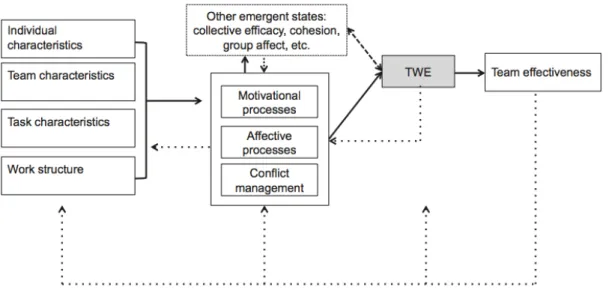
The Model
The model proposed by Costa et al., (2014a) is based on the input–mediator–output–input framework or IMOI exposed by (Ilgen, Hollenbeck, Johnson, & Jundt, 2005). The framework portrays team processes and emergent states as a mediating device between team inputs and outputs (Figure 1). They start with the assumption that teams follow out “a serie of IMOI iterative episodes over time where the outputs of one episode may become inputs of subsequent ones” (Costa et al., 2014a: 7). For example, a bad result in a training program in some company (outcome), can give valuable information for the next training-planing program.
Figure 2. Model of teamwork engagement (Solid Arrows = direct effects; Dashed Arrows = correlational
Inputs
Concerning the inputs, it is integrated into the model the four most common proposed variables used in the literature of team and teamwork: individual characteristics, team characteristics, task characteristics and work structures. They state, “all of these input variables can be considered for the emergence of teamwork engagement, either having a more direct influence or an indirect one, by their effect on the way team members interact” (Costa et al., 2014a: 8).
In what is concerned with individual features, variables such as team orientation and personality traits are considered, according to Salas et al. (2007). Team orientation “is the propensity to consider the other’s behavior when interacting and also the belief in the importance of common goals over individual ones” (Salas, Sims, & Burke, 2005). Regarding personality, extraversion (Costa & McCrae, 1985; Eyesenck, 1998) is intended to be a crucial predictor of positive feelings (Watson & Clark, 1997). Emmons and Diener (1986) empirically proved that extraversion has a significant correlation with positive affect but not with negative affect. Also concerning the individual characteristic input, Costa et al., (2014) remark that “individual’s level of work engagement might work as an input variable for team work engagement because individuals will already be more predisposed to feel and display vigour, dedication and absorption towards work” (Costa et al., 2014a: 8).
Following to team characteristics, these include team’s culture and climate and the power structure of the team. Maslach and Leiter (2008) proposed that this climate for engagement consists of the shared perception of a “challenging, resourceful, and supportive environment and encompasses the six areas if work life: realistic and challenging workload, control, reward, community and collaboration, fairness and values”.
Moving forward to task characteristic, Costa et al., (2014a) recognize that a vast range of tasks which might require an alternating level of interdependence between the members of a team can be considered as a touchstone of emergent states” (Costa et al., 2014a: 9). The last input assigned to this model is the work structure. This is related to the formalities norms of the teams and their communication structure, which defines “who has access to what information and when, as well as the behaviors that are considered appropriate, and these two aspects will shape the nature of team members’ interaction” (Costa et al., 2014a: 9).
Team process
Going forward for the second quadrant of the model, we have team processes. For Costa et al. (2014a) the most relevant interpersonal process for the emergence of TWE is focused on motivation, affect management and conflict management.
Some motivational theories for individual work engagement have been studied over the years. In the work of Bandura (1997), he proposes that “two of the ways by which efficacy is
developed are experiencing success or receiving positive feedback” (Costa et al., (2014a). It is very clear and known that a positive criticism can boost the confidence of someone and therefore enhance performance. At the group level, the work of Wegge and Haslam (2004) and Wegge, Schmidt, and Hoch (2009) supports the adequacy of goal-setting theory. They empirically support that having a specific and difficult team goals guide to a better group performance because it incites communication between them during the whole process and avoid inefficient task strategies.
The sense of collective efficacy such as the accomplishment of something as one group; the validation of teammates competencies like referring the best skills of each member and show how important it is all the kind of interactions that can foster the motivational process (Costa et al., 2014a).
Regarding affecting processes, Marks et al., (2001) describe it as a process that regulates member’s emotions. The management of affect and the promotion of this positive affective manner can occur through three different processes, according to Costa et al., (2014a). The first one is the use of controlled interpersonal affect regulation strategies to improve affect (Niven, Totterdell & Holman, 2009) such as positive engagement and acceptance. Member’s relating with each other on an emphatic or affective way in order to improve their affect can generate positive engagement.
Acceptance is a strategy that is based on expressing validation to the team’s members. For example: showing concern and use positive humor while working, are certain approaches that can boost the self-esteem and the affect of someone’s.
However affect regulation within the team can be a way to manipulate “influence over attitudes and behaviors of team members, and not over their affective experience per se” (Costa et al., 2014a: 11). The authors exemplify saying that teams develop a set of rules about which emotions should be demonstrated in the work context and how that should be exhibited (Rafaeli and Sutton, 1987). In consequence, this demonstration of norms have an impact on the emergence of teamwork engagement in two ways: explicit expression of emotion and expression of positive emotions.
Through exposing their emotions in a precise way, team members can promote an unbiased evaluation of their affective state by others improving the likeliness of resulting in a shared understanding based on the explicitness of the message. While if the rule focuses on the positivity of the emotions being expressed, the emergence of teamwork engagement may also be facilitated, “more team members will show positive affect and act congruently with the definition of team work engagement, displaying enthusiasm and energy. This display will, in turn, reinforce team members’ perception of teams’ high level of engagement” (Costa et al., 2014a: 11).
It's also important to say that affective climate might be an outgrowth of emotional contagion (Bakker et al., 2006; Torrente et al., 2012b). It means that the gears of non-verbal manifestations of emotion (like facial expressions) can automatically generate a similar emotional state.
When it come to conflict situations, Marks et al., (2001) affirms that these should be handled before even originates. The conflict between team members can trigger negative outcomes on member’s affection, resulting to the detriment of the team performance (DeWit, Greer & Jehn, 2012) and also of the teamwork engagement. That’s why preventing conflict or stopping it by creating norms that limit its potential of arising, is very important as an enabler of the emergence of teamwork engagement.
Emergent States
In accordance with Marks et al., (2001), emergent states can be viewed as team inputs as well as proximal outcomes, which means that teamwork engagement has an influence on team process as an input and output. The authors Costa et al., (2014a) clearly exempliefy this statement by pointing that “an increase in teamwork engagement may lead to an increased investment in strategic planning and energetic interactions, because team members feel more
vigorous and dedicated which, in turn, may lead to better outcomes. Better outcomes, in turn, will foster future teamwork engagement”(p. 12).
Since they consider that there is a positive relation between these emergent sates and teamwork engagement, the authors theoretically describe their mutual influences and also distinguish them, focusing on four particular emergent states that my that may co-occur with team work engagement: collective efficacy, team potency, cohesion, and group affect (Costa et al., 2014a). Bandura (1997) defined collective efficacy as group’s shared belief that they can execute their tasks successfully. And while collective efficacy is based on specific temporal focus and situations, team potency resembles a generalized belief to “any task or demand a group may confront” (Starjkovic, Lee & Nyberg, 2009), having both a broader temporal focus and outcome emphasis.
In terms of individual work engagement, the review by Salanova, Llorens, and Schaufeli (2011) reports that efficacy beliefs have an influence on engagement through positive affect and this whole process is at the same time reciprocal. Regarding team level, the authors Costa et al., (2014a) say that “both collective efficacy and group potency enhance the likelihood that team members will persist, approach, and succeed in their tasks; they enhance the likelihood of finding vigorous, dedicated, and absorbed teams” (p.13). Also having a high level of TWE can provide the team’s perception of collective efficacy because team members display preparedness to work and to continue even when difficulties arise.
It very important to state that collective efficacy beliefs and being collectively engaged are different from one another. The first one is essentialy cognitive that can also increase focus while working or be influenced by the increasing focus and energy; the nature of the second one is purely motivational, and it just promote the increase of energy and involvement (Costa et al., 2014a).
In what regards cohesion, this emergent state relates to ‘a group property with individual manifestations of feelings of belongingness or attraction to the group’ (Lieberman, Yalom, & Miles, 1973, p. 337). It is stated that the more group members are attracted to the team, the willingness to devote in chasing the goals and also more. However, they, team member, might but an effort on working together in order to achieve a certain goal without feeling fulfilled by
Moving forward to group affect, it’s very usual for team members that perform the same kind of tasks and produce identical outputs, to share a common affective state. George (1996) explain this common affective state as a consistent or homogeneous affective reactions within a group” (p. 77). And in the work of Trottedel et al., (1998) and Totterdell (2000), the authors empirically proved the existence of a shared affective state between the members of a team. Regarding the impact of affective state on teamwork engagement, Costa et al., (2014) express that“the existence of positive affect will correlate highly with team work engagement, because this emergent state has a positive affective nature: teams with positive group affect are more likely to exhibit team work than teams with negative group affect because the nature of team work engagement and a positive affective states converges” also “engaged teams will tend to collectively display positive emotions such as joy and pride while working” (p. 14). However, even related, these two contructs are dissimilar. Teamwork engagement is a construct that is related to taks work and work relate while positive group affective state can go beyond the work environment, for example, pleasing and playful breaks.
Output
As the final outcome of the model, Costa et al., (2014a) proposed nothing more than team effectiveness. It was mentioned in the first sub-chapter of this work that team effectiveness, according to Hackman (1987), reflects in terms of team performance, satisfaction, and viability. Consistent with to Costa et al., (2014a: 14) “a good performance and feelings of satisfaction and desire to keep working together will facilitate motivation-focused interactions, as well as interactions with a positive affective valence”.
In addition, it is also important to make a reference of the empirical study (Costa, Passos and Bakker, 2014b) that was done in order to validate the TWE model. The results supported that in fact TWE is a valid construct independent of work engagement in indivudual level and when measured is more than a simple aggragation of individual work engagement tool. The authors even stated that the study was “relevant, not only for the study of work engagement at multiple levels, but also for the multilevel research, where no clear rule transposing individual constructs to higher levels exists at the moment, namely, concerning measurement” Costa et
Chapter IV
“For good ideas and true innovation, you need human interaction, conflict, argument, and debate.”
- Margaret Heffernan
4.1 Intragroup Conflict
Since childhood, people are taught and trained to play, work, and socially get along with each other. We learn that the process of working together to achieve the same goal is called teamwork. But even being used to this kind of synergy since the early stage, the challenges of working effectively in teams are considerable. One of the challenges that we faced every day while interacting with each other is conflict.
The intragroup conflict has been broadly defined “as perceived incompatibilities or perceptions by the parties involved that they hold discrepant views or have interpersonal incompatibilities (deWit et al., 2012, p. 360). The same opinion is shared by Vargas (2010), who states conflict refers to “the tension that an individual or a group can experience as a consequence of perceiving differences in relation to others”.
Usually, we would think that the term conflict is a trigger for negative a process and outcomes, however recent scientific literature is showing that some conflicts can have a positive impact on teams. The study of deWit, Jehn, & Greer (2012), showed that having disagreements related to some issues can, somehow, increase the quality of decision-making and helps find solutions that involve various viewpoints.
Regarding types of conflict, De Dreu and Weingart (2003: 741) said, “because team members contribute to the team through social inputs and task input, conflict in teams is concerned with relationship and task issues”. The relationship conflict concerns with disagreement between team members, which is typically about interpersonal issues such as differences concerning personality, norms and values (Jehn, 1995). Sometimes a lot of time is wasted on trying to solve relationships and emotional problems among members instead of focusing on what matters (Meer, 2013). Task conflict, as the name says, happens when group members dissent
accomplishments (DeWit et al., 2012). Regarding task conflict, this one is considered to be the most beneficial type of conflict for a company, comparing to the others. As told before this type of conflict stimulates new idea, viewpoints, concerning whichever task have been assigned them (Passos, Silva, & Santos, 2011).
Referring just to task and relationship conflict, these two manners are normally studied individually in a set of studies that aim to find their effects in another type of variables. In the meta-analysis of DeWit, Greer and Jehn (2012), the authors distinguish the effects of conflict in two different temporal frameworks, the more proximal and more distal.
They stated that positive effects could be seen at a later stage such as group performance, productivity, effectiveness, and the proximal outcomes are the emergent states of teams, defined as teams’ cognitive, motivational, and affective states that modify dynamically and permanently, reflecting the changes in team inputs, team processes, and team outcomes (Marks, Mathieu, & Zaccaro, 2001), such as trust, cohesion (DeWit et al., 2012), and team work engagement. De Wit, Greer, and Jenh (2012) for example discuss that task conflicts might be a good facilitator for positive outcome because, across the work/projects, teammates can discuss and argue about different ideas, which lead to a more rich and weighted decision. However, this also can originate a mistrusting and undermine the confidence of the team. On the other side, studies such as Bayazit & Mannix (2003) revealed that relationship conflict is usually very associated with negative outcomes such as turnover intentions.
Regarding teamwork engagement, DeWit, Greer and Jehn (2012) describe that “interpersonal conflict may directly worsen team members” affect, because individuals are rude to each other, accuse others of inappropriate behaviour, or reject each other’s feelings, and motivation, because individuals are unable to give constructive criticism and become more self-centred and less concerned with the teams’ collective goal accomplishment which, therefore, undermine the emergence of this construct”.
Also in the work of Costa, Passos & Bakker (2015), the authors tested relationship and task conflict as being negatively related to teamwork engagement and team performance.
The findings showed no support for the relationship conflict being a predictor for either TWE nor team effectiveness. However, task conflict had a significant value on predicting TWE but no on team performance. They explained that the results were “in line with the low average relational conflict these teams reported, compared to the average task conflict level” (p. 222).
Another recent concept that will also be regarded in this dissertation is the temporal conflict. In a recent study the authors Standifer et al., (2015) address the importance of shared cognition, conflict and team process in temporal terms. They characterize temporal conflict as being the “dispute among members about time” (Standifer, et al., 2015: 693). The subject regarded is very fresh in the field, so there isn’t a lot of research done related to it. However some authors point out that temporal conflict negatively affects team performance, affective responses of team members, create debilitated competition, decrease in motivation and job dissatisfaction (Meer, 2013) (Passos, Silva, & Santos, 2011).
Also Standifer et al., (2015) empirically tested the relationship of time conflict with team satisfaction and as well as a mediator between the relationship shared temporal cognition and team satisfaction. As predicted in the hypotheses, in fact the authors found a negative relation between the temporal conflict and team satisfaction and they explain that it’s because this conflict cultivates a feeling of uncertainty and misunderstanding about temporal features of the project and tasks being completed. They also found that temporal conflict partially mediates the relationship between shared temporal cognition and team satisfaction. The authors specifically said, “teams that lack STC are more likely to become embroiled in disagreements about time-related aspects leading to decreased satisfaction” (p.703).
Chapter V
5.1 The Model proposed
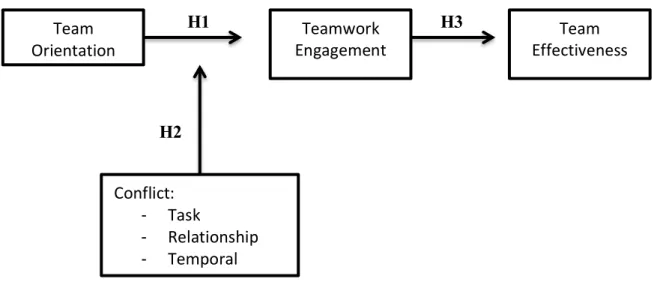
The present study aims to contribute to a better understanding of group dynamics in the hostels, but also to add empirical information to the construct of teamwork engagement, which is a very recent topic in the Human Resource field. The initial focus is to examine the influence of one of the inputs– Team orientation- on the construct of teamwork engagement. Having in account the definition of team orientation - “the propensity to consider the other’s behavior when interacting and also the belief in the importance of common goals over individual ones” - (Salas, Sims, & Burke, 2005) and teamwork engagement - “ a shared, positive and fulfilling, emergent motivational state of work-related well-being”- (Costa et al., 2014), it is predictable that TO will help for the emergence of TWE since the individuals are more open and predisposed to work with others. Thus, the first hypothesis is:
H1: Team Orientation has a positive impact on Teamwork engagement
Conflict is considered in the majority studies a negative process that prevents the emergence of TWE and team satisfaction. On the other side, some studies have been arguing that task conflict, for example, can be beneficial for organization since can stimulate a new ideas, viewpoints concerning whichever task has been assigned them (Passos, Silva, & M. Santos, 2011). More recently, like Costa, Passos and Bakker (2015) described team conflict as contextual like conflict climate.
Given the context in which the study is conducted, employees do not have a lot of freedom to innovate and create new projects. Therefore the conflict that might happen is majority instantaneous and in short time period. In accordance with self-verification theory (Swann, Polzer, Seyle & Ko, 2004), team members tend to interpret different opinions as negative appraisal of their own abilities and competencies, consequently leading to dissatisfaction. Thus, we assume that task conflict is not seen as a positive influence for the emergence of TWE. As for relationship and time conflict, this has been shown on the literature – DeWit et al. (2012) and Meer (2013) - to have only negative influences on satisfaction and performance. Hereupon, the present dissertation will follow the same line presenting the hypothesis as:
H2: Intragroup conflict moderates the relation between team orientation and teamwork
engagement, reducing the positive effect between them.
H2a: Task conflict moderates the relation between team orientation and teamwork
engagement, reducing the positive effect between them.
H2b: Relationship conflict moderates the relation between team orientation and
teamwork engagement, reducing the positive effect between them.
H2c: Time conflict moderates the relation between team orientation and teamwork
engagement, reducing the positive effect between them.
Last but not least, we are interested in the relationship between Teamwork engagement and Team effectiveness. From what it was observed during the whole procedure process, neither conflicts nor the predisposition of a person to work with another does not influence that much on the effectiveness of the work performed.
Most tasks are clearly defined in the form of implementation, and possible problems that may occur are almost never on the reach of the employee to solve. Therefore, we can say that even conflict being a negative influence on the emergence of teamwork engagement, the relationship that it has with the efficiency is always positive but varying the degree. Thus, we have:
H3: Teamwork engagement has a positive impact on Team effectiveness
Figure 3. The model proposed for the study (Model 1)
Team
Orientation Engagement Teamwork Effectiveness Team
Conflict: -‐ Task -‐ Relationship -‐ Temporal H1 H2 H3
Chapter VI
6.1 Methodology
The present dissertation takes part of a broader research about the study of team effectiveness within the tourism industry. The first approach was from Professor Ana Passos presenting us the main subject of the project and the opportunity of gathering all the data required from a controlled group of study. To include as many hostels in the project as possible, my colleagues and I focused on key areas in the Greater Lisbon. We chose: Bairro Alto, Chiado, Santa Maria da Misericórdia, Alfama, Belém and some other spots that were not very touristic.
The method of gathering information was held in two phases: delivery and explanation of the questionnaire and the goal of the study as well; and the second phase were collecting the surveys. In between those stages, we had some contact with the works in order to see if they were in fact contributing to the study and how they felt while fulfilling the questionnaires. Unfortunately, we didn't get as many answers as expected, but the project showed to be an extraordinary opportunity to continue further studies in the industry regarded and also to enhance the team effectiveness literature.
Sample
The study sample is consisted of 22 teams (99 individuals), 53, 5% female and 46, 5% male, enrolled in their daily activities as team members of the Hostels in the Greater Lisbon. The teams were composed of company’s owners (12%), receptionists/staff and other (88%). They were be made up of two to fourteen persons with an average team size of 7 persons (SD= 3, 6316). The average age was 30 years old (SD= 8, 1) with an average working time of 2 years (SD= 1, 1).
Procedure
The first approach to hostels was presenting the proposal and delivery of questionnaires in order to publicize the study and to investigate whether these were interested in participate. In this way, we ensured greater safety for the understanding of the issues, as we had to explain each detail before making the delivery. In each hostel visited we distributed an envelope with
questionnaires, a letter from the supervisor, Prof.ª Doutora Ana Margarida Passos, explaining the goal of the study formally. In each hostel, it was mentioned that the questionnaires would have to be given to the staff that takes part of the daily work and after filling, that they should keep anonymity for not skewing the answer. The final step was collecting all the questionnaires, which was 3 to 4 weeks after the delivery.
Measures
The questionnaire was delivered by printed format, with a brief introduction explaining some relevant information such as the goal of the study, the conditions to answer and the email of the supervisor in case of doubt. In the end, the questionnaire had some demographic questions, for instance: age, gender, occupation, how long was working at the hostel.
Regarding the distribution of the variables used in the shared survey1, it follows in this way: • Teamwork Engagement – second group of questions (9 items)
• Team Orientation – sixth group of questions (3 items) • Intragroup conflict – third group of questions (12 items) • Team effectiveness – Seventh group of questions (6 items)
Operationalization of variables
Teamwork Engagement. To operationalize this variable, we used the measure of
teamwork engagement proposed by (Costa, Passos, & Bakker, 2014a). We asked the participants to indicate their level of agreement with each of the 9 sentences rated on a 7-point likert scale (1 = totally disagree and 7= totally agree).
The Cronbach alpha obtained for this variable show high the internal consistency that is, how closely related the set of items are as a group. The coefficient varies between 0 and 1, and as closer to 1 more reliable is the scale. In the variable Teamwork engagement the Cronbach’s alpha was of .953 and from the 23 teams, the average for TWE was 5.90 (SD= 1,035).
Team Orientation. This variable was measured in a 3 scale items, adopted by Marks,
Mathieu, and Zaccaro (2001). The participants were asked to evaluate level of agreement of the sentences on their willingness to work with other people and being more productive while
do in it, on a 7-point likert scale (1 = totally disagree and 7= totally agree). The higher the values of the scale, less was the willingness to work with others. To measure the internal consistency was tested Cronbach's alpha value and the scale showed a value of .575. The average for the present variable was 4.929 (SD= 1,710).
Intragrupal Conflict. The variable was operationalized adopting the scale of Jehn
(1995) for taks and relationship conflict, and Standifer, Raes, Peus, Passos, Santos, and Weisweile (2015) for temporal conflict. The scale contains 12 questions and the answers were distributed on a 7- point likert’s scale as well (1= Never and 7= Always). Each type of conflict was measured through 3 items, including: “There are personal conflicts between team members” that aimed to measure the relationship conflict; “There is disagreement among members on how to distribute the available time to perform tasks” that measured the conflict about time management and “There is a conflict on the delegation of tasks " that mediates the process of conflict, and finally” There is a conflict of ideas between team members " that mediates the task of conflict. Regarding the internal consistency of the scale, conflict punctuated .947 in alpha Cronbach with an average of 2.305 (SD= 1,2895).
Team Effectiveness. We used a 6 items developed by González-Romá,
Fortes-Ferreira, and Peiró (2009), which had his base on the previous work of Hackman (1987). Participants were asked to point put their level of agreement regarding experience on how they felt about their team performance and the effectiveness in general. The scale contains 6 questions and the answers were distributed on a 7- point likerts scale as well (1 = totally disagree and 7= totally agree). In terms of internal consistency of the scale, the present variable had .849 in alpha Cronbach with an average of 6.058 (SD= 1,0034).
Perception of effectiveness for guests. Regarding this variable, we thought it would
be interesting to see the effectiveness of the teams from the guests’ point of view. For this, we collected the measures – Value for money; Security; Location; Staff; Atmosphere; Cleanliness; Facilities - from Hostel world website on the 6th of July. After gathering the data from all the hostels we made the average, and that is what we consider the perception of team effectiveness for the guests.
Chapter VII
7.1 Results
Aggregation
Since the study is in terms of teams, all individual survey responses were aggregated to the team level for further analysis.
By aggregating and RWG index (J) (James, Demaree, & Wolf, 1983) we can calculate the agreement between teams for each of the variables used in the study. The measure ranges from 1 to 0, meaning the closest values of unity strong agreement intra-team.
Therefore analyzing the value of the RWG for each variable, Teamwork engagement, Team orientation, Task Conflict, Relational Conflict, Temporal Conflict and Team Effectiveness. All the values were in agreement with the required criteria:
• TWE – Rwg(j) = 0,91 • Team Orientation – Rwg(j) = 0,77 • Task Conflict – Rwg(j) = 0,78 • Relational Conflict – Rwg(j) = 0,83 • Temporal Conflict – Rwg(j) = 0,73 • Team effectiveness – Rwg(j) = 0,87 Hypothesis Tests
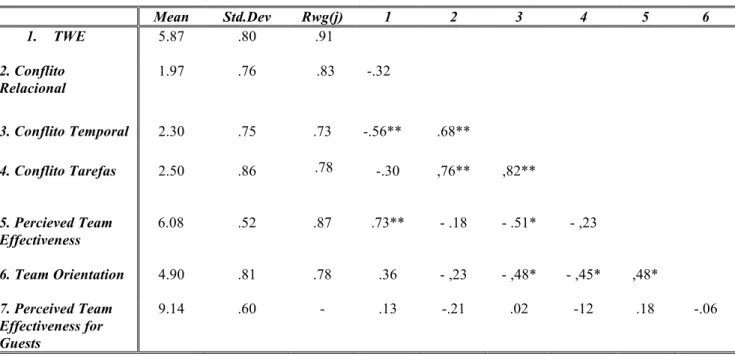
The table below - Table 1- presents the correlation, the average and standard deviations of the variables studied. The results show that the majority of the variables have a significant correlation, with the exception of perceived effectiveness for guests. The predictor variable team orientation correlates positively with TWE and having no clear significance (r = .36, p = 0.1) but significantly and negatively with temporal and task conflicts variables. Regarding TWE, as it can be seen, its positvely and significantly correlated with perceived team effectiveness (r = .73, p < .001).
Table 1 - Correlations, Average, and Standard deviation of the variables studied Mean Std.Dev Rwg(j) 1 2 3 4 5 6 1. TWE 5.87 .80 .91 2. Conflito Relacional 1.97 .76 .83 -.32 3. Conflito Temporal 2.30 .75 .73 -.56** .68** 4. Conflito Tarefas 2.50 .86 .78 -.30 ,76** ,82** 5. Percieved Team Effectiveness 6.08 .52 .87 .73** - .18 - .51* - ,23 6. Team Orientation 4.90 .81 .78 .36 - ,23 - ,48* - ,45* ,48* 7. Perceived Team Effectiveness for Guests 9.14 .60 - .13 -.21 .02 -12 .18 -.06
** Correlation is significant at the 0.01 level (2-tailed) * Correlation is significant at the 0.05 level (2-tailed)
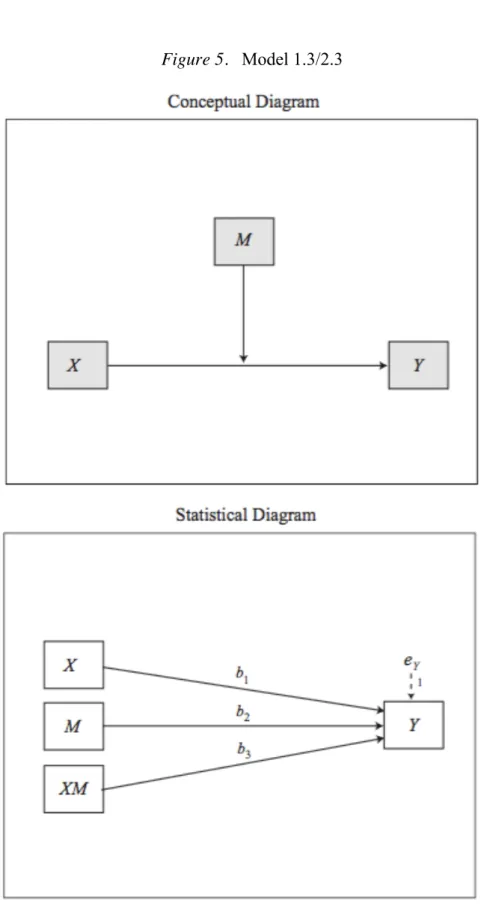
In order to analyze all the hypothesis proposed, we used Linear regression models and PROCESS Macro (Hayes, 2013) command for the moderation and mediation models. For that, we first confirmed the linearity of the variables according to on results of the scatter plots, so as the normality of the distributions as well, which was non-observed. Also, missing data were check, and the results showed none of it.
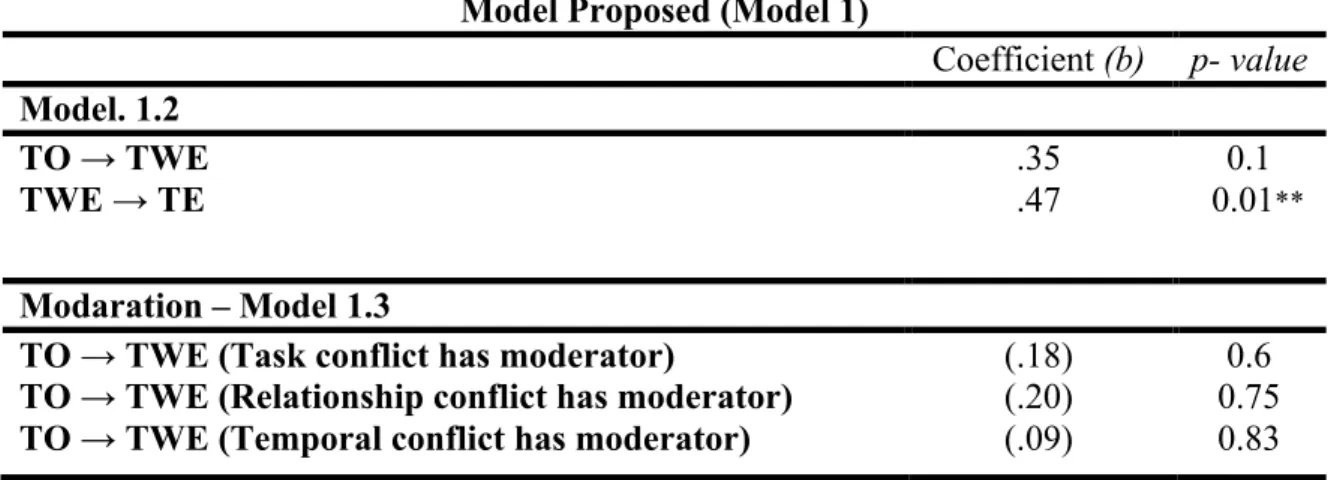
Regarding the direct effects, the first linear regression analysis was examined for Team Orientation (X variable) and TWE (Y Variable). The results showed a slightly significant positive effect (B = .36, p =< 0.1) between the predictor variable and the criterion variable. Even team orientation is explaining in average 8, 5 % of the variation on TWE in groups; the Hypothesis 1 is not supported since our confidence level is 95%.
However TWE is shown to have a significant and positive effect on the dependent variable, team effectiveness (B = .47, p = <. 001) as it was predicted. In this way, it can be said that higher levels of TWE lead to higher levels of team effectiveness. Thus, Hypothesis 3 of the proposed model is supported. For the second model -1- in the study, we sought to understand the effect that team orientation has on TWE when having various types of conflicts.
supported (B = -.18, p = 0.6). In this sense, Hypothesis 2.a was not verified. And same we have for moderation of relationship (B = -.20, p = 0.75) and temporal (B = -.09, p = .83) conflict. In turn, we conclude, the intragroup conflict does not occur as moderators in this suggested relationship.
Since almost all the Hypothesis suggested was rejected, another model was tested to see if we could find significant correlations. The outcome proposed for the second model was perceived effectiveness for guests and the independent variable, TWE. Regarding the first model tested, as we can see in Table 3, the relationship between TWE and perceived effectiveness for guest showed it to be positive but with no significance (B = .14, p = 0.5). Regarding moderations models, we also tried intragroup conflict as it was tested before. While the all the conflicts had a negative impact on model 1, in model 2 they appear to have a positive effect towards this relationship.
Concerning task conflict as moderator and TWE as the dependent variable we cannot see any direct effect of perceived effectiveness for guest (B = .32, p = .21). The same we have for relationship conflict, this variable shown not to have a significant effect (B = .19, p = .32) and in turn not verified the moderating effect on the relationship proposed. Last but not least, we tested the model with temporal conflict as moderator. Even having a p-value that is better than the other to conflicts (p = .17) this is hardly enough to explain the moderation because as it was said before, the confidence level used to test all models was 95 %.
Table 2 – Testing results of propesed model of the study – Model 1
Table 3 - Testing results of Model 2
** Correlation is significant at the 0.01 level
Note: The betas presented are non-standardized
Model 2 - Percived effectiveness for guests
Coefficient (b) p- value Model. 2.2
PEG → TWE / TWE → PEG .14 0.5
Model. 2.3
TWE → PEG (Task conflict has moderator)
TWE → PEG (Relationship conflict has moderator) TWE → PEG (Temporal conflict has moderator)
.32 .19 .30 .21 .32 .17 Model Proposed (Model 1)
Coefficient (b) p- value Model. 1.2 TO → TWE TWE → TE .35 .47 0.1 0.01** Modaration – Model 1.3
TO → TWE (Task conflict has moderator)
TO → TWE (Relationship conflict has moderator) TO → TWE (Temporal conflict has moderator)
(.18) (.20) (.09) 0.6 0.75 0.83
7.2 Discussion
The primary purpose of this study was to add a significant contribution to the existing knowledge regarding teamwork engagement and team effectiveness literature. We sought to understand the implications of the individual characteristics - team orientation- on the emergence of TWE, having intragroup conflicts as moderators and still observe in what extend this whole process would affect the effectiveness of the teams. The results do not support most hypotheses presented but still, allows us to introduce a line of conclusions on the topic of teams in the proposed context.
Regarding the relationship between the team orientation, TWE, and team effectiveness, the results revealed only a direct and positive relationship between TWE and team effectiveness. The team orientation showed no significant effect on TWE leading us to affirm that the preference of an individual for working in groups or taking other's behavior into account, has no implications for the level of TWE in the hostel context. Therefore of Hypothesis 1 did was support it. As personal experience working three months in a hostel, it is quite understandable the results since mostly of the work is done autonomously. Teamwork is essentially performed through communication, transmission of information, from one shift to another. Costa, Passos and Bakker (2014) present TWE model as a complex process where inputs of the team (individual characteristics of the team, task characteristics and structure of the work), team processes (motivational, affective and management conflicts) play a central role in all the laying procedure. But yet the literature has not defined in which context these characteristics has more weight than in others. Regarding the effect of the perceived team effectiveness for guests towards teamwork engagement, there was no significance observed as well.
About conflicts as moderators in the relationship between team orientation and teamwork engagement, none of the hypotheses was supported for both models. However, temporal conflict seems to have a direct and negative influence on TWE and on team effectiveness. As Standifer et al., (2015) present in their study, this feeling of uncertainty misunderstanding about temporal features of the project and tasks being completed, can decrease the satisfaction of team. And as the IMOI (Ilgen, Hollenbeck, Johnson, & Jundt, 2005) suggest, this process is
consequently the performance. Considering the effects of the other two conflict types: task and relationship, these didn’t show any effect on teamwork engagement nor team effectiveness. As explained before, there is no much “room” for conflict when one or two people perform the work.
Theoretical implications
Due to the particular reality of this study and the sample size, the approach towards theoretical implications must be very meticulous. The results obtained cannot be generalized and covered to others teams realities. Hence, the results do not add much more to literature than we know so far. The study focus was essential to understand how the dynamics between individuals working in hostels could be favorable for the emergence of the group engagement and also how the conflicts, as contextual variable, might change this relationship. Regarding the mediation teamwork engagement between the orientation team and the effectiveness of the teams, the first interaction showed no significant results while the second counters to the hypothesis that was already supported by Costa, Passos and Bakker (2015). We believe that these results reinforce the model, which may be further explored.
Concerning conflicts, our data follow partially the results presented by Costa, Passos and Bakker (2015). Neither relationship nor task conflict generates any significance neither on teamwork engagement nor team performance. As moderators, none of the conflicts worked in order to explain the model. The only significant results were from time/ temporal conflict that revealed to have a notable impact on TWE and TE. This last results might be useful for the literature when regards studies with small size sample.
Practical implications
In regards to practical implications, it is critical to reflect on the context where the empirical data was collected. As stated before the sample size was subtle but still, this study mainly caveat the importance of managing the time on carrying out the tasks in order to have a better performance. Also, the findings on Hypothesis 3 (TWE has a positive and significant impact on team effectiveness) implies that hostel’s employers should keep on having the same strategies to engage employees. For example, having clear goals about the procedure on receiving (Check-in, Check-out) a guest; knowing how to act when having a complaint;
understanding the priority of the tasks; are some of the predictors for self- engagement which combined leads to teamwork engagement and consequently to effective performance.
Limitations and future suggestions
Throughout this research, we had certain inevitable limitations. The small numbers of individuals on teams was the first limitation for not having almost any type of conflict. Secondly, besides the small number of teams, the total number of hostels participating was lower than expected. Third, research teams were composed of young – adults’ individuals, who might know each other in a more friendly way and therefore better able to engage at work.
Concerning future investigations, we recommend a study with a relatively same model but in a different context. It would be interesting to follow this same pattern but in a more academic environment. We also advise a larger sample size so that the results can be more accurate and maybe use different predictors for teamwork engagement.
In conclusion, this research, with all its limitations, recorded a correlation between teamwork engagement and team effectiveness, which enables us to add the empirical results to the recent literature regarding team dynamics. About the intragroup conflicts, no significant effect was verified but still creates an intriguing and thoughtful prospect.