Copyright © 2012 (Pinto, T.C.). Licensed under the Creative Commons AttributionNon-commercial No Derivatives.
CIDADES, Comunidades e Territórios
Patterns of housing demand under uncertainty: a case study in Lisbon
Teresa Costa Pinto12, Instituto Universitário de Lisboa (ISCTE-IUL), DINÂMIA’CET-IUL, Portugal
Abstract
In this paper, we use the results of a questionnaire on the potential demand for housing in a residential area of Lisbon to explore patterns of housing demand, taking into account the current context of crisis and uncertainty surrounding the housing markets as well as societal evolution. The sociological profiles of potential buyers / tenants are described and an analysis made of the relationship of certain residential options (in terms of location, house type, tenure and price) and the particular characteristics of individuals who want to move house: socioeconomic group, age, stage of life course and location of current residence.These data will be used as a pretext for a reflection on the characteristics of the current demand for housing in Lisbon. Special emphasis is given to identifying emerging trends in demand (such as the growing demand for rental accommodation) and associated profiles; these are interpreted in light of the current constraints of the real estate market as well as the cultural and social changes driving new attitudes and housing values. Focus also goes to the analysis of consolidated trends in housing demand that have constrained some urban dynamics in structuring the social and urban fabric of the Lisbon metropolis (e.g. the trend towards residential mobility characterized by geographical continuity evidenced in many studies).
Keywords: Housing; Housing Demand; Residential Choices.
1. Introduction
For some years, the studies on residential strategies and patterns of housing demand emphasized housing as an investment for families, and the need for accommodation was associated to a certain way of life and willingness to build future real-estate assets for home-owners and their offspring (Culturello,1993; Lacaze,1997;Bonvalet, 1993). The access to housing also indicated belonging to a social group and a symbolic marker of prestige and social mobility. More recently, the international housing literature has started to reflect on the impact of the deepening economic crisis and social changes on the housing market and on the residential strategies and patterns of housing demand. Several recent studies show marked changes in housing consumption patterns, namely, the demand for housing is conditioned by affordability, job insecurity, unemployment and changes in the family unit (Aalbers, 2009; Bigot and Hoibian, 2009; Authier, 2010; Whitehead and Williams, 2010). In a context of crisis and great uncertainty, the pressure placed by economic factors on personal choices about housing becomes crucial and certainly implies key changes in patterns of housing demand (Aalbers, 2009; Cailly, 2007; Munro, 2000).
2This article is based on a research project and part of it, more specifically, on a chapter authored by Magda Nico, Post-Doctoral Researcher at Centro de Investigação e Estudos de Sociologia – IUL, [email protected].
In Portugal, the housing situation has been shaped by a trend towards home ownership, less state intervention, large family supports in the accessing to the house, and the delayed emancipation of youth; these are some of the lines shaping the specific "housing model" of Southern European countries. However, social and demographic changes and recent economic dynamics, particularly the economic and financial crisis, may be redefining the contours of this "housing model". The instability of real estate markets, restrictions on credit, the high level of unemployment, growing job insecurity and job mobility and the loss of income of families intersect with demographic, family and lifestyle changes that may affect patterns of housing demand and families’ residential strategies. The present situation in Portugal combines the socio-demographic trends found in most European countries (aging population, decreasing average household size, new types of family, marital instability) with a severe economic situation that modifies both the ability and means to access housing, devalues housing prices and is leading to new trends in ownership and patterns of housing demands generally.
The data presented in this paper comes from a study of the potential demand for housing in a specific district of Lisbon - Alta de Lisboa.This is a recently built neighborhood that has attempted a new social mix with equal proportions of private and social housing. However, we can also use these data to reflect on current trends in housing demand not only in the context of a marked change in real estate dynamics, the housing finance system and major credit constraints, but also one of social and cultural changes with impacts on housing values and behaviours.
This study was based on a survey for which the sample was people living in Lisbon and the North Metropolitan Area (NMA) who intended to buy or rent housing in the five years following the application of the questionnaire; a total of 425 questionnaires were completed in 2009.
2. Moving house? When and who?
“Determined” and “Undecided”
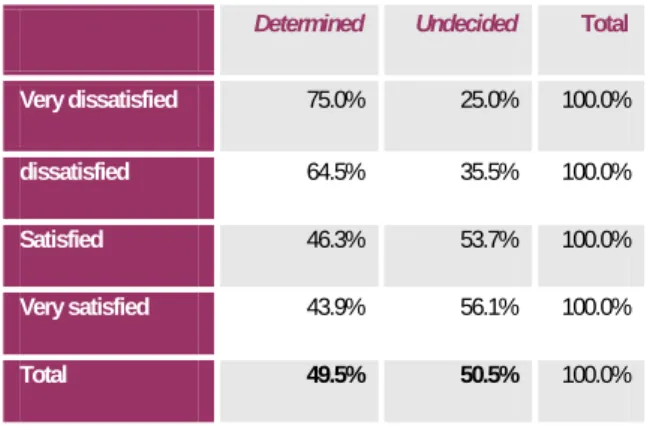
In a context of great uncertainty and changes in real estate dynamics and in the system of housing loans, the increasing constraints facing people who wish to change their residential situation is the first point to note. Only about half of respondents had plans to move house regardless of the circumstances; these are classified as “Determined”. The remaining, classified as “Undecided”, say that their intention to move is conditioned by certain circumstances. To facilitate reading and interpretation of data, these categories will be hence utilized. The variables influencing a person’s decision to move house include personal characteristics such as age and income as well as general features of the housing situation. As expected, the lower the income, the greater the uncertainty as to the possibility of buying/ renting. The type of family also influences the probability of moving house. In general, individuals in an unsettled family situation,e.g. single parents or extended families, are more convinced about the need to move. But the specific circumstances and degree of satisfaction with the current housing are powerful variables distinguishing the “Determined” from the “Undecided”. The former are the most dissatisfied with their current housing situation; the certainty about moving house decreases as the satisfaction with current housing increases.
Table 1. Intention to move house by family type (%) Determined
(Regardless of the circumstances)
Undecided
(Depending on circumstances ) Total
Single-person 52,0% 48,0% 100,0%
Couple without children 42,4% 57,6% 100,0%
Couple with children 45,8% 54,2% 100,0%
Single-parent families 56,8% 43,2% 100,0%
Extended family 63,4% 36,6% 100,0%
Non-nuclear families 72,7% 27,3% 100,0%
Total 49,6% 50,4% 100,0%
Source: Surveyof the potential demand for housing in Lisbon and NMA (2010).
Table 2. Intention to move house by satisfaction with current home (%)
Determined Undecided Total
Very dissatisfied 75.0% 25.0% 100.0%
dissatisfied 64.5% 35.5% 100.0%
Satisfied 46.3% 53.7% 100.0%
Very satisfied 43.9% 56.1% 100.0%
Total 49.5% 50.5% 100.0%
Source: Surveyof the potential demand for housing in Lisbon and NMA (2010).
Regardless of how determined people are to buy/rent a home, the reasons most frequently given are as follows: • need for more space (35.5%)
• looking for a different form of housing (23.3%) • change in family situation (14.8%)
• dissatisfaction with current area of residence (14.4%) • construction problems of current home (14.4%) • inconvenienceof the location of current home (12.5%).
It is well known that the overall residential mobility of the Portuguese is low, and it is therefore not surprising that the above residential choices are driven predominantly by housing needs involving family changes or the characteristics of living space rather than by the choice of location related to lifestyles.
The decision to buy or to rent
Like most countries in southern Europe, there has been a widespread trend towards home ownership in Portugal such that 73% of the population are currently home owners, though the figure falls to 67% in the Lisbon region (INE, 2012). This is explained by the breakdown of the private rental market (limited supply and unaffordable prices), state support for home ownership and the lack of social or subsidized housing; moreover, property is culturally valued and understood as a way of providing a secure future for the owners and their offspring and as a form of holding capital.
However, this model has been challenged by the recent economic and real estate crisis partly due to lower household incomes but also as a result of increasing difficulties to obtain a mortgage. In addition to this cyclical context, structural changes in the employment system and family model have led to greater job insecurity and labour mobility as well as a growing number of single parents and people living alone. These changes seem to have triggered new trends in housing demand, notably in tenure status “Undecided”.
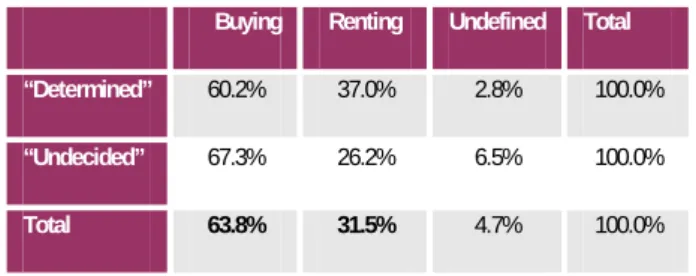
The data collected seem to confirm this trend. About one third of those who wanted to change their current housing situation stated their intention to rent. As most people continue to express a preference for buying, it is sociologically interesting to learn more about those wishing to enter the rental market.
First, the “Determined” are more convinced that they want to rent, totalling 37% of those who are considering moving house, regardless of the circumstances.This percentage drops to 26.2% among the “Undecided”, indicating a stronger tendency towards buying and expectations of possible changes in the dynamics of the real estate market.
Table 3. Intention to move house by intention to buy/rent
Buying Renting Undefined Total “Determined” 60.2% 37.0% 2.8% 100.0%
“Undecided” 67.3% 26.2% 6.5% 100.0%
Total 63.8% 31.5% 4.7% 100.0%
Source: Survey of the potential demand for housing in Lisbon and NMA (2010).
The profile of those who show a preference for renting over buying results from a set of variables which combines individual and residential characteristics/situations. In terms of age, it is noted that a larger proportion of respondents aged up to 29 years and between 45 and 59 years express a preference for renting. This can be explained by the fact that these groups are more likely to experience a change in the family situation: single-parent and one-person households or extended families. These vulnerable households are understandably more likely to find renting an attractive option as this tenure status offers greater flexibility and mobility than buying. In the following table we can observe a trend already detected in other studies on the relationship between housing tenure and social class: the lower a person’s social class, the more likely he/she is to be a home owner.The table confirms that lower socio-professional groups prefer to buy and not to rent.
Table 4. Intention to buy/rent by socio-professional group of respondent (%)
Buying Renting Undefined Total High socio-professional group 52.1% 43.8% 4.2% 100.0% Medium-high socio professional group 59.7% 34.3% 6.0% 100.0% Medium-low socio-professional group 66.3% 31.3% 2.5% 100.0% Low socio-professional group 65.7% 27.8% 6.5% 100.0% 63.2% 32.4% 4.4% 100.0%
Source: Survey of the potential demand for housing in Lisbon and NMA (2010).
The characteristics of the current residential situation also seem to affect the choice between buying and renting differently. As shown in chart 1, the current housing system tends to be replicated in the future home as opposed to considering a different kind of housing situation.
On the other hand, although the place of residence has a smaller and similar impact on the decision to buy or rent, the preference for renting is a little stronger among Lisbon residents.
Graph 1: Intention to buy/rent by tenure status (%)
77,4
50
50
33,3
17,2
50
45,7
66,7
5,4
0
4,3
0
0%
10%
20%
30%
40%
50%
60%
70%
80%
90%
100%
own house
own house (social
housing bought
from City Hall)
rented house
(private renting)
rented house
(from the state)
buy
rent
undefined
Table 5. Intention to buy/rent by current location of residence (%)
Buying Renting Undefined Total Lisbon 61.2% 35.8% 3.0% 100.0% Loures 53.4% 31.0% 15.5% 100.0% Oeiras 66.7% 26.7% 6.7% 100.0% Sintra 63.0% 33.3% 3.7% 100.0% Amadora 81.4% 16.3% 2.3% 100.0% Odivelas 71.8% 28.2% 0.0% 100.0% Total 63.8% 31.5% 4.7% 100.0%
Source: Survey of the potential demand for housing in Lisbon and NMA (2010).
The importance of the economic context and professional situation
The main concern for “undecided buyers”, i.e. those waiting for the right circumstances to buy a house, is an improvement in the economic situation as can be seen in the chart below. About 32% of respondents are waiting for housing prices to go down while 24% are waiting for interest rates to improve before they consider buying a home. It is also interesting to note that this is combined with personal circumstances that is to say changes in professional or family situation. Only about 21% of respondents waiting for the right circumstance to buy a house give the stabilization of their own or their spouse’s professional situation as one of the requirements. Though less significant, the two remaining circumstances involve rearrangements or changes in household or marital status.
Chart 2. Circumstances that foster the option to buy (%)
31,9 24,4 20,9 12,9 8,3 0,8 0,8 0 5 10 15 20 25 30 35 Evolution of housing value (tendency to decrease) Evolution in interest rate (tendency to decrease or stabilize) Stabilized/ improved professional condition (self or spouse's) Changes in household (new children, relatives, etc.) Changes in affective-marital situation Other financial reasons Personal fulfilment (space and property)
The option to rent (for “Undecided tenants”) seems to be less dependent on macro-economic mechanisms as a greater proportion of individual factors are given as the most important,such as the decision to move using the rental market. On the other hand, the references to circumstances influencing the decision are more varied, which highlights the need for more diverse and flexible solutions for this group of individuals. Although 30% of respondents say that the dynamism of the rental market is the key requirement for moving to rental accommodation (especially if the rental market becomes more affordable), the three following conditions mentioned are linked to phenomena that express individual or family circumstances:20% of respondents who intend to rent are waiting for their own and/or their spouse’s employment status to stabilize or for a change in the composition of the household through vertical kinship (13.5%) or horizontal kinship (12.8%)
Chart 3. Circumstances that facilitate the option to rent (%)
30,1 20,3 13,5 12,8 10,5 6 4,5 2,3 0 5 10 15 20 25 30 35 Increased affordability of rental market Stabilized/ improved professional condition (self or spouse's) Changes in household (new children, relatives, etc.) Changes in affective-marital situation Continued downtrend in housing prices (even if it means losing money by selling) Declined bank loan request Struggle to meet bank loan payments Coming across a better and cheaper
house
Source: Survey of the potential demand for housing in Lisbon and NMA (2010).
As noted, a smaller proportion of individuals who are waiting for the right circumstances to move have not yet decided whether to buy or to rent. The main reasons they give for not having made a decision are associated to the uncertainty of the economic context: the changing housing market (fear of property devaluation: 26.5%), changes in interest rates (decreasing or stabilizing: 23.5%), greater ease in obtaining credit (20.6%).
Chart 4. Circumstances that make it difficult to choose between buying and renting (%)
26,5 23,5 20,6 11,8 8,8 0 5 10 15 20 25 30
Evolution of the real estate market (property devaluation, low price)
Changes in interest rates (decreasing or
stabilization)
Bank loan request approved
Increased affordability of rental market
Bank loan resquest declined
3. Factors exerting influence on the selection of a new house
The importance of price, location and characteristics of the house in the decision to move
In a context of economic crisis and uncertainty, price may be a decisive factor when choosing between buying and renting, overlapping with the factors related to preferences of house location and characteristics .In fact, the price of the house is most often stated as the most important factor (48.8%), followed by the house location (40.7%), and lastly, its characteristics or attributes (53.6%).However, Lisbon residents are the exception and place location first, and then price; the value given to house location may indicate another hierarchy of housing and urban values linked with lifestyles.
Chart 5. First, second and third attributes influencing the decision to buy or rent (%)
18,1 28,2 53,6 32,9 40,7 26,4 48,9 31,1 20 0% 10% 20% 30% 40% 50% 60% 70% 80% 90% 100% 1st 2nd 3rd
House price House location House features
Source: Survey of the potential demand for housing in Lisbon and NMA (2010).
Chart 6. The main attribute influencing the decision to buy or rent, by home location (%)
20,4 5,2 20,0 25,9 11,6 20,5 18,1 40,8 25,9 30,0 29,6 20,9 23,1 32,9 38,8 69,0 50,0 44,4 67,4 56,4 18,1 0% 10% 20% 30% 40% 50% 60% 70% 80% 90% 100%
Lisbon Loures Oeiras Sintra Amadora Odivelas Total House features House location House price
Second hand house in good condition is the main target
Given the pace of construction in Portugal in recent decades, one would expect people to be looking primarily for a new house. Surprisingly however, most respondents are looking for a fairly new second hand house. This is consistent with the previous answers where price outweighs other factors in the decision. It is also important to note the considerable numbers wanting to move to a renovated house; this emerging trend in housing demand expresses an awareness that this can be a good financial opportunity, but also recognition of the renovation process in historical and central areas that has brought houses into the private market.
Chart 7. Type of house to which planning to move
23,1%
7,1%
53,9% 16,0%
New, available in the house market New, built at own initiative Relatively new Rehabilitated
Source: Survey of the potential demand for housing in Lisbon and NMA (2010).
4. The predominance of trajectories of territorial continuity
Several studies on residential trajectories have underlined the weight of geographical continuity in relation to discontinuity, which may imply a geographical change and sometimes an emotional and affective break with the previous place of residence (Bonvalet, Gotman, 1993; Bonvalet, 1994, 2010, 2012). This trend towards geographical continuity is confirmed by an analysis of the former and current place of residence.Moderate distance mobility flows are the most marked, and the highest percentages are in municipalities that are both the source and destination of the last move of house. For example, 55.2% move within the Loures and Odivelas municipalities, 46.8% move within the city of Lisbon, and around 33% move within the Oeiras and Cascais municipalities.
The respondents’ statements on the desired location of a new home confirm this trend of trajectories of continuity. While 38.4% of respondents intend to move to the periphery,i.e. municipalities of Lisbon Metropolitan Area other than the municipality of Lisbon, 35.8% would like to move to the municipality of Lisbon, and a much lower percentage would prefer to move back to the village/area they were born (14.8%) or a town/ city in the province (9.9%).However, most respondents who currently reside in Lisbon municipality intend to remain there and this is also the case for residents in the peripheral counties. This would therefore suggest that mobility flows do not involve marked geographical discontinuities.
Table 6. Municipality of origin and destination of the last move of house (%) Lisbon Amadora + Sintra Loures + Odivelas Oeiras + Cascais Other LMA municipalities Total Lisbon 46.8% 14.4% 5.5% 4.0% 29.4% 100% Loures 8.6% 3.4% 55.2% 0.0% 32.8% 100% Oeiras 30.0% 26.7% 3.3% 33.3% 6.7% 100% Sintra 16.7% 33.3% 3.7% 14.8% 31.5% 100% Amadora 23.3% 34.9% 4.7% 2.3% 34.9% 100% Odivelas 23.1% 12.8% 25.6% 0.0% 38.5% 100% Total 32.0% 18.1% 13.6% 6.4% 29.9% 100%
Source: Survey of the potential demand for housing in Lisbon and NMA (2010).
Chart 8. Desired location of move, by current home location
54,1 13,8 16,7 9,3 35,9 23,1 35,8 24,9 53,4 56,7 48,1 46,2 51,3 38,4 11,7 22,4 16,7 20,4 7,7 17,9 14,8 8,3 6,9 10,0 20,4 10,3 7,7 9,9 1,9 0% 10% 20% 30% 40% 50% 60% 70% 80% 90% 100%
Lisbon Loures Oeiras Sintra Amadora Odivelas Total
City of Lisbon Outskirts of Lisbon Countryside, rural Provincial town or city Other national location Other country
Source: Survey of the potential demand for housing in Lisbon and NMA (2010).
While it is interesting to note this geographical continuity, it is also relevant to analyze the social profiles associated with each of the options of geographical location as it may reflect different urban and housing values. By examining the charts below, we find that the respondents who prefer to live in the periphery are mainly under the age of 29 and over 60 (46.5% and 35.2%, respectively), the lower and middle-lower socioeconomic group and families composed of couples with children. By contrast, those who wish to live in Lisbon or to remain are found predominantly in the intermediate age group (between 30 and 59 years), in medium and medium-high socio-professional groups and one-person households (45.3%). This profile reveals a very different social structure in the metropolis of Lisbon, where, younger, more skilled groups, and new family models are among the new residents.
Chart 9. Intended location of move, by age group (%) 40,4 49,3 56,2 41,4 46,9 52,9 43,2 30,4 37,9 43,6 3,4 11,9 11,9 10,4 5,3 2,5 1,5 1,5 10,4 3,6 0% 10% 20% 30% 40% 50% 60% 70% 80% 90% 100% < 30 30 - 44 45 - 59 > 60 Total
Lisbon North Metropolitan Area South Metropolitan Area Remaning Districts
Source: Survey of the potential demand for housing in Lisbon and NMA (2010).
Chart 10. Intended location of move, by socio-economic group (%)
47,9 55,2 44,9 42,8 38,4 33,3 50,4 42,4 6,9 2,5 3 9,3 5,8 7,5 1,1 4,1 0% 10% 20% 30% 40% 50% 60% 70% 80% 90% 100% High Socio-Economic Group Medium-High Socio-Economic Group Medium-Low Socio-Economic Group Low Socio-Economic Group
Lisbon Unspecified Lisbon Municipalities
North Metropolitan Area South Metropolitan Area
Remaning Districts
Source: Survey of the potential demand for housing in Lisbon and NMA (2010).
To identify possible trends in residential mobility flows, a typology of mobility using the location of the intended future residence was created, taking into account Lisbon versus periphery. In the first case, we speak of
established Lisbon residents, i.e., respondents who say they reside in Lisbon and wish to remain there. The latter
are Lisbon candidates: respondents who currently reside in the suburbs and want to move to the municipality of Lisbon. Together they make up a total of 47.6% of respondents. Potential former Lisbon residents refers to respondents who now reside in the city but would like to move to the municipalities of the periphery in the future. They are, as we see, 15.9% of respondents. Established residents in the periphery refers to those who do
not reside in the municipality of Lisbon at present or aspire to do so. This typology confirms that the flow of residential mobility towards the periphery is higher than entry or staying in the city: 52.5% versus 47.6%. This is in line with the continued trend of population loss in Lisbon, although it is now much less pronounced than in previous decades.
Chart 11. Type of mobility (%)
35,3 12,3 15,9 36,6 0 5 10 15 20 25 30 35 40
Established Lisbon Population Potential Lisbon Population Potential Ex-Lisbon Population Remaining
Source: Survey of the potential demand for housing in Lisbon and NMA (2010).
5. Profiles of potential housing demand
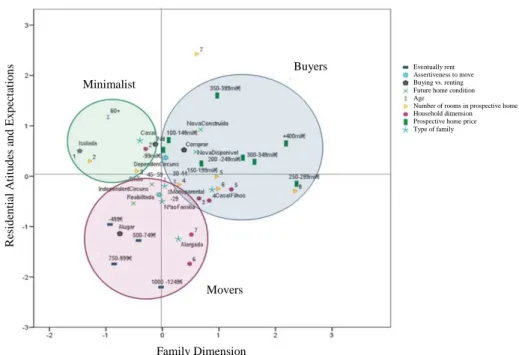
In an attempt to link the trends described above, we performed a multiple correspondence analysis to gather this information in profiles of potential demand for housing. The multiple correspondence analysis shown in Figure 1 combines the positions of individuals in the following variables: age, family type, number of persons in the household, determination to move, number of rooms in future home, state of conservation, price, and tenure status.
These are the variables that contribute most to the differentiation and variability of responses and therefore most responsible for the design of the profiles of potential buyers/tenants represented by circles3.
The profiles are organized into two dimensions:
1. “Family dimension” with most variables of family type, number of people in the household and number of rooms in future house (which vary greatly from lower - the left - to the higher numbers - to the right).
2. “Residential attitudes and expectations”, with most variables (that go from low to high) such as: the choice between buying and renting a home (from buying to renting), the state of the house (from new to second hand) and the (non)existence of conditions in which moving house will occur (from moving regardless of circumstances to moving depending on certain circumstances).
3 It should be noted, therefore, that neither the reference to the necessary equipment, nor the reasons why respondents wanting to move are variables that differentiate profiles of buyers/tenants (and presented irrelevant discrimination measures, and for that reason, were excluded from this analysis).
Three profiles can be drawn that somehow summarize the bivariate descriptive analysis made throughout this paper, as noted in the figure below:
• Minimalist: households in this group have the fewest members (which roughly reflects the type of family), and want a future home to have the fewest rooms. This specific lifecycle situation shows no marked pattern of rental or buying, or of the type of future house. The minimalism of the starting conditions inflate the possible scenarios, meaning that this group shows weak associations with expectations or attitudes to new residence. Note that older individuals (over 60) are concentrated in this group and we can probably infer that they were cases of widowhood or empty nests. Although they do not reject the idea of moving house within 5 years, they are likely to be less pro-active towards this move than other presented profiles.
• Movers: they have a strong tendency to rent and to move house regardless of the circumstances. Perhaps this explains why there is a greater concentration in the preference for second hand and renovated houses on the one hand, and respondents in recent or imminent situations of family transition (less than 29 years old, single person households, extended families) on the other hand.
• Buyers: Regardless of the amount of money available, these individuals will only move house by buying, and if the circumstances to do so are favorable. They are mainly couples with children or children with parents, again aged mainly between 30 and 44 years. The property is therefore valued and they are looking for new houses (available in the market or built by them) with more rooms than other groups (4, 5, 6).
Figure 1. Profiles of potential housing demand(Multiple Correspondence Analysis)4
Source: Survey of the potential demand for housing in Lisbon and NMA (2010).
4Original data exclusively available in Portuguese. Full English version of this figure was not obtainable (Editor’s Note). Buyers Minimalist Movers R es id en ti al A tit u d es a n d E x p ec ta tio n s Family Dimension Eventually rent Assertiveness to move Buying vs. renting Future home condition Age
Number of rooms in prospective home Household dimension Prospective home price Type of family
6. Some concluding remarks
The data presented herein are exploratory results that will be developed in subsequent research. However, they indicate significant changes in the residential choices and behaviours that have defined trends in the demand for housing in Portugal and Lisbon in particular, namely:
1. The uncertain and insecure economic and financial situation together with real estate crisis mean that buying/ renting a house is dependent on certain circumstances. The clarification of the economic environment (especially in relation to the decision to buy or rent) appears to be more important than individual circumstances;
2.The demand for rented housing is increasing, thus bringing a change in the massive trend for home ownership. Although still in the minority, it indicates a change in the hegemonic tendency to buy the home.This may be due to the uncertain economic climate which threatens the value property and the evolution of interest rates; however, it also seems to respond to changes in demography, family and housing preferences and decisions. The profile of potential tenants is quite different from the profile of potential buyers: the former are predominantly young, single person households and single parent families, belonging to higher socioeconomic groups and found among Lisbon residents in particular.
On the contrary, the predominance of geographical continuity in residential mobility reveals a consolidated trend, at least in the context of LMA. This trend confirms a very endogenous mobility; it helps consolidate the urban dynamics that have been structuring the space of the metropolis of Lisbon, and the movement from Lisbon towards the periphery may be particularly difficult to reverse.
BIBLIOGRAPHY
Aalbers, M. (2009), “Geographies of the Financial Crisis”,Area, Vol. 41, n.º 1, pp.34-42.
Authier, J-Y et al. (2010), « État des Lieux sur les Trajectoires Résidentielles », Plan Urbanisme Construction Architecture (PUCA), Ministère de l'Ecologie, de l'Energie, du Développement Durable et de la Mer, Université Lyon 2 (Groupe de Recherche sur la Socialisation).
Bigot, R.; Hoibian, S. (2009), « Les Difficultés des Français Face au Logement », Cahier de Recherche, n.º 265, Paris: Centre de Recherche pour l'Étude et l'Observation des Conditions de Vie (CRÉDOC).
Cailly, L. (2007), « Capital Spatial, Stratégies Résidentielles et Processus d'Individualisation », Annales de
Géographie, 2007/2, n.º654, pp.169-187.
Bonvalet, C., Gotman, A. (Dir.)(1993), Le logement, un affaire de famille; l’approche intergénérationnelle des
statuts résidentiels, Paris: L’Harmattan.
Bonvalet, C. (1994), Logement, mobilité et populations urbaines, Paris: CNRS Éditions, Pir Villes.
Bonvalet, C., Bringé, A. (2010), « Les trajectoires des Franciliens depuis leur départ de chez parents »,
Temporalités, n.º 11, availableathttp://temporalites.revues,org/index1205.html.
Bonvalet, C. et al.(2010),Elire Domicile: la construction sociale des choix résidentiels, Lyon: PU de Lyon. Bonvalet, C. (Dir.)(2012), De la famille à l’entourage, INED Éditions: Paris.
Culturello, P. (1993), « Le poids de l'origine et la force de parenté: la dualité familiale dans les pratiques résidentielles », in C. Bonvalet,A. Gotman (dir.), Le logement, unaffaire de famille. L’approche
intergénérationnelle des statuts résidentiels,Paris: L'Harmattan, pp.111-127.
INE (2012), “Evolução do Parque Habitacional em Portugal 2001-2011”, EstatísticasOficiais. Lacaze, J-P. (1997), Les Politiques du Logement, Paris : Flammarion.
Lévy, J-P.(2009), « Mobilités urbaines: des pratiques sociales aux évolutions territoriales », in F. Dureau, M.-A., Hily, Les mondes de la mobilité, Rennes : Presses Universitaires de Rennes, coll. « Essais », pp. 107-136. Munro, M. (2000), “Riding the Roller Coaster: household responses to changing housing market risk”, in P. Taylor-Gooby (Ed.),Risk, Trust and Welfare, Basingstoke: Macmillan Press.
Pinto, T.C. (Coord.), Beja, I., Gouveia, J., Nico M., Martins, M., Santos, M, Jorge, S. (2009), Reprogramação de equipamentos na Alta de Lisboa. Estudo e planificação de equipamentos. Rsearch report on the survey “À procura de habitação”, Lisbon: DINÂMIA’CET (consultants: Ana Cristina Ferreira, Sandra Marques Pereira,
Teresa Sá Marques).
Whitehead, C., Williams, P.(2010), “Causes and Consequences?Exploring the Shape and Direction of the Housing System in the UK Post the Financial Crisis”, Housing Studies, 26 (7-8), pp.1157-1169.